The White House

Office of the Press Secretary

President Obama Signs Kansas Disaster Declaration

The President today declared a major disaster exists in the State of Kansas and ordered Federal aid to supplement state and local recovery efforts in the area affected by a snowstorm during the period of February 20-23, 2013.

Federal funding is available to state and eligible local governments and certain private nonprofit organizations on a cost-sharing basis for emergency protective measures and the repair or replacement of buildings and equipment damaged by the snowstorm in the counties of Barber, Barton, Dickinson, Ellis, Franklin, Harper, Harvey, Hodgeman, Kingman, Marion, McPherson, Ness, Osage, Osborne, Pawnee, Phillips, Pratt, Rice, Rooks, Rush, Russell, Smith, and Stafford.

In addition, federal funding is available to the state and eligible local governments on a cost-sharing basis for snow assistance for a continuous 48-hour period during or proximate to the incident period in the counties of Barton, Dickinson, Ellis, Franklin, Harper, Harvey, Hodgeman, Kingman, Marion, McPherson, Ness, Osage, Osborne, Pawnee, Phillips, Pratt, Rice, Rooks, Rush, Russell, Smith, and Stafford.  This assistance will be provided for a 72-hour period in Barber County.

Federal funding is also available on a cost-sharing basis for hazard mitigation measures statewide.

W. Craig Fugate, Administrator, Federal Emergency Management Agency (FEMA), Department of Homeland Security, named Joe M. Girot as the Federal Coordinating Officer for federal recovery operations in the affected area. 

FEMA said additional designations may be made at a later date if requested by the state and warranted by the results of further damage assessments.

The White House

Office of the Press Secretary

Remarks by President Obama and His Majesty King Abdullah II before Bilateral Meeting

Oval Office

2:07 P.M. EDT

THE PRESIDENT:  I want to welcome to the Oval Office once again King Abdullah.  His Majesty is a great friend of the United States.  Jordan is a great partner to the United States on a whole host of issues.  And obviously, although we just recently saw each other -- and I want to thank again His Majesty for the extraordinary hospitality that he showed during our visit -- there remain a host of very urgent issues in the region that we’re going to have an opportunity to discuss.

First of all, I want to congratulate His Majesty on a series of reforms that he’s initiating inside of Jordan, and we want to find out how we can continue to be supportive and helpful in creating greater economic opportunity and prosperity in the area.

We have been supportive with respect to loan guarantees and other efforts, in part because we’ve also seen King Abdullah take some very important steps to further open democratization and entrepreneurship and economic development inside of Jordan.  We want to encourage that because we think Jordan can be an extraordinary model for effective governance in the region.

We’re also going to have an opportunity to talk about the Middle East peace process.  And the last time I saw King Abdullah, I’d just come out of Israel and the West Bank in consultations with Prime Minister Netanyahu and President Abbas. And Jordan, like the United States, has an enormous stake in peace.  And we do think that there’s a window of opportunity that needs to be seized, and so we will both consult in how we can jumpstart serious conversations that could lead to a peaceful settlement and both a secure Israel with normalized relations with its neighbors and a Palestinian state that was sovereign.

Of great urgency right now obviously is the situation in Syria.  Jordan has experienced a huge influx of refugees coming into the country from Syria, people who’ve been displaced.  Jordan historically has maintained open borders and allowed these refugees on a humanitarian basis to come in, but it’s an enormous strain on a small country.  And we are mobilizing international support to help with these refugees, but obviously our goal is to create a stable Syria, where civilians are not at risk. 

And we both agree that at this point, President Assad has lost legitimacy and that we need to find a political transition that allows a multi-sect, democratic transition to take place so that Syria can be a place where all people can live in peace and harmony.

This will be difficult to accomplish.  And yesterday, some of you saw that I asked my people to brief Congress about the fact that we now have some evidence that chemical weapons have been used on the populations in Syria.  Now, these are preliminary assessments; they’re based on our intelligence gathering.  We have varying degrees of confidence about the actual use, but there are a range of questions around how, when, where these weapons may have been used. 

So we’re going to be pursuing a very vigorous investigation ourselves, and we’re going to be consulting with our partners in the region as well as the international community and the United Nations to make sure that we are investigating this as effectively and as quickly as we can.

But I meant what I’d said, and I will repeat that it’s, obviously, horrific as it is when mortars are being fired on civilians and people are being indiscriminately killed.  To use potential weapons of mass destruction on civilian populations crosses another line with respect to international norms and international law.  And that is going to be a game changer. 

We have to act prudently.  We have to make these assessments deliberately.  But I think all of us, not just in the United States but around the world, recognize how we cannot stand by and permit the systematic use of weapons like chemical weapons on civilian populations. 

So this is going to be something that we’ll be paying a lot of attention to -- trying to confirm, and mobilize the international community around those issues.

But in everything that we do, we very much appreciate the kinds of support, advice, counsel, and partnership that we have with His Majesty and the people of Jordan.  And we look forward to a fruitful consultation this afternoon.

HIS MAJESTY KING ABDULLAH:  Mr. President, thank you very much.  We’re delighted to be back here again.  And may I first start off by expressing, on behalf of myself and the delegation and people of Jordan, our heartfelt condolences on the tremendous tragedies both in Boston for the bombings, as well as that of Texas -- especially that of Boston.  We've always stood together in our fight against terrorism, and this is an issue that we will always be strong partners there.

As you've mentioned, sir, on the issue of the peace process, when you were in Jordan, we had mentioned this is the homework stage.  Jordan will continue to work very closely with the Israelis and the Palestinians, obviously with our American allies to see how we can bring both sides closer together.

But one of the major concerns that brings us here to Washington together, as you alluded to, is obviously the challenge with Syria, the fragmentation of Syrian society, which is becoming more and more alarming. 

Since your last visit to Jordan five weeks ago, we've had over 60,000 refugees -- up to over half a million, so we're at 10 percent of an increase of our population.  We're so grateful to the support that you and the American people have given to our country.  You couldn’t do more, quite honestly, and we're so grateful.  I just wanted to express our appreciation on behalf of myself and the Jordanian people for that.

I think, sir, that we are both working very hard to look for a political solution for a Syria that is one that is, as you mentioned, inclusive so that we're bringing everybody together, which is sort of our last hope to -- as we're now seeing the surge of the second threat appear, which is that of militant terrorist organizations that have risen over the past several months.

But I am confident, with your leadership and with meetings that we will have today, that we can find a mechanism to bring a solution -- to an end as quickly as possible. 

Lastly, sir, you had the Crown Prince of the United Arab Emirates, Mohammed bin Zayed, who is one of our strongest strategic allies.  And I know that is his position with the United States, as well as the Kingdom of Saudi Arabia -- the three of us are working very hard in cooperation with the United States to try to find a quick and just solution to the Syrian crisis. 

So I look forward to our discussions later this afternoon, and I hope that together we will be able to alleviate the suffering.

PRESIDENT OBAMA:  Okay. 

Q    Mr. President, why has the red line been crossed --

PRESIDENT OBAMA:  You guys all have the same question?

Q    Yes.

Q    You know that they are --

PRESIDENT OBAMA:  Hold on a second, miss.  One at a time. 

What we have right now is an intelligence assessment.  And as I said, knowing that potentially chemical weapons have been used inside of Syria doesn’t tell us when they were used, how they were used.  Obtaining confirmation and strong evidence, all of those things we have to make sure that we work on with the international community.  And we ourselves are going to be putting a lot of resources into focusing on this. 

And I think that, in many ways, a line has been crossed when we see tens of thousands of innocent people being killed by a regime.  But the use of chemical weapons and the dangers that poses to the international community, to neighbors of Syria, the potential for chemical weapons to get into the hands of terrorists -- all of those things add increased urgency to what is already a significant security problem and humanitarian problem in the region. 

So we're going to be working with countries like Jordan to try to obtain more direct evidence and confirmation of this potential use.  In the meantime, I've been very clear publicly, but also privately, that for the Syrian government to utilize chemical weapons on its people crosses a line that will change my calculus and how the United States approaches these issues. 

So this is not an on or off switch.  This is an ongoing challenge that all of us have to be concerned about.  And we're going to be working with the international community and our partners to keep our eyes on what's happening on the ground, to gather any evidence of potential chemical weapon use and, at the same time, to continue to help with a moderate and inclusive opposition to help bring about the day when the Syrian people can once again focus on living their lives, raising their children, starting businesses, and obtaining basic freedom and human rights. 

This is going to be a long-term proposition.  This is not going to be something that is solved easily overnight.  But I know that King Abdullah is committed to trying to find these kinds of solutions.  So am I. 

Thank you, everybody.

END 
2:19 P.M. EDT

President Obama Speaks at the Planned Parenthood Gala

April 26, 2013 | 12:16 | Public Domain

President Obama delivers remarks at the 2013 Planned Parenthood Gala.

Download mp4 (450MB) | mp3 (30MB)

Read the Transcript

Remarks by the President at the Planned Parenthood Conference

Marriott Wardman Park Hotel

11:17 A.M. EDT

THE PRESIDENT:  Hello, everybody!  (Applause.)  Thank you.  Thank you!  (Applause.)  All right, everybody have a seat.  Have a seat.  You're making me blush.  (Laughter.)

AUDIENCE MEMBER:  I love you!

THE PRESIDENT:  I love you back.  Thank you.  (Applause.) 

Cecile, thank you for the warm introduction, and thank you for the outstanding leadership that you’ve shown over the years. You just do a great, great job.  (Applause.)  I want to thank all of you for the remarkable work that you’re doing day in, day out in providing quality health care to women all across America.  You are somebody that women -- young women, old women, women in between -- count on for so many important services.  And we are truly grateful to you.

I'm sorry that I could not be at the party yesterday.  I understand it was a little wild.  (Laughter.)  That's what I heard.  But as all of you know, obviously, we've gone through a pretty tough week and a half, and I was down in Texas, letting the people of West, Texas know that we all love them and care about them in their time of grieving.  (Applause.)  

But obviously this is a special national conference, because it’s been nearly a hundred years since the first health clinic of what later would become Planned Parenthood opened its doors to women in Brooklyn.  And for nearly a century now, one core principle has guided everything all of you do -- that women should be allowed to make their own decisions about their own health.  (Applause.)  It’s a simple principle.  

So what I see in this audience, extraordinary doctors and nurses, and advocates and staff who work tirelessly to keep the doors at health centers all across the country going, then I'm reminded of those very early efforts and all the strides that we've made in subsequent decades.  And I also think about the millions of mothers and daughters and wives and sisters, friends and neighbors who walk through those doors every year. 

Somewhere there’s a woman who just received a new lease on life because of a screening that you provided that helped catch her cancer in time.  Somewhere there’s a woman who’s breathing easier today because of the support and counseling she got at her local Planned Parenthood health clinic.  Somewhere there’s a young woman starting a career who, because of you, is able to decide for herself when she wants to start a family.  (Applause.)  
One in five women in this country has turned to Planned Parenthood for health care.  One in five.  (Applause.)  And for many, Planned Parenthood is their primary source of health care  -- not just for contraceptive care, but for lifesaving preventive care, like cancer screenings and health counseling. 

So when politicians try to turned Planned Parenthood into a punching bag, they’re not just talking about you; they’re talking about the millions of women who you serve.  And when they talk about cutting off your funding, let’s be clear:  They’re talking about telling many of those women, you’re on your own.  They’re talking about shutting those women out at a time when they may need it most -- shutting off communities that need more health care options for women, not less.  (Applause.) 

So the fact is, after decades of progress, there’s still those who want to turn back the clock to policies more suited to the 1950s than the 21st century.  And they’ve been involved in an orchestrated and historic effort to roll back basic rights when it comes to women’s health. 

Forty-two states have introduced laws that would ban or severely limit access to a woman’s right to choose -- laws that would make it harder for women to get the contraceptive care that they need; laws that would cut off access to cancer screenings and end educational programs that help prevent teen pregnancy. 

In North Dakota, they just passed a law that outlaws your right to choose, starting as early as six weeks, even if a woman is raped.  A woman may not even know that she’s pregnant at six weeks.  In Mississippi, a ballot initiative was put forward that could not only have outlawed your right to choose, but could have had all sorts of other far-reaching consequences like cutting off fertility treatments, making certain forms of contraception a crime. 

That’s absurd.  It’s wrong.  It’s an assault on women’s rights.  And that’s why when the people of Mississippi were given a chance to vote on that initiative, they turned it down.  (Applause.)  Mississippi is a conservative state, but they wanted to make clear there’s nothing conservative about the government injecting itself into decisions best made between a woman and her doctor.  And folks are trying to do this all across the country.

When you read about some of these laws, you want to check the calendar; you want to make sure you’re still living in 2013. (Laughter.) 

Forty years after the Supreme Court affirmed a woman’s constitutional right to privacy, including the right to choose, we shouldn’t have to remind people that when it comes to a woman’s health, no politician should get to decide what’s best for you.  No insurer should get to decide what kind of care that you get.  The only person who should get to make decisions about your health is you.  (Applause.)  That’s why we fought so hard to make health care reform a reality.  (Applause.)

That principle is at the heart of the Affordable Care Act.  Because of the ACA, most insurance plans are now covering the cost of contraceptive care, so that a working mom doesn’t have to put off the care she needs just so she can pay her bills on time. Because of the Affordable Care Act, 47 million women have new access to preventive care like mammograms and cancer screenings with no copay, no deductible, no out-of-pocket costs, so they don’t have to put off a mammogram just because money is tight.  Because of the Affordable Care Act, young people under the age of 26 can now stay on their parent’s health care plan. 

And insurance companies soon will no longer be able to deny you coverage based on preexisting conditions like breast cancer, or charge you more just because you are a woman.  Those days are ending.  (Applause.)  Those days are ending.  (Applause.)

Now, I know how hard you worked to help us pass health care reform.  You and your supporters got out there -- you organized; you mobilized; you made your voices heard.  It made all the difference.  But here’s the thing -- if Americans don’t know how to access the new benefits and protections that they’re going to receive as we implement this law, then health care reform won’t make much of a difference in their lives. 

So I’m here to also ask for your help, because we need to get the word out.  We need you to tell your patients, your friends, your neighbors, your family members what the health care law means for them.  Make sure they know that if they don’t have health insurance, they’ll be able to sign up for quality, affordable insurance starting this fall in an online marketplace where private insurers will compete for their business.  Make sure that they know that there are plans out there right now that cover the cost of contraceptive and preventive care free of charge.
 
We’ve got to spread the word, particularly among women, particularly among young women, who are the ones who are most likely to benefit from these laws.  We need all the women who come through your doors telling their children, their husbands, and the folks in their neighborhoods about their health care options.  We need all the college students who come through your doors to call up their friends and post on Facebook talking about the protections and benefits that are kicking in. 

And you are all in a unique position to deliver that message, because the women you serve know you and they trust you. And the reason for that is that you haven’t let them down before.

I know it’s not always easy.  As Cecile described, Planned Parenthood as the only organization that she’s ever been at where there are opponents who, in her words, “literally got up every day trying to figure out how to keep us from doing our work.”  Now, if she had worked in the administration -- (laughter and applause) -- she’d be more familiar with this phenomenon.  (Laughter and applause.)  But when it comes to your patients, you never let them down -- no matter what. 

And that’s because you never forget who this is all about.  This is about a woman from Chicago named Courtney who has a disease that can leave women infertile.  So in college, she turned to Planned Parenthood for access to affordable contraceptive care to keep her healthy.  You didn’t just help her plan for a family; you made sure she could start one.  And today, she's got two beautiful kids.  That’s what Planned Parenthood is about.  (Applause.)

This is about a woman in Washington State named Joyce who for years could only afford health care at her local Planned Parenthood clinic.  And heeding your advice, she never missed her annual exam.  During one of them, your doctors helped catch an aggressive form of cervical cancer early enough to save her life. Today, she's been cancer-free for 25 years.  (Applause.)

So every day, in every state, in ever center that Planned Parenthood operates, there are stories like those -- lives you've saved, women you've empowered, families that you've strengthened. That’s why, no matter how great the challenge, no matter how fierce the opposition, if there’s one thing the past few years have shown, it's that Planned Parenthood is not going anywhere.  It's not going anywhere today.  It's not going anywhere tomorrow. (Applause.)

As long as we've got to fight to make sure women have access to quality, affordable health care, and as long as we've got to fight to protect a woman's right to make her own choices about her own health, I want you to know that you've also got a President who's going to be right there with you fighting every step of the way.  (Applause.)

Thank you, Planned Parenthood.  God bless you.  God bless America.  Thank you.

END
11:29 A.M. EDT

Close Transcript

President Obama Speaks to the Planned Parenthood Conference

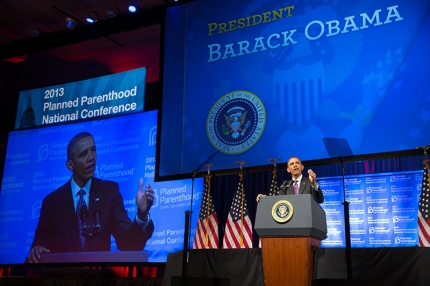
President Barack Obama delivers remarks at the 2013 Planned Parenthood National Conference

President Barack Obama delivers remarks at the 2013 Planned Parenthood National Conference at the Marriott Wardman Park Hotel in Washington, D.C., April 26, 2013. (Official White House Photo by Pete Souza)

Today, President Obama spoke at the Planned Parenthood Conference in Washington, DC, reaffirming the core principle that has guided the organization for nearly a century: that women should be allowed to make their own decisions about their own health.

President Obama thanked the doctors, nurses, advocates and staff who work tirelessly to keep the doors open for the millions of women who depend on the health services Planned Parenthood offers.

Somewhere there’s a woman who just received a new lease on life because of a screening that you provided that helped catch her cancer in time.  Somewhere there’s a woman who’s breathing easier today because of the support and counseling she got at her local Planned Parenthood health clinic.  Somewhere there’s a young woman starting a career who, because of you, is able to decide for herself when she wants to start a family. 

“One in five women in this country has turned to Planned Parenthood for health care,” he said. “And for many, Planned Parenthood is their primary source of health care  -- not just for contraceptive care, but for lifesaving preventive care, like cancer screenings and health counseling.” 

Related Topics: Health Care, Women

The White House

Office of the Press Secretary

Remarks by the President at the Planned Parenthood Conference

Marriott Wardman Park Hotel

11:17 A.M. EDT

THE PRESIDENT:  Hello, everybody!  (Applause.)  Thank you.  Thank you!  (Applause.)  All right, everybody have a seat.  Have a seat.  You're making me blush.  (Laughter.)

AUDIENCE MEMBER:  I love you!

THE PRESIDENT:  I love you back.  Thank you.  (Applause.) 

Cecile, thank you for the warm introduction, and thank you for the outstanding leadership that you’ve shown over the years. You just do a great, great job.  (Applause.)  I want to thank all of you for the remarkable work that you’re doing day in, day out in providing quality health care to women all across America.  You are somebody that women -- young women, old women, women in between -- count on for so many important services.  And we are truly grateful to you.

I'm sorry that I could not be at the party yesterday.  I understand it was a little wild.  (Laughter.)  That's what I heard.  But as all of you know, obviously, we've gone through a pretty tough week and a half, and I was down in Texas, letting the people of West, Texas know that we all love them and care about them in their time of grieving.  (Applause.)  

But obviously this is a special national conference, because it’s been nearly a hundred years since the first health clinic of what later would become Planned Parenthood opened its doors to women in Brooklyn.  And for nearly a century now, one core principle has guided everything all of you do -- that women should be allowed to make their own decisions about their own health.  (Applause.)  It’s a simple principle.  

So what I see in this audience, extraordinary doctors and nurses, and advocates and staff who work tirelessly to keep the doors at health centers all across the country going, then I'm reminded of those very early efforts and all the strides that we've made in subsequent decades.  And I also think about the millions of mothers and daughters and wives and sisters, friends and neighbors who walk through those doors every year. 

Somewhere there’s a woman who just received a new lease on life because of a screening that you provided that helped catch her cancer in time.  Somewhere there’s a woman who’s breathing easier today because of the support and counseling she got at her local Planned Parenthood health clinic.  Somewhere there’s a young woman starting a career who, because of you, is able to decide for herself when she wants to start a family.  (Applause.)  
One in five women in this country has turned to Planned Parenthood for health care.  One in five.  (Applause.)  And for many, Planned Parenthood is their primary source of health care  -- not just for contraceptive care, but for lifesaving preventive care, like cancer screenings and health counseling. 

So when politicians try to turned Planned Parenthood into a punching bag, they’re not just talking about you; they’re talking about the millions of women who you serve.  And when they talk about cutting off your funding, let’s be clear:  They’re talking about telling many of those women, you’re on your own.  They’re talking about shutting those women out at a time when they may need it most -- shutting off communities that need more health care options for women, not less.  (Applause.) 

So the fact is, after decades of progress, there’s still those who want to turn back the clock to policies more suited to the 1950s than the 21st century.  And they’ve been involved in an orchestrated and historic effort to roll back basic rights when it comes to women’s health. 

Forty-two states have introduced laws that would ban or severely limit access to a woman’s right to choose -- laws that would make it harder for women to get the contraceptive care that they need; laws that would cut off access to cancer screenings and end educational programs that help prevent teen pregnancy. 

In North Dakota, they just passed a law that outlaws your right to choose, starting as early as six weeks, even if a woman is raped.  A woman may not even know that she’s pregnant at six weeks.  In Mississippi, a ballot initiative was put forward that could not only have outlawed your right to choose, but could have had all sorts of other far-reaching consequences like cutting off fertility treatments, making certain forms of contraception a crime. 

That’s absurd.  It’s wrong.  It’s an assault on women’s rights.  And that’s why when the people of Mississippi were given a chance to vote on that initiative, they turned it down.  (Applause.)  Mississippi is a conservative state, but they wanted to make clear there’s nothing conservative about the government injecting itself into decisions best made between a woman and her doctor.  And folks are trying to do this all across the country.

When you read about some of these laws, you want to check the calendar; you want to make sure you’re still living in 2013. (Laughter.) 

Forty years after the Supreme Court affirmed a woman’s constitutional right to privacy, including the right to choose, we shouldn’t have to remind people that when it comes to a woman’s health, no politician should get to decide what’s best for you.  No insurer should get to decide what kind of care that you get.  The only person who should get to make decisions about your health is you.  (Applause.)  That’s why we fought so hard to make health care reform a reality.  (Applause.)

That principle is at the heart of the Affordable Care Act.  Because of the ACA, most insurance plans are now covering the cost of contraceptive care, so that a working mom doesn’t have to put off the care she needs just so she can pay her bills on time. Because of the Affordable Care Act, 47 million women have new access to preventive care like mammograms and cancer screenings with no copay, no deductible, no out-of-pocket costs, so they don’t have to put off a mammogram just because money is tight.  Because of the Affordable Care Act, young people under the age of 26 can now stay on their parent’s health care plan. 

And insurance companies soon will no longer be able to deny you coverage based on preexisting conditions like breast cancer, or charge you more just because you are a woman.  Those days are ending.  (Applause.)  Those days are ending.  (Applause.)

Now, I know how hard you worked to help us pass health care reform.  You and your supporters got out there -- you organized; you mobilized; you made your voices heard.  It made all the difference.  But here’s the thing -- if Americans don’t know how to access the new benefits and protections that they’re going to receive as we implement this law, then health care reform won’t make much of a difference in their lives. 

So I’m here to also ask for your help, because we need to get the word out.  We need you to tell your patients, your friends, your neighbors, your family members what the health care law means for them.  Make sure they know that if they don’t have health insurance, they’ll be able to sign up for quality, affordable insurance starting this fall in an online marketplace where private insurers will compete for their business.  Make sure that they know that there are plans out there right now that cover the cost of contraceptive and preventive care free of charge.
 
We’ve got to spread the word, particularly among women, particularly among young women, who are the ones who are most likely to benefit from these laws.  We need all the women who come through your doors telling their children, their husbands, and the folks in their neighborhoods about their health care options.  We need all the college students who come through your doors to call up their friends and post on Facebook talking about the protections and benefits that are kicking in. 

And you are all in a unique position to deliver that message, because the women you serve know you and they trust you. And the reason for that is that you haven’t let them down before.

I know it’s not always easy.  As Cecile described, Planned Parenthood as the only organization that she’s ever been at where there are opponents who, in her words, “literally got up every day trying to figure out how to keep us from doing our work.”  Now, if she had worked in the administration -- (laughter and applause) -- she’d be more familiar with this phenomenon.  (Laughter and applause.)  But when it comes to your patients, you never let them down -- no matter what. 

And that’s because you never forget who this is all about.  This is about a woman from Chicago named Courtney who has a disease that can leave women infertile.  So in college, she turned to Planned Parenthood for access to affordable contraceptive care to keep her healthy.  You didn’t just help her plan for a family; you made sure she could start one.  And today, she's got two beautiful kids.  That’s what Planned Parenthood is about.  (Applause.)

This is about a woman in Washington State named Joyce who for years could only afford health care at her local Planned Parenthood clinic.  And heeding your advice, she never missed her annual exam.  During one of them, your doctors helped catch an aggressive form of cervical cancer early enough to save her life. Today, she's been cancer-free for 25 years.  (Applause.)

So every day, in every state, in ever center that Planned Parenthood operates, there are stories like those -- lives you've saved, women you've empowered, families that you've strengthened. That’s why, no matter how great the challenge, no matter how fierce the opposition, if there’s one thing the past few years have shown, it's that Planned Parenthood is not going anywhere.  It's not going anywhere today.  It's not going anywhere tomorrow. (Applause.)

As long as we've got to fight to make sure women have access to quality, affordable health care, and as long as we've got to fight to protect a woman's right to make her own choices about her own health, I want you to know that you've also got a President who's going to be right there with you fighting every step of the way.  (Applause.)

Thank you, Planned Parenthood.  God bless you.  God bless America.  Thank you.

END
11:29 A.M. EDT

President Obama Honors Those Lost and Injured in West, Texas Explosion

President Barack Obama delivers remarks during a memorial service at Baylor University

President Barack Obama delivers remarks during a memorial service at Baylor University in Waco, Texas, for victims killed last week at a fertilizer plant explosion in West, Texas, April 25, 2013. (Official White House Photo by Pete Souza)

Today, President Obama traveled to Waco, Texas to speak at a memorial service for those lost and injured in last week’s deadly explosion at a fertilizer plant in nearby West, Texas.

The President honored the first responders and volunteers from the tight-knit community who rushed to the scene as soon as the fire alarm sounded, “farmers and car salesmen; and welders and funeral home directors; the city secretary and the mayor… folks who are tough enough and selfless enough to put in a full day’s work and then be ready for more.”

And together, you answered the call. You dropped your schoolwork, left your families, jumped in fire trucks, and rushed to the flames. And when you got to the scene, you forgot fear and you fought that blaze as hard as you could, knowing the danger, buying time so others could escape. And then, about 20 minutes after the first alarm, the earth shook, and the sky went dark -- and West changed forever.

“Today our prayers are with the families of all who we’ve lost -- the proud sons and daughters of West whose memories will live on in our hearts,” President Obama said. “Our thoughts are with those who face a long road -- the wounded, the heartbroken, the families who lost their homes and possessions in an instant.”

Related Topics: Texas

The White House

Office of the Press Secretary

Presidential Nominations Sent to the Senate

NOMINATIONS SENT TO THE SENATE:

William S. Jasien, of Virginia, to be a Member of the Federal Retirement Thrift Investment Board for a term expiring October 11, 2015, vice Terrence A. Duffy, term expired.

Nanci E. Langley, of Hawaii, to be a Commissioner of the Postal Regulatory Commission for a term expiring November 22, 2018. (Reappointment)

Brent Franklin Nelsen, of South Carolina, to be a Member of the Board of Directors of the Corporation for Public Broadcasting for a term expiring January 31, 2016, vice Gay Hart Gaines, term expired.

Howard A. Shelanski, of Pennsylvania, to be Administrator of the Office of Information and Regulatory Affairs, Office of Management and Budget, vice Cass R. Sunstein, resigned.

West Wing Week: 04/26/13 or “This Stuff’s Really Cool”

This week, the Vice President traveled to Boston for a memorial for Officer Collier, and the President memorialized the victims of the West Texas explosion. The President also hosted the Amir of Qatar, the Teacher of the Year, the 3rd White House Science Fair, and visited Dallas with the First Lady for the dedication of the George W. Bush Presidential Center.

West Wing Week: 04/26/13 or “This Stuff’s Really Cool”

April 25, 2013 | 6:09 | Public Domain

This week, the Vice President traveled to Boston for a memorial for Officer Collier, and the President memorialized the victims of the West Texas explosion. The President also hosted the Amir of Qatar, the Teacher of the Year, the 3rd White House Science Fair, and visited Dallas with the First Lady for the dedication of the George W. Bush Presidential Center.

Download mp4 (245.3MB)

The White House

Office of the Press Secretary

President Obama Announces More Key Administration Posts

WASHINGTON, DC – Today, President Barack Obama announced his intent to nominate the following individuals to key Administration posts:

• William S. Jasien – Member, Federal Retirement Thrift Investment Board
• Brent F. Nelsen –  Member, Board of Directors of the Corporation for Public Broadcasting

President Obama announced his intent to nominate the following individuals to key Administration posts:

William S. Jasien, Nominee for Member, Federal Retirement Thrift Investment Board
William S. Jasien is currently the CEO and Managing Director of StoneHedge Global Partners, Inc., a position he has held since 2012.  From 1993 to 2012, Mr. Jasien held a number of executive positions at ING, including President of the Government Business Division, Senior Vice President of the Individual Business Group, Senior Vice President for Institutional Business Development, and Vice President of the Customer Service Division.  Prior to this, he served as Principal Deputy Assistant Secretary for Finance and Management at the Department of the Treasury from 1991 to 1993.  From 1989 to 1991, he was Director for Congressional and Public Affairs at Resolution Trust Corporation.  Mr. Jasien worked in the Office of the Vice President from 1987 to 1989, and started his career as a Legislative Assistant to Senator Paula Hawkins in 1985.  He has served as a Director on the Board of Directors of the Securities Investor Protection Corporation since 2007.  Mr. Jasien received a B.S. from James Madison University.

Dr. Brent F. Nelsen, Nominee for Member, Board of Directors of the Corporation for Public Broadcasting
Dr. Brent F. Nelsen is a Professor of Political Science at Furman University, a position he has held since 2002.  He has served as Chair of the South Carolina Educational Television Commission since 2011.  From 2003 to 2009, he served as Chair of the Department of Political Science at Furman University, and has held various teaching positions there since 1990.  He was President of the South Carolina Political Science Association from 2009 to 2010, and is a member of the American Political Science Association.  Dr. Nelsen received a B.A. from Wheaton College, and an M.A. and Ph.D. from the University of Wisconsin-Madison.