President Obama Honors the 2013 National Teacher of the Year

President Barack Obama, with Education Secretary Arne Duncan, honors 2013 National Teacher of the Year Jeff Charbonneau

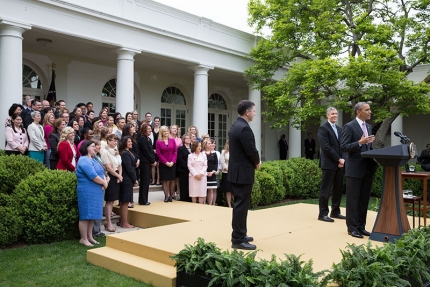
President Barack Obama, with Education Secretary Arne Duncan, honors 2013 National Teacher of the Year Jeff Charbonneau, State Teachers of the Year, and Principals of the Year, in the Rose Garden of the White House, April 23, 2013. (Official White House Photo by Pete Souza)

Twelve years ago, Zillah High School in Washington state had no engineering classes. The science curriculum was lagging behind, and students had to go off campus to take technology classes.

Jeff Charbonneau, who returned to his hometown 11 years ago to teach at Zillah High, was determined to change that. And he did. Science enrollment is way up. Kids are graduating with college-level science credits. The school expects to have to hire more teachers now to meet the demand. 

And today, President Obama honored Jeff as the 2013 National Teacher of the Year.

Jeff teaches chemistry, physics, and engineering, and works to create accessible, interactive lessons that help convince kids that the science classes most students consider hardest are worth diving in to, not running away from. But President Obama said that it’s not just his work in the classroom that distinguishes Jeff.

“He started an outdoors club,” President Obama said. “He brought his passion to the drama program. He’s even helping out other schools.” Because of Jeff, hundreds of students all over Washington are now participating in high-skills robotics competitions and gaining valuable engineering experience.

Related Topics: Education

The White House

Office of the Press Secretary

President Obama Announces More Key Administration Posts

WASHINGTON, DC – Today, President Barack Obama announced his intent to nominate the following individuals to key Administration posts:

  • D. Michael Bennett – Governor, Board of Governors of the United States Postal Service
  • Roberto R. Herencia – Member, Board of Directors of the Overseas Private Investment Corporation
  • Yvette Roubideaux – Director of the Indian Health Service, Department of Health and Human Services

President Obama said, “I am grateful these accomplished individuals have agreed to join this Administration, and I’m confident they will serve ably in these important roles.  I look forward to working with them in the coming months and years.”

President Obama announced his intent to nominate the following individuals to key Administration posts:

D. Michael Bennett, Nominee for Governor, Board of Governors of the United States Postal Service
D. Michael Bennett is Senior Vice President of Information Management and Chief Information Officer of BAE Systems, a position he has held since 2010.  Previously, Mr. Bennett was Vice President and General Manager of the Enterprise Solutions Business Area of BAE System’s Information Solutions Line of Business.  He worked at Northrup Grumman, ultimately becoming Vice President for Contracts, Pricing, Procurement and Risk Management for Northrop’s Information Technology Sector in 1999.  From 1980 to 1999, Mr. Bennett practiced law in various positions with Northrup Grumman, EDS Corporation, and the U.S. Department of Commerce.  He serves on the Board of Visitors of the Howard University School of Business, Vice President of Duke University Alumni Association Board of Directors, and Chair of the Manna Ventures Board of Directors.  In 2012, he received the Minority Business Leader Award from the Washington Business Journal.  Mr. Bennett received a B.A. from Duke University and a J.D. from The George Washington University Law School.

Roberto R. Herencia, Nominee for Member, Board of Directors of the Overseas Private Investment Corporation
Roberto R. Herencia is the President and CEO of BXM Holdings, a position he has held since 2010.  He was first appointed as a Member of the Board of Directors of the Overseas Private Investment Corporation by President Obama in 2011.  He has served as an independent director of SKBHC Holdings and its two subsidiary banks since 2010.  Since 2011, Mr. Herencia has served as an independent director and Chairman of the board of First BanCorp and its subsidiary bank, FirstBank Puerto Rico.  Between 2009 and 2010, Mr. Herencia was the President and CEO of Midwest Banc Holdings Inc. and Midwest Bank and Trust.  Previously, he spent 17 years with Popular Inc. as Executive Vice President and as President of Banco Popular North America.  Mr. Herencia received a B.S. from Georgetown University and an M.B.A. from the Kellogg School of Management at Northwestern University.

Dr. Yvette Roubideaux, Nominee for Director of the Indian Health Service, Department of Health and Human Services
Dr. Yvette Roubideaux is currently the Director of the Indian Health Service (IHS) at the Department of Health and Human Services, a position she has held since 2009.  Prior to this, Dr. Roubideaux worked at the University of Arizona from 1998 to 2009 in a number of roles, most recently as Assistant Professor in the College of Medicine’s Department of Family & Community Medicine.  Previously, Dr. Roubideaux worked in the IHS as a Medical Officer and Clinical Director on the San Carlos Indian Reservation and as a Medical Officer in the Gila River Indian Community.  Dr. Roubideaux is a recipient of the American Diabetes Association’s 2008 Addison B. Scoville Award for Outstanding Volunteer Service and the 2004 Indian Physician of the Year Award from the Association of American Indian Physicians.  She is co-editor of the American Public Health Association’s book entitled Promises to Keep: Public Health Policy for American Indians and Alaska Natives in the 21st Century.  Dr. Roubideaux received a B.A. in Biology from Harvard University, an M.D. from Harvard Medical School, and an M.P.H. from the Harvard School of Public Health.

The White House

Office of the Press Secretary

Remarks by the President at Teacher of the Year Event

Rose Garden

2:10 P.M. EDT

THE PRESIDENT:  Well, hello, everybody.  Please have a seat.  I am thrilled to welcome our state and national teachers of the year to the White House this afternoon.

People who know me know I’ve just got a soft spot for teachers, partly -- my sister is a teacher, my mom was a teacher for a while.  And if there’s one thing we can’t say enough to our nation’s educators, it is "thank you."  So today, we’ve got a chance to do that -- to show our extraordinary appreciation for the difference that they make in the lives of our children and the lives of our nation.

Now, before we get started, I’ve got to recognize another outstanding educator, our Secretary of Education, Arne Duncan -- (applause) -- who is as passionate about the future of our kids as anybody that I know.  And I’d like to acknowledge and applaud the three outstanding principals of the year who are joining us -- because we know that unless we’ve got outstanding leadership in our schools, it’s very hard for even great teachers to do their job.  And so please give them a big round of applause as well.  (Applause.)

Now, these educators behind me come from all over the country.  They represent cities and towns of every shape and size, all types of schools.  But the one thing that binds them together is that they are absolutely devoted to nurturing the next generation.  They’re role models who show our kids how to work hard to reach their potential.  They encourage our children’s passion.  They inspire our children’s imaginations.

And this year’s national teacher of the year, Jeff Charbonneau, is from Zillah, Washington.  Did I say that right, Jeff?

MR. CHARBONNEAU:  Charbonneau, so yes.

THE PRESIDENT:  Charbonneau --

MR. CHARBONNEAU:  Charbonneau from Zillah.

THE PRESIDENT:  From Zillah.  (Laughter.)  That’s why he’s a good teacher.  (Laughter.)  As Jeff put it, a teacher’s “greatest accomplishments are revealed each time a student realizes that he or she has an unlimited potential.”  And I’ll bet any -- everybody here can remember a moment like that, when a teacher helped them find that spark that allowed them to get to where they are today; a teacher who saw something in us that maybe at the time we didn’t see in ourselves.

Twelve years ago, when Jeff decided to return to his hometown to teach, Zillah High School had no engineering curriculum.  The science curriculum was lagging.  Kids had to go off campus for technology classes, and the computer resources were, frankly, pretty poor.

But Jeff was determined to turn that around.  He wanted to convince kids that something like quantum mechanics wasn’t something to run away from, but something to dive into.  And he said, “It's my job to convince them that they are smart enough, that they can do anything.”

And now, with Jeff’s leadership at his high school, science enrollment is way up.  Kids are graduating at college-level science -- with college-level science credits.  The school expects to have to hire more teachers now to meet the demand. 

This kind of transformation is exactly why I’ve proposed preparing an additional 100,000 math and science teachers across the country over the next decade.  (Applause.)  And excellent teachers like Jeff could make up part of a Master Teachers Corps -- a network of outstanding educators who serve as leaders and mentors for their colleagues in these particular subject areas.

But it’s not just classroom teaching that distinguishes Jeff.  He reinvigorated the school’s yearbook.  He started an outdoors club.  He brought his passion to the drama program.  He’s even helping out other schools.  Because of Jeff, hundreds of thousands -- or hundreds of students all over the state are now participating in high-skills robotics competitions and gaining valuable engineering experience, all in the name of creating what Jeff calls “paradise.”  That’s what school is for him, that’s what he wants it to be for his students -- in their classrooms, but also in their activities and the greater community.

And basically, there’s nothing that Jeff will not try to give his students the best education in every respect.  And, by the way, I think it's important for us to acknowledge Jeff's wife and children and mom and dad and brother -- all presumably have to put up with him constantly doing all this stuff.  (Laughter.)  And we appreciate them for the great support that they've given him.  (Applause.) 

What's true for Jeff is true for every educator standing behind me.  They understand that their job is more than teaching subjects like reading or chemistry.  They’re not just filling blackboards with numbers and diagrams.  In classrooms across America, they’re teaching things like character and compassion and resilience and imagination.  They’re filling young minds with virtues and values, and teaching our kids how to cooperate and overcome obstacles.  So today, we honor the dedicated professionals that help guide that critical development. 

Any parent knows it’s hard to drop your son off or your daughter off at school that first time.  In the instant the car door slams or the school bus door shuts, there is a little flutter that goes on.  I like quoting somebody who said that being a parent is like having your heart outside your body wandering around.  (Laughter.)  But these teachers, they're the ones that we trust with our kids.  They're people who love our kids. 

A few months ago, we saw the true depths of a teacher’s commitment when six educators were killed trying to protect the children they embraced as their own.  There was the teacher who locked her first-grade students in a bathroom and whispered, “I love you," because, in her words, “I wanted that to be the last thing they heard, and not gunfire.”  The special-education teacher who was found cradling a student in her arms, trying to protect him from the evil that ultimately took them both. 

In those moments, those brave teachers showed the world what they do is more than just educate kids.  They embrace them and they nurture them and they love them.  And we know that the men and women behind me do the same.  

These folks did not go into teaching for money.  (Laughter.)  They certainly didn’t go into it because of the light hours and the easy work.  They walk into the classroom every single day because they love doing what they do, because they're passionate about helping our children realize the best versions of themselves so that our country can become the best version of itself.

And I just want to say to all of them, I hope that in some small measure this award keeps them going.  Because I never want our teachers to feel discouraged at a time of budget cuts, at a time when all too often problems in the schools are laid at the feet of teachers; where we expect them to do so much, and sometimes they get so little in return. 

I want you guys to know that the country appreciates you.  The kids appreciate you.  The parents appreciate you.  What you do matters.  It's critical to our success as a country, but most importantly, it's critical to those kids themselves.  I cannot think of something more important than reaching that child who maybe came in uninspired, and suddenly, you've inspired them. 

And, by the way, I want to mention -- I often talk about STEM and math and science -- I really do think it's critically important.  We've fallen behind on a lot of those subjects.  But I don't want to neglect our English teachers and our arts teachers, our music teachers, our history teachers, our social science teachers -- (applause) -- because, yes, we want folks inventing things and we need more engineers and scientists and probably fewer lawyers.  I can say that as a lawyer.  (Laughter.)  But part of what you're also teaching young people is qualities like compassion, and being able to put yourself in somebody else's shoes.  And that's what makes our society worth living in as well. 

So the bottom line is, thank you.  And the least that the rest of us can do is to give all of these folks the respect that they’ve earned, the gratitude we owe them.  Teaching is a profession and it should be treated like one.  And that means we're going to have to recruit and prepare and reward our next generation of great educators more effectively.  Secretary Duncan has been working with folks around the country on a new blueprint for teaching in the 21st century, listening to some of these outstanding teachers and educators and principals so that we can figure out what best practices are out there. 

Educators like Jeff and everyone up here today, they represent the very best of America -- committed professionals who give themselves fully to the growth and development of our kids.  And with them at the front of the classroom and leading our schools, I am absolutely confident that our children are going to be prepared to meet the tests of our time and the tests of the future. 

So we're grateful to all of you.  Thanks for helping our kids dream big, hope deeply and realize a brighter future.  So with that, I would now like to present Jeff with his apple.  And I want to -- but don't bite into it -- (laughter) -- and invite him to say a few words.  Give Jeff a big round of applause.  (Applause.) 

END
2:20 P.M. EDT

The White House

Office of the Press Secretary

Statement by the President on Senator Baucus

I want to thank Max Baucus for his nearly 35 years of service to the people of Montana.  Max has made small businesses a top priority, often taking “Work Days” to visit local businesses across Montana and spend a day working alongside his constituents to gain perspective and help bolster the local economy.  As Finance Committee Chairman and a senior member of both the Agriculture and the Environment and Public Works Committees, Max has been a leader on a broad range of issues that touch the lives of Americans across the country.  Michelle and I commend Senator Baucus on his career, and wish him and his family well in the future.

The White House

Office of the Press Secretary

President Obama Signs Texas Emergency Declaration

The President today declared an emergency exists in the State of Texas and ordered federal aid to supplement state and local response efforts due to the emergency conditions resulting from an explosion beginning on April 17, 2013, and continuing.

The President's action authorizes the Department of Homeland Security, Federal Emergency Management Agency (FEMA), to coordinate all disaster relief efforts which have the purpose of alleviating the hardship and suffering caused by the emergency on the local population, and to provide appropriate assistance for required emergency measures, authorized under Title V of the Stafford Act, to save lives and to protect property and public health and safety, and to lessen or avert the threat of a catastrophe in McLennan County.

Specifically, FEMA is authorized to identify, mobilize, and provide at its discretion, equipment and resources necessary to alleviate the impacts of the emergency.  Emergency protective measures, including direct federal assistance, will be provided at 75 percent federal funding. 

W. Craig Fugate, Administrator, Federal Emergency Management Agency (FEMA), Department of Homeland Security, named Kevin L. Hannes as the Federal Coordinating Officer for federal recovery operations in the affected area. 

The White House

Office of the Press Secretary

President Obama Signs Massachusetts Disaster Declaration

The President today declared a major disaster exists in the Commonwealth of Massachusetts and ordered Federal aid to supplement commonwealth and local recovery efforts in the area affected by the severe winter storm, snowstorm, and flooding during the period of February 8-9, 2013.

Federal funding is available to commonwealth and eligible local governments and certain private nonprofit organizations on a cost-sharing basis for emergency work and the repair or replacement of facilities damaged by the severe winter storm, snowstorm, and flooding in the counties of Barnstable, Berkshire, Bristol, Dukes, Essex, Franklin, Hampden, Hampshire, Middlesex, Nantucket, Norfolk, Plymouth, Suffolk, and Worcester.

In addition, federal funding is available to the commonwealth and eligible local governments on a cost-sharing basis for snow assistance for a continuous 48-hour period during or proximate to the incident period in Berkshire, Bristol, Essex, Franklin, Hampden, Hampshire, Middlesex, Norfolk, Suffolk, and Worcester Counties. 

Federal funding is also available on a cost-sharing basis for hazard mitigation measures for all counties within the commonwealth.

W. Craig Fugate, Administrator, Federal Emergency Management Agency (FEMA), Department of Homeland Security, named James N. Russo as the Federal Coordinating Officer for federal recovery operations in the affected area.

FEMA said additional designations may be made at a later date if requested by the commonwealth and warranted by the results of further damage assessments.

President Obama Speaks at the 2013 White House Science Fair

April 22, 2013 | 14:30 | Public Domain

The White House Science Fair celebrates the student winners of a broad range of science, technology, engineering and math (STEM) competitions from across the country.

Download mp4 (533MB) | mp3 (35MB)

Read the Transcript

Remarks by the President at the 2013 White House Science Fair

East Room

2:21 P.M. EDT

THE PRESIDENT:  Thank you, everybody.  (Applause.)  Please have a seat.  Have a seat.  Well, good afternoon, everybody.  And welcome to the White House Science Fair, one of my favorite events during the course of the year.

And I just had a chance to see some of the outstanding exhibits that have been put forward by some of these amazing young people.  And let me just start by saying, in my official capacity as President:  This stuff is really cool.  (Laughter.)  And I want to thank these incredible young people for explaining to me what the heck is going on.  (Laughter.)

Every one of you is enormously talented, obviously, but there’s also a community of people who helped all these young people succeed -- dedicated teachers who believed in them and challenged them to do even more; all of them have loving parents and mentors and family.  So I want to not only give the young people a big round of applause, but all the parents and teachers and principals and everybody who was involved, give yourselves a big round of applause as well.  (Applause.) 

Of course, primarily we’re here to celebrate these young scientists and visionaries who dream, and create, and innovate; who ask the question, why not?  Why not try something better?  Something that’s faster; something that helps more people.  And that drive, that refusal to give up, that focus on the future is part of what makes America great.  And all of you are participants in this long line of inventors and creators that have made this the most dynamic economy and the most dynamic country on Earth.

And that’s one of the things that I’ve been focused on as President is how do we create an all-hands-on-deck approach to science, technology, engineering, and math.  And I’m happy to have so many key members of my science team who are here today, including my Chief Science Advisor, John Holdren, who is here.  There’s John.  NIH Director Francis Collins.  There’s Francis right there, the tall guy.  We’ve got Acting Director of the National Science Foundation, Cora Marrett, who is here.  There’s Cora.  And we’ve got real-life astronaut and NASA Administrator, Charles Bolden.  Where’s Charlie?  There he is, right there.

So we need to make this a priority to train an army of new teachers in these subject areas, and to make sure that all of us as a country are lifting up these subjects for the respect that they deserve.  And one of the things that I’m concerned about is that, as a culture, we’re great consumers of technology, but we’re not always properly respecting the people who are in the labs and behind the scenes creating the stuff that we now take for granted.  And we’ve got to give the millions of Americans who work in science and technology not only the kind of respect they deserve but also new ways to engage young people. 

So today, I’m proud to announce a new AmeriCorps program that are going to -- (applause) --  that’s our Community Service Director.  (Laughter.)  She is a little bit biased, but I like that in her.  She’s got that kind of get-up-and-go.  A new AmeriCorps program that’s going to connect more professional scientists and engineers to young students who might follow in their footsteps.  And other people are stepping up, too. 

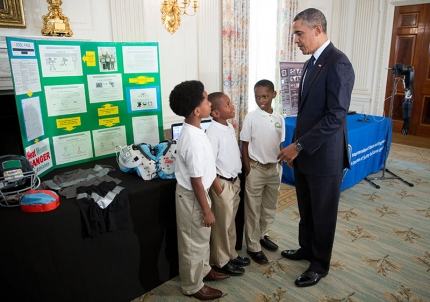
Some of America’s biggest tech companies are encouraging their workers to mentor young students.  You’ve got media organizations that are working with athletes like outstanding wide receiver Victor Cruz from the New York Giants, who’s here to highlight how critical math and science are to sports.  (Applause.)  And, by the way, since Victor is here, I don’t know -- did you see the exhibit about the whole cooling shoulder pads and helmet that these young guys did?  And they had a whole slogan that said you can succeed in athletics and science.  They were very impressive.  Had the little Gatorade so you -- (laughter) -- you didn’t even have to, like, reach for your Gatorade; you could just -- it would automatically transmit itself into your helmet.  (Laughter.)  It could work. 

We’ve got non-profits that are helping to organize 1,000 summer learning events this year.  They all realize how important science, technology, engineering, and math are to our future.  So we are doing this together.

And, after all, the science fair projects of today could become the products and businesses of tomorrow.  Three students -- Evan Jackson, Alec Jackson, and Caleb Robinson -- those are the folks that I talked about.  They’re from Flippen Elementary School.  Keep in mind, they’re in third, fourth grade, and they’ve already got this idea for COOL Pads so that Victor doesn’t get overheated when he’s out on the field.  But think about that.  If you’re inventing stuff in the third grade, what are you going to do by the time you get to college?  (Laughter.) 

And we just had the University of Alabama’s national championship football team here last week, and I know they’re interested in this idea because it gets really hot down in Alabama.

A lot of these students are working on the next generation of medical research.  So listen to this story.  When pancreatic cancer took the life of Jack Andraka’s close family friend, it inspired Jack to look for new ways to improve detection.  So Jack requested space from research labs to pursue his work -- nearly 200 times.  Two hundred times he asked.  Two hundred times he was turned down.  Finally, with the help of some folks at Johns Hopkins, he got the research facilities that he needed, developed a pancreatic cancer test that is faster, cheaper and more sensitive than the test that came before it -- which is not bad for a guy who is just barely old enough to drive.  So where's Jack?  There he is.  Jack, stand up, because that's pretty spectacular stuff.  (Applause.)  That's great work.  I don't know what you guys were doing when you were juniors in high school.  (Laughter.)  That's what Jack is doing.  (Laughter.)  Better than I was doing, I promise you.  (Laughter.)

Now, today is not just the third White House Science Fair.  It’s also the 43rd Earth Day.  So I want to give a special shout-out to all of the young people who participated, who focused their attention on how to harness cleaner forms of energy and how to create more energy efficiency.  So we’ve got young people like Caleb Meyer -- where's Caleb?  Caleb is way back there.  Stand up, Caleb, so we can see you.  (Applause.)  Caleb built a wind turbine that's small and fast enough to be installed on your roof or in your front yard.  

We’ve got Jon Kubricki and Bridget Zarych, who, together with their classmates, designed an inexpensive press that can recycle garbage like banana peels into briquettes as an alternative to using wood for fuel.  They're in eighth grade.  I don't know what you were doing in eighth grade.  (Laughter.)  That's what they're doing -- which could potentially help to reduce carbon emissions, save trees and deforestation, and reduce the amount of smoke inhalation that has an impact on people.

We've got Sara Volz, who is breeding new types of algae.  Where's Sara?  There's Sara.  (Applause.)  Sara is breeding new types of algae.  She stores this in a lab in her bedroom.  (Laughter.)  So, Sara, you have very supportive parents.  (Laughter.)  One reporter asked her, “Exactly what is growing under your bed that’s going to save the planet?”  (Laughter.)  And Sara’s answer was algae that can produce more oil for cheaper biofuels.  So, by the way, Jon Kubricki and Bridget Zarych, I didn't have them stand up.  I want to acknowledge them.  I saw them.  Maybe they're still cleaning their hands off.  (Applause.)  But there they are.  There they are. 

So I've got to say, young people like these, every one of them have these kinds of incredible innovations.  Some of them are already fully operational.  Some of them are getting fine-tuned.  But young people like these have to make you hopeful about the future of our country.  And it's also a reminder for us -- the adults -- we've got to do our part.  We've got to do everything we can to make sure that we are giving these young people opportunity to pursue their studies and discover new ways of doing things.  And we've got to make sure that we're also leaving behind a world that is safer and cleaner and healthier than the one we found.  That’s our obligation.   

And that’s why, over the last four years, we’ve made historic investments in the clean energy future that we need.  And today we import less oil than we have in 20 years.  Thanks to new fuel economy standards, by the middle of the next decade, cars will go twice as far on a gallon of gas.  We’ve doubled the amount of renewable energy that we're generating from sources like wind and solar -- and, by the way, creating tens of thousands of good, American jobs in the process.  We're emitting less carbon pollution into the environment than we have in nearly 20 years.

But we understand this is not enough.  We've got to do better.  And that's why we've got to pursue an all-of-the-above energy strategy that includes investing in more biofuels and more fuel-efficient vehicles, and more solar power and more wind power, and more people going back to work building cars and homes and businesses that are more energy efficient than the ones that we've got right now. 

And that’s why I’ve proposed new job-creating investments in science and innovation.  And all these young people, as young as they are, they're all going to be going to college, and a lot of them are going to want to continue to pursue their research and pursue their dreams.  And if there is not the research grant pipeline in place, many of them will not have the resources to invent and discover the things that will make us healthier and make us more energy efficient and improve the quality of our lives. 

So this is not the time to gut investments that keep our businesses on the cutting edge, that keep our economy humming, that improve the quality of our lives.  This is the time to reach a level of research and development that we haven't seen since the height of the Space Race.  That's what we should be doing.  That's what we should be focused on.  (Applause.)  

And that should not be a partisan idea.  America has always been about discovery, and invention, and engineering, and science and evidence.  That's who we are.  That's in our DNA.  That's how this country became the greatest economic power in the history of the world.  That's how we’re able to provide so many contributions to people all around the world with our scientific and medical and technological discoveries.

And that's what these young people here are all about.  And if extraordinary young people like all of you can use your talents to shape the future for our families and our communities and our countries, we’ve got a responsibility to make sure that they’ve got the tools to do it. 

So I want to thank all the Science Fair winners not only for the work that you guys are doing, but also the example that you’re setting for your peers and also for your adults -- the adults in your lives.  We could not be prouder of you.  And I want you to keep up your incredible work.

And part of the reason that we’re doing this here -- we celebrate our great football players like Victor, and we celebrate outstanding musicians, and that's all appropriate.  But we’ve got to make sure that we’re also celebrating every single day in our schools, in our classrooms, and in our country the outstanding contributions that scientists and engineers and mathematicians and engineers are providing to us every single day.  And we want you to know that you’ve got a whole country behind you as you pursue your dreams.  And your success is going to be our success, as well.  So way to go. 

Thank you.  Appreciate it, everybody.  Thank you very much.  (Applause.)

END
2:35 P.M. EDT

Close Transcript

President Obama Tours the 2013 White House Science Fair

April 22, 2013 | 14:30 | Public Domain

President Obama talks with students about their projects at the 2013 White House Science Fair.

Download mp4 (1321MB) | mp3 (84MB)

Read the Transcript

Remarks by the President at the 2013 White House Science Fair

East Room

2:21 P.M. EDT

THE PRESIDENT:  Thank you, everybody.  (Applause.)  Please have a seat.  Have a seat.  Well, good afternoon, everybody.  And welcome to the White House Science Fair, one of my favorite events during the course of the year.

And I just had a chance to see some of the outstanding exhibits that have been put forward by some of these amazing young people.  And let me just start by saying, in my official capacity as President:  This stuff is really cool.  (Laughter.)  And I want to thank these incredible young people for explaining to me what the heck is going on.  (Laughter.)

Every one of you is enormously talented, obviously, but there’s also a community of people who helped all these young people succeed -- dedicated teachers who believed in them and challenged them to do even more; all of them have loving parents and mentors and family.  So I want to not only give the young people a big round of applause, but all the parents and teachers and principals and everybody who was involved, give yourselves a big round of applause as well.  (Applause.) 

Of course, primarily we’re here to celebrate these young scientists and visionaries who dream, and create, and innovate; who ask the question, why not?  Why not try something better?  Something that’s faster; something that helps more people.  And that drive, that refusal to give up, that focus on the future is part of what makes America great.  And all of you are participants in this long line of inventors and creators that have made this the most dynamic economy and the most dynamic country on Earth.

And that’s one of the things that I’ve been focused on as President is how do we create an all-hands-on-deck approach to science, technology, engineering, and math.  And I’m happy to have so many key members of my science team who are here today, including my Chief Science Advisor, John Holdren, who is here.  There’s John.  NIH Director Francis Collins.  There’s Francis right there, the tall guy.  We’ve got Acting Director of the National Science Foundation, Cora Marrett, who is here.  There’s Cora.  And we’ve got real-life astronaut and NASA Administrator, Charles Bolden.  Where’s Charlie?  There he is, right there.

So we need to make this a priority to train an army of new teachers in these subject areas, and to make sure that all of us as a country are lifting up these subjects for the respect that they deserve.  And one of the things that I’m concerned about is that, as a culture, we’re great consumers of technology, but we’re not always properly respecting the people who are in the labs and behind the scenes creating the stuff that we now take for granted.  And we’ve got to give the millions of Americans who work in science and technology not only the kind of respect they deserve but also new ways to engage young people. 

So today, I’m proud to announce a new AmeriCorps program that are going to -- (applause) --  that’s our Community Service Director.  (Laughter.)  She is a little bit biased, but I like that in her.  She’s got that kind of get-up-and-go.  A new AmeriCorps program that’s going to connect more professional scientists and engineers to young students who might follow in their footsteps.  And other people are stepping up, too. 

Some of America’s biggest tech companies are encouraging their workers to mentor young students.  You’ve got media organizations that are working with athletes like outstanding wide receiver Victor Cruz from the New York Giants, who’s here to highlight how critical math and science are to sports.  (Applause.)  And, by the way, since Victor is here, I don’t know -- did you see the exhibit about the whole cooling shoulder pads and helmet that these young guys did?  And they had a whole slogan that said you can succeed in athletics and science.  They were very impressive.  Had the little Gatorade so you -- (laughter) -- you didn’t even have to, like, reach for your Gatorade; you could just -- it would automatically transmit itself into your helmet.  (Laughter.)  It could work. 

We’ve got non-profits that are helping to organize 1,000 summer learning events this year.  They all realize how important science, technology, engineering, and math are to our future.  So we are doing this together.

And, after all, the science fair projects of today could become the products and businesses of tomorrow.  Three students -- Evan Jackson, Alec Jackson, and Caleb Robinson -- those are the folks that I talked about.  They’re from Flippen Elementary School.  Keep in mind, they’re in third, fourth grade, and they’ve already got this idea for COOL Pads so that Victor doesn’t get overheated when he’s out on the field.  But think about that.  If you’re inventing stuff in the third grade, what are you going to do by the time you get to college?  (Laughter.) 

And we just had the University of Alabama’s national championship football team here last week, and I know they’re interested in this idea because it gets really hot down in Alabama.

A lot of these students are working on the next generation of medical research.  So listen to this story.  When pancreatic cancer took the life of Jack Andraka’s close family friend, it inspired Jack to look for new ways to improve detection.  So Jack requested space from research labs to pursue his work -- nearly 200 times.  Two hundred times he asked.  Two hundred times he was turned down.  Finally, with the help of some folks at Johns Hopkins, he got the research facilities that he needed, developed a pancreatic cancer test that is faster, cheaper and more sensitive than the test that came before it -- which is not bad for a guy who is just barely old enough to drive.  So where's Jack?  There he is.  Jack, stand up, because that's pretty spectacular stuff.  (Applause.)  That's great work.  I don't know what you guys were doing when you were juniors in high school.  (Laughter.)  That's what Jack is doing.  (Laughter.)  Better than I was doing, I promise you.  (Laughter.)

Now, today is not just the third White House Science Fair.  It’s also the 43rd Earth Day.  So I want to give a special shout-out to all of the young people who participated, who focused their attention on how to harness cleaner forms of energy and how to create more energy efficiency.  So we’ve got young people like Caleb Meyer -- where's Caleb?  Caleb is way back there.  Stand up, Caleb, so we can see you.  (Applause.)  Caleb built a wind turbine that's small and fast enough to be installed on your roof or in your front yard.  

We’ve got Jon Kubricki and Bridget Zarych, who, together with their classmates, designed an inexpensive press that can recycle garbage like banana peels into briquettes as an alternative to using wood for fuel.  They're in eighth grade.  I don't know what you were doing in eighth grade.  (Laughter.)  That's what they're doing -- which could potentially help to reduce carbon emissions, save trees and deforestation, and reduce the amount of smoke inhalation that has an impact on people.

We've got Sara Volz, who is breeding new types of algae.  Where's Sara?  There's Sara.  (Applause.)  Sara is breeding new types of algae.  She stores this in a lab in her bedroom.  (Laughter.)  So, Sara, you have very supportive parents.  (Laughter.)  One reporter asked her, “Exactly what is growing under your bed that’s going to save the planet?”  (Laughter.)  And Sara’s answer was algae that can produce more oil for cheaper biofuels.  So, by the way, Jon Kubricki and Bridget Zarych, I didn't have them stand up.  I want to acknowledge them.  I saw them.  Maybe they're still cleaning their hands off.  (Applause.)  But there they are.  There they are. 

So I've got to say, young people like these, every one of them have these kinds of incredible innovations.  Some of them are already fully operational.  Some of them are getting fine-tuned.  But young people like these have to make you hopeful about the future of our country.  And it's also a reminder for us -- the adults -- we've got to do our part.  We've got to do everything we can to make sure that we are giving these young people opportunity to pursue their studies and discover new ways of doing things.  And we've got to make sure that we're also leaving behind a world that is safer and cleaner and healthier than the one we found.  That’s our obligation.   

And that’s why, over the last four years, we’ve made historic investments in the clean energy future that we need.  And today we import less oil than we have in 20 years.  Thanks to new fuel economy standards, by the middle of the next decade, cars will go twice as far on a gallon of gas.  We’ve doubled the amount of renewable energy that we're generating from sources like wind and solar -- and, by the way, creating tens of thousands of good, American jobs in the process.  We're emitting less carbon pollution into the environment than we have in nearly 20 years.

But we understand this is not enough.  We've got to do better.  And that's why we've got to pursue an all-of-the-above energy strategy that includes investing in more biofuels and more fuel-efficient vehicles, and more solar power and more wind power, and more people going back to work building cars and homes and businesses that are more energy efficient than the ones that we've got right now. 

And that’s why I’ve proposed new job-creating investments in science and innovation.  And all these young people, as young as they are, they're all going to be going to college, and a lot of them are going to want to continue to pursue their research and pursue their dreams.  And if there is not the research grant pipeline in place, many of them will not have the resources to invent and discover the things that will make us healthier and make us more energy efficient and improve the quality of our lives. 

So this is not the time to gut investments that keep our businesses on the cutting edge, that keep our economy humming, that improve the quality of our lives.  This is the time to reach a level of research and development that we haven't seen since the height of the Space Race.  That's what we should be doing.  That's what we should be focused on.  (Applause.)  

And that should not be a partisan idea.  America has always been about discovery, and invention, and engineering, and science and evidence.  That's who we are.  That's in our DNA.  That's how this country became the greatest economic power in the history of the world.  That's how we’re able to provide so many contributions to people all around the world with our scientific and medical and technological discoveries.

And that's what these young people here are all about.  And if extraordinary young people like all of you can use your talents to shape the future for our families and our communities and our countries, we’ve got a responsibility to make sure that they’ve got the tools to do it. 

So I want to thank all the Science Fair winners not only for the work that you guys are doing, but also the example that you’re setting for your peers and also for your adults -- the adults in your lives.  We could not be prouder of you.  And I want you to keep up your incredible work.

And part of the reason that we’re doing this here -- we celebrate our great football players like Victor, and we celebrate outstanding musicians, and that's all appropriate.  But we’ve got to make sure that we’re also celebrating every single day in our schools, in our classrooms, and in our country the outstanding contributions that scientists and engineers and mathematicians and engineers are providing to us every single day.  And we want you to know that you’ve got a whole country behind you as you pursue your dreams.  And your success is going to be our success, as well.  So way to go. 

Thank you.  Appreciate it, everybody.  Thank you very much.  (Applause.)

END
2:35 P.M. EDT

Close Transcript
The White House

Office of the Press Secretary

Readout of the President’s Calls to Special Agent in Charge Deslauriers and Commissioner Davis

Today, the President placed calls to FBI Special Agent in Charge Richard Deslauriers and Boston Police Commissioner Edward F. Davis to express his appreciation to the men and women of the Boston Field Office, Boston Police Department, and all the members of the Joint Terrorism Task Force. The President hailed the professionalism and bravery demonstrated by officers since Monday, and praised the impressive coordination between these federal, state, and local law enforcement agencies who together were able to bring this chapter of this tragedy to a close. While the President acknowledged there is still much work ahead, he thanked Special Agent in Charge Deslauriers and Commissioner Davis for their leadership and told them that the law enforcement officials, the citizens of Boston, and all affected by this tragedy were in his thoughts and prayers.

Young Scientists and Innovators Amaze President Obama at the White House Science Fair

President Obama today celebrated the remarkable achievements of student science fair winners and extraordinary kid innovators from across the nation in the third White House Science Fair. The Fair brought 100 students from more than 40 states to an all-day, hands-on celebration of the power and potential of science, technology, engineering, and math (STEM) education.

As the President said in 2009, when he announced the first-ever White House Science Fair, “If you win the NCAA championship, you come to the White House. Well, if you're a young person and you've produced the best experiment or design, the best hardware or software, you ought to be recognized for that achievement, too.”

President Obama with Evan Jackson, Alec Jackson, and Caleb Robinson at the White House Science Fair, April 22, 2013

President Barack Obama talks with Evan Jackson, 10, Alec Jackson, 8, and Caleb Robinson, 8, from McDonough, Ga., while looking at exhibits at the White House Science Fair in the State Dining Room, April 22, 2013. The sports-loving grade-schoolers created a new product concept to keep athletes cool and helps players maintain safe body temperatures on the field. (Official White House Photo by Chuck Kennedy)

Becky Fried is a Communications and Policy Analyst at the White House Office of Science & Technology Policy
Related Topics: Education