The White House

Office of the Press Secretary

Statement by the Press Secretary Announcing the Visit of Crown Prince Mohammed bin Zayed Al Nahyan of the United Arab Emirates

President Obama will welcome Crown Prince Mohammed bin Zayed Al Nahyan of the United Arab Emirates to the White House on Tuesday, April 16.  The President looks forward to discussing with the Crown Prince the strong and enduring ties between the United States and the UAE and consulting on common strategic interests in the Gulf region and broader Middle East. 

The United States and the UAE enjoy a vibrant and expanding bilateral relationship, including strong defense cooperation and economic ties, and a shared commitment to advancing peace, economic opportunity, and stability throughout the world.  The United States remains firmly committed to continuing to deepen the U.S.-UAE partnership through close and regular consultations between our two countries. 

The White House

Office of the Press Secretary

Remarks by the President at a DNC Event -- Atherton, CA


Private Residence
Atherton, California
 
 
12:12 P.M. PDT 
 
THE PRESIDENT:  Hello, everybody!  (Applause.)  It is good to be back in California.
 
AUDIENCE:  It’s good to have you!  (Laughter.)
 
THE PRESIDENT:  Thank you.  Somebody said -- somebody told me, they were in the photo line, they said, we’re glad you could join our state.  (Laughter.)  They made it sound like a health club or something.  (Laughter.)  But I appreciate that you allowed me to join -- (laughter) -- because it is obviously a spectacular place and we’ve got so many good friends here, and some of you I see out there worked tirelessly dating back to when people could not pronounce my name.  (Laughter.)  And so I’m grateful to all of you. 
 
First of all, though, I want to give a special acknowledgement to John and Marcia for the incredible job they've done and their great hospitality.  Thank you so much.  (Applause.)  And I must say that if you had a cute baby competition, their granddaughter would have to be an entry.  (Laughter.)  And I got to say, I might have to pick her, because she is adorable and did not drool on my suit when I grabbed her.  (Laughter.)  So I'm grateful.  I'm grateful to her for that.  
 
We've got some elected officials who are doing incredible work -- great friends.  First of all, somebody who works tirelessly on behalf of California every day, but also works on behalf of working people and makes sure that we've got a more inclusive America -- a good friend of mine, somebody who you guys should be very proud of, Congressman Mike Honda is here.  Where is Mike?  (Applause.)  He is around here somewhere.  There he is.  Yes, I mean, he's not like a real tall guy, but he's a great guy.  (Laughter.) 
 
Second of all, you have to be careful to, first of all, say she is brilliant and she is dedicated and she is tough, and she is exactly what you'd want in anybody who is administering the law, and making sure that everybody is getting a fair shake.  She also happens to be by far the best-looking attorney general in the country -- Kamala Harris is here.  (Applause.)  It's true.  Come on.  (Laughter.)  And she is a great friend and has just been a great supporter for many, many years. 
 
And, finally, somebody who is not yet probably as well known on the national scene but is certainly well known in all of us who worked on my campaign this last time out.  He did incredible work, could not have been more effective, and has now taken on what can sometimes be a thankless job of being the DNC finance chair -- Henry Muñoz is here.  Can everybody please give Henry Muñoz a big round of applause.  (Applause.) 
 
So my election is over and you thought you wouldn’t have to see me again at these fundraisers.  (Laughter.)  And a close friend of mine, Abner Mikva, who was White House counsel -- he was a long-time congressman from the Chicago area -- he used to say that being friends with a politician is like perpetually having a child in college.  (Laughter.)  It's like every few months you have to write this check and you're thinking when is it going to be over.  With elected officials, it's never over.
 
But the reason I'm here is not for me.  The reason I'm here is because the country still needs you.  We have, as John indicated, done some work that I'm very, very proud of over the last four years.  We took an economy that was about to go into a great depression and we were able to yank it out and put us back on a path towards growth and putting people back to work.  We were able to make sure that in the process we rebuilt roads and bridges and a smarter infrastructure all across the country; and invested in clean energy; and made sure that schools got the kinds of Internet connections that they needed; and invested in basic science and research -- all of which will pay dividends for years and years to come. 
 
We said that in a country as wealthy as ours, nobody should go bankrupt just because they got sick.  And, already, millions of people are benefiting from the Affordable Care Act.  And, by next year, we will know that millions of people all across the country who previously did not have health insurance will have it, including folks with preexisting conditions, which will make everybody a little bit more secure.  (Applause.) 
 
We expanded access to college by expanding our student loan programs.  We are in the process of reforming our schools to make sure that every child gets a fair shot in life.  We ended "don't ask, don't tell" -- laying the groundwork to make sure that this was a country where you were treated fairly and equally no matter who you love.  (Applause.) 
 
We expanded national service.  We doubled fuel efficiency on cars.  We doubled the production of wind and solar energy.  We made sure that the Violence Against Women Act was resigned and that it provided even greater protection for women all across this country.  (Applause.)  We ended one war, as promised.  We're in the process of ending another, and at the same time have been able to keep the American people safe.  
And so I'm very proud of the work that we've done.  But we've got a lot more work to do.  We all know that.  This country is the greatest nation on Earth, but it can be even greater.  And my main message here today is that America’s greatness will not result simply from who you elect to office; it’s going to depend on you, as citizens, and how badly you want it.  
 
During the State of the Union speech, as well as my inauguration speech, I talked about citizenship.  And this is a word that I spend a lot of time thinking about these days, partly because my background, my orientation, I came into politics believing that politics works best when people are involved.  I’ve never believed that more than I do now, in my second term as President, that the idea of citizenship is not just that you vote, it’s not just that you write a check where you can to support a candidate.  It’s this notion, fundamental to who we are, that we have responsibilities to ourselves and our families, but we also have obligations to our neighborhood, our community, our cities, our states, and ultimately the nation and the next generation.  
 
And the only way that this country moves forward is when we, the people, collectively, make it our business to meet the challenges of our time.  And we know what those challenges are.  And we know we’ve got to do better.
 
Now, in the next couple of months, we’ve got the opportunity to make some very significant changes.  Number one, I believe that we can get comprehensive immigration reform passed -- (applause) -- and that is going to mean that America can continue to be a nation of laws, but also a nation of immigrants, and attract the best and the brightest from all around the world.  And if we push hard and we stay focused, we’ve got the opportunity to get this done over the next couple of months.  
 
I believe that we have a chance to, after 30 years, frankly, of doing almost nothing, to reduce gun violence in our society.  (Applause.)  And it’s going to be hard, it’s going to be tough, but I think we’ve got a chance to get some stuff done on that.
 
Now, one of the things that I want to be very clear on is that this year, next year, and for the next four years that I’m in office, I am always going to be seeking, wherever I can, bipartisan solutions.  And I intend to continue to reach out to Republicans because I genuinely believe that the politics that you see in Washington isn’t representative of America; that most people actually have common sense, and most folks think cooperation and occasional compromise is part of life.  And I also think that we have to govern, not simply politick.  
 
And so, whether it’s on immigration reform or the budget or any of these issues, I will continue to do everything I can to reach out to my friends on the other side of the aisle.  And look, I believe that they love their kids and this country just as much as we do, and although we may have some very fundamental disagreements about how to get there, I don’t think we’ve got a disagreement about what we need to be as a nation.  
 
Having said that, though, there are still some really big arguments that we’re having in Washington, and I believe that Democrats represent those values that will best advance the interests of middle-class families and everybody who is willing to work hard to get into the middle class; that will grow this economy in a broad-based way, and that will lay the foundation for prosperity for generations to come.  
 
And you believe that, too.  That’s why you’re here.  In order for us to do that, you’re going to have to stay involved.  Think about some of the things I spoke about during the State of the Union address:  making sure that every child in America has outstanding, high-quality, early childhood education.  We know that there’s nothing more important to a child’s success than those early years.  And if we do that right, not only are we going to see better performance in our schools, we’re going to see better performance in our economy.  And we can do it.  We can afford to do it.  
 
But in order for us to make that happen, we’re going to have to have an active, motivated, Democratic national party.  People here in this area care deeply about issues of energy and climate change.  And I think that the science is indisputable, and this is an obligation we owe to future generations.  And as I said, we’ve already done a lot to reduce our carbon footprint and to make our economy more energy efficient.  But if we’re going to do more, then we’ve got to make sure that we’re active and involved, and helping to educate our friends and our neighbors and our coworkers about why this is important and why there’s no contradiction between a sound environment and strong economic growth; that, in fact, if we do this right, the energy sources of the future, the clean energy sources of the future can be an engine for economic growth for decades and decades to come.
 
When it comes to our economy -- making sure that we’re investing in basic research and science.  This is the epicenter of innovation in this nation.  Some of you saw, a couple of days ago, I announced a new BRAIN Initiative that will allow us to crack the code and map -- (applause) -- what this incredible gray matter between our ears, one of the greatest mysteries there is, what’s causing things like Alzheimer’s and Parkinson’s, and to not just provide cures but also to help generate entire new industries that can put people to work in this region and around the country.  
 
In order for us to make sure that we’re investing sufficiently in basic science and research, you’re going to have to be involved.  You have to push.  You can’t just wait for it to happen, because there are going to be competing interests and folks who want to spend those resources in a different way.  
 
When it comes to our budget, I actually think that we can stabilize our finances, reduce our debt, reduce our deficit in a prudent, balanced way.  But we’ve got the other side insisting that somehow we can cut our way to prosperity.  I disagree with that.  I will take that case to the American people.  But for me to be successful in resolving that argument in a way that allows us to keep growing and keep investing, I’m going to need your help.  
 
Making sure that we’re providing ladders of opportunity in communities all across the country that have been left behind -- and, in some cases, have been behind for decades -- so that we’re not just investing in education, but also making sure that we’re providing transportation assistance and tax credits so that impoverished communities can be part of this global economy.  That will make us all stronger.  I can’t do that unless I have your help.
 
And for us to continue to make progress so that this is a society that is more just and more equal and more inclusive -- we’ve made remarkable progress over these last few years, but that’s not because of what started in Washington, it’s because of what happened in communities all across the country.
 
I was mentioning to people I had a chance to see an early screening of this new movie called “42”; it’s about Jackie Robinson.  And I look around the room -- young people -- (laughter) -- kind of vaguely know, yes, Jackie Robinson -- (laughter) -- first African American baseball player.  His widow was there, Rachel Robinson, who’s gorgeous and 90, but looks better than I do -- (laughter) -- and could not be more gracious.  
 
And to sit there in a movie theater watching what happened in her lifetime, and to know that because of the decisions and courage of Jackie Robison and Branch Rickey, and all the other path breakers, that we now have a country that is fairer and better for it is a reminder of how change happens in this country.  It doesn’t happen all at once.  It doesn’t happen in one fell swoop.  It doesn’t happen because a President gives a speech.  It happens because a whole bunch of people out there, day in and day out, are making choices and decisions about whether we’re going to be fair or less fair; whether we’re going to be generous or less generous; whether we are going to be inclusive or less inclusive.  And that changing of our hearts and our minds ultimately translates itself into politics, but it begins with citizens.  It begins with you.
 
And if the Democratic Party stands for anything, then it has to stand for that basic proposition that not only do we want an economy where if you work hard, you can make it if you try -- no matter where you come from, what you look like, who you love -- but also that the way to get there is by giving everybody a voice and making sure everybody is involved and everybody is included.  If we stand for anything as Democrats, that’s got to be what we stand for.
 
And so the DNC is an important part of that overall process.  And the fact that you are here, the fact that John and Marcia were willing to open up their home like this gives me confidence that, in fact, we will be able to sustain these efforts.  And it has to be sustained beyond elections.  You can’t just wait until a presidential election to do this.  It’s all those days in between that are going to determine whether or not we bring about the changes that we so desperately believe in.
 
So to all of you, I want to say thank you.  But understand this is just a beginning, it’s not an end.  You are going to be called on to do more work.  You are going to be called on to get more engaged and more involved.  And if you ever have any doubts as to why you’re doing it, then you have to look at John and Marcia’s grandbaby, or that young man who’s falling asleep because I’ve been talking too long.  (Laughter.)  And you will remember that, ultimately, the only thing that matters is whether or not we’re leaving behind a country that’s a little bit better than the one we founded for them.  That’s why we do what we do.  That’s why I do what I do -- for Malia and Sasha, and all the Malias and Sashas out there, I want to make sure we’re doing right by them.
 
All right, thank you very much, everybody.  (Applause.)  God bless you.  Thank you.
 
END
12:31 P.M. PDT

The White House

Office of the Press Secretary

Statement by the President on the Passing of Roger Ebert

Michelle and I are saddened to hear about the passing of Roger Ebert.  For a generation of Americans - and especially Chicagoans - Roger was the movies.  When he didn't like a film, he was honest; when he did, he was effusive - capturing the unique power of the movies to take us somewhere magical.  Even amidst his own battles with cancer, Roger was as productive as he was resilient - continuing to share his passion and perspective with the world.  The movies won't be the same without Roger, and our thoughts and prayers are with Chaz and the rest of the Ebert family.

The White House

Office of the Press Secretary

Remarks by the President at a DNC Event -- Atherton, CA

Private Residence
Atherton, California

10:28 A.M. PDT

THE PRESIDENT:  Thank you.  (Applause.)  Thank you so much.  Well, it is wonderful to see all of you.  This is an intimate group.  What I want to do is mostly have a conversation.  But, first of all, obviously I want to thank Liz and Mark for their incredible hospitality.  We couldn’t be more appreciative.  And I want to thank all of you for being here today.

A lot of you -- in fact, almost everybody here I’ve known, have supported me.  Some of you were involved in my first campaign when nobody could pronounce my name.  (Laughter.)  And you stuck with me through thick and thin, and I just want to say how much I appreciate all of you for taking the time.

Some people have been asking me -- well, what’s different about the second term?  And I say, well, for one thing, I’m not raising money for myself, and that’s good.  (Laughter.)  For another thing, the girls are getting old enough now where they don’t want to spend time with us on the weekends.  (Laughter.)  They have sleepovers and parties and sports, and all that stuff.  I don’t know if you guys are doing the same thing to your parents, but it’s starting to happen.

But I think the most important thing is that when you don’t have another race to run, all you’re really thinking about it is how do I leave a legacy, not simply for the next President, but for the next generation that makes America stronger; that helps assure our children can compete with an ever-changing world; that we are solving what I think is one of the core challenges we face as a generation, and that is making sure that we have a strong, growing middle class and ladders of opportunity for everybody who is willing to work to get into that middle class; that we continue to be innovative; that we address some of our core environmental challenges, particularly climate change, to make sure that the planet we leave behind is one that our children can thrive in.

So you end up taking the long view on things.  And you also feel a great urgency because you know you don’t have a lot of time.  And so the main message I want to deliver here today is that I could not be prouder of the track record that we’ve put together over the last four years and two months, whether it was saving an economy from a great depression; doubling fuel efficiency standards on cars; expanding access to college for the millions of young people; making sure that nobody in this country has to go bankrupt because they get sick; re-upping the law preventing violence against women; making sure that we have the "don't ask, don't tell" policy, which I think has laid the groundwork for further progress when it comes to LGBT rights.

On so many issues, we’ve made progress.  But we’ve got so much more work to do.  And I laid out what that vision might look like during both the inauguration speech and in the State of the Union.  I want to make sure that we’ve got the best education system in the world and that starts young.  And so we’ve given all the research that we have.  Expanding our investment in childhood education can make all the difference in the world, and will pay enormous dividends for a very, very long time.

I want to make sure that we’re rebuilding this country, our infrastructure.  We’ve got $2 trillion in deferred maintenance.  We could be putting people back to work right now, and not only improving our current economic growth, but laying the foundation for economic growth for many years to come.  Many of you are aware that I am a big proponent of investments in science and research, and obviously, this entire region has thrived precisely because it has been the epicenter of innovation.  And that requires us putting money into research in biomedicine, in nanoscience.  Our recent initiative around the brain and being able to map that and crack the code potentially not only can help us cure things like Alzheimer’s and Parkinson’s, but can generate entire new industries and put people back to work and be the next great challenge for the American economy.

And I believe that we’ve got to get a handle on our energy policy so that we are growing and we are productive, but we are not simply investing in the energy sources of the past; we’re also investing in the energy sources of the future.  We’ve doubled fuel efficiency standards on cars, but we’ve also had a chance to double our production in solar and wind and biofuels.  We can continue to make progress on that front.  We can continue to make sure that electric cars and other new technologies for transportation are built here in the United States of America and not someplace else. 

We can make sure that our buildings, our schools, our hospitals are more efficient.  If we were able to achieve the same efficiencies that Japan already has achieved using existing technologies, we'd cut our power utilization by 15, 20 percent -- which would have enormous ramifications in bringing down our carbon footprint.

And we can do all this without spending massive amounts of money.  The truth is, is that our fiscal situation has improved significantly since I first came into office, but we still have a long way to go.  The way for us to do it intelligently is the kind of balanced approach I've talked about in the past:  making sure that everybody is doing their fair share; making sure that those of us in this room and, frankly, in this whole town probably -- (laughter) -- recognizes the incredible blessings that we've been given and make sure that we're willing to invest back in the next generation, and also making sure that our money is wisely spent. 

We still waste money in all kinds of things that don't work, and we have the capacity to shift those dollars into things that do work and that will grow our economy.  And we can reduce our deficit, stabilize our debt, and do so without sacrificing the kinds of investments that are going to be required to grow.

Now, the last point I'll make is just politics.  Our policies, the ones that we prevented -- or the ones that we've presented, traditionally, would be considered pretty bipartisan.  There's nothing particularly Democratic about road building or basic science or environmental protection.  Teddy Roosevelt started the conservation movement.  Abraham Lincoln, the first Republican President, was pretty big on building infrastructure and investing in things like science and research. 

Unfortunately, we continue to still have some of that gridlock in Washington.  Part of it is fed by changes in information and communications that amplify conflict and extremes as opposed to trying to bring people together.  I know it's a great source of frustration for the American people.  I assure you it's a source of frustration for me as well.  (Laughter.)

But what I believed when I was running for this office back in 2007-2008, what I believed when I was running for a second term is what I still believe now -- and that is this country is not as divided as our politics would suggest.  And the only way we break through this gridlock is when people's voices are heard and people are engaged and involved.  I am very optimistic that we get immigration reform done in the next few months.  And the reason I'm optimistic is because people spoke out through the ballot box, and that's breaking gridlock. 

It's going to be tougher to get better gun legislation to reduce gun violence through the Senate and the House that so many of us I think want to see, particularly after the tragedy in Newtown.  But I still think it can get done if people are activated and involved. 

And so, on every front, on every issue that all of you care about, making sure that we can provide good information to the American people, engage them, inform them; make sure that they are embracing a form of citizenship that goes beyond just voting, but involves understanding what's at stake and talking to their neighbors, talking to their coworkers, talking to their friends, writing to their members of Congress, getting organized, getting mobilized -- all that ends up being really the critical ingredient and the constant dynamic change and improvement that has characterized this country for so long.

And your involvement with the DNC helps us do that.  It will help us register voters.  It will help us make sure that they understand what's at stake in all of these issues.  It's hugely important.  It's not always glamorous.  It's not always sexy.  But it's really what ends up driving our ability to make policy and to deliver for the young people who are here today. 

So, again, I want to thank Liz and Mark for making this spectacular home available to us.  And I want to thank all of you for not only what you've done in the past on my behalf, but more importantly what you're continuing to do on behalf of this country as a whole. 

Thank you, so much.  I appreciate it.  (Applause.)

END
10:39 A.M. PDT

The White House

Office of the Press Secretary

Notice -- Continuation of the National Emergency with Respect to Somalia

NOTICE

- - - - - - -

CONTINUATION OF THE NATIONAL EMERGENCY WITH RESPECT TO SOMALIA

On April 12, 2010, by Executive Order 13536, I declared a national emergency pursuant to the International Emergency Economic Powers Act (50 U.S.C. 1701-1706) to deal with the unusual and extraordinary threat to the national security and foreign policy of the United States constituted by the deterioration of the security situation and the persistence of violence in Somalia, acts of piracy and armed robbery at sea off the coast of Somalia, which have repeatedly been the subject of United Nations Security Council resolutions, and violations of the arms embargo imposed by the United Nations Security Council.

On July 20, 2012, I issued Executive Order 13620 to take additional steps to deal with the national emergency declared in Executive Order 13536 in view of United Nations Security Council Resolution 2036 of February 22, 2012, and Resolution 2002 of July 29, 2011, and to address: exports of charcoal from Somalia, which generate significant revenue for al-Shabaab; the misappropriation of Somali public assets; and certain acts of violence committed against civilians in Somalia, all of which contribute to the deterioration of the security situation and the persistence of violence in Somalia.

The situation with respect to Somalia continues to pose an unusual and extraordinary threat to the national security and foreign policy of the United States. For this reason, the national emergency declared on April 12, 2010, and the measures adopted on that date and on July 20, 2012, to deal with that emergency, must continue in effect beyond April 12, 2013. Therefore, in accordance with section 202(d) of the National Emergencies Act (50 U.S.C. 1622(d)), I am continuing for 1 year the national emergency declared in Executive Order 13536.

This notice shall be published in the Federal Register and transmitted to the Congress.

BARACK OBAMA

The White House

Office of the Press Secretary

Letter -- Continuation of the National Emergency with Respect to Somalia

April 4, 2013

Dear Mr. Speaker: (Dear Mr. President:)

Section 202(d) of the National Emergencies Act (50 U.S.C. 1622(d)) provides for the automatic termination of a national emergency unless, within 90 days prior to the anniversary date of its declaration, the President publishes in the Federal Register and transmits to the Congress a notice stating that the emergency is to continue in effect beyond the anniversary date. In accordance with this provision, I have sent to the Federal Register for publication the enclosed notice stating that the national emergency declared in Executive Order 13536 of April 12, 2010, with respect to Somalia is to continue in effect beyond April 12, 2013.

On January 17, 2013, the United States Government announced its formal recognition of the Government of Somalia. The United States had not recognized a government in Somalia for the previous 22 years. Although the U.S. recognition underscores a strong commitment to Somalia's stabilization, it does not remove the importance of U.S. sanctions, especially against persons undermining the stability of Somalia. For this reason, I have determined that it is necessary to continue the national emergency with respect to Somalia and to maintain in force the sanctions to respond to this threat.

Sincerely,

BARACK OBAMA

The White House

Office of the Press Secretary

Remarks by the President at a DCCC Event -- San Francisco, CA

Private Residence
San Francisco, California
 
 
8:24 P.M. PDT
 
THE PRESIDENT:  Thank you.  (Applause.)  Well, first of all, let me thank Ann and Gordon for once again extending such gracious hospitality to all of us.  I was reminded that I was first here in 2008, when I was running the first time, and I had much less gray hair.  (Laughter.)  But they were kind to me then and have been kind to me since, and I appreciate very much their friendship and support.  
 
I want to acknowledge Steve Israel, who is here and has an often thankless, extraordinarily difficult but critically important job, and he’s done so with good humor and boundless energy.  And so please give Congressman Steve Israel a big round of applause.  (Applause.)  
 
And of course I’m here because your neighbor told me I needed to be here.  (Laughter.)  And I am here because there are very few people in public office who I am more fond of and respectful than the person who just introduced me, Nancy Pelosi.  She is thoughtful, she’s visionary, she’s as tough as nails.  (Laughter.)  She is practical.  She never lets ideology cloud her judgment.  She’s constantly motivated by how do we create a country that is more just, more fair, more dynamic.  She knows why she’s in public life.  It’s connected to her values -- the values that she grew up with, the values that she’s raised her kids, and now spoils her grandkids with.  (Laughter.)  And I’m just so proud to call her a friend.  
 
And I am here because I won my last election, but I’m here because my job is not simply to occupy the Oval Office.  My job is to make sure we move the country forward, and I think we can best do that if Nancy Pelosi is Speaker of the House once again.  (Applause.)
 
Nancy used a word that I’ve spent a lot of time thinking about these days.  And that’s the word “citizenship.”  I talked about it at the inauguration speech.  I talked about it at the State of the Union speech.  I actually talked about it at the convention, my acceptance speech.  And the reason I care about the word so much is because there are times in today’s busy world, the media chatter, where there’s a government over here somewhere, and then there’s people and ordinary life and the private sector, and all that stuff is over there.  And somehow the notion is that these two things are separate. 
 
And some of the folks who most adamantly insist that government is something alien and distant are the same folks who claim the mantle of the Founders and believe that their views best represent the original intentions of those who fought for and formed this country.
 
And yet, when I read the Declaration of Independence, when I read the Constitution, when I look at all the great documents and laws that have been passed that built this country up, what I see is this central idea that citizenship means we are the government -- the government of and by and for the people -- which means we have responsibilities that extend beyond voting or even writing a check.  
 
It speaks to rights, but it also speaks to responsibilities and obligations.  It suggests that we are responsible for ourselves, and our families, and our neighborhoods, and our cities, and our farmlands, and our neighbors, and our nation, and future generations.  And so we don't just think about “us,” we think about “we, the people.”  That’s the idea that motivated me to get into public service in the first place.  That’s what I think has always been at the heart of America.  
 
And the reason that we’ve been able to make significant progress over the last four years and couple months is because a lot of you have believed it, too.  That’s how I got elected in 2008.  That’s how Nancy Pelosi became Speaker in 2006.  That’s the reason that we were able to yank an economy on the verge of depression and get it back on track to growth and job creation.  That’s the reason that we were able to pass a health care law that is already helping millions of people, and will help millions more when it is fully implemented next year.  (Applause.)  
That’s the reason we’ve been able to put people back to work building roads and bridges and water systems and new park trails all across this country.  That’s the reason that we were able to double fuel efficiency standards on cars, begin the process of reducing carbons and making our economy more energy-efficient, and doubling the amount of clean energy that we’re producing through wind and solar and other renewables.  
It’s the reason that we’ve been able slowly to nurse the housing market back to health.  That is the reason that we’ve been able to keep this country safe while still being true to our values and principles of rule of law.  
 
That is the reason why we’ve been able to help millions of kids all across this country go to college who couldn't otherwise afford it.  We’ve started to reform schools at the K-12 level.  
 
We were able to do all this because you believed in citizenship.  And the reason I ran for another term was because I think we’ve got more work to do.  And the reason that Nancy wants to be Speaker again is because she thinks we have more work to do.  (Applause.)  I assure you that she does not like being away from her grandkids.  (Laughter.)  She could be doing a lot of other stuff.  Steve makes enormous sacrifices.  He’s got to travel all across the country raising money constantly and recruiting candidates.  He’d love to be home.  But we think we’ve got more work to do.
 
Now, this year, we have a window.  Just completed one election.  We would like to see some governing done in Washington before the next election starts.  (Laughter.)  And so we’ve got this opportunity that we need to seize to initiate serious gun safety legislation, reduce gun violence -- (applause) -- to make sure that we finally get a comprehensive immigration reform done, because we are a nation of laws but we are also a nation of immigrants, and those two things are not incompatible.  (Applause.)  
 
We have more work to do to make sure that we stabilize our finances in a way that still allows us to make investments in critical infrastructure and basic research.  Somebody mentioned to me they heard my speech about the new BRAIN Initiative that we’ve put forward; just an entire sweeping horizon of possibilities when it comes to -- (applause) -- curing Alzheimer’s, and curing Parkinson’s, and so many diseases, but also just allowing us to do things that we couldn't even imagine a year ago, two years ago.  Now we’re on the threshold of cracking a code that could open up endless possibilities.  
 
Now, in order to do that, we’ve got to be able to pass laws.  There are some things I can do administratively, a lot of stuff that we can do administratively, but a lot of stuff we’ve got to do legislatively.  Right now we’re constrained by what we get done.  And I have said publicly and I will say it to this room once again that I believe that Republicans love their kids and their country as much as we do, and there are a whole bunch of folks out there who I believe actually want to cooperate with us but feel constrained right now because of their own politics.   
 
I’m looking and probing for every crack and possible opportunity to join in a bipartisan fashion to solve these problems, because I think most of the problems out there are ones that, at least historically, have garnered support from Democrats and Republicans, and that’s -- there is nothing inherently Democratic about building roads or funding research or looking out for the environment.  It used to be a great bipartisan set of ideas.
 
And so my hope is, is that we can get some governing done this year, and I know that Nancy feels the same way.  By the way, she’s already worked with her caucus to deliver votes on things that aren’t necessarily politically advantageous but are the right thing to do.  She did it as Speaker, and she’s done it as Democratic Leader in the House.  So we want to get this -- we just want to get stuff done.  
 
And I won’t say -- I won’t speak for Nancy here, I will speak for myself.  I would love nothing better than an effective, loyal opposition that is willing to meet us halfway and move the country forward -- because that’s what the American people are looking for.  The economy is growing but there is still a lot of folks out there who are struggling; still way too many people who are unemployed; people who haven’t seen a raise in a decade; people whose homes are still underwater; people who when they see $4-a-gallon gas know that that is money that’s coming straight out of their pockets or their retirement funds and is going to be very hard to make up.  And they’re hoping that we can do some governing.  And that’s what I intend to do this year, and the year after that and the year after that. 
 
But I would be dishonest if I didn’t say that it would be a whole lot easier to govern if I had Nancy Pelosi as Speaker.  (Laughter and applause.)  Because here are the stakes -- I actually think we’ve got a great chance of getting immigration reform done.  I think we have a good chance of getting serious gun safety legislation done.  But if we’re going to move forward on some of the other things I talked about in the State of the Union -- making sure that we’ve got early childhood education for every child in America so that they can (inaudible.) (Applause.)  
 
If we’re going to deal with the $2 trillion of deferred maintenance we’ve got in terms of infrastructure -- not just roads and bridges, but a smart grid that can connect up clean energy to our cities and make sure that we continue to reduce not only existing loads of renewable energy, but also discovering those breakthroughs that are going to make all the difference down the future, then I’m going to need some more help in Congress. 
 
If we’re going to deal with climate change in a serious way, then we’ve got to have folks in Congress -- even when it’s not politically convenient -- to talk about it and advocate for it, and break out of this notion that somehow there’s a contradiction between us being good stewards of the environment and us growing this economy.  They are not a contradiction.  We can grow this economy fast and faster if we are seizing the opportunities of the future and not just looking at the energy sources of the past.  We’re going to need some help. 
 
I’m going to need some help if we are going to continue to make progress in assuring that every young person in this country has a chance to go to college and that they can afford it.  I’m going to need some help if we’re going to make sure that simple stuff -- what should be simple -- that everybody in America right now can refinance their homes.  We could put $3,000 a year into the pockets of every single American just by passing a law in Congress that, by the way, Mitt Romney’s key economic advisor, chief economic advisor says was a good idea.  For some reason, we still can’t get it through the Congress -- 3,000 bucks.  It’s like free money for families who right now are struggling.  Think about what they could do with it, and what that will do in terms of boosting our growth.  I need some help.
 
And my hope is, is that we’re going to see more and more Republicans who say, you know what, I didn’t come here just to fight the President or demonize Nancy Pelosi, I came here to get some stuff done.  And they will be greeted with great enthusiasm by me and I think by Nancy, if we could get some more stuff done right now.  But, realistically, I could get a whole lot more done if Nancy Pelosi is Speaker of the House.  (Applause.) 
 
So let me just close by saying this.  And I know that Nancy’s people will have a chance to answer some more specific questions about their game plan, all the great candidates they’ve recruited, the significant financial burden that will have to be bent in order to help elect these candidates.  
 
But let me close by saying this, go back to where I started this notion of citizenship.  People ask me, does it feel different now in your second term than it did in your first?  It does.  Look, I would hope I’m better at my job now than I was when I first came in.  I’ve got some nicks, bruises to prove that I’ve been to this rodeo before.  Hopefully, I’m making better decisions and our team is better organized, and we know what works and what doesn’t, what some of the pitfalls are. 
 
But the main difference really is a sense of perspective and realization that nothing worthwhile happens in six months or a year.  It happens over decades.  It happens over generations, that the story of America has been us steadily, through fits and starts, expanding opportunity, creating a more perfect union, seizing the promise of the future, fighting off some of our own worst impulses.  And that any one of us, our job is not to do it by ourselves or get it all done in one year or one term or even necessarily in our lifetimes, but our job is to make sure that we’re pressing and pushing so that the whole country, over time, is moving in the right direction.
 
We did a screening of the Jackie -- there’s a new movie about Jackie Robinson called “42,” which I usually don’t plug movies, but I strongly recommend people take their kids and their grandkids to see this.  A lot of people don’t necessarily remember the story of Jackie Robinson or if they it’s sort of vague.  His widow, Rachel Robinson was there.  She’s 90 years old and gorgeous.  And in the theater at the White House, I thanked her.  I thanked the people who made the film, just for reminding me in very visceral terms that in her lifetime, she saw her husband being the first African American to play in Major League Baseball, and now she’s sitting there with me, in the White House.  That’s a long time -- 70 years.  On the other hand, that’s a blink of an eye in terms of human history.  And that required Branch Rickey, it required Jackie Robinson, and then it required --
 
AUDIENCE MEMBER:  Chandler.  The commissioner, Happy Chandler.
 
THE PRESIDENT:  -- and it just -- it required a succession of people making tough choices, but the right choice.  And then slowly things changed.  A culture transformed itself.  
 
I was just in another house here in, very close by.  A wonderful young woman, singer-songwriter Brandi Carlile was performing.  And she was with her wife -- just got married I guess the day that I announced that I supported same-sex marriage.  And she’s a young woman, and I’m assuming she’s thinking about all the people who were fighting the good fight not just in Stonewall, but well before that.   
 
And so generation after generation, we just plug away, and sometimes we make progress and sometimes it feels like we’re not making progress.  We just stay at it and stay at it.  And then suddenly there’s a breakthrough, and the entire culture shifts.  
 
And that’s what citizenship means.  That’s why it’s so important, because it’s not going to happen all at once.  And all of us have to carry the burden of moving things forward. 
 
So I hope that when you hear from Nancy and Steve, I hope that all of you understand this is not just a one-off, this is not just checking this off the list.  You’ve got to stay with them.  And it’ll be frustrating, it’ll be slow, and there will be times where you lose hope, and there will be times where you won’t be mad at Nancy, but there will certainly be times where you’re mad at me.  (Laughter.)   
 
But if you stay with it, if you and your neighbors and your friends and your children and your grandchildren, if they maintain that sense that this is our government not somebody else’s, and we can change it, then I’ve got great optimism for the future of this country and for the future of citizens in America. 
 
Thank you very much, everybody.  (Applause.)
 
END
8:48 P.M. PDT

The White House

Office of the Press Secretary

Remarks by the President at a DCCC Event -- San Francisco, CA

Private Residence
San Francisco, California
 
 
6:53 P.M. PDT
 
THE PRESIDENT:  Thank you.  (Applause.)  Thank you, everybody.  Thank you.   Well, first of all, I want to thank Tom and Kat for opening up this spectacular home.  They were bragging about the view -- (laughter) -- but Secret Service wasn’t going to let me look at the view.  But I’m now in my second term, so I can -- (laughter) -- so I called an audible, and I went out there, and it is spectacular.  And they were all apologetic.  They said, well, you can’t see the bridge.  (Laughter.)  I said, it’s okay, I can see the Pacific Ocean; that’s pretty good.  (Laughter.)  So I was perfectly satisfied with the view, and I could not be more grateful and thankful to them for hosting us here tonight.  So give them a big round of applause.  (Applause.)
 
I want to thank Brandi Carlile for singing the -- (applause) -- there she is.  Now, I just -- the reason I know Brandi is because the White House photographer, Pete Souza, was a fan of Brandi’s before the rest of the world knew Brandi, and followed her around everywhere.  He didn’t stalk her, he was just -- (laughter) -- he was a fan.  And so Pete Souza gets credit, before Jimmy Fallon or anybody else, for Brandi Carlile being discovered, at least by me.  (Laughter.)  But we’re so grateful for her participating here tonight.
 
The main reason we’re here is actually not me.  The main reason we’re here is because we have got a fearless leader who happens to be your neighbor, who day in, day out is fighting the good fight on every single issue that matters in terms of making this a more equitable, more prosperous, more generous, more competitive nation.  And she has been an extraordinary friend of mine, but more importantly, she’s a friend to working families all across the country each and every day.  I could not be prouder of her, and I expect that she is going to be once again the Speaker of the House -- Nancy Pelosi.  Love Nancy.  (Applause.)
 
And Nancy wouldn’t be -- I think would be the first to say that she could not do what she does if it weren’t for her extraordinary members.  Right now, her chief rebounder, assist person, handyman -- (laughter) -- the guy who is making this enormous effort work is Steve Israel.  So we want to thank Congressman Steve Israel.  (Applause.)  And we’ve got three other members here today.  Mike Honda -- where’s Mike?  There he is in the back.  (Applause.)  Jared Huffman.  Jared is right there.  (Applause.)  And Eric Swalwell.  There he is.  (Applause.)  
 
All right, now, first of all, Tom used that analogy I think two days after I went two for twenty at -- (laughter) -- at the Easter Egg Roll, guarded by a number of 6-year-olds.  (Laughter.)  So clearly I have not been playing enough basketball for anybody to want to use that analogy.  But what I think is absolutely true is that the way I have always thought about politics, I know the way Nancy thinks about politics, is that we are a team.  And when I say “we,” I’m not simply referring to the people in Washington.  
 
If you noticed, during my inauguration address and my State of the Union, I talked about citizenship; I talked about what it means to be a citizen.  And the notion of citizenship is not simply a matter of voting, it’s not simply a matter of writing a check to a candidate who you like.  The notion of citizenship is that all of us have obligations to this nation, to our fellow citizens, and to future generations, and that each and every day we are tested and asked to participate in ways large and small to push that boulder up the hill a little bit, and to make sure that when our time here has passed, we can say, America is stronger, it’s more prosperous, and opportunity is available to every single American.
 
That’s not just my job, it’s not just Nancy’s job -- it’s your job, as well.  And the fact that all of you are here is an indicator that you take this notion of citizenship seriously.  And because you do, Nancy and I, and Steve and others, we’ve had an opportunity over these last four years and a couple of months to make some extraordinary changes in this country. 
 
We were able to yank an economy that was on the verge of a depression out of depression.  And although we’re not all the way back, the economy has stabilized, our financial markets have stabilized, housing is beginning to come back, and families are starting to feel a little more hopeful about their prospects for the future.
 
Because of you, because of our team, we have been able to assure that people who already have health insurance have better health insurance; that they’ve got preventive care, they’ve got contraceptive care; that insurance companies can’t drop them for no good reason; that young people can stay on their parent’s plan until they’re 26.  And by next year, we’ll know that 35 million people, most of whom work, are never again going to have to say to themselves that because of a preexisting condition or simply a lack of money, that they end up bankrupt or end up in an emergency room when they or their family members get sick.  That happened because of all of you.  (Applause.)  
 
Because of you, we were able to make sure that serving your country didn't depend on who you loved, and as a consequence of some of those changes, we’re now starting to see a extraordinary transformation in our culture that assures that the LGBT community has full and equal citizenship in this country.  (Applause.)  That happened because of you.  
 
Because of you, roads have been built that needed repair, and people were put back to work.  Because of you, research has happened that is looking to cure everything from Alzheimer’s to Parkinson’s to juvenile diabetes.  Because of you, we’re actually seeing genuine improvement in our schools, and states all across the country -- including very red states -- have embarked on a reform agenda that makes certain that our kids can compete in this new global economy.
 
Because of you, millions of young people have health insurance -- they have health insurance but are also able to afford college, and couldn't afford it before.  And because of you, despite a very aggressive agenda on the other side to block action, we’ve been able to double fuel efficiency standards on cars.  We’ve been able to take mercury out of our air.  We have been able to reduce carbon emissions in this country and have made not only this a healthier place to live, but have also begun to address in a serious way one of the biggest challenges of our time, and that is the challenge of climate change.  That all happened because of you.  (Applause.) 
 
But here is the thing:  We’ve got a lot more work to do.  That’s why I ran for a second term.  The plane is nice -- (laughter) -- but the truth is, is that being in the bubble drives me crazy.  So if I didn't think I was actually going to get something done, I wouldn’t have run.  
 
Nancy has gorgeous grandchildren.  And if it weren’t for the fact that we have more work to do, I’m sure that she wouldn’t be going after the speakership again.  The reason we do so, and the reason you’re here, is because we know we can do so much more to make this country what it can be.
 
Now, over the next couple of months, we’ve got a couple of issues:  gun control.  (Applause.)  I just came from Denver, where the issue of gun violence is something that has haunted families for way too long, and it is possible for us to create common-sense gun safety measures that respect the traditions of gun ownership in this country and hunters and sportsmen, but also make sure that we don’t have another 20 children in a classroom gunned down by a semiautomatic weapon -- by a fully automatic weapon in that case, sadly.  
 
Immigration reform is something that I believe that we can get done over the next couple of months.  It’s interesting how clarifying to the mind Democrats getting 70 percent of the Latino vote was in suggesting that maybe we needed to get -- finally fix a broken immigration system, and making sure that we’re both a nation of laws and a nation of immigrants.  
 
But even if we’re able to get those two things done -- and I’m hopeful that we do over the next couple of months -- we’re going to have some big challenges.  We still have to rebuild this country.  We’ve got about $2 trillion worth of deferred maintenance.  We could be putting back to work Americans all across this country not just rebuilding roads and bridges, but building state-of-the-art schools and a smart grid that would make sure that we’re wasting less energy, and link cities that are using energy with wind farms in the Dakotas and in the plains of Colorado.  
 
We’ve got still more work to do to make college more affordable.  We’re going to have a lot more work to do to make sure that hard work pays off, which is why passing a minimum wage increase is so important -- because there are a lot of families out there, even who have jobs, who are having a tough time each and every day.
 
And something that I know is near and dear to Tom and Kat’s hearts, and to Nancy’s -- we’ve got more work to do in terms of dealing with climate change and making sure that we’ve got an economy that is energy-efficient, that is productive, that is cutting-edge, and thinks about not just the energy sources of the past, but also the energy promise of the future.  
 
And the thing that I’m going to have to try to work to persuade the American people a little more convincingly on is this notion that there’s a contradiction between our economy and our environment is just a false choice -- that if we invest now, we will create jobs, we will create entire new industries; other countries will be looking to catch up, they will be looking to import what we do.  We will set the standard, and everybody else will have to adapt.  
 
But -- and I mentioned this to Tom and Kat and a few folks right before I came out here -- the politics of this are tough. Because if you haven’t seen a raise in a decade; if your house is still $25,000, $30,000 underwater; if you’re just happy that you’ve still got that factor job that is powered by cheap energy; if every time you go to fill up your old car because you can’t afford to buy a new one, and you certainly can’t afford to buy a Prius, you’re spending 40 bucks that you don’t have, which means that you may not be able to save for retirement -- you may be concerned about the temperature of the planet, but it’s probably not rising to your number-one concern.  And if people think, well, that’s shortsighted, that’s what happens when you’re struggling to get by.  You’re thinking about what’s right in front of you, which is how do I fill up my gas tank and how do I feed my family.
 
And so part of what we’re going to have to do is to marry a genuine, passionate concern about middle-class families and everybody who is trying to get into the middle class to show them that we’re working just as hard for them as we are for our environmental agenda, and that we can bridge these things in a way that advances the causes of both.  And that’s going to take some work. 
 
But the most important thing that it’s going to take is people in Washington who are willing to speak truth to power, are willing to take some risks politically, are willing to get a little bit out ahead of the curve -- not two miles ahead of the curve, but just a little bit ahead of it.  And that’s why your presence here is so important.  
 
Look, my intention here is to try to get as much done with the Republican Party over the next two years as I can, because we can’t have perpetual campaigns.  And so I mean what I say.  I am looking to find areas of common ground with Republicans every single day.  I want to make sure that we’re working together to stabilize our finances.  And I think actually that we can come up with a fiscal deal that instead of lurching from crisis to crisis every three months, we lay the groundwork for long-term growth -- controlling our deficits, controlling our debt, but also making sure we can invest in our future.  I want to get an immigration deal done.  I want to find some common-sense gun safety legislation that we can get done.  And I do believe that there are well-meaning Republicans out there who care about their kids just as passionately as we do.  
 
Despite all the rhetoric on television, I actually believe that Americans have a lot more in common than our political rhetoric would give us credit for.  But having said all that, I know Nancy Pelosi.  I’ve seen her courage.  I know that she is willing to do the right thing, even when it’s not politically popular.  And I want her once again as a fully empowered partner for us to be able to move our agenda forward.  
 
And so I’m going to expect that you guys are fighting for issues, helping to move public opinion; engaging in organizing and engaging in advocacy and public policy work -- all the stuff that -- and I’m looking around this room, it’s full of do-gooders here -- all the stuff you do.  But I also want to make sure that you are paying attention to what can we do to support the prospect of Nancy Pelosi being Speaker once again.  
 
If we do that, then I’m confident that not only can we deliver on this profound issue of climate change, not only can we make sure that clean energy is the norm here in America, but I also think that we can give America that sense of confidence and forward movement that’s always been our hallmark that characterizes who we are.  To do that, I’m going to need you and Nancy is going to need you. 
 
And so I hope that this is not the end of your involvement.  I hope it is the beginning.  If, in fact, all the energy that’s represented in this room is fully deployed, then I feel pretty good about Malia and Sasha, I feel pretty good about these young people right here.  They’re smarter than we are.  If we hand off the kind of America that we should be handing off to them, I promise you they will take it to ever greater heights.  
 
All right, thank you very much, everybody.  God bless you.  God bless America.  (Applause.) 
 
END
7:12 P.M. PDT

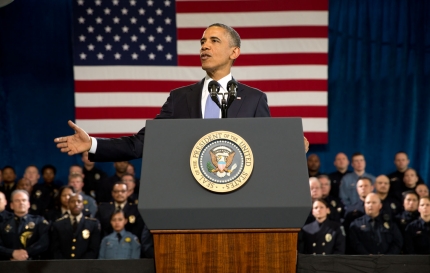
President Obama Speaks on Reducing Gun Violence

April 03, 2013 | 25:38 | Public Domain

President Obama asks the American people to join him in calling on Congress to pass common-sense measures to reduce gun violence, including closing loopholes in the background check system to keep guns out of the hands criminals and others who should not have access to them.

Download mp4 (946MB) | mp3 (62MB)

Read the Transcript

Remarks by the President on Reducing Gun Violence -- Denver, Colorado

Denver Police Academy
Denver, Colorado

3:19 P.M. MDT

THE PRESIDENT:  Thank you!  (Applause.)  Thank you so much.  Everybody, please have a seat.  Thank you.  Well, it is wonderful to be back in Colorado.  It is wonderful to be back in Denver.  I want to thank Chief White for that introduction.  You’ve got some outstanding elected officials who are here today, and I want to acknowledge them.  First of all, a wonderful governor -- John Hickenlooper is here.  (Applause.)  He’s here somewhere.  I know, because I just talked to him.  There he is.  Next to him an outstanding lieutenant governor, Joe Garcia.  (Applause.)  One of the finest young senators in the country -- Michael Bennet is here.  (Applause.)  Terrific members of the House of Representatives -- Ed Perlmutter -- (applause) -- and Dianna Degette.  (Applause.)  And your own mayor, Michael Hancock, is here.  (Applause.) 

I want to say thank you to the Denver Police for having me here, and more importantly, for the outstanding work that all of you do each and every day to serve your communities and protect your citizens. 

Before I came out here, I had a chance to sit down with some local law enforcement, Attorney General Holder, and some of the leaders I just mentioned, the wonderful mayor of Aurora who’s here, sportsmen, parents, loved ones of the victims of the shootings in Columbine and Aurora.  And we talked about what we can do to protect more of our citizens from gun violence. 

And from the beginning of this effort, we’ve wanted law enforcement front and center in shaping this discussion and the reforms that emerge from it -- because law enforcement lives this every day.  Law enforcement are the first to see the terrible consequences of any kind of violence, certainly gun violence -- lives lost, families broken, communities that are changed forever.  They’re very often in the line of fire.  The law enforcement knows what works and what doesn’t, and so we wanted that experience and that advice. 

And it was also important for us to hear from mayors like Steve Hogan, because he’s been on the front lines having to deal with these issues under incredibly sad circumstances.  And I’ve come to Denver today in particular because Colorado is proving a model of what’s possible.

It’s now been just over 100 days since the murder of 20 innocent children and six brave educators in Newtown, Connecticut -- an event that shocked this country and I think galvanized parents all across the country to say, we’ve got to do something more to protect our kids.  But consider this:  Over those 100 days or so, more than 100 times as many Americans have fallen victim to gun violence.  More than 2,000 of our fellow citizens, struck down, often because they were just going about their daily round.  They weren’t doing anything special.  Just doing what folks do every day -- shopping, going to school.  Every day that we wait to do something about it, even more of our fellow citizens are stolen from our lives by a bullet from a gun.

Now, the good news is Colorado has already chosen to do something about it.  (Applause.)  Look, this is a state that has suffered the tragedy of two of the worst mass shootings in our history -- 14 years ago this month in Columbine, and just last year in Aurora.  But this is also a state that treasures its Second Amendment rights -- the state of proud hunters and sportsmen.  And, by the way, the Governor wanted me to remind everybody that there is outstanding elk hunting here in Colorado.  (Laughter.)  There’s a strong tradition of gun ownership that’s handed down from generation to generation, and it’s part of the fabric of people’s lives.  And they treat gun ownership with reverence and respect.

And so I’m here because I believe there doesn't have to be a conflict in reconciling these realities.  There doesn’t have to be a conflict between protecting our citizens and protecting our Second Amendment rights.  I’ve got stacks of letters in my office from proud gun owners, whether they’re for sport, or protection, or collection, who tell me how deeply they cherish their rights, don’t want them infringed upon, but they still want us to do something to stop the epidemic of gun violence.  And I appreciate every one of those letters.  And I’ve learned from them. 

And I think that Colorado has shown that practical progress is possible thanks to the leadership of Governor Hickenlooper and some of the state legislators who are here today.  When I was talking to Steve, he mentioned that Aurora is very much a purple city.  It’s got a majority Republican city council; a majority of the state legislators are Democrat.  But they came together understanding that out of this tragedy there had to be something that made sense.  And so we’ve seen enacted tougher background checks that won’t infringe on the rights of responsible gun owners, but will help keep guns out of the hands of dangerous people.  (Applause.)

Now, in January, just a few weeks after Newtown, I put forward a series of common-sense proposals along the same lines as what’s passed here in Colorado, to reduce gun violence and keep our kids safe.  In my State of the Union address, I urged Congress to give these proposals a vote.  And, by the way, before we even asked for a vote, I had already signed numerous executive orders doing what we could administratively to make sure that guns don't fall into the hands of the wrong people.

But what I said then is still true:  If we're really going to tackle this problem seriously, then we've got to get Congress to take the next step.  And as soon as next week, they will be voting.  As soon as next week, every senator will get to vote on whether or not we should require background checks for anyone who wants to purchase a gun. 

Now, some say, well, we already have background checks.  And they're right.  Over the past 20 years, those background checks have kept more than 2 million dangerous people from buying a gun.  But the loopholes that currently exist in the law have allowed way too many criminals and folks who shouldn’t be getting guns -- it has allowed them to avoid background checks entirely.  That makes it harder for law enforcement to do its job.  It's not safe.  It's not smart.  And, by the way, it's not fair to responsible gun owners who are playing by the rules.

Now, understand, nobody is talking about creating an entirely new system.  We are simply talking about plugging holes, sealing a porous system that isn't working as well as it should.  If you want to buy a gun, whether it's from a licensed dealer or a private seller, you should at least have to pass a background check to show you're not a criminal or someone legally prohibited from buying on.  And that’s just common sense.  (Applause.) 

During our roundtable discussion with Governor Hickenlooper, who I know was in the midst of this passionate debate about the legislation here in Colorado, and some people said, well, background checks aren't going to stop everybody.  And the Governor was the first one to acknowledge, yes, they won't stop everybody, but as he pointed out, statistically, there are a whole bunch of folks who have been stopped. 

As a consequence of background checks, law enforcement has been able to stop people who have been convicted of murder from getting a gun, people who are under restraining orders for having committed violent domestic abuse from getting a gun.  In a couple of cases the governor mentioned to me, law enforcement has actually been able to arrest people who came to pick up their gun -- (laughter) -- because they were criminals, wanted.

So this does work.  And, by the way, if you’re selling a gun, wouldn’t you want to know who you’re selling it to?  Wouldn’t you want to know?  Wouldn’t you want in your conscience to know that the person you’re selling to isn’t going to commit a crime?  (Applause.) 

So these enhanced background checks won’t stop all gun crimes, but they will certainly help prevent some.  This is common sense.  And, by the way, most gun owners -- more than 80 percent -- agree this makes sense.  More than 70 percent of NRA members agree.  Ninety percent of the American people agree.  So there’s no reason we can’t do this unless politics is getting in the way.  There’s no reason we can’t do this.

As soon as next week, every senator will get a chance to vote on a proposal to help strengthen school safety and help people struggling with mental health problems get the treatment that they need.

As soon as next week, every senator will get to vote on whether or not we should crack down on folks who buy guns as part of a scheme to arm criminals.  That would keep more guns off the streets and out of the hands of people who are intent on doing harm.  And it would make life a whole lot easier and safer for the people behind me -- police officers. 

Every senator will get a say on whether or not we should keep weapons of war and high-capacity ammunition magazines that facilitate mass killings off our streets.  The type of assault rifle used in Aurora, for example, when paired with a high-capacity magazine, has one purpose:  to pump out as many bullets as possible, as fast as possible.  It’s what allowed that gunman to shoot 70 people and kill 12 in a matter of a few minutes.  I don’t believe that weapons designed for theaters of war have a place in movie theaters.  Most Americans agree with that.  (Applause.) 

Most of these ideas are not controversial.  Right now, 90 percent of Americans -- 90 percent -- support background checks that will keep criminals and people who have been found to be a danger to themselves or others from buying a gun.  More than 80 percent of Republicans agree.  Most gun owners agree.  Think about it:  How often do 90 percent of Americans agree on anything?  (Laughter.)

And yet, there are already some senators back in Washington floating the idea that they might use obscure procedural stunts to prevent or delay any of these votes on reform.  Think about that.  They’re not just saying they’ll vote “no” on the proposal that most Americans support.  They’re saying they’ll do everything they can to avoid even allowing a vote on a proposal that the overwhelming majority of the American people support.  They’re saying your opinion doesn’t matter. 

We knew from the beginning that change wouldn’t be easy.  And we knew that there would be powerful voices that would do everything they could to run out the clock, change the subject, ignore the majority of the American people.  We knew they’d try to make any progress collapse under the weight of fear and frustration, or maybe people would just stop paying attention.

The only way this time will be different is if the American people demand that this time it must be different -- that this time, we must do something to protect our communities and our kids.  (Applause.)  We need parents, we need teachers, we need police officers, we need pastors, we need hunters and sportsmen, Americans of every background to say, we’ve suffered too much pain and care too much about our children to allow this to continue.  We’re not going to just wait for the next Newtown or the next Aurora before we act.  And I genuinely believe that’s what the overwhelming majority of Americans -- I don’t care what party they belong to -- that’s what they want.  They just want to see some progress. 

It was interesting, during the conversation, a number of people talked about the trust issue.  Part of the reason it's so hard to get this done is because both sides of the debate sometimes don't listen to each other.  The people who take absolute positions on these issues, on both sides, sometimes aren't willing to concede even an inch of ground. 

And so one of the questions we talked about was, how do you build trust?  How do you rebuild some trust?  And I told the story about two conversations I had.  The first conversation was when Michelle came back from doing some campaigning out in rural Iowa.  And we were sitting at dinner, and she had been to like a big county, a lot of driving out there, a lot of farmland.  And she said, if I was living out in a farm in Iowa, I'd probably want a gun, too.  If somebody just drives up into your driveway and you're not home -- you don't know who these people are and you don't know how long it's going to take for the sheriffs to respond.  I can see why you'd want some guns for protection.  That's one conversation.

I had another conversation just a couple of months ago with a mom from Chicago -- actually, Evanston, Illinois -- whose son had been killed in a random shooting.  And she said, you know, I hate it when people tell me that my son was shot because he was in the wrong place at the wrong time.  He was in the right place.  He was on his way to school.  He wasn't in the wrong place.  He was exactly where he was supposed to be. 

Now, both those things are true.  And sometimes we're so divided between rural and urban, and folks whose hunting is part of their lives and folks whose only experience with guns is street crime.  And the two sides just talk past one another.  And more than anything, what I want to just emphasize is there are good people on both sides of this thing, but we have to be able to put ourselves in the other person's shoes.  If you're a hunter, if you're a sportsman -- if you have a gun in your house for protection -- you've got to understand what it feels like for that mom whose son was randomly shot. 

And if you live in an urban area and you're worried about street crime, you've got to understand what it might be like if you grew out on a ranch and your dad had been taking you hunting all your life.  And we had a couple of sportsmen in our conversation today, and I thought one of them said something very important.  He said, all my experiences with guns have been positive, but I realize that for others, all their experiences about guns have been negative.  Well, that's a start, right?  If we start listening to each other, then we should be able to get something done that's constructive.  We should be able to get that done.  (Applause.) 

One last thing I’m going to mention is that during this conversation -- I hope you don't mind me quoting you, Joe.  Joe Garcia, I thought, also made an important point, and that is that the opponents of some of these common-sense laws have ginned up fears among responsible gun owners that have nothing to do with what’s being proposed and nothing to do with the facts, but feeds into this suspicion about government. 

You hear some of these quotes:  “I need a gun to protect myself from the government.”  “We can't do background checks because the government is going to come take my guns away.” 

Well, the government is us.  These officials are elected by you.  (Applause.)  They are elected by you.  I am elected by you.  I am constrained, as they are constrained, by a system that our Founders put in place.  It’s a government of and by and for the people.

And so, surely, we can have a debate that's not based on the notion somehow that your elected representatives are trying to do something to you other than potentially prevent another group of families from grieving the way the families of Aurora or Newtown or Columbine have grieved.  We’ve got to get past some of the rhetoric that gets perpetuated that breaks down trust and is so over the top that it just shuts down all discussion.  And it’s important for all of us when we hear that kind of talk to say, hold on a second.  If there are any folks who are out there right now who are gun owners, and you’ve been hearing that somehow somebody is taking away your guns, get the facts.  We’re not proposing a gun registration system, we’re proposing background checks for criminals.  (Applause.)

Don't just listen to what some advocates or folks who have an interest in this thing are saying.  Look at the actual legislation.  That's what happened here in Colorado.  And hopefully, if we know the facts and we’re listening to each other, then we can actually move forward. 

And that’s what members of Congress need to hear from you.  Right now, members of Congress are at home in their districts.  Many of them are holding events where they can hear from their constituents.  So I'm asking anyone out there who is listening today, find out where your member of Congress stands on these issues.  If they're not part of the 90 percent of Americans who agree on background checks, then ask them why not.  Why wouldn’t you want to make it more difficult for a dangerous criminal to get his or her hands on a gun?  Why wouldn’t you want to close the loophole that allows too many criminals to buy a gun without even the simplest of background checks?  Why on Earth wouldn’t you want to make it easier rather than harder for law enforcement to do their job?

I know that some of the officers here today know what it's like to look into the eyes of a parent or a grandparent, a brother or a sister, or a spouse who has just lost a loved one to an act of violence.  Some of those families, by the way, are here today.  And as police officers, you know as well as anybody, there is no magic solution to prevent every bad thing from happening in the world.  You still suit up, you put on your badge, put yourself at risk every single day.  Every single day, you go to work and you try to do the best you can to protect the people you're sworn to protect and serve.  Well, how can the rest of us as citizens do anything less?

If there is just one step we can take to prevent more Americans from knowing the pain that some of the families who are here have known, don’t we have an obligation to try?  Don’t we have an obligation to try?  (Applause.)  If these reforms keep one person from murdering dozens of innocent children or worshippers or moviegoers in a span of minutes, isn't it worth fighting for?  (Applause.)  I believe it is.  That’s why I'm going to keep on working.  I'm going to keep on giving it my best efforts.  But I'm going to need your help. 

This is not easy.  And I'll be blunt -- a lot of members of Congress, this is tough for them.  Because those who are opposed to any form of legislation affecting guns, they're very well-organized and they're very well-financed.  But it can be done if enough voices are heard.

So I want to thank all the police officers who are here for giving their best efforts every single day.  (Applause.)  I want to thank Governor Hickenlooper for his outstanding leadership.  (Applause.)  I want to thank all the families who are here for your courage in being willing to take out of this tragedy something positive.  I want to thank the people of Colorado for coming together in sensible ways.  (Applause.)  Let's see if we can get the whole country to do so.

Thank you, Denver.  God bless you.  And God bless the United States of America.  (Applause.)

                                  END                3:45 P.M. MDT

Close Transcript

President Obama: Requiring Background Checks for Anyone Who Wants to Buy a Gun is Common Sense

President Barack Obama delivers remarks at the Denver Police Academy

President Barack Obama delivers remarks at the Denver Police Academy in Denver, Colo., April 3, 2013. (Official White House Photo by Pete Souza)

Today in Colorado, President Obama asked the American people to continue calling on Congress to vote on a set of common-sense proposals to help reduce gun violence, including closing loopholes in the background check system to keep guns out of the hands criminals and others who should not have access to them.

Since the tragic shooting in Newtown, Connecticut prompted a national call for action just over 100 days ago, gun violence has killed more than 2,000 Americans. “Every day that we wait to do something about it, even more of our fellow citizens are stolen from our lives by a bullet from a gun,” President Obama said today.

Colorado – a state that’s experienced two of the worst mass shootings in U.S. history – has already taken action to prevent future violence. State officials worked together to enact tougher background checks that help keep guns out of the hands of dangerous people without infringing on the rights of responsible gun owners.

“There doesn’t have to be a conflict between protecting our citizens and protecting our Second Amendment rights,” President Obama said. “Colorado has shown that practical progress is possible.”