The White House

Office of the Press Secretary

Remarks by the President on Reducing Gun Violence -- Denver, Colorado

Denver Police Academy
Denver, Colorado

3:19 P.M. MDT

THE PRESIDENT:  Thank you!  (Applause.)  Thank you so much.  Everybody, please have a seat.  Thank you.  Well, it is wonderful to be back in Colorado.  It is wonderful to be back in Denver.  I want to thank Chief White for that introduction.  You’ve got some outstanding elected officials who are here today, and I want to acknowledge them.  First of all, a wonderful governor -- John Hickenlooper is here.  (Applause.)  He’s here somewhere.  I know, because I just talked to him.  There he is.  Next to him an outstanding lieutenant governor, Joe Garcia.  (Applause.)  One of the finest young senators in the country -- Michael Bennet is here.  (Applause.)  Terrific members of the House of Representatives -- Ed Perlmutter -- (applause) -- and Dianna Degette.  (Applause.)  And your own mayor, Michael Hancock, is here.  (Applause.) 

I want to say thank you to the Denver Police for having me here, and more importantly, for the outstanding work that all of you do each and every day to serve your communities and protect your citizens. 

Before I came out here, I had a chance to sit down with some local law enforcement, Attorney General Holder, and some of the leaders I just mentioned, the wonderful mayor of Aurora who’s here, sportsmen, parents, loved ones of the victims of the shootings in Columbine and Aurora.  And we talked about what we can do to protect more of our citizens from gun violence. 

And from the beginning of this effort, we’ve wanted law enforcement front and center in shaping this discussion and the reforms that emerge from it -- because law enforcement lives this every day.  Law enforcement are the first to see the terrible consequences of any kind of violence, certainly gun violence -- lives lost, families broken, communities that are changed forever.  They’re very often in the line of fire.  The law enforcement knows what works and what doesn’t, and so we wanted that experience and that advice. 

And it was also important for us to hear from mayors like Steve Hogan, because he’s been on the front lines having to deal with these issues under incredibly sad circumstances.  And I’ve come to Denver today in particular because Colorado is proving a model of what’s possible.

It’s now been just over 100 days since the murder of 20 innocent children and six brave educators in Newtown, Connecticut -- an event that shocked this country and I think galvanized parents all across the country to say, we’ve got to do something more to protect our kids.  But consider this:  Over those 100 days or so, more than 100 times as many Americans have fallen victim to gun violence.  More than 2,000 of our fellow citizens, struck down, often because they were just going about their daily round.  They weren’t doing anything special.  Just doing what folks do every day -- shopping, going to school.  Every day that we wait to do something about it, even more of our fellow citizens are stolen from our lives by a bullet from a gun.

Now, the good news is Colorado has already chosen to do something about it.  (Applause.)  Look, this is a state that has suffered the tragedy of two of the worst mass shootings in our history -- 14 years ago this month in Columbine, and just last year in Aurora.  But this is also a state that treasures its Second Amendment rights -- the state of proud hunters and sportsmen.  And, by the way, the Governor wanted me to remind everybody that there is outstanding elk hunting here in Colorado.  (Laughter.)  There’s a strong tradition of gun ownership that’s handed down from generation to generation, and it’s part of the fabric of people’s lives.  And they treat gun ownership with reverence and respect.

And so I’m here because I believe there doesn't have to be a conflict in reconciling these realities.  There doesn’t have to be a conflict between protecting our citizens and protecting our Second Amendment rights.  I’ve got stacks of letters in my office from proud gun owners, whether they’re for sport, or protection, or collection, who tell me how deeply they cherish their rights, don’t want them infringed upon, but they still want us to do something to stop the epidemic of gun violence.  And I appreciate every one of those letters.  And I’ve learned from them. 

And I think that Colorado has shown that practical progress is possible thanks to the leadership of Governor Hickenlooper and some of the state legislators who are here today.  When I was talking to Steve, he mentioned that Aurora is very much a purple city.  It’s got a majority Republican city council; a majority of the state legislators are Democrat.  But they came together understanding that out of this tragedy there had to be something that made sense.  And so we’ve seen enacted tougher background checks that won’t infringe on the rights of responsible gun owners, but will help keep guns out of the hands of dangerous people.  (Applause.)

Now, in January, just a few weeks after Newtown, I put forward a series of common-sense proposals along the same lines as what’s passed here in Colorado, to reduce gun violence and keep our kids safe.  In my State of the Union address, I urged Congress to give these proposals a vote.  And, by the way, before we even asked for a vote, I had already signed numerous executive orders doing what we could administratively to make sure that guns don't fall into the hands of the wrong people.

But what I said then is still true:  If we're really going to tackle this problem seriously, then we've got to get Congress to take the next step.  And as soon as next week, they will be voting.  As soon as next week, every senator will get to vote on whether or not we should require background checks for anyone who wants to purchase a gun. 

Now, some say, well, we already have background checks.  And they're right.  Over the past 20 years, those background checks have kept more than 2 million dangerous people from buying a gun.  But the loopholes that currently exist in the law have allowed way too many criminals and folks who shouldn’t be getting guns -- it has allowed them to avoid background checks entirely.  That makes it harder for law enforcement to do its job.  It's not safe.  It's not smart.  And, by the way, it's not fair to responsible gun owners who are playing by the rules.

Now, understand, nobody is talking about creating an entirely new system.  We are simply talking about plugging holes, sealing a porous system that isn't working as well as it should.  If you want to buy a gun, whether it's from a licensed dealer or a private seller, you should at least have to pass a background check to show you're not a criminal or someone legally prohibited from buying on.  And that’s just common sense.  (Applause.) 

During our roundtable discussion with Governor Hickenlooper, who I know was in the midst of this passionate debate about the legislation here in Colorado, and some people said, well, background checks aren't going to stop everybody.  And the Governor was the first one to acknowledge, yes, they won't stop everybody, but as he pointed out, statistically, there are a whole bunch of folks who have been stopped. 

As a consequence of background checks, law enforcement has been able to stop people who have been convicted of murder from getting a gun, people who are under restraining orders for having committed violent domestic abuse from getting a gun.  In a couple of cases the governor mentioned to me, law enforcement has actually been able to arrest people who came to pick up their gun -- (laughter) -- because they were criminals, wanted.

So this does work.  And, by the way, if you’re selling a gun, wouldn’t you want to know who you’re selling it to?  Wouldn’t you want to know?  Wouldn’t you want in your conscience to know that the person you’re selling to isn’t going to commit a crime?  (Applause.) 

So these enhanced background checks won’t stop all gun crimes, but they will certainly help prevent some.  This is common sense.  And, by the way, most gun owners -- more than 80 percent -- agree this makes sense.  More than 70 percent of NRA members agree.  Ninety percent of the American people agree.  So there’s no reason we can’t do this unless politics is getting in the way.  There’s no reason we can’t do this.

As soon as next week, every senator will get a chance to vote on a proposal to help strengthen school safety and help people struggling with mental health problems get the treatment that they need.

As soon as next week, every senator will get to vote on whether or not we should crack down on folks who buy guns as part of a scheme to arm criminals.  That would keep more guns off the streets and out of the hands of people who are intent on doing harm.  And it would make life a whole lot easier and safer for the people behind me -- police officers. 

Every senator will get a say on whether or not we should keep weapons of war and high-capacity ammunition magazines that facilitate mass killings off our streets.  The type of assault rifle used in Aurora, for example, when paired with a high-capacity magazine, has one purpose:  to pump out as many bullets as possible, as fast as possible.  It’s what allowed that gunman to shoot 70 people and kill 12 in a matter of a few minutes.  I don’t believe that weapons designed for theaters of war have a place in movie theaters.  Most Americans agree with that.  (Applause.) 

Most of these ideas are not controversial.  Right now, 90 percent of Americans -- 90 percent -- support background checks that will keep criminals and people who have been found to be a danger to themselves or others from buying a gun.  More than 80 percent of Republicans agree.  Most gun owners agree.  Think about it:  How often do 90 percent of Americans agree on anything?  (Laughter.)

And yet, there are already some senators back in Washington floating the idea that they might use obscure procedural stunts to prevent or delay any of these votes on reform.  Think about that.  They’re not just saying they’ll vote “no” on the proposal that most Americans support.  They’re saying they’ll do everything they can to avoid even allowing a vote on a proposal that the overwhelming majority of the American people support.  They’re saying your opinion doesn’t matter. 

We knew from the beginning that change wouldn’t be easy.  And we knew that there would be powerful voices that would do everything they could to run out the clock, change the subject, ignore the majority of the American people.  We knew they’d try to make any progress collapse under the weight of fear and frustration, or maybe people would just stop paying attention.

The only way this time will be different is if the American people demand that this time it must be different -- that this time, we must do something to protect our communities and our kids.  (Applause.)  We need parents, we need teachers, we need police officers, we need pastors, we need hunters and sportsmen, Americans of every background to say, we’ve suffered too much pain and care too much about our children to allow this to continue.  We’re not going to just wait for the next Newtown or the next Aurora before we act.  And I genuinely believe that’s what the overwhelming majority of Americans -- I don’t care what party they belong to -- that’s what they want.  They just want to see some progress. 

It was interesting, during the conversation, a number of people talked about the trust issue.  Part of the reason it's so hard to get this done is because both sides of the debate sometimes don't listen to each other.  The people who take absolute positions on these issues, on both sides, sometimes aren't willing to concede even an inch of ground. 

And so one of the questions we talked about was, how do you build trust?  How do you rebuild some trust?  And I told the story about two conversations I had.  The first conversation was when Michelle came back from doing some campaigning out in rural Iowa.  And we were sitting at dinner, and she had been to like a big county, a lot of driving out there, a lot of farmland.  And she said, if I was living out in a farm in Iowa, I'd probably want a gun, too.  If somebody just drives up into your driveway and you're not home -- you don't know who these people are and you don't know how long it's going to take for the sheriffs to respond.  I can see why you'd want some guns for protection.  That's one conversation.

I had another conversation just a couple of months ago with a mom from Chicago -- actually, Evanston, Illinois -- whose son had been killed in a random shooting.  And she said, you know, I hate it when people tell me that my son was shot because he was in the wrong place at the wrong time.  He was in the right place.  He was on his way to school.  He wasn't in the wrong place.  He was exactly where he was supposed to be. 

Now, both those things are true.  And sometimes we're so divided between rural and urban, and folks whose hunting is part of their lives and folks whose only experience with guns is street crime.  And the two sides just talk past one another.  And more than anything, what I want to just emphasize is there are good people on both sides of this thing, but we have to be able to put ourselves in the other person's shoes.  If you're a hunter, if you're a sportsman -- if you have a gun in your house for protection -- you've got to understand what it feels like for that mom whose son was randomly shot. 

And if you live in an urban area and you're worried about street crime, you've got to understand what it might be like if you grew out on a ranch and your dad had been taking you hunting all your life.  And we had a couple of sportsmen in our conversation today, and I thought one of them said something very important.  He said, all my experiences with guns have been positive, but I realize that for others, all their experiences about guns have been negative.  Well, that's a start, right?  If we start listening to each other, then we should be able to get something done that's constructive.  We should be able to get that done.  (Applause.) 

One last thing I’m going to mention is that during this conversation -- I hope you don't mind me quoting you, Joe.  Joe Garcia, I thought, also made an important point, and that is that the opponents of some of these common-sense laws have ginned up fears among responsible gun owners that have nothing to do with what’s being proposed and nothing to do with the facts, but feeds into this suspicion about government. 

You hear some of these quotes:  “I need a gun to protect myself from the government.”  “We can't do background checks because the government is going to come take my guns away.” 

Well, the government is us.  These officials are elected by you.  (Applause.)  They are elected by you.  I am elected by you.  I am constrained, as they are constrained, by a system that our Founders put in place.  It’s a government of and by and for the people.

And so, surely, we can have a debate that's not based on the notion somehow that your elected representatives are trying to do something to you other than potentially prevent another group of families from grieving the way the families of Aurora or Newtown or Columbine have grieved.  We’ve got to get past some of the rhetoric that gets perpetuated that breaks down trust and is so over the top that it just shuts down all discussion.  And it’s important for all of us when we hear that kind of talk to say, hold on a second.  If there are any folks who are out there right now who are gun owners, and you’ve been hearing that somehow somebody is taking away your guns, get the facts.  We’re not proposing a gun registration system, we’re proposing background checks for criminals.  (Applause.)

Don't just listen to what some advocates or folks who have an interest in this thing are saying.  Look at the actual legislation.  That's what happened here in Colorado.  And hopefully, if we know the facts and we’re listening to each other, then we can actually move forward. 

And that’s what members of Congress need to hear from you.  Right now, members of Congress are at home in their districts.  Many of them are holding events where they can hear from their constituents.  So I'm asking anyone out there who is listening today, find out where your member of Congress stands on these issues.  If they're not part of the 90 percent of Americans who agree on background checks, then ask them why not.  Why wouldn’t you want to make it more difficult for a dangerous criminal to get his or her hands on a gun?  Why wouldn’t you want to close the loophole that allows too many criminals to buy a gun without even the simplest of background checks?  Why on Earth wouldn’t you want to make it easier rather than harder for law enforcement to do their job?

I know that some of the officers here today know what it's like to look into the eyes of a parent or a grandparent, a brother or a sister, or a spouse who has just lost a loved one to an act of violence.  Some of those families, by the way, are here today.  And as police officers, you know as well as anybody, there is no magic solution to prevent every bad thing from happening in the world.  You still suit up, you put on your badge, put yourself at risk every single day.  Every single day, you go to work and you try to do the best you can to protect the people you're sworn to protect and serve.  Well, how can the rest of us as citizens do anything less?

If there is just one step we can take to prevent more Americans from knowing the pain that some of the families who are here have known, don’t we have an obligation to try?  Don’t we have an obligation to try?  (Applause.)  If these reforms keep one person from murdering dozens of innocent children or worshippers or moviegoers in a span of minutes, isn't it worth fighting for?  (Applause.)  I believe it is.  That’s why I'm going to keep on working.  I'm going to keep on giving it my best efforts.  But I'm going to need your help. 

This is not easy.  And I'll be blunt -- a lot of members of Congress, this is tough for them.  Because those who are opposed to any form of legislation affecting guns, they're very well-organized and they're very well-financed.  But it can be done if enough voices are heard.

So I want to thank all the police officers who are here for giving their best efforts every single day.  (Applause.)  I want to thank Governor Hickenlooper for his outstanding leadership.  (Applause.)  I want to thank all the families who are here for your courage in being willing to take out of this tragedy something positive.  I want to thank the people of Colorado for coming together in sensible ways.  (Applause.)  Let's see if we can get the whole country to do so.

Thank you, Denver.  God bless you.  And God bless the United States of America.  (Applause.)

                                  END                3:45 P.M. MDT

The White House

Office of the Press Secretary

Press Gaggle by Press Secretary Jay Carney Aboard Air Force One en route Denver, Colorado, 4/3/2013


Aboard Air Force One
En Route Denver, Colorado
 
 
2:14 P.M. EDT
 
MR. CARNEY:  Thanks for joining us today on our flight to Denver, where, as you know, the President will be meeting with law enforcement officials and others at the Denver Police Academy where he will discuss the need for Congress to act on common-sense measures to reduce the scourge of gun violence in America.  
 
I think you can expect that he will note that the legislation he supports that has been moving through Congress represents real, sensible, middle-of-the-road attempts to address this problem; that nothing he supports would in any way violate the Second Amendment rights of the American people, the Second Amendment rights that the President strongly supports.
 
One provision that he supports -- the effort to close loopholes in our background check system -- is supported by over 90 percent of the American people, by vast majorities of Republicans and Democrats and independents, by a substantial majority of gun owners, and a substantial majority of members of the NRA.  
 
He has made clear in his effort, his concerted effort, to move forward with these measures since the Newtown tragedy; that it is imperative the elected officials of the American people allow all of these measures to come to a vote -- and, in his view, to vote for them -- but at the very least, to allow them to come to a vote.  Because if you disagree with 90 percent of the American people on background checks, you ought to vote no, and not oppose -- not use parliamentary maneuvers to prevent a vote.  That’s the President’s view.  
 
In any case, he looks forward to this event.  As you know, he will be going to Connecticut on Monday to continue this conversation.  
 
Q    When the President insists on these votes, particularly on assault weapons and the high-capacity magazines, is it because he thinks that there is a price to pay for voting no?  And isn’t there just as well a price to pay by some members of Congress, some Democrats, for voting yes on those issues?
 
MR. CARNEY:  Jim, there are definitely political issues involved in this.  This has always been the case.  But the President doesn’t look at this through a political lens.  He’s not asking for a vote for political reasons, he’s asking for a vote because the victims of Newtown and of Aurora and Virginia Tech, and the countless lesser-known victims of gun violence across America deserve at least a vote.  And the kids who were killed -- the 20 children who were killed in Newtown, they weren’t Republicans or Democrats; they didn’t care, and their parents don’t care about the political implications of voting yes or no on these bills.  They want things done that give other children more protection from this kind of violence, and that includes every measure that the President supports. 
 
Q    Any reaction to reports that current and former cops think that today’s Denver venue is not the right place to have a speech?
 
MR. CARNEY:  Well, look, obviously people have a variety of views on these issues across America.  I think it’s irrefutable that a majority of law enforcement professionals in America support common-sense measures that are at issue now and subject to votes in Congress.  I don't think anybody would argue with that.
 
I think most law enforcement officials agree that closing loopholes in our background check system assists them in their job to protect the American people from gun violence.  If you're opposed to taking measures to prevent criminals from getting weapons, vote no and explain why.  Most police officers, law enforcement officers support the idea that we ought to take measures to ensure that the system that already exists is actually effective so that those who by law should not have weapons cannot obtain them.  It’s a pretty simple proposition.
 
Q    How do you fight the perception, though, that these measures are losing steam in Congress? 
 
MR. CARNEY:  I think perceptions are one thing, reality is another.  And the fact is we are moving forward with Congress and are in regular conversation with members and staff from both parties about how to move forward.  And the President is committed to pressing this agenda because it’s the right thing to do for our children and all the potential victims of gun violence in the country. 
 
I think that as I said the other day and the President has made clear, he never believed and we never suggested that any of this would be easy.  There’s a reason why these kinds of actions have not succeeded for many years now.  There are a variety of reasons why.  But it is incumbent upon every elected official sent to Washington to address this challenge, this scourge, and to -- he believes -- do the common-sense things that can help save the lives of our children in the future.
 
Q    But there’s a difference, isn’t there, between saying this isn’t going to be easy and counting votes.  And the votes for a lot of these things aren’t there.
 
MR. CARNEY:  Well, again, the votes haven’t happened, first of all.  Secondly, if the votes were there, Jeff, they would have been voted and done and signed into law a long time ago.  That's why a process like this exists.  That’s why negotiations are ongoing on a variety of pieces of this proposal in an effort to try to find the votes necessary.  And, unfortunately, it is, as we've said many times, a feature of our system now that everything in the Senate is subject to a filibuster.  And what the President has said I think very clearly is that it would be shameful to not allow any one of these measures to come up to a vote.  
 
Q    You talked about parliamentary procedures.  Would you consider a filibuster an illegitimate procedure?  I mean, it is part of the rules.
 
MR. CARNEY:  I didn’t say it wasn't part of the rules.  I said that the victims of Newtown -- the 20 kids and the 6 educators who lost their lives -- deserve a vote.  And that if you want to vote no, vote no.  Don’t block a vote.  That’s not doing service to the memory of these kids.  
 
Q    You said that -- you have emphasized that the President doesn’t mean to impinge on anyone's Second Amendment rights, but there are a lot of people out there who believe that he does.  And if I'm not mistaken, Saturday is the five-year anniversary of his speech in San Francisco where he talked about small-town Americans clinging to guns and religion.  What about the optics of going there right after this event in Denver to call attention to his views on guns?
 
MR. CARNEY:  As you know, and as everyone who is an expert on this issue can attest, there is not a single thing that the President has proposed that would take a single firearm away from a single law-abiding citizen in America.  This President supports our Second Amendment rights.  The proposals he put forward -- like banning military-style assault weapons, like limiting high-capacity ammunition clips -- these are proposals that in no way infringe upon Second Amendment rights, and, again, would not take any firearm away from any law enforcement -- law-abiding citizen.
 
When it comes to straw purchases -- I mean, again, this is about enforcing the law.  If you have individuals who are routinely buying weapons as straw purchasers on behalf of criminals who cannot buy weapons themselves because of their criminal record, that’s a violation of the law, and we ought to take action to ensure that the law is enforced.  That seems like a very common-sense, conservative principle to me, as does the idea that the background check system that already exists should be improved so that loopholes are closed that make sure that it does what it was intended to do, and that is ensure that those with criminal records and others who by law should not be allowed to, or are not allowed to purchase weapons cannot circumvent the law because of the loopholes in the system.
 
Q    Does the President see Colorado as a model for other states after the legislation that they passed here?
 
MR. CARNEY:  The President believes that actions in Colorado, the actions underway in Connecticut do represent important progress on these issues, and I think are useful models to look at as we undertake efforts in Washington.
 
Q    Do you know which lawmakers are going to be at the event?
 
MR. CARNEY:  I don’t.  I can try -- if I can find out, I’ll get that for you.
 
Q    There’s a report that Senator Bennet would be there, but the other senator wouldn’t.
 
MR. CARNEY:  Again, I don’t know.  I’ll have to find out, or we may find out when we get there.
 
Q    On a different subject.  The President and Mrs. Obama are going to Dallas for the Bush Library opening.  Can you tell me how that decision came about, how excited he is about going to Dallas to do this?  What will be on his mind?
 
MR. CARNEY:  He’s very pleased to be going, and looks forward to it.  The office of the President of the United States is a pretty rare position to hold, and only those who have held it can fully appreciate what it means to be President of the United States.  And he shares in common with President George W. Bush a love, a deep love for his country, and appreciates President Bush’s service, and looks forward to being there with him as well as President George H. W. Bush and Presidents Clinton and Carter.
 
Q    Jay, on Keystone pipeline.  One of his hosts today at the fundraiser in San Francisco is an active opponent of the Keystone pipeline -- Tom Steyer.  There are also going to be protests planned outside the Getty mansion tonight.  I guess I’ll try a third time on the Arkansas spill:  Have you had a chance to talk to the President about that spill?  And how does it affect -- how does the Utah spill affect his thinking on the Keystone pipeline, and what would he tell his hosts today if that issue comes up?
 
MR. CARNEY:  Well, I’m not going to preview hypothetical answers to hypothetical questions.  What I will say is that there are procedures in place --
 
Q    The answers wouldn’t be hypothetical, the questions would be.  The answers would be answers to the hypothetical.
 
MR. CARNEY:  Well, I think the whole thing would be hypothetical, Hans, but thank you for your --
 
Q    I’m just clarifying.
 
MR. CARNEY:  I think you’re muddying, actually, but thanks.
 
Q    No, you hide behind this hypothetical thing all the time.
 
MR. CARNEY:  He asked me, if he’s asked, what would he say?
 
Q    Right, but what he’d say would be his answer.  The “if” is the hypothetical.
 
MR. CARNEY:  Well, first of all, the question hasn’t been asked.  He’s not here to give the answer to the hypothetical.
 
Q    -- to the question is the hypothetical.
 
MR. CARNEY:  Thank you for your assistance in the briefing, Hans.  As you know, when an incident like what has happened in Arkansas occurs, there are procedures in place.  The EPA takes the lead; the responsible party is held responsible, as is the case in this situation.  When it comes to Keystone, that is a process, as we’ve discussed many times, that is evaluated at the State Department, as has been the case for many, many years under multiple presidencies, and as is appropriate given the fact that it is a pipeline that crosses international borders.  And that process is underway, as you know.
 
Q    But do incidents such as Arkansas, such as the spill in Utah, inform the decision-making?
 
MR. CARNEY:  Again, the evaluation of these proposals is made at the State Department.  You can certainly ask the State Department about whether any incidents, present or past, what those incidents have in terms of an impact on their evaluation process.  I think there are standards that are followed in this evaluation process that are being followed today at the State Department, but the State Department is the location where this process takes place.
 
Q    Is the decision of the administration at all influenced by people like Mr. Steyer, who is hosting the President today?  Is it at all influenced by the protest and demonstrators that the President sees?
 
MR. CARNEY:  Look, I think we’ve seen over time that there are strongly held views on this issue, on both sides.  And the President is following a process that has been in place for quite some time, through multiple administrations of both parties, and that is the way it should be.  As you know, the process was delayed because of a political action by Congress, but the -- nevertheless, the process is underway and being undertaken by the State Department.
 
Q    Are there any updates, Jay, on North Korea and monitoring of the North Korea situation?
 
MR. CARNEY:  Well, we continue to monitor the situation.  The provocative actions and bellicose rhetoric that we see from North Korea is obviously of concern, and we take -- are taking the necessary precautionary measures, many of which have been reported on.  It is also the case that the behavior of the regime in Pyongyang that we are seeing now has a -- represents a familiar pattern, and as I think we’ve seen over the past several administrations.  
 
So we are taking the necessary precautionary measures, but it is important to view this within the context of the kind of behavior that we’ve seen out of North Korea in the past.  And it’s important to say that, in every instance, this refusal to abide by its international obligations and to engage in threats and provocative rhetoric and behavior only serves to isolate North Korea further, to make it more and more difficult for the North Korean economy to develop, and imposes more and more hardships on the North Korean people.  
 
North Korea knows the path that's available to it -- the regime does -- and that is a path towards greater integration in the international community, stronger economic development, and better prospects for the North Korean people if they take substantive steps towards denuclearization and abide by the series of international obligations that they are currently flouting.
 
Q    Jay, I don’t know if you were asked this in the past few days.  But on immigration, Senator Leahy is saying he is calling for, once a bill is introduced by the Gang of Eight, that he wants to accelerate the process, to mark it up, and then advance it to the Senate floor.  Marco Rubio is calling for regular order -- wants hearings, wants more hearings.  He says we need to make sure that we really understand this bill.  What is the administration's view?  Do you believe that, like Senator Leahy, you have to move as fast as possible on this thing, because otherwise it could just die in the Senate because of it just being drawn out, and that we shouldn't go through regular order just because we've already had enough hearings over the past several years?
 
MR. CARNEY:  I think the characterization of regular order here has to be understood within the context of the fact that this legislation in essence has been on the table and subject to debate in the United States Congress for many years now.  The basic outlines of what has been under consideration and is being worked on by the Gang of Eight and has been proposed by the President reflects legislation that was considered in Congress, in 2006, 2007, I believe.  
 
Senator Leahy, as I understand it -- and I would refer you to him and his statements -- has held multiple hearings on this issue.  And the Gang of Eight and all of its members are the ones writing the legislation, which the President obviously believes is a good thing.  And the progress that they have made thus far is also a good thing.  
 
So I leave it to and we leave it to the Chairman and other leaders in the Senate to decide on the process they want to follow.  But the President has made clear that he believes there is no reason to delay this process.  There is no reason to postpone it.  And he has been encouraged by the progress thus far, and hopes and expects that that progress will continue, and that it will result in the production of a bill and the consideration of the bill and a vote on the bill.
 
Q    Now Rubio and other Republicans are saying, wait a minute, why rush it -- if it's good legislation, doesn't it deserve the test of scrutiny, of talking -- it is a new Congress.  The country has changed in the past six years; don't we want to talk it over and look at it more, possibly offer other amendments, make it better.  Do you fear that it would just get killed if it's going to be dragged out?  Is that the problem?  Or is it that people are being deported and you need to get this on the books and end the deportations that the administration is carrying out?
 
MR. CARNEY:  Again, as veterans of the Senate know, this issue has been under consideration at very serious levels periodically for a long time now.  There is a great need to act on comprehensive immigration reform and a great opportunity to do it now, as the President has made clear.  It has been in the past, and seems to be now, a bipartisan priority.  And that is as it should be, in the President's view.  
 
And he has been encouraged by and welcomes the progress being made by the bipartisan Group of Eight.  He has contributed to this process through the blueprint that has been available publicly for a long time now that outlines his principles when it comes to comprehensive immigration reform, and again, looks forward to further progress by the Senate, and action -- and consideration of the bill and action on the bill.
 
Q    Jay, on another -- one last thing.  There’s a new independent report today -- among its leaders are Senator Sam Nunn -- and it says that the U.S. and Russia need to gradually take their nuclear weapons off ready-to-launch status.  I was wondering if you were familiar with that, if the President is familiar with it.  Does he endorse that idea?  
 
MR. CARNEY:  I am not familiar with it.  I am obviously familiar with the very important work that former Senator Nunn and former Senator Lugar have done on the issues of proliferation and reduction of nuclear arsenals, but I’m not familiar with this report.  
 
END
2:35 P.M. EDT

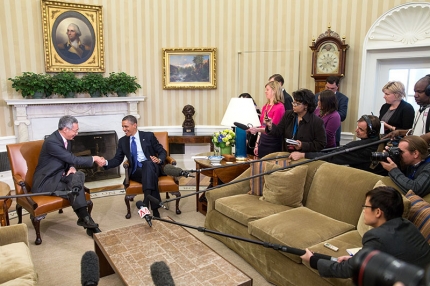
President Obama Meets with Prime Minister Lee of Singapore

President Barack Obama delivers remarks with Prime Minister Lee Hsien Loong of the Republic of Singapore

President Barack Obama delivers remarks with Prime Minister Lee Hsien Loong of the Republic of Singapore prior to a bilateral meeting in the Oval Office, April 2, 2013. (Official White House Photo by Lawrence Jackson)

In a bilateral meeting today with Prime Minister Lee Hsien Loong of Singapore, President Obama reaffirmed America's commitment to a secure and prosperous Asia-Pacific region, and thanked Prime Minster Lee for being “an outstanding partner for us on the international stage.”

In addition to close military cooperation between the two countries that allows the United States to maintain an effective presence the Pacific, Singapore is also a strong economic partner.

“Over the last decade, since we signed our free trade agreement, we have seen a doubling of trade between our countries, and that creates jobs here in the United States as well as in Singapore,” the President said.

The White House

Office of the Press Secretary

Press Briefing by Press Secretary Jay Carney, 4/2/2013


James S. Brady Press Briefing Room
 
 
12:50 P.M. EDT
 
MR. CARNEY:  Good afternoon.  Thank you all for being here.  Before I start, I have two very important announcements to make.  The first, contradicting the April Fool’s joke that Jon-Christopher made yesterday, the Red Sox walloped the Yankees on opening day -- that’s important to note -- 8-2.  And second, the Nationals blanked the Marlins 2-0 with two homeruns by Bryce Harper in his first two at bats.  Excellent opening day.  
 
Second announcement is Monday travel.  You probably have seen, but I want to reiterate that on Monday, April 8th, President Obama will travel to the University of Hartford, where he will continue asking the American people to join him in calling on Congress to pass common-sense legislation to reduce gun violence.  Additional details on the President’s event at the University of Hartford will be forthcoming.
 
With that, I will take your questions.  Jim.
 
Q    Thanks, Jay.  I wanted to start with North Korea.  Yesterday you said that the U.S. has seen no large-scale mobilizations or reposition of forces in North Korea.  Today, Pyongyang said it will restart its plutonium reactor and increase production of nuclear weapons material.  And I wondered if -- does that give the President some pause?  And are you reconsidering the view that this is a familiar pattern or simply belligerent rhetoric?   
 
MR. CARNEY:  I appreciate the question.  The fact is that North Korea’s announcement that it will reopen or restart its nuclear facilities at Yongbyon is another indication of its pattern of contradicting its own commitments and its pattern of violating its international obligations.  As you know, that facility has been dormant, as part of an agreement which North Korea, at least with this announcement, seems to be willing to violate.
 
And there is a path open to North Korea to achieve the security, international respect, and economic development that it seeks.  But this is surely not the path.  And as I said yesterday, it is our position and the position of a broad international alliance, if you will, that North Korea must abandon its pursuit of nuclear weapons and abide by all of its international commitments.
 
We seek the complete, verifiable, and irreversible denuclearization through authentic and credible negotiations.  The U.S. and our international partners have a shared goal of ensuring the denuclearization of the Korean Peninsula and a strong, common interest in peace and stability in Southeast Asia.  
 
As I said yesterday, we are working very closely with our allies in the region.  We are taking appropriate measures in response to the bellicose rhetoric and provocative actions out of North Korea.  But it is -- these actions and this rhetoric is in keeping with a pattern of behavior by the regime in Pyongyang.
 
Q    Jay, at the U.N. today, Ban Ki-moon seemed a little more alarmed, saying the current crisis has gone too far.  He said North Korea is “on a collision course with the international community” and that international negotiations are urgently needed.  Does the President agree?
 
MR. CARNEY:  The President has expressed his concern about the actions and behavior of the regime in North Korea.  And we have worked with our allies, most recognizably at the United Nations Security Council, when a resolution was passed unanimously, with China and Russia, condemning North Korean behavior in this arena.  And we will continue to do that.  And the steps we take, together with our partners, put more pressure on North Korea, further isolate North Korea; make it clear to the regime there that there is no benefit to the North Korean people to the path that they are taking.
 
Meanwhile, we obviously take the steps necessary to ensure the capacity to assist our allies and defend the United States.
 
Q    On the trip to Hartford, coming after the trip to Denver tomorrow, is this a recognition by the President that he faces some real obstacles in Congress on anti-gun legislation or gun violence legislation -- even on the background checks that seemed to have some movement before?
 
MR. CARNEY:  The President has always said, we have always said that this would be hard.  If that weren’t the case, it would have been done before.  If it were simple to pass measures through Congress that are very common sense but would reduce gun violence in America, those measures would have passed already.  And the President has always recognized that this is something that would be a challenge, but that in the wake of the horrific shootings at Newtown, was an obligation of all of us to work on and to try to get done.  
 
We remain engaged in conversations with the Senate and those senators who are interested in forging a bipartisan compromise on measures to reduce gun violence.  I noted, and the President has noted, that when it comes to background checks -- the measure you mentioned -- this is something that's supported by over 90 percent of the American people.  When you ask an average American whether or not it makes sense to have -- to require a background check if you're going to purchase a weapon, overwhelmingly, 90 percent-plus, they say of course it makes sense.  And most of them say -- or many of them say they just assume that system already exists.  And that's an important point to make, too, here, is that the system does exist.  
 
The goal of those, like the President, who are trying to improve the system, is to close loopholes within it that make it imperfect; that allow those who should not obtain weapons to obtain them.  And this is something we're working on very closely with members of both parties.  And that's why the President is going to Denver.  That's why the President is going to Hartford.  That's why the Vice President has held so many events and meetings and conversations.  And you can assume safely that lots of conversations take place between the administration and both staff and lawmakers on Capitol Hill on this issue, and we're going to continue to press forward.  It's very important.  
 
It's essential to the memory of the victims of Newtown that all of these measures get a vote, that they are not filibustered, and it is essential that action be taken, as the President said so passionately last week.
 
Q    Jay, back on North Korea.  When you say "working with our allies," what exactly does that mean? 
 
MR. CARNEY:  Well, we are in close contact -- have been and continue to be -- with our allies in Seoul and Tokyo to coordinate on this issue, and we are regularly reaching out to Beijing and Moscow to encourage them to do more to restrain the North Koreans.  And as I noted moments ago, that we have seen cooperation from all the members of the Security Council, as well as obviously our allies in the region, on this issue, and that is very helpful when it comes to putting the necessary pressure on North Korea.
 
This is part of a pattern of behavior that we've seen out of North Korea.  North Korea acquired a nuclear weapon and tested it under the previous administration, and we have seen consistent behavior that is counterproductive, to say the least, to a goal that one assumes North Korea's leaders aspire to, which is an improvement of the lot of the North Korean people and an end to the isolation of their country within the international community.  
 
So the President is being regularly updated on this and briefed on this.  The entire national security team is obviously focused on this, as you would expect.  But I think it's important to note that, as I said yesterday, the rhetoric has not been backed up by action, and there is a pattern here, a pattern that is familiar.
 
Q    What are the Chinese and Russians not doing that they should be that would be more helpful?
 
MR. CARNEY:  Well, I think it's not a mystery to anyone that China has influence on North Korea, or potentially has influence on North Korea, and we have in the past, and we are now, urged China to use that influence to try to affect North Korean behavior.  That is also true of our interactions with the Russians.  This is a broad diplomatic effort that includes coordination with our allies in Japan and the Republic of Korea as well as with China and Russia and others.  So we're going to keep up that effort.
 
Q    And are you sort of waiting for this whole crisis atmosphere to blow over and then engage the North Koreans to try to get them back to the negotiating table?
 
MR. CARNEY:  Well, I think North Korea understands fully what steps it needs to take to move down the path towards ending its isolation, and those steps have to be concrete towards abiding by its international obligations.  And there's a system in place for that to move forward.  
 
Meanwhile, during a period like this where we're seeing this kind of pattern of behavior reassert itself, we're consulting with our allies, taking necessary precautions, making clear to the North Koreans what our views are, what the consensus view is of the international community; what steps they need to take to improve their situation within the world.  And that process will continue.
 
Dan.
 
Q    Thank you.  Just to follow on Jim's question -- does the President concede that the kind of bipartisan enthusiasm that existed after the Sandy Hook shootings is no longer there?
 
MR. CARNEY:  Well, I would point you to what the President said last Thursday.  And he took great issue with the suggestion or the implication that a mere 100 days after that terrible event, somehow the country or Washington could move on.  The families that suffered the loss in Newtown will never fully be able to move on.  And those of us across the country who were horrified -- and as I think everyone in the country was -- by what happened in Newtown will never forget that day or the days after.  And it's a reminder constantly of why we need to act. 
 
As the President said way back in the wake of Newtown, if we can take some common-sense measures that would save one life, one child's life, we ought to do it.  And if we can do more than that through the proposals that he has urged Congress to act on and the initiatives that he has acted on and is acting on administratively -- if we can reduce the amount of gun violence, if we can protect our children better -- then we will have at least partly fulfilled our most fundamental obligation.  
 
And he believes that that passion, that urgency still exists around the country and still exists -- if not in full, then in part -- in Washington.  And that is why he is continuing to make the case and why he will make the case in Denver and will make the case in Connecticut.  It is why we are engaging with Congress on this very important matter. 
 
And I would just note that this process continues to move forward.  Negotiations and conversations continue to take place.  And it is essential that Congress act and essential that it take action. 
 
Q    Would the President, though, be as aggressively pursuing this on the road -- and the Vice President and others in the administration -- if the conversation up on the Hill was in a better place?
 
MR. CARNEY:  I think that sort of turns on its head the basic point, which is the President in the wake of Newtown made clear that the country needed to act and that he would act.  He immediately called on Congress to take up measures that he supported, in terms of legislation that would help reduce gun violence, common-sense legislation that in no way infringes upon Americans' Second Amendment rights.  He then asked the Vice President to lead an effort to assess what else we could do, what package of initiatives we could act on to address this problem.  And that, within a month, was put forward to the American people, and we have been pressing ever since.  
 
But from the beginning, as everyone here knows, the proposition itself was a challenging one for all the reasons that we understand about the efforts in the past to address gun violence through common-sense legislation or other means.  This is not easy stuff.  And the President has been clear about that from the beginning.  But that is not an excuse not to do everything you can to make it happen. 
 
Q    On another subject, former-Secretary of State Clinton will be stepping out to make a public speech this evening.  And I'm wondering if the President is paying any attention to this at all.  And does he continue to get any foreign policy advice from her?
 
MR. CARNEY:  Well, I have no private conversations to read out to you with Secretary Clinton or anyone else.  But you know how the President feels about Secretary Clinton, about her remarkable service in this administration in his first term.  And I am sure -- I think you're referring to the Vital Voices event, and I'm sure he wishes her well tonight and going forward.
 
Q    Jay, does the President think he can change votes in Congress by going out into the country and making this appeal on guns?
 
MR. CARNEY:  Jon, I don't think it's an issue of changing votes.  It's a matter of what we've always said, which is that these are -- all of these issues that we are addressing here in Washington have a direct impact on the lives of average Americans, and they have a stake in what we do here.  And it has never been the President's belief that Americans elect their representatives, send them to Washington, and then disengage from the process.  In fact, it's been the President's belief that Americans remain focused on a care deeply about what happens here, and that they want to be brought into and engaged in the process.  
 
And that’s why the President has taken the approach on this issue and so many other issues that he has --because he believes that the voices of the American people are a very important part of moving forward on these tough issues, whether it's budget or fiscal issues, or immigration reform, or measures to reduce gun violence.
 
So I think that it's important -- it's an important part of the process that those of us who are here in Washington working on these issues are constantly reminded of the Americans out there in the country who care about what happens here and hold us accountable, and hold especially their elected leaders accountable for what they do and how they vote, and how they respond to national tragedies like the tragedy that occurred in Newtown, Connecticut.
 
So that’s part of a process that he's engaged in.  It's not an either/or, as we've always said.  As you know, and we've been very transparent about, he is engaged very deeply in an effort on this issue and others to have constructive conversations with lawmakers of both parties.  That process continues, and that’s reflected even when Congress is out of town with our engagement at the staff level with staffs of both parties on Capitol Hill on this issue and others.  And that will continue.
 
But at no point in this process does the President believe we should leave the American people out of it.  He will constantly engage them, and constantly make his views known and ask the American people to make their views known, because that's how stuff gets done, important stuff gets done.
 
Q    And the President obviously said this in the State of the Union, you just said it again -- it's essential that there be a vote on these issues.  What are you demanding and what's the President demanding?  A vote?  Or to get these things passed?
 
MR. CARNEY:  Well, he clearly -- every element of the package that he put forward he supports 100 percent.  It is a starting point to insist that they all get a vote, the legislative pieces of this.  Because it would be appalling, in his view, if the memories of the victims of Newtown and other places were forgotten through the process of filibustering a vote on measures that the American people expect, whether they agree or disagree, their elected officials in Washington to vote on.  That’s all.
 
I mean, these are all tough issues.  We've talked about it with every component of the legislative package.  But at the very least, we need votes on these.  Those who are elected and sent to Washington need to cast a vote and say -- explain their position and say where they stand.  The President is out there making an impassioned case for these common-sense measures.  The Vice President is out there doing the same.  A number of members of Congress are doing the same.  Other leaders around the country are engaged in that.  
 
And we understand, and the President has made clear that he understands that these are -- that there are regional differences on some of these issues and there are things that we need to engage in and recognize and make part of the discussion.  And the Vice President's process did that.  Conversations the President has had with lawmakers who have an interest in taking common-sense measures but who also historically had strong backing when it comes to their support for the Second Amendment -- the President understands all of this, and he understands it's all part of the process.  But he insists that we act.
 
Yes.  Welcome to the front row.
 
Q    A couple of questions revolving around the BRAIN Initiative this morning.  Do you think that this BRAIN Initiative has any chance of moving forward if the President doesn't get his way with the budget?  And if the budget deficit is running into trillions of dollars, how can the President justify proposing spending another $100 million on this?
 
MR. CARNEY:  Well, first of all, everything that the President is proposing will be paid for and will be in keeping with the cap set by the Budget Control Act.  That's number one.
 
Number two, there has historically been and there seems to be today bipartisan interest in this kind of innovative research that can pay huge dividends down the road for our country economically, medically, when it comes to the health of our senior citizens who suffer from Alzheimer’s or others who suffer from Parkinson’s.  I mean, this is -- the potential here is enormous and the investment is relatively small compared to the potential.
 
So the President expects that there will be -- that the tradition of bipartisan support for this kind of initiative and this kind of innovation will prevail.  One of the agencies he’s tasked here with undertaking this initiative is DARPA.  And as you all know, in its previous incarnation as ARPA, this was the agency that was seminal in the effort -- in creating the Internet and launching so many -- so much economic potential in this country and around the globe.
 
So I think that this is one of those investments, as the President has argued often, that are essential to make if we are going to continue to grow and maintain our lead internationally on the cutting edge of scientific discovery and economic and technological development.
 
Q    You don't think it’s a long shot given the current climate?
 
MR. CARNEY:  I don't.  Well, no, I think that budgets are all about priorities.  I think that -- I will stipulate now that the President’s budget will not be passed word for word into law.  It has never happened, and it won’t happen this time.  But the President’s budget will make clear what his priorities are; and many of those priorities will reflect the kinds of things that have enjoyed bipartisan support in the past and we believe enjoy bipartisan support now.  And this kind of innovation and research is key to our future economic development.  It’s also key to the health and welfare of the American people.
 
Ed.
 
Q    Speaking about the budget, can you give us an update on the sequester?  Because yesterday the Customs and Border Protection Agency said that they're actually postponing furloughs and overtime cuts for Border Patrol agents.  I thought, in February, when Secretary Napolitano came out here with you, she told us it was dire, these Border Patrol agents were going to be furloughed, and that we were going to be less safe because of that.
 
MR. CARNEY:  Well, I think both are true.  What is a fact is that when you're dealing with these kinds of across-the-board, forced budget cuts in the middle of a fiscal year and you're having to make all sorts of adjustments to account for them and to reduce your expenditures accordingly, it’s a moving picture.  And that can be on the plus side, where furloughs may take place a little later, or on the minus side, where things may be more immediate.  I mean, that's just a fact.  That's true at every agency.  
 
But feel free to convey to your readers and viewers that the sequester doesn’t matter.  And then --
 
Q    Okay, well, first of all, let me just stop you, because I didn't say it didn't matter.
 
MR. CARNEY:  -- and explain -- nobody said it wasn’t dire.
 
Q    I said that the Secretary came in here and said that we were going to be less safe, that people were going to be crossing the border because there are less Border Patrol agents.  And then they announced yesterday, actually, we're not doing that.  So I'm not saying it's not important.  I'm saying, did she mislead the public?
 
MR. CARNEY:  Absolutely not.  And I'm saying that this is  -- I mean, you're editorializing enormously in that, but the --
 
Q    How so?  February -- I'll give you -- February 25th she said, "If you have 5,000 fewer Border Patrol hours or agents, you have 5,000 fewer Border Patrol agents.  That has a real impact."  Those are her words.  That's not politicizing.
 
MR. CARNEY:  Right.  And how is that not the case?
 
Q    They announced yesterday they're not doing that.
 
MR. CARNEY:  Well, but there are reductions.  And whether it's those Border Patrol --
 
Q    Well, what are they?
 
MR. CARNEY:  Go ahead and report that, Ed.  We've made clear, look --
 
Q    Okay, she said 5,000.  They said yesterday, we're not doing that.
 
MR. CARNEY:  Talk to those who have been laid off at defense industries.  Talk to those who have been furloughed in the --
 
Q    Let’s talk about Border Patrol first.
 
MR. CARNEY:  Look, you can obviously go to DHS and --
 
Q    Well, that's what she said.  She said we're going to be less safe.  
 
MR. CARNEY:  Right.  And the impacts of the sequester will not all be immediate.  If you can predict to me when the sequester will end -- if it will end -- when Republicans will make the fateful decision to fund Border Patrol agents or fund our national security interests or fund Head Start at appropriate levels rather than continue to extend tax breaks to the wealthy and well-connected, tell me when that happens, and then we can assess what damage was done after the fact.  
 
There is no question that when you have these kinds of across-the-board budget cuts, as many Republicans warned -- and as many Republicans when they go home to their districts, as we speak, are complaining about -- when they affect their districts, the impacts are real and they affect real people.  And I know that there hasn't been a lot of coverage of the impacts on real people, on the families who had to be engaged in lotteries to see whether their child, on a Friday, was still going to be in Head Start on Monday.  Tell them it doesn't matter.  Tell them that the impacts aren't real.  
 
And I take your point.  Look, this is a moving picture.  Budgets are big things.  Outflows and inflows, that's why there are constant adjustments being made at each agency as they deal with their budget in terms of what the impacts of sequester are.  But they are real.  And they are progressive in the sense that they don't all happen at once.  And when we make predictions about what will happen in the future, it's going to change based on how the budget picture looks a month later.  But they're real.
 
Q    But the last thing on this.  When you said "moving picture," the other thing the administration kept saying in February was that there was no flexibility for these Cabinet Secretaries.  Republicans were saying they can move money around.  You said, Secretary Duncan said, others said you can't do that; there is no flexibility.  Now you're saying it's a moving picture, so the Border Patrol agents won't be laid off today but maybe -- I thought there was no flexibility.  I thought it was indiscriminate, it was across the board --
 
MR. CARNEY:  The law is written the way it's written, designed specifically not to allow the kinds of choices that the Budget Control Act and the sequester part of it were written to force Congress to make -- to be arbitrary and indiscriminate.  And that remains a fact.  
 
What is also true is as time progresses and savings are made by eliminating a contract, for example, or ending new purchases of equipment for a period of time, or other things that can be done, changes about the prognosis for furloughs can be made.  But that is not -- any more than it was uniform a month ago, it's not uniform now.  And this will fluctuate as time goes on.  It will fluctuate next month, and if the sequester continues, it will fluctuate on and on and on after that as the agencies adjust to that budget picture.
 
Q    Jay, thanks.  Does the President regret at all not doing more events like the one he's going to do tomorrow, the one he's going to do on Monday, given that when you look at public opinion polls, they actually show support for stiffer gun laws as dropping?  It's not just what's happening in Congress, but actually what's happening on the American people.
 
MR. CARNEY:  Well, I think the data on this is quite mixed, and when it comes to some of the measures that we've just been talking about, including closing loopholes in our background check system, the data remains very strong and overwhelming in support of doing just that.  And the President has been doing events, has been talking about gun violence.  I think the most memorable moment I can recall from a State of the Union address in all the time I've been in Washington occurred at the end of the President's State of the Union address this year, when --
 
Q    But I mean going out, going on the road, talking to people like he's going to be doing tomorrow and on Monday.
 
MR. CARNEY:  Right.  Well, I mean, I have a list here that I can provide you of everything the President and the Vice President have done, and it's quite extensive, and the dates are December 16th, December 19th, January 19th, January 16th, January 25th, January 28th, February 4th, February 11th, February 12th, February 15th, 19th, 20th, 21st, 27th.  These are all presidential and vice presidential engagements or events regarding this very important issue.  
 
So I would -- the fact that it’s a challenge is something that was recognized at the outset by everyone, including this President, including the Vice President.  The fact that it would require concerted and consistent effort was recognized by the President and is embodied by -- is reflected in the actions that he’s taken ever since Newtown happened.
 
So tomorrow’s event, Monday’s event, that's part of this process.  Last week’s event is part of this process.
 
Q    Jay, on North Korea, one foreign policy expert said to me that Kim Jong-il seemed to know where the line was, and that Kim Jong-un doesn't.  Does the President share that assessment?  And does he therefore see this current leader as being more dangerous and less predictable than his father?
 
MR. CARNEY:  I would say that we are judging the regime by its actions and its -- mostly its actions, but also by its rhetoric.  And those are the assessments we make, and it’s not personality-based.
 
The fact is that the pattern we have seen of bellicose rhetoric and provocative behavior long predates the current leader of North Korea, as veterans of previous administrations can tell you.  So assessments about the current leader are obviously things that outside experts make and inside experts make, but as a policy matter, we base our policy decisions on overall actions and behavior by the regime.
 
Yes, sir.
 
Q    Yes, on the BRAIN Initiative that the President outlined today, you described the $100 million as this small initial investment --
 
MR. CARNEY:  I think I said a small investment compared to the potential benefit.
 
Q    A lot of experts say it’s going to take years and billions of dollars.  The President himself compared it to the Apollo program, which cost hundreds of billions of dollars.  How many years, how much money do you think ultimately it will take to sort of achieve what you guys envision?
 
MR. CARNEY:  Well, I think that the scientific experts are best at predicting how soon breakthroughs will occur.  And even they, I think as history proves, are not likely to be dead on, spot on in their predictions.  It's impossible to know.  That's what makes this essential and exciting, because the potential is huge.  But it requires investments that allow for the necessary innovation and research that can bring us to that threshold.  
 
So the President believes this is the kind of thing that we ought to be doing.  It is the kind of thing that Republicans and Democrats have supported in the past as part of our economic development.  And he is very enthusiastic about the prospect for discovery and innovation in this field, as are so many experts in the field.  
 
Q    So you said that $100 million is small relative to the potential.  Do you agree just small relative to the overall cost involved in this initiative?
 
MR. CARNEY:  I don't have a projection to lay out to you based on what revelations might come from early stages of research and innovation and development.  What I can tell you is when we talked about budget priorities and we talked about the fact that the President's budget will -- the initiatives that are in it will be paid for, and that it has always been his position -- whether it's investing in infrastructure or in medical research -- that there are things that we need to do investment-wise, even as we trim our budgets and reduce our deficits, that are essential to future economic growth, and this is one of them. 
 
Roger. 
 
Q    Jay, the U.N. today passed a treaty regulating world commerce and arms trading.  The Senate last month opposed a symbolic treaty along those same lines, suggesting it's going to be an uphill battle to get it through for ratification.  How are you going to get it through?
 
MR. CARNEY:  Well, I think that I can say two things.  One, we are pleased with the outcome of the conference, and the text achieves the objectives that we set out for this negotiation.  And we are pleased to join the consensus.  As is the case with all treaties of this nature, we will follow normal procedures to conduct a thorough review of the treaty text to determine whether to sign the treaty.  And what that timeline is, I cannot predict to you now.  And we are just beginning the review process, so I wouldn't want to speculate about when that process will end.  But we're certainly encouraged by and pleased by the outcome. 
 
Q    Do you have any idea how you're going to get it through the Senate?
 
MR. CARNEY:  Again, I think before we get to that, we're going to review the treaty and assess it, and then make judgments accordingly. 
 
Mara. 
 
Q    I just have a question about background checks.  You pointed out that in many polls it polls above 90 percent.  Yet Michael Bloomberg is spending a lot of money on this.  Organizing for America has made it kind of their maiden grassroots effort.  And the President has been out doing all these events that you cited.  So what is your theory of the case as to why this seems to be losing steam in Congress?
 
MR. CARNEY:  Well, I would at least in part suggest that the process continues.  And I'm not sure that I would agree with the assessment that it's losing steam.  I think it has always been challenging.  I think that predictions that any element of this legislative package would be easily passed were incorrect and probably naïve if and when they were made, whether it’s this particular aspect of it or any other aspect of it.  This has all traditionally been difficult.
 
I would note that -- I would send you to members of Congress to explain their position on these issues; if they’re in opposition, why they’re in opposition -- why they’re in opposition to a proposition that has 90 percent support from the American people and that enjoys support in every region of the country, and from Republicans and Democrats and independents.
 
Having said that, there are obviously challenges and have traditionally been challenges to moving this kind of legislation.  I would note that on the background check issue, a number of Republicans are on the record supporting the idea of closing loopholes in background checks.  A number of them voted for improving our background check system in the late 1990s, and I think there’s a reason for that.  And it’s important to explain to readers and viewers and listeners, and that is that background checks are the quintessence of a common-sense approach to how to address this problem.  And I think most Americans believe it makes absolute sense to check the criminal record of someone before they are allowed to purchase a gun, because they’re not allowed to have one otherwise.
 
So we’re simply saying, let’s enforce the law through an effective background check system to keep weapons away from those who should not by law have them.  That’s why gun-trafficking measures are so important as well.  
 
So having said that, this is always going -- it was always going to be a challenge, and that’s why we’re pressing hard to get it done; why the President is out there making the case, the Vice President is out there making the case; why legislators from both parties have been talking about it.  And we’re going to continue to press for action on it.
 
Q    Well, I can’t think of any other issue that polls above 90 percent and some polls above 94 percent.  I’m just wondering -- there must be a theory for this.  Is it the power of the NRA?  I mean, you guys must have some idea of why you think this particular piece of it is proving to be so difficult.
 
MR. CARNEY:  Look, I used to write articles about this, but I’m going to leave the political analysis to others and simply say that, for a host of reasons, advancing legislation that is common-sense and reduces gun violence has always been a challenge and probably always will be.  But it is essential to try to get it done and move forward on it.  And the American people expect that it should be done, and they recognize the object rationale behind closing loopholes in the background check system, making sure that people who should not have a gun by law do not obtain a gun, cannot obtain a gun, in a very simple -- and this is about, again, I know I'm repeating myself to you, but for those who are not engaged in this issue all the time, it's important to understand that system exists.  This is not about creating some registry or background check system.  The existing system does not -- is not a registry and will not be a registry.  It is a background check system that is in place, but there are holes in the system and those holes ought to be closed.
 
April.
 
Q    I'm following up on Mara -- since the NRA and other gun-lobbying groups are so powerful, has this White House thought about meeting with groups like the NRA again since the Vice President's meeting with the NRA?  Has the President thought about it?  Has the Vice President thought about another meeting?
 
MR. CARNEY:  Well, we're working -- when it comes to the legislation, we're obviously working with lawmakers of both parties, and that particular organization has connections and contacts on Capitol Hill.  I don’t think there is any danger in us not knowing where they stand on certain issues and vice versa.  There has been outreach and I'm sure -- I'm not saying there won't be continued outreach, but on the legislative side of this, the legislation has been written, it's moving through committees, and we're engaged in that process right now.  And we are working with lawmakers of both parties in trying to achieve a compromise that can make this happen, especially when it comes to the background checks.
 
Q    But realistically, this whole effort started out bigger -- much bigger than what it was, and it's boiled down to -- you're talking about a consensus on background checks.  And much of the holdup to include ammunitions, the reduction in magazines, is dealing with the NRA and the ammunition manufacturers.  Why not come together and talk it over to possibly find common ground to -- 
 
MR. CARNEY:  Well, first of all, that’s what the Vice President -- the initiative the Vice President --
 
Q    That was months ago, and they're getting ready to come back to Congress.
 
MR. CARNEY:  Months ago -- well, first of all, it wasn't that long -- it was fairly recent, and it was what helped lead to the initiative, the package of initiatives that the Vice President put forward with the President.  
 
Look, there are a lot of conversations happening around this issue.  And the President's views on what he believes we should do are clearly stated and reflected in this proposal.  And I would challenge that it’s all come down to one thing.  There are other aspects of this that have been moving forward and we are encouraged by that, and we’re going to continue to press to get it done.
 
Q    And one last question on this -- realistically, once this is all said and done and a vote happens, what do you expect to pass, realistically?
 
MR. CARNEY:  I would hesitate to make predictions on any of this for the very reason that I’ve been saying, and that is that it was always going to be a challenge.  And if any of this were easy -- I mean the sad fact about Newtown is that it’s not the first of its kind, and the age of the victims made it particularly horrific.  But there have been other incidents at Virginia Tech and Aurora that are similar.  And the idea that suddenly all of this would become easy when it had been difficult in the past was never credible, but that doesn't mean we shouldn’t be working hard to get it done.
 
Christi.
 
Q    Thanks, Jay.  Is the President planning on weighing in on the Los Angeles mayor’s race?  Eric Garcetti has been a big supporter of the President over the years.
 
MR. CARNEY:  I appreciate the question.  In keeping with past practice, when there is a primary, a Democratic primary in a race like this, we’re not -- the President won’t endorse any candidate.  Mr. Garcetti is, of course, someone who has been a long-time supporter of the President.  The President appreciates that support, appreciates their working relationship.  But we won’t -- there won’t be a formal endorsement. 
 
Q    Do you expect that they will see each other this week when the President is in California?
 
MR. CARNEY:  I’m not sure.  I think we’re in Northern California. 
 
Alexis.
 
Q    Jay, in the President’s visit to Colorado and Connecticut, the common theme in those two states is legislative action in the state, at the state level, and I’m assuming the President is going to talk about that when he’s in both states.  What are the common denominators that the President sees in those two states that compelled them to move in a way that he would like to have Congress pay attention to?  What are the themes, other than the horror being in their midst?  But why would they take action when the NRA has been very active at the state level too, whereas Congress is very reluctant?
 
MR. CARNEY:  Well, I might look to state experts to make that analysis.  I think that you’re right that action has been taken in both states, and I think they -- a thing that connects them terribly is the tragedies that occurred recently in those states.  Beyond that, I think -- others might have a better assessment about why bipartisan action has happened in those states.  But I think that reflects the capacity around the country for bipartisan action, including here in Washington.
 
Q    And just to follow up, if the President doesn't see the willingness in Congress to do what he would hope at the federal level, to what extent does he hope that states themselves in a piecemeal basis can begin to act?
 
MR. CARNEY:  Well, the President is focused right now on the proposal he put forward, the set of proposals which includes pieces of legislation at the federal level.  And that's what he is focused on.  Obviously, he is -- I mean, it is important that other states address this issue as they see fit.  But right now, we're focused on the President's initiative. 
 
Mark.
 
Q    Jay, North Korea again.  You spoke about the mismatch between rhetoric and not seeing deployments change on the ground or mobilization.  Specifically on the Yongbyon reactor, have we seen any sign, any preparations that the North Koreans are going to try and restart it?  And beyond that, does the President -- would he accept the restarting of that reactor?  Would he take steps to stop it?
 
MR. CARNEY:  Well, we do not accept a violation of international obligations by the North Koreans.  And we have -- take action through the United Nations and elsewhere through sanctions and other measures that isolate and put pressure on North Korea for its violations of its international obligations.  I'm not going to predict what next steps will be if this action is followed through on.  I believe it was an announcement that North Korea just made.  I don't have any other information to impart to you about that facility. 
 
But this -- again, this is in keeping with a pattern.  And that behavior has been met with and responded to -- met with action by the international community, responded to often through consensus as it was at the Security Council not long ago. 
 
Jon-Christopher.  
 
Q    Jay, this is the 60th anniversary of the so-called armistice, which Kim Jong-un has basically rescinded.  The conflict there has been going on during 12 presidential administrations.  Has this administration been in touch with any of those individuals, going back to the Truman administration, who can lend some insight and some regional acumen basically to the President in terms of advice?
 
MR. CARNEY:  Well, I don't have any specific conversations the President has had to read out to you.  The President is constantly speaking with those with expertise in different areas of both foreign policy and domestic policy, and I'm confident that he has had conversations with experts outside of government on this issue.  But I have no specific ones to read out to you.  It is certainly the case that this is -- North Korea's actions have been something that successive administrations have had to deal with, especially the last several.
 
Q    Thanks, Jay.
 
MR. CARNEY:  Last one, Ann -- I'm sorry, I did say Connie.   
 
Q    On the BRAIN research -- and thank you very much -- just some follow ups.  Will there be any private investment into this?  Is there any congressional opposition that you know of?  And would you please announce when there are clinical trials so that people who need them can try to get -- 
 
MR. CARNEY:  Well, I don't think it will be for the White House to announce clinical trials.  I would point you to those who are overseeing the initiative at the agencies the President mentioned today.  I'm going to go out on a limb and suggest that there might be some congressional opposition.  (Laughter.)  I said earlier that there has been indication that there is bipartisan support for this kind of initiative, this specific initiative, but I can't predict where that will end up. 
 
What I do know is that this is something that does not have a political or partisan flavor to it.  This is the kind of potentially breakthrough research that results in enormous advances in the health of the American people as well as enormous economic advances, potentially.  So it's the kind of thing that we have done in the past successfully and we should continue to do.  That's what the President believes.  Thanks. 
 
Q    Private firms -- will private drug firms be involved?
 
MR. CARNEY:  I think we put out a lot of paper on this in terms of how the investments are made and leveraging issues. 
 
Ann.
 
Q    Real quickly -- should the oil spill in Arkansas that blackened a neighborhood have any impact on the State Department's or the President's consideration of Keystone XL?
 
MR. CARNEY:  Well, first of all, the assessment of that particular pipeline is ongoing at the State Department, and they assess a range of criteria.  And obviously, the assessments they make based on environmental impacts and the assessments that were made in the past had to do with some of these issues.  But I don't have anything for you specific on that, because it's a process that's underway at the State Department.  
 
Q    Have you spoken to the President about the Arkansas spill?  I know you were asked about it.  
 
MR. CARNEY:  I have not. 
 
Q    You still haven't spoken to him about it?
 
MR. CARNEY:  About that issue, no.  Thanks.
 
 
END
1:40 P.M. EDT

President Obama's Bilateral Meeting with Prime Minister Lee of Singapore

April 02, 2013 | 5:26 | Public Domain

President Obama and Prime Minister Lee Hsien Loong of Singapore speak to the press after a bilateral meeting in the Oval Office.

Download mp4 (198MB) | mp3 (13MB)

Read the Transcript

Remarks by President Obama and Prime Minister Lee of Singapore Before Bilateral Meeting

Oval Office

2:14 P.M. EDT

PRESIDENT OBAMA:  Well, it is a great pleasure for me to welcome my good friend, Prime Minister Lee, to the Oval Office.  He and I have had interacted in a whole range of international forums, and not surprisingly, he has proven to be an outstanding partner for us on the international stage -- not surprising because Singapore and the United States have historically had an extraordinary relationship.  Singapore is one of the most successful countries in the world. 

I think their progress and their development over the last several decades has been an example for many countries around the world.  We have extremely close military cooperation.  And I want to thank Singapore for all the facilities that they provide that allow us to maintain our effective Pacific presence. 

They are an outstanding economic partner.  Over the last decade, since we signed our free trade agreement, we have seen a doubling of trade between our countries, and that creates jobs here in the United States as well as in Singapore.  As a leader in ASEAN and the East Asia Summit, they’ve provided I think a steady vision of how countries in the Pacific region can cooperate effectively for the prosperity and security of all, and are strong promoters of rules of the road and international norms that the United States strongly supports. 

And so, across the board, we have very much appreciated the extraordinary relationship between our two countries.  And personally, I can tell you that there are very few world leaders who I am more appreciative of in terms of their advice and counsel and thoughtful analysis than Prime Minister Lee. 

And as we continue the process that we called rebalancing when I first came into office, we’ve continued to seek out the advice and good counsel of Singapore in how to effect that in a way that creates not only strong security, but also increase prosperity for both the United States and the countries of the region. 

So I’m very thankful for Singapore and its partnership.  I’m thankful for Prime Minister Lee for his outstanding work.  I’m grateful for the people of Singapore.  As many of you know, I spent some time in my youth in this part of the world and have a great fondness and affection for the people of Singapore.  I’m extraordinarily pleased to see their great success and I’m looking forward to a very productive discussion about how we can continue to improve prospects for people not just in the Asia Pacific region but around the world. 

So thank you very much, Mr. Prime Minister.

PRIME MINISTER LEE:  Thank you, Mr. President.  I’m very happy to be here in Washington during cherry blossom season and very honored to be calling on the President so early in his second term.

We have very good relations between Singapore and the United States, grown in deep cooperation.  We work together in education, research and development.  We work together in economic areas and trade.  We work together in counterterrorism and defense.  And it’s a comprehensive relationship, and we look forward particularly in the next few weeks to welcoming the first littoral combat ship, which will be arriving in Singapore and we will be playing host to it for a few months.

But more broadly, Singapore is very happy that the U.S. and the Obama administration has been putting greater emphasis on its relation to Asia; that it’s rebalancing towards Asia, and that it’s engaging Asia across many fronts -- not just security, but also economics, also cultural and educational.  And Singapore would like to be of help in furthering this process in deepening the relationship. 

The TPP, the Trans-Pacific Partnership, is a very important part of it, and we’re working on that agenda now.  There’s also work going on deepening ASEAN’s relations with the United States, which the President initiated when we last met in November back then. 

And there are other important bilateral relationships in Asia, including what is perhaps the most important bilateral relationship in the world, which is between the U.S. and China.  And we are happy that the administration’s attention is focused on this, and Singapore will do our part to do what we can to help America engage the region constructively, productively, and in a way in which it fosters stability and prosperity for all the countries.

So I’m very happy to be here, to be calling on this President, and I hope I’ll have the opportunity to invite him to come and visit Singapore before too long, and for me to reciprocate his wonderful hospitality.

PRESIDENT OBAMA:  Thank you very much, everybody.

END
2:20 P.M. EDT

Close Transcript

The White House

Office of the Press Secretary

Remarks by President Obama and Prime Minister Lee of Singapore Before Bilateral Meeting

Oval Office

2:14 P.M. EDT

PRESIDENT OBAMA:  Well, it is a great pleasure for me to welcome my good friend, Prime Minister Lee, to the Oval Office.  He and I have had interacted in a whole range of international forums, and not surprisingly, he has proven to be an outstanding partner for us on the international stage -- not surprising because Singapore and the United States have historically had an extraordinary relationship.  Singapore is one of the most successful countries in the world. 

I think their progress and their development over the last several decades has been an example for many countries around the world.  We have extremely close military cooperation.  And I want to thank Singapore for all the facilities that they provide that allow us to maintain our effective Pacific presence. 

They are an outstanding economic partner.  Over the last decade, since we signed our free trade agreement, we have seen a doubling of trade between our countries, and that creates jobs here in the United States as well as in Singapore.  As a leader in ASEAN and the East Asia Summit, they’ve provided I think a steady vision of how countries in the Pacific region can cooperate effectively for the prosperity and security of all, and are strong promoters of rules of the road and international norms that the United States strongly supports. 

And so, across the board, we have very much appreciated the extraordinary relationship between our two countries.  And personally, I can tell you that there are very few world leaders who I am more appreciative of in terms of their advice and counsel and thoughtful analysis than Prime Minister Lee. 

And as we continue the process that we called rebalancing when I first came into office, we’ve continued to seek out the advice and good counsel of Singapore in how to effect that in a way that creates not only strong security, but also increase prosperity for both the United States and the countries of the region. 

So I’m very thankful for Singapore and its partnership.  I’m thankful for Prime Minister Lee for his outstanding work.  I’m grateful for the people of Singapore.  As many of you know, I spent some time in my youth in this part of the world and have a great fondness and affection for the people of Singapore.  I’m extraordinarily pleased to see their great success and I’m looking forward to a very productive discussion about how we can continue to improve prospects for people not just in the Asia Pacific region but around the world. 

So thank you very much, Mr. Prime Minister.

PRIME MINISTER LEE:  Thank you, Mr. President.  I’m very happy to be here in Washington during cherry blossom season and very honored to be calling on the President so early in his second term.

We have very good relations between Singapore and the United States, grown in deep cooperation.  We work together in education, research and development.  We work together in economic areas and trade.  We work together in counterterrorism and defense.  And it’s a comprehensive relationship, and we look forward particularly in the next few weeks to welcoming the first littoral combat ship, which will be arriving in Singapore and we will be playing host to it for a few months.

But more broadly, Singapore is very happy that the U.S. and the Obama administration has been putting greater emphasis on its relation to Asia; that it’s rebalancing towards Asia, and that it’s engaging Asia across many fronts -- not just security, but also economics, also cultural and educational.  And Singapore would like to be of help in furthering this process in deepening the relationship. 

The TPP, the Trans-Pacific Partnership, is a very important part of it, and we’re working on that agenda now.  There’s also work going on deepening ASEAN’s relations with the United States, which the President initiated when we last met in November back then. 

And there are other important bilateral relationships in Asia, including what is perhaps the most important bilateral relationship in the world, which is between the U.S. and China.  And we are happy that the administration’s attention is focused on this, and Singapore will do our part to do what we can to help America engage the region constructively, productively, and in a way in which it fosters stability and prosperity for all the countries.

So I’m very happy to be here, to be calling on this President, and I hope I’ll have the opportunity to invite him to come and visit Singapore before too long, and for me to reciprocate his wonderful hospitality.

PRESIDENT OBAMA:  Thank you very much, everybody.

END
2:20 P.M. EDT

President Obama Speaks on the BRAIN Initiative and American Innovation

April 02, 2013 | 14:29 | Public Domain

President Obama unveils a bold new research initiative designed to revolutionize our understanding of the human brain, and discusses the importance of investing in American innovation to create jobs and strengthen our economy.

Download mp4 (532MB) | mp3 (35MB)

Read the Transcript

Remarks by the President on the BRAIN Initiative and American Innovation

East Room
 
 
10:04 A.M. EDT
 
THE PRESIDENT:  Thank you so much.  (Applause.)  Thank you, everybody.  Please have a seat.  Well, first of all, let me thank Dr. Collins not just for the introduction but for his incredible leadership at NIH.  Those of you who know Francis also know that he’s quite a gifted singer and musician.  So I was asking whether he was going to be willing to sing the introduction -- (laughter) -- and he declined.
 
But his leadership has been extraordinary.  And I’m glad I’ve been promoted Scientist-in-Chief.  (Laughter.)  Given my grades in physics, I’m not sure it’s deserving.  But I hold science in proper esteem, so maybe that gives me a little credit.
 
Today I’ve invited some of the smartest people in the country, some of the most imaginative and effective researchers in the country -- some very smart people to talk about the challenge that I issued in my State of the Union address:  to grow our economy, to create new jobs, to reignite a rising, thriving middle class by investing in one of our core strengths, and that’s American innovation. 
 
Ideas are what power our economy.  It’s what sets us apart.  It’s what America has been all about.  We have been a nation of dreamers and risk-takers; people who see what nobody else sees sooner than anybody else sees it.  We do innovation better than anybody else -- and that makes our economy stronger.  When we invest in the best ideas before anybody else does, our businesses and our workers can make the best products and deliver the best services before anybody else.  
 
And because of that incredible dynamism, we don’t just attract the best scientists or the best entrepreneurs -- we also continually invest in their success.  We support labs and universities to help them learn and explore.  And we fund grants to help them turn a dream into a reality.  And we have a patent system to protect their inventions.  And we offer loans to help them turn those inventions into successful businesses.  
 
And the investments don’t always pay off.  But when they do, they change our lives in ways that we could never have imagined.  Computer chips and GPS technology, the Internet -- all these things grew out of government investments in basic research.  And sometimes, in fact, some of the best products and services spin off completely from unintended research that nobody expected to have certain applications.  Businesses then used that technology to create countless new jobs.
 
So the founders of Google got their early support from the National Science Foundation.  The Apollo project that put a man on the moon also gave us eventually CAT scans.  And every dollar we spent to map the human genome has returned $140 to our economy -- $1 of investment, $140 in return.  Dr. Collins helped lead that genome effort, and that’s why we thought it was appropriate to have him here to announce the next great American project, and that’s what we're calling the BRAIN Initiative.  
 
As humans, we can identify galaxies light years away, we can study particles smaller than an atom.  But we still haven’t unlocked the mystery of the three pounds of matter that sits between our ears.  (Laughter.)  But today, scientists possess the capability to study individual neurons and figure out the main functions of certain areas of the brain.  But a human brain contains almost 100 billion neurons making trillions of connections.  So Dr. Collins says it’s like listening to the strings section and trying to figure out what the whole orchestra sounds like.  So as a result, we’re still unable to cure diseases like Alzheimer’s or autism, or fully reverse the effects of a stroke.  And the most powerful computer in the world isn’t nearly as intuitive as the one we’re born with.
 
So there is this enormous mystery waiting to be unlocked, and the BRAIN Initiative will change that by giving scientists the tools they need to get a dynamic picture of the brain in action and better understand how we think and how we learn and how we remember.  And that knowledge could be -- will be -- transformative.  
 
In the budget I will send to Congress next week, I will propose a significant investment by the National Institutes of Health, DARPA, and the National Science Foundation to help get this project off the ground.  I’m directing my bioethics commission to make sure all of the research is being done in a responsible way.  And we’re also partnering with the private sector, including leading companies and foundations and research institutions, to tap the nation’s brightest minds to help us reach our goal.
 
And of course, none of this will be easy.  If it was, we would already know everything there was about how the brain works, and presumably my life would be simpler here.  (Laughter.)  It could explain all kinds of things that go on in Washington.  (Laughter.)  We could prescribe something.  (Laughter.) 
 
So it won't be easy.  But think about what we could do once we do crack this code.  Imagine if no family had to feel helpless watching a loved one disappear behind the mask of Parkinson’s or struggle in the grip of epilepsy.  Imagine if we could reverse traumatic brain injury or PTSD for our veterans who are coming home.  Imagine if someone with a prosthetic limb can now play the piano or throw a baseball as well as anybody else, because the wiring from the brain to that prosthetic is direct and triggered by what's already happening in the patient's mind.  What if computers could respond to our thoughts or our language barriers could come tumbling down.  Or if millions of Americans were suddenly finding new jobs in these fields -- jobs we haven’t even dreamt up yet -- because we chose to invest in this project.
 
That's the future we're imagining.  That's what we're hoping for.  That’s why the BRAIN Initiative is so absolutely important.  And that’s why it’s so important that we think about basic research generally as a driver of growth and that we replace the across-the-board budget cuts that are threatening to set us back before we even get started.  A few weeks ago, the directors of some of our national laboratories said that the sequester -- these arbitrary, across-the-board cuts that have gone into place -- are so severe, so poorly designed that they will hold back a generation of young scientists. 
 
When our leading thinkers wonder if it still makes sense to encourage young people to get involved in science in the first place because they're not sure whether the research funding and the grants will be there to cultivate an entire new generation of scientists, that's something we should worry about.  We can’t afford to miss these opportunities while the rest of the world races ahead.  We have to seize them.  I don’t want the next job-creating discoveries to happen in China or India or Germany.  I want them to happen right here, in the United States of America.  
 
And that's part of what this BRAIN Initiative is about.  That’s why we’re pursuing other “grand challenges” like making solar energy as cheap as coal or making electric vehicles as affordable as the ones that run on gas.  They’re ambitious goals, but they’re achievable.  And we’re encouraging companies and research universities and other organizations to get involved and help us make progress.
 
We have a chance to improve the lives of not just millions, but billions of people on this planet through the research that's done in this BRAIN Initiative alone.  But it's going to require a serious effort, a sustained effort.  And it’s going to require us as a country to embody and embrace that spirit of discovery that is what made America, America.
 
They year before I was born, an American company came out with one of the earliest mini-computers.  It was a revolutionary machine, didn't require its own air conditioning system.  That was a big deal.  It took only one person to operate, but each computer was eight feet tall, weighed 1,200 pounds, and cost more than $100,000.  And today, most of the people in this room, including the person whose cell phone just rang -- (laughter) -- have a far more powerful computer in their pocket.  Computers have become so small, so universal, so ubiquitous, most of us can't imagine life without them -- certainly, my kids can't.  
 
And, as a consequence, millions of Americans work in fields that didn't exist before their parents were born.  Watson, the computer that won “Jeopardy,” is now being used in hospitals across the country to diagnose diseases like cancer.  That's how much progress has been made in my lifetime and in many of yours.  That's how fast we can move when we make the investments.  
 
But we can't predict what that next big thing will be.  We don't know what life will be like 20 years from now, or 50 years, or 100 years down the road.  What we do know is if we keep investing in the most prominent, promising solutions to our toughest problems, then things will get better.
 
I don't want our children or grandchildren to look back on this day and wish we had done more to keep America at the cutting edge.  I want them to look back and be proud that we took some risks, that we seized this opportunity.  That's what the American story is about.  That's who we are.  That's why this BRAIN Initiative is so important.  And if we keep taking bold steps like the one we’re talking about to learn about the brain, then I’m confident America will continue to lead the world in the next frontiers of human understanding.  And all of you are going to help us get there.
 
So I’m very excited about this project.  Francis, let’s get to work.  God bless you and God bless the United States of America.  Thank you.  (Applause.) 
 
END
10:16 A.M. EDT
 

Close Transcript

Highlights of the 2013 White House Easter Egg Roll

April 01, 2013 | 2:32 | Public Domain

Check out the best of the 2013 White House Easter Egg Roll including interviews with NASCAR's Danica Patrick, the NFL's Anquan Boldin and Performing Artist Austin Mahone.

Download mp4 (105.6MB)

The White House

Office of the Press Secretary

Remarks by the President on the BRAIN Initiative and American Innovation

East Room
 
 
10:04 A.M. EDT
 
THE PRESIDENT:  Thank you so much.  (Applause.)  Thank you, everybody.  Please have a seat.  Well, first of all, let me thank Dr. Collins not just for the introduction but for his incredible leadership at NIH.  Those of you who know Francis also know that he’s quite a gifted singer and musician.  So I was asking whether he was going to be willing to sing the introduction -- (laughter) -- and he declined.
 
But his leadership has been extraordinary.  And I’m glad I’ve been promoted Scientist-in-Chief.  (Laughter.)  Given my grades in physics, I’m not sure it’s deserving.  But I hold science in proper esteem, so maybe that gives me a little credit.
 
Today I’ve invited some of the smartest people in the country, some of the most imaginative and effective researchers in the country -- some very smart people to talk about the challenge that I issued in my State of the Union address:  to grow our economy, to create new jobs, to reignite a rising, thriving middle class by investing in one of our core strengths, and that’s American innovation. 
 
Ideas are what power our economy.  It’s what sets us apart.  It’s what America has been all about.  We have been a nation of dreamers and risk-takers; people who see what nobody else sees sooner than anybody else sees it.  We do innovation better than anybody else -- and that makes our economy stronger.  When we invest in the best ideas before anybody else does, our businesses and our workers can make the best products and deliver the best services before anybody else.  
 
And because of that incredible dynamism, we don’t just attract the best scientists or the best entrepreneurs -- we also continually invest in their success.  We support labs and universities to help them learn and explore.  And we fund grants to help them turn a dream into a reality.  And we have a patent system to protect their inventions.  And we offer loans to help them turn those inventions into successful businesses.  
 
And the investments don’t always pay off.  But when they do, they change our lives in ways that we could never have imagined.  Computer chips and GPS technology, the Internet -- all these things grew out of government investments in basic research.  And sometimes, in fact, some of the best products and services spin off completely from unintended research that nobody expected to have certain applications.  Businesses then used that technology to create countless new jobs.
 
So the founders of Google got their early support from the National Science Foundation.  The Apollo project that put a man on the moon also gave us eventually CAT scans.  And every dollar we spent to map the human genome has returned $140 to our economy -- $1 of investment, $140 in return.  Dr. Collins helped lead that genome effort, and that’s why we thought it was appropriate to have him here to announce the next great American project, and that’s what we're calling the BRAIN Initiative.  
 
As humans, we can identify galaxies light years away, we can study particles smaller than an atom.  But we still haven’t unlocked the mystery of the three pounds of matter that sits between our ears.  (Laughter.)  But today, scientists possess the capability to study individual neurons and figure out the main functions of certain areas of the brain.  But a human brain contains almost 100 billion neurons making trillions of connections.  So Dr. Collins says it’s like listening to the strings section and trying to figure out what the whole orchestra sounds like.  So as a result, we’re still unable to cure diseases like Alzheimer’s or autism, or fully reverse the effects of a stroke.  And the most powerful computer in the world isn’t nearly as intuitive as the one we’re born with.
 
So there is this enormous mystery waiting to be unlocked, and the BRAIN Initiative will change that by giving scientists the tools they need to get a dynamic picture of the brain in action and better understand how we think and how we learn and how we remember.  And that knowledge could be -- will be -- transformative.  
 
In the budget I will send to Congress next week, I will propose a significant investment by the National Institutes of Health, DARPA, and the National Science Foundation to help get this project off the ground.  I’m directing my bioethics commission to make sure all of the research is being done in a responsible way.  And we’re also partnering with the private sector, including leading companies and foundations and research institutions, to tap the nation’s brightest minds to help us reach our goal.
 
And of course, none of this will be easy.  If it was, we would already know everything there was about how the brain works, and presumably my life would be simpler here.  (Laughter.)  It could explain all kinds of things that go on in Washington.  (Laughter.)  We could prescribe something.  (Laughter.) 
 
So it won't be easy.  But think about what we could do once we do crack this code.  Imagine if no family had to feel helpless watching a loved one disappear behind the mask of Parkinson’s or struggle in the grip of epilepsy.  Imagine if we could reverse traumatic brain injury or PTSD for our veterans who are coming home.  Imagine if someone with a prosthetic limb can now play the piano or throw a baseball as well as anybody else, because the wiring from the brain to that prosthetic is direct and triggered by what's already happening in the patient's mind.  What if computers could respond to our thoughts or our language barriers could come tumbling down.  Or if millions of Americans were suddenly finding new jobs in these fields -- jobs we haven’t even dreamt up yet -- because we chose to invest in this project.
 
That's the future we're imagining.  That's what we're hoping for.  That’s why the BRAIN Initiative is so absolutely important.  And that’s why it’s so important that we think about basic research generally as a driver of growth and that we replace the across-the-board budget cuts that are threatening to set us back before we even get started.  A few weeks ago, the directors of some of our national laboratories said that the sequester -- these arbitrary, across-the-board cuts that have gone into place -- are so severe, so poorly designed that they will hold back a generation of young scientists. 
 
When our leading thinkers wonder if it still makes sense to encourage young people to get involved in science in the first place because they're not sure whether the research funding and the grants will be there to cultivate an entire new generation of scientists, that's something we should worry about.  We can’t afford to miss these opportunities while the rest of the world races ahead.  We have to seize them.  I don’t want the next job-creating discoveries to happen in China or India or Germany.  I want them to happen right here, in the United States of America.  
 
And that's part of what this BRAIN Initiative is about.  That’s why we’re pursuing other “grand challenges” like making solar energy as cheap as coal or making electric vehicles as affordable as the ones that run on gas.  They’re ambitious goals, but they’re achievable.  And we’re encouraging companies and research universities and other organizations to get involved and help us make progress.
 
We have a chance to improve the lives of not just millions, but billions of people on this planet through the research that's done in this BRAIN Initiative alone.  But it's going to require a serious effort, a sustained effort.  And it’s going to require us as a country to embody and embrace that spirit of discovery that is what made America, America.
 
They year before I was born, an American company came out with one of the earliest mini-computers.  It was a revolutionary machine, didn't require its own air conditioning system.  That was a big deal.  It took only one person to operate, but each computer was eight feet tall, weighed 1,200 pounds, and cost more than $100,000.  And today, most of the people in this room, including the person whose cell phone just rang -- (laughter) -- have a far more powerful computer in their pocket.  Computers have become so small, so universal, so ubiquitous, most of us can't imagine life without them -- certainly, my kids can't.  
 
And, as a consequence, millions of Americans work in fields that didn't exist before their parents were born.  Watson, the computer that won “Jeopardy,” is now being used in hospitals across the country to diagnose diseases like cancer.  That's how much progress has been made in my lifetime and in many of yours.  That's how fast we can move when we make the investments.  
 
But we can't predict what that next big thing will be.  We don't know what life will be like 20 years from now, or 50 years, or 100 years down the road.  What we do know is if we keep investing in the most prominent, promising solutions to our toughest problems, then things will get better.
 
I don't want our children or grandchildren to look back on this day and wish we had done more to keep America at the cutting edge.  I want them to look back and be proud that we took some risks, that we seized this opportunity.  That's what the American story is about.  That's who we are.  That's why this BRAIN Initiative is so important.  And if we keep taking bold steps like the one we’re talking about to learn about the brain, then I’m confident America will continue to lead the world in the next frontiers of human understanding.  And all of you are going to help us get there.
 
So I’m very excited about this project.  Francis, let’s get to work.  God bless you and God bless the United States of America.  Thank you.  (Applause.) 
 
END
10:16 A.M. EDT
 

The White House

Office of the Press Secretary

Fact Sheet: BRAIN Initiative

If we want to make the best products, we also have to invest in the best ideas... Every dollar we invested to map the human genome returned $140 to our economy... Today, our scientists are mapping the human brain to unlock the answers to Alzheimer’s… Now is not the time to gut these job-creating investments in science and innovation. Now is the time to reach a level of research and development not seen since the height of the Space Race.”

- President Barack Obama, 2013 State of the Union

In his State of the Union address, the President laid out his vision for creating jobs and building a growing, thriving middle class by making a historic investment in research and development.

Today, at a White House event, the President unveiled a bold new research initiative designed to revolutionize our understanding of the human brain. Launched with approximately $100 million in the President’s Fiscal Year 2014 Budget, the BRAIN (Brain Research through Advancing Innovative Neurotechnologies) Initiative ultimately aims to help researchers find new ways to treat, cure, and even prevent brain disorders, such as Alzheimer’s disease, epilepsy, and traumatic brain injury.

The BRAIN Initiative will accelerate the development and application of new technologies that will enable researchers to produce dynamic pictures of the brain that show how individual brain cells and complex neural circuits interact at the speed of thought.  These technologies will open new doors to explore how the brain records, processes, uses, stores, and retrieves vast quantities of information, and shed light on the complex links between brain function and behavior.

This initiative is one of the Administration’s “Grand Challenges” – ambitious but achievable goals that require advances in science and technology.  In his remarks today, the President called on companies, research universities, foundations, and philanthropists to join with him in identifying and pursuing the Grand Challenges of the 21st century.

The BRAIN Initiative includes:

  • Key investments to jumpstart the effort: The National Institutes of Health, the Defense Advanced Research Projects Agency, and the National Science Foundation will support approximately $100 million in research beginning in FY 2014.

  • Strong academic leadership: The National Institutes of Health will establish a high-level working group co-chaired by Dr. Cornelia “Cori” Bargmann (The Rockefeller University) and Dr. William Newsome (Stanford University) to define detailed scientific goals for the NIH’s investment, and to develop a multi-year scientific plan for achieving these goals, including timetables, milestones, and cost estimates.

  • Public-private partnerships: Federal research agencies will partner with companies, foundations, and private research institutions that are also investing in relevant neuroscience research, such as the Allen Institute, the Howard Hughes Medical Institute, the Kavli Foundation, and the Salk Institute for Biological Studies.

  • Maintaining our highest ethical standards:  Pioneering research often has the potential to raise new ethical challenges. To ensure this new effort proceeds in ways that continue to adhere to our highest standards of research protections, the President will direct his Commission for the Study of Bioethical Issues to explore the ethical, legal, and societal implications raised by this research initiative and other recent advances in neuroscience. 

Background

In the last decade alone, scientists have made a number of landmark discoveries that now create the opportunity to unlock the mysteries of the brain, including the sequencing of the human genome, the development of new tools for mapping neuronal connections, the increasing resolution of imaging technologies, and the explosion of nanoscience. These breakthroughs have paved the way for unprecedented collaboration and discovery across scientific fields. For instance, by combining advanced genetic and optical techniques, scientists can now use pulses of light to determine how specific cell activities in the brain affect behavior. In addition, through the integration of neuroscience and physics, researchers can now use high-resolution imaging technologies to observe how the brain is structurally and functionally connected in living humans.  

While these technological innovations have contributed substantially to our expanding knowledge of the brain, significant breakthroughs in how we treat neurological and psychiatric disease will require a new generation of tools to enable researchers to record signals from brain cells in much greater numbers and at even faster speeds. This cannot currently be achieved, but great promise for developing such technologies lies at the intersections of nanoscience, imaging, engineering, informatics, and other rapidly emerging fields of science and engineering.

Key Investments to Launch this Effort

To make the most of these opportunities, the National Institutes of Health, the Defense Advanced Research Projects Agency, and the National Science Foundation are launching this effort with funding in the President’s FY 2014 budget.

  • National Institutes of Health:  The NIH Blueprint for Neuroscience Research—an initiative that pools resources and expertise from across 15 NIH Institutes and Centers—will be a leading NIH contributor to the implementation of this initiative in FY 2014.  The Blueprint program will contribute funding for the initiative, given that the Blueprint funds are specifically devoted to projects that support the development of new tools, training opportunities, and other resources. In total, NIH intends to allocate approximately $40 million in FY 2014.

  • Defense Advanced Research Projects Agency:  In FY 2014, DARPA plans to invest $50 million in a set of programs with the goal of understanding the dynamic functions of the brain and demonstrating breakthrough applications based on these insights.  DARPA aims to develop a new set of tools to capture and process dynamic neural and synaptic activities.  DARPA is interested in applications—such as a new generation of information processing systems and restoration mechanisms—that dramatically improve the way we diagnose and treat warfighters suffering from post-traumatic stress, brain injury, and memory loss.  DARPA will engage a broad range of experts to explore the ethical, legal, and societal issues raised by advances in neurotechnology.

  • National Science Foundation:  The National Science Foundation will play an important role in the BRAIN Initiative because of its ability to support research that spans biology, the physical sciences, engineering, computer science, and the social and behavioral sciences.  The National Science Foundation intends to support approximately $20 million in FY 2014 in research that will advance this initiative, such as the development of molecular-scale probes that can sense and record the activity of neural networks; advances in “Big Data” that are necessary to analyze the huge amounts of information that will be generated, and increased understanding of how thoughts, emotions, actions, and memories are represented in the brain.

Private Sector Partners

Key private sector partners have made important commitments to support the BRAIN Initiative, including:

  • The Allen Institute for Brain Science:  The Allen Institute, a nonprofit medical research organization, is a leader in large-scale brain research and public sharing of data and tools. In March 2012, the Allen Institute for Brain Science embarked upon a ten-year project to understand the neural code: how brain activity leads to perception, decision making, and ultimately action. The Allen Institute’s expansion, with a $300M investment from philanthropist Paul G. Allen in the first four years, was based on the recent unprecedented advances in technologies for recording the brain’s activity and mapping its interconnections.  More than $60M annually will be spent to support Allen Institute projects related to the BRAIN Initiative.

  • Howard Hughes Medical InstituteHHMI is the Nation’s largest nongovernmental funder of basic biomedical research and has a long history of supporting basic neuroscience research.  HHMI’s Janelia Farm Research Campus in Virginia was opened in 2006 with the goal of developing new imaging technologies and understanding how information is stored and processed in neural networks. It will spend at least $30 million annually to support projects related to this initiative. 

  • Kavli FoundationThe Kavli Foundation anticipates supporting activities that are related to this project with approximately $4 million dollars per year over the next ten years.  This figure includes a portion of the expected annual income from the endowments of existing Kavli Institutes and endowment gifts to establish new Kavli Institutes over the coming decade. This figure also includes the Foundation's continuing commitment to supporting project meetings and selected other activities.

  • Salk Institute for Biological StudiesThe Salk Institute, under its Dynamic Brain Initiative, will dedicate over $28 million to work across traditional boundaries of neuroscience, producing a sophisticated understanding of the brain, from individual genes to neuronal circuits to behavior. To truly understand how the brain operates in both healthy and diseased states, scientists will map out the brain's neural networks and unravel how they interrelate. To stave off or reverse diseases such as Alzheimer's and Parkinson's, scientists will explore the changes that occur in the brain as we age, laying the groundwork for prevention and treatment of age-related neurological diseases.