Press Briefing by Press Secretary Jay Carney, 3/19/2013
James S. Brady Press Briefing Room
11:17 A.M. EDT
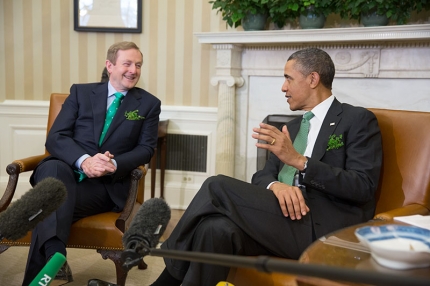
MR. CARNEY: Top of the morning to everyone. I have to thank Cody Keenan, my fellow Irish American, for loaning me his tie. (Laughter.) Because I was a little thrown off -- I had corned beef and cabbage on Sunday, and I forgot that today is the day that we are officially celebrating Saint Patrick’s Day here in Washington.
As you know, the President has a bilateral meeting with the Taoiseach, Enda Kenny of Ireland, a meeting with the Northern Ireland delegation. He is attending also the Friends of Ireland luncheon on Capitol Hill, and there is a Saint Patrick’s Day reception in the East Room later today.
I also want to note that, because of those remarks, we need to have a hard stop at 12:00 noon today.
With that, I’ll go to the Associated Press.
Q Thanks, Jay. There are reports out of Damascus by state-run media that rebels have mounted a chemical attack that killed 25 people. The Russian Foreign Ministry is backing up those claims, saying that there also -- I'm wondering if -- what the administration has on that report.
MR. CARNEY: Jim, as you know, we have been very clear about our concern that as the Assad regime is increasingly beleaguered and finds its escalation of violence through conventional means inadequate, including the barbaric use of Scud missiles against population centers, that it will consider the use of chemical weapons against the Syrian people. This is a serious concern.
I am not going to discuss intelligence, but it is important that as fighting in Syria intensifies and the regime becomes more desperate, that the United States and the international community make absolutely clear to Assad that the use of chemical weapons would be totally unacceptable. The President was clear when he said that if Assad and those under his command make the mistake of using chemical weapons or fail to meet their obligations to secure them, then there will be consequences and they will be held accountable.
The international community is united on this issue and the message to the Assad regime has been very clear.
Q Does that mean that you have confirmation that there was indeed a chemical attack, no matter who it came from?
MR. CARNEY: We are looking carefully at the information as it comes in. I’m not going to discuss intelligence processes. All I can tell you is that this is an issue that has been made very clear by the President to be of great concern to us.
Q There were some initial reports that this may have been propaganda. You’re not saying that that is propaganda on the part of the Assad.
MR. CARNEY: Again, I can tell you that we’re looking carefully at allegations of CW use, chemical weapons use. We’re evaluating them, but I have no further assessment to provide to you from here.
Q On the point that -- it does raise the question, however, about how secure chemical weapons stockpiles are. Secretary Kerry warned recently about the ability of extremists getting access to those weapons. I was wondering if the administration, if the President is starting to think that arming rebels, like the French and the British are doing -- arming friendly rebels, whether that would help our ability to make sure that those stockpiles remain secure.
MR. CARNEY: Well, I wouldn’t -- I would separate those two issues, first, to say that the issue of the possibility of chemical weapons use remains a grave concern. You heard the President, from this podium, express his position when he said, “The use of chemical weapons is and would be totally unacceptable,” and his warning to the Syrian regime that, “There will be consequences and you will be held accountable,” if the regime were to use chemical weapons. That’s the first point.
The second point is we are constantly assessing our programs of assistance to the Syrian people and to the Syrian opposition. And we evaluate them and the options available based on what we think will best serve our policy, and that is to help bring about a future where Syria is rid of Assad and that Syrians have the opportunity to build a country that is more democratic, more prosperous, and a stable country within the region. And that process continues.
Our position is and remains that we will not -- or we are not supplying lethal assistance to the opposition, but we are of course, as you would expect, constantly evaluating and assessing our various assistance programs.
Yes.
Q If it’s opposition or rebel groups that have used chemical weapons, as the Russian -- as Russia has said -- alleged -- how will -- I mean, but how -- you've just said that the United States wants to hold Assad accountable for this. And what --
MR. CARNEY: I appreciate it, and I should have made clear in my answer to Jim that on that specific allegation we have no evidence to substantiate the charge that the opposition has used chemical weapons. We are deeply skeptical of a regime that has lost all credibility, and we would also warn the regime against making these kinds of charges as any kind of pretext or cover for its use of chemical weapons.
Q So just so I’m clear, you don’t think that -- the United States does not think it’s the opposition?
MR. CARNEY: Again, we are evaluating the charges that are being made and the allegations, consulting closely with our partners in the region and in the international community. But we have no evidence to substantiate that charge, that the opposition has used chemical weapons.
Q And this is coming as the President is heading to the Middle East. How much of his time during talks with leaders there do you expect will be devoted to this threat specifically?
MR. CARNEY: Well, there’s no question that the President will discuss, with the leaders of the region on this trip, Syria. It is a high priority for the region and for the United States and our allies around the world. So that was always going to be, I think, a significant topic of conversation. I have no doubt that Prime Minister Netanyahu and the President will discuss it, President Shimon Peres and the President will discuss it as well, and it will be a topic, I’m sure, in discussions with other leaders -- the King of Jordan, as well as the Palestinian leader, at least probably so. It’s hard to assess, in light of these reports and allegations, at this point, how that will affect the breakdown of conversations in coming days, but it was already going to be a topic.
Yes.
Q Staying on Syria quickly, you talk about consequences if the Assad government is found to be using chemical weapons. What kind of consequences do you mean? Sanctions, or some other kind of escalation?
MR. CARNEY: Well, I wouldn’t care to speculate about what consequences would take place if it were to be found that the regime had used chemical weapons. I would simply point you to what the President said from this podium about this issue -- language that I just quoted. This is a very serious matter.
And with regards to today’s reports, I want to stress that we are evaluating them and consulting with our allies about them. But on the general principle, the President made very clear that the use of chemical weapons -- and I quote -- “is and would be entirely” -- or “totally,” rather, “unacceptable.” And he warned the Syrian regime, in particular, that, “There will be consequences, and you will be held accountable.”
Q Separate topic. When can we expect to see the President’s March Madness bracket? (Laughter.)
MR. CARNEY: Well, I appreciate the question. The President, as you know, has traditionally filled one out, and I don’t expect this year will be any different. But as would be the case if, say, CNN were having an interview with the President, I wouldn’t preview it for your colleagues here, so I won’t do that for any other news organization.
Q And last thing, on the Easter Egg Roll. You said earlier this month that the plan is for that event to go on, go forward as planned, but we know that the ticket confirmations have a disclaimer that it could be canceled. Where do things stand now? Which is it going to be? What do you expect?
MR. CARNEY: Well, I appreciate the question, and I’ve noted just substantial interest; it must be the very top news story among the Washington press corps today just based on the incoming inquiries. And I just want to be clear that we are currently planning to proceed with the Easter Egg Roll. Because we distributed tickets to the Easter Egg Roll far in advance of the actual event, we alerted all ticket holders that this event is subject to cancellation due to funding uncertainty, including the possibility of a government shutdown. Again, the language that got attention on the Hill and was reported duly by the press was prepared well in advance, and it had to do with the potential for at least the possibility of a government shutdown should there not be a resolution on the continuing resolution. It was not about sequester principally.
So having said that, I want to be clear that because it certainly looks like there is progress being made, and nobody expects a government shutdown, that we have every expectation that the Easter Egg Roll will proceed as planned. I hope that settles the matter.
Q And lastly, on brackets, you won’t tell us whether we should expect it before the President leaves tonight or --
MR. CARNEY: Again, I don’t think it’s -- it certainly won’t be two months from now -- if he does it at all. But I don’t want to scoop another news outlet.
Yes.
Q Was the President briefed on the Marine accident?
MR. CARNEY: Yes, he was.
Q And what can we learn from that?
MR. CARNEY: Well, the President’s thoughts and prayers go to the families of those who were lost and to those who are injured. We're obviously in the early stages of assessing the incident. It's a tragedy, clearly. And the President was briefed immediately on -- and made aware of it immediately and briefed on it, and we're monitoring the situation.
Q Jay, on Syria. Two questions, if I may, on Syria. Your answers to the opening round of questions came in somewhat piecemeal fashion, and so I want to make sure I'm clear on this. You have told us that --
MR. CARNEY: Is that theater criticism? (Laughter.) Or is it a --
Q It is a matter of craft, yes. You have told us that you have no evidence to believe that it was any elements among the rebels that used chemical weapons --
MR. CARNEY: Right.
Q -- but that you are still looking into the allegations.
MR. CARNEY: Correct.
Q What is it that prohibits you from telling us that you have no evidence that it was the government that used these weapons?
MR. CARNEY: Because we're still looking into the reports of the use of chemical weapons.
Q If that’s so, how can you eliminate so quickly the idea that it wasn't the rebels?
MR. CARNEY: I'm saying that at this time, we have no evidence to substantiate that charge, and that we are skeptical -- deeply -- of a regime that might make that charge, given that the regime has lost all credibility in the eyes of the Syrian people and the world. Having said that, we are obviously assessing the reports. And without getting into intelligence matters and methods, I can tell you that we're making evaluations about the reports.
Q It would not, it seems to me, betray any intelligence methods or sources for you to tell us whether in fact you even know whether chemical weapons were used.
MR. CARNEY: Again, I appreciate the question. And I can tell you that we are assessing the reports about the possible use of chemical weapons, as well as the reports about the origins of the possible use of chemical weapons in Syria. And I have no further assessment to provide to you at this time about our judgments on that. I can tell you that we're evaluating them. And I can tell you, obviously, about our disposition towards the potential for the use of chemical weapons. But at this time, we're simply -- as a matter of intelligence, I can't give you more information about the assessments we're making.
Q And you said repeatedly at the podium today that the President has been clear on this point; that the use of such weapons would constitute a red line for the United States, but I wonder how clear the administration's position on this has been. You quoted from the President's remarks to the National War College in December, in which he said that the use of chemical weapons is and would be totally unacceptable. But about three months prior to that, from this very podium, on August 20, the President said -- and I'm quoting now -- "a red line for us is we start seeing a whole bunch of chemical weapons moving around or being utilized." So what is the red line for the President? Is it moving around?
MR. CARNEY: Well, as we explained many times -- and I know you're not here often -- the President was talking about that -- moving around in terms of the proliferation, which is a very serious issue, the proliferation by the regime to -- potential proliferation to the regime to other actors in the region potentially of chemical weapons. So it's a fair question, but that was the distinction he was making. The utilization by the regime potentially of chemical weapons, we made very clear in our warnings how we would view that. We also consider a red line the proliferation of chemical weapons to other actors by the regime.
Q Does either of those things appear to have happened today?
MR. CARNEY: Again, I have no -- the reports today are about the possible use of chemical weapons. We are making assessments about those reports. I don’t have any more information to provide you on those efforts, and I can’t get into intelligence matters from here. But we are obviously treating this as a serious issue and evaluating it accordingly.
Yes, Kristen.
Q Jay, as you evaluate, is the President also considering changing his policy towards Syria at this point? Are those discussions underway?
MR. CARNEY: As is always the case, we are evaluating our assistance programs to both the Syrian people and the Syrian opposition. We have stepped up our assistance programs in both cases. Substantial amounts of humanitarian assistance has been provided by the United States and will continue to be provided by the United States to the Syrian people. Substantial assistance has been and will continue to be provided to the Syrian opposition. That assistance remains nonlethal with regards to the opposition, but we are evaluating our policies and programs of assistance regularly to assess their effectiveness and to make judgments about what would best help bring about the policy objectives that we have and that we share with the Syrian people as well as our international partners. And that evaluation has been ongoing prior to the reports today.
And I think I’ve answered questions about this similarly in the past when you and your colleagues have asked about whether we’re considering changing our approach on lethal versus nonlethal assistance, for example, and I’ve made the point that our position is that we are providing only nonlethal assistance but we are, obviously, constantly evaluating that aspect of our assistance as well as others.
Q And going back to the CR for a moment, it sounds like you’re confident that there will not be a government shutdown. Are you 100 percent confident that that won’t happen?
MR. CARNEY: Well, the process continues in Congress towards funding the government and avoiding another unnecessary self-inflicted wound on the economy. We take heart in the indications that we’ve had from both sides of the aisle and from the leaders in the Republican Party that it is their intent to move forward with passage of a CR. The President has made clear that he believes that we need to avoid another manufactured crisis and that we should move forward with a continuing resolution that continues to fund the government and does not allow for a government shutdown.
So the Easter Egg Roll is entirely likely to continue and proceed.
Q It doesn’t appear as though the CR discussions include stopping the sequester or really mitigating it in a serious way. Should we assume at this point that the sequester will be in effect for several months if not for the duration --
MR. CARNEY: Well, it’s a great question, and I’ve talked about how the President has approached his engagement with lawmakers, for example -- Republican lawmakers -- within the context of the fact that a decision was made, regrettably, about imposition of the sequester; a decision was made by Republicans not to entertain the idea of a temporary delay in the sequester deadline that would have been purchased with a balanced plan much as had been at the end of 2012. That decision was made.
We would obviously welcome a change of heart by Republicans, but there’s no indication from Republicans that such a change of heart is forthcoming. Therefore, we are engaged in conversations about the possibility of moving forward on broader deficit reduction in a balanced way that would both eliminate the sequester -- if achieved -- but also, beyond that, further reduce our deficit and bring us past the $4 trillion over 10 years goal that so many have identified as what we need to achieve. And that’s what the current discussions are about.
Now, the timeline for that, obviously, is a little prolonged because it involves regular order and the budget process underway in the Congress, in both the House and the Senate, as well as the conversations and meetings that the President has been having with lawmakers, and that lawmakers have been having among themselves.
So it certainly looks as though the sequester will remain imposed for some time unless Republicans have a change of heart about the decision to impose it.
Q It doesn’t seem like there was a lot of urgency to prevent it from going into effect, and it feels like there’s less now. It doesn’t feel like there are --
MR. CARNEY: I think we made clear that we firmly oppose the imposition of the sequester. We tried to warn about the real-world effects that imposition of the sequester would have on middle-class Americans across the country, on our defense industries and on our military posture, national security readiness. And those effects are being felt. And we obviously implored Republicans to consider the option of doing what they had done just two months before, which was to pass a short-term delay of the sequester that was balanced, that asked everyone to chip in, if you will -- not just seniors and middle-class Americans, but the well-off and well-connected.
There was adamant refusal to do that. The sequester was imposed, and we’re now seeing the effects -- including, I think, a story that I found particularly striking out of Indianapolis, an Associated Press story about one school district where a lottery had to be imposed on Head Start families, and if you lost the lottery, your child was withdrawn from the Head Start program almost immediately because of sequester.
Roger.
Q Back to the CR for a moment. Is there, as it stands today, and I know the process is not complete -- but does the White House see any objections to the CR as it stands right now?
MR. CARNEY: We’re monitoring it. We’re encouraged by the progress. I don’t want to prejudge the final outcome. We believe that both sides seem inclined to avoid a shutdown, and that is a good thing, and to avoid using the CR to provoke a confrontation that could lead to a shutdown. But the work is not done, and so I will not make a final assessment about it. But we remain hopeful that members and leaders of Congress agree with the President, or are likeminded, in that they do not believe that this is a place where we should have another manufactured crisis that negatively affects our economy and the middle class.
Q And one other one. The leaders, in the pool spray this morning, both made a reference to the proposed U.S. transatlantic trade and cap negotiations. Does the White House have to notify Congress of its intent to start such negotiations? And if I have my memory, have you done that yet?
MR. CARNEY: I will have to check, Roger. I confess I do not know the answer to that question and will not venture to guess.
Ari, how are you?
Q Fine, thanks. Any reflections from the White House on the 10th anniversary of the Iraq invasion?
MR. CARNEY: I would simply note that over the past 10 years, or certainly leading up to the final withdrawal of U.S. troops from Iraq, our men and women in uniform, as well as our civilian personnel, sacrificed on our behalf enormously and fulfilled every mission that was assigned to them bravely and courageously -- well, bravely and heroically. And the President is enormously appreciative of the service of those who went to Iraq, the heroism that they demonstrated, and the sacrifice that they made.
It’s not a mystery, obviously, that the President, as a Senate candidate and then a Senator, opposed the invasion of Iraq, opposed the Iraq war, and as a candidate in 2008 promised to end the Iraq war. And he has fulfilled that promise. And he fulfilled that promise in a way that allowed Iraq to have the best possible chance to -- provided to them by the service and sacrifice of Americans in uniform as well as civilians, for a better future.
And the situation in Iraq continues to be a challenge, but there is an elected government, there is a growing economy, and there is certainly the potential and prospect for Iraq to have a much better future than its past, and that is due to, in significant measure, the sacrifice and service of Americans.
Peter.
Q Jay, on that subject, I mean, is the President planning to do anything to mark the occasion? He put out a statement the other day on the Anfal, the anniversary of the Anfal massacre. Is he going to put out a statement? Is he -- is this --
MR. CARNEY: I think we will have a statement, Peter, but I wouldn’t expect more than that.
Q Does he have reflections on the lessons that people should be thinking about 10 years later?
MR. CARNEY: I haven’t discussed this with him recently. I think that -- well, you know the President’s position as a candidate for the Senate and a candidate for this office, about this particular military policy. And I think he said at the time, as a candidate for the Senate, that war is necessary sometimes, but not all wars are necessary, to paraphrase, and that this one in his view was not.
But that in no way should take away from his extremely strongly held view that the Americans who were sent over to serve their country in Iraq performed heroically and at a level of professionalism that has never been seen before. And it is because of their service that Iraq has the chance, and the Iraqi people have the chance, for a better future. And he’s enormously grateful for that service.
Q Last question on this. Do you think the administration is doing enough right now to ensure that future? A lot of people in Iraq feel like America has abandoned them or not paid attention, or not been active enough in the last two years.
MR. CARNEY: Well, President Obama, as he promised, ended the war in Iraq and we have withdrawn all U.S. military personnel from Iraq. We still have an enormously important relationship with Iraq. We have an extremely large diplomatic presence in Iraq, and connections on issues at all levels with the Iraqi government and the Iraqi people, both economic, cultural, geopolitical, regional.
So this is a relationship that we consider very important, and we continue to work with the Iraqis on a whole host of issues, and continue to assist the Iraqi people and the Iraqi government in their efforts to build on the progress they have made. But there is no question that the President made a commitment to end that war, and he ended it.
Q Do you mind a follow-up on this subject?
MR. CARNEY: David. I’ll come back to you in a second.
Q I’ve got a couple. First, on Iraq. A decade later, is Iraq better off?
MR. CARNEY: I think historians have to make the judgment. I think that ridding the world of Saddam Hussein was a welcome development for the world and for Iraq, but again, the President opposed the policy, as a candidate, of invading Iraq, and as a candidate for President as well. But he made a commitment, as a candidate, to end that war in a manner more responsible than the manner in which we entered it. And he has fulfilled that promise.
The Iraqi people are a proud and capable people, and they have an enormous potential for building a future for that country with the assistance of friends and partners in the international community that is far brighter, not just in the past, but even the present. And we remain committed to that relationship and to assisting Iraq in that effort. But it was entirely the right thing to do to wind down and end that war.
Q A money question. GAO recently issued a report about federal buildings that are unused or underused -- 77,000 of the buildings that they actually track. And it costs taxpayers more than a billion and a half dollars every year just to operate these buildings. Why are we spending a billion and a half to operate buildings we don’t need?
MR. CARNEY: It’s an excellent question, which is why in 2010, President Obama set up -- set an ambitious goal for his administration, and that was to eliminate $8 billion in real estate costs by 2012, and federal agencies have beaten both of these goals. In other words, they eliminated more than $8 billion prior to the completion of 2012. The administration has also put forward an aggressive proposal that would further these efforts by expediting the process to dispose of additional high-value assets. And OMB has done a lot of work on this and I would refer you to them for more details.
But it’s an excellent question. And we have aggressively approached this challenge of disposing of unused federal property because the cost of maintaining it are unnecessary and we have --
Q But we’re still spending --
MR. CARNEY: Well, the project is not done, but we have made extreme -- exceptional amount of progress since the President set that goal, and we continue to work on it. And we need to be as efficient as we can, and this is one of the reasons why the President set that goal. It’s one of the reasons the Office of Management and Budget has continued to work on it. It’s not an issue that gets a lot of attention, and I appreciate the question because it’s a worthwhile effort as part of the President’s overall approach to making government more efficient and finding savings where he can.
Jon-Christopher -- and sorry, James, I did say I’d come back to you. Did you have something?
Q Yes. Just to follow up on the discussion of the Iraq war, none of us wants to plunge ourselves into counterfactual histories about what if. And so all we have is the record of what did occur. And when you stand here and tell us that Iraq today now has the option for a chance for a much better future than her past, that is, as a matter of factual history, only possible because President Bush decided to launch this war and send all these heroic servicemen and women into this mission. And so if credit is due to those servicemen and women, it seems to me a matter of logic that some credit would also be due to President Bush and his advisors. And that on this occasion, do you not see it that way?
MR. CARNEY: James, I would simply take up your first proposition that engaging in counterfactuals about what might have happened had we not gone to war in search of weapons of mass destruction that didn’t exist, what would have happened.
There is no question, as I made clear in several answers, that the President believes that Iraq has the potential for a better future today because of the remarkable sacrifice and service of American men and women in uniform as well as civilian American men and women who served in Iraq. And that is without question and without doubt.
It is impossible to know, obviously, what course would have occurred in Iraq had the inspections regime continued, had different choices been made. That was not obviously the world that the President inherited when he took office in January of 2009. The world he inherited was one that included America at war in two places, in two countries, with, I believe, an excess of 130,000 troops in combination -- Iraq and Afghanistan.
And he set in motion policy objectives that included winding down responsibly the war in Iraq; refocusing our attention on the war in Afghanistan, which, after all, was the war that we launched because we were attacked on September 11, 2001. He did both. And he is now, having ended the war in Iraq, winding down the war in Afghanistan.
So it really is -- all these questions are very interesting, and I think the anniversary is an appropriate time to begin asking them. But I think historians will make the assessments about the policy judgments made by the administration that was in power at the time. The President had very clearly stated views as a candidate for Senate and very clearly stated views as a candidate for President that were judged and evaluated by the American people. He had very clear policy positions that he promised to implement if he were elected, and he has done so.
Q But it sounds to me listening to you that for what you call the “welcome development” of Saddam Hussein being gone, you are unwilling to accord President George W. Bush even a single iota of credit for that development.
MR. CARNEY: Well, I’m happy to do that, James. I think the focus on doing that is unique here in this briefing. But there is no question that Saddam Hussein was removed from power thanks to the military efforts of U.S. armed forces, and they were sent to Iraq by President Bush. So, obviously, there is a causal relationship. And to the extent that credit is due, credit is due to him for that. That does not change, I think, assessments made by this President as a candidate or by many others on this day, 10 years after, about the judgments made to go to war in Iraq and to invade the country.
And Americans obviously will continue to have different views on this, appropriately so. And this will be a matter of discussion and debate for a long time, I expect, in Washington as well as in classrooms and among historians.
But the President’s views as a candidate and as President are very clear. His commitments, when it comes to policy, have been very clear and they have been followed through on. And he believes that when he promised the American people to end the war in Iraq, he owed them to fulfill that promise, and he has.
Yes, April.
Q Jay, the most recent recession is blamed in part on the financing of the war in Iraq. Is there any tentacle from the financing of the Iraq war that affects this current economic situation that this country was in?
MR. CARNEY: Well, I’m not sure. Just to be clear, I think the deficits -- the record deficits that President Obama inherited were in part due to the unpaid-for wars that he inherited. I’m not sure that the recession itself -- economists would have a better assessment -- was caused by the spending on those wars.
There is no question that the -- to go back to my first point -- that the record deficits that President Obama inherited when he took office in the midst of a financial collapse, and what would become the Great Recession and threaten to become a depression, contribute to our fiscal challenges today -- no question. And the President said back in his campaign in 2008 and many times I’m sure since, that that put us -- tax cuts, two massive tax cuts that were unpaid for, two wars that were unpaid for -- everything put on a credit card -- led to a situation where the United States had a -- a country that had a budget surplus and surpluses as far as the eye could see in January of 2001, just eight years later, was a country that had the largest deficits in its history.
So again, much as an answer to James’s question, the President took office and these were the facts that he had to deal with both in terms of the financial crisis, the deficits he inherited, and the wars that were ongoing when he took office. And he applied his best judgments in dealing with all of the challenges that this country faced. And the American people obviously will and have made their assessments about those decisions, and historians will make assessments into the future, as will journalists.
Q Right. So let me clarify, because I’m hearing things but I’m not getting an answer. I’m sorry. (Laughter.)
MR. CARNEY: Really?
Q I’m sorry.
MR. CARNEY: I thought it was pretty good, right?
Q It was pretty good for you.
Q That's a matter of craft.
MR. CARNEY: That’s -- craft. It was clearer than the Syria answer, right? (Laughter.)
Q Oh, so you recognize that you were just giving --
MR. CARNEY: No, no, I’m just having some fun here. (Laughter.)
Q All right. So you're saying indirectly that the President is dealing with deficits now --
MR. CARNEY: I’m simply -- I apologize. I just wanted to make clear that the -- I’m not sure economists would agree that the recession was caused by the profligate spending in the previous administration --
Q I said in part, though. I said in part.
MR. CARNEY: Well, again, that would be for economists to decide. There is no question that the deficits the President inherited, which have exacerbated the fiscal challenges that we face, were due to, in part, the unpaid-for spending on the war in Iraq as well as the war in Afghanistan.
Q So I’m talking about now -- so you’re that the deficits --
MR. CARNEY: No question.
Q Okay, thank you.
MR. CARNEY: Donovan and then Jon-Christopher. Yes.
Q Thanks, Jay. Two quick things. Another clarification, if I could on Iraq. Are you saying that Iraq is better off now thanks to the war, but you’re going to leave the judgment about whether it was a good idea to make them better off to historians?
MR. CARNEY: Well, the President -- no, that's a slightly altered way of explaining what I said. The President’s position on whether or not the United States made a wise decision to invade Iraq 10 years ago was clear and remains clear. He does not believe that was the right choice. Did not believe then, and his position has changed.
What is absolutely the case is that our men and women in uniform, the most professional military the world has ever known, when given an assignment -- regardless of whether the assignment was the right policy choice or not -- fulfill their mission and do it heroically and professionally. And that is the case with regards to Iraq, and it is certainly the case with regards to Afghanistan. That is the point that I’m making.
So the fact that Iraq is in a place, as difficult as its challenges remain, where it has the potential for a better future is due in no small measure to the sacrifice and service of American men and women. It is also obviously due to the courage and perseverance of the Iraqi people, and we should note that.
But my point was the President has made his judgments clear about the invasion. Historians will and the American people will, over the years, make their own judgments.
As President, he entered office when there was still an enormous number of troops in Iraq, and he set about ensuring that we gradually wound down our presence there, our military presence in a way that made the sacrifice that had been given there -- that that sacrifice was honored by the way that we wound down the war and the position that we left Iraq in to make its own future -- to make its own future without our military assistance, but obviously with our continued civilian presence and the assistance of the United States and international partners moving forward.
Q Thanks. And finally, on Sylvia Matthews Burwell. The President has asked Jeffrey Zients -- Zients?
MR. CARNEY: Jeff Zients.
Q -- to stay on until she’s confirmed. And she was nominated a few weeks ago. Does he anticipate any issues with her confirmation? Or does the White House --
MR. CARNEY: No, we don't. We believe that Sylvia Burwell is enormously qualified and will be confirmed by the Senate without a problem, although that's what we believe. It’s the Senate to decide, and I defer to the Senate.
But it is the case that confirmations take a certain amount of time, even when they're smooth. And this is an enormously important agency, especially at this time. And the President has asked Jeff Zients to continue as Acting
Director of OMB. He has been just an enormously valuable player on the President’s economic team. He has served twice as Acting Director of OMB. He has served as deputy director, and his first job in the administration was as chief performance officer. He brings a unique set of talents and wisdom to this job, and the President appreciates his service and his willingness to continue as acting director very much indeed.
Q Thanks, Jay.
MR. CARNEY: Jon-Christopher. I owe Jon-Christopher, and then we’ve got --
Q It’s kind of a 10th anniversary-sequester combo question. How concerned is --
MR. CARNEY: Combination platter.
Q Yes, combination. How concerned is the President that 600,000 Iraqi and Afghan War vets have been waiting more than 25 days for their backlog benefits?
MR. CARNEY: This issue is of enormous concern to the President. He has made clear to Secretary Shinseki that he wants this problem addressed. I think it’s important to step back and look at the issue of the backlog and acknowledge that one of the -- there are a number of contributing factors to it. The ending of two wars has increased our veteran population and increased the population of those who depend on VA services. The President obviously believes that ending these two wars is the right policy.
It is also true that decisions made by this administration to expand the universe of people whose afflictions are covered by VA services was absolutely the right thing to do for our veterans, and that includes Gulf War syndrome and exposure to Agent Orange, as well as Post-Traumatic Stress Disorder. And the fact that in expanding the realm of services and the number of people for whom those services are available -- that fact has obviously contributed to the backlog.
However, it is absolutely the President’s position that we need to aggressively address this problem, and he has made clear to Secretary Shinseki that he wants this addressed. He is getting weekly updates on the backlog and progress made on the backlog because he believes it is absolutely our responsibility as a nation to make sure that we’re doing right by our veterans.
Q Jay, one more before you go?
MR. CARNEY: I got to run. It’s 12:00 p.m.
Q Thanks, Jay.
MR. CARNEY: Thank you, guys. Those who are traveling with us, we’ll see you there. Thanks.
END
12:00 P.M. EDT