The White House

Office of the Press Secretary

Presidential Withdrawal Sent to the Senate

WITHDRAWAL SENT TO THE SENATE:

Caitlin Joan Halligan, of New York, to be United States Circuit Judge for the District of Columbia Circuit, vice John G. Roberts, Jr., elevated, which was sent to the Senate on January 4, 2013.

The White House

Office of the Press Secretary

Statement by the President on Julius Genachowski

I want to thank Chairman Genachowski for his dedicated service on behalf of the American people.  Over the last four years, Julius has brought to the Federal Communications Commission a clear focus on spurring innovation, helping our businesses compete in a global economy and helping our country attract the industries and jobs of tomorrow.  Because of his leadership, we have expanded high-speed internet access, fueled growth in the mobile sector, and continued to protect the open internet as a platform for entrepreneurship and free speech.  I am grateful for his service and friendship, and I wish Julius the best of luck.

The White House

Office of the Press Secretary

Press Briefing by Senior Administration Officials

Aboard Air Force One
En Route Amman, Jordan

4:24 P.M. IST

SENIOR ADMINISTRATION OFFICIAL:  We’ll do this on background -- senior administration officials.  Do you guys have the statement from the President?

Q    Yes, we do.

SENIOR ADMINISTRATION OFFICIAL:  Okay.  I'll just make a couple of comments and then turn it over here.  The President considers both Turkey and Israel to be very close partners and friends of the United States.  He has a very close relationship with both Prime Minister Erdogan and Prime Minister Netanyahu, and of course believes strongly that the national security interests of the United States, Turkey, Israel, and frankly, the region are served by normalized Israel-Turkey relations.

You saw the President go into that trailer with the Prime Minister before the departure ceremony.  That's when the call was placed from Prime Minister Netanyahu to Prime Minister Erdogan.  And I'll turn it over to my colleague here to give a bit more of the background.

SENIOR ADMINISTRATION OFFICIAL:  So that is really the context.  The United States has important friendships and strategic relationships with both Israel and Turkey, and the President has those relationships with his counterparts.  And that's why we have regretted for a couple of years now the absence of normalization -- normal relations between those two countries.  And we have worked with them and urged them both to reach out and try to put their differences between them.

It’s been difficult, but that's why this call that took place today was important, because it was a sign that both of them -- the two Prime Ministers said that to each other -- value their own relationship between Turkey and Israel.

And maybe just to give you a flavor of the call itself and more of the context, Prime Minister Netanyahu told Prime Minister Erdogan that he had been discussing with President Obama the importance of regional relations, importance of regional cooperation, and that President Obama had underscored how important it is to us to see all of these countries in the region work with each other, and particularly Turkey and Israel.  And he, Netanyahu, wanted to relay that to Prime Minister Erdogan, which he did.

He also told Prime Minister Erdogan that he had seen his interview in a Danish newspaper and that he, Netanyahu, appreciated those comments.  And you’ll get this -- I'm sure the Israelis and Turks will read this all out.

And then he -- again, Netanyahu -- brought up the issue that had been dividing them mostly over the past couple of years, which is the flotilla incident, the Mavi Mamara  incident, and what he told him is that he regretted that that incident had led to a deterioration in their relations.  It was important --

Q    Netanyahu said this --

SENIOR ADMINISTRATION OFFICIAL:  Netanyahu said that he regretted that that incident had led to a deterioration in their relations, and also that in light of Israel’s investigation into that incident, which revealed some operational mistakes, that on behalf of Israel he apologized for any deaths that those operational mistakes may have caused, and he hoped that the two countries would be able to normalize their relationship and work together effectively in the future.

And Prime Minister Erdogan said he appreciated those remarks, that on behalf of Turkey, he accepted that apology, and that he cherished the longstanding relationship between Turkey and Israel, between Jewish people and Turkey, and that he also wanted to have a better relationship.

So in that sense, it was a really positive call.  I think the President was very pleased that these two leaders, these two important partners of the United States, were able to take this important step forward.

Q    Did the President get on the line?

SENIOR ADMINISTRATION OFFICIAL:  The President did get on the line.  He expressed his greetings to Prime Minister Erdogan and suggested they, themselves, talk more in detail in the near future.  But it was a call between Prime Minister Netanyahu and Prime Minister Erdogan.

Q    So what did the President do to facilitate this whole thing?  What was his role?

SENIOR ADMINISTRATION OFFICIAL:  Well, I think, in one way, the timing of the call speaks for itself, and as I noted, Prime Minister Netanyahu, when he began that call, he began by saying to Prime Minister Erdogan, I've been discussing with President Obama the importance of regional relations, the importance of Turkey-Israel cooperation, and that is what led him to take this initiative now.

Q    -- the apology that Netanyahu offered and that Erdogan accepted is the apology that the Turks have been looking for for all these years?  And did they also mention Prime Minister Erdogan’s rather pungent comments that I asked Secretary Kerry about in Ankara a couple of weeks ago?

SENIOR ADMINISTRATION OFFICIAL:  Well, as I noted, Prime Minister Erdogan accepted the apology on behalf of Turkey.

Q    Was that the apology he was --

SENIOR ADMINISTRATION OFFICIAL:  Well, he accepted it.  I mean, I think that --

Q    Do they want more that you know of?

SENIOR ADMINISTRATION OFFICIAL:  No, he accepted the apology -- no.

Q    So this does it?  This ends this?  This is over?

SENIOR ADMINISTRATION OFFICIAL:  He accepted the apology.

SENIOR ADMINISTRATION OFFICIAL:  We’ll let the other governments speak to this in detail, but he accepted the apology and as the President said in his statement, we welcome steps that normalize the relationship.

Q    But would it be accurate to say the President brokered this thing?

SENIOR ADMINISTRATION OFFICIAL:  I think it would be accurate to say the President has been making this point to both leaders for going on a couple years now.  So I think it’s well known by both Turkey and Israel the importance we place on seeing these two close friends of ours have normalized relations.

Ultimately, this is an Israeli-Turkey decision that -- as my colleague said, the timing kind of speaks for itself.  I will say also there will still be differences on issues between Turkey and Israel, but we do believe that they can cooperate while they have differences.  And so taking these important steps to put this behind them allows them to move forward in that process.

Q    Had they been working on this --

Q    -- at Herzl’s tomb this morning, the comments -- everyone’s comments about Zionism and crime against humanity come up?

SENIOR ADMINISTRATION OFFICIAL:  Prime Minister Netanyahu told Prime Minister Erdogan that he had seen his interview in a Danish newspaper and that he appreciated his words.

Q    So is it fair to say -- I mean, did the President in his meetings with Netanyahu this week, did he say he’d like to facilitate this call while he was here?

SENIOR ADMINISTRATION OFFICIAL:  I think he discussed the importance of Turkey and Israel working to repair their relationship, and the two of them in their discussions agreed on that, and Prime Minister Netanyahu placed a call.

Q    But had they been working on this all during the day?  There was a series of meetings obviously today.  Is that something that was a large part of their discussion?

SENIOR ADMINISTRATION OFFICIAL:  I wouldn't get too much of the details, the operational details.  They agreed it would be a good thing for Netanyahu to --

Q    -- back at the airport?

SENIOR ADMINISTRATION OFFICIAL:  Well, no, obviously it came up before they got to the tarmac in the airport.

Q    Yes, I know, but, I mean, why do it on the tarmac at the airport?

SENIOR ADMINISTRATION OFFICIAL:  You had to get three leaders together when they were able to do the call.

Q    But how long has this been -- so for how long has this been being coordinated?

SENIOR ADMINISTRATION OFFICIAL:  Over the last couple of days that we’ve been here.  We put out a comment yesterday you may have seen saying that this is a subject that came up in the discussions between the President and Prime Minister.  So it was a topic of discussion during the visit and we were able to get this call scheduled while President Obama was still here.  Again, it was a call from Prime Minister Netanyahu to Prime Minister Erdogan, but given the President’s relationship with both of them, he felt it was important to support that effort.

Q    -- how long they spoke and who all was a party to the call?  It sounds like you heard both sides of the call -- was it a conference call?

SENIOR ADMINISTRATION OFFICIAL:  Well, they spoke for -- I don’t have the exact details -- a good half an hour.

SENIOR ADMINISTRATION OFFICIAL:  Yes, you guys saw -- I mean, basically he went into that trailer, and however long he was in there was how long the call was.

Q    So like a half an hour?

SENIOR ADMINISTRATION OFFICIAL:  Well, keep in mind there’s also interpretation and President Obama was on the phone for a bit -- but I just wanted to reinforce my colleagues point.  No one is claiming that this resolves every potential different between Israel and Turkey.  I think we said and I think they would tell you this was an important step because one of the key things that had been dividing them was their strong differences over the Mavi Mamara  incident and Turkey’s desire for an apology and compensation.

Q    Was there compensation?

SENIOR ADMINISTRATION OFFICIAL:  And their teams have over the past years been talking about resolving these issues and the references made to the work that they had done to reach an agreement on that as well.

Q    Does the United States think that now this satisfies Turkey’s demand for an apology over this incident?  From your point of view, did the Turks say to you, this apology thing is now a thing of the past?

SENIOR ADMINISTRATION OFFICIAL:  Only the Turks can answer that question, but when the Prime Minister says, I accept your apology, I think most people would believe that that --

Q    You can’t say only the Turks can answer that question, and then tell us that he accepted the apology.

SENIOR ADMINISTRATION OFFICIAL:  We’ve got to wrap this up, but let me just -- we believe it’s a very important thing that these two countries, even as they’re going to have differences, can work together.  And this step is what allows that to take place.  And we’re going to continue to support both of these key partners of the United States as they move forward not just in dealing with their own relations, but in dealing with regional security challenges that both of them have a significant stake in because we all have an interest in peace and stability in this region.  With that --

Q    So how do you describe the diplomatic relationship between these two countries now?

SENIOR ADMINISTRATION OFFICIAL:  We believe that the call today is an important step towards the normalization of that relationship.

SENIOR ADMINISTRATION OFFICIAL:  Okay, thanks, everybody.

END 
4:34 P.M. IST

The White House

Office of the Press Secretary

Statement by President Obama on Turkey and Israel

I welcome the call today between Prime Minister Netanyahu and Prime Minister Erdogan.  The United States deeply values our close partnerships with both Turkey and Israel, and we attach great importance to the restoration of positive relations between them in order to advance regional peace and security.  I am hopeful that today's exchange between the two leaders will enable them to engage in deeper cooperation on this and a range of other challenges and opportunities.

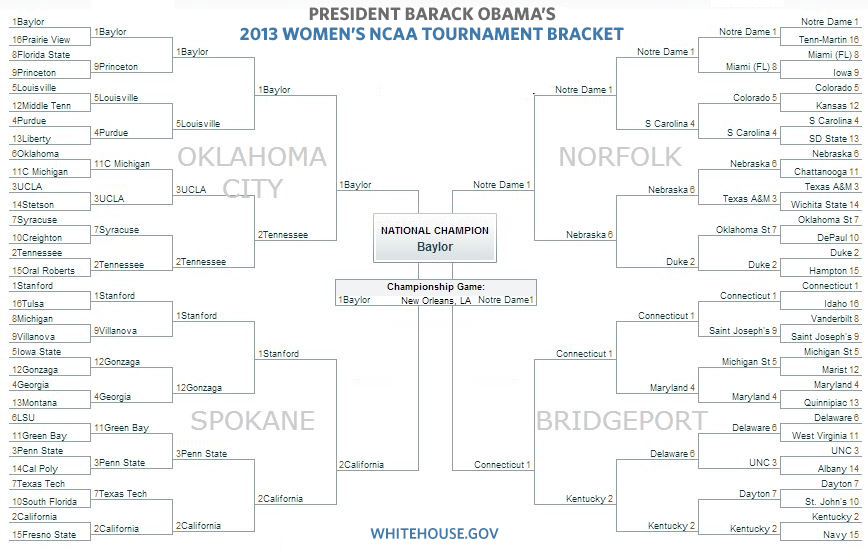
President Obama's 2013 NCAA Women's Basketball Tournament Bracket

Last year, President Obama predicted Baylor would win the 2012 NCAA Women's basketball tournament. The Bears lived up to the billing, winning the national championship over Notre Dame.

This year, the President is predicting a rematch.

Joining Baylor and Notre Dame in his Final Four are California and UConn. Check out his full bracket:

President Obama's Picks for the 2013 NCAA Women's Basketball Tournament

For President Obama's predictions in the NCAA men’s tournament, click here.

The White House

Office of the Press Secretary

Remarks by the President at the Hall of Children, Yad Vashem

Yad Vashem
Jerusalem

10:22 A.M. IST
 
THE PRESIDENT:  “Unto them I will give my house and within my walls a memorial and a name…an everlasting name that shall not be cut off.”
 
President Peres, Prime Minister Netanyahu, Chairman Shalev, Rabbi Lau -- thank you for sharing this house, this memorial, with me today.  And thank you to the people of Israel for preserving the names of the millions taken from us, of blessed memory -- names that shall never be forgotten.
 
This is my second visit to this living memorial.  Since then, I’ve walked among the barbed wire and guard towers of Buchenwald.  Rabbi Lau told me of his time there, and we reminisced about our good friend, Elie Wiesel, and the memories that he shared with me.  I have stood in the old Warsaw ghetto, with survivors who would not go quietly.  But nothing equals the wrenching power of this sacred place, where the totality of the Shoah is told.  We could come here a thousand times, and each time our hearts would break.
 
For here we see the depravity to which man can sink; the barbarism that unfolds when we begin to see our fellow human beings as somehow less than us, less worthy of dignity and of life.  We see how evil can, for a moment in time, triumph when good people do nothing, and how silence abetted a crime unique in human history.
 
Here we see their faces and we hear their voices.  We look upon the objects of their lives -- the art that they created, the prayer books that they carried.  We see that even as they had hate etched into their arms, they were not numbers.  They were men and women and children -- so many children -- sent to their deaths because of who they were, how they prayed, or who they loved.
 
And yet, here, alongside man’s capacity for evil, we also are reminded of man’s capacity for good -- the rescuers, the Righteous Among the Nations who refused to be bystanders.  And in their noble acts of courage, we see how this place, this accounting of horror, is, in the end, a source of hope.

For here we learn that we are never powerless.  In our lives we always have choices.  To succumb to our worst instincts or to summon the better angels of our nature.  To be indifferent to suffering to wherever it may be, whoever it may be visited upon, or to display the empathy that is at the core of our humanity.  We have the choice to acquiesce to evil or make real our solemn vow -- “never again.”  We have the choice to ignore what happens to others, or to act on behalf of others and to continually examine in ourselves whatever dark places there may be that might lead to such actions or inactions.  This is our obligation -- not simply to bear witness, but to act.
 
For us, in our time, this means confronting bigotry and hatred in all of its forms, racism, especially anti-Semitism.  None of that has a place in the civilized world -- not in the classrooms of children; not in the corridors of power.  And let us never forget the link between the two.  For our sons and daughters are not born to hate, they are taught to hate.  So let us fill their young hearts with the same understanding and compassion that we hope others have for them.  
 
Here we hope.  Because after you walk through these halls, after you pass through the darkness, there is light -- a glorious view of the Jerusalem Forest, with the sun shining over the historic homeland of the Jewish people; a fulfillment of the prophecy: “you shall live again…upon your own soil.”  Here, on your ancient land, let it be said for all the world to hear:  The State of Israel does not exist because of the Holocaust.  But with the survival of a strong Jewish State of Israel, such a Holocaust will never happen again. 
 
Here we pray that we all can be better; that we can all grow, like the sapling near the Children’s Memorial -- a sapling from a chestnut tree that Anne Frank could see from her window.  The last time she described it in her diary, she wrote: “Our chestnut tree is in full bloom.  It’s covered with leaves and is even more beautiful than last year.”  That’s a reminder of who we can be.  But we have to work for it.  We have to work for it here in Israel.  We have to work for it in America.  We have to work for it around the world -- to tend the light and the brightness as opposed to our worst instincts.
 
So may God bless the memory of the millions.  May their souls be bound up in the bond of eternal life.  And may each spring bring a full bloom even more beautiful than the last. 
 
END
10:29 A.M. IST

West Wing Week: 03/22/13 or “Reach Out to New Horizons”

March 21, 2013 | 5:25 | Public Domain

This week, the President spoke on American Energy Security at the Argonne National Laboratory in Illinois, celebrated the luck of the Irish, honored leaders in STEM education and small business, filled out his NCAA tournament brackets, announced his nominee for the Secretary of Labor, and embarked on a 5 day trip to Israel, the West Bank, and Jordan.

Download mp4 (228.3MB)

President Obama and President Peres of Israel Speak at State Dinner

March 21, 2013 | 28:21 | Public Domain

President Obama attends a dinner hosted by President Peres at the President’s residence in Jerusalem.

Download mp4 (1075MB) | mp3 (68MB)

Read the Transcript

Remarks by President and President Peres of Israel at State Dinner

President’s Residence
Jerusalem

8:15 P.M. IST

PRESIDENT PERES:  I think that's the President's remarks.  Mr. President, can I read your speech?  (Laughter.)  They are mistaken.  (Laughter.)

President Barack Obama, my dear friend, let me say first, Bravo.  Bravo, President.  (Applause.) 

It is my great pleasure to welcome you tonight.  I was moved the way in which you spoke to the heart of our young Israelis.  Our youngsters, in time of need, are always willing to stand up and defend their country.  Today, you have seen how much the same young people long for peace.  How enthusiastic they were, how engaged they were, listening to the vision of peace, which you beautifully delivered and moved the heart.

Mr. President, this morning several rockets were shot from the Gaza Strip towards civilian targets in Israel, including Sderot that you have visited.  From here, in the name of all us, I want to convey our love to the inhabitants of the south around Gaza who carry this heavy burden courageously and continue to plow their land, plant their trees, raise their children.  It is an inspiration to each of us.  Today, the enemies of peace spoke in the only language they know -- the language of terror.  I am convinced that together we shall defeat them. 

Dear Barack, your visit here is a historic event.  We are so happy to receive you and your distinguished delegation.  I am very glad to see Secretary John Kerry -- an old friend.  John, I know you are and I know you will be successful.  I'm not sure that the prophets have had speechwriters -- (laughter) -- but if they had, I imagine Isaiah would have said -- but actually he has said on that occasion -- and I'm quoting him, "How beautiful on the mountains are the feet of those who bring good news, who proclaim peace, who bring good tidings, who proclaim salvation." Well, you have to be satisfied with my language -- I cannot speak like him.  (Laughter.)

It is my privilege to present you with our country's highest honor -- the Medal of Distinction.  This award speaks to you, to your tireless work to make Israel strong, to make peace possible. Your presidency has given the closest ties between Israel and the United States a new height, a sense of intimacy, a vision for the future. 

The people of Israel are particularly moved by your unforgettable contribution to their security.  You are defending our skies -- to you, revelation in the name of intelligence, which is the right way to preempt bloodshed.  The diplomatic and the military bonds between us have reached an unprecedented level. 

When I visited you in Washington, I thought in my heart, America is so great and we are so small.  I learned that you don't measure us by size, but by values.  Thank you.  When it comes to values, we are you, and you are us.  On occasions when we were alone you stood with us, so we were not alone.  We were alone together.  We shall never forget it. 

During your previous visit to Israel, you asked me if I had any advice to offer.  Well, it's not my nature to let questions go unanswered.  (Laughter.)  So just that while people say that the future belongs to the young, it is the present that really belongs to the young.  Leave the future to me.  I have time.  (Laughter and applause.) 

I think I was right, because the moment you came into office, you immediately had to face daunting and demanding challenges day in, day out.  I prayed that you would meet them with wisdom and determination, without losing hope, without allowing others to lose hope.  The prayers were answered -- after all, they came from Jerusalem and they came to us as a great message.  It is a tribute to your leadership, to the strength of your character, to your principles, that you have never surrendered to hopelessness.  You stood and stand firmly by your vision.  Your values serve your nation.  They serve our nation as well.

So I know that you will never stop to strive for a better world, as you said today in a good Hebrew -- tikkun olam.  We have a rich heritage and a great dream.  As I look back, I feel that the Israel of today has exceeded the vision we had 65 years ago.  Reality has surpassed the dreams.  The United States of America helped us to make this possible. 

Still the path to tomorrow may be fraught with obstacles.  I believe that we can overcome them by our determination and by your commitment.  I'm convinced that you will do whatever is necessary to free the world's horizons and the skies of Jerusalem from the Iranian threat.  Iran denies the Shoah and calls for a new one.  Iran is building a nuclear bomb and denies it.  The Iranian regime is the greatest danger to world peace.  History has shown time and again that peace, prosperity and stable civil society cannot flourish when threats and belligerency abound. 

Ladies and gentlemen, tonight the Iranian people are celebrating their New Year.  I wish them from the depths of my heart a happy holiday and a real freedom. 

Israel will seize any opportunity for peace.  Being small, we have to maintain our qualitative edge.  I know that you responded and will respond to it.  The strength of Israel is its defense forces.  They afford us the ability to seek peace.  And what America has contributed to Israel's security is the best guarantee to end the march of folly, the march of terror and bloodshed. 

We watch with admiration the way you lead the United States of America, the way you have stayed true time and again to your bonds of friendship with us.  Your commitment and deeds speaks volumes about the principles that guides America.  To strive for freedom and democracy at home, but also all over the world, you send the boys to fight for the freedom of others.  What is uplifting is that the United States brought freedom not only to its own people, but never stops, and never will stop, to help other people to become free. 

You represent democracy at its best.  You have deepened its meaning -- namely that democracy is not just the right to be equal, but the equal right to be different.  Democracy is not just a free expression, but is self-expression as well. 

You exemplify the spirit of democracy by striving for justice and equality and opportunity in the American society.  As the world has now become global and yet remains individual, and you offer those principles.  You have shown global responsibility and individual sensitivity. 

On Monday night, Mr. President, we shall celebrate Passover, the Festival of Freedom, the Celebration of Spring.  The Celebration of Spring means our journey from the house of slaves to the home of the free that started more than 3,000 years ago. We remember it every year.  We are commended to feel as though each of us personally participated in that journey.  We shall not forget where we came from.  We shall remember always where we are headed, too, which is to make the Promised Land a land of promise, a land of freedom, justice and equality. 

While reality calls for vigilance, Passover calls to remain believers.  Israel is an island in a stormy sea.  We have to make our island safe and we wish that the sea will become tranquil.  We converted our desert into a garden.  It was achieved by the talents of our people and the potential of science.  What we have done, Mr. President, can be done all over the Middle East, as you have rightly said tonight.  Israel is described as a start-up nation.  The Middle East can become a start-up region. 

Dear President, you noted in your address today that peace is the greatest hope for the human being.  I share your vision.  Your call to reopen the peace process may pave the way for the implementation of the two-state solution agreed by all of us -- as you said, a Jewish state, Israel; an Arab state, Palestine. 

If I'm not wrong, next to you sits our Prime Minister who was just reelected.  He opened his address in the Knesset by reiterating his commitment to the two-state solution.  Dear friends, I have seen in my life I earned the right to believe that peace is attainable.  As you felt today, I know, this is the deep conviction of our people.  With our resolve and your support, Barack Obama, we shall win and it will happen. 

Mr. President, I am privileged to bestow upon you the Medal of Distinction.  It was recommended by a committee of seven prominent Israeli citizens, headed by our former Chief of Justice Meir Shamgar, and includes our former President Yitzhak Navon.  It was my view and I was glad to accept their recommendation.  You inspired the world with your leadership.  Toda raba, Mr. President.  Toda from a grateful nation to a very great leader. 

God bless America.  God bless Israel.  (Applause.) 


PRESIDENT OBAMA:  President Peres; Prime Minister Netanyahu and First Lady Sara; distinguished guests and friends.  This is a extraordinary honor for me and I could not be more deeply moved. And I have to say, after the incredible welcome I’ve received over the past two days and the warmth of the Israeli people, the tribute from President Peres, the honor of this medal -- I mean, as you say, dayenu.  ((Applause.)
 
Now, I’m told that the Talmud teaches that you shouldn’t pronounce all the praises of a person in their presence.  And, Mr. President, if I praised all the chapters of your remarkable life, then we would be here all night.  (Laughter.)  So let me simply say this about our gracious host.

Mr. President, the State of Israel has been the cause of your life -- through bitter wars and fragile peace, through hardship and prosperity.  You’ve built her.  You’ve cared for her.  You’ve strengthened her.  You’ve nurtured the next generation who will inherit her. 

Ben Gurion.  Meir.  Begin.  Rabin.  These giants have left us.  Only you are with us still -- a founding father in our midst.  And we are so grateful for your vision, your friendship, but most of all, for your example, including the example of your extraordinary vitality.  Every time I see your President I ask him who his doctor is.  (Laughter.)  We all want to know the secret.

So, with gratitude for your life and your service, and as you prepare to celebrate your 90th birthday this summer -- and since I’m starting to get pretty good at Hebrew -- (laughter) -- let me propose a toast -- even though you’ve taken away my wine
-- (laughter.)  Come on.  Bring another.

How are you?

SERVER:  Here you are, sir.  (Applause.)

THE PRESIDENT:  A toast -- ad me’ah ve’esrim.  L’chaim! (Applause.)  Mmm, that's good wine.  (Laughter.)  Actually, we should probably get this out of the photograph.  All these people will say I'm having too much fun in Israel.  (Laughter.) 

Just a few more words, Mr. President.  You mentioned that this medal is presented in recognition of progress toward the ideals of equality and opportunity and justice.  But I am mindful that I stand here tonight because of so many others, including the example and the sacrifices of the Jewish people.

In a few days, as we do at every Seder, we’ll break and hide a piece of matzoh.  It’s a great way to entertain the kids.  Malia and Sasha, even though they are getting older, they still enjoy it -- and there are a lot of good places to hide it in the White House.  (Laughter.)  But on a much deeper level, it speaks to the scope of our human experience -- how parts of our lives can be broken while other parts can be elusive; how we can never give up searching for the things that make us whole.  And few know this better than the Jewish people. 

After slavery and decades in the wilderness and with Moses gone, the future of the Israelites was in doubt.  But with Joshua as their guide, they pushed on to victory.  After the First Temple was destroyed, it seemed Jerusalem was lost.  But with courage and resolve, the Second Temple reestablished the Jewish presence.  After centuries of persecution and pogroms, the Shoah aimed to eliminate the entire Jewish people.  But the gates of the camps flew open, and there emerged the ultimate rebuke to hate and to ignorance -- survivors would live and love again.

When the moment of Israel’s independence was met by aggression on all sides, it was unclear whether this nation would survive.  But with heroism and sacrifice, the State of Israel not only endured, but thrived.  And during six days in June and Yom Kippur one October, it seemed as though all you had built might be lost.  But when the guns fell silent it was clear -- “the nation of Israel lives.”

As I said in my speech earlier today, this story -- from slavery to salvation, of overcoming even the most overwhelming odds -- is a message that’s inspired the world.  And that includes Jewish Americans but also African Americans, who have so often had to deal with their own challenges, but with whom you have stood shoulder to shoulder. 

African Americans and Jewish Americans marched together at Selma and Montgomery, with rabbis carrying the Torah as they walked.  They boarded buses for freedom rides together.  They bled together.  They gave their lives together -- Jewish Americans like Andrew Goodman and Michael Schwerner alongside  African American, James Chaney. 

Because of their sacrifice, because of the struggle of generations in both our countries, we can come together tonight, in freedom and in security.  So if I can paraphrase the Psalm -- they turned our mourning into dancing; they changed our sack cloths into robes of joy. 

And this evening, I’d like to close with the words of two leaders who brought us some of this joy.  Rabbi Abraham Joshua Heschel was born in Poland and lost his mother and sisters to the Nazis.  He came to America.  He raised his voice for social justice.  He marched with Martin Luther King.  And he spoke of the State of Israel in words that could well describe the struggle for equality in America.  “Our very existence is a witness that man must live toward redemption,” he said, and “that history is not always made by man alone.”

Rabbi Joachim Prinz was born in Germany, expelled by the Nazis and found refuge in America, and he built support for the new State of Israel.  And on that August day in 1963, he joined Dr. King at the March on Washington.  And this is what Rabbi Prinz said to the crowd:

“In the realm of the spirit, our fathers taught us thousands of years ago that when God created man, he created him as everybody's neighbor.  Neighbor is not a geographic concept.  It is a moral concept.  It means our collective responsibility for the preservation of man's dignity and integrity.”

President Peres, Prime Minister Netanyahu, friends -- our very existence, our presence here tonight, is a testament that all things are possible, even those things that, in moments of darkness and doubt, may seem elusive.  The stories of our peoples teach us to never stop searching for the things -- the justice and the peace -- that make us whole.  And so we go forward together, with confidence, we'll know that while our countries may be separated by a great ocean, in the realm of the spirit we will always be neighbors and friends.

I very humbly accept this award, understanding that I'm accepting it on behalf of the American people, who are joined together with you.

May God bless you and may He watch over our two great nations.  Thank you very much.  (Applause.)

END
8:44 P.M. IST

Close Transcript

The White House

Office of the Press Secretary

Presidential Nominations Sent to the Senate

NOMINATIONS SENT TO THE SENATE:

 Cynthia L. Attwood, of Virginia, to be a Member of the Occupational Safety and Health Review Commission for a term expiring April 27, 2019.  (Reappointment)

 Stuart F. Delery, of the District of Columbia, to be an Assistant Attorney General, vice Tony West.

 Fred P. Hochberg, of New York, to be President of the Export-Import Bank of the United States for a term expiring January 20, 2017.  (Reappointment)

 Allison M. Macfarlane, of Maryland, to be a Member of the Nuclear Regulatory Commission for a term expiring June 30, 2018.  (Reappointment)

 Patricia M. Wald, of the District of Columbia, to be a Member of the Privacy and Civil Liberties Oversight Board for a term expiring January 29, 2019.  (Reappointment)

 Marilyn A. Brown, of Georgia, to be a Member of the Board of Directors of the Tennessee Valley Authority for a term expiring May 18, 2017.  (Reappointment)

 Vicki Miles-LaGrange, of Oklahoma, to be a Member of the Board of Trustees of the Harry S Truman Scholarship Foundation for a term expiring December 10, 2015, vice Roger L. Hunt, term expired.

 Kevin A. Ohlson, of Virginia, to be a Judge of the United States Court of Appeals for the Armed Forces for the term of fifteen years to expire on the date prescribed by law, vice Andrew S. Effron, term expired.

 Ranee Ramaswamy, of Minnesota, to be a Member of the National Council on the Arts for a term expiring September 3, 2018, vice Miguel Campaneria, term expired.

Constance B. Tobias, of Maryland, to be Chairman of the Board of Veterans' Appeals for a term of six years, vice James Philip Terry, term expired.

President Obama Meets Young Israelis and Palestinians on Second Day of his Middle East Trip

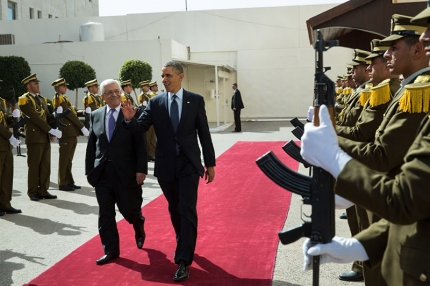
President Barack Obama and President Mahmoud Abbas of the Palestinian Authority walk past an honor guard

President Barack Obama and President Mahmoud Abbas of the Palestinian Authority walk past an honor guard at the Mugata Presidential Compound in Ramallah, the West Bank, March 21, 2013. (Official White House Photo by Pete Souza)

President Obama was in the West Bank for the first time since 2008 on the second day of his visit to the Middle East, where he held meetings in Ramallah with Palestinian Authority President Abbas and Palestinian Authority Prime Minister Fayyad, and attended a cultural event at Al-Bireh Youth Center. President Obama, who was joined by Secretary of State John Kerry in his meetings, commended President Abbas and Prime Minister Fayyad for the progress that they’ve made in building the institutions of a Palestinian state.

“I’ve returned to the West Bank because the United States is deeply committed to the creation of an independent and sovereign state of Palestine,” President Obama said in a joint press conference with President Abbas. “Like people everywhere, Palestinians deserve a future of hope -- that their rights will be respected, that tomorrow will be better than today and that they can give their children a life of dignity and opportunity. Put simply, Palestinians deserve a state of their own.”

In the interests of the Palestinian people, and also in the national security interest of Israel, the United States, and the world, President Obama reaffirmed “that the United States remains committed to realizing the vision of two states.”

We seek an independent, a viable and contiguous Palestinian state as the homeland of the Palestinian people, alongside the Jewish State of Israel -- two nations enjoying self-determination, security and peace. As I have said many times, the only way to achieve that goal is through direct negotiations between Israelis and Palestinians themselves. There is no shortcut to a sustainable solution.

The President also spent time in Jerusalem today, this morning where he toured the Israel Museum and again in the afternoon, where he delivered remarks to the Israeli people from the Jerusalem International Convention Center. In his speech, President Obama spoke about the “unbreakable bonds of friendship” between Israel and the United States.