The White House

Office of the Press Secretary

Statement by the Press Secretary on the President’s Trip to Mexico and Costa Rica

President Obama will travel to Mexico and Costa Rica May 2-4.  This trip is an important opportunity to reinforce the deep cultural, familial, and economic ties that so many Americans share with Mexico and Central America.

In Mexico, the President looks forward to meeting with President Peña Nieto, with whom he spoke by telephone today.  The President welcomes the opportunity to discuss ways to deepen our economic and commercial partnership and further our engagement on the broad array of bilateral, regional, and global issues that connect our two countries.  In Costa Rica, the President looks forward to the opportunity to meet with President Chinchilla as well as heads of state of the other Central American countries and the Dominican Republic, whom President Chinchilla has graciously offered to host.  The trip will be an important chance to discuss our collective efforts to promote economic growth and development in Central America and our ongoing collaboration on citizen security.

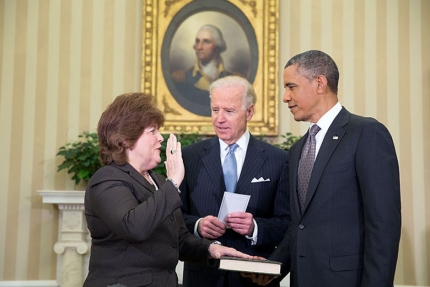
Julia Pierson Is Sworn In As First-Ever Female Director of the US Secret Service

President Obama watches as Vice President Joe Biden administers the oath of office to incoming U.S. Secret Service Director Julia Pierson, March 27, 2013.

President Barack Obama watches as Vice President Joe Biden administers the oath of office to incoming U.S. Secret Service Director Julia Pierson during a swearing-in ceremony in the Oval Office, March 27, 2013. (Official White House Photo by Pete Souza)

A highly respected veteran of the Secret Service was sworn in as head of that agency today in a ceremony in the Oval Office. President Obama watched as Vice President Joe Biden administered the oath to Julia Pierson, and praised her dedication, professionalism and commitment to her work:

"I have to say that Julia’s reputation within the Service is extraordinary," President Obama said following the ceremony. "She’s come up through the ranks. She’s done just about every job there is to do at the Secret Service."

"Obviously, she’s breaking the mold in terms of directors of the agency, and I think that people are all extraordinarily proud of her. And we have the greatest confidence in the wonderful task that lies ahead and very confident that she is going to do a great job. So we just want to say congratulations."

The White House

Office of the Press Secretary

Remarks by the President at Swearing-in Ceremony of Julia Pierson as the Director of the U.S. Secret Service

Oval Office

3:16 P.M. EDT

(The Vice President administers the oath to Ms. Pierson.)

THE VICE PRESIDENT:  Congratulations.

THE PRESIDENT:  Great job.

MS. PIERSON:  Thank you very much, Mr. President.

THE PRESIDENT:  Thank you so much.  Well, listen, I have to say that Julia’s reputation within the Service is extraordinary.  She’s come up through the ranks.  She’s done just about every job there is to do at the Secret Service. 

Obviously, she’s breaking the mold in terms of directors of the agency, and I think that people are all extraordinarily proud of her.  And we have the greatest confidence in the wonderful task that lies ahead and very confident that she is going to do a great job.  So we just want to say congratulations. 

As Joe Biden pointed out, this person now probably has more control over our lives than anyone else -- (laughter) -- except for our spouses.  And I couldn’t be placing our lives in better hands than Julia’s.

THE VICE PRESIDENT:  And my agents are excited that we picked her.

THE PRESIDENT:  Absolutely.  You’re going to do a great job.

Q    How did you make your decision?

THE PRESIDENT:  She has extraordinary qualifications, and I think a lot of people who have worked with Julia know how dedicated, how professional, how committed she is, and I think are absolutely certain that she’s going to thrive in this job.

Thank you, guys.

Q    How are you feeling about your bracket, sir?

THE PRESIDENT:  Busted.  (Laughter.)  I think my women’s bracket is doing much better than my men’s bracket.

END  
3:18 P.M. EDT

The White House

Office of the Press Secretary

Press Briefing by Principal Deputy Press Secretary Josh Earnest, 03/27/2013

James S. Brady Press Briefing Room

12:39 P.M. EDT

MR. EARNEST:  Two quick announcements at the top before we go to your questions.  They’re both scheduling announcements, actually.  The first is, at 3:00 p.m. today the President will host a swearing-in ceremony for the new director of the United States Secret Service, Julia Pierson.  That will be in the Oval Office, and we’ve arranged for a pool to be there to witness it.  So that should be pretty good.

The second thing is about tomorrow.  Tomorrow, the President will hold an event here at the White House where he will stand with mothers who want Congress to take action on common-sense measures to protect children from gun violence.  The event will take place in the East Room.  And in addition to the mothers on stage with the President, there will be law enforcement officials, victims of gun violence, and other stakeholders.  So that will be tomorrow.  I don’t know the exact time, but we’ll have more on that on the guidance tonight.  So, yes, here in the East Room in the White House. 

With that, Julie, I’ll let you get us started.

Q    Thank you.  Just a couple things on DOMA.  Did the President get any update from the Solicitor General following the oral arguments today?  And was there anyone from the White House who was there to witness the arguments, like yesterday?

MR. EARNEST:  It is my understanding that the President has been kept apprised of the arguments made at the Supreme Court on these issues, both through reading the coverage of you and your colleagues but also based on briefings that he’s gotten from his legal staff here at the White House.

It’s also my understanding that the White House officials who attended yesterday are the White House officials also attended today.  So that was Valerie Jarrett, Kathy Ruemmler, the Counsel of the White House, and Kathleen Hartnett, who’s an associate counsel here at the White House.

Q    There seemed to be, in sort of the initial reading of the justices’ questions, a sense that they were also questioning the constitutionality of DOMA.  Did the President, in the short period of time that’s passed since it was wrapped up, have any reaction to the proceedings today?

MR. EARNEST:  I haven’t heard from him about his reaction to the proceedings today.  I know that going into the proceedings that he had full confidence in his team at the Justice Department and others who were responsible for preparing the arguments, and had total confidence in the people who were prepared to walk in there and deliver them.  But in terms of his reaction for how it played out, I didn’t get one.

Q    We’re seeing a little bit more from the President, at least publicly this week, on immigration reform -- the interviews today, the event on Monday.  Is there a reason why he feels like he needs to be kind of more forthright publicly this week as Congress works its way towards a possible deal?

MR. EARNEST:  The reason that the President felt like it was important for him to be very public this week, as he has been in previous weeks about immigration reform, is that it remains a top priority of his.  This is something that he talked about quite extensively during the campaign; and something since the beginning of this year, when he laid out his principles in a speech in Las Vegas in January, has made clear that this is an important priority, both in terms of the impact that -- reforming in a comprehensive way our broken immigration system because of the impact that it would have on our economy, but also because it’s the President’s view that we need to make sure that everybody is playing by the same set of rules.   And by reforming our broken immigration system in a comprehensive way, we can accomplish those two goals.

So the President is looking forward to the opportunity that he’ll have to speak with Univision and Telemundo correspondents this afternoon to talk about why that’s such a priority for him.  And I think what he’ll also note, though, to be fair, is the progress that’s being made by the bipartisan group of eight senators who are working on this in the United States Senate.

Q    One of the sticking points right now is this wages for guest workers.  Obviously, business and labor are split on this.  Has the President done any outreach to labor, to Trumka at AFL-CIO on this?

MR. EARNEST:  I don’t have any specific calls to read out to you.  As you know, the White House staff, throughout this process of negotiations -- bipartisan negotiations have been ongoing -- has been engaged.  And they have been engaged both to offer some technical assistance, but also to ensure, or at least to represent the administration point of view, to try to steer the proposal in the direction of the principles that the President had laid out. 

So we’re pleased with the progress that the groups are making in terms of trying to hammer out an agreement here.  And we are also heartened by the fact that Senator Schumer at least has said that he expects that a bill will be filed shortly after the Easter vacation.  And if that’s the case, we’re certainly pleased with the progress and looking forward to taking a look at what they have agreed upon.

Hey, Steve.

Q    Josh, what’s the next step in trying to reach a grand bargain with Republicans over the deficit?

MR. EARNEST:  Well, as you know, Steve, for some time now, the chief impediment to reaching a grand bargain has been the refusal of Republicans to ask the wealthiest and well-connected to pay even a dime more to help us deal with our deficit challenges.  I’m sad to report that even months later that that continues to be the case, that we are seeing a group of Republicans in the Congress who are refusing to compromise on this.  In fact, you even see some of them that are actually running around the country bragging about their intransigence on this.

That's not in the best interest of the country.  It’s not in the best interest of our economy.  The President has put forward his own plan, a genuine compromise that reflects the balanced approach that the President supports.  It would reduce our deficits based on the agreements that we’ve reached over the last 18 months or so.  It would reduce our deficits by about $4 trillion, $4.5 trillion over 10 years, and it would reach that deficit reduction by making smart cuts in government spending, by eliciting some savings from reforms to our entitlement programs, and by asking the wealthy and well-connected to pay a little bit more.

Q    So what happens now then?

MR. EARNEST:  Well, we are in a place now where it’s difficult for us to reach an agreement when you have a firm block of Republican senators who are refusing to compromise.  It’s even more disappointing where -- it’s even more disappointing that the natural compromise that should exist in terms of additional cuts in government spending, some reforms to entitlement programs, both of those -- those are two items that Republicans have long said that they have sought, and asking the wealthiest and well-connected to pay a little bit more.  By pursuing that balanced approach, we can reach some significant deficit reduction in a way that's good for the economy.  But as long as Republicans are saying we’re not going to ask the wealthiest and well-connected to pay a single dime to reduce our deficit, then it is hard to imagine that we’re going to reach a compromise.

Q    So basically the process has stalemated then?

MR. EARNEST:  Well, the process is currently being blocked by Republicans who refuse to consider -- even consider asking the wealthiest and well-connected to pay more.

Q    So any more meetings planned or any talks about this?

MR. EARNEST:  Nothing that I have to read out to you right now.  The President has -- since December -- has had on the table an updated compromise plan, one that he originally presented to Speaker Boehner in mid-December.  The details of that offer are posted on the White House website.  They remain on the table.  So if there happens to be a critical mass of Republicans in Congress who take a look at that proposal and say, you know what, we actually would like to reach an agreement that would do something significant about our deficit; that would make some strategic cuts to government programs where we can; that would reform entitlements in a way that would protect those programs for the future, but also enjoy some savings that we could pay toward reducing the deficit; and ask the wealthy and well-connected to pay a little bit more, then that would be the outline of compromise.  What we need to see is we need to see Republicans who are willing to demonstrate some political courage to do that.

Q    And quickly on another subject.  North Dakota is signing a law banning most abortions.  Is this something you’re taking a look at on whether it is constitutional?

MR. EARNEST:  Well, this is -- it’s a state matter, and so I don't have a specific comment on it.  I know that the expectation is -- just from reading the reports, I know the expectation is that there are a number of legal challenges that are likely to be pursued.  And I know that many people who know a whole lot more about the law than I do are skeptical that these types of laws will stand up to legal scrutiny like that, but that’s not a decision for us to make.

The President’s view on this is pretty clear.  He certainly is opposed to measures like that.  He believes in protecting a woman’s right to choose.  But in terms of if there is a legal process forthcoming, that’s something that will be -- that will wind its way through the process and not something that we’ll -- at least initially -- be involved in.

Jim.

Q    Back on immigration, if we could.  Senator McCain in his home state said yesterday that he -- he told some of his constituents that, “I don’t know if we can achieve agreement or not.  We’ve been working hard…but I can’t guarantee anything.” Is the White House concerned?  And is in fact this push that happened on Monday and then, again, the interviews today, are those linked in any way in a concern that this is stalled at this point?

MR. EARNEST:  No, in fact, we’re actually encouraged by the progress that’s being made by the bipartisan group of senators who have been working on this for a number of months now.  Senator Schumer said just on Sunday that he was optimistic that they’d be able to file a piece of legislation when they got back from the Easter recess. 

I know that Senator McCain and his Arizona colleague, Senator Flake, are hosting a couple of their Democratic colleagues -- Senator Bennet and Senator Schumer -- in Arizona today, again, to take a look at the border, to take a look at the important investments and commitments that have been made by this administration to securing the border. 

And we are hopeful that, as they work their way through this process, that we’ll have a bipartisan agreement that reflects many of the principles that the President himself has laid out.  We’ll reserve judgment on the product of those discussions until it’s produced, but at this time we are -- we remain encouraged by the progress that they’re making.

Q    So Sunday’s statement by Senator Schumer would trump yesterday’s statement by Senator McCain that he, in fact, can’t guarantee they will have a bill and that he is, in fact -- couldn’t guarantee anything and he is discouraged?

MR. EARNEST:  I haven’t seen the exact comments from Senator McCain.  I would -- if he’s suggesting that he’s not going to make any guarantees about what happens in Congress two weeks from now, I would actually suggest that he’s quite -- he’s being pretty judicious, because I think it is difficult to predict what exactly happens in Congress.

But I think that the vast majority of indications are that this bipartisan group has made a lot of progress.  That’s progress that the White House has been involved in, as I mentioned earlier.  The White House has offered some technical assistance to them as they’ve been working through drafts of legislation and I know that there are others who are involved in those talks who are interested in ensuring or at least trying to steer that group in the direction of the principles that the President has laid out.  And by all indications, they’ve made some important progress. 

I’m not up here offering any guarantees either.  But what I am encouraged by and what the White House is encouraged by are the indications that they’re making some progress and will be prepared in a couple of weeks to file a piece of legislation or around the deadline that they set for themselves a few months ago.

Q    So, finally, just to be clear here, so the President hasn’t changed his mind about stepping back, letting Congress work this out, and not inserting himself as he did on Monday and as he is a little bit today with the Spanish-language media?  That’s not reasserting himself into the process at this point?

MR. EARNEST:  Well, I’ll let you guys sort of evaluate whether or not the President is asserting himself or inserting himself into the process.  The President has beliefs.  The President campaigned on and won reelection on a platform of pursuing comprehensive immigration reform early in his second term.  That is a promise that the President has followed through on.  The reason -- one of the important reasons that immigration reform is such a legislative priority for both sides is because of the public support that the President has marshaled on this issue.

So it is natural that the President would be involved in the process of putting together a policy that would finally fix our broken immigration system.  But in this case, we have allowed a bipartisan group of senators, at their request, to take the lead in the conversations about a bipartisan compromise in the United States Senate.  Those are conversations that we’ve been involved with from the beginning, but we’re pleased that we see this group of eight senators -- Democrats and Republicans -- working together to try to put in place a policy that could pass through the Senate with bipartisan support, could pass through the House with bipartisan support, and would be the kind of legislation that the President could sign.  That’s the way that the system is supposed to work.

Major.

Q    I just want to talk to you about North Korea for a minute.  And I took seriously what Jay said about the statement.  But what I’m trying to get at is if there is any conversation that’s reached the President, or if he’s aligned or put together working groups that view what’s happened in North Korea in the last three or four weeks as materially different the kind of rhetoric and provocations and actions that this government has seen before.  Because there are a number of people who are familiar with this issue who do feel increasingly that there is a material difference and that the risks are greater, and that there is something afoot here that is different and possibly more threatening to South Korea and U.S. interests throughout the region than we have seen before.  I wanted to ask you if you can tell us anything about whether the administration believes that’s true, if it feels it is materially different, and is doing anything in response to that conclusion.

MR. EARNEST:  Well, the thing that we have -- it’s difficult to offer you a specific assessment from here.  But I can tell you that the White House and this administration, and certainly through the Department of Defense and other agencies and leaders in this government who are responsible for the safety and security of not just the United States of America but also our allies, have been engaged with our international partners to try to deal with this challenge.  I mean, what we’ve seen from North Koreans is more bellicose rhetoric and threats that only follow a pattern designed to raise tensions and intimidate others.  The North Koreans are not going to achieve anything through these threats and provocations, and they’re only going to further isolate the North Koreans and undermine international efforts to bring peace and stability to Northeast Asia.

We remain committed to ensuring that the security of the South Koreans, our allies, are protected, and we have the capability that we need to ensure that the United States and our assets are protected.

Q    The Treasury Secretary was over in China, had -- was the first civilian leader to see the new Chinese President.  Obviously, he has a very good relationship with the President.  I’m wondering if there were any conversations or any reports back to the President from the Treasury Secretary, because I have to believe in these conversations North Korea did come up as a general topic.

MR. EARNEST:  I’m not familiar with the details of the discussions between Secretary Lew and President Xi, so I’d refer you to the Treasury Department for that.

Q    Right.  And can you tell us if there is any different posturing here in the building, on a daily basis or even a weekly basis, about North Korea?

MR. EARNEST:  What do you mean by posturing?

Q    Meetings, briefings to the President? 

MR. EARNEST:  No, I’d say no.

Q    Is anything being lifted up to a higher level of
scrutiny, analysis and presentation of that analysis to the President?

MR. EARNEST:  Well, I can tell you that this is something that is being --

Q    Is there a higher level of urgency or curiosity or interest now than there was, say, two months ago?

MR. EARNEST:  Well, I think that there’s always been a pretty vigilant posture when it comes to North Korea, in terms of monitoring their statements, in terms of monitoring their capabilities, and making sure that we have the resources that we need to protect our interests and our allies.  We remain engaged with our international partners in the region who also have a stake in resolving this peacefully.  It’s hard for me to compare that to previous instances like this, but I can tell you that this is something that we have been vigilant about for quite some time now.

Q    But not more so now than throughout the entire administration?

MR. EARNEST:  Well, I would say at least as vigilant as we have been previously.

Ed.

Q    Josh, I want to ask all of Jim’s questions over again -- (laughter) -- but just to insert gun control instead of immigration reform.  Will you guarantee that there’s going to be a big gun control bill that will pass through both chambers?

MR. EARNEST:  I don’t want to try to stand here and predict the future about what’s going to happen in the Congress, but I can tell you that, in the same way that we’re encouraged by the progress that’s been made in bipartisan fashion on immigration reform, we’re encouraged by the bipartisan progress that's been made in the Senate. 

There are a number of measures that passed through the Senate Judiciary Committee, last week I believe it was, and we’re going to continue to work with the Senate and with members in both parties, frankly, who are interested in working with the President to put in place measures that would reduce gun violence.  As the President himself has said pretty articulately that this is a complex problem, but we shouldn’t let the complicated nature of it prevent us from taking action.  And there are some meaningful, common-sense things that we can do to reduce gun violence in our communities at the same time respecting the rights provided by the Second Amendment of the Constitution.

Q    Today I believe is 100 days since the tragedy at Sandy Hook, and obviously the President -- that may be one reason why he’s having this event here at the White House tomorrow, obviously to mark that.  There’s a national day of action tomorrow, as well on this.  But a lot of time -- 100 days has passed since the tragedy.  The nation’s attention was focused.  Obviously, the fiscal cliff and other things have come up.  Is he getting more active now, worried that perhaps he’s lost some momentum on this important issue?

MR. EARNEST:  Well, I think I would slightly disagree with the premise of your question because I think that the President has been engaged on this pretty quickly.  And I think --

Q    But how many events has he had here at the White House on this in this room, pushing with moms or --

MR. EARNEST:  Sure.  There have been more than 20 events actually, more than 20 events and interviews and public appearances, between the President and the Vice President’s activities, spread out over 100 days.  That's more than one a week.  So this is something that the President has been engaged on from the beginning.  Putting somebody like the Vice President in charge of this is significant.  This is somebody that has a long history with these issues from being the Chairman of the Judiciary Committee and intimately involved in the passage of the first crime bill that included an assault weapons ban.

But two days after the tragedy in Newtown, the President spoke pretty eloquently about steps that Congress should take.  Three days later, he stood at this podium in this room where he appointed -- or he asked the Vice President to take the lead here, at least initially, in coming up with some ideas.  But even in those remarks, he talked about and challenged Congress to pass legislation on banning military-style assault weapons, banning high-capacity magazines, and closing loopholes in the background checks.  And that's something that the President said and called on Congress to act on, on December 19th.  And since that time, the President has spoken repeatedly about this from weekly addresses.  The President had a very eloquent challenge in the State of the Union, where he asked Congress to vote on specific measures that would actually have a tangible impact on reducing gun violence.

Q    He’s done all that, and yet his own Senate Majority Leader, fellow Democrat Harry Reid, would not include the assault weapons ban in the package of reforms that's coming up.  There’s talk about a separate vote on it as an amendment.  But despite all of that talk, all of the speeches, all of the meetings, even the Senate Majority Leader is not guaranteeing that they're going to get an assault --

MR. EARNEST:  I think because of all the talk of the President and because of his aggressive advocacy of this issue, there will be a vote in the United States Senate on whether or not military-style assault weapons will be banned from the streets of this country.  I think there is -- that represents progress.

Now, does it mean -- I can't stand here and guarantee that it’s going to pass, but it is a question that 100 senators are going to ask themselves when they wake up in the morning and look themselves in the mirror about whether or not they are going to -- about which side they're going to be on when it comes to voting on a ban on military-style assault weapons.  And the President will certainly continue to advocate for senators to support that ban.

Peter.

Q    If I can, I want to ask you a question about what’s happening at 3:00 p.m. today.  The President is going to be there with Julia Pierson for the U.S. Secret Service Director.  First of all, was she the President’s first choice to be Secret Service Director?

MR. EARNEST:  The President believes that she’s the right person for the job, absolutely.

Q    Does that mean she was the first choice?

MR. EARNEST:  Well, I’m not going to get into that -- to the process here.  I don't know that there is even more than one candidate.  I mean, Ms. Pierson, as you know, is a 30-year veteran of the United States Secret Service.  She’s somebody who has held a variety of leadership roles at the Secret Service from some protective activities to cybercrime, and most recently as the chief of staff of the organization.  So this is somebody that has a strong record of leadership at the organization.  And she embodies the kind of character and leadership that the President would like to see at the top of that organization.

Q    Obviously, that organization faces unique challenges right now.  The Washington Post reported some information that I just want to get your thoughts on.  They spoke to a series of agents that were interviewed in the last couple of weeks that said that Pierson was a “weak candidate about rank-and-file agents because she has spent relatively little time supervising or working high-priority protective details, spending most of her career in administrative jobs.”  Is that a concern for the President to have somebody who has more time in the field than behind the desk?

MR. EARNEST:  No, I think the President believes that Julia Pierson has exactly the kind of experience that we want the person who’s going to lead that agency to have.  I guess the other thing I would point you to is that I know that the outgoing director, Mark Sullivan, who I know has a lot of respect across the agency, is somebody who has strongly supported her for candidacy and said that she was exactly the right person for the job.  So it’s not just the President who believes that she’s the right person for the job, it’s the outgoing Director of the Secret Service who believes that she has exactly the experience and skills necessary to lead that agency.

Q    This one -- given the fact that the White House came under a lot of scrutiny in recent weeks or months about what the Cabinet looked like and what some of the top leaders of this top administration looked like and that there weren’t enough women at the time, now we can say that the head of the DEA, the head of the U.S. Marshals Office and now the head of the Secret Service will all be women.  Does this represent something significant that America should be taking note of -- that the administration would want to declare with yet another female head?

MR. EARNEST:  Well, I guess what I would say is that Ms. Pierson got the job because of her 30 years of experience and because the leadership skills that she’s shown throughout her career at the United States Secret Service.  The fact that she’s the first woman to lead this agency is notable and I think it’s important, but it’s not the reason she was chosen for the job. 

She’s chosen for the job because she is the right person at the right time to lead this agency that has a critical law enforcement function -- not just in terms of protecting the President and his family, but also in terms of safeguarding the financial system and other large public events that come under the jurisdiction of the Secret Service.  So she’s got a big job but she’s the right person to get it done right.

Q    And then digressing on one other topic and I’ll tee it up for the next person if they like, but why if the spending cuts are locked into place with the CR, why didn’t the President just veto the CR?  Why wasn’t this something worth fighting for to continue his effort?

MR. EARNEST:  Well, the President does believe that eliminating the sequester is something that’s worth fighting for.  The President said that this was bad policy from the beginning.  Republicans said it was bad policy from the beginning, at least many of them did.  After it passed, though, we unfortunately saw a lot of tea party Republicans say that this was a political victory.  I know another one of them called it a homerun.  So that’s unfortunate.

What the President also believes, though, is we can’t have a situation where Washington careens from one fiscal crisis to another.  That is -- that has a terrible impact on our economy.  And the truth is what we’ve seen is that we’ve actually seen that our economy is starting to actually get some traction in the recovery from the worst recession since the Great Depression.  So we’re starting to make some progress -- whether you look at jobs numbers or consumer confidence, even housing data recently came out to indicate that home values are -- have increased as much as they have in any time in the last eight years. 

So there’s a lot of progress that’s being made in terms of our economic recovery, and we can’t careen from one fiscal crisis to another because that’s only going to block that progress.  What we actually need is we need comprehensive compromise, economic policymaking in this town that actually supports that recovery instead of inhibit it. 

Brianna.

Q    A report by the Society of Actuaries says that insurers will have to pay on average 32 percent more for claims on insurance policies, individual insurance policies that they purchase because of Obamacare, and that that’s likely to be passed on to consumers.  It says that there will be a dip some places, but some states are going to see really big increases, like 62 percent in California, 80 percent in Ohio and Wisconsin.  What do you think about those numbers?

MR. EARNEST:  Well, I think that you are citing a study that I believe was conducted by a health insurance company that’s critical of the Affordable Care Act.  So that part I’m not particularly surprised about.  The reason that the Affordable Care Act was put in place was to ensure that we were expanding access to health care for every American, but also because we wanted to actually protect consumers who are repeatedly victimized by insurance companies. 

So it’s not particularly surprising to me that an insurance company would conduct a study that was critical of a piece of legislation that was promising to hold them accountable for their actions. 

Q    But can you talk about some of the numbers -- I know that there is some contention with the way that they -- sort of what they’ve factored in and what they haven’t factored in.  What do you think about that?

MR. EARNEST:  Well, I know that -- you should check with the Department of Health and Human Services who may have some more detailed information on this.  I know that there are some assumptions on there that are spurious at best.  But there are a number of things about the Affordable Care Act that at this point are inarguable at this point, if you will.

The Affordable Care Act has already saved consumers an estimated $2.1 billion on their health insurance premiums that probably otherwise were it not for the Affordable Care Act would be an additional $2 billion that were paid into the pockets of insurance companies, like that one that funded this study.

Once the law takes full effect, it will have the benefit of increasing competition, driving down cost, and result in average premiums that are lower today -- I’m sorry, that will be lower in the future than they are today for the same benefits that are being provided.  And that’s an analysis that’s conducted by the nonpartisan Congressional Budget Office.

Q    Can I ask you about some comments yesterday, made reportedly by your Health and Human Services Secretary, saying that that there will be an increase in premium cost for some Americans as a result of Obamacare?  Do you agree with that?

MR. EARNEST:  I didn’t see those comments.  I mean, what I did see yesterday was actually a blog post from the Chairman of the President’s Council of Economic Advisors, who said that each year, from 2009 to 2011, the national health expenditure data shows the real rate of annual growth in overall health spending was between 3 and 3.1 percent, which is actually the lowest rate of growth since reporting began in 1960.

Q    Will there be increases for some people who are purchasing insurance?  Do you concede that?  Kathleen Sebelius reportedly has.

MR. EARNEST:  Well, what I would actually point you to is I would actually point to the results that we’re already seeing from the Affordable Care Act, which is a savings of $2.1 billion, and the analysis from the CBO that actually says in the future we’re going to see rates that are lower for higher benefits.

Q    Is she wrong?  Because she’s talking about people paying more for higher benefits.

MR. EARNEST:  Again, I didn’t see her comment.  I didn’t see her comments.

Q    On the guest worker program, does the President think it’s necessary for it to be in there to have a viable, comprehensive immigration reform bill that can get bipartisan support?

MR. EARNEST:  Well, this is something that a variety of parties who have interests in this are working on.  And if it’s included in line with the other principles that the President has rolled out -- laid out in terms of what should be included in comprehensive immigration reform, that’s certainly something that we could support.  But we’re going to reserve judgment on what that looks like until it’s actually produced.

Q    What’s more important?  Coming to an agreement, or bringing labor along and making sure that they’re included?

MR. EARNEST:  What the President wants to see is he wants to see a bipartisan agreement in line with the principles that the President has laid out.  There is an opportunity for us to fix our broken immigration system in a way that will strengthen our economy and ensure that everybody is playing by the same set of rules.  That is the priority, and that’s what the President is looking for.

Q    How important is the labor sign-on? 

MR. EARNEST:  Well, I mean, we’re in a place right now where we want a piece -- see a piece of legislation that’s in the best interests of the economy and that reflects our nation’s heritage, as a nation of immigrants but also a nation of laws.  And we certainly want to build as much support for that as we possibly can, both from Democrats and Republicans as well as from outside organizations that traditionally support Democrats and outside organizations that traditionally support Republicans. 

Ari.

Q    During the arguments over DOMA, the justices seemed to have a lot of questions about why the President has decided to continue enforcing a law that he thinks is unconstitutional.  The Chief Justice said, “I don’t see why he doesn’t have the courage of his convictions and not enforce the law if he thinks it is unconstitutional.”  Can you explain that?

MR. EARNEST:  Well, there is a responsibility that the administration has to enforce the laws that are on the books, and we’ll do that even for laws that we disagree with, including the Defense of Marriage Act.  The argument that we have made before the Supreme Court and the argument that we have made publicly, including in a letter that the Attorney General sent to the Speaker of the House a couple years ago, is the argument that Section 3 -- let me make sure I got that right -- Section 3 of the Defense of Marriage Act is unconstitutional.  That is a position, broadly speaking, that a lot of Republicans agree with.  It’s not unprecedented for an administration to take that position.  That’s the position that’s being argued before the Supreme Court today.  It’s a position that has a lot of support from people in both parties.  But we’ll see what the outcome looks like from the Supreme Court.

Q    But President Obama has endorsed signing statements; he’s issued signing statements saying, I believe this law or this part of the law to be unconstitutional so I’m not going to enforce it.  So as you say we will enforce laws that we believe to be unconstitutional, he’s also said he won’t enforce some laws that he believes to be unconstitutional.

MR. EARNEST:  Well, I’m not sure that that’s exactly what the signing statements have said.  But in terms of what our legal posture is for these things, I’d refer you to the Department of Justice.  They have done the legal analysis required to reach the conclusion that it is unconstitutional.  They also are the ones that are responsible for enforcing these laws.  So I’m not going to prejudge what the Department of Justice may have to say about this, based on their own analysis.  But what I can tell you is that the argument that the administration has put forward before the Supreme Court today is an indication that our lawyers have concluded that Section 3 of the Defense of Marriage Act is unconstitutional.

Yes, Roger.

Q    On the Fiscal ’14 budget, do you guys have a date yet?

MR. EARNEST:  (Laughter.)  What day of the week is this?  Is it Wednesday?  I’ll see at least --

Q    Jay said you would tell.

MR. EARNEST:  I anticipate we’ll get this question at least two more times before the end of the week.  I don’t have a specific date to allow you to mark anything on your calendar just yet, Roger, beyond the week of April 8th. 

Q    But you will give us a date eventually?

MR. EARNEST:  Eventually, we’ll probably have to, unless we could spread out the budget rollout over the course of five full days, which I think everybody in here would be disappointed about except Roger.  (Laughter.)

Q    Why is it taking so long to set a date?

MR. EARNEST:  Well, I didn’t say we hadn’t set a date. 

Q    So tell it.

MR. EARNEST:  I just said I wasn’t going to tell you what date it is.  But it’ll be the week of April 8th.

Q    What’s that about?  

MR. EARNEST:  It’ll be the week of April 8th.

Q    What’s the big secret?  What’s the --

MR. EARNEST:  Well, because we’re going to have a planning process and we’re working through it.  So it’ll be April 8th.  The week of April 8th.  (Laughter.) 

Q    One more, Josh.  When the President does send up the Fiscal ’14 budget --

MR. EARNEST:  Yes, the week of April 8th.  (Laughter.)

Q    -- the week of April 8th, sometime next month --

MR. EARNEST:  Sometime next month.

Q    -- the Pentagon is going to be asking for $8.4 billion to continue development and purchase of the F-35 fighter.  That’s a project that’s seven years behind schedule and 70 percent over its initial cost estimates.  Does the President support that project?

MR. EARNEST:  Well, I don’t want to -- because the budget is going to be rolled out in just a couple of weeks, I don’t want to get ahead of what may or may not be included in the budget.  So those are the kinds of questions that are perfectly legitimate, and one that we’ll be in a position to answer after the budget has been rolled out.  And we’ll have a detailed answer for you at that point.

Q    He has supported it in the past, right?

MR. EARNEST:  I don’t have previous years’ budgets in front of me, so I don’t know how to compare them to previous ones.  But we can certainly have OMB take a look at that for you.   

Stephen.

Q    What kind of level of concern is there or engagement in the White House right now about the situation in Guantanamo Bay?  The military says 31 inmates are on hunger strike.  Defense lawyers say that number is higher.  Is the President concerned about this?  Is there any dialogue with the military about this in the White House?

MR. EARNEST:  Stephen, I can tell you that the White House and the President’s team is closely monitoring the hunger strikers at Guantanamo Bay.  For details about what’s actually happening there, I would refer you to the Department of Defense.  But I can tell you that the administration remains committed to closing the detention facility at Guantanamo Bay.  Progress has been made under this and the previous administration.  But given the legislation that progress has put in place it’s clear that it’s going to take some time to fully close the facility.

The other thing that I’ve seen from news reports is that there are representatives from the Red Cross that will be visiting the facility sometime this week -- I don’t know if it’s today or tomorrow.  That is part of a routine agreement that we have with the Red Cross, where we give them full access so that they can take a look at what’s happening at the prison there.

Q    Is there any sense that somewhat -- the situation there is the result of the fact that Congress has stopped funding to transfer people who have already been cleared for release?

MR. EARNEST:  To be honest with you, I wouldn’t want to judge about what these individuals may or may not be thinking or what may be motivating their actions there.  So, again, I’d refer you to the Department of Defense.  They may have a better assessment there than I do.

April.

Q    Josh, two questions.  The Pierson appointment -- what does that do for the Service right now, especially after the Colombian prostitute scandal?

MR. EARNEST:  How so?

Q    She’s the first woman to be appointed --

MR. EARNEST:  She is.

Q    Okay, thank you for agreeing.  (Laughter.)  She’s the first woman to be appointed.  But, I mean, there was a prostitute scandal with women, with men, and with prostitutes that are women in Colombia.  So, I mean, you asked me, so I’m breaking it down very basic for you --

MR. EARNEST:  Okay, I appreciate that.

Q    -- so you can help me get me an answer.  (Laughter.) 

MR. EARNEST:  Well, April, what I can tell you is that Director Sullivan, in the immediate aftermath of the events that you so colorfully described --

Q    You asked for it.

MR. EARNEST:  -- took immediate steps to ensure that the safety of the President had not been affected.  The allegations of misconduct were investigated, and swift action was taken against those Secret Service personnel who had engaged in that misconduct.

And I know that there were several members of the Secret Service who, as a result of this misconduct, either left the Secret Service or lost their job.  So it’s pretty clear that there were -- that Director Sullivan, in the immediate aftermath of this event, took swift action both in terms of investigating what had happened, ensuring that the President’s safety was never jeopardized, and ensuring that new protocols were put in place to reduce the likelihood that something like this would ever happen again.

Now, it’s also relevant, it seems to me, that the new director has some leadership experience at the agency.  She also has some experience in human resources and training, and would be able to, as she leads the agency, to ensure that the protocols that Director Sullivan has put in place are continued and, if necessary, strengthened.

Q    Were you trying to send a message with this appointment of a female who has strong leadership in the light of all of this and other allegations?  

MR. EARNEST:  Well, I think the President was pretty direct in the paper statement that we distributed from him yesterday about why she was chosen for the job.  And certainly her leadership skills and her character and her 30 years of experience at the United States Secret Service are the reasons why she was chosen.

Q    And I want to ask you another question.  I hope you have it on paper as well.  Tomorrow, the President meets with African leaders.  Could you give us a readout as to why this meeting -- why now? 

MR. EARNEST:  You’re asking a very good question but I’m not prepared to answer it right now.  But if you want to touch base later this afternoon, maybe you and I can record an interview or we can make sure that your listeners are aware just what the President is up to tomorrow. 

Q    I would love to, thank you.

MR. EARNEST:  Okay, sounds good.

Zach.

Q    Thanks, Josh.  A question related to the Affordable Care Act, which you mentioned earlier.  First of all, the reduction in health spending, you mentioned earlier, is it the White House’s position that that’s the result of the Affordable Care Act or the administration’s policies?  And then, a second question is, the administration requested more funding for ACA implementation, and the CR didn’t get it, of course.  Are you concerned that the program is underfunded and it’s going to make it difficult to roll out in full form in about seven months?

MR. EARNEST:  Well, in terms of the impact that the Affordable Care Act has had on health care costs, I think I’d actually refer you to the Congressional Budget Office, that they’ve actually noted that based on their nonpartisan independent analysis, that once the Affordable Care Act takes effect it will increase competition, drive down costs, and result in average premiums being lower than they are today for the exact same benefits.  So I think that is a pretty clear assessment from a nonpartisan group as opposed to a study that was funded by the health insurance industry -- but a pretty clear assessment from a nonpartisan group about what impact the Affordable Care Act is going to have on the budgets of families all across the country.

Q    Just to clarify -- the slowdown you said earlier from the White House post, that’s not -- is that the result of the Affordable Care Act?

MR. EARNEST:  I guess I’m not quite sure what you’re referring to.

Q    I think earlier you said there had been a slowdown in health spending since 2009-2011, in response to Brianna’s question.

MR. EARNEST:  Oh, yes.

Q    And I was wondering, are you saying that’s the result of the administration’s policies?  Or is that a separate issue?

MR. EARNEST:  Well, this was an analysis that was conducted by the CEA, so we can maybe get you some more details on that analysis if you’d like.  But I do think that it is probably not a coincidence that after the Affordable Care Act was passed, that we have seen growth rates slow to the lowest levels on record.

Q    And then the second question was, is the ACA underfunded, and is that going to make more difficult the implementation of the program?

MR. EARNEST:  I do not -- I have not been told.  I do not anticipate at all any delay in the successful implementation of the Affordable Care Act.  There are some deadlines coming up later this year, and the expectation is that we’ll have these marketplaces set up and ready to roll and begin covering people by January 1st.  So there are some important deadlines to be met, and I have no reason to believe that those deadlines won’t be met.

Mike.

Q    Do you have anything on the TennCare decision?  The Governor in Tennessee has decided that rather than actually expanding Medicare, as is allowed under the Affordable Care Act, he’s going to take the money and use it to help people purchase insurance on their own.  However, in order to do that, he obviously needs permission from the administration, which he doesn't have yet.  Have you folks taken a look at that?  Are you leaning towards that or against?  Or anything you can --

MR. EARNEST:  I saw that news right before I came out here.  The Department of Health and Human Services is responsible for working with states as they implement the Affordable Care Act, so I’d direct your question to Health and Human Services and they may be able to give you a clearer sense of whether or not they’ll be able to find a workable solution with the state of Tennessee.

Q    And just very quickly on the budget -- I just got an email here from the Speaker’s office.  It says it’s 12 days until you release your budget.  Did you tell them when you’re releasing the budget?  (Laughter.)

MR. EARNEST:  Maybe we have a mole.  No, we have not told them when we’re going to release the budget.  But they’ve been paying attention to the briefings and know that it’s the week of April 8th. 

Alexis.

Q    Back to immigration for a second.  You brought up Senator McCain and Senator Flake’s and Bennet’s and Schumer’s visit to the border.  I just want to clarify -- your impression is that what they're trying to do there is to showcase the achievements of the Obama administration on border security? 

MR. EARNEST:  I don't want to speak for them.  I’m not sure what they're planning to showcase.  What I was actually observing is what I think they’ll see when they get to the border.  What they’ll see is the results of the significant investment and commitment that this administration has made to securing the border.  So we’ve -- there are 22,000 personnel on the border.  There are -- I’m just going to look for -- these are some good statistics about what they might see while they're there.

There are some unprecedented investments in technology and infrastructure that have resulted in the construction of 651 miles of fencing; the deployment of mobile surveillance units, of thermal imaging systems; and more than 125 aircraft, including six unmanned aircraft systems, patrolling the Southwest border.  And this is all part of why the border is now more secure than it ever has been.

Q    Can you give us any information about who from the administration is helping guide them through the Arizona border to give them the field trip?

MR. EARNEST:  That's a good question.  I assume that it’s Border Patrol personnel who will be helping to guide the tour.  But in terms of who exactly it is --

Q    And then also, to follow up -- because Senator McCain has indicated to the media “how challenging the border is” in interviews, and because also Senator Leahy has also described his concern about the time, the calendar as it’s going along with his committee, I want to get back to the question:  Is there a time period in which the President will say, I want to jettison -- I want to add some momentum to this, and I have a bill in my pocket and I’m ready to put it out there?

MR. EARNEST:  Well, I would point out that Senator McCain has many times expressed his view of the difficulty of trying to secure the border.  At the same time, I think that even he has acknowledged in recent months the progress that's been made there in terms of the commitment of resources and the impact that's had on the border.  I know that because of our efforts, that apprehensions continue to decrease and seizures actually are increasing.  So that’s a pretty good indication that the measures that we’re taking along the border to secure it are having a tangible impact on the law enforcement efforts that are underway there right now.  So that part of it is clear. 

In terms of what impact this has on the legislative process, it’s our view that they’re making progress, and we’re pleased that they’re making progress.  The President has also been clear that if that progress stalls, we’ll be prepared to act, and we’ll be prepared to act in a way that will move the process along.  But right now there’s not a need for that. 

Right now we’re in a place where members of the Senate on both sides -- Democrats and Republicans -- are working constructively to try to find some common ground to put in place a policy that will finally fix our broken immigration system, and we’re encouraged by that progress.

So, Amy, I’m going to give you the last one.

MR. EARNEST:  Amy, go ahead.

Q    There have been a string of senators who have come out and supported gay marriage this week, and I wonder if the President has sort of weighed in on that, and if he feels somewhat responsible for kind of clearing the way for these people to come out.

MR. EARNEST:  Well, I -- so to speak, I guess.  I got asked this question a couple of weeks ago, after Senator Portman made his announcement about his changing view on this issue.  I haven’t talked to the President about any of the specific announcements that have been made by other senators in recent days on this issue, but I do think it’s a testament to something I referred to a couple of weeks ago when asked about this. 

We’re seeing a pretty significant change in this country, where an issue related to equality and fairness is getting more prominence.  And I think it is a testament to the character of this country that we are moving in a direction where we will better fulfill some of the founding principles of the country -- in terms of treating everybody fairly and equally. 

And what’s notable, I think, about this circumstance is it’s happening really fast.  We’re seeing history change right before our eyes.  That’s a notable event.  And I think the President himself, when he talked about his own changing perspective on this issue, acknowledged the rapid nature of that change and how significant it was for the country.  But in terms of response to specific changes, I haven’t talked to him about that. 

So, thanks, everybody. 

END 
1:25 P.M. EDT

The White House

Office of the Press Secretary

Statement by the President on Senator Johnson

For more than three decades, Tim Johnson has dedicated himself to improving the lives of South Dakota’s working families.  From his early days in the state legislature to his distinguished career in the Senate, Tim has worked tirelessly to protect our environment, empower rural and Native American communities, and build a financial system that is better able to serve the American people.  Always a fighter, Tim’s return to the Senate floor after a life-threatening brain injury was a powerful moment and his recovery continues to inspire us all.  I look forward to working with Senator Johnson as he finishes his third term, and Michelle and I join the people of South Dakota in wishing Tim, Barbara, and their entire family all the best.

The White House

Office of the Press Secretary

Press Briefing by Press Secretary Jay Carney, 3/26/2013

James S. Brady Press Briefing Room

12:33 P.M. EDT

MR. CARNEY:  Welcome to the White House.  Thanks for being here.  I have no announcements to make at the top, so I'll go to Darlene.

Q    Thank you.  On gay marriage, can you tell us at this point whether the President has been brought up to date on the arguments today over at the Supreme Court?

MR. CARNEY:  As you know, the Senior Advisor Valerie Jarrett was there; White House Counsel Kathy Ruemmler, as well as Associate Counsel Kathleen Hartnett were in attendance.  The President has been updated on the arguments, but beyond that I don't have anything for you.

Q    Has he signed the CR? 

MR. CARNEY:  He has not, but will, I'm sure, in due time. 

Q    And then a quick question about Afghanistan, the meeting that Secretary of State Kerry had with Karzai, where Karzai sort of explained that his comment that the U.S. was conspiring with the Taliban was misinterpreted by the media.  Is the White House satisfied with President Karzai’s explanation about what he had to say?

MR. CARNEY:  We have a very important relationship with President Karzai.  Most importantly, we have a very important relationship with the Afghan people, the Afghanistan government. As you know, on Sunday, Secretary Kerry and Pakistani Chief of Army Staff General Kayani had dinner and they discussed a range of bilateral security issues, including combatting terrorism, reconciliation process in Afghanistan and regional security.  And of course, as you know, Secretary Kerry was in Kabul yesterday to reaffirm the U.S. commitment to our strategic partnership with Afghanistan, and he met with President Karzai and other Afghan officials as well as the civil society groups to discuss how we can continue to work together to sustain the progress we've made and to advance our shared goal of a stable, sovereign Afghanistan that is no longer a launching pad for al Qaeda and other transnational terrorists.

As you know, the transfer of responsibility for the facility of Bagram has taken place and we are continuing to work with our Afghan counterparts as we move forward with the President’s policies on these issues.

Yes.

Q    North Korea has renewed some of its threats against the United States.  Does this raise heightened concerns, or is this just the usual rhetoric?

MR. CARNEY:  Well, Mark, as you know, North Korea’s bellicose rhetoric and the threats that they engage in follow a pattern designed to raise tensions and intimidate others.  And as we say consistently, the DPRK will achieve nothing by these threats or provocations, which will only further isolate North Korea and undermine international efforts to ensure peace and stability in Northeast Asia.

We continue to urge the North Korean leadership to heed President Obama’s call to choose the path of peace and to come into compliance with its international obligations.  This is something that we work on consistently with our international partners.  The United Nations Security Council recently took action unanimously in response to North Korean actions that were not in keeping with their international obligations and imposed further sanctions as part of that process.

So we do look at this as part of a pattern and we respond in the way that we always have.

Q    And if I can just go back to Darlene’s question -- I know it’s early days yet on the Prop 8 case, but some of Justice Kennedy’s comments raise concerns that the Court might not want to fully engage on this topic.  Would this be a missed opportunity to settle an issue of such great importance for the country?

MR. CARNEY:  Well, I'm not going to evaluate the arguments today, and I, as everyone, I think, will wait for whatever decisions the Supreme Court makes in the case they heard today and the case they’ll hear tomorrow.  I would wait -- I think we've seen in recent history there’s ample reason to be cautious about predicting outcomes in Supreme Court cases based on any particular piece of the puzzle -- in this case, oral arguments.  So I'll heed my own caution and not engage in that.

Q    And just one detail -- you’ve said that the budget submission would come the week of April 8th.  Have you narrowed it down to the day of that week yet?

MR. CARNEY:  Between Monday and Friday.  (Laughter.) 

Yes.  Good to see you.

Q    Let me go to immigration for a moment.  This morning Janet Napolitano said --

MR. CARNEY:  And by “between” I mean it could include Monday or Friday.  (Laughter.)  Sorry.

Q    Inclusive, in other words.

MR. CARNEY:  Inclusive of. 

Q    Secretary Napolitano said today that triggers are not necessary before comprehensive immigration reform.  So what does the White House do to convince those on the other side?  Since there are no reliable metrics about border security, what will you do to convince them that the border is secure enough for immigration and a path to citizenship to begin?

MR. CARNEY:  Well, I think the question is excellent, and I would note that what Secretary Napolitano has said -- Secretary Napolitano has said that the Department of Homeland Security measures progress using a number of metrics to make sure we are putting our resources where they will have the most impact.  And I think that while there are different ways to look at this issue, the fact is, by a host of measures, there has been great improvement in our border security.

Certainly the facts are there when it comes to the resources that have been applied to border security -- the doubling of border security agents, as well as the other metrics that you will often hear Secretary Napolitano or others discuss.  So we look at a variety of measures.

And I think you can look at what this President has committed to and the record on border security since he came into office to evaluate his assertion that border security is a vital element of comprehensive immigration reform.  That has been his position, and it continues to be.  And I would note -- and this is something that has been acknowledged by important members of the Senate, Republican members -- the progress that has been made on this very important issue, border security.  Much of -- the last time comprehensive immigration reform was essentially abandoned, some of the issues -- the principal reason for that was because of concerns about border security.  And many of the metrics that were put forward then have been met -- the goals and the targets that were said to have to be achieved before we could move forward have been met. 

But this is an ongoing issue.  This is an ongoing concern, and it’s an ongoing project of this administration.  And it will certainly be an important part of immigration reform.

Q    Do you -- does the White House oppose commissions or certain triggers before a path to citizenship can begin?

MR. CARNEY:  What we have said and I’ll say today is that we are not going to judge the bill before it’s been written.  And we are working with the senators who are in the Gang of Eight as they make progress, and they’ve made considerable progress, and that is worth noting.  Senator Schumer just the other day talked about where they are in that process and the progress that they’ve been making, and we were heartened by that. 

But as the President said yesterday, we have to keep pushing.  We have to make sure that we follow through on this progress, and that that progress leads to a bill that has bipartisan support and that can be signed by this President.  And we’re not there yet.  Progress is being made.  It’s being made in the Senate, which is where the President hoped it would be made. And we are very much monitoring that process and engaging in that process.  But it’s not done yet, and I don't want to prejudge a bill that hasn't been written.

Q    But if I could just press you on it, it does appear as though that Secretary Napolitano did today prejudge.  She said the triggers are not necessary.  Does the White House agree with that assessment?

MR. CARNEY:  I think what she was saying -- and the assessment we do agree with -- is that there are a variety of metrics by which you can measure, and we do measure, progress on border security.  And these are metrics that others use to measure border security, including Democrats and Republicans in the Senate and beyond the Senate, beyond the Congress. 

So we're working with Congress on this, with the Senate on this.  Progress has been made.  Border security is one of the key principles that the President has put forward that has to be part of comprehensive immigration reform.  He has demonstrated his seriousness on this issue, as has Secretary Napolitano.  But it is something that we're -- it’s not a done project.  We have to continue working on it.

Q    Senators Paul, Cruz and Lee say that they plan to filibuster a procedural vote to begin considering gun control legislation.  Is the President aware of this and what is his reaction?

MR. CARNEY:  I haven't discussed that with him.  I did see him earlier today, but I didn't hear that issue raised.  I would simply say that filibusters of efforts to move forward with common-sense measures to reduce gun violence would be unfortunate.  We have worked with Congress, with the Senate, to try to advance the elements of the President's plan that require legislative action.  And these, again, are common-sense measures.

Closing gun show loopholes, that's an idea that has something like 90 percent of support in the United States; by some polls, has a majority of support among gun owners in America, support among Republicans and independents and Democrats.  We ought to be able to do this.

But it's hard.  And we're continuing to work with Congress to get it done.  And as you know, a number of pieces of this have been voted out of committee.  That is important progress.  Senator Reid has vowed that action will be taken on these elements, and that is important progress.  We hope that that takes place. 

A vote ought to be held on all these elements.  That was what the President made clear when he announced his plan.  It is what the American people deserve.  It is what the victims of gun violence deserve.  I don't think you need to tell the families of those who have lost their children to gun violence that bills like this might be filibustered -- I don't think that would be welcome news. 

Q    Do you think you would be able to overcome that 60-vote threshold?

MR. CARNEY:  I don't have prognostications to make about these measures.  What I can tell you is that they have broad support, elements of them have overwhelming support, and they ought to be voted on.  And the President backs every element of them.

Q    Also, does the President think the assault weapons ban has any chance of passing as an amendment?

MR. CARNEY:  The President supports strongly the renewal of the assault weapons ban.  He has since he was a senator.  It is a part of the comprehensive package of proposals that he put forward and he certainly hopes that the Senate will pass it.

Q    What type of pressure is he willing to exert?

MR. CARNEY:  The President has been engaging with lawmakers of both parties on these issues.  When he has been having conversations with Democrats and Republicans, much of the attention has focused on fiscal and budget issues in the reporting and much of the conversation has been devoted to those topics.  But they have also included conversations about comprehensive immigration reform and moving forward on gun violence measures. 

And that will continue, as will our staff interaction with Congress on these issues.  And you'll continue to hear the President in public discuss the need to move forward on these important measures. 

Q    Will he really twist arms, though, particularly with members of his own party?

MR. CARNEY:  I think he has and will continue to make clear that this is a measure that he believes ought to pass; that it's a common-sense measure that would not -- and this is true of everything that’s part of his plan -- would not take a single firearm away from a law-abiding American citizen; that respects entirely the Second Amendment rights of the American people -- Second Amendment rights that the President supports, but which, as all of the measures do as a package, would help reduce the scourge of gun violence in America, which is an objective that he believes is non-political, non-partisan -- because the victims of gun violence in America are not Democrats or Republicans, and, as we have learned, they're often not even eligible to vote.

Q    Jay, can I follow up?

MR. CARNEY:  Yes.

Q    It appears that background checks are sort of the center of gravity in this legislative debate.  And I wonder if the White House believes it's a false construct on its face, both politically and from a policy perspective, that background checks require a federal registry?

MR. CARNEY:  It is not our position that --

Q    But is it a false construct?  Did you not have --

MR. CARNEY:  Well, I don’t -- that maybe too clever for me to answer.  I think the fact is, is that the existing system -- this is something that I think is misunderstood by those who don’t follow this issue closely.  There is a background check system.  What the President believes has to be done, and what the efforts underway in Congress hopefully would do if passed and made law, would close the loopholes in that system, make the system comprehensive so that it is absolutely effective in -- as effective as it can be in preventing weapons from getting into the hands of those who should not have them. 

That’s the purpose of the system.  And it is -- this idea is supported, as I said earlier, by a huge majority of the American people of all political persuasion. 

Q    You are aware that being injected into this debate is a either assertion or a fear that a registry has to be accompanied for this to be effective?  I'm curious what the administration --

MR. CARNEY:  Well, we do not believe that’s -- whether you would describe that as a false construct or not, we do not believe that.  That is not what would happen.  And a system that already exists merely needs to be improved so that these loopholes are closed, so that those who should not have weapons cannot obtain them.  That is the purpose of this legislation.  And it does not involve registries.  It is simply a background check system that would do in full what the system already does in part, which is, in a very simple process, ensure that those who don’t -- or should not have weapons cannot obtain them. 

Q    And that would apply to private transactions, as well?

MR. CARNEY:  The position is, is that the loopholes ought to be closed, all of them.  I'm not going to get involved in the specific negotiations underway right now.  This is obviously a topic of much discussion among those in the Senate who are engaged in this process. 

But we firmly believe that this element of the President's package is very important, and that it ought to be passed -- as should all elements.  This one in particular has enormous support among the American people.  It is, on its face, a common-sense measure, and we hope it moves forward.

Q    I want to follow up on Jim's question on immigration, because you mentioned some of the metrics or ways that people thought about measuring things in 2007 when the bill fell apart. Are you saying that those are acceptable means of measuring, and, maybe by certain standards, have already been met, as far as border security?

MR. CARNEY:  I’m simply citing what some lawmakers, including Republicans, have said about the goals that were asserted by some back in that previous debate and how they have been met when it comes to some of these metrics. 

It is a fact that we now have nearly 22,000 personnel along our border.  That's an all-time high.  And they are deploying unprecedented levels of technology in the effort to make our border more secure.  And there are just a variety of metrics that DHS I know has discussed and provided to reporters that confirm the progress that has been made on border security issues.  We want to --

Q    -- the 2007 standard, the border is already secure?

MR. CARNEY:  No, I think that what I would say, in echoing some lawmakers, is that much of what was put forward as necessary back in that debate has been achieved.  I would not suggest, because the President would not support this proposition, that we do not need to continue to do everything we can to make our border more secure. 

And the President is committed to that.  That's why it’s a key element of comprehensive immigration reform.  Secretary Napolitano is committed to that.  And we are working every day to take necessary measures to improve our border security.  And that's part of the discussion right now on this important piece of legislation.

Q    Lastly, on the CR, whenever the President signs it, what is the take-away from the White House on the fact that he will sign a CR that in large measure puts into law for the second time sequestration and perhaps casts a shadow over future years? Because the sequestration is there and there are those who look at it now and say this is part of a new normal.

MR. CARNEY:  Well, the CR does not put -- the CR just simply extends budget levels in keeping with the previous budget agreements.  The sequester stays into effect.  It doesn't alter the fact that the sequester is being implemented in keeping with the law. 

There is no question that we believe we should not have come to this point where sequester would be imposed.  There’s no question that we believe regular folks out there are being unnecessarily harmed by imposition of the sequester -- which was designed by Democrats and Republicans purposefully never to become law, to be filled with nonsensical approaches to deficit reduction. 

Q    And yet here it is? 

MR. CARNEY:  And yet here it is.  So we would love to see Republicans change their mind about imposition of the sequester. We would welcome a change of heart, maybe a change back to the position they held for much of 2012, which was sequester’s imposition would be cataclysmic and terrible for the economy and for our national defense -- that is what they said at the time -- instead of doing what they did on January 1st -- end of the year, January 1st -- instead of doing it, which was to postpone or delay the implementation of sequester with a balanced buy-down, which they were willing to do two months ago and now are suddenly unwilling to do -- or recently became suddenly unwilling to do.  We would welcome a reversal of that position.

Q    The President has had to accommodate political realities he finds very negative, right?

MR. CARNEY:  There is no question that Republicans chose to implement the sequester.  We cannot -- we have presented ways -- the President has presented ways on numerous occasions to eliminate the sequester entirely, to do that in a balanced way, to do that in a way that asks those who are well-off and well-connected to participate in further deficit reduction --

Q    Right, but you lost that.

MR. CARNEY:  No, we have not lost that.  The fact is --

Q    This doesn’t mean you’ve lost that debate?

MR. CARNEY:  On the overall effort to reduce our deficit in a balanced way?  No, absolutely not.  The fact is the Senate passed a budget that is balanced in its approach to deficit reduction that allows for the key investments that are necessary so that our economy will grow and our kids are educated.  It enacts further spending cuts and entitlement reforms.  It mirrors the balanced approach that the Simpson-Bowles Commission put forward, that the President’s budget proposals and submissions to the sequester and his offer to John Boehner represent. 

And we hope that now that the House has passed a budget and the Senate has passed a budget that we can come together -- Democrats and Republicans -- and reach a compromise.  Compromise requires accepting the general proposition you’re not going to get 100 percent of what you want.  The President has in his own submissions and offers and his budget made clear that he understands that, that he is willing to compromise on things that are difficult for Democrats. 

What we have not seen as of yet is a commensurate willingness by Republicans to compromise.  So their position now is we ought to devastate Medicare; we ought to seriously reduce, dramatically reduce our spending on education, research and development, innovation, manufacturing, infrastructure -- just cut, cut, cut to the bone in the name of deficit reduction -- but while we do that, reform our tax code in a way that funnels massive tax cuts for the well-off. 

That's a terrible approach to the problems that we face, because this challenge can be dealt with in a balanced and reasonable way.  And that's represented in the President's proposals.  It's represented in the budget the Senate passed.  And the President hopes that as these conversations continue that he has been engaged in that we can move forward and find common ground.  It's going to be hard, because as we've seen in the House, there is an embrace of -- by some -- of the idea that the well-off and well-connected should not only be held harmless, but they should get a huge tax cut.

Q    I understand that, Jay.  But that's all -- budget resolutions are all theoretical until you do something in reconciliation.  The CR is law.  And for the second time now --

MR. CARNEY:  The CR is simply --

Q    You're putting into place that which the White House fundamentally opposes -- originally suggested but hoped never would be implemented but now has to implement.

MR. CARNEY:  I just want to be clear.  The CR extends funding level for the government through the fiscal year at the levels already agreed to by both parties.  It did not eliminate the sequester.  It doesn't address the sequester.  The sequester remains law. 

Q    It could have, but it didn't. 

MR. CARNEY:  Well, look, the Republicans made clear that they went from saying the sequester would be the worst possible thing --

Q    And yet, the President is going to sign this.
 
MR. CARNEY:  -- that could ever happen to calling it a homerun; to saying it was a political victory for the tea party.

Q    That the President now shares.

MR. CARNEY:  Well, no, he doesn't.  He thinks they were wrong. 

Q    But signing it anyway.  

MR. CARNEY:  The CR does not -- you're not signing a sequester, Major.  I think you’ve got to understand the CR is not the sequester.  Republicans chose to impose the sequester.  The sequester was part of the Budget Control Act.  So if you're asking me does the President regret that Republicans would not make a common-sense, balanced proposition to postpone or eliminate the sequester -- you bet.  Is he continuing to work with lawmakers of both parties on a bigger deal that would not just eliminate the sequester, but reduce our deficit beyond the $4 trillion target that we've all talked about?  Yes, he is.  And he hopes that Republicans will go along with that, because the American people overwhelmingly support it.

Q    Jay, on Syria, interesting moment today at the Arab League Summit where, of course, President Assad was not there, so a Syrian opposition leader took his seat.  I wonder if you could talk about how symbolically important you think that is in terms of getting Assad out of power?  But also, when that opposition leader had the microphone, he seemed to be calling on the U.S., some of our key allies, to do more.  How do you answer that criticism that you're facing?

MR. CARNEY:  Well, I would say a couple of things.  One is we support the Syrian Opposition Coalition, as you know.  And we do so with our partners.  We believe that it is the legitimate representative of the opposition and of the Syrian people in their effort to rid their country of the scourge that is President Assad, a leader with enormous amounts of the blood of his own people on his hands. 

We continue to provide an exceptional amount of humanitarian aid to the Syrian people, the largest amount, I believe, of any country.  We continue to provide non-lethal assistance to the opposition and continue to step up the levels of non-lethal assistance that we provide.  And we work with our partners. 

As the President said on his trip when he was asked about Syria, this is a problem that we are working with our partners on.  It is one, when it comes to our policy, that we are constantly evaluating in terms of what steps we should be taking to help bring about the transition in Syria that the Syrian people so desperately deserve.  And we will continue to do that. 
The fact is that we have provided an enormous amount of humanitarian assistance.  We are assisting the opposition and we'll continue to do so, working with our partners. 

Q    On that trip, he was obviously in Jordan.  And since he's returned from Jordan there have been reports and there’s some conflicting information about whether or not the U.S. is training the Syrian opposition inside the boundaries of Jordan.  And the question is whether we're directly training the Syrian opposition, or whether we're training the Jordanian forces to then train them.  Can you clear that up?

MR. CARNEY:  Well, let me say that we have always been clear that our non-lethal assistance to the Syrian opposition includes equipment and training to build a capacity of civilian activists, and to link Syrian citizens with the Syrian Opposition Coalition and local coordinating councils.  So I can say that much.

Q    So what does that mean in English, though, I guess?  (Laughter.) 

MR. CARNEY:  That was pretty good English. 

Q    Well, I mean, no offense, but --

MR. CARNEY:  There were no dangling participles.

Q    I mean, so are we training the Syrians directly, or are we training them through Jordanian --

MR. CARNEY:  Well, I can just tell you that, again, our non-lethal assistance to the Syrian opposition includes equipment and training to build a capacity of civilian activists.  On some of these other issues, I don’t have anything for you.  But it is clear that we are providing the kinds of non-lethal assistance to the Syrian opposition that we've discussed.

Q    Okay.  One other quick question on health care.  Republicans on the Hill are complaining that there is a draft questionnaire -- or draft application, I should say, for people to apply for insurance coverage under the Affordable Care Act.  And I think it's on page 59, there's a question asking whether you want to register to vote.  And Republicans are complaining specifically about the idea that in offering a benefit, there seems to be a suggestion that the administration wants to steer people to register to vote, but to also register for the Democratic Party because you're getting a benefit.  Is that the administration is doing?

MR. CARNEY:  Are you suggesting that all benefits -- does that means the Republicans are disowning any ownership of Medicare, Medicaid, Social Security?  Is that --

Q    This is about the Affordable Care Act. 

MR. CARNEY:  Well, actually --

Q    When you apply for Medicare --

MR. CARNEY:  -- the linkage of checking off whether or not you want to register to vote goes back to a 1993 law regarding Medicaid, which maybe Republicans opposed, I can't remember.  But again, it goes back to that.  It's not about the Affordable Care Act.  As a separate measure, I'm not sure that it's such a terrible thing that people might want to register to vote.  But I think this predates the Affordable Care Act.

Yes, sir.  Peter.

Q    Jay, back to Syria very briefly.  How do we know that the aid, humanitarian or military, in any form that’s coming from the United States is going to the right people, is getting to the good guys in Syria right now?

MR. CARNEY:  Well, obviously, we monitor this closely in making our decisions about the kinds of aid that we supply and who we provide it to -- evaluate just these questions.  But when it comes to the Syrian Opposition Coalition, we obviously have recognized that organization, and work with our partners and directly with them to help them unify and to provide non-lethal assistance to them.  But this is a question I think, going back on this issue in Syria, that we've talked about in the past that we have to make these evaluations all the time.

Q    And do we presently have people on the ground inside Syria helping vet those opposition members to determine -- groups to see exactly who should be recipients?

MR. CARNEY:  Not that I'm aware of, no. 

Q    Let me digress very briefly -- I want to ask you a question.  Given the fact that the President is a big college sports fan and now we're heading toward the Sweet 16, this is the first year where basketball teams have been disqualified for failing to meet academic requirements.  This year one of the teams that failed to make it was Connecticut, because it didn’t graduate approaching 50 percent of those necessary to graduate.  So would the President be willing to endorse efforts to raise the minimum academic rate, basically -- the minimum graduation rate higher to 60 percent or something like that? 

MR. CARNEY:  It's a fascinating question, and I don’t know the answer to it.  I haven't had that conversation with him.  I know he believes strongly in the need for student athletes to be students, but I don’t -- beyond that, I haven't had a conversation with him about that particular proposal.

Q    I guess the question, then, to take for consideration  -- I'll pose it to you again since we'll have plenty of time to talk basketball -- the gist is, right now, if you have 50 percent, that’s viewed as sufficient to play in the NCAA tournament.  Does this White House support efforts to try to make it higher than that?

MR. CARNEY:  Again, I wouldn’t want to guess whether we have a position or what it is.  I can just tell you that the President, in general, believes that it’s important for student athletes to be students and not just athletes.

Roger.

Q    Thanks.  Back to immigration and guns for a moment.  You said a few minutes ago that --

MR. CARNEY:  I'm driving them away.  (Laughter.)  Maybe it’s you, Roger, I don't know.  (Laughter.) 

Q    You said a few minutes ago that we will continue to hear the President in public on these two issues.  Can you give a little sketch as to what’s planned in the next several weeks on pressing immigration and guns?

MR. CARNEY:  No.  I can just say that -- I have no scheduling announcements to make.  But the President has made clear --

Q    Speeches out of town, trips to the Hill again, one-on-one?

MR. CARNEY:  Again, I don't have any specific scheduling engagement to preview for you.  Going back to his State of the Union address and then back even further to the announcement of his plan to reduce gun violence, the President has made clear that he considers this a priority.  And he will make that clear, as he has already, in the future, in the coming days and weeks as these issues are being -- as these issues are considered by the Senate and hopefully move forward in the Senate.

So beyond that, I don't want to preview anything for you, but you can be sure the President will be continuing to discuss what he believes are fundamentally common-sense proposals that would help reduce gun violence in America in a way that is absolutely appropriate and that in no way infringes on our Second Amendment rights; in no way would take any weapons away from any law-abiding citizen.  And he believes that we ought to move forward with those measures, and we are working with the Senate as they consider them.

Q    The event in Florida on Friday is on the economy, but could he conceivably touch on these two subjects as well?

MR. CARNEY:  Well, I'm not going to preview that event or the President’s remarks.  I would just say that in coming days and weeks, as these issues move forward in the Senate, the President will want to make clear his support for common-sense measures to reduce gun violence.

Yes, Alexis.

Q    Can you tell us whether any members of Congress will be with the President at the event?  It’s supposed to be at the Port of Miami.

MR. CARNEY:  I just don't have anything for you on that.  When we're ready to provide more details about the President’s schedule we'll offer them to you, but I don't have anything more.

Q    Can you at least suggest that it’s trade-related?  Can you help us --

MR. CARNEY:  I can promise you that when we have more information to provide that we will provide it -- and it will be excellent.

Yes, Steve.

Q    To follow up Ed’s question, Khatib specifically ask for NATO and U.S. to provide Patriot missile protection for rebels from -- to Syria.  That would seem to me to test the non-lethal help.  Is that something the U.S. might consider?

MR. CARNEY:  Well, we are aware of the request and at this time, NATO does not intend to intervene militarily in Syria.  I think that a Patriot missile battery I think would be -- would fall within the definition of military assistance.  The Patriot missile batteries that are deployed in Turkey are for defensive purposes only, to augment Turkey’s air defense capabilities to defend its territory and people.

But again, we will continue to work with the coalition leadership and membership to expand their efforts to provide essential services to Syrians across the country, to deliver assistance to those in need, and prepare for a Syrian-led political transition toward a free and democratic Syria.

Bill.

Q    Jay, the Italian highest court in Italy has reversed the verdict of Amanda Knox, who is now back in the United States. Is there any way the Obama administration would agree to the extradition of Amanda Knox so she could go -- had to go back to Italy?

MR. CARNEY:  This is a legal matter that’s I think still in process.  I just don't have any comment on it, Bill.

Yes.

Q    Thanks, Jay.  Back on the gun issue, there have been 381 sheriffs, local sheriffs, that have signed on saying that they would not enforce gun laws that they believe are unconstitutional.  Would the administration or the Justice Department have any problems with that if a sheriff at the local level or local law enforcement did not enforce whatever gun package that is passed?

MR. CARNEY:  Well, I haven’t seen the letters that you reference.  I think that as a general proposition we think that people ought to follow the law.  And as an absolute matter of fact, in my view and I think many others, including constitutional experts, there’s not a single measure in this package of proposals the President has put forward that in any way violates the Constitution.  In fact, they reflect the President’s commitment to our Second Amendment rights.

Q    Okay, and one more.  Today the Democrats For Life filed amicus briefs in two cases regarding the HHS mandate.  Would you have any comment on that?

MR. CARNEY:  I don't.  I don't have anything for you on that.

All the way in the back, yes, sir.

Q    Jay, a question on immigration.  What’s the position of the President with regard to visas for immediate family member, immigrants who will benefit with any immigration reform?

MR. CARNEY:  I know that this is an issue that is part of the discussion as comprehensive immigration reform is being worked on in the Senate.  I don't have anything specific for you on it.  We want to see what emerges from that process.  The President’s views on this are reflected in his blueprint, which has been available for sometime online.  But I don't want to prejudge a bill -- a bipartisan bill that's being worked on before we’ve seen the language in that bill.

Yes, sir.

Q    You said you didn't want to get into the business of predicting Supreme Court case outcomes.  Should we expect the President to talk about same-sex marriage at all between now and the Court’s decision?

MR. CARNEY:  Well, I mean the President’s views are clear.  He made those views clear last year.  He spoke about in a press conference I believe about the amicus brief that the Department of Justice filed, and he spoke beyond that about his own views and how the application of heightened scrutiny in his view would mean that there would be no way to write a law that cleared the bar when it came to justifying discrimination against LGBT Americans. 

But it’s certainly possible that either in an engagement with -- in a press conference or some other encounter, he might be asked about and therefore speak about it, but I don't have anything beyond that to preview for you. 

Ann.

Q    To follow on that, does the President have any thought about why there’s so much interest in this now, and so many members of Congress and public figures are changing their minds on gay marriage?  I think it was Jay Rockefeller and Senator McCaskill has changed, Senator Warner of Virginia.  Does he have any thoughts on what it is about an issue like this that has really a very dramatic increase in support in public opinion polls in the last year?

MR. CARNEY:  Well, the President has noted in talking with you about the transformation that's been taking place in American society on these issues.  He’s talked about his own evolution on these issues.  And many other commentators on American society have discussed I think in depth this phenomenon, which is a welcome phenomenon.  And I think the only comment that we would have about it -- we’d leave the in-depth studies to sociologists and others -- is that it is a recognition by an increasing number of Americans that gay and lesbian Americans ought not to be discriminated against. 

And that goes to core principles about who we are as a country.  The President spoke about this in his inaugural address, and that section of the address was much noted.  And it reflects his core beliefs on these issues.

Donovan.

Q    Thanks, Jay.  I just wanted to get back a little bit to the sequester and implementation here at the White House.  Has there -- is there further information about that?  Like, are people getting furlough notices?

MR. CARNEY:  I'll have to check.  We were traveling.  I'm not sure what updates I have on that.  As we've said in the past, the sequester applies to the White House and the Executive Office of the President as it does to the rest of the executive branch. But I don’t have any more details for you.

Q    People have been asking about this for weeks.  Is there a way to maybe corral some of the information and put it out, as opposed to just getting the question again and again and again?  Because we're going to keep asking again and again.

MR. CARNEY:  Yes, we'll see what we can get for you.  This is -- when furlough decisions are made, as I understand it -- and I would have to refer you to OMB -- about the implementation and application of the sequester, there might be furlough notices or reductions in pay.  And I'm not familiar with the details.  And I don’t think -- before those things actually happen -- and we've seen this in other agencies, that before the notices actually go out, we don’t have specific information about when that will happen because I think those evaluations are being made in real time. 

Is that it?  Thanks, all.

END 
1:12 P.M. EDT

L.A. Kings and L.A. Galaxy Celebrate Championship Seasons at the White House

President Obama tosses a soccer ball as he welcomes the LA Kings and the LA Galaxy to the White House, March 26, 2013

President Barack Obama tosses a soccer ball as he welcomes the National Hockey League Stanley Cup champion Los Angeles Kings, left, and the Major League Soccer champion LA Galaxy to the White House to honor their 2012 championship seasons in a ceremony in the East Room, March 26, 2013 (Official White House Photo by Pete Souza)

Two of Southern California's finest sports teams joined President Obama in the East Room to celebrate their championship seasons. The LA Galaxy was here for the second year in a row, as they repeated their dominance of the Major League Soccer in the 2012 season. The LA Kings, meanwhile, made their first visit to the White House after winning their first Stanley Cup.

And as President Obama pointed out, these teams share more than a hometown.

In 2012, they also shared "a pretty good comeback story." The President was referring to the Galaxy's injury plagued season, which culminated in a championship game they won after tying the score at the 60-minute mark. The King's triumph seemed even more improbable as they were the first hockey team in NHL history to win the Stanley Cup after entering the playoffs as an eight seed.

President Obama Welcomes the Stanley Cup Champion LA Kings and MLS Cup Champion LA Galaxy

March 26, 2013 | 6:47 | Public Domain

President Obama congratulates the 2012 Stanley Cup Champion LA Kings and MLS Cup Champion LA Galaxy at the White House.

Download mp4 (247MB) | mp3 (17MB)

Read the Transcript

Remarks by the President Honoring the Stanley Cup Champion LA Kings and MLS Cup Champion LA Galaxy

East Room

2:00 P.M. EDT

THE PRESIDENT:  Hello, everybody!  (Applause.)  Welcome to the White House.  And welcome back to the back-to-back MLS champion, the L.A. Galaxy.  (Applause.)  I was telling these guys, they’re starting to get a little comfortable around here because they just keep on coming back.

But this time they brought some company -- the Stanley Cup champion, L.A. Kings.  (Applause.)  

Now, it is great to have both teams here not just because they share a hometown.  I’m a little resentful coming from Chicago that L.A. seems to be getting all these championships.  But they don’t just share a hometown, they also share a pretty good comeback story.

When it comes to the Galaxy, a team with Landon Donovan on it is rarely the underdog.  But when the Galaxy was here last year, their chances of repeating as champions didn’t look all that good.  The injury bug plagued the team.  It seemed like it might be a rebuilding year.  But right after that visit, they turned things around.  And you can call it a coincidence, but I just want to point out that right after they visited with me -- (laughter) -- the Galaxy built the best record in the league.

In the MLS Cup Final, the Galaxy trailed at halftime, and it stayed that way until Omar Gonzalez, who is with the national team today, scored the equalizer in the 60th minute.  A few minutes after that, Landon did what he does best and scored the go-ahead goal.  And pretty soon, they were up 3-1, and then midfielder Juninho was probably dancing the samba -- (laughter) -- the MLS Cup belonged to L.A. for the second straight year, and that was the fourth in Galaxy history.

Now, the Kings’ story is a little bit different.  These guys were not defending champions.  In fact, before last year, L.A. had never won the Stanley Cup.  And after switching head coaches midseason -- a coach, I should add, who got good training from the Chicago Blackhawks -- (laughter) -- squeaking into the playoffs as a number eight seed, it looked like the streak of not winning was going to continue.  No eight seed had ever won a championship in any of our professional sports.

But something happened during the playoffs -- timing is everything.  And as center Jarret Stoll says, “We all came together at the right time, and we all peaked at the right time.”  With playoff MVP Jonathan Quick playing lights out in goal, these guys just kept winning game after game after game.  And eventually, the rest of the league started to take notice. 

Captain Dustin Brown put it best before the final game.  He said, “I don’t know what 45 years of energy sounds like.  But if we play our game, maybe we’ll find out.”  And that night at the Staples Center, they found out.  And America found out that Southern California actually has some pretty intense hockey fans.  (Applause.)

So I’m going to be a good sport -- these guys pointed out that they beat my Blackhawks last night.  I will also say that, given this season how rare it is to beat the Blackhawks, I want to congratulate them for that as well.  (Laughter.)

We also found out that both these teams are full of some pretty stand-up players and coaches.  They’re out in the community year-round.  They’re changing lives, they’re making a difference.  As Coach Arena of the Galaxy says, “The soccer is very much secondary.  If we can have an impact on the lives of young kids, we want to be a part of that.”

And that’s something we all appreciate, especially those of us who are parents.  And we are thrilled that you guys are sticking around to host a Let’s Move question-and-answer session with kids from all across the country.

So I want to give a hearty congratulations to both the Kings and the Galaxy one more time for bringing two championships to L.A. and for doing so much for your fans back in California. 

And we also know that there are a couple of Galaxy players who couldn’t be here because of World Cup qualifying, so I want to wish Team USA the very best of luck as they take on Mexico tonight.  I hope both these teams have a great rest of the season.

So everybody give them a big round of applause.  Congratulations.  (Applause.)

All right, are we going to do the jerseys at the podium?  So, Landon, what do we got here?

MR. DONOVAN:  We have a ball for you, and then we’ve got a -- (laughter) -- and then we’ve got a jersey for you.

THE PRESIDENT:  I hope you guys caught that.  (Laughter.)  That doesn’t happen very often.

MR. DONOVAN:  And a jersey.

THE PRESIDENT:  That is a nice-looking jersey.  Thank you.  (Applause.) 

So am I going to stand over here?  And what do we got here?

MR. BROWN:  Just a jersey here.

THE PRESIDENT:  That’s a good-looking jersey.  Forty-four -- it’s a lucky number.  All right, thank you.

END
2:06 P.M. EDT

Close Transcript

The White House

Office of the Press Secretary

Letter from the President -- Regarding Overseas Contingency Operations/Global War on Terrorism

Dear Mr. Speaker: (Dear Mr. President:)

In accordance with section 5 of the Consolidated and Further Continuing Appropriations Act, 2013, I hereby designate for Overseas Contingency Operations/Global War on Terrorism all funding (including the rescission of funds) so designated by the Congress in the Act pursuant to section 251(b)(2)(A) of the Balanced Budget and Emergency Deficit Control Act of 1985, as amended, as outlined in the enclosed list of accounts.

The details of this action are set forth in the enclosed memorandum from the Acting Director of the Office of Management and Budget.

Sincerely,

BARACK OBAMA

The White House

Office of the Press Secretary

Statement by the Press Secretary on H.R. 933

On Tuesday, March 26, 2013, the President signed into law:

H.R. 933, the "Consolidated and Further Continuing Appropriations Act, 2013," in which Divisions A through E provide fiscal year (FY) 2013 full-year appropriations through September 30, 2013, for the Departments of Agriculture, Commerce, Defense, Homeland Security, Justice, and Veterans Affairs, as well as the National Aeronautics and Space Administration, the National Science Foundation, and other related agencies; Division F provides for further continuing FY 2013 funding through September 30, 2013 for the remaining projects and activities of the Federal Government funded through discretionary appropriations not covered in Divisions A through E; and Division G includes across-the-board reductions for FY 2013 discretionary appropriations contained in Divisions A through F to assure compliance with the discretionary spending limits.