The White House

Office of the Press Secretary

President Obama Announces More Key Administration Posts

WASHINGTON, DC – Today, President Barack Obama announced his intent to nominate the following individuals to key Administration posts:

• Robert F. Cohen, Jr. – Member, Federal Mine Safety and Health Review Commission
• Timothy J. Feighery – Chairman, Foreign Claims Settlement Commission of the United States

President Obama also announced his intent to appoint the following individuals to key Administration posts:

• Audrey Choi – Member, Community Development Advisory Board
• Nani A. Coloretti – Assistant Secretary for Management, Department of the Treasury
• Tanya M. Fiddler – Member, Community Development Advisory Board
• Doug Low – Member, Community Development Advisory Board

President Obama said, “These fine public servants both bring a depth of experience and tremendous dedication to their new roles.  Our nation will be well-served by these men and women, and I look forward to working with them in the months and years to come.”

President Obama announced his intent to nominate the following individuals to key Administration posts:

Robert F. Cohen, Jr., Nominee for Member, Federal Mine Safety and Health Review Commission
Robert F. Cohen, Jr. was appointed as a Member to the Federal Mine Safety and Health Review Commission in 2008.  Prior to this appointment, Mr. Cohen worked as a trial and appellate attorney in Fairmont and Morgantown, West Virginia, first as a solo practitioner from 1974 to 1984, and then at the law firm of Cohen, Abate, and Cohen from 1984 to 2008.  From 1970 to 1972, he was a community outreach worker at Harvard University’s Center for Law and Education, and from 1968 to 1970, he was a community organizer in Providence, Rhode Island.  Mr. Cohen received a B.A. from Brown University and a J.D. from Boston University Law School. 

Timothy J. Feighery, Nominee for Chairman, Foreign Claims Settlement Commission of the United States
Timothy J. Feighery is the Chairman of the Foreign Claims Settlement Commission of the United States, a position he has held since 2011. Previously, he was an Attorney Adviser in the Office of the Legal Adviser at the U.S. Department of State from 2004 to 2011, and a Deputy Special Master for the September 11th Victim Compensation Fund from 2003 to 2004. In addition, from 2000 to 2003, he served as Chief of Section of the Legal Services Branch for the United Nations Compensation Commission (UNCC). Earlier in his career, Mr. Feighery served as a Senior Attorney at the Federal Trade Commission from 1998 to 1999, a Team Leader for the UNCC from 1996 to 1998, and an Associate at the law firm of Kaye Scholer, LLP from 1987 to 1996. Mr. Feighery served as Co-Vice Chair of the American Bar Association Committee on International Courts from 2008 to 2010. He was an Adjunct Professor at the George Mason University School of Law and at Webster University in Geneva, Switzerland. He received a B.A. from Fordham College and a J.D. from Fordham University School of Law.

President Obama also announced his intent to appoint the following individuals to key Administration posts:

Audrey Choi, Appointee for Member, Community Development Advisory Board
Audrey Choi is Managing Director and Head of Morgan Stanley Global Sustainable Finance, a position she has held since 2007. From 2006 to 2007, she worked with One Laptop Per Child where she focused on international outreach efforts, and from 2005 to 2006, was a Corporate Strategy Officer with Current Communications Group LLC. Ms. Choi served in the Clinton Administration in various policy positions at the White House, the Department of Commerce, and the Federal Communications Commission from 1996 to 2001, including Chief of Staff for the Council of Economic Advisers from 1999 to 2001 and Domestic Policy Advisor to the Vice President from 1998 to 1999. From 1991 to 1996, she was a Technology Reporter, Bureau Chief, and Foreign Correspondent for The Wall Street Journal. Ms. Choi serves on the boards of the Local Initiatives Support Corporation, StoryCorps, Living Cities, The Wildlife Conservation Society, and the Morgan Stanley Foundation.  She also serves on the National Leadership Council of Communities In Schools. Ms. Choi received a B.A. from Harvard College and an M.B.A. from Harvard Business School.

Nani A. Coloretti, Appointee for Assistant Secretary for Management, Department of the Treasury
Nani A. Coloretti is Acting Assistant Secretary for Management and Deputy Assistant Secretary for Management and Budget at the United States Department of the Treasury.  Prior to joining the Administration, Ms. Coloretti worked in the San Francisco Mayor’s office from 2005 until 2009, most recently serving as Budget Director.  Previously, Ms. Coloretti served as the Director of Policy, Planning, and Budget for the San Francisco Department of Children, Youth, and Their Families from 1999 to 2005.  Ms. Coloretti worked as a Health Financing Branch Budget Examiner for the U.S. Office of Management and Budget from 1994 to 1997.  She was a Budget Analyst for the Department of Public Safety in the State of Hawaii from 1991 to 1992.  Ms. Coloretti is a recipient of the National Public Service Award, the Public Policy and International Affairs Achievement Award, and the Government Finance Officers Association Distinguished Budget Presentation Award.  She received a B.A. in Economics and Communications from the University of Pennsylvania and a M.P.P. from the Goldman School of Public Policy at the University of California at Berkeley.

Tanya M. Fiddler, Appointee for Member, Community Development Advisory Board
Tanya Fiddler is the Executive Director of Four Bands Community Fund, a Native community development financial institution founded to assist entrepreneurs of the Cheyenne River Indian Reservation (Lakota), a position she has held since 2002.  Ms. Fiddler, an enrolled member of the Cheyenne River Sioux Tribe, is Co-Chair of the Native Community Development Financial Institution Network, a national coalition she co-founded in 2009.  She serves on the Board of Directors for both Mazaska Owecaso Otipi Financial and the Corporation for Enterprise Development, and is Chair of the South Dakota Indian Business Alliance. Ms. Fiddler received a B.S. from South Dakota School of Mines and Technology.

Doug Low, Appointee for Member, Community Development Advisory Board
Doug Low is currently the Executive Director and Vice President of Development for Kidz Express, a position he has held since 2004.  From 2002 to 2003, Mr. Low worked as a project consultant at ShoreBank.  Mr. Low is the founder of Competitive Strategies Group and served as its President from 1996 to 2002.  Prior to founding Competitive Strategies Group, Mr. Low was the Executive Assistant and Senior Advisor to the Chairman and Commissioners of the Illinois Commerce Commission.  Mr. Low is a member of the Steering Committee for Strengthening Chicago’s Youth.  He received a B.A. and an M.B.A. from Northwestern University.

The White House

Office of the Press Secretary

President Obama Nominates William Greenberg to the United States Court of Appeal for Veterans Claims

 WASHINGTON, DC – President Obama announced today his intent to nominate William S. Greenberg as a Judge to the United States Court of Appeals for Veterans Claims.

 President Obama said, “I am confident that Mr. Greenberg will greatly serve the American people in his new role and I look forward to working with him in the months and years to come.”

William S. Greenberg, Nominee for Judge, United States Court of Appeals for Veterans Claims
William S. Greenberg is currently a Partner at McCarter & English, LLP, a position he has held since 1993.  He served in the Reserve Components of the United States Army for 27 years, rising to the rank of Brigadier General.  From 2011 to 2012, Mr. Greenberg served as Chairman of the Judicial and Prosecutorial Appointments Committee of the New Jersey State Bar Association (NJSBA).  From 2009 to 2011, he was the Chairman of the Reserve Forces Policy Board at the Department of Defense.  In 2006, he founded the NJSBA Military Legal Assistance Program, which provides legal assistance to recent veterans.  Mr. Greenberg received the Secretary of Defense Medal for Outstanding Public Service in 2011 and was named New Jersey Lawyer of the Year in 2009 by the New Jersey Law Journal.  He is also an Adjunct Professor of Military Law at Seton Hall University School of Law.  Mr. Greenberg received his B.A. from Johns Hopkins University and a J.D. from Rutgers University School of Law.

The White House

Office of the Press Secretary

Remarks by the President After Surveying Damage from Hurricane Sandy

Cedar Grove Avenue
Staten Island, New York

2:01 P.M. EST

THE PRESIDENT:  Thank you so much, everybody.  I’m going to be relatively brief.  I came up here right after the storm, was on the Jersey side, and I promised to everybody that I was speaking on behalf of the country when I said we are going to be here until the rebuilding is complete, and I meant it.  So I’m going to come back today, but I’m also going to be coming back in the future to make sure that we have followed through on that commitment.

I want to thank the outstanding leadership that’s been provided by state and local officials.  Obviously, Governor Cuomo and Mayor Bloomberg have done an outstanding job.  To borough president Molinaro, thank you so much for your leadership at a time when the folks here on this island were obviously going through extraordinarily difficult times, the people of Long Island who are going through really tough times.

Across the board, what we’ve seen is cooperation and a spirit of service.  And for the first responders who are here, the police officers, the firefighters, the EMS folks, the sanitation workers who sometimes don’t get credit but have done heroic work, we are so grateful to you because you exemplify what America is all about.  I’m grateful to the Red Cross who has been so responsive not just here, but in disasters around the country.  And I want to thank all the volunteers.  As we were shaking hands over there, we had folks from every part of the country.  We had some Canadians who had come down to help out.

And during difficult times like this, we’re reminded that we’re bound together and we have to look out for each other.  And a lot of the things that seem important, the petty differences melt away, and we focus on what binds us together and that we as Americans are going to stand with each other in their hour of need. 

Now, more specifically, we are now still in the process of recovery.  As you can see, as you travel around parts of Staten Island, as we flew over parts of -- other parts of the city and the region that had been impacted, there is still a lot of cleanup to do.  People still need emergency help.  They still need heat.  They still need power.  They still need food.  They still need shelter.  Kids are still trying to figure out where they’re going to school.  So there’s a lot of short-term, immediate stuff that has to be dealt with.  And we are going to make sure that we stay here as long as people need that immediate help.  That’s FEMA’s primary task.  And we’ll be coordinating closely with state and local governments to make sure folks are getting the short-term help.

But what we’ve also already heard is that there’s going to be some long-term rebuilding that’s required.  You look at this block and you know that this is a community that is deeply rooted.  Most of the folks that I met here have been here 20, 30, 50 years.  They don't want to see their community uprooted, but there’s got to be a plan for rebuilding, and that plan is going to have to be coordinated, and they’re going to need resources.

So what I’ve committed to doing is to work with the outstanding congressional delegation led by your Senators Chuck Schumer and Kirsten Gillibrand, also working with Governor Christie and the Jersey delegation to try to come up with a game plan for how we’re going to be able to resource the rebuilding process. 

And I’m confident, as Governor Cuomo said, that we’re going to be able to do it.  But it’s going to require everybody focused on getting the job done.  We’re going to have to put some of the turf battles aside.  We’re going to have to make sure that everybody is focused on doing the job as opposed to worrying about who is getting the credit or who is getting the contracts or all that stuff that sometimes goes into the rebuilding process.

On the federal level, because this is going to be such a big job, I wanted to assign one particular person who would be in charge from our perspective, who would be our point person -- because FEMA basically runs the recovery process, it doesn't focus on the rebuilding.  For that, we’ve got to have all government agencies involved.  Janet Napolitano has done a great job with respect to DHS, but we thought it would be good to have a New Yorker who is going to be the point person.  And so our outstanding HUD Secretary, Shaun Donovan, who used to be the head of the New York Housing Authority -- so he knows a little bit about New York and building -- is going to be our point person.  And he's going to be working with the mayor, the governor, the borough presidents, the county officials to make sure that we come up with a strong, effective plan.  And then, I'll be working with the members of Congress to do everything we can to get the resources needed to rebuild.  And I have every confidence that Shaun is going to be doing a great job, and so people should feel some confidence about that.  

Let me just close by saying this:  I had the opportunity to give some hugs and communicate thoughts and prayers to the Moore family.  They lost two young sons during the course of this tragedy.  And obviously, I expressed to them -- as a father, as a parent -- my heartbreak over what they went through.  And they're still obviously a little shell-shocked. 

But they came here in part because they wanted to say thank you to all the people who have been supportive of them.  They in particular mentioned Lieutenant Kevin Gallagher of the NYPD, who, when they knew that their sons were missing, Lieutenant Gallagher made a point of staying with them and doing everything he could so that ultimately they knew what had happened with their boys and were able to recover their bodies, and has been with them as a source of support ever since.

That's not in the job description of Lieutenant Gallagher.  He did that because that's what so many of our first responders do.  They go above and beyond the call of duty to respond to people in need.  And so I want to give a shout-out to Lieutenant Gallagher, but I also want to point out, the Moores, even in their grief, asked me to mention Lieutenant Gallagher, and that says something about them as well. 

And that spirit and sense of togetherness and looking out for one another, that's what's going to carry us through this tragedy.  It's not going to be easy.  There's still going to be, believe it or not, some complaints over the next several months.  Not everybody is going to be satisfied.  I have to tell you the insurance companies and some of the other private sector folks who are involved in this, we need you to show some heart and some spirit in helping people rebuild as well.

But when I hear the story of the Moores and I hear about Lieutenant Gallagher, that's what makes me confident that we're going to be able to rebuild. 

I'm very proud of you, New York.  You guys are tough.  You bounce back, just as America always bounces back.  The same is going to be true this time out.  All right, thank you very much, everybody.  (Applause.)

END 
2:08 P.M. EST

The White House

Office of the Press Secretary

Ongoing Response to Hurricane Sandy

On Thursday, November 15th the President travelled to New York, marking his second trip to the affected region since Hurricane Sandy made landfall. During the visit the President toured damaged communities in the New York City area, met with Governor Cuomo, Mayor Bloomberg, local officials, first responders, Federal Emergency Management Agency (FEMA) staff and families recovering from the storm.

At the President’s direction, the Administration has continued to bring all available resources to bear to support our state and local partners as they continue to respond and recover from the storm. Prior to the storm making landfall, the President provided Emergency Declarations for states up and down the East Coast, and FEMA pre-deployed teams to support Governors in potentially impacted areas. Working with the Department of Defense (DOD), FEMA also established staging locations for water, meals, generators, medical supplies and other important resources, so that they could be quickly deployed to impacted areas once the storm had passed.

Since that time, following expedited Major Disaster Declarations for New Jersey and New York provided by the President, FEMA has deployed over 7,000 personnel to the impacted area, established 65 Disaster Recovery Centers to support affected communities, provided millions of bottles of water, hundreds of thousands of meals, and hundreds of generators to affected states, and approved over $600 million in direct assistance to hundreds of thousands of individuals impacted by the storm.

Federal partners have also surged resources to continue to support power restoration, fuel challenges, and dewatering missions led by the states. While power restoration remains a priority for the thousands of residents still without power, since the height of the storm state, local, and private sector partners have restored power to 99% of homes who lost power as a result of the storm. DOD and FEMA have also provided millions of gallons of fuel to affected states and communities, and the Army Corps of Engineers in support of FEMA has helped drain over 470 million gallons of water from the New York metropolitan area.

While FEMA continues to support state and local response and relief activities, additional federal partners are also taking steps to support the Governors, Mayors and other local officials as they identify longer term priorities to help communities rebuild and recover.

Today, the President announced that he has asked Housing and Urban Development Secretary Shaun Donovan to continue to work closely with Governors, mayors and local officials of New Jersey and New York as they begin the process of identifying redevelopment plans for affected communities.

While the Department of Homeland Security (DHS) and FEMA continue to provide all available federal resources to support the immediate response and recovery efforts, Secretary Donovan will coordinate the federal support as states design their redevelopment plans, identify priorities, and over time begin implementation of their plans. This structure will streamline this process for Governors as they seek assistance for longer term projects they identify as priorities for community redevelopment.

Secretary Donovan has deep roots in the region.  Before becoming HUD secretary in 2009, Donovan served as Commissioner of the New York City Department of Housing Preservation and Development (HPD). He created and implemented HPD's New Housing Marketplace Plan to build and preserve 165,000 affordable homes, the largest municipal affordable housing plan in the nation's history.  He previously worked at the Community Preservation Corporation in New York City, a non-profit lender and developer of affordable housing, and Prudential Mortgage Capital in Newark, New Jersey, where he led its affordable housing portfolio. A native New Yorker, he also was a visiting scholar at New York University, where he researched and wrote about the preservation of federally-assisted housing.  

Secretary Donovan will be working closely with FEMA and other agencies working under the National Disaster Recovery Framework, a construct developed in the first term of the Obama Administration to improve long term recovery. FEMA continues to lead response and recovery efforts in the region. 

National Disaster Recovery Framework Overview:

The National Disaster Recovery Framework (NDRF) was created to ensure coordination and recovery planning at all levels of government before a disaster, and describes how the nation will work together, following a disaster. The framework establishes structures, defines leadership roles and responsibilities, and guides coordination and recovery planning at all levels of government.  The NDRF was released on September 23, 2011, as the first framework published under Presidential Policy Directive – 8.  The NDRF is available here: http://www.fema.gov/pdf/recoveryframework/ndrf.pdf

Response and Recovery Activities Continue

At the direction of President Obama, the Federal Emergency Management Agency (FEMA) continues to lead the federal government's effort to provide assistance and support to states affected by Hurricane Sandy, ensuring the federal partners and its public and private partners continue to provide all available resources to support state, local, and tribal communities in affected areas. The Administration's top priority remains supporting states, tribes and communities, as response efforts continue.

Federal agencies, under FEMA leadership, continue to work to assist with power restorations and to address fuel shortages. The Department of Defense (DoD), Department of Transportation (DOT), Department of Energy, U.S. Army Corps of Engineers and representatives from the private sector and local law enforcement remain committed to supporting state and local governments in these efforts.  The federal government has provided hundreds of generators and millions of gallons of fuel to help critical infrastructure sites and fuel stations operate until full power is restored.
 
The U.S. Army Corps of Engineers (USACE) has also executed an essential unwatering mission (removing water) at the direction of FEMA. Flood waters have been removed from all 14 critical infrastructure locations in New Jersey and New York as identified by local officials. Locations included the Jersey City PATH Train Tunnel, Brooklyn Battery, and the World Trade Center.  Maintenance pumping continues throughout the affected areas.  Additional USACE teams are clearing debris and providing technical assistance personnel to support emergency power operations.

For the State of New York, four additional counties have been designated for federal disaster assistance to help households and businesses recover. Individuals and businesses in Ulster, Sullivan, Orange and Putnam counties are eligible for assistance. Assistance can include grants for temporary housing and home repairs, low-cost loans to cover uninsured property losses and other programs to help individuals and business owners recover from the effects of the disaster. Counties previously designated for individual assistance in New York include Bronx, Kings (Brooklyn), Nassau, New York, Queens, Richmond (Staten Island), Rockland, Suffolk and Westchester. For New Jersey, individuals and businesses in all 21 counties can apply for federal assistance.

Individuals and business owners who sustained losses in the designated counties in New Jersey, New York and Connecticut can apply for assistance by calling 1-800-621-FEMA (3362), register by web-enabled mobile device at m.fema.gov or apply online at www.disasterassistance.gov.  Disaster assistance applicants, who have a speech disability or hearing loss and use TTY, should call 1-800-462-7585 directly; for those who use 711 or Video Relay Service (VRS), call 1-800-621-3362.  The toll-free telephone numbers are operating 24 hours a day, seven days a week until further notice.

As of 8 a.m. on Nov. 15, more than 414,000 individuals in New Jersey, New York and Connecticut have registered for assistance. More than $611 million has been approved in FEMA housing and for other needs assistance.  After registering, most residents and business owners will receive an application for a low-interest disaster loan from the Small Business Administration (SBA). Thus far, SBA has issued 262,668 disaster loan applications to residents and businesses.

When survivors apply for individual disaster assistance through FEMA, their needs are assessed based on a number of factors, including eligibility requirements laid out under federal law.  Sometimes people do not qualify for assistance right away and may receive a denial letter in the mail stating "ineligible." Receiving a denial letter does not necessarily mean an applicant is not eligible for disaster aid and can be an indication that further information is needed, or that the applicant’s insurance claim needs to be settled first. The letter will specifically explain why an application needs to be revisited and might ask for insurance settlement documentation for property damaged or destroyed, or documents reflecting proof of occupancy or ownership of the damaged property. Or, applicants may need to return the U.S. Small Business Administration (SBA) disaster loan application.

SBA disaster loans are available to homeowners, renters, businesses of any size and private, nonprofit organizations for their uncompensated disaster-damaged property. Filling out the SBA loan application is a necessary step for homeowners and renters to be considered for some other forms of disaster assistance. Approved homeowners approved may borrow up to $40,000 to repair or replace clothing, furniture, cars, or appliances damaged or destroyed in the disaster, or up to $200,000 to repair/replace primary residences if not fully compensated by insurance or some other source. If the SBA is unable to approve a loan, the applicant may be referred back to FEMA for some other type of disaster aid in the form of a grant to repair or replace destroyed personal items, such as clothing and vehicles.

Survivors who have questions about available assistance are encouraged to visit one of the 63 Disaster Recovery Centers open in New Jersey, New York and Connecticut.  32 Disaster Recovery Centers are open in New York, 24 in New Jersey and seven in Connecticut and more continue to open.  To date, more than 26,000 survivors have visited disaster recovery centers in affected areas to meet with recovery specialist including representatives from both FEMA and the SBA. Survivors can find a disaster recovery center location at the disaster recovery center locator at www.FEMA.gov/disaster-recovery-centers or by mobile phone at m.fema.gov.  They may also text DRC and a Zip Code to 43362 (4FEMA).

More than 7,700 FEMA personnel have been deployed to support response operations, including search and rescue, situational awareness, communications and logistical support in states affected by the storm.  Community relations teams are on the ground in the hardest hit areas going door-to-door to inform disaster survivors about available services and resources and to gather situational awareness.  FEMA continues to coordinate with federal agencies who have mobilized hundreds of staff to support community relations and operational activities. More than 2,112 housing inspectors are on the ground, meeting with disaster survivors to identify damages to homes, to further expedite assistance to individuals; and more than 114,793 damage inspections have already been completed in New Jersey, New York and Connecticut.

Secretary Napolitano has activated the DHS Surge Capacity Force (SCF), which was stood up as a volunteer capability to be deployed to a disaster location to help FEMA with response and recovery support. All SCF volunteers are trained and utilized in four primary program areas — Logistics, Community Relations, Individual Assistance, and Public Assistance before deploying. As of Nov. 13, there were a total of 1,032 Surge Force members in the region, including 386 in New York working on Community Relations and 366 in New York working at DRCs.

To date, the President has declared that major disasters exist in Connecticut, New York, New Jersey, and Rhode Island and emergency declarations have been made in Connecticut, Delaware, District of Columbia, Maryland, Massachusetts, New Hampshire, New Jersey, New York, Pennsylvania, Rhode Island, Virginia and West Virginia. FEMA continues to deliver commodities including food, water, blankets, fuel, generators and others resources to distribution points across the region impacted by Hurricane Sandy.

The White House

Office of the Press Secretary

Press Gaggle by Press Secretary Jay Carney en route New York, NY, 11/15/2012

Aboard Air Force One
En Route New York, New York

11:07 A.M. EST

MR. CARNEY:  Thank you all for joining us this morning as we make our way to New York.  As you know, the President will travel today to New York to tour Hurricane Sandy damage and meet with local officials, first responders, FEMA staff, and families recovering from the storm. 

His visit will include an aerial tour of storm damage, where he will be joined by Governor Andrew Cuomo, Mayor Michael Bloomberg, Secretary Janet Napolitano, and Secretary Shaun Donovan; a visit to a local FEMA disaster recovery center; and a walking tour of an affected neighborhood.

New York senators Chuck Schumer and Kirsten Gillibrand will travel with the President aboard Air Force One; they are with us right now.  The President is speaking with them as I speak.

I wanted to also note that Secretary Napolitano and Secretary Donovan this morning were in Long Island meeting with local officials and viewing response and recovery efforts there.  I’d also like to note that as this is my first Air Force One gaggle after the campaign, it’s hard to do this without my faithful companion, Jen Psaki, and I miss her, so we brought another Jen with us, Jen Palmieri, who’s aboard today. 

With that, I’ll take your questions.

Q    Jay, on the trip, earlier this week, Governor Cuomo had asked -- or said he was going to request $30 billion in federal aid to help basically rebuild New York.  What are the President’s thoughts on that?  And what role will he play in that?

MR. CARNEY:  Well, we can't comment specifically on that plan, as we haven’t seen it, but the administration continues to provide all available resources to support our state and local partners, as well as affected families.  The administration, as you know, has obligated more than $1.5 billion to support response and recovery efforts, which includes more than $600 million now, already approved in direct assistance to hundreds of thousands of individuals impacted by the storm.  And we will continue to work with the governors on ongoing recovery efforts, including supporting their efforts to develop appropriate long-term housing plans for those whose homes were damaged or destroyed.

Q    Jay, violence is escalating in Israel and Gaza.  I know the President had a phone call last night, but what else is the President doing to prevent this from escalating into a full-out war?

MR. CARNEY:  Well, we strongly condemn the barrage of rocket fire from Gaza into Israel, and we regret the death and injury of innocent Israeli and Palestinian civilians caused by the ensuing violence.  There is no justification for the violence that Hamas and other terrorist organizations are employing against the people of Israel.  We call on those responsible to stop these cowardly acts immediately in order to allow the situation to deescalate. 

As you know, President Obama spoke yesterday with Israeli Prime Minister Netanyahu and Egyptian President Morsi.  In both conversations, the President reiterated the United States’ support for Israel’s right to self-defense.  President Obama also urged Prime Minister Netanyahu to make every effort to avoid civilian casualties. 

Hamas -- let me just finish here -- Hamas claims to have the best interest of the Palestinian people at heart, yet it continues to engage in violence that is counterproductive to the Palestinian cause.  Attacking Israel on a near daily basis does nothing to help Palestinians in Gaza or to move the Palestinian people any close to achieving self-determination.

Q    Jay, Speaker Boehner says that poll data indicates the public is actually on the Republican side in the fiscal cliff talks.  He is citing, I guess among other things, some Gallup poll that says that people favor lower tax rates and tax reform, doing stuff to strengthen entitlement programs, and cutting government spending.  I was wondering, do you agree with him, the public is on the Republican side?  Do you have a response?

MR. CARNEY:  We had a lot of debate about which polls were accurate, and we obviously believe that our reading of data about how the public feels has been consistently more accurate than others.  But I would simply say that, as the President said yesterday in his press conference, even a greater majority of Americans than voted for him last week supports the idea that there has to be revenue in our approach to dealing with our fiscal challenges, and that revenue ought to come from asking the very wealthiest Americans to pay a little bit extra.  I think survey after survey reflects that fundamental fact.

And as the President said, we can solve these fiscal challenges if we take a balanced approach.  And we can do that in a way that does not place the burden unfairly and unduly on middle-class families, does not place the burden unduly and unfairly on seniors or families with disabled children or others.  It is simply unacceptable to go back to policies that failed that stuck the middle class with the bill in order to give very expensive tax cuts to the wealthiest in our country.  We can't afford it.  And the President will not sign under any circumstances an extension of tax cuts for the top 2 percent of American earners.

Q    Jay, speaking of wealthier Americans, have you had occasion to speak to President Obama about Governor Romney's phone conversation with donors yesterday in which he described the "gifts" that President Obama offered certain constituencies in his campaign strategy?

MR. CARNEY:  Let me just say that I think that view of the American people, of the electorate and of the election is at odds with the truth of what happened last week.  And as we talked about a lot and the President talked about a lot, making it easier for Americans to go to college, that's good for America.  It's good for all Americans.  It's good for the economy.  Making health care available to young people who can stay on their parents’ plans -- that's good for those families, it's good for those young people, so that they aren't bankrupted in their twenties by an illness.  And it's good for the economy, and it's good for all of us.

The President pursues policies that have at their core a desire to build the middle class, strengthen the middle class, make the middle class more secure, because that's what makes America more secure.  So I think it's just not the view we take about the choices -- the decision the American people made last week. 

Q    Did you talk to the President about that?

MR. CARNEY:  I talk to the President about a lot of issues, but I don't have a readout of any conversations with him on that subject.

Q    Jay, yesterday, Governor Christie said that the President had called him every day, starting the day before the storm hit, through this weekend.  Does the fact that he stopped calling him every day mean that New Jersey is fine?  Or why did he stop calling him every day?

MR. CARNEY:  No, the President, as Governor Christie has noted, has been in regular contact with both the Governor of New Jersey, the Governor of New York, the Governor of Connecticut, a state that was also hard hit, and other leaders in those severely affected areas.  And he'll continue to be in regular contact with state and local officials who are still dealing with the aftermath of one of the worst storms in our history. 

This is why we're traveling today.  It's why he had a meeting yesterday on our recovery efforts.  It's why you saw him throughout the campaign and since the election ended, focusing on this issue, because a storm passes and sometimes attention turns elsewhere.  But the fact is, is that there’s a lot of work that still needs to be done to help New York and New Jersey and those communities recover from this devastating storm.

Q    I’m just speaking of the aftermath yesterday -- he seemed to almost go out of his way to dismiss the idea of a carbon tax, kind of rule it out.  Why did he -- why was he so --

MR. CARNEY:  We would never propose a carbon tax, and have no intention of proposing one.  The point the President was making is that our focus right now is the same as the American people’s focus, which is on the need to extend economic growth, expand job creation.  And task number one is dealing with these deadlines that pose real challenges to our economy, as he talked about yesterday. 

Everyone rightly is worried about the fiscal cliff and the effect that going over the cliff would have on the economy.  And as the President said yesterday, well, let’s do something that we all agree on that would mitigate over half of the potential damage caused by the fiscal cliff -- that would be caused by the fiscal cliff.  Let’s pass tax cuts for 98 percent of the American people.  The Senate has done that.  The only obstacle is the House, the Republicans in the House; obviously, the Democrats in the House are absolutely ready to pass that tax cut, the extension of tax cuts for 98 percent. 

It is inconceivable to me, going back to I think the first question, that you could make an argument to the American people that it is right economic policy to hold the middle class hostage, to tell the middle class that their taxes are going to go up unless the top 2 percent of the American people, the wealthiest American people, the millionaires and billionaires get a tax cut.  That's just bad policy, and it’s --

Q    So if you don’t do anything with the carbon tax, what can you do about climate change in the short term?  He talked about a national conversation, but beyond that, what does he want to do?

MR. CARNEY:  Well, the President, as he spoke about yesterday, has already taken significant steps, including doubling our fuel-efficiency standards, including doubling our renewable energy production and the investments that we’ve made in other areas of clean energy that will improve the situation from what it would have been in terms of carbon emissions. 

But there is more work to do.  I don't have items that I’m going to lay out here on Air Force One for you, but I think the President gave a pretty expansive response to a question about this yesterday.

Q    Can we expect climate change to come up in his speech today, in his prepared remarks?

MR. CARNEY:  I would not expect that.  He’s focused on the recovery efforts underway in New York in the aftermath of this devastating storm.  The President made clear yesterday that we can't attribute any one single weather event to climate change.  He’s going to focus today on the very important recovery efforts that are underway in a coordinated way with federal, state and local officials working together to bring relief.

Q    -- and kind of federal investigation into why it’s taking so long to restore power?  I mean, it’s more than two weeks out and a lot of people still don’t have power all through the New York region.

MR. CARNEY:  I’m not aware of a federal investigation or proposals for that.  We’ve worked, obviously, very closely with state and local officials to, in advance of the storm, pre-position generators so that they could be surged into affected areas.  We took extraordinary efforts to bring equipment from the West Coast using DoD assets, Defense Department assets, to the Northeast so that assets from -- the equipment from power companies on the West Coast could be brought to bear in the effort to restore power in New Jersey, New York, and Connecticut.

We took, as you know and have written about, a number of measures to bring fuel to the affected areas, and we’re going to continue to do what the President has instructed the administration to do, which is cut through red tape, bull through the bureaucracy, make sure that we are doing everything we can to assist state and local officials in these recovery efforts.

Q    Does he think the power companies are doing enough?  In other words, if you had a threat of a meeting with the President, these power companies might be more responsive.

MR. CARNEY:  Well, as you know, the President with executives from power companies, both in the affected areas and around the country, in the immediate aftermath of the storm.  And he made clear that restoring power is an absolute priority, and he continues to make that clear in the meetings that he has.

Q    Jay, in the press conference yesterday, the President said he had been studying other second terms and had learned from --

MR. CARNEY:  I think he said he’s familiar with the literature.

Q    What exactly is he trying to avoid?  What are the pitfalls of a second term?

MR. CARNEY:  I think the President said very clearly that the mandate he received last Tuesday was a mandate to get to work, was a mandate to help the middle class.  And so he doesn’t view the election as anything but a call by the American people for their President and their leaders in Congress to get to work to resolve the challenges that are very much right in front of them so that this economy can continue to grow and it can continue to create jobs. 

I mean, we have big, big issues in front of us.  And one of the first and easiest steps that can be taken to signal to the American people that Washington can work and can work in a bipartisan way would be the passage of an extension of tax cuts for 98 percent of the American people.  This should be easy.  We all agree, Democrats and Republicans alike.  The President said he’s willing to sign it the minute that bill gets to his desk.  Let’s do that.  That eliminates half -- more than half of the fiscal cliff, and would be a signal to the American people that we take these challenges seriously and that we can put ideology aside and get to work helping the economy and helping the middle class.

Q    Can I go into the weeds for one second?  We know you’re not going to sign anything that extends for the top 2 percent the Bush tax cuts, but are you willing to do something that still lets that sunset but lowers the tax rate for the upper income and sort of offsets that money somewhere else?  Is there wiggle room in how you get that revenue from the top 2 percent?

MR. CARNEY:  Here’s what I would say, as the President -- echoing what the President said.  There’s no wiggle room when it comes to math.  The math has to add up.  The numbers have to add up.  The President is absolutely open to ideas from any corner on how to resolve these issues, how to ensure we tackle our long-term fiscal challenges in a balanced way, in a way that includes substantial revenues -- revenues that need to come from those who can afford it most, and those who do not need tax breaks. 

But the math has to add up.  I think you heard Secretary Geithner make clear that you need -- one of the reasons why the President talked about during the campaign the Clinton-era rates for income taxes were a preferable way to go, or a good way to go, allowing that rate to rise, was because we saw, A, that would produce the kind of revenue that is necessary for a balanced approach; and, two, it has been tested by real-world experience, not magic imaginings about dynamic scoring.

So what we know about -- even though there were many at the time in the Republican Party, including some of those who are now leaders of the Republican Party, who predicted with absolute confidence that passage of the Clinton budget in 1993 would lead to massive unemployment and economic recession, and general decline of America -- what we saw was the opposite.  We saw the longest peacetime expansion in our history; we saw 23 million jobs created; we saw deficits turned into surpluses.

Now, the President is not wedded to every detail in his plan.  He has made that clear.  He is willing and ready to compromise, and he welcomes the tone and content of the statements that many Republican leaders have said about their willingness to include revenues and to compromise.  That is very important.

So he is open to new ideas, but he will not accept a proposal that has some vague promise of revenues produced from closing loopholes and limiting deductions from the wealthy that is coupled with very concrete burdens placed on the middle class and seniors.  That’s not acceptable.

Q    So, Jay, just to be clear on that point --

Q    Who is on board today?  Is he going to talk to --

Q    Math adds up means no dynamic scoring, right?  No dynamic scoring?

MR. CARNEY:  Well, I think the President talked about that yesterday.

Q    What about -- Schumer is on board.  Is he going to talk to him about a million dollars?

MR. CARNEY:  Well, they were talking when I was here, but I think they were probably talking about the situation in New York in the aftermath of Hurricane Sandy. 

Q    He doesn’t want to talk to Schumer about his idea --

MR. CARNEY:  I didn’t say that at all.  I'm saying that I'm here with you, so I'm not listening to that conversation. 

Anybody else?  Thank you.

END
11:24 A.M. EST

The White House

Office of the Press Secretary

Presidential Proclamation -- America Recycles Day, 2012

AMERICA RECYCLES DAY, 2012

- - - - - - -

BY THE PRESIDENT OF THE UNITED STATES OF AMERICA

A PROCLAMATION

For 15 years, our country has celebrated America Recycles Day as a time to focus on conserving valuable materials, keeping our communities clean, and protecting our environment. Today, we reflect on the progress we have made toward fulfilling those important goals and rededicate ourselves to building a more sustainable future.

Each year, recycling puts millions of pounds of valuable materials back into use. By diverting old products from the landfill to the factory floor, we take meaningful steps toward a greener economy and help power an entire industry centered on recycling, reuse, and refurbishing. We also reduce or avoid the environmental impacts of using virgin materials.

As many of us prepare to gather with families and friends this Thanksgiving, America Recycles Day offers a chance to highlight another resource that is too often taken for granted: food. Though many Americans lack access to regular, nutritious meals, much of our country's food goes to waste. To put surplus food to better use, the Environmental Protection Agency is partnering with businesses and organizations in the Food Recovery Challenge, which is helping participants support their communities through food donation and protect their bottom line by reducing waste. By consuming carefully and donating what we can, each of us can join in that important work. Food banks and pantries accept wholesome food that meets quality and safety standards, as do many national and local food recovery programs. Through giving to those in need, all Americans can lift up their communities while helping protect the environment we share.

Aldo Leopold once said that conservation is "a positive exercise of skill and insight, not merely a negative exercise of abstinence and caution." With that important lesson in mind, let us commemorate America Recycles Day by taking bold action to preserve our natural resources, strengthen our economy, and protect the bountiful landscapes we have been blessed with.

NOW, THEREFORE, I, BARACK OBAMA, President of the United States of America, by virtue of the authority vested in me by the Constitution and the laws of the United States, do hereby proclaim November 15, 2012, as America Recycles Day. I call upon the people of the United States to observe this day with appropriate programs and activities, and I encourage all Americans to continue their reducing, reusing, and recycling efforts throughout the year.

IN WITNESS WHEREOF, I have hereunto set my hand this fifteenth day of November, in the year of our Lord two thousand twelve, and of the Independence of the United States of America the two hundred and thirty-seventh.

BARACK OBAMA

The White House

Office of the Press Secretary

Readout of the President’s Phone Calls with Israeli Prime Minister Netanyahu and Egyptian President Morsi

Today, the President spoke with Prime Minister Netanyahu and President Morsi about the rocket attacks being launched from Gaza into Israel, and the escalating violence in Gaza. 

The President reiterated to Prime Minister Netanyahu the United States’ support for Israel’s right to self-defense in light of the barrage of rocket attacks being launched from Gaza against Israeli civilians.  The President urged Prime Minister Netanyahu to make every effort to avoid civilian casualties.  The two agreed that Hamas needs to stop its attacks on Israel to allow the situation to de-escalate.  The two leaders agreed to stay in close touch in the coming days.  Earlier today, Vice President Biden received a briefing from Prime Minister Netanyahu on the events in Gaza.

The President also spoke with President Morsi given Egypt’s central role in preserving regional security.  In their conversation, President Obama condemned the rocket fire from Gaza into Israel and reiterated Israel’s right to self-defense.  The two leaders agreed on the importance of working to de-escalate the situation as quickly as possible and agreed to stay in close touch in the days ahead.

President Obama: There's Only One Way to Solve These Challenges - Together

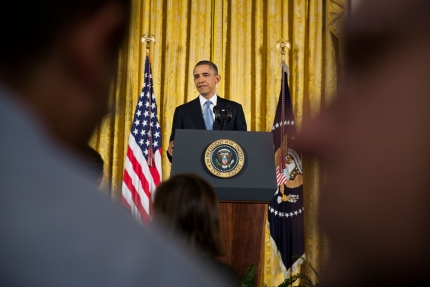
President Obama through the crowd at a press conference in the East Room

President Barack Obama gives a press conference in the East Room of the White House, Nov. 14, 2012. (Official White House Photo by Lawrence Jackson)

Today, President Obama held a news conference to answer questions about his plans for the next four years. He made one thing clear: his job is to help American families and small businesses get ahead in the wake of the recession.

I’ve got a mandate to help middle-class families and families that are working hard to try to get into the middle class. That’s my mandate. That’s what the American people said. They said: Work really hard to help us. Don’t worry about the politics of it; don’t worry about the party interests; don’t worry about the special interests. Just work really hard to see if you can help us get ahead -- because we’re working really hard out here and we’re still struggling, a lot of us.

The most immediate issue facing President Obama and lawmakers here in Washington is a year-end deadline that will require some big decisions on jobs, taxes and deficits -- and have a real effect on families all over the country.

The President said there's one thing we can do right now to provide a foundation for a solution that helps the economy and gives middle-class families more certainty in the coming weeks. And it's something that everyone agrees on: pass a law that would prevent any tax hike whatsoever on the first $250,000 of everybody’s income.

"That means every American, including the wealthiest Americans, get a tax cut," he said. "It means that 98 percent of all Americans, and 97 percent of all small businesses won’t see their taxes go up a single dime." 

Related Topics: Economy, Tennessee

President Obama Holds a Press Conference

November 14, 2012 | 51:48 | Public Domain

President Obama holds a press conference in the East Room of the White House.

Download mp4 (1966MB) | mp3 (124MB)

Read the Transcript

Remarks by the President in a News Conference

East Room

1:34 P.M. EST

THE PRESIDENT:  Good afternoon, everybody.  Please have a seat.  I hear you have some questions for me.  (Laughter.)  But let me just make a few remarks at the top, and then I'll open it up.

First of all, I want to reiterate what I said on Friday.  Right now, our economy is still recovering from a very deep and damaging crisis, so our top priority has to be jobs and growth.  We’ve got to build on the progress that we’ve made, because this nation succeeds when we’ve got a growing, thriving middle class. 

And that’s the idea at the core of the plan that I talked about on the campaign trail over the last year:  Rewarding manufacturers and small businesses that create jobs here, not overseas; providing more Americans the chance to earn the skills that businesses are looking for right now; keeping this country at the forefront of research, technology, and clean energy; putting people back to work rebuilding our roads, our bridges, and our schools; and reducing our deficit in a balanced and responsible way.

Now, on this last item, we face a very clear deadline that requires us to make some big decisions on jobs, taxes and deficits by the end of the year.  Both parties voted to set this deadline.  And I believe that both parties can work together to make these decisions in a balanced and responsible way.  

Yesterday, I had a chance to meet with labor and civic leaders for their input.  Today, I’m meeting with CEOs of some of America’s largest companies.  And I’ll meet with leaders of both parties of Congress before the week is out.  Because there’s only one way to solve these challenges, and that is to do it together.

As I’ve said before, I’m open to compromise and I’m open to new ideas.  And I’ve been encouraged over the past week to hear Republican after Republican agree on the need for more revenue from the wealthiest Americans as part of our arithmetic if we’re going to be serious about reducing the deficit.   

Because when it comes to taxes, there are two pathways available:  Option one, if Congress fails to act by the end of the year, everybody’s taxes will automatically go up -- including the 98 percent of Americans who make less than $250,000 a year and the 97 percent of small businesses who earn less than $250,000 a year.  That doesn’t make sense.  Our economy can’t afford that right now.  Certainly no middle-class family can afford that right now.  And nobody in either party says that they want it to happen.

The other option is to pass a law right now that would prevent any tax hike whatsoever on the first $250,000 of everybody’s income.  And by the way, that means every American, including the wealthiest Americans, get a tax cut.  It means that 98 percent of all Americans, and 97 percent of all small businesses won’t see their taxes go up a single dime.  The Senate has already passed a law like this.  Democrats in the House are ready to pass a law like this.  And I hope Republicans in the House come on board, too. 

We should not hold the middle class hostage while we debate tax cuts for the wealthy.  We should at least do what we agree on, and that's to keep middle-class taxes low.  And I’ll bring everyone in to sign it right away so we can give folks some certainty before the holiday season.

I won’t pretend that figuring out everything else will be easy, but I'm confident we can do it -- and I know we have to.  I know that that's what the American people want us to do.  That was the very clear message from the election last week.  And that was the message of a letter that I received over the weekend. 

It came from a man in Tennessee who began by writing that he didn’t vote for me -- which is okay.  (Laughter.)  But what he said was even though he didn’t give me his vote, he’s giving me his support to move this country forward.  And he said the same to his Republican representatives in Washington.  He said that he’ll back each of us, regardless of party, as long as we work together to make life better for all of us.  And he made it clear that if we don’t make enough progress, he’ll be back in touch. 

“My hope,” he wrote, “is that we can make progress in light of personal and party principles, special interest groups, and years of business as usual.  We’ve got to work together and put our differences aside.”

I couldn't say it better myself.  That’s precisely what I intend to do. 

And with that, let me open it up for your questions.  And I'm going to start off with Ben Feller of AP.

Q    Thank you, Mr. President.  Can you assure the American people that there have been no breaches of national security or classified information in the scandal involving Generals Petraeus and Allen?  And do you think that you as Commander-in-Chief and the American people should have been told that the CIA chief was under investigation before the election?

THE PRESIDENT:  Well, I have no evidence at this point from what I've seen that classified information was disclosed that in any way would have had a negative impact on our national security. 

Obviously there’s an ongoing investigation.  I don't want to comment on the specifics of the investigation.  The FBI has its own protocols in terms of how they proceed, and I'm going to let Director Mueller and others examine those protocols and make some statements to the public generally.

I do want to emphasize what I’ve said before:  General Petraeus had an extraordinary career.  He served this country with great distinction in Iraq, in Afghanistan, and as head of the CIA.  By his own assessment, he did not meet the standards that he felt were necessary as the Director of CIA with respect to this personal matter that he is now dealing with, with his family and with his wife.  And it’s on that basis that he tendered his resignation, and it’s on that basis that I accepted it.

But I want to emphasize that from my perspective at least, he has provided this country an extraordinary service.  We are safer because of the work that Dave Petraeus has done.  And my main hope right now is, is that he and his family are able to move on and that this ends up being a single side note on what has otherwise been an extraordinary career.

Q    What about voters?  Did they deserve to know?

THE PRESIDENT:  Again, I think you’re going to have to talk to the FBI in terms of what their general protocols are when it comes to what started off as a potential criminal investigation. One of the challenges here is, is that we’re not supposed to meddle in criminal investigations, and that’s been our practice. And I think that there are certain procedures that both the FBI follow, or DOJ follow, when they’re involved in these investigations.  That’s traditionally been how we view things, in part because people are innocent until proven guilty, and we want to make sure that we don’t pre-judge these kinds of situations.  And so my expectation is, is that they followed protocols that they already established.

Jessica Yellin.  Where’s Jessica?

Q    Mr. President, on the fiscal cliff, two years ago, sir, you said that you wouldn’t extend the Bush-era tax cuts, but at the end of the day, you did.  So, respectfully, sir, why should the American people and the Republicans believe that you won’t cave again this time?

THE PRESIDENT:  Well, two years ago, the economy was in a different situation.  We were still very much in the early parts of recovering from the worst economic crisis since the Great Depression.  And ultimately, we came together not only to extend the Bush tax cuts, but also a wide range of policies that were going to be good for the economy at that point -- unemployment insurance extensions, payroll tax extension -- all of which made a difference, and is part of the reason why what we've seen now is 32 consecutive months of job growth and over 5.5 million jobs created and the unemployment rate coming down.

But what I said at the time is what I meant, which is this was a one-time proposition.  And what I have told leaders privately as well as publicly is that we cannot afford to extend the Bush tax cuts for the wealthy.  What we can do is make sure that middle-class taxes don’t go up. 

And so the most important step we can take right now -- I think the foundation for a deal that helps the economy, creates jobs, gives consumers certainty, which means gives businesses confidence that they're going to have consumers during the holiday season -- is if we right away say 98 percent of Americans are not going to see their taxes go up; 97 percent of small businesses are not going to see their taxes go up. 

If we get that in place, we are actually removing half of the fiscal cliff.  Half of the danger to our economy is removed by that single step. 

And what we can then do is shape a process whereby we look at tax reform -- which I'm very eager to do.  I think we can simplify our tax system.  I think we can make it more efficient. We can eliminate loopholes and deductions that have a distorting effect on our economy.  I believe that we have to continue to take a serious look at how we reform our entitlements, because health care costs continue to be the biggest driver of our deficits.

So there is a package to be shaped, and I'm confident that parties -- folks of goodwill in both parties can make that happen.  But what I'm not going to do is to extend Bush tax cuts for the wealthiest 2 percent that we can't afford, and according to economists, will have the least positive impact on our economy.

Q    You've said that the wealthiest must pay more.  Would closing loopholes instead of raising rates for them satisfy you?

THE PRESIDENT:  I think that there are loopholes that can be closed, and we should look at how we can make the process of deductions, the filing process easier, simpler.  But when it comes to the top 2 percent, what I’m not going to do is to extend further a tax cut for folks who don’t need it, which would cost close to a trillion dollars. 

And it’s very difficult to see how you make up that trillion dollars -- if we’re serious about deficit reduction -- just by closing loopholes and deductions.  The math tends not to work.  And I think it’s important to establish a basic principle that was debated extensively during the course of this campaign.  I mean, this shouldn’t be a surprise to anybody.  If there was one thing that everybody understood was a big difference between myself and Mr. Romney, it was when it comes to how we reduce our deficit, I argued for a balanced, responsible approach, and part of that included making sure that the wealthiest Americans pay a little bit more. 

I think every voter out there understood that that was an important debate, and the majority of voters agreed with me.  By the way, more voters agreed with me on this issue than voted for me.  So we’ve got a clear majority of the American people who recognize if we’re going to be serious about deficit reduction, we’ve got to do it in a balanced way. 

The only question now is are we going to hold the middle class hostage in order to go ahead and let that happen?  Or can we all step back and say, here’s something we agree on -- we don’t want middle-class taxes to go up.  Let’s go ahead and lock that in.  That will be good for the economy.  It will be good for consumers.  It will be good for businesses.  It takes the edge off the fiscal cliff.  And let’s also then commit ourselves to the broader package of deficit reduction that includes entitlement changes and it includes potentially tax reform, as well as I’m willing to look at additional work that we can do on the discretionary spending side.

So I want a big deal.  I want a comprehensive deal.  I want to see if we can, at least for the foreseeable future, provide certainty to businesses and the American people so that we can focus on job growth, so that we’re also investing in the things that we need.  But right now what I want to make sure of is that taxes on middle-class families don’t go up.  And there’s a very easy way to do that.  We could get that done by next week.

Lori Montenegro, Telemundo.

Q    Thank you, Mr. President.  On immigration reform, the criticism in the past has been that you did not put forth legislation with specific ideas and send it up to the Hill.  This time around you have said again that this will be one of the top priorities for a second term.  Will you then send legislation to the Hill?  And exactly what do you envision is broad immigration reform?  Does that include a legalization program?  And also, what lessons, if any, did Democrats learn from this last election and the Latino vote?

THE PRESIDENT:  Well, I think what was incredibly encouraging was to see a significant increase in Latino turnout. It is the fastest-growing group in the country.  And historically what you’ve seen is the Latino vote, vote at lower rates than the broader population, and that's beginning to change.  You're starting to see a sense of empowerment and civic participation that I think is going to be powerful and good for the country.

And it is why I’m very confident that we can get immigration reform done.  Before the election I had given a couple interviews where I predicted that the Latino vote was going to be strong, and that that would cause some reflection on the part of Republicans about their position on immigration reform.  I think we’re starting to see that already.  I think that's a positive sign.

This has not historically been a partisan issue -- we’ve had President Bush and John McCain and others who have supported comprehensive immigration reform in the past.  So we need to seize the moment.  And my expectation is, is that we get a bill introduced and we begin the process in Congress very soon after my inauguration.  And in fact, some conversations I think are already beginning to take place among senators and congressmen and my staff about what would this look like.

And when I say comprehensive immigration reform, it is very similar to the outlines of previous efforts at comprehensive immigration reform.  I think it should include a continuation of the strong border security measures that we’ve taken because we have to secure our borders.  I think it should contain serious penalties for companies that are purposely hiring undocumented workers and taking advantage of them.  And I do think that there should be a pathway for legal status for those who are living in this country, are not engaged in criminal activity, are here simply to work.  It’s important for them to pay back-taxes.  It’s important for them to learn English.  It’s important for them to potentially pay a fine.  But to give them the avenue whereby they can resolve their legal status here in this country I think is very important.

Obviously, making sure that we put into law what the first step that we’ve taken administratively dealing with the DREAM Act kids is very important as well.  One thing that I’m very clear about is that young people who are brought here through no fault of their own, who have gone to school here, pledged allegiance to our flag, want to serve in our military, want to go to school and contribute to our society, that they shouldn’t be under the cloud of deportation, that we should give them every opportunity to earn their citizenship.

And so there are other components to it, obviously.  The business community continues to be concerned about getting enough high-skill workers, and I am a believer that if you’ve got a PhD in physics or computer science who wants to stay here and start a business here, we shouldn’t make it harder for him to stay here; we should try to encourage him to contribute to this society. 

I think that the agricultural sector obviously has very specific concerns about making sure that they’ve got a workforce that helps deliver food to our tables. 

So there are going to be a bunch of components to it, but I think whatever process we have needs to make sure our border security is strong, needs to deal with employers effectively, needs to provide a pathway for the undocumented here, needs to deal with the DREAM Act kids.  And I think that’s something that we can get done.

Chuck Todd.  Where’s Chuck?

Q    Mr. President, I just want to follow on both Ben’s question and Jessica’s question.  On having to do with Ben’s question --

THE PRESIDENT:  How about Lori’s question?  Do you want to follow up on that one, too?  (Laughter.)

Q    No, I feel like you answered that one completely. 

Are you withholding judgment on whether you should have known sooner that there was a potential -- that there was an investigation into whether your CIA Director -- potentially there was a national security breach with your CIA Director -- do you believe you should have known sooner?  Are you withholding judgment until the investigation is complete on that front? 

And then the follow-up to Jessica’s question -- tax rates.  Are you -- is there no deal at the end of the year if tax rates for the top 2 percent aren’t the Clinton tax rates, period?  No ifs, ands, or buts -- any room in negotiating on that specific aspect of the fiscal cliff?

THE PRESIDENT:  I am withholding judgment with respect to how the entire process surrounding General Petraeus came up.  We don’t have all the information yet, but I want to say that I have a lot of confidence generally in the FBI, and they’ve got a difficult job.  And so I’m going to wait and see to see if there’s any other --

Q    -- that you should have known?  Do you think in hindsight --

THE PRESIDENT:  Well, I mean, Chuck, what I’ll say is, is that if -- it is also possible that had we been told, then you’d be sitting here asking a question about why were you interfering in a criminal investigation.  So I think it’s best right now for us to just see how this whole process unfolded.

With respect to the tax rates, I just want to emphasize I am open to new ideas.  If Republican counterparts or some Democrats have a great idea for us to raise revenue, maintain progressivity, make sure the middle class isn’t getting hit, reduces our deficit, encourages growth, I’m not going to just slam the door in their face.  I want to hear ideas from everybody.

Q    -- red line.

THE PRESIDENT:  Look, I believe this is solvable.  I think that fair-minded people can come to an agreement that does not cause the economy to go back into recession, that protects middle-class families, that focuses on jobs and growth, and reduces our deficit.  I’m confident it can be done.

My budget, frankly, does it.  I understand that -- I don’t expect the Republicans simply to adopt my budget.  That’s not realistic.  So I recognize that we're going to have to compromise.  And as I said on Election Night, compromise is hard, and not everybody gets 100 percent of what they want and not everybody is going to be perfectly happy.

But what I will not do is to have a process that is vague, that says we're going to sort of, kind of, raise revenue through dynamic scoring or closing loopholes that have not been identified.  And the reason I won't do that is because I don’t want to find ourselves in a position six months from now or a year from now where, lo and behold, the only way to close the deficit is to sock it to middle-class families, or to burden families that have disabled kids or have a parent in a nursing home, or suddenly we've got to cut more out of our basic research budget that is the key to growing the economy in the long term.

So that’s my concern.  I'm less concerned about red lines, per se.  What I'm concerned about is not finding ourselves in a situation where the wealthy aren't paying more or aren't paying as much as they should, middle-class families one way or another are making up the difference -- that’s the kind of status quo that has been going on here too long, and that’s exactly what I argued against during this campaign.  And if there’s one thing that I'm pretty confident about is the American people understood what they were getting when they gave me this incredible privilege of being in office for another four years. 

They want compromise.  They want action.  But they also want to make sure that middle-class folks aren't bearing the entire burden and sacrifice when it comes to some of these big challenges.  They expect that folks at the top are doing their fair share as well.  And that’s going to be my guiding principle during these negotiations, but, more importantly, during the next four years of my administration.

Nancy Cordes.

Q    Mr. President, on Election Night, you said that you were looking forward to speaking with Governor Romney, sitting down in the coming weeks to discuss ways that you could work together on this nation's problems.  Have you extended that invitation?  Has he accepted?  And in what ways do you think you can work together?

THE PRESIDENT:  We haven't scheduled something yet.  I think everybody forgets that the election was only a week ago and -- I know I've forgotten.  I forgot on Wednesday.  (Laughter.)  So I think everybody needs to catch their breath.  I'm sure that Governor Romney is spending some time with his family.

And my hope is, before the end of the year, though, that we have a chance to sit down and talk.  There are certain aspects of Governor Romney’s record and his ideas that I think could be very helpful. 

Q    Such as?

THE PRESIDENT:  Well, to give you one example, I do think he did a terrific job running the Olympics.  And that skill set of trying to figure out how do we make something work better applies to the federal government.  There are a lot of ideas that I don’t think are partisan ideas but are just smart ideas about how can we make the federal government more customer friendly; how can we make sure that we’re consolidating programs that are duplicative; how can we eliminate additional waste.  He presented some ideas during the course of the campaign that I actually agree with.  So it would be interesting to talk to him about something like that. There may be ideas that he has with respect to jobs and growth that can help middle-class families that I want to hear.

So I’m not either prejudging what he’s interested in doing, nor am I suggesting I’ve got some specific assignment.  But what I want to do is to get ideas from him and see if there are some ways that we can potentially work together.

Q    But when it comes to your relationships with Congress, one of the most frequent criticisms we’ve heard over the past few years from members on both sides is that you haven’t done enough to reach out and build relationships.  Are there concrete ways that you plan to approach your relationships with Congress in a second term?

THE PRESIDENT:  Look, I think there’s no doubt that I can always do better, and so I will examine ways that I can make sure to communicate my desire to work with everybody, so long as it’s advancing the cause of strengthening our middle class and improving our economy.  I’ve got a lot of good relationships with folks both in the House and the Senate.  I have a lot of relationships on both sides of the aisle.  It hasn’t always manifested itself in the kind of agreements that I’d like to see between Democrats and Republicans.  And so I think all of us have responsibilities to see if there are things that we can improve on.  And I don’t exempt myself from needing to do some self-reflection and see if I can improve our working relationship. 

There are probably going to be still some very sharp differences.  And as I said during the campaign, there are going to be times where there are fights, and I think those are fights that need to be had.  But what I think the American people don’t want to see is a focus on the next election instead of a focus on them. 

And I don’t have another election.  And Michelle and I were talking last night about what an incredible honor and privilege it is to be put in this position.  And there are people all across this country, millions of folks, who worked so hard to help us get elected, but there are also millions of people who may not have voted for us but are also counting on us.  And we take that responsibility very seriously.  I take that responsibility very seriously.  And I hope and intend to be an even better President in the second term than I was in the first.

Jonathan Karl.

Q    Thank you, Mr. President.  Senator John McCain and Senator Lindsey Graham both said today that they want to have Watergate-style hearings on the attack on the U.S. consulate in Benghazi, and said that if you nominate Susan Rice to be Secretary of State, they will do everything in their power to block her nomination.  As Senator Graham said, he simply doesn’t trust Ambassador Rice after what she said about Benghazi.  I’d like your reaction to that.  And would those threats deter you from making a nomination like that?

THE PRESIDENT:  Well, first of all, I’m not going to comment at this point on various nominations that I’ll put forward to fill out my Cabinet for the second term.  Those are things that are still being discussed.

But let me say specifically about Susan Rice, she has done exemplary work.  She has represented the United States and our interests in the United Nations with skill and professionalism and toughness and grace. 

As I’ve said before, she made an appearance at the request of the White House in which she gave her best understanding of the intelligence that had been provided to her.  If Senator McCain and Senator Graham and others want to go after somebody, they should go after me.  And I’m happy to have that discussion with them.  But for them to go after the U.N. Ambassador, who had nothing to do with Benghazi, and was simply making a presentation based on intelligence that she had received, and to besmirch her reputation is outrageous. 

And we’re after an election now.  I think it is important for us to find out exactly what happened in Benghazi, and I’m happy to cooperate in any ways that Congress wants.  We have provided every bit of information that we have, and we will continue to provide information.  And we’ve got a full-blown investigation, and all that information will be disgorged to Congress. 

And I don't think there’s any debate in this country that when you have four Americans killed, that's a problem.  And we’ve got to get to the bottom of it, and there needs to be accountability.  We’ve got to bring those who carried it out to justice.  They won’t get any debate from me on that.

But when they go after the U.N. Ambassador, apparently because they think she’s an easy target, then they’ve got a problem with me.  And should I choose, if I think that she would be the best person to serve America in the capacity of the State Department, then I will nominate her.  That's not a determination that I’ve made yet.

Ed Henry.

Q    I want to take Chuck’s lead and just ask a very small follow-up, which is whether you feel you have a mandate not just on taxes but on a range of issues because of your decisive victory? 

But I want to stay on Benghazi, based on what Jon asked because you said, if they want to come after me, come after me.  I wanted to ask about the families of these four Americans who were killed.  Sean Smith’s father, Ray, said he believes his son basically called 911 for help and they didn't get it.  And I know you’ve said you grieve for these four Americans, that it’s being investigated, but the families have been waiting for more than two months.  So I would like to -- for you to address the families, if you can.  On 9/11, as Commander-in-Chief, did you issue any orders to try to protect their lives?

THE PRESIDENT:  Ed, I’ll address the families not through the press.  I’ll address the families directly, as I already have.  And we will provide all the information that is available about what happened on that day.  That’s what the investigation is for. 

But as I’ve said repeatedly, if people don’t think that we did everything we can to make sure that we saved the lives of folks who I sent there and who were carrying out missions on behalf of the United States, then you don’t know how our Defense Department thinks or our State Department thinks or our CIA thinks.  Their number-one priority is obviously to protect American lives.  That’s what our job is.  Now --

Q    (Inaudible.)

THE PRESIDENT:  Ed, I will put forward every bit of information that we have.  I can tell you that immediately upon finding out that our folks were in danger, that my orders to my national security team were do whatever we need to do to make sure they’re safe.  And that’s the same order that I would give any time that I see Americans are in danger, whether they’re civilian or military, because that’s our number-one priority.

With respect to the issue of mandate, I’ve got one mandate. I’ve got a mandate to help middle-class families and families that are working hard to try to get into the middle class.  That’s my mandate.  That’s what the American people said.  They said:  Work really hard to help us.  Don’t worry about the politics of it; don’t worry about the party interests; don’t worry about the special interests.  Just work really hard to see if you can help us get ahead -- because we’re working really hard out here and we’re still struggling, a lot of us.  That’s my mandate.

I don’t presume that because I won an election that everybody suddenly agrees with me on everything.  I’m more than familiar with all the literature about presidential overreach in second terms.  We are very cautious about that.  On the other hand, I didn’t get reelected just to bask in reelection.  I got elected to do work on behalf of American families and small businesses all across the country who are still recovering from a really bad recession, but are hopeful about the future. 

And I am, too.  The one thing that I said during the campaign that maybe sounds like a bunch of campaign rhetoric, but now that the campaign is over I am going to repeat it and hopefully you guys will really believe me -- when you travel around the country, you are inspired by the grit and resilience and hard work and decency of the American people.  And it just makes you want to work harder.  You meet families who are -- have overcome really tough odds and somehow are making it and sending their kids to college.  And you meet young people who are doing incredible work in disadvantaged communities because they believe in the American ideal and it should available for everybody.  And you meet farmers who are helping each other during times of drought, and you meet businesses that kept their doors open during the recession, even though the owner didn’t have to take a salary. 

And when you talk to these folks, you say to yourself, man, they deserve a better government than they've been getting.  They deserve all of us here in Washington to be thinking every single day, how can I make things a little better for them -- which isn't to say that everything we do is going to be perfect, or that there aren't just going to be some big, tough challenges that we have to grapple with.  But I do know the federal government can make a difference. 

We're seeing it right now on the Jersey coast and in New York.  People are still going through a really tough time; the response hasn't been perfect; but it's been aggressive and strong and fast and robust, and a lot of people have been helped because of it.  And that’s a pretty good metaphor for how I want the federal government to operate generally, and I'm going to do everything I can to make sure it does.

Christi Parson.  Hey. 

Q    Thank you, Mr. President, and congratulations, by the way. 

THE PRESIDENT:  Thanks. 

Q    One quick follow up --

THE PRESIDENT:  Christi was there when I was running for state Senate.

Q    That’s right, I was. 

THE PRESIDENT:  So Christi and I go back a ways.

Q    I've never seen you lose.  I wasn't looking that one time.  (Laughter.)   

THE PRESIDENT:  There you go.   

Q    One quick follow-up, and then I want to ask you about Iran.  I just want to make sure I understood what you said.  Can you envision any scenario in which we do go off the fiscal cliff at the end of the year? 

And on Iran, are you preparing a final diplomatic push here to resolve the nuclear program issue, and are we headed toward one-on-one talks?

THE PRESIDENT:  Well, obviously, we can all imagine a scenario where we go off the fiscal cliff.  If despite the election, if despite the dangers of going over the fiscal cliff and what that means for our economy, that there’s too much stubbornness in Congress that we can't even agree on giving middle-class families a tax cut, then middle-class families are all going to end up having a big tax hike.  And that’s going to be a pretty rude shock for them, and I suspect will have a big impact on the holiday shopping season, which, in turn, will have an impact on business planning and hiring, and we can go back into a recession. 

It would be a bad thing.  It is not necessary.  So I want to repeat:  Step number one that we can take in the next couple of weeks, provide certainty to middle-class families -- 98 percent of families who make less than $250,000 a year, 97 percent of small businesses -- that their taxes will not go up a single dime next year.  Give them that certainty right now.  We can get that done. 

We can then set up a structure whereby we are dealing with tax reform, closing deductions, closing loopholes, simplifying, dealing with entitlements.  And I’m ready and willing to make big commitments to make sure that we’re locking in the kind of deficit reductions that stabilize our deficit, start bringing it down, start bringing down our debt.  I’m confident we can do it.

And, look, I’ve been living with this for a couple of years now.  I know the math pretty well.  And it really is arithmetic; it’s not calculus.  There are some tough things that have to be done, but there is a way of doing this that does not hurt middle-class families, that does not hurt our seniors, doesn’t hurt families with disabled kids, allows us to continue to invest in those things that make us grow, like basic research and education, helping young people afford going to college.  As we’ve already heard from some Republican commentators, a modest tax increase on the wealthy is not going to break their backs; they’ll still be wealthy.  And it will not impinge on business investment. 

So we know how to do this.  This is just a matter of whether or not we come together and go ahead and say, Democrats and Republicans, we’re both going to hold hands and do what’s right for the American people.  And I hope that’s what happens.

With respect to Iran, I very much want to see a diplomatic resolution to the problem.  I was very clear before the campaign, I was clear during the campaign, and I’m now clear after the campaign -- we’re not going to let Iran get a nuclear weapon.  But I think there is still a window of time for us to resolve this diplomatically.  We’ve imposed the toughest sanctions in history.  It is having an impact on Iran’s economy. 

There should be a way in which they can enjoy peaceful nuclear power while still meeting their international obligations and providing clear assurances to the international community that they’re not pursuing a nuclear weapon. 

And so, yes, I will try to make a push in the coming months to see if we can open up a dialogue between Iran and not just us, but the international community, to see if we can get this things resolved.  I can’t promise that Iran will walk through the door that they need to walk through, but that would be very much the preferable option.

Q    And under what circumstances would one-on-one conversations take place?

THE PRESIDENT:  I won’t talk about the details in negotiations.  But I think it’s fair to say we want to get this resolved, and we’re not going to be constrained by diplomatic niceties or protocols.  If Iran is serious about wanting to resolve this, they’ll be in a position to resolve it.

Q    At one point just prior to the election that was talk that talks might be imminent.  

THE PRESIDENT:  That was not true, and it’s not true as of today.

Just going to knock through a couple others.  Mark Landler.  Where’s Mark?  There he is right in front of me.

Q    Thank you, Mr. President.  In his endorsement of you a few weeks ago, Mayor Bloomberg said he was motivated by the belief that you would do more to confront the threat of climate change than your opponent.  Tomorrow you’re going up to New York City where you’re going to, I assume, see people who are still suffering the effects of Hurricane Sandy, which many people say is further evidence of how a warming globe is changing our weather.  What specifically do you plan to do in a second term to tackle the issue of climate change?  And do you think the political will exists in Washington to pass legislation that could include some kind of a tax on carbon? 

THE PRESIDENT:  As you know, Mark, we can’t attribute any particular weather event to climate change.  What we do know is the temperature around the globe is increasing faster than was predicted even 10 years ago.  We do know that the Arctic ice cap is melting faster than was predicted even five years ago.  We do know that there have been extraordinarily -- there have been an extraordinarily large number of severe weather events here in North America, but also around the globe.

And I am a firm believer that climate change is real, that it is impacted by human behavior and carbon emissions.  And as a consequence, I think we've got an obligation to future generations to do something about it.

Now, in my first term, we doubled fuel efficiency standards on cars and trucks.  That will have an impact.  That will take a lot of carbon out of the atmosphere.  We doubled the production of clean energy, which promises to reduce the utilization of fossil fuels for power generation.  And we continue to invest in potential breakthrough technologies that could further remove carbon from our atmosphere.  But we haven't done as much as we need to.

So what I'm going to be doing over the next several weeks, next several months, is having a conversation, a wide-ranging conversation with scientists, engineers, and elected officials to find out what can -- what more can we do to make a short-term progress in reducing carbons, and then working through an education process that I think is necessary -- a discussion, a conversation across the country about what realistically can we do long term to make sure that this is not something we're passing on to future generations that's going to be very expensive and very painful to deal with.

I don't know what either Democrats or Republicans are prepared to do at this point, because this is one of those issues that's not just a partisan issue; I also think there are regional differences.  There’s no doubt that for us to take on climate change in a serious way would involve making some tough political choices.  And understandably, I think the American people right now have been so focused, and will continue to be focused on our economy and jobs and growth, that if the message is somehow we're going to ignore jobs and growth simply to address climate change, I don't think anybody is going to go for that.  I won't go for that.

If, on the other hand, we can shape an agenda that says we can create jobs, advance growth, and make a serious dent in climate change and be an international leader, I think that's something that the American people would support.

So you can expect that you’ll hear more from me in the coming months and years about how we can shape an agenda that garners bipartisan support and helps move this agenda forward.

Q    Sounds like you're saying, though, in the current environment, we're probably still short of a consensus on some kind of attack.

THE PRESIDENT:  That I'm pretty certain of.  And, look, we're still trying to debate whether we can just make sure that middle-class families don't get a tax hike.  Let’s see if we can resolve that.  That should be easy.  This one is hard -- but it’s important because one of the things that we don't always factor in are the costs involved in these natural disasters; we just put them off as something that's unconnected to our behavior right now.  And I think what -- based on the evidence we're seeing, is that what we do now is going to have an impact and a cost down the road if we don’t do something about it.

All right, last question.  Mark Felsenthal.  Where’s Mark?

Q    Thank you.  Mr. President, the Assad regime is engaged in a brutal crackdown on its people.  France has recognized the opposition coalition.  What would it take for the United States to do the same?  And is there any point at which the United States would consider arming the rebels?

THE PRESIDENT:  I was one of the first leaders I think around the world to say Assad had to go, in response to the incredible brutality that his government displayed in the face of what were initially peaceful protests.

Obviously, the situation in Syria has deteriorated since then.  We have been extensively engaged with the international community as well as regional powers to help the opposition.  We have committed to hundreds of millions of dollars of humanitarian aid to help folks both inside of Syria and outside of Syria.  We are constantly consulting with the opposition on how they can get organized so that they’re not splintered and divided in the face of the onslaught from the Assad regime. 

We are in very close contact with countries like Turkey and Jordan that immediately border Syria and have an impact -- and obviously Israel, which is having already grave concerns, as we do, about, for example, movements of chemical weapons that might occur in such a chaotic atmosphere and that could have an impact not just within Syria, but on the region as a whole.

I’m encouraged to see that the Syrian opposition created an umbrella group that may have more cohesion than they’ve had in the past.  We’re going to be talking to them.  My envoys are going to be traveling to various meetings that are going to be taking place with the international community and the opposition.

We consider them a legitimate representative of the aspirations of the Syrian people.  We’re not yet prepared to recognize them as some sort of government in exile, but we do think that it is a broad-based representative group.  One of the questions that we’re going to continue to press is making sure that that opposition is committed to a democratic Syria, an inclusive Syria, a moderate Syria.

We have seen extremist elements insinuate themselves into the opposition, and one of the things that we have to be on guard about -- particularly when we start talking about arming opposition figures -- is that we’re not indirectly putting arms in the hands of folks who would do Americans harm, or do Israelis harm, or otherwise engage in actions that are detrimental to our national security.

So we're constantly probing and working on that issue.  The more engaged we are, the more we'll be in a position to make sure that we are encouraging the most moderate, thoughtful elements of the opposition that are committed to inclusion, observance of human rights, and working cooperatively with us over the long term.

Thank you very much.

Q    -- spending side of the fiscal cliff.  On spending, the $1.2 trillion trigger, is that something that you can see having a short-term component -- because I remember you said it's not happening -- 

THE PRESIDENT:  That was a great question, but it would be a horrible precedent for me to answer your question just because you yelled it out.  (Laughter.) 

So thank you very much, guys.

END  
2:26 P.M. EST

Close Transcript

The White House

Office of the Press Secretary

Readout of the President’s Phone Calls with World Leaders

Today the President was able to continue returning messages of congratulations from his counterparts. In each call, he thanked his counterpart for their friendship and partnership thus far and expressed his desire to continue close cooperation moving ahead.

The President spoke with:

Prime Minister Enda Kenny of Ireland
President Shimon Peres of Israel
Prime Minister Yoshihiko Noda of Japan
President Lee Myung-bak of the Republic of Korea
President Felipe Calderon of Mexico
President-Elect Enrique Pena Nieto of Mexico