The White House

Office of the Press Secretary

Presidential Proclamation -- National Adoption Month, 2012

NATIONAL ADOPTION MONTH, 2012

- - - - - - -

BY THE PRESIDENT OF THE UNITED STATES OF AMERICA

A PROCLAMATION

As a Nation that believes all children deserve the chance to reach their full potential, we have a fundamental responsibility to ensure each of them grows up knowing the love and protection of a permanent family. During National Adoption Month, we give voice to children who are still waiting for that opportunity, celebrate the bond that unites adoptive parents with their sons and daughters, and recommit to providing every child with the care and security that will nurture their development and well-being.

Later this month, many Americans will also mark National Adoption Day by completing a foster care adoption and embracing a new member of their family. Driven by reasons unique to their households but united by the spirit of compassion that moves all who choose to adopt, these parents will take up our country's most important task -- the work of raising our sons and daughters. As we celebrate the contributions of adoptive parents across our Nation, let us also strive to eliminate discriminatory barriers that would separate foster children from a loving family. Adoptive families come in many forms, and it is essential that all qualified adults have the opportunity to care for a child in need.

My Administration remains committed to helping every child find a loving home. We have partnered with faith-based and community organizations across America to help connect children with adoptive parents, and we continue to work with State, local, and tribal governments to improve child outcomes; enhance safety, permanency, and well-being; and support adoptive families. I was proud to sign the Affordable Care Act and the International Adoption Simplification Act, which have made it easier for families to adopt, as well as the Child and Family Services Improvement and Innovation Act, which will help reduce the length of time young children are without families. We have built on those efforts as part of the National Adoption Campaign, which continues to bring adoption and foster care into our national conversation.

Thousands of children living in America hope for the comfort and safety of a loving family. This month, we pay tribute to the dedicated professionals who help make those children's dreams a reality, sharpen our resolve to find a permanent home for every child, and celebrate the stories of all whose lives have been touched by adoption.

NOW, THEREFORE, I, BARACK OBAMA, President of the United States of America, by virtue of the authority vested in me by the Constitution and the laws of the United States, do hereby proclaim November 2012 as National Adoption Month. I encourage all Americans to observe this month by answering the call to find a permanent and caring family for every child in need, and by supporting the families who care for them.

IN WITNESS WHEREOF, I have hereunto set my hand this first day of November, in the year of our Lord two thousand twelve, and of the Independence of the United States of America the two hundred and thirty-seventh.

BARACK OBAMA

The White House

Office of the Press Secretary

Presidential Proclamation -- Military Family Month, 2012

MILITARY FAMILY MONTH, 2012

- - - - - - -

BY THE PRESIDENT OF THE UNITED STATES OF AMERICA

A PROCLAMATION

Since our Nation's earliest days, courageous men and women of all backgrounds and beliefs have banded together to fight for the freedoms we cherish. Behind each of them stands a parent, a sibling, a child, a spouse -- proud family members who share the weight of deployment and make profound sacrifices on behalf of our country. During Military Family Month, we honor our military families and recommit to showing them the fullest care and respect of a grateful Nation.

In our military families, we see the best our country has to offer. They demonstrate the virtues that have made America great for more than two centuries and the values that will preserve our greatness for centuries to come. With loved ones serving far from home, military spouses take on the work of two. Their children show courage and resilience as they move from base to base, school to school, home to home. And even through the strain of deployment, military families strengthen the fabric of each community they touch and enrich our national life as shining examples of patriotism.

We each have a solemn duty to serve our Armed Forces and their families as well as they serve us. Through First Lady Michelle Obama and Dr. Jill Biden's Joining Forces initiative, we have worked to fulfill this obligation by mobilizing all Americans to give service members and their families the opportunities and support they have earned. Last year, we challenged American businesses to hire or train 100,000 veterans and military spouses by the end of 2013. To date, they have already exceeded that challenge, hiring over 125,000 veterans and military spouses. From helping military children succeed in the classroom to increasing support for those who care for our wounded warriors, Joining Forces will keep fighting to ensure the well-being of our troops and their families.

When a young woman signs up to defend our Nation, her parents are enlisted as well. When a father deploys to a combat zone, his children are called to serve on the home front. And when the men and women of our military serve far from home, their families feel the strain of their absence. In that absence, let us stand together as one American family. Let us honor the brave patriots who keep our country safe, and let us forever hold close the memories of those who have perished in the line of duty. This month, we reaffirm that we will always lift up our military families -- not just when their loved ones are away, but also long after the welcome home ceremonies are over.

NOW, THEREFORE, I, BARACK OBAMA, President of the United States of America, by virtue of the authority vested in me by the Constitution and the laws of the United States, do hereby proclaim November 2012 as Military Family Month. I call on all Americans to honor military families through private actions and public service for the tremendous contributions they make in support of our service members and our Nation.

IN WITNESS WHEREOF, I have hereunto set my hand this first day of November, in the year of our Lord two thousand twelve, and of the Independence of the United States of America the two hundred and thirty-seventh.

BARACK OBAMA

The White House

Office of the Press Secretary

Presidential Proclamation -- National Alzheimer's Disease Awareness Month, 2012

NATIONAL ALZHEIMER'S DISEASE AWARENESS MONTH, 2012

- - - - - - -

BY THE PRESIDENT OF THE UNITED STATES OF AMERICA

A PROCLAMATION

Every day, families across our country confront the tragic realities of Alzheimer's disease -- an irreversible, fatal illness that robs men and women of their cherished memories and leads to progressive mental and physical impairments. Millions of individuals suffer from this debilitating ailment, and millions more shoulder profound emotional and financial burdens by serving as caregivers for their loved ones. As the number of older Americans grows in the coming years, Alzheimer's disease will continue to pose serious risks to our well-being -- which is why it is essential we join together to address it today. During National Alzheimer's Disease Awareness Month, we stand with all those who have known the pain of this devastating illness, extend our support to Americans living with Alzheimer's, and press on toward promising new treatments.

This May, my Administration released the first National Plan to Address Alzheimer's Disease. The Plan lays out a bold vision for Alzheimer's prevention and treatment, calling for a comprehensive, collaborative approach that engages partners throughout the public, private, and non-profit sectors. As part of this effort, we have made historic investments in research and clinical trials that bring us closer to unlocking tomorrow's therapies. Through www.Alzheimers.gov, we are working to empower people living with Alzheimer's, their caregivers, and all Americans with information and resources about the disease. We are also providing training to health care providers to help them recognize the signs and symptoms of Alzheimer's disease and care for those who suffer from it. And to help ensure Americans living with Alzheimer's can access the care they need, we have worked to strengthen Medicare and expand choices for health insurance.

In homes and care facilities across our country, Alzheimer's disease continues to take a heartbreaking toll on millions of lives. As we honor the memory of those we have lost and lend our strength to those who face this ailment today, let us strive toward a brighter future.

NOW, THEREFORE, I, BARACK OBAMA, President of the United States of America, by virtue of the authority vested in me by the Constitution and the laws of the United States, do hereby proclaim November 2012 as National Alzheimer's Disease Awareness Month. I call upon the people of the United States to learn more about Alzheimer's disease and to offer their support to the individuals living with this disease and to their caregivers.

IN WITNESS WHEREOF, I have hereunto set my hand this first day of November, in the year of our Lord two thousand twelve, and of the Independence of the United States of America the two hundred and thirty-seventh.

BARACK OBAMA

The White House

Office of the Press Secretary

Remarks by the President at a Campaign Event -- Green Bay, WI

Austin Straubel International Airport
Green Bay, Wisconsin

10:43 P.M. CDT

THE PRESIDENT:  Hello, Wisconsin!  (Applause.)  It is good to be back in Green Bay, Wisconsin.  (Applause.)  I want to thank all of you for giving such a warm welcome to a Bears fan  -- (applause) -- and I especially want to thank one of the greatest defensive players in NFL history for being here today  -- Charles Woodson.  (Applause.)  And I want to thank Charles because I understand he made an announcement about a gift to the Red Cross to help support everybody over on the East Coast, and that’s the kind of guy he is, so we’re grateful to him.  Thank you, Charles.  (Applause.)

Let’s also give it up for your next United States senator, Tammy Baldwin.  (Applause.)  She’s going to be following leaders like Herb Kohl and Russ Feingold in being fierce fighters for the people of Wisconsin.  (Applause.)  

Now, for the past few days, all of us have been focused on one of the worst storms in our lifetimes.  And we’re awed and we’re humbled by nature’s destructive power.  We mourn the loss of so many people.  Our hearts go out to those who have lost their loved ones.  We pledge to help those whose lives have been turned upside down.  And I was out in New Jersey yesterday and saw the devastation, and you really get a sense of how difficult this is going to be for a lot, a lot of people. 

But we’ve also been inspired these past few days -- because when disaster strikes, we see America at its best.  All the petty differences that consume us in normal times all seem to melt away.  There are no Democrats or Republicans during a storm, there are just fellow Americans.  (Applause.)  Leaders of different parties working to fix what’s broken; neighbors helping neighbors cope with tragedy; communities rallying to rebuild; a spirit that says, in the end, we’re all in this together -– that we rise or fall as one nation, as one people.  (Applause.)

That spirit has guided this country along its improbable journey for more than two centuries.  It has carried us through the trials of the last four years.  In 2008, we were in the middle of two wars and the worst economic crisis since the Great Depression.  Today, our businesses have created over 5 million new jobs.  (Applause.)  The American auto industry is back on top.  American manufacturing is growing at the fastest pace in 15 years.  Home values are on the rise.  Thanks to the service and sacrifice of our brave men and women in uniform, the war in Iraq is over.  (Applause.)  The war in Afghanistan is winding down.  Al Qaeda has been decimated.  Osama bin Laden is dead.  (Applause.)

So we’ve made real progress these past four years.  But, Wisconsin, we know our work is not yet done.  As long as there’s a single American who wants a job but can’t find one, our work isn’t done.  As long as there are families who are working harder but falling behind, our work isn’t done.  As long as there’s a child languishing in poverty, barred from opportunity, anywhere in this country, our work is not yet done.  (Applause.)  

Our fight goes on because we know this nation cannot succeed without a growing, thriving middle class; and strong, sturdy ladders into the middle class.  Our fight goes on because America has always done its best when everybody gets a fair shot, and everybody is doing their fair share, and everybody is playing by the same rules.  (Applause.)  That’s what we believe.  That’s why you elected me in 2008.  And that’s why I’m running for a second term as President -- because we’ve got more work to do.  (Applause.)

AUDIENCE:  Four more years!  Four more years!

THE PRESIDENT:  Now, we knew from the beginning that our work would take more than one year, or even one term -- because let’s face it, the middle class was getting hammered long before the financial crisis hit.  Technology made us more productive, but it also made a lot of good jobs obsolete.  Global trade brought us cheaper products, but it also allowed companies to hire in low-wage countries.  American workers saw their paychecks squeezed, even as corporate profits rose and CEO salaries exploded, and the guaranteed security of pensions and health care slowly started disappearing.

And these fundamental changes in the economy –- the rise of technology and global competition –- they’re real.  We can’t wish these challenges away.  But here’s what I know, Wisconsin:  We can meet them -- because we’re Americans.  We’ve got the world’s best workers and the best entrepreneurs.  We’ve got the best scientists and the best researchers; the best colleges and universities.  And we’ve got the most innovative spirit.  We have everything we need to thrive in this new economy, in this new century, and there’s not a country on Earth that wouldn’t trade places with the United States of America.

But we have a choice to make.  In five days, we will choose our next President.  (Applause.)  And it’s more than just a choice between two candidates or two parties.  You’ll be making a choice between two fundamentally different visions of America -– one where we return to the top-down policies that crashed our economy --

AUDIENCE:  Booo --

THE PRESIDENT:  Don’t boo, Wisconsin -- vote.  (Applause.)

Or a future that’s built on a strong and growing middle class.  (Applause.)  And, Wisconsin, we know what the choice needs to be.  We’re here today because we believe that if this country invests in the skills and ideas of its people, then good jobs and businesses will follow. 

We believe that America’s free market has been the engine of America’s progress, driven by risk-takers and innovators, and dreamers.  But we also understand that in this country, people succeed when they’ve got a chance to get a good education and learn new skills –- and, by the way, so do the businesses that hire those people, or the companies that those folks start.

We believe that when we support research into medical breakthroughs or new technology, then entire new industries will start here and stay here and hire here. 

We don’t believe government should poke its nose into everything we do.  But do we believe this country is stronger when there are rules to protect our kids from toxic dumping and mercury pollution -- (applause) -- when there are rules to protect consumers and ordinary families from credit card companies that are engaging in deceptive practices, mortgage lenders that are unscrupulous.  (Applause.)

We grow faster when our tax code rewards hard work and companies that create jobs here in America.  (Applause.)  And we believe that quality, affordable health care and a dignified retirement aren’t just achievable goals, they’re a measure of our values as a nation.  (Applause.)  That’s what we believe. 

For eight years, we had a President who shared these beliefs; his name was Bill Clinton.  (Applause.)  When he was first elected, he asked the wealthiest Americans to pay a little more so we could reduce the deficit and still make investments in things like education and training, science and research.  And guess what?  Plenty of folks who were running for Congress at the time said it would hurt the economy; that it would kill jobs.  And if that argument sounds familiar, one of those candidates back then happens to be running for President right now.  (Laughter.)  And it turns out their math was just as bad back then as it is today.  (Applause.)  Because by the end of Bill Clinton’s second term, America had created 23 million new jobs, and incomes were up, and poverty was down.  And our deficit became the biggest surplus in our history. 

So, Wisconsin, we know the ideas that work.  We also know the ideas that don’t work.  Because in the eight years after Bill Clinton left office, his policies were reversed.  The wealthiest Americans got tax cuts they didn’t need and that we couldn’t afford.  Companies enjoyed tax breaks for shipping jobs overseas.  Insurance companies and oil companies and Wall Street were given free license to do what they pleased.  Folks at the top got to play by a different set of rules than the rest of us.

And the result of this top-down economics was falling incomes, record deficits, the slowest job growth in half a century, and an economic crisis that we’ve been cleaning up for the last four years. 

Now, in the closing weeks of this campaign, Governor Romney has been using all his talents as a salesman to dress up these very same policies that failed our country so badly, the very same policies we’ve been cleaning up after for the past four years.  And he is offering them up as change.  (Laughter.)  He’s saying he’s the candidate of change.

Well, let me tell you, Wisconsin, we know what change looks like.  (Applause.)  And what the Governor is offering sure ain’t change.  Giving more power back to the biggest banks isn’t change.  Leaving millions without health insurance isn’t change.  Another $5 trillion tax cut that favors the wealthy isn’t change.  Turning Medicare into a voucher is change, but we don’t want that change.  (Laughter.)  Refusing to answer questions about the details of your policies isn’t change.  Ruling out compromise by pledging to rubberstamp the tea party’s agenda as President -– that’s definitely not change.  In fact, that’s exactly the attitude in Washington that needs to go.   
Now, here’s the thing, Wisconsin.  After four years as President, you know me by now.  You may not agree with every decision I’ve made.  You may be frustrated at the pace of change.  But you know what I believe.  You know where I stand.  You know I’m willing to make tough decisions, even when they’re not politically convenient.  (Applause.)  And you know I’ll fight for you and your families every single day, as hard as I know how.  You know that.  (Applause.)

I know what change looks like, because I fought for it.  You have, too.  And after all we’ve been through together, we sure as heck can’t give up now. 

AUDIENCE:  No!

THE PRESIDENT:  Change is a country where Americans of every age have the skills and education that good jobs now require.  And government can’t do this alone, but don’t tell me that hiring more teachers won’t help this economy grow, or help young people compete.  (Applause.)  Don’t tell me that students who can’t afford college should just borrow money from their parents.  That wasn’t an option for me, and I’ll bet it wasn’t an option for a whole lot of you. 

We shouldn’t be ending college tax credits to pay for millionaires’ tax cuts; we should be making college more affordable for everyone who’s willing to work for it.  (Applause.)  We should recruit 100,000 math and science teachers so that high-tech, high-wage jobs aren’t created in China, they’re created right here in Green Bay, Wisconsin.  (Applause.) 

We should work with community colleges to train another two million Americans with skills that businesses are looking for right now.  That’s my plan for the future.  That’s what change is.  That’s the America we’re fighting for in this election.

Change comes when we live up to our legacy of innovation, and make America home to the next generation of manufacturing, scientific discovery, technological breakthroughs.  I’m proud I bet on American workers and American ingenuity and the American auto industry.  And today, we’re not just building cars again, we’re building better cars –- cars that by the middle of the next decade will go twice as far on a gallon of gas.  (Applause.) 

Today, there are thousands of workers building long-lasting batteries and wind turbines and solar panels all across the country –- jobs that weren’t there four years ago.  And sure, not all technologies we bet on will pan out.  Some of the businesses we encourage will fail.  But I promise you this -– there is a future for manufacturing here in America.  There is a future for clean energy here in America.  (Applause.)  And I refuse to cede that future to other countries. 

I don’t want tax codes rewarding companies for creating jobs overseas; I want to reward companies that create jobs here in America.  (Applause.)  I don’t want a tax code that subsidizes oil company profits; I want to support the energy jobs of tomorrow and the new technologies that will cut our oil imports in half.  That’s my plan for jobs and growth.  That’s the future of America that I see. 

Change is finally turning the page on a decade of war to do some nation-building here at home.  So long as I’m Commander-in-Chief, we will pursue our enemies with the strongest military the world has ever known.  But it’s time to use the savings from ending the wars in Iraq and Afghanistan to start paying down our debts here and rebuilding America.  Right now, we can put people back to work fixing up roads and bridges.  Right now, we can expand broadband into rural neighborhoods, and make sure our schools are state-of-the-art. 

Let’s put Americans back to work doing the work that needs to be done.  And let’s especially focus on our veterans -- because no one who fights for this country should have to fight for a job, or a roof over their heads, or the care that they need when they come home.  (Applause.)  That’s my plan to keep us strong.  That’s my commitment to you.  And that’s what’s at stake in this election. 

Change is a future where we reduce our deficit in a way that’s balanced and responsible.  I’ve signed a trillion dollars’ worth of spending cuts; I intend to do more.  And I’ll work with both parties to streamline agencies and get rid of programs that don’t work. 

But if we’re serious about the deficit, we’ve also got to ask the wealthiest Americans to go back to the tax rates that they paid when Bill Clinton was in office.  (Applause.)  Because as long as I’m President, I will never turn Medicare into a voucher just to pay for another millionaire’s tax cut.  (Applause.)  I will never allow this nation to be plunged into another battle over health care reform just so insurance companies can jump back in the driver’s seat.  And I will never allow politicians in Washington to control health care choices that women should be making for themselves.  (Applause.)

So, Wisconsin, we know what change is.  We know what the future requires -- we don’t need a big government agenda or a small government agenda.  We need a middle-class agenda that rewards hard work and responsibility. 

We don’t need a partisan agenda –- we need a common-sense agenda that says when we educate a poor child, we’ll all be better off; that says when we fund the research of a young scientist, her new discovery will benefit every American. 

We need a vision that says we don’t just look out for ourselves –- we look out for one another other; we look out for future generations, and we meet those obligations by working together.  That’s the change we believe in.  That’s what this election is all about.  

Now, let’s be clear, achieving this agenda won’t be easy.  It’s never been easy.  We always knew that.  Back in 2008, when we talked about change, I told you I wasn’t just talking about changing Presidents.  I wasn’t just talking about changing parties.  I was talking about changing our politics.  I ran because the voices of the American people –- your voices -– had been shut out of our democracy for way too long –- by lobbyists and special interests, and politicians who believe that compromise is somehow a dirty word; by folks who would say anything to win office, and do anything to stay there. 

The protectors of the status quo are a powerful force in Washington.  And over the last four years, every time we’ve tried to make a change, they’ve fought back with everything they’ve got.  They spent millions to stop us from reforming health care and Wall Street and student loans.  And their strategy from the start was to engineer pure gridlock in Congress, refusing to compromise on ideas that both Democrats and Republicans had supported in the past. 

And what they’re counting on now, Wisconsin, is that the American people will be so worn down by all the squabbling, so tired of all the dysfunction, that you’ll actually reward obstruction, and put people back in charge who advocate the very policies that got us into this mess. 

AUDIENCE:  No!

THE PRESIDENT:  In other words, their bet is on cynicism.  But, Wisconsin, my bet is on you.  (Applause.)  My bet is on the decency and good sense of the America people -- because despite all the resistance, despite all the setbacks, we’ve won some great fights.  And I’ve never lost sight of the vision we share that you would have a voice; that there would be somebody at the table fighting every single day for middle-class Americans who work hard.  Sometimes, Republicans in Congress have worked with me to meet our goals –- to cut taxes for small businesses and families like yours, to open new markets for American goods, or finally repeal “don’t ask, don’t tell.”  (Applause.) 

And sometimes we’ve had big fights -- fights that were worth having -- like when we forced the banks to stop overcharging for student loans, and made college more affordable for millions.  (Applause.)  Like when we forced Wall Street to abide by the toughest rules since the 1930s.  Like when we stopped insurance companies from discriminating against Americans with preexisting conditions like cancer or diabetes, so that nobody in America goes bankrupt just because they get sick.  (Applause.)

I didn’t fight those fights for any partisan advantage.  I’ve shown my willingness to work with anybody, of any party, to move this country forward.  And if you want to break the gridlock in Congress, you’ll vote for leaders –- whether they are Democrats, Republicans, or independents –- who feel the same way.

But if the price of peace in Washington is cutting deals that will kick students off of financial aid, or get rid of funding for Planned Parenthood, or eliminate health care for millions on Medicaid who are poor, or elderly, or disabled, just to give a millionaire a tax cut, I’m not having it.  That’s not a deal worth having.  That’s not bipartisanship.  That’s not change.  That’s surrender to the same status quo that has hurt middle-class families for way too long.  And I’m not ready to give up on that fight.  (Applause.)

I hope you aren’t either, Wisconsin.  (Applause.)  I hope you aren’t either.  See, the folks at the very top in this country don’t need another champion in Washington.  They’ll always have a seat at the table.  They’ll always have access and influence. 

The people who need a champion are the Americans whose letters I read late at night; the men and women I meet on the campaign trail every day.  The laid off furniture worker who is retraining at age 55 for a career in biotechnology -– she needs a champion. 

The small restaurant owner who needs a loan to expand after the bank turned him down -– he needs a champion.  The cooks and the waiters and the cleaning staff working overtime at a Vegas hotel, trying to save enough to buy a first home or send their kid to college -– they need a champion.  (Applause.) 

The autoworker who’s back on the job, filled with pride and dignity because he’s building a great car –- he needs a champion.  (Applause.)  The young teacher doing her best in an overcrowded classroom with outdated textbooks –- she needs a champion.  (Applause.) 

All those kids in inner cities and small farm towns, in the valleys of Ohio or rolling Virginia hills or right here in Green Bay; kids dreaming of becoming scientists or doctors, engineers or entrepreneurs, diplomats or even a president –- (applause) -- they need a champion in Washington.  (Applause.)  They need a champion.  They need a champion because the future will never have as many lobbyists as the past, but it’s the dreams of those children that will be our saving grace. 

And that’s why I need you, Wisconsin -- to make sure their voices are heard; to make sure your voices are heard.  We’ve come too far to turn back now.  We’ve come too far to let our hearts grow faint.  Now is the time to keep pushing forward -– to educate all our kids, and train all our workers; to create new jobs, and rebuild our infrastructure; to discover new sources of energy, to broaden opportunity, to grow our middle class, to restore our democracy, and to make sure that no matter who you are, or where you come from, or how you started out, you can work to achieve your American Dream.  (Applause.)

In the midst of the Great Depression, FDR reminded the country that “failure is not an American habit; and in the strength of great hope we must [all] shoulder our common load.”  That’s the strength we need today.  That’s the hope I’m asking you to share.  That’s the future in our sights.  That’s why I’m asking for your vote.  (Applause.) 

And if you’re willing to work with me again, and knock on some doors with me, and make some phone calls for me, and turn out for me, we’ll win Brown County again.  (Applause.)  We’ll win Wisconsin again.  We’ll win this election.  And together, we’ll renew those bonds, and reaffirm that spirit that makes the United States of America the greatest nation on Earth. 

Thank you, Wisconsin.  Get out there and vote!  Thank you.  God bless you, and God bless America.  (Applause.) 

END
11:08 A.M. CDT

The White House

Office of the Press Secretary

Press Gaggle by Press Secretary Jay Carney aboard Air Force One en route Wisconsin, 11/1/2012

Aboard Air Force One
En Route Wisconsin

10:50 A.M. EDT

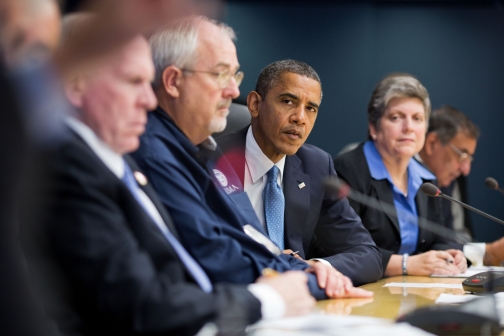
MR. CARNEY:  Welcome aboard Air Force One as we make our way to many places.  Before we take your questions I just wanted to let you know that this morning before leaving the White House, Assistant to the President for Homeland Security John Brennan, Deputy Chief of Staff Alyssa Mastromonaco, and FEMA Administrator Craig Fugate updated the President with the latest details on the ongoing response to Sandy, including efforts to restore power. 

Throughout the day, the President will stay in regular touch with Administrator Fugate and the rest of his team to ensure that bureaucracy and red tape are not impeding efforts to respond to communities recovering from the storm.  The President will also convene conference calls today with local elected officials from affected areas to ensure that available federal resources are being provided in support of local response efforts.  We will provide readouts of those calls after they are conducted.

At the direction of the President, the federal government continues to lean forward to support state and local partners as they recover from this storm.  On Tuesday, as you know, the President provided major disaster declarations for the states of New Jersey, New York, and Connecticut.  These declarations build on the emergency declarations provided earlier this week for these three states and many others leading up to the storm.  These specific three declarations make additional federal support available to states as they respond.

These declarations also make federal assistance available directly to affected individuals, including temporary housing assistance, low-cost loans, and other resources to help cover uninsured losses.  As of 7:00 a.m. this morning, more than 36,000 disaster survivors from New York, New Jersey, and Connecticut have applied for federal disaster assistance, and more than $3.4 million in direct assistance to these individuals has already been approved.  These are resources, as I said, like housing assistance and to support immediate needs.

We continue to urge, as we did yesterday, affected individuals in eligible counties to apply for assistance by visiting www.disasterassistance.gov, or calling 1-800-621-FEMA.  That's 1-800-621-3362.

Today, Secretary of Homeland Security Janet Napolitano is scheduled to travel to Connecticut and New York to meet with state and local officials and view ongoing response and recovery efforts to Hurricane and Storm Sandy.  The U.S. Army Corps of Engineers is involved in unwatering activities in support of state and local efforts, including in New York City.  The Corps has also deployed the 249th Engineering Battalion and other temporary emergency power assets to provide support to areas impacted by the storm.

Coming out of the President’s call with utility companies Tuesday night, FEMA has established a power restoration working group, which you know about, which includes representatives for the utilities at the National Response Coordination Center to cut through the red tape, increase federal, state, and local and private coordination, and restore power to people as quickly as possible.

Led by FEMA, this working group includes representatives from private-sector utilities and includes government reps from the Departments of Transportation and Energy, as well as the U.S. Army Corps of Engineers, and representatives from local law enforcement, among others.

At the request of state and local officials, FEMA has deployed approximately 50 industrial generators to the states of New York, New Jersey, and Connecticut to provide support in areas where power has been lost.  Those generators are the kind that can put hospitals back online, and other facilities that are critically in need of power. 

There are currently nine federal Urban Search and Rescue Teams deployed to impacted states that have helped support hundreds of rescues.  Currently, over 2,300 FEMA personnel are deployed to affected states up and down the East Coast, and that includes 14 Incident Management Assistant Teams, as well as FEMA liaisons embedded in state emergency operation centers.

Additionally, the National Guard has more than 11,000 forces activated to support governors of affected states.  Other federal agencies continue to provide resources -- provide support, including medical equipment and other resources.  Also, as an example, today more than 60 power restoration vehicles and crews from private utility companies on the West Coast are being air-lifted, using DOD assets from California, to the East Coast to support power restoration efforts in New York and New Jersey.

With that, I turn it over to my colleague.

MS. PSAKI:  Two quick things.  One, I’m sure you saw, but just to highlight for everybody -- we have a new ad on the air today featuring the powerful endorsement by General Colin Powell. It’s running in 10 states.  If you need a list, please let me know.

Second, because we’re on our way today to three states -- four if you count where we’re sleeping -- I just wanted to highlight where we are in those states and give you a couple of new additional facts. 

Wisconsin, our first stop -- in Wisconsin voters in Democratic counties and precincts are turning out at higher rates and outvoting Republican counties and precincts by a margin of more than two to one; 161,787 -- to be exact -- ballots have been returned from wards won by Barack Obama in 2008; 78,876 from Republican wards.  And 87 percent of new registered voters are women, youth, minorities. 

Second, we are headed to Nevada as you know.  Take off your sweaters.  Nearly half of Nevada voters’ votes have already been cast.  And the President has an eight-point lead among these voters, according to an NBC-Wall Street Journal poll.  This means Romney needs to win the remaining voters’ votes by 54 percent just in order to tie up the race.  Democrats have an early-vote lead of 40,000 over Republicans, and the Democrats have the largest registration advantage ever of 15 percent compared to 2008.

Finally, we’ll end our day before flying to Ohio in Colorado.  Nearly half of Colorado votes have already been cast, and the President leads by 10 points among those who have already voted, according to recent polling.  Now, remember, Colorado is a state where 78 percent of the vote was cast by mail or early vote in 2008, so to give you an indication of how important that base is.

Democrats are doing better in early voting this year than we were two years ago when we swept the U.S. Senate and governors race.  Turnout is up 25 percent among African Americans and 34 percent among Latinos compared with four years ago. 

With that, we’ll take your questions.

Q    Jen, can you talk at all about what we should expect from the President’s tone today, coming off three days where he was really immersed in the storm effort?  Is it going to basically be game on in terms of criticizing Romney, or is he going to try to temper his tone a bit?

MS. PSAKI:  Well, two things I’ll say.  The first is that obviously the President has been focused the last few days on exactly what the American people elected him to do, which is to serve as Commander-in-Chief and manage the country in a state of crisis.  This week, that’s been the hurricane, Hurricane Sandy.

At the same time, there’s another reality happening, which is the election that’s happening in five days.  And as Jay mentioned, he will be receiving updates throughout the day, receiving briefings on calls, constantly monitoring, and he’s already put a robust recovery process in place.  But he will be out there today, tomorrow, Saturday, Sunday, Monday making the case to the American people. 

As you may have seen overnight, and I forwarded to all you, he’ll also be laying out his closing argument to the America people today in his remarks.  That's something that he has always planned to do.  It’s been in the works for weeks.  And in his remarks today, he’ll be -- these are the last five days of his last campaign -- ever.  So you will hear many of the themes -- much about the fight that he’s been waging throughout his public -- career in public life on behalf of the middle class. 

And I think people who have been covering him a while -- and I know most of you have not been covering him back to his state Senate days, but back to 2008 -- will hear a lot of the same themes, and you’ll hear a lot of the same message to the middle class, same message to the American people, about the choice they're facing.

Now, part of that is laying out the choice between him and his opponent.  And what he’ll say in his remarks today is that there’s a difference between real change -- real change that he’s brought about, real change that he’s not done delivering on -- and the change Mitt Romney is promising, which is going back to the same policies that led us into this mess and calling it change.  So to that degree, he will laying out the choice.

Q    How important did the Jeep have -- the Jeep ads in Ohio How have you seen that impacting voters in Ohio and other Midwestern states?  Is it moving the needle at all with swing voters, or is it more mobilizing the base?

MS. PSAKI:  Well, first, I mean, just to reiterate, these Jeep ads that the Romney team have been running are a Hail Mary pass by the Romney team.  There are two major issues with it:  One is the facts.  You have the CEOs of GM and Chrysler making a very rare step to come out and say these ads are false. 

But the second, which I would argue is more important, is this raises a character issue.  Mitt Romney is closing the campaign in Ohio with an ad of fear -- scare tactics to scare the workers in the state about -- with false statements about what’s going to happen at the Jeep plant, when we all know, and the plant has made clear, what the facts are.

With that, the race in Ohio has been very stable.  It’s been a four to five point race in most polls for weeks now, and we think that's because, one, the people of the state are responding to the tough choices the President made to save the auto industry -- one in eight jobs in Ohio dependent on the auto industry.  That's something he’s been talking about a great deal.  Also, the President’s record on manufacturing. 

And the people of Ohio aren’t looking for a President who is going to support tax credits for companies that ship jobs overseas, or support incentives to help millionaires and billionaires and not the middle class. 

So the race has been very stable.  Whether or not this ad specifically -- obviously, we’ve been up on the air with a response ad.  This has been dominating the media in the state for eight days now, and it’s also trickled into other states -- the Denver Post wrote an editorial about it, and The New York Times, many papers.  And the truth is this isn’t a step you take, running an ad like this full of false statements, if you think you’re winning the state.  This is a clear sign that they’re worried that they haven’t been able to crack the nut in Ohio because it’s been so stable.

Q    Jay, are those readouts of the President’s calls today, are they going to come on paper or are they coming --

MR. CARNEY:  I’ll provide them.  I mean, we --

Q    To the pool?

MR. CARNEY:  To the pool, yes.  A lot of them will happen in the air.

Q    Really quickly on this -- obviously we’re a week out; we’ll be post-election and everything is going to turn towards the fiscal cliff.  Is the President doing anything at all to prepare for that in advance?  Or has that all been pushed off until after November 6th?

MR. CARNEY:  The administration, under the President’s direction, is always working on the issues of budget policy, and that work continues.  The challenges posed by the so-called fiscal cliff are well known, and the opportunity that Congress has had -- the House of Representatives in particular -- to mitigate some of those challenges has been available to Republicans in the House for many months now, ever since the Senate passed an extension of the tax cuts for 98 percent of the American people. 

Unfortunately, Republicans in the House have refused to pass that measure, choosing instead to hold hostage tax cuts for the middle class to the wealthiest 2 percent of the American people. That’s bad policy. 

The President has said and believes that after the election we will be able to come together in a bipartisan way to resolve these issues and to deal with our deficit and debt challenge with a balanced proposal that reflects an overwhelming consensus among experts and the American people about how we should get this done.  And he looks forward to tackling those issues after the election.

Q    Any more thought to the idea of a “secretary of business”?  Is that something that he’s likely to -- I mean, one of the things that he’s talked a lot about is that he wanted to continue the conversation with the American people, post-election, in a way that he maybe didn’t, according to him, in the first couple of years.  So is he going to pivot immediately off the election to try and sell some of these ideas to voters?

MR. CARNEY:  The President will be engaging directly after the election in moving forward on the number of --

Q    I mean, holding events, those kinds of things.

MR. CARNEY:  I have no schedule announcements to make for you.  We’re obviously focused on the President’s schedule in the next several days.  And as you’ve seen, changes come about very quickly in response to events -- some of them unpredicted.

The point I’ll make is that the President is committed to working to find solutions to these challenges.  There is a clear path to resolving them, when we talk about our budget and fiscal issues, that has broad support among the American people, broad support from Democrats, independents, and Republicans, except those who are leaders in the House of Representatives, by and large.

On the issue of his approach to streamlining government -- and specifically, to asking Congress for the authority that every President from Herbert Hoover to Ronald Reagan had to make proposals to streamline government -- he very much wants to see action on that.  And his initial proposal has to do with consolidating agencies that deal with business and exports and commerce.  So he’s very committed to that proposal.  That’s the proposal that has the support of the Chamber of Commerce and has the support of John Engler and others from the Business Roundtable because it’s the right thing to do.

And it would save money -- $3 billion over 10 years.  And it would consolidate a lot of agencies so there’s one location, one website, one phone number, one agency that handles all these different issues that have to deal with supporting American business and supporting exports.

Q    Jen, earlier this year, the President didn't spend a whole lot of time in Wisconsin while he was going to many of the other swing states.  Now that it’s really close here, looking back, does the campaign regret that he didn't spend a little bit more time in Wisconsin up until the end?

MS. PSAKI:  Well, we’ve always known the state would be harder for us than it was in 2008.   We won by 14 point in 2008. Obviously, when Mitt Romney chose Paul Ryan as his running mate, he’s a native son, and they’ve tried to make a big to-do about that.  He’s basically moved into the state and spends a great deal of time there.  They’ve put in money there; we’ve put in money there.  And races change always as time goes on.  We’ve obviously -- we’ve had an organization on the ground there since 2008.  We think that continues to be helpful, and is one of the reasons that we’re going to win Wisconsin on Tuesday.

But, no, we certainly don't look back and have any regrets about where we spent time or where we spent resources.  Any campaign, you always need to be flexible and always need to be moving with where the state of the race is going.  And when the Romney team put in money there, when they decided that Paul Ryan would pitch a tent, move into his home state, we knew we weren’t going to cede the state, and we knew we were going to spend money, and fortunately we had the resources to do that.

Q    Tomorrow is the final jobs report before the election. It’s the last snapshot that voters will have of the jobs picture in this country.  Do you think it’s going to have any bearing on voters when they head to the polls on Tuesday regardless of what the numbers show? 

MR. CARNEY:  I, of course, do not have the numbers, so I have nothing to provide.

MS. PSAKI:  We don't know what the numbers are.  No one does.  Regardless of what they are, the President is still going to feel there’s more we need to do to help the economy recover at a faster rate, put more people back to work.  As he says every day and he’ll say today, until everybody who wants a job has a job, his job is not done.  And that won’t change.

We also know that people at home are making their decisions based on where we take the economy from here.  There’s no question any nonpartisan economists will tell you we’ve made progress.  The numbers tell you that story -- 5.2 million jobs, 31 straight months of private sector job growth.  But the President is the first to say there’s more we need to do.  That is the same thing he’ll say today, I expect the same thing he’ll say tomorrow, and the same thing he’ll say on Monday.

Q    On Benghazi, overnight, FOX News had a report on another cable.  But the question is not about that.  These cables have been coming out, news reports have been coming.  How closely -- I know an investigation is ongoing -- but how closely is the President reading these reports, following them?  Is he asking questions?  Even the ones in The New York Times, elsewhere -- is he engaged in the investigation and receiving updates on the investigation, or is he waiting until it’s complete?

MR. CARNEY:  These investigations are being conducted by both the FBI and the Accountability Review Board, and he is not participating in the investigation.  He is anticipating results that show us exactly what happened, who was responsible and what lessons we can learn from it in terms of how we ensure that it never happens again.

Q    Is it safe to say he’s withholding judgment and getting involved and asking questions and follow-ups until something comes out?

MR. CARNEY:  The President was asked in interviews as recently as when he spoke with Brian Williams of NBC about what he expects.  He expects the investigations to be rigorous.  He is extremely focused on making sure that we find exactly what happened and who was responsible, and tracking down those who were responsible and bringing them to justice.

And his responsibility as Commander-in-Chief is for the men and women that he sends into harm’s way.  And that is often thought of as just members of the military, but it includes members of the diplomatic corps who serve in countries that are dangerous, but who do extraordinarily important work and who serve their country bravely in doing that work, in promoting American values and building relationships that help our national security interests.

So the President is very committed to letting the facts come through and ensuring that we find out exactly what happened and who is responsible.

Q    Jen, can I ask you about Bill Clinton?  He’s barnstorming the country, 13 events in four days, seven states.  Does he help you guys in tight races in some of these battlegrounds?  And does he have -- is he something of a super surrogate?  Does he have an influence that other surrogates for the President -- and for Mitt Romney, for that matter -- don’t have?

MS. PSAKI:  Well, certainly we’d rather have President Bill Clinton out there than Newt Gingrich or whomever the Romney team has on their side.  But, look, there’s no one better to make the case for the middle class, for why the American people should send the President back for another four years, why he’s the better fighter for the middle class than President Bill Clinton.

He made that case during his convention speech.  He’s been a tireless advocate for the President out on the campaign trail, day in and day out, event to event.  And he’s an incredibly powerful asset for us to have out there campaigning, and we’re incredibly grateful for that.  And if you look at the fact that the President today will be hitting three states, he’ll be hitting one state with three stops tomorrow, countless events this weekend, and we have the First Lady out there; we have the Vice President out there; we also have President Clinton out there -- it’s a huge added bonus for us to have such a powerful advocate out on the trail.

And when they campaign together this weekend, that will be an even more powerful argument for why it’s important to take a look at what’s worked in the past and where we need to take those lessons and use them moving forward.

Q    Is Chris Christie an added bonus also?

MS. PSAKI:  Look, I think Jay gave -- has given many readouts over the last couple of days.  I’ll leave it to all of you to analyze the last couple of days.  I will say the President was very laudatory of Governor Christie and the steps he’s taken in New Jersey -- are well-deserved.  And they have a shared commitment to making sure that the state has the resources and the information they need as they recover.

Q    Thank you.


END
11:14 A.M. EDT
President Obama Tours Storm Damage in New Jersey

President Obama and Gov. Christie Survey Storm Damage

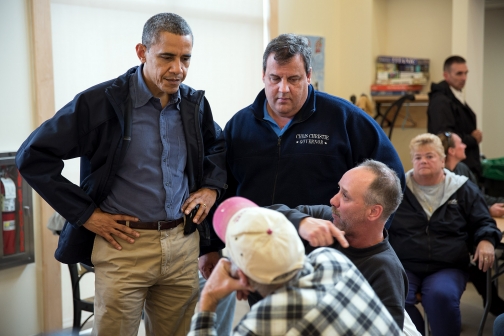
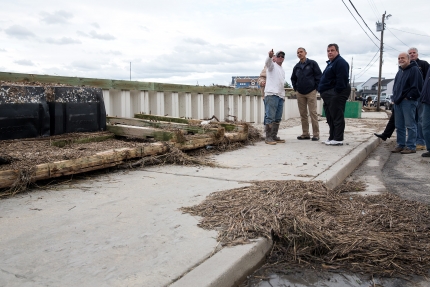
President Barack Obama and New Jersey Gov. Chris Christie talk with citizens who are recovering from Hurricane Sandy, while surveying storm damage in Brigantine, N.J., Oct. 31, 2012. (Official White House Photo by Pete Souza)

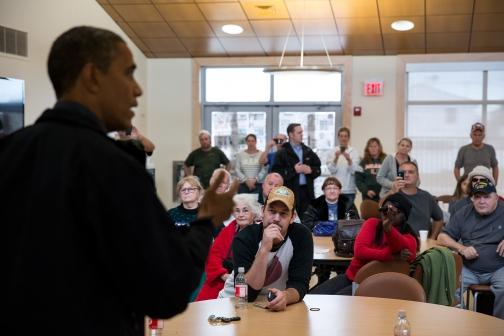
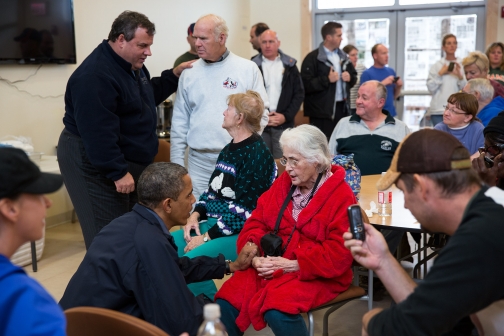
Yesterday, the President was in New Jersey to witness first-hand the devastation of Hurricane Sandy, and comfort the Americans affected by the storm. With New Jersey Governor Chris Christie, he surveyed the damage from Marine One, walked the streets of Brigantine, and visited a community center now serving as shelter for displaced residents.

After speaking with residents and hearing their stories, the President spoke, alongside Governor Chris Christie, FEMA Administrator Craig Fugate, and other officials, to reassure those affected by the storm of recovery, and pledge the full support of the federal government every step of the way. He reminded the American people of our remarkable ability to come together as a country when we go through tough times, and the importance of never leaving anybody behind:

And when you see folks like that respond with strength and resilience, when you see neighbors helping neighbors, then you're reminded about what America is all about.  We go through tough times, but we bounce back.  And the reason we bounce back is because we look out for one another and we don’t leave anybody behind. And so my commitment to the people on this block, the people in this community, and the people of this state is that that same spirit will carry over all the way through until our work is done.

Take a look at the President’s tour of New Jersey:

  • President Obama at FEMA Briefing

    President Obama listens to Transportation Secretary Ray LaHood in a FEMA briefing on Hurricane Sandy (All official White House Photos by Pete Souza)

    1 of 11
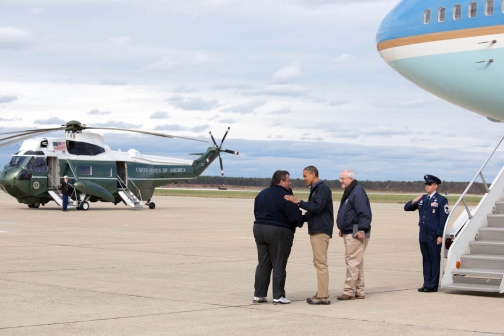
  • President Obama Greets New Jersey Gov. Chris Christie

    President Barack Obama and FEMA Director Craig Fugate greet New Jersey Gov. Chris Christie on the tarmac of Atlantic City International Airport in Atl

    2 of 11
  • Marine One and Nighthawk Two

    Marine One, carrying President Barack Obama and New Jersey Gov. Chris Christie, and a second helicopter fly over storm damage near Atlantic City, NJ

    3 of 11
  • President Obama and Gov. Christie Look at Storm Damage

    President Barack Obama and New Jersey Gov. Chris Christie look at storm damage along the coast of New Jersey on Marine One

    4 of 11
  • President Obama Looks at the Storm Damage

    President Barack Obama looks at the storm damage as he and New Jersey Gov. Chris Christie make an aerial tour from Marine One near Seaside Heights, NJ

    5 of 11
  • President Obama Talks with Local Residents

    President Barack Obama talks with local residents at the Brigantine Beach Community Center, currently a shelter for those displaced by Hurricane Sandy

    6 of 11
  • President Obama and Gov. Christie at the Brigantine Beach Community Center

    President Barack Obama and New Jersey Gov. Chris Christie talk with local residents at the Brigantine Beach Community Center

    7 of 11
  • President Obama and Gov. Christie Talk with Local Residents

    President Barack Obama and New Jersey Gov. Chris Christie talk with local residents at the Brigantine Beach Community Center

    8 of 11
  • President Obama and Gov. Christie Survey Storm Damage

    President Barack Obama and New Jersey Gov. Chris Christie talk with citizens who are recovering from Hurricane Sandy

    9 of 11
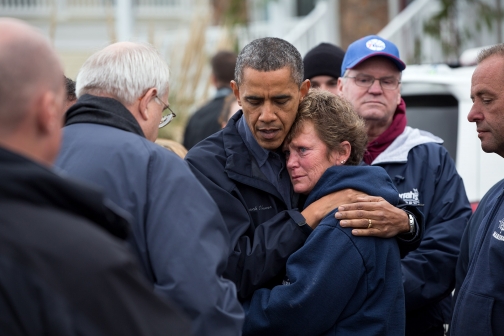
  • President Obama Comforts Donna Vanzant

    President Barack Obama hugs Donna Vanzant, the owner of North Point Marina, as he tours damage from Hurricane Sandy

    10 of 11
  • President Obama, Gov. Chris Christie, and FEMA Administrator Craig Fugate

    President Barack Obama, New Jersey Gov. Chris Christie, FEMA Administrator Craig Fugate, and others make a statement after touring storm damage

    11 of 11
Related Topics: Homeland Security, New Jersey

The White House

Office of the Press Secretary

Notice -- Continuation of the National Emergency with Respect to Sudan

NOTICE

- - - - - - -

CONTINUATION OF THE NATIONAL EMERGENCY WITH RESPECT TO SUDAN

On November 3, 1997, by Executive Order 13067, the President declared a national emergency with respect to Sudan and, pursuant to the International Emergency Economic Powers Act (50 U.S.C. 1701-1706), took related steps to deal with the unusual and extraordinary threat to the national security and foreign policy of the United States posed by the actions and policies of the Government of Sudan. On April 26, 2006, in Executive Order 13400, the President determined that the conflict in Sudan's Darfur region posed an unusual and extraordinary threat to the national security and foreign policy of the United States, expanded the scope of the national emergency to deal with that threat, and ordered the blocking of property of certain persons connected to the conflict. On October 13, 2006, the President issued Executive Order 13412 to take additional steps with respect to the national emergency and to implement the Darfur Peace and Accountability Act of 2006 (Public Law 109-344).

Because the actions and policies of the Government of Sudan continue to pose an unusual and extraordinary threat to the national security and foreign policy of the United States, the national emergency declared on November 3, 1997, as expanded on April 26, 2006, and with respect to which additional steps were taken on October 13, 2006, must continue in effect beyond November 3, 2012. Therefore, consistent with section 202(d) of the National Emergencies Act (50 U.S.C. 1622(d)), I am continuing for 1 year the national emergency with respect to Sudan.

This notice shall be published in the Federal Register and transmitted to the Congress.

BARACK OBAMA

The White House

Office of the Press Secretary

Letter -- Continuation of the National Emergency with Respect to Sudan

Dear Mr. Speaker: (Dear Mr. President:)

Section 202(d) of the National Emergencies Act (50 U.S.C. 1622(d)) provides for the automatic termination of a national emergency unless, within the 90-day period prior to the anniversary date of its declaration, the President publishes in the Federal Register and transmits to the Congress a notice stating that the emergency is to continue in effect beyond the anniversary date. In accordance with this provision, I have sent to the Federal Register for publication the enclosed notice stating that the Sudan emergency is to continue in effect beyond November 3, 2012.

The crisis constituted by the actions and policies of the Government of Sudan that led to the declaration of a national emergency in Executive Order 13067 of November 3, 1997, and the expansion of that emergency in Executive Order 13400 of April 26, 2006, and with respect to which additional steps were taken in Executive Order 13412 of October 13, 2006, has not been resolved. These actions and policies are hostile to U.S. interests and continue to pose an unusual and extraordinary threat to the national security and foreign policy of the United States. Therefore, I have determined that it is necessary to continue the national emergency declared with respect to Sudan and maintain in force the sanctions against Sudan to respond to this threat.

Sincerely,

BARACK OBAMA

President Obama Tours Areas Damaged by Hurricane Sandy

October 31, 2012 | 10:50 | Public Domain

President Obama tours a New Jersey neighborhood that was badly damaged by Hurricane Sandy.

Download mp4 (400MB) | mp3 (26MB)

President Obama in New Jersey: "We Are Here for You"

President Obama Comforts Donna Vanzant

President Barack Obama hugs Donna Vanzant, the owner of North Point Marina, as he tours damage from Hurricane Sandy in Brigantine, N.J., Oct. 31, 2012. (Official White House Photo by Pete Souza)

Two days after Hurricane Sandy made landfall in southern New Jersey, President Obama was on hand to witness the devastation, comfort residents, and pledge the full support of the federal government in the recovery effort.

Across the state, the storm damaged homes, flooded communities, and left more than 2 million people without power. The President and New Jersey Governor Chris Christie surveyed the effects of the hurricane from Marine One, then walked the streets of Brigantine, a town near Atlantic City. The two leaders also visited a community center now serving as a shelter for displaced residents.

"One of our challenges now is to get back to normalcy," said Gov. Christie. "And so the things we need to do is to make sure that we get power restored as quickly as possible; make sure that people have clean drinking water, and waste water treatment plants are working; hospitals are taken care of the way they need to; and that we get kids back to school. And so, I discussed all those issues today with the President, and I’m pleased to report that he has sprung into action immediately to help get us those things."

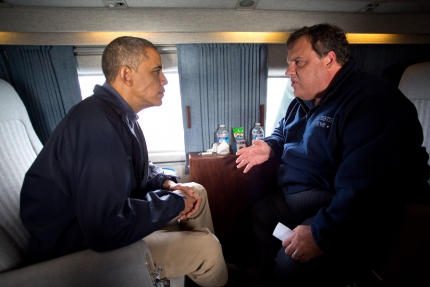
President Barack Obama and New Jersey Gov. Chris Christie (October 31, 2012)

President Barack Obama and New Jersey Gov. Chris Christie talk as they fly over the coast of New Jersey on Marine One, Oct. 31, 2012. (Official White House Photo by Pete Souza)

President Obama outlined the steps being taken by federal emergency responders. Even before the storm hit, FEMA and other groups were able to preposition supplies like water, food, and power generators. Now more than 2,000 FEMA personnel are on the ground in the state, and the President promised that the recovery effort would continue. 

"Number one, and most important, our hearts go out to the families who have lost loved ones," he said. "For those like the people I just had the chance to meet on this block and throughout New Jersey and throughout the region whose lives have been upended, my second message is we are here for you, and we will not forget; we will follow up to make sure that you get all the help that you need until you've rebuilt."

Update: Check out a slide show of images from today's visit.

Related Topics: Homeland Security, New Jersey