The White House

Office of the Press Secretary

Press Gaggle by Press Secretary Jay Carney en route Charlotte, NC, 9/5/2012

Aboard Air Force One
En Route Charlotte, North Carolina

2:25 P.M. EDT

MR. CARNEY:  Welcome aboard Air Force One as we make our way to Charlotte, North Carolina.  So happy to have you.  I have no announcements.

MS. PSAKI:  As I did yesterday, I’m just going to tick through the speakers for the evening so you all have that fresh. So now you’ll hear from the CEO of Carmax and the CEO of Costco. They’ll talk about the need to not only unleash the power of our entrepreneurs and small businesses, but also invest in things that can help them succeed.  You’ll also hear from former employees of companies controlled by Romney’s Bain Capital who will speak to the impact of his business experience on workers and families. 

You’ll hear from Congressman Chris Van Hollen.  Elizabeth Warren will talk about what President Obama has done to make sure that Wall Street plays by the same rules as Main Street and what would happen if Mitt Romney and Paul Ryan had their way.  And finally, I know you’ve heard this, but you’ll from President Clinton this evening who will take the stage to talk about what the President has done to help the nation recover from the worst economic crisis ever handed to a new President and what he’s doing to create an economy built to last.

Finally, one thing you won’t hear is -- but you may have heard from the Romney-Ryan team today -- is a statement -- a comment by Paul Ryan that "the nation is in decline."  So what a pessimistic comment to come from the Republican ticket at a time when we’re continuing to recover.  More work needs to be done, but you’ll hear much more from the Democratic speakers tonight and tomorrow about what we need to do moving forward than that kind of pessimistic language.

MR. CARNEY:  I wanted to note if you hadn’t seen it already that to help meet the growing humanitarian need caused by the violence in Syria, U.S. Agency for International Development Administrator Dr. Rajiv Shah announced today in Jordan that the United States is providing an additional $21 million to the United Nations World Food Program.  With this new assistance the United States is providing a total of more than $100 million for humanitarian activities both inside Syria and in neighboring countries.

Now, we’ll take your questions.

Q    Did the President have any role in the decision to move his speech from the stadium to the arena?  And was he disappointed by the outcome there?

MS. PSAKI:  We’re all disappointed because we had 65,000 ticket holders, plus 19,000 people who were on the waiting list ready and excited and fired up to hear the President deliver his speech tomorrow night.  So certainly he is.

The decision was made on a staff level.  We’ve been working closely on the ground with an advisory team.  This is not a Panthers game, as you may know.  It’s a national special security event -- is what it’s called.  So the criteria used for that is making -- ensuring that we’re not putting the public safety or security of anybody in the audience at risk.

There were several weather forecasts that were calling for a 30 to 40 percent chance of thunderstorms tomorrow night, which just to put that in real terms for you, what it means, we would have had to possibly evacuate the stadium if there were thunderstorms.  So we know that Mother Nature doesn't always cooperate.  Unfortunately, we wish she did.  But we’ve been planning for this, a contingency plan from the day that we announced that there would be an outdoor venue, and so we had alternative plans in place in case this happened.

Q    How does that square, though, with what you said yesterday when we asked about the concerns about weather and you said, we plan to go ahead -- I think you had even mentioned that sporting events happen there, and now you’re saying this isn’t a sporting event.

MS. PSAKI:  There's a difference between raindrops and severe thunderstorms.  And those calls are made by people who have a great deal of experience planning for and preventing a situation like evacuating tens of thousands of people. 

This isn’t a call we wanted to make.  Obviously, we were very much looking forward to having a full and energized and excited crowd in the stadium.  And again, as I said before, it’s disappointing, but we made it because it was recommended by the collection of the team on the ground that we needed to plan for it for public safety reasons.

Q    Can I ask you, Jen, about the -- or even Jay -- about the change in the platform regarding Jerusalem from 2008.  This platform I think for the DNC does not mention them as the capital of Israel.  Can you both comment on that and whether you agree with it -- the White House agree with it?

MS. PSAKI:  Well, first I’ll say the President’s position has been completely consistent since 2008.  He spoke about this in 2008, beyond what was in the platform in 2008.  This is being addressed.  I don't have anything further for you on it other than that. 

But I’ll also say that there are times -- this is one example of a time when a position on an issue where there’s been bipartisan agreement on, Republicans are trying to make it into a wedge issue, and that's very disappointing.

But I’ll let you speak to it.

MR. CARNEY:  I would simply add that obviously we’ve heard some of the concerns expressed about it.  But let’s be clear.  As President of the United States, the position on Jerusalem held by this administration, this President, is exactly the same position that Presidents and administrations have held since 1967 -- Presidents of both parties, administrations of both parties. 

And I think it’s -- you certainly didn't hear leaders of the Republican Party during the George W. Bush administration saying that his position of his government that Jerusalem needed to be resolved in final status negotiations between the two parties -- Israelis and Palestinians -- was "shameful."  I didn't hear Mitt Romney say that.  I certainly didn't hear Paul Ryan say that.

Q    Can I ask about Bill Clinton’s speech tonight?  Will President Obama be watching that speech?  And what kind of coordination has there between President Clinton’s office and the campaign in crafting his remarks?

MS. PSAKI:  Well, our team has been working closely with President Clinton and his team since the day the President asked him to deliver the speech.  You may know some of the colorful characters -- Gene Sperling, people like that -- who worked for President Clinton also work for President Obama. 

The President will be watching.  He’s very much looking forward to watching his remarks tonight.  He will not be in the First Lady’s box.  The First Lady will have a group of people in the box.  You may already have, but I’m happy to get you that list if you don't have.  We’ll have more details later on where he’ll be watching his remarks from.

Q    -- helped him with his remarks?  Is there --

MS. PSAKI:  I was just using the example -- there were several people from our -- from President Obama’s team who have been working closely with President Clinton and his team from the beginning.  I don't want to -- I don't mean to single anyone out. And they’ve been closely coordinating on both the message and the content.

As is true of President Obama, President Clinton will probably be tweaking it and fine-tuning it until the very last moment before he takes the stage.  Anyone who's covered him knows that that's what traditionally happens. 

But I will say we’re very much looking forward to not only hearing President Clinton speak and take down the house and -- bring down the house, not take down the house -- bring down the house at the convention site, but he has a unique background, and 20 years ago, when he was running, he was also facing a Republican -- Republicans who wanted to give tax cuts to the wealthiest.  They wanted to slash benefits for the middle class, and he can really speak to experience on why it’s important to take the path that the President has laid out.

Q    What's the campaign’s position on Rahm Emanuel raising money for Priorities USA?  And does that signal some sort of panic mode about being out-raised by the Republicans?

MS. PSAKI:  Well, we’ve been very clear for months that we expected to be out-raised by the Republicans.  And it’s been very clear that on the super PAC side that's evident in the monthly reporting.  Rahm Emanuel -- Mayor Emanuel is very close, of course, to the President, a strong supporter of his.  And he has said that this is what he thinks is the right -- or his team has said that he thinks this is the best way he can help the President get reelected.  So I think it’s more about what he feels is the best role he can play between now and November.

Q    Glenn Thrush's book I think reported that Rahm Emanuel had pushed earlier to sort of set up a super PAC to raise money like this, and that he was shot down because of the idea the President was sort of against this kind of outside money influence.  I don't know if you can talk about that and whether you -- there’s any second-guessing now.

MS. PSAKI:  Well, look, the President has been very clear about his opposition to the Citizens United decision.  There’s been no secret about that.  At the same time, we’re not going to bring a butter knife to a knife -- or a butter knife to a gunfight, and we’ve also been clear that we don't want to play by a different set of rules.  And that's why months ago we’ve encouraged our supporters to give to the Super PAC, despite the fact that we’d love to see greater accountability, greater disclosure.  So there’s absolutely -- it’s been a very consistent view on our part.  We know this election is going to be close and we need all the tools we can have out there.

Q    Back to moving the Thursday venue, was there ever a concern about being able to fill the stadium?  Did that factor in at all?

MS. PSAKI:  Absolutely not.  I know that our opponents on the other side of the aisle seem to be pushing this.  However, when you had 65,000 ticketed people, 19,000 people on the waiting list, our concern was more about turning people away than it was about filling the stadium.  We had an overwhelming response from people in North Carolina. 

More than 6,000 people participate in this program we’ve talked a little bit about called the 9-3-1 program -- nine hours, three shifts, one ticket.  Those are people who are now engaged and are going to be a part of this campaign between now and November.  And we need to do everything possible -- and we’re going to do everything possible -- to make sure all of these people who are unable to attend now because of feisty Mother Nature know how valuable they are.  The President is doing a conference call tomorrow.  We’re inviting them to events in the future.  And that’s really where our focus is.

Q    Why were the organizers telling people that the event was going to go off tomorrow night, rain or shine?  Doesn’t that inconvenience a lot of people?

MS. PSAKI:  Well, if it were a light drizzle, it might be still in the stadium.  So there’s a difference, as I mentioned before, between the possibility of severe thunderstorms, the risks that that could pose to the tens of thousands of people in the stadium.  And there was decision made by an advisory group who have a lot of experience making these calls that we just couldn’t put people at that public safety risk.

Q    Will the President be making any stops by the arena tonight to do a walk-through since he can’t go to the stadium?

MRS. PSAKI:  Well, given the circumstances and the change, the recent change, we’re seeing what’s logistically possible.  I don’t have any update as of now on that, but we’ll keep you guys updated if that ends up being part of his evening plans.

Q    Will he be meeting with Clinton at all while he’s here in town?

MS. PSAKI:  Well, I’m sure he will see him around.  I don’t have any specific -- there’s no meeting specifically set up, but I know he’s looking forward to watching his speech -- and we’ll see.  We’ll see what the next few days bring.

Q    Jen, will the media -- or can the media have access to that conference call you mentioned that the President is going to have?

MS. PSAKI:  Let me get back to you on that.  Let me check on that.  I’m not sure what decision was made.

Q    And do either of you have any reaction from the President on the First Lady’s speech last night and what he thought when he watched it?

MR. CARNEY:  I spoke with him about it this morning, and he was extremely pleased with the First Lady’s performance, and commented on the power of the words she spoke and the grace and skill with which she delivered the speech.  I think any of us -- any of you who saw it I think I’m sure were impressed by it, as I was.

Q    Did he get misty?

MR. CARNEY:  I didn’t ask him if he got misty.

MS. PSAKI:  I can also add just for a little more detail that he called the First Lady last night to just tell her how proud he was of her and what an incredible job she did during her remarks.  As you saw in the photo, he watched the speech with his two daughters and with Mrs. Robinson, and they had dinner before the speech and talked about their first day of school because yesterday was the girls’ first day of school.

Q    Are the girls coming out to the convention?

MS. PSAKI:  I believe -- let me double-check.  I believe they’ll be here tomorrow evening.  But this is their first week of school so they’re obviously not on the plane here, but we’ll get back to you on when they’ll be arriving.

Q    -- opinion that the welfare reform ought to go back -- the welfare changes ought to go back to Congress?

MR. CARNEY:  I have seen that report.  I can say that this is pretty arcane stuff and there is a many-year, multi-administration dispute between the executive branch and the Congress over how these kinds of guidances should be viewed.  But beyond that I don’t have any reaction.

Thanks, guys.

END 
2:37 P.M. EDT

The White House

Office of the Press Secretary

White House Appoints 2012-2013 Class Of White House Fellows

WASHINGTON, DC – Today, the President’s Commission on White House Fellowships announced the appointment of the 2012-2013 Class of White House Fellows. The Fellows come from diverse backgrounds, varied professions, and have all shown a strong commitment to public service and leadership. The 2012-2013 Class of Fellows and their biographies are included in the following pages.

The White House Fellows Program was created in 1964 by President Lyndon B. Johnson to give promising American leaders “first hand, high-level experience with the workings of the Federal government, and to increase their sense of participation in national affairs.”  This unique opportunity to work within our nation’s government is designed to encourage active citizenship and a lifelong commitment to service. The Fellows also take part in an education program designed to broaden their knowledge of leadership, policy formulation, and current affairs. Community service is another essential element of the program, and Fellows participate in service projects throughout the year in the Washington, DC area.

Selection as a White House Fellow is highly competitive and based on a record of professional achievement, evidence of leadership potential, and a proven commitment to public service. Each Fellow must possess the knowledge and skills necessary to contribute meaningfully at senior levels in the Federal government. Throughout its history, the program has fostered leaders in many fields, including leaders in government, business, media, medicine, education, diplomacy and the military. Additional information about the White House Fellows program is available at www.whitehouse.gov/fellows.

2012-2013 Class of White House Fellows

Elliot Ackerman, Washington, DC, is the Chief Operating Officer for Americans Elect, an initiative that offers a nonpartisan platform for individuals to run for elected office.  Prior to this, he served as a Marine Corps Infantry Officer and Special Operations Officer, and later as a Paramilitary Case Officer in the Central Intelligence Agency.  Over the course of eight years, he conducted multiple deployments to Iraq, Afghanistan, and the Middle East.  He also participated in post-Hurricane Katrina relief efforts.  As a Special Operations Officer, Elliot led a team of fourteen Marines who served as the primary combat advisors to a 700-man Afghan commando battalion.  As an Infantry Officer, Elliot led a 46-man rifle platoon during the November 2004 Battle of Fallujah.  Elliot holds a Master’s degree in International Relations from the Fletcher School, and earned his undergraduate degree, summa cum laude and Phi Beta Kappa from Tufts University.  He has served on the board of the Afghan Scholars Initiative and as an advisor to the No Greater Sacrifice Scholarship Fund.  His published works have appeared in Politico, Comparative Strategy Journal, and The Marine Corps Gazette among others. Elliot’s military awards include the Silver Star, Bronze Star for Valor, and the Purple Heart. 

Archie Bates, Bessemer, AL, is a United States Army Major who most recently served as the Executive Officer to the Director of Army Human Resources Policy, responsible for strategy and policy development.  Previously, he served as Assistant Professor at the United States Military Academy, where he was director of Leadership and Management courses, Academic Liaison between the dean and the head football coach, and Officer-in-charge of Special Olympics.  He has lectured internationally on leadership and co-authored a book chapter.  Archie deployed to Baghdad with the 2nd Brigade, 101st Airborne Division and was responsible for the individual readiness of over 8,000 Soldiers.  Archie graduated from the United States Military Academy with a B.S. in Management and earned the Superintendent’s Award for Academic, Military and Physical Excellence.  He also earned a Ph.D. and a M.A. in Industrial/Organizational Psychology from University of Maryland.  Archie’s awards include the Bronze Star Medal, Meritorious Service Medal, Major General Newman Award for Leadership Excellence, and the Military Outstanding Volunteer Service Medal.  An avid athlete, Archie played collegiate and semi-professional football, ran a marathon to raise funds for cancer research, and participated in weightlifting competitions.  He enjoys supporting his wife’s teaching career and coaching his two sons’ football teams.  

Ariel Grace Batungbacal, Marietta, GA, is a Major in the U.S. Air Force; and served as the Joint Staff J2/Director of Intelligence’s Deputy Executive Assistant.  Prior to that, she was Branch Chief for Middle East Strategy, leading intelligence efforts for the Chairman of the Joint Chiefs of Staff's policy development.  She served over five years in overseas assignments, supporting military operations in Asia, Europe and the Middle East, including three deployments supporting Operations Iraqi and Enduring Freedom.  She received the National Intelligence Meritorious Unit Award, and several military decorations to include the Defense Meritorious Service Medal and two AF Meritorious Service Medals.  Ariel currently serves as a founding board member for The Doolittle Foundation.  She has committed approximately 3,000 hours over the last decade to community organizations that cultivate women leaders, such as Junior League, Daughters of the American Revolution, and Hermandad de Sigma Iota Alpha, Inc.  She is a Southern California Leadership Network Fellow, and a Junior League Board Fellow.  Ariel received an Executive Master’s in Leadership from Georgetown University where her research on women in leadership was showcased.  She earned a M.A. in Diplomacy from Norwich University, B.A. in Chinese and B.A. in Government/Politics from the University of Maryland, College Park.

Dave Chokshi, Baton Rouge, LA, is a primary care physician with interests in public health and innovation in health care delivery.  He recently completed internal medicine residency at Brigham & Women's Hospital and Harvard Medical School.  He practiced at the Southern Jamaica Plain Health Center, where he was a member of the Youth Health Equity Collaborative.  Dave's prior work experience spans the public, private, and nonprofit sectors, including positions with the New York City Department of Health, the Louisiana Department of Health, a startup clinical software company, and with nonprofit organizations seeking to advance global health.  Dave helped grow the nonprofit Universities Allied for Essential Medicines (UAEM), dedicated to improving access to medicines in developing countries; he was a founding member of UAEM's Board of Directors.  He has done clinical work in Guatemala, Peru, Botswana, Ghana, and India.  Dave has written extensively on medicine and public health in journals including The New England Journal of Medicine, JAMA, Health Affairs, and Nature.  He is a Rhodes Scholar, a Truman Scholar, a Soros Fellow, and a Gamble Scholar.  He received his M.D. with distinction from Penn, an M.Sc in global public health from Oxford, and graduated summa cum laude and Phi Beta Kappa from Duke.

Chris Domencic, Export, PA, is a Lieutenant Commander in the United States Navy and a U.S. Navy SEAL.  He began his fourteen-year career in the Navy as a Surface Warfare Officer stationed aboard the USS Carter Hall where he was named the TYCOM Junior Ship Handler of the Year for COMPHIBRON TWO. As a SEAL, he has deployed to Central and South America, Africa, Europe, and the Middle East including four deployments to Afghanistan in support of Operation Enduring Freedom and two deployments in support of Operation Iraqi Freedom. He graduated with honors from the United States Naval Academy with a B.S. in Oceanography and received an M.P.P. from the Woodrow Wilson School of Public and International Affairs at Princeton University.

Mark Hanis, Plantation, FL, is the co-founder and board member of United to End Genocide which empowers all sectors (public, private, citizen) to prevent and stop mass atrocities. As the founding President for over six years, Mark transitioned UEG from a student group into a multimillion dollar non-profit whose impact included establishing over one thousand student chapters, playing key roles in passing state and federal legislation, and acquiring and merging other organizations in the same sector. He is currently co-founding an organization to address the unnecessary deaths due to a shortage of transplantable organs. Mark graduated from Swarthmore College with a degree in Political Science and a minor in Public Policy.  In 2003, Mark worked for the Office of the Prosecutor at the Special Court for Sierra Leone.  He is the grandchild of four Holocaust survivors and was raised in Quito, Ecuador. Mark has been awarded several fellowships for social entrepreneurship, including Ashoka, Echoing Green, Draper Richards Kaplan, and Hunt Alternatives Prime Movers. Mark was named a Young Global Leader by the World Economic Forum. Mark serves on the Board of Stakeholders of the University of Pacific's Global Center for Social Entrepreneurship, and is an advisory board member of Generation Citizen.

Bethany Rubin Henderson, Baton Rouge, LA, is a social entrepreneur.  She founded and leads City Hall Fellows, a non-partisan service corps empowering the next generation to lead America’s cities. Over 5 years, Bethany grew City Hall Fellows from a one-page sketch to an impactful venture, raising over $4,000,000 in public and private funding. Seven cohorts of City Hall Fellows to date have saved city agencies over $10,000,000, piloted ground-breaking anti-obesity and renewable energy programs, project managed civil service and financial system modernization efforts, and much more.  Bethany has been awarded an Echoing Green Fellowship, and has been named to Next American City magazine’s 2010 list of 33 emerging urban leaders; New Leaders Council’s 40 Under 40 Progressive Political Entrepreneurs of 2011; and babble.com’s 2011 Mominee of the Year (Politics).  Prior to launching City Hall Fellows, Bethany was a litigator at Quinn Emanuel, where she won an award from the California State Bar Association for pro bono representation of special education students. Bethany previously was a New York City Urban Fellow during Mayor Rudolph Giuliani’s administration.  She received a J.D. from Harvard Law School and both an M.A. and B.A. (Phi Beta Kappa and Summa Cum Laude) in Political Science from the University of Pennsylvania. Originally from Baton Rouge, LA, Bethany now lives just outside Washington, DC with her husband and two young daughters.

Candice Jones, Chicago, IL, is Executive Director of the Illinois Juvenile Justice Commission.  She manages a state commission tasked with the distribution of Federal Title II block grant funds.  Prior to joining the Commission, Candice was a Juvenile Justice Program Officer in the MacArthur Foundation’s US Programs.  In that role she managed a grant portfolio in excess of $40 million including two intensive strategies: to improve racial and ethnic disparities; and to improve the quality of juvenile indigent defense.  Before joining the Foundation, she worked as a litigator at Barack Ferrazzano Kirschbaum & Nagelberg, focusing on complex commercial litigation.  She identified and piloted a restorative justice program in an area high school that served pregnant and parenting young women, while at the firm.  Candice has provided criminal defense representation to youth and adults at the Legal Aid Society’s Juvenile Rights Division and the Neighborhood Defender Services of Harlem, both in New York.  She has also worked in Japan as an English Language Instructor and in Chicago as a rape crisis advocate.  Her bachelor’s degree is in Political Science and African & African-American Studies from Washington University in St. Louis and her J.D. from New York University School of Law. 

Kermit Jones, South Haven, MI, recently finished his M.P.A., with a regional specialization in South Asia, at Columbia’s School of International and Public Affairs (SIPA).  There, he founded a chapter of Developments in Literacy (DIL), a non-profit that has educated over 16,000 elementary school students in Pakistan and led a team that advised on technology use and teacher training.  He also served on a team that worked with the NYC Office of Management and Budget to evaluate and to advise on ways to streamline the design process in their $ 8 billion annual capital infrastructure investment portfolio. Before SIPA he served in the U.S. Navy as a flight surgeon for a Marine helicopter casualty evacuation squadron in Al Habbaniyah, Iraq, providing primary care for his squadron, HMM-364 (“Purple Foxes”), and emergency care for U.S. and Iraqi nationals.  Prior to military service, Kermit worked as a primary care physician with a rural health service at Christian Medical College in Vellore, India.  He studied the legal implications of trade and AIDS-related public health legislation at the World Health Organization in Geneva, and was a Mordecai scholar at Duke University, where he received his M.D. and J.D.  He is conversational in Urdu, Hindi, and Spanish.

Amen Ra Mashariki, Chicago, IL, is a computer scientist at the Johns Hopkins University Applied Physics Laboratory (JHU APL). As a senior bioinformatics researcher at JHU APL he develops and utilizes smart algorithms that explore biological data in search of complex associations and relationships in order to provide insight into common biological diagnostics and clinical trends. Prior to academia, Amen has spent 7 years in the technical industry as a senior software engineer for Motorola. He has authored 5 patent disclosures, and received the prestigious Chicago Museum of Science ‘Top Technology Innovators’ award. Over the last 8 years Amen has spent his summers teaching advanced computer science courses for 7th – 10th graders at the Johns Hopkins University Center For Talented Youth program. Amen earned his doctorate degree from Morgan State University, his Master’s degree in computer science from Howard University, and also his bachelor’s degree in computer science from Lincoln University.

Anne O’Connell, West Haven, CT, is a Lieutenant Commander in the United States Coast Guard. She has commanded four Coast Guard ships, including one in the Middle East conducting international security missions as part of Operation Iraqi Freedom and Operation Enduring Freedom. Most recently, she commanded a ship in the Caribbean responsible for regional security priorities including counter-narcotic, anti-human trafficking, and other operations. She has also served as an aide-de-camp to the second-in-command of the Coast Guard. Anne’s accomplishments have been featured in the Coast Guard’s “Leaders of Today” panel at the Coast Guard Academy’s Women’s History Exhibit. Her volunteer work includes co-founding the Massachusetts chapter of the veterans’ support organization Team Red, White and Blue, and assisting animal rescue groups in San Juan, Puerto Rico. Anne’s military decorations include four Coast Guard Commendation medals, the Iraqi Campaign medal and multiple unit awards. She received a Bachelor of Science degree with honors from the U.S. Coast Guard Academy where she was a member of the National Political Science Honor Society and a Second Team All-American in Rowing. Anne also holds a Master in Public Administration degree from Harvard University’s John F. Kennedy School of Government.

Missy Ryan, Washington, DC, is a journalist who has been posted in the Middle East and Latin America. Prior to beginning the fellowship, Missy wrote about U.S. policy on Afghanistan/Pakistan and military affairs for Thomson Reuters, receiving along with two colleagues a 2012 New York Press Club award for political coverage. Missy was posted in Baghdad for 20 months, where she served as correspondent and deputy bureau chief for Reuters. She also served as Reuters’ acting bureau chief for Mexico and Central America. Missy spent about five years after college in Latin America, where she worked with an indigenous women’s business cooperative in southern Chile and worked as a journalist in Argentina and Peru. She was selected for a year-long fellowship from the Inter-American Press Association. Missy has also reported from Afghanistan, Pakistan, Egypt, Sudan, Yemen, Lebanon and Libya, including covering the final days of the Gaddafi regime in 2011. In addition to Reuters, her articles have appeared in the Boston Globe, World Policy Journal, and National Journal. Missy is a term member of the Council on Foreign Relations, and speaks Arabic and Spanish. She obtained a BA from Georgetown University, taking part in the honors English program and a Masters in Public Policy from Harvard University’s Kennedy School of Government.

Carolyn Snyder, Bethesda, MD, is the Director of Delaware’s Division of Energy & Climate in the Department of Natural Resources and Environmental Control.  She serves as Delaware’s chief policy expert on energy and climate issues and manages over $70 million in programs that help residents and businesses save money through clean energy and energy efficiency.  She also leads the development of Delaware’s first comprehensive climate change impacts and vulnerability assessment.  Prior to state government, Carolyn spent seven years working on climate science and energy policy at academic institutions around the world.  Her research seeks to better characterize important uncertainties in our understanding of future climate change to enable more effective decision-making.  She earned a Ph.D. from Stanford University in Environment and Resources, where she was a National Science Foundation Graduate Fellow.  Carolyn was awarded the Lieberman fellowship in recognition of her service and leadership on interdisciplinary education, student healthcare policy, and mentorship in the Stanford community.  She is a Marshall and a Goldwater Scholar who received an M.Sc. in Environmental Change and Management from the University of Oxford, an M.Phil. in Quaternary Science from the University of Cambridge, and a B.A., Phi Beta Kappa, in Biology and Geology from Amherst College.

Anand Veeravagu, Palo Alto, CA, is a Neurosurgeon in training at Stanford University SOM. He most recently served as Chief Neurosurgery Resident at the Palo Alto Veterans Affairs Hospital caring for soldiers returning from Afghanistan with traumatic brain and spinal cord injuries. Anand is focused on advancing minimally invasive diagnostic and surgical techniques for diseases of the central nervous system. In 2006, Anand developed a novel radiotherapeutic to treat Glioblastoma Multiforme, a malignant brain tumor. He has published over 50 peer-reviewed scientific manuscripts and has written for the Huffington Post. In 2011 Anand staffed the CURE Neurosurgical Hospital in Uganda and organized medical relief missions for the Tsunami of 2004. Anand has received over 30 awards for his leadership, research and promotion of healthcare access to underserved populations. In 2012 Anand received the Gold Foundation's Humanism and Excellence in Teaching Award for his commitment to mentorship. Anand’s research employs national databases to evaluate trends in health resource utilization to provide guidelines for policy reform. Anand has been accepted to the Stanford GSB MBA program, received his M.D. from Stanford University and graduated with honors from Johns Hopkins University with a B.S in Biomedical Engineering and minor in Multicultural and Regional Studies.

Jason Washington, Texarkana, TX, is a Senior Policy Advisor for Mayor Stephanie Rawlings-Blake of Baltimore, Maryland.  He is a member of the Mayor’s Office of Government Relations where his responsibilities include developing and managing the City’s legislative portfolio including the education, finance and economic development legislative portfolio.  He currently chairs the Mayor’s School Construction Taskforce, a joint taskforce with Baltimore City Public Schools, created to develop a fiscally prudent plan to modernize City Schools’ infrastructure.  Prior to public service, Jason served as Baltimore City’s Get-Out-The-Vote Director for the Maryland Democratic Party, Deputy Campaign Director for State Senator Bill Ferguson, an associate at Kirkland & Ellis LLP, and a 7th-Grade Teacher at John Marshall Middle School in Houston, Texas as part of Teach For America.  He serves as chair of the AnBryce Foundation Advisory Council, treasurer of the New York University School of Law Black, Latino, Asian, Pacific-Islander Alumni Association and a board member of the Way to Work.  Jason received a B.S. in Biology, cum Laude, from Morehouse College, an M.Ed. in General Education from the University of St. Thomas, and a J.D. from New York University School of Law where he was the recipient of the AnBryce Scholarship, Malcolm X Leadership Award and the Vanderbilt Medal.

The White House

Office of the Press Secretary

Statement by the Press Secretary on the Government of Colombia’s Peace Negotiations with the Revolutionary Armed Forces of Colombia (FARC)

President Obama today welcomed the announcement that Colombian President Santos reached a framework for peace negotiations between the Colombian government and the FARC.

The President noted that the “Santos administration has demonstrated an unwavering commitment to seeking a durable peace and ensuring a better life for all Colombians through its security and social inclusion policies.”  The Colombian government’s conclusion of this framework for negotiations sets the stage for talks that hold out the promise of ending the 50-year conflict with the FARC, in order to permit all Colombians to live with greater peace, security, and prosperity.

President Obama welcomes President Santos’ deep commitment to working for peace and recognizes the courage and sacrifice of successive Colombian governments – and most especially of the Colombian people – in achieving this milestone.  The FARC should now take this opportunity to end its decades of terrorism and narcotics trafficking, and allow the Colombian people to continue building a democratic, prosperous, and just society.

As the Santos administration works toward a resolution of the conflict, the United States reaffirms its longstanding defense and security partnership with Colombia and its commitment to work with Colombia to promote citizen security, respect for human rights, and economic prosperity for all its people.

The White House

Office of the Press Secretary

Remarks by the President at a Campaign Event -- Norfolk, VA

Norfolk State University
Norfolk, Virginia

12:37 P.M. EDT

THE PRESIDENT:  Hello, Norfolk State!  (Applause.)  Go Spartans!  (Applause.)  Can everybody please give Ed a huge round of applause not just for that introduction, but for his extraordinary service to our country and to our veterans?  (Applause.)  It’s good to see all of you. 

We’ve got Bobby Scott, your great congressman in the house.  We’ve got your next congressman, Paul Hirschbiel is here.  (Applause.)  We are very proud to have an Olympic gold medalist, Francena McCorory, 4x400 relay winner.  (Applause.)  I’m not that fast.  (Laughter.)  I was watching those folks on TV -- I said, those are some fast people.   

It is good to be back in Norfolk!  (Applause.)  And this is our last stop on the way to the convention in Charlotte.  (Applause.)  I decided to come back here today despite the fact that, back in March, Norfolk State ruined my NCAA bracket.  (Applause.)  I had Missouri going pretty deep.  But I want you to know I’ve got no hard feelings.  (Laughter.)  Let’s just say you owe me one.  (Laughter.) 

Now, I know that whatever I say here today, it’s going to be, at best, a distant second to the speech you will hear tonight from the star of the Obama family, Michelle Obama.  (Applause.)  This is just like a relay, and you start off with the fastest person.  (Laughter.)  So I’m going to be at home and I’m going to be watching it with our girls.  And I’m going to try not to let them see their daddy cry, because when Michelle starts talking I start getting all misty.

AUDIENCE:  Awww --

THE PRESIDENT:  But I’m looking forward to being in Charlotte myself; I’ll go down there tomorrow.  And last week, our friends in the other party had their convention. 

AUDIENCE:  Booo --

THE PRESIDENT:  Don’t boo, vote!  (Applause.)  Vote!

AUDIENCE:  Four more years!  Four more years!

THE PRESIDENT:  Now, just in case some of you missed it, some of you didn’t DVR the Republican Convention, let me give you a basic recap.  Basically, they said, first of all, everything is bad and it’s Obama’s fault, and Governor Romney knows the secret to creating jobs and growing the economy.  The only problem was he kept it secret.  (Laughter.)  There was a lot of talk about “hard truths” and “bold choices,” but they never bothered to tell you what they were.  And when my opponent had the chance to offer his secret sauce, he did not offer a single new idea.  It was just retreads of the same old policies that have been sticking it to the middle class for years. 

They spent a lot of time talking about me, but they didn’t spend a lot of time talking about you.  (Applause.)  They didn't talk a lot about how we’re going to move forward so that the middle class is strong, so that the economy is growing for everybody.  They spent even less time talking about their plans.  And that's not just because they know you won’t like it, but it’s because they know you saw that happened when we tried it.  You’ve lived through it, and you know we can’t afford to repeat it.  (Applause.)

Think about it, a plan that says we’re going to make middle-class families pay for another budget-busting $250,000 tax cut for people making $3 million a year or more -- that's not really persuasive to most people.  We don't think that will magically translate into jobs or prosperity for people.  We know families won’t be better off if we undo all the Wall Street reforms we’ve put into place to prevent another financial crisis; or that we’re going to be better off if we remove rules to protect our air and our water; or if we’re going to take away protections we put in place to make sure that health care is there for you when you get sick.  (Applause.)

And we are certainly positive that the best way to strengthen Medicare isn’t to turn it into a voucher that leaves seniors paying additional costs out of pocket.

AUDIENCE:  Booo --

THE PRESIDENT:  That’s not a plan to create jobs.  It’s not a plan to lower the deficit.  It’s not a plan to strengthen the middle class.  It’s not a plan to strengthen this country.

AUDIENCE:  No!

THE PRESIDENT:  We believe in something better.  (Applause.)  We believe in an America that says our economic strength doesn't come from the top down, it comes from the middle out.  It comes from the bottom up.  It comes from workers and students, and small business owners and a strong, thriving middle class.

We believe in an America where going to school doesn’t depend on how much money you have.  (Applause.)  We believe in an America where getting decent health care doesn't depend on how much money you’ve got.  (Applause.)

We believe in an America that leads with our military, but also takes care of our veterans and stands up for our ideals and shows the power of our example.  (Applause.)

We believe in an America where no matter who you are, where you come from, what you look like, what your last name is, you can pursue your own happiness, and you can make it if you try.  (Applause.)  That’s what these last four years have been about.  That’s what this campaign is about.  And that’s why I’m running for a second term as President of the United States of America.  (Applause.)

Now, the other side may not have been eager to talk about their ideas.  But on Thursday night, I’m going to look forward to sharing mine with you.  On Thursday night, I will offer what I believe is a better path forward -- a path that will create good jobs and strengthen our middle class and grow our economy.  And the good news is, Virginia, that in just two months, you get to choose which path we take.  (Applause.)

You can choose their path -- give massive new tax cuts to folks who have already made it, or you can choose my plan.  (Applause.)  I want to keep taxes low for every American who’s out there still trying to make it.  I’ve cut taxes by a total of about $3,600 for the typical family.  I kept my promise to cut taxes for middle-class families and for small businesses.  (Applause.)

And now I’m running to make sure that taxes aren’t raised by a single dime on your family’s first $250,000 of income, which, by the way, means 98 percent of Americans wouldn’t pay a single dime more in income tax.  (Applause.)

But that will be up to you.  It will be up to your vote.  I mean, you can decide whether we give new jobs and new industries to countries like China, or whether we fight for those jobs in places like Virginia.  (Applause.)  Unlike my opponent, I want to stop giving tax breaks to companies that are shipping jobs overseas.  Let’s give those tax breaks to companies that are investing right here in American plants and American factories and American jobs so we can go out there and make products stamped with three proud words: Made in America.  That’s why I’m running for a second term.  (Applause.)

When a young person asked Governor Romney what he could do to help folks go to college, he suggested, “borrow money from your parents.”

AUDIENCE:  Booo --

THE PRESIDENT:  Don’t boo --

AUDIENCE:  Vote!

THE PRESIDENT:  Vote!  But maybe he wasn’t aware that there are actually some young people whose parents would love to give them the money and don’t have it.  So that’s one path. 

My path is to make sure America once again leads the world in educating our kids and training our workers.  Let’s help more young people afford the kind of education you students get here at Norfolk State.  (Applause.)  Let’s keep investing more in our HBCUs.  (Applause.)  Let’s continue to make sure that Pell grants are there for folks who need it.  Let’s help more folks go to community college to get the skills and the training that companies are hiring for right now.  (Applause.)

Governor Romney wants to end the tax credit we created that is saving families up to $10,000 over four years in tuition costs.  I want to expand it.  Because higher education, that’s not a luxury anymore.  It is an economic necessity in the 21st century for every family, and every family should be able to afford it.  That’s what we’re fighting for.  That’s why I’m running for a second term.  (Applause.) 

But it’s going to be up to you.  You’ll make the choice.  Virginia, you can choose an energy plan written by and for the big oil companies -- that’s Governor Romney’s plan.  Or you can choose a strategy that taps into all of America’s resources and ingenuity.  Renewable energy isn’t “imaginary.”  Those jobs that we’re creating in wind power and solar power, those aren’t a “fad.”  And I think it’s time to stop giving $4 billion a year in taxpayer subsidies that are going to big oil companies that are making money every time you go to the pump, and let’s invest in homegrown energy sources that will create good jobs here in the United States of America.  That’s the choice in this election.  (Applause.) 

And it’s up to you whether we go back to a health care system that says insurance companies can deny you coverage whenever they want.  I think we need to keep moving forward with the new health care law -- it’s cutting costs, it’s covering more people, it’s saving lives.  They like to call it Obamacare -- well, let me tell you, I do care.  (Applause.)  I care about all the young people who are able to stay on their parent’s plans now.  I care about the seniors who are seeing lower prescription drug costs.  I care about folks with preexisting conditions who can’t be denied care now.  (Applause.)

Governor Romney has promised that he would overturn Obamacare on his first day in office, which means he’d kick nearly 7 million young people off their parent’s plans.  He’d make seniors’ prescription drugs more expensive.  Maybe we should call his plan “Romney Doesn’t Care.”  (Laughter and applause.)  But I do care.  And this law is here to stay.  And we’re not going to refight the battles we’ve already fought over the last four years.  We’re not going backwards.  We’re moving forward.  That’s why I’m running for reelection.  (Applause.)

This November, you get to decide the future of the war in Afghanistan.  By the end of this month, I will have brought home 33,000 troops.  (Applause.)  I’ve said we will end this war in 2014.  Governor Romney last week didn’t have a word to say about Afghanistan.  He said the way I ended the war in Iraq was “tragic.” 

Listen, I promised I’d end the war in Iraq, and I did.  I said we’d take out bin Laden -- we did.  (Applause.)  Getting our troops out of Iraq was the right thing to do.  Bringing our troops home from Afghanistan in a responsible way is the right thing to do.  (Applause.)  And as long as I’m Commander-in-Chief, we will serve our veterans as well as they’ve served us, because nobody who fights for this country should have to fight for a job or a roof over their heads when they come home.  That’s a solemn obligation.  (Applause.) 

That’s why I fought to strengthen the Post-9/11 GI Bill.  That’s why we secured the largest increase in VA funding in decades.  (Applause.)  That’s why I fought to create a new tax cut for business owners who hire veterans.  That’s why Michelle and Jill Biden challenged CEOs to hire 100,000 of our veterans by the end of the next year.  Last month, Michelle and Jill stood with those CEOs and announced they’ve already hit 125,000 veterans being hired.  They are beating their schedule by a year.  That’s the commitment we’ve shown.  (Applause.)

So, Virginia, Norfolk, on issue after issue, Governor Romney and Congressman Ryan, they want to take us backwards.  But the story of America is not about going backwards; it’s about going forward.  (Applause.)  And in two months, you will actually choose whether or not we travel that path. 

But I want everybody to understand, over these next two months, over these next 63 days, you will see more ads, more negative ads, more insults and distractions and baloney, than you’ve ever seen.  And it will be supported by $10 million checks from wealthy donors that like things just the way they are.  And they’re counting on you, maybe not to vote for Romney, but they’re counting on you to feel discouraged.  And they figure if you don’t vote, then big oil will write our energy future, and insurance companies will write our health care plans, and politicians will dictate what a woman can or can’t do when it comes to her own health.  They’re counting on you just to accept their version of things. 

But I’m counting on something different.  Those who oppose change, those who benefit from an unjust status quo, they’re always betting on complacency and cynicism of the American people.  But throughout America’s history, they’ve always lost that bet, and I think they’re going to lose that bet this time, too.  (Applause.)

But, Virginia, that depends on you.  It depends on you registering to vote.  It depends on you showing up to vote.  It depends on you setting an example for the next person in class, or in your workplace, or in the next town, or your cousin in the next state.  You’ve got to call them.  You’ve got to let them know what is at stake; that we can close the gap between what America should be and what it is right now -- because they may be waiting on you.  They’re waiting to see if you register.  They’re waiting to see if you vote. 

We’ve come too far to turn back now.  (Applause.)  We’ve created a lot of jobs, but we’ve got more jobs to create.  We’ve created a lot of homegrown energy, but we’ve got more energy to generate.  We’ve got a lot more young people to send to college.   We’ve got a lot more good teachers we’ve got to hire, and more good schools we’ve got to build.  (Applause.)  We’ve got more troops we’ve got to bring home, and we’ve got more veterans we’ve got to take care of.  We’ve got more doors of opportunity we’ve got to open up to everybody who is willing to work hard and walk through those doors.  And that’s why I’m running for a second term.  (Applause.) 

And if you’re willing to stand with me, and you’re willing to make some phone calls for me, if you’re willing to knock on some doors for me, if you’re willing to vote for me, we’ll win Norfolk again.  (Applause.)  We’ll win Virginia again.  (Applause.)  We’ll win this election.  We will finish what we started.  And we’ll remind the world why the United States of America is the greatest nation on Earth.

God bless you, Virginia, and God bless America.  (Applause.)

END
12:57 P.M. EDT

The White House

Office of the Press Secretary

Press Gaggle by Principal Deputy Press Secretary Josh Earnest en route Norfolk, VA, 9/4/2012

Aboard Air Force One
En Route Norfolk, Virginia

11:22 A.M. EDT

MR. EARNEST:  All right, good morning.  I think we are getting near the end of our flight, so we’ll move quickly here.  I don’t have anything to start, but I think Jen has a couple things she wants to preview.

MS. PSAKI:  Yes, I just wanted to go through the convention schedule for you guys, just to remind you of who’s speaking.  So tonight, Americans will heard from San Antonio Mayor Julian Castro, the keynote speaker, whose story reflects the President’s story and the American story -- if you work hard, play by the rules, this is the land of the opportunity, you can get a fair shot and a fair shake. 

Mayor Castro will talk about those values that define us and discuss the choice the American people face in the election between going forward and moving back.  We can invest in things like education that was key to his success and critical to a strong middle class and growing economy, or we can provide additional tax cuts to millionaires and pay for it with tax increases on middle-class families while cutting education.

The night culminates with the First Lady, Michelle Obama, who knows the President best, and she’ll speak about the values and experience that drive him.  She’ll give a personal and passionate speech.  After a moving introduction from Elaine Brye, a military mom from Ohio, she’ll talk about the President’s deep connection to the struggles middle-class families are facing, because he’s lived it, and why he’s made the choices he’s made to strengthen the middle class and move our nation forward.

I’m just going to run quickly through the other speakers:  Governor Lincoln Chafee, Governor Pat Quinn, Governor Ted Strickland, Secretary Kathleen Sebelius, Governor Deval Patrick and Tammy Duckworth.

MR. EARNEST:  Questions?

Q    Can I ask about President Clinton tomorrow night?  Has the campaign seen his remarks?  Do you have a sense of what points he’ll be hitting?  And also, is there the risk that in talking about the economic boom of the ‘90s, that a broader audience now will be drawing comparisons to the current economic situation?

MS. PSAKI:  Sure.  So President Clinton is -- we’ve been in close contact with him, and he is working on his remarks.  And I’m sure, when he’s done, we’ll see them.  We have absolute confidence about what he’s going to say.  And we think who better to deliver a message to the American people about the choice middle-class families in this country are facing, the difference between what the vision President Obama is presenting to the American people and the vision Mitt Romney and Paul Ryan are presenting. 

He is somebody who can speak directly from experience, not only from his time as President in the ‘90s, but also as somebody who’s been deeply involved in the last decades, post-presidency, about what we need to do to move the country forward, what the right choices are for the American people.  And we expect he’ll speak to all of that tomorrow evening.

Q    The President speaks on Thursday ahead of the Friday jobs report.  Is there any concern that an uptick in the unemployment report might diminish any positive impact that might be seen coming out of the convention?

MS. PSAKI:  Well, we won’t know what the jobs numbers are until Friday morning, as you know.  We’ve to date had 29 straight months of private sector job growth, 500,000 manufacturing jobs.  We know that more needs to be done, but we feel good about the steps that -- the direction the country is moving in.

Regardless of what the numbers are on Friday, we know that the American people are still facing a choice about who they would rather have standing up for them in the White House -- who has a better chance for the middle class, who has a better vision for the country moving forward.  And when people are sitting at home, talking about this at their kitchen tables, they’re talking about who’s going to help them send their kids to college, who’s going to help them make sure that they have access to affordable health care, who’s going to make sure that their middle-class tax cuts are continued.  And on that, along those lines, we feel pretty good about the choice we’re presenting.  You’ll hear the President talk about that on Thursday.

Q    Jen, a few of the Republicans are seizing on the President’s comment that his work on the economy is incomplete -- that’s how he graded himself.  Can you talk about what he meant by that and also how that squares with you guys also saying that people are better off than they were four years ago?

MS. PSAKI:  Well, that wasn’t -- the question he was asked, and I was there for the interview, was what grade he would give himself.  And they clearly haven’t done their homework because he’s said that countless times -- in part because we know, despite the fact that millions of people have access to affordable health care, that we’ve had 29 straight months of private sector job growth, that the troops have been taken out of Iraq -- we know -- he feels that there’s more we need to do for the American people and for the middle class.

The alternative is to go with the failed policies, the bad study habits, the rotten ideas of the Romney/Ryan team that no doubt would lead to failing grades.  And the President knows more work is -- there is more work that needs to be done, and he wants the American people to send him back for four more years so he can continue to fight for the middle class and continue to do more to make their lives better.

Q    But as a recipient of many “incompletes” myself, I know that it’s not a passing grade.  (Laughter.)  So how do you make your pitch to the American public that an incomplete deserves a reelection?

MS. PSAKI:  Well, I think what an incomplete means is that there’s more work that he wants to do for the middle class and for the American people.  The alternative is to go back to the old playbook of failed policies and failing grades, and that’s what Mitt Romney and Paul Ryan want to do.  That’s where they want to lead this country. 

So you have a choice: Either you have somebody who has accomplished a great deal, who has helped bring the economy back from the brink of collapse and still wants to fight more for the middle class and do more for the American people, or you have the Romney/Ryan team that wants to go back to the failed, rotten policies of the past.  So I think an incomplete and a desire to do more is far better than a failing grade.

MR. EARNEST:  One thing that I would interject as a matter of policy is that the other reason that an incomplete is an appropriate assessment of where we stand is there are a number of things sitting on the steps of the Republican-led House of Representatives that could be done that would strengthen our economy.

The Senate has passed a piece of legislation that would ensure that taxes don’t go up on 98 percent of Americans and 97 percent of small businesses.  That would be something that would improve our economy.  The President’s -- there are several components to the American -- of the President’s American Jobs Act that would put construction workers and teachers and police officers and firefighters back to work.  Outside analysts indicate that that could actually add about a million jobs to our economy. 

So the work is incomplete, but a lot more could be done if Republicans in Congress -- the reason those things haven’t gotten done is because Republicans in Congress are insisting that we actually protect the tax benefits that are currently enjoyed by millionaires and billionaires.  That’s what’s stopping a number of policy initiatives that could have a tangible, positive impact on the economy.  And hopefully, we’ll see the Republicans drop their opposition to these measures that would actually have a positive benefit for the American economy.

Q    You guys have said that the President is going to watch the First Lady’s speech tonight at the White House and you’ll send a picture out.  Can you talk about where he’ll watch President Clinton’s speech, and give other details about what the President’s schedule is on Wednesday, in Charlotte, and Thursday before he speaks?

MS. PSAKI:  Sure.  I mean, we’re arriving, as you know, at 2:45 tomorrow afternoon.  At some point in the evening, he’ll do a walkthrough, as is pretty standard.  I don’t have any update for you on where he’ll watch President Clinton’s speech, but we’re happy to get back to you as soon as we have more specifics on that.

Q    What else will he be doing?  Will he be meeting with other Democrats and things there?

MS. PSAKI:  I don’t have any other updates on his schedule for tomorrow, but if there are more details to share we’ll certainly make sure you have them.

Q    Anything concerns about the weather forecast right now with the stadium?

MS. PSAKI:  Well, as we’ve said, the convention proceedings at Bank of America Stadium will take place rain or shine, similar to other events at the stadium.  Of course, there are many sports teams that I hear do some business there.  We have an advisory team in place, and if any changes need to be made that’s certainly something we would adjust.  But at this point in time we don’t anticipate that and we expect they will proceed as planned.

Q    Are you concerned that you’ll have more trouble filling the stadium if there is rain?

MS. PSAKI:  Well, we’ve spent the last couple of weeks reaching out to the people of North Carolina and had an overwhelming response to a desire to come see the President deliver his remarks on Thursday evening.  We’re absolutely confident we’re going to have an energetic crowd, full crowd in the stadium Thursday evening.  If changes need to be made because of weather, that’s something we’ll deal with at that point in time.

Q    I wanted to ask -- the Navy SEAL’s book comes out today, hits shelves, on the bin Laden raid.  Does the President have any comment on what folks can read from that?  Or does the White House have any response to what may be right from that book?

MR. EARNEST:  Well, I do want to remind you of something that the President said on the night that Osama bin Laden was brought to justice last summer, which is the President said, “We give thanks for the men who carried out this operation, for they exemplify the professionalism, patriotism, and unparalleled courage of those who serve our country.”  Bringing Osama bin Laden to justice is a testament to the courage and service of our men and women in uniform, and particularly the special operators who performed so courageously that evening.

In terms of the specifics that are included in the book, I’d refer you to my colleagues at the Department of Defense who have been -- who have taken some questions on this.

Q    Does the President think it was appropriate for this former SEAL to write the book?  And does he support the Pentagon’s threat to perhaps proceed from a prosecution standpoint?

MR. EARNEST:  Well, like I said, this is something that the Department of Defense is handling, and this is something they’re doing independent of any advice or consultation with the White House or the President.  The President’s position on this is pretty clear, which is that the successful mission really was a testament to the courage and service of our men and women in uniform.

Q    You mentioned that these events take place rain or shine, but aren’t you concerned about safety if he tries to give the speech and it is bad weather in the stadium?

MS. PSAKI:  Well, we have an advisory team who is closely watching the weather working with our team, and if any changes need to be made, we’ll make them.

Q    The other day Vice President Biden made a comment about a reference in a Rolling Stone article and Mitt Romney securing what he called a bailout from the FDIC for Bain Capital while he was working there.  The Washington Post, David’s fine organization here, has fact-checked that statement and given it three Pinocchios for saying that there was no -- the FDIC, which doesn’t receive taxpayer money, doesn’t really give a taxpayer bailout for anything like that.  Is this something that we’ll be hearing more about on the stump?  And do you think the Vice President will change his language at all on it?

MS. PSAKI:  Well, I spend time with the President, obviously listening to what the President has to say.  I’m not familiar with the comment you’re referring to.  As you know, it’s not something the President talks about out there on the campaign trail.  He does talk about the contrast between his vision for the economy and his vision for the future for the American people and how that differs from Mitt Romney and Paul Ryan. 

So I don’t know that it has become a major part of any stump or that -- and it certainly -- I don’t know that I expect it would be since I haven’t even heard of the comment before you just mentioned it now.

MR. EARNEST:  I haven’t heard the comment either, but I do think that there is a pretty clear difference between the approaches that the two candidates are advocating on this front.  The President has advocated for Wall Street reform that would ensure that taxpayer-funded bailouts aren’t needed in the future.  And that’s something that Mitt Romney and Paul Ryan say that they would undo if they were to take office.

So since we’re landing, why don’t we call it a day.

Thanks, everybody.

END
11:34 A.M. EDT

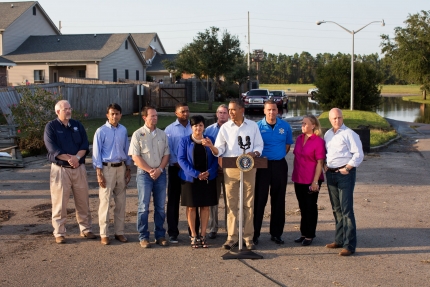
President Obama Meets with Victims of Hurricane Isaac


President Obama delivers a statement on the ongoing response to Hurricane Isaac (September 3, 2012)

President Barack Obama is surrounded by local and federal officials as he delivers a statement on the ongoing response and recovery efforts to Hurricane Isaac in LaPlace, Louisiana, Sept. 3, 2012. Standing with the President from left were FEMA Administrator Craig Fugate, Gov. Bobby Jindal, Rep. Jeff Landry, Rep. Cedric Richmond, Saint John the Baptist Parish President Natalie Robottom, Sen. David Vitter, Sheriff Mike Tregre, Sen. Mary Landrieu and New Orleans Mayor Mitch Landrieu. (Official White House Photo by Pete Souza)

President Obama yesterday made his way to St. John's Parish in Louisiana to take in the damage from Hurricane Isaac and meet with officials responding to the disaster.

The President highlighted the “extraordinary work” done by local first responders who worked around the clock to rescue residents stranded by high water in a place that hadn't flooded in 17 years.

"Some of the folks that we just walked by literally had to be saved by boat. They were in their homes, trapped. The waters came in so quickly," he said. "But because of the great work of law enforcement, National Guard, Coast Guard, making sure that folks were out in rescue mode rapidly, even in some cases at risk of their own lives, no lives were lost."

The White House

Office of the Press Secretary

Remarks by the President After Touring Flood Damage from Hurricane Isaac

St. John the Baptist Parish, Louisiana

THE PRESIDENT:  Well, good afternoon, everybody. I want to just say, first of all, how proud I am to be joined by Governor Jindal, Senator Mary Landrieu, Senator David Vitter, Representative Cedric Richmond. We’ve got Mayor Mitch Landrieu of New Orleans, St. John the Baptist Parish President Natalie Robottom, and we’ve also got St. John the Baptist Sheriff Mike Tregre.

As you can see, there has been enormous devastation in St. John’s Parish, and that’s not the only place that’s been hard hit. We’ve also seen enormous damage in Plaquemines Parish and in other parts of Louisiana and Mississippi.

I want to commend everybody who’s here for the extraordinary work that they’ve done in making sure that lives were saved, that although there was tremendous property damage, people were in a position to get out quickly.  And, as you can see, folks are on the ground already clearing out the debris and making sure that they’re able to recover as rapidly as possible.

I want to particularly thank FEMA and the state and local authorities, because sometimes in the past we haven’t seen the kind of coordination that is necessary in response to these kinds of disasters. This time we’ve seen it. We made sure that we had the disaster declarations happen quickly so that we weren’t behind the eight ball. We’ve approved individual assistance for this area, which means that these folks, if they’ve suffered additional losses beyond what they’re insured for, that they are potentially eligible for some help. We’re going to be providing St. John’s the Baptist Parish with help in debris removal, in some of the other losses that have been suffered. 

I particularly want to commend the sheriff and his team because they’ve been working around the clock saving lives. Some of the folks that we just walked by literally had to be saved by boat. They were in their homes, trapped. The waters came in so quickly. And this is an area that hadn’t been flooded in 17 years, so as a consequence, folks just weren’t anticipating and accustomed to the scale and scope of the destruction. But because of the great work of law enforcement, National Guard, Coast Guard, making sure that folks were out in rescue mode rapidly, even in some cases at risk of their own lives, no lives were lost.

Keep in mind that many of these folks who have been working so hard, they themselves suffered losses. So I’ve just been talking to the sheriff and his wife about the fact that they’re having to do -- actually his wife is having to do exactly what these families are having to do while he’s on the job. 

A couple of final points I want to make. Obviously, right now, we’re still in recovery mode, and that means that our biggest priority is helping to house people who have been displaced, making sure that they’ve got the resources they need to re-enroll their kids in school, make sure that they’re able to get to their jobs, make sure that they can have the kind of support that they need to get restarted. That’s in the short term. And I’m confident that with Craig Fugate and his team on the job, on the ground, that that’s going to happen in a seamless fashion.

But we’ve got a larger issue involved here, and that is how do we anticipate these storms and how do we make sure that an area like St. John’s is protected when you have these kinds of disasters. The good news is, is that the Army Corps levees that were built around New Orleans and Jefferson Parish and some of these other areas worked very well and they were done expeditiously.

And so what I’ve pledged to these folks is we’re going to make sure that at the federal level we are getting on the case very quickly about figuring out what exactly happened here, what can we do to make sure that it doesn’t happen again, and expediting some of the decisions that may need to be made to ensure that we’ve got the infrastructure in place to protect people’s property and to protect people’s lives.

So the final point I’ll make is, one thing you know about folks in Louisiana, they are resilient.  People in Mississippi, they are resilient. They know what tough times are like, but they know that they can bounce back. There is enormous faith here, enormous strength here. You can see it with these families. I mean, they were just devastated a few days ago, and they’re already smiling and laughing, and feeling confident about the future and pulling together. 

We heard one story about one of these homes where a local church group came in and did all the work that was needed to strip out the damaged interior of the house.  They did it not for any pay -- weren’t even asked.  But they did it because they care about their neighbors and they care about their friends. 

And that’s what we do here in the United States of America, and that’s what happens in Louisiana. When disasters like this happen, we set aside whatever petty disagreements we may have. Nobody is a Democrat or a Republican -- we’re all just Americans looking out for one another. And I couldn’t be prouder of this group right here that’s around me for the great work that they’ve done.

Thank you very much, everybody.

END                 6:25 P.M. CDT

President Obama Tours Areas Damaged by Hurricane Isaac

September 03, 2012 | 6:06 | Public Domain

President Obama speaks to the press after touring a Louisiana neighborhood affected by Hurricane Isaac.

Download mp4 (224MB) | mp3 (6MB)

Read the Transcript

Remarks by the President After Touring Flood Damage from Hurricane Isaac

THE PRESIDENT:  Well, good afternoon, everybody. I want to just say, first of all, how proud I am to be joined by Governor Jindal, Senator Mary Landrieu, Senator David Vitter, Representative Cedric Richmond. We’ve got Mayor Mitch Landrieu of New Orleans, St. John the Baptist Parish President Natalie Robottom, and we’ve also got St. John the Baptist Sheriff Mike Tregre.

As you can see, there has been enormous devastation in St. John’s Parish, and that’s not the only place that’s been hard hit. We’ve also seen enormous damage in Plaquemines Parish and in other parts of Louisiana and Mississippi.

I want to commend everybody who’s here for the extraordinary work that they’ve done in making sure that lives were saved, that although there was tremendous property damage, people were in a position to get out quickly.  And, as you can see, folks are on the ground already clearing out the debris and making sure that they’re able to recover as rapidly as possible.

I want to particularly thank FEMA and the state and local authorities, because sometimes in the past we haven’t seen the kind of coordination that is necessary in response to these kinds of disasters. This time we’ve seen it. We made sure that we had the disaster declarations happen quickly so that we weren’t behind the eight ball. We’ve approved individual assistance for this area, which means that these folks, if they’ve suffered additional losses beyond what they’re insured for, that they are potentially eligible for some help. We’re going to be providing St. John’s the Baptist Parish with help in debris removal, in some of the other losses that have been suffered. 

I particularly want to commend the sheriff and his team because they’ve been working around the clock saving lives. Some of the folks that we just walked by literally had to be saved by boat. They were in their homes, trapped. The waters came in so quickly. And this is an area that hadn’t been flooded in 17 years, so as a consequence, folks just weren’t anticipating and accustomed to the scale and scope of the destruction. But because of the great work of law enforcement, National Guard, Coast Guard, making sure that folks were out in rescue mode rapidly, even in some cases at risk of their own lives, no lives were lost.

Keep in mind that many of these folks who have been working so hard, they themselves suffered losses. So I’ve just been talking to the sheriff and his wife about the fact that they’re having to do -- actually his wife is having to do exactly what these families are having to do while he’s on the job. 

A couple of final points I want to make. Obviously, right now, we’re still in recovery mode, and that means that our biggest priority is helping to house people who have been displaced, making sure that they’ve got the resources they need to re-enroll their kids in school, make sure that they’re able to get to their jobs, make sure that they can have the kind of support that they need to get restarted. That’s in the short term. And I’m confident that with Craig Fugate and his team on the job, on the ground, that that’s going to happen in a seamless fashion.

But we’ve got a larger issue involved here, and that is how do we anticipate these storms and how do we make sure that an area like St. John’s is protected when you have these kinds of disasters. The good news is, is that the Army Corps levees that were built around New Orleans and Jefferson Parish and some of these other areas worked very well and they were done expeditiously.

And so what I’ve pledged to these folks is we’re going to make sure that at the federal level we are getting on the case very quickly about figuring out what exactly happened here, what can we do to make sure that it doesn’t happen again, and expediting some of the decisions that may need to be made to ensure that we’ve got the infrastructure in place to protect people’s property and to protect people’s lives.

So the final point I’ll make is, one thing you know about folks in Louisiana, they are resilient.  People in Mississippi, they are resilient. They know what tough times are like, but they know that they can bounce back. There is enormous faith here, enormous strength here. You can see it with these families. I mean, they were just devastated a few days ago, and they’re already smiling and laughing, and feeling confident about the future and pulling together. 

We heard one story about one of these homes where a local church group came in and did all the work that was needed to strip out the damaged interior of the house.  They did it not for any pay -- weren’t even asked.  But they did it because they care about their neighbors and they care about their friends. 

And that’s what we do here in the United States of America, and that’s what happens in Louisiana. When disasters like this happen, we set aside whatever petty disagreements we may have. Nobody is a Democrat or a Republican -- we’re all just Americans looking out for one another. And I couldn’t be prouder of this group right here that’s around me for the great work that they’ve done.

Thank you very much, everybody.

END                 6:25 P.M. CDT

Close Transcript

The White House

Office of the Press Secretary

Remarks by the President at a Campaign Event -- Toledo, OH

Scott High School, Toledo, Ohio

12:30 P.M. EDT

     THE PRESIDENT:  Hello, Toledo!  (Applause.)  Thank you, thank you.  It is good to be in Toledo, Ohio.  (Applause.) 

     AUDIENCE:  Obama!  Obama!  Obama!

     THE PRESIDENT:  Thank you so much.  Now, first of all, I've got to say thank you for Kenyatta, for that outstanding introduction.  Give Kenyatta a big round of applause.  (Applause.)  I was listening backstage and I thought I heard a little preaching going on there.  (Laughter.)  Folks in the crowd were going "yeah", "wow."  (Laughter.)  So Kenyatta can talk -- no doubt about it.  

It is great to see so many good friends --

AUDIENCE:  We love you!

THE PRESIDENT:  I love you back.  (Applause.)  It's great to see so many good friends who work so hard on behalf of working families every day.  We've got Sherrod Brown -- (applause) -- one of the best senators in the country.  Marcy Kaptur, one of the best congresswomen in the country.  (Applause.)  We've got my friend and your friend, daughter of a Teamster, our Secretary of Labor Hilda Solis in the house.  (Applause.)  We've got your outstanding UAW President Bob King in the house.  (Applause.)  President of the AFL-CIO, Rich Trumka, is here.  (Applause.)  And the President of the National Education Association, Dennis van Roekel.  (Applause.)

So we've got some working people in the house here.  (Applause.)  And to everybody who is working hard each and every day, Happy Labor Day.  (Applause.)  Happy Labor Day.

AUDIENCE MEMBER:  We got your back, Obama.

THE PRESIDENT:  Thank you.  (Applause.)  Now, for those of you who have got a seat, feel free to take a seat.  I've got some things to say.  I've got some things to say here.  For those of you who don't have a seat, make sure to bend your knees a little bit.  We don't want you fainting.  Sometimes, folks are standing too long -- they drop off.  (Laughter.) 

Now, we're on our way to our convention in Charlotte this week.  (Applause.)  But I wanted to stop here in Toledo to spend this day with you -- (applause) -- a day that belongs to the working men and women of America -- teachers and factory workers, construction workers and students and families and small business owners.  And I know we’ve got some proud autoworkers in the house helping to bring Toledo back.  (Applause.)

After all, it’s working folks like you who fought for jobs and opportunity for generations of American workers.  It’s working people like you who helped to lay the cornerstones of middle-class security, things that people now sometimes take for granted, but weren't always there -- the 40-hour workweek, weekends, paid leave, pensions, the minimum wage, health care, Social Security, Medicare.  Those things happened because working people organized and mobilized. 

It is unions like yours that helped to forge the basic bargain of this country -- the bargain that built the greatest middle class and the most prosperous country and the most prosperous economy that the world has ever known.  (Applause.)  

And you know what that bargain is, because it's a simple one.  It’s a bargain that says if you work hard, if you're responsible, then your work should be rewarded.  (Applause.)  That if you put in enough effort, you should be able to find a job that pays the bills.  You should afford a home to call your own.  That you'll have health care you can count on if you get sick.  That you can put away enough to retire, maybe take a vacation once in a while -- nothing fancy, but you can enjoy your friends and your family.  And, most importantly, that you can provide your children with an education to make sure that they do even better than you did.  (Applause.)  

It’s an American promise that says no matter who you are, no matter what you look like, no matter where you come from, no matter what your last name is, no matter who you love, you can make it here if you try.  (Applause.)  And that’s what we’re fighting for, Toledo.  That’s what’s at stake in this election.  And that’s why I’m running for a second term as President of the United States of America.  (Applause.)

Now, last week, the other party gave their sales pitch at their convention down in Florida. 

AUDIENCE:  Booo --

THE PRESIDENT:  Don't boo, vote.  (Laughter and applause.)  Vote.  And I have to say, it was something to see.  Despite all the challenges that we face in this new century, we saw three straight days of an agenda out of the last century.  It was a rerun.  You might as well have watched it on black-and-white TV, with some rabbit ears on there.  (Laughter and applause.)  It should have been on "Nick at Nite."  (Laughter.)

Now, if you didn’t DVR it, let me give you a basic recap of what they said.  The economy is bad.  It's all Obama’s fault.  And Governor Romney has the secret to creating jobs and growing the economy.  That's a basic summary.  They spent the most time on me.  (Laughter.)  They were talking about me.  (Laughter.) 

And there was a lot of “hard truths” and “bold choices,” they said, but nobody ever bothered to tell you what they really were.  And when Governor Romney had his chance to let you in on the secret sauce of job creation -- (laughter) -- he did not offer you a single new idea.  It was just a retread of the same old policies that have been sticking it to the middle class for years.  (Applause.)  

And then, after the convention, Governor Romney came here to Ohio, and he said he's going to be the coach that leads America to a “winning season.”  The problem is everybody has already seen his economic playbook.  We know what’s in it.

On 1st down, he hikes taxes by nearly $2,000 on the average family with kids in order to pay for a massive tax cut for multi-millionaires.  That's on 1st down.  It sounds like unnecessary roughness to me.  (Laughter and applause.)

On 2nd down, he calls an audible, and undoes reforms that are there to prevent another financial crisis and bank bailout.  He wants to get rid of rules that are there to protect our air and our water, and workers’ rights, and protections to make sure health care is there for you when you get sick. 

And then, on 3rd down, he calls for a Hail Mary -- ending Medicare as we know it by giving seniors a voucher that leaves them to pay any additional cost out of their pocket.  There’s a flag on the play -- loss of up to an additional $6,400 a year for the same benefits you get now. 

That’s their playbook.  That’s their economic plan.  And I’ve got one piece of advice for you about the Romney/Ryan game plan, Ohio: Punt it away!  (Applause.)  It won’t work.  It won’t win the game.  You don’t need that coach.  That’s a losing season. 

Now, there was one person at Governor Romney’s convention last week who wasn’t entirely on script.  (Laughter.) 

AUDIENCE MEMBER:  Booo --

THE PRESIDENT:  No, no -- because while they were busy telling folks how bad everything is, your Governor, John Kasich --

AUDIENCE:  Booo --

THE PRESIDENT:  Don’t boo --

AUDIENCE:  Vote!  (Laughter and applause.)

THE PRESIDENT:  John Kasich stood up there and told everybody that Ohio is now number one in the Midwest in job creation, fourth best in America -- which got folks kind of confused, because if it’s all Obama’s fault and nothing is going right, what’s going on in Ohio?  (Applause.)

Now, I guess the theory was that it’s all the Governor’s doing.  But I think we need to refresh his memory -- because a lot of those jobs are autoworker jobs like yours.  (Applause.)  The American auto industry supports one in eight jobs in this state.  And just a few years ago, when the auto industry was flat-lining, what was in his and Governor Romney’s playbook?  “Let Detroit go bankrupt.”  You remember that?

AUDIENCE:  Yes!

THE PRESIDENT:  Now, think about what that would have meant not just for Ohio but for America.  If we had turned our backs on you, if America had thrown in the towel like that, GM and Chrysler wouldn’t exist today.  The suppliers and the distributors that get their business from these companies would have died off, too.  Then even Ford could have gone down as well.  Production: shut down.  Factories: shuttered.  Once proud companies chopped up and sold off in scraps.  And all of you -- the men and women who built these companies with your own hands -- you would have been benched for good.  That’s not a good play.  We didn’t run that play.

More than one million Americans across the country would have lost their jobs in the middle of the worst economic crisis since the Great Depression.  In communities across the Midwest, it would have been another Great Depression.  And it’s not just the workers themselves; think about everybody who depends on you -- schoolteachers, small business owners, the server in the diner who knows your order before you walk in, the bartender who knows your order before you walk in.  (Applause.)  Their livelihoods were at stake as well, and so was something else. 

How many autoworkers here worked the assembly line, but your dads and your granddads, maybe your mom, grandmas worked on that same line?  How many people are second or third or fourth generation?  How many of you have sons and daughters who hope to work on those same assembly lines?  (Applause.) 

These jobs are worth more than just a paycheck.  They’re a source of pride.  They’re a ticket into a middle-class life.  These companies are worth more than just the cars that they build.  They’re a symbol of America’s innovation.  They’re a source of our manufacturing might.  If that is not worth fighting for, then what is?  

Ohio, we’re not about to take a knee and do nothing.  We weren’t going to give up on your jobs and your families and your communities.  We weren’t going to let Detroit go bankrupt, or Lordstown go bankrupt, or Toledo go bankrupt.  I stood with American workers.  I stood with American manufacturing.  I believed in you.  I bet on you.  (Applause.)  I’ll make that bet any day of the week.  And because of that bet, three years later, that bet is paying off for America.  (Applause.)  Three years later, the American auto industry has come roaring back --nearly 250,000 new jobs.

So it’s a little funny watching Governor Romney and Governor Kasich and others just try to rewrite history now that you’re back on your feet.  These are the folks who said if we went forward with our plan, then -- I’m quoting here -- “you can kiss the American automotive industry goodbye.”  Now they’re saying it was their idea all along.  (Laughter.)  Seriously.  Or what they’re saying is, well, the problem is that you, the workers, made out like bandits in this whole thing; that we did what we did because it was all about paying back unions.  Really?  I mean, even by the standards of political campaigns, that’s a lot of you know what. 

Workers made some of the biggest sacrifices.  About 700,000 retirees saw a reduction in the health benefits they had earned.  Hours were reduced, pay and wages scaled back.  You gave up promises made to you over the years for the sake and the survival of your fellow workers and their families and the company.  You made sacrifices.  (Applause.)  Which is why I don’t understand why these folks have the nerve to talk about you like you’re some greedy special interest that needs to be beaten down. 

After all that unions have done to build and protect the middle class, they were standing up there at their convention saying you’re responsible for the problems we face.  Their plan says the best way to help workers is to roll back workers’ rights; to overturn laws that make sure construction workers get a fair wage; to blame teachers and firefighters and police officers and other public servants for our economic challenges  -- instead of what happened on Wall Street and a historic financial collapse. 

So, Toledo, what you need to know is this: When they’re trying to take your collective bargaining rights away, when they’re trying to pass so-called “right to work” laws that really mean right to work for less and less, you should know this isn’t about economics.  This is about politics.

This notion that we should have let the auto industry die and that we should pursue anti-worker policies in the hopes that unions like yours will unravel -- it’s part of the same old you’re-on-your-own, top-down philosophy that says we should just leave everybody to fend for themselves. 

Now, on Thursday night, I’m going to offer you what I believe is a better path forward -- (applause) -- a path that’s going to grow this economy and create more good jobs, and strengthen the middle class.  (Applause.)  And the good news is, starting on October 2nd, Ohio gets its say because you get to vote early.  (Applause.)  You can choose which path we take.  You could choose their plan.

AUDIENCE:  Booo --

THE PRESIDENT:  Don't boo.

AUDIENCE:  Vote!

THE PRESIDENT:  You can choose to give massive new tax cuts to folks who have already made it.  Or you can choose my plan -- to keep taxes low for every American who is in the middle class and every American who is striving to get into that middle class.  (Applause.) 

Four years ago, I promised to cut taxes by a total -- for middle-class families, and I have cut taxes by a total of about $3,600 for the typical family.  (Applause.)  And now I’m running to make sure that taxes aren’t raised a single dime on the first $250,000 of any family’s income.  Now, that's 98 percent of Americans.  It may be 99.9 percent of this auditorium.  (Applause.)  Your taxes won't go up, because my belief is you need relief.  I don't need relief.  Mitt Romney doesn't need relief.  He needs it less than me.  (Laughter.)   

But that's a choice in this election.  You can choose whether we give up new jobs and new industries to countries like China, or whether we fight to keep those jobs in states like Ohio.  (Applause.)  Unlike my opponent, I want to stop giving tax breaks to companies that are shipping jobs overseas.  I want to give those tax breaks to companies that are investing right here in Toledo, right here in the United States -- all across Ohio, all across the Midwest.  (Applause.) 

You can decide whether borrowing money from your parents is an answer when a young person asks how they’re going to go to college.  You heard about that, right?  This young college student says, how can I get some help going to college?  He says, well, you need to borrow money from your parents.  (Laughter.)  Now, I guess that's one path.  That's one approach.   

I've got a different approach that says let's make sure Americans once again lead the world in educating our kids and training our workers for the jobs of tomorrow.  (Applause.)  And that means let's hire more great teachers, especially in math and science.  Let's help more folks go to community colleges to get trained in the skills that employers are hiring for right now.  (Applause.)  Because the truth is, some sort of higher education, whether it's four-year or a two-year technical school -- some form of higher education -- that's not a luxury anymore.  That is an economic necessity that every family should be able to afford.  And that's what I'm going to be fighting for.  (Applause.)  That's what I'm going to be fighting for.  (Applause.) 

Now, Ohio, you can choose an energy plan like the other guy is offering that's written by and for the oil companies.  Or you can choose an all-of-the-above strategy for American energy, which means we drill for more oil, we mine for more coal.  But it also means that we're going after the new energy sources of the future. 

Now, my opponent said renewable energy sources are “imaginary.”  The folks here in Toledo manufacturing solar panels might disagree with that.  (Applause.)  These jobs aren’t a “fad” -- they’re not imaginary.  They're our future.  And unlike my opponent, I want to stop giving a $4 billion-a-year taxpayer subsidy to big oil companies that are making money every time you go to the pump, and I want to use that money to invest in homegrown energy sources that have never been more promising and are creating jobs right here in Ohio.  (Applause.)  

It’s up to you whether we go back to the old health care system that let insurance companies decide when to cover you and when to cover you, and drop you when you needed it most.  But I think we should keep moving forward with the new health care law that's already cutting costs and covering more people and saving lives.  They call it Obamacare.  It's true, I care.  It's true.  (Applause.)

I guess the other side's plan is the "Romney Doesn't Care" plan.  (Laughter.)  But now is not the time to refight the battles of the last four years.  We need to move forward.

You get to decide what the future of the war in Afghanistan is.  Last week, did you notice Governor Romney did not say a word about our troops who are in harm’s way over there?  And because of my plan, 33,000 of them will have come home by the end of this month.  (Applause.) 

He said ending the war in Iraq was “tragic.”  I think it was the right thing to do.  I said we’d end that war -- and we did.  (Applause.)  I said we’d go after al Qaeda -- we did.  (Applause.)  I said we'd take out bin Laden -- we did.  (Applause.) 

Our troops are out of Iraq.  We’re bringing them home from Afghanistan.  And as long as I’m Commander-in-Chief, we will serve our veterans as well as they’ve served us, because nobody who fights for this country should have to fight for a job or a roof over their heads when they come home.  That's why I'm running for a second term.  (Applause.)

So we've got some big choices we've got to make.  And the other side is going to spend the next two months -- they're fighting back with everything they’ve got.  They're going to give you an avalanche of attack ads and insults and distraction.  And they may massage the truth a little bit.  And it will be supported with $10 million checks from wealthy donors.  And they know that even if you don't buy into their plan, even if you don't vote for them, they're thinking, well, maybe we'll discourage people.  We'll get folks so disillusioned by all these negative ads, all this negativity, that you'll just decide to sit this one out.

AUDIENCE:  Booo --

THE PRESIDENT:  But you know what, I'm counting on something different.  I’m counting on you.  (Applause.)  I’m counting on you.  If you're not registered to vote, then you've got to go to GottaRegister.com.  Now, that's not "GotToRegister.com.”  This is "gotta" -- G-o-t-t-a-Register.com  (Applause.)

If you want to find out how to vote early, starting on October 2nd, then you need to go to GottaVote.com.  That’s not "GotToVote.com,” that's "gotta vote” -- (laughter) -- GottaRegister, GottaVote -- because we’ve got a whole lot of more work to do.  (Applause.)

We’ve got more good jobs to create.  We’ve got more good cars to build.  We’ve got more schools to upgrade, and more great teachers to hire, and more young people to send to college.  (Applause.)  And we’ve got more troops we've got to bring home and more veterans we’ve got to take care of, and more doors of opportunity that we've got to open up for everybody who is willing to walk through them.  That's what's at stake in this election.  That's why I'm asking for your vote.  (Applause.)  

That's why I need you to knock on doors.  That's why I need you to get on the phone.  (Applause.)  I need you to talk to your friends.  I need you to talk to your neighbors.  I need you to stand with me, Ohio.  (Applause.)  And if we win Toledo, we will win Ohio.  And if we win Ohio, we'll win this election.  (Applause.)  And if we win this election, we will finish what we started, and we will remind the world why the United States of America is the greatest nation on Earth. 

Thank you.  God bless you.  And God bless America.  (Applause.)

                                           END                 1:00 P.M. EDT


The White House

Office of the Press Secretary

Remarks by the President at a Campaign Event -- Boulder, CO

University of Colorado-Boulder, Boulder, Colorado

1:44 P.M. MDT

THE PRESIDENT:  Hello, Colorado!  (Applause.)  Go Buffs!  (Applause.) 

Can everybody please give Ryan a huge round of applause for that beautiful introduction?  (Applause.)  Americans like Ryan are why I ran for this office in the first place and why I am running for it again. 

It’s great to see your outstanding Governor, John Hickenlooper.  (Applause.)  One of the finest senators that we’ve got in the country, Michael Bennet.  (Applause.)  Outstanding Congressman, Jared Polis.  (Applause.)  And it is good to be back in Boulder, Colorado!  (Applause.)

Now, the last time I was here, I stopped by The Sink for some pizza.  I signed my name on the ceiling.  I hope it’s still there.  I hope nobody vandalized it.  (Laughter.)  And a girl I met there was so surprised that she spilled her frozen yogurt on my pants.  (Laughter.)  But it was worth it because I’ve been told that The Sink renamed one of their pizzas after me.  (Applause.)  I’m deeply moved by this.  (Laughter.)  So the next time you go there, just ask for “The POTUS.”  It’s got pepperoni, sausage, green pepper, black olives, and onion.  We put the olives and the onion on there for Michelle so you can say that you had some vegetables on your pizza.  (Laughter.)

Now, I’ve got to address a sensitive subject.  I know you guys are a little bummed out about the game yesterday.  I know the “Rocky Mountain Showdown” did not go down the way you wanted.  So I’ll tell you what, we are going to give you a chance to get even.  We are giving the Buffs and the Rams a second chance to go at it this fall.  We’ve set up a “Rocky Mountain Rumble” to see which school can register more voters, CU or Colorado State.  (Applause.)

Now, I was at Colorado State last week, and because we had volunteers in the crowd to help, they got a little bit of a head start.  So they are up by just 41 votes.  But today, we are in Boulder, so let’s get it done.  There are volunteers throughout the audience; they can help you register today. 

When you go home, you can register your classmates, your friends.  You go online to something called GottaRegister.com.  I apologize in advance to English teachers, but this is not “Got To Register” this is gotta -- G-o-t-t-a-register.com.  And this is important because just over two months from now, for the first time in many of your lives, you will get a chance to pick a President.  And by doing so, you will get to a chance to choose the path that we take from here.

Now, last week, the other party gave their pitch at their convention down in Florida.

AUDIENCE:  Booo --

THE PRESIDENT:  Don't boo, vote.  (Laughter and applause.)

I will say, though, that it was something to behold.  (Laughter.)  Despite all the challenges that we face in this new century, what they offered over those three days was an agenda that was better suited for the last century.  It was a rerun.  It could have been on “Nick at Nite.”  (Laughter.)  We’ve seen it before.  You might as well have watched it on a black-and-white TV, with some rabbit ears.  (Laughter.)

And if you didn’t DVR it, the basic recap goes something like this:  The economy is not doing what it should be; it’s all Obama’s fault -- that was a key theme -- (laughter) -- and Governor Romney knows the secret to creating jobs and growing the economy.

And then, there was a lot of talk about “hard truths” and “bold choices,” but the interesting thing was nobody ever bothered to tell us what they were.  And when Governor Romney finally had a chance to reveal the secret sauce, he did not offer a single new idea.  It was just retreads of the same old policies we’ve been hearing for decades, the same policies that have been sticking it to the middle class for years. 

They talked a lot about me, and they talked a lot about Governor Romney, but they didn’t spend a lot of time talking about you.  They didn't talk about families like Ryan’s, and what it might mean to go back to a time when folks with preexisting conditions couldn’t get health care.  You didn't hear them spend a lot of time talking about young people and the debt that they're incurring when they go to college.

They spent even less time talking about what plans they had to actually meet these challenges and solve these problems.  And you know why they didn't talk about it, it’s not just because they know you won’t like it -- and you won’t like it -- (laughter) -- because you’ve already seen what happens when we try what they're offering, and you’ve lived through it, and you know we can’t afford to repeat it, but it’s also that they are exhausted of ideas. 

See, it turns out we know that making the middle class pay for another budget-busting $250,000 tax cut for folks making $3 million a year or more won’t magically translate into jobs and prosperity for everybody else.  (Applause.)

We know families aren’t going to be better off if we undo Wall Street reform that we fought so hard to pass, and that can prevent another financial crisis.  We know we’re not going to be better off if we strip away regulations that protect our air and our water.  (Applause.)  We know we’re not going to be better off if we strip away protections to make sure you’ve got health care when you get sick. 

Seniors are pretty certain that the best way to strengthen Medicare isn’t to give them vouchers that leaves them to pay off any additional costs out of their own pockets. 

     The point is everything you heard from them -- what little you did hear -- we’ve heard before.  They have tried to sell us this tired, trickle-down, you’re-on-your-own snake oil before.  (Applause.)  Those ideas don't work.  They didn't work then, they won’t work now.  They did not create jobs.  They did not cut the deficit.  They did not strengthen the middle class.  They are not a plan to move this country forward. 

And we believe in something better.  (Applause.)  We believe in an America that says our economic strength has never come from the top down.  It comes from the middle out.  It comes from the bottom up.  It comes from students and workers and small business owners, and a growing, thriving middle class.  (Applause.)  It comes from teachers and receptionists and firefighters and construction workers who are helping to build this country each and every day.  That's the backbone of this country.  (Applause.)

We believe in an America that doesn’t let how much money you’ve got determine whether or not you’ve got good health care, whether or not you can get a good college education.

We believe in an America that doesn't just lead by the force of our amazing military -- and we are so grateful for their service -- but we also know that we’ve got to combine that with the strength of our ideals and the power of our example.  (Applause.)

We believe in an America where no matter what you look like, no matter where you come from, no matter who you love, you can pursue your own version of happiness, and you can make it here if you try.  (Applause.)  And that's what we’ve been working for four years now, Colorado.  That's what this campaign is about, and that's why I’m running for a second term as President of the United States of America.  (Applause.)

Now, on Thursday night, I’m going to offer you what I believe is a better path forward -- a path that will grow this economy and create more jobs and strengthen the middle class.  And the good news is you get to choose the path we take.

Now, you can go with their plan to give massive new tax cuts to folks who have already made it, or we can go forward with my plan to keep taxes low for every American who is still trying to make it.  (Applause.)  If you talk to a Republican out there who says, oh, Obama and Democrats, they're all about tax and spend and all this -- remind them I promised four years ago to cut taxes for middle-class families.  And the typical middle-class family is paying a total of about $3,600 less in taxes now than when I came into office.  (Applause.)  I kept my promise.  I kept that promise. 

And now I’m running to make sure taxes aren’t raised a single dime for the first $250,000 of income, which means 98 percent of Americans and 97 percent of small businesses will see their taxes remain low, because they're the ones who need relief, not folks like me, not folks like Mr. Romney.  He needs it even less than I do.  (Laughter and applause.)   

But this is ultimately going to be your choice.  Now, you can choose whether we cede new jobs and new industries to countries like China, or whether we fight for those jobs in states like Colorado.  (Applause.)  My opponent likes to tout his private-sector experience.  And he was incredibly successful, and clearly disciplined and hardworking.  But keep in mind that his experience was investing in companies that were called “pioneers” in the business of outsourcing jobs. 

When the auto industry was on the verge of collapse, he said, let's “let Detroit go bankrupt.”  And I've got a different vision for America.  I bet on American workers and I bet on American manufacturing.  And today, the U.S. auto industry has come roaring back.  (Applause.)  And, by the way, the cars they're making are better and more fuel efficient than ever.  That's how we move forward.  That's how we move forward.  (Applause.) 

I want to stop giving tax breaks to companies that ship jobs overseas.  I want to give tax breaks to companies that are starting businesses right here in Boulder, creating jobs right here in Colorado, making sure that here in the United States of America we're making stuff again stamped with three proud words: Made In America.  That's the path forward that I'm offering in this election.  (Applause.)

You can decide whether Governor Romney's advice -- “just borrow more money from your parents” -- is an acceptable answer to young people who are trying to go to college.  Or you can take the path that we've already started on, making sure America once again leads the world in educating our kids and training our workers for the jobs of tomorrow.  (Applause.) 

I want to make sure that we are helping more young people afford the kind of education that you can get right here at CU Boulder.  Let's make more people be able to go to community colleges to be trained for the jobs that employers are hiring for right now.  Governor Romney wants to end the tax credit that we created to help families save up to $10,000 over four years on their college tuition.  I want to extend it, I don't want to end it -- because in America today, a higher education cannot be a luxury, it is an economic necessity that every family should be able to afford. 

And you know that in your own lives.  That's why you're here.  (Applause.)  That's why you're making an investment in yourself.  And I want to make sure that America is standing by you every step of the way, because if you succeed, then we succeed.  (Applause.)  If we're producing more engineers, then America is producing more jobs.  If we've got great teachers -- (applause) -- then we're going to see the next generation be able to compete all over the world.  That's what's at stake in this election.    

Now, Colorado, you look out at this amazing vista and you say to yourself, part of what's at stake is energy and how we deal with this planet.  You can choose an energy plan written by and for the oil companies.  Or you can choose what I've offered, an all-of-the above strategy for American energy. 

Governor Romney called renewable energy “imaginary.”  He said the jobs that -- actually it was Congressman Ryan who said that the jobs they create are “fads.”  Let me tell you, there are 10,000 good Colorado jobs right now that depend on wind and solar power.  (Applause.)  These jobs are worth fighting for. 

And so I think it’s time to stop giving $4 billion a year in taxpayer subsidies to big oil companies that are making money every time you fill up a tank of gas.  Let's keep investing in homegrown energy sources that have never been more promising, that are good for our economy, that are good for our national security, that will create jobs and are good for our planet as well.  That's the path we're offering.  That's the choice we're going to have in this election.  (Applause.)

     AUDIENCE MEMBER:  I love you, Obama!

     THE PRESIDENT:  I love you back, but we got to vote.  It’s up to you whether we go back to a health care system that let insurance companies decide who to cover and when.  Or we can keep moving forward with the new health care law that’s already cut costs and covered more people and saved more lives.  (Applause.)

Governor Romney promised that on his first day of office, he’s going to sit right down and grab a pen, and end Obamacare. 

AUDIENCE:  Booo --

THE PRESIDENT:  Now, what that means is right away he'd kick nearly 7 million young people off their parent's plan.  He'd take hope away from tens of millions of Americans with preexisting conditions by repealing reform.  He calls it Obamacare and I like the name.  I do care.  (Applause.)

We fought to pass that law for families like Ryan's.  We know the heartbreak of a broken health care system.  So I don't mind if folks think I care.  I do care.  (Applause.)  And I don't know exactly what the other side is proposing.  I guess you could call it "Romney Doesn't Care."  (Laughter.)  But this law is here to stay.  (Applause.)  We're not going to refight the battles of the last four years.  We're going to implement this law, make the health care system work for families all across America.  It is time to move forward.  That's the choice in this election.  (Applause.)  

Of course, this isn't the only battle that they want to refight.  They want to refight some battles we thought were settled in the last century.  So in November, you will have some say as to whether women should be trusted to make their own health care decisions.  I think they are.  (Applause.)

You will have some say as to whether students who were brought here by their parents as infants and have gone to school here, and understand themselves to be Americans and have pledged allegiance, that suddenly they should be kicked out of the only country they've ever known. 

AUDIENCE:  Booo --

THE PRESIDENT:  I don't think so.  I've got a different view.  (Applause.) 

You will have some say as to whether we should rewrite the Constitution the way the other side is proposing, to prevent gay Americans from being able to marry the person they love. 

AUDIENCE:  Booo --

THE PRESIDENT:  You can reaffirm that the strength of our character doesn’t come from shoving people to the sidelines.  It comes from hearing every voice, harnessing every talent -- realizing that in America, we are greater together than we are on our own.  That's who we are.  (Applause.)  That's who we are and that's what's at stake in this election.   

This November, you get to decide the future of the Afghanistan war.  Governor Romney had nothing to say about Afghanistan last week.  Yes, he hasn't offered a plan for the 33,000 troops who will have come home from this war by the end of this month.  (Applause.)

He said that ending the war in Iraq was “tragic.”  I think it was the right thing to do.  And I said I would do it, and we did.  (Applause.)  I said we'd take out bin Laden, and we did.  (Applause.)

We are bringing our troops home from Afghanistan.  And I've set a timetable.  We will have them all out of there by 2014.  Governor Romney doesn't have a timetable.  I think he's wrong.  That's what's at stake in this election.  And as long as I’m Commander-in-Chief, we will serve our veterans as well as they’ve served us, because nobody who fights for us should have to fight for a job or a roof over their heads when they come home.  That's the choice in this election.  (Applause.)  

So, Boulder, on issue after issue, Governor Romney and Congressman Ryan want to go backwards.  But the story of America is about going forwards.  Nobody understands that better than folks in the West, because this is a region that was settled by people who understand we're not looking back, we're going forward.  (Applause.)  We're going forward to the next frontier, to new horizons.  And in two months, you get to choose the path that will lead us to that better future. 

But understand, over the next two months the other side is going to spend more money than we've ever seen in our lives, with an avalanche of attack ads and insults and making stuff up, just making stuff up.  (Laughter.)  And they'll be supported by $10 million checks that are being written by wealthy donors who are trying to protect things just as they are.

And what they're counting on is that you get so discouraged by this, that at a certain point you just say, you know what, I'm going to leave it up to somebody else.  I'm going to let big oil write the energy bills, and I'm going to let insurance companies decide when to cover somebody, and we're going to let politicians dictate what a woman can or can’t do when it comes to her own health. 

AUDIENCE:  Booo --

THE PRESIDENT:  They're counting on you to accept their version of the things the way they ought to be.  And I'm counting on something different.  I'm counting on you.  (Applause.)

You've always had powerful forces in this country who benefit from the status quo, and they bet against the American people.  And I've always bet on you.  I don't believe you're cynical.  I don't believe in your complacency.  Those other guys, they always lose the bet over the long term.  And they're going to lose the bet this time as well.  (Applause.) 

But that's going to depend on you.  It's going to depend on you registering to vote.  It's going to depend on you showing up to vote.  I was over at the The Buff before I came here and the food looked really good.  (Laughter.)  People were having mimosas and Bloody Mary's.  (Laughter.)  And I was thinking to myself, I could see folks, like, forgetting to vote.  (Laughter.)  They're having too much fun.  

But that's why you're so important, because you're going to have to set an example for the person next to you in class.  You're going to have to remind them, have you voted yet?  You're going to have to call up your family or your cousins in the other states.  You're going to have to reach up and close that gap between what America is and what it should be -- because you know what, you can't wait on somebody else.  It turns out other folks are waiting on you.  They're waiting to see if you'll register.  They're waiting to see if you'll vote.  They're waiting to see if you'll lead.

Colorado, we have come too far to turn back now.  We’ve got more good jobs to create.  We’ve got more homegrown energy to generate.  We’ve got more young people to send to college.  We’ve got more good teachers to hire.  (Applause.)  We’ve got more good schools to build.  We’ve got one more war to end.  We've got more troops we've got to bring home.  We've got more veterans we've got to take care of.  (Applause.)  We’ve got more doors of opportunity that we have to open for every single person who’s willing to work hard and walk through them.  (Applause.)  That’s why I’m asking you for a second term. 

And if you’re willing to work with me and knock on some doors with me, make some phone calls with me; if you’re willing to vote for me in November, we will win Boulder and we will win Colorado.  We will win this election.  (Applause.)  We will finish what we started.  And we will remind the world why it is that the United States of America is the greatest nation on Earth.

God bless you.  And God bless the United States of America.  (Applause.)

                                                                             END             2:08 P.M. MDT