Press Briefing by Press Secretary Jay Carney, 09/10/2012
James S. Brady Press Briefing Room
12:42 P.M. EDT
MR. CARNEY: I was going to say I see some faces who were with us on our long trip. (Laughter.) Welcome to the White House. It’s good to be back. We don’t do that all -- do this all that frequently these days because we’re traveling so much. But we’re all happy to be here for the daily briefing. I have no announcements to make at the top, so I’ll go straight to your questions.
Ben Feller.
Q Thanks, Jay. A couple of topics, please. I’m wondering what the President’s reaction is to the teacher strike in Chicago, assuming he’s had a chance to follow that story, and whether he has any reaction to both the strike and how his former Chief of Staff is handling it.
MR. CARNEY: Well, I’m sure he’s aware of it -- I know he’s aware of it, but I haven’t spoken with him about it, so I can’t speak for his reaction. I can tell you that as a -- more broadly, that our principal concern is for the students, and his principal concern is for the students and families who are affected by the situation. And we hope that both sides are able to come together to settle this quickly and in the best interest of Chicago’s students. But beyond that, I haven’t got a specific reaction from the President.
Q Governor Romney weighed in on it and said that the President has chosen a fight -- chosen a side of the fight, that being the unions and the teachers. Any reaction to that?
MR. CARNEY: Well, the President, as I think you just heard from me, has not expressed any opinion or made any assessment about this particular incident. I can tell you that this President has pursued an education policy that has been a notable success, and a notable bipartisan success, under the President’s and Secretary Duncan’s leadership. And he’ll continue to do that because he believes, as he says frequently, that investing in education now pays enormous economic dividends later. It is integral to our economic future, and that’s why he’s made it such an important part of his domestic policy agenda.
And with regard to teachers in particular, you know that he has on the table, and has had on the table since a year ago virtually today, a comprehensive proposal called the American Jobs Act which includes within it a section that would, if implemented by Congress, if Republicans would stop blocking it, put 100,000 teachers on the job and into our classrooms helping educate our children. The President is focused very much on this issue. He certainly doesn’t agree with those who think that adding more teachers is not or should not be a priority.
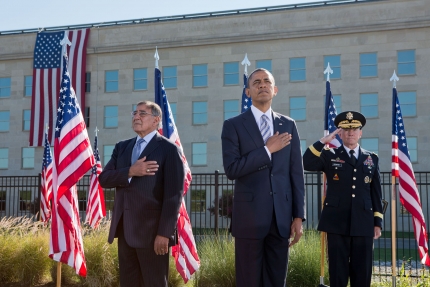
Q Last question. Tomorrow, the President, of course, plans to mark the somber anniversary of 9/11 at the White House, at the Pentagon. I’m wondering whether he gave any consideration to having a joint event with Governor Romney the way that he did with Senator McCain when they were both running for the presidency four years ago.
MR. CARNEY: I hadn’t heard that discussed. I know he looks forward tomorrow to the moment of silence here at the White House, and then visiting the Pentagon. And he certainly hopes and knows that Americans across the country will take a moment to reflect upon the events of September 11th, 2001, and all that our country has been through together since then. And especially, I think, take that moment to remember the victims and their families from that terrible event.
Yes, sir.
Q Prime Minister Netanyahu said in a TV interview today that Israel and the United States are discussing the U.S. setting red lines for Iran’s nuclear program. What, if any, red lines is the President willing to accept in this case?
MR. CARNEY: Well, first of all, we have extensive and ongoing conversations and contact with our close ally, Israel, on this issue as well as a wide variety of other security-related issues. We have the most comprehensive security and intelligence relationship with Israel in history, as attested to by not just leaders from this administration but from the Israeli government.
The President’s position, unequivocally, is that he is committed to preventing Iran from acquiring a nuclear weapon, and we share that view with Israel and Israel’s leadership in a way that has been made clear again and again. And that’s why the President has pursued the policy that he has that has put, together with our international partners, unrelenting pressure on Iran to abide by its international obligations and to forsake its nuclear weapons ambitions.
We believe that there remains time and space for that effort to bear frui, an effort that is focused on punitive sanctions to isolate and pressure Iran, and on diplomacy to bring about a change in behavior from Iran. But we’ve also made clear that the window of opportunity for reaching a solution by that means will not remain open indefinitely, and that the President retains all options on the table in the pursuit of his commitment to prevent Iran from acquiring a nuclear weapon.
Q Will the President meet with Prime Minister Netanyahu when the Prime Minister is at the U.N. General Assembly towards the end of September?
MR. CARNEY: I don’t have scheduling updates this far in advance for you.
Q And one other subject. The Treasury has said it will sell $18 million of shares from AIG, the bailed-out insurer, and that that will lower the government’s stake to around 20 percent from a current 53 percent. What’s the implications of this sale in the view of the administration? And is there any desire to show that the administration is getting out of the bailout business in an election, as we move to the home stretch of the election?
MR. CARNEY: Well, the announcements you referred to are part of Treasury’s ongoing efforts to exit its investment in AIG, to recover taxpayer dollars, and to wind down the TARP program. That has been an effort in progress now for quite some time. And the principles behind exiting investments like the ones in AIG or in General Motors have been that we have been committed to exiting those investments as quickly as practicable, but always with a mind to taxpayer interests.
And I think Treasury has the specifics, but what it does demonstrate is an ongoing commitment to recover taxpayer money and to -- I mean, if you look at the history here and the fact that, as you noted, this will bring down the government investment significantly, I think it demonstrates, again, as with the decision to save the automobile industry -- decisions that were made that were politically fraught, but that were viewed by this President as absolutely necessary to ensure that our economy reversed the cataclysmic slide that it was in when he took office, and that steps be taken that prevented an utter collapse of our global financial system that would have led to even more hardship and suffering by the American people here.
And the specifics on this program and the way it’s worked out, this is all done over at Treasury. But I think that it’s safe to say that the President is pleased with the progress being made as we wind down these investments and recover taxpayer money.
Jake.
Q Just following up on the subject of Prime Minister Netanyahu, there were reports from an attendee of a meeting between the U.S. Ambassador to Israel and Prime Minister Netanyahu about a very heated meeting, and the Prime Minister expressing serious concerns about the U.S.’s or President Obama’s failure to draw -- to specify the red lines beyond which Iran cannot cross, and with suggestions that nobody in the Israeli or Iranian government believes that President Obama would act -- that there is no actual threat, because no one believes the U.S. would do anything.
First of all, can you confirm, or what can you tell us about the meeting between Prime Minister Netanyahu and Ambassador Benjamin [sic]? And, second of all, what do you make of skepticism that the U.S. would act if Iran crossed a line because nobody knows what the line is?
MR. CARNEY: The line is the President is committed to prevent Iran from acquiring a nuclear weapon and he will use every tool in the arsenal of American power to achieve that goal. And he is --
Q So it’s the beginning of the construction of a weapon?
MR. CARNEY: No, look, it is not fruitful, as part of this process, to engage in that kind of specificity. What we know, and I have said and many others have said, is that we have eyes into the program, we are aware of developments, and we would know if there were a so-called breakout move by Iran toward the building of a nuclear weapon -- and that has not happened.
There remains time, based on the information that we have and we and the Israelis share back and forth, to continue to pursue the two-pronged effort here -- a diplomatic push paired with this intense pressure through punitive sanctions and other means that have isolated and pressured the regime in Tehran.
Because ultimately, the best way to ensure that Iran has given up its nuclear weapons ambitions is through a process by which the diplomatic effort works and a decision is made in Tehran to give up those ambitions and to abide by in a verifiable way its United Nations obligations.
But the President has always made clear -- and I would dispute the characterization that people doubt his will -- the President has always made clear that he retains all options, and that he will use and have available to him all the tools of American power as necessary to deal with this very serious issue.
Q Just to be clear, it’s not my characterization. It is reportedly Prime Minister Netanyahu’s characterization. Do you have any comment on the meeting itself and reports about the meeting?
MR. CARNEY: I don't. I’ve seen reports about it. I believe Ambassador Shapiro has discussed it.
Q Oh, I’m sorry --
MR. CARNEY: But I have no other information to provide to it -- about it. I can tell you what I think you already know and I’ve stated, and that is that this relationship has never been stronger. There has never been the level of cooperation and integration between American and Israeli military and intelligence agencies. The level of support provided by this administration to Israel’s security needs has never been greater, and that will continue. And that has been attested to by Israel’s leaders, not just by those of us over here.
So our commitment is clear. The President’s resolve is absolute. But it is certainly the case that we need to continue to pursue the policy that we’ve had in place because there remains time and space to do that, and because ultimately, if pressure on Iran, sanctions on Iran, diplomatic isolation on Iran produces a change in Iranian behavior, that is the best way to ensure that Iran does not acquire a nuclear weapon.
Q I’m sorry if I misstated the Ambassador’s name.
MR. CARNEY: No, that's fine.
Q But you don't -- you do or do not concede that Prime Minister Netanyahu wishes the U.S. would be more public about the red line?
MR. CARNEY: I don’t. I don't want to characterize Prime Minister Netanyahu’s position on this or other issues. What I can tell you is that we have regular consultations with the Israeli leadership, including the Prime Minister, Defense Minister, other leaders, on this issue, as well as many others involving Israel’s security. There is no daylight between the United States and Israel when it comes to what we perceive to be happening in Iran with regards to its program or when it comes to the commitment to preventing Iran from acquiring a nuclear weapon.
Let me -- I’ve been bad of late of not mixing it up a little bit.
Q -- at the beginning of the briefing, Jay.
MR. CARNEY: Sorry.
Q I’m just saying it always just happens to be after you're halfway through.
MR. CARNEY: You know the last few briefings I think I did the entire two rows 15 minutes into the briefing before I went to the back.
Q I am all for it.
MR. CARNEY: Chuck Todd.
Q No, no, no. (Laughter.) I’m just saying you always want to mix it up after you start it the exact same way for the first three questions. It’s just an observation.
MR. CARNEY: Anybody else have a -- (laughter.)
Dan.
Q I wanted to know if you -- see if you had any reaction at all to the latest poll numbers showing that the President got a little bit of a bounce coming out of the Democratic National Convention? And also, a reaction to the Romney campaign calling this bounce a “sugar high” that will dissipate as voters go to the polls on Election Day?
MR. CARNEY: I’ll just say a couple of things. First, those are the kinds of questions that are better answered by the campaign. But I can say, because I’ve heard the President say it as well as others around him, that we have always believed that this will be a very close race, and that continues to be the President’s belief as well as the belief of those around him.
So if that helps, in terms of our assessment of things, that’s how we view it. And I think you’ve heard that stated by not just the President, but members of his team.
Q And the fact that the Romney campaign calls it a “sugar high”?
MR. CARNEY: Again, I just know what we believe, which is that this is going to be a close race. It has been and will be.
And the President is very focused on traveling around the country, coming out of the convention in Charlotte, and traveling around the country as he did these last several days, explaining to the American people what his vision is -- what we need to do to continue moving forward to build the economy, to help it create jobs, to create greater security for the middle class -- and why, in this choice between his vision and his proposals and his opponent’s, he believes his are the right ones and his opponent’s are not.
And it’s not just, as he says, a theoretical or hypothetical conversation or comparison, because we know from recent, direct experience as a country what the results of policies like those promoted by his opponent would be -- because we’d know what they were.
And they took a situation in 2001, where we had the largest surpluses -- we had large surpluses and surpluses projected to last into the future. We had a situation where eight years later, President Obama was handed a greater than $1 trillion deficit, the largest in history, an economic collapse the likes of which this country hadn’t experienced since the Great Depression, and a situation where jobs were being lost at a rate of 750,000 per month. More than 4 million jobs had been lost in the six months before he took office, another 4 plus-million would be lost in the few months after he was sworn into office.
The policies being promoted by the other side are the policies that were in place leading up to the Great Recession. The President believes that we need to continue along with the kinds of policies that invest in education, invest in clean energy, invest in research and development, and deal with our fiscal challenges in a balanced way -- protect and build the middle class of the United States. And that’s what you’re hearing him talk about all around the country.
Q So does the President blame Republicans for the unemployment rate still above 8 percent?
MR. CARNEY: It’s not about blaming. We know that the country was in economic free fall when he took office, that we were shedding jobs at an alarming rate -- 700, 750, 800,000 jobs per month. That’s a fact. And that continued -- because the recession was in full bloom when he took office -- and it continued into 2009.
Once the President’s policies -- having been enacted by Congress, acted on by the President -- began to take effect, that free fall was halted. And we have been gradually pulling ourselves out of the hole created by the recession.
We have been creating private-sector jobs for 30 straight months, 4.6 million private-sector jobs. We have been seeing a situation where an industry that is iconic to the American people and to the notion of America around the globe -- the American automobile industry, which was on the verge of liquidation, potentially -- was saved, restructured, and is now leading the world again. And, by outside estimates, a million jobs were saved because of that.
We have a situation where manufacturing in this country, which had been in decline since the mid-1990s, has experienced a revival and more than half a million jobs have been created in manufacturing. You have a direction. When the President came into office, things were cascading downward at an alarming rate. And we have had a situation where we’ve been making steady progress.
What the President says every time he talks about this, however, is that we are not where we need to be. We need to continue moving forward. We have a lot of work to do. We need to implement policies that help the economy grow, that protect the middle class, that don’t ask seniors to shoulder the burden of the need to get our fiscal house in order. This is what this debate is all about. This is what this election is all about.
And the President could not be more passionate about the choice that the American people have to make come November.
Yes, in the back.
Q There is a case that the U.S. government recommending immunity to the former President of Mexico, Ernesto Zedillo, last Friday, against a criminal case with regard to a massacre that occurred in Mexico a decade ago. Do you think this will be a bad precedent for the U.S., giving immunity to people who probably are in charge of government, but there are a lot of massacres and human rights abuses?
MR. CARNEY: I’m going to have to refer you to the State Department. I’m afraid demonstrating the risk of venturing beyond the front two rows, I’ve been asked a question to which I do not have an answer. And I will have to take it or refer you to the State Department.
Q Okay, could you take the question, please?
MR. CARNEY: All right. Thank you.
Donovan.
Q Thanks, Jay. I want to ask about the new Woodward book coming out. There’s obviously been some excerpts out. And I think one reported by ABC News said that Woodward said that the President’s “gaps” in leadership contributed to the failure of the grand bargain. And I wanted to get the White House feeling on that.
MR. CARNEY: Well, I didn’t see the report that you mention in particular. I’ve seen some of the assessments.
I can tell you a couple of things. We, here on this side of it, who experienced and lived through the debt ceiling negotiations, those of you who covered it I think understand this well. The President had a number of priorities. First, he was absolutely committed as Commander-in-Chief to preventing a default by the United States, for the first time in its history, on its obligations -- a default which would have led to serious economic consequences both in this country and around the world; a default which, sadly, some elements in Congress, Republicans in particular -- I mean, all Republicans, notably in the House of Representatives -- seems to relish the prospect of coming about.
So there is no question that the President during those negotiations had to be the responsible party and ensure that however they ended, they prevented default.
Second, he pursued a grand bargain with Speaker Boehner, because he believed it was in the best interest of the United States, best interest of the American people. And he demonstrated again and again through that process that he was willing to compromise to make really tough choices and decisions, to ask of his party to come with him -- that they come with him and join him in making compromises.
And, unfortunately, throughout that process, whenever the possibility of a grand bargain seemed in the offing, a grand bargain that had to be balanced in nature -- because every bipartisan group that looked at this and every reasonable economist who looked at this agreed that a solution had to be balanced in nature. It had to include cuts in domestic spending, it had to include reforms in entitlement programs, and it had to include revenues. Every time that became a possibility, House Republicans walked away.
I mean, don’t forget this is a party where every one of its would-be presidents stood on a stage and said they would not accept a deal, a grand bargain, that included $1 in revenue for millionaires and billionaires -- just $1 for every $10 in cuts, which is a ratio that is preposterous on its face.
So the President fought hard for a grand bargain. In the end, the Speaker of the House, I think -- while the President believes that he also wanted one -- the Speaker looked over his shoulder and found that there was nobody behind him in his caucus willing to make the compromises necessary. And what resulted was the Budget Control Act that did two things: locked in cuts that had already been agreed to, committed Congress to finding another $1.2 trillion, I believe, in reductions, and ensured that we did not have the kind of game of chicken with our debt ceiling that we had engaged in last summer that caused enormous economic damage even though default never came about.
The President’s leadership on that was, from my perspective, significant. And his commitment to trying to find a reasonable compromise was both sincere and deliberate.
In the end, unfortunately, the Republican position was -- as it continues to be -- which is that they would rather see dramatic cuts in national defense, dramatic cuts in research, innovation, education, infrastructure, border security. They would rather see all of that than ask millionaires and billionaires to go back to the marginal income rate that they had under Bill Clinton, when, by the way, the economy created 23 million jobs. It grew at a pace that we hadn’t seen in half a century. The middle class got stronger, and millionaires and billionaires were coined regularly.
So that's the choice that we -- I mean, that's the conflict that existed last summer, and unfortunately, it continues to be the source of our fundamental disagreement now. And that's very much a part of the discussion that we’re having in this election.
Nancy.
Q Following up on that, Woodward in his book also talks about how he believes the President lacked the “stamina” in turning personal relationships with congressional leaders into action, and says he talked to a lot of congressional leaders on both sides of the aisle who felt that the President hadn’t done the work socially to develop relationships either through events here at the White House or outside of the White House, and so he didn't have those relationships to draw upon when this went downhill.
Does the President regret that he hasn’t spent more time socially with leaders of Congress to develop those relationships?
MR. CARNEY: It’s a funny conclusion to reach given how many hours the President spent with the leaders of Congress of both parties in these negotiations, including sitting on his patio, including playing golf, including at the residence.
Q But he’s only played golf once with --
MR. CARNEY: The issue here isn’t did John Boehner and President -- did Speaker Boehner and President Obama get along, because they did, and they do. And it is a fallacy -- and I look at some of the faces here I know who have been covering this for a while -- to suggest that it was the personal chemistry between Bill Clinton and Newt Gingrich that allowed for the balanced budgets to be created in the 1990s. Don't forget, Speaker Gingrich presided over a House of Representatives that impeached the former President.
So what is required here is a willingness to accept the simple proposition that in our system of government, and in a specific condition when we have the Republicans in control -- largely in control in Congress, and definitely in control in the House of Representatives, and the Democrats here at the White House and in the Senate, that not everybody is going to -- you can't get everything you want. You cannot stand on your maximalist position and just hold your breath.
And what we experienced and what we continue to experience is the adamant refusal of Republicans, led by House Republicans, to accept that millionaires and billionaires ought to be part of the deal; that in order to protect the middle class from having their taxes going up, to protect seniors from having to live in a world where Medicare comes in a voucher and their costs skyrocket, millionaires and billionaires need to pay a little bit more. Oil and gas companies need to give up their subsidies.
And that's just a fundamental difference in view that until Republicans in the House, in particular, but also in the Senate, accept the wisdom of the vast majority of the American people, of the bipartisan commissions that have looked at this, there's going to be a conflict.
Q Speaker Boehner doesn’t seem to have the same view of this good relationship. He said before, it seems like we're on different planets. He said, we're not particularly close; we go a while without speaking. They've gone to play golf once. Do you think more could have been done to nurture that relationship --
MR. CARNEY: I would just refer you to the answer I just gave you, which is that it is simply -- again, I'm not sure what magical past people are invoking where they imagine that in any recent time, serious accomplishments were achieved in policy matters at a dinner in Georgetown. It doesn’t happen. And what has to happen is that leaders have to be willing on behalf of all of the American people to compromise and take risk, and not to worry about whether they're going to get a challenge from the tea party in their next congressional primary, but worry about whether or not they're going to do the right thing by the American people and the American economy.
Q And on jobs, the President said in his convention speech, and I think you said it today, that if Congress would pass his jobs plan that you could create another million jobs. But that jobs plan is paid for by raising taxes on wealthy Americans, something that was always going to be a non-starter with Republicans --
MR. CARNEY: You just stated the problem, that on every issue that could be resolved here, the adamant refusal of Republicans to accept the simple proposition that millionaires and billionaires ought to be able to pay a little bit more, that we can go back to the tax rates that were in place when this country had an exceptionally strong economy and millionaires and billionaires did very well indeed -- as long as that remains the red line for the Republicans we have a conflict.
Q I understand that. But you introduced it a year ago; it's gone nowhere; it didn’t make it through the Senate. Why not go back to the bargaining table and try to figure out another way to pay for it that you could get some traction on?
MR. CARNEY: Here's the thing. The President has demonstrated again and again his willingness to make tough choices. There are a trillion dollars in cuts in law now that represent cuts in programs that in many cases Democrats would not like to see cut. As the President said, it is simply a fact that because of the fiscal situation we're in it was necessary to make those cuts. And the President has been, was, and continues to be willing to do more in terms of spending reductions, but there has to be a concurrent willingness on the Republican side to make some compromises, too.
I mean, we can relive last summer today, this afternoon if you want. But that was and continues to be the fundamental obstacle to putting in place a plan that would cut our deficits by $4 trillion and make huge progress towards getting our fiscal house in order.
And again, if the entire universe of people who look at this is made up of a vast majority who see it as necessary to approach it in a balanced way, so that middle-class Americans don’t get left holding the bag, so that seniors don’t get left holding the bag, all because one segment of the leadership or of the Republican Party in Congress insists that millionaires and billionaires should remain unharmed, that’s simply -- just because you hold your breath doesn’t mean you should get your way.
Q I’m just saying that if it’s so important that the President is going to mention it in his convention speech --
MR. CARNEY: Here’s the thing. So the idea is it’s so important that he should say, you know what, because Republicans refuse to do the right thing, guess what, middle-class America, you pay the bill. Your taxes are going to go up so that a millionaire’s doesn’t have to. Or if you’re a senior you should pay more directly out of pocket for your Medicare because there’s a faction in Congress that simply will not ask Warren Buffett to pay a little more in taxes.
The President is not going to accept that. He’s just not.
Chuck, and then sorry, then I owe you, Wendell.
Q One -- considering Arne Duncan, Secretary of Education, his history with Chicago -- obviously the President is from there -- should we expect them to have sort of some public -- to weigh in publicly on what’s going on?
MR. CARNEY: I think it’s our view that the sides in this dispute in Chicago can and should work it out. I don’t --
Q Is there a point where you might step in?
MR. CARNEY: Well, I don’t want to speculate on that. I haven’t had that discussion with either Secretary Duncan or the President. I think that we believe that both sides ought to -- and we hope they do -- resolve this in a way that recognizes that it is the interest of Chicago’s children that must be preeminent as they work it out. But I don’t have any predictions for where it’s going to go. We just simply hope that it gets resolved.
Q Is it fair to characterize the White House as sort of neutral in this dispute?
MR. CARNEY: Well, we certainly haven’t expressed an opinion on how it should be resolved. We’re urging the sides to resolve it.
Q This has been -- there are some reports that there were some Chicagoans that have brought this to the President’s attention, this coming showdown before. Can you talk --
MR. CARNEY: Not that I’m aware of. I mean, I’m not with him every moment of the day, but I -- not in my presence, but I don’t know.
Q I know the President keeps saying $4 trillion. Does he still have a $4 trillion plan?
MR. CARNEY: Yes.
Q Or does that already count as -- is there $4 trillion in new deficit reduction that he’s calling for?
MR. CARNEY: No. It’s not okay for Republicans to say, well, thanks for the million out of the four, we’ll pocket it and let’s start again so that we don’t have to --
Q So you count what’s already been agreed upon?
MR. CARNEY: The trillion dollars --
Q That plan he’s got is an additional $2 trillion? Is that the better way to characterize it?
MR. CARNEY: No, it’s $3 trillion. The total is $4 trillion. So the trillion dollars that have already been signed into law -- the Budget Control Act includes, as part of the super committee and sequester, another $1.2 trillion. Then there’s revenue, and then there’s savings on interest and other things that bring it to $4 trillion-plus.
That is the President’s proposal. It’s been the President’s proposal for quite some time. It was reflected again in the budget that we put forward earlier this year. And that -- again, within the context of the big plans that have been presented, whether it’s the Ryan budget or Simpson-Bowles or Rivlin-Domenici, the $4 trillion figure has been sort of a magic number.
Q But you've already used -- what you’re saying -- but you’re counting a trillion already?
MR. CARNEY: Well, because they were cuts that were negotiated --
Q -- this is a $3 trillion -- how would you -- if we were doing math --
MR. CARNEY: The plan was a $4 trillion plan, of which $1 trillion in cuts, just cuts has been enacted. And again, that $4 trillion figure reflects in rough figures what Simpson-Bowles was looking at, and Rivlin-Domenici and others, as what was necessary to begin to get our fiscal house in order. And that's why the President had a plan that reflected that.
And remember, it was built on the principles of his fiscal commission, the principles that some folks celebrate without knowing what they're talking about, because Simpson-Bowles not just -- not only did Simpson-Bowles include revenue, it includes substantially more revenue the President has asked for and put in his plan. Not only did it include defense cuts, it included significantly deeper defense cuts than the President believes are prudent and wise and therefore his proposals have less reduction in defense spending.
So when you hear Republicans try to get through a discussion in a roundtable or something and cite the merits of Simpson-Bowles, and then you ask them, well, do you actually support eliminating carried interest? Do you support revenues the size that Simpson-Bowles put on the table? Do you support not just all of the provisions, but maybe any of the provisions in Simpson-Bowles? It turns out the answer is no -- which is why, by the way, the leading House Republican on Simpson-Bowles voted no -- Paul Ryan.
Q When are we expecting the sequester recommendations? I know that the President --
MR. CARNEY: End of the week.
Q End of the week?
MR. CARNEY: By the end of the week is what I think I said on Friday or Saturday.
Q And finally, who does get the presidential daily briefing if he’s not there? I saw this --
MR. CARNEY: I saw that report. It is hilarious to me --
Q -- if he's not there?
MR. CARNEY: He gets it every day, okay? The President of the United States gets the presidential daily briefing every day. There is a document that he reads every day when he is not -- well, he always reads it every day because he’s a voracious consumer of all of his briefing materials. And when he is physically here, most days he has a meeting in his office, the Oval one -- (laughter) -- with participants in -- his national security team, including obviously Tom Donilon and others. He also has regular meetings with --
Q This is about the physical briefing from whoever is giving it versus the written briefing?
MR. CARNEY: This was a case of -- I don't know how far I want to go here, but I believe if you compare our foreign policy record with the one that preceded this one, we’re comfortable with that comparison. And this President is very much steeped in the details of national security issues and the information that as President he received --
Q Do you believe this report was misleading --
MR. CARNEY: I believe the article written about it was amusing.
MR. CARNEY: Wendell.
Q You owe me a couple.
MR. CARNEY: I owe you a couple or a coffee?
Q A couple.
Q A coffee, too. (Laughter.)
Q As we chase this new book by Mr. Woodward --
MR. CARNEY: I don't think you have to chase it. You can probably buy it. (Laughter.) I am sure he wants you to buy it.
Q He asserts that the idea for a sequestration came out of the White House, if not from the President himself. Can you confirm that?
MR. CARNEY: I love this, too. The President pushed as hard as he could for a grand bargain to be balanced to include revenues, and then for a sequester to include revenues. Why doesn't it include revenues? I’ll ask you. Why do you think it doesn't include revenues? Because John Boehner, Eric Cantor, Mitch McConnell, Paul Ryan adamantly refuse to ask oil and gas companies, billionaires, millionaires to contribute a dime to the cause of getting our fiscal house in order.
So the sequester, as it exists, reflects not the President’s principles, but the insistence by Republicans that no revenue be included in it -- which again, goes back to the fundamental conflict that they would rather have deep cuts in the military budget, they would rather have deep cuts in education, in border patrol, in innovation, in infrastructure, and we know in Medicare, than accept the idea that everyone ought to do their fair share.
And let’s not forget, as I’m sure none of us could ever -- that the Budget Control Act was not just passed with majorities of both parties in both houses; it was celebrated as a victory by Republicans, including House Republicans -- including notable House Republicans -- at the time. There seems a bit of revisionism because of the way that it’s being presented now as a political argument -- there seems to be a bit of revisionism in it, and it has produced what I saw yesterday watching or hearing about the Sunday shows, a bit of conflict at the top over exactly what was right and what was wrong when Republicans overwhelmingly supported the Budget Control Act back last summer.
Q So the idea of the sequester may have come out of the White House, but the nature of the sequester you say goes to Republicans?
MR. CARNEY: I don't know where the idea came out of. There have been sequesters. I think in Gramm-Rudman there was a sequester. The idea of a forcing mechanism -- I think everybody in the process, when there wasn’t a grand bargain to be achieved because of the Republicans refusal to accept balance, the idea of a forcing mechanism was agreed upon. And then it was a question of what would be contained within that forcing mechanism.
The President pushed very hard, in the name of common sense and fairness, for balance, just as he had when he was trying to negotiate a grand bargain. Republicans, in the name of ideology, insisted on a lack of balance, and what we have is a sequester -- which, by the way, nobody wants to see become law because it was designed specifically to be so onerous that Congress would actually do something, choosing compromise and hard decision-making over the onerous cuts contained within the sequester -- we have a situation where the sequester includes only cuts in defense and non-defense discretionary spending.
Q In part, because of the apparent inability to get past that, the World Economic Forum is now ranking the U.S. 7th in global competitiveness. We're down from 5th I think it was, and that's down from 4th. We're going in the wrong direction. What's your reaction to that?
MR. CARNEY: I wasn’t aware of it, but I think there is a simple solution and it's called compromise, and it's called a willingness to accept that we have to have a balanced approach to our fiscal challenges. That's a proposition that I think is broadly accepted beyond the ideological partisan realms inhabited largely on Capitol Hill by members of the Republican Party.
Because what we saw -- remember -- I'll take you back 13, 14 months ago -- is that even then, during when this debate was happening, there were polls showing that a majority of Republicans supported balance -- a majority of Republicans and huge majorities of independents and Democrats supported the idea that a grand bargain, that a plan to get our fiscal house in order should include the three legs on the stool -- of the stool -- spending cuts, entitlement reforms that strengthen the programs, and revenues.
I guess some folks on the Hill like their stools with only two legs. They don't stand too well.
Andrei.
Q Thank you, Jay. On 9/11, I wanted to run by you an idea I heard about in some American strategies about 9/11. The idea was that without the Northern Distribution Network for Afghanistan, the strike on Osama bin Laden may not have happened because of the obvious implications for Pakistani relations. So I guess my question for you is, to the best of your knowledge, was NDN as important as all that in the equation?
MR. CARNEY: I really -- I couldn't say. I wouldn't be able to make that assessment. I haven't looked at it. I think I would refer you to the Pentagon and elsewhere for that assessment. I think if you're getting at the value of being able to provide material and equipment to our troops in Afghanistan from the north, it's very important -- there's no question it is. And the assistance we've received in achieving that has been very important, as we've noted repeatedly, as part of the U.S.-Russian relationship. But in terms of that, I'm not sure that I'm the right person to ask that kind of technical question.
Q I'm in this briefing, so I'm asking you. (Laughter.)
MR. CARNEY: Well, as others have discovered, sometimes I don’t have the answers.
Q Have you ever heard the President describe, like in a personal way, his memories about 9/11 --
MR. CARNEY: I have.
Q -- where he was, what it meant for him?
MR. CARNEY: Well, I think he's spoken about this a number of times. My understanding is he was in a building in Chicago that was evacuated and he was driving -- he's written about this and discussed it -- but he was in Chicago, and I've heard him talk about leaving the building and getting in his car. But my memories of his accounts are probably not entirely reliable, so I would point you to what he's said on the record about it.
Q Do you want the memories of that day to live on, or basically for the people to get back to normal, sort of?
MR. CARNEY: I don’t think it's -- I think it's important to remember. I think most people probably can't forget. Ann and I remember where we were. We were on Air Force One on 9/11 as reporters.
But the nature of, I think, this country and our people is that we remember the tragedy, we remember those we lost, we keep in our hearts their families, but we rebuild and we move forward. As the President said in his speech last week, a new tower is rising over the skyline in Manhattan. And I think that’s testament to the kind of people that we have here. But we don’t forget either.
Julianna.
Q The Clinton Global Initiative announced today that in addition to President Obama, that Governor Romney would be addressing its meeting at the end of the month. Do you think that that undercuts any of the arguments that President Clinton was making against Governor Romney last week?
MR. CARNEY: No. Well, I have no idea what any of the other participants are going to say at that forum, but I would simply point you to the speech that President Clinton gave, which I think tells you all you need to know about his views of the President's agenda and his vision for moving forward, versus his opponent's. So the answer I think is categorically no.
I mean, it's a little hard to get the bank shot that’s being played here when Republicans embrace President Clinton and say he gave a great speech but don’t want you to actually know what was in it because what was in it was as clear and comprehensive an assessment of the various proposals as you could ask for. And I don’t think it was one that reflected well on the idea that we ought to go back to the policies that we had that led to the recession, that produced the biggest deficits in history, that created a situation where the middle class -- which was already under stress -- suffered mightily, and then take those policies, double down and ask seniors to accept a voucher instead of Medicare. I didn’t hear any endorsements on that.
Q Also, the end of this week marks the four-year anniversary of the collapse of Lehman Brothers. Will the President be doing anything to mark that date? And also, does he think now, four years later, that Wall Street has learned its lesson?
MR. CARNEY: I'm not aware and don’t believe he'll be doing anything to mark that date in particular. I think that using an adage applied in a different circumstance, the President believes that -- well, I won't use the adage, but I think that our financial sector is incredibly important to our economy. There is no question about it. That’s why it was essential to the cause of getting the collapse under control and reversing it that we take the steps as a country that we did to stabilize the situation in our financial sector.
It was absolutely just as important to push through Wall Street reform to ensure that the kinds of things that led to the great recession, that led to the near collapse of our financial markets, could not happen again, and that taxpayers would not be on the hook when institutions failed. And that’s why he fought so hard to pass Wall Street reform, and why he is fighting so hard to keep it, against an all-out assault by those who believe that it's the right policy to undo Wall Street reform, let Wall Street write its own rules again, and hope that it turns out different. He certainly doesn’t agree with that.
Q Thanks, Jay.
MR. CARNEY: Thanks all. I appreciate it.
Q Thanks, Jay.
END
1:35 P.M. EDT