The White House

Office of the Press Secretary

Presidential Proclamation -- National Employer Support of the Guard and Reserve Week, 2012

NATIONAL EMPLOYER SUPPORT OF THE GUARD AND RESERVE WEEK, 2012

- - - - - - -

BY THE PRESIDENT OF THE UNITED STATES OF AMERICA

A PROCLAMATION

During the 236 years since our fundamental rights to life, liberty, and the pursuit of happiness were first put to paper, ordinary citizens have always stood ready to defend them as members of the United States Armed Forces. Today's service members represent the latest in the long line of heroes who have answered their country's call, and their exceptional service in a post-9/11 world has secured their place alongside the greatest generations. As essential components of our military, the National Guard and Reserve have helped carry that legacy forward. This week, we honor their service and sacrifice, give thanks to their employers, and reaffirm our commitment to giving our troops, our military families, and our veterans the opportunities and support they have earned.

Of the more than 2 million Americans who have gone to war since September 11, 2001, many have been members of the Guard and Reserve. Deployment after deployment, these men and women demonstrate the utmost courage and distinction in the line of duty, putting themselves in harm's way while knowing all too well the full cost of conflict. Members of the Guard and Reserve also serve here at home, stepping in to keep our communities safe when emergencies or natural disasters threaten our security. For their extraordinary sacrifice, our Nation must serve them as well as they have served us -- from ensuring they have our fullest support on the battlefield to helping them find good jobs when they come home.

Businesses across America are helping us meet that obligation by hiring and retaining members of the Guard and Reserve, and by creating a culture of military support in the workplace. These employers help keep our service members' civilian careers moving forward, and many demonstrate their invaluable support by ensuring our men and women in uniform -- and their families -- get the flexibility and care they need during deployment. At a time when our Nation has asked so much of our troops and military families, businesses nationwide are helping them meet the challenges they face and defend the country they love.

America shares a sacred trust with all those who serve in our Armed Forces, and my Administration remains committed to honoring that trust. As part of First Lady Michelle Obama and Dr. Jill Biden's Joining Forces initiative, we have striven to expand employment opportunities for veterans and military spouses, and to help workplaces create environments that support

military families. Within the past year, 2,000 companies have hired or trained more than 125,000 service members and military spouses through Joining Forces. With tools like our online Veterans Job Bank, we are connecting veterans to businesses that will put their skills to work. I was proud to sign the VOW to Hire Heroes Act, which created new tax credits to encourage employers to hire veterans. And this July, we announced an overhaul of our transition assistance program that will give departing service members the training they need to find their next job or advance their education and skills.

During National Employer Support of the Guard and Reserve Week, let us pay tribute to the brave men and women who keep our Nation safe and celebrate their devoted employers, whose support is vital to the strength of our military.

NOW, THEREFORE, I, BARACK OBAMA, President of the United States of America, by virtue of the authority vested in me by the Constitution and the laws of the United States, do hereby proclaim September 16 through September 22, 2012, as National Employer Support of the Guard and Reserve Week. I call upon all Americans to join me in expressing our heartfelt thanks to the members of the National Guard and Reserve and their civilian employers. I also call on State and local officials, private organizations, and all military commanders, to observe this week with appropriate ceremonies and activities.

IN WITNESS WHEREOF, I have hereunto set my hand this fourteenth day of September, in the year of our Lord two thousand twelve, and of the Independence of the United States of America the two hundred and thirty-seventh.

BARACK OBAMA

The White House

Office of the Press Secretary

Remarks by the President at Transfer of Remains Ceremony for Benghazi Victims

Andrews Air Force Base

2:46 P.M. EDT

THE PRESIDENT:  Scripture teaches us “Greater love hath no man than this, that a man lay down his life for his friends.”  Glen Doherty never shied from adventure.  He believed that, in his life, he could make a difference -- a calling he fulfilled as a Navy SEAL.  He served with distinction in Iraq and worked in Afghanistan.  And there, in Benghazi, as he tended to others, he laid down his life, loyal as always, protecting his friends.  Today, Glen is home.

Tyrone Woods devoted 20 years of his life to the SEALs -- the consummate “quiet professional.”  At the Salty Frog Bar, they might not have known, but “Rone” also served in Iraq and Afghanistan.  And there, in Benghazi, he was far from Dorothy and Tyrone Jr., Hunter and little Kai.  And he laid down his life, as he would have for them, protecting his friends.  And today, Rone is home. 

Sean Smith, it seems, lived to serve -- first, in the Air Force, then, with you at the State Department.  He knew the perils of this calling from his time in Baghdad.  And there, in Benghazi, far from home, he surely thought of Heather and Samantha and Nathan.  And he laid down his life in service to us all.  Today, Sean is home.

Chris Stevens was everything America could want in an ambassador, as the whole country has come to see -- how he first went to the region as a young man in the Peace Corps, how during the revolution, he arrived in Libya on that cargo ship, how he believed in Libya and its people and how they loved him back.  And there, in Benghazi, he laid down his life for his friends -- Libyan and American -- and for us all.  Today, Chris is home.

Four Americans, four patriots -- they loved this country and they chose to serve it, and served it well.  They had a mission and they believed in it.  They knew the danger and they accepted it.  They didn’t simply embrace the American ideal, they lived it.  They embodied it -- the courage, the hope and, yes, the idealism, that fundamental American belief that we can leave this world a little better than before.  That’s who they were and that’s who we are.  And if we want to truly honor their memory, that’s who we must always be.

I know that this awful loss, the terrible images of recent days, the pictures we’re seeing again today, have caused some to question this work.  And there is no doubt these are difficult days.  In moments such as this -- so much anger and violence --even the most hopeful among us must wonder. 

But amid all of the images of this week, I also think of the Libyans who took to the streets with homemade signs expressing their gratitude to an American who believed in what we could achieve together.  I think of the man in Benghazi with his sign in English, a message he wanted all of us to hear that said, "Chris Stevens was a friend to all Libyans.  Chris Stevens was a friend." 

That’s the message these four patriots sent.  That’s the message that each of you sends every day -- civilians, military -- to people in every corner of the world, that America is a friend, and that we care not just about our own country, not just about our own interests, but about theirs; that even as voices of suspicion and mistrust seek to divide countries and cultures from one another, the United States of America will never retreat from the world.  We will never stop working for the dignity and freedom that every person deserves, whatever their creed, whatever their faith.

That’s the essence of American leadership.  That’s the spirit that sets us apart from other nations.  This was their work in Benghazi, and this is the work we will carry on. 

To you -- their families and colleagues -- to all Americans, know this: Their sacrifice will never be forgotten.  We will bring to justice those who took them from us.  We will stand fast against the violence on our diplomatic missions.  We will continue to do everything in our power to protect Americans serving overseas, whether that means increasing security at our diplomatic posts, working with host countries, which have an obligation to provide security, and making it clear that justice will come to those who harm Americans. 

Most of all, even in our grief, we will be resolute.  For we are Americans, and we hold our head high knowing that because of these patriots -- because of you -- this country that we love will always shine as a light unto the world. 

"Greater love hath no man than this, that a man lay down his life for his friends." 

The flag they served under now carries them home.  May God bless the memory of these men who laid down their lives for us all.  May God watch over your families and all who loved them.  And may God bless these United States of America. 

END                
2:55 P.M. EDT

The White House

Office of the Press Secretary

Presidential Proclamation -- National Hispanic Heritage Month, 2012

NATIONAL HISPANIC HERITAGE MONTH, 2012

- - - - - - -

BY THE PRESIDENT OF THE UNITED STATES OF AMERICA

A PROCLAMATION

Our Nation's story would not be possible without generations of Hispanics who have shaped and strengthened the fabric of our Union. They have enriched every aspect of our national identity with traditions that stretch across centuries and reflect the many ancestries that comprise the Hispanic community. This month, we celebrate this rich heritage and reflect on the invaluable contributions Hispanics have made to America.

Hispanics have helped shape our communities and expand our country, from laboratories and industry to board rooms and classrooms. They have led movements that pushed our country closer to realizing the democratic ideals of America's founding documents, and they have served courageously as members of our Armed Forces to defend those ideals at home and abroad. Hispanics also serve as leaders throughout the public sector, working at the highest levels of our government and serving on our highest courts.

As we celebrate these hard-fought achievements, we must also remember there is more work to be done to widen the circle of opportunity for the Hispanic community and keep the American dream within reach for all who seek it. From promoting job creation and ensuring Hispanics are represented in the Federal workforce to reshaping our education system to meet the demands of the 21st century, my Administration has built ladders of opportunity. The Department of Homeland Security has lifted the shadow of deportation from talented and patriotic young people who were brought to America as children, giving them a degree of relief so they can continue contributing to our society, and we remain steadfast in our pursuit of meaningful legislative immigration reform.

Whether we trace our roots to those who came here on the Mayflower, who settled the Southwest centuries ago, or who joined the American family more recently, we share a common belief in the enduring promise of America -- the promise that regardless of where we come from or what we look like, each of us can make it if we try. During National Hispanic Heritage Month, as we celebrate the successes of the Hispanic community, let us reaffirm our commitment to extending that promise to all Americans.

To honor the achievements of Hispanics in America, the Congress by Public Law 100-402, as amended, has authorized and requested the President to issue annually a proclamation designating September 15 through October 15 as "National Hispanic Heritage Month."

NOW, THEREFORE, I, BARACK OBAMA, President of the United States of America, do hereby proclaim September 15 through October 15, 2012, as National Hispanic Heritage Month. I call upon public officials, educators, librarians, and all Americans to observe this month with appropriate ceremonies, activities, and programs.

IN WITNESS WHEREOF, I have hereunto set my hand this fourteenth day of September, in the year of our Lord two thousand twelve, and of the Independence of the United States of America the two hundred and thirty-seventh.

BARACK OBAMA
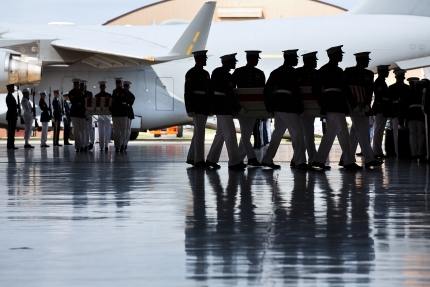
President Obama Attends Transfer of Remains Ceremony for Diplomats Killed in Libya

Marines During the Transfer of Remains Ceremony at Joint Base Andrews, Sept. 14, 2012

Marines carry the flag draped transfer cases during the transfer of remains ceremony at Joint Base Andrews, Maryland, Sept. 14, 2012, marking the return to the United States of the remains of the four Americans killed this week in Benghazi, Libya. September 14, 2012. (Official White House Photo by Pete Souza)

On Friday afternoon, President Obama, Vice President Biden and Secretary Clinton were at Andrews Air Force Base for the Transfer of Remains Ceremony which marked the return to the United States of the remains of the four brave Americans who were killed this week in Benghazi, Libya.

At the solemn ceremony that honored the fallen diplomats - Glen Doherty, Tyrone Woods, Sean Smith and Ambassador J. Christopher Stevens -- President Obama paid tribute to four patriots who served their country and shared a “fundamental American belief that we can leave this world a little better than before.”

The President promised the families and colleagues of the fallen heroes that their sacrifice would never be forgotten. He also noted the outpouring of sympathy from the people of Libya, who called Ambassador Stevens a friend: 

That’s the message these four patriots sent. That’s the message that each of you sends every day -- civilians, military -- to people in every corner of the world, that America is a friend, and that we care not just about our own country, not just about our own interests, but about theirs; that even as voices of suspicion and mistrust seek to divide countries and cultures from one another, the United States of America will never retreat from the world.  We will never stop working for the dignity and freedom that every person deserves, whatever their creed, whatever their faith. 

That’s the essence of American leadership. That’s the spirit that sets us apart from other nations. This was their work in Benghazi, and this is the work we will carry on. 

The White House

Office of the Press Secretary

Presidential Memorandum -- Presidential Determination with Respect to Foreign Governments' Efforts Regarding Trafficking in Persons

MEMORANDUM FOR THE SECRETARY OF STATE

SUBJECT: Presidential Determination with Respect to Foreign Governments' Efforts Regarding Trafficking in Persons

Consistent with section 110 of the Trafficking Victims Protection Act of 2000 (Division A of Public Law 106-386), as amended (the "Act"), I hereby:

Make the determination provided in section 110(d)(1)(A)(i) of the Act, with respect to the Democratic Republic of the Congo, Equatorial Guinea, Sudan, and Zimbabwe, not to provide certain funding for those countries' governments for Fiscal Year 2013, until such governments comply with the minimum standards or make significant efforts to bring themselves into compliance, as may be determined by the Secretary of State in a report to the Congress pursuant to section 110(b) of the Act;

Make the determination provided in section 110(d)(1)(A)(ii) of the Act, with respect to Cuba, the Democratic People's Republic of Korea, Eritrea, Iran, Madagascar, and Syria not to provide certain funding for those countries' governments for Fiscal Year 2013, until such governments comply with the minimum standards or make significant efforts to bring themselves into compliance, as may be determined by the Secretary of State in a report to the Congress pursuant to section 110(b) of the Act;

Determine, consistent with section 110(d)(4) of the Act, with respect to Algeria, the Central African Republic, Kuwait, Libya, Papua New Guinea, Saudi Arabia, and Yemen that provision to these countries' governments of all programs, projects, or activities of assistance described in sections 110(d)(1)(A)(i)-(ii) and 110(d)(1)(B) of the Act would promote the purposes of the Act or is otherwise in the national interest of the United States;

Determine, consistent with section 110(d)(4) of the Act, with respect to the Democratic Republic of the Congo, that assistance and programs described in section 110(d)(1)(A)(i) and 110(d)(1)(B) of the Act, with the exception of Foreign Military Sales and

Foreign Military Financing to the army of the Democratic Republic of the Congo, would promote the purposes of the Act or is otherwise in the national interest of the United States;

Determine, consistent with section 110(d)(4) of the Act, with respect to Sudan, that assistance and programs described in section 110(d)(1)(A)(i) and 110(d)(1)(B) of the Act, with the exception of Foreign Military Sales and Foreign Military Financing to the Sudanese land forces, air forces, and Popular Defense Force, would promote the purposes of the Act or is otherwise in the national interest of the United States;

Determine, consistent with section 110(d)(4) of the Act, with respect to Iran, that a partial waiver to allow funding for educational and cultural exchange programs described in section 110(d)(1)(A)(ii) of the Act would promote the purposes of the Act or is otherwise in the national interest of the United States;

Determine, consistent with section 110(d)(4) of the Act, with respect to Syria, that a partial waiver to allow funding for educational and cultural exchange programs described in section 110(d)(1)(A)(ii) of the Act would promote the purposes of the Act or is otherwise in the national interest of the United States;

Determine, consistent with section 110(d)(4) of the Act, with respect to Equatorial Guinea, that a partial waiver to allow funding for programs described in section 110(d)(1)(A)(i) of the Act to support programs to study and combat the spread of infectious diseases and to advance sustainable natural resource management and biodiversity would promote the purposes of the Act or is otherwise in the national interest of the United States;

Determine, consistent with section 110(d)(4) of the Act, with respect to Equatorial Guinea, that assistance described in section 110(d)(1)(B) of the Act would promote the purposes of the Act or is otherwise in the national interest of the United States;

Determine, consistent with section 110(d)(4) of the Act, with respect to Zimbabwe, that a partial waiver to allow funding for programs described in section 110(d)(1)(A)(i) of the Act for assistance for victims of trafficking in persons or to combat such trafficking, and for programs to support the promotion of health, good governance, education, agriculture and food security, poverty reduction, livelihoods, family planning, and macroeconomic growth including anticorruption, and programs that would have a significant adverse effect on vulnerable populations if suspended, would promote the purposes of the Act or is otherwise in the national interest of the United States;

And determine, consistent with section 110(d)(4) of the Act, with respect to Zimbabwe, that assistance described in section 110(d)(1)(B) of the Act, which:

(1) is a regional program, project, or activity under which the total benefit to Zimbabwe does not exceed 10 percent of the total value of such program, project, or activity; or

(2) has as its primary objective the addressing of basic human needs, as defined by the Department of the Treasury with respect to other, existing legislative mandates concerning U.S. participation in the multilateral development banks; or

(3) is complementary to or has similar policy objectives to programs being implemented bilaterally by the United States Government; or

(4) has as its primary objective the improvement of Zimbabwe's legal system, including in areas that impact Zimbabwe's ability to investigate and prosecute trafficking cases or otherwise improve implementation of its anti-trafficking policy, regulations, or legislation; or

(5) is engaging a government, international organization, or civil society organization, and seeks as its primary objective(s) to: (a) increase efforts to investigate and prosecute trafficking in persons crimes; (b) increase protection for victims of trafficking through better screening, identification, rescue or removal, aftercare (shelter, counseling), training, and reintegration; or (c) expand prevention efforts through education and awareness campaigns highlighting the dangers of trafficking or training and economic empowerment of populations clearly at risk of falling victim to trafficking; or

(6) is targeted macroeconomic assistance from the International Monetary Fund that strengthens the macroeconomic management capacity of Zimbabwe, would promote the purposes of the Act, or is otherwise in the national interest of the United States.

The certification required by section 110(e) of the Act is provided herewith.

You are hereby authorized and directed to submit this determination to the Congress, and to publish it in the Federal Register.

BARACK OBAMA

The White House

Office of the Press Secretary

Letter from the President regarding the Sequestration Transparency Act

Dear Mr. Speaker: (Dear Mr. President:)

Pursuant to section 2 of the Sequestration Transparency Act of 2012 (Public Law 112-155), I am providing a report prepared by the Office of Management and Budget on the sequestration required to be ordered by paragraphs (7)(A) and (8) of section 251A of the Balanced Budget and Emergency Deficit Control Act of 1985 (2 U.S.C. 901a) for Fiscal Year 2013 on January 2, 2013.

Sincerely,

BARACK OBAMA

Team USA Visits the White House

President Barack Obama delivers remarks to the 2012 United States Olympic and Paralympic Teams

President Barack Obama, with Vice President Joe Biden and First Lady Michelle Obama, delivers remarks to the 2012 United States Olympic and Paralympic Teams on the South Lawn of the White House, Sept. 14, 2012. (Official White House Photo by Lawrence Jackson)

Today, the President and First Lady welcomed the 2012 U.S. Olympic and Paralympic teams to the White House to honor their participation and success in this year’s Olympic and Paralympic Games in London. 

At an event on the South Lawn, Mrs. Obama told the athletes that she was impressed not only by the 200-plus medals they brought home, but also by their dedication and hard work leading up to the games.

I want you to know how inspired we are by all of you -- your passion, your dedication, your courage. This summer, people across the country -- including some of the young people with us today -- watched you compete and thought to themselves, you know what, if they can set a goal and work hard to reach it, maybe I can too, and maybe I can go a little farther and do a little better than people think I can. They saw all of you out there giving 100 percent, overcoming all kinds of obstacles, representing our country with such determination and pride. 

Related Topics: Inside the White House

The White House

Office of the Press Secretary

Letter from the President regarding the War Powers Resolution Report for Libya

Dear Mr. Speaker: (Dear Mr. President:)

On September 12, 2012, in response to an attack on our diplomatic post in Benghazi, Libya, that killed four U.S. citizens, including U.S. Ambassador John Christopher Stevens, a security force from the U.S. Africa Command deployed to Libya to support the security of U.S. personnel in Libya. Further, on September 13, an additional security force arrived in Yemen in response to security threats there.

Although these security forces are equipped for combat, these movements have been undertaken solely for the purpose of protecting American citizens and property. These security forces will remain in Libya and in Yemen until the security situation becomes such that they are no longer needed.

These actions have been directed consistent with my responsibility to protect U.S. citizens both at home and abroad, and in furtherance of U.S. national security and foreign policy interests, pursuant to my constitutional authority to conduct U.S. foreign relations and as Commander in Chief and Chief Executive.

I am providing this report as part of my efforts to keep the Congress fully informed, consistent with the War Powers Resolution (Public Law 93-148). I appreciate the support of the Congress in these actions.

Sincerely,

BARACK OBAMA

The White House

Office of the Press Secretary

Remarks by the President and the First Lady Welcoming the 2012 U.S. Olympic and Paralympic Teams

South Lawn

10:14 A.M. EDT

MRS. OBAMA:  All right.  While they're shaking hands -- because the President has vowed to stay out here to meet everyone, even if it blows his schedule.  (Laughter and applause.)  So I'm going to get things started while Joe and Barack do their thing.

Hello, Team USA!  (Applause.)  And welcome to the White House!  Yes!  (Applause.)  Look, I had so much fun with everyone over in London that when I got home, I told Barack -- what's his name -- my husband, this guy -- (laughter) -- that we had to invite everybody over to the house.  So here you are, and we are thrilled that you all could join us today.

Now leading the U.S. delegation to the Olympic Ceremony was truly a dream come true for me.  I got the chance to spend time with so many of you and hear about your journeys.  I got to see how incredibly talented all of you are -- including one member of our women's wrestling team who literally swept me off my feet -- (laughter) -- if you hadn't seen the pictures.  I've never been picked up before by a wrestler.  (Laughter.)  It was good.

And I got to see Team USA win, and then win again, and again, and again.  And together, our Olympians and Paralympians brought home more than 200 medals from London -- that’s impressive.  (Applause.)  Very impressive. 

But even more impressive than those medals is all the hard work that led up to that Olympic and Paralympic dream.  All those early mornings and long hours at the gym, many of you balancing work or classes, or raising your kids at the same time.  And today, I want you all to know how proud we are of you, which is why this day has been so special.  We've been looking forward to this for a very long time.

I want you to know how inspired we are by all of you -- your passion, your dedication, your courage.  This summer, people across the country -- including some of the young people with us today -- watched you compete and thought to themselves, you know what, if they can set a goal and work hard to reach it, maybe I can too, and maybe I can go a little farther and do a little better than people think I can.  They saw all of you out there giving 100 percent, overcoming all kinds of obstacles, representing our country with such determination and pride. 

They saw athletes like Navy Lieutenant Brad Snyder, who is here with us today.

THE PRESIDENT:  Where's Brad?

MRS. OBAMA:  Right here.  (Applause.)  There's Brad.  Just one year ago, Lieutenant Snyder was blinded by an IED in Afghanistan.  But this summer, he competed in London, winning two gold medals and a silver.  (Applause.)  And afterwards, he said -- this is his quote -- "To be able to come out here, and to keep in the fight, and keep going and keep inspiring, and keep perpetuating some goodwill for our country means a lot." 

And that means a lot to us, too.  It means a lot that all of you chose to stand up and represent this country; to carry our flag and remind us what an honor it is to call ourselves Americans.  And today, I want to once again congratulate you all on your achievements.

I also want to thank the USOC and all of you for getting more young people involved in sports in their communities as part of Let's Move.  By the end of this year, we will have helped 1.7 million kids all across the country get healthy and active -- and maybe we've inspired some future Olympian and Paralympians, as well.  So we appreciate everything you all have done, and I want to wish you the very best of luck in whatever you choose to do next. 

And with that, it is now my pleasure to introduce another big fan of yours, my husband, our President, Barack Obama.  (Applause.) 

THE PRESIDENT:  Hey!  (Applause.)  Thank you.  I'm the fan-in-chief!  (Laughter.)

It is great to have Team USA here at the White House.  And I want to thank Michelle for not teasing me too much, which is usually what she does in her introductions.  It is true, I was pretty jealous of the fact that she had a chance to go to London. 

But like millions of Americans, I had almost as much fun just following you guys from here and what you did.  I usually work pretty late, but I’ve have mastered the DVR -- (laughter) -- so I was able to catch a little bit of everything.  It was a great way to end the day, watching you guys do things that I did not think were humanly possible.

So every morning, when Michelle and I would work out we’d talk about, did you see that thing?

MRS. OBAMA:  Yes, it was good.

THE PRESIDENT:  That was unbelievable.  (Laughter.)  And then I’d jog on the treadmill.  (Laughter.)  But I was inspired to watch you guys even though I couldn’t do what you do.  I was inspired to run a little bit faster watching Tyson Gay, and lift a little more after watching Holley Mangold, or do a few more crunches after watching Michael Phelps and the other swimmers.  (Laughter.)  Somehow, it didn’t work quite on me.  (Laughter.)  And wheelchair rugby -- I’m just glad you guys aren’t taking me out.  (Laughter and applause.)

But most importantly, what you guys did was inspire us.  You made us proud.  And, as President, you made me especially proud to see how you conducted yourself on a world stage.  You could not have been better ambassadors and better representatives for the United States and what we stand for. 

And one of the great things about watching our Olympics is we are a portrait of what this country is all about -- people from every walk of life, every background, every race, every faith.  It sends a message to the world about what makes America special.  It speaks to the character of this group, how you guys carried yourselves.  And it’s even more impressive when you think about the obstacles that many of you have had to overcome not just to succeed at the games, but to get there in the first place.

Thirteen years ago, Kari Miller was serving in the Army when her car was hit by a drunk driver.  She lost both her legs.  She went onto college, learned how to play sitting volleyball.  Today she is the proud owner of two silver medals.  (Applause.)

Lance Brooks is here.  Leading up to the Olympic Games, he had a job pouring concrete for 12 hours a day, and still managed to put in two more hours of training in the discus.

Katie Ledecky may have been swimming in London, but she still had to finish the summer reading assignments for her high school English class.  (Laughter.)  Where’s Katie?  Yes, there she is.  (Applause.)  She brought some of her classmates here today.  (Applause.)

And then there’s Manteo Mitchell.  Where is he?  Now, this has to be one of my favorite stories of the whole Olympics -- breaks his shin bone halfway through his lap on the 4X400 meter relay, but he finishes anyway in 46 seconds, and helps the U.S. qualify for the final.  (Applause.)  Right here.  Unbelievable.

So all of you have stories of determination and perseverance.  All of you made incredible sacrifices to get here.

About a month ago, I was in Colorado Springs.  We stopped by the Olympic training center and I met a bunch of athletes, including some of the amazing Paralympians that were just about to head out.  I got to meet some of the bobsledders who were working out together for the next Winter Olympics, and it was just amazing to see not only how hard people were training, but also to hear how much you guys get to eat during training -- (laughter) -- which I was very impressed with.

So I hope that all of you guys get some well-deserved time off over the next few months.  But I know that pretty soon, many of you will be back in the gym or on the track or in the pool, thinking about Rio, because the Olympics is not just about what happens on the big stage in front of the cameras when the world is watching.  It’s about what’s happening when nobody is watching.  And that’s what really counts.

As Olympians and Paralympians, you guys all find the strength to keep pushing on good days and bad days -- because you believe that no matter where we come from, or no matter what hand we’ve been dealt in life, with enough effort, there is no limit to how far we can go.

That’s what sets all of you apart.  That’s what sets America apart.  We celebrate individual effort, but we also know that, together, we can do incredible things that we couldn’t accomplish on our own.

So thank you for being such great role models, especially for our young people.  We could not be prouder of you.  You gave us a summer that we will never forget.  It is a great honor to welcome you home.  And I’ve been told that, because of my schedule, I’m not allowed to shake everybody’s hands, but I am going to break the rule and try to shake as many as I can before I get dragged out of here.

God bless you.  Marine band, let’s hit the music!  I love this!

END
10:25 A.M. EDT

The White House

Office of the Press Secretary

Presidential Memorandum -- Presidential Determination on the annual Presidential Determination on Major Illicit Drug Transit and Drug Producing Countries

MEMORANDUM FOR THE SECRETARY OF STATE

SUBJECT: Presidential Determination on Major Illicit Drug Transit or Major Illicit Drug Producing Countries for Fiscal Year 2013

Pursuant to section 706(1) of the Foreign Relations Authorization Act, Fiscal Year 2003 (Public Law 107-228)(FRAA), I hereby identify the following countries as major drug transit and/or major illicit drug producing countries: Afghanistan, The Bahamas, Belize, Bolivia, Burma, Colombia, Costa Rica, Dominican Republic, Ecuador, El Salvador, Guatemala, Haiti, Honduras, India, Jamaica, Laos, Mexico, Nicaragua, Pakistan, Panama, Peru, and Venezuela.

A country's presence on the majors list is not necessarily an adverse reflection of its government's counternarcotics efforts or level of cooperation with the United States. Consistent with the statutory definition of a major drug transit or drug producing country set forth in section 481(e)(2) and (5) of the Foreign Assistance Act of 1961, as amended (FAA), one of the reasons major drug transit or illicit drug producing countries are placed on the list is the combination of geographic, commercial, and economic factors that allow drugs to transit or be produced, even if a government has carried out stringent narcotics control law enforcement measures.

Pursuant to section 706(2)(A) of the FRAA, I hereby designate Bolivia, Burma, and Venezuela as countries that have failed demonstrably during the previous 12 months to adhere to their obligations under international counternarcotics agreements and take the measures set forth in section 489(a)(1) of the FAA. Included in this report are justifications for the determinations on Bolivia, Burma, and Venezuela, as required by section 706(2)(B) of the FRAA.

I have also determined, in accordance with provisions of section 706(3)(A) of the FRAA, that support for programs to aid Bolivia, Burma, and Venezuela is vital to the national interests of the United States.

Afghanistan produces approximately 90 percent of the world's illicit opium. Nearly all of this cultivation occurs in four southern and western provinces. Instability in the area allows criminal networks, insurgent groups, and illicit cultivation and drug production to thrive. While Helmand Province continues to be the largest poppy-cultivating area, the United States and the United Nations Office on Drugs and Crime (UNODC) estimate that cultivation in Helmand decreased between 35 and 39 percent, respectively, since 2008, to roughly 63,000 hectares.

The strategic objective of Afghanistan's Ministry of Counter Narcotics, as stated in its National Drug Control Strategy, is "to create a secure environment for a healthy society with a strong licit economy, through evidence-based policy-setting, effective coordination and full accountability to the people of Afghanistan and our government." The ongoing Good Performer Initiative, now in its sixth year, rewards provinces for successful counternarcotics performance. In 2011, 22 of Afghanistan's 34 provinces qualified for $19.2 million in development projects as the result of their poppy reduction efforts.

Afghanistan's gains remain fragile. Reducing illegal cultivation and trafficking are closely linked to broader economic opportunity, security, and the ability of the Afghan government to project the rule of law. International support for the Afghan National Drug Control Strategy, including from the United States, is designed to bolster the country's drug control undertakings and is directly tied to the success of the country's wide-ranging national objectives to improve peace, security, and economic development.

This year, the Caribbean was examined for its relative importance as a transit zone for illegal substances destined for U.S. markets. Without factoring in illegal maritime and air drug smuggling believed to be destined for Europe and beyond, approximately 5 percent of all drugs destined for the United States are estimated to pass through the majors list countries of The Bahamas, Dominican Republic, Haiti, and Jamaica. As traffickers constantly reorder their routes and methods, the United States and other donors continue to believe that countering the drug trade in the Caribbean is in our national interest, as well as that of the countries themselves. Without the rule of law, well-run institutions, and effective drug interdiction, the viability of the broad range of national and regional goals adopted by Caribbean countries is threatened.

European, Canadian, and U.S. bilateral drug control support, as well as the Caribbean Basin Security Initiative, contribute to the region's ability to prevent and address drug trafficking and related violence and crime in the Caribbean. Similarly, key undertakings by the Organization of American States and UNODC in the region -- especially those aimed at bringing long-term stability to Haiti -- are an important part of the policy and assistance mosaic for smaller countries seeking to build on the successes of broad regional policies and programs.

United States analysts estimate that approximately 95 percent of illegal drugs cultivated and produced in South America destined for the United States are smuggled through Central America, Mexico, and the Eastern Pacific, primarily using maritime conveyances and illegal air flights. In response, the

United States launched the Central America Regional Security Initiative (CARSI) in 2008, which was further expanded when I announced the Central America Citizen Security Partnership in San Salvador in March 2011. Through CARSI and the Partnership, the United States has focused its crime prevention, counternarcotics, law enforcement and security assistance, and bolstered rule of law institutions in Central America. The region also has strengthened cooperation through the Central American Integration System (SICA) to promote citizen security and other programs. Multilateral cooperation to stem the flow of precursor chemicals from as far away as China that are used to produce illegal methamphetamine in Central America is an important component of SICA's unprecedented regional cooperation. Similar objectives are achieved through U.S. support for Mexico's drug control policies and programs under the Merida Initiative.

Several other countries were evaluated for inclusion in this year's list, but are not determined to be major drug transit and/or major illicit drug producing countries. For example, Canada has taken effective steps to stem the flow of synthetic MDMA (ecstasy) across its shared border with the United States, a problem of growing concern during the past several years. The country continues its robust efforts to combat the production, distribution, and consumption of various illegal drugs. As part of its 5-year National Anti-Drug Strategy, Canada has rolled out new initiatives specifically intended to fight the trafficking of marijuana and synthetic drugs. As detailed in the March 2011 report on precursors by the International Narcotics Control Board, Canada broadened its existing Controlled Drugs and Substances Act to prohibit any person from possessing, producing, selling, or importing material intended to be used in the illegal manufacture or trafficking of methamphetamine or ecstasy. The United States has al
so collaborated with Canada on a National Northern Border Counternarcotics Strategy that defines in detail the wide range of initiatives underway to combat all phases of drug trafficking. Bilateral initiatives focus on programs to stem the two-way drug trade between Canada and the United States.

You are hereby authorized and directed to submit this determination, with its Bolivia, Burma, and Venezuela memoranda of justification, under section 706 of the FRAA, to the Congress, and publish it in the Federal Register.

BARACK OBAMA