The White House

Office of the Press Secretary

Remarks by the President at Campaign Event -- 40/40 Club

40/40 Club
New York, New York

8:48 P.M. EDT
 
THE PRESIDENT: Thank you. Thank you. (Applause.) Thank you. Well, it is wonderful to see all of you. I’m so grateful for all your support.
 
Let me just begin by saying to Jay and Bey, thank you so much for your friendship. We are so grateful. Michelle and Malia and Sasha are mad at me because they are not here. (Laughter.) That doesn’t usually happen. Usually they’re like, we’re glad you’re going -- we don’t need to go. But every time they get a chance to see these two they are thrilled, partly because they are just both so generous, particularly to my kids. And Malia and Sasha just love both of them.
 
Beyoncé couldn’t be a better role model for our daughters because she carries herself with such class and poise -- (applause) -- and has so much talent. And Jay-Z now knows what my life is like. (Laughter.) We both have daughters, and our wives are more popular than we are. (Laughter and applause.) So we’ve got a little bond there. (Laughter.) It’s hard, but it’s okay. It’s okay. (Laughter.)
 
Forty-nine days until this election. We just came out of convention season, and we had two conventions -- one in Tampa, and one in Charlotte. And I don’t know that everybody here spent all their time watching conventions. I’m sure that many of you had better things to do. But you saw two very stark visions, different visions about where we need to take this country.
 
I think everybody recognizes that America has all the ingredients we need for success. We’ve got the best workers in the world. We’ve got the best businesses in the world. We’ve got the most entrepreneurial culture in the world. We’ve got the best universities and scientists and researchers. We’ve got this incredible diversity of talent and innovation and ingenuity, which makes us the envy of the world. People come here from every corner of the globe because of that central idea at the heart of America, which says no matter what you look like, no matter where you come from, no matter what your last name is, no matter who you love, here in America you can make it if you work hard, if you try. (Applause.) All right, that’s what inspires so many people, not just in this country but around the world.
 
But what we also recognize is that that basic bargain has been eroding over the course of a decade. There are a lot of people who have been out there working really hard, and yet their paychecks haven’t kept up with the costs of everything from gas to groceries to sending a kid to college. There are a lot of folks out there who take responsibility for their lives and their families and their communities and their neighborhoods, and yet it seems as if security is always a little bit out of reach.
 
We’ve seen an economy over the last decade where jobs were being shipped overseas; an economy that was loaded up with debt; an economy where there was a lot of irresponsibility on the part of folks who should have known better. And it all culminated in the worst financial crisis since the Great Depression.
 
And it was in that context that I was sworn into office almost four years ago, at a time when the banking system was melting down, at a time when -- the month I was sworn in, we lost 800,000 jobs, the worst crisis since the Great Depression. And we have worked tirelessly over the last four years to start turning that around, and we have made progress.
 
So the last 30 months, we’ve seen the private sector create jobs every single month -- 4.5 million jobs altogether. We’ve seen manufacturing start coming back. (Applause.) An auto industry that was on the brink of liquidation has come roaring back, so that now GM is once again on the top of the world and Chrysler is selling more cars than they’ve seen in a very, very long time. (Applause.) We’ve been able to make sure that small businesses survived and got help through the Small Business Administration.
 
But what we tried to do was not just get back to where we were before the crisis. We tried to start addressing some of those issues that had been lingering for too long. That’s what health care -- in a country like ours, we shouldn’t have millions of people who are at risk of going bankrupt just because somebody in their family got sick. And that’s why we passed a health care reform law that will provide millions of families the kind of security they need and also make sure that we’re starting to bring down health care costs, so that we can afford it.
 
That’s the reason why we made sure that we changed our student loan system and our Pell Grant system, so that young people have a chance to go to college even if they weren’t born rich, that we understand if we make an investment in young people and they succeed, then all of us are going to be better off. (Applause.)
 
It’s the reason why we’ve invested in alternative energy, to make sure that instead of just relying on foreign oil, we’re starting to build windmills and solar panels and putting people back to work here all across the country -- and in the process also helping our national security and doing something about climate change.
 
It’s the reason why we ended a policy like “don’t ask, don’t tell” that somehow prevented outstanding people in our services to serve the country they love just because of who they love. It’s the reason that we ended the war in Iraq and we’re bringing the war in Afghanistan to a close. (Applause.)
 
So we’ve made a lot of progress, but we’ve got so much more work to do. And the other side, they’ve got a different vision. You saw it at their convention. And their basic theory is that if you give tax cuts to folks at the very top, people like us who have been incredibly blessed and fortunate and, frankly, don’t need a tax cut, that somehow the country is going to be better off.
 
And the good thing about so many of us here -- and I know, I speak for Jay and Bey -- is we remember what it’s like not having anything, and we know people who were just as talented as us that didn’t get the same break, the same chance. We remember some of our parents or grandparents who came here as immigrants and got a little bit of help along the way to go to that school or be able to start that first business. We understand that -- as Michelle said as well as anybody could -- those of us who have been blessed with success and been able to walk through those doors of opportunity, we don’t slam the door behind us. We prop it open. We make it easier for those who follow to succeed as well.
 
And by doing that, our success is that much better. It’s that much more stable and more secure, because when the whole country does well, everybody does well. When the middle class does well, and when teachers and firefighters and construction workers and receptionists and waiters and the folks who are cleaning up these big office buildings in Manhattan, if they’re getting a decent wage and they’re able to provide their kids a good education, the whole economy booms. That’s been our history. That’s who we are. And that’s what’s at stake in this election.
 
Now, there are other things that are at stake -- who gets seated on the Supreme Court? Are we going to allow ourselves to go back to a time when politicians in Washington are telling women how to make health care decisions? Michelle tells me you guys are actually quite capable of making those decisions by yourself. (Applause.)
 
When it comes to issues of war and peace, my opponent says that me ending the war in Iraq was tragic. He hasn’t been able to explain what his plan would be in terms of dealing with a situation like Afghanistan. And so, how we’re perceived in the world and how we’re able to project our power not just through our extraordinary military and what our outstanding troops do, but also through our diplomacy and our culture and our ideals and our values -- the message that we’re sending around the world,that is also at stake in this election.
 
Whether or not we continue to stay focused on ensuring that college is affordable, and making sure that our air is clean and our water is clean, the air and water that our kids play in and breathe -- that’s at stake in this election.
 
So the stakes could not be higher. And I think most of you already understand that Otherwise you wouldn’t be here tonight. And then, so the question becomes how much are we willing to fight for this in the last seven weeks?
 
I think that there’s a danger sometimes among Democrats, progressives, supporters of mine, to think we must be right on the issues so I’m sure the election will be fine. But that’s not how elections work. Elections work because you put in the effort and the sweat and the passion and the energy to get out there and deliver a message to the American people.
 
Because the American people are busy and they’re focused on their kids and they’re focused on getting to work or finding a job. And all this politics stuff sometimes seems very distant to them. And they’re being inundated by more negative ads from the other side than we’ve ever seen in our history. We’ve got people writing $10 million checks just to see if they can beat me. And you see it, anybody who has been turning on the television -- you don’t see it in New York, because this isn’t a swing state. (Laughter.) But you try going to Ohio or Virginia right now and ad after ad is distorting my record or trying to persuade people as to why we need to change course and replace the occupant of the White House.
 
So we can’t be complacent. If all of you genuinely believe that the decisions that I’ve made and the vision that I’m projecting about the kind of America we want not just for ourselves, but for our kids and our grandkids -- if you genuinely believe that, we’re going to have to work for it. The other side is full of passion and they are working very hard to beat us. And in these next seven weeks we're going to have to do everything that we can.
 
And for some of you that means financial support; for others it may mean you're out there knocking on some doors or making some phone calls, or using your influence to persuade other people to get involved.
 
But understand that this will not come easy, and that we're going to have to fight for this thing every step of the way. And that's always been the case. It's been interesting over the last four years, sometimes people ask me, how do you handle all the criticism and the media and the scrutiny and the pressure and this and that and the other. And I tell them there are two things that allow me to not just survive this but to thrive and enjoy it. The first is the American people. Because when you travel around the country, it turns out that they're so much better than the kind of politics we see in Washington.
 
Most people are good and they're decent and they're trying to do the right thing. And they may not follow every issue and know exactly what is going on, but their basic instinct is let's give everybody a fair shot and let's make sure everybody does their fair share, and let's make sure everybody is playing by the same set of rules. And let's open up opportunity for everybody. That's -- you go to a small town in Iowa, you go to a big city in California -- that decency and goodness of the American people shines through. And that encourages me. That makes me feel good.
 
Some of you saw -- I was just on Letterman before I came here, and some of you saw that he showed that picture of that pizza owner who picked me up -- (laughter) -- and lifted me up and kind of straightened out my back -- (laughter) -- well, this guy, he started his own pizza company and is a Republican, but is somebody who thought that I shared with him a passion for doing the right thing. And he started his own blood drive in the community that is now the largest blood drive in Florida, and is passionate about helping folks who haven’t had a chance, and wants to make sure that they succeed.
 
And so when I hear people trying to label folks as, well, these are Republicans, or these are Democrats, or these are people who don't understand the country -- when I hear those divisions, I say, well, you're not paying attention to what's going on in the country. There's a lot of good out there.
 
So that keeps me energized and inspired. And the second thing is an awareness of history and an understanding that change in this country has never been easy. It's never been easy. Women getting the right to vote took decades of work. The civil rights movement -- we had a century of work. The union movement, people having an opportunity to get a minimum wage -- people were beaten and died for that.
 
So I'm always reminded and humbled by the fact that what we do at any given moment is just part of this bigger pattern, part of God's plan, part of a process. And our job is just to make sure that we are pushing in the right direction -- pushing the wheel of history in the right direction. And hopefully, then our kids will be equipped and have the privilege to keep pushing in the right direction in the future.
 
So I don't want people to be complacent, but I also don't want people to be discouraged. We're on the brink of an election, but more importantly, we're on the brink of moving America in a direction in which we're going to be more just, more fair, the economy is going to grow in a way that includes everybody -- an America that's respected around the world because we are putting forward our best values and our best ideals.
 
And you're a part of that. Being here tonight, you're a part of that. You're a part of us trying to make some more history. And we've made history in the past; we're going to make some more history over the next seven weeks as long as you guys are ready to keep going with me. All right? (Applause.)
 
So thank you so much, everybody. God bless you. Appreciate you. (Applause.) Bey, Jay, thank you.
 
END
9:05 P.M. EDT

The White House

Office of the Press Secretary

Remarks by the President at Campaign Event -- Waldorf Astoria

Waldorf Astoria Hotel
New York, New York

6:33 P.M. EDT
 
THE PRESIDENT: Hello, everybody! Hello! (Applause.) Hello, New York! (Applause.) Thank you. Thank you so much. If you have a chair, go ahead and use it. If you don'the -- don't. (Laughter.)

It is wonderful -- hey, guys, good to see you. It is wonderful to be with all of you. I just had a chance to take some pictures with you and I have to tell you they all turned out wonderfully. (Laughter.) I mean this is a good-looking group, very photogenic. Yes, you especially. (Laughter.)

It’s wonderful to be here. We’ve got some people who’ve supported me since I actually ran for Senate in this ballroom. (Applause.) And then we’ve got some folks who supported us in ’08, and then we’ve got some new friends. And to all of you, I just want to say how grateful I am and how wonderful it is to be back in New York.

Now, we just came off two conventions, one in Tampa and one in Charlotte. And Michelle Obama was pretty good, you know? (Applause.) And then you had Bill Clinton who somebody said should be secretary of explaining stuff. (Laughter and applause.) And what was striking I think coming out of those two conventions was the clarity about how important this choice is.

Seven weeks from today, we’re going to be making a decision about the future of our country. And a lot of you brought your kids here today. (Baby cries.) Yes, right on cue. (Laughter.) And that is entirely appropriate because the decisions that we’re going to make in this election are going to have an impact not just on us, it’s going to have an impact on them and their kids for decades to come. (Baby cries again.) It’s true. (Laughter.)

The fact is that on almost every issue, we have a deep difference not just between two candidates or two political parties, but a deep difference in terms of how we think about growing our economy and how we think about what ensures prosperity and security over the long term.

The other side, they have their convention, and they talked a lot about what they think is wrong with the country, but they didn't really tell you much about how they’d make it right. They asked for your vote, but they didn't really have a plan. And the reason they didn't want to talk about their plan much was because the plan they're offering is the same one they’ve offered for the last 30 years, which is if we give a lot of tax cuts, particularly skewed towards people who really don't need tax cuts, and if we roll back regulations on clean air and we roll back regulations on consumer protection, and we roll back regulations that ensure that insurance companies treat you properly, that somehow America’s energy will be unleashed and the economy will be going gangbusters.

And what they're counting on is an element of amnesia because that's exactly what we tried from 2001 to 2008, during which we experienced the slowest job growth in 50 years. We went from surpluses to deficits. Ordinary families actually saw their average incomes go down, and it culminated in the worst financial crisis since the Great Depression -- so not a real good track record in terms of the plan that they are presenting.

We’ve got a different vision, and our vision says that our economy grows best and our children’s futures are best secured when we recognize that we’re all in this together; that we believe in a free-market system and individual initiative and hard work, but we also believe in this basic bargain that says if you work hard, you can make it in this country. Everybody, no matter what you look like, no matter where you come from, no matter what last name you have, no matter who you love, here in America, you can make it you try, and that there are important ways in which we can ensure that everybody has access to opportunity.

So what I tried to do at the convention was lay out very specifically how I think we’re going to get there. Over the last three and a half years, we’ve created 4.5 million new jobs, half a million of them in manufacturing. So what I said was, let’s double down and make sure that we’re exporting more and outsourcing fewer jobs. Let’s develop exports markets all around the world, and let’s make sure that we’re investing in things like clean energy so that we’re building wind turbines and long-lasting batteries and all the cutting-edge technologies that ensure we keep at the cutting edge of this global economy.

And then I talked about education and how all the work we’ve done to reform schools is starting to bear fruit, but we’ve also got to make sure that every young person in this country can afford a college education. (Applause.) And make sure that they’re not loaded up with debt when they get out, so that they can potentially become teachers or go into the foreign service or do something that may not pay a lot of money, but is vitally important to our country.

I talked about how important it was for us to have an energy policy that ensures that we have high production of traditional fuels like oil and natural gas, but that we’re also investing in clean energy. We’ve doubled fuel efficiency on cars. We have doubled our production of clean energy. That’s creating thousands of jobs. It’s taking carbon out of our atmosphere.

And it is freeing ourselves from dependence on foreign oil. We’ve actually reduced our dependence -- our oil imports every year that I’ve been in office and we now have it below 50 percent. And we think we can cut that in half by 2020, but only if we pursue the kinds of energy sources that are good for our economy and potentially can help save the planet.

And I also talked about how, if we’re going to be serious about reducing our deficits, that we’ve got to cut out spending that we don’t need, that’s not helping us grow. But we can’t just gut our investment in education, or our investments in science and research, or our investments in making sure that young people can go to college, just to pay for tax cuts for folks like me -- that we’re going to have to take a balanced approach. That means that those of us who have been incredibly blessed by this country, we can afford to do a little bit more. (Applause.)

Now, that’s a very different agenda than a $5 trillion tax cut that’s paid for by gutting education, gutting Medicaid and turning Medicare into a voucher system. It’s a different philosophy about how we grow our economy. And I believe that we grow our economy from the middle out and by providing ladders of opportunity for everybody. And when we do, everybody does better.

When Bill Clinton was President, we created 23 million new jobs, had a surplus instead of a deficit, and we produced a whole lot more millionaires than we’ve produced under this other theory, because suddenly businesses had customers and had more profits and we got a virtuous cycle that continued in the longest post-World War II boom in American history. And we can replicate that, even in this competitive environment, but we’ve got to be smart about it.

Now, a lot of you here obviously recognize that those aren’t the only choices involved. We’ve got choices about war and peace. I ended the war in Iraq, as I promised. We are transitioning out of Afghanistan. (Applause.) We have gone after the terrorists who actually attacked us 9/11 and decimated al Qaeda.

Mr. Romney thinks that we should have stayed in Iraq, indicated that it was a “tragic” mistake for us to have gotten out of Iraq; still hasn’t made clear what his plan would be for Afghanistan; wants to add $2 trillion to our defense budget for programs that our Joint Chiefs don’t want. It’s a fundamentally different view of how we project power and ensure our security around the world.

On social issues, we did the right thing ending “don’t ask, don’t tell.” (Applause.) I am absolutely certain, based on conversations with Michelle -- (laughter) -- that women are capable of making their own health care decisions. (Applause.) And the notion that we would have a constitutional amendment that would tell people who they could marry -- across the board, there’s just a different vision of who we are as a people.
 
And I believe we are at our best, we are at our strongest, when we’re including everybody, when everybody gets a fair shot and everybody is doing their fair share and everybody is playing by the same rules. (Applause.)

So I guess if you’re here I’m kind of preaching to the choir. (Laughter.) I don’t need to tell you that I think we’re offering the better vision for our country. So let me just wrap up by saying a key issue is going to be, do we get this thing done?

We’ve got seven weeks. Seven weeks goes by fast, especially when you’re out there campaigning. And the good news is that our ideas are better and they’re more resonant with the American people. The bad news is that these folks have super PACs that are writing $10 million checks and have the capacity to just bury us under the kind of advertising that we’ve never seen before.

And we’ve never seen something like this, so we don’t know what impact it’s going to have. And that means that we’re going to have to work a little bit harder than the other side. It means that we have to have more volunteers. We have to have a better grassroots organization. It means the people who can write $25 checks or $50 checks or $100 checks or $1,000 checks -- that’s how we’re going to be able to compete.

We don’t need to match these folks dollar for dollar. We can’t. I mean, if somebody here has a $10 million check -- (laughter) -- I can’t solicit it from you, but feel free to use it wisely. (Laughter.) But that’s not our game. Our game is grassroots. Our game is mobilizing numbers and passion and energy and focus and hope. That’s who we are.
 
And so I guess what I’d ask is -- look, I had a friend named Abner Mikva in Chicago. He was a congressman -- former congressman, former White House counsel and wonderful man. And Abner used to say that being friends with a politician is like perpetually having a kid in college -- (laughter) -- because every few months, you’ve got to write this big check. (Laughter.) Well, the good news is I’m graduating. (Laughter.) So this is my last race.

But the stakes couldn’t be higher, so we’ve got to leave it all on the field. I am asking everybody here to spend these next seven weeks really focused on this election. You’re already converted. Go out there and get your friends, get your neighbors involved. To the extent that you can ask them for contributions, ask them for their time, ask them for their votes, you are going to be the best ambassadors that we can have for this election.

And if you are as determined and as energized as I am, if you believe that we’ve still got more good jobs to create, and clean energy to generate, and more troops to bring home and more vets to take care of, and more doors of opportunity to open for everybody who’s willing to work hard in this country -- if you believe that we’re all in this together, then I need you to get to work. Seven weeks.
 
And I promise you, if you’re putting everything you’ve got into this thing, we’ll win this election and we will finish what we started. And we’ll remind the world why the United States of America is the envy of the world.

So thank you very much, everybody. God bless you. Thank you. (Applause.)

END
6:47 P.M. EDT

Celebrating the 2011 WNBA Champions

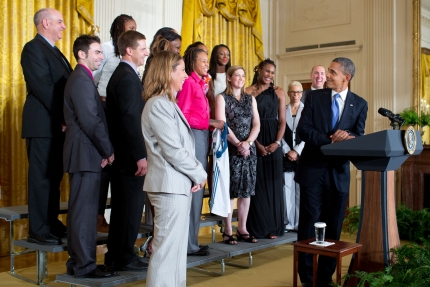
President Obama welcomes Coach Cheryl Reeve and the WNBA Champion Minnesota Lynx to the White House (September 18, 2012)

President Barack Obama welcomes Coach Cheryl Reeve and the WNBA Champion Minnesota Lynx to the White House to honor the team and their 2011 WNBA Finals victory, in the East Room, Sept. 18, 2012. (Official White House Photo by Sonya N. Hebert)

President Obama today welcomed the Minnesota Lynx to the White House.

Two years ago, Minnesota was home to the worst team in the WNBA. Last year, they were the WNBA champions.

In describing their march to WNBA finals, President Obama told the story of their remarkable turnaround -- describing how they drafted Maya Moore, signed veteran players like Rebekkah Brunson and Lindsay Whalen, and hired Cheryl Reeve to be their coach.

"By the end of the season, Maya was Rookie of the Year, Lindsay led the league in assists, Cheryl was Coach of the Year," the President said. "The team had the best record in the league. They made their home games the hottest ticket in town. Then, just in case anyone doubted their dominance, they marched through the playoffs, losing only one game and sweeping their final two series."

This year, the Lynx are picking up where they left off -- they're leading the Western Conference, and they've already clinched homecourt advantage for the playoffs.

But more importantly, the President said, they're continuing to set an important example for young women across the country.

"As the husband of a tall, good-looking woman and as the father of two tall, fabulous girls, it is just wonderful to have these young ladies as role models," he said. "There’s something about women’s athletics -- we know for a fact that when girls are involved in athletics, they do better across the board. They’re more confident. They do better in school."

President Obama Welcomes the 2011 WNBA Champion Minnesota Lynx

September 18, 2012 | 7:21 | Public Domain

President Obama congratulates the Minnesota Lynx on winning their first-ever WNBA championship.

Download mp4 (271MB) | mp3 (7MB)

Read the Transcript

Remarks by the President Honoring the WNBA Champion Minnesota Lynx

East Room

1:26 P.M. EDT

THE PRESIDENT:  Hello, everybody!  Hello!  Please everybody have a seat, have a seat.  Welcome to the White House, and congratulations to the Minnesota Lynx on winning their first-ever WNBA championship.  (Applause.)

These women have brought glory back to the Twin Cities.  I know there are a lot fans at home who are happy to have a professional title back in Minnesota. 

This team has come a long way to get here.  Just two years ago, the Lynx had the worst record in the WNBA.  (Laughter.)  I’m just saying.  (Laughter.)  But they didn’t let it get them down –- they got to work.  GM Roger Griffith is here, and he’ll tell you that it was hard work for him, too.
It helped that the team drafted UConn standout Maya Moore.  She is becoming a regular here.  I mean, this like the fourth time she’s shown up at the White House.  (Laughter.)  She just somehow likes to attract hardware.  Picked up veterans like Rebekkah Brunson and Lindsay Whalen, and Cheryl Reeve took over as head coach and has done an extraordinary job.

Apparently, that was the recipe to go from worst to first.    By the end of the season, Maya was Rookie of the Year, Lindsay led the league in assists, Cheryl was Coach of the Year.  The team had the best record in the league.  They made their home games the hottest ticket in town.  Then, just in case anyone doubted their dominance, they marched through the playoffs, losing only one game and sweeping their final two series.  That is one heck of a turnaround.   

In the championship series, the Lynx faced a very tough Atlanta Dream, but they were ready.  I hear they brought in a bunch of men who played in college to imitate the Dream in practice so they could gain an extra edge.  And those were some brave guys, because -- (laughter) -- I wouldn’t want to take any of these ladies on.  I’ve had the pleasure of playing with Maya and she lit everybody up.  (Laughter.)  It is not fun when she’s raining down jumpers on you. 

But, obviously, it worked.  And in the finals, the Lynx came back from three consecutive first-half deficits and took home the championship trophy.  They won it on the shooting of Seimone Augustus, who averaged nearly 25 points a game, and after leading the scoring charge in the final game, was named -- not surprisingly -- Finals MVP.  And they won it on the heart and grit of Taj McWilliams-Franklin.  Mama Taj played the final game on a sprained knee and still managed to secure the paint and pull down four rebounds. 

So there’s no question that these are some outstanding basketball players.  But they also find the time to raise money for breast cancer research, help local students with their reading.  I hear they clean up pretty well for their Cat Walk for a Cure fashion show.  (Laughter.) 

So this team does it all and they do it in style.  (Applause.)  And I appreciate the Lynx taking time to stop by today, because they’re in the middle of their season right now.  And they’ve picked up right where they left off –- on top of the Western Conference by a wide margin.  Coach just told me that they’ve now secured home court advantage throughout the playoffs.  With three games to go, best record in the league.  They’re leading the league in points, rebounds, assists.  So you get the idea -- they’re pretty good.  And I have a feeling that we might end up seeing them back here before too long.

And finally, I was saying to these folks as I was backstage, as the husband of a tall, good-looking woman -- (laughter) -- and as the father of two tall, fabulous girls, it is just wonderful to have these young ladies as role models.  There’s something about women’s athletics -- we know for a fact that when girls are involved in athletics, they do better across the board.  They’re more confident.  They do better in school.  They have less social problems. 

We know all the statistics, but what’s also true is that our women athletes just present themselves so well and are such great ambassadors for the game.  And as I was pointing out, you don’t see them on Sports Center doing stupid stuff.  (Laughter.)  They play the game the right way.  They compete fiercely, but they’re good -- great sportswomen.  And so they’re just wonderful examples for my daughters and my niece, and for so many parents I think we all feel really, really great about what the WNBA has accomplished, but what this team in particular has accomplished.

So I want to say thank you to all of you.  Congratulations.  I’m going to invite Coach to come up and just say a few words.  (Applause.) 

END          
1:31 P.M. EDT

Close Transcript

The White House

Office of the Press Secretary

Readout of the President’s Call with Prime Minister Erdogan of Turkey

President Obama and Prime Minister Erdogan spoke by phone today to continue their close consultations on regional and global issues.  The President expressed condolences for today’s deadly attack on a Turkish military convoy and other recent attacks that have killed and wounded Turkish citizens; the Prime Minister expressed his condolences for the recent loss of Ambassador Chris Stevens and his three colleagues in Libya.  The two leaders agreed on the necessity to work together against all forms of terrorism.  In light of the outrageous attacks on the American consulate in Benghazi and subsequent attacks on American and other nation’s facilities across the region, the President commended Prime Minister Erdogan for his leadership in calling for resistance to provocation and condemning violence.  On Syria, the two leaders shared their concerns over the regime’s escalating use of violence against civilians, the growing humanitarian crisis, and the urgency of transition.  They took note of the very close and effective cooperation between the governments of the United States and Turkey in the face of the ongoing crisis in Syria, and pledged to advance this important work.

The White House

Office of the Press Secretary

Press Briefing by Press Secretary Jay Carney, 9/18/2012

James S. Brady Press Briefing Room

11:33 A.M. EDT

MR. CARNEY:  Well, hello, ladies and gentlemen.  Thanks for being here this morning -- still morning.  I appreciate, as ever, you coming to the briefing.  I don't have any announcements, so we'll go straight to questions.

Ben.

Q    Thanks, Jay.  Has the President seen the video that's caused a lot of people to be talking this morning -- the 47 percent video? And if so, what's his reaction to it?  

MR. CARNEY:  Let me say this.  The campaign has put out a statement and I'm sure others from the campaign will be asked about and will address it.  So I'll limit what I say in response to questions about it.  What I'll say is this:  When you're President of the United States you are President of all the people, not just the people who voted for you.  You've heard the President say so many times because he deeply believes it that we're in this together, all of us.  From the time he began his career in public service, from the time that those of us in this room first heard of him in 2004, his message has been about the fact that what unites us as Americans is far greater than the things that divide us.  And that's fundamental to who this President is, and it's fundamental to what guides him as he makes decisions.

When he made the decision against the advice of many to take action to save the auto industry, the President did not ask whether the 1.1 million Americans whose jobs would be saved had voted for him or against him.  When he pressed for 18 small business tax cuts he didn’t ask if small businessmen and women were Democrat or Republican.  When he fought to pass health care reform he didn’t wonder whether the 129 million Americans with preexisting conditions who would be helped by this reform, who would be given security through the reform, were likely to be with him or against him in 2012.  That's just not how he thinks.

And I think the way you have to approach the job is with a keen understanding that you're out there fighting for every American.  And this President's agenda has always been about building the middle class, strengthening the middle class, bringing people up into the middle class.  And that's what it will be going forward.

Q    Has the President actually watched the video?

MR. CARNEY:  I don't -- haven’t asked him.

Q    One other follow on this.  One of the comments from Governor Romney in the fundraiser was that 47 percent who support President Obama believe they are victims.  Putting aside just the campaign politics if you need to, does the White House think that that kind of statement has policy implications that would affect how Governor Romney would run the country?

MR. CARNEY:  Well, again, setting aside what Governor Romney thinks, I can tell you that the President certainly doesn’t think that men and women on Social Security are irresponsible or victims; that students are irresponsible or victims.  He certainly doesn’t think that middle-class families are paying too little in taxes.

But again, the broader point that you always hear him make is that we need to come together as a country.  We need to work together for what's best for the country and best for especially the middle class, which is the backbone of this nation.

Jeff.

Q    Jay, can you tell us a little bit more about how the President himself reacted to the video, whether or not he's seen it?

MR. CARNEY:  Again, I don't know if he's seen it and I don't have any discussions with him about it to read out to you.

Q    Can you tell us if he talked about it with senior staff this morning or --

MR. CARNEY:  Again, I'm not going to read out any internal conversations about that or other issues.

Q    Let me switch to a policy question then.  There's some volatility in the oil markets yesterday and today.  Some of that some people are saying was due to speculation about an imminent SPR move.  Number one, can you give us any update on your SPR thinking?  And number two, can you tell us if there was any sort of intel that showed -- may have shown that yesterday's drop was a technical glitch?

MR. CARNEY:  Let me refer questions about the market yesterday to the CFTC.  That's the appropriate agency to refer those questions to. 

Our position on the SPR is what it has been, which is that we monitor the situation regularly and constantly together with our international partners and we continue to say that all options remain on the table.  But I don't have any announcements to make today.

Q    Do you have -- has the President, has the White House been watching the oil markets in general?  Even if you don't want to speak specifically to yesterday's move, any update in your thinking about just developments there? 

MR. CARNEY:  Well, look, I think you saw in May at the G8, and, more recently, finance ministers for the G7, this is something that is regularly monitored and discussed by the United States with its international partners. 

I can say that in terms of more recent developments, the administration welcomes the Saudi Arabian oil minister's recent remarks and share his concern about rising oil prices in the international oil market.  We also welcome Saudi Arabia's continued commitment to take all necessary steps to ensure the market is well supplied and to help moderate prices. 

As we have also said for some time, the administration continues to take steps to expand domestic oil and gas production, which has increased each year the President has been in office.  In fact, as you know, U.S. oil production is currently at an 8-year high and domestic natural gas production is at an all-time high.

Q    But gas prices are going up in the U.S. right now.  Is that something you're concerned about or looking at any additional measures to address?

MR. CARNEY:  With regards to the international oil market and oil prices, we monitor them constantly with our international partners.  It's something that we keep very close track of.  And we retain the right to keep all options for dealing with those issues on the table, and that includes SPR.  But I have no announcements of any action that may or may not be taken.

Yes, Mary.

Q    The President also had his fair share of private moments that have later been made public.  During the 2008 election, he said that rural voters "get bitter" and they cling to their guns or religion.  Like Mr. Romney, this was also said privately to donors and then later made public after the fact.  Rural voters certainly aren't 47 percent of the electorate, but they are a large demographic.  How is Mr. Romney's comments any different from what the President said?

MR. CARNEY:  Look, I think that happened four years ago and was discussed in abundance at the time.  What the President said four years ago, what he said eight years ago, what he says today and what he said ever since he took office here is that he's fighting for every American, that he firmly believes that as a nation we're all in this together, that what unites us is far stronger and greater than what divides us, that we're not red America and blue America, we're the United States of America.

And I think that that's a fundamental fact about Barack Obama.  And it's been the guiding philosophy and principle behind the policy decisions he's made. 

I think, again, citing some of the examples from what he's done in office, when he took action to ensure that our financial markets, our financial sector did not collapse, he didn't check to see whether the people who would most directly benefit from that were supporters or not.  He took a lot of grief for that, but he did it because he thought it was right for the American economy and right for all Americans that we do not experience the collapse of an important sector of our economy. 

The same thing with the auto industry -- he didn't ask if autoworkers were supporters, he didn't ask if auto executives were supporters.  He did what he believed was right for the country.  And that's been his guiding principle.

And I think he talked about this in Charlotte, that the people who inspire him, the people who give him hope, he doesn't know whether they're voting for him.  The soldier he first met at Walter Reed who lost a leg, he doesn't know; the gentleman who won the lottery and kept working and bought flags for his town. 

This is the sort of essence of the American story that inspires him every day.  And it does not matter to him whether they're Republican or Democrat or independent, because we're all in this together.

Q    The campaign said, in their response to Mitt Romney's statements, that it's hard to serve as President for all Americans when you've disdainfully written off half the nation.  And you've said repeatedly now that the President obviously does represent all Americans.  Why is that any different from Mitt Romney when he makes a comment like this?

MR. CARNEY:  What's the question again?

Q    The question being that if the President can make a comment like he did in 2008, where he sort of offended a large -- I don't want to say "offended," but where he made a remark in direct relation to a large portion of the electorate, and Mitt Romney makes a similar remarks also offending or --

MR. CARNEY:  Then-Senator Obama never said that he did not worry about or would not worry about 47 percent of the population. 

A lot of folks, when we travel around the country ask why the President is campaigning on a bus in towns and communities and counties that trend red or Republican.  Why is he there if he's not likely to win the count?  Because he's there to take his message about his economic vision and his agenda for the country to everybody, because he firmly believes that building this country up helps everybody.  You've heard him talk about it, that if we do the right things for our economic policy, if we take a balanced approach to dealing with our fiscal challenges, if we reduce spending, reform our entitlements, ask millionaires and billionaires to pay a little bit more, that everybody will benefit, including millionaires and billionaires.  That's the essence of his governing philosophy and it's at the core of who he is.

Q    Can I ask one more question, just on a different topic? It seems that the U.S. and Libya have sort of different accounts of the attack in Benghazi last week.  There are reports that Libyan officials warned the U.S. of the growing extremist threat prior to the attacks, that they admitted they could not control some of these militias.  That seems to run counter to what administration officials have been saying, that this was just a spontaneous reaction to this anti-Islam film.  Can you kind of reconcile this?

MR. CARNEY:  Well, what I can tell you is that we have provided information about what we believe was the precipitating cause of the protest and the violence, based on the information that we have had available.  There is an ongoing investigation.  The FBI is investigating.  And that investigation will follow the facts wherever they lead.

What we do know about Libya is that it's a country that emerged from war and revolution, and you have a new government trying to assert its authority as that country makes a transition to democracy and broader representation for all Libyans and broader rights for all Libyans.  And in that environment there are certainly, in this postwar, post-revolution environment, there are vast numbers of weapons and certainly a number of violent groups in the country. 

What is important to note, however, is that the Libyan people do not understand -- or rather they do understand that the United States was with them in their efforts to achieve their aspirations, to rid them of the Qaddafi regime and the tyranny that Qaddafi inflicted upon them.  But it is still a very volatile place, there's no question about it. 

Nancy.

Q    Jay, back to Mary's question for one moment -- did the President regret making those comments about guns and religion?  Did he learn something from the fallout?

MR. CARNEY:  Nancy, again, these are comments that happened four years ago.  There has been plenty of ink spilled and plenty of things said about them four years ago.  I know that fundamentally what the President was saying four years ago, what he was saying in 2004, and what he's saying today is entirely consistent, which is that as a country we are united by far stronger stuff than the things that divide us, that he is out there fighting for every American, regardless of whether or not they support him politically or support the Democratic Party.

It is really the essence of who he is as a public official, that that's his guiding principle.  And it's reflected by everything I've just talked about.  The policies that he's pursued have sometimes earned him criticism from left or right or center, precisely because he's not evaluating when he makes those decisions whether the people who are helped by them are supporters, or people who voted against him or will vote against him.  He is guided by what he thinks is best for the country.

And he firmly believes that outside of the rancor in Washington, while people have very firmly held positions and opinions and it is a country that tends to be relatively divided between the two parties when we have national elections, that on the stuff that matters to Americans' day-to-day lives, we're a lot more united than we sometimes perceive here in Washington, and that the President believes that in his bones and it's what guides him. 

Q    I want to ask you about something else that Governor Romney said and get your take from a policy perspective.  On the Middle East peace process, he said the "Palestinians have no interest whatsoever in establishing peace and that the pathway to peace is almost unthinkable to accomplish."  Does the President share this view about the Middle East?

MR. CARNEY:  The President believes and is committed to working with -- the President believes and is committed to the principle that a two-state solution is the right solution for Middle East peace.  That is a basic tenet that has been pursued by Democratic and Republican administrations prior to President Obama.  And his two immediate predecessors worked on this issue under the firm belief that a two-state solution was the right solution, and it’s what has guided this President.  So I think his view is a little different from what was expressed.

Q    Governor Romney said that this is likely to remain an “unsolved problem.”  Given recent history in the Middle East, is he wrong about that?

MR. CARNEY:  Well, that it’s a difficult problem I think we can all agree on.  That it is a challenge that previous Presidents of both parties have embraced because they believe it’s right for the country, they believe it’s right for American interests, for the interests of Israelis, the interests of Palestinians, is also true.  And it is simply the wrong approach to say we can't do anything about it, so we’ll just kick it down the field.  That's not leadership.  That's the opposite of leadership.

And this President has been working on this issue since the day he took office.  It is a tough issue, but ultimately peace between the Israelis and Palestinians, a negotiated peace that provides security for Israel and a state for the Palestinians, is in the interest of the Israelis and the Palestinians, and is in the interest of the United States of America, and this President will continue to pursue it.

Ed.

Q    Jay, I want to go back to Libya.  On September 10th, you put out a press release saying that the President had a meeting with senior officials to figure out the security posture around the 9/11 anniversary.  And in that press release you said that “steps were taken to protect U.S. persons and facilities abroad.  The President reiterated that departments and agencies must do everything possible to protect the American people both at home and abroad.”  So in retrospect, given the tragedy, did the administration drop the ball on what you promised on September 10th that you had improved security at these installations?

MR. CARNEY:  They were numerous steps taken, as there have been every year on the anniversary of 9/11, and as there have been at different times on the calendar when it is judged by the experts that taking additional steps, security steps, is the right thing to do.  As for specific measures taken at specific facilities, diplomatic facilities, I would refer you to the State Department.

Q    Separate from the FBI investigation you mentioned to Mary a few moments ago, is there any sort of inquiry going on here at the White House among the President’s national security team to get to the bottom of -- you told the American people on September 10th, "We’ve taken steps to protect Americans here at home and abroad."  Obviously, with four Americans tragically being killed, the steps were not good enough.  So is there an inquiry going on here to figure out what went wrong?

MR. CARNEY:  Well, I think that you’re conveniently conflating two things, which is the anniversary of 9/11 and the incidents that took place, which are under investigation in terms of what --

Q    Which happened on the anniversary.

MR. CARNEY:  -- which are under investigation, and the cause and motivation behind them will be decided by that investigation.

It is certainly -- I would point you to what Ambassador Rice said and others have said about what we know thus far about the video and its influence on the protests that occurred in Cairo, in Benghazi and elsewhere.  And all I can tell you is that steps are taken, both seen and unseen, in advance of and in preparation for times like the anniversary of 9/11 when it is judged that there might be greater threats.  And those steps are based on the threat assessments that we have at the time.  But I would refer you in terms of specific security for specific facilities to the State Department.

Q    But you’re not trying to say there was enough security in Benghazi are you?

MR. CARNEY:  I am simply saying that this is a matter under investigation.  It is an absolute tragedy that we lost four Americans in Benghazi, including our ambassador, including security personnel.  And there’s an active investigation underway into what happened and why, and what the motivations were, and driven by the absolute commitment that this President made to finding who was responsible and holding them accountable and bringing them to justice.  And I think that’s very important.

Q    I think Mary asked as well whether or not there was sort of any heads-up for the administration that there was violence coming in Libya.  Reuters reported that the U.S. embassy in Cairo got a heads-up that there was a cable that went around suggesting that violence was increasing around the U.S. embassy there.  There were other reports suggesting that the U.S. installation in Benghazi in Libya had up to three days’ notice that violence was increasing.  I didn’t hear an answer to that, so I’m trying to understand -- to that question.  Did the administration have any sort of heads-up that violence was increasing specifically in Libya before the attack?

MR. CARNEY:  I’m not aware of any, Ed.  This is a matter that’s under investigation in terms of what precipitated the attacks, what the motivations of the attackers were, what role the video played in that.  What we have seen is broad unrest across the region and elsewhere in response to this video, which we have made clear we view as reprehensible and disgusting, and a video that is in no way connected to the United States government and does not reflect the values that we hold as a people.

Q    Do you think the video led protesters to get rocket-propelled grenades --

MR. CARNEY:  What I know, Ed, and I know you know is that Libya, as I just said, is a very volatile place that has just gone through a revolution and a war, and where there is an abundance of weapons, including heaving weapons.  And there are certainly groups that carry those weapons and look to take advantage of circumstances, as there are around the region and the world. 

We have seen circumstances in the past, in other parts of the region, where incidents that inflame opinion are taken advantage of and exploited by groups that have an interest in creating chaos and destabilizing either a local government or attacking the West or the United States.  And that’s something we’ve seen certainly for the past number of years.

Q    Jay, thanks.  The U.S. is suspending training for new Afghan recruits.  How big of a setback will this be for the withdrawal timeline?

MR. CARNEY:  Well, the military continues to work to understand why there has been a spike in the kinds of attacks, the so-called green-on-blue attacks, in Afghanistan.  And we’re working with Afghanistan to take measures to better protect our troops.  In that vein, General Allen has directed all of his operational commanders to review their force protection and tactical activities in light of the current circumstances. 

As a result of that directive, ISAF directed a change in the level at which advising and partnering takes place; most partnering and advising will now be at the battalion level and above.  This does not mean that there will be no partnering below that level.  The need for that will be evaluated on a case-by-case basis. 

More broadly, the President’s policy of gradually turning over security lead to Afghan forces continues, and that is part of a broader strategy that has to -- that will result in more American troops coming home and Afghans taking more and greater responsibility for the security of their nation, and that process continues.

Q    But, Jay, handover of power is such a key part of the withdrawal process, so how can this not impact the overall timeline?

MR. CARNEY:  It doesn’t affect the timeline.  I think the issue here is partnering with our Afghan security forces.  That's what General Allen was addressing and ISAF was addressing.  And part of this process obviously is training up Afghan security forces so that they are in a position to capably take over responsibility for their own security.  That partnering continues with the changes in directives that I just talked about.  But the transition that the President has laid out will absolutely continue.

Q    And it's been described as a temporary suspension.  Can you characterize what temporary means?

MR. CARNEY:  I think that's obviously something that's based on the judgments made by commanders in the field as well as officials at the Pentagon.

Q    And you point out you're suspending training of the new recruits, but the Afghan army, the national police trained by NATO are not going to be affected by this suspension.  So how can you have confidence that they won't --

MR. CARNEY:  Well, I think that's a question best addressed to ISAF as well as to the Pentagon.  Our commanders are keenly focused on security for our troops and are taking steps that they believe are necessary to enhance that security and to reduce the incidents of these so-called green-on-blue attacks.  For their specific views on how these measures will achieve that I would refer you to them.

Q    And I just have one more, Jay.  The Washington Post is reporting that due to the protests in Cairo and the Middle East, negotiations have stalled in terms of talking about increased aid to Egypt.  Can you confirm this?

MR. CARNEY:  The reports that we have cut off aid, which is the report that I saw, to Egypt are completely incorrect.  We're continuing to work with the Hill on ways to support a stable, democratic transition in Egypt that is important for defeating extremism of the very kind that we just recently saw.  We provide assistance to Egypt because it's in our interest to help them advance regional security and uphold their treaty with Israel and transition to democracy.   And that process, as I said, continues, and we're working with the Hill to do that.

Q    Jay, I know you can't say whether the President watched the video, but do you know if he's aware of Governor Romney's remarks?

MR. CARNEY:  I think I've said frequently that the President keeps abreast of the news.  I expect that he is aware of that news.

Q    "Expect" -- pretty strong, right?  (Laughter.) 

MR. CARNEY:  I'm sure he's aware of what -- (laughter) -- of news that reaches a level that it's the first thing I'm asked about at the briefing.  (Laughter.) 

Q    Back to Afghanistan.  General Dempsey said yesterday that the green-on-blue attacks pose a very serious threat to the campaign in Afghanistan.  Has that been communicated to the President and does he agree with that assessment?

MR. CARNEY:  Well, I would have to look at the entirety of General Dempsey's comments.  There's no question that the steps that are being taken by our commanders, by General Allen, by ISAF, in reaction to these reflect serious concern about the increase in these attacks.  And it is their commitment and the President's commitment that we take the steps necessary to enhance security for our forces in Afghanistan even as we continue with the mission, which is a very important mission of partnering with and training Afghan security forces so that they can gradually, as they are now, take security responsibility for their own country.  And as they do that American forces will continue to come home.

Q    If the timeline is more affected by (inaudible) the training, does that mean that the quality of the forces that are left behind with the Afghans will be less?  And does that mean that the state of the country that NATO is going to leave behind is going to be a worse state than had hoped?

MR. CARNEY:  I think it's important to point you to a couple of things.  One, what I think Kristen mentioned, this is viewed as a temporary measure, a temporary change in directive, and it is also important to note that partnering will continue at the battalion level and up and at lower levels as judged on a case-by-case basis.

So the partnering relationship continues.  It is important to the process of transitioning security lead over to the Afghans so that our men and women can come home.  And that process continues.

Mark.

Q    Jay, is there a policy about donors bringing recording devices into presidential events that are closed to the press?

MR. CARNEY:  I would refer you to the campaign.

Q    Well, you've been to many of them where there are closed press events where the President takes questions from donors and the like.  Would you say he's more forthcoming when there's no press there?

MR. CARNEY:  Well, first of all, I'd say at these events the President speaks and the press pool is there when he addresses --

Q    Not for the Q&A part.

MR. CARNEY:  No, I agree with that, and I would say that that President's message is consistent whether he's talking to donors or to grassroots supporters or to people at an official event on policy matter.  And I think it's fair to say that when the President speaks to wealthier Americans who are supporters, he doesn’t change the fact that he believes we need to take a balanced approach to our fiscal challenges, and that includes asking millionaires and billionaires -- including millionaires and billionaires who might be in the room -- to pay a little extra.  And his supporters who fall into that category are aware of that and they've made the decision that for the good of the country that policy is the right policy moving forward.

So the President's message is clear and he takes it to all Americans.  And it goes to what I was talking about earlier, that he really doesn’t believe that dividing us into categories and groups is the right way to move forward as a nation.  And he doesn’t spend a lot of time thinking about what policies he's pursuing -- about the policies he's pursuing and whether or not they benefit specific individuals who may or may not, or groups of individuals who may or may not have supported him in 2008 or will support him in 2012.

He thinks that the best politics is the right policy, and the best policy are the policies that move the country forward, that makes sure that more Americans are getting educated, that more middle-class Americans have work, that they have security -- health care security and retirement security -- and that we're taking steps to develop alternative energy so that we can enhance our energy independence, and that we're investing in research and development and infrastructure so that our country has the economic foundation it needs to move forward so that everybody benefits, everybody from the factory floor to --

Q    So if there's no change in tone or substance, why are they closed to the press?

MR. CARNEY:  We have taken steps to have the press participate in these events.  I spent a lot of time on driveways, in vans as a reporter for this President's predecessors, covering this President's predecessors, when the press pool was not allowed in.  And as you --

Q    You didn’t like it, I'll bet.

MR. CARNEY:  Well, it depended on whether or not there were beverages served.  (Laughter.)  

Q    Is now the time to bring up your April 14 column from 2008 when you said the President's words were poorly chosen on the guns and bitter?

MR. CARNEY:  I don't remember that column.  (Laughter.)  I honestly don't. 

Q    I can read the whole thing for you if you want. 

MR. CARNEY:  I think the President, then candidate, addressed this at the time -- this was four years ago -- and I think the broader point is that his message there and everywhere in 2008, and going back to 2004, and every day since, has been consistent, which is that we're in this together, all of us, and that his interest is in moving the entire country forward in ways that benefit senior citizens on Social Security, students who are getting student loans, combat veterans -- I mean, combat troops as well as veterans -- everybody in this country is I think working towards the same goal, which is advance moving the country forward. 

And the vast majority of people, this President believes, are hardworking, responsible, committed to their families and committed to their country.  And that's the animating principle behind his politics and his policies.

Q    Will the President mention it in his fundraisers tonight, the Romney remarks?

MR. CARNEY:  I don't have any previews for you on the President's remarks.

Q    I wanted to go back to the conflict between -- the conflicting reports I guess between the administration and Libyan officials over what happened.  On Friday, you seemed to cite that the videos were definitely part of it, but I get the sense that you're backing away from that a little bit today.  Is there something that you've learned since? 

MR. CARNEY:  No, no.  I think what I am making clear and what Ambassador Rice made clear on Sunday is that reaction to the video was the precipitating factor in protests in violence across the region.  And what I'm also saying is that we have -- we made that assessment based on the evidence that we have, and that includes all the evidence that we have at this time.

I am not, unlike some others, going to prejudge the outcome of an investigation and categorically assert one way or the other what the motivations are or what happened exactly until that investigation is complete.  And there are a lot suppositions based on the number of weapons and other things about what really happened in Benghazi and I'd rather wait, and the President would rather wait, for that investigation to be completed.

Q    So you're not ruling out that --

MR. CARNEY:  Of course not.  I'm not ruling out -- if more information comes to light, that will obviously be a part of the investigation and we'll make it available when appropriate.  But at this time, as Ambassador Rice said and as I said, our understanding and our belief based on the information we have is it was the video that caused the unrest in Cairo, and the video and the unrest in Cairo that helped -- that precipitated some of the unrest in Benghazi and elsewhere.  What other factors were involved is a matter of investigation.

Q    Can you talk a little bit about is this going to prompt any --

MR. CARNEY:  I'd refer you to the FBI for that.  I don't keep timelines, FBI timelines at the ready. 

Q    You mentioned aid with Egypt and working with the Hill. Is this going to prompt any revisions or any review, I guess, of the President's policies toward the Arab Spring?

MR. CARNEY:  Look, the President’s policy towards the Arab Spring is that we support the democratic aspirations of the people of the region.  And the upheavals that you’ve seen in the region over the past several years have been in reaction to oppressive governments that do not respect the basic rights of their citizens.  In cases like in Tunisia and Libya and elsewhere, democratic transitions are underway.  They are in early stages, and there is a lot of volatility in these countries -- Egypt as well, of course. 

And our policy is geared towards supporting that transition in a way that enhances the prospects of democracy in the region and enhances the prospects that the countries in the region will continue to be -- either will continue to be or will grow to be supportive of the United States and our interests in the region and around the world.  And that policy hasn’t changed.

Q    Jay, there’s going to be a lot of attention on the Supreme Court next week because they'll consider taking up several pending marriage cases related to both the Defense of Marriage Act and California’s Proposition 8.  The Justice Department has already made its views known on the DOMA cases, but given the President’s previously supported -- previously stated opposition to Prop 8 and support for marriage equality, does the administration want the Supreme Court to take up the Prop 8 case, making some national ruling on same-sex marriage?  Or as claimants in the case have requested, would you prefer that the Court allow the lower court ruling to stand and striking down the marriage ban just in California?

MR. CARNEY:  That’s quite a question, and I will ask you to direct it to the Justice Department.  I’m not going to make policy towards Supreme Court cases from here.

Q    Generally speaking, though, I mean, would this President welcome the Supreme Court taking up a case that will enable it making a court ruling in favor of same-sex marriage across the country?

MR. CARNEY:  I don’t have anything to say on that at this time.

Q    Back to Libya.  Ambassador Rice says on Sunday that it was spontaneous, and then we hear from the State Department that there’s not enough information to make the determination.  But you’re saying that there is no shift, right?

MR. CARNEY:  No, I’m saying that based on information that we -- our initial information, and that includes all information -- we saw no evidence to back up claims by others that this was a preplanned or premeditated attack; that we saw evidence that it was sparked by the reaction to this video.  And that is what we know thus far based on the evidence, concrete evidence -- not supposition -- concrete evidence that we have thus far.  But there is a lot that is under investigation here, and as more facts come to light, if they change that assessment, we’ll make that clear.  But there’s an active investigation for a reason -- so that we actually get the facts and don’t base our policy prescriptions on suppositions about what we think we know happened as opposed to what actually happened.

Q    Would the administration still say that it was spontaneous?

MR. CARNEY:  Based on the information that we have now, it was -- there was a reaction to the video -- there was protests in Cairo, then followed by protests elsewhere, including Benghazi, and that that was what led to the original unrest.  The other factors here -- all factors -- but the other factors here, including participants in the unrest, participants in the violence, are under investigation.  And the goal of that investigation is both to find out what happened and why, but also to track down and bring to justice those who killed four Americans.  And we’re working with our Libyan counterparts to ensure that that happens, as the President committed it would. 

Q    Tomorrow, administration officials will be on the Hill briefing members.  Can you tell us anything about that?

MR. CARNEY:  On what subject?  I think members of the administration brief members regularly on different --

Q    On Libya?

MR. CARNEY:  I assume that they’ll be briefing them on all the information we have up to the moment before they brief.  And that’s what I’m reflecting at this time from here.

Q    Thank you, Jay.  As far as next week, how much is the President realistically going to be able to accomplish at the U.N. General Assembly with partners and allies when he’s only going to be there for such a short time, and he’s spending a lot of that on two big speeches?

MR. CARNEY:  Well, the President is attending UNGA, as Presidents before him have during their reelection years, and he intends it to be a productive time spent at the U.N. General Assembly, as it was last year, as it was the year before and the year prior to that.  I don’t have anything specific in terms of what he’s going to say at UNGA or what issues he’s going to press, but you can be sure that he expects it to be a productive visit. 

Q    What’s keeping him from extending the stay a little longer, like you would in other years, in order to have bilaterals and things like that?

MR. CARNEY:  I think we’re there for two days, which is the number of days we were there last year.  We were there for an overnight last year.

Q    Aung San Suu Kyi is in town for a few days.  I was wondering if the President will be meeting with her while she’s here.

MR. CARNEY:  I don’t have any scheduling announcements for the President at this time.  If there’s a change in that I’ll bring it to your attention.  

Mark.  Donovan, after Mark.

Q    A question on China.

MR. CARNEY:  Yes.

Q    Yesterday, in addition to the trade news, Leon Panetta was in Japan.  The Japanese and the U.S. are cooperating on building this missile defense system, which prompted a lot of anxiety in China among analysts and some officials there who said they viewed it as being targeted or aimed at them.  Given that you’ve had two major trade cases in the last few months and this, is there a concern that the message, the overall message the United States is giving to China is perhaps too tough? 

And given that in the past when China has become a big issue in campaigns -- in ’92 and 1980 -- it’s often led to very difficult period for whoever wins the election in actually dealing with China.  Is the President at all concerned that that precedent is being repeated now?*

MR. CARNEY:  The President’s policy, with regards to China  -- his policies, because this is a broad and complex relationship -- are driven by what he believes are in the interests of the American people and the American economy as well as America’s national security.  And that is why we have such a multifaceted, complex relationship with China that includes cooperation in a wide variety of areas, because cooperation is beneficial both to the United States and to China.

It is why when we see instances or the USTR sees instances of unfair trade practices that are harmful to American workers and American businesses, this administration will act as it has to take cases before the WTO at twice the pace of the previous administration.

When the President and senior members of his administration sit with their Chinese counterparts, they discuss all of these issues -- areas of disagreement as well as areas of agreement where they can work forward together.  And I have been in the room when the President has been with President Hu, and can testify to that fact that it is a very frank exchange about a variety of issues.  And we have a broad and important relationship with the Chinese that we expect will continue with this President after he’s reelected, if in fact he is.

Q    On the missile defense system, specifically, though -- what argument, what case would you make to Chinese analysts that are worried that somehow that represents (inaudible) China?

MR. CARNEY:  I will have to take that question.  I haven’t looked into it to any degree so I’ll have to take that and get back to you.

Donovan, I owe you.

Q    Thanks.  A brief follow on Libya.  There’s still a little bit of confusion.  You guys have said that you’re working closely with the Libyan government in the investigation and you’re saying the information available to you guys so far has indicated that it’s the film that prompted the violence.  And is the information different that you guys have than the Libyan government has?  Are you suggesting that the Libyan government is jumping to conclusions?

MR. CARNEY:  I’m not making a judgment on statements by others.  I’m simply saying that, based on the information -- what we initially had available and have available -- we do not have any indication at this point of premeditation or preplanned attacks.  But it is under investigation and I don’t -- and that investigation will follow the facts wherever they go and wherever they lead. 

So, again, I’m not -- we are working with the Libyans -- with the Libyan government in our pursuit of those who killed four Americans and our commitment to bringing them to justice, as well as to the broader -- within the broader investigation.  But I’m not casting judgment on others’ assertions.  I’m simply saying what we know and what we are working to find out.

Q    So have you guys ruled out premeditation or --

MR. CARNEY:  No.  No, I’m simply saying based on what we knew at the time, knew initially, what we know now, the facts that we have, the video was a precipitating cause to the unrest in the region and specifically in Libya.  Other factors involved in the violence that ensued -- other factors that are involved in that are under investigation and, again, the facts will be followed wherever they lead.  The point is that we’re not making declarations ahead of the facts here.  We’re just telling you what we know based on the information we have at the time.

Yes, Kathleen.

Q    Just one more bit on the Romney video.  The other remark he made was that he might have a better chance in the election if his parents were Mexican-born.  I’m wondering if the President has seen that and if you had any reaction.

MR. CARNEY:  Did I have any reaction?

Q    Well --

MR. CARNEY:  Yes, I think I’ll steer away from that, but thanks for the opportunity.

Q    Well, has the President seen that, do you know?

MR. CARNEY:  Again, I haven’t had a discussion with him about the video so -- but I can boldly say that I am confident that he’s aware of it.

Yes, ma’am.

Q    Thank you, Jay.  On North Korea, I hear that President Obama has extended sanctions against North Korea for one more year.  Is it related with the terrorist standards of the North Korean regime?

MR. CARNEY:  Our position with regards to North Korea is unchanged.  And we continue to work with our international partners to pressure North Korea to get right with the international community, to abide by its obligations and, in doing so, to end its isolation, its profound isolation from the world.  But I don’t have anything specific on that issue today.

Q    Thanks, Jay.

MR. CARNEY:  Yes.  I'm sorry -- go ahead. 

Q    Back to Burma for a moment.  Aung San Suu Kyi is in town.  How does the administration assess the progress that’s being made in Burma toward more openness, more reforms?  And what’s the next step for the U.S. if that process continues?

MR. CARNEY:  Well, I think we’ve said all along that progress that is made towards openness and democracy and reform will be met with positive steps by this administration, this government in its dealings with Burma.  And I think that is a step-by-step process.  I don’t have next steps to announce before they happen, but we’re closely monitoring that progress and taking steps accordingly, as I think Secretary Clinton has been pretty explicit about in her recent comments.

Thanks very much.

END   
12:22 P.M. EDT

The White House

Office of the Press Secretary

Remarks by the President Honoring the WNBA Champion Minnesota Lynx

East Room

1:26 P.M. EDT

THE PRESIDENT:  Hello, everybody!  Hello!  Please everybody have a seat, have a seat.  Welcome to the White House, and congratulations to the Minnesota Lynx on winning their first-ever WNBA championship.  (Applause.)

These women have brought glory back to the Twin Cities.  I know there are a lot fans at home who are happy to have a professional title back in Minnesota. 

This team has come a long way to get here.  Just two years ago, the Lynx had the worst record in the WNBA.  (Laughter.)  I’m just saying.  (Laughter.)  But they didn’t let it get them down –- they got to work.  GM Roger Griffith is here, and he’ll tell you that it was hard work for him, too.
It helped that the team drafted UConn standout Maya Moore.  She is becoming a regular here.  I mean, this like the fourth time she’s shown up at the White House.  (Laughter.)  She just somehow likes to attract hardware.  Picked up veterans like Rebekkah Brunson and Lindsay Whalen, and Cheryl Reeve took over as head coach and has done an extraordinary job.

Apparently, that was the recipe to go from worst to first.    By the end of the season, Maya was Rookie of the Year, Lindsay led the league in assists, Cheryl was Coach of the Year.  The team had the best record in the league.  They made their home games the hottest ticket in town.  Then, just in case anyone doubted their dominance, they marched through the playoffs, losing only one game and sweeping their final two series.  That is one heck of a turnaround.   

In the championship series, the Lynx faced a very tough Atlanta Dream, but they were ready.  I hear they brought in a bunch of men who played in college to imitate the Dream in practice so they could gain an extra edge.  And those were some brave guys, because -- (laughter) -- I wouldn’t want to take any of these ladies on.  I’ve had the pleasure of playing with Maya and she lit everybody up.  (Laughter.)  It is not fun when she’s raining down jumpers on you. 

But, obviously, it worked.  And in the finals, the Lynx came back from three consecutive first-half deficits and took home the championship trophy.  They won it on the shooting of Seimone Augustus, who averaged nearly 25 points a game, and after leading the scoring charge in the final game, was named -- not surprisingly -- Finals MVP.  And they won it on the heart and grit of Taj McWilliams-Franklin.  Mama Taj played the final game on a sprained knee and still managed to secure the paint and pull down four rebounds. 

So there’s no question that these are some outstanding basketball players.  But they also find the time to raise money for breast cancer research, help local students with their reading.  I hear they clean up pretty well for their Cat Walk for a Cure fashion show.  (Laughter.) 

So this team does it all and they do it in style.  (Applause.)  And I appreciate the Lynx taking time to stop by today, because they’re in the middle of their season right now.  And they’ve picked up right where they left off –- on top of the Western Conference by a wide margin.  Coach just told me that they’ve now secured home court advantage throughout the playoffs.  With three games to go, best record in the league.  They’re leading the league in points, rebounds, assists.  So you get the idea -- they’re pretty good.  And I have a feeling that we might end up seeing them back here before too long.

And finally, I was saying to these folks as I was backstage, as the husband of a tall, good-looking woman -- (laughter) -- and as the father of two tall, fabulous girls, it is just wonderful to have these young ladies as role models.  There’s something about women’s athletics -- we know for a fact that when girls are involved in athletics, they do better across the board.  They’re more confident.  They do better in school.  They have less social problems. 

We know all the statistics, but what’s also true is that our women athletes just present themselves so well and are such great ambassadors for the game.  And as I was pointing out, you don’t see them on Sports Center doing stupid stuff.  (Laughter.)  They play the game the right way.  They compete fiercely, but they’re good -- great sportswomen.  And so they’re just wonderful examples for my daughters and my niece, and for so many parents I think we all feel really, really great about what the WNBA has accomplished, but what this team in particular has accomplished.

So I want to say thank you to all of you.  Congratulations.  I’m going to invite Coach to come up and just say a few words.  (Applause.) 

END          
1:31 P.M. EDT

Behind the Scenes Video: Team USA at the White House

On Friday, more than 400 Olympians and Paralympians were on hand at the White House for an event to celebrate their success in this year's London Games.

This new video lets you go behind the scenes and hear from the athletes as they describe their visit. Check it out here

Related Topics: Inside the White House

Together as One: Honoring Team USA at the White House

September 18, 2012 | 3:51 | Public Domain

Go behind-the scenes and hear from Olympians and Paralympians as President Barack Obama and First Lady Michelle Obama host the 2012 United States Olympic and Paralympic teams at the White House.

Download mp4 (165.1MB)

The White House

Office of the Press Secretary

Remarks by the President to the AFL-CIO Convention -- Columbus, OH

Renaissance Columbus Hotel
Columbus, Ohio

6:17 P.M. EDT

THE PRESIDENT:  Hello, AFL-CIO!  (Applause.)  It is good to be back in Ohio!  Good to see my brothers and sisters in labor. (Applause.)

I want to start off by saying you've got an outstanding leader in Tim.  Give him a big round of applause.  Love what he's doing.  (Applause.)  But you are also -- I was going to say lucky, but you're also wise to have somebody who fights on your behalf every single day in the halls of Capitol Hill, and that is your outstanding Senator, Sherrod Brown.  (Applause.)

Now, you guys have a seat, have a seat, have a seat.  (Applause.)  I am not going to be long, but I'll admit we didn’t necessarily know what you guys were up to until kind of the last minute.  And I said, well, I can't leave Ohio without seeing my friends at the AFL-CIO.  (Applause.)

And it's pretty -- it's timely to be able to see you because I was in Cincinnati today -- (applause) -- came up to Columbus this afternoon, and in both places we announced the work that we've done, in conjunction with Sherrod, to make sure that we're filing a new WTO case challenging China's illegal trade and subsidies in autos and auto parts.  (Applause.)

My attitude is when other countries don't play by the rules we're going to stand up to them.  (Applause.)  Which is why we've actually filed twice as many cases as the previous administration, won every case that has been decided.  So we were able to stop some of these cheap tire imports that were coming into this country unfairly, make sure that a thousand jobs right here in the United States were maintained.  It's the reason that we are going to keep on pressing to make sure that they are playing by the rules -- because my attitude is the United States of America has the best workers on Earth; we've got the best businesses on Earth; and if they are competing fairly we will win every single time.  That's what I believe.  (Applause.)

You may have noticed the guy who's running against me  --

AUDIENCE:  Booo --

THE PRESIDENT:  Don't boo -- vote.  (Applause.)  Vote.  (Applause.) 

He has been running around, talking about how he's going to get tough with China.  Now, this is a guy who started off investing in companies that are called "pioneers" in the business of outsourcing jobs to countries like China.  So I don't think that we can have a lot of confidence if seven weeks before an election, he suddenly says he wants to get tough on China, when his entire history has been feeling pretty comfortable with seeing jobs shipped to China.  In fact, on that tire case, he complained that I was being protectionist. 

And so, now, all of a sudden he is going to go around trying to claim the mantle of fighting for the American working man and woman.  This gives you some sense of what is at stake in this election.  And we've got two fundamentally different visions about how we move this country forward. 

They are peddling the same top-down economics that got us into this mess in the first place.  You ask them what's your ideas to build this economy, they'll tell you, well, we've got tax cuts in the morning and tax cuts at night -- (laughter) -- tax cuts when there's peace and tax cuts when there's war.  In between, we'll roll back some regulations and try to bust some unions, and then we'll go back to some more tax cuts.  That's their entire agenda. 

Well, we've got a different vision.  We want to restore that basic bargain in America that says if you work hard, you can make it -- (applause) -- that says if you're acting responsibly and looking after your family, and willing to put in the effort, you can afford a home that you can call your own, you have a job that pays the bills, that you won't have to worry about going bankrupt if you get sick, that you'll be able to retire with some dignity and some respect.  (Applause.)  And you'll be able to save up enough to help your kids do even better than you did. 

That's what the union movement's been about.  That's what America has been about.  (Applause.)  That's what built the middle class.  That's what built our economy.  That's what we're fighting for.  And we're not going backwards.  We're going forward.  That's what this election is about.  (Applause.)

AUDIENCE:  Four more years!  Four more years!  Four more years!

THE PRESIDENT:  And the nice thing is when you make this choice, you've got a track record to look at.  When I came into office, the first thing I did was overturn bans on project labor agreements on federal -- in federally funded construction -- (applause) -- expanded Davis Bacon coverage in the Recovery Act, appointed folks to the NLRB who actually recognize that their jobs is to be fair and decent brokers -- (applause) -- and to understand that you should be thinking a little bit about labor if you’re a member of the NLRB. 

We made fair pay protections the law of the land -- because my attitude is if a woman is in there working just as hard on that assembly line, or on that construction site, she should get paid just like a man does.  (Applause.)

We committed to doubling our nation’s exports so we’re not just sending jobs overseas, we should be sending products overseas, keeping those jobs right here in the United States of America.  (Applause.)

When some folks said let’s let Detroit go bankrupt, I said we’ve got a million jobs on the line, a whole bunch of them right here in Ohio.  And so we placed our bet on American workers, and now the American auto industry has come roaring back, hiring 250,000 folks back on the job all throughout the Midwest.  (Applause.)

We’re making investments in entire new industries -- in clean energy, folks making wind turbines, building long-lasting batteries.  We are investing in our community colleges to make sure that folks are trained for the jobs of the future.  That's the vision that we’ve got.  We believe that America grows best when everybody has got a fair shot, and everybody is doing their fair share, and everybody is playing by the same rules from Main Street to Wall Street to Washington, D.C.  (Applause.)

That's what we’re fighting for.  That's why I’m running for a second term.  That's why I intend to win Ohio.  That's why I intend to win this election.  I’m going to need your help.  I hope you are ready because I’m just getting started.  And if we win Ohio, we win this election.  If we win this election, we’ll finish what we started, and we will work on behalf of the working men and women of this country, and we’ll remind the world by the United States of America is the greatest nation on Earth. 

Let’s get to work.  Seven more weeks.  God bless you.  God bless America.  (Applause.)

END
6:25 P.M. EDT