Weekly Address: Congress Must Act to Create Jobs and Grow the Economy

President Obama describes how the House of Representatives left town without finishing important work that would create jobs and strengthen our economy.
President Obama describes how the House of Representatives left town without finishing important work that would create jobs and strengthen our economy.
The White House
Office of the Press Secretary
WASHINGTON, DC – Today, President Barack Obama announced his intent to nominate the following individuals to key Administration posts:
Joe H. Ritch – Member, Board of Directors of the Tennessee Valley Authority
President Obama also announced his intent to appoint the following individuals to key Administration posts:
President Obama said, “I am confident that these outstanding men and women will greatly serve the American people in their new roles and I look forward to working with them in the months and years to come.”
President Obama announced his intent to nominate the following individuals to key Administration posts:
Alan F. Estevez, Nominee for Principal Deputy Under Secretary of Defense for Acquisition, Technology, and Logistics, Department of Defense
Alan F. Estevez is currently Assistant Secretary of Defense for Logistics and Materiel Readiness. Prior to his appointment in 2011, he was Principal Deputy Assistant Secretary of Defense for Logistics and Materiel Readiness. From 2002 to 2006, he was Assistant Deputy Under Secretary of Defense for Supply Chain Integration. From 1991 to 2002, Mr. Estevez worked within the Office of the Secretary of Defense and the United States Army Strategic Logistics Agency. From 1981 to 1990, he worked with Military Traffic Management Command. He is the recipient of the Presidential Rank Award for Meritorious Service, the Secretary of Defense Medal for Meritorious Civilian Service, and the 2005 Service to America Medal. Mr. Estevez received a B.A. from Rutgers University and an M.A. from the Industrial College of the Armed Forces.
Vincent G. Logan, Nominee for Special Trustee for American Indians, Department of the Interior
Vincent G. Logan is the owner of The Nations Group, LLC, which works with Native American tribes on asset management, investment strategies, and financial education. He worked in the Private Banking and Investment Group at Merrill Lynch from 2006 to 2009, and was a corporate finance attorney for Schulte, Roth, & Zabel from 2001 to 2006. Prior to that, Mr. Logan worked in the Antitrust Division at the United States Department of Justice from 1996 to 1998. He was appointed to the Oklahoma State University Foundation Board of Governors in 2010. Mr. Logan is a member of the Osage Nation. He received a B.S. from Oklahoma State University and a J.D. from the University Of Oklahoma College of Law.
Olga Viso, Nominee for Member, National Council on the Arts
Olga Viso is Executive Director of the Walker Art Center in Minneapolis, Minnesota, a position she has held since 2008. Previously, from 1995 to 2007, she held positions at the Hirshhorn Museum and Sculpture Garden – Smithsonian Institution, starting as Assistant Curator and becoming Director in 2005. Ms. Viso was a Curator at the Norton Museum of Art in West Palm Beach, Florida from 1993 to 1995, and held several curatorial and administrative positions at the High Museum of Art in Atlanta, Georgia from 1989 to 1993. She serves on the Board of Directors of the Andy Warhol Foundation for the Visual Arts, and is a member of the Association of Art Museum Directors. From 2003 to 2006, she served on the Federal Advisory Committee on International Exhibitions. Ms. Viso received a B.A. from Rollins College and an M.A. from Emory University.
Dr. Marilyn A. Brown, Nominee for Member, Board of Directors of the Tennessee Valley Authority
Dr. Marilyn A. Brown is a professor at the School of Public Policy at the Georgia Institute of Technology, where she has served since 2006. She has served on the Board of Directors of the Tennessee Valley Authority since September 2010. From 1984 to 2006, Dr. Brown worked at the United States Department of Energy’s Oak Ridge National Laboratory (ORNL), where she held a number of roles, including Director of the Engineering Science and Technology Division from 2005 to 2006. Currently, she serves as a Distinguished Visiting Scientist at ORNL. In 2006, she co-founded the Southeast Energy Efficiency Alliance and chaired its Board of Directors from 2006 to 2009. Dr. Brown is a co-recipient of the 2007 Nobel Peace Prize for her work with the Intergovernmental Panel on Climate Change. She received a B.A. in Political Science from Rutgers University, an M.R.P. in Resource Planning from the University of Massachusetts, and a Ph.D. in Geography from The Ohio State University.
V. Lynn Evans, Nominee for Member, Board of Directors of the Tennessee Valley Authority
V. Lynn Evans is the owner of V. Lynn Evans, CPA, a certified public accounting and consulting firm established in 1983. Ms. Evans has also served on the Board of Commissioners of Memphis Light, Gas, and Water Division since 2004, and served as Chair of the Board from 2008 to 2009. She has served on the Board of Directors of First Alliance Bank in Memphis, Tennessee, since its inception in 1998. Ms. Evans is a member of the American Institute of Certified Public Accountants, Black Business Association, and the National Association of Women Business Owners. She has served on the boards of a number of community organizations, including ArtsMemphis from 1998 to 2008 and the RISE Foundation from 1997 to 2007, where she was Vice Chair in 2007. Ms. Evans received a B.S. in Accounting from Jackson State University.
Michael McWherter, Nominee for Member, Board of Directors of the Tennessee Valley Authority
Michael McWherter is owner and President of Central Distributors Co. and Volunteer Distributing Co., Tennessee-based beverage distribution companies, since 1989 and 1985 respectively. Mr. McWherter worked in private law practice from 1982 to 1985 in Nashville, with a focus on banking and administrative law, and clerked for the Tennessee Supreme Court from 1981 to 1982. He serves as Director and former Chairman of First State Bank of Union City, Tennessee, and is on the Board of Directors of the Jackson Energy Authority in Jackson, Tennessee. Mr. McWherter was the Democratic nominee in the 2010 Tennessee Gubernatorial race. He has served as Director of the Jackson Chamber of Commerce and the Nashville Arts Council. From 1988 to 1995, he served as a Member of the Board of the Tennessee Performing Arts Center. Mr. McWherter received both a B.A and a J.D. from Vanderbilt University.
Joe H. Ritch, Nominee for Member, Board of Directors of the Tennessee Valley Authority
Joe H. Ritch is an attorney at the Sirote & Permutt law firm in Huntsville, Alabama, where he has worked since 1982. He has served as Chairman of the Tennessee Valley Base Realignment and Closures Committee since 1994 and as Co-Chairman of the Tennessee Valley Growth Coordination Group since 2008. He also served as a Member of the University of Alabama Board of Trustees from 2005 to 2011. Mr. Ritch serves on the Board of Directors at several other companies and non-profits, including Axiometrics and the Von Braun Center for Innovative Science. He received a B.S. from the University of Alabama in Huntsville, a J.D. from Samford University, and an L.L.M. in Taxation from New York University.
President Obama also announced his intent to appoint the following individuals to key Administration posts:
Dr. Jean Bahr, Appointee for Member, Nuclear Waste Technical Review Board
Dr. Jean Bahr is a professor in the Department of Geoscience at the University of Wisconsin – Madison. She has been a professor at the University of Wisconsin since 1987, serving as Chair of the Department from 2005 to 2008. From 1984 to 1986, Dr. Bahr served as a hydrologist for the United States Geological Survey. Prior to that, Dr. Bahr served from 1980 to 1985 as a research assistant at Stanford University and from 1976 to 1980, she was a geologist for Wahler Associates in Palo Alto, CA. She was President of the Geological Society of America from 2009 to 2010, was a member of the National Research Council’s Board on Radioactive Waste Management from 1992 to 1997, and Faculty Co-Director for the Women in Science and Engineering Residential Learning Community at the University of Wisconsin - Madison from 2003 to 2005. Dr. Bahr received a B.A. in Geology and Geophysics from Yale University and an M.S. and Ph.D. in Applied Earth Sciences (Hydrogeology) from Stanford University.
Dr. Steven M. Becker, Appointee for Member, Nuclear Waste Technical Review Board
Dr. Steven M. Becker is a professor of Community and Environmental Health, College of Health Sciences, at Old Dominion University in Norfolk, Virginia. Prior to joining the faculty at Old Dominion University, Dr. Becker was a Professor at the University of Alabama at Birmingham’s School of Public Health, a position he held from 1997 to 2012, and has been an invited faculty member at Harvard’s’ School of Public Health course on Radiological Emergency Planning. In 2011, Dr. Becker was a member of a three-person Assistance Team that was invited to Japan in response to the earthquake-tsunami and accident at Fukushima Dai-ichi nuclear plant. He has also served as a Member of the National Council on Radiation Protection and Measurements since 2005. Dr. Becker was a Kreitman Scholar and post-doctoral fellow at Ben-Gurion University of the Negev in Israel from 1996 to 1997. Dr. Becker received a B.A. in Political Science and Psychology from George Washington University, an M.A. in Political Science from Columbia University, and a Ph.D. in Social Work and Social Research in Bryn Mawr College’s Occupational and Environmental Health Program.
Dr. Susan L. Brantley, Appointee for Member, Nuclear Waste Technical Review Board
Dr. Susan L. Brantley is currently a distinguished professor of Geosciences at Pennsylvania State University, a faculty position she has held since 1986. In this capacity she also serves as Director of the Earth & Environmental Systems Institute. From 2006 to 2008, Dr. Brantley served as the President of the Geochemical Society. From 1980 to 1981, she served as a Fulbright Scholar in Peru. Dr. Brantley received an A.B. in Chemistry and an M.A. and a Ph.D. in Geological and Geophysical Sciences from Princeton University.
Dr. Efi Foufoula-Georgiou, Appointee for Member, Nuclear Waste Technical Review Board
Dr. Efi Foufoula-Georgiou is a professor of Civil Engineering at the University of Minnesota, having joined the University in 1989. She has served as the Director of the National Center for Earth-Surface Dynamics at the University since 2008. Dr. Foufoula-Georgiou was an assistant professor at Iowa State University from 1986 to 1989 and a research associate at University of Minnesota’s St. Anthony Falls Hydraulic Laboratory from 1985 to 1986. She has served on the National Center for Atmospheric Research’s Science Advisory Board since 2005, and is a member of the American Geophysical Union, American Society of Civil Engineers, and the Society of Women Engineers. Dr. Foufoula-Georgiou received a degree in Civil Engineering from the National Technical University in Athens, Greece, as well as an M.S. and a Ph.D. in Environmental Engineering from the University of Florida.
Dr. Gerald S. Frankel, Appointee for Member, Nuclear Waste Technical Review Board
Dr. Gerald S. Frankel is a professor of Materials Science and Engineering and the Director of the Fontana Corrosion Center at The Ohio State University, where he has served since 1995. In 2007, he was named the Det Norske Veritas Chair in Corrosion. From 1986 to 1995, Dr. Frankel was a Research Staff Member at the IBM T.J. Watson Research Center, and he did post-doctoral research at the Swiss Federal Institute of Technology from 1985-1986. He was Chairman of the Corrosion Division of the Electrochemical Society from 2000 to 2002, and Chairman of the Research Committee of the National Association of Corrosion Engineers from 2004 to 2006. Dr. Frankel earned The Ohio State University Distinguished Scholar Award in 2010 and the H.H. Uhlig Award from the Corrosion Division of The Electrochemical Society in 2010. He received a Sc.B. in Materials Science and Engineering from Brown University and an Sc.D. in Materials Science and Engineering from the Massachusetts Institute of Technology.
Dr. Kenneth Lee Peddicord, Appointee for Member, Nuclear Waste Technical Review Board
Dr. Kenneth Lee Peddicord has served as the Director of the Nuclear Power Institute at Texas A&M University since 2007, where he has been a professor of Nuclear Engineering since 1983. From 2007 to 2009, he served as the Senior Associate Dean for Research at Texas A&M’s Dwight Look College of Engineering, and from 2003 to 2007, he was Texas A&M’s Vice Chancellor for Research and Federal Relations. Dr. Peddicord served as the Associate Director for Educational Outreach at NASA’s Commercial Space Center for Engineering from 1999 to 2000 and as the Director of the National Emergency Response and Rescue Training Center in Texas from 1998 to 2000. Dr. Peddicord is a member of the American Nuclear Society, the American Society for Engineering Education, and the American Society of Mechanical Engineers. He received a B.S. in Mechanical Engineering from the University of Notre Dame and an M.S. and a Ph.D. in Nuclear Engineering from the University of Illinois.
Dr. Paul J. Turinsky, Appointee for Member, Nuclear Waste Technical Review Board
Dr. Paul J. Turinsky is a professor of Nuclear Engineering at North Carolina State University (NCSU), where he has worked since 1980. Since 2010, he has served as the Chief Scientist for the Department of Energy’s Innovation Hub for Modeling and Simulation of Nuclear Reactors. Dr. Turinsky served as head of the NCSU’s Department of Nuclear Engineering from 1980 to 1988 and again from 1999 to 2006. He served in engineering and management positions for Westinghouse Electric from 1973 to 1980 and as an assistant professor of Nuclear Science and Engineering at the Rensselaer Polytechnic Institute from 1970 to 1973. Dr. Turinsky is a Fellow of the American Nuclear Society and an E.O Lawrence Awardee in Nuclear Technology. Dr. Turinsky received a B.S in Chemical Engineering from University of Rhode Island, an M.S.E. and a Ph.D. in Nuclear Engineering from the University of Michigan, and an M.B.A. from the University of Pittsburgh.
Dr. Mary Lou Zoback, Appointee for Member, Nuclear Waste Technical Review Board
Dr. Mary Lou Zoback is a consulting professor in the Environmental Earth System Science Department at Stanford University, a position she has held since 2011. Previously, she was Vice President for Earthquake Risk Applications for Risk Management Solutions in Newark, CA from 2006 to 2011. Dr. Zoback served at the United States Geological Survey from 1978 to 2006, most recently as a Senior Research Scientist and Program Coordinator for the Northern California Earthquake Hazards Program. In 2000, Dr. Zoback was appointed to the President’s Committee on the National Medal of Science, and in 1996, she was elected to the National Academy of Sciences. In addition, she is a member of the American Geophysical Union and the Geological Society of America, and served on the National Research Council’s Board on Radioactive Waste Management from 1997 to 2000. Dr. Zoback received a B.S., an M.S., and a Ph.D. in Geophysics from Stanford University.
The White House
Office of the Press Secretary
NATIONAL HUNTING AND FISHING DAY, 2012
BY THE PRESIDENT OF THE UNITED STATES OF AMERICA
A PROCLAMATION
From our highest peaks and most historic parks to the quiet woods and streams where generations of families have connected with the land around them, America's great outdoors have always played an important role in our national life. On National Hunting and Fishing Day, we celebrate our rich legacy of conservation, recognize sportsmen and women who have carried that legacy forward, and renew the spirit of stewardship that has moved countless Americans to help preserve our natural heritage for future generations.
As keepers of an age-old tradition, sportsmen and women share a deep and abiding bond with our environment. Generations have worked tirelessly to protect the lands and waters they cherish, and today, hunters and anglers stand among our strongest conservation advocates. This year, we also mark the 75th anniversary of the Federal Aid in Wildlife Restoration Act, which provided permanent and dependable funding for habitat conservation. This milestone recalls the many ways sportsmen and women have contributed to conservation of the public lands we all enjoy. Their legacy is all around us, and as we take time to appreciate America's natural beauty, let us give thanks to all those who have helped make our country what it is today.
Fulfilling our role as environmental stewards in the 21st century demands that we find the best ideas at the grassroots level and empower States, communities, and nonprofits with the tools they need to protect the land they love. Through the America's Great Outdoors Initiative, my Administration has striven to meet those challenges and lay the foundation for a comprehensive, community-driven conservation strategy. From hunters and anglers to tribal leaders and young people, we are engaging stakeholders of all backgrounds and beliefs -- and moving forward, we will continue to find new ways to make the Federal Government a better partner in preserving our environment today and tomorrow.
As Americans, each of us has an equal share in the land and an equal responsibility to protect it. On National Hunting and Fishing Day, we pay tribute to the community of sportsmen and women who have kept faith with that fundamental principle, and who will continue to help drive our environmental progress in the years to come.
NOW, THEREFORE, I, BARACK OBAMA, President of the United States of America, by virtue of the authority vested in me by the Constitution and the laws of the United States, do hereby proclaim September 22, 2012, as National Hunting and Fishing Day. I call upon all Americans to observe this day with appropriate programs and activities.
IN WITNESS WHEREOF, I have hereunto set my hand this twenty-first day of September, in the year of our Lord two thousand twelve, and of the Independence of the United States of America the two hundred and thirty-seventh.
BARACK OBAMA
The White House
Office of the Press Secretary
NATIONAL HISTORICALLY BLACK COLLEGES AND UNIVERSITIES WEEK, 2012
BY THE PRESIDENT OF THE UNITED STATES OF AMERICA
A PROCLAMATION
The founders of our Nation's first colleges and universities for African Americans shared a fundamental belief that, with the right education, all people can overcome barriers of injustice to achieve their fullest potential. These pioneers understood that education means emancipation -- a path to freedom, independence, and success. More than 150 years later, America's Historically Black Colleges and Universities (HBCUs) carry forward this proud legacy, and this week, we celebrate the profound impact these places of learning have made on the life of our country.
For generations, HBCUs have provided students with access to higher education and instilled in them a sense of pride and history. Graduates of these institutions have played an extraordinary role in shaping the progress of our Union by championing equality and changing perspectives through the arts. They have strengthened our Nation by building our economy, teaching our children, healing the sick, and defending America as members of our Armed Forces. Today, HBCUs continue to help move our country forward, cultivating leaders in every area of our society. And with each new HBCU alum, we move closer to achieving our goal of having the highest proportion of college graduates in the world by 2020.
During National Historically Black Colleges and Universities Week, as we recognize the immeasurable contributions of these institutions, let us recommit to ensuring they remain cradles of opportunity for the next generation. Let us also reaffirm our belief in the power of progress through education -- a belief we share with the visionary leaders who established our HBCUs so many years ago.
NOW, THEREFORE, I, BARACK OBAMA, President of the United States of America, by virtue of the authority vested in me by the Constitution and the laws of the United States, do hereby proclaim September 23 through September 29, 2012, as National Historically Black Colleges and Universities Week. I call upon educators, public officials, professional organizations, corporations, and all Americans to observe this week with appropriate programs, ceremonies, and activities that acknowledge the countless contributions these institutions and their alumni have made to our country.
IN WITNESS WHEREOF, I have hereunto set my hand this twenty-first day of September, in the year of our Lord two thousand twelve, and of the Independence of the United States of America the two hundred and thirty-seventh.
BARACK OBAMA
The White House
Office of the Press Secretary
The President today declared a major disaster exists in the State of Alabama and ordered Federal aid to supplement state and local recovery efforts in the area affected by Hurricane Isaac during the period of August 26 to September 5, 2012.
Federal funding also is available to state and eligible local governments and certain private nonprofit organizations on a cost-sharing basis for emergency work and the repair or replacement of facilities damaged by Hurricane Isaac in the counties of Baldwin, Mobile, and Pickens.
Federal funding is also available on a cost-sharing basis for hazard mitigation measures statewide.
W. Craig Fugate, Administrator, Federal Emergency Management Agency (FEMA), Department of Homeland Security, named Joe M. Girot as the Federal Coordinating Officer for federal recovery operations in the affected area.
FEMA said additional designations may be made at a later date if requested by the state and warranted by the results of further damage assessments.
FOR FURTHER INFORMATION MEDIA SHOULD CONTACT: FEMA NEWS DESK AT (202) 646-3272 OR FEMA-NEWS-DESK@DHS.GOV
The White House
Office of the Press Secretary
G. Richard Pfitzner Stadium
Woodbridge, Virginia
12:14 P.M. EDT
THE PRESIDENT: Hello, Virginia! (Applause.) Well, it is great to be here in Pfitzner Stadium, home of the Potomac Nationals. I want to congratulate the Washington Nationals for bringing playoff baseball to D.C. (Applause.) You guys are looking good. I am looking forward to a White Sox Nationals World Series. (Applause.) It’s going to happen. White Sox are still in first place. But I got to admit, you guys are looking a little better right now. You guys are looking very good.
A couple of people I want to acknowledge. I want to thank, first of all, your former outstanding governor and your current outstanding Senator, Mark Warner, for his leadership. (Applause.) Give him a big round of applause. (Applause.) I also want to thank your Congressman, Gerry Connolly, for being here with us today. (Applause.)
And I want to thank all of you for being here, although I got to admit on a day like today, this is not a bad place to be, out on the ballpark. (Laughter and applause.) Got a nice little breeze going. It feels good.
AUDIENCE MEMBER: We love you!
THE PRESIDENT: I love you back. (Applause.) I do. (Applause.) Now, unless your cable has been broken for a while, you may be aware there's an election going on. (Laughter.) I was told a story by my campaign manager. He was meeting with some folks, and there was a young couple there with a young son, maybe three or four years old, and the parents were really proud that he knew who I was. And they explained to my campaign manager -- they said, listen, he loves Barack Obama. And they turned to the little boy and they said, what does Barack Obama do? And the little boy says, Barack Obama approves this message. (Laughter.) So you know it’s election season. That's what I do. I approve this message. (Laughter.) And that's because in the coming weeks, you’ve got a very big choice to make. This is not a choice between two candidates or two parties. This is a choice between two different paths for America, two fundamentally different visions of our future.
My opponents are big believers in top-down economics.
AUDIENCE: Booo --
THE PRESIDENT: Don’t boo, vote! (Applause.) Mr. Romney thinks that if we just spend another $5 trillion dollars on tax cuts that favor the wealthiest 2 percent of Americans, all our problems are going to solved. Jobs and prosperity will rain down from the sky. Deficits will magically disappear. We will all live happily ever after. The end.
There’s only one problem. We tried that scheme during the last decade. It didn’t work. Top-down economics don’t work. This country doesn’t succeed when only the rich are getting richer. We succeed when folks at the top are doing well, but also when the middle class is doing well, and folks who are fighting to get into the middle are doing well; when more people have a chance to get ahead and live up to their God-given potential.
I don’t believe we can get very far with leaders who write off half the nation as a bunch of victims -- (applause) -- who think that they’re not interested in taking responsibility for their own lives. I don’t see a lot of victims in this crowd today. (Applause.) I see hard-working Virginians. (Applause.)
Some of you may be students trying to work your way through college. (Applause.) Some of you may be single moms like my mom -- (applause) -- putting in overtime to see if you can provide a better life for your kids. Some of you may be senior citizens who have been saving your whole life for your retirement. Some of you may be veterans who have served this country bravely -- (applause) -- soldiers who defend our freedom today. (Applause.)
Nobody believes that anyone is entitled to success in this country. We don’t believe that government should be helping people who refuse to help themselves. But we do believe in something called opportunity. (Applause.) We believe in a country where hard work pays off; where responsibility is rewarded; where everyone gets a fair shot, and everybody is doing their fair share, and everybody plays by the same rules. That’s the country we believe in. That’s what I believe in. That's why I’m running for a second term as President of the United States. (Applause.)
Now, I told you before and I will tell you again, the path I’m offering is not necessarily going to be quick or easy, because the truth is it’s going to take more than a few years to solve challenges that built up over decades. But I can tell you this, Virginia, this is America. Our problems can be solved and our challenges can be met. We’ve got the best workers in the world. We’ve got the best businesspeople and entrepreneurs in the world. We’ve got the best scientists and researchers in the world. We’ve got the best colleges and universities in the world. (Applause.) There’s not a country on Earth that wouldn’t trade places with the United States of America.
So the path I’m offering may be harder, but it leads to a better place. I’m offering a practical, five-point plan to create jobs, and grow the middle-class, and rebuild the economy on a stronger foundation.
So let me break it down in case you guys missed the convention -- (applause) -- just in case. Or just in case you only saw Michelle. (Laughter and applause.)
Number one, I want to export more products and outsource fewer jobs. (Applause.) When my opponent said we should “let Detroit go bankrupt,” we came together to reinvent a dying auto industry that’s back on top of the world. (Applause.) In the last two and a half years, we’ve created more than half a million new manufacturing jobs in this country. (Applause.)
So now you have a choice. We can build on that progress, or we can do what the other folks want to do and give more tax breaks to companies that ship jobs overseas.
AUDIENCE: No!
THE PRESIDENT: We can continue to see outsourcing, or we can do some insourcing and reward companies that open new plants and train new workers and create new jobs right here in the United States of America. (Applause.) I want to help big factories and small businesses double their exports. We can create a million new manufacturing jobs in the next four years. We can make that happen. But I’m going to need your help.
Number two, I want us to control more of our own energy. After 30 years of inaction, we raised fuel standards so that by the middle of the next decade, your cars and trucks will go twice as far on a gallon of gas. (Applause.) We’ve doubled the amount of renewable energy we generate from sources like wind and solar. Thousands of Americans have jobs today building wind turbines and long-lasting batteries. Today, the United States of America is less dependent on foreign oil than at any time in nearly two decades. (Applause.)
So now you’ve got a choice. You can do what Mr. Romney wants to do and reverse all that progress --
AUDIENCE: No!
THE PRESIDENT: -- or we can build on it. I’m not going to let oil companies write this country’s energy plan. I don’t want them to keep collecting another $4 billion in corporate welfare from our taxpayers. (Applause.)
We’ve got a better plan where we keep investing in wind and solar and clean coal technology, and farmers and scientists harness new biofuels to power our cars and our trucks; where we’re putting more construction workers back to work retrofitting homes and factories so they waste less energy. We can develop nearly a 100-year supply of natural gas that’s right beneath our feet. And my plan would cut our oil imports in half by 2020 and support more than 600,000 new jobs in natural gas alone. (Applause.) But I’m going to need your help to make it happen.
Number three, I want to give more Americans the chance to learn the skills they need to compete. Governor Warner -- Senator Warner said it well: We’ve got to invest in our workforce. And education was the gateway of opportunity for me; it was the gateway of opportunity for Michelle. It’s the gateway of opportunity for many of you. It’s the gateway to a middle-class life. (Applause.) And we’ve already been working on this, so millions of students are right now paying less for college because we took on a system that was wasting billions of dollars in taxpayer money to banks and lenders. We said, let’s give it directly to students. (Applause.)
But now you’ve got a choice. The other side, they want to gut education to pay for more tax breaks for the wealthy. I think that’s the wrong way to go. I think we can decide that in the United States of America, no child should have her dream deferred because of a overcrowded classroom. No family should have to set aside a college acceptance letter because they didn’t have the money. (Applause.) No company should have to look for workers in China because they couldn’t find ones with the right skills right here in Virginia. (Applause.)
So I’m asking you to help me recruit 100,000 math and science teachers in the next 10 years, and improve early childhood education. (Applause.) Let’s give 2 million workers the chance to learn skills at community colleges for jobs that are hiring right now. (Applause.) And let’s work with colleges and universities to cut the growth of tuition costs, because we don’t want our young people loaded up with debt. We want them to be able to get the education they need to compete in the 21st century. That’s the path we have to choose together. That’s what we’re fighting for. (Applause.)
Fourth, we’ve got to reduce our deficit. And I put forward a plan that independent experts have looked at the numbers; it cuts the deficit by $4 trillion -- without sticking it to the middle class. Now, I’ve already worked with Republicans to cut a trillion dollars in spending, and I’m willing to do more. I want to reform our tax code so it’s simpler and fairer, but the only way we’re going to reduce the deficit is also to ask the wealthiest households to pay higher taxes on incomes over $250,000 -- (applause) -- to go back to the same rate we had when Bill Clinton was President, our economy created nearly 23 million new jobs, we went from deficit to surplus, and we created a whole lot of millionaires to boot. (Applause.)
And understand the reason why I want to do this, it’s because that’s how an economy grows. If we keep taxes low for middle-class families, if you’ve got a little more money in your pocket, what do you do? You spend it. Maybe you buy that new computer for your kid. Maybe you finally trade in that 10-year-old car you’ve got. And that means that business now has more customers, and they’re making more profits, which means they hire more workers. Everybody does better when we’re growing together.
Now, my opponent, he’s got a plan, too. But as President Clinton pointed out, there’s no math in it. (Laughter.) It’s missing arithmetic. (Applause.)
They say the biggest priority -- we’ve got to reduce our debt, reduce our deficit. You see their ads: Oh, we’ve got to reduce our deficit. And then the first thing they want to do is spend trillions of dollars on new tax breaks for the wealthy. And when you ask them, well, how does that work, they can’t explain it. They won’t say how they’d pay for $5 trillion in new tax cuts without raising taxes on middle-class families. They want to spend another $2 trillion on new military spending that our military says we don’t need. The reason they can’t explain it is because the math doesn’t work.
And I tell you what, I want you to be clear, Virginia, I want to work with Republicans to reduce our deficit. (Applause.) I don’t want continued gridlock on Capitol Hill, but I’m not ashamed to say I will refuse to ask middle-class families to give up their deductions for owning a home or raising kids just so millionaires get another tax cut. (Applause.) I refuse to ask students to pay more for college -- (applause) -- or kick children off of Head Start programs, or eliminate health insurance for millions of Americans, including the poor and the elderly and the disabled –- just to pay for more tax cuts that we can’t afford.
And I promise you, I will refuse to turn Medicare into a voucher. (Applause.) Americans who have worked hard shouldn’t have to spend their golden years at the mercy of insurance companies. They should retire with the care and the dignity they have earned. So we’ll reform and strengthen Medicare for the long haul, but we’ll do it by reducing the cost of health care –- not by dumping those costs onto seniors. Just like we’ll keep the promise of Social Security, but we will not be slashing benefits or turning it over to Wall Street, like some have proposed. That’s the wrong way to go. (Applause.)
Now, Virginia, I’ve talked about what we need to do here at home, but it’s connected to what we do abroad. Four years ago, I promised to end the war in Iraq, and I did. (Applause.) I said we’d wind down the war in Afghanistan, and we are. Thirty-three thousand more troops have now left Afghanistan. (Applause.) Meanwhile, a new tower is rising above the New York skyline, al Qaeda is on the path to defeat, Osama bin Laden is dead. (Applause.)
But as we saw last week, we still face serious threats in the world. We have to make sure that not only our military, but also our diplomats overseas are protected. We’ve got to go after anybody who harms Americans overseas. (Applause.) And as long as I am Commander-in-Chief, we will sustain the strongest military the world has ever known. (Applause.)
And when our troops come home and take off their uniform, we will serve them as well as they’ve served us -– (applause) -- because nobody who has fought for us should have to fight for a job or a roof over their heads when they come home. (Applause.)
Now, my opponent has got a different idea. He says it was “tragic” to end the war in Iraq; still won’t tell us how he’d end the war in Afghanistan. I have, and I will. And I’ll use the money we’re no longer spending on war to pay down our debt and put more folks to work back here in the United States rebuilding roads and bridges, runways, broadband lines, schools. (Applause.) After a decade of war, it’s time to do some nation-building right here at home. (Applause.)
So that’s the choice we now face. This is what the election comes down to. Over and over, we’ve been told by the other side, the opponent, that bigger tax cuts and fewer regulations are the only way to go; that since government can’t do everything, it should do almost nothing. Their basic attitude is, you’re on your own. If you can’t afford health insurance, hope you don’t get sick. If some plant is releasing pollution into the air that your children breathe, well, that’s the price of progress. If you can’t afford to go to college, just borrow some money from your parents. (Laughter.)
I’ve got a different vision. I don’t think that’s who we are. I don’t think that’s what this country is about. (Applause.) We don't think government can solve all our problems. But we don't think government is the source of all our problems either.
AUDIENCE: No!
THE PRESIDENT: We don't think anybody is the source of all our problems -- not welfare recipients, not corporations, not unions, not immigrants, not gays. (Applause.) Not all the other groups that we’re told to blame for our troubles, because we believe that here in America we’re all in it together. (Applause.)
We believe America only works when we accept responsibility for ourselves, but also certain responsibilities for each other and for our country -- (applause) -- to create a country that's filled with more opportunity and possibility than any other nation on Earth. We understand that America is not what can be done for us, but what can be done by us together, as one nation, as one people. (Applause.)
And that's what the campaign was about four years ago. I’ll say it again, it was not about me. It was about you. (Applause.) You were the change. You were the reason a mother from Leesburg doesn't have to worry about her son being denied medical coverage due to his heart condition. You made that happen. You’re the reason a veteran in Virginia Beach can go to college on the new GI Bill. You did that. (Applause.)
You’re the reason a middle-class family here in Virginia got a tax cut, money they're using to buy groceries and put gas in the car, maybe pay off some hospital bills when their daughter was born. That's because of you. You’re the reason a young immigrant who grew up here and pledged allegiance to our flag is no longer going to be deported from the only country she’s ever known. (Applause.)
You’re the reason why an outstanding soldier won’t be kicked out of our military just because of who he loves. (Applause.) You're the reason why families all across this country can welcome home loved ones who served us so bravely, give them that hug, know they're back and safe. (Applause.) You're the reason. That’s how change happened.
Now, yesterday, I made this same point at a town hall in Florida. I said, one thing I've learned is that you can't change Washington just from the inside. You change it from the outside. You change it because people are mobilized. You change it with the help of ordinary Americans who are willing to make their voices heard because of the decency and the goodness and the common sense of Americans. That’s what moves the country forward. (Applause.)
Now, for some reason my opponent got really excited. He rewrote his speech real quick. (Laughter.) He stood up at a rally, proudly declared, "I'll get the job done from the inside." (Laughter.) What kind of inside job is he talking about? (Applause.) Is it the job of rubberstamping the top-down, you're-on-your-own agenda of this Republican Congress? Because if it is, we don’t want it. (Applause.) If it's the job of letting oil companies run our energy policy, we don’t want it.
AUDIENCE: No!
THE PRESIDENT: If it's the job of outsources writing our tax code, we don’t want it.
AUDIENCE: No!
THE PRESIDENT: If it's the job of letting politicians decide who you can marry, or control the health care choices that women should be able to make for themselves, we'll take a pass. (Applause.)
We don’t want an inside job in Washington. We want change in Washington. (Applause.) And from the day we began this campaign, we've always said that change takes more than one term or even one President, and it certainly takes more than one party. It can't happen if you write off half the nation before you even took office. (Applause.)
In 2008, 47 percent of the country didn’t vote for me. But on the night of the election, I said to all those Americans, “I may not have won your vote but I hear you voices, I need your help, and I will be your President.” (Applause.) And for everybody who is watching, or anybody here who is still undecided, I don’t know how many people are going to vote for me this time around, but -- (applause) -- hold on -- but I’m telling the American people I will be fighting for you no matter what. (Applause.) I will be your President no matter what. (Applause.) I’m not fighting to create Democratic jobs or Republicans jobs, I’m fighting to create American jobs. (Applause.)
I’m not fighting to improve red state schools or blue state schools, I’m fighting to improve schools in the United States of America. (Applause.) The values we believe in don’t just belong to workers or businesses, the 53 percent or the 47 percent, the rich or the poor, the 1 percent, the 99 percent -- these are American values. They belong to all of us. (Applause.)
Virginia, I still believe we’re not as divided as our politics suggest. I still believe we’ve got more in common than the pundits tell us. I believe in you. I still believe in your capacity to help me bring about change. And I’m asking you to keep believing in me. (Applause.)
I’m asking for your vote. And if you’re willing to stand with me and work with me, we’ll win Prince William County. We will win Virginia. We’ll finish what we’ve started, and we’ll remind the world why the United States of America is the greatest nation on Earth. (Applause.)
God bless you. God bless the United States.
END
12:40 P.M. EDT
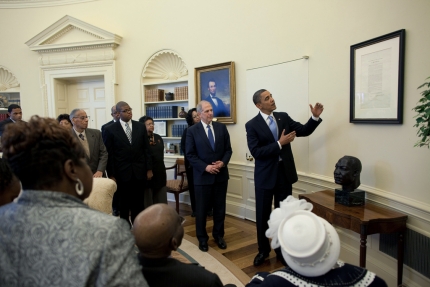
President Barack Obama views the Emancipation Proclamation with a small group of African American seniors, their grandchildren and some children from the Washington DC area, in the Oval Office. This copy of the Emancipation Proclamation, which is on loan from the Smithsonian Institution, was hung on the wall of the Oval Office today and will be exhibited for six months, before being moved to the Lincoln Bedroom where the original Proclamation was signed by Abraham Lincoln on Jan. 1, 1863, January 18, 2010. (Official White House Photo by Pete Souza)
One hundred fifty years ago Monday, on September 17, 1862, the Union army commanded by Major General George McClellan met a Confederate force under Robert E. Lee at Antietam Creek in western Maryland, outside the town of Sharpsburg.
For 12 hours, 87,000 Union soldiers launched a series of attacks against 45,000 Confederates. The result was a staggering loss of human life. When dark approached and the fighting ended, almost 25,000 were dead, wounded, or missing. Neither before nor since have more Americans been killed in a single day.
The White House
Office of the Press Secretary
G. Richard Pfitzner Stadium
Woodbridge, Virginia
11:18 A.M. EDT
THE PRESIDENT: Thank you, Jane. (Applause.) Thank you, AARP. (Applause.) I want to thank Barry, and the entire AARP, for everything you do on behalf of America’s seniors. (Applause.)
And today is especially poignant for me I think because I can’t help to think about my grandmother, Madelyn Dunham. During World War II, she worked on a bomber assembly line, with a baby at home, while her husband was off serving his country. And in the postwar years, she worked her way from a secretary to vice president at her local bank. And later, she helped raise my mother, and then obviously helped raise me and my sister.
She was a great citizen who lived up to her responsibilities. And after a lifetime of hard work, what she hoped for in return was to be able to live out her golden years with dignity and security, and to see her grandchildren and her great grandchildren have a better life.
And she was fiercely independent, so she didn’t want a lot of help from me or anybody else. She just wanted to make sure that the work she had put in was going to pay off. And I’m thinking a lot about her these days because we lost my grandmother three days before I was elected to this office, back in 2008. But rewarding those hopes that she and so many other Americans shared -- restoring the basic bargain that says if you work hard, that work will pay off -- is one of the reasons I ran for this office in the first place. The values that she taught me are part of what has driven me over the last four years
Now, we’ve come a long way, but we’re not there yet. And that’s why I’m asking you for a second term as President. (Applause.)
There’s been a lot of talk about Medicare and Social Security in this campaign, as there should be. And these are bedrock commitments that America makes to its seniors, and I consider those commitments unshakeable. But given the conversations that have been out there in the political arena lately, I want to emphasize Medicare and Social Security are not handouts. (Applause.) You’ve paid into these programs your whole lives. You’ve earned them. And as President, it’s my job to make sure that Medicare and Social Security remain strong for today’s seniors and for future generations.
It probably won’t surprise you, though, that there’s a lot of talk about Medicare and Social Security that hasn’t been completely on the level over the last several months. So here’s what you need to know:
I have strengthened Medicare as President. (Applause.) We’ve added years to the life of the program by getting rid of taxpayer subsidies to insurance companies that weren’t making people healthier. And we used those savings to lower prescription drug costs, and to offer seniors on Medicare new preventive services like cancer screenings and wellness services.
In fact, the health reform law we passed has already saved more than 5.5 million seniors and people with disabilities nearly $4.5 billion on their prescription drugs. (Applause.) Seniors who received a discount have saved an average of more than $600 this year alone. And over the next 10 years, we expect the average Medicare beneficiary to save nearly $5,000 as a result of this law.
Now, my opponents have pledged to repeal these savings and benefits in their first day on the job, which means billions in new profits for insurance companies, but also would mean immediately increased costs for seniors and would bankrupt the Medicare trust fund in just four years. And what would they replace it with? Their plan replaces guaranteed Medicare benefits with a voucher that wouldn’t keep up with costs.
And when they tell you that their plan lets you keep your doctor, they’re leaving out one thing -- and that’s the facts. A new study says that under their plan, if just 5 percent of seniors switch to private plans, 40 percent of doctors who currently take Medicare would stop accepting it. So think about that. Millions of seniors would be forced to change doctors.
I don’t consider this approach bold or particularly courageous, I just think it’s a bad idea. No American should ever spend their golden years at the mercy of insurance companies. They should retire with the care and the dignity that they have earned. (Applause.)
Now, we do have to reform and strengthen Medicare for the long haul, but we’re going to do it by reducing the costs of care -- not by asking seniors to pay thousands of dollars more while we’re giving millionaires and billionaires a massive new tax cut. (Applause.)
And when it comes to Social Security, we’ve got to keep the promise of Social Security by taking responsible steps to strengthen it, not by turning it over to Wall Street. (Applause.) The last time the other side was in charge, my opponent’s running mate wrote a bill that would have privatized Social Security. And after what happened on Wall Street just four years ago, does anybody actually think that’s a good idea? (Laughter.)
Most seniors rely on Social Security for most of their income. It keeps 20 million Americans out of poverty each and every year. And while it’s not the cause of today’s deficits, we do need to strengthen the program for the coming decades. And that means folks on both sides need to come together around a balanced plan. (Applause.)
My opponent claims that to pay for a new $5 trillion tax cut skewed towards the very top, he’d just close tax loopholes for the very wealthy. But independent experts say there’s no way to do that without also cutting deductions that the middle class relies on, and that includes taxing things like Social Security benefits. And this could mean higher taxes for seniors on Social Security, including taxing benefits for seniors who make less than $32,000 a year for the first time ever. Nearly 30 million seniors could see their taxes go up by hundreds of dollars.
So I want you all to know at AARP I’m not going to let that happen. (Applause.) My plan calls for both parties to come together and take responsible steps to preserve Social Security for the long run. And we’ll do it in a way that ensures a lifetime of hard work is rewarded with dignity and security for generations to come.
So you guys have a big choice in this election and these are the paths -- the two paths our country can take. We can spend trillions of dollars on tax cuts targeted towards the wealthiest Americans, which could result in cuts to benefits that you’ve worked a lifetime to earn. Or we can take a balanced approach to invest in the middle class and strengthen Medicare and Social Security for you and your children and your grandchildren. That’s the choice in this election and that’s why I’m asking for your vote. (Applause.)
So thanks so much, AARP, for having me. And with that, Jane, I’m ready to take some questions. (Applause.)
Q Mr. President, Jane Pauley here again. I’m back in the hall with our members, and they do have some questions for you. I’d like to explain here in the hall that -- what a satellite delay is. When I ask a question, it goes up there, and then it comes down. There’s about a second and a half delay between my delivering a question and the President hearing it. Just so you know the drill and a little inside stuff on television.
Mr. President, we are so grateful that you can stay with us a few minutes longer.
Mike, from Brier, Washington, asks: “How will you reduce the federal debt and not gut Social Security and Medicare?”
THE PRESIDENT: Well, it’s a great question, Mike, and I appreciate it. We have a genuine challenge in bringing our deficit down and reducing our debt, and I think it’s important for folks to know that 90 percent of the debt and deficits that we’re seeing right now are the result of choices that were made over the course of the last decade -- two wars that weren’t paid for; tax cuts skewed towards the wealthy that were not paid for. So we made some decisions, and then when the Great Recession hit, that meant more money was going out and not as much money was coming in, and that has blown up our deficit and our debt.
The key to reducing it is to do it in a balanced, responsible way. So I’ve put forward a $4 trillion, deficit-reduction plan which would bring our deficits down to a manageable level and begin the work of bringing our debt down, and it involves making some tough choices. So I’ve already signed a trillion dollars’ worth of cuts, programs that we don't need, programs that, frankly, are not helping people get more opportunity or creating pathways for success for middle-class families or those who are striving to get into the middle class.
But after those cuts are made and some additional cuts are made, the only way to reach that $4 trillion target to also ask the wealthiest among us to do a little bit more. So what I’ve suggested is that we go back for people whose incomes are above $250,000 to go back to the tax rates that existed when Bill Clinton was President, which, by the way, was a time when we created 23 million new jobs, went from a deficit to a surplus, and created a whole lot of millionaires to boot. (Applause.)
Now, this contrasts with the plan that my opponent is putting forward for deficit reduction. And some of you may have seen President Clinton speak at the convention -- (applause) -- what's missing from it is arithmetic, because what they're proposing is not only to extend the Bush tax cuts for the wealthy, but then they want to add another $5 trillion tax cut on top of that, and $2 trillion in additional defense spending that our Joint Chiefs of Staff say doesn’t make sense at a time when we're winding down two wars.
So before they even start digging us out of the hole that we're in, they just added to the hole with $7 trillion in additional spending on tax cuts or on defense. Now, they haven't explained how they would pay for that, but independent analysts who have looked at it have said the only way you pay for this is not only to gut investments in education, in basic research that could help find cures for cancer or Alzheimer's, to not invest in our infrastructure, but it also means that you're going to have to impose a higher tax burden on middle-class families -- up to $2,000 a year for families with children.
And as I mentioned in my opening remarks, if you're looking at figuring out how to pay for that $5 trillion tax cut, part of what you would also start looking at is taxing Social Security benefits, or turning Medicare into a voucher program. And that is not the right approach to take.
My attitude is that if we're going to work together to bring down our deficit, everybody has got to do their fair share, everybody has got to do their part. (Applause.) And for us to have new tax cuts for millionaires and billionaires to pay for cuts in Social Security or Medicare or education is just not the right way to go.
Q Mr. President, from Washington D.C, Paulette (ph) asks a question. She says, “If one makes $106 [thousand] a year or less, they pay Social Security taxes on 100 percent of their income; a millionaire pays 10 percent or less. Will you try to get the cap removed for Social Security taxes?"
THE PRESIDENT: I do think that looking at changing the cap is an important aspect of putting Social Security on a more stable footing. (Applause.) And what I've said is, is that I'm willing to work with Republicans and examine all their ideas, but what I'm not going to do as a matter of principle is to slash benefits or privatize Social Security and suddenly turn it over to Wall Street. Because we saw what can happen, back in 2008/2009, when the stock market crashed. And we're still recovering from that.
Q Mr. President, James from Derry, Pennsylvania says, "I haven't heard you say much about out-of-control prescription drug costs facing those of us retired and living on fixed incomes. What are you plans to bring down these costs?"
THE PRESIDENT: Well, the good news is, I'm not just talking about it, we've actually done something about it. (Applause.) The health care bill that we passed, Obamacare, which, by the way, I don’t mind the term because I do care, that’s why we passed the bill -- (applause) -- one of the things that we did was to begin closing the notorious doughnut hole that so many seniors suffer from.
So starting this year already, what we’re seeing is a 50 percent discount for seniors who are in the doughnut hole. Each year they’re going to get additional discounts until the doughnut hole is completely closed. That's already saving millions of seniors around the country an average of $600 to $650 a year. That's on top, by the way, of the preventive care that is now provided without additional charge, under Medicare, as a consequence of what we did with Obamacare.
And there's more that we can do on prescription drugs. One of the things that I’ve proposed in my budget is that Medicare recipients should get some of the same deep discounts that Medicaid receives. That would save additional billions of dollars for seniors. (Applause.) And there's work that we can also do in terms of accelerating the use of generics and making sure that the process for seniors getting access to cheaper prescription drugs is obtained.
But this is critically important because I meet too many families where they tell me a story of their parents having to cut their pills in half because they just can’t afford the prescriptions that have been given to them.
Q Mr. President, a question for you from Hawaii, from Richard: “What would you do to guarantee the future of Medicare?”
THE PRESIDENT: Well, again, it turns out that contrary to what you’ve heard and what you may hear from subsequent speakers, Obamacare actually strengthened Medicare. So what we did was extend the Medicare trust fund by eight years. In addition, we dealt with prescription drugs in a way that is helping seniors now and in the future. The preventive care that we’re doing is going to ensure that seniors stay healthier, which reduces costs.
And one thing that I want to point out is, when you hear this notion of -- that we somehow took $716 billion, robbed it from Medicare beneficiaries and seniors, I want you to know that is simply not true. (Applause.) What we did was we went after waste and fraud, and overcharging by insurance companies, for example. Those savings do come out to $716 [billion], and those savings are part of what allows us to close the doughnut hole, provide the preventive care, and is actually going to extend the life of Medicare over the long term. It also, by the way, helps to reduce the increase in the premiums that seniors pay under Medicare.
And that points to what we need to do with Medicare generally. What we need to do is to go after the waste, the fraud, and reduce health care costs overall. (Applause.) So part of what we’re doing through this new health care law is using the power of -- the purchasing power of Medicare to say to doctors and hospitals and insurance companies, you guys need to work smarter -- instead of having five different tests that you’re charging us for, do one test and then email it to everybody. (Applause.) Instead of having all kinds of administrative costs and paperwork, let’s make sure that we’re using health IT -- information technologies -- to do a better job. Let’s coordinate care better. Let’s engage in more preventive care. (Applause.)
Because this is not just a Medicare problem. Medicare actually is a very efficient program relative to the private insurance programs. The problem is health care costs generally are going up. So we’ve got to bring down health care costs; that’s what we’re focused on. And I just want to point out that the other side’s approach to saving Medicare -- and you’ll be hearing about this, I gather, after I speak -- is to turn Medicare into a voucher program and essentially transfer those costs onto seniors.
Congressman Ryan’s original plan that was put forward -- independent analysis showed that, as a consequence, seniors could expect to pay over $6,000 more for their Medicare once they were under a voucher program. Now, that was his original plan. I want to be fair here. He then modified it -- because obviously there was a lot of pushback from seniors on that idea -- so he said, well, we’re going to have traditional Medicare stand side by side with the voucher program, and no current beneficiaries will be affected.
The problem is that insurance companies, once they’re getting vouchers, they’re really good at recruiting the healthier, younger Medicare recipients, and weeding out and leaving in traditional Medicare [to] the older, sicker recipients. And over time what happens is that, because there are older, sicker folks in the traditional Medicare plan, premiums start going up, they start going through the roof. And the entire infrastructure of traditional Medicare ends up collapsing, which means that all seniors at some point end up being at the mercy of the insurance companies through a voucher program. That’s what we’re trying to prevent. And the reason that AARP supported Obamacare and does not support this voucher approach is because they have looked at these independent experts and the analysis that they’ve put forward, and they know that a voucher program is not going to be a good deal for Medicare over the long haul. (Applause.)
Q Mr. President, from Sandwich, Massachusetts. Kathy (ph) has the following question for you: “What would your administration do to make sure age discrimination laws are enforced so we have an even playing field to get a job?”
THE PRESIDENT: Well, this is a great question, and obviously one of the challenges that we’ve seen as a consequence of this terrible recession we went through was a lot of workers in their 50s and early 60s found themselves suddenly laid off, and it’s very hard for them to get their foot in the door despite all the incredible experience that they have and the skills and training that they’ve got. So there are a couple of things that we need to do.
Number one, we just have to make sure that we’re enforcing nondiscrimination laws effectively. And the Attorney General knows that that's always a top priority for me. In some cases, part of what we’re trying to do is to see if we legislatively can overturn some bad Supreme Court rulings that have made it harder to prove age discrimination. (Applause.)
Q Using the --
THE PRESIDENT: And that's something that we’re really focused on.
Q Forgive me for interrupting the President of the United States. Sorry. (Laughter.)
Mr. President, you used the word “legislation” which will ring a bell with Joe from Fort Aktinson, Wisconsin, who asks: “What can you do about this gridlock between both sides of the aisle in Congress?”
THE PRESIDENT: Well, Jane, let me just say this -- first of all, before I go to the gridlock issue, I did want to emphasize that in addition to dealing with age discrimination, the work that's being done between the SBA and the AARP around the Encore Entrepreneur’s Program, helping thousands of seniors across the country start their own small businesses, if in fact they're not getting hired, to provide them a source of income and use their incredible skills -- I just wanted to give a shout out to AARP because that program is really doing great work. (Applause.)
But when it comes to gridlock, look, I came in in 2008 and I said, even though I got 53 percent of the vote and 47 percent of the country voted against me, that I’d be the President for everybody, and I’d listen to everybody’s voices. (Applause.)
And every idea that I put forward and all the work that we have done has been to draw on the best ideas from both parties. In fact, Obamacare now owes a debt to what was done in Massachusetts by my opponent Mr. Romney, even though sometimes he denies it. (Applause.)
So I am always going to be looking to find common ground and solve problems for the American people. The one thing I won't do, though, is to go along with bad ideas that are not helping the middle class, not helping people who have worked hard all their lives, not helping to provide ladders of opportunity to people who are still looking to succeed in this great country of ours. And so, if I hear that the only way that Republicans in Congress are willing to move forward is to voucherize Medicare, I'll say no. (Applause.) If the only thing that they're willing to offer in terms of deficit reduction is to do it on the backs of seniors or our children who need to get a great education, or middle-class families who can't afford another tax increase, I'm going to say no.
So part of what I think you want from your President is somebody who is working hard to bring people together, but is also willing to stand up to bad ideas that would end up tilting the playing field further in favor of those who have already made it instead of also thinking about folks who are trying to make it who worked hard all their lives, like my grandmother. And that’s exactly why I'm running for a second term as President of the United States. (Applause.)
Q Mr. President, on behalf of everyone here in the hall and listening online, we are so grateful that you could spend some time with us this morning. Thank you very much. (Applause.)
THE PRESIDENT: Thank you so much, Jane. Take care, everybody.
END
11:46 A.M. EDT
The White House
Office of the Press Secretary
National Monument Will Honor Native American Culture, Generate Tourism and Economic Benefits for Local Economy
WASHINGTON, DC – Today President Obama signed a proclamation establishing Chimney Rock as a National Monument. Chimney Rock, located in the San Juan National Forest in southwestern Colorado, offers a spectacular landscape rich in history and Native American culture. The designation was made under the Antiquities Act with bi-partisan support from Colorado officials, the Native American community, local businesses and other stakeholders.
"Chimney Rock draws thousands of visitors who seek out its rich cultural and recreational opportunities,” said President Obama. “Today's designation will ensure this important and historic site will receive the protection it deserves."
"Thousands of people come every year to experience the cultural, and spiritual significance of Chimney Rock," said Agriculture Secretary Tom Vilsack. "With President Obama's action and the strong support of the Native American community and others throughout the region, this new monument will bring new economic opportunity to Archuleta County and the Four Corners region as more visitors from around the world come to see this national treasure."
The 4,726 acre Chimney Rock National Monument will be managed by the USDA Forest Service - the seventh National Monument managed by the agency - in close collaboration with tribal, community, state, and Federal partners.
Today, Chimney Rock is one of the best recognized and most unique archaeological resources in North America, home to hundreds of ruins built by the Ancestral Pueblo People about 1,000 years ago, including the highest elevation ceremonial "great house" in the Southwest. Notably, every 18.6 years, during the northern lunar standstill, the moonrise is aligned with the sites two rock pinnacles, as well as during the summer and winter solstices, and the fall and spring equinoxes. Descendants of the Ancestral Pueblo People return to Chimney Rock to visit their ancestors and for other spiritual and traditional purposes.
Chimney Rock is the third National Monument designated by President Obama using the Antiquities Act. He previously designated Fort Monroe National Monument in Virginia, a former Army post integral to the history of slavery, the Civil War, and the U.S. military, and Fort Ord National Monument in California, a former military base that is a world-class destination for outdoor recreation. First exercised by President Theodore Roosevelt in 1906 to designate Devils Tower National Monument in Wyoming, the authority of the Antiquities Act has been used by 16 presidents since 1906 to protect unique natural and historic features in America, such as the Grand Canyon, the Statue of Liberty, and Colorado's Canyons of the Ancients.
The designation of Chimney Rock National Monument builds on President Obama's America's Great Outdoors initiative, which fosters a 21st century approach to conservation that responds to the priorities of the American people. During the past three years, USDA's conservation agencies, the U.S. Forest Service, the Natural Resources Conservation Service, and the Farm Service Agency, have worked with more than half a million farmers, ranchers and forest landowners to enroll record acres in conservation programs, have targeted conservation dollars to locally-driven conservation initiatives and have worked to increase conservation and restoration activities on the 193 million acre National Forest system.
The White House
Office of the Press Secretary
ESTABLISHMENT OF THE CHIMNEY ROCK NATIONAL MONUMENT
BY THE PRESIDENT OF THE UNITED STATES OF AMERICA
A PROCLAMATION
The Chimney Rock site in southwestern Colorado incorporates spiritual, historic, and scientific resources of great value and significance. A thousand years ago, the vast Chaco civilization was drawn to the site's soaring massive rock pinnacles, Chimney Rock and Companion Rock, that rise hundreds of feet from the valley floor to an elevation of 7,600 feet. High atop ancient sandstone formations, Ancestral Pueblo People built exquisite stone buildings, including the highest ceremonial "great house" in the Southwest.
This landscape, encompassing both Chimney Rock and Companion Rock, and known today as Chimney Rock, holds deep spiritual significance for modern Pueblo and tribal communities and was one of the largest communities of the Pueblo II era (900 1150 A.D.). The Chimney Rock site also includes nationally significant archaeology, archaeoastronomy, visual and landscape characteristics, and geological and biological features, as well as objects of deep cultural and educational value.
In 1100 A.D., the area's cultivated fields and settlements extended from the valley floors to the mesa tops. The pinnacles, Chimney Rock and Companion Rock, dominated the landscape. Today, peregrine falcons nest on the pinnacles and soar over ancient structures, the dramatic landscape, and the forested slopes of the Piedra River and Stolsteimer Creek drainages, which are all framed by the high peaks of the San Juan Mountains.
Migratory mule deer and elk herds pass through the area each fall and spring as they have for thousands of years, and live there during the critical winter months. Merriam's turkeys, river otters, bald eagles, golden eagles, mountain lions, bats, woodpeckers, and many species of migratory birds also live in the area among the Ponderosa Pine, pinon, and juniper. Several desert plants usually found farther south grow there, including a species of cholla cactus that does not occur naturally outside the Sonoran Desert and is believed to be associated with deliberate cultivation by the Ancestral Pueblo People.
The Chimney Rock site is one of the best recognized archaeoastronomical resources in North America. Virtually all building clusters have views of Chimney Rock and Companion Rock, which frame multiple astronomical alignments and illustrate the Ancestral Pueblo People's knowledge of astronomy. Hundreds of archaeological ruins and buildings from the Pueblo II period are within the boundaries of the site, including a Chaco style communal multi room "great house" built in the late eleventh century to command observations of the surrounding landscape and astronomical phenomena.
The Chimney Rock site features an isolated Chacoan settlement among a complex system of dispersed communities bound by economic, political, and religious interdependence centered in Chaco Canyon, New Mexico, about 100 miles south of Chimney Rock. Chimney Rock continues to contribute to our knowledge about the Ancestral Pueblo People and their understanding and command of their environment.
Today, descendants of the Ancestral Pueblo People return to this important place of cultural continuity to visit their ancestors and for other spiritual and traditional purposes. It is a living landscape that shapes those who visit it and brings people together across time. Since the 1920s, there has been significant archaeological interest in Chimney Rock. Because it does not appear to have been reoccupied after the early 1100s, Chimney Rock offers a valuable window into the cultural developments of the Pueblo II era and affords opportunities to understand how geology, ecology, and archaeology interrelate. Because visitors travel from areas near and far, these lands support a growing travel and tourism sector that is a source of economic opportunity for the community, especially businesses in the region. They also help to attract new residents, retirees, and businesses that will further diversify the local economy.
In 1970, Chimney Rock was listed on the National Register of Historic Places, and its spectacular landscape has been open to visitors ever since.
WHEREAS section 2 of the Act of June 8, 1906 (34 Stat. 225, 16 U.S.C. 431) (the "Antiquities Act"), authorizes the President, in his discretion, to declare by public proclamation historic landmarks, historic and prehistoric structures, and other objects of historic or scientific interest that are situated upon the lands owned or controlled by the Government of the United States to be national monuments, and to reserve as a part thereof parcels of land, the limits of which in all cases shall be confined to the smallest area compatible with the proper care and management of the objects to be protected;
WHEREAS it is in the public interest to preserve and protect the objects of scientific and historic interest at Chimney Rock;
NOW, THEREFORE, I, BARACK OBAMA, President of the United States of America, by the authority vested in me by section 2 of the Antiquities Act, hereby proclaim, set apart, and reserve as the Chimney Rock National Monument (monument) the objects identified above and all lands and interests in lands owned or controlled by the Government of the United States within the boundaries described on the accompanying map entitled "Chimney Rock National Monument" and the accompanying legal description, which are attached to and form a part of this proclamation, for the purpose of protecting those objects. These reserved Federal lands and interests in lands encompass approximately 4,726 acres, which is the smallest area compatible with the proper care and management of the objects to be protected.
All Federal lands and interests in lands within the boundaries of the monument are hereby appropriated and withdrawn from all forms of entry, location, selection, sale, leasing, or other disposition under the public lands laws, including withdrawal from location, entry, and patent under the mining laws, and from disposition under all laws relating to mineral and geothermal leasing. Lands and interests in lands within the monument's boundaries not owned or controlled by the United States shall be reserved as part of the monument upon acquisition of ownership or control by the United States.
The establishment of this monument is subject to valid existing rights. The Secretaries of Agriculture and the Interior shall manage development under existing oil and gas leases within the monument, subject to valid existing rights, so as not to create any new impacts that would interfere with the proper care and management of the objects protected by this proclamation.
Nothing in this proclamation shall be construed to alter the valid existing water rights of any party, including the United States.
The Secretary of Agriculture (Secretary) shall manage the monument through the Forest Service, pursuant to applicable legal authorities, consistent with the purposes and provisions of this proclamation. The Secretary shall prepare, within 3 years of the date of this proclamation, a management plan for the monument, and shall promulgate such regulations for its management as deemed appropriate. The plan will provide for protection and interpretation of the scientific and historic objects identified above, and continued public access to those objects, consistent with their protection. The plan will protect and preserve access by tribal members for traditional cultural, spiritual, and food and medicine gathering purposes, consistent with the purposes of the monument, to the maximum extent permitted by law.
The Secretary shall prepare a transportation plan that addresses actions necessary to protect the objects identified in this proclamation, including road closures and travel restrictions. For the purpose of protecting the objects identified above, the Secretary shall limit all motorized and mechanized vehicle use to designated roads, except for emergency or authorized administrative purposes.
The Secretary shall, in developing any management plans and any management rules and regulations governing the monument, consult with the Secretary of the Interior. The final decision to issue any management plans and any management rules and regulations rests with the Secretary of Agriculture. Management plans or rules and regulations developed by the Secretary of the Interior governing uses within national parks or other national monuments administered by the Secretary of the Interior shall not apply within the monument.
Nothing in this proclamation shall be deemed to enlarge or diminish the jurisdiction of the State of Colorado with respect to fish and wildlife management.
Nothing in this proclamation shall be deemed to enlarge or diminish the rights of any Indian tribe.
Laws, regulations, and policies followed by the Forest Service in issuing and administering grazing permits or leases on all lands under its jurisdiction shall continue to apply with regard to the lands in the monument.
The Secretary may carry out vegetative management treatments within the monument, except that timber harvest and prescribed fire may only be used when the Secretary determines it appropriate to address the risk of wildfire, insect infestation, or disease that would endanger the monument or imperil public safety.
Nothing in this proclamation shall be deemed to revoke any existing withdrawal, reservation, or appropriation; however, the national monument shall be the dominant reservation.
Warning is hereby given to all unauthorized persons not to appropriate, injure, destroy, or remove any feature of the monument and not to locate or settle upon any of the lands thereof.
IN WITNESS WHEREOF, I have hereunto set my hand this twenty-first day of September, in the year of our Lord two thousand twelve, and of the Independence of the United States of America the two hundred and thirty-seventh.
BARACK OBAMA