The White House

Office of the Press Secretary

Remarks by the President at Campaign Event -- Boone, IA

Herman Park
Boone, Iowa

6:10 P.M. CDT

THE PRESIDENT:  Hello, everybody!  (Applause.)  Thank you!  It's good to be back!  Thank you so much.  (Applause.)  It is good to be back in Iowa, and it's good to be back in Boone County!  (Applause.)  

A couple of folks I want to acknowledge -- first of all, your outstanding former governor and now I think the best Secretary of Agriculture we've ever had -- Tom Vilsack.  (Applause.)  A great friend of mine, my co-chair for my campaign when I was just getting started in 2007-2008 -- he took a risk on me when nobody could pronounce my name -- Tom Miller is in the house, Attorney General of the great state of Iowa.  (Applause.) And please give Dave a big round of applause for the great introduction.  (Applause.)

Dave may have mentioned he is a music teacher.  And I told him that Malia and Sasha have been practicing their piano.  (Laughter.)  And Malia plays a little flute.  But he mentioned that he thought -- he had heard me sing, and he thought that I had really good pitch.  (Applause.)  So Dave says he's got a band and maybe after I'm finished with the presidency, he said maybe I could be front man for the band.  (Applause.)  He said maybe I could be lead singer.  That would be all right.  (Applause.)

But, listen, it is wonderful to be back in Iowa.  It is wonderful to see some familiar faces and some good friends on a beautiful summer day.  It was on your front porches and in some of your backyards where our movement for change started.  (Applause.)  We spent a lot of time in Iowa, and I felt like an adopted son of Iowa.  (Applause.)  We took bus tours all throughout the state -- although I've got to admit the bus wasn’t as nice as the one I've got now.  (Laughter.)  And we went to school gyms and family farms and small businesses all across the state.

But here's the thing -- our journey is not done.  It's not done.  So I’m going to spend the next three days driving all the way across the state, just like we did in 2007 -- from Council Bluffs all the way to the Quad Cities -- (applause) -- and I'm going to work just as hard, maybe harder, in this campaign as I did in the last one because the choice that you in November couldn't be bigger. 

It is not just a choice between two candidates or two political parties.  But more than any election in recent memory, this is a choice between two fundamentally different visions about how we move this country forward.  (Applause.)  And the direction that we choose -- the direction that you choose when you walk into that voting booth in November is going to have an impact not just on your lives, but on the lives of these young people here, the lives of your children, the lives of your grandchildren for decades to come. 

Think about it.  When we came together four years ago -- and it wasn’t just Democrats, we had independents and some Republicans get involved -- the idea was to restore the basic bargain that made this country great, the basic idea that says if work hard in this country then you can get ahead; that if you put in the effort and you are responsible, then you can find a job that pays the bills.  You can have a home that you call your own. You won't go bankrupt when you get sick.  You can retire with some dignity and some respect.  And maybe most importantly, you know that your kids can get a great education and they can dream bigger and do even better than you did.  (Applause.)

That is the core of the American Dream.  That's the American promise.  (Applause.)  Now, the problem is, is that we had gone through a decade where that promise wasn’t being met, it wasn’t being kept.  So we had gone through a decade where jobs were being shipped overseas, where you were working harder but you were bringing in less.  Costs of college, costs of health care were all going up -- cost of food, cost of gas all were going up. We ran two wars on a credit card.  Tax cuts we didn’t need and that didn’t create jobs.  And it all culminated in the worst financial crisis since the Great Depression.

So we knew that meeting these challenges that had been building up for over a decade, that it wasn't going to be easy.  We knew it was going to take more than one year, or one term, or even one President.  But what we also knew was that Americans are tougher than tough times.  And so, even though this crisis that hit us in 2008 and 2009 was bad -- even though a lot of folks lost their jobs and a lot of folks lost homes and a lot of folks lost savings, so that the middle class felt even more under the gun than they were before -- what we knew was that the American people are resilient and we are tough.  (Applause.)

And so, for the last three and a half years we've rolled up our sleeves and we've worked hard.  And small businesses have kept their doors open.  And folks, even if they got laid off, they've retrained to find new jobs.  And we created 4.5 million new jobs, half a million more in manufacturing.  The auto industry is back on top.  (Applause.)   

And so, we've made progress but we've got a lot more work to do.  We've got a lot more work to do.

AUDIENCE MEMBER:  We can do it!

THE PRESIDENT:  We can do it.  I agree.  (Applause.)  We can. 

Now, here's the thing.  Some people, they're naysayers and they say, oh, America is declining.  And they try to paint things as dark as possible, especially during election time.  But here's what I want everybody to know.  We've got so many things going for us compared to the rest of the world.  We've still got the best workers in the world.  We've got the best entrepreneurs in the world.  We've got the best scientists and the best researchers in the world.  We've got the best colleges and the best universities in the world.  (Applause.)  We know how to work hard.  And we're a young country and we're a country that draws on the diversity of folks who want to come here from all around the world to be part of this American Dream.  And most importantly, the crisis has not changed our character.  It hasn't changed who we are.  It hasn't changed our sense of determination and our sense of neighborliness and our understanding that we're in this thing together. 

And so we've come together, just like we did in 2008, because our mission is not yet finished.  We are here to build an economy where hard work pays off.  And so, no matter who you are or what you look like or where you come from, you can make it if you try here in America.  (Applause.)

That's what this campaign is about and that's why I'm running for a second term as President of the United States of America.  (Applause.) 

AUDIENCE:  Four more years!  Four more years!

THE PRESIDENT:  Just as I said that we've got a lot of things going for us, there aren't any quick fixes or easy solutions to some of our challenges.  We're going to have to keep working.  We're going to meet these challenges.  But the main problem we've got is not a lack of good ideas.  It's not that we don't have good solutions to our problems.  The big problem we've got right now is politics in Washington.  (Applause.)  The big problem we've got is one party just thinks that compromise is a dirty word.  And they've got an economic theory that basically wants to go back to the old top-down economics that got us into this mess in the first place. 

Now, look, over the weekend my opponent chose as his running mate the ideological leader of the Republicans in Congress.  And I've gotten to know Congressman Ryan.  He's a good man.  He's a family man.  He's a very articulate spokesperson for Governor Romney's vision.  The problem is it's the wrong vision for America.  It's a vision that I fundamentally disagree with.  (Applause.)

Their main recipe for solving America’s problems is getting rid of regulations on big corporations and big banks, and then giving more tax breaks to the wealthiest Americans.  And their theory is that somehow that’s going to lead to jobs and prosperity for everybody.  In fact, the centerpiece of Governor Romney’s entire economic plan is a new -- you heard this from Dave -- is a new $5 trillion tax cut, a lot of it going to the wealthiest Americans. 

Now, keep in mind, these are the folks who say the deficit and the debt are the biggest problem we’ve got.  And yet, they now want to give a $5 trillion tax cut.  I know the numbers get so big, but I just want you to get a sense -- our entire defense budget annually is $500 billion.  So what this means is, a $5 trillion tax break over 10 years, that’s the equivalent of the entire defense budget going out as a tax cut every single year. 

Now, keep in mind that this is going disproportionately to the wealthiest Americans.  Last week, we found out that Governor Romney expects you, middle-class families, to pick up the tab for this big tax cut.

AUDIENCE:  No!

THE PRESIDENT:  And please don’t take my word for it.  You can go to their website and look at their plan.  And then independent economists have looked at this thing and they said that Governor Romney’s tax plan would actually raise taxes on middle-class families with children by an average of $2,000.

AUDIENCE:  Booo --

THE PRESIDENT:  Now, keep in mind, this is not $2,000 to reduce the deficit, or to grow jobs, or to invest in education, or make college more affordable, or to rebuild our roads.  This is $2,000 to give another $250,000 tax cut to people making more than $3 million a year.

AUDIENCE:  Booo --

THE PRESIDENT:  Now, let me just see a show of hands.  How many folks are making more than $3 million a year?  (Laughter.)  Okay, this guy back here.  (Laughter.)  I’m looking for a campaign contribution.  (Laughter and applause.)  Let me tell you something -- they have tried to sell us this trickle-down fairy dust before.  And it did not work then; it won’t work now.  It’s not a plan to create jobs.  It’s not a plan to cut the deficit.  And it’s not a plan to move our economy forward.   

We don’t need more tax cuts for the wealthiest Americans.  We don’t need a tax cut for Mr. Romney.  We don’t need a tax cut for me.  We need tax relief for middle-class families who are out there working, to make sure that their kids are healthy and their kids can go to college.  (Applause.) 

That’s the choice in this election.  That’s why I’m running for President -- because I’ve got a different idea.  I’ve got a different idea than Mr. Romney.

When I came into office, I promised that I would cut middle-class taxes.  And you know what, I’ve kept that promise.  (Applause.) 

AUDIENCE MEMBER:  You did!

THE PRESIDENT:  When you hear these Republicans saying that, oh, Obama is all about spending and raising taxes -- let me tell you, the typical family is paying $3,600 less in taxes than when I came into office.  (Applause.)  That’s the truth.  That’s a fact. 

So now I want to keep taxes right where they are on the first $250,000 of everybody’s income.  So if your family makes $250,000 a year or less -- like 98 percent of Americans -- you won’t see your income taxes increase by a single dime next year under my plan.  Not one dime.  (Applause.)

Now, if you’re fortunate enough to be in the other 2 percent, you’ll still get a tax cut for your first $250,000 worth of income.  But after that, we’re asking you to contribute a little bit more so we can pay down our deficit and invest in things like education that help our economy grow.  (Applause.) 


I'll make sure the government does its part by cutting away spending we don't need.  We've already cut a trillion dollars of spending we didn't need and we can do more.  I want to do another trillion, trillion and a half of cuts. 

But we've also got to match that with folks like me and Governor Romney doing our fair share.  And all we're asking is that we go back to the same rates that we paid under Bill Clinton.  (Applause.)  And you know what, that was a time when our economy created nearly 23 million new jobs, the biggest budget surplus in history, and millionaires did pretty good too. 
See, what happens is that when a teacher or a construction worker or a family farm or a receptionist or a nurse, when they've got a little extra money, what do you do?  You end up spending it on things you need.  So maybe you haven't got a new car in 10, 15 years -- you go out and buy a car.  Or maybe the washing machine is broke and you decide to buy a new washing machine.  Maybe you go out to a restaurant on a special occasion. Maybe you take a vacation once in a while.  That money goes into the economy; businesses have more customers; they hire more workers and everybody is better off from top to bottom. 

I don't believe in top-down economics.  I believe in middle class-out economics.  I believe in bottom-up economics.  That's how you grow an economy.  That's the choice in this election.  And that's why I'm running for a second term as President of the United States.  (Applause.)

There's a difference between me and Mr. Romney on almost every issue.  When the American auto industry was on the brink of collapse, more than 1 million jobs were on the line, Governor Romney said let's "let Detroit go bankrupt."  I said let's bet on the American worker.  And three years later, the American auto industry is back on top.  GM is number one again.  (Applause.)
Now, so I want to make sure that hi-tech manufacturing jobs are taking root right here in Boone -- not in China, not in Germany.

Governor Romney, he likes to tout his private sector experience.  But a lot of that experience is investing in companies that were called "pioneers" of outsourcing.  We don't need more outsourcing.  We need some insourcing.  (Applause.) 
I want to take away tax breaks.  Let's stop giving tax breaks to companies that are shipping jobs overseas.  Let's give those tax breaks to companies that are investing right here in Iowa, right here in the United States of America.  (Applause.)  That's the choice in this election. 

My opponent and I disagree when it comes to homegrown energy like wind.  Wind power is creating new jobs all across Iowa.  But Governor Romney says he wants to end the tax credit for wind energy producers.  Now, America generates more than twice as much electricity from wind than when I took office.  (Applause.)  That's right.  The wind industry supports about 7,000 jobs right here in Iowa.  Without these wind energy tax credits, those jobs are at risk -- 37,000 jobs across the country would be at risk.

So my attitude is let's stop giving taxpayer subsidies to oil companies that don't need them, and let's invest in clean energy that will put people back to work right here in Iowa.  That's a choice in this election.  (Applause.) 

I'm running because in 2008, I promised to end the war in Iraq -- and I did.  (Applause.)  I promised to go after al Qaeda and bin Laden -- and we did.  (Applause.)  We're putting a timeline to get our troops out of Afghanistan and put Afghans in charge of their own security.  So all of this is possible only because of the extraordinary sacrifice and service of our men and women in uniform.  And we are so proud of them.  (Applause.) 

Now, we've got to do right by them.  We've got to make sure we're serving our veterans as well as they've served us.  (Applause.)  That's why we've put more money into the VA, making sure that folks are getting the benefits that they have earned, whether it's the wounds that are seen or the wounds that are unseen. 

But it also means that after a decade of war, we need to do some nation-building here at home, so that all our men and women in uniform are coming home to good-paying jobs.  (Applause.)
That's why I've said let's take half the money that we were spending on war and let's put folks back to work right here in the United States of America.  (Applause.)  Let's put them back to work rebuilding schools and rebuilding roads and rebuilding bridges.  (Applause.)  And let's create a Veterans Jobs Corp to help hire veterans to become cops and firefighters in communities that need them the most.  (Applause.) 

That's the America we want to build.  That's the choice in this election.  That's why I'm running for a second term as President of the United States.  (Applause.)

I'm running because I want to make sure that once again, America has the best education system in the world.  (Applause.) So I want to help our schools hire and reward the best teachers, especially in math and science.  I want to give 2 million more Americans a chance to go to community colleges to get trained for the jobs that businesses are hiring for right now.  (Applause.)

And we have a plan to push colleges and universities to bring down their cost of tuition, because young people, they can't be burdened with tens of thousands of dollars' worth of debt when they go to school.  A higher education isn't a luxury anymore.  It is an economic necessity in the 21st century.  And we are going to help them get the education that they need.  (Applause.)

Across the board, Governor Romney and I just see the world differently.  When it comes to housing, I want to make sure that everybody who hasn't yet taken advantage of these historically low interest rates has a chance to refinance their homes.  It can save folks up to $3,000.  Governor Romney's plan, he said just let the housing market bottom out.  That's not a solution.  That's part of the problem. 

He has got a different view than I do in terms of how we move this country forward.  When it comes to health care, I guess he used to agree with me because he had the same health care plan that I do in Massachusetts.  (Applause.)  And, by the way, that plan is working pretty good.  (Applause.)

Now, he says he wants to kill Obamacare.  Well, first of all, I don't mind it being called Obamacare because, it's true, I do care.  That's why I passed the bill.  I do care.  (Applause.) I care about folks who have preexisting conditions and couldn't get insurance.  That's why we passed the bill.  (Applause.)  I care about the 6.5 million young people who can now stay on their parent's plan because of this bill.  (Applause.)  I care about the seniors who were paying too much for their prescription drugs.  We're closing the doughnut hole because of this bill and lowering their prescription drug costs.  (Applause.)
 
So I don't believe that you should go broke when you get sick in this country.  And I'll work with anybody who wants to continue to improve our health care system.  But the Supreme Court has spoken -- the law is here to stay.  We're not spending the next four years refighting that battle.  (Applause.)  We're moving forward.  We're not going backwards.  That's a choice in this election.  (Applause.)

So, Boone, all these things -- whether it's bringing manufacturing jobs back, putting folks back to work in construction, protecting your health care, making sure our kids are getting the best education possible and they can afford to go to college -- all these things that make up that American Dream, that make up a middle-class life, they all tie together.  They're central to that idea that made this country great, the promise that if you work hard you get ahead; that everybody has a fair shot and everybody is doing their fair share and everybody is playing by the same set of rules. 

It's the promise that our parents and our grandparents passed down to us.  That's the promise that allowed me as the child of a single mom to become President of the United States.  (Applause.)  It's the promise that allowed Michelle, whose dad was a blue-collar worker and her mom was a secretary, to become the First Lady.  (Applause.)  It's the promise that all of you have seen in your own lives.  And now, it's time for us to pass that down to our kids and our grandkids.

So over the next three months, the other side will spend more money than you have ever seen running the same ad over and over again, basically, which says, the economy is not where it should be and it's Obama's fault.  They just repeat it over and over again.  They've got different variations, but it's all the same theme.  And --

AUDIENCE MEMBER:  They're not right!

THE PRESIDENT:  Well, they're not constrained by the facts, in terms of these ads that they run.  (Applause.)  They'll just make stuff up.  And that may be a plan to win the election, but the reason they’ve got to do that is because they know they don’t have a plan to create jobs.  They don’t have a plan to grow the economy.  They don’t have a plan to revive the middle class.  What they’re selling, you’re not buying.  That’s why they don’t talk about it. 

I’ve got that plan.  And we can make it work, but I’m going to need your help.  I‘ve got to make sure everybody here is registered to vote.  I’ve got to make sure everybody is getting their friends and their neighbors, their family members to register to vote.  (Applause.)  You can get a voter registration form online.  You go to GottaRegister.com.  That’s gotta -- g-o-t-t-a --GottaRegister.com.

But if you guys get involved, we can’t lose.  I’ve been outspent before and I’ve been counted out before.  But the reason I love this state is because all of you gave me a chance.  (Applause.)  I had a chance to talk to you and meet you, and share stories with you. 

And I used to say back in 2088 that I’m not a perfect man and I won’t be a perfect President.  But I told you I’d always tell you what I thought, always tell you where I stood, and I’d fight every single day as hard as I knew how for you.  And the reason is because I see myself in you.  (Applause.)  When I see your grandparents, I see my grandparents.  And when I see your kids, I see Malia and Sasha. 

And we know what it’s like to work and to fight hard to get ahead.  And I want everybody in America to have that same chance that I had.  Because we have come too far to turn back now, Iowa. (Applause.)  We’ve got too many good jobs to create.  We’ve got too many great teachers to hire.  We’ve got too many schools to rebuild.  We’ve got too many students who need to get a college education.  (Applause.)  We’ve got too many wind farms to build.  We’ve got more troops we’ve got to bring back home.  We’ve got to open up more doors to opportunity.  (Applause.)  

And if you’ll stand with me and work with me, and organize with me and knock on doors with me, Boone, I promise you, we will win Iowa and we will win this election.  (Applause.)  And we’ll remind the world why this is the greatest nation on Earth.  (Applause.)  

God bless you, and God bless America.  (Applause.)

END
5:40 P.M. CDT

More Help for Those Coping with the Drought

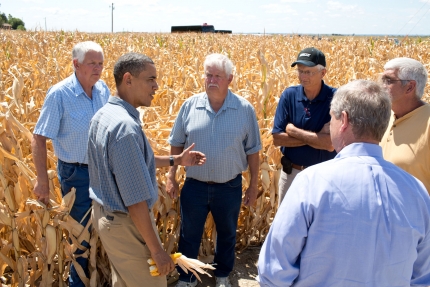
President Barack Obama tours the McIntosh family farm (August 13, 2012)

President Barack Obama tours the McIntosh family farm, which has been affected by the drought, in Missouri Valley, Iowa, Aug. 13, 2012. (Official White House Photo by Pete Souza)

Farmers in Iowa are among those struggling with the fallout from the historic drought. Almost half of the corn crop is in poor or very poor condition. The same is true for more than a third of the soy bean crop. Disappointing yields are in turn driving up feed prices, and farmers and ranchers are having trouble feeding livestock. And there are similar stories throughout the nation's heartland. 

Today President Obama saw the damage first-hand and described a new effort to help livestock producers. 

Touring McIntosh Family Farms in Missouri Valley, Iowa, the President announced that the Department of Agriculture will begin to buy up to $170 million worth of pork, chicken, lamb, and catfish. And the President is directing the Department of Defense -- which purchased more than 150,000 million pounds of beef and pork in the last year alone -- to encourage its vendors to accelerate meat purchases for the military and freeze it for future use.  

The goal is to give farmers and ranchers an opportunity to sell more of what they produce and save taxpayers money on food the government would have purchased for military bases, hospitals, schools, and food banks anyway. 

"Understand this won't solve the problem. We can't make it rain," the President said. "But this will help families like the McIntoshes in states across the country, including here in Iowa. And we're going to keep doing what we can to help because that's what we do. We are Americans. We take care of each other."

To deliver more expansive aid for those hit by the drought, President Obama said that Congress needs to act. 

"They need to pass a farm bill that not only helps farmers and ranchers respond to natural disasters, but also makes necessary reforms and gives them some long-term certainty," he said. 

But in the meantime, the President won't wait for lawmakers to begin helping those struggling with the high temperatures and the lack of rain.


Learn more: 

  • The Department of Agriculture is collecting resources for farmers, ranchers, and small businesses wrestling with this crisis at USDA.gov/drought
  • President Obama discusses his administration's all-hands-on-deck approach to the drought in the Weekly Address
  • More information still is available at WhiteHouse.gov/drought.
Related Topics: Economy, Rural, Iowa

The White House

Office of the Press Secretary

Remarks by the President at McIntosh Family Farms, Missouri Valley, Iowa

McIntosh Family Farm
Missouri Valley, Iowa

1:10 P.M. CDT

THE PRESIDENT:  Today we are here at the McIntosh Family Farms, here in Missouri Valley, Iowa, and we just got a tour from Dean, Don, Richard and Roger.  And like a lot of families in this area and across America, the McIntoshes are suffering under one of the worst droughts in 50 years. 

We've just been through the warmest 12-month period ever recorded, and right now more than 60 percent of the country is under drought conditions.  It's hot, it's dry, and the summer is not over yet. 

Things are especially tough for farmers and ranchers, like the McIntoshes, who depend on a good growing season to pay the bills and keep a roof over their heads.  The McIntosh family has been farming in the Missouri Valley for 96 years, so they've seen just about everything, but this is the worst drought they can remember in decades.  As a result, their corn yield is off by about a third, and some of their neighbors in surrounding areas are struggling even worse.

Here in Iowa, almost half of the corn crop and more than a third of the soybean crop is in poor or very poor condition.  Livestock producers are having trouble feeding their herds.  Crops and livestock are a $30 billion business in Iowa, and that's a huge chunk of the economy that's being put at risk.  And states all across the heartland have it just as bad.

Now, the best way to help these states is for Congress to act.  They need to pass a farm bill that not only helps farmers and ranchers respond to natural disasters, but also makes necessary reforms and gives them some long-term certainty.  But the folks suffering from this drought can't wait for Congress to do its job.  So in the meantime, I've made sure that my administration, under the leadership of Secretary Tom Vilsack, is doing everything we can to provide relief to those who need it.

I've directed the Department of Agriculture and the Small Business Administration to help give farmers and small businesses across 32 states access to low-interest emergency loans.  We've opened up federal land for grazing.  We're working with insurance companies to give farmers a short grace period on their premiums, since money will be tight for a lot of families at the end of the crop year.  And last week, we announced another $30 million to help get more water to livestock and restore land affected by the drought.

Today we're going to go even further, and we're focusing on helping people who make their living by bringing cattle, pigs, sheep, and other animals to market.  The way things work right now, farmers who raise crops are eligible for subsidized insurance to help cushion the blow if disaster strikes.  But livestock producers don't have that option.  So when grasslands dry up and they've got to sell their animals early, it's a huge financial blow and can affect markets all across the country.  We can make a difference, though, and here's what we're going to do.

It turns out that the federal government buys a lot of meat for military bases, hospitals, colleges, food banks and cafeterias.  And because of the drought, there are a lot of folks out there that are trying to sell meat right now.  So just like you might buy more chicken when it's on sale and freeze it, we are going to stock up.  Prizes are low; farmers and ranchers need help; so it makes sense.  It makes sense for farmers who get to sell more of their product, and it makes sense for taxpayers who will save money because we're getting food we would have bought anyway at a better price.

And we're not just talking about a few strips of bacon here. Today the Department of Agriculture announced that it will buy up to $100 million worth of pork products, $50 million worth of chicken, and $20 million worth of lamb and farm-raised catfish.  And the Department of Defense, which bought about 94 million pounds of beef and 64 million pounds of pork last year, will encourage their vendors to buy more now and freeze if for later.

Understand this won't solve the problem.  We can't make it rain.  But this will help families like the McIntoshes in states across the country, including here in Iowa.  And we're going to keep doing what we can to help because that's what we do.  We are Americans.  We take care of each other.  And when our neighbors hit a rough patch, we step up and help out.

So my message to the McIntoshes and everybody who is suffering through the drought, we understand that we depend on you, America depends on you to put food on the table and feed our families, and as a consequence, we're going to make sure that we're there for you -- not just today, but every day until this drought passes.  That is a promise.  And as President, I'll do everything in my power to make sure that you get the relief that you deserve.

So, thank you very much, everybody.  God bless you, and God bless America.  (Applause.)

END
1:16 P.M. CDT  

The White House

Office of the Press Secretary

Remarks by the President at Campaign Event -- Council Bluffs, IA

Bayliss Park
Council Bluffs, IA

11:32 A.M. CDT

THE PRESIDENT:  Hello, Iowa!  (Applause.)  It's good to be back!  (Applause.)  Well, it is good to be back in Iowa!  (Applause.)  I miss you guys.

AUDIENCE:  Obama!  Obama!  Obama!

THE PRESIDENT:  Thank you! 

First of all, can everybody please give Patricia a big round of applause for the great introduction?  (Applause.)  A couple other people I want to acknowledge -- your outstanding former governor, now I think the best Secretary of Agriculture we've ever had -- Tom Vilsack.  (Applause.)  Congressman Leonard Boswell.  (Applause.)  And Mayor Tom Hanafan.  (Applause.)

See, the sun is coming out -- (applause.)  I love being back in Iowa.  Now, we're starting here in Council Bluffs, but we're going to be heading east and I think I'm going to end at the State Fair.  (Applause.)  Michelle has told me I cannot have a fried Twinkie.  (Laughter.)  But I will be checking out the butter cow and I understand this year there's a chocolate moose.  (Laughter.)  So I'm going to have to take a look at that if I can.

The last time I went to the State Fair, Secret Service let me do the bumper cars, but they said this year -- I wasn’t President yet, so I could do that.  (Laughter.)  But not this time. 

Now, before I get started, I just want to say a few words about the drought, because it's had such an impact on this state and all across the country.  Right now folks here in Iowa and across the heartland, we're suffering from one of the worst droughts in 50 years.  Farmers, ranchers depend on a good crop season to pay the bills and put a roof over their heads.  And I know things are tough right now.

The best way to help these states is for the folks in Congress to pass a farm bill that not only helps farmers and ranchers respond to natural disasters, but also makes some necessary reforms and gives farmers and ranchers some long-term certainty. 

Unfortunately, right now, too many members of Congress are blocking the farm bill from becoming law. 

AUDIENCE:  Booo --

THE PRESIDENT:  I am told that Governor Romney's new running mate, Paul Ryan, might be around Iowa the next few days -- he is one of the leaders of Congress standing in the way. 

AUDIENCE:  Booo --

THE PRESIDENT:  So if you happen to see Congressman Ryan, tell him how important this farm bill is to Iowa and our rural communities.  We've got to put politics aside when it comes to doing the right thing for rural America and for Iowa.  (Applause.) 

Now, it's always a problem waiting for Congress.  So in the meantime, I've made sure my administration, led by Tom Vilsack, is doing everything we can to provide relief to those who need it.  So last week, we announced $30 million to help ranchers and farmers get more water to livestock and rehabilitate land affected by drought.
And today, we’re announcing that the federal government will help livestock producers by purchasing over $150 million worth of meat and fish right now, while prices are low -- we'll freeze it for later, but -- we've got a lot of freezers.  (Laughter.)  And that way, that will help ranchers who are going through tough times right now, and also, over the long term, obviously that food is going to be spent by folks at the Pentagon and other places.
America depends on farmers and ranchers to put food on the table; depends on farmers and ranchers to feed our families.  So we've got to be there for them -- not just today, but tomorrow, and every day until this drought passes -- because we are Americans, that’s what we do.  We take care of each other.  And when tough times strike our neighbors, we give them a hand.  (Applause.)
Now, that speaks to the larger idea of why I'm here, the notion that I'm my brother’s keeper, I'm my sister’s keeper, the idea that we're in this together, that was at the heart of the journey that began here in Iowa five years ago.  (Applause.)  We spent a lot of time on bus tours like this one -- at school gyms and family farms and small businesses across this state – although, I have to say the bus we had wasn’t as nice as this one.  (Laughter.)  We used to get some buses.  (Laughter.)
And that campaign back in 2007-2008, it had plenty of ups and downs, but no matter what, you, the people of Iowa, had my back.  (Applause.)  You had my back.  When the pundits had written us off, when we were down in the polls, you believed in me, and I believed in you.  And it was on your front porches and in your backyards where the movement for change in this country began. 

But our journey is not finished.  Not yet.  I’m going to spend the next three days driving all across this state just like I did in 2007 -- from Council Bluffs to the Quad Cities -- because once more, you face a choice in November.  And that choice could not be bigger.  It is not just a choice between two candidates or two political parties.  More than any other election in recent memory, this is a choice between two fundamentally different visions of this country and the path that we have to take. 

And the direction that you choose when you walk into that voting booth in November is going to have an impact not just on your lives but on your children's lives, your grandchildren's lives for decades to come.  This one counts.  (Applause.)

AUDIENCE:  Four more years!  Four more years!  Four more years!  Four more years!

THE PRESIDENT:  Think about this, Council Bluffs.  Four years ago, we came together -- and it wasn’t just Democrats, it was independents and some Republicans -- because we understood that we needed to restore the basic bargain that made this country great, the basic deal that created the greatest middle class and the most prosperous economy the world has ever known.
 
And it’s a simple bargain.  It says if you work hard, your work should be rewarded.  If you act responsibly, and you put in enough effort, you should be able to find a job that pays the bills, have a home you can call your own, count on health care when you get sick -- (applause) -- put away enough to retire with dignity and respect -- (applause) -- and most of all, give your kids an education that allows them to dream even bigger than you did, and do even better than you did.  That's the American promise.  (Applause.)  That's the American Dream. 

And the reason we came together was because we had seen a decade in which that dream was being betrayed.  We had gone through a decade where jobs were being shipped overseas, where you were working harder but making less while the cost of everything from health care to a college education kept on going up.  And it all culminated in the worst financial crisis since the Great Depression.

And so we knew that restoring the basic bargain that made this country was not going to be easy.  We knew it would take more than one year, or one term, or even one President.  And that was before the crisis hit and we saw friends and neighbors lose their job, or lose their home, lose their savings, pushing the American Dream even further out of reach for too many working people.

But over the last three and a half years, we've seen America's grit.  You folks are tougher than any tough time.  (Applause.)  When we get knocked down we stand back up.  (Applause.)  Some workers lost their jobs -- they went back to community college, got retrained and now have got a new job.  Small businesses kept their doors open by hook or by crook.  And so, slowly, we've seen 4.5 million new jobs created, half a million new manufacturing jobs -- the most since the great -- most since the 1990s.

And what we realized was that no matter how bad the crisis was, one thing did not change, and that is the character of the American people and the resilience of the American people.  (Applause.)  And what hasn’t changed is our determination to do what we came together in 2008 to do -- and that is to make sure that in America hard work pays off -- so that no matter who you are, or where you come from, or what you look like, you can make it here in America if you try.  (Applause.) 

That’s what this campaign is about, Iowa.  And that’s why I’m running for a second term as President of the United States of America.  (Applause.)

I told you -- four years ago I said there aren’t going to be quick fixes, there won't be easy solutions.  The challenges we face had been building up for decades.  And that’s still true today.  But I want everybody to know that we have the capacity to meet every challenge.  We've got the best workers in the world.  We've got the best entrepreneurs in the world.  We've got the best colleges, the best universities, the best researchers in the world, the best scientists in the world.  We're still a young nation.  We've got the greatest diversity of talent and ingenuity -- people come here from every corner of the globe.  They want to be here.  So whatever the naysayers may say, or folks who try to make things look dark, listen, there is not another country on Earth that wouldn’t trade places with the United States of America.  (Applause.)  

What’s holding us back right now is Washington politics.

AUDIENCE:  Yes!

THE PRESIDENT:  You’ve got folks on the other side who think "compromise" is a dirty word, and whose main idea is to go back to the same old top-down economics that got us into this mess in the first place. 
  
This weekend, my opponent, Mr. Romney, chose as his running mate the ideological leader of the Republicans in Congress.  And I've got to tell you, I know Congressman Ryan.  He's a good man, he's a family man.  He is an articulate spokesman for Governor Romney’s vision.  But the problem is that vision is one that I fundamentally disagree with. (Applause.)

Governor Romney and his allies in Congress, they think that if we just get rid of more regulations on big corporations and give more tax breaks to the wealthiest Americans, if we end Medicare as we know it, make it a voucher system, then somehow this is all going to lead to jobs and prosperity for everybody. 

AUDIENCE:  Booo --

THE PRESIDENT:  The centerpiece of Mr. Romney’s entire economic plan is a new $5 trillion tax cut, a lot of it going to the very wealthiest Americans.

AUDIENCE:  Booo --

THE PRESIDENT:  Last week, an independent study -- not by me, but by independent economists -- said that Governor Romney's plan would actually raise taxes on middle-class families with children by an average of $2,000 apiece.

AUDIENCE:  Booo --

THE PRESIDENT:  Now, this wouldn't be done -- not to reduce the deficit.  It's not going to be done to create jobs or put folks back to work rebuilding our roads or bridges or schools.  This is you guys paying an extra $2,000 to give another $250,000 tax cut to folks who are making more than $3 million a year.

AUDIENCE:  No!

THE PRESIDENT:  Does this sound familiar to you?  They have tried to sell us this trickle-down theory before.  And guess what -- every time it's been tried it has not worked.  It did not work then; it won’t work now.  It won't create jobs.  It won't lower our deficit.  It is not a plan to move our economy forward.  We do not need more tax cuts for the wealthiest Americans -- we need tax relief for working families.  (Applause.)

You need tax relief -- folks who are trying to raise kids and keep them healthy and put a roof over their heads and send them to college.  And that’s the choice in this election.  That’s the reason I’m running again.

Four years ago, I promised to cut middle-class taxes -- and by the way, that’s exactly what I’ve done.  (Applause.)  The average working family here in Iowa and across the country has seen their tax rates go down about $3,600.  So when you see -- when you hear the other side talking about Democrats raising your taxes -- your taxes are lower since I've been President.  (Applause.)  That's the truth.

Now, I want to keep your taxes right where they are for the first $250,000 of everybody’s income.  So if your family makes under $250,000 -- which, by the way, is 98 percent of Americans -- you won’t see your income taxes go up by a single dime next year.  (Applause.)  Ninety-seven percent of small businesses will not see their taxes go up.  (Applause.)

But here's the thing, Council Bluffs.  This is important. If --

AUDIENCE MEMBER:  And Omaha!

THE PRESIDENT:  And Omaha.  We love you.  (Applause.)  Didn’t want to leave our Nebraska folks left out here. (Applause.)

But here's the thing.  If you’re lucky enough and fortunate enough and been blessed enough to be in the other 2 percent, the top 2 percent, you still get a tax cut for your first $250,000 of income.  All we’re saying is, after that, maybe you can do a little bit more to help pay down this deficit and invest in things like education that help our economy grow.  (Applause.)  

And listen, government is going to do its part.  We've already cut a trillion dollars of savings -- of spending.  We're going to cut more.  We've got to streamline government and make it work efficiently and effectively.  But what we also can do is just ask folks like me to do a little bit more.  And all we're asking is for folks like me to go back to the rates that we paid under Bill Clinton -- and by the way, that was a time when we created nearly 23 million new jobs, and we created the biggest budget surplus in history.  (Applause.)  And here's the kicker  -- folks at the top actually did well because, guess what, when a factory worker or a construction worker or a receptionist or a teacher or a firefighter or a cop -- when they've got a little more money in their pockets, what do they do?

AUDIENCE:  Spend it!

THE PRESIDENT:  Maybe they go out and buy a new car, after having been driving that old beater around for the last 15 years.  Maybe they finally get the new dishwasher because the old one has been broke for a long time.  Maybe they go buy a computer for their kid for the new school year, or they go to a restaurant, or heaven forbid, they take a vacation.  And that means businesses suddenly have more customers.  And then businesses start hiring more workers because they're making more profit.  And everybody does better.  That's how we grow the economy -- not from the top down, but from the middle out, and from the bottom out.  (Applause.)

That's the choice in this election.  And that’s why I’m running for a second term as President of the United States.  (Applause.)  

You know, across the board, there is a sharp contrast between me and Mr. Romney.  When the auto industry was on the brink of collapse, more than a million jobs at stake, Governor Romney said, “let Detroit go bankrupt.”  I bet on American workers.  I bet on American manufacturing.  And three years later, the American auto industry has come roaring back.  (Applause.)  So now I want to make sure that high-tech manufacturing jobs are taking root here, not in China.  I want them to take root here in Council Bluffs.

Governor Romney, he likes to brag about his private sector experience.  A bunch of that private sector experience was investing in companies that have been called “pioneers” of outsourcing.  Let me tell you something -- I want insourcing, not outsourcing.  (Applause.)  I want to stop giving tax breaks to companies that are shipping jobs overseas.  Let’s give tax breaks to companies that are investing here in the United States of America -- (applause) -- hiring American workers to make American products to sell around the world, stamped with those words:  Made in America.  That’s what I believe in.  (Applause.)

Here’s another difference.  Right now, homegrown energy, things like wind energy -- creating new jobs all across the states like Iowa -- and Governor Romney wants to end tax credits for wind energy producers.  America now produces twice as much electricity from wind as we did before I took office.  (Applause.)  We’ve doubled the amount of electricity we’re producing with wind.  The wind industry supports about 7,000 jobs in Iowa.  Without these wind energy tax credits, a whole lot of these jobs would be at risk -- 37,000 jobs across this country would be at risk. 

So I think we should stop spending billions on taxpayer subsidies for an oil industry that is making all kinds of profit, and let’s keep investing in the clean energy that's never been more promising.  (Applause.)  That’s a disagreement I’ve got with Governor Romney.  That’s a choice in this election. 

Back in 2008, I said it was time to end the war in Iraq -- we ended it.  (Applause.)  I said it was time for us to go after bin Laden and al Qaeda -- and we did.  (Applause.)  We’ve set a timeline to start bringing our troops out of Afghanistan, and so after a decade of war, I think it’s time to do some nation-building here at home.  (Applause.) 

Now, we could not have accomplished any of this without the extraordinary service of our men and women in uniform.  (Applause.)  And I promise you this -- as long as I am Commander-in-Chief, this country will care for our veterans and serve our veterans as well as they’ve served us.  (Applause.)  Nobody who has fought for this country should have to fight for a job or a roof over their heads when they come home.  That’s why we’ve invested so heavily in making sure that the VA is working the way it’s supposed to.  That’s why we’ve put more money into treatment of PTSD and traumatic brain injury; ending homelessness* among veterans.  But those are investments that we’ve got to make. 

And my plan says let’s take half the money that we’re no longer spending on war and let’s also use it to put people back to work building our roads and our runways and our ports and our wireless networks -- (applause) -- and creating a Veterans Job Corps so local communities can hire our veterans to be firefighters and police officers in communities that need it. That’s the America that we want to build.  That’s the choice in this election.  That’s why I’m running for a second term.  (Applause.)  

I want to make sure that America once again leads the world in educating our kids and training our workers.  I want to help our schools hire and reward the best teachers, especially in math and science.  I want to give two million more Americans the chance to go to community college and learn the skills that businesses are hiring for right now.  (Applause.)  And I want to get colleges and universities to bring down the cost of tuition once and for all -- (applause) -- because higher education is not a luxury; it’s an economic necessity in the 21st century.  Everybody should be able to afford it.  (Applause.)

I’ve got a plan to help homeowners refinance their homes at historically low rates -- save an average of $3,000.  My opponent’s solution is to let the market bottom out.  That’s what he said.  That’s not a solution -- that’s part of the problem.  That’s the difference in this election. 

My opponent says one of the first things he’d do is repeal Obamacare.

AUDIENCE:  Booo --
   
THE PRESIDENT:  I think that part of being middle class in America is making sure you don’t go bankrupt when you get sick.  (Applause.)  That’s why, because of this law, if you’ve got a preexisting condition, you’ll be able to get health insurance.  (Applause.)  That’s why 6.5 million young people can now stay on their parent’s plan.  That’s why seniors are now getting discounts on their prescription drugs.  That’s why insurance companies can’t drop your coverage or impose lifetime limits when you need it most.  (Applause.)

It’s true -- Obama does care.  That’s why we passed this bill.  (Applause.)  The Supreme Court has spoken.  We’re not going backward, we are going forward.  (Applause.)

All these things, whether it’s bringing back manufacturing, creating more construction jobs, protecting people’s health care, making sure your kids get the best education, making sure our veterans have the same kind of opportunity my grandfather had when he came back from World War II and was able to go to college on the GI Bill.  All these things are part of what makes up a middle-class life.  And they’re all bound together in that idea that made this country great -- that basic promise that if you work hard, you can get ahead. 

It’s not always going to be smooth.  There are going to be times where times are tough.  But the basic idea that if you work hard and look after your family, that work is going to be rewarded.  That’s the promise that our parents and grandparents passed down to us.  And now it’s the promise we’ve got to pass on to our kids and our grandkids.  That’s what’s at stake in this election. 

And so, over the next three months, you are going to see the other side spend more money on negative ads than we’ve ever seen in history; and these folks, they’ve got some really rich people writing $10 million checks.  And basically, they’re going to say the same thing over and over again.  They know their economic theories aren’t going to sell, because folks remember when we tried them.  So all they’re going to say is the economy is not as good as it should and it’s Obama’s fault.  And they expect you to have amnesia and not remember who it is that got us into this mess.  (Applause.)  But they figure, if we run these ads often enough, maybe folks will start kind of thinking about it.  That is true.  (Laughter.)  

So they may have a plan to win the election, but they can’t hide the fact that they don’t have a plan to create jobs or revive the middle class or grow the economy.  And I do have that plan.  (Applause.)  I’ve got a plan that puts you first.  (Applause.)  I’ve got a plan that puts middle-class families and folks striving to get into the middle class first.  (Applause.)

But I’m going to need your help.  I’m going to need your help.  I’ve got to make sure you’re registered.  I’ve got to make sure your friends are registered to vote.  In Iowa, you can get registered online.  All you have to do is go GottaRegister.com.  That’s g-o-t-t-a -- gotta.  (Laughter.)  GottaRegister.com.  

The thing is, we’ve been outspent before and we’ve been counted out before.  But what you taught me in 2007, 2008 was that when the American people cut through all the nonsense, when you focus your attention and you remember the story of your own families and all the struggles your parents and grandparents went through, and how maybe because you got a student loan somewhere, or maybe because your dad was able to get that job at the factory, you guys were able to build a good life together -- just like Michelle and I were able to get opportunities that our parents could have never imagined.  When you focus on that thing that is best in America, the way we pull together and give everybody a fair shot, and everybody is doing their fair share, and everybody is playing by the same set of rules, and everybody is taking responsibility -- when you come together and reaffirm those core values that make this the greatest country on Earth, you can’t be stopped.  All the money those folks are spending doesn’t matter.  You are our democracy.  You make decisions about the direction of this country. 

And, Iowa, I’ve got to tell you, we’ve come too far to go back now.  (Applause.)  We’ve got too many good jobs we still have to create.  We’ve got too many teachers we’ve still got to hire.  We’ve got too many schools we still have to rebuild.  We’ve got too many students who still need help getting an affordable education.  We’ve got more homegrown energy we’ve got to generate.  We’ve got more troops we’ve got to bring home.  Most of all, we’ve got more doors of opportunity that we’ve got to open for everybody who’s willing to work hard enough to walk through those doors.

That is what is at stake in this election.  That is why I am running for President of the United States.  (Applause.)  That is why I’m asking for your vote -- not just for me, but for this country that we believe in.  (Applause.)  And if you’re willing to work with me and stand with me, and knock on doors with me, and make phone calls with me -- if you vote for me in November, we will win Iowa, we will win this election.  We’ll finish what we started in 2008.  And we’ll remind the world why the United States of America is the greatest nation on Earth.  (Applause.)  

God bless you, and God bless the United States of America.

END
12:04 P.M. CDT

The White House

Office of the Press Secretary

Press Gaggle by Press Secretary Jay Carney en route Offutt AFB, Nebraska, 8/13/12

Aboard Air Force One
En Route Offutt AFB, Nebraska  

10:22 A.M. CDT

MR. CARNEY:  Thank you all for joining us this morning as we make our way from the great state of Illinois to the great state of Iowa. 

I wanted to let you know that today, after the first event, which is a campaign event, the President will have an official event touring a farm in Missouri Valley, Iowa, where he will visit with the owners and see firsthand the impacts of the historic drought that is devastating much of the country.  The President will reiterate that while Congress urgently needs to pass a farm bill to provide short-term relief and long-term certainty to farmers and ranchers, his administration will continue to do everything it can to mitigate the drought’s impacts.

He will announce that the Department of Agriculture will buy up to $170 million worth of meat and poultry, up to $100 million worth of pork products, $50 million worth of chicken, and $10 million each worth of lamb and farm-raised catfish. 

In addition, the President is directing the Department of Defense -- which buys about 95 million pounds of beef, 65 million pounds of pork, and 500,000 pounds of lamb each year -- to explore ways to encourage its vendors to accelerate purchases of beef, pork, and lamb in order to buy more now and freeze it for later.

This is a win-win.  Farmers and ranchers will have an opportunity to sell more of their products at this critical time, and taxpayers will get a better price on food that would have been purchased later.

Today’s announcement builds on the steps the administration has taken over the past month, ranging from opening up more lands for haying and grazing, to providing emergency loans to farmers, ranchers, and small businesses, to providing assistance to get water to livestock and improve drought-affected lands.

The President has directed his administration to continue exploring every possible avenue to provide relief to communities struggling with this historic natural disaster. 

I think Jen also has something for the top. 

MS. PSAKI:  And in his remarks this morning, you may have seen excerpts -- if you have not, you will get them shortly -- where the President will call on Congress -- he will reiterate the importance of Congress passing a farm bill that he can sign into law.  The drought has had a devastating impact on many communities across the country, including many in Iowa.  And this is an issue where he feels strongly that this assistance is needed.  It’s needed now.  And in contrast with his opponents and the Republican ticket, he’s doing everything he can to get the bill moving forward so he can sign it into law.

MR. CARNEY:  And with that, we will take your questions -- unless there are none.

Q    Jay, can you talk a little bit to the fact of him announcing this and going to tour a farm?  Does this give him advantage as an incumbent able to do these sort of things that his opponent is not?

MR. CARNEY:  I’ll start simply by saying that the drought is a fact that is having a serious effect, negative effect, on ranchers and farmers throughout affected areas in the country.  It’s the President’s responsibility, one he takes very seriously, to do everything his administration can to help alleviate these negative effects.  He continues to be President, obviously, every day, all day, even as he engages in a reelection campaign.

Jen.

MS. PSAKI:  I’ll also say that the President has been talking about the drought -- the steps we need to take to address the drought, getting a farm bill through -- for the past several weeks as this has been an issue across the country.

In Colorado, just last week, he met with some rural reporters.  This was the issue on the top of their minds.  A few weeks ago he was asked by some radio reporters in Ohio.  This is an issue that the President not only talks to his White House team about, but also hears about on the campaign trail when he’s meeting with voters, when he’s talking to people about the challenges they’re facing.  And it’s one of those issues -- he comes back on the plane, he goes back to the White House, and wants to know what we can do so we can do more to help the people that he’s hearing from when he’s traveling.

MR. CARNEY:  And I’m sure you’re aware of this, but, as you know, the Senate passed a bipartisan, broad, long-term farm bill.  The House failed to do that before leaving town.  So the House really needs to take action.

Q    We saw the excerpts of his remarks.  Does the President believe that Paul Ryan is one of the reasons why that farm bill is not being passed?

MS. PSAKI:  Well, Paul Ryan happens to be in Congress, as you may have heard.  And he has not, as far as we can tell, taken steps to move the farm bill forward.  There are a lot of people who need to -- who are involved in that process, we’re well aware.  But as a leader in Congress, as someone who's going to be in Iowa today, and as somebody who's a part of a Republican ticket led by Mitt Romney, this is an issue, I'm sure they know -- if they don't, they should know -- is on the minds of people not only across the state of Iowa, but across the country.

So we're encouraging everybody, including Paul Ryan, to take action and move forward.

Q    Jen, can you address the criticism from Romney on Medicare?  He's been saying this morning the President cut $700 billion as part of the health care plan and that somehow -- that that's been a wrong approach.  And then, just secondly, do you think it's reasonable -- does the President think it's reasonable for Governor Romney to have his own separate budget plan, separate from Paul Ryan's?

MS. PSAKI:  Well, let me take the second one first.  As the old saying goes, birds of a feather flock together, and Mitt Romney picked -- his pick of Paul Ryan tells you something about his own economic beliefs -- ones we knew, but this solidifies it and crystallizes it even more.  They share a support for a radical budget that would extend tax cuts for millionaires and billionaires while balancing the burden on the backs of the middle class.  They both want to take us back to the 1950s when it comes to women's choices.  And it really tells you something about the ticket.

I will say that the choice we have in this election is between two different visions -- it's President Obama's vision and Mitt Romney's vision.  And the selection of Paul Ryan just solidifies that further.

The last thing I would say is that you typically don't call something "marvelous" unless you think it's pretty great.  So we know that Mitt Romney called Paul Ryan's plan "marvelous," and we also know that he has spoken in support of it many, many times.  So to try to walk away at this point from that plan seems a little tough for him to do.

MR. CARNEY:  If I could just add, that on the disingenuous assertions being made about the Affordable Care Act and Medicare, I think rather than take my word for it, I would point you to the AARP, which has said, first, that the Affordable Care Act "protects and strengthens benefits."  And, second, the AARP has said the Ryan plan would "undermine these programs for seniors and lead to higher costs for seniors."

And it is, as you know, a ridiculous assertion to both criticize the steps in the Affordable Care Act that helped strengthen Medicare and the savings that were contained in that, and then, of course, in their own budget plans include the very same savings. 

So, again, I would point you to the AARP, which I think many, many seniors across the country listen to and believe is a credible source on these issues.  The President's Affordable Care Act strengthens and protects benefits for seniors.  The Ryan plan undermines them.  That's a quote from the AARP.

Q    Jen, can you give us a sense of how many ads have already been cut and the process by which ads are being cut now that are critical of Paul Ryan as well as Mitt Romney?  And also, Paul Ryan will be at the Iowa State Fair today.  Can you tell us anything about the President's plans during his bus trip to make a similar visit?

MS. PSAKI:  Well, as I'm sure will come as no surprise, I don't think we're going to get into specifics about strategy or ads that we're planning to run.  I will say that this election is a choice between the two visions -- President Obama and Mitt Romney's visions -- and the contrast between them.  And that is what people are -- the American people are looking at across the country. 

So today, the President will talk about the difference between what -- who he's fighting for, middle-class tax cuts, making sure college kids have access to the assistance they need to go to college, and also the steps that need to be taken on the drought and moving the farm bill forward, and the contrast that that is with the vision of his opponents.  And that tells you something about our approach and our view of the race at this time.

Q    What does the White House think about the dismissal of Field Marshal Tantawi by the Egyptian President today?  Is there any risk, do you think, that this could lead to more instability, a reaction from the military in Egypt?

MR. CARNEY:  I appreciate the question.  As you know, it is important for the Egyptian military and civilian leadership to work closely together to address the economic and security challenges facing Egypt.  We hope that President Morsi’s announcements will serve the interests of the Egyptian people and maintain good relations with Egypt’s neighbors. 

We had expected President Morsi to coordinate with the military to name a new defense team.  And we will continue to work with Egypt’s civilian and military leaders to advance our many shared interests.  In particular, we are ready to help President Morsi and the military as they continue to work to prevent extremists from operating in the Sinai. 

We know new defense minister el-Sisi from his previous post, and we look forward to continuing to work with him now.  Ambassador Patterson has been in touch with him, and the Department of Defense will also reach out soon.  Further, we commend General Tantawi for his service, especially during the extremely difficult transition from President Mubarak’s leadership through the elections.

Q    Just one thing about Syria -- is there any talk in the administration at all about the possibility of a no-fly zone in Syria?  Secretary Clinton made some remarks, which were kind of -- had various interpretations overnight in Turkey.

MR. CARNEY:  What I can say is that the President and his team have ruled out no options as we try to bring about, with all of our partners, and with the Syrian people, the political transition that is so desperately needed in Syria.  We continue to believe that the course that we’re taking, which engages the international community in collectively putting pressure on the Assad regime, isolating the Assad regime and depriving it of resources to continue its attacks against the Syrian people, is the right course.  But we review all options, as you would expect, and will continue to do so.

Q    Jay, also on foreign policy, is the President alarmed about further leaks and, apparently, the renewed debate in Israel about the possibility of attacking Iran?

MR. CARNEY:  We regret that Iran has not yet made a strategic decision to address the international community’s serious concerns regarding its nuclear program and the ongoing P5-plus-1 talks.  However, we continue to believe that there is time and space for diplomacy.  The opportunity remains for Iran to take advantage of this process by taking the necessary steps to come into compliance with its international obligations. 

In the meantime, even as we continue P5-plus-1 talks, multilateral efforts to increase the pressure on Iran have not ceased at all.  The United States continues to work with its partners around the world to increase the scale and scope on sanctions on Iran, as you know, making clear that such pressure will only grow until Iran changes course. 

Continued diplomatic efforts are not inconsistent with expanded pressure.  That is the essence of the two-track approach that we’ve taken, which is to step up, week by week, the pressure on Iran, the isolation on Iran, through sanctions and other means, in an effort to convince Iran that they need to make that strategic decision to abide by their international obligations and renounce their nuclear weapons ambitions.  And we work with the Israelis as well as all of our partners in that effort.

Q    But the question was specifically about Israel.  Is there concern, or do you have -- are you having talks with them about their plans?

MR. CARNEY:  Well, we, as you know, have a robust, cooperative relationship with Israel on security matters; we share a great deal of information, and especially about Iran.  And I would say that -- I would point you to remarks that Prime Minister Netanyahu made not that long ago where he said that they had not yet made a decision about taking action, kinetic action.  And we believe, and certainly share this with our partners, that there remains time and space to pursue a diplomatic course that is backed up by the very firm approach we’ve taken on sanctions. 

There is every reason to continue the P5-plus-1 talks while the time and space remains.  But let’s be absolutely clear that the President’s policy is to prevent Iran from acquiring a nuclear weapon.

Q    Are leaks complicating this whole issue?

MR. CARNEY:  I think the President’s views and the administration’s policies towards Iran are clear.  And I think, as I’ve said before, we have a shared interest with Israel, countries in the region and around the world in preventing Iran from acquiring a nuclear weapon, and we cooperate accordingly.

Q    Any foreign leader calls, including to Morsi in Egypt?

MR. CARNEY:  None that I have to report.

Q    Is the President inviting the Olympic Team to the White House at any time soon?

MR. CARNEY:  I sure hope so, but I don’t have anything on that for you at this time.

Q    Will we see Warren Buffett in Nebraska?  We’re all looking for a Warren Buffett sighting.  Any chance?

MR. CARNEY:  Again, I have no scheduling updates for you.

MS. PSAKI:  The event is open to the public, so he’s more than welcome.  (Laughter.)

MR. CARNEY:  But it is worth saying, one more time, what a fantastic Olympics it was.  And I’m -- everybody, I just want -- who listens to this tape to know that Margaret is okay and did not harm herself when she fell down.  (Laughter.)

MS. PSAKI:  We have not lost someone.

MR. CARNEY:  But a remarkable accomplishment by American athletes, both men and women, in all the medals they won, all the Gold medals they won, and the grace and dignity with which they comported themselves on the international stage.  I know the President is very excited about it, and he commends the British on their superb carrying out of the Olympic Games over these two weeks in such a -- with such a spotlight on London.  They did an excellent job.

Q    Did Mitt Romney’s remarks about the Olympics come up at all in his call to David Cameron?

MR. CARNEY:  Not that I’m aware of.

Q    Thanks.

MR. CARNEY:  Thank you.

END
10:41 A.M. EDT

The White House

Office of the Press Secretary

Remarks by the President to the Mars Mission Laboratory via Telephone

Via Telephone

10:00 A.M. CDT

THE PRESIDENT:  Hello, everybody. 

DR. ELACHI:  Good morning, Mr. President.

THE PRESIDENT:  Who am I speaking with?

DR. ELACHI:  This is Charles Elachi, the director of JPL.  And we have a room full of the mission operation personnel.  This is "Curiosity" Mission Operation on Mars.

THE PRESIDENT:  Well, it is great to talk to all of you.  And I just want you to know that we could not be more excited about what you've been doing. 

Somebody asked me the other day whether you've already found Martians.  (Laughter.)  I told them we have to give you a little bit of time.  But we know you're all hard at work and you're getting some well-deserved rest after a successful landing.  And I just wanted to call and say congratulations to the entire Mars Science Laboratory team, and really all of JPL, on last Monday's incredible success. 

Through your dedicated efforts, "Curiosity" stuck her landing and captured the attention and imagination of millions of people not just across our country, but people all around the world, including Times Square.  And what you did on Mars was incredibly impressive.  Those 76 pyrotechnics going off in perfect succession and the 500,000 lines of code working exactly the way you guys had ordered them -- so it's really mind-boggling what you've been able to accomplish.  And being able to get that whole landing sequence to work the way you did is a testimony to your team.

I especially want to congratulate Charles Elachi, the head of JPL; the entry descent and landing lead, Adam Steltzner, who helped devise the final step of this amazing descent -- the Sky Crane System.  What you've accomplished embodies the American spirit, and your passion and your commitment is making a difference.  And your hard work is now paying dividends, because our expectation is that "Curiosity" is going to be telling us things that we did not know before and laying the groundwork for an even more audacious undertaking in the future, and that's a human mission to the Red Planet.

I understand there's a special Mohawk Guy that's working on the mission.  (Laughter.)  He's been one of the many stars of the show last Sunday night.  And I, in the past, thought about getting a Mohawk myself -- (laughter) -- but my team keeps on discouraging me.  And now that he's received marriage proposals and thousands of new Twitter followers, I think that I'm going to go back to my team and see if it makes sense.  (Laughter.) 

DR. ELACHI:  That's going to be the new fashion at JPL.  (Laughter.)

THE PRESIDENT:  It does sound like NASA has come a long way from the white shirt, black dark-rimmed glasses and the pocket protectors.  (Laughter.)  You guys are a little cooler than you used to be.  (Laughter.) 

As all of you know, my administration has put a big focus on improving science and technology, engineering and math education. And this is the kind of thing that inspires kids across the country.  They’re telling their moms and dads they want to be part of a Mars mission -- maybe even the first person to walk on Mars.  And that kind of inspiration is the byproduct of work of the sort that you guys have done. 

So not only do I want to congratulate the team, I want to call out a few of the leaders of the group, including Adam, but also Peter Theisinger, Richard Cook, John Grotzinger, John Grunsfeld.  And I’d like to congratulate and thank all of our international partners -- Spain, Russia, Germany, France, Canada, Italy, Japan, Australia -- all of them contributed, I know, to the instrumentation “Curiosity” landed on Martian surface -- and all the scientists who are part of the JPL team. 

So you guys have done an outstanding job.  You made us all proud.  You’ve made NASA proud.  You guys are examples of American know-how and ingenuity, and it’s really an amazing accomplishment.  So we can’t wait to start hearing back from “Curiosity” and finding out what’s going on.  We’re fortunate to be part of a society that can reach beyond our planet and explore frontiers that were only imagined by our ancestors.  So it’s inspiring to all of us. 

I’m going to give you guys a personal commitment to protect these critical investments in science and technology.  I thank you for devoting your lives to this cause.  And if, in fact, you do make contact with Martians, please let me know right away.  (Laughter.)  I’ve got a lot of other things on my plate, but I suspect that that will go to the top of the list.  (Laughter.)  Even if they’re just microbes, it will be pretty exciting.  (Laughter.) 

DR. ELACHI:  Well, thank you, Mr. President.  And on behalf of all us at NASA, we thank you for taking the time to give us a call.  And, hopefully, we inspired some of the millions of young people who were watching this landing.  Thank you again.

THE PRESIDENT:  Well, you’ve already inspired us, but I know that the photographs that are going to start coming back are going to be remarkable and amazing.  And, again, you guys should be remarkably proud.  Really what makes us best as a species is this curiosity that we have and this yearning to discover and know more, and push the boundaries of knowledge.  And you are perfect examples of that, and we couldn’t be more grateful to you.

So, congratulations.  Keep up the great work.

DR. ELACHI:  Thank you very much.  And have a good day.

THE PRESIDENT:  Okay.  Bye-bye, guys.  (Applause.)  

END
10:08 A.M. CDT

The White House

Office of the Press Secretary

Remarks by the President at a Campaign Event -- Chicago, Illinois

Private Residence
Chicago, Illinois

8:22 P.M. CDT

THE PRESIDENT:  Hello, everybody.  (Applause.)  It is good to be back home! 

Let me, first of all, just say something about Barbara.  I think so many of you know the incredible contributions she had made to the city.  She was a leader in early childhood education. She has helped to reshape and redesign how we think about teaching our young people so that they get a great education.  And she has just been an extraordinary friend to me and so many people all across this city and all across the country.

And her and Jim Bowman were folks who took me under their wing, and Michelle under their wing, when we were young and still trying to find our way.  They have been great friends ever since. And I could not be prouder to be with her today -- especially since she let all of you tear up her backyard.  (Laughter.)  So please give Barbara Bowman a big round of applause.  (Applause.)

I’ve got so many good friends here, so many familiar faces, people who were with me when I ran my first state senate campaign.  (Applause.)  That’s when we were -- I had these little flyers we made at Kinko's.  (Laughter.)  We were very proud of them.  The Internet didn’t really exist at that point.  You remember that?  And we had to walk around knocking on doors and folks were -- "Barama?"  (Laughter.)  "Yo momma."  (Laughter.)  No, no -- it’s Obama.  (Laughter.)

So when I look at friends who were there and helped me get my start when raising $5,000 was a big deal.  And you guys scratched and clawed and helped me get that first seat in the state Senate. 

I know that a couple of friends of mine from my service in the state senate are here.  First of all, former senate president, Emil Jones, is in the house somewhere -- (applause) -- and was one of my strongest supporters.  And the new senate president, who at the time we were just on the judiciary committee together -- and he was probably the smartest guy there, so it’s not a surprise that he is now the state senate president -- John Cullerton is here.  So give them a big round of applause. (Applause.)

Now, we have gone through as difficult and challenging four years as we’ve seen in not just a generation, but several generations.  We had already seen a decade in which job growth had stagnated, jobs were being shipped overseas.  The average wages and incomes of middle-class families had actually gone down when you take inflation into account, even though the costs of everything from health care to a college education were going up. All of it culminated in the worst financial crisis since the Great Depression. 

And so, we’ve spent the last three and a half years trying to get things back on track, trying to right the ship -- saving an auto industry that was on the brink of collapse, creating 4.5 million new jobs, half a million jobs in manufacturing, which is the highest rate that we’ve seen since the 1990s.  Slowly, we’ve been trying to help the housing market recover.
 
But the fact is we’ve still got millions of people around the country who are struggling.  We’ve still got folks who are out of work, folks who have lost their homes or their homes are underwater, young people who still are trying to figure out how they can afford college, or if they’ve gone to college, a

And what I try to remind people is that when we ran in 2008, our task was not simply to get back to where we were in 2007.  Our job was to rebuild an economy where here in America, if you were willing to work hard and take responsibility for your own life, you could make it -- where you could find a job that pays a living wage so you could pay the bills and support a family,  where you could have a home that you would call your own, that you weren’t bankrupt when you got sick and you could retire with dignity and respect -- and most importantly, an economy in which you knew that you could get your kid a good education and your grandchild a good education, and that they could dream bigger and do better than you ever imagined. 

That’s what we’ve been fighting for.  That’s why we came together in 2008 -- not just Democrats, but independents and even some Republicans -- understanding that that basic bargain was at risk, the notion that here in America, everybody gets a fair shot and everybody does their fair share and everybody plays by the same set of rules.  That’s what we’ve been fighting for.

And that’s why, in addition to dealing with that immediate aftermath of this economic crisis, we also said let’s do something about health care, and let’s make sure that everybody who is out there working hard and doing the right thing, that they’re not going to go bankrupt because they get sick, that they’re going to have health care they can count on.  And we got that done.  (Applause.)

That’s why we set out to reform Wall Street, because we believe that we’ve got to have a dynamic, vibrant financial sector, but we want the financial sector to do what it’s supposed to be doing, which is financing businesses and families and growing an economy, not just making reckless bets.  And we got that done with Wall Street reform.  (Applause.)

That’s why we took on the student loan system and said that instead of having $60 billion going to banks as middlemen on the student loan programs, let’s have that money go directly to students so that millions more young people could benefit from Pell grants and lower student loan rates -- because we’ve got to make sure that they’ve got those ladders of opportunity.  And we got that done.  (Applause.)  

That's why we said we need to end the war in Iraq, because it was time to do some nation-building here at home and it would allow us to refocus our attention on going after al Qaeda and bin Laden.  And we got that done.  (Applause.)

So our goal has never been just to get back to the pre-crisis situation.  Our goal has been to build an economy that lasts for the long haul, for our kids and for our grandkids.  That work is not yet finished.  And that's why I'm running for a second term as President of the United States of America.  (Applause.) 

Now, we have as stark a choice in this election as we've seen in my lifetime.  In some ways, it's starker than it was in 2008.  The Republican nominee, Mr. Romney, and his new running mate, Congressman Ryan, their basic idea is that what's holding us back is not banks that take reckless risks, or insurance companies that are taking advantage of consumers, or the fact that we've still got a global economic crisis that we're digging our way out of.  Their view is that if we give tax cuts to the wealthiest Americans and we get rid of all kinds of regulations  -- regulations that help make sure that our air is clean and our water is clean, regulations that we've put in place to protect consumers from unscrupulous lenders, regulations that we've put in place to make sure that women are getting equal pay for equal work -- (applause) -- regulations to protect workers and consumers -- that somehow if we get rid of that stuff, then somehow the economy is going to thrive and prosperity will trickle down on everybody.

Now, the problem is we tried it for a decade and it did not work.  They have tried to sell this top-down tax cut fairy dust before.  (Laughter.)  And it did not work.  But that's their theory, and you see it most prominently in how they would tackle the debt and the deficit. 

We've got a real problem with our debt and our deficit.  It is a medium- and long-term problem.  And what I've said is let's go forward with a balanced approach to reduce our deficit, getting rid of spending that we don't need but still making investments in education, still making investments in basic research, still making investments in rebuilding our roads and our bridges.  Let's make sure that we still have a strong Medicare and Social Security system, and make sure that the most vulnerable among us are cared for. 

But their idea is let's have another $5 trillion tax cut on top of the Bush tax cuts, even if it means gutting education investment, even if it means we're not rebuilding America, even if it means voucherizing our Medicare system, even if it means that we are weakening the safety net.  And this $5 trillion tax cut is not to lower our deficit.  It's not to help invest in America.  This $5 trillion tax cut would be used basically to give folks like me or Mr. Romney an additional $100,000, $200,000, million dollars that we don't need and would probably be hard-pressed to spend.  (Laughter.)

So what makes it worse is the analysis that's already been done by not my office, by independent economists and folks who evaluate tax plans for a living -- the only way to actually cut taxes $5 trillion more on top of the Bush tax cuts would be to ask middle-class families to pay an average of $2,000 more to play for my tax cut, or Mr. Romney's tax cut. 

Now, that can't be a theory that is designed to promote an economy that lasts.  That's not something that is going to help young people who are struggling to pay for college get to where they want to go.  That's not the kind of approach that historically made America an economic powerhouse, made us the envy of the world.

I've got a different theory.  I believe that we grow best not from the top down but from the middle out; that we grow best when we create ladders of opportunity so that everybody can succeed, no matter what they look like, no matter where they come from, no matter what their last name is. 

And we've got evidence that my approach of deficit reduction -- a balanced approach of spending cuts and asking folks who can afford it to pay a little bit more and go back to the Clinton tax rates -- the last time we did this we created 23 million new jobs, went from deficit to surplus, and by the way, folks at the top did very well also.  (Applause.) 

What happens is when teachers and construction workers and receptionists and ordinary folks, when they’ve got a little extra money to spend, they spend it.  (Laughter.)  They maybe get rid of the old beater and buy a new car.  They go out and buy a new appliance.  Maybe they go to a restaurant.  Heaven forbid they take a vacation once in a while.  And that means businesses have more customers and they hire more workers.  And we get a virtuous cycle. 

That’s how we have built our economy, historically.  And that’s an example of what is at stake in this election.  That’s the choice, and it couldn’t be starker.  This is not an election between two candidates or two parties.  This is a choice between two fundamentally different visions about America and how we move forward.  (Applause.)
 
Now, how we deal with our fiscal challenges, that’s just one example.  But across the board, there’s a stark choice.  I believe we should give tax breaks to companies that are investing here in the United States.  (Applause.)  Mr. Romney wants to continue to give tax breaks to companies that ship jobs overseas. I think that’s the wrong way to go.

And when we saved the auto industry, Mr. Romney said let’s "let Detroit go bankrupt."  I said let’s bet on American workers. And now the American auto industry has come roaring back.  And I believe that manufacturing can come roaring back here in America if we make good choices. 

Mr. Romney says, "my top priority -- the first thing I’ll do is kill Obamacare."  Well, let me say this.  We’ve got 6.5 million young people already who have got health insurance on their parent’s plan because of Obamacare.  (Applause.)  Seniors are paying lower prescription drug costs now because of Obamacare.  Children with preexisting conditions can’t be refused insurance because of Obamacare.  (Applause.)  And soon, all adults will be able to get health insurance even if they’ve got a preexisting condition, because of Obamacare.  (Applause.) 

We’ve got preventive care for everybody.  Insurances can’t drop you.  And women are having more control over their health care choices.  That was the right thing to do.  We’re not going backwards.  We’re going forward.  (Applause.)
  
Mr. Romney, his plan for strengthening our housing market is just let the thing bottom out, let foreclosures bottom out.  That’s not a solution.  What we’ve said is let’s let families whose homes are underwater, let’s let them refinance at historically low rates, and put an extra $3,000 in their pocket. And that can help them build up equity, strengthen the housing market, circulate in the economy.  That’s a choice in this election.

I said “don’t ask, don’t tell” was the wrong thing to do.  And we ended “don’t ask, don’t tell.”  (Applause.)  Mr. Romney disagrees.  That’s a choice in this election.  (Applause.)

Mr. Romney says that it was a mistake to set a timetable to get our troops out of Afghanistan.  I think after a decade of war, it’s time to help Afghans take responsibility for security in their own nation.  That’s a choice in this election.  (Applause.)

Helping the children of immigrants who have grown up in this country, lived in this country, are Americans in everything except having some papers -- not sending them to countries they, in many cases, they’ve never even been, but embracing them and giving an opportunity to put a stake down here in the country that they loved -- that was the right thing to do.  Mr. Romney has got another idea.  That’s a choice in this election.  (Applause.)

So on almost every issue -- whether it’s clean energy where we’ve doubled fuel-efficiency standards on cars, doubled clean energy, created jobs around the country, we can create more -- Mr. Romney has got a different view.  On student loans, Mr. Romney says kids, they should just borrow money from their parents -- not realizing perhaps that some kids might not have parents whom they can borrow money from.  That’s a different point of view.  It is a different vision about how America should work.

And in all these choices, what’s at stake is whether or not we’re going to continue to be a country where everybody has got a shot -- where we’re building a strong middle class, where the story of someone like me, raised by a single mom who can become the President of the United States, and a young girl who grew up just a couple of miles from here, down in South Shore, whose dad had a blue-collar and mom worked as a secretary, can end up as the First Lady of the United States -- I want to keep that story alive for America.  (Applause.)  I don't want that story to stop now.  That's what's at stake in this election.  (Applause.) 

Now, this is going to be a close election.  It's going to be close because there are a lot of folks still hurting out there and a lot of folks still feeling anxious.  And as President of the United States, these things happen on my watch and I've got responsibilities, and the other side will spend more money than ever just trying to deliver the message over and over again that the economy is still not where it needs to be and it's Obama's fault.  That's going to be their message.  And they're spending more money than we've ever seen in our history, trying to deliver that message.  It's not a plan to create jobs or revive the middle class, but it's a plan to win the election.  And it oftentimes feeds into the fear people have, but also the cynicism that folks have.

But here's the good news.  You guys taught me that no matter how bad we may be outspent, no matter how much we may sometimes be counted out, when the American people focus in on the values that we hold most dear, when we focus on what's best in us, when we remember the story of our own families -- our parents and our grandparents, great-grandparents, some who came here as immigrants, some who came here in chains, folks who went through hardships we can't even imagine but somehow said to themselves, you know what, I may just have a low-paying job right now but I can imagine if I work hard maybe my child will own a business some day; I may not be able to go to college, but I can imagine some day my child going to college -- that persistence and resilience and grit and hopefulness and optimism that says we are not bound by the circumstances of our birth, we can shape our own destiny -- when the American people focus on that, then amazing things happen. 

That's what we saw in 2008 -- that spirit coming to the fore.  And as tough as things have been, that spirit is still out there all across America.  I see it every single day.  We just have to make sure that we're fighting for it. 

I used to say back in 2008 -- and I didn’t have to tell you guys because a lot of you all have known me for a long time -- I'm not a perfect man, and I said I wouldn’t be a perfect President.  But I promised you that I'd always tell you what I thought, I'd always tell you where I stood, and I would wake up every single day thinking about you and fighting as hard as I knew how to make your lives a little bit better.  Because in your stories, I saw my own.  In your grandparents, I saw my grandparents, and in your kids, I saw Malia and Sasha.  And I've kept that promise -- every single day I've been thinking about you.  (Applause.) 

And I still believe in you.  (Applause.)  And if you still believe in me, and are willing to fight with me -- (applause) -- and knock on doors with me, and make phone calls with me -- if you are as determined as I am to keep bringing about hope and keep bringing about change -- if you're ready to finish what we started in 2008, we will not lose this election.  We will keep going forward.  We won't go backwards.  And we'll remind the world why the United States of America is the greatest nation on Earth.  (Applause.) 

Thank you, everybody.  God bless you.  God bless America.  (Applause.) 

END
8:45 P.M. CDT

The White House

Office of the Press Secretary

Remarks by the President at a Campaign Event

Bridgeport Art Center, Chicago, Illinois

3:25 P.M. CDT

     THE PRESIDENT:  Hello, Chicago!  Thank you!  How’s everybody doing?  (Applause.)  It is good to be back home.  Chicago looks good.  And all of you look good.  (Applause.) 

     AUDIENCE:  (Sings Happy Birthday.)

     THE PRESIDENT:  Thank you!  Thank you very much.  (Applause.)  It is true, I am now 51.  (Applause.)  Michelle --

     AUDIENCE MEMBER:  So am I!

     THE PRESIDENT:  You are, too?  You look better than I do.  (Laughter.)  Michelle says I do not look a day over 50.  (Laughter.) 

     There are a couple of people I want to acknowledge.  First of all, DJ Vince Adams, thank you so much.  (Applause.)  DJ Cassidy, thank you so much.  My great friend, Kal Penn, thank you for all that you do.  And everybody on the Gen 44 host committee, thank you for the great job you guys did.  (Applause.)

     Now, we just had the Olympics Closing Ceremony.  We could not be prouder of our U.S. athletes -- (applause) -- bringing home the gold, conducting themselves as we would hope that somebody would conduct themselves representing the United States. They just did an outstanding job. 

And I know that all of you look like pretty smart folks, so you were spending most of your time watching the Olympics, if you were watching TV.  But unless your cable is broken, you probably also know we’ve got a pretty intense campaign going on right now. (Applause.)  And the reason that this is such an intense campaign is because we could not have a bigger choice in front of us than the one that we face in November. 

It’s not just a choice between two candidates or two political parties.  More than any other election, this is a choice about two different visions for the country, for two different directions of where America should go.  And the direction that we choose, the direction that you choose when you walk into that voting booth in November, is going to make a difference not just in your life, but in the lives of your children and in the lives of your grandchildren.  It will make a difference for decades to come.

     Now, four years ago, we came together, not just Democrats -- we had Republicans, we had independents -- we came together because we felt as if the basic bargain that built this country was in danger.  It was a bargain that said here in America, if you work hard, you can get ahead.  The basic idea that if you act responsibly, if you are putting in all your effort, then you can find a job that pays the bills.  You can find a home you can call your own.  You can send your kids to college.  You won’t go bankrupt when you get sick.  You can retire with dignity and respect.  And most importantly, the next generation can dream even bigger and do even better than we ever imagined.  That’s the core of the American Dream.  That’s the basic American promise that made us the envy of the world; that made us the most powerful economy in the world; that built the largest middle class in the world -- that idea that here in America, you can make it if you try. 

     Now, we had gone through a decade in which that basic compact seemed as if it wasn’t true for too many people.  Folks at the top were doing very well, but for ordinary families all across America, it felt as if people were working harder, making less while the costs of everything from health care to college were going up.  Jobs were being shipped overseas.  We ran two wars on a credit card.  We turned surpluses into deficit.  And it all culminated in the worst financial crisis since the Great Depression. 

Now, we’ve spent the last three and half years trying to get us back on track.  We saved an auto industry on the brink of collapse.  (Applause.)  We worked with the financial sector to start doing things the old-fashioned way -- lending to businesses and families, instead of engaging in reckless speculation.  Four and a half million new jobs have been created; half a million manufacturing jobs -- the most since the 1990s.  (Applause.) 

But, Chicago, we’ve got a long way to go.  All of us know friends, neighbors, family members who are still out of work or whose homes are still underwater.  Too many folks are still burdened by enormous college debt.  Too many folks still don’t have a sense that tomorrow will be better than today. 

And so the question in this election is, which way do we go? Do we go forward towards a new vision of an America in which prosperity is shared, or do we go backward to the same policies that got us into this mess in the first place?

     AUDIENCE:  Forward!

     THE PRESIDENT:  I believe we have to go forward.  I believe we've got to keep working to create an America where no matter who you are, no matter what you look like, no matter where you come from, no matter what your last name is, no matter who you love, you can make it here if you try.  (Applause.)  That's what's at stake in November.  That's why I'm running for a second term as President of the United States of America.  (Applause.) 

     Now, the good news is even though there are no quick fixes to our challenges, we've got everything we need to make things work here in America.  We still have the best workers in the world.  (Applause.)  We've still got the best entrepreneurs in the world.  We've got the best colleges, the best universities, the best scientists, the best researchers.  We're a young nation, and we've got the greatest diversity of talent and ingenuity from every corner of the globe.  Witness this room.  Chicago is an example of what makes this country great.  (Applause.)  Right? 

     So what's holding us back is not the lack of big ideas or good plans.  What's holding us back is a brand of Washington politics that says we are not going to compromise, no matter what.  It's gridlock and stalemates and dysfunction.  And it's an idea propagated by the other side that somehow we're going to grow this economy from the top down, and that if people at the top are doing really, really well, then everybody else is automatically going to benefit.

     AUDIENCE:  Booo --

     THE PRESIDENT:  Now, this kind of top-down economics is central to Governor Romney, and it is central to his running mate.  Just yesterday morning, my opponent chose his running mate, the ideological leader of the Republicans in Congress -- Mr. Paul Ryan.  And I want to congratulate --

     AUDIENCE:  Booo --

     THE PRESIDENT:  No, no, no, no.  Look, I want to congratulate Congressman Ryan.  I know him.  I welcome him to the race.  Congressman Ryan is a decent man.  He is a family man.  He's an articulate spokesman for Governor Romney's vision.  But it's a vision that I fundamentally disagree with.  (Applause.)  My opponent and Congressman Ryan and their allies in Congress, they all believe that if we just get rid of more regulations on big corporations and we give more tax breaks to the wealthiest Americans, it will lead to jobs and prosperity for everybody else.  That's what they're proposing.  That's where they'll take us if they win. 

     And this is not speculation.  It's on their websites.  It's embodied in the budget that the House Republicans voted for repeatedly.  The centerpiece of Governor Romney's entire economic plan is a new $5 trillion tax cut, a lot of it going to the wealthiest Americans.  This is on top of the Bush tax cuts.  Last week we found out that to pay for this $5 trillion tax cut, not only would we see them gut education investments --

     AUDIENCE:  Booo --

     THE PRESIDENT:  -- gut investments in science and research, gut investments in things like rebuilding our roads and our bridges, but it turns out that Governor Romney's tax plan would also raise taxes on middle-class families by an average of $2,000 each. 

     AUDIENCE:  Booo --

     THE PRESIDENT:  Not to reduce the deficit, mind you.  Not to create more jobs.  Independent economists have looked at it -- they said there's nothing in Governor Romney's plan that would create jobs right now.  This would all be in order to give another $250,000 tax cut to people who are making $3 million a year or more. 

     AUDIENCE:  Booo --

     THE PRESIDENT:  Let me tell you something.  They have tried this before.  They have tried to sell us this trickle-down fairy dust before.  (Laughter.)  And guess what -- it did not work.  (Applause.)  It did not work.  It's not a plan to cut the deficit.  It's not a plan to create jobs.  It's not a plan to revive the middle class.  It's not a plan to move our economy forward.  We don't need more tax cuts for folks like me.  We need to give tax relief to working Americans.  (Applause.)  To middle-class families.  For folks who are trying to raise their kids and keep them healthy, and send them to college, and keep a roof over their heads.

     That's the choice in this election.  And that's why I'm running for a second term as President of the United States of America.  (Applause.)

     Four years ago, I promised the American people I was going to cut taxes on middle-class families -- and that's what I did.  (Applause.)  The typical middle-class family is actually paying $3,600 less in their taxes than when I came into office.  And I want to keep income taxes exactly where they are for everybody who's making $250,000 a year or more [sic] -- which is about 98 percent of the American people, and 97 percent of small businesses.  So if your income is $250,000 or less, your income taxes will not go up a dime.  (Applause.) 

On the other hand, if you're lucky enough, like I am, to be in the top 2 percent, what we've said is you can afford to do a little bit more so that we can pay down our deficit and still help young people go to college -- (applause) -- and still make sure that we're investing in basic research to cure things like Alzheimer's and cancer.  We're asking you to contribute a little bit more.

     And, look, government is still going to have to do its part. We've already cut a trillion dollars of spending; an additional $1.2 trillion is slated to be made.  We can cut out programs that don't work to make sure we can invest in the things that do.  We can make government more streamlined, more efficient.  But if we're really going to be serious about reducing the deficit and growing the economy, then for folks like me to go back and pay at the rates that existed when Bill Clinton was President, when we created 23 million new jobs, went from deficit to surplus, and created a whole bunch of millionaires to boot -- that is the right plan for America. 

     And by the way, the reason that it's the right plan is because when a construction worker or a teacher or a receptionist -- when they've got a little money in their pocket, what do they do? 

     AUDIENCE:  Spend it!

     THE PRESIDENT:  They maybe go out and buy that new car, or buy that new appliance, or go to a restaurant, or, heaven forbid, they take a vacation once in a while.  (Laughter.)  And so that means business has more customers, and they hire more workers.  Historically, that is how our economy has grown.  Not from the top down, but from the middle out, from the bottom up.  When we create opportunity for everybody who works hard to get ahead, this economy grows. 

     That's the choice in this election.  That's why I'm running for a second term as President of the United States.  (Applause.) 
     Now, that choice -- you can see it in every issue between myself and Mr. Romney.  When the auto industry was on the brink of collapse, Governor Romney said, let's "let Detroit go bankrupt."  I said, with a million workers and an iconic American industry on the line, I’m going to bet on the American worker.  (Applause.)  And you know what, three years later, GM is number one again and the American auto has come roaring back.  (Applause.)  That’s the choice in this election.

     So now I want to make sure that high-tech manufacturing takes root not in China, not in Germany, but here in the United States.  I want to stop giving tax breaks to companies that are shipping jobs overseas.  Let’s give those tax breaks to companies that are investing here in Chicago, investing in Cleveland, investing in Pittsburgh.  (Applause.)  Let’s create jobs here in the United States -- hiring American workers, making American products, selling them around the world, stamped with three proud words:  Made in America.  That’s the choice in this election.  (Applause.) 

     I’m running to make sure that after a decade of war, we start doing some nation-building here at home.  (Applause.)  In 2008, I promised we’d end the war in Iraq -- we’ve ended it.  (Applause.)  I said we’d go after al Qaeda and bin Laden -- we did.  (Applause.)  Now we’re beginning a transition in Afghanistan, making Afghans more responsible for their own security, and bringing our troops home.  All of this is possible only because of the extraordinary men and women in uniform who protect our freedom every single day at great sacrifice to themselves.  (Applause.) 

     But the question now is what country are they coming back to?  We want to give them a country full of opportunity.  Now, part of that means making sure that we’re doing right by them.  And as long as I am Commander-in-Chief, they are going to get the benefits that they have earned -- (applause) -- because if you fought for America, you shouldn’t have to fight for a job or a roof over your head when you come home.  (Applause.) 

     But it also means making sure the economy is absorbing all these folks who are coming home -- which means I want to take about half of the money that we were spending on war and let’s start investing it here in rebuilding our schools and roads and bridges.  (Applause.)  Let’s make sure that we’re putting teachers back to work.  (Applause.)   

     There is so much that we can do with the savings that we had and it will make America stronger, it will make America safer not just for the next five years or the next 10 years, but for decades to come.  That’s the America we want to build.  That’s the choice in this election.

     I’m running because I want to make sure we’ve got the best education system in the world.  (Applause.)  So I want to help local school districts hire and retain the best teachers, especially in math and science.  I want to give 2 million more people the opportunity to go to community colleges and get trained for the jobs that businesses are hiring for right now.  And I want to make sure, building on the work that we’ve already done, that we make college affordable -- not only by making sure that we continue to expand our efforts in Pell grants and student loans, but also that we’re making sure that colleges and universities are keeping their cost down.  Because higher education is no longer a luxury; it is an economic necessity in the 21st century, and we’ve got to fight for it.  (Applause.)  That’s the choice in this election.

     On every issue, there is a stark contrast.  When it comes to homeownership, my opponent says, just let the foreclosures bottom out.  That’s not a solution.  I want to make sure that homeowners across American can refinance at historically low rates, save $3,000.  How many people here can use an extra $3,000?  (Applause.)  That would strengthen the housing market and put money in people’s pockets that will make the economy stronger. 

     My opponent says that we should go back to the days when folks went broke because they got sick.  He wants to kill the Affordable Care Act -- also known affectionately as Obamacare.  (Applause.)  I believe that it was the right thing to do for young people to be able to stay on their parent’s plan -- 6.5 million young people have insurance that didn’t have it before.  (Applause.)  I think it was the right thing to do to make sure that folks without [sic] preexisting conditions are able to get health insurance.  (Applause.)  I think it is the right thing to do for seniors to get discounts on their prescription drugs.  I think it’s the right thing to do for everybody to be able to get preventive care, including women who can have some control over their own health care decisions.  (Applause.) 

We’re not going backwards, we’re going forwards.  That’s a choice in this election.  (Applause.)

     We did the right thing to end "don't ask, don't tell."  We’re not going back, we’re going forward.  (Applause.)  We did the right thing helping out DREAM Act kids.  We’re not going to go backwards, we’re going forward.  (Applause.)

     Across the board, on these issues -- all of these things -- whether we’re talking about manufacturing, a fair tax code, a strong housing market, affordable college, a K-12 system that works -- all these things stitch together.  It has to do with how do we create security for middle-class folks and how do we create ladders of opportunity for everybody.  That’s how we’ve always grown this economy.  That is at the heart of what we believe -- that everybody who works hard has a shot; that everybody gets a fair shot, everybody does their fair share, everybody plays by the same set of rules -- a belief that we are in this together, that we are not all on our own.  (Applause.) 

That’s the vision that we put forward in 2008.  That is the vision that we are fighting for in 2012.  That’s the choice in this election.  And that’s why I’m running for President.  (Applause.)

     AUDIENCE:  Four more years!  Four more years!  Four more years!  

     THE PRESIDENT:  Now, let me just close by saying this.  We’ve got less than three months -- less than three months.  That goes by quick.  And as you get older, as you get to be like 51 -- (laughter) -- you will find out it goes by even quicker.  And during this time we will see the other side spend more money through these super PACs than we’ve ever seen -- ever.  I mean, they are writing $10 million checks, just -- they are just cranking it out.  If you live in a battleground state, you cannot get away from their advertising. 

     Now, the reason they have to advertise like this is because they know their economic theories don’t sell.  They know -- we didn’t get amnesia.  We remember trying what they’re selling, and it didn’t work.  (Laughter.)  So they’re basically just going to repeat over and over again:  The economy is not good and it’s Obama’s fault.  They’ll have variations on the theme, but it’s the same thing over and over again.  (Laughter.) 

     Now, that may be a plan to try to win an election, but it’s not a plan to create jobs.  It’s not a plan to strengthen the economy.  It’s not a plan to revive the middle class.  It’s not a plan to make America stronger.  It feeds into fear and the cynicism that so many Americans feel about Washington, but it’s not a plan for hope.  It’s not -- it doesn’t capture America at its best -- a big, bold, generous, optimistic America.  (Applause.) 
    
     And so the good news is we’ve been outspent before, I’ve been counted out before, but what has always given me faith, what’s given me hope, what’s given me confidence is you.  It’s all of you.  It’s the fact that when the American people come together, they cannot be stopped.  (Applause.)  When people power is harnessed, when you guys are out there knocking on doors, making things happen, you can’t be stopped.

     So I’m going to need your help.  We’ve come too far to go back now.  We got too many good jobs to create.  We got too many teachers we need to hire.  We’ve got too many schools we’ve got to rebuild.  We’ve got too many students who need help affording college.  We’ve got too much homegrown energy that we’ve got to generate.  We’ve got more troops we’ve got to bring home.  We’ve got more doors of opportunity that we have to open.  And that’s what’s at stake. 

And so I am not just asking for your vote, I am asking for your work.  I need your help over the next three months.  (Applause.)  I don’t need you just knocking on doors; I need you to make phone calls, I need you to talk to your friends, I need you to talk to your neighbors.  I need you guys to load up and go over into Iowa, a battleground state, and knock on some doors and make some phone calls over there.  (Applause.)  We’ve got to get help.  You’ve got to get involved in the election.  You’ve got to get on our website.  You’ve got to make sure that you are signing up.

If you are as passionate and as energized and as determined as you were before, then we won’t lose.  (Applause.)  And it is true that I am older and a little grayer, but I made a promise to you in 2008.  I said I’d always tell you what I thought, I’d always tell you where I stood.  And most importantly, I told you I would always, every single day, every minute of every day, think about you, and fight as hard as I knew how for you.  I have kept that promise.  (Applause.) 

I still believe in you.  And if you still believe in me, and are willing to get out there and work over the next 86 days, we will not just win this election, but we will finish what we started and remind the world just why it is the United States of America is the greatest nation on Earth.  (Applause.)

God bless you, Chicago.  (Applause.)  God bless you.  God bless the United States of America.

                             END                3:51 P.M. CDT

The White House

Office of the Press Secretary

Readout of the President's Call with Prime Minister Cameron of the United Kingdom

President Obama called Prime Minister Cameron today to congratulate him and the people of the United Kingdom and London on an extremely successful Olympic games, which speaks to the character and spirit of our close ally. Both leaders commended the exceptional performances by both the Olympic teams of the United States and Great Britain and noted how proud we all are of them. The President thanked the Prime Minister for hosting so many US athletes and fans and for the extremely warm welcome shown to First Lady Michelle Obama.

President Obama Hosts Fourth Annual Iftar Dinner at the White House

President Barack Obama delivers remarks during the Iftar Dinner, Aug. 10, 2012

President Barack Obama delivers remarks during the Iftar Dinner in the State Dining Room of the White House, Aug. 10, 2012 (Official White House Photo by Chuck Kennedy)

Last night, President Obama hosted his fourth Iftar dinner as President in the State Dining Room of the White House. The Iftar is the meal that breaks the day of fasting during Ramadan, when Muslim families and communities eat together after sunset.

During his remarks at the dinner, the President reflected on the importance of religious freedom and the important role Muslims have played throughout our country’s history.

Of all the freedoms we cherish as Americans, of all the rights that we hold sacred, foremost among them is freedom of religion, the right to worship as we choose.  It’s enshrined in the First Amendment of our Constitution -- the law of the land, always and forever.  It beats in our heart -- in the soul of the people who know that our liberty and our equality is endowed by our Creator.  And it runs through the history of this house, a place where Americans of many faiths can come together and celebrate their holiest of days -- and that includes Ramadan.

As I’ve noted before, Thomas Jefferson once held a sunset dinner here with an envoy from Tunisia -- perhaps the first Iftar at the White House, more than 200 years ago.  And some of you, as you arrived tonight, may have seen our special display, courtesy of our friends at the Library of Congress -- the Koran that belonged to Thomas Jefferson.  And that's a reminder, along with the generations of patriotic Muslims in America, that Islam -- like so many faiths -- is part of our national story.

Watch the President's remarks at the Iftar Dinner here.

Related Topics: Inside the White House