The White House

Office of the Press Secretary

Remarks by the President at Campaign Event -- Westport, CT

Private Residence
Westport, Connecticut

8:00 P.M. EDT

THE PRESIDENT:  Thank you, everybody.  (Applause.)  Well, it is wonderful to be here.  And there are just a couple of people I want to acknowledge.  First of all, obviously Harvey and Georgina have just been great friends and have done so much for us -- not just in this election, but in the previous one.  A couple of other people who I want to mention -- your Governor, Dan Malloy, is here, who's doing outstanding work here in Connecticut.  (Applause.) 

I want to thank Anne Hathaway for taking the time to host us.  She's spectacular.  (Laughter.)   And I did get a chance to see Batman.  (Laughter.)  And she was the best thing in it.  (Laughter.)  That's just my personal opinion.  Aaron Sorkin, who writes the way every Democrat in Washington wished they spoke.  (Laughter and applause.)  Aaron, thank you.  

And Joanne Woodward -- what a treat this is.  Joanne and Paul were not only I think what was best about American film, but also just embodied the American spirit in so many ways.  And their love story and the way they took so many people under their wing and helped so many people I think made them something more important than just folks in film.  And for her to be here, what a great treat that is.  So thank you so much for taking the time.  (Applause.)  Thank you.

Now, you know, in these kind of intimate settings, I usually don't make a long speech because what I want to do is have a conversation.  And so let me just say a few things at the top.

I'll give you a sense of the kind of season we're in.  Jim Messina, my campaign manager, tells this story.  He was at an event like this, and there was a young couple; they had a four-year-old boy, cute as can be.  And during this campaign event, there was a picture of me there.  And so the parents, very proudly, prompt the son, "Who is that?"  And he says, "That's Barack Obama."  And they say, "Well, and what does Barack Obama do?"  And he thinks for a second, and he says, "Barack Obama approves this message."  (Laughter and applause.)

Now, that speaks to the state of affairs in politics today.  (Laughter.)  Unless you have -- you don't have a TV set or your cable is busted, you're seeing an awful lot of stuff about politics.  And the reason I think there's so much intensity is because we've got a choice that is as stark and as critical as any that we've seen in my lifetime -- in some ways, more important than 2008.

In 2008, we came together -- and it wasn't just Democrats, it was independents and some Republicans -- because we recognized that for over a decade the core idea at the heart of this country was at risk -- the idea that if you work hard, that hard work is rewarded; that you can make it here if you try, regardless of what you look like, where you come from, what your last name is. 

And for a decade, we had seen job growth slow and we had seen jobs moving overseas, and we had seen people working harder and harder but coming up with less because the costs were going up a lot faster than their wages and their incomes.  And this all culminated in the worst financial crisis since the Great Depression.

We have spent three and a half years, a little over three and a half years now, trying to make sure that this country gets back on its feet.  And because of the extraordinary resilience of the American people, we have seen signs of recovery -- 4.5 million new jobs, half a million new manufacturing jobs, an auto industry that is reinvigorated. 

But we didn’t work this hard in 2008 just to get back to where we were in 2007.  Our notion was that we needed to rebuild a country where the foundations for people who were willing to act responsibly were there for them either to feel security in the middle class or to climb into the middle class -- and maybe do even better.  And that means making sure that we have an education system that works -- which is why we've initiated more aggressive education reform across the country than any President in a very long time; and the reason that we put so much emphasis on making college more affordable for young people.

It meant health care, because in a country this wealthy, we shouldn’t go bankrupt when we get sick.  And the Affordable Care Act means that 30 million people will have health insurance, but it also means that people who already have health insurance have a little more security.

We did an event just before we came here, and there was a woman who clearly is doing fine and is well-insured, but she personally thanked me for the health care bill because she said, my husband just got cancer and we weren’t sure whether we were going to hit that $1 million limit on our insurance policy.  Well, that limit is no longer allowed under the Affordable Care Act -- which means they may not lose their house because of an illness.  (Applause.) 

It means making investments in science and research that are what made us an economic superpower.  It means having a tax code that's fair so that we bring down our deficit not on the backs of folks who are struggling, but we ask those of us who are -- who've been incredibly blessed by this country to do a little bit more, understanding that when folks in the middle and the bottom are doing well, everybody does well and the economy grows.

It means a foreign policy that recognizes the force of our example and our ideals and our capacity to engage with countries diplomatically is a complement to our incredible military power.  And it's not a sign of weakness to say that we are going to reach out around the world and engage people.

So we've had a lot of work to do over the last three and a half years, and we're not done.  We're just -- we've gotten on track, but these gains are reversible.  And you've got the other party and the other candidate who don't just want to reverse the gains that we've made over the last three and a half years, but in many ways want to reverse gains we've made over the last 40, 0r 50, or 60 years. 

When you look at their budget, and they say that they want to initiate a $5 trillion tax cut on top of the Bush tax cut, what that functionally means is that either you blow up the deficit by another $5 trillion -- which they say is irresponsible -- or you're going to have to eliminate funding for education, for infrastructure, for basic science and research.  Medicare is going to be a voucher system, which means that seniors may end up paying thousands of dollars more for care that they were counting on. 

When Mitt Romney says he wants to eliminate funding for Planned Parenthood I think he means it.  When he says that Arizona is a model for how we should deal with immigration, I think that fundamentally misunderstands that we're a nation of laws but also a nation of immigrants.

So on a whole host of issues, you've got very stark differences.  And the good news is that you guys are the tie-breaker.  You and the American people.  And when you walk into that ballot box -- or don't walk into the ballot box.  That's the second time I've said this today.  (Laughter.)  When you walk into the voting booth -- it's illegal, I'm sure, to walk into a ballot box.  (Laughter.)  When you cast your ballot, you will have the opportunity to determine the course of this country's direction not just tomorrow, or next year, or five years from now, but probably for decades to come.

And the great privilege of being President is you interact with people from every walk of life, from every corner of the country.  And what you discover is the faith that I brought into this office in the American people -- their core decency and their values and their resilience and their fundamental fairness -- they have never disappointed me.  And I'm confident that they won't this time either, despite the fact that we've got all these negative ads raining down on our heads, and super PACs running around with folks writing $10 million checks -- because when the American people focus and are paying attention, their instincts are sound and they know what makes this country great.

That's what we're going to be fighting for, and we've got 90 days to do it.  So I hope you guys are onboard.  Thank you very much.  (Applause.) 

END
8:10 P.M. EDT

The White House

Office of the Press Secretary

Remarks by the President at Campaign Event -- Stamford, CT

Stamford Marriott Hotel
Stamford, Connecticut

6:35 P.M. EDT

THE PRESIDENT:  Thank you so much.  (Applause.)  Well, it is wonderful to be back in Connecticut.  A couple of people I want to give a shout-out to -- first of all, your outstanding Governor, Dan Malloy, is here.  (Applause.)  Lieutenant Governor Nancy Wyman is here.  (Applause.)  Senator Dick Blumenthal is here.  (Applause.)  A outstanding trio of Congressmen -- Rosa DeLauro, Jim Himes, Chris Murphy.  (Applause.)  And please give it up for Ben Harper.  (Applause.)  We are so grateful to him.

It was my birthday this weekend.  (Applause.)  I was 51 years old.  Michelle says I don't look a day over 50.  (Laughter.)  She was pointing out, I think in the last week you've gotten more gray hair.  (Laughter.)  But that's okay. 

Obviously I know that all of you have been spending most of this week rooting for our unbelievable athletes in London.  (Applause.)  On the flight over here, I've got to admit I was spending most of my time watching U.S. women's soccer.  They won, by the way, 4 to 3 -- (applause.)  It was a tight game.  And it's just an extraordinary reminder of the fact that even when we've got political differences, when it comes to our love of this country and the incredible people who represent us, we are unified.  And it's a very gratifying feeling during the course of a political season, where sometimes the fact that we are unified around so many important things gets hidden. 
   
But unless you’ve been able to hide from your television, or your cable is broke -- (laughter) -- you are aware that there is a pretty intense campaign going on right now.  And it's a healthy thing because that's what our democracy is about.  Sometimes it's messy and folks get excited.  But in this election in particular, the reason that there is such an intensity is because the choice that we face in November could not be bigger.  Could not be bigger.

It's not just a choice between two candidates or two political parties.  More than any election in recent memory, it is a choice about two fundamentally different paths for our country.  And the direction that we choose -- the direction that you choose when you step into that ballot box in November -- in that voting booth -- I guess you shouldn’t step into the ballot box.  (Laughter.)  Step into the voting booth.  That's probably illegal.  (Laughter.)  The impact that you'll have not just on our lives, but on our kids and our grandkids for decades to come is remarkable.

Now, four years ago, we came together -- and it wasn't just Democrats, we had independents and Republicans coming together to restore that basic bargain that made America an economic superpower, made us the most prosperous economy in the world.  And it's a bargain that says if you work hard in this country, then your work should be rewarded.  It’s an idea that says if you put in enough effort, if you act responsibly, then you can find a job that pays the bills, and you can afford a home that you can call our own, and you can count on health care if you get sick, and put away a little bit for retirement, and most importantly, give your kids the kind of education that allows them to dream even bigger and do even better than you did.

That's at the core of what America is about.  That's the American promise.  And we understood that restoring it wouldn’t be easy.  We had gone through a decade in which jobs were being shipped overseas and job growth was sluggish and incomes were falling even as the costs of health care and college and gas and groceries were going up.  So we understood that it was going to take more than one year, or one term, or even one President to meet these challenges. 

And that was before the middle class was hammered by the worst economic crisis in most of our lifetimes -- a crisis that robbed many of our friends and neighbors of the security of a job, or their homes, or their savings.  That crisis pushed the American Dream even further out of reach for too many working people.

But one of the great privileges of being President is you get to see Americans from every walk of life, and one consistent theme is we don’t buckle, we don’t break, we’re tougher than tough times.  And so over the last three and a half years, we have devoted ourselves to bringing this country back to where it needs to be. 

And we’re not there yet, but we created 4.5 million new jobs and 500,000 in manufacturing.  (Applause.)  An auto industry that was on its knees has come roaring back.  We’ve said that we’ve got to make college more accessible, and been able to provide millions of more young people access to higher education.  We made sure that in a country as remarkable as ours that nobody is going to go bankrupt when they get sick.  (Applause.)   

And through all these battles, through all these struggles, understanding that we’re not where we need to be, what we’ve constantly been able to affirm is that this economic crisis didn’t change our character.  It didn’t change who we are.  It didn’t change what made us great.  It didn’t change our determination and our resilience. 

And what also hasn’t changed is what we came together for in 2008.  It’s just made our mission that much more urgent.  We are here to build an economy where work pays off so that no matter what you look like or where you come from, you can make it here if you try.  That’s what this campaign is about.  (Applause.)  That’s what this campaign is about, Connecticut, and that’s why I’m running for a second term as President of the United States.  (Applause.)

And we understand there are no quick fixes or easy solutions to these challenges, but we know that we have the capacity to meet them.  We’ve got the best workers in the world. We’ve got the best entrepreneurs in the world.  We have the best scientists and the best researchers in the world.  We have the best universities and the best colleges in the world.  We are a young nation, and we’ve got the greatest diversity of talent and ingenuity from every corner of the globe.  (Applause.)  So, no matter what the naysayers may say, no matter how dark the picture they try to paint, there’s not another country on Earth that wouldn’t gladly trade places with the United States of America.  (Applause.) 

So what’s standing in our way right now is not the lack of technical solutions to the deficit or to education or to energy.  What’s standing in our way is our politics -- the uncompromising view that says we should be going back to the old, top-down economics that got us into this mess in the first place.  (Applause.) 

And I don’t exaggerate when it comes to how my opponent and his allies in Congress view this economy.  They believe -- and this is the sum total of their economic package -- that if we give more tax breaks to some of the wealthiest Americans, and we get rid of regulations that keep our air clean and our water clean and make sure consumers aren’t getting cheated and make sure insurance companies aren’t taking advantage of you, that somehow prosperity will rain down on everybody.  That’s their theory.  That’s the path they’re proposing.  That’s where they will take us if we [sic] win.  It is on Mr. Romney’s website.  It is in the form of a bill that passed through the House of Representatives by this Republican Congress. 

In fact, the entire centerpiece of Mitt Romney’s economic plan is a new $5 trillion tax cut.  And we’ve known for a while that a lot of this tax cut would go to the wealthiest 1 percent of all households.  But just last week, an independent, non-partisan organization crunched the numbers.  They went through what would it mean to add a $5 trillion tax cut.  Just to give you a sense of perspective here -- our entire defense budget is about -- it’s over $500 billion a year, but it’s less than $600 billion. 

So you’re talking about each year, a tax cut that’s equivalent of our defense budget for the next 10 years.  And what this policy center did was -- it just ran the numbers -- if you wanted to actually pay for that, what would that mean.  And they determined that Governor Romney’s plan would effectively raise taxes on middle-class families with children by an average of $2,000 -- to pay for this tax cut.  Not to reduce the deficit.  Not to invest in things that grow our economy, like education or roads or basic research.  He’d ask the middle class to pay more in taxes so that he could give another $250,000 tax cut to people making more than $3 million a year. 

AUDIENCE:  Booo --

THE PRESIDENT:  It’s like Robin Hood in reverse.  (Laughter.)  It’s Romney Hood.  (Applause.)

And if this sounds like an idea that’s difficult to explain or sell to the American people, you’d be right.  (Laughter.)  So there were all kinds of different gymnastics being performed by the Romney campaign last week.  They have tried to sell us this trickle-down, tax cut fairy dust before.  And guess what -- it does not work.  It didn’t work then; it won’t work now.  It’s not a plan to create jobs.  It’s not a plan to reduce our deficit.  And it is not a plan to move our economy forward.   

We do not need -- I do not need a tax cut.  We need tax cuts for working Americans.  We need tax cuts for families who are trying to raise kids, and keep them healthy, and send them to college, and keep a roof over their heads. 

So that’s the choice in this election.  That’s what this is about.  That’s why I’m running for a second term as President of the United States.  (Applause.)

See, I’ve got a different plan for America.  Four years ago, I promised to cut middle-class taxes -- that’s exactly what I’ve done, by a total of about $3,600 for the typical family.  (Applause.)  So I want to keep taxes exactly where they are for the first $250,000 of everybody’s income.  If your family makes under $250,000 -- like 98 percent of Americans do -- you will not see your income taxes increase by a single dime next year.

And if you’re fortunate enough -- as many of you are, as I am -- to be in the other 2 percent, you still keep the tax cut on the first $250,000 of your income.  All we’re asking is that, after that, you contribute a little bit more so we can pay down our deficit and invest in things like education that will help us grow.  (Applause.) 

And by the way, we’re going to make sure that government does its part.  Government is going to have to cut away the spending that we don’t need.  We’ve already cut a trillion dollars’ worth of spending that wasn’t necessary, and we can find more.  Members of Congress here are committed to doing that.  We can’t waste taxpayer dollars.  But we’re not going to pay for a massive new tax cut for folks who don’t need it by gutting investments that have always kept the middle class strong. 

We’re going to have to make sure that college is affordable.  We’ve got to make sure that we’re rebuilding our infrastructure.  We’ve got to make sure that we’re investing in science and technology in this competitive 21st century economy.  We’ve got to make sure that Medicare is there for our seniors after they’ve worked hard all their lives.  And we can do all that simply by having folks like me go back to the rates that we paid under Bill Clinton.  And if you remember, that was when the economy created nearly 23 million new jobs, the biggest budget surplus in history, and a whole lot of millionaires to boot.  (Applause.)

The interesting thing when you look at our economic history is, when a construction worker has got some money in his pocket, he goes out and buys a new car.  When a teacher is getting paid a decent wage, that means they can maybe take their family to a restaurant once in a while.  And when the middle class is doing well, then business is doing well, and those at the top do well.  Everybody does well.  That’s what we believe in -- an economy that grows from the middle class out and the bottom up.  That’s the choice in this election.  That’s why I’m running for a second term as President.  (Applause.)

But, look, we’re going to have -- that’s just on tax policy and fiscal issues.  There are going to be contrasts throughout this election.  When the American auto industry was on the brink of collapse, more than 1 million jobs on the line, Governor Romney said, let’s "let Detroit go bankrupt."  I refused to turn back on a great American industry and its workers.  We bet on America’s workers.  Three years later, the American auto industry has come roaring back.  (Applause.)

So I want to make sure that this happens not just in the auto industry; let’s replicate that.  There are manufacturing opportunities -- advanced manufacturing, high-tech manufacturing opportunities all across America, because I want those jobs here -- not in China, not in Germany.  I want them in Connecticut.  I want them in the United States of America.  (Applause.) 

And so Governor Romney extolls his experience in the private sector, investing in companies that have been called "pioneers" of outsourcing.  I believe in insourcing.  I want to give -- I want to take away tax breaks for companies shipping jobs overseas.  Let’s give them to companies that are investing right here in Connecticut, investing in American workers.  (Applause.) 

I said in 2008 I wanted to end the war in Iraq -- we ended it.  (Applause.)  I said we’d go after bin Laden -- we got him.  (Applause.)  I said that we would blunt the Taliban’s momentum, and now we can begin transitioning our troops home.  And so, after a decade of war, I think it’s time to do some nation-building here at home.  (Applause.)

Our freedom was secured because of the courage and selflessness of our men and women in the United States armed forces.  I want to make sure that they don’t have to scramble for a job when they come home.  I want to make sure that we’re investing in a Veterans Job Corps that can give them a chance to go back to work.  I want to make sure that they’re getting the services that they need.  We can take half the savings that we spent on war, and let’s use it to do some nation-building here in the United States of America.  Let’s rebuild America -- rebuilding schools, rebuilding roads, hiring our veterans, making sure they get the care that they have earned.  That’s the choice in this election.  (Applause.)

Because Mr. Romney has got a different idea -- he said me ending the war in Iraq was "tragic."  (Laughter.)  I disagree.  (Laughter.)  That’s the choice in this election.

Connecticut, I’m running to make sure that America once again is a leader in educating our kids and training our workers.  I want to help our schools hire and reward the best teachers, especially in math and science.  (Applause.)  Let’s give 2 million more Americans the chance to go to community colleges and get the skills that local businesses are looking for right now.  We’ve already done a lot to make millions of young people in a better place to be able to go to college, but I want to also work to help colleges and universities bring the cost of tuition down once and for all.  Higher education cannot be a luxury; it is a economic necessity that every American should be able to afford.  (Applause.)

When it comes to the housing market, Mr. Romney says just let foreclosures bottom out.  I don’t think that’s a solution -- I think that’s the problem.  I want to give every American homeowner the opportunity to take advantage of historically low rates and refinance their homes, save $3,000, use that money to recirculate in the economy.  (Applause.)  That will help the entire economy grow and improve the housing market. 

I’m running because I continue to believe that no American should go broke because they get sick.  Health care was the right thing to do.  The Supreme Court has spoken.  We are implementing it now.  (Applause.)  That’s a choice in this election. 

I believe it was the right thing to do to end "don’t ask, don’t tell."  You shouldn’t have to hide who you love to serve the country that you love.  (Applause.)  That’s a choice in this election.

I don’t believe that it is Congress’s job to take away the decisions around women’s health.  I think women should be in charge of their own health care.  That’s a choice in this election.  (Applause.)

So all these things, Connecticut -- whether it’s bringing manufacturing and construction jobs back, or protecting your health care, or making sure our children get the best education they deserve, or making sure that veterans get the care that they have earned -- all these things that help make up a middle-class life, they all tie together.  They’re all central to the idea that made this country great -- the promise that if you work hard, you can get ahead.  The same promise our parents and our grandparents passed down to us.  And now it’s our responsibility to make sure that our children and grandchildren can enjoy that same American Dream.    

And over the course of the next three months, the other side is going to spend more money than we have ever seen on ads that basically say the same thing you've been hearing for months.  They know their economics theory won't sell, so their ads are going to say the same thing over and over again, which is:  The economy is not where it needs to be and it's Obama's fault.  I mean, there will be variations on the theme, but it's basically -- (laughter) -- that's basically their message. 
    
And I'm not exaggerating.  Their strategists admit it.  They say, you know, we're not going to put out any plans.  We're just going to see if this works.  (Laughter.)  Now, that may be a plan to win the election, but that's not a plan to create jobs.  That's not a plan to grow the economy or revive the middle class. 

They don’t have that plan.  I do.  (Applause.)  So, Connecticut, let me say this.  When you're talking to your friends and your neighbors, and they're saying, well, I don't know, I'm not sure -- you just tell them, look, if you believe that a plan to just cut taxes and eliminate regulations is going to make our economy stronger, even if it means gutting investments in education or infrastructure or science, if you want an America that essentially sets our sights lower, then by all means send these folks to Washington for the next few years.

AUDIENCE:  No! 

THE PRESIDENT:  But you need to ask your friends and your neighbors, you need to ask them wouldn't you be better off if we kept fighting for the things that always made us strong -- (applause) -- if we fight to make sure more of our students can afford to go to college?  Won't we be better off if we kept developing new sources of American energy?  Won't we be better off if we invest in manufacturing and we're selling goods around the world stamped with three proud words:  Made in America?  Five years from now, or 10 years from now, or 20 years from now, won't we be better off if we had the courage to keep working and to keep fighting and moving forward -- understanding that it's not easy -- change has never been easy.  I told you in 2008, it wasn't easy.  And I told you I’m not a perfect man.  I told you I wouldn’t be a perfect President.  But I always said that I’d tell you what I thought and where I stood.  And, most of all, I told you I would wake up every single day, fighting as hard as I knew how to make your lives a little bit better.  (Applause.)

And, Connecticut, I have kept that promise.  I've kept that promise, because I still believe in you.  And if you still believe in me, and you're willing to stand with me, and knock on some doors for me, make some phone calls with me, work hard and organize and mobilize with me for the next three months, we will finish what we started in 2008, and we will show the world why the United States of America is the greatest nation on Earth.  (Applause.)   

Thank you, everybody.  God bless you.  God bless America.  (Applause.)

END
6:58 P.M EDT

President Obama Discusses the Shooting in Oak Creek, Wisconsin

Before signing a bill that will better protect veterans and their families, President Obama took a question from reporters about Sunday's shooting in Oak Creek, Wisconsin. 

Though he urged caution against assumptions while the investigations unfold, the President also spoke about the need for Americans to come together as one people in this time of tragedy. 
 
"If it turns out, as some early reports indicate, that it may have been motivated in some way by the ethnicity of those who were attending the temple," he said, "I think the American people immediately recoil against those kinds of attitudes, and I think it will be very important for us to reaffirm once again that, in this country, regardless of what we look like, where we come from, who we worship, we are all one people, and we look after one another and we respect one another."
 
This afternoon, he also issued a proclamation mandating that the flag of the United States be flown at half-staff at the White House and at all public buildings and grounds until sunset on August 10.
Related Topics: Additional Issues, Wisconsin

President Obama Signs the Honoring America's Veterans and Caring for Camp Lejeune Families Act of 2012

President Barack Obama signs H.R. 1627 (August 6, 2012)

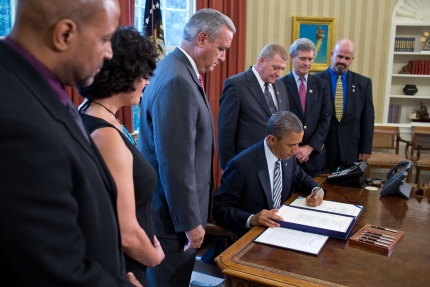
President Barack Obama signs the “Honoring America’s Veterans and Caring for Camp Lejeune Families Act of 2012,” in the Oval Office, Aug. 6, 2012. (Official White House Photo by Pete Souza)

This afternoon, President Obama signed legislation that takes two important steps to help fulfill our nation's obligations to our veterans and their families.

First, the new law offers extended care to a group of servicemembers who were based at Camp Lejeune with their families during a period when contaminated water caused major medical issues for a number of individuals.

Among those standing with the President at today's bill signing were Jerry Ensminger, a Marine Corps veteran who has been an advocate for affected families, and Mike Partain, who was born at Camp Lejuene and later developed male breast cancer. The bill the President signed was named after Janey Ensminger, the Master Sargeant's daughter who passed away from leukemia at age nine.

Second, the law prohibits protests at military funerals in the two hours immediately prior to and following a military funeral -- a measure, the President said, that will ensure that our servicemembers get laid to rest with "the utmost honor and respect."

President Obama upheld this bill as an example of the type of issue on which Republicans and Democrats can find common ground, and he pushed lawmakers to take action on other measures to aid veterans -- including his proposal for a Veterans Jobs Corps. 

Read his full remarks here

Related Topics: Veterans

The White House

Office of the Press Secretary

Readout of the President’s Call with President Rajoy of Spain

President Obama spoke with Spain’s President Mariano Rajoy earlier today as part of his ongoing discussions with European leaders about the eurozone economy.  President Obama acknowledged the difficult challenges that the Spanish people are facing, and reiterated his support for President Rajoy’s efforts to get Spain’s economy back on track.   President Obama discussed the troubling situation in Syria and welcomed Spain’s contributions to the Friends of Syria process.  The President also noted the positive development between Sudan and South Sudan to share oil revenues.

Honoring America's Veterans and Caring for Camp Lejeune Families Act of 2012

August 06, 2012 | 5:36 | Public Domain

President Obama signs a bill that will help improve access to health care for veterans, streamline VA services, expand support for homeless veterans, and also provide extended medical care for veterans and their families who were based in Camp Lejeune in the years the water was contaminated there, and prohibit protesting at military funerals.

Download mp4 (198MB) | mp3 (13MB)

Read the Transcript

Remarks by the President at Signing of the Honoring America's Veterans and Caring for Camp Lejeune Families Act of 2012

Oval Office

2:25 P.M. EDT

THE PRESIDENT:  Well, I want to thank everybody who is here because they all did outstanding work to help us get this legislation completed. 

As you know, I think all Americans feel we have a moral, sacred duty towards our men and women in uniform.  They protect our freedom, and it’s our obligation to do right by them.  This bill takes another important step in fulfilling that commitment.

I want to thank the members of Congress who helped to make this happen.  It is going to have immediate impact.  It is going to improve access to health care, streamline services in the VA. It expands support for veterans who are homeless.

There are two parts to the bill, though, that I especially want to highlight.  First of all, this bill ends a decade-long struggle for those who serve at Camp Lejeune.  Some of the veterans and their families who were based in Camp Lejeune in the years when the water was contaminated will now have access to extended medical care.  And, sadly, this act alone will not bring back those we’ve lost, including Jane Ensminger, but it will honor their memory by making a real difference for those who are still suffering.

The second part of this bill that I want to highlight -- prohibit protesting within 300 feet of military funerals during the two hours before and two hours after a service.  I supported this step as a senator.  I am very pleased to be signing this bill into law.  The graves of our veterans are hallowed ground.  And obviously we all defend our Constitution and the First Amendment and free speech, but we also believe that when men and women die in the service of their country and are laid to rest, it should be done with the utmost honor and respect. 

So I’m glad that Congress passed this bill and I hope that we can continue to do some more good bipartisan work in protecting our veterans.  I’ve been advocating, for example, for a veterans job corps that could help provide additional opportunities for the men and women who are coming home as we’re winding down our operations in Afghanistan and having ended the war in Iraq.  And so this is a good sign of a bipartisan spirit that I’m sure is going to carry through all the way to Election Day and beyond.

With that, I’m going to sign the bill.  Make sure I sign the right place, though.

(The bill is signed.)

There you go.  Congratulations, everybody.  Good work.  Thank you very much.

Q Mr. President, after the Wisconsin shooting, are you going to push for any further gun control measures?

THE PRESIDENT:  Well, first of all, we’re still awaiting the outcome of a full investigation.  Yesterday I had the chance to speak to both the Governor and the Mayor, as well as leaders of the Sikh community in Oak Creek.  All of us are heartbroken by what’s happened.  And I offered the thoughts and prayers not only of myself and Michelle but also for the country as a whole.

I think all of us recognize that these kinds of terrible, tragic events are happening with too much regularity for us not to do some soul-searching and to examine additional ways that we can reduce violence.  And as I've already said, I think there are a lot of elements involved in it, and what I want to do is to bring together law enforcement, community leaders, faith leaders, elected officials of every level to see how we can make continued progress.

We don’t yet know fully what motivated this individual to carry out this terrible act.  If it turns out, as some early reports indicate, that it may have been motivated in some way by the ethnicity of those who were attending the temple, I think the American people immediately recoil against those kinds of attitudes, and I think it will be very important for us to reaffirm once again that, in this country, regardless of what we look like, where we come from, who we worship, we are all one people, and we look after one another and we respect one another. 

But as I said, the FBI is working with local officials and they’re still investigating what motivated this individual.  And as we find out more, I suspect that not only the White House but others in Congress and at the local level will have more to say.

Thank you very much, everybody. 

END
2:31 P.M. EDT

Close Transcript

The White House

Office of the Press Secretary

Remarks by the President at Signing of the Honoring America's Veterans and Caring for Camp Lejeune Families Act of 2012

Oval Office

2:25 P.M. EDT

THE PRESIDENT:  Well, I want to thank everybody who is here because they all did outstanding work to help us get this legislation completed. 

As you know, I think all Americans feel we have a moral, sacred duty towards our men and women in uniform.  They protect our freedom, and it’s our obligation to do right by them.  This bill takes another important step in fulfilling that commitment.

I want to thank the members of Congress who helped to make this happen.  It is going to have immediate impact.  It is going to improve access to health care, streamline services in the VA. It expands support for veterans who are homeless.

There are two parts to the bill, though, that I especially want to highlight.  First of all, this bill ends a decade-long struggle for those who serve at Camp Lejeune.  Some of the veterans and their families who were based in Camp Lejeune in the years when the water was contaminated will now have access to extended medical care.  And, sadly, this act alone will not bring back those we’ve lost, including Jane Ensminger, but it will honor their memory by making a real difference for those who are still suffering.

The second part of this bill that I want to highlight -- prohibit protesting within 300 feet of military funerals during the two hours before and two hours after a service.  I supported this step as a senator.  I am very pleased to be signing this bill into law.  The graves of our veterans are hallowed ground.  And obviously we all defend our Constitution and the First Amendment and free speech, but we also believe that when men and women die in the service of their country and are laid to rest, it should be done with the utmost honor and respect. 

So I’m glad that Congress passed this bill and I hope that we can continue to do some more good bipartisan work in protecting our veterans.  I’ve been advocating, for example, for a veterans job corps that could help provide additional opportunities for the men and women who are coming home as we’re winding down our operations in Afghanistan and having ended the war in Iraq.  And so this is a good sign of a bipartisan spirit that I’m sure is going to carry through all the way to Election Day and beyond.

With that, I’m going to sign the bill.  Make sure I sign the right place, though.

(The bill is signed.)

There you go.  Congratulations, everybody.  Good work.  Thank you very much.

Q Mr. President, after the Wisconsin shooting, are you going to push for any further gun control measures?

THE PRESIDENT:  Well, first of all, we’re still awaiting the outcome of a full investigation.  Yesterday I had the chance to speak to both the Governor and the Mayor, as well as leaders of the Sikh community in Oak Creek.  All of us are heartbroken by what’s happened.  And I offered the thoughts and prayers not only of myself and Michelle but also for the country as a whole.

I think all of us recognize that these kinds of terrible, tragic events are happening with too much regularity for us not to do some soul-searching and to examine additional ways that we can reduce violence.  And as I've already said, I think there are a lot of elements involved in it, and what I want to do is to bring together law enforcement, community leaders, faith leaders, elected officials of every level to see how we can make continued progress.

We don’t yet know fully what motivated this individual to carry out this terrible act.  If it turns out, as some early reports indicate, that it may have been motivated in some way by the ethnicity of those who were attending the temple, I think the American people immediately recoil against those kinds of attitudes, and I think it will be very important for us to reaffirm once again that, in this country, regardless of what we look like, where we come from, who we worship, we are all one people, and we look after one another and we respect one another. 

But as I said, the FBI is working with local officials and they’re still investigating what motivated this individual.  And as we find out more, I suspect that not only the White House but others in Congress and at the local level will have more to say.

Thank you very much, everybody. 

END
2:31 P.M. EDT

The White House

Office of the Press Secretary

Presidential Proclamation--Honoring the Victims of the Tragedy in Oak Creek, Wisconsin

HONORING THE VICTIMS OF THE TRAGEDY IN OAK CREEK, WISCONSIN

BY THE PRESIDENT OF THE UNITED STATES OF AMERICA

A PROCLAMATION

As a mark of respect for the victims of the senseless acts of violence perpetrated on August 5, 2012, in Oak Creek, Wisconsin, by the authority vested in me as President of the United States by the Constitution and the laws of the United States of America, I hereby order that the flag of the United States shall be flown at half-staff at the White House and upon all public buildings and grounds, at all military posts and naval stations, and on all naval vessels of the Federal Government in the District of Columbia and throughout the United States and its Territories and possessions until sunset, August 10, 2012.  I also direct that the flag shall be flown at half-staff for the same length of time at all United States embassies, legations, consular offices, and other facilities abroad, including all military facilities and naval vessels and stations.

IN WITNESS WHEREOF, I have hereunto set my hand this sixth day of August, in the year of our Lord two thousand twelve, and of the Independence of the United States of America the two hundred and thirty-seventh.

BARACK OBAMA

The White House

Office of the Press Secretary

Press Briefing by Press Secretary Jay Carney, 8/6/2012

James S. Brady Press Briefing Room

11:57 A.M. EDT

MR. CARNEY:  I do have one quick announcement before I take your questions.  The President just concluded a call with Prime Minister Rajoy of Spain.  They discussed economic conditions in the eurozone.  And we will have a further readout later today of that call.

With that, I'll go to your questions.  Associated Press.

Q    Thank you.  A couple things on Syria.  I'm wondering if the U.S. has been able to independently confirm the defections of the Syrian prime minister and other government officials there.  And also, if you could give me an assessment of what type of impact you think these defections are having on the Syrian government, because they obviously get a lot of attention and it's clear that there is some instability within the regime, but that doesn’t necessarily seem to translate into a lessening of the violence.

MR. CARNEY:  Well, we have no reason to doubt the reports about the defection of the prime minister or other members of the government.  That the titular head of the Syrian government has rejected the ongoing slaughter being carried out at Assad's direction only reinforces that the Assad regime is crumbling from within and that the Syrian people believe that Assad's days are numbered. 

To go to your question about the implications, as we've said repeatedly as we've seen more and more high-level defections, this is a sign that Assad's grip on power is loosening.  If he cannot maintain cohesion within his own inner circle, it reflects on his inability to maintain any following among the Syrian people that isn't brought about at the point of a gun. 

The momentum is with the opposition and with the Syrian people.  It's clear that these defections are reaching the highest levels of the Syrian government and Assad cannot restore his control over the country because the Syrian people will not allow it.  The quickest way to end the bloodshed and suffering of the Syrian people is for Assad to step aside to enable a peaceful political transition to a government that is responsive to the aspirations of the Syrian people.

Q    What's the latest U.S. intelligence on where Assad is right now?

MR. CARNEY:  Well, you know I wouldn't talk about issues of intelligence.  But we monitor the situation in Syria very closely.  I have no specific information to give you about Assad. I can simply say that what we are seeing, as is evidenced by these latest reports, is increasing instability within his leadership and I think increasing desperation in his efforts to wage war against his own people.

Q    On another topic, we had another horrific shooting, this one in Wisconsin.  And after the Aurora shooting, the President said in his speech to the Urban League that he would talk to anybody, any party, about issues of gun violence and gun control.  I'm wondering if there are any plans for him to actually do something about that, now that we've had a second shooting in a couple of weeks here.

MR. CARNEY:  Well, let me say at the top that the President and the First Lady, as was noted yesterday, were deeply saddened to learn of this tragic shooting that took so many lives.  The President made clear that his administration will provide whatever support is necessary to the officials responding to this event and to the investigation, which the FBI, as you know, is involved in.  The President also made clear -- and this is important -- how much our country has been enriched by Sikhs, who are a part of our broader American family. 

As you know, the President was notified shortly before 1:00 p.m. by his Homeland Security Advisor, John Brennan, yesterday.  Later in the afternoon, the President convened a call with FBI Director Bob Mueller, Chief of Staff Jack Lew, and Homeland Security Advisor Brennan to receive an update.  Following that briefing, the President called the Governor of Wisconsin, Scott Walker, Oak Creek Mayor Steve Scaffidi, and Trustee of the Sikh Temple Charanjeet Singh to express his condolences for the lives lost and his concern for those who were injured.

On the broader issue that you mentioned, I think what the President said is still the case.  He believes that we have a broader issue with violence in America that needs to be addressed from a variety of angles, including efforts that this administration has undertaken to work with local communities to try to get children out of gangs, to get kids out of gangs, to get kids back in school, working with local law enforcement in their efforts to fight crime. 

Incidents like this are horrific, and our hearts go out to the victims and their families, and to the Sikh community in Wisconsin.  But we cannot lose sight of the fact that there is violence all the time in America and that we need to take concerted action to deal with it. 

Q    But no specific plans --

MR. CARNEY:  I have nothing new to announce.  I mean, he did very recently give those remarks at the Urban League and he'll continue to instruct his administration to take action towards common-sense measures that protect the Second Amendment rights of law-abiding citizens, but make it harder and harder for those who should not have weapons under existing law to obtain them.  Some progress has been made on those instructions with regards to our background check system.  And the President will continue to press that, as well as pressing the variety of ways that this administration is assisting local communities in their efforts to combat violence.  

Q    Can I just follow?

Q    Has the President, or will the President be speaking to Indian Prime Minister Singh about the shooting at the Sikh temple in Wisconsin?  And what, if any, assurances can the President or federal law enforcement authorities give to the Sikh community in America that they will be protected from this kind of atrocity?

MR. CARNEY:  Well, on the first part of the question, I have no other foreign leader calls to read out to you at this time.  The President and the First Lady yesterday and again, through me today, expressed their deep condolences to the families of the victims and to the community that was affected.  And the President noted yesterday, as I am today, the important contribution that Sikhs have made and continue to make to the broader American community.  And we need to remember that.

The specifics of this particular incident are under investigation, so questions that go to motive, to the perpetrator, those kinds of things, I would have to refer to the FBI, which has a role in this investigation, as well to local law enforcement.

Q    Can you talk about any special security measures that might --

MR. CARNEY:  Well, again, I think that goes to motive about -- and I wouldn’t want to speculate at this time.  And I think that I would refer you to the FBI and to local law enforcement.

Q    Jay, can I follow up?

MR. CARNEY:  I’ll get to you, but let me go here.

Q    Does the President share Minority Leader Pelosi’s view that even if Democrats controlled Congress, there still wouldn’t be the votes for significant gun legislation?  And is that why the White House hasn’t pushed for new or tougher legislation more strongly?

MR. CARNEY:  Well, I think the President has made his views plain on this, which is that he is for common-sense measures that protect Second Amendment rights -- very important Second Amendment rights that American citizens have, but that make it harder and harder for those who should not have weapons under existing law from obtaining them.

There is no question that there has been a reluctance to act in Congress on these issues.  Whether that will continue to be the case in the future is anyone’s prediction.  The President is focused on the progress we can make along the lines I just described. 

So again, his positions on various issues I think we’ve talked about.  He believes that we can take action within the existing environment that moves the ball forward in terms of enforcement, that enhances background checks, that makes it harder for those who shouldn’t have weapons under existing law -- makes it harder for them to obtain weapons, but continues to ensure that Second Amendment rights are protected.

Q    But does anything -- either one of these incidents suggest that there need to be new gun control legislation?

MR. CARNEY:  I think the President addressed this at the Urban League, John.  And his view is, as I’ve said, that we need to take common-sense measures that protect Second Amendment rights and make it harder for those who should not have weapons under existing law from obtaining weapons. 

I think he made clear, too, in his speech in New Orleans that violence in America is a problem that is greater than just the issue of gun laws.  And he talked very clearly about the prevalence of violence in America, that even as overall statistics show that crime has gone down over these last many years but there is still too much violence.  And incidents like the ones you mentioned are horrific, and our hearts go out to the victims of such appalling acts of violence, but we should not forget that there are victims of violence every day in America, and we need to address that problem in a concerted way that deals with education and summer jobs and other ways to help address the violence problem in America.

Q    On another front, Leader Reid-Governor Romney story continues to percolate.  Does the President think that it’s appropriate for Leader Reid to be making these, some would say, unsubstantiated charges on the Senate floor?  And has the White House spoken to him about it?

MR. CARNEY:  I’m not aware of the White House speaking to Senator Reid about this issue.  I would simply say that you all probably know Senator Reid well, and he speaks for himself, and he has addressed this issue.

I think that the broader question, as it relates to the President’s view, is that he thinks the tradition that has been in place since 1968 of candidates for President releasing multiple years of their tax returns is an important one.  It’s not always every candidate’s favorite part of the process, but it’s a tradition that's important.  It's valuable to the American people as they decide who should be President.  So that's why the President has put forward his financial information, his tax returns when he was a candidate, and believes that that’s an important tradition.

Q    I don't recall him pushing John McCain to release more than two years of his tax returns four years ago.

MR. CARNEY:  Well, I think the issue of Senator McCain -- but I would refer you to, obviously, his office for prior runs where he had released information -- the question here is not -- again, this is a question for the -- and I would refer you to our campaign -- but it's a question for Governor Romney, right?  He, as recently as last week, I think on ABC, said that he would be happy to check if he paid a lower effective tax rate in previous years than the 13.9 percent that he paid in the year related to the tax return that he did release. 

And I think the only -- the reason why this is an issue at a policy level is the President believes very strongly -- and this is central to the debate we're having in this country -- that we need to have greater tax fairness and that we need to make sure that we're passing laws that protect the middle class, that specifically give the middle class a tax cut extension, and that we're not passing laws that give tax breaks to millionaires and billionaires who have already enjoyed substantial tax breaks in the past, and who enjoy legal loopholes like the carried interest law that allow a Warren Buffett or a hedge fund manager or other very affluent Americans to pay taxes at a much lower rate than a factory worker at a plant -- a GM plant in Michigan or Ohio, or a hardworking member of the White House press corps. 

It's just about making our tax code more fair and making our tax code more helpful to the middle class, which is the backbone of our country and backbone of economic security and economic growth in our country.

Q    But, Jay, it's been charged --

MR. CARNEY:  Let me -- I promised him a question.  Tejinder, please go ahead. 

Q    First of all, I'd like to thank the President and First Lady for their kind words to the community.  But the way you said it, that there is violence on the streets of U.S. every day -- this is a particular peace-loving community who has been targeted, and they have been targeted since 9/11.  Where is the education of the general public?  It has been going on for 11 years, culminating in what happened.  And is the President going to travel to that community, in that area, soon?

And following up on that question, Prime Minister Singh has said that -- ensure conditions that such violent acts are not repeated in the future -- what are we going to do?

MR. CARNEY:  Well, let me take your question apart a little bit.  I can't address the motivation behind the specific incident that happened just 24 hours ago.  It is certainly the case that Sikhs have been targeted in America in the past, since 9/11, because they have been believed to be Muslims, and that has been a tragic event -- I mean, a violent -- whether it's against Sikhs or Muslims, this is clearly horrible and unacceptable.  But I can't address the motivation behind yesterday's attack because it's under investigation by the FBI and by local law enforcement. 
As for the President's schedule, I don't have any announcements to make about upcoming travel.  If I do, I will certainly make everyone aware of that travel.  But I just want to be clear and to reiterate, the President feels very strongly that we need to remember on a day like today the profound contributions that the Sikh community has made in this country.  And as you note, this is a very peaceful community, and it is a horrific thing when this kind of event takes place in and around a house of worship of any kind.  And our hearts go out to the victims and to their families.

Ed.

Q    I just want to follow on taxes because the charge is not just that maybe Mitt Romney paid less than a factory worker or whoever, but it’s a bit more vicious than that from Harry Reid.  He’s saying that he didn't pay -- he has an anonymous source telling him that he paid no taxes for something like 10 years.  So the President has talked a lot about changing the tone in this town.  Why hasn’t he picked up the phone and asked Harry Reid to stop making a charge like that?

MR. CARNEY:  Again, I think the idea that people tell Harry Reid what to do is inconsistent with what everyone here understands to be --

Q    But you can express your opinion that maybe that's below the belt.

MR. CARNEY:  Look, I think that the President -- you hear the President going out and talking about the important issues facing the American people every day.  And he talks about those issues in terms that reflect the importance of economic matters like our tax code and how our tax code, for example, currently benefits companies that ship jobs overseas.  He would change that so that it ceases encouraging investment overseas and outsourcing of jobs, and encourages insourcing of investment and jobs.

He talks about that in terms of, as I was saying earlier, a tax code that allows in totally legal fashion hedge fund managers to pay an effective tax rate that's significantly lower than most Americans -- or many Americans -- and that that is not reflective of a system that we need to have in place that helps the American middle class grow, helps enhance its security.

Q    Right, but that's not the charge.  The charge is that Mitt Romney didn't pay taxes for 10 years.  Does the White House believe that allegation?

MR. CARNEY:  Again, I would refer you to Senator Reid for -- I can't -- only Senator Reid knows his source, which he has discussed, and I would refer you to that.

I think it is a fair point to make that this is an issue that was not originated during the general election campaign, did not start with the President’s campaign or with Senator Reid, it started in the Republican primary when Governor Romney’s opponents brought up this issue and the fact that Governor Romney’s father began a tradition in 1968 of major candidates for President releasing multiple years of their tax returns, and that that is a tradition that has been adhered to by major candidates for President ever since.

Q    Nancy Pelosi today said, "Harry Reid made a statement that is true.  Somebody told him.  It is a fact."  Do you agree with that rationale?

MR. CARNEY:  I haven’t seen that statement.  But again, I would refer you to Nancy Pelosi and Harry Reid --

Q    But if someone just made an allegation that he didn’t pay taxes for 10 years, that’s just a fact?

MR. CARNEY:  I think the President is focused on -- and you hear him talk about this every day -- issues that matter to the American people that have to do with both tax fairness, but also actions that we need to be taking to grow the economy, that we need to be taking to increase job creation here in the United States, that we need to take in order to bring jobs back from overseas and have companies invest here in the United States.  Those are the issues the President is talking about.  And you’ll continue to hear him talk about those issues tonight and every day when he’s out there, making the case to the American people about his agenda.

Go ahead, John.

Q    And one more on Harry Reid.  It’s a simple question:  Does the President think that this allegation coming from Harry Reid, without any evidence, made on the Senate floor, is that below the belt?  Does that cross the line?

MR. CARNEY:  Again, I have not -- the President has not expressed an opinion to me on this.  I can tell you that the President is focused on the issues that I’ve just talked about.  And again, he believes in the tradition of releasing tax returns. I mean, this is an issue that was raised by contenders for President in a Republican primary.  And just on your air a number of days ago, former Governor Romney said that he would go back and look at the effective tax rate he paid in previous years, and then his campaign said, oh, no, no, we won’t do that. 

And this is -- the issue here is one of transparency and again, as the President sees it with regards to his candidacy, one that is an important tradition, that allows the American people to get a sense of a candidate’s background.

Again, I don’t have a -- you can talk to Senator Reid.  He, I’m sure, will address this issue if you ask him.  He certainly speaks for himself.  The President is focused on the issues that matter most to the American people.  And we now have a situation where Congress has left town for a number of weeks, where instead of passing legislation that would extend a tax cut for 98 percent of the American people, the House left town refusing to do that. 
Look at the overlap between the measure the Senate passed and the measure the House passed.  There's only 2 percent disagreement with -- and some of the other tax issues that the President put on the table and are part of the Senate version.  Why can't we -- if Washington were to function effectively, if Republicans were to simply accept the principle that we should act on behalf of 98 percent of the American people, we could have taken care of the matter of a middle-class tax cut before they went on recess, and that security would be in place for 98 percent of the American people -- 114 million Americans, taxpaying Americans -- before the fall campaign even began. 

Instead, we didn't get action on that.  And that's the kind of craziness we have in Washington now, where even where we agree completely on an issue, there's a refusal to say, okay, let's get it done.

Q    I was just asking if it was inappropriate for Harry Reid to go out and make an --

MR. CARNEY:  I think I just answered this question three or four times.  And I think I would ask your question of Senator Reid.

The President you've heard on numerous occasions talk about the issues that he believes are central in the minds of the American people, as they make up their minds about the candidates for office in the presidential election.

Q    Well, let me ask you about something else.  David Plouffe, it's been reported today, gave a speech in Nigeria to this -- paid for by a company that had some business dealings with Iran.  The RNC is out condemning this, accusing the White House of hypocrisy, for profiting handsomely by speaking to a company doing business with a radical, anti-government nation of Iran -- anti-American government of Iran.  Is the White House concerned about Mr. Plouffe getting $100,000 for a speech like this so close before he came to work here again?

MR. CARNEY:  Well, David Plouffe was invited to speak in Africa by an affiliate company of the company you mentioned in the spring of 2010.  He gave two speeches on mobile technology and digital communications, and had no separate meetings with the company's leadership.  Even the most zealous watchdog group on this issue did not start their campaign on the host company's holding company until years later. 

Criticism of Mr. Plouffe now for issues and controversies that developed much later are simply misplaced.  And I think you noted where the criticism is coming from -- the RNC.  I certainly -- I don't recall similar criticism from the RNC when senior members of the George W. Bush administration, prior to taking office, had given paid speeches to companies that, in the case of Credit Suisse and UVS, were cited for violations regarding financing in Iran.  And I think that this is clearly politics, which I think is reflected by the citation in your question.

Q    But President Obama came into office talking about a higher standard.  I mean, is there any concern about this kind of -- I mean, $100,000 in Nigeria to a South African company.  I mean, it was widely reported.  I mean, it had been reported even in The New York Times that they had business dealings with Iran. I mean, is there any concern at all about this?  Is this --

MR. CARNEY:  I'm not sure I understand the nature of your question.  This was prior to David Plouffe coming to office -- here to work in the White House.  It was before the watchdog group had even made an issue of this particular holding company.  And again, this is political criticism after the fact that's clearly designed to try to score some points when this was several years ago, prior to this dynamic we have now with regards to sanctions and companies like this.

And I would point out that the same source of criticism was I believe silent when it involved senior administration officials in the previous administration.

Dan.

Q    Just to follow on an earlier question, putting aside what may have motivated the shooting over the weekend, given the fact that you yourself admitted that this is a community that has been targeted in the past, is it time for the administration to step up with some kind of educational campaign, something to help this community?  Because there is a lot of concern among that community, the Sikhs, that they’ve been unfairly targeted and will continue to be targeted in the future.  So is there anything that the administration should be doing?

MR. CARNEY:  Well, Dan, I appreciate the question, but I think it’s safe to say that you wouldn’t have asked me this question on Friday.  And I think that reflects that it relates specifically to this incident.  And because I can't address or speculate about motivation in this incident because it’s under investigation, I can't -- I think it would be inappropriate for me to talk more broadly about that issue because you would be understandably making assumptions about our conclusions about this specific incident that we can't make when the FBI and the local law enforcement are still investigating.  And it’s only been 24 hours.  I think it’s important to note that.

Q    Can I get your reaction to this new ad that Mayor Bloomberg and other mayors have put out asking for the President and Mitt Romney to come up with a plan to combat gun violence?  Have you seen this ad?  Any reaction to it?

MR. CARNEY:  I haven’t.  I would simply point you to what I said earlier in answer to other questions about the President’s views on this, which he expressed in New Orleans at the Urban League, and the broader issue of violence in America that needs to be addressed, and addressed from a variety of angles, because it’s an issue that transcends these incidents of horrific violence that we see periodically, and it’s an issue that transcends legislation passed by Congress with regards to firearms.  And we need to go after it on every front. 

And that's why the President has instructed his Justice Department to make progress in enforcing existing law and enhancing background checks to make it harder for those who should not have weapons under existing law from obtaining them.  It's why he has, since he took office, instructed his administration to work with local communities in combating violence from a variety of different approaches.

Q    I have one more on Syria, one final thing on Syria.  You have talked now for months that Assad's days are numbered, yet he continues to be in power and people continue to get -- innocent people continue to get killed.  Is there anything that can speed this process along?  Because this sort of slow-drip approach is costing a lot of innocent people their lives.

MR. CARNEY:  Well, the responsibility for the appalling violence against civilians in Syria lies with President Assad.  He has systematically attacked his own people, attacked civilian population centers, and periodically through this period he has made promises about ceasing the violence, promises to abide by the principles of the Kofi Annan plan and has refused -- or has not lived up to those promises.  The responsibility is with Assad.  And the quickest way to end the violence and to bring about the transition that the Syrian people so deserve and desire is for Assad to step aside. 

Now, we have worked in a variety of different ways to help bring about that eventuality -- not just through the United Nations, where our efforts and the efforts of the vast majority of the countries with an interest in this have been thwarted by the refusal to go along with meaningful measures at the Security Council by Russia and China, but our efforts are not limited to the United Nations Security Council or the United Nations.  They include working with the "Friends of Syria."  They include working with the Arab League, and working directly with the opposition.  And we will continue to do that. 

And we will -- I think your point is well taken, but it is also true, as we discussed at the top of the briefing, that Assad's grip on power is clearly loosening, that he seems incapable of preventing senior members of his government and his military from defecting.  And I think that indicates a situation where the eventuality of Assad leaving power comes closer and closer.  It's impossible to predict when that will happen, but Syria's future must not, and will not, include Bashar al-Assad because the Syrian people simply won't stand for it and they absolutely do not deserve it.

Q    May I follow up on that?

MR. CARNEY:  Sure.

Q    The current situation that's so deteriorating could have a negative effect on the stability of the state of Israel.  Has the President been in touch with Prime Minister Netanyahu over the last few days?

MR. CARNEY:  I have no other foreign leader communications to read out to you at this time.

Q    Jay, I want to ask you about Friday's mixed jobs report.  On the one hand, the economy had 163,000 jobs; on the other hand, the unemployment rate ticked up to 8.3 percent.  To what extent does that 8.3 percent undermine the President's argument now, just three months until election day, that he is moving the economy in the right direction, albeit not quickly enough?

MR. CARNEY:  Well, the President makes clear every time he talks about this issue that we are not where we need to be.  That is why he has urged Congress again and again to pass measures that independent economists have judged would add a million-plus jobs right now.  But Republicans in Congress have refused.

That's why he has urged Congress to give economic security to the middle class, to 98 percent of taxpaying Americans, by extending tax cuts for the middle class now, because we all agree on it.  We all agree on extending those tax cuts, Republicans and Democrats alike.  But Republicans in Congress have refused, insisting that millionaires and billionaires, the top 2 percent of wage earners in this country -- that the tax cuts of middle-class Americans should be held hostage to tax breaks for the wealthiest 2 percent.  The President believes that absolutely the wrong policy.

What is true is that while there is still more work to do, the economy has added private sector jobs now for 29 straight months, for a total of 4.5 million jobs during that period.  And just this year, the economy has added over 1.1 million private sector jobs.  Friday's report shows that private sector payrolls increased by 172,000 in July.  And while that is not enough, it is progress in the right direction, which is continued job creation.

But you will never hear this President say that he is satisfied, and that is why he is focused overwhelmingly on the things that he can do as President and the things he can do working with Congress to increase economic growth, to increase job creation, to increase middle-class security.  That is his legislative message, his policy message, as well as his campaign message.

Q    No President has gotten reelected with an unemployment rate this high.  So how concerned is the President about that 8.3 percent --

MR. CARNEY:  Well, I think the --

Q    -- the fact that it remains stuck above 8 percent?

MR. CARNEY:  It's a random factoid that’s thrown out a lot because of the limited empirical pool here.  And what is true is nobody -- no President has been reelected with a rate that high since FDR.  And I think that’s an instructive comparison, because, as you all know, this President came into office during the worst economic crisis since Franklin Roosevelt was in power. And the fact is, when he took the oath of office, we were in the process of losing 800,000 jobs that month.  We had just witnessed an economic contraction in the fourth quarter of 2008, the final quarter of his predecessor’s term in office, of nearly 9 percent. That great recession cost the economy close to 9 million jobs.  That is a very deep hole out of which to climb.

Since this President’s policies have taken effect -- and if we take the advice of some leading Republicans that we should measure performance after someone -- after a President is in office for six months or a year -- if you look at what has happened in this economy since this President’s policies have taken effect, we have seen, as I said, 29 straight months of private sector job growth, for a total of 4.5 million jobs.  We have seen economic growth, as opposed to contraction, for quarter after quarter after quarter. 

But we still have a long way to go.  And what we cannot afford, what we simply cannot afford is to adopt the same policies that got us into this mess.  I mean, we’ve tried the prescription that Republicans are offering.  And when a doctor offers you a prescription for an illness, it shouldn’t make the illness worse.  It shouldn’t -- if you’re recovering from a sickness, you don’t want a doctor to give you something that’s going to make you even sicker than you were before. 

But that’s what they’re offering.  They’re offering the same economic prescriptions that were introduced in 2001, 2002, 2003. And we know what happened.  President Bush came into office in January of 2001; handed to him were the significant surpluses by Bill Clinton; handed to him was a situation where the economy had just produced nearly 24 million jobs, for the largest period of sustained economic expansion since -- a peacetime economic expansion since World War II; and eight years later, after these policies were tried, we had the slowest growth during an expansion in history, I believe, and we had a cascading economic collapse like we hadn’t seen in our lifetimes. 

So we shouldn’t go back.  We shouldn’t adopt those policies again.  We are not where we need to be, but we’re headed in the right direction.

Q    Jay, I want to ask you one on Pakistan.  The new ISI chief visited Washington last week, met with Director Petraeus as well with other top officials.  Was the President kept abreast of those meetings, and was there a sense that they in any way moved the needle forward in terms of creating progress with Pakistani-U.S. relations?

MR. CARNEY:  I don’t have anything specific on the meetings that you ask about.  I can simply say that our relationship with Pakistan is very important.  It can be a difficult relationship, but it is very important to our national security.  We have shared interests in terms of combating extremism in the region, and we work with the Pakistanis on those shared interests all the time.  And the President is constantly kept abreast of those efforts.

Laura.

Q    Just returning to guns for a moment.  You’ve said, in response to a bunch of questions, that he supports enforcing -- better enforcing existing laws.  His position in the past has been in favor of renewing the assault weapons ban, which would, at this point, be a new law.  He also said in New Orleans that AK-47s belong on the battlefield, not on the streets.  Does he still support that legislation?

MR. CARNEY:  He does.  And I’ve said that before from the podium in the last week, that he does support renewing the assault weapons ban.  I think what I’ve noted in the past, and what I noted here, is that there has been reluctance by Congress to pass that renewal.

Q    What’s considered sort of an update of that legislation is the amendment that you were asked about a couple of times last week, which was to ban high-capacity magazines.  That’s viewed by advocates as essentially accomplishing the same thing in a better way.  And when you were asked about that in the past, you didn’t have a position.  Do you have -- does the administration have a position on that?

MR. CARNEY:  Well, I think the legislation on this issue broadly, whether it’s the specific piece of legislation that you mention -- if such legislation emerges, the President will evaluate it, the White House will evaluate it, guided by the principles that I talked about earlier, which is his desire to make it harder for people who should not have weapons under existing law from getting them, and under the principle that we should not infringe upon the Second Amendment rights of American citizens.  But I’m not going to speculate about pieces of suggested legislation.  If something emerges from Congress we’ll certainly evaluate it.

Q    Well, it's introduced; it wasn’t just --

MR. CARNEY:  Well, I know, but -- and I think we’ve noted where Congress is on these issues.  If something emerges from Congress we’ll certainly evaluate it.

Q    And the other thing you talk about on this issue is the national dialogue on issues beyond just gun control, but violence, and you point out that he gave that speech.  Does he feel like that speech has sort of accomplished his part of this dialogue, and now it’s up to others?

MR. CARNEY:  I’m sure he will discuss these issues again in the future.  I think you’ve asked on a number of occasions for specific dates when he might speak again.  I don’t have any announcements to make on that.  But the President has addressed this on several occasions and I’m sure will again in the future.

Q    Does he feel like that speech accomplished its purpose?

MR. CARNEY:  I don’t think he does feel that the goal of addressing violence in America has been achieved, and that’s why we need to continue to work collectively on efforts across the board to reduce violence in America.

Christi.

Q    Jay, when the President disagrees with Congress’s decision not to take up legislation like this, he goes out in the country and tries to pressure them publicly, and even shame them into doing that.  Is this -- does this fall under the same category, the assault weapons ban, or some version of it?

MR. CARNEY:  There’s a lot of legislation the President has a position on.  He believes -- his support for renewal hasn’t changed.  I think we all recognize the situation in Congress with regards to that particular proposal as well as others.  The President is focused, as he talked about in New Orleans, on doing what he can, through his Department of Justice, to take common- sense measures that will enhance our security by improving background checks and making it harder for those who should not have weapons under existing law from obtaining them, and working more broadly to address the issue of violence in America.  Because, as I’ve said now on a couple of occasions, the issue, as the President sees it, transcends legislation relating to guns; it has to do with a whole variety of factors, and should be addressed accordingly.

Q    But he’s been successful at pressuring Congress to take up specific legislation.  Does he view this as less possible?

MR. CARNEY:  Well, I’m not going to grade possibilities here.  I think the President believes that we should -- with Congress where possible, but administratively where allowed -- take measures that enhance security by making it harder for those who should not have these weapons under existing law from obtaining them, but also protect our Second Amendment rights.  And he’ll continue to do that.

April.

Q    Thank you.  Going back to the gun issue, what is the threshold when this administration will say when it’s time to take the gun issue out of that broad basket of violence and focus straight on -- I mean, in recent weeks we’ve had two fatal, horrific shootings.  When does this administration take it out of that violence basket and put a spotlight specifically on it?

MR. CARNEY:  Well, I think, April, the question, as the President discussed in New Orleans, is not one of specific high-profile incidents alone.  And the unfortunate reality is that while these terrible incidents get a lot of headlines, there is violence in America every day.

Q    And a lot of it is gun violence.

MR. CARNEY:  No question.  But that's why we have to work collectively towards addressing these issues in ways that reduce violence and include efforts to keep kids in school, keep them off the streets and from joining gangs, in efforts to, as the President has done through his Department of Justice, make it harder for criminals and others who should not have weapons under existing law from obtaining them.  That's the kind of comprehensive approach the President thinks we ought to adopt, and that he has adopted in office.

Q    But, Jay, many of these acts you can't police against  -- many in law enforcement say you can't police against them.  So when you can't police against something like that, it would seem that the other half would deal with issues of gun control, of the assault weapons ban being -- not renewing, but creating a new assault weapons ban.  Why not now?  Why not now?

MR. CARNEY:  Again, I think I’ve answered this question a bunch, but the President’s approach is that we should work with Congress where possible, and administratively where allowed, to advance common-sense measures that enhance our security, that keep weapons out of the hands of criminals and others who shouldn’t have them under existing law, but that protect Second Amendment rights, which the President thinks is an important goal as well.

I think that I can say that that’s the President’s approach. You heard it recently in New Orleans.  I’m sure you’ll hear from him again on this issue.  But I don’t expect his broader view here about the broader problem with violence in America is going to change because of a specific incident.  It’s a broader problem that needs to be addressed from a variety of fronts.

Q    My last question -- so is the White House Office of Legislative Affairs actively working with congressional leaders, congressional staffers, now on issues of gun control and a new assault weapons ban?

MR. CARNEY:  I don’t have any legislative update for you.  I think Congress is out of session at the moment.

Olivier.
Q    Yes, I've got a couple for you.  Has the President seen the images beamed back from Mars?

MR. CARNEY:  I didn’t ask him.  I think that was -- you saw the statement that we put out.  It’s a remarkable achievement and I think is testimony to the ingenuity of the American people and American companies, and of NASA in particular.  But I haven’t talked to him about whether he’s seen these images.  It really is quite remarkable. 

Q    And given the weeks and months in which you’ve said that Assad’s days are numbered, does the United States today have a plan for the post-Assad Syria?

MR. CARNEY:  Does the United States have what?

Q    A plan for post-Assad Syria -- 

MR. CARNEY:  That's a great question.  We are working --

Q    -- chemical weapons, making sure that violence doesn’t spill over, that kind of thing.

MR. CARNEY:  We very much are focused on, with our partners and the "Friends of Syria," with the opposition directly, with the Arab League, on what a post-Assad Syria will look like, and on the opportunity for the Syrian people to enjoy a better life in a post-Assad world, under a government that would be inclusive and that would give voice to their aspirations. 

There are a lot of issues involved that would have to be resolved, principally by the Syrian people, in terms of achieving that better future.  But there is no question that the first step towards that better future is Assad’s departure from the scene, because the longer he stays in power, the worst the situation gets.  We have seen that repeatedly.  And those who have suggested that, in explaining their continued support for Assad, that somehow having him in power is a better alternative to having him leave power, I think that argument is disproved daily by the appalling violence Assad brings to bear against his own people.

One more.  Ann. 

Q    American athletes are coming back with more than 60 medals from the Olympics.  Does the President think that they should pay taxes, since in some cases, $9,000 for not only the medal but the cash awards they bring home?

MR. CARNEY:  Well, the President believes that we should support efforts, like I think the bill you're referencing, to ensure that we are doing everything we can to honor and support our Olympic athletes who have volunteered to represent our nation at the Olympic Games.  So he supports that bill.  If it were to get to his desk, he would support it. 

Thank you.

END   
12:44 P.M. EDT

The White House

Office of the Press Secretary

Statement by the Press Secretary on H.R. 1627

On Monday, August 6, 2012, the President signed into law:

H.R. 1627, the "Honoring America's Veterans and Caring for Camp Lejeune Families Act of 2012," which amends Department of Veterans Affairs authorities related to:  health care; housing assistance; homeless veterans; education; benefits; memorial, burial, and cemetery matters; and miscellaneous provisions.