The White House

Office of the Press Secretary

Statement by the Press Secretary on Cybersecurity Legislation Vote

Today, despite the strong leadership of Senators Reid, Lieberman, Collins, Rockefeller and Feinstein, an overwhelming majority of Senate Republicans blocked consideration of the Cybersecurity Act of 2012, the only comprehensive piece of cybersecurity legislation that would have begun to address vulnerabilities in the nation’s critical infrastructure systems.  Senate Republican opposition to this vital national security bill, coupled with the deeply-flawed House information sharing bill that threatens personal privacy while doing nothing to protect the nation’s critical infrastructure, is a profound disappointment.  The Administration sent Congress a legislative package in May 2011 that included the new tools needed by our homeland security, law enforcement, intelligence, military and private sector professionals to secure the nation, while including essential safeguards to preserve the privacy rights and civil liberties of our citizens. Since that time, Administration officials have testified at 17 hearings on cybersecurity legislation and presented over 100 briefings, including two all-Member Senate briefings and one all-Member House briefing. Despite the President’s repeated calls for Congress to act on this legislation, and despite pleas from numerous senior national security officials from this Administration and the Bush Administration, the politics of obstructionism, driven by special interest groups seeking to avoid accountability, prevented Congress from passing legislation to better protect our nation from potentially catastrophic cyber-attacks.

The White House

Office of the Press Secretary

Statement by the Press Secretary on Additional $12 Million in U.S. Humanitarian Assistance to Syria

Today, on behalf of the American people, the President approved an additional $12 million in U.S. humanitarian assistance to support those most affected by the crisis in Syria.  After nearly 17 months of conflict, the humanitarian situation is dire and rapidly deteriorating.  The United Nations estimates that over 1.5 million people in Syria are in need of humanitarian assistance, over 1 million people are internally displaced, and more than 130,000 people have sought refuge in neighboring countries.  With these additional funds, the United States is now providing over $76 million in assistance for food, water, medical supplies, clothing, hygiene kits, and other humanitarian relief to those most urgently in need.

The United States applauds the generosity of Turkey, Jordan, Lebanon, Iraq, and others who are hosting and providing assistance to refugees fleeing the horrific atrocities perpetrated by Bashar al-Asad’s regime.  Syria’s neighbors, along with the United Nations and international and local non-governmental organizations, are delivering humanitarian aid wherever possible within Syria and in the region.  Our additional assistance will help their efforts to provide lifesaving assistance and reduce human suffering.  As a leading provider of humanitarian relief to those affected by the crisis in Syria, the United States urges all countries around the world to contribute to the United Nations Syria humanitarian appeal.  We also call on all parties to ensure the safety of civilians and aid workers, and the safe and unimpeded delivery of relief supplies to those in need.

The quickest way to end the bloodshed and suffering of the Syrian people is for Bashar al-Asad to recognize that the Syrian people will not allow him to continue in power, and to step aside to enable a peaceful political transition to a government that is responsive to the aspirations of the Syrian people.  We call on all members of the international community to support a political transition in Syria, and we will continue to work with the opposition and our allies and partners to support an inclusive transition that guarantees the Syrian people their universal rights.

For more details on how U.S. humanitarian aid is reaching Syria and neighboring countries, click here.

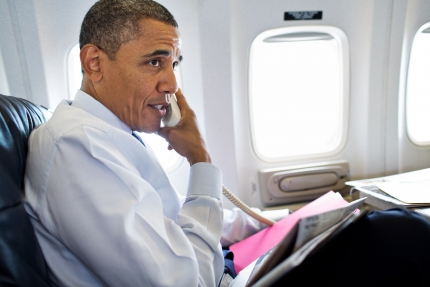
President Obama Calls the US Squad

President Barack Obama talks on the phone with members of the U.S. Olympic women's gymnastics team (August 1, 2012)

President Barack Obama talks on the phone with members of the U.S. Olympic women's gymnastics team during a phone call from Air Force One, Aug. 1, 2012. The President called the women to congratulate them on their gold medal in the team competition. (Official White House Photo by Pete Souza)

President Obama took time yesterday to congratulate some of America's newest Olympic gold medalists -- as well as the greatest Olympian of all time.

While traveling in Ohio, the President placed calls to the five members of the U.S. women's gymnastic team -- Aly Raisman, Jordyn Wieber, McKayla Maroney, Kyla Ross and Gabby Douglas.

He also spoke with Michael Phelps, who picked up his record-breaking 19th Olympic medal - a gold -- on Tuesday night.

Press Secretary Jay Carney told reporters that he had a chance to watch some of the competition in London with the President -- including the gymnastics competition.

"[President Obama] remarked that it is astounding what they are capable of doing and the pressure they are under and the fact that any mistake, any single mistake can cost you everything on a stage like the Olympic Games," Carney said.

Related Topics: Inside the White House, Ohio

The White House

Office of the Press Secretary

Statement by the Press Secretary

House Republicans tonight voted to extend the Bush tax cuts for the wealthiest few and shower millionaires and billionaires with a $1 trillion tax cut that will inevitably be paid for by gutting investments in critical programs needed to create jobs and strengthen the economy.  At a time when we need to make tough choices to reduce the deficit, we can't afford another massive tax break for the wealthiest two percent of Americans. We’ve tried this approach, and it didn't grow the economy or strengthen the middle class. And we certainly can't afford to raise taxes on 25 million middle class families like the Republican plan would do. The President called for a bill that would extend tax cuts for 98% of Americans and ensure taxes don't go up by an average of $2,200 for the typical family at the beginning of next year. He will continue to call on Republicans in the House to stop holding the middle class tax cuts hostage and the House needs to follow the Senate's lead and get this done.

The White House

Office of the Press Secretary

President Obama Announces More Key Administration Posts

WASHINGTON, DC – Today, President Barack Obama announced his intent to nominate the following individuals to key Administration posts:

• Eric K. Fanning – Under Secretary of the Air Force, Department of Defense
• Christopher J. Meade – General Counsel, Department of the Treasury
• William J. Mielke – Member, Advisory Board of the Saint Lawrence Seaway Development Corporation
• Captain Arthur H. Sulzer, USN (ret) – Member, Advisory Board of the Saint Lawrence Seaway Development Corporation
• Iqbal Paroo – Member, Board of Directors of the African Development Foundation

The President also announced his intent to appoint the following individual to a key Administration post:

• Hill Harper – Member, President’s Cancer Panel

President Obama said, “It gives me great confidence that such dedicated and capable individuals have agreed to join this Administration to serve the American people. I look forward to working with them in the months and years to come.”

President Obama announced his intent to nominate the following individuals to key Administration posts:

Eric K. Fanning, Nominee for Under Secretary of the Air Force, Department of Defense
Eric K. Fanning has served as Deputy Under Secretary of the Navy since 2009.  Prior to joining the Administration, he was Deputy Director of the Commission on the Prevention of Weapons of Mass Destruction Proliferation and Terrorism.  Previously, Mr. Fanning worked for Business Executives for National Security (BENS), first as the Washington Regional Director in 2001, and then as Senior Vice President for Strategic Development from 2001 to 2007.  Prior to joining BENS, Mr. Fanning held a number of positions, including Senior Associate at Robinson, Lerer & Montgomery in New York and Associate Producer at CBS News.  Mr. Fanning began his career in public service, serving as an Associate Director of Political Affairs at The White House (1996), a Special Assistant in the Office of the Secretary of Defense (1993-1996), and as a Research Assistant and Professional Staff Member for the Committee on Armed Services in the U.S. House of Representatives (1991-1993).  He received a B.A. from Dartmouth College.

Christopher J. Meade, Nominee for General Counsel, Department of the Treasury
Christopher J. Meade is Principal Deputy General Counsel at the U.S.  Department of the Treasury and, since June 2012, has served as Acting General Counsel.  From 2005 to 2010, Mr. Meade was a partner with the law firm of Wilmer Cutler Pickering Hale and Dorr (WilmerHale), where he was a member of the Litigation and Securities Departments, as well as the Appellate and Supreme Court Litigation Group.  During this time, he argued four cases before the U.S. Supreme Court.  Mr. Meade served as a law clerk to Justice John Paul Stevens from 1997 to 1998, and Judge Harry T. Edwards of the U.S. Court of Appeals for the District of Columbia Circuit from 1996 to 1997. He received his A.B. from Princeton University, magna cum laude, and his J.D. from New York University School of Law, magna cum laude, where he was the Editor-in-Chief of the Law Review.

William J. Mielke, Nominee for Member, Advisory Board of the Saint Lawrence Seaway Development Corporation
William J. Mielke is Chairman of the Board, President, and Chief Executive Officer of Ruekert/Mielke, a consulting engineering company located in Pewaukee, Wisconsin. He has been a director of Bank Mutual Corporation since 2000, and its subsidiary, Bank Mutual, since 1988.  Mr. Mielke is also a Fellow of the American Consulting Engineers Council and served as a diplomat of the American Academy of Environmental Engineers. From 2006 to 2007, he was a member of the Special Committee on Great Lakes Water Resources Compact.  Prior to that, he was a member of the Wisconsin Task Force on State and Local Government from 2002 to 2003. He served as Vice Chairman of the Wisconsin Land Council from 1998 to 2003, and was a member of the Joint Architect-Engineer Committee on Federal Procurement of Engineering services from 1987 to 1995, serving as Chairman for his last year on the Committee. Mr. Mielke earned a B.S. in Civil Engineering from the University of Wisconsin-Madison and is a registered Professional Engineer and Land Surveyor.

Captain Arthur H. Sulzer, USN (ret), Nominee for Member, Advisory Board of the Saint Lawrence Seaway Development Corporation
Captain Arthur H. Sulzer, USN (ret), is President of Arthur H. Sulzer Associates, Inc., a position he has held since 2001.  From 1974 to 2005, Captain Sulzer served in the United States Navy. His active duty assignments included Operation Iraqi Freedom and Operation Enduring Freedom, where he commanded the U.S. Naval Ship Comet.  In 2003, Captain Sulzer joined several colleagues to open Maritime Academy Charter High School.  He was the Manager of Industrial Relations for Keystone Shipping Company from 1996 to 2003, and was Vice President of Operations for the Sea Line Company from 1987 to 1988.  Captain Sulzer has taught at various institutions over the last 30 years including Great Lakes Maritime Academy and the U.S. Merchant Marine Academy.  He is a U.S. Coast Guard Licensed Ships Master and Third Assistant Engineer with extensive commercial sailing experience. Captain Sulzer earned a B.S. in Marine Transportation and an M.S. in Transportation Management & Maintenance from the State University of New York Maritime College.  He received an M.B.A. in Finance from Hofstra University and a Ed.D. from the University of Pennsylvania.

Iqbal Paroo, Nominee for Member, Board of Directors of the African Development Foundation
Iqbal Paroo is the Managing Partner of Paroo and Associates, a health care consulting firm that advises academic health care institutions. From 2002 to 2007, Mr. Paroo served as the President and CEO of Omidyar Network, a philanthropic investment firm. Prior to that, he was Chairman and CEO of Qualitas Healthcare International, a company that developed, owned, and managed health care systems in emerging economies and transforming markets. Mr. Paroo served as President of Hahnemann University from 1987 to 1994. He received a B.S. in Business Administration and an MHA from Georgia State University.

President Obama announced his intent to appoint the following individual to a key Administration post:

Hill Harper, Appointee for Member, President's Cancer Panel
Hill Harper is a film, television, and stage actor.  He is currently a cast member on the CBS television program CSI: NY, where he plays the role of Dr. Sheldon Hawkes.  During his career, Mr. Harper has appeared in numerous films, television shows, and plays, and has received seven NAACP Image Awards for his writing and acting.  Mr. Harper is also a survivor of thyroid cancer.  In 2011, he authored The Wealth Cure: Putting Money in Its Place, a New York Times bestseller which chronicles his diagnosis with thyroid cancer and his journey to health.  He received a B.A. from Brown University, an M.P.A. from the Kennedy School of Government at Harvard University, and a J.D. from Harvard Law School.

The White House

Office of the Press Secretary

Remarks by the President at Campaign Event

John S. Knight Center
Akron, Ohio

3:31 P.M. EDT

THE PRESIDENT:  Hello, Akron!  (Applause.)  Oh, it is good to be in Akron, Ohio again!  (Applause.)

A couple people I want to acknowledge -- first of all, please give Jenna a big round of applause for that great introduction.  (Applause.)  I was telling Jenna before we came out I just love nurses, and for her to be looking after people every single day, that's what it's all about.  So I am so impressed with her.

A couple other people I want to acknowledge -- Russ Pry, Summit County Executive, is here.  (Applause.)  Now, your Mayor, Don Plusquellic -- (applause.)  I very much appreciate the fact that he had a little bit of surgery on his leg, just got out of the hospital, got wheeled in here -- (laughter) -- he's not going to be able to stay, but I'm grateful for him taking the time to come. 

And I want to say thank you to all the neighborhood leaders who are here.  (Applause.)  Thank you.  You guys are what this campaign is all about. 

AUDIENCE MEMBER:  We love you!

THE PRESIDENT:  I love you back.  Thank you.  (Applause.)  Thank you.

I also want to make sure we give it up for all our outstanding U.S. of A. athletes who are competing in London right now.  (Applause.)  There are a whole bunch of Ohioans representing our country over there.  When wrestling gets underway next week, we’ll be rooting for Army Specialist Justin Lester, right here from Akron.  (Applause.)  He may be wearing a different uniform, but he is still fighting for the United States of America.  (Applause.)

On the way over here, I had a chance to speak to Michael Phelps, who's won more medals than anybody.  (Applause.)  And then I spoke to the women's gymnastic team.  (Applause.)  Now, let me just say, I know how to run -- although I don't run as fast as these guys.  I know how to swim -- although I don't swim as fast.  These gymnasts, I don't understand what they're doing. (Laughter.)  I cannot even walk on a balance beam.  They're doing back flips and -- little, itty-bitty young ladies.  Unbelievable. So we could not be prouder of them.  (Applause.)  

Now, let me just say, unless you have been hiding your TV set -- (laughter) -- or your cable is broke, you may be aware that there is a fairly intense political campaign going on right now.  (Applause.) 

AUDIENCE:  Four more years!  Four more years!  Four more years!  Four more years!

THE PRESIDENT:  Now, the reason this campaign is so intense is because the choice that we’re going to be facing in November could not be bigger.  This is not just a choice between two candidates.  It’s not just a choice between two parties.  It is a choice about two fundamentally different visions for where we go in the future, two fundamentally different paths for our country. The direction that we choose -– the direction you choose when you walk into that voting booth –- it will not just have an impact on your lives; it will have an impact on your children’s lives and your grandchildren’s lives.  (Applause.)  It will impact America for decades to come.

AUDIENCE MEMBER:  That’s why we vote for you!  (Applause.)

THE PRESIDENT:  Now, four years ago, we all came together -– Democrats, but we also had independents, we had some Republicans -– to restore the basic bargain that built this country, that made us into an economic powerhouse.  It was a bargain, it was a deal that says if you work hard here in America, you should be rewarded for that work.  (Applause.)  It’s a deal that says if you put in enough effort, if you act responsibly, then you should be able to find a job that pays the bills.  (Applause.)  You should be able to afford a home that you call your own.  You should be able to count on health care when you get sick.  You should be able to put away enough to retire with dignity and respect.  And most of all, you should be able to give your children the kind of education that allows them to dream even bigger and do more than you could ever imagine.  (Applause.)

It’s a simple promise.  It’s a promise that I’ve lived out in my life and Michelle has lived out in hers.  It is --

AUDIENCE MEMBER:  We love Michelle!

THE PRESIDENT:  I know you all love Michelle.  (Applause.) 

It is the promise that’s at the heart of this country -- this idea that here in America, you can make it if you try.  And it had been slipping away for almost a decade.  We had seen sluggish job growth and jobs getting shipped overseas; your incomes were flat or going down; costs of everything from health care to college were going up.  And it culminated in the worst financial crisis since the Great Depression.

Now, we knew that restoring that American Dream would not be easy.  We knew it was going to take more than one year or one term or maybe even one President.  And that was before the middle class got hammered by this recession, and we saw millions of our friends and neighbors get hurt, lose homes, lose jobs. 

But over the last three and a half years, we’ve worked to make progress -- 4.5 million new jobs created; half a million new manufacturing jobs.  They’d counted the auto industry out, and now it is coming back stronger than ever, right here in Ohio and all across the country.  (Applause.) 

We passed health care so you could have security if you get sick.  (Applause.)  We passed reforms to make sure that Wall Street could not act in the same reckless manner that almost brought the economy to its knees.  (Applause.)  We ended the war in Iraq.  (Applause.)  And we’re taking care of our veterans -- because if you fought for this country, you should not have to fight for a job or a roof over your head when you come home.  (Applause.)

Now, we still have a long way to go.  But there’s one thing that this crisis has not changed.  It hasn’t changed who we are. It hasn’t changed our character.  It hasn’t changed what makes us great.  It hasn’t changed what brought us together in 2008.  We just feel a greater sense of urgency about it. 

Our first order of business has been to recover the jobs and wealth that was lost in this crisis.  But we’re not going to stop there.  We’re going to reclaim the financial security that’s been slipping away for more than a decade.  Our job isn’t just to put people back to work.  We want an economy where that work pays off, so that no matter who you are or what you look like or where you come from, here in America, you can make it if you try.  (Applause.)

That’s what this campaign is about -- fighting for the middle class and growing our middle class.  And that’s why I’m running for a second term as President of the United States.  (Applause.)

AUDIENCE:  Four more years!  Four more years!  Four more years!

THE PRESIDENT:  Now, there are no quick fixes or easy solutions to the challenges we face.  But there is no doubt in my mind we’ve got the capacity to meet them.  We’ve got the best workers in the world.  (Applause.)  We’ve got the best entrepreneurs in the world.  We’ve got the best scientists and researchers, the best colleges, and the best universities.  (Applause.)  We are still a young nation; we’ve got the greatest diversity of talent and ingenuity -- people want to come here from every corner of the globe.  So no matter how tough things get, this is not a country that quits.  There isn’t a country on Earth that wouldn’t gladly change places with us. 

What’s standing in our way right now is not the lack of good ideas.  What’s standing in our way is our politics.  We’ve got a stalemate in Washington.  We’ve got Republicans in Congress who have clung to the view -- the uncompromising view -- that the only way to move ahead is to go back to the same, tired solutions that got us into this mess in the first place.

AUDIENCE:  Booo --

THE PRESIDENT:  They’ve got a basic theory -- I call it top-down economics.  And the basic idea is, is that if you give more tax breaks to the very wealthy, and you get rid of regulations on banks and polluters and health insurance companies, then somehow everybody is going to prosper.

Ohio, you know better.  We tried that.  It did not work.  America is not built from the top down.  America is built from the middle out.  America is built from the bottom up.  (Applause.)  America is built by farmers and factory workers, and small businesses and companies that send American products overseas, not jobs overseas.  (Applause.)

That’s the country we're fighting for.  That’s the economy that we need to build together.  And we are not going to get there doing the same kind of stuff that these folks are talking about now.  (Applause.)  We're not going to get there if we spend more money on tax cuts for folks like me who don’t need them and were not even asking for them.  (Applause.)

And yet, the centerpiece of my opponent’s entire economic plan is not only to extend the Bush tax cuts, but then to add a new $5 trillion tax cut on top of it.

AUDIENCE:  Booo --

THE PRESIDENT:  The bulk of this would go to the wealthiest Americans.  A lot of it would go to the top 1 percent.  Pay attention here -- folks making more than $3 million a year -- the top one-tenth of 1 percent -- they would get a tax cut under Mr. Romney's plan that is worth almost a quarter of a million dollars -- $250,000 they would save under his plan.

AUDIENCE:  Booo --

THE PRESIDENT:  Hold on, it gets worse.  My opponent says he's going to pay for this $ 5 trillion plan, but under this plan guess who gets the bill for these $250,000 tax cuts?

AUDIENCE:  No!

THE PRESIDENT:  You do.  And you don’t have to take my word for it.  Just today, an independent, non-partisan organization, they crunched all the numbers.  They looked at his plan.  This wasn’t me, it wasn’t my team.  This was an independent group.  One of the guys who did the analysis used to work for Bush.  (Laughter.)  So they found that if Governor Romney wants to keep his word and pay for his plan, this $5 trillion tax cut, the only way to do it is to cut tax breaks that you, middle-class families, depend on --

AUDIENCE:  Booo --

THE PRESIDENT:  The home mortgage deduction you use to pay for your home.  The health care deduction that your employers use to provide you health care.  Some of the tax credits we've put in place to send your kids to college.  What this means is the average middle-class family with children would be hit with a tax increase of more than $2,000.

AUDIENCE:  No!

THE PRESIDENT:  Now, I think a lot of people are willing to sacrifice to bring down the deficit, to defend our country.  But he's not asking you to contribute more to pay down the deficit.  He's not asking you to do it to invest -- I'm sure they're okay. Sometimes folks faint because they've been standing too long.  So we just need a paramedic right here in the front.  They'll be okay, just give them room.  That's all.  This happens to me all the time.  (Laughter.)  It means I've been talking too long.

AUDIENCE:  No!

THE PRESIDENT:  They'll be okay, just give them space. 

Now, let me make sure people understand this.  They're asking you to pay an extra $2,000 not to pay down the deficit, not to invest in our kids’ education -- Mr. Romney is asking you to pay more so that people like him get a tax cut.

AUDIENCE:  Booo --

THE PRESIDENT:  In order to afford -- we can break it down further.  In order to afford just a tax cut for somebody like Mr. Romney, 125 families like yours would have to pay another $2,000 in taxes each year -- and every year.  Not just one year, every year.   

Now, does that sound like a plan you can afford?

AUDIENCE:  No!

THE PRESIDENT:  How many people like that plan?

AUDIENCE:  None!

THE PRESIDENT:  Does that sound like the kind of future that our country can afford?

AUDIENCE:  No!

THE PRESIDENT:  Ohio, we do not need more tax cuts for the wealthiest Americans.  We need tax cuts for working Americans.  (Applause.)  We need tax cuts for families who are trying to raise their kids, and trying to keep them healthy, and trying to send them to college, and trying to put a roof over their heads. (Applause.)  We don’t need tax breaks for companies that are shipping jobs overseas -- we need tax breaks for companies that are investing here in Akron, Ohio.  (Applause.)

That’s the choice in this election.  And that’s why I’m running for President of the United States.  (Applause.)  

So I've got a different plan.  I've got a different plan.  Four years ago, I promised middle-class tax cuts -- I kept that promise.  (Applause.)  The typical family is paying about $3,600 less in taxes than they were when I came into office.  (Applause.)

So what I've said is let's keep taxes exactly where they are on the first $250,000 of everybody’s income.  So if your family makes under $250,000 -- like 98 percent of American do -- you won’t see your income taxes increase by one single dime.  (Applause.)

Now, if you’ve been lucky or you've been successful, so that you're in the other 2 percent of Americans, like I am, all we’re asking is that we pay a little bit more so that we can pay down our deficit and so we can invest in things like education that will help us grow.  (Applause.)  

And, listen, Akron, I don't believe government can solve every problem.  Not every government program works.  Government can't help somebody who doesn’t want to help themselves.  So we're cutting things that don't work.  I've already cut a trillion dollars' worth of spending.  But we've got to balance that.  And I'm not going to pay for massive new tax cuts for millionaires and billionaires by gutting the investments that we need to keep the middle class strong.  (Applause.)  

I want to make sure we're investing in hiring new teachers, especially in math and science.  (Applause.)  I want to make sure that we're putting folks back to work rebuilding our roads and our bridges, our airports.  (Applause.)  I want to make sure that we're investing in our community colleges so they can train people for the jobs that businesses are hiring for right now.  (Applause.)  I want to make sure we're investing in basic science and research to keep our technological edge.  (Applause.) 

And if we're going to bring down our deficit and do those things, and make sure that Medicare is there for our seniors, and make sure Social Security is there for our seniors -- (applause) -- then we've got to make choices.  And all I'm asking is the folks like me and Mr. Romney go back to the rates that we paid under Bill Clinton.  (Applause.)  And if you remember, that was when the economy created nearly 23 million new jobs, the biggest budget surplus in history, and -- here's the kicker -- it was good for folks at the top, too.

Because here's what happens.  When middle-class folks and folks who are working to get into the middle class, when they're getting a decent wage, when their tax bill isn't too high, they've got a little more money in their pockets, and then they go to the store and they buy a new appliance, or they finally get rid of that old beater and buy a new car, and maybe a student buys a new computer.  And so, suddenly, businesses have customers.  And that's how we make the economy grow.  (Applause.)

So, Ohio, look, this is a choice.  If you believe that Mr. Romney's plan will make you better off --

AUDIENCE:  No!

THE PRESIDENT:  -- if you believe it’s okay to just set our sights lower -- we can't afford to help young people go to college, we can't afford to rebuild our roads, we can't afford basic research -- if you believe that, then go ahead and send these folks to Washington for the next few years.

AUDIENCE:  No!

THE PRESIDENT:  But let me ask you, wouldn’t we be better off if we kept fighting for the things that have always made us strong? 

AUDIENCE:  Yes!

THE PRESIDENT:  If we fight to make sure our young people get the education they need?  (Applause.)  Are we going to be better off if we developing new energy sources here in America?

AUDIENCE:  Yes!

THE PRESIDENT:  Wouldn’t we be better off if we're investing in manufacturing so we're selling goods stamped around the world, "Made in Akron, Ohio," -- (applause) -- "Made in the United States of America"?  (Applause.)  Will we be better off five years from now, or 10 years from now, or 20 years from now if we've got the courage to keep working, to keep striving, to keep fighting for what's true and right and best about America?

AUDIENCE:  Yes!

THE PRESIDENT:  That’s what I believe.  That’s why I’m running for President.  (Applause.)

I want you to know, Akron, my hair may be grayer -- (laughter) -- but my determination is stronger than ever.  (Applause.)  My faith in the American people, my faith in you is stronger than ever.  (Applause.)  And if you still believe in me like I believe in you -- if you're willing to stand with me, and organize with me, and march with me, and vote with me, knock on some doors with me, and make some phone calls with me, and recruiting your friends and neighbors with me -- (applause) -- I promise you we will win the state of Ohio -- (applause) -- we will win this election.  We will finish what we started and we will remind the world why the United States of America is the greatest nation on Earth.  (Applause.)

God bless you.  And God bless the United States of America.  (Applause.)

END
3:56 P.M. EDT

The White House

Office of the Press Secretary

Readout of the President’s Call with President Hollande of France

President Obama spoke with French President Hollande today as part of his ongoing discussions about eurozone economic developments.  President Obama welcomed the recent declarations by the European Central Bank and European leaders on the need to do what is necessary to preserve the eurozone and encouraged their efforts to take decisive action.  The President also noted the troubling developments in Syria and his appreciation of the close cooperation with France on humanitarian assistance in support of the Syrian people, pressuring the regime and accelerating a political transition.    

The White House

Office of the Press Secretary

Press Gaggle by Press Secretary Jay Carney en Route Mansfield, OH, 8/1/12

Aboard Air Force One
En Route Mansfield, Ohio

10:28 A.M. EDT

MR. CARNEY:  Good morning, everyone.  Welcome aboard Air Force One.  For those of you who don't know, we are on a smaller airplane.  But Air Force One is a designation; it is not a specific aircraft.  If we were on the Delta Shuttle, it would be Air Force One.  But we’re not.

And with that I will make a quick announcement at the top just to remind you that as of today, on August 1st, 12.8 million Americans will benefit from $1.1 billion in rebates from insurance companies that were made possible by the Affordable Care Act.  Today is the deadline for these rebates to be delivered to consumers.  The law requires insurance companies to spend at least 80 percent of consumers’ premium dollars on health care -- not advertising, bonuses or overhead.  If insurance companies do not meet that standard, they must provide rebates to their consumers.

The rebates are just another example of how the Affordable Care Act is giving consumers a better value for their health care dollar and making our health care system stronger. 

With that, I’ll turn it over to Jen, who I think has a topper, as well.  It is $1.1 billion in rebates to 12.8 million Americans, who I am sure will be glad to have those rebates.

MS. PSAKI:  So two quick things before we take your questions.  One is the President in his remarks this morning will talk about a new report by the Tax Policy Center that found that if Governor Romney wants to keep his word on his $5 trillion tax cut for millionaires and billionaires, he would have to cut tax breaks that middle-class families depend on.  I encourage you all to read the report.

It also states that the top 1/10 of 1 percent -- 1/10 of 1 percent of people -- people making more than $3 million a year would get a tax cut of $250,000, while families making less than $200,000 would get their tax -- a tax increase of $2,000.  So to be clear, to summarize here, this is the one big idea that Mitt Romney has put out there, which is his tax plan.  His tax plan would give tax breaks to millionaires and billionaires and people making $3 million a year $250,000 tax cuts while raising taxes on middle-class families by $2,000 per family.

The second piece, which you may have seen, but I just wanted to highlight for you, too, is that we put out a new campaign ad yesterday.  I know we weren’t traveling so you may not have seen it, but the campaign ad is called “Worried.”  It highlights the choice voters face between Mitt Romney and President Obama’s plans for the deficit.  It’s playing in six states around the country -- Colorado, Iowa, New Hampshire, Nevada, Ohio and Florida.

With that, we’ll take your questions.

MR. CARNEY:  Questions?  That's it? 

MS. PSAKI:  Everyone happy?

MR. CARNEY:  Can I note as a matter of policy that -- at least the story I read about it, the Tax Policy Center, which is an independent outfit headed by a Republican, according to The Washington Post that wrote about it this morning, the Tax Policy Center went out of their way to be generous to the Republican plan and its assumptions and still concluded, as you have heard us say, that the only way -- and this is a matter of policy in contrast to the President’s proposals -- that the only way that the plan put forward by a leading Republican could work and be revenue-neutral is -- and provide all those tax cuts to upper-income Americans is to provide -- is to cause significant tax hikes to middle-class Americans.

And as you know, the President’s proposals are quite different and focus on extending tax cuts to 98 percent of the American people and asking millionaires and billionaires to pay a little bit more so that we can build our economy in a way that expands the middle class.

Q    Jen, can you address the new Romney campaign ad that faults the President for closing car dealerships?

MS. PSAKI:  Absolutely.  It’s pretty incredible and actually shocking that Mitt Romney and his team would go so far as to be critical of the President’s record on autos when he clearly isn’t familiar, or his team isn’t familiar, with the facts, which is that the President’s actions saved a million jobs -- nearly a million jobs; 2,200 -- let me just check this
-- but 2,200 jobs, I believe, for dealerships in Ohio alone. 

And Mitt Romney is the same person who wrote an op-ed saying, “let Detroit go bankrupt.”  If we had done that, if the country had done that, if the President had done that, it would have been disastrous for not only Ohio but the country. 

Again, one other thing to mention is one in eight jobs in Ohio is dependent on the auto industry.  So I think we were surprised by the ad, and the facts are pretty clearly on the President’s side and the courageous steps he took to save the industry.

Q    Do you have any response to the emails that have been released that suggest White House officials were -- outright say White House officials were holding meetings off-site to avoid the disclosure that comes with the WAVES system?

MR. CARNEY:  As you know, Republicans have spent a great deal of time and money on investigations which they themselves have characterized as political.  With regards to this particular issue, in a recent report from a Capitol Hill newspaper, a Republican on Capitol Hill said that it would be a good thing politically to go after Jim Messina because of his role in the campaign. 

That is not what the American people want their elected officials in Washington to be focusing on, especially at a time when Congress has within its power the opportunity to take action to, A, extend tax cuts for 98 percent of the American people; B, pass legislation proposed by the President that would put teachers, firefighters, policemen, construction workers back on the job, and grow the economy and add a million jobs to the bottom line.  That's what Congress should be focusing on.

Q    Jay, but that doesn't address the question of whether -- of Messina writing in an email suggesting that a meeting be held off campus at Caribou Coffee, specifically to avoid being in the log book.

MR. CARNEY:  But you know from the facts and demonstrated by this is that Mr. Messina had a longstanding personal email account in which he got traffic.  In an effort to comply with all the regulations pertaining to emails, he would forward emails to his White House account or copy his White House account so that those emails would be part of presidential record.  And that is per guidance provided by counsel.

Q    Is it a White House practice to hold meetings off -- outside of the White House to avoid people making it into the log book?

MR. CARNEY:  I don't have anything on this specific issue.  What I can tell you is that Mr. Messina would copy his own emails into the White House account so that the record was established.

Q    That's not -- you realize that's not what we’re asking about.

MR. CARNEY:  I don't have anything on that particular email or that particular meeting.

Q    Have you ever held meetings off campus to avoid people being in the log book?

MR. CARNEY:  I have had meetings with you guys off campus all the time, and it’s true that I don't want people to know that I meet with you because I try to keep better company.  I’m joking.

Any other questions?

Q    Do you have anything more on the aircraft that are being decommissioned or are in line for being decommissioned at the base where we’re landing in Mansfield?

MR. CARNEY:  As you know, the President made some very important policy decisions, keeping commitments that he made during the campaign to end the war in Iraq, to ramp up and refocus our efforts in Afghanistan, and then to wind down the war in Afghanistan.  As part of his foreign policy, national security strategy, he supported cuts that were passed and supported by bipartisan majorities in Congress that bring reductions in our defense spending. 

Regarding the air base, there is a redundancy in terms of the aircraft that this National Guard air base is home to at this point, but the President is committed to finding another mission for the National Guard unit at this particular air base.  But again, let’s be clear, the reductions in spending that are part of this effort are the result of policy decisions to end the war in Iraq, to wind down the war in Afghanistan.  And they were supported by both Democrats and Republicans.

Q    What would be some possible alternative missions?

MR. CARNEY:  I would refer you the Defense Department.  I mean, there are obviously many missions that can be fulfilled by the dedicated members of the National Guard across the country.

Q    Jay, Panetta met with Netanyahu today.  Is there any
-- does the White House believe that the U.S. and Israel are in lockstep on how to deal with Iran?  Netanyahu expressed concerns that the West may not be doing all that it can to curtail Iran’s nuclear ambitions.

MR. CARNEY:  Let me provide you something on that if I may.  The President has been clear that he is committed to preventing Iran from developing a nuclear weapon.  And as part of that goal, the administration has implemented what President Ahmadinejad said last month are "the most severe and strictest sanctions ever imposed on a country.” 

Sanctions are having a significant impact on the Iranian economy and the Iranian government's ability to access revenue.  And that has consequences on what they can spend money on, including on technology for their nuclear program.  And we are seeing increasing cracks in the Iranian leadership.  And that is a result of the pressure that they are under as the consequences for making the wrong choices continue to steadily increase.

The purpose of sanctions is to affect the decisions the Iranian government makes.  And since Iran has not yet decided to come in line with their international obligations, we are disappointed -- as Prime Minister Netanyahu is -- that Iran continues to ignore its international obligations.  The United States remains committed to a diplomatic solution, but the onus  is on Iran. 

If the Iranian government continues to ignore its international obligations, there should be no doubt that the United States and our partners will continue to hold Iran accountable.  I think you heard Secretary Panetta make clear that the effort to isolate and pressure Iran to reduce the resources it has available to spend money on programs like its nuclear programs will continue.  We announced -- the President announced -- new sanctions just yesterday.  That effort will continue.

We have also made clear that while we believe there is time and space for this sanctions regime and this effort to allow for Iran to make the choice it needs to make -- which is to abide by its international obligations, to abandon its nuclear weapons ambitions -- that door is closing and it will not remain open indefinitely.  And the President remains committed to preventing Iran from obtaining a nuclear weapon.  And we, of course, keep all options on the table as part of the effort to prevent Iran from obtaining a nuclear weapon.

Q    Well, I think the heart of the question was whether the U.S. and Israel are on the same page.

MR. CARNEY:  The U.S. and Israel are -- as we've seen in recent days, have an extremely close and cooperative relationship both militarily and in terms of intelligence.  We share information regularly on what is happening in Iran with regards to its behavior and its fulfillment, or lack thereof, of its international obligations.  And we agree with Prime Minister Netanyahu that the Iranian regime has yet to make the choice it needs to make, which is to abandon its weapons -- nuclear weapons ambitions and fulfill its obligations.

But it is also the case that the sanctions regime is unprecedented in history, that it is exacting a toll on the Iranian economy and the Iranian government, that Iranian officials themselves have acknowledged bitterly.  And the purpose of the sanctions and the purpose of continuing to ratchet them up is to apply relentless and ceaseless pressure on Tehran and to force it to make a choice -- rejoin the international community, abide by its international obligations or face the consequences.  And they are feeling consequences as we speak.

Q    Do you agree with Netanyahu's statement that the sanctions have not deterred Iran's nuclear program in his words "one iota" -- he says "not one iota"?

MR. CARNEY:  I just said that he -- there's a point at which Iran makes the decision to abandon its nuclear weapons ambitions.  That's the point of this broad international consensus behind the sanctions regime.  And it's the point behind the effort to continue to ratchet them up, to put increasing pressure on Iran. 

We completely agree with the Prime Minister's assessment that Iran has failed to make that choice, and that is absolutely a disappointment.  But the fact is the regime is having significant effect on the Iranian economy, having significant effect on the Iranian government.  It is making it increasingly difficult for the Iranians to access the resources necessary to fund various programs like the nuclear weapons program, its nuclear program. 

Q    So you disagree that it's having no effect?

MR. CARNEY:  I think that the question is -- obviously, there is one purpose to the sanctions regime, which is to change Iranian behavior, to make Iran make a different choice.  That has not happened yet.  But up and until the moment that it does happen -- if it does, which we hope it does -- obviously, they will not have had their desired effect.
 
But this is a process that we are undertaking, because the window remains open.  There is time and space to pursue this diplomatic option, even as we make clear that there is not unlimited time and space, and as we make clear that all options remain on the table.

Q    So you're saying the sanctions have not yet had their desired effect?

MR. CARNEY:  They have not yet had their desired -- of course, if the sanctions had forced Iran to make the decision to live up to its international obligations, Iran would have made the choice that would have allowed them to rejoin the community of nations and obtain some relief from the sanctions.  The purpose of the sanctions is to change Iranian behavior.  Now, that change has not yet come.  But that does not mean the sanctions are not having an effect on and an impact on the economy or on the regime.

Q    Jay, given the latest developments in Syria, just quickly, is there anything to announce in terms of the President's foreign leader calls or any additional steps the U.S. is taking?

MR. CARNEY:  I don't have any new calls to read out to you on Syria, in particular, or foreign leader calls to read out to you.  I think some of you may have seen the statement put out by President Assad, and his recent remarks show him for the coward that he is.  He hides out of sight, encouraging the heavily-armed Syrian military to continue slaughtering civilians in his name.

There is no military honor in shelling a city full of innocent civilians.  There is no integrity in driving thousands of people from their homes, literally causing them to flee with nothing but the clothes on their backs in an attempt to save their lives.  

The architect of this crisis in Syria is Bashar al-Assad.  Any attempt by the Syrian regime or its friends to cast doubt on that fact is nothing more than a smokescreen.

Recently, Foreign Minister Lavrov of Russia called for the Assad government to "make the first move" in ceasing military action, as Assad himself agreed to do under Annan's -- Kofi Annan's six-point plan.  Yet the Russians refuse to assign consequences to Assad if he doesn’t take this step.  Such calls would be much more meaningful if they were backed by consequences for noncompliance.

As you know, that is a reiteration of our disappointment at the decision made by Russia and China to veto all three attempts to pass a meaningful resolution against Assad at the United Nations Security Council.  We continue our efforts to try to build international consensus as we continue our efforts with the “Friends of Syria” and other partners to provide humanitarian assistance to the Syrian people.  At this point, I think we have provided $64 million of humanitarian assistance to the Syrian people, as well as non-lethal assistance to the opposition.

Q    And, finally, can you tell us -- did the President watch the U.S. women's gymnastics last night?  Has he spoken to the team?  Does he plan to call them?  Any other Olympic updates?

MR. CARNEY:  I can tell you that we -- the President and I and others -- spent some time before and during the trip on Marine One discussing the remarkable accomplishments of American athletes yesterday in London at the Olympics.  He did watch.  He did have the opportunity to watch both the success of the men's American relay team that resulted in Michael Phelps becoming the most decorated Olympian in history. 

And he also watched with extreme admiration the women's gymnastics team.  He remarked that it is astounding what they are capable of doing, and the pressure that they are under, and the fact that any mistake -- any single mistake can cost you everything on a stage like the Olympic Games is just a testament to their skill and their strength of character.  And he was quite impressed. 

Q    Does the President think the American people deserve to watch the Olympic Games live as they happen?  (Laughter.)

MR. CARNEY:  I know that he is just grateful that he had the time to watch some of the competition.  I have not had a discussion with him about the coverage. 

Q    Has he called Phelps or the women's team?

MR. CARNEY:  He has not.  I have not -- I don't have any calls to read out at this time.

MS. PSAKI:  He did tweet back and forth with Phelps, though, you may have seen.

Q    (Inaudible.)

MS. PSAKI:  Well, you saw him tweet.  Michael Phelps tweeted back -- so some breaking news for all of you.

MR. CARNEY:  There you go.

Q    He personally tweeted or his account?

MS. PSAKI:  Yes, yes.  He personally tweeted about Michael Phelps' historic achievement.

Q    So when he decides to tweet something like that, does he run it by someone first?  Or does he just literally call up Twitter and type it in?

MS. PSAKI:  Well, you'd be surprised to learn that we trust the President's judgment and his communications skills.  And what he would like to tweet on Twitter, we let him just run free with that. 

MR. CARNEY:  True story.  Thanks, guys.

END
10:48 A.M. EDT

The White House

Office of the Press Secretary

Remarks by the President at a Campaign Event

Mansfield Central Park
Mansfield, Ohio

11:44 A.M. EDT

THE PRESIDENT:  Hello, Ohio!  (Applause.)  Well, it is good to be in Mansfield.  I hope everybody is having a great summer.  (Applause.) 

A couple of people I want to acknowledge -- first of all, please give a huge round of applause to Brenda for that great introduction.  (Applause.)  And go try some of her pizza if you have not tried it.  (Laughter.)  You got a testimony right here  -- he says it's outstanding.  I want to thank her so much for doing this.

A couple other people -- your outstanding former governor, Ted Strickland, is here.  Give Ted a big round of applause.  (Applause.)  And although he couldn't be here because he's got votes, I just want to tell you that you could not have a stronger advocate than your hometown boy, the United States Senator from Ohio, Sherrod Brown.  (Applause.)

AUDIENCE MEMBERS:  We love you!

THE PRESIDENT:  I love you back.  (Applause.)

And I want to thank all the neighborhood team leaders who are here who are working so hard in this campaign.  (Applause.)

Now, finally, I just think it makes sense for us to give it up for all of our outstanding American athletes who are competing in London right now.  (Applause.)  I want to congratulate Michael Phelps -- (applause) -- most medals we've ever seen.  And then I had a chance on the way over here to call up the women's gymnastic team -- (applause) -- for bringing home the gold. 

I have to tell you, when I'm watching -- when people run track, I understand, I know how to run.  They're just much faster.  (Laughter.)  And I know how to swim -- they just swim much better than I do.  These gymnastics folks -- I don't understand how they do what they do.  (Laughter.)  So I told these young ladies as I was congratulating them, how do you not bust your head -- (laughter) -- every time you're on that little balance beam?  I couldn't walk across that balance beam.  (Laughter.) 

So, anyway, we could not be prouder of them.  (Applause.)  And there are a whole bunch of Ohioans who are representing our country in the Olympics and the Paralympics.  Abby Johnston from Upper Arlington already won a silver medal in diving.  (Applause.)  We’ll be rooting for Army Specialist Justin Lester from Akron -- he's going to be wrestling for America next week.  (Applause.)

The wonderful thing about the Olympics is it reminds us that, for all our differences, when it comes down to our country, we're Americans first.  (Applause.)  And we could not be prouder of them and everything they're doing on our behalf.

Now, unless you’ve been hiding from your television, you may be aware there’s a pretty intense campaign going on right now.  (Applause.)  And the reason that this is an intense campaign is because the choice that we face in November could not be bigger. I mean, this is a stark choice.

It’s a choice not just between two candidates or two parties, but more than any election in recent memory, this is a choice between two fundamentally different visions for America -- two fundamentally different paths that we should -- that we could be going down. 

AUDIENCE MEMBER:  -- President Obama!

THE PRESIDENT:  I appreciate that.  (Laughter.) 

Now, the direction that we choose -- the direction you choose when you walk into this voting booth in November -- is going to have a direct impact on your lives, but also on your children's lives and your grandchildren's lives.  (Applause.)

And four years ago, we came together -- as Democrats, but also independents and some Republicans -- to restore the basic bargain that built the greatest middle class and the most prosperous country the world has ever known.  (Applause.)  And it’s a bargain that I've lived in my life and so many of you have experienced.  It's the basic idea that says here in this country, if you work hard, that work should be rewarded.  (Applause.)  If you act responsibly, you should be able to get ahead. 

It’s a deal that says if we put in enough effort, we should be able to find a job that pays the bills.  We should be able to afford a home that we call our own.  We should have health care that we can count on if we get sick.  (Applause.)  We should be able to retire with dignity and respect.  (Applause.)  And most of all, we should be able to give our children the kind of education that allows them to dream even bigger and do even better than we ever imagined.  (Applause.)  That's what we believe.  (Applause.)

It’s a simple promise.  It’s at the core of the American Dream.  And we knew that restoring it wouldn’t be easy -- we knew it would take more than one year, or one term, or even one President.  And that was before the middle class was hammered by the worst economic crisis of our lifetimes -- a crisis that robbed too many of our friends and our neighbors of their homes, their jobs, their savings -- and pushed the American Dream even further out of reach for too many people.

But you know what, there’s one thing that that crisis did not changed.  It did not change who we are.  It did not change the American character.  It did not change what made us great.  It hasn’t changed why we came together to do what we did in 2008 -- it’s just made our mission more urgent.  (Applause.)

Our first order of business is to recover all the jobs and wealth that was lost in the crisis.  And we’ve made strides these last three and a half years to get that done.  But beyond that, we’re here to reclaim the financial security that’s been slipping away for more than a decade. 

The decade before I came into office, your incomes and wages generally weren’t going up, jobs were moving overseas, the auto industry had been getting hammered.  So our job is not just to put people back to work.  It’s also to build an economy where, over the long haul, that work pays off -- so that no matter who you are, or what you look like, or where you come from, here in America, you can make it if you try.  (Applause.)

That’s what this campaign is about, Ohio.  And that’s why I’m running for a second term as President of the United States of America.  (Applause.)

AUDIENCE:  Four more years!  Four more years!  Four more years!

THE PRESIDENT:  Now, Mansfield, there are no quick fixes or easy solutions to the challenges we face.  But there’s no doubt in my mind we’ve got the capacity to meet them.  Think about everything that we have going for us here in America.  We’ve got the best workers.  (Applause.)  We’ve got the best entrepreneurs. (Applause.)  We’ve got the best scientists.  We’ve got the best researchers.  We’ve got the best colleges, best universities.  (Applause.)  We’ve got a Buckeye guy right here.  (Applause.)  We’re a young nation, with great diversity of talent and ingenuity.  People come here -- want to come here from every corner of the globe.  So no matter what the naysayers tell us, no matter how dark the other side tries to make things look, there is not another country on Earth that wouldn’t gladly trade places with the United States of America.  (Applause.)

So what’s standing in our way is not that we don’t have the ingredients to make the 21st century the American Century just like the 20th.  The problem we’ve got right now is our politics  -- the sort of uncompromising view, the notion that we should be going back to what we were doing that got us into this mess in the first place, instead of going forward to achieve a brighter American future.  It’s the old -- it’s that old top-down economics that we’ve been hearing about for years -- the old, discredited idea that if we somehow get rid of more regulations on big corporations and give more tax breaks to the wealthiest Americans, that somehow that’s going to lead to more jobs and prosperity for everybody. 

Ohio, you know better.  I know better.  We know this country wasn’t built from the top down.  It was built by the middle class.  (Applause.)  It was built by farmers and factory workers, and startups and small businesses, and companies that sent American products overseas, not sending American jobs overseas.  That’s what built Ohio, and that’s what built America.  (Applause.)   

And that’s what we’re fighting for.  That’s what we’re fighting for right now.  That’s the economy we need to build together.  And I promise you, we will not get there if we adopt these ideas that somehow spending more money on tax cuts for millionaires and billionaires who don’t need them and aren’t even asking for them is actually going to improve the economy.  We tried that -- it did not work.

Now, despite the evidence, the entire centerpiece of my opponent’s economic plan is a new, $5 trillion tax cut on top of the Bush tax cuts. 

AUDIENCE:  Booo --

THE PRESIDENT:  Now, the bulk of this tax cut would go to the very top.  A lot of it would go to the wealthiest 1 percent of all households.  Folks making more than $3 million a year -- the top one-tenth of one percent -- would get a tax cut worth almost a quarter of a million dollars.  Now, think about that.  Folks making $3 million a year or more would get a quarter-of-a-million-dollar tax cut.

But, listen, it gets worse.  (Laughter.)  Under my opponent’s plan, who do you think gets the bill for these $250,000 tax cuts?  You do.  And you do not have to take my word for it.  Just today, an independent, nonpartisan organization ran all the numbers on Governor Romney’s plan.  This wasn’t my staff, this wasn’t something we did -- an independent group ran the numbers.  They found that if Governor Romney wants to keep his word and pay for this plan, then he’d have to cut tax breaks that middle-class families depend on to pay for your home -- the home mortgage deduction -- to pay for your health care -- the health care deduction -- to send your kids to college.  That means the average middle-class family with children, according to this study, would be hit with a tax increase of more than $2,000.

AUDIENCE:  Booo --

THE PRESIDENT:  And here’s the thing.  He’s not asking you to contribute more to pay down the deficit.  He’s not asking you to pay more to invest in our children’s education or rebuild our roads or put more folks back to work.  He’s asking you to pay more so that people like him can get a big tax cut.  In order to afford just one $250,000 tax cut for somebody like Mr. Romney, 125 families like yours would have to pay another $2,000 in taxes each and every year. 

Does that sound like a good plan for economic growth? 

AUDIENCE:  No!

THE PRESIDENT:  Does that sound like a plan you can afford?

AUDIENCE:  No!

THE PRESIDENT:  How many of you want to pay another $2,000 to give Mr. Romney or me another tax break?

AUDIENCE:  No!

THE PRESIDENT:  Ohio, we do not need more tax cuts for folks who are already doing really well.  We need tax cuts for working Americans.  We need tax cuts for families who are trying to raise their children, and keep them healthy, and send them to college, and put a roof over their heads.  (Applause.)  We don’t need more tax cuts for companies that are shipping jobs overseas -- we need tax cuts for companies that are creating jobs right here in the United States of America.  (Applause.)

That’s the choice in this election.  That’s why I’m running for a second term as President of the United States.  (Applause.)  
Mansfield, I've got a different plan for America than Mr. Romney's.  Four years ago, I promised to cut middle-class taxes, and that’s exactly what I’ve done -- by a total of about $3,600 for the typical family.  (Applause.)  Now I want to keep income taxes exactly where they are on the first $250,000 of everybody’s income.  So if your family makes under $250,000 a year -- which is 98 percent of American families -- you won’t see your income taxes increase by a single dime next year.  (Applause.)

Now, if you’re fortunate enough to be in the other 2 percent of Americans, all we’re asking you to do is contribute a little bit more -- this includes me, by the way -- so that we can pay down our deficit and invest in things like education that are going to help us grow over the long term.  (Applause.)

And in terms of cutting our deficit, I’ll make sure government does its part.  We're going to cut away spending that we don’t need.  We've already cut a trillion dollars.  We can do more.  But I'm not going to pay for massive new tax cuts for millionaires and billionaires by gutting the investments that have always kept the middle class strong.  (Applause.)  All we’re asking people like me and Mr. Romney to do is go back to the rates we paid under Bill Clinton.  (Applause.)  And I don't know if you remember -- that's when our economy created nearly 23 million new jobs, the biggest budget surplus in history.  (Applause.) 

And here's the kicker -- it actually created a lot of millionaires, because when the middle class is doing well, then our businesses do well.  When folks have money to spend, they buy a new car, and the car companies do well, and they hire more workers.  (Applause.)  When you've got some extra money in your pockets, then you go get some pizza from Brenda.  (Applause.)  And then Brenda decides, maybe she can afford to hire another worker.  That's how we grow our economy.

If we're investing in roads and bridges, putting some hard-hats back to work, getting our steelworkers back to work -- (applause) -- they've got more money to spend.  Maybe they buy that new computer.  Maybe they decide to take a little vacation. And all that money circulates in the economy and it makes us all grow.  

So here's the bottom line, Ohio.  If you believe that their plan -- Mr. Romney's plan and his congressional allies -- if you genuinely believe that that plan will make you better off, if you believe it’s okay for them to tell us just to set our sights lower, or to settle for something less, then by all means, send these folks back to Washington for the next few years.

AUDIENCE:  No!

THE PRESIDENT:  But wouldn't you be better off, wouldn't we all be better off if we kept fighting for the things that have always made us strong?

AUDIENCE:  Yes!

THE PRESIDENT:  If we fought to make higher education more affordable so more young people can go to college?  (Applause.)  Wouldn’t we be better off if we invested to develop new sources of American energy?  Wouldn’t we be better off if we kept investing in manufacturing so that we can sell goods around the world stamped with the words:  "Made in Mansfield, Ohio" -- (applause) -- "Made in the United States of America."  (Applause.)

In five years, or 10 years, or 20 years, won't we be better off if we've got the courage to keep moving forward?  (Applause.) To keep working our way back.  That's what I believe.  That’s why I’m running for President.  (Applause.)

You know, my hair may be grayer than it was four years ago.  (Laughter.)  But my determination to do right by you is stronger than ever.  (Applause.)  My faith in you is stronger than ever.  (Applause.)  And if you still believe in me like I believe in you, I hope you'll stand with me in November.  (Applause.)  I'm asking you to stand with me in November.  I'm asking you to join this cause.  Let's finish what we started in 2008.  (Applause.)  Let's put the middle class back in the forefront.  (Applause.) Let's remind the world just why it is that the United States of America is the greatest nation on Earth.  (Applause.)

God bless you.  God bless the United States of America.  (Applause.)
 
END
12:05 P.M. EDT

The White House

Office of the Press Secretary

President Obama Signs District of Columbia Disaster Declaration

The President yesterday declared a major disaster exists in the District of Columbia and ordered Federal aid to supplement the District of Columbia recovery efforts in the area affected by severe storms during the period of June 29 to July 1, 2012.

Federal funding is available to the District of Columbia and certain private nonprofit organizations on a cost-sharing basis for emergency work and the repair or replacement of facilities damaged by the severe storms in the District of Columbia.

Federal funding is also available on a cost-sharing basis for hazard mitigation measures in the District of Columbia.

W. Craig Fugate, Administrator, Federal Emergency Management Agency (FEMA), Department of Homeland Security, named Michael J. Lapinski as the Federal Coordinating Officer for federal recovery operations in the affected area. 

FEMA said additional designations may be made at a later date if requested by the District of Columbia and warranted by the results of further damage assessments.