Weekly Address: The House of Representatives Must Act on Middle Class Tax Cut Extension

July 28, 2012 | 3:06 | Public Domain

President Obama urges Republicans in the House of Representatives to act on his proposal to protect middle class families and small businesses from being hit with a big tax hike next year.

Download mp4 (243MB) | mp3 (7MB)

Read the Transcript

WEEKLY ADDRESS: The House of Representatives Must Act on Middle Class Tax Cut Extension

WASHINGTON, DC— In this week’s address, President Obama urged Republicans in the House of Representatives to act on his proposal to protect middle class families and small businesses from being hit with a big tax hike next year.  Everyone says they agree that we should extend the tax cuts for the middle class and the Senate already passed the President’s plan to prevent a typical family from seeing a tax increase of $2,200, but Republicans in Congress are holding these tax cuts hostage until we extend tax cuts for the wealthiest Americans.  The President called on Congress to pass the middle class tax extension so that we can continue to grow the economy and create jobs the American people. 

The audio of the address and video of the address will be available online at www.whitehouse.gov at 6:00 a.m. ET, Saturday, July 28, 2012.

Remarks of President Barack Obama
The Weekly Address
The White House
July 28, 2012

This week, the Senate passed a plan that I proposed a few weeks ago to protect middle class Americans and virtually every small business owner from getting hit with a big tax hike next year – a tax hike of $2,200 for the typical family.

Now it comes down to this: If 218 Members of the House vote the right way, 98% of American families and 97% of small business owners will have the certainty of knowing that that their income taxes will not go up next year.

That certainty means something to a middle class family who’s already stretched the budget as far as it can go.  It means something to a small business owner who’s trying to plan ahead.  That’s security at a time when folks could use some.

And here’s the thing: everyone in Washington says they agree on this.  Everyone says they agree that we should extend the tax cuts for the middle class.  When Democrats and Republicans agree on something, it should be pretty easy to get it done.     

But right now, that’s not the case.  Instead of doing what’s right for middle class families and small business owners, Republicans in Congress are holding these tax cuts hostage until we extend tax cuts for the wealthiest Americans.

You see, Republicans in Congress and their nominee for President believe that the best way to create prosperity in America is to let it trickle down from the top.  They believe that if our country spends trillions more on tax cuts for the wealthy, we’ll somehow create jobs – even if we have to pay for it by gutting things like education and training and by raising middle-class taxes.

They’re wrong.  And I know they’re wrong because we already tried it that way for most of the last decade.  It didn’t work.  We’re still paying for trillions of dollars in tax cuts that benefitted the wealthiest Americans more than anyone else; tax cuts that didn’t lead to the middle class jobs or higher wages we were promised and that helped take us from record surpluses to record deficits. 

We can’t afford more top-down economics.  What we need are policies that will grow and strengthen the middle class; that will help create jobs, make education and training more affordable, and encourage businesses to start up and stay right here in the United States. 

That’s why I’ve cut middle-class taxes every year that I’ve been President – by $3,600 for the typical family.  That’s why I’ve cut taxes for small businesses eighteen times.  And that’s why I’m calling on 218 Members of the House to do their job and not raise taxes on the middle class. 

As soon as they pass that bill, I’ll sign it right away.  And in the meantime, I’m going to keep fighting for an economy where we’re not just putting folks back to work, but making sure that work pays off – an economy where every American, no matter who you are, what you look like, or where you come from, can have the confidence that if you work hard, you can get ahead. 

Thanks, and have a great weekend.

###

Close Transcript

The White House

Office of the Press Secretary

Remarks by the President at a Campaign Event

Private Residence
McLean, VA

6:46 P.M. EDT
 
THE PRESIDENT: Hello, everybody! (Applause.) Well, it is good to be with all of you. And I just want to say to Earl and Amanda, thank you so much for opening up your beautiful home. They have been great supports for a very long time.

And I want to thank all the other co-hosts -- the Moores, the Moreheads, the Slades -- thank you, all of you, who helped to put this thing together. It is a great, great event.  (Applause.)

I know it's a little warm out here, but you know, it's summertime. (Laughter.)  It's summertime, so you're supposed to bead up a little bit. (Laughter.)

You know, this is going to be my last campaign. I'm term-limited, I can't run again. Michelle is perfectly happy with that.  (Laughter.) But it's made me a little bit nostalgic about some of my first campaigns. I think back to the first time I ran as a -- for state senate in the South Side of Chicago. (Applause.) And back then, we didn’t have a lot of support there initially, so I had to go Xerox my flyers at Kinko's. (Laughter.)  And Michelle and I and some friends, we'd go and knock on doors, and people would say, "Who?"  "How do you say that name again?" (Laughter.)

I won that first race, and then I ran for the U.S. Senate. And the thing about Illinois is it's a big state and a diverse state, so I'd have to drive all around the state.  And back then I didn’t have Marine One or Air Force One, so I'd do my own driving. I might have a staff person in the passenger seat. And the young people out there, you may not understand this, but we had these things called maps. (Laughter.) So we didn’t have GPS back then. And they were on pieces of paper, and you'd have to unfold them and then fold them again. (Laughter.) And you'd get lost. And then I'd have to find my own parking spot. And if it was raining, I'd have to be reaching in the back to see if I could find an umbrella.

But wherever I went -- inner-city, farm town, suburbs -- whatever people I was meeting, whatever background they were from, they all had a similar story. It was similar to the story of my family. If I'd met an older person -- what are you talking about, young lady? (Laughter.) I'm calling you out. (Applause.) She is talking about how to get her picture right. (Laughter.)  I'm just teasing you. (Laughter.)

But if I met an older veteran, I'd think about my grandparents and how my grandfather fought in World War II. When he came back, he was able to go to college on the GI Bill. And my grandparents were able to buy their first home with an FHA loan.

And if I met a single mom, I'd think about my mom, and how, even though she didn’t have money and she only had the support of her parents -- my grandparents -- she was able to put herself through school, work at the same time, and still give her kids a great education. And I would think about -- if I'd met a working couple I'd think about Michelle's parents. Some of you may know, Michelle's dad had MS, so by the time I met him he could barely walk, had to use two canes. And he'd have to wake up an hour earlier than everybody else to get dressed and get to work on time. But he never missed a day of work. And Michelle's mom worked as a secretary most of her life at a bank. And they didn’t have a lot, but they were able to give their children, Michelle and her brother, the kind of education and love and support that would allow them to pursue their dreams.

And so the point is that everywhere I went I'd meet people with the same story. And at its core was this basic idea that here in America, no matter what you look like, no matter where you come from, you should be able to make it if you work hard. You should be able to get ahead if you act responsibly. It's that idea that built the strongest middle class on Earth, and made us an economic superpower.

And the idea that being in the middle class, by the way, was not necessarily a matter of your bank account. It had to do with could you find a job that paid a living wage, that supported a family. Could you make sure you were able to have a home that you could call you own; that you wouldn’t go bankrupt when you get sick; that you would be able to give your kids a great education and they could achieve things that you never even dreamed of, and then hopefully you could retire with some dignity and some respect.

That was the idea of America. And when we decided in 2008 to launch this improbable campaign, the idea behind it was that idea -- how do we restore an America where everybody can make it if they try. Because we had gone through a decade in which it hadn’t been true for a lot of folks.

I mean, the decade before I was sworn in, we saw the most sluggish job growth in decades. A few people were doing very well, but for the vast majority of people, wages and incomes were going down while the cost of everything from college to health care were going up. And this all culminated in the worst financial crisis since the Great Depression.

So what we said was, America deserves better -- deserves better leadership, deserves a better vision. And a lot of people didn’t give us a chance.  But because of you, we were able not just to win an election but begin this process of turning America towards a better vision for the future.  (Applause.)

Now, over the last three and a half years we've had a lot of work to do. But because of our efforts, instead of losing 800,000 jobs per month we created 4.5 million jobs over the last several years -- (applause) -- half a million in manufacturing, strongest manufacturing job growth since the 1990s. We saved an auto industry that was on the brink of collapse. (Applause.) We were able to stabilize the financial system, help small businesses, and slowly the unemployment rate has begun to come down.

But we understand we've got more work to do. We're not there yet. There's still millions of people who are still out of work, and we've got too many people whose housing -- whose homes are underwater. Too many people still struggling to pay the bills. So our goal was not just to get back to where we were before the crisis. Our goal was to build an economy that would last for decades to come, for the next generation.

And that's why, even as we were working on fixing the economy, we also said let's make sure that nobody goes bankrupt when they get sick. Let's pass a health care law that can ensure that all Americans have access to high-quality to health care. (Applause.) That's the reason why we reformed our student loan system so that we could expand Pell grants and make sure that millions of people were able to get thousands of dollars of assistance in sending their kids to college -- and, by the way, also making sure that young people were dealing with less debt when they graduate. (Applause.)

That's why we put in place Wall Street reform so we don't have another taxpayer-funded bailout. (Applause.)  Because we insisted that banks have enough capital requirements and that they have a plan so that if they make bad decisions, it's not going to cost you any money, it will cost them money.

And so the question is, are we going to continue down this path of building an economy that lasts, where everybody gets a fair shot, everybody does their fair share, everybody plays by the same set of rules? I believe that's the right vision for the future. (Applause.) And that's why I'm running for a second term as President of the United States of America. (Applause.)

Now, there’s as stark a choice in this election as we’ve seen in a very long time because the other side just has some different ideas. Mr. Romney’s basic idea, and his allies in Congress, is what I call top-down economics. He wants to -- Bill Clinton a couple months ago said, they basically want to do the same thing that they did before -- except on steroids.  (Laughter.) So they don't want to just continue the Bush tax cuts; they want to add another $5 trillion of tax cuts on top of that, mostly going to folks who don't need tax cuts and weren’t even asking for tax cuts.

It will be paid for by gutting our investments in education, our investments in infrastructure, our investments in research and development; voucherizing Medicare. That is not a recipe for long-term growth.

And we’ve got an example of how they approach problems right now because the Senate just passed a bill that I have been pushing that says right now, if we don't do anything, if Congress does nothing, everybody’s taxes go up on January 1st, which would be tough on the economy and tough on a lot of families.

So what I’ve said is let’s say that everybody who makes $250,000 a year or less, that their taxes won’t go up -- the incomes taxes will not go up a dime. Let’s give them some certainty. By the way, that includes 97 percent of small businesses. The Senate passed it; the House, so far, has not. If we get 218 votes out of the House, the vast majority of the country will have certainty next year that their taxes will not go up.

But so far at least, the House’s attitude is we’re not going to do that unless we also get a trillion dollar’s worth of tax cuts for the wealthy. That's a bad bargain for America. That's not how we grow an economy. I don't believe in top-down economics. I believe in middle-out economics and bottom-up economics. I believe that when everybody is doing well, then folks at the top do well also because they’ve got customers who have money in their pockets.

AUDIENCE:  Yes!

THE PRESIDENT:  That's the choice in this election. And the good news is you’re going to be able to be the tie-breaker.  You can break this stalemate. And that is why I’m running for a second term as President, to break that stalemate once and for all.  (Applause.)

So let me tell you what my vision is. My vision is that just as we were able to make sure that the auto industry in America stayed strong, we’ve got to bet on American workers and American manufacturing, and that means we got to stop giving tax breaks to companies that ship jobs overseas. Let’s give tax breaks to companies that are investing right here in the United States of America, right here in Virginia -- (applause) -- because we’ve got the best workers in the world and the best innovation in the world. What we need is a tax code that works for folks who are investing here in the United States.  That's my vision.

My vision is to make sure that our education system is working for every child, not just some children. (Applause.)  So I want to help school districts hire the best teachers, new teachers -- especially in math and science. I want to open up community colleges for 2 million more people so that they can get trained for the jobs that local businesses are hiring for right now. And I want to make sure that college is even more affordable -- not just to continuing the tax credits we put in place, not just continuing the expansion of Pell grants we’ve put in place, but also let’s bring down tuition costs so that our young people are not burdened with debt. Because a higher education, it’s not a luxury today, it is an economic necessity in the 21st century.That's what we’re fighting for, and that's why I’m running for a second term as President of the United States. (Applause.)

I want to make sure that we are investing in America. I promised I’d end the war in Iraq -- we ended it. (Applause.)  I said we’d go after al Qaeda -- we have gone after them. (Applause.) We are now transitioning out of Afghanistan, putting Afghans in the lead for their country’s own security.

And now after a decade of war, I think it makes sense for us to take half the savings from war and let’s use it to do some nation-building here at home. Let’s make sure that we’re rebuilding our roads and our bridges. Let’s build broadband lines into rural communities and improve our wireless networks and rebuild our ports and airports.

We can put people to work right now doing the work that America needs done. It will be good for those hard hats who have more money in their pockets. They’ll go to restaurants, and they’ll shop at local businesses. And the entire economic will get a lift, plus we will make ourselves more competitive for decades to come. That's how we build an America that lasts.  That's why I’m running for a second term as President of the United States of America. (Applause.)

I don't want to refight the battles we’ve already fought. Health care was the right thing to do -- 30 million people will have health insurance that did not have it before. (Applause.) Your children can stay on your health insurance plan till they're 26 years old. Women are getting preventative care. We are not going to go back to the old days when insurance companies could just jerk you around for no reason. The Supreme Court has spoken. We are now implementing it, and America is going to be better for it. (Applause.)

The same way that we are not going back to the days when you couldn’t serve the country you love just because of you who you love. We ended “don't ask, don't tell.” That was the right thing to do. We are moving forward. We’re not going to roll back funding for Planned Parenthood -- as my opponent opposes -- because I think women should have control over their health care choices just like everybody else does. (Applause.) We’re not going backwards.

And when it comes to the debt and the deficit, we’re going to lower it, but we’re going to do it in a balanced, responsible way. We’re not going to lower it on the backs of the poor and the middle class. We’re going to make cuts in programs that don't work. We’re going to streamline government. We’ve made government already more responsive, and we’re going to continue. But we’re also going to ask the wealthiest folks, people like me -- and, yes, I’m sorry, Earl, you qualify -- (laughter) -- to do a little bit more because we have been incredibly blessed.

AUDIENCE:  Yes!

THE PRESIDENT:  And this country gave us opportunity, and we’ve got to make sure that we are giving opportunity to the next generation. That's a worthy investment. That's how America grew. We built this nation together. And I want to make sure that we continue to have that vision as we think about Malia and Sasha, your children, your grandchildren. I don't want to go backwards.

AUDIENCE MEMBER:  Me either!

THE PRESIDENT:  We’re going to need to go forwards. (Applause.)

Now, when we ran in 2008, I told you this would not be easy and this would not be quick. And I told you it might take more than one year, more than one term, maybe even more then one President. But we’ve made progress. And so now what you’re going to be seeing over the next three months is more money spent, mostly on negative ads than we’ve ever seen before. Some folks are writing $10 million checks to try to replace me. And basically they make the same argument all the time -- because they know their economic theories don't really work, or at least they don't sell, so their argument will be:  The economy is not where it should, and it’s Obama’s fault. They’ll have variations on it, but they’ll do the same ad over and over and over and over again. You’re already seeing them in Virginia and some other states.

And, look, you always got to be a little concerned when folks are writing $10 million checks. But what gives me confidence and what gives me faith is you. So many of you supported us in 2008. And remember, we were outspent for a time, and we were counted out. I’ve been outspent before. But what I’ve understood is that when the American people really start paying attention, they can cut through the nonsense. When the American people are paying attention, they're the ones who will determine what is true, what is right, what’s consistent with our values.

And when all of you start thinking back to your own family’s history. Some of you, parents, grandparents came here as immigrants. Some of you, your ancestors came here in chains. But the running story has been our capacity, each generation, to say if we work hard, there’s a better day ahead; that if we act responsibly -- whether we’re working on a farm or in a factory or in a mill or down in a mine -- that next generation, they're going to be able to do things I couldn’t do. So maybe I can't own a business, but if I really work hard, some day, maybe my daughter owns a business. I might not own a home, but if I work really hard, maybe some day, my son, he’ll build homes. I might not be able to vote, but some day, maybe a great grandson, or a great-great grandson will end up being a senator or a mayor or maybe even the President of the United States. That has been the story of our history.

And when the American people are reminded of that, when we focus on what’s best in our traditions, then I don't fear $10 million checks. Then I have confidence that change will happen, and we will keep moving forward.

So let me just say to all of you, in addition to thanks, we’ve got a little over a hundred days left. In that campaign in 2008, we went through a lot of ups and downs, and I tried to not make promises that I couldn’t keep. So I promised I’d end the war in Iraq -- I ended it.  I promised, we’d cut taxes for middle-class families -- we did.

But the biggest promise I made, I said, I’m not a perfect man -- Michelle can tell you that -- (laughter) -- and I won’t be a perfect President. But what I can promise you is that I will always tell you what I think, I’ll always tell you where I stand, and I will spend every single day fighting as hard as I know how for you. And I have kept that promise. (Applause.) I have kept that promise because I believe in you. And in you I see my own story. In your grandparents I see my grandparents. In your children I see Malia and Sasha. I know where you've been because that's where I've been. That's where Michelle has been. And we know what it means to struggle, but we also know what it means to receive the incredible blessings of this country.

So if you still believe in me and you're willing to stand with me -- (applause) -- and keep on going, not just today, not just tomorrow, not just next week, not just next month, but for the next 105 days, and then four more years after that -- (applause) -- then we'll finish what we started. We will bring this economy all the way back and more. And we'll remind the world just why it is the United States of America is the greatest nation on Earth. (Applause.)

Thank you, everybody. God bless you. (Applause.) God bless the United States of America. (Applause.)  Appreciate you.

END
7:07 P.M. EDT

The White House

Office of the Press Secretary

Remarks by the President at a Campaign Event

Private Residence
McLean, Virginia

6:46 P.M. EDT

THE PRESIDENT:  Hello, everybody!  (Applause.)  Well, it is good to be with all of you.  And I just want to say to Earl and Amanda, thank you so much for opening up your beautiful home.  They have been great supports for a very long time.

And I want to thank all the other co-hosts -- the Moores, the Moreheads, the Slades -- thank you, all of you, who helped to put this thing together.  It is a great, great event.  (Applause.) 

I know it's a little warm out here, but you know, it's summertime.  (Laughter.)  It's summertime, so you're supposed to bead up a little bit.  (Laughter.) 

You know, this is going to be my last campaign.  I'm term-limited, I can't run again.  Michelle is perfectly happy with that.  (Laughter.)  But it's made me a little bit nostalgic about some of my first campaigns.  I think back to the first time I ran as a -- for state senate in the South Side of Chicago.  (Applause.)  And back then, we didn’t have a lot of support there initially, so I had to go Xerox my flyers at Kinko's.  (Laughter.)  And Michelle and I and some friends, we'd go and knock on doors, and people would say, "Who?"  "How do you say that name again?"  (Laughter.)

I won that first race, and then I ran for the U.S. Senate.  And the thing about Illinois is it's a big state and a diverse state, so I'd have to drive all around the state.  And back then I didn’t have Marine One or Air Force One, so I'd do my own driving.  I might have a staff person in the passenger seat.  And the young people out there, you may not understand this, but we had these things called maps.  (Laughter.)  So we didn’t have GPS back then.  And they were on pieces of paper, and you'd have to unfold them and then fold them again.  (Laughter.)  And you'd get lost.  And then I'd have to find my own parking spot.  And if it was raining, I'd have to be reaching in the back to see if I could find an umbrella.

But wherever I went -- inner-city, farm town, suburbs -- whatever people I was meeting, whatever background they were from, they all had a similar story.  It was similar to the story of my family.  If I'd met an older person -- what are you talking about, young lady?  (Laughter.)  I'm calling you out.  (Applause.)  She is talking about how to get her picture right.  (Laughter.)  I'm just teasing you.  (Laughter.)

But if I met an older veteran, I'd think about my grandparents and how my grandfather fought in World War II.  When he came back, he was able to go to college on the GI Bill.  And my grandparents were able to buy their first home with an FHA loan. 

And if I met a single mom, I'd think about my mom, and how, even though she didn’t have money and she only had the support of her parents -- my grandparents -- she was able to put herself through school, work at the same time, and still give her kids a great education.  And I would think about -- if I'd met a working couple I'd think about Michelle's parents.  Some of you may know, Michelle's dad had MS, so by the time I met him he could barely walk, had to use two canes.  And he'd have to wake up an hour earlier than everybody else to get dressed and get to work on time.  But he never missed a day of work.  And Michelle's mom worked as a secretary most of her life at a bank.  And they didn’t have a lot, but they were able to give their children, Michelle and her brother, the kind of education and love and support that would allow them to pursue their dreams.

And so the point is that everywhere I went I'd meet people with the same story.  And at its core was this basic idea that here in America, no matter what you look like, no matter where you come from, you should be able to make it if you work hard.  You should be able to get ahead if you act responsibly.  It's that idea that built the strongest middle class on Earth, and made us an economic superpower. 

And the idea that being in the middle class, by the way, was not necessarily a matter of your bank account.  It had to do with could you find a job that paid a living wage, that supported a family.  Could you make sure you were able to have a home that you could call you own; that you wouldn’t go bankrupt when you get sick; that you would be able to give your kids a great education and they could achieve things that you never even dreamed of, and then hopefully you could retire with some dignity and some respect.

That was the idea of America.  And when we decided in 2008 to launch this improbable campaign, the idea behind it was that idea -- how do we restore an America where everybody can make it if they try.  Because we had gone through a decade in which it hadn’t been true for a lot of folks. 

I mean, the decade before I was sworn in, we saw the most sluggish job growth in decades.  A few people were doing very well, but for the vast majority of people, wages and incomes were going down while the cost of everything from college to health care were going up.  And this all culminated in the worst financial crisis since the Great Depression.

So what we said was, America deserves better -- deserves better leadership, deserves a better vision.  And a lot of people didn’t give us a chance.  But because of you, we were able not just to win an election but begin this process of turning America towards a better vision for the future.  (Applause.) 

Now, over the last three and a half years we've had a lot of work to do.  But because of our efforts, instead of losing 800,000 jobs per month we created 4.5 million jobs over the last several years -- (applause) -- half a million in manufacturing, strongest manufacturing job growth since the 1990s.  We saved an auto industry that was on the brink of collapse. (Applause.)  We were able to stabilize the financial system, help small businesses, and slowly the unemployment rate has begun to come down. 

But we understand we've got more work to do.  We're not there yet.  There's still millions of people who are still out of work, and we've got too many people whose housing -- whose homes are underwater.  Too many people still struggling to pay the bills.  So our goal was not just to get back to where we were before the crisis.  Our goal was to build an economy that would last for decades to come, for the next generation. 

And that's why, even as we were working on fixing the economy, we also said let's make sure that nobody goes bankrupt when they get sick.  Let's pass a health care law that can ensure that all Americans have access to high-quality to health care.  (Applause.)  That's the reason why we reformed our student loan system so that we could expand Pell grants and make sure that millions of people were able to get thousands of dollars of assistance in sending their kids to college -- and, by the way, also making sure that young people were dealing with less debt when they graduate.  (Applause.) 

That's why we put in place Wall Street reform so we don't have another taxpayer-funded bailout.  (Applause.)  Because we insisted that banks have enough capital requirements and that they have a plan so that if they make bad decisions, it's not going to cost you any money, it will cost them money. 

And so the question is, are we going to continue down this path of building an economy that lasts, where everybody gets a fair shot, everybody does their fair share, everybody plays by the same set of rules?  I believe that's the right vision for the future.  (Applause.)  And that's why I'm running for a second term as President of the United States of America.  (Applause.) 
Now, there’s as stark a choice in this election as we’ve seen in a very long time because the other side just has some different ideas.  Mr. Romney’s basic idea, and his allies in Congress, is what I call top-down economics.  He wants to -- Bill Clinton a couple months ago said, they basically want to do the same thing that they did before -- except on steroids.  (Laughter.)  So they don't want to just continue the Bush tax cuts; they want to add another $5 trillion of tax cuts on top of that, mostly going to folks who don't need tax cuts and weren’t even asking for tax cuts.

It will be paid for by gutting our investments in education, our investments in infrastructure, our investments in research and development; voucherizing Medicare.  That is not a recipe for long-term growth. 

And we’ve got an example of how they approach problems right now because the Senate just passed a bill that I have been pushing that says right now, if we don't do anything, if Congress does nothing, everybody’s taxes go up on January 1st, which would be tough on the economy and tough on a lot of families.

So what I’ve said is let’s say that everybody who makes $250,000 a year or less, that their taxes won’t go up -- the incomes taxes will not go up a dime.  Let’s give them some certainty.  By the way, that includes 97 percent of small businesses.  The Senate passed it; the House, so far, has not.  If we get 218 votes out of the House, the vast majority of the country will have certainty next year that their taxes will not go up. 

But so far at least, the House’s attitude is we’re not going to do that unless we also get a trillion dollar’s worth of tax cuts for the wealthy.  That's a bad bargain for America.  That's not how we grow an economy.  I don't believe in top-down economics.  I believe in middle-out economics and bottom-up economics.  I believe that when everybody is doing well, then folks at the top do well also because they’ve got customers who have money in their pockets.

AUDIENCE:  Yes! 

THE PRESIDENT:  That's the choice in this election.  And the good news is you’re going to be able to be the tie-breaker.  You can break this stalemate.  And that is why I’m running for a second term as President, to break that stalemate once and for all.  (Applause.)

So let me tell you what my vision is.  My vision is that just as we were able to make sure that the auto industry in America stayed strong, we’ve got to bet on American workers and American manufacturing, and that means we got to stop giving tax breaks to companies that ship jobs overseas.  Let’s give tax breaks to companies that are investing right here in the United States of America, right here in Virginia -- (applause) -- because we’ve got the best workers in the world and the best innovation in the world.  What we need is a tax code that works for folks who are investing here in the United States.  That's my vision.

My vision is to make sure that our education system is working for every child, not just some children.  (Applause.)  So I want to help school districts hire the best teachers, new teachers -- especially in math and science.  I want to open up community colleges for 2 million more people so that they can get trained for the jobs that local businesses are hiring for right now.  And I want to make sure that college is even more affordable -- not just to continuing the tax credits we put in place, not just continuing the expansion of Pell grants we’ve put in place, but also let’s bring down tuition costs so that our young people are not burdened with debt.  Because a higher education, it’s not a luxury today, it is an economic necessity in the 21st century.  That's what we’re fighting for, and that's why I’m running for a second term as President of the United States.  (Applause.)

I want to make sure that we are investing in America.  I promised I’d end the war in Iraq -- we ended it.  (Applause.)  I said we’d go after al Qaeda -- we have gone after them.  (Applause.)  We are now transitioning out of Afghanistan, putting Afghans in the lead for their country’s own security. 

And now after a decade of war, I think it makes sense for us to take half the savings from war and let’s use it to do some nation-building here at home.  Let’s make sure that we’re rebuilding our roads and our bridges.  Let’s build broadband lines into rural communities and improve our wireless networks and rebuild our ports and airports. 

We can put people to work right now doing the work that America needs done.  It will be good for those hard hats who have more money in their pockets.  They’ll go to restaurants, and they’ll shop at local businesses.  And the entire economic will get a lift, plus we will make ourselves more competitive for decades to come.  That's how we build an America that lasts.  That's why I’m running for a second term as President of the United States of America.  (Applause.) 

I don't want to refight the battles we’ve already fought.  Health care was the right thing to do -- 30 million people will have health insurance that did not have it before.  (Applause.)  Your children can stay on your health insurance plan till they're 26 years old.  Women are getting preventative care.  We are not going to go back to the old days when insurance companies could just jerk you around for no reason.  The Supreme Court has spoken.  We are now implementing it, and America is going to be better for it.  (Applause.) 

The same way that we are not going back to the days when you couldn’t serve the country you love just because of you who you love.  We ended “don't ask, don't tell.”  That was the right thing to do.  We are moving forward.  We’re not going to roll back funding for Planned Parenthood -- as my opponent opposes -- because I think women should have control over their health care choices just like everybody else does.  (Applause.)  We’re not going backwards.

And when it comes to the debt and the deficit, we’re going to lower it, but we’re going to do it in a balanced, responsible way.  We’re not going to lower it on the backs of the poor and the middle class.  We’re going to make cuts in programs that don't work.  We’re going to streamline government.  We’ve made government already more responsive, and we’re going to continue. But we’re also going to ask the wealthiest folks, people like me -- and, yes, I’m sorry, Earl, you qualify -- (laughter) -- to do a little bit more because we have been incredibly blessed.

AUDIENCE:  Yes!

THE PRESIDENT:  And this country gave us opportunity, and we’ve got to make sure that we are giving opportunity to the next generation.  That's a worthy investment.  That's how America grew.  We built this nation together.  And I want to make sure that we continue to have that vision as we think about Malia and Sasha, your children, your grandchildren.  I don't want to go backwards.

AUDIENCE MEMBER:  Me either!

THE PRESIDENT:  We’re going to need to go forwards.  (Applause.)

Now, when we ran in 2008, I told you this would not be easy and this would not be quick.  And I told you it might take more than one year, more than one term, maybe even more then one President.  But we’ve made progress.  And so now what you’re going to be seeing over the next three months is more money spent, mostly on negative ads than we’ve ever seen before.  Some folks are writing $10 million checks to try to replace me.  And basically they make the same argument all the time -- because they know their economic theories don't really work, or at least they don't sell, so their argument will be:  The economy is not where it should, and it’s Obama’s fault.  They’ll have variations on it, but they’ll do the same ad over and over and over and over again.  You’re already seeing them in Virginia and some other states.

And, look, you always got to be a little concerned when folks are writing $10 million checks.  But what gives me confidence and what gives me faith is you.  So many of you supported us in 2008.  And remember, we were outspent for a time, and we were counted out.  I’ve been outspent before.  But what I’ve understood is that when the American people really start paying attention, they can cut through the nonsense.  When the American people are paying attention, they're the ones who will determine what is true, what is right, what’s consistent with our values.

And when all of you start thinking back to your own family’s history.  Some of you, parents, grandparents came here as immigrants.  Some of you, your ancestors came here in chains.  But the running story has been our capacity, each generation, to say if we work hard, there’s a better day ahead; that if we act responsibly -- whether we’re working on a farm or in a factory or in a mill or down in a mine -- that next generation, they're going to be able to do things I couldn’t do.  So maybe I can't own a business, but if I really work hard, some day, maybe my daughter owns a business.  I might not own a home, but if I work really hard, maybe some day, my son, he’ll build homes.  I might not be able to vote, but some day, maybe a great grandson, or a great-great grandson will end up being a senator or a mayor or maybe even the President of the United States.  That has been the story of our history. 

And when the American people are reminded of that, when we focus on what’s best in our traditions, then I don't fear $10 million checks.  Then I have confidence that change will happen, and we will keep moving forward.

So let me just say to all of you, in addition to thanks, we’ve got a little over a hundred days left.  In that campaign in 2008, we went through a lot of ups and downs, and I tried to not make promises that I couldn’t keep.  So I promised I’d end the war in Iraq -- I ended it.  I promised, we’d cut taxes for middle-class families -- we did. 

But the biggest promise I made, I said, I’m not a perfect man -- Michelle can tell you that -- (laughter) -- and I won’t be a perfect President.  But what I can promise you is that I will always tell you what I think, I’ll always tell you where I stand, and I will spend every single day fighting as hard as I know how for you.  And I have kept that promise.  (Applause.)  I have kept that promise because I believe in you.  And in you I see my own story.  In your grandparents I see my grandparents.  In your children I see Malia and Sasha.  I know where you've been because that's where I've been.  That's where Michelle has been.  And we know what it means to struggle, but we also know what it means to receive the incredible blessings of this country.

So if you still believe in me and you're willing to stand with me -- (applause) -- and keep on going, not just today, not just tomorrow, not just next week, not just next month, but for the next 105 days, and then four more years after that -- (applause) -- then we'll finish what we started.  We will bring this economy all the way back and more.  And we'll remind the world just why it is the United States of America is the greatest nation on Earth.  (Applause.) 

Thank you, everybody.  God bless you.  (Applause.)  God bless the United States of America.  (Applause.)  Appreciate you.

END
7:07 P.M. EDT

President Obama Signs US-Israel Enhanced Security Cooperation Act

July 27, 2012 | 3:23 | Public Domain

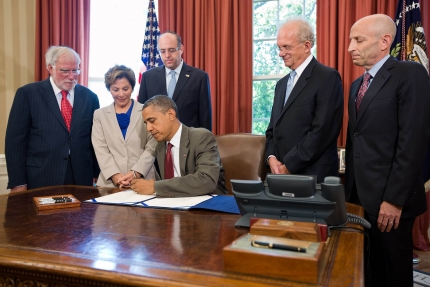
President Obama signs the United States-Israel Enhanced Security Cooperation Act of 2012, which strengthens Israel’s qualitative military edge and support for Administration initiatives that deepen U.S. defense and security cooperation with Israel.

Download mp4 (120MB) | mp3 (8MB)

Read the Transcript

Remarks by the President at Signing of the United States-Israel Enhanced Security Cooperation Act

Oval Office

Please see below for a correction (marked with an asterisk*). 

10:24 A.M. EDT

THE PRESIDENT:  Hello, everybody.  Hope you guys are all staying cool.  Well, listen, I just wanted to welcome these outstanding leaders to the Oval Office.  I want to in particular acknowledge Congressman Howard Berman and Senator Barbara Boxer, who have done outstanding work in shepherding through this bipartisan piece of legislation that underscores our unshakeable commitment to Israel. 

As many of you know, I have made it a top priority for my administration to deepen cooperation with Israel across the whole spectrum of security issues -- intelligence, military, technology.  And, in many ways, what this legislation does is bring together all the outstanding cooperation that we have seen, really, at an unprecedented level between our two countries that underscore our unshakeable commitment to Israel security.

I’m also very pleased that this week we are going to be able to announce $70 million in additional spending -- $70 billion [million]*, excuse me, in additional spending for Iron Dome.  This is a program that has been critical in terms of providing security and safety for the Israeli families.  It is a program that has been tested and has prevented missile strikes inside of Israel.  And it is testimony to the leadership of the folks sitting here that we’re going to be able to lock in that fund to assure that that program continues and that we are standing by our friends in Israel when it comes to these kinds of attacks.

Let me just close by saying that the tragic events that we saw in Bulgaria emphasize the degree to which this continues to be a challenge not just for Israel, but for the entire world -- preventing terrorist attacks and making sure the people of Israel are not targeted.

And I hope that, as I sign as this bill, once again everybody understands how committed all of us are -- Republicans and Democrats -- as Americans to our friends in making sure that Israel is safe and secure.

Leon Panetta, our Secretary of Defense, will be traveling to Israel to further consult and find additional ways that we can ensure such cooperation at a time when, frankly, the region is experiencing heightened tensions.

So, with that, let me sign this bill.  Again, I want to thank all who are standing beside me for their outstanding leadership and their outstanding work on this issue.

(The bill is signed.)

Let me make sure I’m using enough pens.  (Laughter.)  There you go.  Thank you.

END
10:28 A.M. EDT

Close Transcript

The White House

Office of the Press Secretary

Press Briefing by Press Secretary Jay Carney, 7/27/12

James S. Brady Press Briefing Room

12:00 P.M. EDT

MR. CARNEY:  Thanks for being here, everyone.  I’m sorry I’m late.  Actually, on my way here, I dumped most of a cup of water on the floor outside the Oval Office -- very embarrassing.  Pete Souza, the White House photographer, insisted that it was a cup of coffee and he was going to make a "Picture of the Day" out of it.  (Laughter.)  But it was, in fact, water.

I have no announcements.  I wanted to take the toughest questions first, but I don’t see Connie here.  (Laughter.)  She got me yesterday. 

So we’ll go straight to the Associated Press.

Q    Thank you.  At the Israel bill signing today -- I know you got a similar question on the Olympics readout yesterday -- but how much of the timing of this bill signing today and the announcement of the $70 billion in addition to that are tied to Romney’s upcoming visit to Israel?

MR. CARNEY:  Well, Julie, as I think you know, the bill the President signed today that reaffirms the United States’ unshakeable commitment to Israel’s security was passed by Congress this month and was sent to the President a week ago.  And the President has been traveling, so, as is normally the case, he signs a bill when he gets it from Congress -- a bill that he supports -- and that’s what he did.  So the timing of the passage and signing of this legislation was not up to us, but up to Congress.

And then on the announcement that funds had been transferred to fund our support for Iron Dome, the rocket defense program, the President directed those funds to be made available in May and the transfer was made in recent days.  And since this is a program that is very directly related to the U.S.-Israeli security relationship, it’s entirely appropriate to make that announcement at the same time that he’s signing this bill that was passed in a bipartisan way in Congress. 

So I think that both the bill and the funds announcement reflect the commitment of this administration to Israel’s security -- a commitment that Prime Minister Netanyahu and Defense Minister Barak have both said demonstrates -- has reached a level that’s unprecedented under this administration. 

I remember standing with Vice President Biden when we were in Jerusalem with Prime Minister Netanyahu when he said that to both the traveling and the Israeli press, that this administration’s commitment to Israeli security is unprecedented, and the amount of cooperation that we have with Israel on its security needs is unprecedented.

Q    Do you feel like it’s helpful to be able to underscore that commitment just a day before Romney heads to Israel?

MR. CARNEY:  Well, again, I think that the fact that Congress passed this legislation, bipartisan piece of legislation, and that it arrived at the White House in recent days, made signing of it this week necessary. 

And I understand the coincidence, but the fact is our cooperation with Israel on its security is a subject we could discuss every day because there are things that take place in that relationship and in our assistance to Israel every day.  So the fact of the matter is we combined the two today.  We could have spread it out over a couple of days, but we figured that the Iron Dome transfer was so related to the legislation that we could knock them both out in one day.

Q    On Syria, as we’ve talked about the differences between Libya and Syria, one of the reasons that the administration gives for why the U.S. and international partners went into Libya was that there was an imminent attack on a city.  And we’re seeing exactly that situation in Aleppo today.  Does that in any way change the discussion between the U.S. and international partners about what types of involvement you’ll have in Syria?

MR. CARNEY:  Well, we are very concerned about the situation in Aleppo.  As I talked about in the last several days, the assault that Assad’s forces have been perpetrating on the civilian population centers is heinous and reprehensible.  The kinds of weaponry that they’re using against unarmed civilians I think demonstrates the depths of depravity to which Assad has sunk.

The fact of the matter is while your analogy is -- it’s a good question and I understand the analogy -- there were a broader array of issues that allowed for the kind of action that the United States -- the international community, led by the United States, was able to take in Libya.  There was the imminent assault.  There was the call from the opposition, the unified opposition, for international action.  There was international consensus, both at the level of the United Nations Security Council, as well as regional consensus through the Arab League. 

We do not have that.  And we've been very blunt about our disappointment with the Russians and the Chinese in the fact that they have vetoed the three meaningful resolutions that were put before the United Nations Security Council with regards to Syria and Assad.

That's why we're working beyond the Security Council now with "Friends of Syria," other international partners, to try to build consensus to further isolate and pressure Assad.  That's why we're continuing to provide humanitarian assistance to the Syrian people, why we're continuing to provide non-lethal assistance to the opposition, why we are working -- with our partners -- with the opposition to help the opposition unify and fulfill the -- or take steps to fulfill the plan that they put forward not long ago.

And it's why we will continue to call on the international community to -- all members of the international community, and all nations with a stake in the future of the region and of Syria to recognize that siding with Assad is aligning yourself with a tyrant, is ensuring that the Syrian people will remember your assistance to Assad long beyond Assad's removal from power or disappearance from the scene.  And we continue to make that case. 

Reuters.

Q    Just staying on Syria for one moment. 

MR. CARNEY:  Sure.

Q    U.N. Secretary General said today that Syria should categorically state that it will not use chemical weapons under any circumstances.  So we've talked about this before, but I wondered if you think a statement like that is needed and if that's enough when it comes to chemical weapons.

MR. CARNEY:  Well, it's certainly not enough.  As we've said all along, we judge -- we have long since given up -- or long since understood that Assad's word is not worth very much, that he routinely fails to keeps his promises, live up to his commitments.  And that's most evident recently by his -- the lip service he paid to the Annan plan and his categorical refusal to abide by any of the six points of the Annan plan.

On the issue of chemical weapons, there's no question that we share the point of view that they should never be used, that the Syrian government not only must not use those weapons but must maintain control of them, and any failure to do that will be -- will result in those responsible being held accountable by the international community.

So our views on this, I think as I've expressed recently, are very strong.  We are concerned about the disposition of the weapons.  We believe that the stockpiles remain under Syrian government control, and we -- as I just said -- reiterate our position that any use of those weapons, any failure to safeguard those stockpiles would be a very serious transgression that would result in those responsible being held accountable.

Q    And just quickly on GDP, one of the reasons that the rate of growth was as low as it was today, while still growing, not growing very quickly -- is that consumer confidence seemed to be lower.  Automobile sales is one of the things that was slow.  I wonder if you had a message to American consumers who were wondering whether to make a big purchase or not, given the answer to that is related to where the economy is.

MR. CARNEY:  Well, I would say that, on the issue of GDP, what we have seen is the 12th straight quarter of economic growth, positive growth, and that is a good thing.  We have also seen over the last three years an economy that has expanded by 6.7 percent overall, and the private components of the GDP have grown by nearly 10 percent -- 9.9 percent. 

And yet, as we say consistently, this is not enough and this growth is not fast enough, this is job creation that is not substantial enough.  And that's why Congress needs to act.  That's why the President continues to insist that the proposals he has put forward that outside economists say would have an immediate impact on economic growth and an immediate impact on job creation must be passed by Congress.  And we'll continue to make that case.

In terms of -- we obviously, despite the sustained growth, despite the private sector job creation, are still in a position where we're pulling ourselves out of the very deep hole caused by the Great Recession.  And there is still, of course, a great deal of anxiety in the country about the economy.  And that's why we need to take these steps.  That's why it is simply unacceptable to say we'll wait until next year perhaps to take action on economic growth and job creation.  We should do it right now. 

Because the things that are in the American Jobs Act, the President's proposal that Congress has not yet passed, would create, according to outside economists, a million jobs -- firefighters, teachers, construction workers.  And every one of those jobs carries with it not just the benefit for those individuals who are employed and their families, but outsized positive benefits to the economy and to society through the building of roads and bridges and ports and schools, and through the placement of more teachers in classrooms that has obvious positive effects on education in this country.  And this President believes very strongly that education is a key element of our economic picture. 

So, yes, we're going to keep pressing for action.  The President is going to continue to do everything he can administratively to help the economy grow and create jobs.  And he is going to continue to hammer the point that we know what we can do right now to spur growth and job creation, and Congress needs to act.

Jake.

Q    Jay, eight years ago -- I think you were there -- I was in the Democratic National Convention in Boston, Massachusetts.  And I heard a fairly obscure state senator stand up to give a speech in which he talked about how right then there were spinmeisters and negative ad peddlers preparing to divide the country.

Given that the vast, vast majority of the ads that are running these days from both sides -- both Governor Romney and President Obama -- are negative -- I think in one New York Times story, it said all of the ones that ran in Richmond over a certain period were negative, not one positive ad, and then there was a study that showed in a two-week period 89 percent of the President's ads were negative, 94 percent of Mitt Romney's ads were negative -- what would that state senator think about the campaign being run right now by this President?

MR. CARNEY:  Well, I think that he thinks, and we think, that the issues that the President talks about all the time, as President and as a candidate, go right to the central concern that the American people have about economic growth and job creation; about ensuring that the middle class is given a shot to expand; that the squeeze that the middle class has been under now for a decade is relieved; and that there is the right investments made in our economy in education and infrastructure and innovation that will allow it to grow and will allow it to create the kinds of jobs here in the United States that can create the foundation for a good middle-class life --

Q    And that’s why you're running ads about Romney's tax returns? 

MR. CARNEY:  Well, that's why we're running ads about -- well, first of all, I'm not speaking for the campaign.  That's why the President believes that the issue of what do you believe when it comes to what our tax code should look like and whether we should reward companies that ship jobs overseas or should we reward companies that insource jobs in the United States -- that's a policy difference that's extremely important.

This President believes that as a matter of economic policy it is an important point of discussion to note the difference between his position, which is that we ought to have a balanced approach where the wealthiest Americans who have done extremely well, exceptionally well, in the last decade pay their fair share, and that the high-end Bush tax cuts that contributed mightily to the deficits that he inherited not be extended, and that that money be used to help bring down the debt and to invest where we need investments -- in education, innovation and infrastructure. 

And that's a fundamental difference not just with the Republican nominee or presumptive nominee, but with Republicans in Congress that this President has been dealing with, in an attempt to move the economy forward legislatively.

So I mean, I think those are -- all those issues are fundamental to the debate we're having right now.  They're fundamental to the stalemate we have in Washington that the President discusses.  And that's why I think he phrases it the way he does, that the American people have the opportunity to break that stalemate, to decide which direction, which vision is the right one for the American economy.  So I think those are the -- those issues are the subject of most of what the President talks about and what his campaign discusses.  I’d obviously refer you to the Romney campaign for their points of view on their advertising.

Q    So you reject the characterization that these ads are negative?

MR. CARNEY:  No, I’m -- I mean, I think that when we -- the President draws distinctions about his vision for the economy compared to the Republican vision, it is a contrast, there’s no question.

But these are central to -- I mean, this is the absolute core of the debate in our country and it is overwhelmingly the principal focus of the American people.  So I think it very important to have the kinds of discussions that we’ve been having and that the President puts forward every time he goes out and speaks to the people.

Bill.

Q    Can it really be a coincidence that just as Mitt Romney embarks on his foreign trip, that in the past few days the President not only has a chance to declare his unshakeable support for Israel and sign this bill, but his Homeland Security and Counterterrorism Advisor meets with people to discuss security preparations for the Olympics, and the Secretary of Defense meets with the Israeli Secretary of Defense and announces a trip to Poland?  Can all that really be a coincidence?

MR. CARNEY:  Bill, let me ask you -- I wish it were the case that we could direct Congress and have it do what we wanted on our schedule all the time.  The bill the President signed today was passed by Congress, bipartisan majorities, and sent to the White House I believe a week ago, and the President has been on the road and today was the day to sign it.

Q    (Inaudible.)

MR. CARNEY:  I will, if you would like, come out here every time we have a senior administration official meeting a senior Israeli government official -- and it will happen I’m sure extremely frequently, because that’s how intense the cooperation is between the United States and Israel on security matters, as well as other issues.

And then on the Olympics, whatever country the Olympics were in, this President would have been briefed on security.  This is a major event, international event, with thousands of Americans present, hundreds of American athletes present, and it’s the kind of thing that he would, as a matter of routine preparation, be briefed on, just as he is the Super Bowl and other issues and other major events where this is an American security interest.  And this one happens to be -- this event happens to be taking place in the United Kingdom, a country with which we have a deep relationship and a deep security cooperative relationship.

It is a matter of course that John Brennan would be involved in that and that the President would be briefed on that.  And I routinely read out those briefings from the podium.

Q    So there is no political calculation whatsoever involved here?  None?

MR. CARNEY:  On the issues that you just talked, I think I raised -- I think I just explained to you that the President signed a bill that was passed by Congress -- Republicans and Democrats.  And the Olympics is an event that this President would be briefed on in terms of security as a matter of course, no matter where they were or what time of year they took place.

Q    Jay, on Israel, at the beginning you made a joke obviously about not answering the question yesterday.  In the transcript from yesterday’s briefing, you added at the top the administration position, obviously.  Could you explain why you didn’t answer the question and why you decided to add that, I guess?

MR. CARNEY:  Well, I wanted to be clear.  I added it because -- look, I did assume that everyone here knew our position, since it is the same position that we have held since the President was sworn into office.  Not only that -- and this goes to some of the criticism, and perhaps the critics don’t realize this -- it’s the same position that was held by the previous administration for eight years.  Our policy has not changed. 

The status of Jerusalem is an issue that should be resolved in final status negotiations between Israelis and Palestinians.  And we continue to work with both parties to resolve this issue and others in a way that is just and fair, and respects the rights and aspirations of both Israelis and Palestinians.

So I did assume that, since this is a policy that has been longstanding and in place for many, many years now across administrations of both parties, that it was understood.  But I accept that it merited clarification, so thus we provided it.

Q    On the economy, you said, headed in the right direction but obviously more needs to be done.  At a fundraiser on Wednesday night, the President was talking about -- I think in Oakland -- in the context of what the Clinton administration did -- and you said this as well yesterday here in the briefing room -- about sort of the balanced approach, as you call it.  He said, "we tried our plan and it worked."  But he was not just talking about his plan, he was talking about the Clinton plan.

MR. CARNEY:  He was talking about the Clinton proposal.  And I understand that as part of the course -- maybe this goes to Jake’s question of an effort to serially distort what the President said.  I mean, anybody who listened to that set of remarks and has heard President Obama discuss President Clinton’s record surely understands he was citing the approach that was taken by President Clinton, an approach that, as I noted yesterday, for those of us who covered it in 1993, when President Clinton’s economic plan was passed and it included increases in revenue, that Republicans, including some of the very leaders in Congress today, declared from the floor of the House and the Senate that it would lead to recession, economic decline, stagnation, unemployment.  And they were wrong -- entirely and completely. 

And it led instead to the longest peacetime expansion in our history, and it led to the creation of 24 million jobs -- a pretty good record.  So that’s what the President -- President Obama was talking about. 

Q    Right.  And so that’s the context.  My question is, is he running on the Clinton economy or the Obama economy?

MR. CARNEY:  He is running on his record.  He is running on a vision for the future and an economic plan that has as one component a fundamental principle that everyone ought to play by the same set of rules, and everybody ought to get a fair shot, and everyone ought to pay their fair share.  And part of the paying their fair share is simply suggesting that the highest-income Americans, those making over $250,000, the top 2 percent, including millionaires and billionaires, can afford to and should pay income taxes at the marginal rate that was in place in the 1990s when we had one of the strongest economies in American history, and when we created 24 million jobs -- an economic record that occurred despite all the predictions of Republican leaders.

Q    But it's not that with unemployment over 8 percent, GDP slowing down now, the worst in a year, you’d rather talk about those years than --

MR. CARNEY:  We’re not talking -- we’re talking about -- he’s talking about an economic policy.  His plan, which he talks about all the time, which involves a balanced approach, including expiration of the high-end Bush tax cuts, and as a rebuttal to the assertions from Republicans that his is terrible economic policy, he points to the facts, which are that under President Clinton, marginal rates at that level were in place when we saw this substantial economic growth and job creation. 

But let’s be clear.  I saw recently it suggested by a leading Republican that the next President, whether it’s President Obama in his second term or his opponent in his first, that his policies, economic policies, should be judged after six or nine months after they come into office.  And then, after that period, then that’s a fair grace period after which you can judge whether or not those policies are having an impact.  I find that fascinating given some of the discourse that we’ve engaged in over recent months.

But if you do take that standard and apply it to President Obama, who took office during the worst cataclysmic economic recession in full bloom of our lifetimes, and began to measure the economy’s performance after his first six months in office  -- we’ll just start at six months, not even nine months -- and you’ll see a record of economic growth and job creation as we emerged from the worst recession since the Great Depression, and positive job creation -- that job creation.

It is not enough.  As we saw today with the GDP numbers, the economy is not growing fast enough; the economy is not creating jobs fast enough.  And the President says that every time he speaks about the economy.  And that's why he calls on Congress to do the right thing, to pass -- for the House to pass the measure that cleared the Senate this week that would extend tax cuts to 98 percent of the American people and to 97 percent of small businesses in America, and to pass the measures of the American Jobs Act that would create or save over a million jobs -- that would put teachers back in the classroom, first responders back on the job, and construction workers back to work.

Q    On Syria, Reuters is reporting that the White House has crafted a "presidential directive" that would authorize greater covert assistance for the rebels.  Can you confirm that?

MR. CARNEY:  I can't comment on that Reuters report, no.

Q    Can you confirm that the President is more actively considering enhanced assistance to the rebels and how much farther is he going?

MR. CARNEY:  I can only say what our policy is, which is to continue to provide humanitarian assistance to the Syrians, to continue to provide non-lethal assistance to the opposition, to continue to work with the "Friends of Syria" and other nations that have a stake in and care about the Syrian people and the region to isolate the Syrian regime, to put pressure on it, to starve Assad of the financial resources that he needs to continue to wage war on his people.  That is our policy.

Q    You said that Assad's fall is imminent.  Given what we're seeing in Aleppo, given this --

MR. CARNEY:  I think it's inevitable.  I don't know about imminent, but his days are numbered.

Q    You still stand by that?

MR. CARNEY:  Certainly.  There are daily reminders of the fact that his grip on power is loosening, that his control over the country is diminishing.  We've seen almost daily defections of high-level government officials, military officials.  We've seen other indications through the -- by the consolidation of and the strength of the opposition, that Assad is losing control.

But I'm not going to get into the business of predicting when Assad will leave power.  I will simply say that he must, and he will, because the Syrian people demand it. 

Q    And, Jay, domestically, Senator Schumer and six other Democratic senators have offered an amendment to the cyber security bill that would limit the purchase of high-capacity gun magazines for some consumers.  Would the President support such an amendment?

MR. CARNEY:  I haven't seen that legislation or had that discussion with him.  I think as we discussed at length yesterday, the President believes that we need to focus on common-sense measures that protect Second Amendment rights but ensure that those who should not have guns under existing law cannot get them.  We need to take a step back and have a broader discussion about the problem of violence and attack that problem from a variety of angles, including through assistance that this administration provides to local law enforcement and local governments, through programs that put teenagers to work and programs that get them off the street, and programs that help educate our young people and keep them away from gangs and away from violence.

So this is a broader problem, as the President sees it.  But on that specific proposal, I don't have a response because I haven't seen it and haven't discussed it with him.

Mark.

Q    Jay, if the GDP says -- or shows that the economy is not growing fast enough, as you say, why isn't that an indication that it's the wrong time to raise anybody's taxes?

MR. CARNEY:  The President believes that 98 percent of the American people should have the certainty that Congress can provide right now that their taxes will not go up, that that tax cut for the middle class will be extended. 

And I'm sure you have done it -- if you ask economists, in terms of the macroeconomic effect of tax cuts and the growth effect of tax cuts, they will tell you that tax cuts to that 98 percent will have a vastly disproportionate benefit to the economy than will very expensive tax cuts to the top 2 percent, because millionaires and billionaires, for example, are not -- those tax cuts would be substantial if extended, and very expensive.  The dollar-for-dollar benefit of those tax cuts to the economy is much less than the benefit of tax cuts that go to working Americans, middle-class Americans, who are struggling to make ends meet, who use that money to pay bills, to fund education, and therefore, put that money right back into the economy where it has -- there's a virtuous cycle -- it helps drive economic growth and drive job creation.

So this is about choices.  It's about the fact that we need to get our fiscal house in order, the fact that we need to ensure that the middle class has economic certainty, and we need to make the right investments to help our economy grow into the future, and that means investments in education and innovation and infrastructure.

So the President's position I think is very clear.  It happens to be supported by a majority of the American people and it reflects a very careful assessment by the President and his economic team of what the right policies are, the right of mix  of policies are to help the economy grow, to help the middle class, and to help deal with our fiscal challenges.

Q    And you would -- and President Obama would stand firm against tax cuts for everybody if that was the only choice, right?

MR. CARNEY:  The President has made clear that he will not sign a bill that extends tax cuts for the top 2 percent of American earners, the wealthiest Americans.  The top 2 percent  -- 98 percent -- he agrees with, I believe, every Republican on Capitol Hill and every Democrat on Capitol Hill unanimously or close to it, that 98 percent of the American people should have their tax cuts extended.  The top 2 percent of tax cuts that President Bush put into place in 2001 and 2003 are simply more than we can afford, and by extending them we would be making a choice to place the burden of getting our fiscal house in order on the middle class, to place the burden of dealing with our fiscal challenges on seniors and on the disabled.  We would make the choice of providing tax cuts to the wealthiest Americans as opposed to investments in education, investments in medical research.

We do not have infinite resources.  And one of the virtues of all the work that's been done on this issue over the past two years, including the Simpson-Bowles Commission and the Rivlin-Domenici Commission, is the identification of the truth, which is that tax cuts represent spending.  Tax cuts reduce revenues and reflect the same kinds of choices that you have to make when you allocate funds to defense spending or education spending or entitlement spending. 

So this is the balanced approach that the President believes we need to take.  And when you say that it is more important to give tax cuts to the top 2 percent than ensure that Medicare as we know it stays in place --

Q    I didn’t say that.

MR. CARNEY:  No, when the argument is made, you're making a choice there that is harmful to the economy, is harmful to American seniors, and is not supported by the majority of the American people. 

Q    But you're saying it's more important to deny a tax cut extension to the top 2 percent than to give it to everybody.

MR. CARNEY:  No.  We're saying that since we all agree that the 98 percent should have their tax cut extended, then we should pass that tomorrow. 

Now, the only issue -- there is a bill to do that.  The only issue is now will the House take that bill up and pass it or not?  And if they do not, then they are making the choice that tax cuts for 98 percent of the American people should be held hostage to tax cuts for the top 2 percent. 

We can have the debate.  If there is such passion behind the notion that those tax cuts for the top 2 percent, 3 percent must be extended, that Warren Buffett, Bill Gates and --

Q    Justin Bieber. 

MR. CARNEY:  -- Justin Bieber and Mitt Romney and Barack Obama should get a tax cut and if they don't, 98 percent of Americans should have their taxes raised -- we'll have that debate.  Just based on what Mark said, I'm assuming he is in that top 2 percent, but I can't verify that.  (Laughter.)  

Laura.

Q    Following up on Kristen's question, you said that the goal right now is to have a conversation about gun violence.  What is the President planning on doing to advance that conversation?

MR. CARNEY:  I think you heard the President speak before a large audience two nights ago in New Orleans -- I think it was two nights ago -- on this issue.  And I don't have any scheduling announcements for you, but he has directed his Department of Justice to continue to find ways to make improvements in our background check system and other common-sense measures that we can take administratively to ensure that existing laws are enforced and ensure that those who should not obtain weapons under existing law, like criminals, cannot get them. 

And then, more broadly, I think if you listen to what the President said in New Orleans and what he said in a hospital in Aurora, there is a broader issue here about violence -- that it goes well beyond the question of legislation regarding weapons.

Q    So going beyond the legislation, what he said in the speech was that he would "continue to talk to members of both parties, civic organizations and other who are interested in this issue."  And I'm asking if he has any specific plans to do that.

MR. CARNEY:  Well, I have no scheduling announcements to make to you.  But I think --

Q    But can you tell me whether he is planning to do it or not?

MR. CARNEY:  Well, I would point you to what the President of the United States himself said.

Q    So he is planning to?

MR. CARNEY:  Well, that's what he said. 

Q    So if he doesn't, then --

MR. CARNEY:  Well, look, the President will -- has in the past and will continue to address the broader issue of violence.  He will continue to direct his administration to take steps to assist local law enforcement and local government in their efforts to combat violence.  And we'll continue to insist that we need to take broader measures that assist young people -- that ensure that young people get an education and stay in school -- that also can contribute positively to reducing violence.

So I'm sure he will continue discussing these issues.  And I point you to what he himself has said.  But I'm not going to give you a date -- just like I don't give you a date when he is next going to give a speech on foreign policy or economic policy, I'm not going to give you a date on which he is going to make a speech about these issues. 

Q    From what I can tell, in between the op-ed he wrote in the wake of Tucson and the shootings in Aurora, he did not publicly address this issue at all.  And so, I'm --

MR. CARNEY:  Well, I'm not sure that's the case.  A, I think he did, in getting asked about it and in other forums, discuss it -- on the broader issue of violence.  Secondly, in that period, at his direction, the Department of Justice made progress on the very issues that he asked them to make progress on, as we put out on paper and I've discussed here and on Air Force One. 

Q    But that doesn't speak to creating a national dialogue on the issue or trying to find consensus on what he calls issues that should have common ground, common-sense efforts to try to control gun violence.

MR. CARNEY:  But, Laura, I'm not sure of your point.  He just gave a major speech in which he talked about these issues.  He spoke about these issues in a hospital in Aurora, where he had just visited the families of those who lost their lives in that terrible shooting as well as those individuals who are recovering from wounds in that shooting.  And he will, I'm sure, continue to talk about the steps that we need to take to address the problem of violence, and to address the problem of violence that is with us not just when we have these horrific events that garner headlines, but with us consistently around the country, as he mentioned in New Orleans.

Q    So having given the speech, he has done that? 

MR. CARNEY:  Laura, you can continue to editorialize, but I've answered this question a bunch of times.  I don't have an announcement for when the President is next going to address this issue.  He told you that he would and I would take his word on it.  Thank you. 

Q    So Russia is looking at setting up naval bases in Cuba and in Vietnam.  And I'm wondering whether the President has been briefed about that and what he thinks about that.  Does he have some concerns about it or is he cool with it?  (Laughter.)

MR. CARNEY:  I have not had that discussion with the President -- not just in the language that you used -- (laughter) -- but even addressing Russia or Cuba.  So I will have to take that question.

Q    Can I ask another couple of questions -- anything about the week ahead, including the weekend, themes for next week will be greatly appreciated.  And can you give us kind of a good synopsis of his Olympic watching, calling, involvement plans in the days to come?  Who is he going to be talking to?  Are there any events he’s totally keyed in on, et cetera?

MR. CARNEY:  Well, I can tell just from the travel we’ve done recently and talking to him about the Olympics in general, I mean he is a sports fan as everyone knows.  He’s actually very -- I heard him the other day, he’s like, I love the Olympics, I can't wait for the Olympics to start.

So I don't know which events he will be paying attention to.  His interests are very broad, and he’s read up a lot on our athletes and on the upcoming competition, and looks forward to catching as much of the games as he can his schedule being what it is.

There is at least one person in London I know he’ll be in touch with regularly.  That would be the First Lady.  (Laughter.)

MR. CARNEY:  But I don't have any announcements to make in terms of other -- any participation by the President.  I think, as you know, the First Lady is representing the United States delegation in London.  As has been the case in years when a sitting President is running for reelection, he has not been able to -- he, regrettably, is not able to make the trip himself.

Q    Will he be watching horseback riding?

MR. CARNEY:  I can give you -- what’s that?

Q    Will he be watching horseback riding by any chance?

MR. CARNEY:  I think he is interested in seeing every American entrant perform well, and he’ll follow every event.  And I think if his schedule allows, I think the answer to that question is, yes.

On the week ahead, I can give that to you now if you would like?  Do I hear a chorus of yes?

Q    Yes.

Q    Yes.

MR. CARNEY:  On Monday, the President will participate in an ambassador credentialing ceremony here at the White House.  In the afternoon, the President will travel to New York City for campaign events.  The President will return to Washington, D.C., that night. 

On Tuesday, the President will attend meetings here at the White House.  On Wednesday, the President will travel to Mansfield, Ohio and Akron, Ohio for campaign events.  The President will return to Washington, D.C., that night.  The next day, Thursday, the President will travel to Orlando, Florida and to Leesburg, Virginia for campaign events and will return once again to Washington that evening.  On Friday, the President will be here at the White House attending meetings.

Yes, Mark.

Q    Sunday, in between --

MR. CARNEY:  He’ll be watching the Olympics.  (Laughter.)

Q    And in between the Olympic events, on Sunday, Sunday is the 100-day from the election mark.  I know the campaign was going to do some events like house parties and stuff.  Is the President going to play any role in that?  Is he going to mark that day in any fashion?

MR. CARNEY:  I don't have any information involving the President’s schedule on Sunday.  I believe he’s down, but I would address that question to the campaign.

Q    Well, on the larger question of that mark -- how does the President feel about the campaign at this point?

MR. CARNEY:  Well, he’s very, as you’ve seen -- as he’s been out there, he’s energized by the opportunity to get out and campaign, to talk to people across the country about his vision for our economy and looks forward to the next 100 days or the next 103 or 104 or however many days there are.

I don't think this is unique to him.  I think it’s true of past Presidents that the opportunity to get out in the country and to speak to folks in different states and to hear from them is something that is very invigorating for him.  When we travel with him, those of us who have that opportunity and privilege, you can just tell how much he enjoys it and how much energy he draws from it. 

So obviously campaigns can be grueling in terms of the hours and the schedule.  He also has a full-time job as President that he continues to execute.  But he's very gratified at the opportunity and believes that the stakes could not be higher, which is why he's going out there and taking his case around the country.

Ari.  Haven't seen you in a while.  How are you?

Q    Nice to be back.

MR. CARNEY:  Long-term vacation?

Q    I was with Romney actually.

MR. CARNEY:  That's kind of like a vacation.

Q    Oooh! 
 
Q    We're almost at the one-year anniversary of the credit rating downgrade.  And I wonder how concerned the White House is that there could be another one while this President is in office, and given the paralysis in Congress, what the President can do to prevent that from happening.

MR. CARNEY:  Well, I had not thought about the fact that that particular anniversary was nearly upon us.  I can say that it brings back grim memories of a willingness on Capitol Hill to threaten the global economy, and most importantly, the American economy, for the sake of ideology. 

We now know that the price paid by that brinksmanship was great, not just in downgrade but in its impact on consumer confidence -- which is a question that we got earlier -- its impact on economic growth and job creation.  That was a terrible game to play.  And this President ensured as that process came to an end that we would not be playing that game of chicken with the American economy again in a periodic process of every three or six or nine months, which is what Republicans were insisting on.

The full faith and credit of the United States is a very valuable thing, and it should not be toyed with.  This President feels very strongly about that.  And the memory of that I think for all of us and the impact that it had on the economy is not one that's particularly welcome.  But it is a reminder of why Congress needs to act on responsible, balanced deficit reduction.  That is why the sequester was put in place as a forcing mechanism to get Congress to act and make tough decisions, for both parties to accept that they would not get their maximalist positions.

And what you've seen is, unfortunately, Republicans, by and large, still refusing to accept the basic principle that everyone should pay their fair share, that we need all three legs of this stool.  We need significant spending cuts, which this President has already signed into law.  We need entitlement reforms, which this President has made clear he is willing to support.  And we need revenues.  And that is the only way to do this to get the kinds of -- the $4 trillion in deficit reduction that is needed to address our fiscal challenges.

And, yes, I mean, we were all here, and to see the willingness that some on Capitol Hill demonstrated to take the economy over the cliff, to risk default, was very unfortunate.
 
April.

Q    Jay, sometimes when politicians go overseas, they --some dicey issue when they meet with foreign leaders.  And then, particularly -- presidential candidates may go and meet with foreign leaders.  How would you critique thus far the last couple of days for Mitt Romney overseas?

MR. CARNEY:  I would not.  (Laughter.) 

Q    Why not?

MR. CARNEY:  I'll take questions on policy.  I'll certainly entertain --

Q    No, no, no, this one -- this relates to policy ,though.  The White House is working with London on the Olympic issues.  The White House works with people from various parties in the UK.  Our government will assist them, work with Mr. Cameron.  Talk to me about so far what you're feeling.  I mean, because there are issues that could relate, come back here to the White House, especially with Australia, what's happening with Australia. 

MR. CARNEY:  I will let others make those assessments.  Many have been made, I've noticed.

Q    What's yours?

MR. CARNEY:  But I will simply say that while the focus of this election cycle is the economy -- that’s what the American people are focused on, that’s certainly what the President is focused on -- the presidency involves, as a huge component of the job, engagement in national security affairs, engagement with foreign leaders and countries around the world.  And it is important work, even when the attention of others is elsewhere. 

And that’s why this President has made the safety and security of the United States and its people such a high priority.  It’s why he has acted sometimes at some risk to fulfill his promises in the foreign policy arena, including ending the war in Iraq; increasing our troop presence, initially in Afghanistan in order to properly execute that war and to take the fight to al Qaeda; and to create a situation, for example, with Iran, where the approach he took led to a level of international consensus about Iran being the problem that did not exist prior to him coming into office.

So, I mean, that’s simply to say that foreign policy is a big part of the job.

Q    Thanks, Jay.

Q    Wait a minute, wait a minute.  Are you not -- I’m sorry, Jay.  Are you not answering it because you don’t want to discuss it because he’s overseas, and typically you don’t talk about a U.S. --

MR. CARNEY:  I’m just not going to -- I’m not sure what -- the question as it relates to the President here is unclear to me, and I’m not going to give a performance critique of the former governor from the podium. 

Q    Has the President been made aware of some of the gaffes overseas so far?

MR. CARNEY:  Well, as you know, the President follows the news, but I don’t know how much he’s been following this particular story.

Thanks, guys.

END
12:51 P.M. EDT

President Obama Signs the United States-Israel Enhanced Security Cooperation Act

President Barack Obama signs the United States-Israel Enhanced Security Cooperation Act (July 27, 2012)

President Barack Obama signs S. 2165, the United States-Israel Enhanced Security Cooperation Act in the Oval Office, July 27, 2012. With the President from left are: Richard Stone, Chairman, Conference of Presidents of Major American Jewish Organizations; Sen. Barbara Boxer, D-Calif.; Howard Friedman, past Chair of the Board, American Israel Public Affairs Committee, (AIPAC);, Rep. Howard Berman, D-Calif., and Lee Rosenberg, Chairman of the Board, AIPAC. (Official White House Photo by Chuck Kennedy)

This morning, President Obama signed the United States-Israel Enhanced Security Cooperation Act with an eye toward helping to strengthen the military edge Israel currently enjoys.

"I have made it a top priority for my administration to deepen cooperation with Israel across the whole spectrum of security issues -- intelligence, military, technology," the President said. "And, in many ways, what this legislation does is bring together all the outstanding cooperation that we have seen, really, at an unprecedented level between our two countries that underscore our unshakeable commitment to Israel security."

The cooperation between the United States and Israel includes joint training exercises, offering access to U.S. military hardware, and direct foreign military financing.

To learn more, check out the fact sheet.

The White House

Office of the Press Secretary

President Obama Signs Virginia Disaster Declaration

The President today declared a major disaster exists in the Commonwealth of Virginia and ordered Federal aid to supplement commonwealth and local recovery efforts in the area affected by severe storms and straight-line winds during the period of June 29 to July 1, 2012.

Federal funding is available to commonwealth and eligible local governments and certain private nonprofit organizations on a cost-sharing basis for emergency work and the repair or replacement of facilities damaged by the severe storms and straight-line winds in the counties of Albemarle, Alleghany, Amelia, Amherst, Appomattox, Arlington, Augusta, Bath, Bedford, Bland, Botetourt, Buckingham, Campbell, Carroll, Charlotte, Clarke, Craig, Culpeper, Cumberland, Dinwiddie, Fauquier, Floyd, Fluvanna, Frederick, Giles, Greene, Halifax, Highland, Louisa, Lunenburg, Madison, Nelson, New Kent, Nottoway, Orange, Page, Pittsylvania, Powhatan, Prince Edward, Pulaski, Rappahannock, Roanoke, Rockbridge, Rockingham, Shenandoah, Tazewell, and Warren and the independent cities of Bedford, Charlottesville, Covington, Danville, Fairfax, Fredericksburg, Lexington, Lynchburg, Manassas Park, Martinsville, Radford, Roanoke, Salem, Staunton, and Winchester.

Federal funding is also available on a cost-sharing basis for hazard mitigation measures for all counties and independent cities in the Commonwealth of Virginia.

W. Craig Fugate, Administrator, Federal Emergency Management Agency (FEMA), Department of Homeland Security, named Donald L. Keldsen as the Federal Coordinating Officer for federal recovery operations in the affected area. 

FEMA said additional designations may be made at a later date if requested by the commonwealth and warranted by the results of further damage assessments.

FOR FURTHER INFORMATION MEDIA SHOULD CONTACT:  FEMA NEWS DESK AT (202) 646-3272 OR FEMA-NEWS-DESK@DHS.GOV

The White House

Office of the Press Secretary

Remarks by the President at Signing of the United States-Israel Enhanced Security Cooperation Act

Oval Office

Please see below for a correction (marked with an asterisk*). 

10:24 A.M. EDT

THE PRESIDENT:  Hello, everybody.  Hope you guys are all staying cool.  Well, listen, I just wanted to welcome these outstanding leaders to the Oval Office.  I want to in particular acknowledge Congressman Howard Berman and Senator Barbara Boxer, who have done outstanding work in shepherding through this bipartisan piece of legislation that underscores our unshakeable commitment to Israel. 

As many of you know, I have made it a top priority for my administration to deepen cooperation with Israel across the whole spectrum of security issues -- intelligence, military, technology.  And, in many ways, what this legislation does is bring together all the outstanding cooperation that we have seen, really, at an unprecedented level between our two countries that underscore our unshakeable commitment to Israel security.

I’m also very pleased that this week we are going to be able to announce $70 million in additional spending -- $70 billion [million]*, excuse me, in additional spending for Iron Dome.  This is a program that has been critical in terms of providing security and safety for the Israeli families.  It is a program that has been tested and has prevented missile strikes inside of Israel.  And it is testimony to the leadership of the folks sitting here that we’re going to be able to lock in that fund to assure that that program continues and that we are standing by our friends in Israel when it comes to these kinds of attacks.

Let me just close by saying that the tragic events that we saw in Bulgaria emphasize the degree to which this continues to be a challenge not just for Israel, but for the entire world -- preventing terrorist attacks and making sure the people of Israel are not targeted.

And I hope that, as I sign as this bill, once again everybody understands how committed all of us are -- Republicans and Democrats -- as Americans to our friends in making sure that Israel is safe and secure.

Leon Panetta, our Secretary of Defense, will be traveling to Israel to further consult and find additional ways that we can ensure such cooperation at a time when, frankly, the region is experiencing heightened tensions.

So, with that, let me sign this bill.  Again, I want to thank all who are standing beside me for their outstanding leadership and their outstanding work on this issue.

(The bill is signed.)

Let me make sure I’m using enough pens.  (Laughter.)  There you go.  Thank you.

END
10:28 A.M. EDT

The White House

Office of the Press Secretary

Statement by the Press Secretary on S. 2165

On Friday, July 27, 2012, the President signed into law:

S. 2165, the "United States-Israel Enhanced Security Cooperation Act of 2012," which enhances security cooperation between the United States and Israel, and for other purposes.

The White House

Office of the Press Secretary

Presidential Proclamation -- National Korean War Veterans Armistice Day, 2012

NATIONAL KOREAN WAR VETERANS ARMISTICE DAY, 2012

BY THE PRESIDENT OF THE UNITED STATES OF AMERICA

A PROCLAMATION

Sixty two years ago, the Communist invasion of the Republic of Korea summoned a generation of Americans to serve.  From the landings at Inchon to the Pusan Perimeter, from Heartbreak Ridge to Chosin Reservoir, our forces fought with immeasurable courage in one of the defining moments of the Cold War.  Today, on the 59th anniversary of the Military Armistice Agreement signed at Panmunjom, we honor all who served in the Korean War, and we pay lasting tribute to the brave men and women who gave their lives for our Nation.

Through 3 years of combat, American service members and allied forces overcame some of the most unforgiving conditions in modern warfare.  They weathered bitter winters and punishing heat.  They fought on with courage and distinction    often outgunned and outmanned.  Many Americans suffered wounds that would never fully heal.  Still more we count among the captured and the missing, and our resolve to account for Americans who did not come home will never waver.  Most of all, we honor the tens of thousands of Americans who gave their lives defending a country they had never known and a people they had never met.  Their legacy lives on not only in the hearts of the American people, but in a Republic of Korea that is free and prosperous; an alliance that is stronger than ever before; and a world that is safer for their service.

Shortly after the Military Armistice Agreement was signed, President Dwight D. Eisenhower noted that "with special feelings of sorrow    and of solemn gratitude    we think of those who were called upon to lay down their lives in that far off land to prove once again that only courage and sacrifice can keep freedom alive upon the earth."  Nearly six decades later, we renew that call to honor and reflect.  Now and forever, let us keep faith with our Korean War veterans by upholding the ideals they fought to protect, and by supporting them with the care and respect they so deeply deserve.

NOW, THEREFORE, I, BARACK OBAMA, President of the United States of America, by virtue of the authority vested in me by the Constitution and the laws of the United States, do hereby proclaim July 27, 2012, as National Korean War Veterans Armistice Day.  I call upon all Americans to observe this day with appropriate ceremonies and activities that honor our distinguished Korean War veterans.

IN WITNESS WHEREOF, I have hereunto set my hand this twenty-seventh day of July, in the year of our Lord two thousand twelve, and of the Independence of the United States of America the two hundred and thirty-seventh.

BARACK OBAMA