President Obama Speaks to the National Urban League

President Barack Obama delivers remarks at the Urban League Convention

President Barack Obama delivers remarks at the Urban League Convention at the Ernest N. Morial Convention Center in New Orleans, La., July 25, 2012. (Official White House Photo by Pete Souza)

Last night, President Obama addressed the National Urban League, and discussed his Administration's work to help strengthen our nation’s communities and support a strong and growing middle class.

Helping build strong communities has been a part of the Urban League’s mission since its founding, the President said:

For nearly a century, the National Urban League has been inspiring people of every race and every religion and every walk of life to reach for the dream that lies at the heart of our founding -- the promise that no matter who you are, no matter what you look like, no matter where you came from, no matter how modest your beginnings, no matter what the circumstances of your birth, here in America, you can make it if you try. 

The President explained that although this dream has never come easy, it’s this very promise that drew him to his work rebuilding neighborhoods on the South Side of Chicago, and later, into politics.

That idea that everybody should have a fair shot, not just some -- that this country is special because it has grown this magnificent middle class and has provided ladders of access for those striving to get into the middle class -- that's the idea that drove me. That's the idea that has driven the Urban League. That idea that everyone should have equal opportunity -- that's what brought me to Chicago. That belief that this country works best when we are growing a strong middle class and prosperity is broad-based -- that's what led me into politics. 

Related Topics: Economy, Urban Policy

The White House

Office of the Press Secretary

Presidential Proclamation -- Anniversary of the Americans with Disabilities Act, 2012

ANNIVERSARY OF THE AMERICANS WITH DISABILITIES ACT, 2012

- - - - - - -

BY THE PRESIDENT OF THE UNITED STATES OF AMERICA
A PROCLAMATION

Since our earliest days, America has measured its progress not only by the growth of our borders and the breadth of our economy, but also by how far we reach toward fully realizing the fundamental rights, protections, and freedoms afforded to each of us by our Nation's founding documents. For generations, many Americans with disabilities lived as second-class citizens who were denied those most basic opportunities. Not content to accept the world as it was, they marched and organized and testified, coupling quiet acts of persistence and perseverance with vocal acts of advocacy. And step by step, progress was won. Protections were put into law. And a wave of change swept across our country, tearing down the barriers that kept persons with disabilities from securing their fullest measure of happiness.

Today, we mark the 22nd anniversary of the Americans with Disabilities Act (ADA) -- a historic piece of civil rights legislation that affirmed Americans with disabilities are Americans first. When many wrongfully doubted that people with disabilities could participate in our society, contribute to our economy, or support their families, the ADA asserted that they could. Under this landmark law, America became the first Nation to comprehensively declare equality for its citizens with disabilities -- an accomplishment that continues to guide our country toward fulfilling its most essential promises not just for some, but for all.

Yet, despite the gains we have made, independence and freedom from discrimination remain out of reach for too many individuals with disabilities. That is why my Administration continues to build on the legacy set forth by the ADA. Thanks to the Affordable Care Act, insurance companies can no longer deny coverage to children with disabilities because of pre-existing conditions, medical history, or genetic information -- a provision that will be extended to all Americans in 2014. We have fought to protect and strengthen Medicare and Medicaid by improving benefits and opposing proposals that would shift costs to seniors and persons with disabilities. And earlier this year, we established the Administration for Community Living at the Department of Health and Human Services to help ensure people with disabilities have the support they need to live with respect and dignity in their communities, and to be fully included in our national life.

Because every American deserves access to a world-class education, we have worked to make learning environments safer and more inclusive. Last September, the Department of Education implemented new standards for the Individuals with Disabilities Education Act that will help measure and improve outcomes for infants and toddlers with disabilities. Moving forward, we will continue to take action to help all children learn, develop, and participate in instructional programs that equip them with the tools for success in school and beyond.

As we mark this milestone and reflect on the barriers that remain, we also pay tribute to the courageous individuals and communities who have made progress possible. Because so many advocates understood injustice from the depths of their own experience, they also knew that by allowing injustice to stand, we were depriving our Nation and our economy of the full talents and contributions of tens of millions of Americans with disabilities. Today, those Americans are leaders not only in every field and throughout every part of our national life, but also in the journey to bring the American dream within reach for our next generation. On this anniversary of the ADA, we celebrate the contributions Americans with disabilities have made to our Nation, and we rededicate ourselves to empowering every individual with those most American principles of equal access and equal opportunity.

NOW, THEREFORE, I, BARACK OBAMA, President of the United States of America, by virtue of the authority vested in me by the Constitution and the laws of the United States, do hereby proclaim July 26, 2012, the Anniversary of the Americans with Disabilities Act. I encourage Americans across our Nation to celebrate the 22nd anniversary of this civil rights law and the many contributions of individuals with disabilities.

IN WITNESS WHEREOF, I have hereunto set my hand this twenty-sixth day of July, in the year of our Lord two thousand twelve, and of the Independence of the United States of America the two hundred and thirty-seventh.

BARACK OBAMA

The White House

Office of the Press Secretary

Remarks by the President at the National Urban League Convention

Ernest N. Morial Convention Center
New Orleans, Louisiana

7:00 P.M. CDT

THE PRESIDENT:  Hello, Urban League!  (Applause.)  Thank you.  It is good to be with the Urban League.  (Applause.)  And it's good to be in the Big Easy.  (Applause.) 

Now, I don’t know if the fact that this is called the Morial Convention Center had anything to do with folks coming down to New Orleans -- (laughter) -- but it is good to be with all of you.  And I'm glad I caught you at the beginning of the conference, before Bourbon Street has a chance to take a toll on you.  (Laughter.)  All right.  You all stay out of trouble now.  (Laughter.) 

Everybody please have a seat.  Have a seat. 

AUDIENCE MEMBER:  Four more years!  (Applause.) 

THE PRESIDENT:  A couple of people that I want to acknowledge.  Obviously, first of all, I want to acknowledge your outstanding president and CEO who has shown such extraordinary leadership for so many years -- Marc Morial.  (Applause.)  Just like we've got an outstanding former mayor of New Orleans, we've also got the outstanding current mayor of New Orleans -- Mitch Landrieu is in the house.  (Applause.)  Fine young congressman from this area -- Cedric Richmond, is here.  (Applause.)  And one of the best mayors in the country -- we're glad he came down from his hometown of Philadelphia -- Mayor Michael Nutter is in the house.  (Applause.)

And all of you are here, and I am grateful for it.  (Applause.)  And we love the young people who are in the house.  (Applause.)  Mitch, don’t you -- I wasn't referring to you, man, I was talking to those folks over there.  (Laughter.)  Mitch is all waving, "thank you."  (Laughter.) 

For nearly a century, the National Urban League has been inspiring people of every race and every religion and every walk of life to reach for the dream that lies at the heart of our founding -- the promise that no matter who you are, no matter what you look like, no matter where you came from, no matter how modest your beginnings, no matter what the circumstances of your birth, here in America, you can make it if you try.  (Applause.)

Of course, this dream has never come easy.  That’s why the Urban League was formed.  In the aftermath of the Civil War, with the South in the grips of Jim Crow, the waves of men and women who traveled north to urban centers discovered that even in their new homes, opportunity was not guaranteed.  It was something you had to work for, something you had to fight for –- not just on your own, but side-by-side with people who believed in that same dream. 

And so the white widow of a railroad tycoon and a black social worker from Arkansas founded what would become the Urban League, to strengthen our cities and our communities brick by brick, and block by block, and neighborhood by neighborhood, life by life.    

Decades later, I arrived in one of those cities my hometown of Chicago.  (Applause.)  South Side!  (Applause.)  And I was driven by this same cause.  Like many of my classmates, I felt, I understood, the pull of a hefty paycheck that might come from a more conventional job.  But ultimately the pull to serve was even stronger. 

So I moved to the South Side of Chicago, and I took a job with a group of churches, mostly Catholic parishes, working to help families who had no place to turn when the local steel plants shut down, and when panic-peddling had led to enormous turnover in these communities.  And we worked with laypeople and local leaders to rebuild neighborhoods and improve schools, and most of all, to broaden opportunity for young people, too many who were at risk. 

And I confess that progress didn’t come quickly and it did not come easily.  Sometimes, it didn’t come at all.  There were times where I thought about giving up and moving on.  But what kept me going, day in and day out, was the same thing that has sustained the Urban League all these years, the same thing that sustains all of you, and that is the belief that in America, change is always possible; that our union may not be perfect, but it is perfectible; that we can strive over time through effort and sweat and blood and tears until it is the place we imagine.

It may come in fits and starts, at a pace that can be slow and frustrating.  But if we are willing to push through all the doubt and the cynicism and the weariness, then, yes, we can form that more perfect union.  (Applause.)

Now, the people I worked with in those early days in Chicago, they were looking for the same thing that Americans everyplace aspire to.  We’re not a nation of people who are looking for handouts.  We certainly don’t like bailouts.  (Laughter.)  We don’t believe government should be in the business of helping people who refuse to help themselves, and we recognize not every government program works.  But we do expect hard work to pay off.  We do expect responsibility to be rewarded.  We do expect that if you put in enough effort, you should be able to find a job that pays the bills.  (Applause.)  You should be able to own a home you call your own.  You should be able to retire in dignity and respect.  You should be able to afford the security of health care and you should be able to give your kids the best possible education.  (Applause.)

That idea that everybody should have a fair shot, not just some -- that this country is special because it has grown this magnificent middle class and has provided ladders of access for those striving to get into the middle class -- that's the idea that drove me.  That's the idea that has driven the Urban League, That idea that everyone should have equal opportunity -- that's what brought me to Chicago.  That belief that this country works best when we are growing a strong middle class and prosperity is broad-based -- that's what led me into politics.  And it is those values that have guided every decision that I have made as President of the United States.  (Applause.) 

Now, today we're battling our way back from a once-in-a-lifetime economic crisis.  And make no mistake, we've made progress in that fight.  When I took office, we were losing hundreds of thousands of jobs a month.  Our auto industry was on the brink of collapse.  Factories were boarding up their windows. We'd gone through almost a decade in which job growth had been sluggish, incomes had declined, costs were going up -- all culminating in the financial system coming close to a breakdown.

Today, three and a half years later, we've had 28 straight months of private sector job growth.  (Applause.)  Three and a half years later, the auto industry has come roaring back.  (Applause.)  Three and a half years later, companies are beginning to bring thousands of jobs back to American soil.  (Applause.) 

We still have much more work to do.  There's still too many out of work, too many homes underwater, too many Americans struggling to stay afloat.  So the greater challenge that faces us is not just going back to where we were back in 2007, not just settling to get back to where we were before the crisis hit.  Our task is to return to an America that is thriving and growing out from our middle class, where hard work pays off -- where you can make it if you try.  (Applause.)

And, Urban League, I want you to know what’s holding us back from meeting these challenges is not a lack of ideas or solutions.  I have no patience with people who say our best days are behind us, because the fact of the matter is we still have the best workers in the world, the best universities in the world, the best research facilities in the world, the most entrepreneurial culture in the world.  (Applause.)  We have all the ingredients to make the 21st century the American Century just like the 20th. 

What's holding us back is a stalemate in Washington -- (applause) -- between two fundamentally different views about which path we should take as a country.  (Applause.)  And it’s up to the American people to decide what direction we should go.

Let me tell you what I believe.  I believe that strong communities are places that attract the best jobs and the newest businesses.  And you don’t build that kind of community by giving tax breaks to companies that are shipping jobs overseas.  (Applause.)  You build it by giving tax breaks to companies that create jobs in Detroit and in Cleveland and in Chicago and right here in New Orleans, right here in America -- (applause) -- using American workers, making American products that we sell around the world, stamped with three proud words -- Made In America.  (Applause.)  

You build it by investing in America’s manufacturing base and providing the dollars for research so that we have the most advanced products in the world.  You do it by investing in small businesses -- the way we’ve provided 18 tax breaks to small businesses since I’ve been in office.  And if you’re a company that wants to relocate in a community that’s been particularly hard hit when a factory left town, I believe you should get help financing that new plant or equipment, or training for your workers -- because we can’t leave anybody behind if we want to grow America the way it can grow.  (Applause.) 

We also believe that every entrepreneur should have the chance to start a business –- no matter who you are, no matter what you look like.  (Applause.)  That’s why we've supported financing and assistance and exporting to small businesses across the board.  That’s why we’ve helped African American businesses and minority-owned businesses and women-owned businesses gain access to more than $7 billion in contracts and financing -- (applause) -- that allowed them to grow and create jobs. 

That’s why we’ve emphasized helping our veterans create small businesses -- because if they fought for us, they shouldn’t have to fight to get financing when they get home.  (Applause.)  They shouldn’t have to fight for a job when they come home.  They shouldn’t have to fight for a roof over their heads when they come home.  We should honor them the way they’ve honored us with their service.  (Applause.)

I believe strong communities are places where people can afford to buy what their local businesses sell.  So I ran for President promising to cut taxes for the middle class -– and regardless of what you hear during silly political season, I have kept that promise.  (Applause.)  Today, taxes are $3,600 lower for the typical family than they were when I came into office.  (Applause.) 

Just a few hours ago, the Senate moved forward a bill that we had promoted to keep middle-class tax cuts for 98 percent of Americans next year.  (Applause.)  I will add that we didn’t get a lot of Republican votes -- but that’s okay, they’ve got time.  We passed it through the Senate and now is the time for the House to do the same.  They should not be holding middle-class tax cuts hostage just to get more tax cuts for millionaires and billionaires.  (Applause.)  At a time when so many people who have a job can barely keep up with their bills, we don’t need another trillion-dollar tax cut for folks like me.  We need tax cuts for working Americans, not for folks who don't need it and weren’t even asking for it.  (Applause.)

Millions of Americans -- including more than 2 million African American families -- are better off thanks to our extension of the child care tax credit and the earned income tax credit -- (applause) -- because nobody who works hard in America should be poor in America.  That’s how strong communities are built.  (Applause.)  And by the way when working folks have money in their pockets, businesses do well because they’ve got customers, and all of us grow.  That's been the history of this country.

I believe strong communities are built on strong schools.  (Applause.)  If this country is about anything, it’s about passing on even greater opportunity to the next generation.  And we know that has to start before a child even walks into the classroom.  It starts at home with parents who are willing to read to their children, and spend time with their children -- (applause) -- and instill a sense of curiosity and love of learning and a belief in excellence that will last a lifetime. 

But it also begins with an early childhood education, which is why we’ve invested more in child care, and in programs like Early Head Start and Head Start that help prepare our young people for success.  It’s the right thing to do for America.  (Applause.)

Our education policy hasn’t just been based on more money, we’ve also called for real reform.  So we challenged every state in the country to raise their standards for teaching and for learning.  And three years later, nearly every state has answered the call.  We have seen the biggest transformation in terms of school reform in a generation, and we've helped some of the country’s lowest-performing schools make real gains in reading and math, including here in New Orleans.  (Applause.) 

We’ve made it our mission to make a higher education more affordable for every American who wants to go to school.  That's why we fought to extend our college tuition tax credit for working families -- (applause) -- saving millions of families thousands of dollars. 

That’s why we’ve fought to make college more affordable for an additional 200,000 African American students by increasing Pell grants.  (Applause.)  That’s why we’ve strengthened this nation’s commitment to our community colleges, and to our HBCUs. (Applause.) 

That’s why, tomorrow, I’m establishing the first-ever White House Initiative on Educational Excellence for African Americans –- (applause) -- so that every child has greater access to a complete and competitive education from the time they're born all through the time they get a career.  

And that’s why we’re pushing all colleges and universities to cut their costs -- (applause) -- because we can’t keep asking taxpayers to subsidize skyrocketing tuition.  A higher education in the 21st century cannot be a luxury.  It is a vital necessity that every American should be able to afford.  (Applause.)  I want all these young people to be getting a higher education, and I don’t want them loaded up with tens of thousands of dollars of debt just to get an education.  That’s how we make America great. (Applause.)

Of course, that means all of you all have got to hit the books.  (Laughter.)  I'm just saying.  Don’t cheer and then you didn’t do your homework.  (Laughter and applause.)  Because that’s part of the bargain, that's part of the bargain -- America says we will give you opportunity, but you've got to earn your success.  (Applause.) 

You're competing against young people in Beijing and Bangalore.  They're not hanging out.  (Laughter.)  They're not getting over.  They're not playing video games.  They're not watching "Real Housewives."  (Laughter.)  I'm just saying.  It's a two-way street.  You've got to earn success.  (Applause.) 

That wasn't in my prepared remarks.  (Laughter.)  But I'm just saying.  (Applause.)

I believe strong communities are places where you and your family can work and save and buy your home.  That’s why we’ve helped more than a million responsible homeowners -- these are folks who were making their payments -- refinance their mortgages at these historically low rates, saving thousands of dollars every year.  Because people who did everything right shouldn’t pay the price for somebody else’s irresponsibility.  (Applause.)
So now we want to expand that refinancing opportunity to every homeowner who’s making their payments on time. 

And while we’re at it, let’s put construction workers back on the job -- because they've been hit by the housing bubble bursting.  Let's put them back on the job not only rebuilding roads and bridges and ports, but also rehabilitating homes in communities that have been hit by foreclosures, businesses that have been hit hardest by the housing crisis.  (Applause.)  That creates jobs.  It raises property values, and it strengthens the economy of the entire nation.  

Strong communities are healthy communities.  Because we believe that in the richest nation on Earth, you shouldn’t go broke when you get sick.  (Applause.)  And after a century of trying, and a decision now from the highest court in the land, health care reform is here to stay.  (Applause.)  We're moving forward.

Insurance companies will no longer be able to discriminate against those who are sick.  Prescription drug prices will be lower for our seniors.  We're going to close that doughnut hole. Young people will be able to stay on their parent's insurance until they’re 26 years old.  (Applause.)  Thirty million Americans without health insurance will finally know the security of affordable care.  (Applause.) 

We'll improve any aspect of this law, and any recommendations and suggestions that those who actually know the health care system and aren't just playing politics put forward. But we're going to implement this law and America is going to be better for it.  (Applause.)

Now, I've got to say that I recognize we are in political season.  But the Urban League understands that your mission transcends politics.  Good jobs, quality schools, affordable health care, affordable housing -- these are all the pillars upon which communities are built.  And yet, we've been reminded recently that all this matters little if these young people can't walk the streets of their neighborhood safely; if we can't send our kids to school without worrying they might get shot; if they can't go to the movies without fear of violence lurking in the shadows.  (Applause.)

Our hearts break for the victims of the massacre in Aurora.  (Applause.)  We pray for those who were lost and we pray for those who loved them.  We pray for those who are recovering with courage and with hope.  And we also pray for those who succumb to the less-publicized acts of violence that plague our communities in so many cities across the country every single day.  (Applause.)  We can't forget about that.     

Every day -- in fact, every day and a half, the number of young people we lose to violence is about the same as the number of people we lost in that movie theater.  For every Columbine or Virginia Tech, there are dozens gunned down on the streets of Chicago and Atlanta, and here in New Orleans.  For every Tucson or Aurora, there is daily heartbreak over young Americans shot in Milwaukee or Cleveland.  Violence plagues the biggest cities, but it also plagues the smallest towns.  It claims the lives of Americans of different ages and different races, and it’s tied together by the fact that these young people had dreams and had futures that were cut tragically short.
    
And when there is an extraordinarily heartbreaking tragedy like the one we saw, there's always an outcry immediately after for action.  And there’s talk of new reforms, and there’s talk of new legislation.  And too often, those efforts are defeated by politics and by lobbying and eventually by the pull of our collective attention elsewhere. 

But what I said in the wake of Tucson was we were going to stay on this, persistently.  So we’ve been able to take some actions on our own, recognizing that it’s not always easy to get things through Congress these days.  The background checks conducted on those looking to purchase firearms are now more thorough and more complete.  Instead of just throwing more money at the problem of violence, the federal government is now in the trenches with communities and schools and law enforcement and faith-based institutions, with outstanding mayors like Mayor Nutter and Mayor Landrieu -- recognizing that we are stronger when we work together. 

So in cities like New Orleans, we’re partnering with local officials to reduce crime, using best practices.  And in places like Boston and Chicago, we’ve been able to help connect more young people to summer jobs so that they spend less time on the streets.  In cities like Detroit and Salinas, we’re helping communities set up youth prevention and intervention programs that steer young people away from a life of gang violence, and towards the safety and promise of a classroom. 

But even though we’ve taken these actions, they’re not enough.  Other steps to reduce violence have been met with opposition in Congress.  This has been true for some time -- particularly when it touches on the issues of guns.  And I, like most Americans, believe that the Second Amendment guarantees an individual the right to bear arms.  And we recognize the traditions of gun ownership that passed on from generation to generation -– that hunting and shooting are part of a cherished national heritage.   

But I also believe that a lot of gun owners would agree that AK-47s belong in the hands of soldiers, not in the hands of criminals -- (applause) -- that they belong on the battlefield of war, not on the streets of our cities.  I believe the majority of gun owners would agree that we should do everything possible to prevent criminals and fugitives from purchasing weapons; that we should check someone’s criminal record before they can check out a gun seller; that a mentally unbalanced individual should not be able to get his hands on a gun so easily.  (Applause.)  These steps shouldn’t be controversial.  They should be common sense. 

So I’m going to continue to work with members of both parties, and with religious groups and with civic organizations, to arrive at a consensus around violence reduction -- not just of gun violence, but violence at every level, on every step, looking at everything we can do to reduce violence and keep our children safe -– from improving mental health services for troubled youth  -- (applause) -- to instituting more effective community policing strategies.  We should leave no stone unturned, and recognize that we have no greater mission as a country than keeping our young people safe.  (Applause.)

And as we do so, as we convene these conversations, let’s be clear:  Even as we debate government’s role, we have to understand that when a child opens fire on another child, there’s a hole in that child’s heart that government alone can't fill.  (Applause.)  It’s up to us, as parents and as neighbors and as teachers and as mentors, to make sure our young people don’t have that void inside them. 

It’s up to us to spend more time with them, to pay more attention to them, to show them more love so that they learn to love themselves -- (applause) -- so that they learn to love one another, so that they grow up knowing what it is to walk a mile in somebody else’s shoes and to view the world through somebody else’s eyes.  It’s up to us to provide the path toward a life worth living; toward a future that holds greater possibility than taking offense because somebody stepped on your sneakers.

That’s the difference that we can make in our children’s lives and in the lives of our communities.  That’s the legacy we must leave for the next generation.  (Applause.)  

Now, this will not be easy.  Even though it's called the Big Easy, this proud city and those who call it home, they know something about hardship.  They've been battered again and again in this new century:  One of the worst natural disasters in our history, the worst environmental disaster in our history, the worst economic crisis most of us have ever known.  So sometimes being from the Big Easy means knowing hardship and heartbreak.  (Applause.) 

But what this city also knows is resilience, and determination, and heroism.  (Applause.)  That’s one of the reasons it is one of America's jewels.  It's quintessentially American because of its resilience. 

There is no shortage of citizens in this city who's stepped up in the darkest of times.  And one person I want to end with is somebody that many of you know -- the superintendent of schools in St. Bernard's Parish, Doris Voitier.  Now, when Katrina’s waters rose, Doris and the faculty and staff of Chalmette High School saved the lives of hundreds of their neighbors, many of them old and sick, by moving them to shelter in the school’s second floor. 

Two days later, they led 1,200 people to safety.  (Applause.)  The day after that, with her community in ruins, the superintendent was on her way to Baton Rouge to make sure her schools would open that fall.  "Failure is not an option" became her motto.  When some government officials gave her the runaround, she plowed ahead on her own -- secured loans, finding portable classrooms and books, and doing everything it took to make sure her kids -– our kids -– could return to some semblance of normalcy. 

When an official told her a gas line wouldn’t be repaired in time for school to reopen, and that her kids might have to eat MREs, she hired a local restaurant owner to cook hot lunches on a barge and sent FEMA the bill.  (Applause.)  On the first day of school, less than three months after Katrina swept ashore, she heard a young child, who’d endured nearly three months of suffering and hardship, yell out loud, "Real food!  Real food!"

Of that first night she said, "There were no riots; there were no disruptions; there were just hundreds of people just like you and the person sitting next to you, in the blink of an eye, having lost everything they had worked for over their entire lifetimes, who now looked to us for rescue.  And we accepted that responsibility because that’s what school people do."  (Applause.)

Now, obviously, the superintendent is an exceptional educator and an exceptional citizen.  But as I’ve traveled around the country, what I’ve discovered is that’s not just what school people do.  That's not -- that's what Americans do.  (Applause.) That’s what Americans, at their best, do.  When I traveled to Joplin, Missouri, that's what folks in Joplin do.  When I go to Aurora, that's what people in Colorado do.  (Applause.)  In urban communities all across America, that's what you do. 

For more than two centuries, our journey has never been easy, and our victories have never come quickly.  And we have faced our share of struggles and setbacks and climbs that have seemed too steep -– just like we do today.  But we know what we’re fighting for.  We can see the America we believe in –- a country where everybody gets a fair shot and everybody is doing their fair share, where everybody is playing by the same set of rules.  And if we don’t keep fighting as hard as we know how for that America, if we don’t keep fighting for better jobs and better schools and a better future, who will?  (Applause.) 

That's our challenge.  We don’t quit.  Folks in New Orleans didn't quit.  Americans don't quit.  (Applause.)  We accept responsibility.  We keep on going.  We keep marching.  We keep moving forward.  Failure is not an option.  (Applause.)  This is not a time for cynics.  It is not a time for doubters.  It is time for believers.  It is time for folks who have faith in the future. 

I still believe in you.  And if you still believe in me, I ask you to stand with me, march with me, fight with me.  (Applause.)  And as I do, I promise we will finish what we started, turn this economy around, seize our future, and remind the world why the United States of America is the greatest nation on Earth.  (Applause.)  

Thank you, Urban League.  God bless you.  (Applause.)  God bless the United States of America.  (Applause.)

END                 
7:40 P.M. CDT

The White House

Office of the Press Secretary

Remarks by the President at Campaign Event -- House of Blues, New Orleans, LA

House of Blues
New Orleans, Louisiana

5:49 P.M. CDT

THE PRESIDENT:  How’s it going, Big Easy?  It is good to be in New Orleans.  Now, I’ve got to admit I was thinking about just blowing everything off and going and getting something to eat.  (Laughter.) 

AUDIENCE MEMBER:  Where we going?

THE PRESIDENT:  Say where we’re going, huh?  (Laughter.)  I don’t know -- you tell me, this is your town.  (Laughter.)  (People start yelling out places to go.)  All right.  Well, let me tell you, the next time I come down, drinks are on me.  We’ll all go party.  (Applause.)  But until then we’ve got a little work to do.  (Laughter.) 

A couple of folks I want to acknowledge.  First of all, your outstanding Mayor, Mitch Landrieu in the house.  (Applause.)  Congressman Cedric Richmond is in the house.  (Applause.)  State Senator Karen Carter Peterson is in the house.  (Applause.)  One of my favorite actors, a great friend, and a big booster of New Orleans -- Wendell Pierce is here.  (Applause.)  Give it up for Terence Blanchard and his band.  (Applause.)  And I’m not the only out-of-town visitor here today -- we also have the outstanding Mayor of Philadelphia, Mayor Michael Nutter is here.  Give him a big round of applause.  (Applause.) 

AUDIENCE:  And your volunteers!

THE PRESIDENT:  And your volunteers -- my volunteers are all here.  (Applause.)  And you are all here.  (Applause.)  We’re happy about that.  Thank you.

Now, this is my last political campaign.  You know I’m term limited -- you only get two of these.  (Laughter.)  But it has made me a little nostalgic.  It makes me think about some of my first political campaigns. 

AUDIENCE:  Fired up!  Ready to go!

THE PRESIDENT:  You know, when I first started in politics, I was a law professor, I was practicing civil rights law, and then I decided to run for the state senate in my area.  And I didn’t have a lot of backup so we’d have to go to Kinko’s and print up fliers.  (Laughter.)  And Michelle and me and some friends, we’d just go knocking on doors.  And then when I ran for the United States Senate -- Illinois is a big state so we had to drive around all over the place.  But I didn’t have Marine One or Air Force One or a motorcade.  We had me -- (laughter) -- in my car. 

I’d usually have a staff person with me -- and the young people, you wouldn’t understand this, but back then we had to use these things called maps.  (Laughter.)  So they’re pieces of paper and you had to unfold them and try to figure out where you were going, and then you’d have to try to figure out how to fold them back.  (Laughter.) 

And we would travel all across the state and I’d go to inner-cities and farm towns and suburban areas, and you’d meet people from all walks of life, all income levels.  And what was interesting, what inspired me, what made me realize that this might be a worthy pursuit was the sense that wherever I went, no matter how different people looked on the surface, there was a common thread to their story.  And it connected with my story.

So if I saw an elderly couple, they'd remind me of my grandparents.  And I'd about my grandfather, who fought in World War II, and then came home.  My grandmother, during the war, worked on a bomber assembly line, like Rosie the Riveter.  But when my grandfather came back he was able to get a college education because of the GI Bill, and they were able to buy their first home with the help of an FHA loan.  And I'd think about the journey they had traveled and everything that that generation had done for America, but also what America had done for them.

And sometimes I’d meet a single mom and I’d think about my mom.  My dad left and I didn’t know him.  So my mother didn’t have a lot of money -- she had to work, put herself through school, but with the help of scholarships and grants, she was able to get ahead and then she was able to pass on a great education to me and my sister.  And I'd think about how in America, unlike a lot of other countries, she could make something out of herself even in those circumstances.

And then I'd meet a working couple and I'd think about Michelle's parents.  Her dad, by the time I met him, could barely walk -- he had multiple sclerosis.  So he had to use two cains, and he had to wake up an hour early -- earlier than everybody else because that's how long it took him just to get dressed and get ready and get to the job.  But he didn’t miss a day of work, because he believed in his responsibilities and looking after his family.  And Michelle's mom worked as a secretary at a bank.  And so they never had a lot of money, but they had a lot of love, and they understood the concept of hard work and responsibility, and so they were able to pass on an extraordinary life to Michelle and her brother.

And as I traveled around the state of Illinois, it was clear to me that my story wasn’t unique and the stories of people I was meeting weren’t unique -- it was the American story.  It was this idea that here in this country, we don't believe in handouts, we don't believe in bailouts, we believe in people earning what they get.  We believe in people working hard, we believe in people looking after their own families and taking responsibility and taking initiative.  But we also believe that in this country, hard work should pay off, that responsibility should be rewarded.  (Applause.)  And we believe that in this country, no matter what you look like, no matter where you come from, you should be able to make it if you try.  (Applause.) 

That has been the central notion that built this country.  That has been our hallmark.  That’s been the core idea that drove America -- this idea that in this country, you can get a fair shot, and everybody does their fair share, and everybody is playing by the same set of rules, and so, if you work hard, you can get ahead.  And that’s what created this economic superpower, and that’s what created the greatest and largest middle class in the history of the world.  (Applause.) 

Now, in 2008, when I was first running for President, we came together and a lot of you supported me in that race because we believed in those values and we believed in those ideas, and we had seen that, for almost a decade, that idea that built America's middle class seemed as if it was slipping away. 

We had gone through a decade in which hard work wasn't always rewarded.  Middle-class folks saw their incomes actually going down.  So while their paychecks are shrinking, the cost of everything from health care to a college education kept on going up.  A few people were doing really well, but the vast majority was struggling.  Meanwhile, in Washington, we financed two wars on a credit card, turning a surplus into a deficit.  And because nobody was making sure that folks on Wall Street were doing what they were supposed to be doing, all this culminated in the worst financial crisis and the worst economic crisis of our lifetimes. 
We didn’t know all that when I started to run.  But what we understood was what we were fighting for was the kind of change that would once again make real this idea that if you work hard you'll be rewarded and you can get ahead.  We were fighting for policies that would grow the middle class and provide them with that sense of security. 

And, by the way, it's not just a matter of how much money you have in your bank account when we talk about being middle class, it's the idea that if you work hard you can find a job that supports your family, and you can maybe get a home you call your own, and you're not going to go bankrupt if you get sick.  You're going to be able to retire with dignity and respect --  (applause) -- and, most importantly, that your kids and your grandkids can do even better than you did, that they can achieve what you didn’t even imagine.

For the last three and a half years, everything I have done as President has been focused on that principle.  And, obviously, as we saw this economic crisis unfold, we understood that the change we believed in would take more than one year, more than one term and probably take more than one President.  But over the last three and a half years, we've started to steer things in the right direction.  (Applause.) 

We were losing 800,000 jobs a month when I was sworn in.  Now, we've seen more than two years of job growth every single month.  We're at 4.5 million new jobs.  (Applause.)  An auto industry on the brink of collapse -- we made sure that we bet on American workers and American manufacturing.  And it's come roaring back.  (Applause.)  We moved to make sure that college was more affordable for young people, and that more Americans had access to health care. (Applause.) 

And so, over the last three and a half years, everything we've done has been focused on how do we create an economy that is built to last -- is not built on speculation, that doesn't just benefit the few, but that consistently builds the middle class so that they can achieve their dreams.

Now, for all the work that we've done, we know we got more work to do, because there are still millions of people out there out of work.  Too many people still have homes whose values have dropped because of this housing bubble bursting.  So we understand that we've got more work to do.  But sometimes, particularly during political season, when I hear cynics who say that our best days are behind us, I tell them, you don't know the American people.  You don't know their grit and you don't know their determination.  (Applause.) 

You haven’t met the small business owners who decide to keep everybody on payroll, even if they couldn't pay themselves, because they believed in doing the right thing.  (Applause.)  You haven't talked to some of these autoworkers in these plants that folks thought would never build another car again and now can't build them fast enough.  (Applause.)  You haven't met folks who at the age of 50 or 55, went back to community college, sitting next to a bunch of 20-year-olds, because they believed in retraining themselves, and now are finding jobs in biotechnology or clean energy.  (Applause.)

When you travel around this country, you understand that the American people are tougher than any tough times.  And although there are no quick fixes or easy solutions, there's no doubt that we can solve every challenge that we face.  What's holding us back right now is not the lack of solutions.  What's holding us back is a stalemate in Washington.  (Applause.)  What's holding us back is a few folks who say, we are going to take the uncompromising view that the only path forward is to go back to what we were doing that got us into this mess in the first place -- the same top-down economics that we are now debating in this campaign.

Now, let me be specific here.  Now, this afternoon the Senate passed a bill that says if you earn $250,000 or less your taxes should not go up next year.  This is something I deeply believe in, because the middle class is still struggling, recovering from this recession.  You don't need your taxes to go up and we could give you certainty right now.  But, of course, we're dealing with Washington.  So Republicans in the House, they've said, we're going to hold the middle-class tax cut hostage unless they get another trillion dollars' worth of tax cuts for the wealthiest 2 percent of Americans. 

AUDIENCE:  Booo --

THE PRESIDENT:  Now, I've got to tell you this makes no sense.  If Congress doesn't act, the typical middle-class family is going to see their tax bill go up about $2,200.  Small businesses will also see their taxes go up.  So I’ve called on the House Republicans to drop their demands for another trillion-dollar giveaway for millionaires and billionaires so that we can make sure that middle-class families and small businesses have the financial security and certainty that they need.

But so far they don't see it that way.  Governor Romney doesn't see it that way.  Because they’ve got a fundamentally different vision about how we move this country forward.  They believe in top-down economics.  Their plan is to cut more taxes for the wealthy, cut more regulations on banks and corporations, cut more investments in things like education, job training, science, research -- all with the thought that somehow that's going to help us create jobs.  That's what Mitt Romney believes. That's what Washington Republicans believe.

I think they're wrong.  That's not what I believe.  That's not what you believe.  That's not what most Americans believe.  We believe not in top-down economics; we believe in middle-class-out economics.  We believe in bottom-up economics.  That's what we’re fighting for.  That's what I have fought for, for three and a half years.  That's why I’m running for a second terms as President of the United States of America.  (Applause.)

So the good thing is you've got the power to break this stalemate.  But you need to understand there are two fundamentally different visions about how we move forward.  There’s a real choice.  I believe that hard work should be rewarded, and I believe that although all of us have to take individual initiative, there are also some things that we have to do together as a country to make sure that we grow. 

I don't believe that tax cuts for folks like me who don't need them and weren’t even asking for them is going to grow the economy.  But I do think that if we invest in outstanding education for every child in New Orleans and every child across America, that will help grow the economy.  (Applause.)

So what I’ve said is let’s help local school districts hire the best teachers, especially in math and science.  Let’s help folks go to -- 2 million more people go to community colleges so that they can retrain for the jobs that businesses are hiring for right now.  (Applause.)  Let’s make sure, building off the work we’ve already done, to expand Pell grants and to provide tuition tax credits for middle-class families. 

Let’s make sure that college tuition goes down instead of up -- because in the 21st century, a higher education is not a luxury, it’s an economic necessity that everybody should have access to.  That’s one of the reasons I’m running for a second term as President of the United States -- to make sure everybody gets a great education.  (Applause.)

Here’s another difference:  I don’t believe in giving tax breaks to companies that ship jobs overseas.

AUDIENCE:  Booo --

THE PRESIDENT:  I want to give tax breaks to companies that invest right here in New Orleans, right here in Louisiana, right here in the United States of America, hiring American workers to make American products to sell around the world, stamped with three proud words:  Made in America.  (Applause.)  That’s a difference in this campaign.  (Applause.)

My opponent has got different ideas.  He says he’s qualified to turn around the economy because of all his private sector experience.  Turns out that experience is investing in companies that have been called "pioneers" of outsourcing.  I don’t believe in being a "pioneer" in outsourcing.  (Laughter.)  I want some insourcing.  I want to bring jobs back to the United States, not send them someplace else.  (Applause.)  That’s a choice in this election.

Back in 2008, I said I would end the war in Iraq -- and I did.  (Applause.)   Thanks to the extraordinary service of our men and women in uniform -- (applause) -- not only have we given Iraqis an opportunity to determine their own destiny, but we were able to refocus our attention on al Qaeda, the folks who actually carried out the 9/11 attacks.  (Applause.)  So we’ve got them on their heels and decimated their leadership, including Osama bin Laden.  (Applause.)  And now in Afghanistan we’re starting to transition and bring our troops home so that Afghans can take a lead for securing their own country. 

So after almost a decade of war, I think it’s time to do some nation-building here at home.  (Applause.  I want to take half the money that we are saving and put people back to work rebuilding roads and bridges and ports and new schools.  That’s good for the construction industry, it's good for the construction workers, but it also means that those folks have some money in their pockets and they can come down to New Orleans and spend some of that money, and help this local economy.  (Applause.)  And it lays the foundation for economic growth for decades to come.

Mr. Romney has got different ideas.  And we tried those ideas, and they didn’t work.  I believe that we did the right thing in providing health care to every American.  (Applause.)  I don’t think you should go bankrupt because you got sick.  I don’t believe that children should not be able to get health insurance because of a preexisting condition.  I think we did the right thing to make sure that young people could stay on their parent's plan until they're 26.  I think we did the right thing to make sure that seniors have lower prescription drug costs. 

The Supreme Court has spoken.  We are going to implement this law.  We're not going backwards, we're going forward.  That’s the choice in this election.  That’s why I'm running for a second term as President.  (Applause.)  

We're not going back to the day when you had to scramble and try to figure out how you were going to care for your loved ones if they got sick.  We're not going to go back to the day when whether you could serve the country you loved depended on who you love.  We ended "don’t ask, don’t tell."  That was the right thing to do.  We're not going back.  (Applause.)  

We passed the Lilly Ledbetter Act to make sure that women got equal pay for equal work -- because I've got two daughters and think that they should be treated just like somebody else's sons.  (Applause.)  And we're not going to go back to the days when women did not have control of their health care choices.  (Applause.)  We are moving forward, we're not going backwards.  (Applause.) 

On almost every issue there is a choice.  And you see it in terms of how we deal with the deficit.  The deficit is a real problem -- we have to reduce it.  I inherited a big deficit, and we've got to now bring it down.  But we can't bring it down just on the backs of the poor.  We can't bring it down on the backs of the middle class.  (Applause.)  We can't bring it down in a way that prevents us from making investments in the future. 

So what I've said is, look, we've already cut a trillion dollars in programs that we don’t need, and I'm willing to do a little bit more but I'm not going to do more if we're not asking folks who have been most blessed by this country -- like me -- to just pay a little bit more in taxes, to go back to the rates that existed under Bill Clinton.  And by the way, we've tried that and that worked -- (applause) -- 23 million new jobs; surplus instead of deficits.  (Applause.)

And here's the thing, New Orleans -- here's the thing.  We created a lot of millionaires then, too.  Because what happens is when people in the middle and at the bottom have a chance and are doing well, then lo and behold, folks at the top got more customers.  Everybody does better.  Everybody benefits.  We all grow. 

So those are the choices that we have in this election, and you’re going to be the tiebreaker.  You will break the stalemate.
I’ve got to tell you, over the next four months you are going to hear a lot of stuff.  (Laughter.)  That's what it is -- stuff.  (Laughter.)  And sometimes, they will play around with things I say.  They’ll take out whole sentences.  (Laughter.)  They’ve got an ad right now where they just spliced it and diced it, make it seem like I don't appreciate the incredible work of small business people.  And I say, look, everything I’ve done over the least three and a half years has been focused on how do we create greater opportunity for entrepreneurs and small business people
-- cutting their taxes 18 times.

I understand the sacrifice and the sweat and the tears that they put in.  But that's not going to be how it’s presented because that's the nature of politics these days.  We’re going to see more money spent on negative ads than we’ve ever seen before. You’ve got folks writing $10 million checks.  And the message in all these ads is going to be the same.  There will be variations on it, but it’s all going to be the same message, which basically is:  The economy is still struggling, and it’s Obama’s fault.  It’s a very succinct message.

And the reason that that's their message is because they know that their actual ideas won’t sell, that their approach is not one that's going to work and the American people have rejected in the past.  So all they can do is try to argue that just by getting rid of me somehow everything is going to be solved. 

And, look, when folks who are writing $10 million checks are going after you, you think about it.  (Laughter.)  You think about it.  But here's the thing.  The reason I stand before you feeling good and feeling confident about America's future, not just about this election, is because I've been the underdog before, I've been counted out before, I've been outspent before  -- but what I learned in those very first campaigns, and has been confirmed for me ever since, is that when the American people really started focusing and paying attention, when they started cutting through the nonsense, when they start listening to what folks actually have to say, and when the American people start reflecting on their own lives -- they think about their parents and their grandparents and their great-grandparents, and the story of how some of them maybe came to this country as immigrants, some came in chains, but all of those forebears of ours understood there was something about this country where we could make it.

It might be hard sometimes.  There might be times where we have setbacks.  But if we applied ourselves, we could pass on a better America to the next generation.  (Applause.)  That idea -- that idea that led me into politics, that idea that is true for all of our families -- when we focus on that idea, when we remember that we rise or fall together as one nation and as one people, when that idea comes to the fore, the American people can't be stopped.  (Applause.)  It doesn't matter how many negative ads are out there.  It doesn't matter how much money is spent.  Change happens when the American people are focusing on those things that are best in us.

And so, over these next four months, I will be carrying your stories with me, and it will give me confidence and it will give me inspiration, just like it did in 2008.  (Applause.) 

And I have to tell you, New Orleans, back in 2008, I tried to not make promises that I couldn't keep.  So I promised to end the war in Iraq -- I kept that promise.  I said I'd cut taxes for middle-class families, average families -- taxes are $3,600 lower than when I came into office -- kept that promise. 

One of the other promises I kept was I said, you know I'm not a perfect man -- Michelle will tell you that -- (laughter) -- and I won't be a perfect President, but what I can promise is that I’ll always tell you what I think and I’ll always tell you where I stand, and most importantly, I will wake up every morning and fight as hard as I know how for you.  (Applause.) 

Because I see myself in you.  In your grandparents, I see my grandparents.  In your children, I see Malia and Sasha.  I see my own story in your story.  And so I’ve kept that promise, New Orleans.  I’ve been fighting for you.  I believe in you.  

And if you still believe in me -- (applause) -- and you’re willing to stand with me, and fight with me, and organize with me, and make phone calls with me, and knock on doors with me, if you see what I see -- a bold, generous, optimistic America where all people have a fair shot at success and everybody is doing their fair share -- I promise you, we will finish what we started and we will remind the world just why it is that the United States of America is the greatest nation on Earth.  (Applause.)

God bless you.  God bless the United States of America.  (Applause.)

END
6:20 P.M. CDT

President Obama Speaks at the National Urban League Convention

July 25, 2012 | 37:34 | Public Domain

President Obama discusses his Administration’s work strengthening our communities by investing in manufacturers and small businesses, cutting taxes for middle-class families, reforming education by raising standards, and ensuring millions more Americans have access to quality, affordable health care.

Download mp4 (1331MB) | mp3 (86MB)

Read the Transcript

Remarks by the President at the National Urban League Convention

Ernest N. Morial Convention Center
New Orleans, Louisiana

7:00 P.M. CDT

THE PRESIDENT:  Hello, Urban League!  (Applause.)  Thank you.  It is good to be with the Urban League.  (Applause.)  And it's good to be in the Big Easy.  (Applause.) 

Now, I don’t know if the fact that this is called the Morial Convention Center had anything to do with folks coming down to New Orleans -- (laughter) -- but it is good to be with all of you.  And I'm glad I caught you at the beginning of the conference, before Bourbon Street has a chance to take a toll on you.  (Laughter.)  All right.  You all stay out of trouble now.  (Laughter.) 

Everybody please have a seat.  Have a seat. 

AUDIENCE MEMBER:  Four more years!  (Applause.) 

THE PRESIDENT:  A couple of people that I want to acknowledge.  Obviously, first of all, I want to acknowledge your outstanding president and CEO who has shown such extraordinary leadership for so many years -- Marc Morial.  (Applause.)  Just like we've got an outstanding former mayor of New Orleans, we've also got the outstanding current mayor of New Orleans -- Mitch Landrieu is in the house.  (Applause.)  Fine young congressman from this area -- Cedric Richmond, is here.  (Applause.)  And one of the best mayors in the country -- we're glad he came down from his hometown of Philadelphia -- Mayor Michael Nutter is in the house.  (Applause.)

And all of you are here, and I am grateful for it.  (Applause.)  And we love the young people who are in the house.  (Applause.)  Mitch, don’t you -- I wasn't referring to you, man, I was talking to those folks over there.  (Laughter.)  Mitch is all waving, "thank you."  (Laughter.) 

For nearly a century, the National Urban League has been inspiring people of every race and every religion and every walk of life to reach for the dream that lies at the heart of our founding -- the promise that no matter who you are, no matter what you look like, no matter where you came from, no matter how modest your beginnings, no matter what the circumstances of your birth, here in America, you can make it if you try.  (Applause.)

Of course, this dream has never come easy.  That’s why the Urban League was formed.  In the aftermath of the Civil War, with the South in the grips of Jim Crow, the waves of men and women who traveled north to urban centers discovered that even in their new homes, opportunity was not guaranteed.  It was something you had to work for, something you had to fight for –- not just on your own, but side-by-side with people who believed in that same dream. 

And so the white widow of a railroad tycoon and a black social worker from Arkansas founded what would become the Urban League, to strengthen our cities and our communities brick by brick, and block by block, and neighborhood by neighborhood, life by life.    

Decades later, I arrived in one of those cities my hometown of Chicago.  (Applause.)  South Side!  (Applause.)  And I was driven by this same cause.  Like many of my classmates, I felt, I understood, the pull of a hefty paycheck that might come from a more conventional job.  But ultimately the pull to serve was even stronger. 

So I moved to the South Side of Chicago, and I took a job with a group of churches, mostly Catholic parishes, working to help families who had no place to turn when the local steel plants shut down, and when panic-peddling had led to enormous turnover in these communities.  And we worked with laypeople and local leaders to rebuild neighborhoods and improve schools, and most of all, to broaden opportunity for young people, too many who were at risk. 

And I confess that progress didn’t come quickly and it did not come easily.  Sometimes, it didn’t come at all.  There were times where I thought about giving up and moving on.  But what kept me going, day in and day out, was the same thing that has sustained the Urban League all these years, the same thing that sustains all of you, and that is the belief that in America, change is always possible; that our union may not be perfect, but it is perfectible; that we can strive over time through effort and sweat and blood and tears until it is the place we imagine.

It may come in fits and starts, at a pace that can be slow and frustrating.  But if we are willing to push through all the doubt and the cynicism and the weariness, then, yes, we can form that more perfect union.  (Applause.)

Now, the people I worked with in those early days in Chicago, they were looking for the same thing that Americans everyplace aspire to.  We’re not a nation of people who are looking for handouts.  We certainly don’t like bailouts.  (Laughter.)  We don’t believe government should be in the business of helping people who refuse to help themselves, and we recognize not every government program works.  But we do expect hard work to pay off.  We do expect responsibility to be rewarded.  We do expect that if you put in enough effort, you should be able to find a job that pays the bills.  (Applause.)  You should be able to own a home you call your own.  You should be able to retire in dignity and respect.  You should be able to afford the security of health care and you should be able to give your kids the best possible education.  (Applause.)

That idea that everybody should have a fair shot, not just some -- that this country is special because it has grown this magnificent middle class and has provided ladders of access for those striving to get into the middle class -- that's the idea that drove me.  That's the idea that has driven the Urban League, That idea that everyone should have equal opportunity -- that's what brought me to Chicago.  That belief that this country works best when we are growing a strong middle class and prosperity is broad-based -- that's what led me into politics.  And it is those values that have guided every decision that I have made as President of the United States.  (Applause.) 

Now, today we're battling our way back from a once-in-a-lifetime economic crisis.  And make no mistake, we've made progress in that fight.  When I took office, we were losing hundreds of thousands of jobs a month.  Our auto industry was on the brink of collapse.  Factories were boarding up their windows. We'd gone through almost a decade in which job growth had been sluggish, incomes had declined, costs were going up -- all culminating in the financial system coming close to a breakdown.

Today, three and a half years later, we've had 28 straight months of private sector job growth.  (Applause.)  Three and a half years later, the auto industry has come roaring back.  (Applause.)  Three and a half years later, companies are beginning to bring thousands of jobs back to American soil.  (Applause.) 

We still have much more work to do.  There's still too many out of work, too many homes underwater, too many Americans struggling to stay afloat.  So the greater challenge that faces us is not just going back to where we were back in 2007, not just settling to get back to where we were before the crisis hit.  Our task is to return to an America that is thriving and growing out from our middle class, where hard work pays off -- where you can make it if you try.  (Applause.)

And, Urban League, I want you to know what’s holding us back from meeting these challenges is not a lack of ideas or solutions.  I have no patience with people who say our best days are behind us, because the fact of the matter is we still have the best workers in the world, the best universities in the world, the best research facilities in the world, the most entrepreneurial culture in the world.  (Applause.)  We have all the ingredients to make the 21st century the American Century just like the 20th. 

What's holding us back is a stalemate in Washington -- (applause) -- between two fundamentally different views about which path we should take as a country.  (Applause.)  And it’s up to the American people to decide what direction we should go.

Let me tell you what I believe.  I believe that strong communities are places that attract the best jobs and the newest businesses.  And you don’t build that kind of community by giving tax breaks to companies that are shipping jobs overseas.  (Applause.)  You build it by giving tax breaks to companies that create jobs in Detroit and in Cleveland and in Chicago and right here in New Orleans, right here in America -- (applause) -- using American workers, making American products that we sell around the world, stamped with three proud words -- Made In America.  (Applause.)  

You build it by investing in America’s manufacturing base and providing the dollars for research so that we have the most advanced products in the world.  You do it by investing in small businesses -- the way we’ve provided 18 tax breaks to small businesses since I’ve been in office.  And if you’re a company that wants to relocate in a community that’s been particularly hard hit when a factory left town, I believe you should get help financing that new plant or equipment, or training for your workers -- because we can’t leave anybody behind if we want to grow America the way it can grow.  (Applause.) 

We also believe that every entrepreneur should have the chance to start a business –- no matter who you are, no matter what you look like.  (Applause.)  That’s why we've supported financing and assistance and exporting to small businesses across the board.  That’s why we’ve helped African American businesses and minority-owned businesses and women-owned businesses gain access to more than $7 billion in contracts and financing -- (applause) -- that allowed them to grow and create jobs. 

That’s why we’ve emphasized helping our veterans create small businesses -- because if they fought for us, they shouldn’t have to fight to get financing when they get home.  (Applause.)  They shouldn’t have to fight for a job when they come home.  They shouldn’t have to fight for a roof over their heads when they come home.  We should honor them the way they’ve honored us with their service.  (Applause.)

I believe strong communities are places where people can afford to buy what their local businesses sell.  So I ran for President promising to cut taxes for the middle class -– and regardless of what you hear during silly political season, I have kept that promise.  (Applause.)  Today, taxes are $3,600 lower for the typical family than they were when I came into office.  (Applause.) 

Just a few hours ago, the Senate moved forward a bill that we had promoted to keep middle-class tax cuts for 98 percent of Americans next year.  (Applause.)  I will add that we didn’t get a lot of Republican votes -- but that’s okay, they’ve got time.  We passed it through the Senate and now is the time for the House to do the same.  They should not be holding middle-class tax cuts hostage just to get more tax cuts for millionaires and billionaires.  (Applause.)  At a time when so many people who have a job can barely keep up with their bills, we don’t need another trillion-dollar tax cut for folks like me.  We need tax cuts for working Americans, not for folks who don't need it and weren’t even asking for it.  (Applause.)

Millions of Americans -- including more than 2 million African American families -- are better off thanks to our extension of the child care tax credit and the earned income tax credit -- (applause) -- because nobody who works hard in America should be poor in America.  That’s how strong communities are built.  (Applause.)  And by the way when working folks have money in their pockets, businesses do well because they’ve got customers, and all of us grow.  That's been the history of this country.

I believe strong communities are built on strong schools.  (Applause.)  If this country is about anything, it’s about passing on even greater opportunity to the next generation.  And we know that has to start before a child even walks into the classroom.  It starts at home with parents who are willing to read to their children, and spend time with their children -- (applause) -- and instill a sense of curiosity and love of learning and a belief in excellence that will last a lifetime. 

But it also begins with an early childhood education, which is why we’ve invested more in child care, and in programs like Early Head Start and Head Start that help prepare our young people for success.  It’s the right thing to do for America.  (Applause.)

Our education policy hasn’t just been based on more money, we’ve also called for real reform.  So we challenged every state in the country to raise their standards for teaching and for learning.  And three years later, nearly every state has answered the call.  We have seen the biggest transformation in terms of school reform in a generation, and we've helped some of the country’s lowest-performing schools make real gains in reading and math, including here in New Orleans.  (Applause.) 

We’ve made it our mission to make a higher education more affordable for every American who wants to go to school.  That's why we fought to extend our college tuition tax credit for working families -- (applause) -- saving millions of families thousands of dollars. 

That’s why we’ve fought to make college more affordable for an additional 200,000 African American students by increasing Pell grants.  (Applause.)  That’s why we’ve strengthened this nation’s commitment to our community colleges, and to our HBCUs. (Applause.) 

That’s why, tomorrow, I’m establishing the first-ever White House Initiative on Educational Excellence for African Americans –- (applause) -- so that every child has greater access to a complete and competitive education from the time they're born all through the time they get a career.  

And that’s why we’re pushing all colleges and universities to cut their costs -- (applause) -- because we can’t keep asking taxpayers to subsidize skyrocketing tuition.  A higher education in the 21st century cannot be a luxury.  It is a vital necessity that every American should be able to afford.  (Applause.)  I want all these young people to be getting a higher education, and I don’t want them loaded up with tens of thousands of dollars of debt just to get an education.  That’s how we make America great. (Applause.)

Of course, that means all of you all have got to hit the books.  (Laughter.)  I'm just saying.  Don’t cheer and then you didn’t do your homework.  (Laughter and applause.)  Because that’s part of the bargain, that's part of the bargain -- America says we will give you opportunity, but you've got to earn your success.  (Applause.) 

You're competing against young people in Beijing and Bangalore.  They're not hanging out.  (Laughter.)  They're not getting over.  They're not playing video games.  They're not watching "Real Housewives."  (Laughter.)  I'm just saying.  It's a two-way street.  You've got to earn success.  (Applause.) 

That wasn't in my prepared remarks.  (Laughter.)  But I'm just saying.  (Applause.)

I believe strong communities are places where you and your family can work and save and buy your home.  That’s why we’ve helped more than a million responsible homeowners -- these are folks who were making their payments -- refinance their mortgages at these historically low rates, saving thousands of dollars every year.  Because people who did everything right shouldn’t pay the price for somebody else’s irresponsibility.  (Applause.)
So now we want to expand that refinancing opportunity to every homeowner who’s making their payments on time. 

And while we’re at it, let’s put construction workers back on the job -- because they've been hit by the housing bubble bursting.  Let's put them back on the job not only rebuilding roads and bridges and ports, but also rehabilitating homes in communities that have been hit by foreclosures, businesses that have been hit hardest by the housing crisis.  (Applause.)  That creates jobs.  It raises property values, and it strengthens the economy of the entire nation.  

Strong communities are healthy communities.  Because we believe that in the richest nation on Earth, you shouldn’t go broke when you get sick.  (Applause.)  And after a century of trying, and a decision now from the highest court in the land, health care reform is here to stay.  (Applause.)  We're moving forward.

Insurance companies will no longer be able to discriminate against those who are sick.  Prescription drug prices will be lower for our seniors.  We're going to close that doughnut hole. Young people will be able to stay on their parent's insurance until they’re 26 years old.  (Applause.)  Thirty million Americans without health insurance will finally know the security of affordable care.  (Applause.) 

We'll improve any aspect of this law, and any recommendations and suggestions that those who actually know the health care system and aren't just playing politics put forward. But we're going to implement this law and America is going to be better for it.  (Applause.)

Now, I've got to say that I recognize we are in political season.  But the Urban League understands that your mission transcends politics.  Good jobs, quality schools, affordable health care, affordable housing -- these are all the pillars upon which communities are built.  And yet, we've been reminded recently that all this matters little if these young people can't walk the streets of their neighborhood safely; if we can't send our kids to school without worrying they might get shot; if they can't go to the movies without fear of violence lurking in the shadows.  (Applause.)

Our hearts break for the victims of the massacre in Aurora.  (Applause.)  We pray for those who were lost and we pray for those who loved them.  We pray for those who are recovering with courage and with hope.  And we also pray for those who succumb to the less-publicized acts of violence that plague our communities in so many cities across the country every single day.  (Applause.)  We can't forget about that.     

Every day -- in fact, every day and a half, the number of young people we lose to violence is about the same as the number of people we lost in that movie theater.  For every Columbine or Virginia Tech, there are dozens gunned down on the streets of Chicago and Atlanta, and here in New Orleans.  For every Tucson or Aurora, there is daily heartbreak over young Americans shot in Milwaukee or Cleveland.  Violence plagues the biggest cities, but it also plagues the smallest towns.  It claims the lives of Americans of different ages and different races, and it’s tied together by the fact that these young people had dreams and had futures that were cut tragically short.
    
And when there is an extraordinarily heartbreaking tragedy like the one we saw, there's always an outcry immediately after for action.  And there’s talk of new reforms, and there’s talk of new legislation.  And too often, those efforts are defeated by politics and by lobbying and eventually by the pull of our collective attention elsewhere. 

But what I said in the wake of Tucson was we were going to stay on this, persistently.  So we’ve been able to take some actions on our own, recognizing that it’s not always easy to get things through Congress these days.  The background checks conducted on those looking to purchase firearms are now more thorough and more complete.  Instead of just throwing more money at the problem of violence, the federal government is now in the trenches with communities and schools and law enforcement and faith-based institutions, with outstanding mayors like Mayor Nutter and Mayor Landrieu -- recognizing that we are stronger when we work together. 

So in cities like New Orleans, we’re partnering with local officials to reduce crime, using best practices.  And in places like Boston and Chicago, we’ve been able to help connect more young people to summer jobs so that they spend less time on the streets.  In cities like Detroit and Salinas, we’re helping communities set up youth prevention and intervention programs that steer young people away from a life of gang violence, and towards the safety and promise of a classroom. 

But even though we’ve taken these actions, they’re not enough.  Other steps to reduce violence have been met with opposition in Congress.  This has been true for some time -- particularly when it touches on the issues of guns.  And I, like most Americans, believe that the Second Amendment guarantees an individual the right to bear arms.  And we recognize the traditions of gun ownership that passed on from generation to generation -– that hunting and shooting are part of a cherished national heritage.   

But I also believe that a lot of gun owners would agree that AK-47s belong in the hands of soldiers, not in the hands of criminals -- (applause) -- that they belong on the battlefield of war, not on the streets of our cities.  I believe the majority of gun owners would agree that we should do everything possible to prevent criminals and fugitives from purchasing weapons; that we should check someone’s criminal record before they can check out a gun seller; that a mentally unbalanced individual should not be able to get his hands on a gun so easily.  (Applause.)  These steps shouldn’t be controversial.  They should be common sense. 

So I’m going to continue to work with members of both parties, and with religious groups and with civic organizations, to arrive at a consensus around violence reduction -- not just of gun violence, but violence at every level, on every step, looking at everything we can do to reduce violence and keep our children safe -– from improving mental health services for troubled youth  -- (applause) -- to instituting more effective community policing strategies.  We should leave no stone unturned, and recognize that we have no greater mission as a country than keeping our young people safe.  (Applause.)

And as we do so, as we convene these conversations, let’s be clear:  Even as we debate government’s role, we have to understand that when a child opens fire on another child, there’s a hole in that child’s heart that government alone can't fill.  (Applause.)  It’s up to us, as parents and as neighbors and as teachers and as mentors, to make sure our young people don’t have that void inside them. 

It’s up to us to spend more time with them, to pay more attention to them, to show them more love so that they learn to love themselves -- (applause) -- so that they learn to love one another, so that they grow up knowing what it is to walk a mile in somebody else’s shoes and to view the world through somebody else’s eyes.  It’s up to us to provide the path toward a life worth living; toward a future that holds greater possibility than taking offense because somebody stepped on your sneakers.

That’s the difference that we can make in our children’s lives and in the lives of our communities.  That’s the legacy we must leave for the next generation.  (Applause.)  

Now, this will not be easy.  Even though it's called the Big Easy, this proud city and those who call it home, they know something about hardship.  They've been battered again and again in this new century:  One of the worst natural disasters in our history, the worst environmental disaster in our history, the worst economic crisis most of us have ever known.  So sometimes being from the Big Easy means knowing hardship and heartbreak.  (Applause.) 

But what this city also knows is resilience, and determination, and heroism.  (Applause.)  That’s one of the reasons it is one of America's jewels.  It's quintessentially American because of its resilience. 

There is no shortage of citizens in this city who's stepped up in the darkest of times.  And one person I want to end with is somebody that many of you know -- the superintendent of schools in St. Bernard's Parish, Doris Voitier.  Now, when Katrina’s waters rose, Doris and the faculty and staff of Chalmette High School saved the lives of hundreds of their neighbors, many of them old and sick, by moving them to shelter in the school’s second floor. 

Two days later, they led 1,200 people to safety.  (Applause.)  The day after that, with her community in ruins, the superintendent was on her way to Baton Rouge to make sure her schools would open that fall.  "Failure is not an option" became her motto.  When some government officials gave her the runaround, she plowed ahead on her own -- secured loans, finding portable classrooms and books, and doing everything it took to make sure her kids -– our kids -– could return to some semblance of normalcy. 

When an official told her a gas line wouldn’t be repaired in time for school to reopen, and that her kids might have to eat MREs, she hired a local restaurant owner to cook hot lunches on a barge and sent FEMA the bill.  (Applause.)  On the first day of school, less than three months after Katrina swept ashore, she heard a young child, who’d endured nearly three months of suffering and hardship, yell out loud, "Real food!  Real food!"

Of that first night she said, "There were no riots; there were no disruptions; there were just hundreds of people just like you and the person sitting next to you, in the blink of an eye, having lost everything they had worked for over their entire lifetimes, who now looked to us for rescue.  And we accepted that responsibility because that’s what school people do."  (Applause.)

Now, obviously, the superintendent is an exceptional educator and an exceptional citizen.  But as I’ve traveled around the country, what I’ve discovered is that’s not just what school people do.  That's not -- that's what Americans do.  (Applause.) That’s what Americans, at their best, do.  When I traveled to Joplin, Missouri, that's what folks in Joplin do.  When I go to Aurora, that's what people in Colorado do.  (Applause.)  In urban communities all across America, that's what you do. 

For more than two centuries, our journey has never been easy, and our victories have never come quickly.  And we have faced our share of struggles and setbacks and climbs that have seemed too steep -– just like we do today.  But we know what we’re fighting for.  We can see the America we believe in –- a country where everybody gets a fair shot and everybody is doing their fair share, where everybody is playing by the same set of rules.  And if we don’t keep fighting as hard as we know how for that America, if we don’t keep fighting for better jobs and better schools and a better future, who will?  (Applause.) 

That's our challenge.  We don’t quit.  Folks in New Orleans didn't quit.  Americans don't quit.  (Applause.)  We accept responsibility.  We keep on going.  We keep marching.  We keep moving forward.  Failure is not an option.  (Applause.)  This is not a time for cynics.  It is not a time for doubters.  It is time for believers.  It is time for folks who have faith in the future. 

I still believe in you.  And if you still believe in me, I ask you to stand with me, march with me, fight with me.  (Applause.)  And as I do, I promise we will finish what we started, turn this economy around, seize our future, and remind the world why the United States of America is the greatest nation on Earth.  (Applause.)  

Thank you, Urban League.  God bless you.  (Applause.)  God bless the United States of America.  (Applause.)

END                 
7:40 P.M. CDT
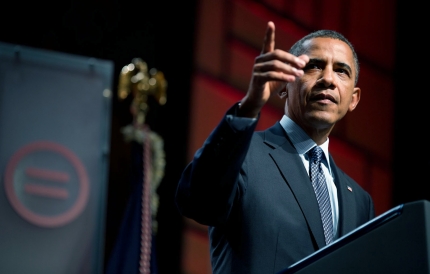
Close Transcript

The White House

Office of the Press Secretary

Fact Sheet: Creating Pathways to the Middle Class for All Americans

On Wednesday, June 25th, President Obama addressed the National Urban League and discussed his Administration’s work strengthening our communities by investing in manufacturers and small businesses, cutting taxes for middle-class families, reforming education by raising standards, and ensuring millions more Americans have access to quality, affordable health care.

As the President has said many times, there’s a basic bargain in America. It says that no matter who you are or where you’re from, if you’re willing to work hard and play by the rules you should be able to find a good job, feel secure in your community, and support a family. There are times when this bargain is tested. Economic crisis is one of those times. When President Obama took office, the United States economy was losing over 800,000 jobs a month. That’s why during his first months in office, President Obama took swift action to stop the rapid loss of jobs--giving tax cuts to working families, keeping teachers in the classroom, and investing in clean energy and manufacturing.

President Obama has acted to prevent millions from slipping into poverty and helped build a path to the middle class.  There is more work to do, but President Obama is moving our country forward.  He believes that your success should not be determined by your background or your zip code; that everyone should get a fair shot, everyone should do their fair share, and everyone should play by the same set of rules.

The President’s Commitment to Strong Communities that Attract Jobs and
Promote Economic Growth

• Providing tax relief for all Americans, with refundable tax credits focused on working families. The Recovery Act expanded the Earned Income Tax Credit (EITC) and Child Tax Credit (CTC). The EITC expansion allowed families with three or more children to receive up to $640 more than they otherwise would this year. The expansion of the CTC gave many families access to thousands of dollars in additional tax benefits that would have otherwise been lost. As part of the 2010 tax deal these expansions were extended through the end of 2012.  An estimated 2.2 million African American families are benefiting from the expansion of the EITC and CTC. These credits help roughly 4.7 million African American children or almost half of all African American children.  In his budget the President has called for making these expansions permanent. 

• Creating opportunity and mobility for children by reforming K-12 and early education. The President has devoted more than $4 billion to turning around our lowest performing schools, and some of them are making encouraging gains in reading and math proficiency. And the President has invested in early childhood education, including Head Start, Early Head Start, and child care assistance, benefiting tens of thousands of low income children.  The Administration also has invested in new child nutrition programs, to make sure fewer young people go hungry.

• Putting the cost of college within reach for more families, including the largest investment in higher education since the G.I. Bill.  Since the beginning of the Administration, the President has dramatically increased Pell Grant funding, helping  make college affordable for an additional 200,000 African American students, created the American Opportunity Tax Credit to ease college costs for over 9 million families, and championed bold and comprehensive reform of student loans that will save taxpayers $68 billion over the next decade.  Together, these represent the largest investments in higher education since the G.I. Bill. The Administration has also dramatically increased investments in historically black colleges and universities.

• Secure, affordable health care coverage. Within a month of taking office, the President signed the Children’s Health Insurance Program Reauthorization Act into law, expanding health coverage to more than 4 million children who would otherwise go uninsured.  And the historic Affordable Care Act will extend coverage to millions of uninsured African Americans by 2016, and prevent insurance companies from charging women more than men and discriminating against those with preexisting conditions such as diabetes or cancer.

 Helping responsible homeowners feel secure in the homes.  The Administration’s programs, both through their direct and indirect impact on the market, have helped more than 4 million families permanently modify their mortgages so they can stay in their homes. And the President, as part of the American Jobs Act, has proposed a $15 billion investment in Project Rebuild, which would put construction workers back on the job repurposing and rehabilitating vacant properties.

• Creating Pathways Back to Work.  Through the Recovery Act, over 260,000 low-income adults and youth were placed in subsidized jobs and an additional 367,000 low-income youth received summer employment.  Building on these successful strategies, the President has proposed a new Pathways Back to Work Fund to support summer and year-round employment opportunities for low-income youth and adults and for the long-term unemployed.  In addition, recognizing that we can’t wait for Congress to act, President Obama has announced nearly 300,000 summer jobs and other employment opportunities for youth and new online tools to help youth access opportunities.

• Building stronger cities and communities.  Strong Cities, Strong Communities (SC2) is an interagency pilot initiative to strengthen the capacity of local governments by partnering with them to execute their economic visions. The Obama Administration has deployed interagency teams of Federal officials to work with the Mayor’s office in six pilot cities – Fresno, Memphis, Detroit, New Orleans, Chester, and Cleveland – helping to leverage Federal investments, advance specific economic development projects and build collaboration to encourage economic growth. In addition to SC2, the Obama Administration has created the Neighborhood Revitalization Initiative, which has invested more than $345 million in the nation’s persistent pockets of poverty since 2009—reaching 68 communities with an interdisciplinary, place-based, and data-driven approach to holistic community change.

The White House

Office of the Press Secretary

Press Gaggle by Press Secretary Jay Carney en route New Orleans, LA

Aboard Air Force One
En Route New Orleans, Louisiana

MR. CARNEY:  Thank you for joining us this morning as we make our way from Seattle, Washington to New Orleans.  As we have been doing now for some time, Jen and I will brief together.  I can take your questions on policy and the President's administration, and Jen can field your questions on the campaign.

I just wanted to note -- it happened yesterday, but it's worth noting again -- that the Congressional Budget Office confirmed once again that repealing the Affordable Care Act would increase the deficit, deny coverage to millions of Americans, and eliminate tax credits that will make health insurance more affordable for middle-class families.  As the President has said, this law is here to stay and it's making a positive difference in the lives of millions of Americans. 

Today, the Department of Health and Human Services announced that in the first six months of this year alone, the law has saved $687 million in prescription drug costs for more than 1 million people with Medicare. 

We will continue, therefore, our work to implement the Affordable Care Act and deliver the benefits of the law to the American people. 

CBO also confirmed that repealing the Affordable Care Act would increase the deficit by $100 billion over the first decade and a trillion -- more than a trillion over the second decade.  That's why we're for implementing the law.

Q    Jay, can you preview the speech a little bit for this evening?

MR. CARNEY:  I think you saw in some places that it was written about that the President is going to announce an executive order aimed at helping African Americans get the best education possible.  I think we can provide you a little more information about that, and certainly the Department of Education can.

He'll focus the speech primarily on the economy.  And of course we believe, unlike, apparently, some in Congress, that education is an elemental aspect of the economy.  But beyond that, I don't have a preview.

MS. PSAKI:  One thing I just wanted to highlight before we continue.  As we know, Mitt Romney has flatly denied his involvement with Bain during the time when he was at the Olympics for months, if not years now.  There's a new AP story today I encourage everybody to read -- happy to send it to you -- that outlines the fact that he took trips back to meet with board members during this period of time.  So that's a contradiction of what he said.  And it shows, again, a continued pattern of secrecy around his involvement there and his time there.

I think the next question it raises that we still don't have an answer on is was that why he was paid $100,000 a year?  Was it something else?  So, an interesting story I just wanted to highlight for everyone and encourage you to read.

Q    Jay, on Syria, it seems like there are a couple of things happening that seem to show some signs of momentum -- rebels taking more territory, more defections, Turkey closing its border for trade.  Is there anything that the U.S. and their allies are willing to do at this point to try to push things over the edge?

MR. CARNEY:  Well, we and our partners have been and will continue to take steps to isolate the Assad regime, to starve it of financial resources through sanctions, which makes it increasingly difficult for Assad to finance his brutal crackdown on his own people.

We continue to support the opposition's efforts to consolidate itself and to take steps to implement their broad agreement in Cairo over what a political transition would look like.  I would note that there is an ongoing assault in Aleppo --

Q    What's that?

MR. CARNEY:  -- an ongoing assault in Aleppo, in Syria, which is a civilian population.  The Assad government is reportedly using not just helicopters, but fixed-wing aircraft as well as tanks to perpetrate heinous violence against the Syrian people and unarmed civilians.  We condemn that.  And it's just another indication of the depths of depravity that Assad has demonstrated himself capable of achieving.

Q    Staying on Syria, Jay -- you said there were reports of using fixed-wing aircraft.  Have you got your own verification of that, or is that just reports?

MR. CARNEY:  We consider the reports credible, but I don’t have an independent confirmation.

Q    Okay.  Staying on Syria, the Russian foreign minister earlier said earlier today that Russia regarded -- would regard the use of chemical weapons by the Syrian government as unacceptable.  How do you respond to that?  And do you see any indication coming from Moscow that they might be softening their support for Assad?

MR. CARNEY:  On the first point, we certainly agree that any use of chemical weapons is unacceptable and anyone responsible for the use of chemical weapons will be held accountable by the international community.  That is certainly our view. 

And we have -- as we’ve said in the past, we continue to be concerned about the disposition of the Assad regime’s chemical weapons.  We believe that they are still under the control of the government, and we use every opportunity to remind the Syrian government that it must maintain control of those weapons and, of course, never use them.

Q    And the Russian support for Assad -- any indication they might be softening?

MR. CARNEY:  We are in, as you know, regular consultations with the Russians as well as others about the need to form an international consensus around the simple notion that Assad must go in order for there to be a hope for a peaceful transition in Syria; that the longer Assad remains in power, the more deadly the situation becomes in Syria.  As we’ve seen in Aleppo today, the longer we go, the more willing Assad is to take extreme measures to kill his own people. 

And to I believe Julie’s point about the defections -- maybe it was you, Roger, I can’t remember -- we can confirm the defections of Syrian ambassadors to both the UAE and Cyprus.  And this is another indication, we believe, that senior officials around the Assad inner circle are fleeing the government because of the heinous actions taken by Assad against his own people, and the recognition that Assad’s days are numbered.

Q    Can you say that again?  That's defections from the UAE and Cyprus?

MR. CARNEY:  Syrian ambassadors to the UAE and Cyprus.

Q    Jen, do you have fundraising numbers for today?

MS. PSAKI:  Sure.  So before we go to the Urban League, the President has two fundraisers.  The first is a roundtable, where we expect about 20 people, $25K per person.  The second is an event at the House of Blues, which is -- the tickets start at $250.  We expect a couple hundred people.  I'll get the exact number once we get there.

Q    What was the first one -- $25,000 for 20 people at the roundtable?

MS. PSAKI:  Per person.  It's a roundtable, kind of one of the smaller groups --

Q    Do you know the name of the home that we're at, the people that are hosting?

MS. PSAKI:  We'll give it to you when we're arriving.

Q    On sort of a separate subject -- you guys have been talking a lot about the expiring Bush tax cuts.  What about the expiring payroll tax cut -- do you want to see that renewed at the end of the year?

MR. CARNEY:  Well, it's not the end of the year, and I will say as I've said in the past that that was a measure that was put in place as a temporary form of assistance to middle-class Americans.  It was renewed for that reason.  And we'll certainly evaluate the situation in the economy as we move closer to the end of the year. 

The bill that we hope will be voted on today in the Senate, that Senator Reid put forward and the administration strongly supports, would extend not just the Bush tax cuts for 98 percent of Americans, those making under $250,000 a year, but would also extend a series of other tax cuts put in place by this administration and passed by Congress that affect millions of middle-class families.

But on the payroll tax cut, we'll obviously evaluate that.

Q    It sounds like you're much more comfortable allowing that to expire.  What would you say to critics who say --

MR. CARNEY:  You're putting words in my mouth.  I'm simply saying that we'll -- that was extended for a year, and I think it was a memorable struggle with Congress and when the Republicans finally relented and allowed for the tax cuts for the middle class to go through, the President was able to sign them into law. 

But what we're focused on right now is the vote in the Senate on the measure that Senator Reid put forward that very closely mirrors the President's proposals -- if we act on what we can all agree on, which is the need to extend tax cuts for the middle class, for 98 percent of the American people, and ensure that their taxes don't go up on January 1st.

Q    Any concern that there might not be (inaudible) agreement by the President's supporters on Capitol Hill?  Webb and I think Lieberman both said today that they wouldn't support Reid's measure.

MR. CARNEY:  I'm very confident that the overwhelming majority of Democrats will vote for this measure.  But I obviously don't want to -- I'm not whipping the vote.  So we'll wait and see what happens.  What I do know is that the wrong vote to take is one that would hold tax cuts for 98 percent of the American people hostage to an insistence that millionaires and billionaires get a tax cut. 

Again, that is bad for the middle class and it's bad macroeconomic policy, because, as you know, independent economists are in broad agreement that tax cuts to working and middle-class Americans are very beneficial to economic growth because that money goes right back into the economy and spurs growth and job creation.  Tax cuts to millionaires and billionaires tend to be far less efficient and generally are more expensive than they are effective in spurring economic growth.

Q    Jay or Jen, can either of you say whether the President is aware of the report in the Telegraph about a Romney advisor saying that Obama doesn’t appreciate the Anglo-Saxon nature of the British-American relationship?  And can either of you talk about whether the President thinks the Romney campaign people are race-baiting?  This is not the first instance where we've seen, for example, John Sununu talked about whether Obama was "American enough" and Romney is quoted on the campaign stump talking about his foreign approach to national affairs, I believe.  What is your view on this and what is the President's view on this?

MS. PSAKI:  I have not spoken to the President specifically about this this morning, but you did see Vice President Biden did issue a statement on this.  And just to reiterate that and add to it, this is a case where before Mitt Romney's plane even is wheels down -- they're still watching romantic comedies on the plane, they're peanuts they're eating -- one of his advisors violated exactly what they said they wouldn't do -- which is criticize the President beyond the borders of the U.S.

This is also -- it shouldn’t be missed that this also comes on the heels of a speech at the VFW that was heavy on attacks, light on substance -- that's not just us saying that -- aside from endorsing the President's timetable in Afghanistan, which he vociferously attacked a couple of months ago, and earlier this week, misquoting the Australian Foreign Minister in public. 

So this is a case where there's a continuous fumbling of the foreign policy football here.  And it does raise the question as to whether Mitt Romney and his team are ready to have a serious conversation about foreign policy.

I don't want to characterize beyond that.  I will say that there are countless examples, which I'm happy to provide, of occasions where Mitt Romney and his surrogates have questioned whether the President understood America or freedom, and that really goes over a line that we think they shouldn’t. 

Q    That line, is it race-baiting?

MS. PSAKI:  I don't want to characterize it in that way.  I know that there will be a lot of people speaking to this today and asked about this.  But there's no question that questioning whether the President of the United States understands America and understands freedom is taking the debate to a level that is not about what you support in terms of small business tax cuts and the extension of middle-class tax cuts, and whether we should have withdrawn from Iraq when we did.  And in the spirit of trying to have a debate about what the American people care about, that’s not what they care about.  And I think that’s not what people want to hear in this debate. 

MR. CARNEY:  Could I just add as a policy matter, referring to the comment by the advisor, is that what it is is gratuitously ignorant of the facts.  As is widely recognized, this President, since he came into office, has strengthened our alliances across the board, including -- and importantly, including our NATO alliances, including the United Kingdom.  As anyone who covered reciprocal state visits between the United Kingdom and the U.S.
-- most recently the visit by Prime Minister David Cameron -- can attest the relationship between the United States and United Kingdom has never been stronger than it is today under the leadership of President Obama. 

Q    Outlook for excerpts of the speech?

MR. CARNEY:  I don’t anticipate that.  We're still checking on it, but I wouldn’t anticipate excerpts.

Q    I'm sorry -- do or don't?

MR. CARNEY:  I would not, but I'll check. 

Q    Thanks.

MR. CARNEY:  Thank you. 

END
11:07 A.M. PDT

The White House

Office of the Press Secretary

Presidential Nomination Sent to the Senate

NOMINATION SENT TO THE SENATE:

Ranee Ramaswamy, of Minnesota, to be a Member of the National Council on the Arts for a term expiring September 3, 2018, vice Miguel Campaneria, term expiring.

The White House

Office of the Press Secretary

Statement by NSC Spokesman Tommy Vietor on Assistant to the President for Homeland Security and Counterterrorism John Brennan’s Trip to Israel

John Brennan, Assistant to the President for Homeland Security and Counterterrorism, visited Israel on July 25 to consult with senior Israeli officials about a range of shared security concerns, including the recent wave of terrorist plots against Israeli and other interests.  He also had a productive meeting with Palestinian Authority Prime Minister Fayyad in Jerusalem.

The White House

Office of the Press Secretary

Statement by NSC Spokesman Tommy Vietor on the National Security Advisor Thomas E. Donilon’s Trip to China

National Security Advisor Tom Donilon held constructive, detailed, and wide ranging discussions with senior Chinese officials during his visit to Beijing July 23-25.  Mr. Donilon met with President Hu Jintao, Vice President Xi Jinping, Vice Premier Wang Qishan, State Councilor Dai Bingguo, and Foreign Minister Yang Jiechi.  He also had a productive discussion with Vice Chairman of the Military Commission General Xu Caihou.

Mr. Donilon held extensive exchanges on the goals of the bilateral relationship and the mechanisms to achieve them.  In discussing regional and global issues, Mr. Donilon underscored the shared responsibility of both countries to address such challenges as North Korea, Iran, Syria, regional security in Asia, as well as the rebalancing of the global economy.  Mr. Donilon underscored the importance of continuing to build a substantive and sustained military-to-military relationship, and underscored the continuing importance of the human rights dialogue.