The White House

Office of the Press Secretary

President Obama Signs West Virginia Disaster Declaration

The President today declared a major disaster exists in the State of West Virginia and ordered Federal aid to supplement state and local recovery efforts in the area affected by severe storms and straight-line winds during the period of June 29 to July 1, 2012.

Federal funding is available to state and eligible local governments and certain private nonprofit organizations on a cost-sharing basis for emergency work and the repair or replacement of facilities damaged by the severe storms and straight-line winds in the counties of Barbour, Boone, Braxton, Cabell, Calhoun, Clay, Doddridge, Fayette, Gilmer, Grant, Greenbrier, Hardy, Harrison, Jackson, Jefferson, Kanawha, Lewis, Lincoln, Logan, Marshall, Mason, McDowell, Mercer, Mingo, Monroe, Nicholas, Pendleton, Pleasants, Pocahontas, Preston, Putnam, Raleigh, Randolph, Ritchie, Roane, Summers, Tucker, Tyler, Upshur, Wayne, Webster, Wetzel, Wirt, Wood, and Wyoming.

Federal funding is also available on a cost-sharing basis for hazard mitigation measures statewide.

W. Craig Fugate, Administrator, Federal Emergency Management Agency (FEMA), Department of Homeland Security, named Dolph A. Diemont as the Federal Coordinating Officer for federal recovery operations in the affected area. 

FEMA said additional designations may be made at a later date if requested by the state and warranted by the results of further damage assessments.

The White House

Office of the Press Secretary

Fact Sheet: President Obama’s Work to Honor our Military Families and Veterans

On Monday, July 23, President Obama addressed the Veterans of Foreign Wars and discussed his Administration’s work to secure our nation, fight terrorism, renew American leadership in the world, better serve our troops and military families and honor our veterans. In his remarks, President Obama announced a redesign of the Transition Assistance Program.  Developed by the Veterans Employment Initiative Task Force established by the President last August, Transition GPS will help our separating servicemembers successfully transition to the civilian workforce, start a business, or pursue higher education. The President also called on Congress to pass his Veterans Job Corps proposal and to extend the Returning Heroes and Wounded Warrior tax credits for businesses that hire veterans.

Additional background information on President Obama’s work to honor and support America’s military families and veterans is included below.

Transition GPS:  Transforming the Transition Assistance Program
In August 2011, President Obama visited the Washington Navy Yard and directed the Departments of Defense and Veterans Affairs to lead a task force to develop the first major redesign of the military’s Transition Assistance Program (TAP) in over 20 years.  Prior to the President’s announcement, TAP consisted of pre-separation counseling and a voluntary, three-day workshop from the Departments of Labor, Defense, and Veterans Affairs that was presented at selected military installations nationwide, and attended by nearly half of the service members who separated from the services each year.

In his remarks to the VFW, the President announced the launch of a revamped transition program, which will help our separating service members successfully transition to the civilian workforce, start a business, or pursue training or higher education.  This new transition program, entitled Transition GPS, will:

• Extend the transition program period from 3 days to 5-7 days.
• Strengthen, standardize, and expand counseling and guidance for service members before leaving the military.
• Transform the military’s approach to education, training, and credentialing for service members. 

Transition GPS will be implemented throughout the Armed Forces by the end of 2013 and includes the following key components:

 Pre-Separation Assessment and Individual Counseling: Through the new transition program, separating service members will have individual counseling to discuss their career goals and start their transition process.  Subsequently, members will have a needs and goals assessment coupled with a counseling session about benefits, resources, and available assistance across a wide scope of military separation topics.  Each service member will develop an Individual Transition Plan that documents his or her personal transition, as well as the deliverables he or she must attain to meet the new transition program’s Career Readiness Standards.

• 5-Day Core Curriculum: The five-day Transition GPS Core Curriculum will include a financial planning seminar, a workshop offered by the Department of Veterans Affairs on available veterans’ benefits and services, and a re-designed employment workshop offered by the Department of Labor. Transitioning service members will also undertake a Military Occupational Code Crosswalk to translate their military skills, training, and experience into civilian occupations, credentials, and employment.  An Individual Transition Plan session will allow Members to seek guidance from subject matter experts, identify career goals, and develop a roadmap for their transition.   

• Career-Specific Additional Curriculum: In addition to completing the Transition GPS Core Curriculum, transitioning service members will also have the option of participating in a series of two day tailored tracks within the Transition GPS curriculum: (1) an Education track, for those pursuing a higher education degree; (2) a Technical and Skills Training track, for those seeking job-ready skills and industry-recognized credentials in shorter-term training programs; and (3) an Entrepreneurship track, for those wanting to start a business.

• CAPSTONE Event: Before their separation from military service, service members will participate in a CAPSTONE event, which will verify that transitioning service members completed the Transition GPS curriculum and achieved Career Readiness Standards.  Service members who require additional assistance will be referred to supplemental training opportunities. In addition, through the CAPSTONE event, all service members will be offered a ‘warm handover’ to appropriate government agencies and organizations that will be able to provide them continued benefits, services, and support as veterans.

• Military Life Cycle Transition Model: The new transition program will incorporate career readiness and transition preparation into the entire span of a service member’s career. In the past, transition and preparation for the civilian workforce occurred late in a service member’s time in the military – near the point of separation. Under this new program, these concepts will be incorporated earlier to ensure that the counseling, assessments, and access to resources to build skills or credentials occur at earlier stages of a service member’s military tenure.

Hiring Our Veterans
Since the President took office, he has been committed to putting veterans back to work rebuilding and protecting America. From the work of the Joining Forces Initiative to encourage the private sector to hire tens of thousands of veterans to the passage of tax credits for businesses that hire veterans, the President has implemented a range of policies to connect veterans to job.   Additionally, the President continues to call on Congress to pass the Veterans Job Corps proposal he announced in the State of the Union to help Afghanistan and Iraq veterans get jobs as cops and firefighters, as well as other jobs serving their communities. The President’s record on hiring veterans includes:

• Creating Two New Veterans’ Tax Credits: In November 2011, the President signed into law two new tax credits for hiring veterans, both of which he proposed as part of the American Jobs Act. The Returning Heroes Tax Credit provides an incentive of up to $5,600 for firms to hire unemployed veterans and the Wounded Warrior Tax Credit doubled the existing tax credit for long-term unemployed veterans with service-connected disabilities to $9,600.  Both credits are set to expire at the end of this year, and the President is calling on Congress to extend those credits.

• Helping More Veterans Start Businesses:  Nine percent of all U.S. firms are owned by veterans and more than 2.4 million veteran-owned businesses employ more than 5.75 million individuals. Between 2009 and 2011, over $3 billion through over 12,000 Small Business Administration loans went to small businesses owned by veterans and service disabled veterans. 

• Increasing Access to Intensive Reemployment Services: Post-9/11 veterans are now able to download the Veteran Gold Card, which entitles them to enhanced reemployment services including six months of personalized case management, assessments and career counseling at their local American Job Center.

• Developing Online Tools to Boost Veteran Employment: The Administration launched the Veterans Jobs Bank, an easy-to-use tool to help veterans find job postings from companies looking to hire them. It already searches over one million job postings and is growing. Additionally, the Department of Labor launched My Next Move for Veterans, a new online resource that allows veterans to enter their military occupation code and discover civilian occupations for which they are well qualified.

• Increasing Hiring of Veterans in Healthcare-Related Fields: The President challenged Community Health Centers to hire 8,000 veterans – approximately one veteran per health center site – over the next three years and the Health Resources and Services Administration pledged to open up career paths in addition to nursing and expand opportunities for veterans to become physician assistants.

• Hiring More Veterans in the Federal Government: The federal government has helped lead efforts to employ veterans, hiring more than 200,000 veterans since 2009.

• Streamlining Civilian Credentialing for Service Members and Veterans: Last month, the Department of Defense established, under the President’s direction, a Military Credentialing and Licensing Task Force, which will identify opportunities where service members can earn civilian occupational credentials and licenses without the need for additional training. As the first action of the Task Force, all branches of the military worked with manufacturing credentialing agencies to enable up to 126,000 service members to gain industry-recognized, nationally-portable certifications for high-demand manufacturing jobs.

Supporting Our Veterans and Military Families
Other steps taken by the Obama Administration to support veterans and military families include:

• Strengthening the VA: Under President Obama, the VA has received record-levels of funding, with the FY13 budget calling for $64 billion in discretionary spending, and $76 billion in mandatory funding. In addition, the Administration has made it clear that veterans benefits are exempt from sequestration.

• Strengthening Military and Veteran Education Benefits: In April, President Obama signed an Executive Order to help ensure all of America’s service members, veterans, spouses, and other family members have the information they need to make informed educational decisions and are protected from aggressive and deceptive targeting by educational institutions.

• Extending Benefits to Victims of Agent Orange:  In the last two years, VA has processed 230,000 claims and awarded $3.62 billion in retroactive benefits to nearly 130,000 Veterans and survivors who were harmed by Agent Orange.

• Mental Health:  The Deployment Health Clinical Center (DHCC), a Component Center of Defense Centers of Excellence, developed the RESPECT-Mil program, which enables primary care providers to screen and treat patients for PTSD and depression.  To date, the program has screened over one million primary care patients, identifying more than 68,000 Service members with previously unmet psychological health needs and referred them to care.  The program has expanded to more than 60 primary care clinics across more than 25 Military Treatment Facilities. Today, more than 1,117 DOD Military Family Life Consultants (MFLC) provide support on active duty installations in all 50 States, four Territories, and the District of Columbia. In FY11, MFLCs provided approximately 6.8 million face-to-face counseling sessions.

• Ending Veterans Homelessness: The Obama Administration is on pace to meet the President’s goal of ending veterans homelessness by 2015. The number of homeless veterans has decreased by 12 percent from 2010 to 2011 on a given night.

• Working to Prevent Suicide: VA has increased the number of mental health professionals by 48 percent since 2006 and in April, announced they would hire an additional 1,600 mental health providers.  Since 2009, VA has increased the mental health care budget by 39 percent.  The Department of Defense has made suicide prevention a top priority, increased behavioral health care providers by 35% over past three years and increased the number of these health care providers in front line units.

• Eliminating the Disability Claims Backlog: While VA has processed more than one million disability claims in the last year, more work remains to be done. VA has redeployed 1,200 claims experts to target and tackle the most complex claims in the backlog.  The Department is also deploying new technology and procedures to ensure our Veterans get the timely, quality benefits they need and deserve.

• Supporting Veterans with Post-Traumatic Stress Disorder: In July 2010, the VA published a historic change to its rules, streamlining the process and paperwork needed by combat veterans to pursue a claim for disability pay for post-traumatic stress disorder (PTSD). The VA has also expanded its mental health programs, hiring more than 3,500 mental health professionals since 2009. Additionally, VA’s 2013 budget proposal includes $6.2 billion for mental health initiatives.

• Honoring Vietnam Veterans: President Obama and the entire federal government have partnered with State and local governments, private organizations, and communities across America to launch the Commemoration of the 50th Anniversary of the Vietnam War—a 13-year program to honor and give thanks to a generation of proud Americans who saw our country through one of the most challenging missions we have ever faced and pay tribute to the more than 3 million men and women who answered the call of duty with courage and valor. 

• Traumatic Brain Injury: VA has launched a comprehensive program to identify, screen and treat all Veterans with traumatic brain injury (TBI), and to ensure that they receive patient-centered, integrated care and benefits.  President Obama signed an amendment to the Americans with Disabilities Act which allows individuals with PTSD and TBI to more easily seek legal protections as they look for and participate in employment opportunities.

Taking the Cyberattack Threat Seriously

Ed note: This op-ed by President Obama was originally published in the Wall Street Journal on July 20, 2012

Last month I convened an emergency meeting of my cabinet and top homeland security, intelligence and defense officials. Across the country trains had derailed, including one carrying industrial chemicals that exploded into a toxic cloud. Water treatment plants in several states had shut down, contaminating drinking water and causing Americans to fall ill.

Our nation, it appeared, was under cyber attack. Unknown hackers, perhaps a world away, had inserted malicious software into the computer networks of private-sector companies that operate most of our transportation, water and other critical infrastructure systems.

Fortunately, last month's scenario was just a simulation—an exercise to test how well federal, state and local governments and the private sector can work together in a crisis. But it was a sobering reminder that the cyber threat to our nation is one of the most serious economic and national security challenges we face.

So far, no one has managed to seriously damage or disrupt our critical infrastructure networks. But foreign governments, criminal syndicates and lone individuals are probing our financial, energy and public safety systems every day. Last year, a water plant in Texas disconnected its control system from the Internet after a hacker posted pictures of the facility's internal controls. More recently, hackers penetrated the networks of companies that operate our natural-gas pipelines. Computer systems in critical sectors of our economy—including the nuclear and chemical industries—are being increasingly targeted.

It doesn't take much to imagine the consequences of a successful cyber attack. In a future conflict, an adversary unable to match our military supremacy on the battlefield might seek to exploit our computer vulnerabilities here at home. Taking down vital banking systems could trigger a financial crisis. The lack of clean water or functioning hospitals could spark a public health emergency. And as we've seen in past blackouts, the loss of electricity can bring businesses, cities and entire regions to a standstill.

This is the future we have to avoid. That's why my administration has made cybersecurity a priority, including proposing legislation to strengthen our nation's digital defenses. It's why Congress must pass comprehensive cybersecurity legislation.

We all know what needs to happen. We need to make it easier for the government to share threat information so critical-infrastructure companies are better prepared. We need to make it easier for these companies—with reasonable liability protection—to share data and information with government when they're attacked. And we need to make it easier for government, if asked, to help these companies prevent and recover from attacks.

Yet simply sharing more information is not enough. Ultimately, this is about security gaps that have to be filled. To their credit, many of these companies have boosted their cyber defenses. But many others have not, with some lacking even the most basic protection: a good password. That puts public safety and our national security at risk.

The American people deserve to know that companies running our critical infrastructure meet basic, commonsense cybersecurity standards, just as they already meet other security requirements. Nuclear power plants must have fences and defenses to thwart a terrorist attack. Water treatment plants must test their water regularly for contaminants. Airplanes must have secure cockpit doors. We all understand the need for these kinds of physical security measures. It would be the height of irresponsibility to leave a digital backdoor wide open to our cyber adversaries.

This approach stays true to our values as a society that cherishes free enterprise and the rights of the individual. Cybersecurity standards would be developed in partnership between government and industry. For the majority of critical infrastructure companies already meeting these standards, nothing more would be expected. Companies needing to upgrade their security would have the flexibility to decide how best to do so using the wide range of innovative products and services available in the marketplace. Moreover, our approach protects the privacy and civil liberties of the American people. Indeed, I will veto any bill that lacks strong privacy and civil-liberties protections.

This is exactly the kind of responsible, collaborative approach to an urgent national-security challenge that Americans expect but that Washington too rarely provides. It reflects the insights and ideas of industry and civil libertarians. It is sponsored by a bipartisan group of senators. It is supported by current and former homeland security, intelligence and defense leaders from both Republican and Democratic administrations.

Today we can see the cyber threat to the networks upon which so much of our modern American lives depend. We have the opportunity—and the responsibility—to take action now and stay a step ahead of our adversaries. For the sake of our national and economic security, I urge the Senate to pass the Cybersecurity Act of 2012 and Congress to send me comprehensive legislation so I can sign it into law.

It's time to strengthen our defenses against this growing danger.

Mr. Obama is President of the United States

Related Topics: Defense, Texas

The White House

Office of the Press Secretary

President Obama Honors Outstanding Early-Career Scientists

President Obama today named 96 researchers as recipients of the Presidential Early Career Awards for Scientists and Engineers, the highest honor bestowed by the United States Government on science and engineering professionals in the early stages of their independent research careers. 

“Discoveries in science and technology not only strengthen our economy, they inspire us as a people.” President Obama said.  “The impressive accomplishments of today’s awardees so early in their careers promise even greater advances in the years ahead.”

The Presidential early career awards embody the high priority the Obama Administration places on producing outstanding scientists and engineers to advance the Nation’s goals, tackle grand challenges, and contribute to the American economy.  The recipients are employed or funded by the following departments and agencies: Department of Agriculture, Department of Commerce, Department of Defense, Department of Education, Department of Energy, Department of Health and Human Services, Department of the Interior, Department of Veteran Affairs, Environmental Protection Agency, National Aeronautics and Space Administration, and the National Science Foundation, which join together annually to nominate the most meritorious scientists and engineers whose early accomplishments show the greatest promise for assuring America’s preeminence in science and engineering and contributing to the awarding agencies' missions.

The awards, established by President Clinton in 1996, are coordinated by the Office of Science and Technology Policy within the Executive Office of the President. Awardees are selected for their pursuit of innovative research at the frontiers of science and technology and their commitment to community service as demonstrated through scientific leadership, public education, or community outreach.

This year’s recipients are:

Department of Agriculture
Joseph E. Jakes, U.S. Forest Service
Ian Kaplan, Purdue University
Christina L. Swaggerty, Agricultural Research Service

Department of Commerce
Anthony Arguez, National Oceanic and Atmospheric Administration
Ian Coddington, National Institute of Standards and Technology
Frank W. DelRio, National Institute of Standards and Technology
Jayne Billmayer Morrow, National Institute of Standards and Technology
Kyle S. Van Houtan, National Oceanic and Atmospheric Administration
Rebecca Washenfelder, National Oceanic and Atmospheric Administration

Department of Defense
David M. Blei, Princeton University
Ania Bleszynski Jayich, University of California, Santa Barbara
Alejandro L. Briseno, University of Massachusetts, Amherst
Lee R. Cambrea, Naval Air Research Intelligence
Vincent Conitzer, Duke University
Chiara Daraio, California Institute of Technology
Craig J. Fennie, Cornell University
Keith Edward Knipling, Naval Research Laboratory, Department of the Navy
Wen Li, Wayne State University
Timothy K. Lu, Massachusetts Institute of Technology
Cindy Regal, University of Colorado Boulder
Matthew B. Squires, Air Force Research Laboratory, Department of the Air Force
Joseph E. Subotnik, University of Pennsylvania
Ao Tang, Cornell University
C. Shad Thaxton, Northwestern University
Maria Laina Urso, U.S. Army Research Institute for Environmental Medicine

Department of Education
Li Cai, University of California, Los Angeles

Department of Energy
Stanley Atcitty, Sandia National Laboratories
Jeffrey W. Banks, Lawrence Livermore National Laboratory
Amy J. Clarke, Los Alamos National Laboratory
Derek R. Gaston, Idaho National Laboratory
Christopher Hirata, California Institute of Technology
Heileen Hsu-Kim, Duke University
Thomas Francisco Jaramillo, Stanford University
Pablo Jarillo-Herrero, Massachusetts Institute of Technology
John R. Kitchin, Carnegie Mellon University
Peter Mueller, Argonne National Laboratory
Daniel B. Sinars, Sandia National Laboratories
Jesse Thaler, Massachusetts Institute of Technology
Heather Whitley, Lawrence Livermore National Laboratory

Department of Health and Human Services
Erez Lieberman Aiden, Harvard University
Nihal Altan-Bonnet, Rutgers University
Peter D. Crompton, National Institute of Allergy and Infectious Diseases
Margherita R. Fontana, University of Michigan School of Dentistry
Ervin Ray Fox, University of Mississippi Medical Center
Valerie Horsley, Yale University
Steven T. Kosak, Northwestern University Feinberg School of Medicine
Erica N. Larschan, Brown University
Daniel R. Larson, National Cancer Institute
Krista M. Lisdahl, University of Wisconsin – Milwaukee
Emanual M. Maverakis, University of California, Davis
Biju Parekkadan, Massachusetts General Hospital and Harvard Medical School
Jay Zachary Parrish, University of Washington
Peter Philip Reese, University of Pennsylvania
Niels Ringstad, Skirball Institute, New York University School of Medicine
Pawan Sinha, Massachusetts Institute of Technology
Georgios Skiniotis, University of Michigan
Beth Stevens, F.M. Kirby Neurobiology Center, Boston Children's Hospital
Justin Taraska, National Heart, Lung, and Blood Institute
Jennifer Rabke Verani, National Center for Immunization and Respiratory Diseases
Brendan M. Walker, Washington State University
Lauren Bailey Zapata, National Center for Chronic Disease Prevention and Health Promotion

Department of the Interior
Joseph P. Colgan, U.S. Geological Survey
Karen R. Felzer, U.S. Geological Survey
Justin J. Hagerty, U.S. Geological Survey

Department of Veterans Affairs
Jeffrey R. Capadona, Louis Stokes Cleveland Veteran Affairs Medical Center
Charlesnika T. Evans, Edward Hines Jr. Veterans Affairs Hospital
Amy M. Kilbourne, Veterans Affairs Ann Arbor Healthcare System
Kinh Luan Phan, Jesse Brown Veterans Affairs Medical Center

Environmental Protection Agency
Adam P. Eisele, U.S. Environmental Protection Agency
Mehdi Saeed Hazari, U.S. Environmental Protection Agency

National Aeronautics and Space Administration
Morgan B. Abney, Marshall Space Flight Center
Ian Gauld Clark, Jet Propulsion Laboratory and California Institute of Technology
Temilola Fatoyinbo-Agueh, Goddard Space Flight Center
Jessica E. Koehne, Ames Research Center
Francis M. McCubbin, Institute of Meteoritics, University of New Mexico
Yuri Y. Shprits, University of California, Los Angeles

National Science Foundation
Baratunde Aole Cola, Georgia Institute of Technology
Brady R. Cox, University of Arkansas
Meghan A. Duffy, Georgia Institute of Technology
Joshua S. Figueroa, University of California, San Diego
Michael J. Freedman, Princeton University
Erin Marie Furtak, University of Colorado Boulder
B. Scott Gaudi, The Ohio State University
Curtis Huttenhower, Harvard University
Christopher A. Mattson, Brigham Young University
David C. Noone, University of Colorado Boulder
Parag A. Pathak, Massachusetts Institute of Technology
Alice Louise Pawley, Purdue University
Amy Lucía Prieto, Colorado State University
Mayly C. Sanchez, Iowa State University and Argonne National Laboratory
Sridevi Vedula Sarma, Johns Hopkins University
Suzanne M. Shontz, Pennsylvania State University
Mariel Vázquez, San Francisco State University
Luis von Ahn, Carnegie Mellon University
Brent R. Waters, University of Texas, Austin
Jennifer Wortman Vaughan, University of California, Los Angeles

The White House

Office of the Press Secretary

Statement by the Press Secretary on the Death of Oswaldo Payá

The President's thoughts and prayers are with the family and friends of Oswaldo Payá, a tireless champion for greater civic and human rights in Cuba.  Payá  gave decades of his life to the nonviolent struggle for freedom and democratic reform in Cuba as the head of the Christian Liberation Movement, the leader of the Varela Project, and through his role as a civil society activist.  He remained optimistic until the end that the country he loved would see a peaceful and democratic transition.  We continue to be inspired by Payá's vision and dedication to a better future for Cuba, and believe that his example and moral leadership will endure.  The United States will continue to support the Cuban people as they seek their fundamental human rights.

President Obama Offers Comfort to Aurora

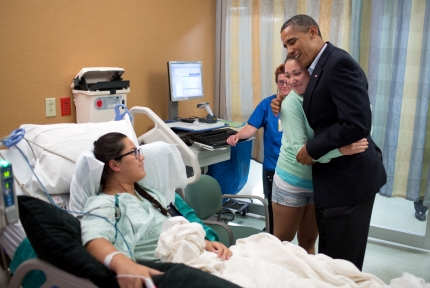
President Barack Obama hugs Stephanie Davies (July 22, 2012)

President Barack Obama hugs Stephanie Davies, who helped keep her friend, Allie Young, left, alive after she was shot during the movie theater shootings in Aurora, Colorado. The President visited patients and family members affected by the shootings at the University of Colorado Hospital July 22, 2012. (Official White House Photo by Pete Souza)

On Sunday, President Obama traveled to Aurora, Colorado to meet with the survivors of the movie theater shooting and offer solace to families of the victims. 

"I had a chance to visit with each family, and most of the conversation was filled with memory," the President said. "I confessed to them that words are always inadequate in these kinds of situations, but that my main task was to serve as a representative of the entire country and let them know that we are thinking about them at this moment and will continue to think about them each and every day."

During his visit to University of Colorado Hospital, the President had a chance to meet Allie Young and Stephanie Davies, and speaking to reporters, he described their story.

During the film, Allie and Stephanie were seated near an aisle and when the gunman began his attack by tossing a canister of gas into the crowd, Allie, just 19 years old, stood up to warn those around her. She was hit in the neck by a bullet, which punctured a vein.

Stephanie, the President said, dropped to the ground beside her friend, applied pressure to Allie's wound to slow the bleeding, then dialed 911 with her cell phone. Even after Allie told Stephanie to run, the 21 year old stayed by her friend -- and when first responders arrived, Stephanie helped to carry Allie to a waiting ambulance.

Doctors expect Allie to make a full recovery.

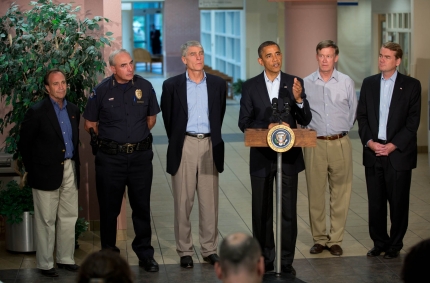
President Barack Obama makes a statement to the press at University of Colorado Hospital in Aurora (July 22, 2012)

President Barack Obama makes a statement to the press at University of Colorado Hospital in Aurora, Colo., July, 22, 2012, following his meetings with families of victims killed in last Thursday's shootings. Standing with the President, from left, are: Rep. Ed Perlmutter, D-Colo., Police Chief Dan Oates, Sen. Mark Udall, D-Colo., Colorado Gov. John Hickenlooper, Sen. Michael Bennet, D-Colo. (Official White House Photo by Lawrence Jackson)

"I don't know how many people at any age would have the presence of mind that Stephanie did, or the courage that Allie showed," President Obama said.  "And so, as tragic as the circumstances of what we've seen today are, as heartbreaking as it is for the families, it's worth us spending most of our time reflecting on young Americans like Allie and Stephanie, because they represent what's best in us, and they assure us that out of this darkness a brighter day is going to come."

Read his full remarks here. Watch the President speak in after visiting Aurora here.

Related Topics: Additional Issues, Colorado

The White House

Office of the Press Secretary

Remarks by the President After Hospital Visit

University of Colorado Hospital
Aurora, Colorado

6:40 P.M. MDT

     THE PRESIDENT:  Good afternoon, everybody.  I want to begin by just thanking all the state, local, and federal officials who have responded magnificently to this tragedy. 

     Governor Hickenlooper, who has already been dealing with a range of natural disasters here in the state, has been an extraordinary example of strength.  The Mayor, who has only been on the job seven months, and obviously has responded with great strength and leadership.  The Police Chief, who -- we had an opportunity to speak over the phone -- Chief Oates has been dealing with as difficult a set of circumstances as any law enforcement officer deals with, and he and his officers have done everything right, by the book, with great courage and great determination.  And so we are very proud of them.  And I think I speak for the entire congressional delegation who is here as well.

     Scripture says that "He will wipe away every tear from their eyes, and death shall be no more.  Neither shall there be mourning, nor crying, nor pain anymore, for the former things have passed away."  And when you have an opportunity to visit with families who have lost their loved ones -- as I described to them, I come to them not so much as President as I do as a father and as a husband.  And I think that the reason stories like this have such an impact on us is because we can all understand what it would be to have somebody that we love taken from us in this fashion -- what it would be like and how it would impact us.

     I had a chance to visit with each family, and most of the conversation was filled with memory.  It was an opportunity for families to describe how wonderful their brother, or their son, or daughter was, and the lives that they have touched, and the dreams that they held for the future.  I confessed to them that words are always inadequate in these kinds of situations, but that my main task was to serve as a representative of the entire country and let them know that we are thinking about them at this moment and will continue to think about them each and every day, and that the awareness that not only all of America but much of the world is thinking about them might serve as some comfort.

     I also tried to assure them that although the perpetrator of this evil act has received a lot of attention over the last couple of days, that attention will fade away.  And in the end, after he has felt the full force of our justice system, what will be remembered are the good people who were impacted by this tragedy. 

     And I also had a chance to give folks some hugs and to shed some tears, but also to share some laughs as they remembered the wonderful lives that these men and women represented.

     I also had a chance, fortunately, to visit some folks who are going to be okay, thanks to the extraordinary efforts of the staff at this hospital.  And I just want to thank everybody who's worked tirelessly here to deal with this tragedy. 

     Some of the stories are remarkable.  You see young people who've come in and just two days ago, or 36 hours ago, or even 24 hours ago, it wasn’t certain whether they'd make it.  And now suddenly, their eyes are open, they're alert and they're talking. And it reminds you that even in the darkest of days, life continues, and people are strong and people bounce back and people are resilient.  And particularly, given the fact that so many of the victims were young, it is a great blessing to see how rapidly they're able to recover from some pretty devastating injuries.

     There's one particular story I want to tell because this was the last visit that I had and I think it's representative of everything that I saw and heard today.  I had a chance, just now, about five minutes ago, to visit with Allie Young -- Allie is 19 years old -- and I also had a chance to visit with Allie's best friend, Stephanie Davies, who's 21.  Stephanie was actually downstairs with Allie as well as Allie's parents when I walked into the room.

     And I don't think this story has been heard -- at least I hadn’t read it yet -- but I wanted to share it with you.  When the gunman initially came in and threw the canisters, he threw them only a few feet away from Allie and Stephanie, who were sitting there watching the film.  Allie stood up, seeing that she might need to do something or at least warn the other people who were there.  And she was immediately shot.  And she was shot in the neck, and it punctured a vein, and immediately she started spurting blood.

     And apparently, as she dropped down on the floor, Stephanie -- 21 years old -- had the presence of mind to drop down on the ground with her, pull her out of the aisle, place her fingers over where she -- where Allie had been wounded, and applied pressure the entire time while the gunman was still shooting.  Allie told Stephanie she needed to run.  Stephanie refused to go -- instead, actually, with her other hand, called 911 on her cell phone.

     Once the SWAT team came in, they were still trying to clear the theater.  Stephanie then, with the help of several others, carries Allie across two parking lots to where the ambulance is waiting.  And because of Stephanie's timely actions, I just had a conversation with Allie downstairs, and she is going to be fine.

     I don't know how many people at any age would have the presence of mind that Stephanie did, or the courage that Allie showed.  And so, as tragic as the circumstances of what we've seen today are, as heartbreaking as it is for the families, it's worth us spending most of our time reflecting on young Americans like Allie and Stephanie, because they represent what's best in us, and they assure us that out of this darkness a brighter day is going to come.

     To the entire community of Aurora, the country is thinking of you.  I know that there's going to be a vigil and an opportunity for everybody to come together.  And I hope that all those who are in attendance understand that the entire country will be there in prayer and reflection today.

     So thank you.  God bless you.  God bless all who helped to respond to this tragedy.  And I hope that over the next several days, next several weeks, and next several months, we all reflect on how we can do something about some of the senseless violence that ends up marring this country, but also reflect on all the wonderful people who make this the greatest country on Earth.

     Thank you very much, everybody. 


                              END             6:50 P.M. CDT  

President Obama Speaks After Visiting Aurora, Colorado Hospital

July 22, 2012 | 9:56 | Public Domain

President Obama speaks to the press after visiting with survivors and families of victims of the movie theater shooting in Aurora, Colorado.

Download mp4 (351MB) | mp3 (23MB)

Read the Transcript

Remarks by the President After Hospital Visit

University of Colorado Hospital
Aurora, Colorado

6:40 P.M. MDT

     THE PRESIDENT:  Good afternoon, everybody.  I want to begin by just thanking all the state, local, and federal officials who have responded magnificently to this tragedy. 

     Governor Hickenlooper, who has already been dealing with a range of natural disasters here in the state, has been an extraordinary example of strength.  The Mayor, who has only been on the job seven months, and obviously has responded with great strength and leadership.  The Police Chief, who -- we had an opportunity to speak over the phone -- Chief Oates has been dealing with as difficult a set of circumstances as any law enforcement officer deals with, and he and his officers have done everything right, by the book, with great courage and great determination.  And so we are very proud of them.  And I think I speak for the entire congressional delegation who is here as well.

     Scripture says that "He will wipe away every tear from their eyes, and death shall be no more.  Neither shall there be mourning, nor crying, nor pain anymore, for the former things have passed away."  And when you have an opportunity to visit with families who have lost their loved ones -- as I described to them, I come to them not so much as President as I do as a father and as a husband.  And I think that the reason stories like this have such an impact on us is because we can all understand what it would be to have somebody that we love taken from us in this fashion -- what it would be like and how it would impact us.

     I had a chance to visit with each family, and most of the conversation was filled with memory.  It was an opportunity for families to describe how wonderful their brother, or their son, or daughter was, and the lives that they have touched, and the dreams that they held for the future.  I confessed to them that words are always inadequate in these kinds of situations, but that my main task was to serve as a representative of the entire country and let them know that we are thinking about them at this moment and will continue to think about them each and every day, and that the awareness that not only all of America but much of the world is thinking about them might serve as some comfort.

     I also tried to assure them that although the perpetrator of this evil act has received a lot of attention over the last couple of days, that attention will fade away.  And in the end, after he has felt the full force of our justice system, what will be remembered are the good people who were impacted by this tragedy. 

     And I also had a chance to give folks some hugs and to shed some tears, but also to share some laughs as they remembered the wonderful lives that these men and women represented.

     I also had a chance, fortunately, to visit some folks who are going to be okay, thanks to the extraordinary efforts of the staff at this hospital.  And I just want to thank everybody who's worked tirelessly here to deal with this tragedy. 

     Some of the stories are remarkable.  You see young people who've come in and just two days ago, or 36 hours ago, or even 24 hours ago, it wasn’t certain whether they'd make it.  And now suddenly, their eyes are open, they're alert and they're talking. And it reminds you that even in the darkest of days, life continues, and people are strong and people bounce back and people are resilient.  And particularly, given the fact that so many of the victims were young, it is a great blessing to see how rapidly they're able to recover from some pretty devastating injuries.

     There's one particular story I want to tell because this was the last visit that I had and I think it's representative of everything that I saw and heard today.  I had a chance, just now, about five minutes ago, to visit with Allie Young -- Allie is 19 years old -- and I also had a chance to visit with Allie's best friend, Stephanie Davies, who's 21.  Stephanie was actually downstairs with Allie as well as Allie's parents when I walked into the room.

     And I don't think this story has been heard -- at least I hadn’t read it yet -- but I wanted to share it with you.  When the gunman initially came in and threw the canisters, he threw them only a few feet away from Allie and Stephanie, who were sitting there watching the film.  Allie stood up, seeing that she might need to do something or at least warn the other people who were there.  And she was immediately shot.  And she was shot in the neck, and it punctured a vein, and immediately she started spurting blood.

     And apparently, as she dropped down on the floor, Stephanie -- 21 years old -- had the presence of mind to drop down on the ground with her, pull her out of the aisle, place her fingers over where she -- where Allie had been wounded, and applied pressure the entire time while the gunman was still shooting.  Allie told Stephanie she needed to run.  Stephanie refused to go -- instead, actually, with her other hand, called 911 on her cell phone.

     Once the SWAT team came in, they were still trying to clear the theater.  Stephanie then, with the help of several others, carries Allie across two parking lots to where the ambulance is waiting.  And because of Stephanie's timely actions, I just had a conversation with Allie downstairs, and she is going to be fine.

     I don't know how many people at any age would have the presence of mind that Stephanie did, or the courage that Allie showed.  And so, as tragic as the circumstances of what we've seen today are, as heartbreaking as it is for the families, it's worth us spending most of our time reflecting on young Americans like Allie and Stephanie, because they represent what's best in us, and they assure us that out of this darkness a brighter day is going to come.

     To the entire community of Aurora, the country is thinking of you.  I know that there's going to be a vigil and an opportunity for everybody to come together.  And I hope that all those who are in attendance understand that the entire country will be there in prayer and reflection today.

     So thank you.  God bless you.  God bless all who helped to respond to this tragedy.  And I hope that over the next several days, next several weeks, and next several months, we all reflect on how we can do something about some of the senseless violence that ends up marring this country, but also reflect on all the wonderful people who make this the greatest country on Earth.

     Thank you very much, everybody. 


                              END             6:50 P.M. CDT  

Close Transcript

The White House

Office of the Press Secretary

Press Gaggle by Press Secretary Jay Carney en Route Aurora, CO, 7/22/12

Aboard Air Force One
En Route Aurora, Colorado

3:13 P.M. EDT

MR. CARNEY:  Thank you for joining us today.  As you know, we're flying to Colorado, to Aurora, where the President will visit some of the families of the victims.  We'll have more detail on his schedule once we're on the ground.  I'm not going to be able to give you a great deal of detail during this gaggle on the record. 

I also wanted to mention to you that President Obama met this morning with his senior national security team to get an update on the situation in Syria.  The United States continues to believe that there must be a political transition in Syria in which Bashar al-Assad leaves power as soon as possible so that Syria can move forward toward a government that is responsible to the Syrian people's aspirations.  We will continue to work with our friends, allies, and the Syrian opposition on behalf of a political transition. 

And with that, we will take your questions.  Jen Psaki is here.  I don't know if you have anything to open with.

MS. PSAKI:  I don't have anything to add at this point.

Q    Jen, this is probably a question for you.  Has the President talked at all about how, if at all, he thinks the shooting might affect the tenor of the campaign going forward?  And does he plan to do anything to change sort of his own approach, the campaign's approach going forward?

MS. PSAKI:  Clearly, the tragic events of last Thursday have changed both the tone and the schedule of events.  As you know, we pulled down our event in Portland that was scheduled to happen on Tuesday -- which is a grassroots event -- for two reasons.  One is, of course, the nature of the tragedy and the feeling, while there's not a playbook for this, that given the tone of grassroots events, it was the right step to take.  The second reason was that in order to come to Colorado -- which was a big priority for the President, to visit with the families, to do that as soon as it was possible and made sense on both sides -- we had to pull down an event in order to have the resources to do that.

So his actions are -- and our actions are clearly conveying how this has impacted him and how this has impacted our approach. Just like everybody, we're taking this day by day.  It's too early to say on the specific policy issues what that will mean.  But again, we're taking it day by day.

Q    The ads are still off the air in Colorado?

MS. PSAKI:  Yes, they are, through at least tomorrow.  And I'll get you an update before the end of the flight here on whether there's any update on that. 

Q    When we return, Jen, do you know if you're going to change the makeup of the ads or are you going to less contrast ads, or do you know yet?

MS. PSAKI:  I don't have any update on that.

Q    What does he do tomorrow?  He's going to the VFW in Reno and is sort of like beginning the campaign again.  Do things start again tomorrow?  Do we go back on the attack, or is there still a timeout?

MR. CARNEY:  Well, I think you know he is speaking at the VFW tomorrow in Reno.  That's an official event where he will discuss his administration's work to secure our nation, fight terrorism, renew American leadership in the world, better serve our troops and military families and honor our veterans. 

Then he does have a schedule back on the West Coast that's campaign related.  Jen can address that.

MS. PSAKI:  I can go over the events just so you know.  Tomorrow he has, after the VFW speech, he'll have a roundtable in Oakland.  We expect about 25 people.  Tickets are $35,800 per person.  The contributions go to the Obama Victory Fund.  Then he's going to hold a dinner at a private residence.  We expect about 60 people.  The tickets are $35,800 again.  And then he'll end the day with a reception in Oakland at Fox Theater.  So that's the full schedule for the rest of the day.

Q    Three open that day then?

MS. PSAKI:  Three tomorrow, correct.

Q    On Tuesday, is he doing campaign events of any nature?

MS. PSAKI:  Yes, he has a schedule of events on Tuesday.  I indicated to you the change in the Portland grassroots event, but the rest of his schedule will move forward on Tuesday.

Q    Jay, you mentioned terrorism as one of the topics the President is going to talk about at the VFW.  The Governor of Colorado called the shooting an act of terror, called the shooter a terrorist, this morning on some of the Sunday shows.  Does the administration agree that this was an act of terror?

MR. CARNEY:  Well, I think broadly defined, I think it is a terrifying thing to imagine and a terrifying moment for anyone in that theater to have experienced what this individual perpetrated.  What we have said, and continues to be the case, is that we at the federal level, and I believe this is true at the local level, do not see any connection between the assault and terrorist organizations or terrorist -- any nexus with terrorist organizations or terrorism. 

As to motive, we obviously will continue to work with local law enforcement officials.  It's their investigation, but the FBI is providing assistance, and of course, the President has made clear that he wants all federal assistance available as needed.  So I don't think we're in a position yet to assess motive behind these actions.

Q    Jay, do the political reality just preclude any sort of policy response in terms of access to firearms?

MR. CARNEY:  I'm sorry, say that again.

Q    Does the gun lobby just really preclude any sort of policy response in terms of access to firearms?

MR. CARNEY:  I would say that the President's views on this are as he has stated and as he spelled out in the op/ed that was published in an Arizona newspaper, which is that he believes we need to take steps that protect Second Amendment rights of the American people but that ensure that we are not allowing weapons into the hands of individuals who should not, by existing law, obtain those weapons.  And there are a number of steps that have been taken and a number of others that can be taken to accomplish that goal.

I don't have any -- the Department of Justice can provide more details in terms of some of the steps that we've taken involving making higher quantity and quality of information available in background checks, and other measures they've taken which I know they can provide to you, working with law enforcement agencies.  But the President's view is that we can take steps to keep guns out of the hands of people who should not have them under existing law.  And that's his focus right now.

Q    In terms of like assault weapons or something like that, there's no renewed push for a renewed assault weapons ban?

MR. CARNEY:  Well, as you know, there has been opposition to that since it expired within Congress, and I think -- I wouldn’t argue with your assessment about that.  So the President is focused on doing the things that we can do that protect Second Amendment rights, which he thinks is important, but also to make it harder for individuals who should not, under existing law, have weapons to obtain them.

Q    Does the President believe that this issue of gun control should now have sort of a larger role in the campaign?  It hasn’t really been talked about much before this. 

MS. PSAKI:  I think this stage where this is so fresh and new for so many people, including the people in Colorado, who are still mourning the loss of their loved ones, will be for a long time, many people are still recovering, we're still learning what exactly happened here and more details -- that's where our focus is right now.  And so it's really too early to say how this will play.  And again, we're just taking it day by day.  That's what our focus is today.

Q    On foreign policy, on Syria, has the President had any information about the security around chemical weapons holdings that the Assad regime have?  Does he have concerns over how secure they are -- to make sure they are -- stay secure?

MR. CARNEY:  I can answer that.  First of all, we've repeatedly made clear that the Syrian government has a responsibility to safeguard and stockpile the chemical weapons and that the international community will hold accountable any Syrian officials who fail to meet that obligation. 

The U.S. is closely monitoring Syria's proliferation-sensitive materials, which include chemical weapons, and facilities, and we believe that Syria's chemical weapons remain under Syrian government control.  But given the escalation in violence in Syria and the regime's increasing attacks on its own people, we remain very concerned about these weapons.  And in addition to monitoring the stockpiles, we are actively consulting with Syria's neighbors and our friends in the international community to underscore our common concern about the security of these weapons and the Syrian government's obligation to secure them. 

We've long said the mere presence of chemical weapons in the region undermines stability, and we continue to call on the Syrian government, as we have in the past, to give up those weapons and to join the Chemical Weapons Convention.

Q    So, Jay, what do you do if you lose confidence in the Syrian government's ability to control security around those weapons?

MR. CARNEY:  As I said, we believe that those stockpiles remain under the control of the Syrian government.  We are concerned, however, as I just expressed, and that's why we're consulting with our partners in the region as well as broader allies within the international community about this issue because it is a matter of concern.  But I don't want to speculate about what action the international community or the United States might take if the disposition of those weapons were to change.

Q    Jay, can you define what "hold accountable" means?

MR. CARNEY:  I think that there are a variety of ways that a government or individuals can be held accountable for this kind of -- the kind of behavior that would result in the deliberate release of chemical weapons or use of chemical weapons.  I wouldn’t want to speculate about what particular measures would be taken.

Q    Jay, back to Colorado -- we just saw the wildfires over the last couple of weeks.  Does the President think about all the extreme weather that we've seen and if there's any relation to climate change?

MR. CARNEY:  I haven’t had that discussion with him.  I think that he has on a number of occasions visited states that have been hard hit by extreme weather, most recently Colorado because of the wildfires.  Last year I remember being with him both in Joplin, Missouri, and Tuscaloosa, Alabama, cities that were devastated by uncommonly powerful tornados. 

His concern is that we, as a people, and that the government specifically, take every action it can to help those who are affected by these kinds of events, and to, as he did when he returned to Joplin, make clear that the American people and the people’s government does not forget about the terrible impact these storms have had, even after cameras have moved on to another story -- because as we saw in Joplin, the impact is long-lasting.  As we also saw in Joplin, the remarkable capacity of the American people to rebound from these events is inspiring, both to the President and I think to everyone across the country.

Q    Jay, just on a different topic.  Does the President think that Penn State made the right decision this morning to remove the statue of Joe Paterno from outside the stadium?

MR. CARNEY:  I have not had that conversation with him.  I know he feels very strongly about the events and about the failure of the institution in what should always be a primary responsibility, which is protecting children.  But I haven’t discussed with him the statue.  I have a feeling I know what the answer is, but I want to check with him before I bring it to you.

Q    Jay, why are we going to the Bay Area tonight?  Why is the President going to the Bay Area tonight?  Is that just, like, logistics?  Just hard to --

MR. CARNEY:  It just has to do with -- yes, we have, as Jen was talking about, assets and resources.  And since we were going out West to begin with, it was -- this was the logistically feasible thing to do, to continue on from Colorado, go to San Francisco, and then begin our schedule pretty much as it had been planned prior to this.

Q    And staying in Colorado would have been -- you’ve taken resources away or something?

MR. PSAKI:  That’s a tricky question, because obviously there are a lot of factors that go into resources and where they are.  We’re staying in the same hotel two nights in a row, so as you can imagine, that makes it a little easier.  But I don’t want to speak to kind of how assets and resources are divided.

It’s really because the President wanted to make it easier for the press that you guys can leave your stuff in your room.  (Laughter.)  He thought, they’ll have a nice glass of wine tonight, give them a break.

MR. CARNEY:  This looks like a crowd that loves the cuisine of San Francisco -- it must be said.  (Laughter.)  I know the President is, generally in situations like this and specifically in this case, always mindful of not taking resources that are needed elsewhere.  And I don’t know whether that factored into the decision.  I think it has more to do with what Jen said, which is the ability to stay in the same hotel twice creates -- makes it a little logistically easier.

Q    For Jay or Jen, I know you said we would get more detail on the ground when we get there.  Can you say that we will hear from him?

MR. CARNEY:  Again, I think I will -- I’ll have to wait until we hit the ground to provide more details about that.  I think what we have said is all I can say at this point, which is that he will meet with families of victims as well as local officials.  And beyond that, we’ll have to wait until we’re on the ground.

Q    Is he meeting with them individually or as a group?

MR. CARNEY:  Again, I want to wait until we get there.  I’ll wait until we get on the ground.

Q    Where are we going to meet with the families?

MR. CARNEY:  That’s part of the specifics that I will provide when we’re actually on the ground.

Q    In Portland, is there any Portland fundraisers on Tuesday?

MS. PSAKI:  Yes, there are.  I can get you the details on the specifics of the Tuesday schedule.

Q    But there’s definitely one fewer than what they had announced?

MR. PSAKI:  There’s not -- well, the event that we -- the event we pulled down was a larger grassroots event, which there’s a different energy and enthusiasm to that type of an event.  So as -- for the two reasons I mentioned -- one was we felt it’s an appropriate step given the tragedy in Colorado.  And second was, in order to come to Colorado we needed the resources to be able to do that.

Q    Thanks, guys.

MR. CARNEY:  Thank you all.

END
3:29 P.M. EDT

President Obama Welcomes 2012 International AIDS Conference Attendees

Watch the AIDS 2012-Turning the Tide video here.

This week, the 19th International AIDS Conference comes to the U.S. for the first time since 1990- thanks to bipartisan action by Presidents Obama and George W. Bush and the Congress to lift the ban on people living with HIV entering the United States. Thirty thousand participants are expected to attend the world's largest HIV/AIDS conference.

The Obama Administration is taking action to turn the tide on HIV/AIDS by strengthening the scientific investments that have revolutionized prevention and care for people living with HIV. Under President Obama’s leadership, the Administration has increased overall funding to combat HIV/AIDS to record levels. We have launched the first comprehensive National HIV/AIDS Strategy for the United States to prevent and treat HIV in America. Globally, the Obama Administration has committed to treating 6 million people by the end of 2013 and is increasing the impact and sustainability of our investments. Take a minute to watch President Obama's welcome video for conference attendees. 

Related Topics: AIDS Policy, Health Care