The White House

Office of the Press Secretary

Statement by the Press Secretary on the Bring Jobs Home Act

The President believes we must attract and keep good jobs in the U.S. by rewarding companies who bring jobs back to America.  That’s why he called on Congress to pass legislation that gives companies a tax credit for moving operations back to the United States.  It was paid for by eliminating deductions for expenses associated with moving operations overseas.

Unfortunately, Republicans in Congress blocked this proposal from moving forward. Rather than encouraging companies to bring jobs back to our shores, they chose to play politics and block measures that will create jobs and strengthen the middle class. We will continue to push Congress to act on proposals like this one and the other remaining portions of the President's American Jobs Act that independent economists say would create a million new American Jobs. It's time for Republicans in Congress to stop obstructing these commonsense proposals and act to create good jobs here at home.

The White House

Office of the Press Secretary

Fact Sheet: Presidential Memorandum Supporting Veterans’ Employment and Reemployment Across the Federal Workforce

President Obama has made helping veterans find civilian employment and reintegrate into our nation’s workforce and economy a top priority.  In November 2011, the President signed into law the Returning Heroes Tax Credit, which provides businesses that hire unemployed veterans with a credit of up to $5,600 per veteran, and the Wounded Warriors Tax Credit, which offers businesses that hire veterans with service-connected disabilities a credit of up to $9,600 per veteran. The First Lady and Dr. Biden’s Joining Forces Initiative has helped 90,000 veterans and military spouses find jobs. And we have developed online tools to help connect veterans to employers

The federal government has led efforts to recruit and retain individuals who have served our country in the armed forces. In Executive Order 13518, the President established the Veterans Employment Initiative to bolster recruitment and retention of veterans in the federal workforce.  This initiative has been extraordinarily successful, ushering in 200,000 new veteran hires and at least 25,000 new Reservists to the federal workforce.  Veterans comprise more than one-fourth (27.3% in FY2011) of the federal workforce, the highest share in 15 years.  Our service members, their families, and our country all benefit from veterans’ talents, experience, and dedication.

Federal laws, including the Uniformed Services Employment and Reemployment Rights Act (USERRA) provide critical protections to those who have served our country, including veterans and Guard and Reserve members. To ensure that returning service members have the fair opportunity guaranteed under the law, the President and his Administration have articulated a zero-tolerance policy for USERRA violations across the federal government.  Today, in order to ensure that directive is carried out, President Obama issued a Memorandum that calls on agencies across the entire federal government to intensify their efforts to ensure fair treatment and equal opportunity for service members in federal employment. Specifically, the Memorandum calls on all agencies in the federal government to: 

• Identify Best Practices: The Presidential Memorandum establishes a working group of agencies that hire the greatest number of veterans and that have expertise in service members’ employment rights to identify personnel best practices.  Within 180 days of the issuance of the Presidential Memorandum, the Office of Personnel Management will then issue guidance to agencies, enumerating specific steps and providing tools to improve their compliance with employment and reemployment protections for veterans and servicemembers, including improved training, information and education.
• Improve Information about those Serving in the Federal Workforce:  A critical part of better serving servicemembers within the federal government is accurate data.  In an era where many returning individuals have faced repeated deployments, it is critical that we have detailed information about Guard and Reserve members and their experiences.  Under this Memorandum, the federal government will identify ways to improve our data collection, with a particular focus on members of the Guard and Reserve. 
• Better Information and Services for those who Serve: Continued outreach and education is critical to serving veterans and members of the Guard and Reserve effectively. Agencies will ensure human resource professionals, managers, and other senior executives also have the appropriate training strategies and tools to support the employment, development and reemployment of service members in their workforce and ensure compliance with the law. Agencies will also continue to expand outreach to service members’ organizations to ensure that individuals are aware of their protections under the law, and connect service members with resources to help them prepare for military leave from federal employment and to help them integrate quickly into their agencies when they return. 

Building on Progress

• Creating two new veterans’ tax credits: In November 2011, the President signed into law two new tax credits for hiring veterans, both of which were included as part of the American Jobs Act. The Returning Heroes Tax Credit provides an incentive of up to $5,600 for firms to hire unemployed veterans and the Wounded Warrior Tax Credit doubled the existing tax credit for long-term unemployed veterans with service-connected disabilities to $9,600.

• Challenging the private sector to hire or train 100,000 veterans and their spouses by 2013: Since the President issued his challenge to the private sector in August 2011, more than 90,000 veterans and their spouses have already been hired and 2,100 companies have committed to hire or train 175,000 veterans and their spouses by the end of 2013 through the leadership of the First Lady Michelle Obama, Dr. Jill Biden and their Joining Forces Initiative.

• Increasing access to intensive reemployment services: Post-9/11 veterans are now able to download the Veteran Gold Card, which entitles them to enhanced reemployment services including six months of personalized case management, assessments and counseling at their local one-stop career center.

• Developing online tools to boost veteran employment: The Administration launched the Veterans Jobs Bank, an easy-to-use tool to help veterans find job postings from companies looking to hire them. It already searches over one million job postings and is growing. Additionally, the Department of Labor launched My Next Move for Veterans, a new online resource that allows veterans to enter their military occupation code and discover civilian occupations for which they are well qualified.

• Increasing hiring of veterans in healthcare-related fields: The President challenged Community Health Centers to hire 8,000 veterans – approximately one veteran per health center site – over the next three years and the Health Resources and Services Administration pledged to open up career paths beyond nursing and expand opportunities for veterans to become physician assistants.

• Streamlining civilian credentialing for service members and veterans: Last month, the Department of Defense established, under the President’s direction, a Military Credentialing and Licensing Task Force, which will identify opportunities where service members can earn civilian occupational credentials and licenses without the need for additional training. As the first action of the Task Force, all branches of the military worked with manufacturing credentialing agencies to enable up to 126,000 service members to gain industry-recognized, nationally-portable certifications for high-demand manufacturing jobs.

The White House

Office of the Press Secretary

Remarks by the President at Campaign Event -- Jacksonville, FL

Prime Osborn Convention Center
Jacksonville, Florida

2:12 P.M. EDT

THE PRESIDENT:  Hello, Florida!  (Applause.)  Oh, it is good to be back in Jacksonville, Florida!  (Applause.) 

A couple people I just want to say thank you to -- first of all, please give Don Herrin a big round of applause for the introduction.  (Applause.)  One of our outstanding members of Congress, your own Corrine Brown is here.  (Applause.)  Another great member of the Florida delegation, Ted Deutch is here.  (Applause.) And Congresswoman and Chair of the Democratic National Committee, Debbie Wasserman-Schultz is in the house.  (Applause.)

And all of you are here.  And I'm happy about that.  (Applause.)

I'm sorry we were a little delayed -- had some weather issues.  Even Air Force One has to fly around the thunder.  (Laughter.)  But we are so glad to be back.  And I want to thank all of you for being here --

AUDIENCE MEMBER:  I love you!

THE PRESIDENT:  I love you back.  (Applause.)  That's why I came.

Now, Jacksonville, this is my last political campaign.

AUDIENCE:  Awww --

THE PRESIDENT:  It's true.  I'm term limited.  (Laughter.)  And since it's my last campaign, it got me thinking about my first political campaigns, early on, back when I had no gray hair.  (Laughter.)  And when I was running for the state senate, or I was running for the United States Senate in Illinois -- Illinois is a big state like Florida, and we'd have to travel across the state, and I didn’t have Air Force One back then.  (Laughter.)  No Marine One.  So I didn’t even have GPS.  (Laughter.)  So I'd be driving -- maybe I'd have one staff person in the car.  And since we didn’t have MapQuest, I had to have a map, and I'd fold it and then I'd try to unfold it and fold it back the way it was, and I'd get it all messed up.  And I'd get lost, and then once I got to an event I'd have to find parking, and sometimes I couldn't find a parking spot, or I'd get rained on. 

But I have such fond memories of those early campaigns because, no matter where I went, no matter what community -- inner-city, rural town, meeting with black folks, white folks, Latinos, Asians, Native Americans -- didn’t matter what background people came from, no matter how much they looked different on the surface, there was a common thread to all the stories that I heard as I traveled around the state. 

I'd meet an elderly couple, and they'd remind me of my grandparents.  I'd think about my grandfather who fought in Patton's Army in World War II, my grandmother working on a bomber assembly line while he was gone.  And when he came back he was rewarded with a chance to go to college on the GI Bill.  They were able to buy their first home with an FHA loan.  And I'd think about the journey that they had traveled and everything that that Greatest Generation had done to build America.

Or I'd meet a middle-class couple and I'd think about Michelle's parents -- especially her dad, who had multiple sclerosis, so by the time I met him he could barely walk, had to use two canes, had to wake up an hour earlier than everybody else to get to work because that's how long it took to get him dressed, but would not miss a day of work.  I'd think about Michelle's mom, who ended up working as a secretary for most of her life, and how, despite the fact that they never had a lot, they were able to give Michelle and Michelle's brother the best education possible, and how remarkable that was -- this country that we live in.

And then I'd meet a single mom and I'd think about my own mother, who raised my sister and me, with the help of my grandparents, because my dad left when I was a baby.  And my mom didn’t have a lot of money, but she worked hard and she went to school at the same time, so that she could give her two children the best education possible and they could travel on a path that she couldn't have even imagined. 

So the people I met in that first campaign and every campaign since, they had all kinds of different stories, all kinds of different backgrounds; they were young and old and every race and every faith -- gay, straight, Democrat, Republican, independent -- but all of them shared the belief in that core American experience, that basic idea, that core bargain that makes us the shining example for the world -- the idea that no matter where you come from, no matter who you are, no matter what you look like, America is a place where you can make it if you try.  (Applause.)

As Americans, we don't expect handouts, but we expect hard work to pay off.  (Applause.)  We understand there will be setbacks, but we also know that responsibility should be rewarded.  We believe that if you put enough effort into it, enough elbow grease into it, you should be able to find a job that pays the bills -- (applause) -- you should be able the have a home that you call your own, health care that you can count on if you get sick.  (Applause.)  You should be able to retire with dignity and respect.  You should be able to provide your children with an education that gives them an even better shot than you had.  That's what we believe.  (Applause.)

Jacksonville, we are here today because we recognize that this basic bargain, this essence of who we are as a people, this simple American Dream is at risk like never before.  For more than a decade, it had been slipping away from too many hardworking people.  Jobs and factories were shipped overseas.  Folks at the top were doing better than ever before, but middle-class families saw their paychecks get smaller even as their bills got bigger.  In Washington, the trillions that were spent on two wars and two tax cuts took us from record surpluses to record deficits.  And on Wall Street, a culture of "anything goes" led to the worst economic crisis and financial crisis since the Great Depression.

Now, ever since I first ran for this office, I’ve said it’s going to take more than one year or one term or maybe even one President to restore the dream that built this country.  (Applause.)  And the financial crisis and economic crisis made our job that much harder.  But I don't get discouraged -- (applause) -- because the cynics who say that our best days are behind us, they haven’t witnessed the everyday courage and the essential character of the American people.  (Applause.)

They haven’t met the small business owners in Minnesota who chose to sacrifice some of their own perks, some of their own pay, to avoid laying off a single worker during that recession.  They haven’t been to the auto companies in Michigan and Ohio that were never supposed to build another car again, but now they can't build them fast enough.  (Applause.)

They haven’t talked to the 55-year-old factory worker from North Carolina who decided that when the furniture industry left town she’d get her degree in biotechnology from the local community college -- not just because she hopes it gets her a job, but because she hopes it tells her children, you don’t give up on your dreams.  (Applause.)  That’s the character I’ve seen in the American people.  That’s who we are. 

There are no easy fixes, no quick solutions to the challenges we face, but there is no doubt in my mind that we have the capacity to meet them and we will meet them.  (Applause.)  We’ve got the best workers in the world and the best entrepreneurs in the world and the best scientists in the world and the best researchers and the best colleges and the best universities.  (Applause.)  We’re a young nation with the greatest diversity and talent and ingenuity from every corner of the globe.  And Florida knows something about that.  No matter what the naysayers tell us, there is not a country on Earth that would not happily trade places with the United States of America. (Applause.)

So the problem -- what’s standing in our way is not technical solutions to the problems of housing or education or dealing with the debt.  We know how to deal with it.  What’s standing in our way is our politics.

AUDIENCE:  Yes!

THE PRESIDENT:  It’s what’s going on in Washington.  It’s the notion that compromise is a bad word, the notion that the only path forward is going backwards to the same top-down economics that got us into this mess in the first place.

AUDIENCE:  Yes!

THE PRESIDENT:  Our opponent’s entire plan -- the same plan of his allies in Congress -- is to cut more taxes for the wealthy, cut more regulations for banks and insurance companies, cut more investments in things like education and research.

AUDIENCE:  Booo --

THE PRESIDENT:  -- all with the hope that somehow that will create jobs and prosperity everywhere.  That’s what Mitt Romney believes.  That’s what folks in his party in Washington believe. But you know what, Florida, that’s not what you and I believe.

AUDIENCE:  No!

THE PRESIDENT:  That’s not what most Americans believe, no matter what party you belong to -- because this country was not built on top-down economics.  This country was built from the middle class out.  It was built from the bottom up.  That’s how we became the most prosperous nation in the history of the world. (Applause.)  That’s the path you can choose for America in this election.  And that is why I am running for a second term as President of the United States of America.  (Applause.)

AUDIENCE:  Four more years!  Four more years!  Four more years!

THE PRESIDENT:  I am running because, like you, I believe you cannot reduce the deficit and deal with our debt without asking folks like me, without asking the wealthiest Americans, to give up the tax cuts they've been getting for the last decade.  (Applause.) 

Now, my opponent doesn’t just want to keep these tax cuts, he wants to cut those taxes by another $5 trillion, including a 25 percent tax cut for every millionaire in the country.

AUDIENCE:  Booo --

THE PRESIDENT:  Now, hold on, it gets better.  (Laughter.)  To pay for this, he plans to gut things like job training and financial aid for college, and potentially raise taxes on the middle class -- on you. 

AUDIENCE:  No!

THE PRESIDENT:  He plans to roll back health care reform, forcing more than 200,000 Floridians to pay more for their prescription drugs.  He plans to turn Medicare into a voucher program.

AUDIENCE:  No!

THE PRESIDENT:  So if that voucher isn't worth enough to buy the health insurance that’s on the market, you're out of luck.  You're on your own.  One independent nonpartisan study found that seniors would have to pay nearly $6,400 more for Medicare than they do today. 

AUDIENCE:  Booo --

THE PRESIDENT:  Now, Florida, that’s the wrong way to go.  It's wrong to ask seniors to pay more for Medicare just so millionaires and billionaires can pay less in taxes.  That’s not the way to reduce the deficit.  (Applause.)  We shouldn’t be squeezing more money out of seniors who are just barely getting by right now. 

My plan is to squeeze more money out of the health care system by eliminating waste, and going after abuse and fraud in Medicare.  (Applause.)  We can cut back government spending that we can't afford, but I will also ask anybody who is making over $250,000 a year to just go back to the rates they were paying under Bill Clinton -- because, by the way, that worked.  (Applause.)  Nearly 23 million new jobs were created, the largest budget surplus in our history.  And when we were doing it that way, where the burden was shared, actually, millionaires did really well. 

That’s the choice we have in this election.  That’s why I'm running for a second term as President.  (Applause.) 

AUDIENCE:  Four more years!  Four more years!  Four more years!

THE PRESIDENT:  There is such a contrast in approach, two fundamentally different visions that you’re going to have to choose from in this election. 

When the American auto industry was on the brink of collapse, more than 1 million jobs on the line, Governor Romney said let’s "let Detroit go bankrupt."

AUDIENCE:  No!

THE PRESIDENT:  I refused to turn my back on a great industry and on American workers.  I bet on American workers.  I bet on American manufacturing.  And three years later the American auto industry has come roaring back.  (Applause.)

So I want to make sure that the high-tech manufacturing jobs of tomorrow -- not just in the auto industry but in every industry -- that those advanced manufacturing jobs are taking root not in China, not in Germany, but in Jacksonville -- (applause) -- and in Cleveland and in Raleigh and in Richmond.

Governor Romney’s experience has been owning companies that were called "pioneers" in the business of outsourcing, wants to give tax breaks to companies that ship jobs overseas.  I want to give tax breaks to companies that are investing here in the United States -- (applause) -- rewarding companies that are investing here and hiring American workers, so we can sell products around the world stamped with three proud words:  Made in America.  (Applause.)  That's why I’m running.

I'm running because in 2008, I promised to end the war in Iraq -- and thanks to our outstanding men and women in uniform, we kept that promise.  (Applause.)  It’s time to do some nation-building here at home.  (Applause.)  America is safer and more respected because of the selflessness of our troops.  Not only did we end the war in Iraq, we've been able to go after al Qaeda and get bin Laden.  (Applause.)  We have set a timeline to end the war in Afghanistan.  And as long as I'm Commander-in-Chief, this country will care for our veterans and serve our veterans as well as they've served us.  (Applause.)  Nobody who fights for this country should have to fight for a job or a roof over their heads when they come home.  (Applause.) 

So my plan would take about half the money that we're no longer spending on war and use that to pay down the deficit -- use the other half to put people back to work rebuilding our roads, our bridges, our runways, our ports, wireless networks.  (Applause.) 

I want to create a Veterans Job Corps, so we can put our returning heroes back to work as cops and firefighters in communities that need them.  (Applause.)  That's the America we want to build.  That's the choice in this election.  And that's why I'm running for a second term as President of the United States.  (Applause.)  

AUDIENCE:  Four more years!  Four more years!  Four more years! 

THE PRESIDENT:  I'm running to make sure that America once again leads the world in educating our kids and training our workers.  (Applause.)  I want to help our schools hire and reward the best teachers, especially in math and science.  (Applause.) 
Let's give 2 million more Americans the chance to go to community colleges and learn the skills that local businesses are looking for right now.  (Applause.)  Let's work with colleges and universities to bring down the cost of tuition once and for all. (Applause.) 

In the 21st century, higher education isn't a luxury.  It's a necessity that every American should be able to afford.  (Applause.) 

On every measure, there's a difference in this election.  My opponent has a plan to help responsible homeowners by letting the housing market hit bottom.

AUDIENCE:  Booo --

THE PRESIDENT:  That isn't a solution, that's a problem.  We've already helped more than a million responsible homeowners refinance their mortgages.  And now I want to give everybody the change to refinance and save $3,000 a year.  That's a plan for housing.  That's the choice in this election.  (Applause.)

I'm running because I believe nobody in America should go broke just because they get sick.  (Applause.)  And because we passed the health care law, we are going to realize that goal.  The Supreme Court has spoken.  We are moving forward.  We are going to help people who are working hard to make sure that just because they have an illness in their family, they don't lose everything.  (Applause.) 

And, by the way, if you’ve already got health insurance, this just gives you the guarantee and security when you’re dealing with your insurance company that they won’t jerk you around because of the fine print.  (Applause.)  And it lets your young -- it lets young people stay on their parent’s plan until they’re 26 years old.  (Applause.)  And it helps our seniors reduce their prescription drug costs.  We’re not going to roll that back.  We’re not going to refight that fight for the next four years.  We need to move forwards, not backwards.  (Applause.)

Just like we’re not going to refight the issue of whether you can serve the country you love just -- depending on who you love.  We ended "don’t ask, don’t tell" -- it was the right thing to do.  We’re not going back and having that fight.  (Applause.) We need to move forward. 

We need to make sure that women have control over their own health care decisions.  (Applause.)  We’re not going backwards.  We’re moving forward.

All these issues connect.  Whether it’s bringing manufacturing and construction jobs back, or protecting your health care, or making sure our kids are getting the best education, making sure our veterans are getting the care that they have earned -- all these things make up a middle-class life. They’re all central to the idea that made this country great -- that promise that if you work hard, you can get ahead.  (Applause.)

It’s the same promise our parents and grandparents passed down to all of us, the promise we have to pass down to our kids and our grandkids -- the idea that we work hard, that everybody has got to take responsibility, that government can’t solve every problem and it certainly can’t solve problems if you don’t want to help yourself -- but we also know there are some things we do better together -- (applause) -- that we rise or fall as one nation and as one people. 

Over the course of the next four months, the other side will spend more money than we have ever seen in our lifetimes on ads that tell you the same thing you’ve been hearing for months.  They know their plan isn’t going to sell, so all they’ll keep doing is saying, the economy is not where it should be and it’s all Obama’s fault. 

AUDIENCE:  Booo -- 

THE PRESIDENT:  That’s basically their message.  Now, I guess that's a plan to win an election, but they can't hide the fact that it’s not a plan to create jobs.  (Applause.)  It’s not a plan to grow the economy.  They don't have a plan to revive the middle class.  Everything they're proposing we tried for a decade and it didn't work. 

So they don't have a plan, and I do.  (Applause.)  And, Florida, I’ve been outspent before, and I’ve been counted out before, but through every campaign, what has always given me hope is the American people.  (Applause.)  You have the ability to cut through all that nonsense.  What gives me hope is that you remember the stories of families just like mine, all the struggles of parents and great grandparents; and some folks coming here as immigrants, some brought here in chains; some working on the farm, some working in the mines or on the mills.  They didn’t know what to expect, but they understood that there was something different about this country.  They knew that this was a country where things might not be perfect, but working together, we could perfect our union; where people were free to pursue their own individual dreams, but still come together as neighbors, as friends, as one American family.  (Applause.) 

They knew that being middle class wasn’t about how much you had in your bank account -- it was about the security of knowing you could take care of your family, and give your kids the chance to pursue the life that they dream of, and the chance to give something back to this country that gave you so much.  (Applause.) 

And when we tap into that spirit, when we push aside all the talk and all the politics, and get down to that core of what it means to be American, all that money doesn’t matter.  All those negative ads don’t matter.  When you come together, you cannot be stopped.  (Applause.)  And so you can still make change happen, Florida.  You can still inspire each other, because you inspire me.  (Applause.) 

In 2008, I tried to only make promises that I could keep or work on keeping.  And I told you then that I was not a perfect man and I wouldn’t be a perfect President, but I also told you I'd always tell you what I thought, I'd always tell you where I stood, and, most of all, I would wake up every single day -- every single day and spend every waking hour thinking about you, fighting as hard as I knew how for you. 

Because I see myself in you.  (Applause.)  Your grandparents remind me of my grandparents.  When I see your kids, I think about my kids.  And so I have kept that promise, Florida.  I've been fighting for you, and I keep believing in you. 

And now I am asking for your vote -- not just for me, but for the country that we believe in, together.  (Applause.)  And if you still believe, and if you're willing to stand up with me  -- (applause) -- and knock on doors for me, and make phone calls for me, talk to your neighbors and talk to your friends, talk to your coworkers, talk to your family, we will win Florida and we will win this election.  (Applause.)  We'll finish what we started in 2008, and we will remind the world just why it is that the United States of America is the greatest nation on Earth.  (Applause.)

God bless you.  God bless the United States of America.  (Applause.)

END
2:43 P.M. EDT

The White House

Office of the Press Secretary

Presidential Memorandum -- Uniformed Services Employment and Reemployment Rights Act (USERRA)

MEMORANDUM FOR THE HEADS OF EXECUTIVE DEPARTMENTS AND AGENCIES

SUBJECT: Ensuring the Uniformed Services Employment and

Reemployment Rights Act (USERRA) Protections

The Uniformed Services Employment and Reemployment Rights Act of 1994 (USERRA) protects individuals performing, or who performed, uniformed service in accordance with 38 U.S.C. 4301-4335 from adverse employment discrimination on the basis of their uniformed service, and provides for their prompt restoration to civilian employment when they return to civilian life.

USERRA is intended to ensure that these service members are not disadvantaged in their civilian careers because of their service; are promptly reemployed in their civilian jobs upon their return from duty; and are not discriminated against in employment because of their military status or obligations. This memorandum will help ensure that Federal agencies improve compliance with USERRA through outreach, education, and oversight.

The Administration strongly believes that every man or woman who has served in our country's uniformed services deserves the full protection of our employment laws, including USERRA. No discrimination or unfair treatment based on one's service will be tolerated. We must do our utmost to ensure that all service members' employment and reemployment rights are respected.

The Federal Government, as our Nation's largest employer, has a responsibility to adopt best practices with respect to employing returning service members. Attracting and retaining the best talent means ensuring fair treatment for individuals who have served our country. Close attention must be paid to our returning service members to ensure that we protect their reemployment rights, and effectively manage their reintegration when they return from service.

As a critical part of that effort, I am directing executive departments and agencies (agencies) to take steps to ensure robust compliance with USERRA's employment and reemployment protections across the Federal Government through outreach, education, and oversight. Ensuring agencies' compliance with USERRA across the Federal Government will maintain our commitment to those who serve.

This effort will build upon, and be in furtherance of, Executive Order 13518 of November 9, 2009 (Employment of Veterans in the Federal Government), which directed agencies to take steps to enhance recruitment of and promote employment opportunities for veterans within the executive branch. Over the last few years, the Federal Government has made a concerted and successful effort to increase the hiring of military veterans and members of the National Guard and Reserves, and veterans now constitute a higher percentage of the Federal workforce than they have in years.

The Federal Government must continue to improve outreach to the uniformed services, veteran, Guard, and Reserve communities; improve agencies' USERRA training and guidance; and ensure that service members and veterans in Federal employment receive the full extent of their employment protections, including USERRA protections. Therefore, by the authority vested in me as President by the Constitution and the laws of the United States of America, I hereby direct the following:

Section 1. USERRA Employment Protection Working Group. There is established the USERRA Employment Protection Working Group (Working Group), to be co-chaired by the Assistant to the President for Domestic Policy and the Assistant to the President and National Security Advisor, or their designated representatives, which shall coordinate and review agency efforts to implement USERRA.

(a) In addition to the Co-Chairs, the Working Group shall include representatives from:

(i) the Department of Defense;

(ii) the Department of Justice;

(iii) the Department of Labor;

(iv) the Department of Veterans Affairs;

(v) the Office of Personnel Management;

(vi) the Office of the Special Counsel; and

(vii) such other agencies or offices as the Co-Chairs may designate.

(b) In addition to coordinating and reviewing agency efforts to implement USERRA pursuant to this memorandum, the Working Group shall:

(i) collect data to better track the Federal Government's performance in implementing USERRA protections;

(ii) coordinate agency efforts to implement best practices, training, and procedures for any agency officials who are authorized to recommend, take, or approve any personnel action with respect to employees of the agency in order to improve compliance with USERRA employment and reemployment protections; and

(iii) conduct outreach to veterans and members of the National Guard and Reserve and other members of the

uniformed services to assist them in fully exercising their employment rights.

(c) Within 30 days of the date of this memorandum, the head of each agency shall designate a senior agency official to act as a liaison between the agency and the Working Group. The agency liaison shall be responsible for providing the Working Group with information on agency efforts to implement this memorandum, as well as any other relevant information on service member employment that the Working Group may require.

(d) Within 90 days of the date of this memorandum, the Working Group shall report to the President on Government-wide progress in implementing this memorandum.

Sec. 2. Federal USERRA Guidance. (a) Within 180 days of the date of this memorandum, the Director of the Office of Personnel Management, in consultation with the Council on Veterans Employment established by Executive Order 13518 and offices and agencies participating in the Working Group, as appropriate, shall issue guidance to agencies on Federal USERRA employment protection, which shall describe specific steps agencies can take to improve USERRA employment and reemployment protection policies and practices, including:

(i) improving data collection procedures to help better track overall service member employment data in the Federal Government, including Guard and Reserve members;

(ii) using appropriate metrics, as established by the Office of Personnel Management, to measure implementation of this memorandum;

(iii) using guidance and tools, as developed by the Office of Personnel Management through collaboration with the Working Group and Council on Veterans Employment, which draw upon best agency practices as well as practices and guidance from the private sector; and

(iv) strengthening relationships between service members, stakeholder groups, and the agency, and providing better information to service members so as to allow them to be reintegrated as quickly and efficiently as possible when they return to civilian life.

(b) In the course of developing guidance pursuant to subsection (a), the Director of the Office of Personnel Management, in consultation with the Council on Veterans Employment and offices and agencies participating in the Working Group as appropriate, shall review relevant statutes, regulations, policies, and agency training and guidance to identify reforms that would facilitate improved implementation of and compliance with USERRA. The Director of the Office of Personnel Management, in consultation with the Director of the Office of Management and Budget (OMB), shall report to the President on this review, no later than 1 year from the date of this memorandum, and provide recommendations for changes to

laws, regulations, and policies that would strengthen USERRA protections.

(c) In developing guidance pursuant to subsection (a), the Director of the Office of Personnel Management shall consult with affected agencies, interagency groups, and public stakeholders.

(d) The Department of Defense and the Office of Personnel Management shall work together to improve data collection procedures to help better track the overall veteran and service member employment data in the Federal Government, particularly Guard and Reserve Members.

Sec. 3. Ensuring USERRA Employment Protection. The head of each agency shall, as expeditiously as possible:

(a) implement the guidance issued pursuant to section 2 of this memorandum;

(b) ensure that the agency has prioritized policies and actions to implement USERRA employment protections, including providing appropriate training and information, as well as undertaking appropriate reemployment measures; and

(c) allocate sufficient resources to effectively implement the requirements of this memorandum, subject to the availability of appropriations.

Sec. 4. General Provisions. (a) Nothing in this memorandum shall be construed to impair or otherwise affect:

(i) the authority granted by law to a department or agency, or the head thereof; or

(ii) the functions of the Director of OMB relating to budgetary, administrative, or legislative proposals.

(b) This memorandum shall be implemented consistent with applicable law and subject to the availability of appropriations.

(c) This memorandum is not intended to, and does not, create any right or benefit, substantive or procedural, enforceable at law or in equity by any party against the United States, its departments, agencies, or entities, its officers, employees, or agents, or any other person.

(d) Independent agencies are strongly encouraged to comply with the requirements of this memorandum.

The Director of the Office of Personnel Management is hereby authorized and directed to publish this memorandum in the Federal Register.

BARACK OBAMA

The White House

Office of the Press Secretary

Press Gaggle by Press Secretary Jay Carney Aboard Air Force One, 7/19/2012

Aboard Air Force One
En Route Jacksonville, Florida   

12:03 P.M. EDT

MR. CARNEY:  Good morning, everyone.  Welcome aboard Air Force One.  Thanks for traveling with us today to Florida -- and tomorrow to Florida.  Jen Psaki and I are together again, operating under the same idea whereby I'm here to field your questions on matters of policy and the presidency and the administration.  Jen will take your questions related to the campaign and the election.  And when there are questions that cover both areas, we'll answer accordingly.

I have no announcements to make, so -- go ahead, Jen.

MS. PSAKI:  Good morning.  You should have in your in-boxes notes that we sent overnight about what the President will be talking about today.  In addition to laying out the choice between Mitt Romney and himself and their plans for moving the economy forward, he will be highlighting a report we put out on the impact, the devastating impact Mitt Romney's Medicare plan would have on seniors in Florida.  So just a few highlights for you.

There are more than 3 million seniors -- let me just make sure -- 3.4 million people, not just seniors, in Florida who rely on Medicare.  As you may have heard, Mitt Romney wants to end the Affordable Care Act and all the many benefits.  That would have a huge impact, including on the 200,000 seniors who will fall into the doughnut hole in Florida, whose costs would likely go up.  He also has a plan to voucherize Medicare.  Independent analysts have found that this could raise the cost by more than $6,000.

So I encourage you to look at the report and look out for the President to talk about the contrast on how they would handle Medicare at the events today.

MR. CARNEY:  Actually, before we do take questions I want to make note of something you may have seen, which is that -- we put out a release on this -- the President yesterday announced action as part of his We Can't Wait initiative, under a program being run by OMB, to streamline the review process for permits on major infrastructure projects.  There are seven nationally and regionally significant projects announced yesterday that affect four major ports, including Miami, Jacksonville, Savannah, New York-New Jersey, Charleston.

I would note that this is an action taken after a recommendation from the President's Jobs Council.  And there was a lot of discussion about the Jobs Council yesterday, and I want to be clear -- the President is extremely appreciative of the initiatives and ideas that have been put forward by his Jobs Council.  You should know that the administration has acted on 90 percent of those initiatives that we can act on -- that the President can act on through his executive authority -- 90 percent rate.

On the initiatives proposed and supported by the President  -- proposed by the Jobs Council and supported by the President and put forward that require congressional action, Congress has acted on 20 percent.  And that includes job-creating initiatives like infrastructure that are part of the American Jobs Act. 

This President is focused on job creation and economic growth and he is using every tool in his toolbox to advance job creation and economic growth through his executive action.  But we need Congress to act, too.  Every economist whose Ph.D. is worth the paper it is printed on will tell you that the initiatives that Congress has so far refused to pass in the American Jobs Act would create at least a million jobs and would add to our economic growth.  Congress ought to act on those initiatives right away.

MS. PSAKI:  And one last thing.  There are three members of Congress traveling with us on the plane this morning -- Congresswoman Debbie Wasserman-Schultz, who is, as you know, head of the DNC; Congressman Ted Deutch and Congresswoman Corrine Brown.

MR. CARNEY:  Questions.

Q    Jay, on what happened in Bulgaria yesterday, is the administration concerned that this will instigate actions by Israel?  And then also, are there any NSC advisors traveling today?

MR. CARNEY:  There's always a national security staff representative who travels with the President, and there is one today.

Q    Who is it?

MR. CARNEY:  It might be Brian McKeon -- I'll check.  But there's always national security staff traveling with the President wherever he goes. 

The President, as you know, called Prime Minister Netanyahu yesterday.  Counterterrorism Advisor John Brennan spoke with his Bulgarian counterpart yesterday.  The President expressed his condolences for the loss of life and his commitment to work with Israel and Bulgaria in the effort to find out who was responsible for this.  And he expressed again our country's unshakeable commitment to Israel's security.

John Brennan, in his conversations with his Bulgarian counterpart, notes the exceptional cooperation and transparency in the Bulgarian effort to find out who is responsible for this and to hold accountable who is responsible for this.  And we'll work closely with both countries in that effort and have offered both countries whatever assistance they might require in that effort that we can provide.

Q    Netanyahu is saying, though, that Iran backed Hezbollah.  If so, has the Israeli government shared any of that intelligence with you?  And would the U.S. back Israel in any effort -- any sort of thing that they would do to confront Iran on this issue?

MR. CARNEY:  First of all, we are still working with those two countries and waiting for assessments of responsibility.  I would note as a general principle that Hezbollah has backed, and Iran has backed terrorist actions against innocent people in third countries in the past.  And we condemn that, as we condemn the heinous assault that took place in Bulgaria and resulted in loss of life.

Q    What's your response to China and Russia vetoing the U.N. Security Council resolution on Syria?

MR. CARNEY:  Well, I would first recommend that you read the comments made by our United Nations Ambassador, and I will echo them, in saying that the decision by a very small minority of the Security Council to veto this action is deplorable and regrettable.  We need to come together behind a simple proposition that the Syrian President is waging a brutal, murderous campaign against his own people and that we need to come together to do everything we can to bring about a future in Syria that does not include Bashar al-Assad.

Those who vetoed the measure -- those nations that vetoed the measure are on the wrong side of history.  They're on the wrong side of the Syrian people.  They're on the wrong side of all of those who hope for peace and stability in the region, and for democratization in the region. 

And we find it highly unfortunate that it was not consensus and unanimity in support of this action, because it is absurd to send forth unarmed U.N. observers in the face of the brutality of the Assad regime if the consequences of failing to live up to their commitments, of the Assad regime's commitments, are non-existent.  There have to be consequences.  And that was -- the purpose of the resolution was to provide a mechanism that would have allowed for consequences through sanctions.  Again, we find it very regrettable. 

Q    Jay, in light of the bombing in Damascus that killed some of the members of the Assad regime, is the administration concerned that Assad could use chemical weapons on his own people?  And what steps is the administration taking to try to prevent those weapons from falling into the wrong hands?

MR. CARNEY:  Well, as we have said in the past, we are, of course, aware of and concerned by the stockpiles of chemical weapons that the Syrian government maintains.  We have made clear to the Syrian government that it is their responsibility to safeguard those stockpiles and that they will be held accountable if they do not.  And that would obviously include the fact that they would be held accountable if they were to use those chemical weapons against their own people.

We have no reason to believe at this point that those weapons are not in control of the Syrian government. 

Q    Can I follow on Kate's question?  How concerned are you guys about Netanyahu's pledge to retaliate against Iran?

MR. CARNEY:  Look, we are in constant and regular contact with our Israeli counterparts.  We share information all the time.  We work together all the time on the issue of Iran and on the issue of broader regional stability.  We are engaged in an effort right now with broad international consensus that is putting unprecedented pressure on the regime in Tehran to forgo its nuclear weapons ambitions and rejoin the community of nations by abiding by its international obligations. 

The concerted efforts by -- both multilateral and unilateral through sanctions and other means have resulted on significant pressure on the regime, significant economic distress -- a fact that has been acknowledged by the regime's leaders.  We continue to work to ratchet up that pressure.  Sanctions continue to come online that will have greater and greater effect. 

We believe that the window for a peaceful resolution to this is still open and that the right approach is to continue to put pressure on Iran to live up to its international obligations and forsake its nuclear weapons ambitions.

Q    My question was how concerned you are about what Netanyahu is saying.

MR. CARNEY:  I think that we will work with and provide assistance to both Israel and Bulgaria in the effort to find out who was responsible for the attack in Bulgaria and to hold accountable the responsible party or parties.  We’re still in the process of gathering information and working with our allies on that effort.

Q    Do you have a timing on that?

MR. CARNEY:  Not at this point, no.

Q    Can we get your response to this morning’s latest poll from The New York Times and CBS -- it shows that Romney has a slight edge over the President, but also seems to show that fears about the economic recovery are -- appear to be the most powerful force in this election.  Are you concerned that your strategy isn’t working and that these Bain attacks don’t seem to be sort of having the impact or aren’t changing the public opinion?

MS. PSAKI:  Well, a couple things.  One is we’ve always known this election would be close.  We’ve also known that three years ago, three and a half years ago, we went through the worst economic crisis and we’re still recovering from it.  And the American people have been going through a tough time.

In the same poll, I would also point out that President Obama is leading Mitt Romney among when voters are asked the question of who cares more and knows more about the middle class, who knows and understands what you’re going through? 

And we know that from -- we’ve also seen -- interesting -- from an ABC poll recently that people who were asked about Mitt Romney’s time in the business sector as a corporate buy-out specialist felt he did more to hurt the economy and hurt workers than to help. 

So people are learning more and more about his record.  There have been a lot of questions raised recently about when he was there, what decisions he was involved in, his record of outsourcing.  And we know as more questions are raised, people's concerns are growing.

I’ll also point you to, today, a story you may have seen in the L.A. Times that raised additional questions about the birth of Bain and the fact that it appears that the same secretive, financial system that Mitt Romney has benefitted financially from has been -- was a part of the investors that helped create Bain. And that raises a whole new set of questions.

But I’d also encourage you -- my final thought -- to talk to people at the events today about what’s on their minds.  And when we’re in Florida today, we know that not only Medicare and health care and how the election is going to impact them is something they’re concerned about, but also housing and the contrast between what President Obama is presenting on housing and the recovery of that sector, and Mitt Romney’s claim that we should just let the housing sector hit bottom.  And those are issues that are on the minds of voters that he’s talking to.

Q    -- talk about why you guys are deciding to highlight Medicare in Florida.  When you talk about Florida, you talk about your advantages on demographics and the state is getting younger and more diverse.  The President is not doing very well among the older voters, particularly, there.  Is this a concerted effort to try and right that?

MS. PSAKI:  Well, two things -- and you’re a Florida expert so you know a lot.  One is there are still 3.4 million people in the state -- some seniors, some other young people --

Q    The majority are seniors.

MS. PSAKI:  Right, but who benefit from Medicare.  It is true that the demographics in this state are changing.  The Latino population especially in the central part of the state has been increasing, and that’s been helping the President -- or that is helpful we think to the President.  Also in Jacksonville, where we’re going, an interesting fact is they just elected their first African American mayor, first Democrat in 20 years.  So those are all pieces that we feel are good for us.

At the same time, we know that the impact of the health care system, that the large seniors population in Florida, and the -- that provides an opportunity to educate people on the choice between the Affordable Care Act, President Obama’s fight for lowering the cost of prescription drugs, for making sure seniors still have access to Medicare benefits, and what Mitt Romney is presenting.  And that’s why he’s talking about it today.

Q    So what makes you guys think that that strategy is going to work this time around when it didn’t work when Democrats tried to use the similar health care issues against Rick Scott in 2010?

MS. PSAKI:  Well, I think the health care issues, and especially the cost of prescription drugs and really the choice between the candidates’ positions on this issue is very stark.  And we’ve been talking about it a lot given the debate over the Affordable Care Act and the decision by the Supreme Court.  We’re obviously implementing the bill now, which wasn’t the case a few years ago.  There are a lot of benefits we can talk about.  And again, there’s a clear choice between what they’re presenting when they come into office.

It’s clear if Mitt Romney voucherizes the Medicare program that could raise the cost for seniors.  Seniors need to know what’s at stake and we’re going to remind them of that.  President Obama’s continued support for the Affordable Care Act and implementing the pieces of it we feel is something seniors need to know about.  If you’re in the doughnut hole, this could impact you if President Obama isn’t elected and Mitt Romney is allowed to end the Affordable Care Act.

Q    And lastly, do you have any response to the Crossroads ad-buy that’s going to go up in states like Florida and other swing states?

MS. PSAKI:  Well, we know that there is a lot of special-interest money that’s being put into this campaign.  We know that that’s going to continue, and we're going to be, in all likelihood, outspent on the airwaves, and that’s something we are aware of.

We also know in Florida that this is a place where four years ago we had just started our campaign a month ago.  So we're way ahead of that, and we have been organizing on the ground since then.  And we know we're going to have to rely on our grassroots campaign, on our Neighbor-to-Neighbor program, on getting people excited at that level.  And we also know we're going to have to continue to draw on the contrast and use every resource we have to do that.

Q    Jay, just to be clear, will the U.S. allow the U.N. mission in Syria to expire tomorrow, since China and Russia aren't going along with the sanctions?  It's kind of a follow-up to Laura's question.

MR. CARNEY:  The United Nations -- I mean, the United States does not support extending a mission without the necessary backup that a resolution would have provided had it passed earlier this morning.

Q    Is that a yes?

MR. CARNEY:  Well, the United States alone doesn’t decide, but the United States does not support extending a mission where you send unarmed U.N. employees into Syria to try to observe the brutality of the Assad regime when there is nothing -- there is no mechanism within the resolution to create consequences for the regime for failing to live up to its obligations and its commitments under the Annan plan. 

That was the whole purpose of the resolution that was vetoed today, it was the purpose of the resolution that was vetoed on two other occasions, and in all three instances, a highly regrettable decision that will I think have repercussions for the countries that vetoed the resolution for a long time, in terms of how they're viewed by the Syrian people.

Because there is no doubt that Syria's future will not include Bashar al-Assad.  His days in power are numbered.  And it is a mistake to prop up that regime in its -- as it comes to an end.  It's clear from the events of recent days that the Assad regime is losing control.  It's clear that the violence is escalating, as we have said all along it would.  And that is why it is essential to take action.

And so the United States will continue to work with the multitude of nations that are within the "Friends of Syria" group and others to continue to pressure the Assad regime, continue to provide both humanitarian assistance to the Syrian people and non-lethal assistance to the opposition, and also to assist the opposition as it organizes itself and continues the work of preparing for a transition that is inevitable.  The only question is how soon it can begin, or how soon it can make real progress and move beyond the violence that we're seeing now.

The argument that it's necessary to support and prop up Assad to avoid chaos and avoid violence is being refuted every day by the chaos and violence that is engulfing that country because of Assad's actions.  It is simply an illogical argument.

Q    So did the Annan plan fail, then?

MR. CARNEY:  It has failed thus far, yes.  And the failure of the Security Council to support this resolution means that it can't go forward. 

Q    Vice President Omar Suleiman died in a Cleveland hospital.  How long had he been in the United States, and how had the U.S. government facilitated his stay here?

MR. CARNEY:  I'll refer you to the State Department for the specifics.  I'm not sure of the answers to either of those questions.  We can confirm, obviously, that he passed away, but he was here for medical treatment but I'm not sure for how long.

Q    The DNC has issued a recent apology of sorts to Ann Romney for their video that featured the Romneys' dancing show horse.  Mrs. Romney uses the horses as part of her MS therapy.  Do you think the video went too far, and what, if any, involvement did you have in their decision to halt this video series?

MS. PSAKI:  As you mentioned, it was a DNC web video that was released.  They did issue a statement last night I'm happy to provide to anyone, saying that if Mrs. Romney was offended in any way that was not their intention, and they have no plans to use the visual of the horse moving forward.  It was a DNC web ad, and they made the decision to pull it down.  So there wasn't involvement from the Obama campaign or anyone, of course, in the White House along those lines.

We are rooting for the Romney horse in London. 

MR. CARNEY:  Anybody else?  All right.

Q    Thanks.

END
12:20 P.M. EDT

The White House

Office of the Press Secretary

President Obama Signs New Jersey Disaster Declaration

The President today declared a major disaster exists in the State of New Jersey and ordered Federal aid to supplement state and local recovery efforts in the area affected by severe storms and straight-line winds on June 30, 2012.

Federal funding is available to state and eligible local governments and certain private nonprofit organizations on a cost-sharing basis for emergency work and the repair or replacement of facilities damaged by the severe storms and straight-line winds in the counties of Atlantic, Cumberland, and Salem.

Federal funding is also available on a cost-sharing basis for hazard mitigation measures statewide.

W. Craig Fugate, Administrator, Federal Emergency Management Agency (FEMA), Department of Homeland Security, named William L. Vogel as the Federal Coordinating Officer for federal recovery operations in the affected area. 

FEMA said additional designations may be made at a later date if requested by the state and warranted by the results of further damage assessments.

Celebrating Perfection with the Baylor Lady Bears

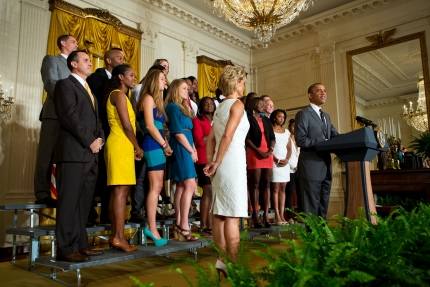
President Barack Obama welcomes the 2012 NCAA Women’s Basketball Champion Baylor Bears to the White House (July 18, 2012)

President Barack Obama welcomes Coach Kim Mulkey and the 2012 NCAA Women’s Basketball Champion Baylor Bears to the East Room of the White House, July 18, 2012, to congratulate them on their historic 40-0 season and their NCAA Championship victory. (Official White House Photo by Lawrence Jackson)

President Obama welcomed the Baylor Lady Bears to the White House yesterday to celebrate their NCAA women's basketball national championship and their historic, undefeated season.

“[If] there’s one thing to describe this team, it was dominant,” the President told the crowd gathered in the East Room. "Last season, the Lady Bears scored more points than any team in women’s college basketball history. They became the first team ever -- men’s or women’s -- to win 40 games in a season."

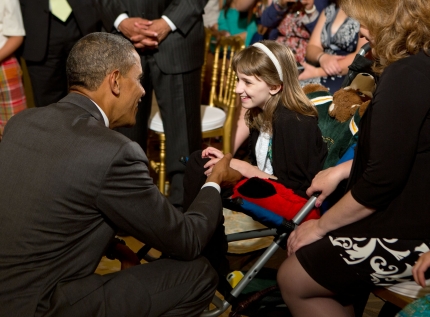
President Barack Obama greets Haley Klepper (July 18, 2012)

President Barack Obama greets Haley Klepper in the East Room of the White House, July 18, 2012, during a ceremony for the 2012 NCAA Women’s Basketball Champion Baylor Bears. The President mentioned Haley during his remarks. (Official White House Photo by Pete Souza)

Among those on hand for the event was Haley Klepper -- a ten year old girl from Waco, Texas with a rare disorder -- who through the course of the season became an unofficial part of the Baylor team.

President Obama made a point to pause and acknowledge Haley, saying: "[When] the team found out about Haley and all the stuff that she goes through every day, and she’s such a brave little girl, they immediately took her under their wing. So she has her own spot reserved in the Baylor locker room, and -- she’s a pretty big fan."

Related Topics: Inside the White House, Texas

The White House

Office of the Press Secretary

We Can’t Wait: Obama Administration Announces 5 Major Port Projects to Be Expedited

WASHINGTON, DC – Today, as part of its We Can’t Wait initiative, the Administration announced that 7 nationally and regionally significant infrastructure projects will be expedited to help modernize and expand 5 major ports in the United States, including the Port of Jacksonville, the Port of Miami, the Port of Savannah, the Port of New York and New Jersey, and the Port of Charleston.  As part of a Presidential Executive Order issued in March of this year, the Office of Management and Budget is charged with overseeing a government-wide effort to make the permitting and review process for infrastructure projects more efficient and effective, saving time while driving better outcomes for local communities.  These are the first 7 of the initial 43 projects that will be expedited by the Executive Order – additional expedited infrastructure projects will be announced in the coming weeks.

“One way to help American businesses grow and hire is to modernize our infrastructure,” said President Obama. “That’s why in March I asked my Administration to identify important projects across the country where Federal review could be expedited. Today’s commitment to move these port projects forward faster will help drive job growth and strengthen the economy.”

The Obama Administration is also announcing the establishment of a White House-led Task Force that will consist of senior officials from various White House offices, the Army Corps of Engineers, and the Departments of Transportation, Commerce, Homeland Security, and the Treasury. The Task Force will develop a Federal strategy and coordinated decision making principles that focus on the economic return of investments into coastal ports and related infrastructure to support the movement of commerce throughout the Nation. For more information on the Task Force, please click HERE.

Port of Jacksonville

One of the critical steps in modernizing and expanding the Port of Jacksonville is to finalize the federal feasibility study examining the costs and benefits of deepening the harbor.  Nationally, feasibility studies take an average of 10 years and the expedited process announced today will shave 7 years off of that timeline, committing the federal government to finalize the study by April of 2013, years ahead of previous projections.  Today, the Administration also announced that it will commit to completing all permits for the Jacksonville Port Intermodal Container Facility by July of 2013.  

Jacksonville Harbor
Coordinating Agency: US Army Corps of Engineers
Target date for completing all Federal permit and review decisions: April 2013

The Army Corps is completing a feasibility study to examine the benefits and costs of deepening the Federal navigation channel at the port from its existing authorized project depth of 40 feet up to maximum project depth of 50 feet to accommodate larger cargo vessels and other ships.  The Army Corps is applying its modernized planning process for potential long-term infrastructure investments to this ongoing study, and expects to complete its recommendations for improvements several years earlier than originally anticipated. The Port of Jacksonville plans to construct a new Intermodal Container Facility concurrently with the navigation improvements that will vastly improve the efficient movement of goods.

Jacksonville Intermodal Container Facility
Coordinating Agency: US Department of Transportation
Target date for completing all Federal permit and review decisions: July 2013

A new Intermodal Container Facility (ICTF) at the Port of Jacksonville will increase the capacity of the port to handle containers that arrive or depart by rail, and thereby will reduce truck traffic on local and regional roads. The ICTF will include a five-track rail yard, two wide-span electric cranes, and a paved area for stacking containers and several support uses, including a road a gate for truck movement of cargo, a parking area, and storm water retention facilities. The facility will also use zero-emission, wide-span electric cranes for all lift operations. This $45 million project is being financed through a public-private partnership, including US Department of Transportation TIGER grant funding of $10 million serving as an example of the expanded  outreach and coordination by DOT to help non-traditional grantees navigate the environmental review process, from start to finish, in an efficient manner to meet the aggressive timelines associated with an innovative funding program.  This port-side investment compliments the ongoing work by the Corps of Engineers helping maintain and increase the economic competitiveness of the port as expansion of the Panama Canal commences in the coming years.

Port of Miami

The Administration today committed to completing all federal reviews for the Port of Miami by August of 2012, and expects to complete the deepening of the channel this year.

Miami Harbor
Coordinating Agency: US Army Corps of Engineers
Target date for completion of all Federal permit and review decisions: August 2012

The Army Corps is working with the Port of Miami to construct an authorized project that involves deepening the Federal navigation at the port from its current depth of 42 feet to a depth of 50 feet.  The project would enable the port to accommodate larger cargo vessels and other ships, ultimately facilitating a more efficient movement of goods.   Through a progressive partnership with the State of Florida, which has provided all of the funds needed to construct this project, the time frame for its construction has been advanced by years.  The Corps expects to complete the deepening of the Federal navigation channel by late 2012.  Related infrastructure improvements include landside investments funded in part by the Department of Transportation. 

Port of Savannah

The Administration today committed to completing all federal reviews for the Port of Savannah by November of 2012.

Savannah Harbor
Coordinating Agency: US Army Corps of Engineers
Target date for completing all Federal permit and review decisions: November 2012

The Army Corps has completed a feasibility report that examined the benefits and costs of deepening the existing channel at Savannah Harbor from its current depth of 42 feet to a depth of 47 feet.  The proposed project would enable the Port of Savannah to accommodate larger cargo vessels and other ships, ultimately facilitating more efficient movement of goods.  The study involved a multiyear collaborative effort with the Environmental Protection Agency, the Department of Interior and the Department of Commerce, all of whom must also approve the final report. As a result of this collaboration, the project includes an extensive mitigation plan, which is an integral part of the recommended improvements and are intended to restore, preserve, and adaptively manage the surrounding ecosystem, which includes the Savannah National Wildlife Refuge.

Port of New York and New Jersey

The Administration today committed to completing all federal permit and review decisions for the Bayonne Bridge by April of 2013, shaving months from the schedule.  In addition, the Administration will complete all remaining federal reviews for the New York and New Jersey Harbor by May of 2013.

New York and New Jersey Harbor
Coordinating Agency: US Army Corps of Engineers
Target date for completing all Federal permit and review decisions: May 2013

The Port of New York and New Jersey is the largest port on the East Coast. Through the port’s major container terminals, waterborne cargo moves to all parts of the United States and throughout the world. The Army Corps is in the final stages of constructing an authorized project that will deepen existing Federal channels that provide access to four container terminals to a depth of 50 feet, enabling the navigation channel to accommodate larger cargo vessels and other ships, ultimately facilitating a more efficient movement of goods.  The Corps expects to complete this $1.6 billion project in 2014.  In order to fully realize the potential economic returns from this improvement to the navigation channel, the Port also plans to raise the Bayonne Bridge.

Bayonne Bridge Raising
Coordinating Agency: US Coast Guard
Target date for completing all Federal permit and review decisions: April 2013

The Port of New York and New Jersey plans to raise the height of the Bayonne Bridge by 2016 in order to provide enough vertical clearance to allow access to the Port's main container terminals by larger container vessels able to transit to the Port of New York/New Jersey due to deepening of the New York Harbor's navigation channels by the Army Corps of Engineers. This project, which is estimated to cost $1 billion paid with the Port Authority funding, involves raising the roadway from 151 feet to 215 feet above mean high water, while preserving the bridge's historic arch. Effective coordination between the Port Authority and the Coast Guard (the federal coordinating agency) and with other Federal agencies, is anticipated to reduce the overall permit decision-making and review timelines by several months.

Port of Charleston

The Administration today committed to completing all federal reviews for the Port of Charleston by September of 2015.

Charleston Harbor
Coordinating Agency: US Army Corps of Engineers
Target date for completing all Federal permit and review decisions: September 2015

Under its planning modernization process, the Army Corps is implementing an aggressive planning schedule for the Charleston Harbor Feasibility Study that will examine the benefits and costs of deepening the Federal navigation channel for Charleston Harbor from its existing depth of 45 feet to a maximum of 50 feet to accommodate larger cargo vessels and other ships, ultimately facilitating a more efficient movement of goods.  The study is expected to be complete within 3 years – much earlier than the over 10 year average. 

The White House

Office of the Press Secretary

Statement by the Press Secretary on the Announcement of Libyan Election Results

Libya’s democratic transition took another important step with yesterday’s announcement of the results from the July 7th National Congress election.  As President Obama noted on Election Day, Libya’s historic election underscores that the future of Libya is in the hands of the Libyan people.  The United States congratulates all the parties and candidates who have won seats in the new General Congress.  We commend Libya’s High National Election Commission for its hard work preparing Libya’s first election in almost 50 years.  The orderly voting process noted by international observers and the significant turnout reflects the Libyan people’s commitment to democracy and civic participation.  Once the final period for appeals has been completed, we look forward to working closely with Libya’s newly elected leaders and the members of the General Congress as they take on the challenges of strengthening public institutions, improving security, and promoting national unity.  As they do so, Libya’s leaders can count on the United States for continued friendship and support.

President Obama Honors the Baylor Lady Bears

July 18, 2012 | 8:25

President Obama welcomes the 2012 NCAA Women’s Basketball champion Baylor Bears to the White House, and congratulates the team on its perfect season.

Download mp4 (298MB) | mp3 (19MB)

Read the Transcript

Remarks by the President Honoring the 2012 NCAA Women's Basketball Champion Baylor Lady Bears

East Room

2:31 P.M. EDT

THE PRESIDENT:  Hello, everybody!  Hello!  (Applause.)  Thank you.  Everybody please have a seat.  Welcome to the White House, everybody.  And congratulations to the Baylor Lady Bears on their undefeated season and second national championship.  (Applause.)

There are some proud members of Congress who are here today.  We’ve got a bunch of proud Texans in the house.

I want to thank all the outstanding young women who are behind me, and the coach, for making my bracket look good -- at least on the women’s side.  (Laughter.)  I picked Baylor over Notre Dame, but I have to say, I wasn’t the only one.  It wasn’t that hard.  (Laughter.)  Because if there’s one thing to describe this team, it was dominant. 

Last season, the Lady Bears scored more points than any team in women’s college basketball history.  (Applause.)  They became the first team ever -- men’s or women’s -- to win 40 games in a season.  (Applause.)

Now, this is not to say that success came easily.  After a tough loss to Texas A&M in the Elite Eight last year, the Lady Bears decided they weren’t going to go through that again.  So they buckled down, they spent all summer in the gym.  And they have not lost since -- not to the Aggies, and not to anybody else.  (Laughter.)

So obviously, a lot of credit goes to Coach Kim Mulkey.  This is Coach’s fifth national championship -- she just -- she likes to win if you haven’t noticed.  (Laughter.)  She won two as a star player at Louisiana Tech, one as an assistant coach, and now two as head coach at Baylor.  That’s an incredible thing.  (Applause.) 

I want to point out that’s the first person in college basketball history to win titles in all three roles.  I heard she plans to win her next one as mascot -- (laughter) -- so that she can -- but -- (laughter) -- I mean, she’s got to figure out what else she can win at this point.  But we want to congratulate Coach Kim for leading this team and being named Coach of the Year in women’s basketball.  Congratulations.  (Applause.)

Now, obviously, a great winning team requires a great coach, but it’s not as if on the court the players were slackers, either.  We can’t say enough about Brittney Griner.  This young woman is the new face of women’s basketball -- she blocks shots, she rebounds, she’s got the jump-hook, she’s got the dunk. 

She won just about every award that you could win last season.  And I have to say that there have been times in the past where I shot around a little bit with the visiting team, but this time I don’t think I can get my shot off, so -- (laughter) -- I’m not doing that this year.  (Applause.)  Not doing that this year.

She’s not the only one I’m scared of.  You’ve got Odyssey Sims, who just owned the backcourt, earned her reputation as one of the premier perimeter defenders in the country.  Senior Terran Condrey, or “Big Shot T” --

TEAM:     Yeah!

THE PRESIDENT:  Where did she go?  Right here?  Knocking down jump shots.  Three other seniors -- Ashley Field, Lindsay Palmer, and Cherrish Wallace who anchored this team for four of the most successful years in school history.

So we know that the Lady Bears are talented on the court.  But when practice is over, they worked just as hard.  Some made the Big 12 Honor Roll with perfect GPAs.  That’s worth an applause right there.  (Applause.)  They read with students at elementary schools in Waco and served meals to the homeless.  They traveled around the world, caring for infants at an AIDS orphanage and building houses in Kenya.  

The Lady Bears also made a difference in one little girl, who is so special to them that the team brought her along for today’s visit.  Haley Klepper, who is right here -- hey, Haley.  (Applause.)  Haley is as brave as can be and has just gone through some struggles.  But when the team found out about Haley and all the stuff that she goes through every day, and she’s such a brave little girl, they immediately took her under their wing.  So she has her own spot reserved in the Baylor locker room, and -- she’s a pretty big fan.  She cheers from the sidelines just about at every home game, is that right?  (Laughter.)  So we’re thrilled to have Haley here.  
    
This team just sets a terrific example for girls everywhere -- as athletes, as scholars, as leaders in their community.  I could not be prouder of this team.  And I’ve said -- I was saying to them before we came out, as the father of two daughters who are tall and beautiful just like them, it is great to have role models who can show that women can be strong and athletic and competitive, but also play as a team.  That’s a terrific lesson for my daughters and it’s a terrific lesson for girls everywhere. 

And so we could not be prouder of them.  And since they’ve got all five starters coming back, I suspect that they’re the odds-on favorite for my bracket next year as well.  (Laughter.)  So congratulations, everybody.  (Applause.)

END      
2:40 P.M. EDT

Close Transcript