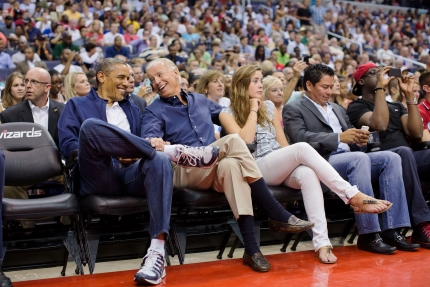
Taking in Team USA

President Obama attends the U.S. Men's Olympic basketball team's game against Brazil (July 17, 2012)

President Barack Obama and Vice President Joe Biden, with granddaughter Naomi Biden, attend the U.S. Men's Olympic basketball team's game against Brazil at the Verizon Center in Washington, D.C., July 16, 2012. (Official White House Photo by Pete Souza)

In the lead up to the 2012 London Olympics, the USA men's basketball team last night played an exhibition game against Brazil at the Verizon Center in Washington, DC.

President Obama was on hand, along with First Lady Michelle Obama and Vice President Biden.

The Obamas and company watched Team USA take on a talented and experienced Brazil squad, also featuring multiple NBA starters. Led by 30 points, six rebounds, and four steals from LeBron James, the Americans forced 23 turnovers to capture an 80-69 win.

Earlier, the USA women's team routed their Brazilian counterparts, 99-67 -- led by 21 points from the three-time WNBA All Star Lindsay Whalen.

President Obama met with both teams to offer some words of encouragement before the players and coaches head to the United Kingdom to defend their gold medals. The Olympics start on July 28, and the First Lady will help to lead the U.S. delegation.

We managed to grab some behind the scenes video from the night. Check it out below.

Earlier, we talked with Alonzo Mourning, a gold medalist in the 2000 Sydney Olympics with Team USA, about the challenges this year's squad will face in London. Watch Alonzo Mourning talk about Team USA basketball.


Related Topics: Inside the White House

The White House

Office of the Press Secretary

Remarks by the President at Campaign Event in San Antonio, TX

Henry Gonzalez Convention Center
San Antonio, Texas

12:45 P.M. CDT
 
THE PRESIDENT:  Hello, San Antone!  (Applause.)  Hello, Texas!  (Applause.)  Well, thank you so much.  Everybody have a seat.  Have a seat.  It is good to be with all of you, good to be back in San Antonio.  (Applause.)
 
A couple of people I want to acknowledge who helped to make this day possible.  First of all, your outstanding Mayor, Julian Castro.  (Applause.)  Somebody whose name I know you're familiar with because we are in the Henry Gonzalez Convention Center -- a great friend, outstanding leader, great Congressman -- Charlie Gonzalez is in the house. (Applause.)  Another fighter for working people -- Lloyd Doggett is here.  (Applause.)  One of my national co-chairs and just a great friend and a great advocate  -- and a really good actress, too -- Eva Longoria.  (Applause.)  And finally, our FuturoFund co-chair and a wonderful friend and supporter -- Henry Muñoz.  (Applause.)
 
Now, this is my last campaign.  It's true, I'm term-limited up.  (Laughter.)  And that got me thinking about some of my first campaigns.  I know that Charlie and Julian and others, they think back to your first campaigns.  And back then, I didn’t have Air Force One.  (Laughter.)  Didn’t have a motorcade, no helicopter. I did the driving myself, and we didn’t even have MapQuest -- (laughter) -- I'd have to unfold the maps.  And Illinois, like Texas, is a big state, so I'd have to travel all across the state, and you'd go from urban neighborhoods to rural communities, suburbs.  You'd meet folks from every walk of life  -- black, white, Latino, Asian, Native American.
 
And wherever I traveled, what I discovered was that there was a common theme to everyone's story.  If I met an elderly couple, I'd think back to my grandparents, and how my grandfather fought in Patton's Army in World War II, and my grandmother worked on a bomber assembly line.  And when my grandfather came back home, he was able to attend college on the GI Bill, and they were able to buy their first home with an FHA loan.  And I'd think about the distance they'd traveled from the small towns in Kansas, where they had been born. 
 
And if I met a single mom I'd think about my mother, who had to raise me and my sister basically by herself, with some help from my grandparents, because my father had left, so that I didn't even know him, and how she had to work and go to school and look after her kids.  But with the help of grants and scholarships, she was able to get an outstanding education and, more importantly from her perspective, give me and my sister a great education.  And I thought about how much that would be possible in some other place.
 
And if I met a working family, I’d think about Michelle’s family.  Her dad had multiple sclerosis, so by the time I met him, he could barely walk, had to use two canes, and had to wake up an hour earlier than everybody else to get dressed before going to work.  He worked at a water filtration plant, blue-collar worker.  And Michelle’s mom stayed at home when the kids were young, and then worked as a secretary.  But Michelle’s dad, despite his disability, never missed a day of work, and went to every dance recital and every basketball game, and had just a great joy about him.
 
And so all across the state of Illinois, I would be traveling and I’d meet people, and I’d say, you know what, their story is my story.  And then when I began to run for President I traveled all across the country, including here in Texas -- I’d realize, well, the stories I’ve been hearing in Illinois, those are America’s story.  And at the heart of that story was a basic idea, which is, in this country, unlike any other, the basic bargain that binds us together is the idea that if we work hard, if we’re responsible, then you can get ahead; that you’re endowed by our Creator with certain inalienable rights like liberty, but also the pursuit of happiness -- not a guarantee, but the chance to get ahead if you work hard.
 
And so generation after generation, parents, grandparents, great-grandparents toiling against all odds, understanding that at some point this hard work would pay off and they could climb their way into a middle class.  And that middle class didn’t just have to do with how much money you had in your bank account.  It had to do with the idea that you could always find a job that supported a family, and you wouldn’t go bankrupt when you got sick, and you could buy a home to call your own, and you could make sure your kids had a good education.  Maybe you take a vacation once in a while -- nothing fancy, but time to spend with those you love.  And you could retire with dignity and respect.  And most of all, you could expect that your children could aspire to things that you never even imagined. 
 
That was the heart -- that is the heart of the American idea. This basic idea that no matter what you look like, no matter where you come from, no matter what your last name is, here in America, you can make it if you try. 
 
And in 2008, when I ran for President and so many of you supported me, we ran because we believed in that idea and we believed that that basic bargain had been fraying.  We had seen a decade in which hard work wasn’t paying off for too many people. So people were working harder than ever, but the cost of living, gas, college, health care, all were going up; incomes, wages flat-lining.  We’d gone from surplus to record deficits, job growth stagnant. 
 
And so what compelled us together to make this effort was specific issues, but it was also, how do we get that idea back for the vast majority of Americans?  And what we didn’t know at the time was, is that we were looking at the worst financial crisis in a generation -- the worst economic crisis since the Great Depression.  And so millions of people were losing their jobs even as I was wrapping up the campaign.  And people lost their homes, and more and more folks struggled, and it felt as if that dream was slipping even further away.
 
But we have not been deterred.  As much work as we still have to do, over the last three and a half years that focus on how do we build a middle class that is strong and secure and growing, that has remained my central focus.  (Applause.)  And even as we've created 4.5 million new jobs and 500,000 jobs in manufacturing, and stabilized the financial system -- all the steps we've taken without much cooperation from the other side -- that's still been our North Star. 
 
And what's always helped me every single day move forward is the recognition and the belief and the understanding that although the times have been tough, the American people have been tougher -- (applause) -- and that for everything that happened during that financial crisis and the recession that followed, America's fundamental character did not change.  (Applause.)  People's willingness to work hard did not change.  People's ability to bounce back from adversity had not changed.  (Applause.)
 
And now, as we look out at the future, the question is, how do we best fulfill that goal, that aim that we set for ourselves in 2008?  For all the progress we've made, we did not embark on this journey just to get back to where we were in 2007.  We worked hard because we want a country where everybody gets a fair shot and everybody is doing their fair share and everybody is playing by the same set of rules.  (Applause.)  That's why I ran for President in 2008.  That's why I'm running for a second term as President of the United States of America.  (Applause.)
 
AUDIENCE:  Four more years!  Four more years!  Four more years!  Four more years!
 
THE PRESIDENT:  Now, as we think about this election, understand that the challenges we face are solvable.  Sometimes it's fashionable among the pundits to say, well, America is in decline, or our best days are behind us.  You hear that periodically.  This isn't the first time we've heard that about America.  And I could not disagree more, because there's not a problem out there that we can't solve.  The problem is not that we don’t have technical solutions or big ideas to tackle these challenges.  The problem is we've got a stalemate in Washington right now.  And it's more than just a difference between two candidates, more than just a difference between two political parties.  It is two fundamentally different visions about how to move America forward. 
 
My opponent and his allies in Congress, they believe that prosperity comes from the top down.  They believe that if we keep in place the Bush tax cuts for the wealthiest Americans and then we add on top of that another $5 trillion of tax cuts -- most of which would go to people who don’t need tax cuts and, frankly, aren't even asking for them -- if we do all that, even if it means gutting education investments, even if it means slashing transportation, even if it means that we're not able to take care of our veterans as effectively, even if it means that we're not investing in basic science and research, even if it means that Medicare we've got to voucherize -- even if we do all those things, they still believe that those tax cuts that benefit folks at the top will result in everybody being better off.  That’s their basic economic theory.  It's not complicated.
 
They've got one other element to it, in fairness.  They also say they want to eliminate regulations on insurance companies and Wall Street banks -- regulations we put in place to protect consumers from unscrupulous mortgage practices, and that take regulations off of polluters.  If we do those things along with the tax cuts, the market will be freed up, government is out of the way, and happy days are here again.  That’s their theory.
 
AUDIENCE:  Booo --
 
THE PRESIDENT:  And don’t take my word for it -- go to their websites.  Look at the budget that was passed by the House Republicans.  That’s their theory.  That’s what it boils down to. 
 
Now, it is a theory -- (laughter) -- and some of you might be persuaded by this theory if it hadn't been for the fact that we just tried it.  (Laughter and applause.)  We spent almost a decade doing what they prescribed.  And how did it turn out?  We didn't see greater job growth.  We didn't see middle-class security.  We saw the opposite.  And it all culminated in the worst financial crisis in our lifetimes -- precisely because there were no regulations that were adequate to the kinds of recklessness that was being carried out.
 
So I don't know about you, I don't know how you guys operate in your life, but my general rule is if I do something and it doesn't work -- (laughter) -- I don't go back to doing it.  (Applause.)  We don't go backwards, we go forwards. 
 
So I’ve got a different idea.  I don't believe in top-down economics; I believe in middle-out economics.  I believe in bottom-up economics.  (Applause.)  I believe in fighting on behalf of working families and giving them opportunity and putting some money in their pockets -- because when we do that, everybody does better, folks at the bottom, folks in the middle and folks at the top.
 
That's not a Democratic idea.  That's an American idea.  (Applause.)  That's what built this country.  That's what made us into an economic superpower.  (Applause.)
 
So let’s just be more specific about some contrasts here.  My opponent thought it was a good idea to "let Detroit go bankrupt."  With a million jobs at stake, I disagreed.  I wanted to make a bet on America’s workers and American industry and American manufacturing.  And three and a half years later, the auto industry is back.  GM is number one; Ford and Chrysler are selling cars.  (Applause.)  That's my vision for America.
 
And this is not unique to the auto industry.  I want advanced manufacturing locating here in San Antonio.  (Applause.) I want us to be making things here in the United States of America, so I want to end tax breaks to companies that are shipping jobs overseas.  Let’s give tax breaks to companies that are investing right here in Texas, right here in the United States of America.  (Applause.)  Let’s put American workers back to work selling goods stamped with three proud words:  Made in America.  That's my vision for America.  (Applause.)
 
My opponent has a different idea.  His main calling card for wanting to be President is his private sector experience.  So we asked the voters to examine that experience.  He invested -- made money investing in companies that had been called "pioneers" of outsourcing.  I don’t want pioneers of outsourcing in the White House; I want somebody who believes in insourcing.  Let’s bring those jobs back home.  That’s why I’m running for a second term as President of the United States.  (Applause.)
 
In 2008, I made a promise we’d end the war in Iraq -- we ended it.  (Applause.)  I promised to go after bin Laden -- we got him.  (Applause.)  We’re transitioning out of Afghanistan and starting to bring our troops home.  And what I’ve said is, as we wind down these wars, let’s take half the money that we spent on war to pay down the deficit; let’s use the other half to do some nation-building here at home.  (Applause.) 
 
Now, Mr. Romney disagrees with me on this -- said it was "tragic" the way I ended the war in Iraq -- the way I ended the war in Iraq, doesn’t want to set a timetable for ending the war in Afghanistan.  But, you know, I’m looking around this country and I know from our history, from world history, that no nation has always been stronger than its economy.  That’s an issue of our national defense.
 
And so because of our outstanding men and women in uniform, we know that we’ve got the greatest military on Earth, but we also have to have the best economy on Earth to support those troops.  (Applause.)  And that means, let’s start investing, rebuilding roads and rebuilding bridges and laying broadband lines into rural communities.  Let’s rebuild schools that are overcrowded and give them state-of-the-art science labs.  (Applause.)  And let’s rebuild our ports and our runways.  (Applause.)
 
That’s what America is about, is rebuilding.  And we’ve got thousands of construction workers out there that are ready to get to work.  Let’s put them to work.  (Applause.)  That will be good for our economy, and over the long term will be good for our strength.  That’s a difference between myself and my opponent.
 
As long as I’m Commander-in-Chief, we’re going to make sure that our veterans are properly cared for.  (Applause.)  And we have expanded our funding and improved how we are working with our veterans.  But we’ve got more work to do and that requires resources.  We’re sure not going to spend that money better on tax cuts for me.  (Laughter.)  I want to make sure that a young man or woman who has served our country, who has fought for us, they shouldn’t have to fight for a job or a roof over their heads when they come home.  (Applause.) 
 
I'm running to make sure that America has the best education system on Earth -- (applause) -- from pre-K all the way to post-graduate.  And that means hiring new teachers, especially in math and science.  And it means building on the work we've already done to make sure that student loan rates don’t double, to make sure that middle-class families are getting tuition tax credits. Now we've got to reduce the cost of college, make it more affordable to everybody.  (Applause.)  I want to expand opportunities for 2 million young people to go to community colleges so they can get trained on the jobs that businesses are hiring for right now.  (Applause.)  Because today education is not a luxury, today a higher education is an economic imperative for the 21st century.  And I want to make sure that the United States of America once again has the highest percentage of college graduates, because that is going to help determine who wins the race in this global economy in the 21st century.  (Applause.)  And I want America to be number one.  That’s why I'm running for President of the United States. (Applause.)
 
On almost every issue, there's a stark contrast between my vision and my opponent's.  When it comes to housing, he wants to just let foreclosure bottom out.  I don’t think that’s a solution; that’s part of the problem.  So I want to actually help families all across Texas and all across the country refinance -- at these historically low rates, the average family could save $3,000 a year, in your pockets.  That will not just be good for you, that will not just be good for the housing market; that will be good for the economy.  But we need to get it done.  (Applause.)
 
I don't want to go back to the days when whether you could serve your country or not depended on who you loved.  We ended "don't ask, don't tell," and I want to make sure that it stays ended because it was a bad idea.  (Applause.)
 
I don't want to go back to the day when women didn't have control of their health care choices.  (Applause.)  I’ve got two daughters, and I want them to have the same control over their health care as anybody’s sons out there.  I believe that's the right thing to do.  (Applause.)
 
And we don't need another four years of arguments about health care.
 
AUDIENCE:  No!
 
THE PRESIDENT:  The Affordable Health Care Act -- otherwise known as Obamacare -- was the right thing to do.  (Applause.)  And you know what, they're right, I do care.  I care about folks who get sick and go bankrupt.  I care about parents who don't know whether or not they're going to be able to get treatment for their kids.  It was the right thing to do.  (Applause.)
 
And for all the misinformation out there, it’s very simple to describe what’s going to happen.  If you already have health care, the only thing that you have to do is enjoy the fact that now insurance companies can't jerk you around because of the small print.  (Applause.)  You have rights.  Your kids can stay on their parent's plan until they’re 26 years old.  (Applause.)  Senior citizens are seeing reductions in prescription drug costs.
 
If you don't have health insurance, we’re going to help you get it.  (Applause.)  And, yes, it’s true we expect everybody to act responsibly, so for the 1 percent or 2 percent of people who still don't get health insurance even though they can afford it, we’re going to say to them, you can't pass off those costs on to somebody else in the form of higher premiums.  (Applause.)  You’ve got to take responsibility, as well. 
 
It was the right thing to do.  We are not going backwards, we’re going forwards.  And 30 million people are going to get health insurance because of it.  (Applause.)
 
We’re not going backwards when it comes to immigration.  My opponent says the Arizona law should be "a model for the nation." 
AUDIENCE:  Booo --
 
THE PRESIDENT:  I believe we are a nation of laws and a nation of immigrants.  (Applause.)  I believe we can secure our borders and give opportunities to people who are striving and working hard -- especially young people who have been raised in this country and see themselves as Americans.  That was the right thing to do.  We're not going backwards, we're going forwards.  (Applause.)
 
And we're going to get control of our deficit and debt, but not with the plan that these folks are promoting.  They say this is the most important issue, the thing they care about most, and then, they propose a $5 trillion tax cut that would mostly benefit folks who don't need it, and would blow a hole a mile wide through our budget. 
 
Now, I don't believe government can solve every problem.  Not every government program works.  We've already cut a trillion dollars out of our federal budget, and we can do more.  But we've got to do it smartly and responsibly.  I don't believe that government can help somebody that doesn't want to help themselves, but for all those folks who are working hard every day, I want to make sure that we continue to invest so that young people can go to college; that we continue to take steps so that we've got a great transportation system to move people and goods and services across the country.  I want to make sure that we're investing in basic research and science that has given us this technological lead that allowed us to grow and become the economic superpower that we are. 
 
So what I've said is, yes, we'll make some more cuts, but let's ask folks who have been incredibly blessed to do a little bit more, to go back to the rates we had under Bill Clinton.  (Applause.)  And you know what, that theory has been tested as well -- because when Bill Clinton did it, we had surpluses instead of deficits.  (Applause.)  We created 23 million new jobs -- and people at the top did really well also.
 
Like I said, that’s been our history -- when middle-class folks are doing well and those striving to get into the middle class are doing well, everybody does well. 
 
And that maybe is what is at the heart of the difference in this debate.  See, I believe in individual initiative and entrepreneurship and risk-taking.  And I believe that the free market is the greatest system on Earth to create wealth and prosperity.  But just like Abraham Lincoln said, there are some things we do better together than we do on our own.  (Applause.)
 
When my grandfather came back home and that generation got the GI Bill that was great for everyone because it upgraded the skills of all of our workers, that wasn’t just good for some, that was good for all.  When we invested in the Hoover Dam or the Golden Gate Bridge or the Trans-Continental Rail System, or when we sent a man to the moon or invented the Internet, that was good for everybody. 
 
There are some things we do better together.  And we rise or fall as one nation.  (Applause.)  That’s what I believe.  That’s what our history tells us.  That’s what our future demands.  That’s why I’m running for a second term as President of the United States.  (Applause.)
 
So let me just say this.  In the next four months -- you guys won’t see them because you’re not considered one of the battleground states, although that’s going to be changing soon -- (applause) -- but there’s going to be more money spent than we’ve ever seen before.  Folks writing $10 million checks to try to beat me, running ads with scary voices -- (laughter) -- and basically one message.  I mean, it’s a very simple message.  Their message is:  The economy is not where it needs to be and it’s Obama’s fault.  So there will be various -- there will be variations on the theme, but it will be the same message over and over and over again. 
 
That's what they're banking on -- because they can't sell their actual economic plan, so their goal is to see if they can knock us down.  More money than we’ve ever seen before.  And it’s understandable that some folks get cynical about the political process as a result. 
 
But what you taught me in 2008 is the same thing that I learned in my first campaigns, as I traveling around in my car, going from town to town, talking to people in their living rooms or VFW halls or diners, and trying to get their votes -- and hearing stories about people’s parents and grandparents and great-grandparents, some who came as immigrants, some who were brought here not of their own accord, some who worked in mills or mines, some worked on farms, ranches.  The thing I learned was that there is a core decency and grit and faith in the American people.  And when the American people decide what’s true and what’s right, and they join together to bring about change, to make this country more responsive to the hopes and dreams of ordinary people -- when that happens, it doesn't matter how much money the other side spends, it can't be stopped.  I cannot be stopped.  (Applause.)
 
You showed that in 2008, and I believe you’re going to show it again in 2012.  (Applause.)  I tried to make promises in 2008 that I knew I could keep, and one of those promises was that I wasn’t a perfect man and I wouldn't be a perfect President, but I’d always tell you what I thought and I’d always tell you where I stood, and I’d spend every waking minute fighting as hard as I knew how for you -- (applause) -- making sure that every single day I was thinking about how to make your lives a little bit better.
 
And I knew I could keep that promise because I saw myself in you.  And when I saw your grandparents, I saw my grandparents.  And when I saw your kids, I saw my kids.  And I’ve kept that promise.  And I still believe in you.  (Applause.)  
 
And if you still believe in me, and you're willing to stand up, and knock on doors and make phone calls, and get out there and fight on behalf of a vision in which every Americans has opportunity to pursue their dreams -- (applause) -- I promise you, we will finish what we started in 2008.  We will not be going backwards, we will be going forwards.  We will win this election.  (Applause.)  And we will remind the world just why it is that the United States of America is the greatest nation on Earth.  (Applause.)
 
God bless you.  God bless the great state of Texas and God bless the United States of America.  (Applause.)
 
END
1:20 P.M. CDT
 

The White House

Office of the Press Secretary

Press Gaggle by Principal Deputy Press Secretary Josh Earnest en route San Antonio, TX, 7/17/12

Aboard Air Force One
En Route San Antonio, Texas

10:00 A.M. EDT

MR. EARNEST:  Good morning, everybody.  Thank you for joining us for this trip deep into the heart of Texas this morning.  As we've done the past couple of weeks, I will be on hand to answer a couple of questions you may have about official administration policy, and my colleague, Jen, is here to talk to you about the President's reelection campaign and reelection activities.

Before we get started, there is one piece of official business that I did want to raise for you.  Later this morning, the Office of Personnel Management will be releasing some specifics per a directive from the President last week about providing health insurance to the seasonal workers at the Department of Interior and the Department of Agriculture who are fighting -- firefighters out West.  This is something the President directed OPM to do in conjunction with the Department of Interior and the Department of Agriculture.  So you should look for an announcement -- that should be out by the time we land in Texas in a couple of hours.

MS. PSAKI:  And I just wanted to start with two announcements.  One is, as you may have seen overnight, we have a new ad in Pennsylvania that will be welcoming Mitt Romney to the state today, called, "Makes You Wonder."  It highlights the question of whether Mitt Romney paid his fair share in taxes.  As we know, until he releases more years of tax returns we're not going to have additional information on why he had investments in the Cayman Islands, why he had investments in a company in Bermuda, and what decisions he was involved in.

The second announcement, I just wanted to highlight -- actually I just wanted to run through the schedule through the day just so everybody is clear on that. 

There are four fundraisers today, two in San Antonio, two in Austin.  So we start off the day with an event at the Henry Gonzalez Convention Center in San Antonio.  We expect about 1,200 people.  The tickets started at $250.  That will be followed by a private reception at a private home.  We expect about 70 people. Those tickets were $35,800 per person.  Then we'll go to Austin later this afternoon.  He'll have an event at the Austin Music Hall.  We expect about 1,100 people.  Tickets start at $250.  Then we'll have a private reception there where we expect about 80 people, and the tickets are $25,000 per couple.

With that, we'll take your questions.

Q    Are you attacking the President on his income -- I mean Governor Romney on his income taxes?  Is this something that we're going to see more of this week?

MS. PSAKI:  Well, Amie, when you hear the President speak today at several of those events, what you'll hear him do is lay out the choice the American people are facing, the differing visions he has from Mitt Romney for the future of the country, and his commitment to continue to fight for the middle class.

We have raised, as many people have raised, including many Republicans -- it’s been a growing number over the last couple of days -- Bill Kristol, Haley Barbour over the weekend.  We saw the governor of Alabama just ask for Mitt Romney to release further years of tax returns, and this is a call that's not just being made by us, it’s being made by many people including people from Mitt Romney’s own party.

Q    What about the President -- will he address that today at all?

MS. PSAKI:  The President’s remarks will focus on what he wants to do to lead the country over the next four years, and his differing vision from Mitt Romney.

Q    Jen, is it fair to suggest, however, as the ad does and as if you’ve been doing, that Romney may not have, in fact, paid any taxes, or may have hidden some, when we, in fact, don't know what those tax returns might show?

MS. PSAKI:  Well, the ad raises the question that we won’t know, and it’s not possible for anyone to know, until he releases further years of tax returns and everybody is able to examine what is included in them.

Q    Vice President Cheney is on the Hill today to talk to Republicans on how to avoid sequestration.  Has he been in contact with the President at all?

MR. EARNEST:  I don't have any phone calls to read out to you between the President and the former Vice President.  It does seem odd to me, however, that House Republicans would be taking budget advice from somebody who famously declared that "deficits don't matter." 

The President obviously has a different view, which is that deficits do matter, which is why the President has laid out a balanced approach to dealing with our long-term deficit challenges.  He’s hopeful that we’ll finally get Republicans to agree to work with him on that effort.

One of the reasons that the Republicans have continuously rebuffed the President’s efforts to reach this long-term solution is because they feel it’s very important to protect tax cuts for the wealthiest Americans.  The President believes it’s important for the wealthy to do their fair share, deal with our deficit challenges in conjunction with making some pretty significant cuts in government spending, as well as dealing with some of the challenges -- budgetary challenges posed by our entitlement programs.

So the President believes that this comprehensive balanced approach is what’s required, and we’re ready and waiting for Republicans to get onboard.

Q    Does the President support Democrats who are threatening with the fiscal cliff?

MR. EARNEST:  Well, as I mentioned, the President believes firmly that there is a way for us to deal with our deficit challenges that doesn't involve the historic funding cuts that are included in the sequester.  There is bipartisan agreement about the fact that the cuts that are included in the so-called sequester would not be good for our economy, and you’ve even heard the Secretary of Defense raising concerns about the impact that it could have on national security.  Democrats and Republicans -- a majority of Republicans -- voted for the sequester in an effort to force Congress to act to reach a long-term solution to our deficit challenges.

The President has put forward an approach that mirrors the approach that has been taken by a wide range of bipartisan commissions that have looked at this problem, and the only thing that is standing in the way are congressional Republicans who are fighting tooth and nail to protect tax cuts for the wealthiest Americans.  The President does not believe that it’s just middle-class families that should have to sacrifice to deal with our deficit challenges.  We’re all in this together, and that includes asking those wealthiest 2 percent of Americans, millionaires and billionaires, essentially, to do their fair share.

Q    Josh, the Syrian ambassador who defected has raised the possibility that the Syrian government will use chemical weapons in Syria.  Do you have any intel to back that up?  And is that a concern that the White House is looking at?

MR. EARNEST:  You’re talking about the Syrian ambassador to Iraq, right?

Q    Yes.

MR. EARNEST:  I don't have any comment at this point about intelligence reports about Syria’s chemical weapons.  What I can tell you is -- this is something that the State Department has also expressed publicly -- is that there are certain responsibilities that go along with the handling and storage and security of those chemical weapons.  And we believe that the individuals who are responsible for living up to those challenges should do so and will be held accountable for doing so.

But in terms of the specific intelligence reports that you’re citing, I’m not able to comment on those one way or the other. 

Q    All right.  Is the U.S. concerned that Assad may use those chemical weapons against his own people?

MR. EARNEST:  Well, what we have seen is inhumane brutality from the Assad regime, and that is something that has aroused the concern -- against his own people I should say -- and that has certainly aroused concern not just by the President and U.S. officials, but by the leaders of countries all over the globe, including a number of countries in the region.

Q    Josh, the Fed Chairman is testifying on the Hill today. Some Democrats want the Fed to consider using monetary policy to prime the economy given continued slowdown.  Does the President agree with that call?

MR. EARNEST:  Jim, as you know the Federal Reserve is completely independent.  And so I wouldn't want to comment on any decisions, any policy decisions they may be contemplating right now.  As you point out, the Chairman is going to testify before Congress later today, and I'm sure that he'll have some thoughts on that.

What the President believes is that there are -- while it's the Fed's decision to decide whether or not to take action, the President believes Congress should act.  And there are a whole range of policies the President has put forth that the Congress can act on right away -- whether it's tax cuts for small businesses that want to hire new workers, whether it's offering responsible homeowners the opportunity to refinance their homes at historically low interest rates, whether it's investing in our infrastructure. 

The President has talked extensively, both in official events and on the campaign trail, about his view that we should take half the money that we get from bringing our troops home from Afghanistan, use half of that to pay down the deficit and use the other half to do some nation-building at home by investing in our ports, in our airports, in our railways and our runways and our highways -- that we can not only create construction jobs in the short term that would address the weakness in the construction sector, but also lay a foundation for our long-term economic strength in this country. 

Q    Will the President be closely following what Bernanke says?

MR. EARNEST:  Well, the President will certainly be interested to hear what Chairman Bernanke has to say when he testifies before Congress today.

Q    Jen, can you give us more context for this trip to Texas, in terms of how often the President has been to Texas for fundraisers for the past year or so -- do you have any count on that?

MS. PSAKI:  Sure, I'm happy to get you some numbers on that. I don't have it in front of me now.  There are many Democrats who support the President in Texas, and we will see many of them today.  He will have a similar message to what you've heard over the past couple of trips, in terms of laying out the contrast between what he is fighting for, who he is fighting for, and his vision for the future of the country.

But as you know, and as I mentioned, we expect to see a couple of thousand people here who are supportive of the President, excited to see him, and looking forward to sending him back for four more years.  But I'll get you some specifics --

Q    Is this the first time he has gone to San Antonio since he has been in office, do you know?

MS. PSAKI:  I will check that for you.

MR. EARNEST:  One thing I would add to that is anybody who  -- having worked on the President's campaign in a private capacity in 2008, I actually spent about four really fun weeks in Texas in February of 2008.  And certainly, there were a lot of very strong supporters of the President in Texas.  Anybody who covered that race is certainly aware of --

Q    -- tough primary, though.

MR. EARNEST:  It was a tough primary.  It was exciting.  We were actually talking about this last week about what an exciting time in the campaign that was.  I was the communications director for the Texas campaign down here that spring.  But there are certainly a lot of very strong supporters of the President who were strong supporters of him in 2008 as well.

Q    -- Marissa Mayer -- she’s a supporter of his -- did he reach out to her?

MR. EARNEST:  I don’t know of any phone calls that he may have made to her yesterday.

Q    Jen, one of the events today I believe is co-sponsored by the Democratic Party’s LGBT Council.  The other one features leading Hispanics in Texas.  Does the President have specific messages to both those audiences today?

MS. PSAKI:  Well, again, the President will be talking about his differing vision for the country.  There are a number of issues he’s been fighting for, including access to affordable health care, access to education to middle-class families that are important to many different groups.  He will be interacting with the audience and there will be some opportunities for them to ask him questions, so there could be issues that come up related to that.  But I expect you will hear a consistent message of his differing vision for the country from his opponent.

Q    Will he do a kind of a town hall-style thing that we’ll be able to see?

MS. PSAKI:  You will be there for the remarks, which you will enjoy thoroughly, I’m certain.  And the people who are attending will, I’m sure, enjoy the interaction back and forth.

That was my nice way of saying it.  (Laughter.) 

Q    On a lighter note, Josh, did the President have a reaction to being on the Kiss Cam last night and being turned down at first by his wife?

MR. EARNEST:  I will say that this incident was the subject of some high-level conversations on the helicopter en route to Andrew’s Air Force Base this morning.  (Laughter.)  I can tell you, based on a very good source, that reports the President was rebuffed are false.  The President and First Lady enjoyed the basketball game yesterday.  During the first half, they were sitting in the stands, noticed that their images were on the large screen, smiled, did not recognize that their images were on the screen in conjunction with the Kiss Cam.  So it was not until halftime, when the President and First Lady saw their daughters and their daughters asked them why they didn’t kiss during the Kiss Cam segment.  They remarked that they did not recognize they were on the screen during the Kiss Cam segment, and so during act two of the Kiss Cam promotion, the President took advantage to steal a kiss from his wife.

Q    There were reports of people at the game, which I was not, and I think our sportswriter took a photo where it appeared on the Kiss Cam that the President was leaning in to try for a kiss.  You’re saying that they were not aware at all that -- what was going on with that?

MR. EARNEST:  That's correct.

Q    The President also said he -- at the half time interview that he’d talked to the women’s team.  What were the circumstances of that -- before the game, after the game?  What did he say to them?  And then did he talk to any of the men’s players or team at all?

MR. EARNEST:  Before the men’s game, he was able to go I don’t know if it was into the locker room or one of the rooms in the Verizon Center where the President was able to greet the women’s team.  He didn’t arrive in time to see their game.  But he got a chance to visit with each of them, and he thanked them for the way in which they’re representing our country, that -- the President obviously has a very high opinion of the women's team. 

And I think he noted in his interview with Mark Jones yesterday that he actually expected that the women's basketball team might be an even bigger favorite in the basketball competition in the Olympics than the men's team.  So I also heard that he may have gotten a jersey from the women's team as well. So he had an opportunity to visit with them before he attended the men's game.  I don't know that he had a chance to visit with any of the members of the men's team yesterday.

Anything else? 

MS. PSAKI:  One other thing let me just raise since you're all here.  One story that came out overnight I would encourage all of you to read is a story in the Boston Globe that touches on the changing language that Mitt Romney's team and his surrogates have used to describe Mitt Romney's tenure at Bain.  They're starting to refer to it as that he didn't manage the day-to-day, which raises some questions about what exactly he did do.  I'm happy to provide that to anyone, but I just wanted to highlight it while we were all here. 

Q    One other thing about the President's schedule -- I mean, four days this week he is campaigning out of town.  And I'm just wondering is that going to be sort of the norm from here on out, three or four days a week?  And does that leave time for governing?

MS. PSAKI:  I don't know the schedule weeks out from now.  We are three and a half months from the election.  While he is campaigning, he is reading briefing books, he is doing calls, he is having meetings with his advisors.  And that's something -- he can walk and chew gum at the same time. 

He will be campaigning later this week in Florida, as you touched on, for two days.  And I think he looks forward to and really enjoys getting out there and having those conversations with the American people about what they're focused on.  And, oftentimes, that does impact his governing -- when he hears from people on concerns they have about small businesses -- yesterday, he heard from somebody whose father needed to get a job and he talked about infrastructure.  We had a conversation this morning about the drought and what we can do more on the drought.  And those are all conversations he is having while he's out on the campaign trail, meeting with the American people.  And he does take them back and discuss with his advisors as well.

Q    Thanks.

MR. EARNEST:  Thanks, everybody.   
 
END
10:16 A.M. EDT

The White House

Office of the Press Secretary

Notice -- Continuation of the National Emergency with Respect to the Former Liberian Regime of Charles Taylor

NOTICE

- - - - - - -

THE CONTINUATION OF THE NATIONAL EMERGENCY WITH RESPECT

TO THE FORMER LIBERIAN REGIME OF CHARLES TAYLOR

On July 22, 2004, by Executive Order 13348, the President declared a national emergency and ordered related measures, including the blocking of the property of certain persons connected to the former Liberian regime of Charles Taylor, pursuant to the International Emergency Economic Powers Act (50 U.S.C. 1701-1706). The President took this action to deal with the unusual and extraordinary threat to the foreign policy of the United States constituted by the actions and policies of former Liberian President Charles Taylor and other persons, in particular their unlawful depletion of Liberian resources and their removal from Liberia and secreting of Liberian funds and property, which have undermined Liberia's transition to democracy and the orderly development of its political, administrative, and economic institutions and resources.

Although Liberia has made advances to promote democracy, and the Special Court for Sierra Leone recently convicted Charles Taylor for war crimes and crimes against humanity, the actions and policies of Charles Taylor and others have left a legacy of destruction that could still challenge Liberia's transformation and recovery. Because the actions and policies of these persons continue to pose an unusual and extraordinary threat to the foreign policy of the United States, the national emergency declared on July 22, 2004, and the measures adopted on that date to deal with that emergency, must continue in effect beyond July 22, 2012. Therefore, in accordance with section 202(d) of the National Emergencies Act (50 U.S.C. 1622(d)), I am continuing for 1 year the national emergency declared in Executive Order 13348.

This notice shall be published in the Federal Register and transmitted to the Congress.

BARACK OBAMA

The White House

Office of the Press Secretary

Message -- Continuation of the National Emergency with Respect to the Former Liberian Regime of Charles Taylor

TO THE CONGRESS OF THE UNITED STATES:

Section 202(d) of the National Emergencies Act (50 U.S.C. 1622(d)) provides for the automatic termination of a national emergency unless, within 90 days prior to the anniversary date of its declaration, the President publishes in the Federal Register and transmits to the Congress a notice stating that the emergency is to continue in effect beyond the anniversary date. In accordance with this provision, I have sent the enclosed notice to the Federal Register for publication stating that the national emergency and related measures dealing with the former Liberian regime of Charles Taylor are to continue in effect beyond July 22, 2012.

Although Liberia has made advances to promote democracy, and the Special Court for Sierra Leone recently convicted Charles Taylor for war crimes and crimes against humanity, the actions and policies of former Liberian President Charles Taylor and other persons, in particular their unlawful depletion of Liberian resources and their removal from Liberia and secreting of Liberian funds and property, could still challenge Liberia's efforts to strengthen its democracy and the orderly development of its political, administrative, and economic institutions and resources. These actions and policies continue to pose an unusual and extraordinary threat to the foreign policy of the United States. For this reason, I have determined that it is necessary to continue the national emergency with respect to the former Liberian regime of Charles Taylor.

BARACK OBAMA

The White House

Office of the Press Secretary

Statement by the President on Extending Health Coverage to Federal Firefighters

Starting today, the brave men and women of our nation's federal firefighting forces, as well as their families, will have access to the health coverage they deserve.  Their heroism in battling the deadly fires that have impacted states across the country this summer inspires us all.  Each day, these Americans put themselves in grave danger to save the lives of people they never met, which is why I directed my administration to ensure that our nation’s firefighters can count on the care and protection they need. 

The White House

Office of the Press Secretary

Interview of the President by Mark Jones on ESPN 2

Verizon Center
Washington, D.C.

9:03 P.M. EDT

Q    President Obama, I want to ask you, first of all, your thoughts on the first half of play.  It was a little bit more competitive maybe than some people thought.

THE PRESIDENT:  Well, you forget how many Brazilians are in the NBA now.  Between Nenê and Varejāo and Barbosa, they've got a good team.  So it took a while for our guys to kind of get into rhythm, but we're so much deeper that over time you get a sense they're going to wear them down.

Q    Predictions for the second half?

THE PRESIDENT:  I don't think it will be close in the second half.

Q    No.  USA Basketball, Mr. President, has undergone a culture change.  They bottomed out a little bit in 2004 with LeBron the bronze, and then Coach Krzyzewski came aboard and really turned it around.  Your thoughts on that process.

THE PRESIDENT:  Well, obviously Coach K is one of the greatest coaches of all time.  He knows how to bring together folks to think like a team.  And obviously the talent that we've got at this point is unbelievable.  So there's no reason we shouldn’t bring home the Gold.  We just have to stay focused.

One thing I'm happy about is to see how hard everybody is playing.  You really get a sense of how proud they are to represent the United States and I think they're going to conduct themselves really well in London.

Q    One of the subjects of great debate of late, started by one Kobe Bryant, was the fact that he feels that the present constitution of the team would beat the 1992 original version.  Your thoughts on that.  Can you weigh in on that argument for us?

THE PRESIDENT:  You know, this is a generational thing.  I was around in '92.  I was a Bulls fan, so I've got to go with the original Dream Team.  And I suspect that Michael and Sir Charles and others would point out they were probably never down at any point in any of their games.  But this is a great team, unbelievable talent, and Kobe is a competitor, so you expect him to do a little trash talking whenever the opportunity arises.

Q    You're a big basketball fan.  Everybody knows that.  And you're involved in coaching your daughters.  We saw the USA Women's National Team win by a big margin earlier tonight.  How would you characterize your experience in coaching your two daughters?

THE PRESIDENT:  Well, first of all, I want to congratulate the women's team.  They're going to be as dominant, if not more dominant, I think in the Olympics.  And wonderful young women; they're great role models for my daughter.  And I had a chance to say hello to them before this game started.

As you know, coaching kids, your heart is out there on the floor with them.  I get more excited than I ever got when I was actually playing, watching Sasha or Malia play.  They're really enjoying it, and to see them improve and start playing as a team always is great satisfaction.

What you want to see in your kids, even if they're not going to be professionals, is just taking something seriously, learning how to put a lot into it and seeing them get something out of it.

Q    For your 49th birthday you had an all-star cast of players come to the White House for a much-celebrated pickup game.  Who's coming to the next birthday party pickup game?

THE PRESIDENT:  Well, this summer these guys are busy.  (Laughter.)  So they need to focus on the Olympics.  But it was one of the most fun events that we've had. 

Q    Did your team win?

THE PRESIDENT:  We actually had four teams, and my team did not win.  I did not stack it.  But LeBron and Dwyane Wade and Chris Paul and a whole bunch of folks -- Derrick Rose -- came.  We had three pros and two amateurs on each team and it was a lot of fun.  Then we had a barbecue at the White House afterwards.

And we did it in front of wounded warriors, so it gave them a chance to see up close and personal some of the greatest basketball talent.  And the guys could not have been more generous -- signing shoes and jerseys and everything.  So really enjoyed it and these are all some great guys.

Q    Thanks a lot for joining us, Mr. President.

THE PRESIDENT:  Really enjoyed it.  Thank you, Mark.

Q    Back to you guys.

END   
9:07 P.M. EDT

The White House

Office of the Press Secretary

Statement by the President on the DISCLOSE Act

Two years ago, the Supreme Court ruled in Citizens United that big corporations are allowed to spend unlimited amounts of money to influence American elections.  They can buy millions of dollars’ worth of TV ads with no obligation to reveal who’s actually paying for them. 

The consequences of this decision are predictable.  If we allow this practice to continue, special interests will have unprecedented influence over politicians.  It’s wrong. It’s corrosive to our democracy, and it’s a threat to our future.

Today, Republicans in the Senate had the chance to change it.  They had the opportunity to support a bill that would prevent the worst effects of the Citizens United decision and require groups or special interests who are trying to influence elections to reveal their donors so the public will know who’s funding their political ads.  This bill should have received broad, bipartisan support.

Unfortunately, Republicans chose to block it.  Instead of standing up for the American people, Republicans stood with big banks and oil companies – special interests that certainly don’t need more clout in Washington. 

I will continue to do everything I can to repair the deficit of trust between Washington and the American people.  I’m disappointed Republicans in Congress failed to take action and hold corporations and special interests accountable to the American people.


###

The White House

Office of the Press Secretary

Statement by NSC Spokesman Tommy Vietor on National Security Advisor Donilon's Travel to the Kingdom of Saudi Arabia

National Security Advisor Tom Donilon concluded a positive and productive visit to the Kingdom of Saudi Arabia today.  During his visit to Jeddah, Mr. Donilon met with King Abdullah bin Abd al-Aziz Al Saud to discuss and coordinate on approaches to a broad range of regional and bilateral issues.  Mr. Donilon conveyed President Obama’s appreciation of and commitment to the strength of the bilateral relationship and affirmed the enduring strategic interests on which the U.S. - Saudi partnership is built. 

The White House

Office of the Press Secretary

Remarks by the President at a Campaign Event

Cincinnati Music Hall
Cincinnati, Ohio

2:00 P.M. EDT

THE PRESIDENT:  Hello, Cincinnati!  It is good to be back!  Everybody, please have a seat if you've got a seat.  (Laughter.) I think most people have a seat here.  It is great to see all of you. 

I want to acknowledge -- first of all, I want to make sure that I acknowledge your outstanding mayor, Mark Mallory is in the house!  (Applause.)  Where is he?  He was around here somewhere. There he is right there.  Good to see you. 

Now, I know that some of you think that I came to this music hall to sing.  (Laughter and applause.)  But I have to tell you, there's no concert tonight -- (laughter) -- or at least not this afternoon.  There may be a concert tonight.  Michelle has told me I should not be singing in public all the time.  (Laughter.)  Well, it's -- happy birthday.  What's your name? 

AUDIENCE MEMBER:  Adam.

THE PRESIDENT:  Adam?  How old are you, Adam? 

AUDIENCE:  I'm 18 today.

THE PRESIDENT:  All right.  Let's sing "Happy Birthday" to Adam then.  We can sing.  (Sings "Happy Birthday").  Yay!  All right.  (Applause.)  So there was a concert after all.  (Applause.)

AUDIENCE MEMBER:  I'm 101 years old! 

THE PRESIDENT:  There you go.  Let's give a round of applause -- what's your name, sir?

AUDIENCE MEMBER:  Dr. Harvey.

THE PRESIDENT:  Okay.  (Laughter.)  Dr. Harvey, happy -- it's not your birthday, but just congratulations on being 101.  (Applause.)  Dr. Harvey looks good.  I've got to follow him around and see what he eats.  (Laughter.)  Because I'm going to eat what he eats. 

Okay, you guys -- 105 right here!  (Applause.)  105?  (Laughter.)  What's that sweet lady's name? 

AUDIENCE MEMBER:  Margaret Harris.

THE PRESIDENT:  Margaret Harris is 105 years old.  (Applause.)  God bless her -- 106 next month.  She's beautiful. 

Well, it's so nice to -- I guess folks do pretty good down here in Cincinnati.  (Laughter.)  You've got 105, 101 --

AUDIENCE MEMBER:  I'm 93.

THE PRESIDENT:  -- 93 -- okay.  (Laughter.)  God bless you. We love you, too.  (Laughter.)  Anybody else over 100?  (Laughter.)  You're not over 100.  All right.  No more birthdays, that’s it.  (Laughter.)   

Now, today --

AUDIENCE MEMBER:  Are you going to sing?

THE PRESIDENT:  No, I'm not going to sing.  (Laughter.)  No Al Green.

Today, we are turning this beautiful music hall into a town hall.  (Applause.)  So I'm not going to take too much time up front.  I want to spend as much time as possible answering some of your questions and getting your comments.  But I do want to just say a few things about what's at stake here.

Four years ago, we came together -- Democrats, but also independents and Republicans -- who were interested in restoring the basic bargain that made America the greatest nation on Earth. We've got so much to be thankful for -- incredible land and an incredible military, our men and women in uniform, they do so much for us all the time, and there's obviously great wealth in this nation.  But what really sets us apart has always been that we've got the greatest middle class -- (applause) -- and a basic idea that’s at the heart of this country that says if you work hard, then you can get ahead.  If you're responsible, then you can live out your dreams, you're not confined to the circumstances of your birth. 

A basic belief that if you're doing what you need to do -- because we're not a country that believes in handouts, we believe in working for what we get -- that you're able to find a job that supports a family, get a home that you can call your own, that you're able to send your kids to get a good education and hopefully allow them to go to college and they can achieve and succeed in ways you might not have even imagined; that you won't go bankrupt when you get sick -- (applause) -- that you'll be able to retire with dignity and respect.  (Applause.)  That’s the idea that built this country.  That’s the idea that turned us into a economic powerhouse. 

And what we saw for about a decade before I took office was the sense that that dream was slipping away from too many people, because people were working harder but they were getting less. Incomes and wages were flat-lining while the cost of everything from college to health care to groceries to gas were all going up. 

So our goal was to turn this around -- and we knew it wouldn’t be easy.  We knew that it might take more than one term, maybe more than one President.  But we knew that we had to get started to reclaim this dream. 

And then what we discovered was that because of irresponsibility, because of economic policies that had failed and a lack of oversight when it came to regulations, we inherited the worst financial crisis and the worst economic crisis since the Great Depression.  And millions of people were hurt -- lost their jobs, lost their homes, lost their savings.  And a lot of folks are still struggling. 

But here's the thing.  Americans are always tougher than tough times.  And this crisis has not changed our character.  It hasn't changed what we believe in.  It hasn't changed that basic notion that everybody should get a fair shot, and everybody should do their fair share, and everybody should play by the same set of rules.  (Applause.) 

And so even though over the last three and a half years, our central focus has been how do we recover from this crisis, and get people back to work, and make sure that small businesses are doing well again, and that they're getting financing -- despite all those things, our goal has not just been to get back to where we were before the crisis struck, but rather to build an economy that lasts -- (applause) -- to build an economy that says no matter what you look like, no matter where you come from, no matter what your last name is, you can make it if you try here in America.  (Applause.)

Everything I’ve done since I’ve been President has been focused on this central issue.  That's the reason I’m running for a second term as President of the United States.  (Applause.)

AUDIENCE:  Four more years!  Four more years!  (Applause.)

THE PRESIDENT:  And you know, part of the reason -- part of the reason I’m here today --

AUDIENCE:  Four more years!  Four more years! 

THE PRESIDENT:  -- part of the reason that I’m here today is I want to remind everybody that the challenges we face are solvable.  The problem is not a lack of big ideas.  It’s not a lack of technical solutions to our policy issues.  The problem is we’ve got a stalemate right now in Washington --

AUDIENCE:  Yes!

THE PRESIDENT:  -- between two fundamentally different ideas about how we move the country forward.

This election is about more than just two candidates or two political parties.  It’s about two different visions about how do we build a strong economy.  (Applause.)  And the good news is you’re the tiebreaker.  The choice is up to you.  The choice is up to you.  (Applause.)

Governor Romney and his allies in Congress, they believe in an economic theory that says if folks at the very top are doing really well, then that spreads to everybody else.  It’s what we call top-down economics. 

So right now their main prescription for growing the economy faster is an additional $5 trillion in tax cuts, most of which would go to the wealthiest Americans, even if to pay for it you’d have to gut education programs, or turn Medicare into a voucher program, or eliminate our investments in basic research and science.  That's their vision about how you grow an economy.

They’ve actually got a two-part vision.  One is tax cuts for the wealthy, and then the second is eliminate regulations that we’ve put in place to make sure, for example, that Wall Street doesn't engage in the same reckless behavior that got us into this mess in the first place.  (Applause.) 

Now, I’ve got to tell you, it would be one thing if they had this theory and we hadn’t tried it before.  But the truth is we tried it for almost a decade, and it didn’t work.  The track record of their vision resulted in turning surpluses into deficits.  We ran two wars on a credit card.  Job growth was the most sluggish it had been in decades.  The average wages and income of working families actually went down during this period, and it culminated in this massive crisis.

So I don’t know about you, but in my life, what I found -- sometimes I do bone-headed things, I make mistakes.  What I find is when I don’t -- when I try something and it doesn’t work, then I don’t try it again.  (Applause.)  Right?  You don’t go back to doing something that didn’t work.

Now, I’ve got a different idea.  So, for example, Governor Romney said he would extend the tax cuts for the wealthiest Americans indefinitely. 

AUDIENCE:  Booo --

THE PRESIDENT:  He says that until he puts a tax plan in place.  But his tax plan is not just to keep all the Bush tax cuts.  As I said, he wants to put another $5 trillion -- this is estimated that it’s almost impossible for you to bring down the deficit and deal with the debt with that kind of tax plan.  Nearly 40 percent of these new taxes would go to the top 1 percent of all households. 

We have not found any serious economic study that says Governor Romney’s economic plan would actually create jobs -- until today.  I’ve got to be honest.  Today we found out there’s a new study out by non-partisan economists that says Governor Romney’s economic plan would, in fact, create 800,000 jobs.  There’s only one problem:  The jobs wouldn’t be in America.  (Laughter and applause.)  They would not be in America.  They’d be in other countries.  By eliminating taxes on corporations’ foreign income, Governor Romney’s plan would actually encourage companies to shift more of their operations to foreign tax havens, creating 800,000 jobs in those other countries. 

Now, this shouldn’t be a surprise, because Governor Romney’s experience has been investing in what were called "pioneers" of the business of outsourcing.  Now he wants to give more tax breaks to companies that are shipping jobs overseas. 

So I want everybody to understand, Ohio, I’ve got a different theory.  We don’t need a President who plans to ship more jobs overseas, or wants to give more tax breaks to companies that are shipping jobs overseas.  I want to give tax breaks to companies that are investing right here in Ohio -- (applause) -- that are investing in Cincinnati, that are investing in Hamilton County.  (Applause.)  I want to give incentives to companies that are investing in you, the American people, to create American jobs, making American goods that we’re selling around the world, stamped with three proud words:  Made in America.  (Applause.) 

That’s why I’m running for President of the United States.

Now, the difference extends not just to the difference in corporate taxes, it's also individual taxes.  We don't need a President who is going to give himself a big tax break.  (Laughter.)  We need a President who is going to cut your taxes.

Now, four years ago I promised to cut taxes for the middle class -- and I kept that promise.

AUDIENCE MEMBER:  Yes, you did!  (Applause.) 

THE PRESIDENT:  The typical family's tax burden is $3,600 lower than it was when I came into office.  I want all the press to notice that.  (Applause.)  Because sometimes, you'll hear all these crazy accusations -- oh, Obama, is raising taxes and burdening -- no, here are the facts.  Typical middle-class family, your taxes have gone down $3,600 since I've been in office.  (Applause.)

A couple weeks ago, I called on Congress to immediately extend these tax cuts to 98 percent of the American people.  Folks making $250,000 a year or less would not see their taxes go up one single dime -- their income taxes go up one single dime.  (Applause.)  Now, I should point out, by the way, that 97 percent of small businesses also would not see their taxes go up, because typically they don't earn more than $250,000.  (Applause.)

Now, if you're fortunate enough to be the other 2 percent -- and I am -- I mean, Michelle and I didn't use to be, now we are. We've been blessed.  That's great.  (Applause.)  What we're saying is for those folks, we can afford to pay a little bit more in taxes by going back to the rates that were paid under Bill Clinton.  That will help us reduce our deficit by about a trillion dollars.  And everybody says the deficit and the debt are important, and I agree.  (Applause.)

And I just want to point out, the last time we did that, when Bill Clinton was President, we had surpluses, not deficits, created 23 million new jobs, and by the way, we created a lot of millionaires and billionaires to boot.  Because when an economy is growing from the middle out and from the bottom up, everybody does well, including people at the very top.  That's how you grow an economy.  (Applause.)

When teachers and firefighters and police officers and construction workers -- when folks who are putting in a hard day's work, when they do well, then everybody does well.  That's how America has always succeeded.  We believe in individual initiative and self-reliance.  But there's some things we do together, and growing an economy is one of them.

My grandfather, he went to college on the GI Bill.  That generation helped to expand the middle class, and everybody did better.  When we invested in the Hoover Dam or the Golden Gate Bridge, or the Internet, sending a man to the moon -- all those things benefited everybody.  And so that's the vision that I want to carry forward. 

That's why when the auto industry was on the brink of collapse and Governor Romney said let's "let Detroit go bankrupt," I said no.  One out of eight jobs in Ohio depend on the auto industry -- (applause) -- a million jobs across the Midwest are at stake.  (Applause.)  I'm going to bet on American workers and American ingenuity.  And now, GM is back on top and Chrysler and Ford are on the move, and the American auto industry has come roaring back.  (Applause.)

So let me just close by saying this, and then we can get to some questions.  My vision says we’re going to invest in education and we’re going to hire new teachers, especially in math and science; open up 2 million more slots for folks to go to community colleges to get trained in the jobs that businesses are hiring for right now.  (Applause.)  We already helped to make sure that student loan rates didn't double, but now we’ve got to work more to lower tuition costs so young people aren’t burdened with debt.  (Applause.) 

So we’re going to invest in education.  We’re going to invest in American energy.  Yes, we want to continue to expand our production of oil and natural gas, but I also want to make sure that we are the leaders in solar and wind and biodiesel, the energy of the future that can help reduce our dependence on foreign oil.  (Applause.)

American manufacturing, change our tax code, provide incentives for companies to invest here, invest in basic research and science so that we are at the cutting-edge -- because whoever has got the best technology, will ultimately have the best economy.  (Applause.)  We've got to make those investments. 

Rebuilding our infrastructure -- I know you've got some bridges around here that need repair.  (Applause.)  You've got some roads that need a repair.  Let's put construction workers back to work.  (Applause.) 

I ended the war in Iraq as I promised.  We're winding down the war in Afghanistan.  We decimated al Qaeda.  (Applause.)  Let's now take half the money we were spending on war and do some nation-building right here at home.  (Applause.) 

AUDIENCE:  Four more years!  Four more years!  Four more years!

THE PRESIDENT:  And finally, let's reduce our deficit, reduce our debt.  Let's do it in a responsible way that allows us to continue to make these investments we need to grow, and make sure that everybody is doing a little bit to help not just themselves but help the country.

So that’s my vision.  And it contrasts with the other side, and you are going to be the tiebreaker.  This is going to be your choice.  That’s how our democracy works.  And some of you noticed, there's going to be a lot of paid advertising and a lot of money -- we're seeing folks write $10 million checks  --

AUDIENCE MEMBER:  That's not us!

THE PRESIDENT:  -- to try to get me out of office.  So it's not you, I know.  (Laughter.) 

But even though my hair is a little grayer -- (laughter) -- even though I'm a little older, let me tell you, I still have as much confidence as I ever had in the American people.  (Applause.)  Because one of the great privileges of being President is you get a chance to travel all across the country.  You meet people from every walk of life.  And wherever I go, what I'm always struck by is the core decency and goodness and hard work and responsibility and faith that the American people have.

So I'll always bet on the American people.  And I'm confident that if we work hard, we get our message out, we have an honest debate about what needs to happen in this country and what future is best for our children and our grandchildren, then we're going to finish what we started in 2008.  (Applause.)  And we'll remind the world why the United States is the greatest  nation on Earth.  (Applause.)

Thank you very much, everybody.  Thank you.  (Applause.) 

Okay.  So everybody take a seat so I can see who wants to ask a question.  And there are no -- there are only a couple of rules here.  Rule number one is you’ve got to raise your hand if you have a question.  I’m going to call girl-boy, girl-boy -- (laughter) -- just to make sure that it’s fair.  If you have a chance, stand up and introduce yourself.  And there are folks in the audience with microphones, so wait until we’ve got a microphone so everybody can hear your question. 

And my only other request, because I want to try to get in as many questions as I can -- at least six or seven -- so if people can keep their questions short, I’ll try to keep my answers short.  (Laughter.)  But, now, if you ask me how do you bring about world peace, that’s a big question.  (Laughter.)  So try to keep the question to one that we can be succinct about, all right?

And I’m going to start with this young lady right here in the sort of the pink, white blouse.  Yes, right there.  All right, and wait till the microphone comes up.  Introduce yourself.

Q    Can you stand with me?

THE PRESIDENT:  Oh, is that the birthday boy?

Q    Yes.

THE PRESIDENT:  Okay, I didn’t -- he’s getting a lot of attention today.  (Laughter.)  All right, go ahead.

Q    Okay.  My name is Anna, and my son is openly gay.  And he is grassroots, and he speaks for a lot of the LGBT community. And we’d like to know, since you are for the LGBT, what’s your next steps?  What are you going to do for us?  (Applause.)  

THE PRESIDENT:  Well, look, let me say this.  First of all, I think what the American people have seen and made such progress on is recognizing the idea of equal rights, equal dignity, equal respect for everybody.  That applies to everybody. (Applause.)  That is a bedrock principle of America. 

And that’s -- when I came into office, everything from making sure that same-sex couples could have visitation in hospitals just like everybody else, making sure that we ended "don’t ask, don’t tell" because fighting for the country you love should not depend on who you love -- (applause) -- being clear that DOMA is something that we should repeal -- across the board I’ve tried to constantly align myself with what is best in our tradition, and that is you treat everybody fairly. 

Americans are about fairness.  And that doesn’t mean that folks have to agree with everybody on everything.  We don’t.  But we want to treat everybody fairly. 

Now, I think it’s important to recognize, though, that our gay and lesbian brothers and sisters are still subject to discrimination.  That’s why we passed hate-crime legislation, and we’ve still got to fight for that.  I think it is important for us to respect decisions that states make with respect to expanding treatment of same-sex couples and marriage.  But also what I want to say is that gay and lesbian families are like everybody else -- what they’re really also worried about right now is making sure they can pay the bills.  (Applause.)

So my strong belief is that it is important for us to focus on individual issues of fairness, but also recognize that we all have common interests as well.  Your son is 18; I’m assuming he’s going to get some more education, and I’m assuming you guys are worrying right now about making sure he doesn’t come out with a whole bunch of debt, and how --

Q    Miami.

THE PRESIDENT:  Miami? 

Q    Miami.

THE PRESIDENT:  Miami of Ohio? 

Q    Yes.

THE PRESIDENT:  Outstanding -- congratulations.  (Applause.)  We’ve got some folks from the alma mater here. 

So we want to treat everybody fairly, and we also want to make sure that the economy treats everybody fairly.  And I’m going to be fighting for that as long as I’m President of the United States.  (Applause.)

All right.  This gentleman right here.  Does anybody have a mic over there?  Okay, right behind -- very good.  I’m impressed. There you go.

Q    Mr. President, I’m Jim O’Reilly.  Ten years as an elected city official has shown me a real change in what the Republican Party has been doing to us.  They’ve taken away our power to protect our natural resources -- water and air -- from the strength of the oil and gas drillers that are doing fracking here in Ohio.  I support what Lisa Jackson and the EPA are doing. Is there more the administration can do to protect us from the adverse effects of drilling for natural gas?  Thank you.

THE PRESIDENT:  Well, this is a great question, and it’s an important question.  (Applause.)  A couple of things I just want everybody to know.  First of all, if you hear anybody say that somehow we are impeding the development of our energy resources here in this nation, I want you to know these facts:  oil production -- higher than it’s been in eight years; natural gas production -- higher than it’s been probably in our lifetimes; oil imports -- actually lower than they’ve been in 16 years.  In fact, our oil imports are less than 50 percent now for the first time in a very long time.  And so we’re moving in the right direction in terms of energy independence.  (Applause.)

Now, part of that is this boom in natural gas.  And this is something we should welcome, because not only are we blessed with incredible natural gas resources that are now accessible because of new technologies, but natural gas actually burns cleaner than some other fossil fuels, and is an ideal fuel -- energy source that we potentially can use for the next 100 years.  So I want to encourage natural gas production.  The key is to make sure that we do it safely and in a way that is environmentally sound. 

Now, you always hear these arguments that somehow there’s this huge contradiction between the environment and economic development, or the environment and energy production.  And the fact of the matter is that there are a lot of folks right now that are engaging in hydraulic fracking who are doing it safely. The problem is, is that we haven’t established clear guidelines for how to do it safely, and informed the public so that neighbors know what’s going on, and your family, you can make sure that any industry that’s operating in your area, that they’re being responsible.

So what we’ve said is, look, we are going to work with industry to establish best practices.  We are going to invest in the basic research and science required to make sure this is done safely and in a way that protects the public health.  And for responsible companies, they should be able to operate, make a profit, and we can all benefit and put people back to work.  But if you’re an irresponsible company that’s not doing the right thing, we’re going to hold you to account.  And that’s how we should develop this incredible resource -- which, by the way, if we do it properly, could end up changing the economics and politics globally of energy in a way that's actually very good for us, because we'll be less dependent on what happens in the Middle East and our economy will be less subject to the kinds of spikes that we saw earlier in the spring in terms of gas prices. 
Thank you for the question.  (Applause.) 

All right, it's a woman's turn.  That young lady in the white t-shirt right there -- hold on, hold on, wait for the mic.

Q    My name is Delisha White (ph) and I and my husband, we're small business owners.  And he actually has a question that he needs to answer.  (Laughter.) 

THE PRESIDENT:  Well, wait.  No, no, you can't do that now. (Laughter.)  I called on the young lady and that's what's called a bait and switch.  (Laughter.)  That is what's called a bait and switch.  No, the rule is that I'm going to make sure that women get equal time with men.  (Applause.)

Q    Well, we would like --

THE PRESIDENT:  Oh, no, no, no, no.  (Laughter.) 

Q    Okay, his question was, he is a small business owner and he wanted to know what can you do for the self-employed -- for self-employed businesses with less than 10 employees working with him.

THE PRESIDENT:  Okay, here's what I'm going to do.  I'm going to let him go ahead and ask his question.  (Laughter.)  And then, I'm going to call on two women in a row.  (Applause.)  Because this is -- we got cheated here.  (Laughter.)   

Go ahead.  Next time, you stand up.  Don't send your wife out first.  (Laughter and applause.)

Q    Okay, I'm Tony White and hello, Mr. President. 

THE PRESIDENT:  Good to see you, Tony.  What kind of business do you have?

Q    A barbershop and beauty salon.

THE PRESIDENT:  There you go.

Q    I've been in business for over 10 years now.

THE PRESIDENT:  That's great.

Q    And what I'm trying to find out is what will you be doing, or if there's anything you'll be doing, for the self-employed and businesses with employees -- with less than 10 employees. 

THE PRESIDENT:  Absolutely. 

Q    And also, when can I cut your hair?  (Laughter and applause.)

THE PRESIDENT:  Well, first of all, let me answer the second question first.  You know that you would not want a President who is disloyal to his barber.  (Laughter and applause.)  I mean, a man and his barber, that's a strong connection.  (Laughter.)

Q    I know, I know.

THE PRESIDENT:  So I am not going to let you cut my hair because my barber would be hurt.  (Laughter.)  

Q    Just one time, just once.  (Laughter.)
 THE PRESIDENT:  Maybe I’ll let you give me a line -- a little bit.

Q    Yeah, yeah, we can do that.  (Laughter.)   

THE PRESIDENT:  All right, in terms of small business -- look, small businesses are the lifeblood of our economy.  They account for most of the new job growth.  We’ve got obviously great big businesses.  In this area, Proctor & Gamble is an example of an outstanding large business.  But a lot of the job growth happens with small businesses who then become medium-sized businesses and then maybe at some point become large businesses. 
So ever since I came into office, one of my biggest priorities was how do we support small businesses -- which is why we’ve actually provided 18 different tax breaks just targeted at small business since I’ve been in office.  It’s the reason why we have pushed the Small Business Administration, especially when the recession had just hit, to extend additional financing and to waive fees for small business, because one of the biggest challenges for small businesses is getting credit lines.

Q    Yes, it is.

THE PRESIDENT:  And we’ve actually been pushing the banks to say, look, taxpayers pulled your backside out of the fire -- (applause) -- it’s now important for you to step up and make sure that small businesses aren’t finding their credit restricted, especially if they’ve been in business for a while. 

The other thing we’ve done is to say, what are the critical needs of small business?  A lot of time, one of the biggest challenges is to make sure that you, as a sole proprietor, that you can get health insurance for you and your family.  So when you hear about the Affordable Care Act -- Obamacare -- (applause) -- and I don’t mind the name because I really do care.  That’s why we passed it.  (Applause.)  You should know that once we have fully implemented, you’re going to be able to buy insurance through a pool so that you can get the same good rates as a group that if you’re an employee at a big company you can get right now -- which means your premiums will go down.  (Applause.)

We will also give you additional tax credits if you are providing health insurance for your employees -- we’ll give you tax credits for that.  Right now, one of the things we’re pushing Congress to do is to give you a tax credit if you hire additional workers, or you give folks who are a working for you a raise.  We want to give you incentive to do that.  (Applause.)

But this is an example of where there’s a contrast between myself and my opponent.  As I said before, his basic tax plan is to give folks at the top a tax break.  Now, we can have that debate, but what I’ve said is, in the meantime, let’s give 98 percent of individuals and 97 percent of small businesses some certainty right now by going ahead and passing a law that says your taxes won’t go up.  Because if Congress doesn't act, by the way, by January 1st, everybody’s taxes here are going to go up, by an average of about $1,600 -- if Congress doesn't do anything.  And so what I’ve said is if you really want to help small business right now, give 97 percent of them the certainty that their costs will not go up.  (Applause.)  And then we can have a debate about the other 2, 3 percent.

Now, one last point I’m going to make on this small business and taxes argument -- you’ll hear Republicans say, you know what, if you tax, let’s say, somebody with a million dollars of income, you're going to be crushing the small business jobs creators.  Now, first of all, I’ve just explained 97 percent of small businesses make less than $250,000 a year.  But setting aside that, the way they describe small businesses, half of the Fortune 400 richest Americans in the country would qualify as a "small business."  Hedge fund managers would qualify as small business, even if they were pulling in a billion dollars a year.  And this is an example of what I mean when I say we just want everybody to be treated fairly. 

AUDIENCE:  Right!

THE PRESIDENT:  Michelle and I were talking the other day, and Michelle’s dad worked as a blue-collar worker.  He was at the water filtration plant in Chicago, worked there all his life -- all his adult life.  And he had MS, so by the time I met him, he could barely walk.  But he never missed a day of work.  He had to use two canes.  He had to wake up an hour earlier than everybody else just to get dressed.  But he never missed a day of work.  And he took pride in being at the job, even if he didn’t feel well.  And he used to tease folks who were lazy -- he'd say, these people are so lazy they won't even go to work to pick up their paycheck.  (Laughter.)  They want it mailed to them. 

And Michelle's mom, she stayed at home when the kids were young and then she went to work as a secretary.  And she worked as a secretary most of her adult life. 

So the point is, they didn’t have a lot.  But Michelle and I were talking about how they didn’t envy people who had a lot more.  There was no sense that somehow our lives are less because we're not millionaires, we're not making huge amounts of money.  God bless folks who are doing successful -- who are successful and doing well.  The only thing that Michelle's parents, my mom, my grandparents, the only thing they didn’t like is when you felt like folks at the top were taking advantage of their position and not following the same rules as everybody else and keeping other folks down.  (Applause.)  

And we don’t want an economy in which some are being treated differently than others.  That’s all.  And that’s especially true when it comes for our small business folks.  I want them to have some of the same advantages, because you probably can't afford the same number of lawyers and accountants and all that stuff that are working all these loopholes.  And I want to make sure that you're getting the same good deal as everybody else.

All right?  Okay.  (Applause.) 

I'm going to call on this young lady right here.  She seems like she has an urgent question.  Hold on, wait for your mic.  Wait for your microphone.  We're getting the next generation involved in this.  (Applause.)  Right here, right there.  Yes.

Q    What's your favorite Girl Scout cookie?  (Applause.)

THE PRESIDENT:  Oh, oh.  I've got to say this is one of the toughest questions.  (Laughter.)  What's your name?

Q    Julie.

THE PRESIDENT:  And you’re a member of a Girl Scout troupe?  Are you? 

Q    Yes.

THE PRESIDENT:  How long have you been a Girl Scout?

Q    I think for only -- I think only this year.

THE PRESIDENT:  This year?  Have you --

Q    Two years.

THE PRESIDENT:  Two years.  Have you been having fun?

Q    Yes.

THE PRESIDENT:  Yes?  You know, I've got to say that I'm pretty partial to those mint -- (applause.) 

THE PRESIDENT:  I'm just saying -- that’s just me.  I didn’t mean to create controversy here.  There was someone -- (laughter) -- did you hear there was somebody booing.  What do you -- how do you -- what's was your choice?  Who was booing up there?  (Laughter.)  You had a different opinion.  What are you, oatmeal, or --

AUDIENCE MEMBER:  Peanut butter.

THE PRESIDENT:  Peanut butter is quite good, too, but I'm going with the mint.  I'm going with the mint. 

All right?  Thank you for the question.  Thank you.  (Applause.) 

All right.  Remember I said I was going to go two ladies right now.  So here, right here.  Right here.  Here we go.  Whoops, don't fall, now.  Go ahead. 

Q    My name is Susan.  Welcome to Cincinnati.

THE PRESIDENT:  Thank you. 

Q    Given how divided the country is, if elected, how do you plan to try to united everyone?

THE PRESIDENT:  Well, I'll be honest, sometimes people ask me what's my disappointment since I've come into office.  And obviously, we're always trying to grow the economy faster, put people back to work faster.  But one of the disappointments I've had is that we have not changed the tone in Washington the way I wanted to.  (Applause.)

Now, part of this just has to do with the fact that the other side had a basic economic -- or a basic political theory after I got elected -- and this is not my opinion.  I mean, this has been said by the leader of the Senate minority in Washington. And the basic theory was, you know what, we kind of screwed things up; Obama is really popular right now; if we cooperate with him, then he'll get credit, so we're better off just saying no.  And if we do that, then over time folks will forget the mess he inherited and we can go after him, and hopefully that will help our politics.  Again, this is not my theory.  This is explicitly their strategy. 

What's true is also we've got, as I said, two different visions about how to move the country forward.  But my hope is that this election allows us to, once and for all, resolve some of the bigger questions about how we move the country forward -- because right now we've got as stark a choice as you could imagine.  I believe in investing in education and transportation and science and research, and bringing down our deficits in a balanced way, and changing our tax code to make sure that companies that are investing here are doing better. 

Mr. Romney has the opposite view on almost all those positions.  On things like "don't ask, don't tell", Mr. Romney wants to reverse my position.  On issues like immigration -- I believe in comprehensive immigration reform; he does not.  On issues related to women, I believe that Planned Parenthood does a lot of good, and that women's health -- (applause) -- women should be able to control their own health care decisions.  (Applause.)  He does not. 

On Iraq, he said me ending the war was "tragic."  I said I think it was the right thing to do.  (Applause.)  On Afghanistan, I imposed a deadline, a timetable for when we're going to bring our troops home.  He wants to extend their stay indefinitely.  So on all these issues, we've got just profound differences. 

Now, you guys ultimately are the arbiters of this disagreement.  And in this election, if the American people decide you know what, we want to try what Mr. Romney is offering --

AUDIENCE:  Booo --

THE PRESIDENT:  No, I mean, that's the great thing about democracy, is people can vote and make up their minds.  And so, if that's the case, then you can count on Mr. Romney implementing the plan that he and the Republicans in Congress have put forward.  So $5 trillion in tax cuts, massive cuts in a lot of the programs that are so important, from my perspective, to growing the economy -- those will be eliminated.  Medicare will be voucherized.  They will implement what they say they're going to implement.

But if I'm elected, not only do I think that we'll be able to continue the progress that we've made over the last three and a half years, I actually think that a lot of Republicans, since this will be my last election, they will not be as interested in just beating me, and maybe they’ll be more interested in moving the country forward.  That's my hope.  (Applause.)

And I have to say the truth is on most of these issues, there shouldn’t be so much partisan rancor because most of the positions I’ve taken are positions that used to be supported by Republicans.  (Applause.)

And if you want just one good example -- health care.  (Applause.)  The bill I passed is in all respects similar to what Mr. Romney passed in Massachusetts.  It’s working really well there.  He should be proud of it instead of running away from it. And the original idea of using the private sector to make sure that everybody had health care -- that originated as a Republican idea.  And I said, fine, I’m willing to work with your ideas to make progress.

So I actually think that there are a number of Republican members of Congress who right now feel as if they’ve got to toe the party line.  But if the objective is no longer just beating me, my hope is that they’ll be more open to finding common-sense solutions to the problems that our country faces.  And I know that is absolutely a goal of mine because in the end, we are not Democrats or Republicans first, we are Americans first.  That's what I believe.  (Applause.) 

All right.  I’ve got time for two more questions.  This gentleman in the blue shirt right there.  All right, I’ll end over here.  (Laughter.)  Go ahead.

Q    Mr. President, my name is Jeff Weitzel (ph) and I have been teaching more 21 years.

THE PRESIDENT:  Congratulations.  (Applause.)

Q    Thank you.  I teach at a vocational school, career-tech school.  And my question to you is -- we’ve been talking about jobs, we’ve been talking about kids, we’ve been talking about -- I know you want every kid to go to college, but not every kid is going to go to college.  We need people to work.  We need people to be plumbers and build bridges and those kinds of things.  And what I want to -- (applause) -- I believe it, I really do. 

We do miracles at our school.  We take kids who have had really rough lives and we make them productive.  But the problem is, is that they are not getting enough chances to get to go to work right away.  We have advisory boards, but they advisory boards are free, and these people are not getting paid.  What we need -- and I was hoping that you could tell if this is something in your agenda -- can we have people come in, give tax breaks to these companies to come and help schools to teach the schools what they really need for these kids?  And that’s what we’re looking for.  (Applause.)

THE PRESIDENT:  Well, first of all, thank you for teaching. Most important job there is.  (Applause.)  We appreciate that.  Second of all, I want to be very clear.  When I say everybody needs a higher education, I don’t mean everybody has got to take a four-year college education.  The point is that, these days, if you want to be a plumber, if you want to be an electrician, you want to be working in a factory, you are generally going to need a little bit more training than high school provides -- which is why our community college system is so important.

But you are absolutely right that one of the, I believe, mistakes we made 20, 30 years ago was to start deemphasizing vocational education -- (applause) -- because not everybody wants to sit in a classroom with a book.  A lot of folks want to do stuff.  And right now, we’ve got shortages of folks in fields that need technical training but don’t necessarily require a four-year college degree. 

And so part of what I’m talking to Secretary of Education Arne Duncan about is how do we work with high schools so that young people who've got an aptitude -- whether it’s in graphic design or in electronics, or you name it -- that they can start getting on a pathway so that they are being trained for the jobs that actually exist now; they’re being matched up with companies that are hiring now.  They maybe start apprenticing junior, senior year in high school; maybe it extends to another year or two in community college.  And by the time they’re 21, 22, 23, they are expert in fields where we know there is hiring taking place right now.

So it’s very important.  We’re going to be working with states, local governments, schools districts, and community colleges to try to figure out how we can expand what is already a proven idea in a lot of places around the country. 

And so, you and I, we’re right there.  We’re thinking the same way.  And I’m looking forward to seeing if we can make progress on this.  (Applause.)

All right, last question.  I promised -- no, I’m going to call on this young lady right here.  This is the last question, and we got to get a mic to her.  But it’s nice to see you, young man.  (Laughter.)  That’s a good-looking young man, isn’t he?  He’s a handsome young guy.  (Laughter.)  All right, go ahead.

Q    Hi.  My father, he’s an unemployed construction worker and he’s on unemployment.  So as your job as President, will he have a job before his unemployment runs out?

THE PRESIDENT:  Well, this is an important question.  What’s your name?

Q    Taylor.

THE PRESIDENT:  Taylor.  How old are you, Taylor?

Q    I will be 13 in two months.

THE PRESIDENT:  Well, so nice to meet you, and I’m glad you’re thinking about your dad, because I know he wants to work.

AUDIENCE MEMBER:  That's my granddaughter.

THE PRESIDENT:  My hope is, is that we can put him to work.

Housing took the biggest hit in our economy because you had this big housing bubble that collapsed, so the construction industry, the industry where your dad works, was the hardest hit of any industry and it’s the one that’s been the slowest to come back -- which is why, since September of last year, I have urged Congress to expand our efforts to rebuild roads, bridges, schools, laying broadband lines going into rural communities -- making sure that all these folks, like your father, who want to work -- these aren’t folks who are looking for a handout, they want to be on the job -- so that they have an opportunity to do work that we’re going to have to do anyway. 

And this is important.  How many folks here have a house and you know that you’ve got a leaky roof?  Do you -- you can put off patching up that leaky roof, but sooner or later, you’re going to have to patch it up.  Sooner or later.  And if you don't, what happens? 

AUDIENCE MEMBER:  Falls in.

THE PRESIDENT:  It falls in.  And then what happens?  It’s more expensive.  Same is true if you got a busted boiler.  So we all have what’s called deferred maintenance.  We can't always do it right away, but a lot of times, if we have an opportunity to do it, we should go ahead and do it, especially if it’s cheap. 

It is cheaper now to do it than it will be later.  Interest rates are low.  Construction workers are out of work.  Contractors are begging for work.  They’ll come in on time, under budget.  And so we could knock out a whole bunch of work that needs to get done for this country anyway, and put people back to work, which would grow the economy right now.

Now, so far, I have not gotten a positive response from members of Congress on the other side of the aisle.  They did just pass -- and this was a sign of some modest cooperation, so it makes me feel a little bit encouraged -- they did just pass a transportation bill that at least wouldn’t lay off more construction workers. 

But the first thing I want to do was put your dad back on the job rebuilding America.  Now, if your father still doesn't get a job, though, part of what I’m also looking for is making sure that unemployment insurance is there for folks who want to work but are having trouble finding work.  (Applause.) 

And I want folks to be clear:  Unemployment insurance -- unemployment benefits, they're paid for.  Your employer paid for them.  Directly and indirectly, you paid for them.  The idea is to have that safety net because everybody once in a while can have some bad luck.

Now, we tried to extend unemployment insurance beyond normal right after the recession hit.  We were able to extend it again in 2010.  It’s been harder now to get Congress to extend it further.  And I don't know exactly what category your father falls in, but my bottom line is, my general view is that as long as the economy is weak and somebody is willing and able to work, and looking for work actively -- which is what's required if you want to get unemployment insurance -- then we should be there for them to make sure that they can pay the rent and look after their families. 

And so we'll continue to negotiate with Congress to make sure that unemployment is there.  But the most important thing I want to do is make sure your dad can get a job.  (Applause.)

Let me just say, everybody, I am going to be back in Cincinnati.  I'm going to be back in Ohio.  (Applause.)  I want to thank you for your attention.  And I want to explicitly ask you for your support.  (Applause.) 

This is going to be a close election.  This is going to be a close election and it is going to be an important debate.  And I want everybody to understand that what I've tried to do over the last three and a half years is to keep my promises.  So I promised I'd end the war in Iraq -- I ended it.  (Applause.)  I promised that we would keep taxes low for middle-class families  -- I did that.  (Applause.)

But the most important promise I made -- some of you remember me saying this in 2008 -- I said, you know I'm not a perfect man; I said, I wasn't going to be a perfect President -- no President is.  But what I promised you was that I would always tell you what I thought, I'd always tell you what I believed, and I would wake up every single day fighting as hard as I knew how for you.  (Applause.)  And you know what, I have kept that promise. 

Because when I look around this room, if I see an elderly couple I think about my grandparents and everything they did for me.  And when I see this young lady asking about her dad, I think about my daughters.  I see myself in you.  And my most important job is fighting for you and that basic American idea that if you work hard in this country, you can succeed, you can get ahead.  (Applause.)

And I'm going to do everything I can, as long as I have the honor of being President, to fight for you and working families and middle-class families all across this country.  (Applause.)  So I hope you'll stand with me.  I hope you'll work with me.  Let's finish what we started, and remind the world why the United States is the great nation that it is. 

God bless you and God bless the United States of America.  (Applause.)

END   
3:04 P.M. EDT