The White House
Office of the Press Secretary
Press Briefing by Press Secretary Jay Carney, 7/11/12
James S. Brady Press Briefing Room
2:10 P.M. EDT
MR. CARNEY: Good afternoon, ladies and gentlemen. Welcome to the White House. Thanks for coming. I have no announcements so I will go straight to questions.
Mr. Babbington.
Q Thank you, Jay. Mitt Romney, at the NAACP meeting today in Houston, said that his policies and leadership would help the families of color more so than policies and leadership of President Obama. What's your reaction to that?
MR. CARNEY: Well, I didn’t see the speech. I can simply say that the President's policies from the day he took office have been focused on helping all Americans recover from the worst recession since the Great Depression. His policies have focused in particular on middle-class families.
And one thing we know is that African Americans as well as other minority communities were particularly hard hit by the recession, and therefore some of the policies the President put in place -- including the Recovery Act, and including his call this week for Congress to extend middle-class tax cuts -- will benefit all Americans -- all middle-class Americans, including African Americans as well as other communities.
So I think this is a broader debate about what the right economic policies are for this country moving forward. The President is committed to policies that help expand the middle class. His vision is founded in the idea that our country grows best when it grows from the middle class out, rather than the top down. And that's a vision and a theory that has been tested in practice within the last 15 years or so, and the top-down approach in the previous administration, the middle-out approach in the administration before that, and I know you've seen the comparative statistics on how those policies worked out for the American economy and the middle class in particular.
Q Did the President's decision not to the NAACP meeting suggest that he takes the black vote for granted?
MR. CARNEY: Well, for campaign-specific questions about voting blocs and things like that I'd refer you to the campaign. I can tell you that the President enjoyed addressing the NAACP in 2009 for their centennial celebration, where he thanked the organization for being pioneers of social change and continuing a legacy of civil rights in our country. Last year -- rather in 2010, the First Lady addressed the convention, and last year the President met with Ben Jealous in the Oval Office to discuss many of the concerns in the African American community. The Vice President of the United States will be speaking at the convention this year.
Q Why did the President decide to skip it this year, given that he can --
MR. CARNEY: For scheduling --
Q He can control the schedule, he's the President.
MR. CARNEY: Certainly. But again, he's spoken before the organization in the past, he met with Ben Jealous last year, his Vice President is speaking this year. He is -- for campaign scheduling I would refer you to the campaign. But I think that his commitment to the organization and the broader community is easy to see.
Q A couple of questions on Syria. Kofi Annan has proposed, and the idea is backed by both Russia and China, that Iran be given a role in the diplomatic efforts to resolve the Syria crisis. Would the U.S., would the administration rule out an Iranian role in such efforts?
MR. CARNEY: Well, I would simply point to what the Iranian role has been thus far, and I think one would be hard pressed to plausibly suggest that it's been a constructive role.
We're focused on working with the international community and international partners who want to play a constructive role in resolving the situation in Syria. We are working very closely, obviously, with Kofi Annan. We're in regular consultations with the Russians and others about the steps we need to take to build a consensus around the idea of a transition for which time is running short. Our interest is in an outcome that gives the Syrian people the best chance for a brighter future. We believe very strongly that President Assad has no place in that transition, because he long ago lost all credibility he might have had and any claim to be a participant in a transition to a democratic future for Syria.
I think that we have seen, increasingly, evidence that Assad is being isolated, both his regime internationally, but internally we’ve seen defections at a very high level, including from his inner circle. We have seen progress on the international front in terms of building a consensus, including announcements out of Moscow. And we firmly believe that Syria’s future has to be determined by the Syrian people, and it does not have room for President Assad.
Q You’re saying that Iran has not been a constructive player so far, up to this point. Can they not -- is there not a possibility they could participate in future negotiations, either contact group negotiations or -- to help push the process in the right direction?
MR. CARNEY: Well, look, I think countries in the region have interests in the region. I think Iran’s role has not been productive or helpful. Our interest is in working with nations that want to see stability in Syria, want to see an end to the bloodshed, want to see a democratic future for the Syrian people. I’m not excluding anything. I’m simply saying that we are very clear-eyed about what and -- who are likely to be helpful participants in constructing that future, and who is not. Again, without ruling anything out, I’m simply focusing on where we think progress can be made.
Q Okay. Does the U.S. reject the idea of Iran playing a role?
MR. CARNEY: We reject that it’s likely that Iran could play a constructive role. But our interest is in moving forward towards a consensus that allows for a transition that gives the Syrian people the best chance for a brighter future.
Q Okay. And last thing -- the Syrian opposition officials are saying that Syria’s ambassador to Iraq has defected. Do you all have any confirmation of that? And if so, how significant is it that two major members of Assad’s inner circle have gone in one week?
MR. CARNEY: I don’t have confirmation of that. I can tell you that there have been a number of high-level defections in recent days and weeks, and they are simply the tip of the iceberg. There have been many, many defections within the military leadership, within the government, and I think that that is an indication of the fact that support for Assad is crumbling -- internationally and internally. And that’s a welcome development.
And we have, as you know, called on those around Assad to consider their options here, to see what Assad is doing to his own people, to understand that siding with Assad is allying with a tyrant who will go down in history as such, and that the right choice is to abandon him, to abandon the regime, and support the Syrian people in their pursuit of a better future.
Dan.
Q Thank you. Yesterday, during -- or after the hearings to repeal health care, there was a lot of colorful language used by lawmakers, one Democrat making the comparison -- the obsession by Republicans -- making the comparison to the Fatal Attraction character of Glenn Close; a Republican making the comparison to Boss Hogg. Does the President think this kind of tone is appropriate?
MR. CARNEY: Both of those anecdotes are new to me and I haven’t discussed them with --
Q You did not hear about that?
MR. CARNEY: I didn’t.
Q We talked about it this morning on the air.
MR. CARNEY: On CNN?
Q Yes, we did.
MR. CARNEY: I’m sorry, I was in a meeting. (Laughter.) But, look, I think the point I would make about this is that the President believes a couple of things. One, the Affordable Care Act was the right thing to do. It has been upheld by the Supreme Court. We are committed to implementing the law, which will bring benefits -- has brought benefits to millions of Americans, and will bring benefits to millions more.
The fact that the House of Representatives has voted -- Republicans have voted for the 33rd time, by my count, to either repeal or defund the Affordable Care Act in a quixotic effort to try to score political points I think demonstrates exactly what people out in the country loathe about politics in Washington. We do not need to refight the battles of two years ago and three years ago. We need to take steps to help the American people, the American economy now.
Casting these votes again and again and again -- it’s probably on average once every few weeks -- does nothing to improve the bottom line for middle-class families, does nothing to send a single 18-year-old American to college, does nothing to help build new industries in this country, and it certainly does nothing to help provide health care to the American people.
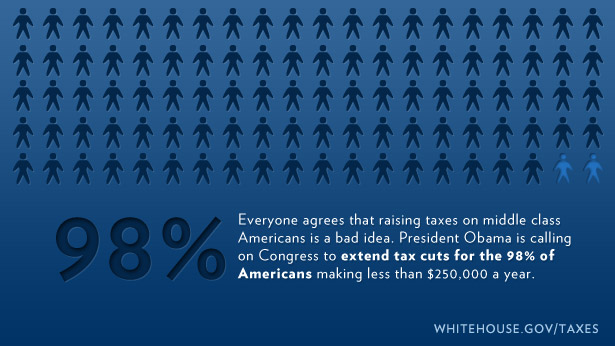
So we’re focused on implementing a law that has been passed, that has been upheld by the Supreme Court, and in calling on Congress, as the President is this week, to take actions that will provide concrete results for the American people, for the middle class, and for the economy. They could do that by passing an extension of the middle-class tax cuts that would go to 98 percent of the American people. They could do that this week and the President would sign it into law right away.
They could do it by passing the small business tax credits that -- or tax cuts that the President has put forward as part of his "To-Do" list that the Senate is acting on this week, that would reward small businesses that hire new employees or increase the wages of their existing employees. They could do it by passing the unpassed elements of the American Jobs Act that would put, by the estimate of outside economists, a million Americans back to work.
Everyone seems to agree that the economy is the central issue of our time right now in this country; that we need to help it grow, we need to take measures that help it create more jobs. Congress should be focusing on that. That’s our opinion.
Q On the whole outsourcing debate, you folks, the Obama campaign has been for some time now accusing Romney of being part of a company that outsourced jobs, and now Romney making the sort of counterclaim that stimulus dollars led to U.S. jobs going overseas. Was stimulus money sent to foreign companies?
MR. CARNEY: Well, I think there is an element here -- I would refer you for campaign-specific things to the campaign. I think there is an element --
Q But the stimulus dollars --
MR. CARNEY: -- yes, no I appreciate the question. That’s a policy question and I'll answer it. There is an element here of "I know you are but what am I" to this charge. But the facts tell a different story.
The Recovery Act, by, again, independent economists' estimation, saved or created over 3 million jobs. The Recovery Act helped create new industries in this country or build new industries in this country, including the advanced battery industry, that barely existed here in the past. And the investments in those industries helped fund thousands and thousands of jobs.
On the insourcing point, making investments that encourage foreign companies to come here and build projects that hire American workers as opposed to doing it overseas -- that’s a good thing. That’s a good thing for the American economy, and it's a good thing for American workers.
I mean, the charge is just -- it doesn’t pass the laugh test. And I would point you to what the President supports now versus what Republicans oppose. The President has been pushing for Congress to take action to reward companies that bring jobs back home to the United States, and to cease incentivizing companies for moving jobs overseas. Republicans oppose that.
So this President's record on bringing jobs home, creating jobs here in America I think is pretty clear, and it stands in stark contrast, unfortunately, to the opposition to those measures that we've seen from Republicans in Congress.
Q So you're saying stimulus money did go to foreign companies but it was to create jobs here, domestically?
MR. CARNEY: I think in some cases it went to companies that have, like a lot of companies, that have operations both overseas and in the United States. The money -- and I think there's been some good reporting on this -- the funds from the Recovery Act that went to these companies went to operations in the United States that created jobs for American workers here at home. And that was the purpose.
And again, the opposition to the Recovery Act -- at the time -- I know you were here -- there was a broad recognition that we had to do something to stop what was a crisis the likes of which most of us had never seen, economically. We now know that the economy shrank in the fourth quarter of 2008 by nearly 9 percent. We know that the economy was shedding jobs at a rate of 750,000 to 800,000 per month in January of 2009. Significant action had to be taken.
The President took that action, with the help of Congress, and the Recovery Act not only saved or created more than 3 million jobs, it helped invest in industries that will do two things: one, continue to create American jobs in the United States, and two, help develop industries in this country, especially in clean energy, that will provide us national security benefits and a competitive edge against China and India and Europe and the rest of the world going into the 21st century. It helped build a foundation for a 21st century economy that will allow us to compete at a level that otherwise we might not have been able to.
Q In the process, though, did it also help lose jobs for some of those companies overseas?
MR. CARNEY: Again, no. It did not. Not for Americans -- I would look at the reporting on this, it’s pretty clear.
Yes, in the back.
Q Thank you, Jay. Two questions. First is on Myanmar. What’s the President’s expectation to new ambassador to Myanmar, Derek Mitchell?
MR. CARNEY: What’s the -- sorry?
Q Expectation from the President to the new ambassador to Myanmar.
MR. CARNEY: What’s his expectation? I think I’d refer you to the State Department on a new ambassador. There were actions taken today by the President to ease restrictions to allow U.S. companies to responsibly do business in Burma, as you know. And easing sanctions is a strong signal of our support for reform, and will provide immediate incentives for reformers and significant benefits to the people of Burma.
I mean, I can provide more information for you on that. I don’t have anything for you on the ambassador.
Q The second question, Mr. Romney called China a cheater -- (inaudible) -- so does the President support his idea on clamping on China?
MR. CARNEY: The President has been very clear about his position on the need to take action to ensure that American companies and American workers are able to compete on a level playing field -- with China and other international competitors. And where this administration, this President, have seen unfair trade practices, we have taken action at twice the rate of the previous administration. At the WTO, as you know, there was another action taken just last week at the WTO against China over duties on -- tariffs on American automobiles.
We have a very important relationship with China that encompasses a lot of different areas. Where we have disagreements, we’re very clear about those disagreements and we work through them in a methodical way, and we take action where we believe it’s necessary.
Q So does the President believe this kind of bashing China strategy might hurt the future in U.S.-China relations?
MR. CARNEY: Well, I’m not aware of the remarks that you cited. I think the President is committed to a relationship with China that is in the best interests of the American people. And he believes that achieving that relationship is also in the best interest of the Chinese people. But he is very focused on ensuring that American companies and American workers are able to compete on a level playing field.
And that’s why he has taken the kinds of aggressive actions he has -- his administration has -- in a very methodical, non-inflammatory way, but a very direct way, through the WTO. The seventh case was brought forward last week. The six previous cases under this administration were all successful. And those successes benefit American workers and American companies.
Laura, then Wendell.
Q First I want to follow up on Myanmar announcement. Are you concerned -- or how would you respond I guess to the criticism from some activists who say that this opens the door to doing business with state oil firms that have not been part of the reforms and, in fact, that could be counterproductive?
MR. CARNEY: Well, I think that the actions announced today are fairly complex, and I think it’s important to understand what’s at work here. We retain all the authorities to impose sanctions that we had previously. We have eased some sanctions, but as we indicated in May, the armed forces and Ministry of Defense-owned entities will not be covered by these general licenses that are covered by this. In addition, U.S. companies will be asked to report on their activities in line with international corporate governance standards.
The President, as you know, also signed a new executive order that expands the Secretary of Treasury’s existing sanctions authorities to those who undermine the reform process, engage in human rights abuses, contribute to ethnic conflict, or participate in military trade with North Korea.
In sum, this order is a clear message to Burmese government and military officials: Those individuals who continue to engage in abusive, corrupt, or destabilizing behavior going forward will not reap the rewards of reform. So the measures announced today are designed to recognize the progress that has been made on reform, but retain all the authorities to ensure that those individuals who continue, or companies that continue to engage in abusive, corrupt, or destabilizing behavior do not benefit.
Q But do you anticipate that this will open the door for U.S. energy firms to do business with state-owned oil companies?
MR. CARNEY: I don’t have specific industry-based analysis for you. I can take the question. What I can tell you is that it will -- the actions taken today are designed to ensure that our ability to enforce sanctions against entities that are not engaged in positive steps towards reform remain, while allowing U.S. companies to do business in Burma in ways that help acknowledge and reward the progress that has been made.
Q And on another topic -- there's a vote expected in the Senate in a couple weeks on the tax -- the President's tax proposal. Are you at all concerned that some Democrats, perhaps who are in difficult races from more conservative states are going to have trouble supporting the President's plan and that he may not -- the party may not pull together on this issue?
MR. CARNEY: I'd say two things. One, you will hear from the President in coming days what you heard yesterday, and that is his argument for why this is an area where there is absolute consensus in Washington, and that is the need to extend middle-class tax cuts, tax cuts that benefit 98 percent of the taxpaying public. Since we agree on this, we should act on it. And I think every Democrat in the House and the Senate, and every Republican in the House and the Senate agrees at least in principle on the idea that we ought to extend those tax cuts. That's good for the American people. It's good for the middle class. It's good for the American economy.
And you will continue to hear from him in coming days as he makes that case. I made the point yesterday on the plane, on Air Force One, that one lesson that I think we have all learned in the last several months, maybe a year, is that one way to produce movement in Congress on issues that have broad support from the American people but face intransigence on Capitol Hill is to take the case to the American people. And that's what the President did with the payroll tax cut extension and unemployment insurance extension. That's what he did with other measures like this need to take action to ensure that student loan rates didn’t double.
And what we have seen is that Republican opposition to the President's position has, at least in some cases, waned as the President made that public case, because there is great public support for the President's positions.
I can't predict to you how individuals will vote, but I know that Democrats to a person support extending middle-class tax cuts.
Q You're not concerned, though, that there might be fissures?
MR. CARNEY: No. I think that what you'll see is overwhelming Democratic support. What we've seen today is overwhelming Republican opposition. What I hope is a change in that dynamic that produces significant bipartisan support for something that everyone says they agree on.
It is -- you guys are the analysts now, and the observers of the sort of broader political scene. But it does seem to me a difficult argument to make that 98 percent of Americans should not get a tax cut unless the wealthiest 2 percent get their tax cut -- the wealthiest 2 percent that has done quite well at a time when the middle class has seen its incomes stagnate or decline. How you make that argument -- I mean, I know they'll find some rhetorical devices to make it, but it doesn’t seem all that tenable. And one of the -- in the past, the refusal to move forward on just extending the middle-class tax cuts is borne out of, I think, a recognition that there is not broad public support for the idea that the wealthiest Americans, those who make more than $250,000 a year -- which is just 2 percent -- need a tax cut at a time when we can't afford it.
The middle class, I think everyone recognizes, suffered significantly during the recession, and even prior to the recession was under a great deal of pressure. And we all agree that those tax cuts should be extended for middle-class Americans. So let's get it done.
Wendell.
Q Jay, the Pentagon acknowledged yesterday that it had not made contingency plans for the $500 billion in spending cuts it would have to make if Congress and the White House don’t come up with a deficit-cutting agreement by the end of the year. Your critics say that this is irresponsible on the part of the administration. What's your reaction?
MR. CARNEY: I can tell you that while OMB has not yet engaged agencies in planning, our staff is conducting the analysis that is necessary to move forward, should that be required. And as we have made clear in the past, should it get to the point where it appears that Congress will not do its job and the sequester may take effect, OMB, the Defense Department and the entire administration will be prepared.
That said, as I've said in the past, when bipartisan majorities voted for the Budget Control Act and the President signed it into law, everyone agreed that the sequester would be, by design, harmful both to defense and non-defense programs. That was the purpose. It was designed to be onerous and objectionable and something that nobody wanted, so it would force action by Congress to come up with and to make the hard choices to create a balanced approach to further deficit reduction.
What’s needed is action to avoid the sequester by Congress by passing balanced deficit reduction along the lines that the President has put forward. But not just the President -- every bipartisan commission that’s looked at it has said that we need a balanced approach. The so-called Gang of Six that was bipartisan said we need a balanced approach.
Thus far, the obstacle to passing legislation that embodies that balanced approach has been Republicans in Congress, who I guess object on principle to the notion that everybody should do their fair share when it comes to getting our medium- and long-term deficits and debt under control.
And that’s, again, speaking of I think untenable positions, pretty untenable. Because the alternative we’ve seen -- we see it in the budget proposals that have come forward. The alternative to doing it in a way that’s balanced is to put all the burden on the middle class, the working poor, on seniors, on families with children with disabilities. I mean, if you take one approach that says, okay, we’re not doing revenue, that’s off the table, we’re not doing defense cuts -- in fact, we’re going to raise defense spending -- what’s left? And who carries the burden?
The only approach that’s appropriate, the one that Simpson-Bowles Commission endorsed, the one that the Rivlin-Domenici Commission endorsed, the one that the Gang of Six endorsed, the one that the President has endorsed is one that takes all three legs of the stool and says that we need a balanced approach that includes revenues, includes reforms to our entitlement programs that make them stronger and more financially stable, and one that includes substantial non-defense, discretionary spending cuts, as this President has signed into law.
Q Why isn’t this President leading that effort?
MR. CARNEY: He has led that effort. He has a very detailed proposal before Congress that embodies the principles in detail that I just described. Again, if it is -- if there is a broad consensus on what path needs to be taken, a broad, bipartisan consensus out in the real world on the path that needs to be taken, and then the one contingent here in Washington says, no, I won’t accept a deficit reduction deal that includes $10 in spending cuts for every dollar in revenue -- which is just so far outside of the mainstream it’s rather amazing -- I think the obstacle is clear, and I think it’s incumbent upon all of us to say, look, wait. Step back and say, what is the problem here? What’s preventing progress? What has created this stalemate?
And it is a refusal to accept the simple premise that everyone needs to do their fair share, that achieving the kind of deficit reduction that's necessary to get our fiscal house in order requires that the burden be shared, and that includes a requirement that the wealthiest among us do not enjoy an extension of tax cuts and do not get a trillion dollars of additional tax cuts when we can't afford them.
Q Do you still believe that this issue will be resolved in time to avoid the sequester? Would you accept -- I think Senator Graham is working on a one-year fix for this. Would you accept something like that?
MR. CARNEY: I think that -- there is certainly time. There's no question there's time. Because as I've said in the past, all the work that's necessary has been done. We know there is no magic here left in terms of how you make the necessary hard decisions to get the kind of deficit reduction necessary. What is required here is a little will and spine. And that means saying, I know I signed a pledge, but the right thing to do for the broader American economy and the American middle class is to take the balanced approach that everyone supports.
And I think that now is the time to come together around that balanced approach and not search for ways to get out of the commitment that Congress made back in August in a bipartisan way, which is to hold their own feet to the fire so that tough decisions were made and balanced deficit reduction was put into place.
Mike.
Q A couple things. First, following on Mr. Babbington's earlier question about the NAACP, was the President invited? And this is purely a scheduling matter that keeps him from attending this year?
MR. CARNEY: I would refer -- again, I think this is a campaign issue. In terms of the scheduling of it, I don't know the answer --
Q Well, there wasn’t a campaign in 2009. He spoke in 2009 and it wasn’t a campaign issue.
MR. CARNEY: It wasn’t a campaign issue there. I think this is -- I mean, I think the nominee for the other party spoke, as somebody just mentioned. I don't know. I think you have to ask the campaign. I don't know about invitations and schedules when it relates to the campaign in this case.
Q All right. So following up on Wendell, there is this economic calamity coming -- the fiscal cliff, the sequesters, the expiration of the tax cuts, a few other things. Both sides continue to talk past each other. The House vote today that you've already decried; Senator Reid blocked bringing up the President's tax cut proposal in the Senate -- you can call it gamesmanship, political posturing, whatever -- both sides talking past each other, but the President is speaking only to Democrats today. Why not get Republicans up here and get the ball rolling on this?
MR. CARNEY: Well, I'd answer that the way I've answered it before, which is that if all of us have learned something I think valuable in the last several months or close to a year it's that progress has been made on achieving bipartisan compromises in Congress when the President has taken an issue to the public and made his case to the American people. That was true with the payroll tax cut extension; it was true with the enactment of legislation to prevent student loans from doubling -- student loan rates from doubling; it was true with the so-called -- the JOBS Act and the STOCK Act.
I mean, these are -- I think it's pretty apparent that the opposition to these mainstream, broadly supported proposals begins to dissipate when there is public consensus and public awareness of what the right thing to do is. So that’s the --
Q -- a year and a half ago when the President extended all the tax cuts, including the ones for the most wealthy. So what's different? The President had the bully pulpit then.
MR. CARNEY: Well, first of all, there are significant differences. And I would remind you that there was a lot to that package, not just the extension of the so-called Bush tax cuts.
Secondly, we have made, the President has made his position clear. Ninety-eight percent of the American people need to have and should get, and he supports them getting, an extension of tax cuts. And the tax cuts here include not just the Bush tax cuts, but the extension of tax cuts that he put into law in 2009 that benefit the middle class and were not included in the gimmick vote -- or proposal today in the Senate, by the way.
So the President believes that this is the way, and I think evidence suggests that this is the best way to try to get something done here that will help the American economy. And others have asked me -- this is just politics, you're trying to create a contrast. And my answer to that, and I know the President's answer is if that’s what you believe, you think this is just politics that we want to take advantage of, deprive us of that opportunity by passing the legislation that we all support. Take it away. Take this away from the President and give it to the American people. Give them a tax cut.
Q I just have one more question, and it's a completely unrelated topic. Some noted public officials from Illinois -- Dick Durbin, Luis Gutierrez, the minority whip in the House -- today all say that Congressman Jackson needs to divulge more information about what's keeping him from tending to his duties in Congress. What does the President think?
MR. CARNEY: I have no idea. I haven't spoken to him about it, and have not myself given a thought to it. So I don’t know.
Yes. And then Kevin.
Q Will the President and congressional Democrats leave this meeting today with a timeline for a vote on the middle-class tax cut?
MR. CARNEY: Well, the President is meeting with congressional Democrats, and they will discuss a broad range of issues, including the need to extend middle-class tax cuts, but the need to take action to help small businesses; the need to pass elements of the American Jobs Act that have not been passed that would put up to a million Americans back to work. So it will be a discussion of the broader agenda, not just this issue.
I am confident, just citing what Senator Reid said the other day, that the Senate will have an opportunity to vote on the proposals that the President has made to extend middle-class tax cuts to 98 percent of the American people. But I don’t have any announcements to make from here in terms of Senate schedule. I leave that to the Majority Leader.
Q Does the President agree with Senator Reid blocking the vote today?
MR. CARNEY: Well, I think I did it in sort of shorthand. The vote today -- first of all, the Senate is considering a very important proposal that would give a tax break to small businesses that hire new workers and expand their payroll. If we care about small businesses, as this President does, the Senate should overwhelmingly pass that. It should gain Republican support. It would be, I think, the 19th small business tax cut that this President has signed into law if it were to pass the Congress.
On the issue of the -- I think it was the Hatch proposal that was put forward -- it was not the President’s proposal. It did not include the other middle-class tax cuts that were part of the President’s proposal and, in fact, would result in, if passed, raising taxes on 25 million American families. So the President doesn’t support that.
If it looks like a gimmick, it usually is, and that’s a gimmick. And we know that, broadly, the American people, Republicans and Democrats in Congress, most folks even of no political persuasion at all, support the idea that we ought to extend these middle-class tax cuts. And the only thing holding it up is the idea that 98 percent of us -- 98 percent of the country shouldn’t have a tax cut unless the top 2 percent get a tax cut.
And the President’s position is we can’t afford it for the top 2 percent. The middle class needs it. The economy needs it. But we cannot afford tax cuts -- extending tax cuts that over a decade would cost close to a trillion dollars; tax cuts that contributed to the massive deficit that the President inherited when he took office in January 2009.
Q And there’s no compromise there between $250,000 and, say, $500,000 and $750,000? He would not sign --
MR. CARNEY: I think this is something of a Bloomberg specialty in terms of like -- (laughter) -- the proposals that I’m aware of are $250,000, which is the President’s position in extending the high-end tax cuts. The President would not support, would not sign into law, would veto legislation that extended the high-end tax cuts. He will sign tomorrow an extension of the middle-class tax cuts.
Q Jay, in what way is Hugo Chavez’s government in Venezuela not a serious security threat to the U.S.?
MR. CARNEY: You know what, I’m going to have to refer you to the State Department on that. I saw that story before I came out, but I haven’t -- I didn’t read it, so I don’t know the underlying aspect of it.
Kevin.
Q Thanks, Jay. On outsourcing -- in 2008, candidate Obama promised to end tax breaks to companies that ship jobs overseas. We heard it yesterday in Cedar Rapids. We just touched on it again. Why hasn’t that happened in three and a half years?
MR. CARNEY: Because unfortunately, there is a constituency in Congress that supports tax breaks for companies that ship jobs overseas. The President believes, again, that we need to have a tax code that creates incentives for companies to do the opposite, that bring jobs home, that create jobs at home. And we certainly shouldn’t have a tax code that provides incentives to companies to move jobs overseas, and that’s very much an initiative that he supports.
The fact that it’s not easily achieved I will acknowledge. But it is the right thing to do, and it is broadly supported by the American people. It is opposed, unfortunately, by the Republicans in Congress, although I think that -- I’m a firm believer in the possibility of compromise in the future.
And I think that one of the things that’s unique about our economic situation now is, as you know, we’ve seen a recovery in manufacturing jobs in this country that -- I just looked at some data recently that showed that in the recovery from the recession in 2001, 2002, manufacturing continued to lose jobs. But we have a situation where we have had a return of manufacturing jobs in this country, and we need to do everything we can to keep that going.
One of the reasons why we have that happening is because of the actions the President took to save the automobile industry in the United States. But there are numerous other things that the President and Congress have done to help encourage investments in manufacturing that go back to the question that I think Dan asked about the Recovery Act. We need to do everything we can to encourage job creation here in the United States.
Q But given the importance of these -- ending these breaks that the President has been really putting the spotlight on lately -- you just said a few minutes ago, Republican opposition waned when he made the case on student loans, on payroll taxes. Did he wait too long on this issue that was such a key part --
MR. CARNEY: He has always supported this issue, and it would be a wonderful thing if you could get everything that needs to be done, done in your first month or year. This needs to get done, and that’s why you’re hearing him argue for it now. And he’ll continue to make the case, and it’s an important case.
I mean, at the very least, we shouldn’t be giving tax breaks to companies to take jobs overseas. And certainly the next step is to make sure that we’re creating incentives for companies to bring jobs home. I think that’s a principle that enjoys broad support.
Jon-Christopher.
Q Sky News is reporting Syrian opposition sources say the country’s ambassador to Iraq had defected, becoming the latest Assad defector. Any comment?
MR. CARNEY: I got that question earlier -- I can’t confirm it. What I can say is that we have seen an increasing number of defections, including a recent defection from President Assad’s inner circle. And I think that just indicates, again, the deterioration of Assad’s situation in that country, his lack of support, and the recognition around him -- both in the government and the military -- that he is not going to be part of Syria’s future. And if they love Syria and they care about the Syrian people, the right choice, the right decision is to abandon the regime. But on that specific report I have not received confirmation.
Q My McClatchy colleague, Marisa Taylor, yesterday published several articles that revealed startlingly aggressive use of polygraph tests by the National Reconnaissance Office of job applicants and employees to try to reveal personal information about these people, even going so far as to award bonuses to the polygraphers who have come up with the most intimate details. Is there any concern by you or the President or other administration officials about this?
MR. CARNEY: I confess that, although I have heard that those stories were published, I have not read them, so I don’t have a detailed response. I do believe that the NRO has responded on the record, and I would point you to those statements. But I don’t have more for you on it, and I have not discussed it with the President.
Donovan -- sorry, I just don’t have anything more for you on it.
Q Thanks, Jay. Not to go back to another question --
MR. CARNEY: No, that’s fine.
Q -- you said the “outsourcer-in-chief” claims by the RNC are part of the game of “I know you are, but what am I?” But can you -- so can you say that, yes, stimulus dollars did go overseas, or they did not?
MR. CARNEY: Look, I think -- I’m happy to provide you all the background on this. I think that there has been some very good reporting by your colleagues that demonstrate that -- and by -- from the companies themselves that have been cited here, that demonstrate that Recovery Act dollars helped create jobs for Americans here in the United States. And when you have foreign companies that are creating operations here in the United States, the fact that in one case some South Koreans were also part of that, the broader truth of it is, is that many, many jobs for Americans were created here, and facilities were built here that will continue to create jobs and give economic benefit here in the United States. That was the idea behind the Recovery Act.
I mean, I think that the idea that investments that helped bring jobs here to the United States took place is something that is a very positive thing. And again, broadly speaking, the Recovery Act is widely recognized, even by many of its detractors, to have saved or created over 3 million jobs.
Q So these accusations that some of the money went to pay for foreign workers --
MR. CARNEY: I think they have been uncovered. I would simply -- because some people, for reasons I don’t understand, might discount what I say, I would point you to the reporting of your colleagues that uncovered those charges and revealed them for what they are, which is specious.
Yes, Scott.
Q But, Jay, doesn’t that sort of undermine the whole outsourcing argument, though -- the notion that if money invested overseas also creates jobs here, isn’t that also true for the kinds of investments that Bain made?
MR. CARNEY: If you want to get into campaign-specific questions, I can refer you to the campaign. I can tell you what -- I can talk about the Recovery Act at length, having spent my first two years working for the Vice President as he oversaw the enactment of it. The point of distinction here is that those investments created jobs here. They didn’t create jobs overseas, they created jobs here in the United States and for American workers. And that was the purpose of the Recovery Act, and it fulfilled that purpose. But for the campaign stuff I’d refer you to the campaign.
Q Thank you, Jay.
MR. CARNEY: All right. Thanks, guys. I appreciate it.
END
2:58 P.M. EDT