The White House

Office of the Press Secretary

President Obama Announces More Key Administration Posts

WASHINGTON, DC – Today, President Barack Obama announced his intent to nominate the following individuals to key Administration posts:
 
• Dorothy Kosinski – Member, National Council on the Humanities
• Dawn M. Liberi – Ambassador to the Republic of Burundi, Department of State
• Stephen D. Mull – Ambassador to the Republic of Poland, Department of State
• Walter North – Ambassador to Papua New Guinea, the Solomon Islands, and the Republic of Vanuatu, Department of State
 
President Obama said, “I am honored that these talented individuals have decided to join this Administration and serve our country.  I look forward to working with them in the months and years to come.”
 
President Obama announced his intent to nominate the following individuals to key Administration posts:
 
Dr. Dorothy Kosinski, Nominee for Member, National Council on the Humanities
Dr. Dorothy Kosinski has served as Director of The Phillips Collection since 2008.  Prior to joining The Phillips Collection, Dr. Kosinski worked at the Dallas Museum of Art, where she served in a number of capacities from 1995 to 2008, last as Senior Curator of Painting and Sculpture.  From 1985 to 1997, she worked with the Douglas Cooper Collection of cubist art in Basel, Switzerland.  She also served as an independent curator of major exhibitions at the Royal Academy of Arts, London; The Kunstmuseum Basel; The Kunstmuseum Wolfsburg; and The National Gallery in Prague. Dr. Kosinski has written and edited many books and catalogs on a variety of art topics including 19th Century Symbolism, Dada, Surrealism, 20th Century sculpture and contemporary art.  She currently serves on the Board of the Association of Art Museum Directors and the Advisory Board of The Musée Rodin, Paris. Dr. Kosinski received a B.A. from Yale University and an M.A. and Ph.D. from the Institute of Fine Arts at New York University.
 
Dawn M. Liberi, Nominee for Ambassador to the Republic of Burundi, Department of State
Dawn M. Liberi, a career member of the Senior Foreign Service, class of Career Minister, most recently served as the Senior Assistance Coordinator at the U.S. Embassy in Tripoli.  From 2009 to 2011, she served as Coordinator for the Interagency Provincial Affairs Office at the U.S. Embassy in Kabul and as Senior Civilian Representative for the Combined Joint Task-Force 82 with the International Security Assistance Force Regional Command-East at Bagram Airfield, Afghanistan.  From 2006 to 2009, she was an Executive Civil-Military Counselor with USAID.  From 2005 to 2006, Ms. Liberi was the USAID Mission Director in Iraq.  She previously served as the USAID Mission Director in Nigeria (2002-2005) and Uganda (1998-2002).  Other assignments have included: USAID Associate Assistant Administrator in the Global Bureau, Population, Health and Nutrition Office (1994-1998); USAID Deputy Mission Director in Ghana (1992-1994); and Population, Health and Nutrition Technical Officer for USAID's missions in Senegal and Niger from (1981-1987).  Ms. Liberi received a Bachelor's Degree from Hampshire College and an M.P.H. from the University of California at Berkeley.  
 
Ambassador Stephen D. Mull, Nominee for Ambassador to the Republic of Poland, Department of State
Ambassador Stephen D. Mull, a career member of the Senior Foreign Service, Class of Career-Minister, is Executive Secretary at the Department of State, a position he has held since June 2010.  Prior to this position, he was Senior Advisor to the Under Secretary for Political Affairs from 2008 to 2010, and Principal Deputy Assistant Secretary for Political Military Affairs from 2006 to 2008.  From 2007 to 2008, he served concurrently as Acting Assistant Secretary for Political-Military Affairs.  Ambassador Mull served as U.S. Ambassador to the Republic of Lithuania from 2003 to 2006, and as Deputy Chief of Mission at the U.S. Embassy in Indonesia from 2000 to 2003.  With over 30 years of service at the State Department, Ambassador Mull’s previous positions include: Deputy Executive Secretary (1998-2000); Director of the Office of Southern European Affairs (1997-1998); Political Counselor at the U.S. Embassy in Poland (1993-1997); and Deputy Director of the State Department Operations Center (1991-1993).  Ambassador Mull received a B.S. from Georgetown University.
 
Walter North, Nominee for Ambassador to Papua New Guinea, the Solomon Islands, and the Republic of Vanuatu, Department of State
Walter North, a career member of the Senior Foreign Service, class of Career-Minister, is currently the United States Agency for International Development (USAID) Mission Director in Egypt.  Mr. North previously served as USAID Mission Director in Indonesia (2007-2011); India (2000-2004); and Zambia (1996-2000), as well as Deputy Mission Director in Ethiopia (1992-1996).  Posts at USAID’s Washington headquarters have included: Interim Assistant Administrator for the Bureau for Africa (2006-2007); Deputy Assistant Administrator for the Bureau for Policy and Program Coordination (2005-2006); and Deputy Assistant Administrator for the Bureau for Asia and the Near East (2004-2005).   Before joining USAID in 1980, Mr. North was a project manager for the non-profit, humanitarian organization, CARE in India and Bangladesh, and a Peace Corps Volunteer in Ethiopia. He received a B.A. from Lawrence University, a J.D. from George Washington University Law School, and an M.P.A. from Harvard University.
 

The White House

Office of the Press Secretary

Remarks by the President at Campaign Event -- Cedar Rapids, IA

Kirkwood Community College
Cedar Rapids, Iowa

12:58 P.M. CDT

THE PRESIDENT:  Hello, Cedar Rapids!  (Applause.)  Oh, it is good to be back.  (Applause.)  Love Cedar Rapids! 

All right, a couple of people I want to acknowledge.  First of all, please give Jason and his wife Ali a big round of applause.  (Applause.)  They are just wonderful people.  I'm so glad I had a chance to meet them.  Now, they're debating what to name their son, so if you guys have some suggestions.  (Laughter.)  I asked them, what about Barack?  (Laughter.)  That was not yet on the list.  (Laughter.)  But they are wonderful people and they've got an incredibly cute guy named Cooper.  And so I really thank them for their hospitality and we appreciate them so much.  And Jason is starting as a high school principal, so wish him good luck.  (Applause.)  He's going to do a great job. 

I want to acknowledge Mick Starverich --

AUDIENCE:  Starcevich.

THE PRESIDENT:  Starverich.

AUDIENCE:  Starcevich.

THE PRESIDENT:  Starcevich.  (Applause.)  I call him Mick.  (Laughter.)  And he is the President of Kirkwood and our host today.  Thank you so much.  (Applause.)

I want to acknowledge our outstanding MC, Peggy Whitworth.  (Applause.)  Great friend.  Great friend of mine.  And one of my dearest friends here in Iowa, your outstanding Attorney General, Tom Miller, is in the house.  (Applause.) 

Now, if you guys have a seat, feel free to take a seat.  That way, if it gets a little warm, I don't want anybody getting overheated.  You guys are kind of out of luck.  (Laughter.)  So make sure you're hydrated. 

And Abraham Lincoln is in the house! (Applause.)  My homeboy from Illinois -- (laughter) -- and an outstanding Republican endorsee.  (Laughter and applause.)  There you go.  

Now, unless you’ve managed to hide your television somewhere for the last year, you may be aware that it is now campaign season.  (Laughter.)  And here in Iowa it seems like it’s always campaign season.  You guys can't get away from it.  And I know that it is not always pretty to watch.  There is more money flooding the system than ever before.  There's more negative ads. There's more cynicism.  Most of what you hear in terms of the news is who’s up or who’s down in the polls, instead of how any of this relates to your lives and the country that you love.

So I know that sometimes it can be tempting to lose interest and to lose heart and to get a little cynical.  And frankly, that's what a lot of people are betting that you do.  But I’m betting that you won’t.  I’m betting that you are going to be as fired up as you were in 2008 -- (applause) -- because you understand the stakes for America.  (Applause.)  

Most of you are here because you know that even though sometimes our politics seems real small and petty, the stakes in this election could not be bigger.  What’s at stake is bigger than two candidates, it's bigger than two political parties.  What’s at stake is two very different visions for our country. 
And, Cedar Rapids, the choice that we make that will help determine our direction for years to come -- that choice is going to be up to you.

AUDIENCE:  Obama!  (Applause.)

THE PRESIDENT:  That’s a good choice.  (Applause.)

This will be my last political campaign, no matter what.  I’ve got nothing else to run for.  (Laughter.)  But it’s got -- and because of that, you start feeling a little nostalgic and you start thinking about some of your first campaigns.  I think about all the places I used to travel in Illinois and the first race I ran as a state senator.  And Michelle and I had to Xerox or go to Kinko’s and copy our little flyers, and we didn’t have a TV budget back then.  (Laughter.)  And we rode around in my car and I filled it up with my gas -- (laughter) -- and I’m the one who got lost if I took a wrong turn.  (Laughter.)   

And what’s amazing, though, when I think about it was how many people you’d meet from every walk of life all across Illinois in big cities, small towns, upstate, downstate, quads, you name it.  And you’d always hear similar stories from people about their parents or their grandparents and the struggles they had gone through, and how they had been able to find a job that paid a living wage and look after their families and their kids had done a little better than they did.  And those stories would resonate with me and Michelle because that was our story, that was our lives.

And then when I came to Iowa for the presidential campaign  -- first stop, Cedar Rapids -- (applause) -- first stop.

AUDIENCE:  We love you!

THE PRESIDENT:  I love you back.  (Applause.)

And the first stop was Cedar Rapids.  And then we went on to Waterloo.  That was the first time I had campaigned as President, and I was kind of nervous.  We had this huge town hall, and I don’t remember what I said.  (Laughter.)  Most of the time I was just worrying about screwing up.  (Laughter.)  But the same thing that I saw in Illinois I was seeing in Iowa.  This was a state that gave me a chance when nobody else would.  (Applause.) 

And no matter what the national media was saying, no matter how far down we were in the polls, we’d come here and Michelle and I we’d feel hopeful, because we had that same conversation that we had had in my first race as a state senator or my first race as U.S. senator -- going to state fairs and stopping in towns and visiting VFW halls and diners -- and meeting people whose lives on the surface might have looked different than mine, but when you heard their stories, they were a common story.

I thought about my grandparents whose service in World War II was rewarded -- when my grandfather came back from the war and my grandmother worked on a bomber assembly line -- and they were able to go to college on the GI Bill, buy their first house with an FHA loan.  (Applause.) 

I had a single mom who, with the help of my grandparents, was able to send my sister and me to great schools, even though she didn’t make a lot of money.  She was struggling to put herself through school and working at the same time.  And Michelle would think about her father, who had worked as a stationary engineer at the water filtration plant -- blue-collar job all his life.  And her mom, who was a stay-at-home mom, and then worked as a secretary for most of her life.

And we thought about how far we had come, and the fact that our lives were a testament to that fundamental American ideal that no matter who you are, no matter what you look like, no matter where you come from, America is a place where you can make it if you try.  (Applause.)  America is a place where you can make it if you try.  (Applause.)

And that same story -- my family story, Michelle’s family story -- I heard it from you guys.  It was your story.  And we understood.  And we’d sit and talk and we’d agree that America has never been a country of people looking for handouts.  We’re a nation of workers and dreamers and doers.  (Applause.)  And we understand that we’ve got to work for everything that we’ve got. And all we ask is for is that hard work pays off, that responsibility is rewarded; so that if you put in enough effort, if you’re willing to put in some sweat and tears and overcome some difficulties in your life, then you can find a job that pays the bills, and afford a home that you can call your own, and count on health care when you get sick -- (applause) -- and put away enough to retire on, maybe take a vacation once in a while.

I was telling folks in Ohio the other day, I remember my favorite vacation when I was 11 years old, traveling the country with my grandmother and my mom and my sister.  And once in a while we’d rent a car, but a bunch of times we’d just take Greyhound buses.  And sometimes we’d take the train and stay at Howard Johnsons.  And as long as there was a little puddle of a pool, I’d be happy.  (Laughter.)  And you’d go to the ice machine and the vending machine and buy a soda and get the ice, and you were really excited about it.  (Laughter.) 

And what was important was just the time that you had to spend with your family.  It wasn’t anything fancy, but you understood that you could spend time with your family.  They were cared for.  You had a sense of security.  You could provide for your children an education that would allow them to do even better than you did.  (Applause.)  That was the basic bargain that built America’s middle class, the largest middle class on Earth.  That's what built our prosperity, the greatest economy the world has ever known.  (Applause.)

And so those shared memories, those shared stories -- that was the basis of our campaign when I ran for President.  That's why I talked about the first time I came to Cedar Rapids, because we came together as Democrats and independents and Republicans because for too long that basic bargain, that vision of what it means to make it in America, had been slipping away for too many folks.  People were working harder for less.  It was getting more difficult to save, more difficult to retire.  The cost of health care and college was going through the roof.   

And we understood that turning that around was not going to be easy.  We knew it would take more than one year or one term or maybe even one President.  Now, what we didn't know was that we were about to get hit with the worst economic crisis in our lifetimes.  And that crisis has put us through some really tough times -- here in Iowa and all across the country.  It robbed millions of our fellow Americans their jobs and their homes and their savings.  And it made the American Dream seem even further out of reach for too many hardworking people.

But the basic idea of why I ran in 2008, the reason you're here today, is because that crisis did not change who we are.  It did not change our character.  It did not change our values.  We still know what makes us great.  (Applause.)  We still know that what makes us great is the fact that if you work hard in this country, you can still make it -- that vision we still believe in.  (Applause.)  The vision of a strong middle class is what we're fighting for.  (Applause.) 

Our mission right now is not just to recover from a recession.  It's to reclaim the basic security that so many Americans have lost.  Our goal is to put people back to work, but it's also to build an economy where that work pays off, an economy in which everybody, whether they start a business or they're punching a clock, can have confidence that if you work hard, you can get ahead.  (Applause.)  

That’s what this campaign is about, Iowa.  That’s what I've been fighting for, for the last three and a half years.  And that's why I’m running for a second term as President of the United States.  (Applause.)
 
Now, you know what’s holding us back from meeting this challenge is not a lack of ideas or a lack of solutions.  What's holding us back from making even more progress than we've made is a stalemate in Washington between two fundamentally views about which path we should take as a country.  And this election is about breaking that stalemate.  (Applause.)

This election will determine our economic future for the next generation.  And, frankly, the choice could not be clearer. My opponent, his allies in Congress, they sincerely believe that prosperity comes from the top down. 

AUDIENCE:  No!

THE PRESIDENT:  They believe that if we spend trillions of dollars more on tax cuts -- mostly for the wealthy -- that it will somehow create more jobs, even if we have to pay for it by gutting education, chopping assistance to community colleges and Pell grants, cutting back on training --

AUDIENCE:  No!

THE PRESIDENT:  -- raising middle-class taxes.

AUDIENCE:  No!

THE PRESIDENT:  They believe that if we roll back regulations that we put in place on banks and insurance companies and oil companies, all meant to protect our people and our economy, that somehow everybody is going to be better off.

AUDIENCE:  No!

THE PRESIDENT:  And I think they're wrong.  I think they're wrong.  (Applause.)

And listen, listen, it’s not just my opinion.  We tried it their way through most of the last decade, and it didn't work.  (Applause.) 

We fought two wars on a credit card; still paying for trillions of dollars in tax cuts that didn't lead to more jobs or better wages for the middle class.  And the lack of rules on Wall Street is what allowed people to take shortcuts and game the system in a way that caused this whole mess in the first place. So we tried what they're selling, and it didn't work.  And somehow they think you don't remember.  (Laughter.)  But you remember, and we don't need more top-down economics.

What we need is somebody who's going to fight every single day to grow the middle class -- (applause) -- because that's how our economy grows, from the middle out, from the bottom up, where everybody has got a shot.  That's how the economy grows.  (Applause.)

So I was over at Jason and Ali’s -- and wonderful, wonderful story, really nice family.  Jason is the new principal over at Central City High.  Ali is an account manager at a document scanning company.  They’ve got a very cute four-year-old, Cooper, and then the yet-to-be-named other cute one.  (Laughter.)  They met at a convenience store where they worked while they were in school.  Apparently, Ali was Jason’s boss.  (Laughter.)  And she is still his boss.  (Laughter and applause.)  That does not change.  That's how it works.  (Laughter.)

So we were talking about something that nobody looks forward to, and that's paying taxes.  Everybody understands it’s something you have to do; you don't love doing it.  But we were talking about how over the last four years, because of policies my administration put in place, we’ve been able to offer the McLaughlins about $4,900 in tax relief.  (Applause.)

And they’ve said that’s made a real difference in their lives.  It’s helped them pay their bills; helped them get day care for Cooper.  We were sitting and I was telling them the house they're in now is roughly the same size as the house that Michelle and I lived in for the first 13 years that we were married.  We had a little co-op.  And when they were talking about the bills, I remembered going through them.  You got the mortgage.  You got the student loans.  You got the electricity bill, car note, gas bill, day care.  Everything they were talking about was familiar because Michelle and I went through it.  And that $4,900 helped.  It made a difference.

Now we’ve got a choice to make, because on January 1st, taxes are scheduled to go up on everybody in America.  That's what the law says right now -- if we don't do anything, if Congress doesn't do anything, taxes will go up on everybody at the end of this year.

Yesterday I called on Congress to stop any tax hikes for the 98 percent of Americans who are just like the McLaughlins -- just like you.  (Applause.)  Because if Congress doesn't act, then that tax hike could cost up to $2,200 for a family of four.  That wouldn’t just be a big financial hit for Jason and Ali, because as they pointed out -- and this is what I love about America and what I love about them -- they said, as tight as things may be for us, we’re a lot better off than a lot of folks we know.  So imagine if it’s tough for them what it’s going to be for somebody else. 

AUDIENCE MEMBER:  Like my mom.

THE PRESIDENT:  Like your mom.  (Laughter.)

AUDIENCE MEMBER:  That's right. 

THE PRESIDENT:  It would be not only a huge blow to those families, it would be a big blow to our entire economy at a time when we need all the help we can get. 

Now, I believe that we should make sure that taxes on the 98 percent of Americans don't go up, and then we should let the tax cuts expire for folks like me, for the top 2 percent of Americans.  (Applause.)

So anybody making over $250,000 a year, including me, we’d go back to the tax rates that we were paying under Bill Clinton, which, by the way, was a time when our economy created nearly 23 million new jobs, the biggest budget surplus in history and created plenty of millionaires to boot.  (Applause.) 

And by the way, the reason I say that is not because I just love to pay taxes.  (Laughter.)  It’s because I know I can afford it, and to give me another tax break or to give Warren Buffett another tax break, or to give Mitt Romney another tax break --

AUDIENCE:  No!

THE PRESIDENT:  -- that would cost about a trillion dollars, and we can’t afford it -- not at a time where we’re trying to bring down our deficit.  Not at a time when we’re trying to reduce our debt.

So this has nothing to do with me wanting to punish success. We love folks getting rich.  I hope Malia and Sascha go out there and if that’s what they want to do, that’s great.  But I do want to make sure that everybody else gets that chance as well.  And for us to give a trillion dollars’ worth of tax breaks to folks who don’t need it -- (applause) -- to folks who don’t need it and aren’t even asking for it, that doesn’t make sense.

Now, the Republicans in Congress and Mr. Romney disagree with me.  And that’s what democracy is all about.  They want more tax cuts for the wealthiest Americans -- on top of the existing Bush tax cuts, they want to give $5 trillion more in tax cuts.  And that fight is a big part of what this election is about.  We’re going to have that debate -- here in Iowa and all across the country.

But in the meantime, doesn’t it make sense for us to agree to keep taxes low for 98 percent of Americans who are working hard and can’t afford a tax hike right now?  (Applause.) 

I mean, think about it.  I want to hold taxes steady for 98 percent of Americans; Republicans say they want to do the same thing.  We disagree on the other 2 percent.  Well, what do you usually do if you agree on 98 percent and you disagree on 2 percent?

AUDIENCE MEMBER:  Compromise!

THE PRESIDENT:  Why don’t you compromise to help the middle class?  Go ahead and do the 98 percent, and we can keep arguing about the 2 percent.  Let’s agree when we can agree.  (Applause.)

Let’s not hold the vast majority of Americans hostage while we debate the merits of another tax cut for the other 2 percent. In other words, let’s stand up for families like yours that are working hard every day, give you some certainty so you can start planning, so you have an idea of what’s coming next year. 

And that’s what this election is about.  Ultimately, Cedar Rapids, that’s why I’m running for a second term as President -- because I believe we can make progress right now that helps you and your families.  That’s what I’m going to be fighting for.  (Applause.)

AUDIENCE:  Four more years!  Four more years!  Four more years!  Four more years!  Four more years!

THE PRESIDENT:  Now, this tax issue is part of a broader debate we’re going to have about how we rebuild an economy that grows the middle class and gives opportunity to everybody who is trying to get into the middle class.

When the American auto industry was on the brink of collapse and more than one million jobs were on the line, Governor Romney said we should "let Detroit go bankrupt." 

AUDIENCE:  Booo --

THE PRESIDENT:  I refused to turn my back on a great American industry and great American workers.  (Applause.)  I bet on American workers.  I bet on American manufacturing.  And three years later, the American auto industry has come roaring back.  (Applause.)  That's what this election is about.  (Applause.)  

Because what’s happening in the auto industry can happen in other industries, and I’m running to make sure it does.  I want hi-tech manufacturing to take root in places like Cedar Rapids and Newton and Des Moines.  (Applause.)  I want goods stamped with "Made In America" selling all around the world.  (Applause.) I want to stop giving tax breaks to companies that ship jobs and factories overseas, and start rewarding companies that create jobs right here in the United States of America.  (Applause.) 

Governor Romney has experience owning companies that were called "pioneers" in the business of outsourcing.  My experience has been working with outstanding members of labor and great managers to save the American auto industry.  (Applause.)  And as long as I’m President, I will keep fighting to make sure jobs are located here in the United States of America.  (Applause.)

But we can't stop there.  I'm running to make sure that America once again leads the world in educating our kids and training our workers.  (Applause.)  Our tuition tax credit has saved millions of families thousands of dollars.  I want to extend it.  We just won the fight that we were having with Congress to stop the federal student loan rate from doubling for more than 7 million students.  (Applause.)  We got that done.  Now, I want to work with presidents and officials at universities and community colleges to bring the cost of tuition down once and for all. 

I want to help our schools hire and reward the best teachers, especially in math and science.  (Applause.)  I want to give 2 million more Americans the chance to attend great community colleges like Kirkwood, help them learn the skills that local businesses are hiring for right now.  Because higher education is not a luxury in the 21st century, it is a necessity, and I want everybody to be able to afford it.  (Applause.)  That's what this election is about.  (Applause.)

My administration has already helped more than a million responsible homeowners refinance their mortgages.  Well, I'm running to give more folks like them a chance to refinance and save $3,000 a year.  My opponent’s plan is to let the housing market "hit bottom."  That's not a solution; that's part of the problem.  That's a choice in this election.   

I’m running because I believe that nobody in America should go broke just because they get sick.  (Applause.)  Our health care law was the right thing to do.  (Applause.)  It was the right thing to do.  And you know what, I will work with anybody to improve the health care law where we can.  But this law is here to stay.  (Applause.) 

And it will help the vast majority of Americans feel greater security.  (Applause.)  If you’ve got health insurance, it’s going to be more secure because insurance companies can’t jerk you around because of fine print.  If you don’t have health insurance, we’ll help you get it.  They’re not going to be able to discriminate against you in buying health insurance because you’re sick.  And we’re not going to tell the six million young people who have already been helped because they’re now on their parent’s insurance plan that suddenly they’re on their own.  And we’re not going to turn Medicare into a voucher system.  (Applause.) 

We’re not going to refight political battles from two years ago or three years ago.  We’re going to move forward, and help every American make sure they feel some security when it comes to health care.  (Applause.)

I’m running because after a decade of war, we stopped and ended the war in Iraq, we’re transitioning out of Afghanistan, and now it’s time to do some nation-building here at home.  (Applause.)  So I want to take about half the money we’re no longer spending on a war and let’s use it to put people back to work -- (applause) -- rebuilding our roads, rebuilding our runways, our ports, our wireless networks.  \

I know we’ve got some trades here in the house.  These guys, they’re ready to work.  They’re ready to put a hardhat on.  They’re read to rebuild America.  That’s what we need to be doing all across Iowa, all across this country.  We can’t go back.  We’ve got to move forward.  (Applause.)

And I am running to make sure that we can afford to pay down our debt and our deficits in a way that is responsible.  After a decade of irresponsible decisions, we need to reduce it, but in a balanced, responsible way.  I will cut spending that we can’t afford -- 

AUDIENCE  Be sure you help our vets!

THE PRESIDENT:  And we’re going to help our vets -- we’re doing it.  We’ve actually increased veterans funding since I’ve been President higher than any time in 30 years.  (Applause.)

But in order to bring down our debt and our deficits in a responsible way, it means cutting out things we can’t afford.  Not every government program works -- we can streamline government.  I’ve asked for authority from Congress to make sure that government is suited for the 21st century, not the 19th century.  (Applause.) 

But what we’ve also got to do is ask the wealthiest Americans who enjoyed the biggest unlike tax cuts over the past decade to just pay a little bit more.  And here’s the thing.   There are plenty of patriotic, successful Americans who want to make this contribution.  They’re willing to do it because they remember how they got successful. 

All of these things -- whether it’s bringing manufacturing, or getting construction workers back on the job, or protecting your health care, or saving the auto industry, or making sure our kids get the best education, making sure our veterans get the care they deserve after fighting on behalf of our freedom -- all these things that make up a middle-class life, they’re all tied together.  They’re all central to the idea that made this big, diverse, hopeful, optimistic, hardworking country great -- the idea that if you work hard, you can have the security to make of your life what you will.  The idea that we are all in this together. 

We are individuals, and we have to take responsibility and nobody is going to offer you anything, but ultimately there are some things we do together.  That’s the promise of our parents and our grandparents.  They passed it down to us.  It’s the promise we have to pass down to our kids and our grandkids -- that we don’t just look out for ourselves.  We look after other people, too, in our communities, in our states, in our nation, and next generation of Americans.  (Applause.) 

So over the next four months, you’ll see the other side spending more money than we’ve ever seen before.  And even though there will probably be a bunch of different ads, they’ll all have the same message.  They’ll all say:  The economy is not where it needs to be and it’s Obama’s fault.  That’s basically their idea. They know their economic theory isn’t going to sell, so all they can say is, unemployment is still too high; folks are still struggling and it’s Obama’s fault.  That’s their message.  That’s it.  They don’t have another one.  (Laughter.)  I guarantee you, you watch every ad, that’s going to be the message. 

Now, that may be a plan to win an election, but it’s not a plan to create jobs.  It sure as heck is not a plan to grow our economy.  (Applause.)  It’s not a plan to revive our middle class.  They don’t have that plan.  I’ve got that plan, Iowa.  (Applause.) 

So let me tell you, we have been outspent before, we’ve been counted out before.  But through every one of my campaigns, what’s always given me hope is you -- your ability to cut through the nonsense; your ability to identify what’s true, to tap into those values that we all believe in. 

I know that you guys remember the story of your family just like I remember mine -- and all the struggles of our parents and our grandparents and great-grandparents -- everything they went through –- some of them coming here as immigrants, maybe working in a mine, working on a mill, farming the land.  They didn’t know what to expect, but they understood there was something special about this country.  They knew that this was a country where people are free to pursue their own dreams, but that we still come together as one American family. 

And they knew that being middle class wasn’t just about having a certain amount of money in your bank account.  It was about the values you cared about, and the responsibilities that you took, and the communities that you believed in, and how you were able to have some security to take care of your family and give your children a better chance than you did.

And when we come together and we tap into those values, when we remember what we’re made of and who we are and how we got here, and that we didn't get here alone because somebody out there was helping us along the way, then all that money spent on TV advertising doesn't matter.  All those negative ads don't happen.

AUDIENCE MEMBER:  We're not buying it!

THE PRESIDENT:  That's what I remember.  That's what I know about -- how you guys not only inspired me but you inspired each other.  And you can still do that.  You still inspire me.

When I told you in 2008 that I was running for President, I told you, look, I’m not a perfect man -- Michelle tells me that. (Laughter.)  And I wouldn’t be a perfect President.  But I promised that I would tell you what I thought, I’d tell you where I stood, and I promised I would work every single day -- I would fight as hard as I knew how for you.  (Applause.)  Because I saw myself in you.  I saw my kids in your kids, and my grandparents in your grandparents.  (Applause.)

And I’ve kept that promise, Iowa.  (Applause.)  I have kept that promise.  And I still believe in you.  And if you still believe in me, and you’re willing to stand with me, and work with me, and knock on doors with me, and make phone calls with me, I promise you we will not just win this election, we will finish what we started, and we will remind the world why America is the greatest nation on Earth.  (Applause.)

God bless you.  God bless the United States of America.  (Applause.)

END
1:38 P.M. CDT

The White House

Office of the Press Secretary

Remarks by the President to Overflow Crowd at Kirkwood Community College

Kirkwood Community College
Cedar Rapids, Iowa

12:47 P.M. CDT

THE PRESIDENT:  How’s it going, Iowa?  (Applause.)  Well, it is great to see you guys.  It is good to be back.  (Applause.)  I’m not going to give a long speech because I’m going to give a long speech there.  But I just want to say, first of all, all of you guys who were involved four years ago  -- thank you.  (Applause.)  For those of you who are getting involved for the first time -- welcome. 

This is going to be a close election.  But I have so much confidence whenever I come to Iowa, because I remember four years ago, even when the national press was writing us off, we would come here, Michelle and I, and we would talk to folks and we would sit in people’s living rooms, and drop by a diner or a VFW hall, and everywhere we went we were reminded of the strength and the decency and the values of America -- because nobody represents those values better than the people of Iowa.  (Applause.)

We’re going to have two choices in this election.  And one choice is to take us down a path of top-down economics and an approach that says if we do good for folks at the very top, somehow everybody benefits --

AUDIENCE:  Booo --

THE PRESIDENT:  -- and my vision, which says, when we grow best it’s because our middle class is doing well and everybody who’s fighting to get into the middle class.  (Applause.)  And this debate we’re having right now about taxes -- where we want to go ahead and just make sure that 99.9 percent of the folks here, I suspect, would get the tax break that they need to help provide for their families, and folks like me, we can do without, and we can lower our deficit, rather than give more tax breaks to folks who don’t need them and weren’t even asking for them -- that tax debate is representative of the kind of debate that we’re going to be having on a whole bunch of issues all throughout this election.

So the bottom line, though, is I’m going to need your help.  (Applause.)  And all of you are going to be bombarded with all kinds of negative ads, and it’s going to be non-stop.  But the thing you guys taught me four years ago is that when you have grassroots folks who are energized and enthusiastic, nobody can stop you.  (Applause.)

So I hope you guys are ready to hit the streets and knock on doors, and make phone calls, and talk to your friends and talk to your neighbors -- because if you do, we’re going to finish what we started in 2008 and remind everybody just why it is America is the greatest country on Earth.

Thank you, Iowa!  Love you, guys.  (Applause.)  Hope you’re still fired up and you’re still ready to go!  (Applause.)

END
12:50 P.M. CDT

The White House

Office of the Press Secretary

Press Gaggle by Press Secretary Jay Carney en route Cedar Rapids, IA, 7/10/12

Aboard Air Force One
En Route Cedar Rapids, Iowa   

10:40 A.M. EDT

MR. CARNEY:  Good morning.  Welcome aboard Air Force One as we make our way to the great state of Iowa.  As we did last week, Jen and I will be briefing together.  I will take questions on matters of policy.  You should direct campaign-related questions to Jen.  Some questions will have elements of both in them, and we'll try to answer them accordingly.  But we're doing this together to basically make it as efficient as possible for you all, since this is, in fact, a campaign trip.

I don't have any announcements to make.  You saw the President yesterday put forward his proposal that in the midst of a broad stalemate on some very important issues, he believes that we can create some certainty for 98 percent of Americans and some good for our economy if we come together on something that we all agree on in Washington, which is the need to extend the middle-class tax cuts that 98 percent of American taxpayers pay.

If Congress were to do that tomorrow, he would sign it tomorrow.  And we can debate about whether or not now is the time to give additional tax cuts to the top 2 percent of American earners, the top 2 percent of the wealthiest Americans.  The President believes it is not -- that that's not good policy.  Republicans believe that it is.  So that's a clear area of disagreement.  Where there's an area of agreement is that the rest of America, the 98 percent should not see their taxes go up on January 1st.  So let's pass that right away.

MS. PSAKI:  And I just wanted to give two flags for today.  One is that on the way to the grassroots event the President will be doing at Kirkwood Community College, he'll be meeting with a middle-class family -- Ali and Jason McLaughlin.  They have a son, they have a child on the way.  They've benefited to date by about $4,900 in tax cuts from the President's plan, and they're very concerned, as millions of middle-class families are around the country, about their taxes going up if we don't extend middle-class tax cuts now.  So he'll be talking with them about that.

The second thing I wanted to flag is that we will -- also the campaign will be putting out reports in about a dozen states today laying out the contrast between President Obama and Mitt Romney's plans for taxes -- for tax cuts I should say.  Mitt Romney has a plan that's a $5 trillion tax cut plan focused on millionaires and billionaires.  He hasn’t explained how he'd pay for it, so either he'll blow up the deficit or he'll raise taxes on families like those in Iowa.  So look out for those today as well.

MR. CARNEY:  Your questions, please.

Q    Jen, will we hear anything from the President about Romney's tax accounts overseas and will we see tax returns today?

MS. PSAKI:  You will hear the President lay out the difference in vision that he has with Mitt Romney, what he wants to do in fighting for middle-class families.  That includes extending the tax cuts now.  That includes providing affordable  -- access to affordable health care, access to education.

The campaign has put out some details in a fact sheet on offshore -- on sending jobs overseas.  I'm happy to provide that to anyone today.  But the President will be focusing his remarks on the contrasting vision when you hear him speak in Iowa later this morning.

Q    Anything at all about -- I meant to say bank accounts, not tax accounts, overseas.  Anything about that, regarding his opponent?

MS. PSAKI:  Well, since you've given me the opportunity to speak to it, I will say that there still remain a number of serious questions about where Mitt Romney is investing, what he’s invested, what it means.  If you’re an average Iowa family, you’re going to the bank around the street, and it’s a question that I think a lot of people have raised about why would he have had an account in Switzerland.  Why did he have investments in the Cayman Islands?  He was running a hedgefund -- you may or may not know this -- for three years with major investments in the Cayman Islands.  He has an over $100 million IRA that’s based there. 

There are a lot of questions that people want answers to, and the ball is really in Mitt Romney’s court and his team’s court to release the tax returns so we can get those questions answered.

Q    Jen, can you talk about why Iowa today?  Is there a particular urgency that the campaign is starting to feel about Iowa particularly in contrast with his performance there in the 2008 election?

MS. PSAKI:  Well, Amy, as you know and many people know, Iowa is where this journey began.  It will always have a special place for the President in his heart.  I would encourage anybody to read the remarks he gave the night he won Iowa.  I was there; many people were there.  He talked about a couple of things -- fighting for access to affordable health care, ending the war in Iraq, giving the tax cuts to middle-class families.  He’s delivered on all of those.  There’s more work to be done, as you’ve heard him say repeatedly. 

Iowa is a place -- the tickets for this event today were gone in 24 hours, so we’ve had a really positive response in Iowa.  We know that the Republican candidates just spent a year campaigning there and organizing there, but we feel good about where we are and we feel great about the fact that we’ve had strong grassroots support in this state for five years.

Q    So there's not a heightened sense of urgency about Iowa today than a few months ago?

MS. PSAKI:  Well, of course, we’re coming here because this is a state where we want to compete, we want to win, and the President cares deeply about the people here and he’s looking forward to seeing some familiar faces.

Q    Jen, the campaign finance numbers came out the other day.  It was the second month in a row that the President was outraised by Mitt Romney.  What are you guys trying to do to change course on that?  And is this basically a two-month blip -- similar to what we saw in 2004 with President Bush and John Kerry, or is something different happening here?

MS. PSAKI:  Well, first I’ll say it was our best month to date.  Yes, we were outraised.  We’ve been saying we’d be outraised for some time, so it didn’t come as a surprise to us.  In there, there was some good news for us, which was almost 200,000 new donors.  The average donation -- 98 percent of people gave less than $250.  Average size was just over $50. 

These are people who are excited, who want to get involved. We want to make them volunteers; we want to make them phone bankers.  But we’re continuing to fight to get every last dollar just like we’re fighting to get every last volunteer, and we encourage any of you to go to our website and donate.  (Laughter.) 

Q    Does the deficit, though, that could be forming, does that present problems for your battleground states, your infrastructure, your ability to actually get people out to the polls?

MS. PSAKI:  Well, as you mentioned and touched on, and I'll just add on this -- back in 2004 -- and I worked for John Kerry  -- so back in 2004, he outraised President Bush several months after the nomination.  That's common.  There's often a common bump where the nominee gets a fundraising bump.  So we knew to expect that.

It's all about how you spend your resources and how you invest them as well, and how you excite and energize your supporters -- including Democrats, but also including independents.  We feel good about how we've decided to spend our resources -- opening offices, hiring field workers, making sure we have the resources and assets on the ground.  And that's where our focus was in 2008 and where it will be in 2012.

Q    I’d like to ask you about the veto threat that both you made from the podium and that the President then made in at least one of those interviews last night.  So, so far you both have said that he would sign -- that he wants the one-year extension of the tax cuts up to $250,000, and that he would veto any effort for the extension of the full Bush-era tax cuts.  But what neither of you have said is would he veto anything above the $250,000 extension?

MR. CARNEY:  I appreciate the question.  The options on the table are the President's proposal to extend tax cuts to 98 percent of taxpaying Americans, those making $250,000 or less, or the Republican proposal, which is to insist on extending not just those tax cuts but tax cuts for the wealthiest Americans, the 2 percent of top earners in this country. 

The President would not sign a bill that extended the tax cuts for the wealthiest earners.  We cannot afford it.  He would veto that bill if it were to arrive on his desk.  He obviously supports and has long supported extending tax cuts for middle-class Americans. 

We could go dollar by dollar and engage in hypotheticals.  Those are the only two bills that are going to be voted on as far as I know, and those are -- the President's position on those two bills could not be more clear.

Q    I'd like to just follow up.  The art of the compromise is -- I understand there's nothing on the table right now for some amount in the middle.  But by not saying that the veto threat kicks in at $250,000 and one cent, you're certainly leaving the impression that there's some room for negotiation.

MR. CARNEY:  -- leaving that impression.  The President's position is clear -- 98 percent of American taxpayers must have the certainty that their taxes will not go up on January 1st.  That's the position he has held for years.  And he re-established it again yesterday when he put forward a proposal that said, let's do something that we all agree on, which is extend those tax cuts to middle-class Americans.

He has long opposed extension of the high-income tax cuts because we can't afford it, because we know it’s bad policy, because we know economically at a macro level that tax cuts that go to the wealthiest earners do not have the same kind of positive impact on economic growth that tax cuts to middle-class Americans have.  So that's his policy position.

But I’m not going to engage in negotiations that might take place in November and December now.  The President’s position is clear.  He’s calling for a piece of legislation to be acted on now.  And he has not engaged in a negotiation about other dollar amounts; $250,000 is the limit.  That covers virtually 98 percent of taxpaying Americans, I’m sure a similar percentage, if not higher, of taxpaying Iowans.

And we cannot -- people talk a lot about the fiscal cliff, economic uncertainty that it creates.  Here’s an opportunity for Democrats and Republicans to come together to resolve some of that uncertainty for the heart of America, for middle-class Americans.  They should just do it and stop holding 98 percent of taxpaying Americans hostage to tax cuts for the top 2 percent.

Q    -- reach out to the campaign or how -- out of the 98 percent of the people, how did they pick this family?

MS. PSAKI:  Let me check on that for you.  Typically what happens is our local supporters, our campaign identifies a family or a personal story, just like with what happened when we introduced (inaudible.)  Let me find exactly how we found them and I’ll get back to all of you.

Q    Jay, you talked about the President's push for legislation.  Jen has talked about the President’s push for tax legislation.  He announced it from the White House.  He’s now taking it on the road and campaigning.  Is this a White House issue, or is this a campaign issue?

MR. CARNEY:  I think it’s both.  He would, as I said yesterday, welcome the opportunity to take this issue off the table.  If Republicans in Congress were to act and send him -- join with Democrats and send him a bill that extended tax cuts for 98 percent of Americans this week, he would sign it this week, and then that debate is over.

What we have learned as a legislative issue, as a policy issue is that positions that the President takes and Republicans oppose -- well, let me put it this way -- that when the President proposes something and brings it to the American people, Republican opposition often wanes. 

Q    Can you give us a couple examples of that?

MR. CARNEY:  Payroll tax cuts, student loans, STOCK Act, Jobs Act.  Basically, every significant piece of legislation that's been accomplished in the last six months that this President signed into law has been a result of the President making a case to the American people about why his vision for what needs to be done is one that most Americans share, and arguing that they should then make that clear to their representatives in Washington.  And this is another one of those situations.

We know that Republicans have, by and large, insisted on holding tax cuts for the middle class hostage to their insistence that the wealthiest Americans get additional tax cuts.  That's their position, the polar opposite of the President’s position.  But we believe that if the President makes his case to Americans around the country, that the Republican position will become increasingly untenable, and that we can then accomplish something for the American people now before the election -- because, in fact, one of the reasons why it is untenable is because the Republicans say they want these tax cuts extended.

Q    So is this going to be the same message that we hear in Virginia on Friday and Saturday?

MS. PSAKI:  Well, who knows what will happen in the next three days.  You will hear the President talk about the differing visions he has for moving the country forward from Mitt Romney.  He will talk today about tax cuts specifically, his call yesterday to extend them for one year for the middle class, and why that’s important.  If we can all agree on this, why aren’t we moving forward?

I just want to add one thing to what Jay said, is that the question also should be posted to the Republicans and to Mitt Romney, if this is an area we can agree, why can’t we move this ball forward now so that we can debate about the other issues later?  That’s a question we’re all wondering.

So you’ll hear him talk about the differing visions as well as tax cuts.  I expect you’ll hear some of that again in Virginia, but we’ll talk about that on Friday.

Q    When you look at the guidance on the McLaughlin family, what he's planning on saying today, is all this on taxes?  Is there a jobs message in there?  Is he bringing a jobs message to Iowa?  Will he be bringing one to Virginia?  Or is that --

MS. PSAKI:  There are many different issues that fall into  -- in the President’s view, are about the economic security of the middle class.  Of course jobs, providing people access to jobs, investing in jobs of the future -- that’s innovation, that’s infrastructure, that’s clean energy. 

But he also feels that middle-class families that are struggling, that are trying to dig themselves out from the recession, need help in areas like access to affordable health care, access to tax credits to help them get a good education.  So these are all areas that squeeze the middle class.  He’ll talk about all of them today, and he’ll continue to over the course of the next few months.

MR. CARNEY:  And if I could just add as a matter of policy make that point that I made before that it is widely established among independent economists that tax cuts to ordinary Americans, middle-class Americans, have, as a rule, a much more positive impact on economic growth in the near term than tax cuts to the wealthiest, because the wealthiest are less likely to spend that money, whereas average Americans, ordinary Americans, middle-class Americans are trying to make ends meet and, by and large, that money goes straight back into the economy, which helps the economy grow and helps to create jobs.

Q    Any foreign leader calls today?

MR. CARNEY:  I have none to report, no.

Q    Do you guys have any comment on this new framework that Kofi Annan has been presenting to try to end the violence in Syria?  And then, secondly, Annan also met with some Iranian officials.  Does the administration have any view on whether Iran could have a positive role here?

MR. CARNEY:  On Iran, I don’t think anybody with a straight face could argue that Iran has had a positive impact on developments in Syria.  That's our view.

Broadly, on the Annan plan, we believe that it is essential that the international community come together behind the plan, that the plan be implemented, and that the transition that the plan calls for does not include President Assad.  We’ve made that case very clearly to all the "Friends of Syria" and all our international partners.  And that is a view that is widely held among interested parties around the globe. 

And we remain highly skeptical about Assad’s willingness to meet his commitments, which is another reason why Syria's future cannot plausibly have Bashar al-Assad in the government.  He’s long since lost his credibility.  He will go down in history as a brutal tyrant who murdered his own people.  And we call on members of his inner circle, senior members of his government and his military to break with Assad, to break with that tyrant, and to do so on behalf of the Syrian people. 

We also call on other nations to recognize the obvious, which is that allying with Bashar al-Assad is allying with a tyrant and putting your nation on the wrong side of the Syrian people.

Q    Can you follow up about the message on whether it's going to be about jobs?  Will the President continue to talk about outsourcing, and is that message made a little bit more difficult right now by the media reports and the Republicans recent sort of seizing on the limits of what President Obama has done to limit outsourcing in his first term?

MS. PSAKI:  I’ll start.  I would say, first of all, the truth -- oh sorry -- it’s a loud plane.  The truth sometimes hurts, and that’s true for Mitt Romney and his record on outsourcing.  The facts are very clear on this.  Mitt Romney not only supported outsourcing as governor, he benefited financially from companies that outsourced at Bain, and he supports giving tax credits to companies that ship jobs overseas. 

In contrast, the President has been fighting against outsourcing throughout his career over the last four years.  As you know, he’s pushed to give tax credits to companies who bring jobs back here, to end tax credits for companies that are sending jobs overseas, and he’s doubled the rate of enforcement against China as well.  So he’s taken a number of steps. 

We understand why the Romney campaign wants to try to muddy the waters here, but as I said to start with, the facts are very clear and the contrast between their records couldn’t be more clear either.

MR. CARNEY:  As a matter of policy, I think Jen got it just right.  You just have to look at the facts, and what the President supports and the efforts he’s made both in terms of enforcement of fair trade practices, with the actions taken before the WTO against China -- a seventh one just taken recently, the previous six having been successful -- as well as his very clear position on rewarding companies that bring jobs back and removing the incentive that Republicans support to reward companies for moving jobs overseas.  I mean, that’s the President’s policy position, and I think it’s pretty clear which side he’s stands on.

Thanks, guys.

END 
11:00 A.M. EDT

The White House

Office of the Press Secretary

Press Briefing by Press Secretary Jay Carney, 7/9/2012

James S. Brady Press Briefing Room

See below for a follow up to questions (marked with asterisks) posed in the briefing.

*Per the Tax Policy Center, 2.7 percent of small business owners bring in over $250K in small business income. http://www.taxpolicycenter.org/numbers/displayatab.cfm?Docid=2526&DocTypeID=7

1:22 P.M. EDT

MR. CARNEY:  Good afternoon, everyone.  Thanks for being here.  Welcome to the White House for your daily briefing.  I have no announcements to make at the top, so I’ll just go right to your questions.

Ken.

Q    Thanks, Jay.  The President laid out his plan today on taxes.  Republicans in Congress have said that they want to temporarily extend the Bush tax cuts across the board for all income groups.  If that bill were to reach the President’s desk, would he veto it?

MR. CARNEY:  Let me say a couple of things, Ken.  We have a lot of disagreement in Washington.  The President talks about it all the time -- the fact that we have a stalemate that has prevented us from doing some of the very important things we need to do to help grow the economy, to help it create more jobs, and to help make the middle class more secure. 

One thing that we all agree on -- virtually everyone in Washington, Democrats and Republicans -- is that the middle-class tax cuts should be extended.  We all agree.  That’s good for American families.  It’s good for the American economy.  That’s what the President announced today -- his absolute intention and willingness to sign a bill that would extend tax cuts for 98 percent of the American people.

If Republicans want to hold those tax cuts hostage to the tax cuts for the wealthiest Americans, including millionaires and billionaires, that seems pretty untenable.  That seems like a hard argument to make.  The President’s position is clear:  We should extend the tax cuts for the middle class, for 98 percent of Americans.  We should not extend tax cuts for the wealthiest Americans -- tax cuts for people who don’t need them and for whom it doesn’t even make a great deal of -- it doesn’t make economic sense to extend them.  As any economist whose PhD is worth the paper it is printed on will tell you, middle-class Americans -- hardworking, middle-class Americans, when they get that tax cut, it has a very positive and direct and immediate impact on the economy.  Wealthier Americans tend not to spend that.  And the cost, in terms of adding to our deficit, makes it a net loss.

So the President would sign tomorrow a bill that everybody agrees on -- extend the middle-class tax cuts.  He does not support extending tax cuts for the wealthiest Americans.

Q    Does that mean he would veto a bill that extends the tax cuts across the board then?

MR. CARNEY:  He would not support it.  He would not sign that bill. 

Q    During the weekend, several Democrats, including Robert Gibbs, were critical of Mitt Romney’s offshore bank accounts.  Does the President think that holding an offshore bank account would disqualify someone from being President?  And why is this relevant to the campaign?  How does this tell us how the next administration will help address the economy?

MR. CARNEY:  Well, look, I think you should take purely campaign related questions and address them to the campaign.  I can simply say that the President believes that disclosure is an important tradition, and a useful one, in this country, and it’s one that he’s followed as a candidate for office, both when he ran for the Senate and, obviously, when he ran for President in 2008, and again now running for reelection.  But beyond that I think you should take that question to the campaign.

Q    Is there something nefarious about a presidential candidate having an offshore account?

MR. CARNEY:  Again, that’s a question you may address to the campaign.  I think the issue here is most of these questions could be answered easily by any candidate who would simply disclose tax returns, as the President did, as virtually every major presidential candidate in recent memory has.

Alister.

Q    Jay, thanks.  The Bush-era tax cuts expiring at the end of the year are part of the fiscal cliff.  Is the White House open to exploring a deal that would tie together a postponement of the sequesters coming in as a way of pushing off the -- sort of the impact of all of those things happening at the same time on the economy?

MR. CARNEY:  Let me say two things.  One, in terms of creating some greater economic certainty, the initiative the President announced today, which is his absolute willingness and intention to sign a bill that would extend for a year the tax cuts for 98 percent of Americans, that would relieve -- that would create certainty for the vast majority of Americans, and it would have a very positive impact economically. 

Our position, the President’s position on the broader issues when you talk about the sequester -- it’s an action-enforcing mechanism.  And we all know what needs to be done to address our medium- and long-term fiscal challenges.  It’s very clear at length in the President’s budget proposal what his position is on how we need to move forward to address these issues, and that’s a balanced approach that includes non-defense discretionary spending cuts that we’ve already made and signed into law.  It includes reforms to entitlement programs to make them stronger and more cost effective.  And it includes asking the wealthiest Americans to pay their fair share so that we do not ask ordinary, hardworking Americans and seniors and parents of disabled children to be the ones to bear the full burden of getting our fiscal house in order.

Q    Well, but that’s his position.  But would he rule out doing a deal if it tied the two things together to get an extension, given you’re not going to get it done in this Congress?

MR. CARNEY:  Well, I think you’re trying to negotiate something that will be decided much later in the year, today.  I think what we made clear today, what the President made clear today is there are a lot of issues where we have a great deal of disagreement.  There is a stalemate in Washington that is due almost entirely to the fact that Republicans are so intransigent when it comes to asking that everyone pay their fair share and do their fair share. 

But one thing we all agree on, Democrats and Republicans alike, is that America’s middle class should have this tax cut extended, that their taxes should not go up on average $2,200 in six months.  Since we all agree on that, pass the bill in the Senate, pass it in the House, send it to the White House, the President will sign it.  And that will have a positive effect on those American families and on the economy.

Ann.

Q    Thank you.  Is the President wedded to that $250,000 threshold?  And does today represent a change?  Before, he said $200,000 for individuals; $250,000 income for households.

MR. CARNEY:  I think we’re still talking about households here.  The President’s position has been this very same position for a long, long time, and it has not changed and it will not change.  He believes that we should extend tax cuts for 98 percent of America’s taxpayers.  And we can do that -- he, as you know, is in favor of extending those tax cuts and making them permanent. 

But again, recognizing that there is a stalemate in Washington and that the broader issues of tax reform are very much a subject of contentious debate, let’s do something that can have a positive effect on the economy and have a positive effect on the finances of millions and millions and millions of American families, and pass this and sign it into law right away.

Q    Some of his Democratic colleagues have made the case for putting that threshold at a million dollars -- a way of letting the taxes go up only for those in a much, much higher category.  Would he negotiate anything like that?  Does he -- would he reject that?

MR. CARNEY:  The President’s position is clear; he announced it today.  Again, this is something we all agree on, and we should be able to have Congress pass.  The Senate Majority Leader, Harry Reid, has said that he looks forward to giving Democrats and Republicans in the Senate the opportunity to vote on this proposal that he supports, in the coming weeks.  The President very much appreciates that.

Again, here is the President’s position long held, encapsulated in this specific legislative proposal that everybody agrees on.  And I guess the question is, if Senate Republicans oppose this, if Republicans, beyond the Senate, oppose this, they have to explain why, because we’ve -- you were here, Ann, and so was I, and we saw what happened.  The tax cuts that were passed in the early part of this century, in 2001 and I think 2003, that disproportionately benefited the wealthiest Americans, they were -- we were assured at the time that the reason why they were so -- the right thing to do was because it would create prosperity for everyone -- that the middle class would benefit, that average Americans would end up benefiting. 

What we saw instead was an economy that created fewer jobs than during any period of expansion in recent memory.  We saw the incomes of the wealthiest Americans expand considerably while middle-class incomes stagnated or declined.  And then the end point of this experiment was the calamitous recession that was the worst economic recession, the worst crisis that we’ve had -- economic crisis that we’ve had since the 1930s.

So we tried that -- didn’t work out so well.  A good point of comparison in terms of tax rates for wealthiest Americans is the period before that, under President Bill Clinton, which you also covered.  And when those tax rates were put into place, I remember in 1993 some Republicans said it would cause a terrible recession and economic decline.  And instead, we saw the largest peacetime expansion in our history.  We saw an economy that created over 23 million jobs, I believe.  And we saw the first budget surpluses in a generation or more.

So when we’re looking at what these proposals are and comparing them, we don’t have to guess about what the impact would be if they were implemented -- if the President’s proposals were implemented versus proposals put forward by Republicans both in Congress and on the campaign trail.  We’ve seen the impacts of those policy proposals in the past.  And I think most people accept the premise that the statistics bear out, which is that the middle class did not do so well in a situation where tax cuts were given to, disproportionately, to the wealthiest Americans, and our budget deficits exploded and we ended up in a terrible recession.

Q    Where do you get the 97 percent figure for small businesses that would be under the $250,000?

MR. CARNEY:  Where do I get it?

Q    Yes.

MR. CARNEY:  Well, we can provide you the sources for this.*

Q    Thank you.

MR. CARNEY:  But this is a -- I’m glad you asked me about this, Ann.  The question is -- as almost -- on a save/get key, when this issue is raised about the need to end these tax cuts for the wealthiest earners in America, because we can't afford them, opponents of that policy come out and say, well, you're raising taxes on America's job creators, on small businesses.  But it is a fact that 97 percent of America's small businesses would not be affected by this.  It is a fact that of the 400 wealthiest Americans, roughly half of them would qualify as a small business under the definition put forward by Senator McConnell and others.

I think it's a useful exercise to ask those who hold up the banner of being defenders of small business on this issue to say, well, where are these small businesses and who are they who would be harmed by this?  And the fact is they're often partners in law firms or hedge fund managers.  They're not the kind of small businesses that you and I tend to think of when we talk about small businesses.  They're not the small businesses who have been helped again and again by this President, who has signed into law I believe 18 or 19 small business tax cuts and who has on his "To-Do" list for Congress another tax cut for small businesses that would go to small businesses that hire or raise their wages.

If members -- if Republicans in Congress are concerned about small businesses, they have an opportunity this week to vote for that proposal.  We look forward to them doing so. 

Move it around a little bit -- foreign policy, yes.

Q    Thank you, Jay.

MR. CARNEY:  Perhaps -- maybe you want to ask about the tax cuts.

Q    Afghanistan -- I'm sure you and everyone here has seen the video of the, quote, execution of the woman in the Taliban village.  General Allen had a statement, and I wanted to give you an opportunity to say something from the podium about that.  And I had another question on that as well.

MR. CARNEY:  Sure.  As you mentioned, General Allen, President Karzai, the U.S. Embassy have all spoken out to condemn the Taliban's public execution of an Afghan woman in the Parwan Province.  From here, I would echo that strong condemnation. 

Under the Taliban's rule, women's rights were ignored, attacked and eroded.  This cold-blooded murder is another reminder to the Afghan people and the international community of the brutality of the Taliban.  The United States stands alongside the Afghan people, and especially the women of Afghanistan, to ensure that the hard-won gains made by women in the last 10 years in that country are not only protected, but advanced.

Q    Can I ask you how this links over to the whole issue of talks with the Taliban and the kinds of things that this White House considers in this process of negotiations and, in fact, where those talks stand at this point?

MR. CARNEY:  Well, two points.  One, we support an Afghan-led process of reconciliation.  There cannot be peace in that country without reconciliation, ultimate peace.  The criteria that we have made clear must be present for any reconciliation process, for any Taliban who would reconcile, is that they would abide by the Afghan constitution, they would lay down arms, and they would renounce any ties to al Qaeda and to the tactics of al Qaeda. 

So those are the criteria that we put in place.  But reconciliation, I think everyone recognizes is something that has to move forward.  And we support an Afghan-led process of reconciliation.

Q    Did the President see that video?

MR. CARNEY:  I haven't discussed it with him.  I don't know.

Q    Can I follow on Afghanistan?

MR. CARNEY:  Let me go to Norah and then Brianna.

Q    Is this effort -- the White House talking about extending these tax cuts for those under $250,000 -- a way to distract from the poor job numbers last Friday?

MR. CARNEY:  No.  It's a way to focus on something that we all agree on, which is that these tax cuts for 98 percent of taxpaying Americans should be extended, and coming together around that rare consensus, voting yes to it, and having the President sign it into law. 

How could it be a reaction to something that happened a few days ago when it’s been the President’s position all along that these tax cuts should be --

Q    So on that very point --

MR. CARNEY:  -- extended for middle-class Americans.

Q    On that very point that it’s been the President’s position all along, in December 2010, when he advocated an extension of all of the Bush tax cuts, including those for the wealthiest of Americans, he argued that raising taxes would be a “blow to our economy.”  So what’s different from now from then?

MR. CARNEY:  The President’s position has always been that we should permanently extend the tax cuts for middle-class Americans and we should no longer extend the tax cuts for the wealthiest Americans.  At the time that you question, there was a package of proposals that passed that helped the economy at a time that it was very vulnerable and that the President signed into law.

What he made clear at the time was that he would not in the future support a measure that would extend tax cuts for the wealthiest Americans.  And it was a point made by independent economists and others at the time, and they’re making it again now, that when we’re talking about positive effects on the economy, it is tax cuts to middle-class Americans that produce that positive effect.  It is not tax cuts to the wealthiest Americans who tend not to spend that money as quickly or as readily as hardworking, middle-class Americans.

And the cost of extending those tax cuts -- $65 billion -- I’m talking about for the high end -- $65 billion for one year, close to a trillion over 10 -- is prohibitive, and we cannot afford it, and it does not work as a matter of macroeconomic policy.  We’ve seen what happened in the period from 2001 to 2008.  We saw the impact of those policy decisions.

Q    Okay.  And also in December, the President said that raising taxes on entrepreneurs who have money said that -- he said then, when entrepreneurs have money, it frees up “other money to hire workers.”  So why was the argument then that raising taxes on entrepreneurs would be bad and now it’s okay?

MR. CARNEY:  Well, first of all, you’re talking about apples and oranges.  As I’ve just made clear, the small business --

Q    But he said in December 2010 it would be a blow to the economy to raise taxes on individuals.  Now he says it’s not?

MR. CARNEY:  Look, as I just said, we’re talking 98 percent of the tax cuts -- 98 percent -- for 98 percent of the American people, he has always supported extending.  He supported it then.  He supported it now.  He --

Q    But in December 2010, he was worried about entrepreneurs.  He’s not now worried about entrepreneurs?

MR. CARNEY:  Of course he is, which is why he has passed small business tax cuts and signed into law small business tax cuts for I think 17 or 18 or 19 times.  It’s why he has put forward a proposal that Republicans could join Democrats in supporting this very week that would extend another tax break to small businesses if they hire -- make new hires or expand the wages of their employees.  The President is very concerned about that.

You’re buying into, again, the red herring argument that just isn’t true because -- and they can’t back it up -- that somehow the top 2 percent of America’s earners are all a bunch of small businesses when, in fact, the people who would be affected by this are -- that would identify themselves as small businesses under that definition, are largely hedge fund managers and law firm partners and others who file that way who tend to be doing much better than average, hardworking, middle-class Americans. 

Q    The Joint Committee on Taxation and Republicans have pointed out that about a million businesses would be affected by this, who file as Subchapter S corporations.  And so --

MR. CARNEY:  Again, I can repeat it, and I will, that we’re talking about 97 percent of small businesses -- 97 percent would not be affected.  The small businesses --

Q    Where is that figure from?

MR. CARNEY:  I’ll get you that.  I don’t have it in front of me.  But this is not a disputed notion.  I understand that -- I mean, there was a great piece done not long ago when this was a debate about -- *

Q    It is a disputed notion.  Republicans say something different.  It is disputed.

MR. CARNEY:  Well, I think you ought to ask them:  Would hedge fund managers who file that way, who make millions and millions of dollars potentially, benefit from this?  And are they one of the small businesses that they’re looking to support?  Would law firm partners who are doing very well but who file as a small business because they’re in a partnership, are they the small businesses that they’re so desperate to protect?  If they want to protect and assist small businesses, they ought to vote for the tax cut the President has put on the table and that will be voted on in the Senate this week.

I understand that this makes them uncomfortable, because one of the reasons we have a stalemate in Washington is because of their absolute intransigence, their refusal to even entertain the idea that the wealthiest Americans ought to do their fair share.  I mean, that’s why we don’t have a grand bargain.  It’s why we don’t have the comprehensive, balanced budget proposal that every independent commission that’s looked at it, made up of Republicans and Democrats, that everybody who takes these issues seriously has said we need to have, that the President himself has put forward in numerous proposals to Congress.  Because -- it’s because when the would-be Presidents in the Republican primary process were asked if they would support a proposal that had $1 in revenue increases for every $10 in spending cuts to a person, they said no.  And that is so far outside of the mainstream in terms of what makes -- what the American people support and what is common-sense economic policy that it has created this stalemate.

But one thing we can agree on is that middle-class Americans, 98 percent of taxpayers in this country, should have their tax cuts extended.  We cannot afford to extend them for the wealthiest taxpayers in America.  It didn’t work as economic policy, right? 

The tax rates that seem to concern those who are asking the question that you’re asking of me were in place at a time of record economic growth; at a time when the middle class did well and millionaires and billionaires did well; when mom-and-pop shops did well and large corporations did well; when folks on Main Street did well and people on Wall Street did well.  By contrast, when we put into place the Bush tax cuts, look what happened:  The middle class saw their incomes stagnate, and by the end of that eight-year period, we had the worst recession since the Great Depression.

Alexis.  Sorry, I think I did say -- Brianna, then Chuck, then Alexis.  Yes -- and sorry, Wendell, you too.

Q    Thanks.  To follow on Norah’s question about timing -- a Democratic source tells CNN that this announcement that the President made was actually moved up, which would give the appearance that it was to distract from the jobs numbers.  Was it moved up?

MR. CARNEY:  Not that I’m aware of.  I mean, it’s been the President’s position for a long time.  He believes that --

Q    Not the position, the sort of spectacle today of going before the cameras and saying something.  I mean, not -- obviously, this is his position, but going --

MR. CARNEY:  Having the President of the United States go forward and --

Q    This announcement, the actual -- what he said today.

MR. CARNEY: -- say what his position is and what he believes Congress ought to do has been the President’s position for a long time.  I have said it in my briefings and gaggles, that if the Congress were to pass a bill extending the middle-class tax cuts either temporarily or permanently tomorrow, the President would sign it tomorrow. 

And the fact is, the President in his announcement today is acknowledging what he’s been talking about out in the country, which is the stalemate has been making it very hard to get the necessary big things done that we need to get done, so we ought to focus on something that we all agree on, which is that we should extend tax cuts for the middle class.

Q    So that’s wrong, that the event was moved up in time?

MR. CARNEY:  Yes, I don’t believe it was scheduled for any other day.

Q    Okay.  And would he veto an extension that had a million-dollar threshold?

MR. CARNEY:  The President’s position, as he articulated today, and as he has made clear for many years now, is that tax cuts for 98 percent of Americans should be extended.  Those for the remaining 2 percent -- the wealthiest Americans, including millionaires and billionaires -- should not, because we can’t afford it and it doesn’t make good economic policy.

Q    But in 2010 he agreed to let --

MR. CARNEY:  Well, I addressed this.  I understand --

Q    -- and you said that on the $250,000.  On a million -- you said that he would veto on $250,000.  On a million, would he veto?

MR. CARNEY:  Look, I’m not going to take you -- the President’s position is clear.

Q    Well, you said he would veto on $250,000.  Will he veto on a million as well?

MR. CARNEY:  I said -- I was asked if he would not sign or veto a law that would extend all of the Bush tax cuts, including those for millionaires and billionaires, and the answer is he would not sign that.

Q    So would he not sign $1 million --

MR. CARNEY:  I’m not going to negotiate the particulars.  His position is clear.  It is for $250,000 -- 98 percent.  I mean, most of the people watching this -- and thank you for watching -- (laughter) -- will see their tax cuts stay where they are -- their tax levels stay where they are if we extend these tax cuts for middle-class Americans.  That’s the President’s position; it has always been the President’s position.

Q    But you say he wouldn’t sign extending all, and you won’t say the same about a million-dollar threshold.  It seems like --

MR. CARNEY:  But you could --

Q    Well, no, you’re staking out a claim on what --

MR. CARNEY:  I’m not -- no, I’m not.  Look, here’s what -- let me be clear.  I recognize that there are different positions -- that people have different positions on this.  But where everyone --

Q    But some of which you will agree to and some of which you’re not.

MR. CARNEY:  No -- where everyone agrees -- everyone that I’m aware of, in Congress as well as the President -- is that the tax cuts for middle-class Americans, up to earnings of $250,000 for a family, should be extended.  That’s the President’s position.  And the point he was making today is this is great -- here is something that we all agree on, that we all think is good for the American people, it’s good for the American economy.  Let’s do it.  Understanding that we have a stalemate here on some of these bigger issues, let’s do something that we all agree on.  That’s the President’s position.

Q    So you’re leaving the door open on a million?

MR. CARNEY:  I’m not.  (Laughter.)  I’m not.

Q    So there is no door open?  There’s no --

MR. CARNEY:  No.  The President’s position is clear.

Q    He would not sign?

MR. CARNEY:  He announced today what his position is.

Yes -- sorry, Chuck, and then Wendell.  Chuck first.

Q    Oh, I just -- can you actually clear up, there is a difference between vetoing and not signing.

MR. CARNEY:  He would veto.

Q    He would veto an extension --

MR. CARNEY:  An extension of the upper-income Bush tax cuts.

Q    Okay.  And I think I heard you twice now -- are you directly correlating the Great Recession with the Bush tax cuts?
MR. CARNEY:  No.  I think that the policies of that administration contributed mightily to what became known as the Great Recession -- the worst economic crisis since the Great Depression.  Not just the tax cuts, maybe -- I mean, in terms of our fiscal picture, two wars that weren’t paid for didn’t help; a Medicare expansion that was unpaid for didn’t help.  There were a lot of contributors. 

But what is absolutely the case -- and I think you’ve covered it, too, Chuck -- was that the campaign for those tax cuts was mounted on the idea that it would be beneficial for every American, for the whole American economy.  And now that -- with the benefit of hindsight, we know that’s not what happened.  And in fact, that the period before that, when wealthier Americans paid a higher rate -- not a historically high rate by any means, but a higher -- a slightly higher rate, the economy did significantly better. 

And of course there are different factors that contribute to that.  But we know that this policy did not work.  It just did not work -- because even before the crisis, even before things began to go really south in 2007, you had a situation where middle-class incomes were stagnating, where we had the slowest job creation of any expansion in recent memory.  So something wasn’t working, and those economic policies were not working.

Q    So the President today, he said, let’s not hold the middle class tax rates hostage to the wealthy.  How, by issuing a veto threat -- if they all came to your desk, for all of the extension -- is that not the -- are you --

MR. CARNEY:  But the point is --

Q    I’m just saying, is it -- could the same -- could they -- could the Republicans say the same thing about the President, that he’s holding the same tax cuts hostage to the wealthy?

MR. CARNEY:  But here’s the point -- and I think the President was making this very clearly earlier today, is that there is a great deal of disagreement about whether or not the wealthiest of Americans should see their tax cuts extended at the cost of $65 billion for one year, over $800 billion over 10; hundreds and hundreds of billions more if you did it permanently as the way -- as some Republicans would have us do it.  There is no debate about this.

So I don't think there’s an issue of extending all of the Bush tax cuts.  The issue is can we find something here that we all agree on that's good for the economy and good for the American people.  And that is extending the tax cuts for 98 percent of American taxpayers.  That's what the President talked about today.  He’s saying, let’s be realistic about the stalemate that we have here because of this position that Republicans have taken that nothing moves unless millionaires and billionaires and the wealthiest Americans get their tax cut.

Q    So this is about decoupling.  This is about decoupling the middle class from the upper income so that there’s two separate debates --

MR. CARNEY:  Well, I mean, that's one way --

Q    -- because of political leverage, the other side has had too much leverage under this?

MR. CARNEY:  No, that's one way to look at it.  It’s because we all agree that -- the President disagrees.  He does not believe that extending tax cuts for millionaires and billionaires is good economic policy.  Democrats don't believe that it’s good economic policy.  He does believe that it’s good economic policy to extend the tax cuts for 98 percent of taxpaying Americans, and so do Republicans.  So let’s do that.  And if supporters of extending tax cuts for wealthier Americans want to have the debate about that, we should and we will.  That's in many ways one of the most dominant issues of this campaign thus far.  And I'm sure it will be going forward.  And there is great disagreement. 

And as the President says, there's a stalemate -- that's the bad news.  The good news is that the American people get to resolve the stalemate on those issues.  On the issue of extending middle-class tax cuts, there isn't disagreement, so let's extend them.

Q    The Egyptian President -- do you have anything to confirm right now as far as when President Obama is going to meet with him?

MR. CARNEY:  The President will be going to UNGA, the United Nations General Assembly, in September.  And he will, I'm sure, encounter a number of leaders.  After all, that's a gathering of world leaders, including the new Egyptian President there.  He is not -- there are no --

Q    There are no planned --

MR. CARNEY:  There are no planned bilateral meetings in Washington around UNGA with any leader. 

Q    Here in Washington, but --

MR. CARNEY:  Correct, or there.

Q    -- there -- but that could change -- could anything change in Washington?

MR. CARNEY:  No.  I mean, there's nothing planned.  The President looks forward to meeting the new President of Egypt at UNGA.  They have not met, and they will both be participating at the UN General Assembly.  That is really the only issue here in terms of the reports. 

Q    So they will have a one-on-one in some form or that's not 100 percent?

MR. CARNEY:  No, no, there's nothing scheduled like that.  It's just, they will meet. 

Q    Encounter each other.

MR. CARNEY:  Encounter each other.

Q    Jay, the President said one of the reasons for today's proposal was to provide certainty for the middle class.  Where's the certainty in a one-year extension?

MR. CARNEY:  Well, the President very much supports permanent extension of tax cuts for middle-class Americans.  Under his presidency, he has lowered taxes for middle-class Americans every year he has been in office.  But the proposal today to extend it for one year recognizes that there are broader issues of tax reform that are highly contested, that unless there's a real break in the logjam will not be resolved before the election. 

So a one-year extension provides certainty for a year, it does a great benefit for the economy, and it saves the money that every baseline that your news organization relies on assumes will be spent on tax cuts for the higher-income Americans.  And it leaves until later the bigger issues -- a broader tax reform, which the President supports, and of a balanced approach to medium- and long-term deficit reduction.

Q    And on Norah's question, in 2010, the President said, a bad time to raise taxes, at a time when growth was substantially higher than it is right now.  So I must assume that now is a good time to raise taxes on the wealthier Americans, because he doesn't have as part of the deal the extension of jobless benefits and the extension of the payroll tax cut. 

MR. CARNEY:  I think I addressed this.  The President believes, as do independent economists, that as a matter of macroeconomic policy, what's good for the broader economy -- extending tax cuts for the middle class, 98 percent of taxpaying Americans -- is good for the economy.  Under any scenario, the positive impact of extending them for higher-income Americans is greatly outweighed by the expansion in the deficits that's brought about by extending them.  He does not believe that is good economic policy.  At the time --

Q    But he spoke, at the time, to growth at the time.  And at the time, growth was almost twice as high as it is right now.

MR. CARNEY:  His broader point was about the tax cuts for 98 percent of the American people, not for the 2 percent at the higher end.  The fact was, at the time that was what could be agreed on then.  Right now, where we have agreement -- where we all agree, where the President agrees with every Republican and Democrat in Congress that I know of -- is that tax cuts for 98 percent of the American people ought to be extended. 

So let's pass that and sign it, and continue to have the debate about whether it makes good economic sense to extend tax cuts for those making more than $250,000 -- including millionaires and billionaires, whom this President believes do not need the tax cut at a time when we need to get our fiscal house in order.

Q    And where is he on the payroll tax rate right now?  Does he support another extension of that?

MR. CARNEY:  The payroll tax cut is a temporary measure, as we made clear at the time and made clear at the extension, is it's far too early at this point to say what -- whether the payroll tax cut that was put in place for one year and then extended for a year is something that we would look at in December.  So it’s not -- this is a separate issue from the income tax rates that are the focus of the middle-class --

Q    So you’re not willing to say now, let the payroll tax cut expire in December?

MR. CARNEY:  I’m not.  No, because that's -- that was a -- look, the President’s position again on the broader middle-class tax cuts is that they should be made permanent, that those rates should be made permanent.  Recognizing the stalemate that's in Washington, he proposed extending those tax cuts for the middle class for one year to create economic certainty for them, and to create a positive effect for the broader American economy.

The payroll tax cut is a temporary measure, and it was extended at the end of last year and early this year because the economic circumstances demanded it.  And it’s obviously a very controversial issue, as we saw, because of the great reluctance displayed by Republicans for week after week after week to extend the payroll tax cut.  And the President’s point today is, let’s acknowledge that the contentious issues are going to be hard to resolve now, but we should be able to do something on an issue that we all agree on, which is extending the middle-class tax cuts.

Alexis, then Margaret.

Q    Jay, can we go back to sequestration for a second?  Thousands and thousands of workers are going to get pink slips who work with the government in some private contractors, small businesses, because their companies are going to be obligated to give them those pink slips sometimes 90 days before the sequestration goes into effect -- or it could be longer, depending on their policies.  But you were just saying that the President would be content to leave that until much later in the year.  So this has a direct job impact, the sequestration --

MR. CARNEY:  He would not be content, Alexis.  That's your word.  I think that the President would -- if there was a willingness by Congress --

Q    Okay, so that's my question.  That's my question --

MR. CARNEY:  -- to do what everybody says it should do, which is recognize that the sequester imposes policies that nobody wants.  And by definition, it’s a forcing mechanism to get Congress to make tough choices -- in this case, to deal with our medium- and long-term deficit issues with a balanced plan.  The President would -- again, would welcome a breakthrough right now.  He certainly thinks that would be positive for the economy.

Q    So my question was, if the President was eager today to talk about a one-year extension as a way to try to mitigate one part of the disagreement, because there is some meeting of the minds, there’s also some meeting of the minds about sequestration, right?  And there’s been proposals to temporarily extend.  So my question was, will the President today or this week also say, come talk to me, let’s do a temporary extension?

MR. CARNEY:  Look, the President today was talking about tax cuts.  I don't have anything speculative for you about sequestration except we all know what we need to do.  There is -- the point of the sequester -- and remember Republicans voted for this, as well as Democrats -- was to force Congress to make some tough choices, and that meant tough for everybody -- not just tough for one side -- to implement the kinds of policies that would get our fiscal house in order over the long term.

And that requires a balanced approach.  It requires hard choices for Democrats and Republicans.  It requires significant non-defense, discretionary cuts; cuts in programs that affect a lot of people -- and the President has signed into law substantial, nondefense, discretionary cuts.  It requires reforms to our entitlement programs that make them stronger, and reforms that would help the bottom line and help our economy.  And it requires an approach to taxes that says that everyone should get a fair shot and everyone should do their fair share. 

And that’s been the holdup -- that last part -- a refusal to do anything on dealing with the sequester, on tax reform, on our overall budget issues because of this broadly uniform position that they won’t do anything if we don't give more tax cuts to the wealthiest Americans, which just -- it’s not good policy.  We saw that.  We can't afford it.  We know that.

Proposals put forward by Republicans in Congress and the broader Republican Party, including the nominee -- likely nominee for President would make the situation much worse in terms of deficits and debt.  They would almost without question result in tax hikes for the middle class.  This is just bad policy. 

So we need to -- again, recognizing that there’s a debate about this, and a stalemate that the American people will settle in November, let’s focus on the things that we agree on -- and one of them is that we should extend these tax cuts for middle-class Americans.  That's what the President wants to do.

Margaret.

Q    Thanks.  I have one domestic and one foreign policy.  On the domestic, by pressing now, does the President believe that there’s a good chance that he can get this extension done before the election?  And if so, why?  Is it because he thinks that Republicans will be sort of pressured into a situation where you’re on the campaign trail?  Or what’s the argument for why this approach would get this done now instead of at the end of the year?

MR. CARNEY:  Well, again, it’s not -- it is not everything that we would need to do.  And the reason why he separated this out and said, let’s do this now, is because he does believe there’s a broad consensus on the need to extend these tax cuts for the middle class.  And hopefully, the Republicans will come to that conclusion as well. 

And we’ve had this discussion in the past when I’ve been up here, as well as on the road, about what tactics by the President result in positive momentum legislatively.  And what we’ve seen in the last year or so -- or in the last six months or so -- especially the last 10 or 12 months, is that when the President makes a public case for policy that is sensible, that is broadly supported by the American people, and he continues to make that case, that we see the kind of movement that initially seems unlikely in Congress.  And that will hopefully be the case here.

Q    But in time -- 

MR. CARNEY:  But it doesn’t have to be -- well, I don't know.  I mean, I think it depends on --

Q    -- the convention, when --

MR. CARNEY:  Tomorrow.

Q    Tomorrow?

MR. CARNEY:  Why not?  No, I mean, seriously.  There are those who will say it's never going to happen because the Republicans won't extend tax cuts for the middle class unless we extend tax cuts for the wealthiest Americans.  And there are those who say that the Republican position of refusing to support tax cuts for the middle class is a very untenable position.  We'll see. 

I think it's untenable.  I think it’s hard -- it's a tough one to explain, why you'd vote no for extending tax cuts for the middle class when to most people you'd have that conversation with, it would be nonsensical.  But you're not going to do that?  You're going to make my taxes go up on average $2,200 on January 1st, just because you insist that somebody who makes $1 million or $2 million or $10 million a year should get a tax cut, too? 

Let's have the debate about the high-income stuff later, because we know we disagree on that.  We all agree that 98 percent of Americans ought to have their taxes cut again on January 1st.

Q    On the foreign policy question -- I just wanted to follow up on the non-meeting meeting with the Egyptian President.  So what came out yesterday from Cairo following Burns’ meeting with Morsi was that they would have a meeting at UNGA.  What you're saying now -- I just want to make sure I understand -- is that it won't be like a real-meeting meeting -- it won't be a bilateral?  They will --

MR. CARNEY:  Let me just be clear.  There was one report that I think overstated this.  I expect that the President will have a chance to meet with or see President Morsi at the UN General Assembly.  We haven't worked details out of that, but we expect that he will be able to see him. 

And this goes to I think Chuck's question -- there hasn't been anything worked out and there is no bilateral session planned here with any -- it's not about Egypt, but with any leader.  Nobody -- they have a lot of world leaders coming to the United States -- to the United Nations.  The President has no bilateral meetings planned here in Washington around that.  He will obviously see many world leaders while he is up at the United Nations, including, he hopes, the new President of Egypt. 

Q    Is part of -- maybe you can sort of peel back then -- is part of it that the President wants to sort of see Morsi in action a little bit more before he commits to a bilateral meeting?  Or what's kind of the politics of how that works?

MR. CARNEY:  Let's be clear -- I don't have any bilateral meetings with foreign leaders to announce -- with any foreign leader.  He --

Q    Well, it was announced.  I mean, it was --

MR. CARNEY:  It wasn't announced. 

Q    I mean, it was -- well, it actually was.  I mean, it was announced by the Egyptians.

MR. CARNEY:  It was a letter in which -- again, we don't have a habit of reading out presidential correspondence.  But look at what the Egyptians said.  The President looks forward to seeing President Morsi in New York at the United Nations General Assembly.  He will see many leaders there, but many of whom he has met already.  He has not met President Morsi.

Mark.

Q    Thanks, Jay.  You've been clear that the President's position on the $250,000 threshold is a long-held position.  I'm wondering, though, whether the President muddied the message a little bit by so aggressively advocating on behalf of the Buffett tax over the past several months, which obviously sets a threshold of a million dollars a year for a minimum marginal tax rate.  Why would it make sense to have $250,000 be the proper cutoff for an extension of a tax cut, but a million be the proper threshold for the imposition of a minimum marginal tax rate?  Why are those two different?

MR. CARNEY:  Well, there are different ways to answer that question.  Some of them go to economic policy.  The Buffett Rule is a matter of principle that would guide a broader tax reform -- approach to tax reform.  And we made that clear.  What Warren Buffett said, and what the President supports, is that it is -- does not make sense and it does not seem fair that someone like Warren Buffett, who is a billionaire, would pay taxes on his income at a lower rate than his secretary or somebody like his secretary.  The President agrees with that principle. 

The Bush tax cuts, the so-called tax cuts, are concrete law the President has long supported.  They expire.  The concrete -- the President has long supported extending and making permanent the Bush tax cuts, the middle-class tax cuts, for 98 percent of taxpaying Americans.  And that is reflected in the announcement he made today, recognizing that there is a lot of debate and disagreement over tax policy in Washington and on the campaign trail, and that getting broader tax reform done, getting broader issues resolved would be very hard.

But here's one thing we can all agree on, is that we need to extend these tax cuts for 98 percent of taxpaying Americans, for hardworking Americans.  And it's not just let's reward -- let's just do that because it's 98 percent and it's middle class and we're all for that.  It's good economic policy, because we know and you know -- and if you talk to an economist, they'll tell you -- that tax cuts for Americans making less than $250,000, and especially for those solidly in the middle class who are making ends meet every week and every month, giving them tax cuts, more money in their pocket and not raising their taxes is good in terms of direct positive impact on economic growth in the near term. 

And there's a real difference there between -- in terms of the macro issues, the economic growth issues, between tax cuts for middle-class Americans and tax cuts for the wealthiest of Americans.

Q    And one quick follow up -- did the White House consult with Nancy Pelosi, Chuck Schumer and others who were on the record for a million as the threshold prior to the President's announcement today?

MR. CARNEY:  Yes, and we consult with Democratic leaders in the Senate and the House all the time.  I don’t think it came as a surprise to anyone -- Republican or Democrat in Congress -- that the President supports extending tax cuts for middle-class Americans.  But the short answer is yes. 

Q    Thanks, Jay.  Does the President still believe Kofi Annan is capable of convincing President Assad of accepting the ceasefire?  And does he consider this last visit as a last-ditch effort to solve this diplomatically?

MR. CARNEY:  Well, as Secretary Clinton said and I’ll echo, there is not a lot of time here.  President Assad’s behavior has been heinous, and we judge him by his actions, not his words. 

The President does support Kofi Annan’s mission, does support the plan that Mr. Annan has put forward -- because we need that transition for the benefit of the Syrian people.  And it is not one person alone who will bring about that transition in Syria, certainly not Kofi Annan. 

I mean, President Assad -- if he would finally do the right thing and step aside -- could help facilitate it more than any one individual could.  The fact is, is that there’s broad international support for Kofi Annan’s plan, and it is that pressure that we believe and we hope will ultimately lead to a political transition in Syria that creates a better future for the Syrian people.  And that future cannot happen with Assad still in power, in our view.

Yes, April.  And then -- sorry, what’s -- you’re next.

Q    Jay, President Obama has many hats.  And in the four months leading up to November as President -- not as campaigner, but as President -- what can the American public expect to see from him in these last four months before the election as President, not as campaigner?

MR. CARNEY:  Well, I think you saw today the one thing that he wants to get done as President with the help of Congress is an extension of tax cuts for 98 percent of the American people, middle-class tax cuts.  There are still a number of issues that we can get done that will benefit the economy and benefit job creation if we get some cooperation out of Congress.  Sometimes you hear people say, we need a plan, we need to see a plan for dealing with the economy and job creation right now -- and the President, as you know, put forward that plan, the American Jobs Act.  Some elements of it were passed by Congress, including the extension of the payroll tax cut, but many of those elements were not passed.

And outside, independent economists have analyzed those elements -- those un-passed elements of the American Jobs Act -- and said that they would lead to the creation of a million jobs very quickly.  And that’s why Congress ought to act on that.  Assuming that everyone on Capitol Hill is concerned with the need to have the economy grow faster and have it create more jobs faster as the President is.

So the President is going to push these issues every day, and you’re right -- he’s campaigning for reelection, but he’s President of the United States every day, and he is interested in making progress on the core issues -- economic growth and job creation -- wherever he sees possible. 

And the question I didn’t get, but I thought might is, well, isn’t this -- Republicans are saying this proposal today is political.  And my answer to that would be, well, take it away from him.  Deprive him of the political benefit by passing it and signing -- and getting it signed into law.  And then everybody can go on and discuss other issues.  Because he knows that would be good for the American people and good for the economy.  So nothing would make him happier than Republicans in Congress voting in the way that they say they believe, which is that 98 percent of Americans ought to get their tax cuts extended in January.

Victoria.

Q    On Syria --

MR. CARNEY:  Jim, and then you’re next.  Victoria, and then -- sorry.

Q    On Syria, you just said there’s not a lot of time here.  Not a lot of time before what?

MR. CARNEY:  Well, as we’ve seen -- I appreciate the question -- and as I’ve said in the past, the situation in Syria continues to deteriorate because Assad refuses to stop brutally assaulting his own people and murdering them.  The risk, as we’ve said in the past, is that that situation will dissolve into a broader, sectarian civil war -- they could have broader implications for the region, could involve other nations.  That’s obviously a terrible outcome for the world as well as the Syrian people. 

That is why it is so essential that the international community come together in support of the Annan plan and in support of the basic principle that Syria’s future can only be brighter if a brutal dictator who has overseen the massacre of his own people in these past 14 or 15 months steps aside and is no longer a part of the Syrian government.

Q    And yet, the first point of the Annan plan, which is ceasefire, isn’t even working.

MR. CARNEY:  Well, there’s no question, as we’ve said, that Assad has refused to live up to his own commitments, not for the first time.  And that’s why whenever Assad says something that sounds good, sounds like progress, we remain highly skeptical because we in the world have seen that he routinely fails to live up to his obligation, that he routinely fails to keep his promises, that he makes promises about implementing a ceasefire or creating some progress, and then continues to brutally assault his own people.

So we have said and have been quite clear about the fact that we’re skeptical about Assad’s intentions.  That’s why he has to go, in our view.  He long ago gave up any claim he might have had to being a participant in a transition to a better future for Syria.

But look, we’re working with our international partners.  You saw in recent meetings that the opposition is coming together, that the international consensus is growing.  And we will continue to press on every front to bring about a transition in Syria that will produce a future that the Syrian people -- or give Syria a chance to produce a future that the Syrian people deserve.

Q    One final question.  Do you believe there is any international mechanism for producing a result in Syria without Russia and China?

MR. CARNEY:  We’ve made very clear that Russia and China and the United States have disagreements about Syria, and that we strongly disagree with the vetoes that those countries put forth on measures before the United Nations Security Council. 

We continue to have discussions with the Russians and the Chinese in a very blunt and clear fashion about why we think we need to come together around the proposition that a transition needs to take place -- and there’s agreement on that -- and that that transition cannot include Assad.  And we are continuing to have conversations with the Russians about this. 

And our fundamental point is, Russia’s -- it is in nobody’s interest to stand by Bashar al-Assad.  That’s our point to those in his inner circle, to those in the military and governmental leadership.  We have seen a great number of defections, including a recent high-level military defection, somebody from Assad’s inner circle. 

And it is our message internationally that it doesn’t make sense, as a matter of self-interest for any nation to stand by an international pariah.  And it doesn’t make sense for the future relations of any country with the Syrian people to stand by Assad. 

I think Jim, I owe you one.

Q    (Speaks in Russian.)

MR. CARNEY:  (Speaks in Russian.)

Q    (Speaks in Russian.) 

With the federal debt approaching $16 trillion, does the President’s call for continued tax cuts for 98 percent of Americans, as he repeatedly said today, and thus preventing huge revenue increases that would help reduce the debt -- does that represent an acknowledgement by him that the economy is still doing poorly and that his previous steps to boost it have not worked?

MR. CARNEY:  The President says all the time, as recently as Thursday and Friday, that the economy is not where it needs to be.  While we have made progress, we are nowhere finished with the job of digging out of the worst recession since the Great Depression.  Nobody is satisfied with economic growth below where we want it to be and job creation below where we want it to be. 

We have 28 straight months of private sector job creation -- 4.4 million private sector jobs.  And that would be -- that is progress.  And that would seem like even greater progress if we hadn't created -- if the situation that we inherited didn't result in the loss of more than 8 million jobs; if we didn't have a situation where in the fourth quarter of 2008, before this President took office, the economy shrank by nearly 9 percent.  I mean, think of that.  The GDP shrank by nearly 9 percent in one quarter.  So we have a long way to go, and the President makes that clear all the time. 

Now, in terms of the benefits of extending the middle-class tax cuts -- this President's position all along -- we need to follow policies that help the middle class grow, create security for the middle class.  The President's whole economic vision is premised upon the idea that we grow from the middle class out.  We don't trickle down from the top and hope that the middle class benefits.  That maybe once sounded like sensible economic policy, but it's been implemented and it didn't work.

So what does work are policies that focus on creating more security for and expanding the middle class, and that's what the President has been focused on.  The fact is, is that every baseline -- to go to your point about the deficit -- that your news organizations rely on in terms of what the deficit looks like in years going forward assumes the extension of all the tax cuts.  And by not extending tax cuts for the wealthiest Americans, we actually save $65 billion in this one year, over $800 billion over 10, close to a trillion if you include everything. 

And that's the right economic policy.  We need to take measures that help the middle class.  We need to ask the wealthiest Americans to do their fair share.  And that's the President's belief.  Thanks.

END
2:21 P.M. EDT
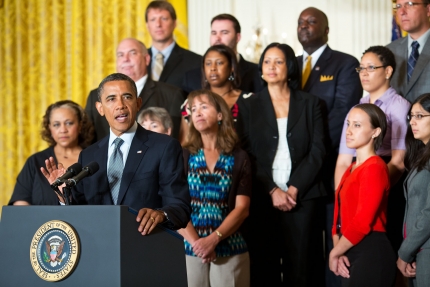
Extending Middle Class Tax Cuts for 98% of Americans and 97% of Small Businesses

President Barack discusses on the need for Congress to act to extend tax cuts for middle class families (July 9, 2012)

President Barack delivers a statement on the need for Congress to act to extend tax cuts for middle class families, in the East Room of the White House, July 9, 2012. (Official White House Photo by Pete Souza)

Today the President called on Congress to extend the middle class tax cuts for the 98 percent of Americans making less than $250,000 for another year. In fact, the President’s proposal extends tax cuts for 97 percent of all small business owners in America.  If Congress fails to act, a typical middle-class family of four will see its taxes go up by $2,200, and America’s small business owners would take a big hit. The President refuses to let that happen.

This should be one of those rare moments where everyone in Washington can agree. Independent experts, economists, and folks on both side of the aisle agree that we should extend tax cuts for middle class families. But so far, Congress hasn’t been able to extend middle class tax cuts because Republicans in Washington refuse to ask the wealthy and big corporations to pay their fair share. In fact, on every issue – from reducing the deficit in a balanced way to paying for investments in education – Republican insistence on cutting taxes for millionaires and billionaires has been the major cause of gridlock in Washington.

So, we look forward to a debate on tax cuts for the wealthy, but right now Congress should act to give middle class families the certainty and security of knowing their taxes won’t go up in six months.

As the President said, if Congress passes a bill extending the tax cuts for the middle class, he’ll sign it tomorrow. It’s time for Congress to get to work.

Unfortunately, Republicans continue to push their tired, false claims to distort and distract the American people.  We’ve already heard some folks opposing this proposal -- claiming we’re trying to tax “job creators.”  The fact is, the people who create most new jobs in America are America’s small business owners.  The President has cut taxes for small business owners 18 times. Even using an overly broad definition of who is a small business owner (a definition that includes passive investors and highly compensated lawyers and hedge fund managers), today’s proposal will extend all of the 2001 and 2003 tax cuts for 97 percent of all small business owners. 

If Republicans in Congress want to act to help small businesses across the country, they should vote for the proposals the President proposed that the Senate is considering this week that include new incentives to help our nation’s small businesses grow and hire and strengthen our economy. 

Related Topics: Economy, Taxes

The White House

Office of the Press Secretary

Statement by the Press Secretary on H.R. 33, H.R. 2297, and S. 3187

On Monday, July 9, 2012, the President signed into law:

H.R. 33, the "Church Plan Investment Clarification Act," which amends the Securities Act of 1933 to provide specifically for an exemption from SEC requirements in connection with church pension plans participating in collective trust funds;

H.R. 2297, which makes technical amendments to the District of Columbia Code to facilitate development of the Southwest Waterfront in the District of Columbia; and

S. 3187, the "Food and Drug Administration Safety and Innovation Act," which reauthorizes a number of FDA user fee programs, including the Prescription Drug User Fee Act and Medical Device User Fee and Modernization Act, and increases FDA's ability to provide timely and expedited review and approval of applications for prescription drugs and medical devices; authorizes new user fee programs for generic drugs and biosimilar biological products; extends and modifies FDA authorities related to drugs intended for use by children; and improves the drug approval process and helps to reduce drug shortages.

President Obama Signs Bill to Create Jobs, Restore America's Transportation System

Ed. Note: This is a cross-post from Fast Lane, Secretary of Transportation Ray LaHood's official blog

Last Friday afternoon, President Obama signed legislation that will put thousands of construction workers on job sites across the country and supports our commitment to restoring America's infrastructure.

This transportation bill, Moving Ahead for Progress in the 21st Century (MAP-21), will sustain our Highway Trust Fund and provide states and communities with two years of steady funding to build needed roads, bridges, and transit systems. It also builds on DOT's efforts to improve safety across all forms of transportation and to make progress on transportation alternatives as we have done during the last three years.

President Obama signs MAP-21

President Barack Obama signs HR 4348, the Transportation and Student Loan Interest Rate bill during a ceremony in the East Room of the White House. June 7, 2012. (Official White House Photo by Lawrence Jackson)

Related Topics: Economy, Maryland

President Obama Speaks on Extending Tax Cuts for Middle Class Families

July 09, 2012 | 12:42 | Public Domain

President Obama calls on Congress to extend the tax cuts for the 98 percent of Americans making less than $250,000 for another year so that millions of American families don’t see their taxes go up by $2,200 starting on January 1st.

Download mp4 (448MB) | mp3 (29MB)

The White House

Office of the Press Secretary

Remarks by the President on Extending Tax Cuts for Middle-Class Families

East Room

12:08 P.M. EDT

THE PRESIDENT:  Thank you.  (Applause.)  Thank you very much.  Everybody, have a seat.  Have a seat.  Good afternoon, everybody.  I’m glad things have cooled off a little bit.  I know folks were hot.  (Laughter.)  

We’re here today to talk about taxes -- something that everybody obviously cares deeply about.  And I’ve often said that our biggest challenge right now isn’t just to reclaim all the jobs that we lost to the recession -- it’s to reclaim the security that so many middle-class Americans have lost over the past decade.  Our core mission as an administration and as a country has to be, yes, putting people back to work, but also rebuilding an economy where that work pays off -- an economy in which everybody can have the confidence that if you work hard, you can get ahead. 

What’s holding us back from meeting these challenges, it’s not a lack of plans, it’s not a lack of ideas -- it is a stalemate in this town, in Washington, between two very different views about which direction we should go in as a country.  And nowhere is that stalemate more pronounced than on the issue of taxes.

Many members of the other party believe that prosperity comes from the top down, so that if we spend trillions more on tax cuts for the wealthiest Americans, that that will somehow unleash jobs and economic growth.

I disagree.  I think they’re wrong.  I believe our prosperity has always come from an economy that’s built on a strong and growing middle class -- one that can afford to buy the products that our businesses sell; a middle class that can own homes, and send their kids to college, and save enough to retire on.  That’s why I’ve cut middle-class taxes every year that I’ve been President -- by $3,600 for the typical middle-class family.  Let me repeat:  Since I’ve been in office, we’ve cut taxes for the typical middle-class family by $3,600.  (Applause.)

I wanted to repeat that because sometimes there’s a little misinformation out there -- (laughter) -- and folks get confused about it. 

Moreover, we’ve tried it their way.  It didn’t work.  At the beginning of the last decade, Congress passed trillions of dollars in tax cuts that benefited the wealthiest Americans more than anybody else.  And we were told that it would lead to more jobs and higher incomes for everybody, and that prosperity would start at the top but then trickle down. 

And what happened?  The wealthy got wealthier, but most Americans struggled.  Instead of creating more jobs, we had the slowest job growth in half a century.  Instead of widespread prosperity, the typical family saw its income fall.  And in just a few years, we went from record surpluses under Bill Clinton to record deficits that we are now still struggling to pay off today.

So we don’t need more top-down economics.  We’ve tried that theory.  We’ve seen what happens.  We can’t afford to go back to it.  We need policies that grow and strengthen the middle class -- policies that help create jobs, that make education and training more affordable, that encourage businesses to start up and create jobs right here in the United States.

So that’s why I believe it’s time to let the tax cuts for the wealthiest Americans -- folks like myself -- to expire.  (Applause.)  And, by the way, I might feel differently -- because it’s not like I like to pay taxes -- (laughter) -- I might feel differently if we were still in surplus.  But we’ve got this huge deficit, and everybody agrees that we need to do something about these deficits and these debts.  So the money we’re spending on these tax cuts for the wealthy is a major driver of our deficit, a major contributor to our deficit, costing us a trillion dollars over the next decade. 

By the way, these tax cuts for the wealthiest Americans are also the tax cuts that are least likely to promote growth.  So we can’t afford to keep that up, not right now.  So I’m not proposing anything radical here.  I just believe that anybody making over $250,000 a year should go back to the income tax rates we were paying under Bill Clinton -- back when our economy created nearly 23 million new jobs, the biggest budget surplus in history, and plenty of millionaires to boot. 

And this is not just my opinion.  The American people are with me on this.  Poll after poll shows that’s the case.  And there are plenty of patriotic and very successful, very wealthy Americans who also agree, because they know that by making that kind of contribution, they’re making the country as a whole stronger.

At the same time, most people agree that we should not raise taxes on middle-class families or small businesses -- not when so many folks are just trying to get by.  Not when so many folks are still digging themselves out of the hole that was created by this Great Recession that we had, and at a time when the recovery is still fragile.  And that’s why I’m calling on Congress to extend the tax cuts for the 98 percent of Americans who make less than $250,000 for another year.  (Applause.) 

If Congress doesn’t do this, millions of American families -- including these good-looking people behind me -- (laughter) -- could see their taxes go up by $2,200 starting on January 1st of next year.  And that would be a big blow to working families, and it would be a drag on the entire economy.

Now, we can already anticipate -- we know what those who are opposed to letting the high-end tax cuts expire will say.  They’ll say that we can’t tax “job creators.”  And they'll try to explain how this would be bad for small businesses. 

Let me tell you, the folks who create most new jobs in America are America’s small business owners.  And I've cut taxes for small business owners 18 times since I've been in office.  (Applause.)  I’ve also asked Congress repeatedly to pass new tax cuts for entrepreneurs who hired new workers and raised their workers’ wages. 

But here's the thing that you have to remember.  The proposal I make today would extend these tax cuts for 97 percent of all small business owners in America.  In other words, 97 percent of small businesses fall under the $250,000 threshold.  (Applause.)  So this isn’t about taxing job creators, this is about helping job creators.  I want to give them relief.  I want to give those 97 percent a sense of permanence.

I believe we should be able to come together and get this done.  While I disagree on extending tax cuts for the wealthy, because we just can’t afford them, I recognize that not everybody agrees with me on this.  On the other hand, we all say we agree that we should extend the tax cuts for 98 percent of the American people.  Everybody says that.  The Republicans say they don't want to raise taxes on the middle class.  I don't want to raise taxes on the middle class.

So we should all agree to extend the tax cuts for the middle class.  Let's agree to do what we agree on.  Right?  (Applause.)  That’s what compromise is all about.  Let’s not hold the vast majority of Americans and our entire economy hostage while we debate the merits of another tax cut for the wealthy.  We can have that debate.  (Applause.)  We can have that debate, but let's not hold up working on the thing that we already agree on.

In many ways, the fate of the tax cut for the wealthiest Americans will be decided by the outcome of the next election.  My opponent will fight to keep them in place.  I will fight to end them.  But that argument shouldn’t threaten you.  It shouldn’t threaten the 98 percent of Americans who just want to know that their taxes won’t go up next year. 

Middle-class families and small business owners, they deserve that guarantee.  They deserve that certainty.  It will be good for the economy and it will be good for you.  And we should give you that certainty now.  We should do it now.  It will be good for you.  It will be good for the economy as a whole.  (Applause.)

So my message to Congress is this:  Pass a bill extending the tax cuts for the middle class; I will sign it tomorrow.  Pass it next week; I’ll sign it next week.  Pass it next -- well, you get the idea.  (Laughter.)

As soon as that gets done, we can continue to have a debate about whether it’s a good idea to also extend the tax cuts for the wealthiest Americans.  I’ll have one position.  The other side will have another.  And we’ll have that debate, and the American people can listen to that debate.

And then next year, once the election is over, things have calmed down a little bit, based on what the American people have said and how they’ve spoken during that election, we’ll be in a good position to decide how to reform our entire tax code in a simple way that lowers rates and helps our economy grow, and brings down our deficit -- because that’s something that we’re going to have to do for the long term.

But right now, our top priority has to be giving middle-class families and small businesses the security they deserve.  You’re the ones who are driving this recovery forward.  (Applause.)  You’re the ones who are driving this recovery forward, and I think it’s time to widen the circle of opportunity and help more Americans who work hard to get ahead.  It’s time that we learned the lessons of our past and lay the foundation for a better future.  That’s what I’m focused on every day, and I hope Congress will join me in doing the right thing.

So thank you very much, you all, for being here.  Thank you.  (Applause.)

END               
12:21 P.M. EDT