From the Archives: President Obama Travels to Russia, Italy, and Ghana

On July 5, 2009, President Obama embarked on an official international trip, making stops in Russia, Italy, and Ghana. He met with then-Russian President Medvedev in Moscow to discuss a “reset” in U.S.-Russia relations, attended the G-8 Summit in L’Aquila, Italy, met the Pope at the Vatican, and gave an important foreign policy speech in Ghana, laying out his vision for human rights and democracy in Africa’s future.

White House photographers captured many behind-the-scenes moments from the trip, and shared some of the best images on the White House Flickr feed. Check out the slideshow below, or head over to Flickr to see the full-size gallery.

The White House

Office of the Press Secretary

Remarks by the President at a Campaign Event

Wolcott House Museum Complex
Maumee, Ohio

12:00 P.M. EDT

THE PRESIDENT:  Hey!  (Applause.)  Hello, Ohio!  (Applause.)  Hello!  It is good to be back in Ohio.  All right.  Well, everybody who’s got a chair, feel free to sit down.  Just go ahead and relax.  I know it’s a little warm out here, but this is how summer is supposed to feel like.

A couple of people I want to acknowledge.  First of all, please give Ina a big round of applause for the great introduction.  We’re proud of her.  (Applause.)  I am so pleased to see once again the outstanding Mayor of Maumee, Tim Wagener.  (Applause.)  There he is.  One of the best Senators in the country -- your Senator, Sherrod Brown.  (Applause.)  One of your outstanding members of the congressional delegation -- Marcy Kaptur is here.  And your former governor and my campaign co-chair -- Ted Strickland is in the house.  (Applause.)

AUDIENCE MEMBER:  We love you!  

THE PRESIDENT:  I love you!  It’s great to see you.  (Applause.)  I hope everybody had a wonderful Fourth of July.  (Applause.)  We invited some people over for a barbecue -- (laughter) -- had a chance to say thank you to our incredible men and women in uniform.  (Applause.)  And we’re so proud of them.  And then it was Malia’s birthday yesterday.  (Applause.)  She’s 14 years old -- I know, it happens too fast.  (Laughter.)  Don’t even remind me.  She’s going into high school next year.  Which means that she’s -- see, when she was small I could say, all these fireworks I had arranged for her birthday.  (Laughter.)  But she doesn’t believe me anymore.  (Laughter.)  

Now, unless you have been hiding out in the woods somewhere, you are aware of the fact that it’s campaign season.  

AUDIENCE MEMBER:  We’re fired up and ready to go!

THE PRESIDENT:  You’re fired up!  (Applause.)  

It’s campaign season again.  Look, I understand it’s not always pretty to watch.  There has been more money flooding into the system than we’ve ever seen before.  More negative ads, more cynicism.  Most of what you read about or hear about on the news has to do with who is up or down in the polls, instead of what these issues actually mean for you and for America.  So it can be frustrating.  

And I know sometimes it may be tempting to kind of turn away from all of it, and just turn off the TV, TiVo everything that you want to watch so you can skip over the commercials.  It’s easy sometimes, I think, to lose interest and lose heart when you hear what’s going on in Washington.  And I’ll be honest with you -- I think there are some folks who are betting that you will lose interest, that are betting that somehow you’re going to lose heart.  But here you are in the heat.  (Applause.)  I’m betting you’re not going to lose interest.

AUDIENCE:  No!

THE PRESIDENT:  I’m betting you’re not going to lose heart.  

AUDIENCE:  No!

THE PRESIDENT:  I still believe in you.  I’m betting on you.  And the country is betting on you, Ohio.  (Applause.)  Because you understand that, even though politics may seem real small right now and may seem real petty, the choice in this election could not be clearer.  And it could not be bigger -- the stakes could not be bigger.  

AUDIENCE MEMBER:  You can do it!

THE PRESIDENT:  I know -- with you.  (Applause.)  

What’s going on in this election is bigger than just a choice between two candidates or between two parties.  It’s about two fundamentally different visions of where we go as a country.
 
See, I believe in an America where no matter who you are, no matter what you look like, no matter where you come from, you can make it if you try.  (Applause.)

We’ve never been a country that -- we've never been a country looking for handouts.  We’re a nation of strivers and risk-takers and entrepreneurs, workers.  (Applause.)  But what we ask for is that hard work pays off, that responsibility is rewarded.  The idea is if you take responsibility for your life, if you put in the effort, if you do the responsible thing, then you can find a job that pays a living wage, that you can look after your family, that you can buy a home, that you can retire with some dignity and some respect, that you won't go bankrupt when you get sick -- (applause) -- that you have that core, middle-class security that built this country, and that you can pass that on to your kids so they can do things that you never even imagined.  That's the essence of America.  

And I believe in that basic promise of America because I lived it.  That's my biography.  I had grandparents whose service at World War II was rewarded by them having a chance to go to college and buying their first house -- because I had a hardworking mother who raised me and my sister right, but also had some help so that we could end up going to the best schools in the country even though we didn't have a lot of money.  

I got involved in politics.  I ran for President in 2008, and some of you joined me in 2008 -- (applause) -- because we believed in that basic bargain that built the largest middle class in history and the strongest economy in the world.  And we felt like that basic bargain was slipping away, that hard work wasn’t always rewarded, that being responsible didn't always get you ahead, that folks who acted irresponsibly sometimes were making out like bandits while ordinary folks were having a tougher and tougher time.
 
So we came together in that election -- Democrats, but also independents and, yes, some Republicans -- to restore that basic bargain that built this country.  And we knew at the time it wouldn’t be easy.  We knew it would take more than one year or one term or maybe even one President.  But what we didn’t realize at the time was we were going to be hit by the worst economic crisis in our lifetimes.  

And that's been tough on a lot of folks, including people here in Ohio.  It robbed millions of people of their jobs and their homes and their savings.  And it pushed the American Dream even further from reach for a lot of people.
 
But you know what, this crisis has not changed the fundamental character of America.  It hasn’t changed the fundamental character of this town, or this state, or this part of the country.  We've still got people who are working hard.  We've still got people who are acting responsibly.  (Applause.)  It hasn't diminished our belief in those ideals we were fighting for in 2008.  (Applause.)

And our mission right now isn’t just to recover from this economic crisis, although that's job one.  Our mission is to give back to America, to Americans all across the country, what's been lost -- that sense of security.  Our goal isn’t just to put people back to work tomorrow; it’s also to build for the long haul an economy where hard work pays off -- (applause) -- an economy where everybody, whether you're starting a business or punching a clock, has confidence that if you work hard, you will get ahead.  That's what America is about.  That's what Ohio is about.  (Applause.)  
 
Now, I got to tell you, what’s holding us back is not --

AUDIENCE MEMBER:  Where is Michelle?

THE PRESIDENT:  Where's Michelle?  (Laughter.)  Look, I know I'm second fiddle -- (laughter) -- but I'll have Michelle come back sometime.  (Applause.)  I'm just the warm-up act.  Michelle says hi.  (Laughter.)    

AUDIENCE MEMBER:  We love you, Mr. President!

THE PRESIDENT:  Thank you so much.  I appreciate it.  

Now, let me say this.  What's holding us back from going ahead and meeting these challenges -- (audience interruption) --

AUDIENCE:  Four more years!  Four more years!  Four more years!  Four more years!  

THE PRESIDENT:  What's holding us back from meeting our challenges -- it’s not a lack of ideas, it’s not a lack of solutions.  What’s holding us back is we’ve got a stalemate in Washington between these two visions of where the country needs to go.  And this election is all about breaking that stalemate.  The outcome of this election will determine our economic future not just for the next year or the next two years, but maybe for the next decade or the next two.  

And I want everybody to be clear about what this choice is.  My opponent and his allies in Congress, they believe prosperity comes from the top down.  They believe if we eliminate most regulations and we cut taxes for the wealthy by trillions of dollars, that somehow our whole economy will benefit, and all of you will benefit, and there’s going to be more jobs and better security for everybody.  That’s their basic economic plan.

Now, I think they’re wrong about their vision.  And part of the reason I think they’re wrong is because we tried it, remember, just a while back --

AUDIENCE MEMBER:  It didn’t work.

THE PRESIDENT:  -- and it didn’t work.  We’re still paying for trillions of dollars in tax cuts that weren’t paid for and didn’t lead to better jobs or better wages for the middle class.  The lack of regulation on Wall Street, the kind of thing that they’re prescribing, that’s exactly what allowed people to game the system that caused this whole mess in the first place.   
 
So, no, I don’t think that Mr. Romney’s plan to spend trillions of dollars more on tax cuts for folks who don’t need them and aren’t even asking for them is the right way to grow our economy -- (applause) -- especially since they want to pay for it by cutting education spending and cutting job training programs and raising middle-class taxes.  

AUDIENCE:  No!

THE PRESIDENT:  And I sure don’t agree with his plan to keep giving tax breaks to companies that ship jobs overseas.  (Applause.)  I don’t think we’re better off by rolling back regulations on banks or insurance companies or oil companies --

AUDIENCE:  No!

THE PRESIDENT:  -- regulations that are meant to protect workers and consumers and families and our economy.   
 
So we don’t need more top-down economics.  We’ve tried it; it did not work.  What we need is somebody who is out there fighting for the middle class and wants to grow the middle class.  (Applause.)  

When the American auto industry was on the brink of collapse, and more than one million jobs were on the line, Governor Romney said we should just let Detroit go bankrupt.

AUDIENCE MEMBER:  That's what he said!

THE PRESIDENT:  I refused to turn my back on communities like this one.  I was betting on the American worker and I was betting on American industry.  (Applause.)  And three years later, the American auto industry is coming roaring back.  (Applause.)  That Chrysler plant up the road bringing on another 1,100 employees to make the cars that the world wants to buy.  The Wrangler built right here in Toledo just set an all-time sales record.  (Applause.)

What’s happening in Toledo can happen in cities like Cleveland, can happen in Pittsburgh.  It can happen in other industries.  And that’s why I’m running for a second term as President, because I’m going to make sure that it does.  I want it happening all across this country.  (Applause.)

AUDIENCE:  Four more years!  Four more years!  

THE PRESIDENT:  Just like Ina said, I want goods shipped around the world, stamped with "Made in America."  (Applause.)  Unlike my opponent, I want to stop giving tax breaks to companies that are shipping jobs overseas, start rewarding companies that are investing right here in Toledo, right here in Ohio, right here in Maumee.  That’s what I’m looking for.  (Applause.)

AUDIENCE MEMBER:  We are, too!

THE PRESIDENT:  Governor Romney’s experience has been in owning companies that were called "pioneers" of outsourcing.  That's not my phrase -- "pioneers" of outsourcing.  My experience has been in saving the American auto industry.  And as long as I’m President, that's what I'm going to be doing -- waking up every single day thinking about how we can create more jobs for your families and more security for your communities.  (Applause.)

That’s why my administration brought trade cases against China at a faster pace than the previous administration -- and we’ve won those cases.  Just this morning, my administration took a new action to hold China accountable for unfair trade practices that harm American automakers.  (Applause.)  

And let me tell you something.  Americans aren’t afraid to compete.  We believe in competition.  I believe in trade.  And I know this:  Americans and American workers build better products than anybody else -- (applause) -- so as long as we're competing on a fair playing field instead of an unfair playing field, we'll do just fine.  But we're going to make sure that competition is fair.  That's what I believe.  That's part of our vision for America.  (Applause.)  

But that’s not all it takes to rebuild this economy.  I’m running to make sure that America once again leads the world in educating our kids and training our workers.  (Applause.)  

Our tuition tax credit has saved millions of families thousands of dollars each -- and now I want to extend it.  We won the fight in Congress to stop Congress from letting student loans double.  (Applause.)  And now we're working with colleges and universities to start bringing tuition costs down.  (Applause.)

I want our schools to hire and reward the best teachers -- (applause) -- especially in math and science.  I want to give
2 million more Americans the chance to go to community colleges and learn skills that local businesses are looking for right now.  See, in the 21st century, a higher education is not a luxury; it is an economic necessity for every single one of our young people -- (applause) -- and folks who are retraining to get the jobs of the future, and our veterans who are coming home.  And we need to take care of all of them and give them those opportunities to work their way into the middle class.  (Applause.)

God bless you.  Thanks for your service.  

AUDIENCE MEMBER:  My pleasure, sir.  

THE PRESIDENT:  God bless you.  Freedom is not free, and you fought for it.  (Applause.)   

I’m running to give more responsible homeowners the chance to refinance their mortgage and save $3,000 a year.  (Applause.)  We've got low interest rates right now, but a lot of folks are having trouble refinancing with their banks.  We've said to Congress, let's go ahead and help them refinance, because that extra -- can you use an extra $3,000?

AUDIENCE:  Yes!

THE PRESIDENT:  And that means you're spending at restaurants and you're buying stuff at the store and -- you're buying some clothes, is that what you said?  (Laughter.)  That you're putting that money back into circulation -- that's good for everybody.  It's good for small businesses; it's good for large businesses.  We've already given thousands of families the chance to do this.  My opponent, his plan for the housing market is to let it hit bottom.

AUDIENCE:  Booo --

THE PRESIDENT:  That's not a plan.  That's a problem, that's not a solution.  

I’m running because I believe that in America, nobody should go bankrupt because they get sick.  (Applause.)  I’ll work with anybody who wants to work with me to continue to improve our health care system and our health care laws.  (Applause.)  But the law I passed is here to stay.  (Applause.)

And let me tell you something, Maumee.  It is going to make the vast majority of Americans more secure.  We will not go back to the days when insurance companies could discriminate against people just because they were sick.  We're not going to tell 6 million young people who are now on their parent's health insurance plans that suddenly they don't have health insurance.  We're not going to allow Medicare to be turned into a voucher system.  

Now is not the time to spend four more years refighting battles we fought two years ago.  Now is the time to move forward and make sure that every American has affordable health insurance -- (applause) -- and that insurance companies are treating them fairly.  That’s what we fought for.  That’s what we're going to keep.  We are moving forward.  (Applause.)

AUDIENCE:  Four more years!  Four more years!  Four more years!

THE PRESIDENT:  And, Maumee, I'm running because after a decade of war, it’s time to do some nation-building here at home.  (Applause.)  We ended the war in Iraq.  We are transitioning out of Afghanistan.  My plan would take half the money that we've been spending on war, let's use it to put people back to work rebuilding our roads, rebuilding our bridges, rebuilding our schools, getting those construction workers out and about rebuilding America.  (Applause.)  That’s how we build our future.  We can't go backwards.  We've got to move forward.  

I’m running to make sure that we can afford all this by paying down the debt in a balanced way, in a responsible way.  Keep in mind, we had a surplus last time there was a Democratic President.  (Applause.)  They ran up the tab, put two wars on a credit card, tax cuts not paid for, prescription drug plan not paid for, left us the tab.  Well, we're going to clean it up, but we're going to clean it up not on the backs of the middle class -- we're going to do it in a balanced and responsible way.  

I'll cut spending like we already have on things we can’t afford and aren't helping people.  But unlike my opponent, I’ll ask the wealthiest Americans who enjoyed the biggest tax cuts over the past decade to do a little more.  (Applause.)  

And by the way, just like we know what they did didn’t work, we know what I'm talking about did work, because what I'm talking about is what Bill Clinton did as President.  Our economy created 23 million new jobs, the biggest budget surplus in history, and by the way, we made a whole bunch of millionaires as well.  (Applause.)  It wasn't like rich people were doing bad back in the '90s.  They were doing just fine, right?

AUDIENCE:  Right.

THE PRESIDENT:  And you know what, there are plenty of patriotic, successful Americans who agree with us.  They want to do the right thing because they care about this country.   

On jobs, on education, on housing, on health care, on retirement, on all these things that are the pillars of a middle-class life, we can’t go backwards.  We've got to go forwards.  And that’s the choice facing us this November.  And the choice could not be more clear.

Now, I’m not here to tell you, Ohio, that this is going to be easy, or it's going to be quick.  Changes that we're trying to bring about -- we're dealing with problems that happened over the course of decades.  They're not going to be changed overnight.  And I know sometimes people feel like, well, Obama, he's done some good things, but, boy, things are still tough out there, change hasn't happened fast enough.  I understand that.  I get frustrated, too.  But what's required are long-term solutions, not slick promises, not quick fixes.  

And there are plenty of well-funded special interests in Washington, and their powerful allies in Congress, who want to keep things just the way they are.  But don’t ever buy the line that they’re selling that we can somehow accomplish more by doing less.  That might benefit their interests, but it won’t benefit yours.  

That’s not how we became America.  Our parents, our grandparents, the founders of this country, didn’t set their sights lower.  They didn’t settle for something less.  And neither do we -- because we’re Americans.  If we’re going to be the country we know we can be, we’ve got to keep doing the hard work of building the future of this country for our kids, just like our parents and grandparents did for us.  (Applause.)  

And let me tell you something.  From now until November, the other side is going to spend more money than we’ve ever seen before, and they will be raining ads down on your head.  And they’ll tell you it’s all my fault -- I can’t fix it because I think government is the answer to everything, or because I haven’t make a lot of money in the private sector, or I think everything is doing just fine.  That’s what all the scary voices in the ads will tell you.  That’s what Mitt Romney will say.  That’s what Republicans in Congress will say.  

And that’s their plan for winning an election, but it’s not a plan to create jobs.  (Applause.)  It’s not a plan to provide you with greater security for you and your family.  It’s not a plan to restore the middle class or restore the American Dream.  And that’s the kind of plan we need right now, is a plan to build the middle class and restore the American Dream.  

And if you agree with me -- if you believe that our economy works best when everybody gets a fair shot and everybody is doing their fair share and everybody is playing by the same set of rules, then I’m going to need you out there working.  And you know what, I need you to talk to your friends and your neighbors.  Don’t just talk to Democrats.  Talk to independents, talks to Republicans.  (Applause.)  Because I want to work with anybody who believes that we’re in this together.  (Applause.)  I want to work with anybody who believes we’ve got to invest in our future.  I want to work with anybody who thinks we’ve got to give our kids a great education.  I want to work with anybody who believes that we’ve got to make sure that we’re building things here in America.  (Applause.)

I’m not a Democrat first; I’m an American first.  (Applause.)  I believe we rise or fall as one nation, as one people.  And I believe what’s stopping us is not our capacity to meet our challenges; what’s stopping us is our politics.  And that’s something you have the power to solve.

So hit the doors.  Make some phone calls.  Register your friends.  Talk to those family members who sometimes don’t vote.  Remind them where America’s strength comes from -- it comes from our people.  Remind them how America came this far -- it came because of our people.

All this money that’s being spent on negative ads in this campaign -- they spent money in 2008.  I got outspent when I ran first time for Senate.  But you know what I have learned?  When the American people, when ordinary folks start standing up for themselves, start making their voices heard, start coming together, start believing again, nothing can stop them.  (Applause.)   

Nothing can stop you.  Nothing can stop you, Maumee.  (Applause.)  Nothing can stop you, Ohio.  Nothing can stop us, America.  (Applause.)  Let’s remind the world just why it is we live in the greatest nation on Earth.  (Applause.)   

God bless you.  God bless the United States of America.  (Applause.)

END
12:27 P.M. EDT

The White House

Office of the Press Secretary

Press Gaggle by Press Secretary Jay Carney en route Ohio, 7/5/12

Aboard Air Force One
En Route Ohio

10:30 A.M. EDT

MR. CARNEY:  Welcome aboard Air Force One as we make our way -- on the start of a two-day trip as we make our way to Ohio.  You can see that I am joined by Jen Psaki, who is back by popular demand.  She begins today as campaign press secretary.  And with your indulgence, what we'd like to do is brief together, gaggle together.  So if you have truly campaign-related questions, you should direct them to Jen.  If you have policy questions, administration policy questions, direct them to me.  If you have questions that cover both areas, we'll decide between us how we're going to answer them and probably each take a shot at them.

I wanted to note before we get started that earlier today, the Obama administration launched an enforcement action against China at the World Trade Organization for imposing unfair duties on more than $3 billion in auto exports from the United States.  The Chinese duties in question cover more than 80 percent of U.S. auto exports to China, including cars manufactured in Toledo and Marysville, Ohio, and Detroit and Lansing, Michigan.  And the duties disproportionately fall on General Motors and Chrysler products because of the actions that President Obama took, as you know, to support the auto industry during the financial crisis.

This is the seventh such action that this administration has taken against China -- seventh.  The previous six have all been successful.  The pace of actions taken by this administration is double that of the previous administration -- actions against China for unfair trade practices.  And I think it underscores the President's commitment to American companies and American workers -- his commitment to them to make sure that when they compete with their products and their know-how around the world they're competing on a level playing field.  

So that action was submitted today in Geneva at the WTO.  As is common practice, the Chinese were given a courtesy heads-up that this action would be taken.

And with that, we will answer your questions.  

Q    Jay, how do you answer people who might say the timing of this and the announcement of it by the President at a campaign stop in a battleground state makes it really more of a political move than a well-considered step in American trade policy?

MR. CARNEY:  The fact is this is an action that has been in development for quite a long time.  The USTR studies these issues and prepares actions with great deliberation to ensure their success at the WTO.  This one has been in development for many, many months, and that’s just a fact.

And again, this is the seventh such action that this administration has taken.  It simply can’t suddenly be a political action because it happens during the campaign.  The President is committed to doing this throughout his presidency and will continue to take these actions when they’re appropriate to ensure that there’s a level playing field for our businesses and workers.

Q    This affects carmakers or plants in Toledo and he’s going to the Toledo area today to campaign.  That’s not a coincidence.

MR. CARNEY:  Well, look, I think that the timing is determined by USTR after long development of a case to be made at the WTO as filed in Geneva.  As you guys note all the time, we’ve been to Ohio on a number of occasions and I’m sure we’ll be back. And certainly now that we’re in more of a campaign mode, you can expect he’ll be back.  But he never ceases being President of the United States and, as such, he has directed the Ambassador of the USTR to investigate matters like this and take action where appropriate to ensure that American workers and businesses compete on a level playing field with China and other nations.

Q    But on the matter of timing, Jay, they clamped this tariff last year.  Why did it take this long, and again, why today?

MR. CARNEY:  You can ask the USTR about their process for developing a case.  But obviously you do not react immediately.  You develop a case; you do a lot of research; you put together the necessary documentation and back-up and support in order to be successful, precisely because it’s not a political issue, it’s an issue that goes right at the heart of our economy.  

I don’t need to remind you, but I will, that this President took what was seen as very bold and risky action to ensure that General Motors and Chrysler, during the great recession, did not liquidate because of the enormous pressure on the American automobile industry.  Had that happened, according to a study done by the Bush administration in December of 2009 -- or 2008 rather -- the United States would have lost 1.1 million additional jobs.  And some studies suggest that had the American automobile industry been forced to liquidate not just GM and Chrysler but, because of the supply chain, Ford eventually as well, that the job loss would have been ever more substantial.

We’ve seen a revival in manufacturing in this country.  We’ve seen the revival in the automobile industry, job creation in the automobile industry that we have not seen since the mid-1990s.  This is all happening because of actions the President took.  And it is vital that the United States -- in this case the Obama administration -- take the right action to ensure that companies like GM and Chrysler and others can compete fairly around the world.

MS. PSAKI:  If I can just add one thing to this.  As you know, one of the first actions the President took regarding China was to put in place stiff tariffs in 2009 on Chinese tires.  Many people didn’t read Mitt Romney’s book.  If you did read Mitt Romney’s book, you’ll note that in there he criticized the President for this step, for taking this step.  He said it was bad for workers; it would be bad for the country and the nation.  
Along this trip, the President will meet many autoworkers.  He’ll meet people who would be impacted by this, who would, no question, say something different.  So that’s something to look out for on the trip as well.  

Q    Republicans and Romney now argue that the President should declare China a currency manipulator, which is something he has declined to do.  Is that something that’s going to be revisited at all before the election?  And if not, why not?

MR. CARNEY:  Well, for the specifics of how we evaluate that, I would direct your question to the Treasury Department.  But this administration always brings up our concern about the Chinese currency in our conversations with Chinese leaders, both at the level of President Obama and President Hu, as well as in ministerial meetings that Secretary Geithner engages in, and others.  

The fact is that the currency needs to appreciate more.  There have been some steps taken over the last several years but not enough.  And this continues to be something that is a high priority in our conversations with and diplomatic efforts with China.

Q    -- Mitt Romney now saying that the health care mandate is a tax and not a penalty?  Isn't that essentially agreeing with the Supreme Court decision that's calling it a tax?  

MS. PSAKI:  For years -- I was going to say decades, but that's not true -- for years, Mitt Romney has been defending not only his bill that he pushed forward in Massachusetts but also this as a penalty that was essential to taking into account the people who weren’t paying for health insurance who could afford it.  The President agreed with him.  That's for years up until Monday, when his own campaign spokesperson defended it the same way.

So Mitt Romney is -- it's clear that he is being impacted by the push from the right, the Rush Limbaughs of the world, congressional Republicans, who are pushing him to go back on a decision and a defense that he's had in place for years.  

You'll hear the President today touch on health care in his remarks as part of his discussion of standing up for and fighting for the security of the middle class and he'll talk about the importance of making sure people in this country aren’t worried about going bankrupt over health care, posing the question of we don't want to take away from the millions of young people who have insurance, that benefit that they've been -- they've received for the last several months.  

And that's really the question we should be dealing with now, not this silly debate that is, again, Mitt Romney going back -- being influenced by the extreme right of the party and going back on a defense he's had in place for years.

MR. CARNEY:  But if I could just add as a matter of policy, it is simply a fallacy to say that this is a broad-based tax.  That's not what the opinion stated that was authored by the Chief Justice.  The Affordable Care Act is constitutional under Congress's taxing authority, but this is clearly a penalty that affects less than 1 percent of the American population.  And it is a penalty you only pay as a matter of choice, if you're in that 1 percent and you can afford health insurance but choose not to and therefore choose to pass the responsibility for your health care to every other American, which I would note that Governor Romney, when he was governor, thought was unfair and therefore instituted a penalty -- and clear the President does, too, which is why the penalty that's part of the Affordable Care Act was modeled very much on what Governor Romney implemented in Massachusetts.

Q    Does the President believe that the mandate can be a penalty on the state level but a tax on the federal level?

MR. CARNEY:  Look, it's a penalty.  It affects 1 percent, and perhaps less, of the population.  It is a -- I don't know about you, but you don't get to choose whether you pay your income taxes -- most people don't.  I certainly don't.  This is not a tax in that sense at all.  It is a penalty you pay if you fail to buy health insurance but can afford it.  

And the reason why the penalty is important is that it's simply not fair to get a free ride and force other -- every other American to pay for your health care if you can afford it.  So that's why it was the right approach when it was implemented in Massachusetts and it's the right approach as part of the Affordable Care Act.

Q    Can I ask one more political question, maybe for Jen?  Jen, the unemployment rate in Pennsylvania and Ohio is somewhat lower than nationally.  Do you guys believe that voters make their decisions principally on their perception of the health of the national economy, or are they positively affected by the fact that things may be somewhat better closer to home?

MS. PSAKI:  Well, as you know, we're going to be spending two days in Ohio mainly, and partly in Pennsylvania.  And the places where we'll be visiting over the next couple of days have been largely impacted by the recovery of the auto industry and the difficult steps the President took there.

I think voters and the American people are impacted by what challenges they're facing every day.  So that is, do they have a job?  Can they afford to send their kids to college?  Can they afford access to health care?  You'll hear the President talk about this today.  There are many issues that impact the security of the middle class, and that's what families are worried about day to day, especially in the places we'll be visiting over the next two days.

Q    What's it like to be back?

MS. PSAKI:  Great.  I wouldn't want to be anywhere else.

MR. CARNEY:  I say that every day when I'm with you guys.  (Laughter.)    

MS. PSAKI:  Jay says he is living the dream every day, one day at a time.

MR. CARNEY:  I am.  It's the best job ever.  It's good to see you guys.  Anything else?

Q    Jen, is it basically going to be the same message tomorrow as today?

MS. PSAKI:  Yes.  You'll hear the President talk today, as I mentioned, about fighting for American workers, his bet on workers in Ohio and Pennsylvania.  He'll talk about the contrast and the difference between the visions that he is presenting and Mitt Romney is presenting on many issues that impact the middle class, including health care, including education, including access to -- including tax cuts.  So you'll hear him talk about that consistently over the next two days.

I should note also, as often happens, he'll be making some local stops along the way.  As is standard, you'll learn where they are and what they're about.  But they all will be opportunities to talk about the same issues.

MR. CARNEY:  I know that as a matter of policy I think that the President will also talk about his initiatives that he's put forward that he hopes Congress will act on to create incentives for American companies to come back to the United States, and to close loopholes that create incentives for companies to offshore -- move their operations and their hiring offshore.  

And it's a very important matter that the President has been pursuing for a number of years now as a matter of policy, because his commitment is to -- as you saw with the American automobile industry -- is to create an economy that's built to last, that has an important manufacturing component, and that allows for jobs in the United States that create the kind of security that middle-class Americans desperately deserve, and the kind of security that in the first decade of the century was eroding very rapidly.

Q    Thank you.

MS. PSAKI:  You must leave room for the ice cream social later this afternoon in Sandusky.  I don't know the flavors, but something for everyone.

END
10:45 A.M. EDT

Fourth of July at the White House

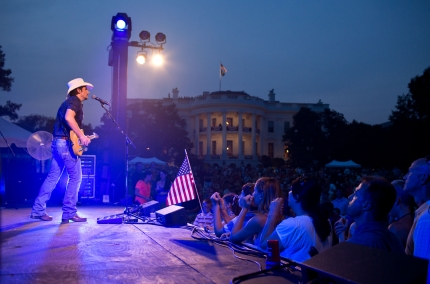
Brad Paisley performs on the South Lawn of the White House (July 4, 2012)

Brad Paisley performs on the South Lawn of the White House, July 4, 2012. (Official White House Photo by Chuck Kennedy)

Last night, the White House threw a party for more than 1,200 military service members and their families to celebrate the Fourth of July. 

President Obama welcomed the crowd to the South Lawn, saying:

[As] long as I have the honor of being your Commander-in-Chief, I want you all -- our men and women in uniform, our veterans and their families -- to know this: America will always remember. We will always be there for you, just as you’ve been there for us. That’s my promise. That is America’s promise. And that is one that we pledge to fulfill on this Independence Day.

The event, organized by the USO, featured a performance by country music star Brad Paisley.

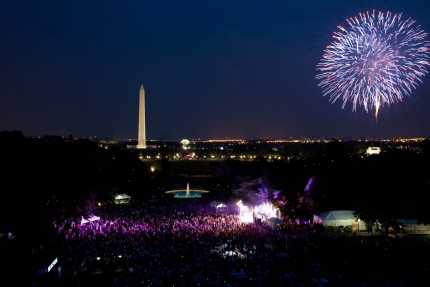
A crowd watches as fireworks erupt over the National Mall (July 4, 2012)

A crowd watches the end of Brad Paisley's performance on the South Lawn of the White House as fireworks erupt over the National Mall, July 4, 2012. (Official White House Photo by Pete Souza)

As Paisley and his band finished their final song ("Welcome to the Future"), fireworks began over the National Mall. Check it out here:


Learn more

Related Topics: Inside the White House

The White House

Office of the Press Secretary

Remarks by the President at Fourth of July Celebration

South Lawn

6:02 P.M. EDT

THE PRESIDENT:  How’s it going, everybody?  (Applause.)  Are you hot?  It’s supposed to be hot.  It’s the fourth of July.  Happy Fourth of July, everybody!  (Applause.)  On behalf of the entire Obama family, welcome to the White House. 

Now, the last thing anybody wants to do is to ruin a nice backyard barbecue with a long speech, so I’m going to be quick.

It is always such an honor for us to spend this holiday with members of our military and your extraordinary families.  All of you represent what is best in America.  You serve under our proud flag.  You and your families sacrifice more than most of us can ever know -- all in defense of those God-given rights that were first put to paper 236 years ago: life, liberty, and the pursuit of happiness.

So as your Commander-in-Chief -- but also as an American -- I want to invite all of you over to say one thing: thank you.

Today, all across America, at schools, and beaches, and in town squares, Americans are celebrating the freedoms that all of you and your families defend.  Like many of them, we’re grilling in the backyard.  We’ve got some pretty good tunes for you.  We’ve got the outstanding Marine Band.  Give them a big round of applause.  (Applause.)  And we’ve got Brad Paisley and his band in the house for a little country.  (Applause.)

We’ve also got all of you.  We’ve got Army in the house.  (Applause.)  We’ve got Navy.  (Applause.)  We’ve got Air Force.  (Applause.)  You know we’ve got some Marines here.  (Applause.)  And we’ve got Coast Guard.  (Applause.)  Today, we salute all of you.

We salute our soldiers, like Sergeant Alan Ruehs, who, in the midst of an enemy ambush in Afghanistan, risked his own life to save the lives of four others. 

We salute our sailors, like Petty Officer Taylor Morris, who suffered terrible wounds while serving in Afghanistan on an Explosive Ordnance Disposal Team, but who inspires us all through his incredible recovery.

We salute an Airman -- Colonel Charles Barnett, who led close to 200 combat missions in Afghanistan and still serves his country by volunteering to care for our fallen heroes at Arlington National Cemetery. 

We salute a Marine -- Corporal Alex Nguyen, who sustained serious injuries when his vehicle struck an IED in Afghanistan, but who carries on stronger than ever.

We salute a “Coastie” from my hometown of Chicago -- Lieutenant Commander Michelle Watson, who was one of the first African American women to graduate from the Coast Guard Academy, and went on to perform exceptional service in Operation Enduring Freedom.

All the men and women who stand with us here this afternoon are an example of this generation of heroes -- this 9/11 Generation that has earned its place in history alongside the greatest generations.  Because of your service and sacrifice, all of our troops are now out of Iraq.  (Applause.)  Because of your service and sacrifice, we took the fight to al Qaeda and we brought Osama bin Laden to justice.  (Applause.)  Because of your service and sacrifice, we’re transitioning out of Afghanistan.  We will remain ready for any threat.  That is all because of you.  (Applause.)

And as long as I have the honor of being your Commander-in-Chief, I want you all -- our men and women in uniform, our veterans and their families -- to know this: America will always remember.  We will always be there for you, just as you’ve been there for us.  That’s my promise.  That is America’s promise.  And that is one that we pledge to fulfill on this Independence Day. 

So, Happy Fourth of July, everybody.  Enjoy the fireworks.  Get some hotdogs.  God bless you.  God bless your families.  And God bless these United States of America.  

And with that, let me turn it back over to the United States Marine Band.  (Applause.)

END               
6:07 P.M. EDT

President Obama Speaks at a Naturalization Ceremony

July 04, 2012 | 11:19 | Public Domain

President Obama delivers remarks at a naturalization ceremony for active duty service members.

Download mp4 (400MB) | mp3 (26MB)

President Obama Salutes New American Citizens

President Obama at Naturalization Ceremony July 4, 2012

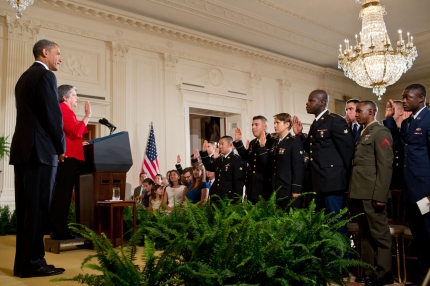
President Barack Obama listens as Secretary of Homeland Security Janet Napolitano administers the oath of allegiance during a military naturalization ceremony for active duty service members in the East Room of the White House, July 4, 2012. (Official White House Photo by Pete Souza)

President Obama began his Independence Day celebrations by hosting a naturalization ceremony for active duty service members in the East Room of the White House. It was the third time the President has hosted this kind of service, and he told the audience, which included the families of the service members who were taking the oath of citizenship, that it is one of his favorite things to do. "It brings me great joy and inspiration because it reminds us that we are a country that is bound together not simply by ethnicity or bloodlines, but by fidelity to a set of ideas."

Before the President gave his remarks, U.S. Citizenship and Immigration Services Director Alejandro Mayorkas presented the countries of the candidates for naturalization and Secretary of Homeland Security Janet Napolitano delivered the oath of allegiance.  President Obama told the new citizens that is was an honor to serve as their Commander in Chief, and to be the first to greet them as "my fellow Americans."

Related Topics: Immigration, Veterans

The White House

Office of the Press Secretary

Remarks by the President at Naturalization Ceremony

East Room

10:58 A.M. EDT

THE PRESIDENT:  Thank you.  (Applause.)  Good morning, everybody. 

AUDIENCE:  Good morning, Mr. President.

THE PRESIDENT:  Secretary Napolitano, Director Mayorkas, distinguished guests, family and friends -- welcome to the White House.  Happy Fourth of July.  What a perfect way to celebrate America’s birthday -- the world’s oldest democracy, with some of our newest citizens. 

I have to tell you, just personally, this is one of my favorite things to do.  It brings me great joy and inspiration because it reminds us that we are a country that is bound together not simply by ethnicity or bloodlines, but by fidelity to a set of ideas.  And as members of our military, you raised your hand and took an oath of service.  It is an honor for me to serve as your Commander-in-Chief.  Today, you raised your hand and have taken an oath of citizenship.  And I could not be prouder to be among the first to greet you as "my fellow Americans."

Looking back, it was an act of extraordinary audacity -- a few dozen delegates, in that hall in Philadelphia, daring to defy the mightiest empire in the world, declaring "that these United Colonies are, and of Right ought to be Free and Independent States."

Two hundred and thirty-six years later, we marvel at America’s story.  From a string of 13 colonies to 50 states from sea to shining sea.  From a fragile experiment in democracy to a beacon of freedom that still lights the world.  From a society of farmers and merchants to the largest, most dynamic economy in the world.  From a ragtag army of militias and regulars to you -- the finest military that the world has ever known.  From a population of some 3 million -- free and slave -- to more than 300 million Americans of every color and every creed. 

With this ceremony today -- and ceremonies like it across our country -- we affirm another truth:  Our American journey, our success, would simply not be possible without the generations of immigrants who have come to our shores from every corner of the globe.  We say it so often, we sometimes forget what it means -- we are a nation of immigrants.  Unless you are one of the first Americans, a Native American, we are all descended from folks who came from someplace else -- whether they arrived on the Mayflower or on a slave ship, whether they came through Ellis Island or crossed the Rio Grande.

Immigrants signed their names to our Declaration and helped win our independence.  Immigrants helped lay the railroads and build our cities, calloused hand by calloused hand.  Immigrants took up arms to preserve our union, to defeat fascism, and to win a Cold War.  Immigrants and their descendants helped pioneer new industries and fuel our Information Age, from Google to the iPhone.  So the story of immigrants in America isn’t a story of "them," it’s a story of "us."  It’s who we are.  And now, all of you get to write the next chapter. 

Each of you have traveled your own path to this moment -- from Cameroon and the Philippines, Russia and Palau and places in between.  Some of you came here as children, brought by parents who dreamed of giving you the opportunities that they had never had.  Others of you came as adults, finding your way through a new country and a new culture and a new language. 

All of you did something profound:  You chose to serve.  You put on the uniform of a country that was not yet fully your own. In a time of war, some of you deployed into harm’s way.  You displayed the values that we celebrate every Fourth of July -- duty, responsibility, and patriotism.

We salute a husband and father, originally from Mexico, now a United States Marine, joined today by his wife Silvia and daughter Juliett.  Becoming a citizen, he says, is "another step in the right direction for my family."  So today we congratulate Francisco Ballesteros De La Rosa.  Where’s Francisco?  (Applause.)

We salute a young woman from El Salvador, who came here when she was just six, grew up in America, who says she "always had a desire to serve" and who dreamed of becoming -- who dreams of becoming an Army medic.  So we congratulate Luisa Childers.  Luisa.  (Applause.)

We salute a young man from Nigeria who came here as a child. "I left Nigeria," he says, "with the dream that we all have a destiny in life and we are all born with the resources to make a difference."  We are confident he will make a difference.  We congratulate Oluwatosin Akinduro.  (Applause.)

We salute a young man from Bolivia, who came to America, enlisted in our military and has volunteered to help care for our veterans.  He’s becoming a citizen, he says, to be a "part of the freedom that everybody is looking for."  And so we congratulate Javier Beltran.  (Applause.)

It has taken these men and women -- these Americans -- years, even decades, to realize their dream.  And this, too, reminds us of a lesson of the Fourth.  On that July day, our Founders declared their independence.  But they only declared it; it would take another seven years to win the war.  Fifteen years to forge a Constitution and a Bill of Rights.  Nearly 90 years, and a great Civil War, to abolish slavery.  Nearly 150 years for women to win the right to vote.  Nearly 190 years to enshrine voting rights.  And even now, we’re still perfecting our union, still extending the promise of America.

That includes making sure the American dream endures for all those -- like these men and women -- who are willing to work hard, play by the rules and meet their responsibilities.  For just as we remain a nation of laws, we have to remain a nation of immigrants.  And that’s why, as another step forward, we’re lifting the shadow of deportation from serving -- from deserving young people who were brought to this country as children.  It’s why we still need a DREAM Act -- to keep talented young people who want to contribute to our society and serve our country.  It’s why we need -- why America’s success demands -- comprehensive immigration reform.

Because the lesson of these 236 years is clear -- immigration makes America stronger.  Immigration makes us more prosperous.  And immigration positions America to lead in the 21st century.  And these young men and women are testaments to that.  No other nation in the world welcomes so many new arrivals.  No other nation constantly renews itself, refreshes itself with the hopes, and the drive, and the optimism, and the dynamism of each new generation of immigrants.  You are all one of the reasons that America is exceptional.  You’re one of the reasons why, even after two centuries, America is always young, always looking to the future, always confident that our greatest days are still to come.

So, to all of you, I want to wish you the happiest Fourth of July.  God bless you all.  God bless our men and women in uniform and your families.  And God bless the United States of America.  (Applause.)

And with that, I want you to join me in welcoming onto the stage one of America’s newest citizens.  Born in Guatemala, he enlisted in the Marine Corps, served with honor in Afghanistan.  And I know he’s especially proud because, in a few days, his father Walter -- who’s also here today -- will become a naturalized American citizen as well.  Where’s Walter?  There he is over there.  (Laughter.)  Good to see you, Walter.  (Applause.)  Please welcome, Lance Corporal Byron Acevedo to lead us in the Pledge of Allegiance.

Right here.

MR. ACEVEDO:  I’m nervous.  (Laughter.) 

(The Pledge of Allegiance is said.)

THE PRESIDENT:  Thank you, everybody.  Have a great Fourth of July.  Congratulations to our newest citizens.  Yay!  (Applause.)

END         
11:09 A.M. EDT 

The White House

Office of the Press Secretary

Background on Military Naturalization Ceremony at the White House

WASHINGTON, DC - On July 4, 2012, President Obama will deliver remarks at a naturalization ceremony for active duty service members in the East Room of the White House. U.S. Citizenship and Immigration Services Director Alejandro Mayorkas will present the countries of the candidates for naturalization and Secretary of Homeland Security Janet Napolitano will deliver the oath of allegiance. The audience will be composed of the service members and their families.
 
Other Senior Administration Officials will also be speaking at naturalization ceremonies around the country, including Secretary of Labor Hilda Solis in New York, Small Business Administrator Karen Mills and Council on Environmental Quality Chair Nancy Sutley in Massachusetts, Domestic Policy Council Director Cecilia Muñoz in Virginia, and Cabinet Secretary Chris Lu in Maryland.

The President hosted similar naturalization ceremonies at the White House on May 1, 2009 and April 23, 2010.
 
The following active duty service members are expected to attend as candidates for naturalization:
 
Byron Oswaldo Acevedo, born in Guatemala City, Guatemala, enlisted in the Marine Corps in April 2010 from Providence, Rhode Island.  Lance Corporal Acevedo has served in support of Operation Enduring Freedom, and served in Helmand province, Afghanistan in a Quick Reaction Force and Aerial Interdiction Force. His personal awards and decorations include a Purple Heart, Combat Action Ribbon, Global War On Terrorism Service Medal, Afghanistan Campaign Medal, Sea Service Deployment Ribbon, National Defense Service Medal, Nato Medal-ISAF Afghanistan, and an Armed Forces Reserve Medal.
 
Oluwatosin K Akinduro, born in Lagos, Nigeria, graduated high school in Houston, Texas. He joined the Army National Guard in search of new opportunities and a new challenge to lead by example.
 
Miguel Andrade, born and raised in the Cape Verde Islands, moved to the United States in the fall of 2008. Private First Class Andrade has distinguished himself, earning a coveted position in 3rd Battalion, 7th Infantry Regiment’s Scout Platoon.
 
Alla Victorovna Ausheva, born in Russia, Alla joined the New York Army National Guard in July 2011 and serves as a maintenance technician in Company G of the 427th Brigade Support Battalion. The unit supports the 1st Battalion 258th Field Artillery. She lives in Bayside, NY.
 
Francisco Jose Ballesteros de la Rosa, born in Mexico, joined the Marine Corps in December 2009. Corporal Ballestros’ personal awards and decorations include the Global War on Terrorism Service Medal and the National Defense Service Medal. 
 
Oscar Javier Beltran Medina, born in Bolivia, enlisted into the United States Air Force in 2009 as a Vehicle Operator. Airman Beltran is currently assigned to Joint Base Andrews, MD. During his 2 ½ years, Airman Beltran has completed college courses at Northern Virginia Community College and volunteered his time at Charlotte Hall Veterans home in Maryland.
 
Silvano Carcamo, born in Honduras, moved to Springfield, OH in 1996. Specialist Carcamo enlisted in the Army in October 2009 and became a medic. His first duty station was Bravo Troop, 3rd Squadron, 71st Cavalry Regiment, 3rd Infantry Brigade Combat Team, 10th Mountain Division where he served as a line medic. During his deployment from March 2011 to March 2012 he earned several awards among them an Army Achievement Medal, Combat Medic Badge, and a Navy Achievement Medal.
 
Luisa Maria Childers, born in El Salvador, moved to the United States at the age of 6. She joined the Army Reserves in 2009 and is a 72R, Parachute Rigger. Her goal is to ultimately become an Army Medic.
 
Mamadou Aliou Diallo, born in Conakry, Guinea, enlisted in the Marine Corps in May 2011. Private First Class Diallo is an Online Message Board Clerk at Marine Barracks in Washington, D.C..  His decorations include the National Defense Service Medal and Global War on Terrorism Service Medal.
 
Terence Njikang Ekabe, born in Cameroon, enlisted in the Air Force in June 2011 as a 4N0/med technician. Airman Ekabe also helped raise money for Veterans’ families, Airmen in need, and the Air Force Assistance Fund. His charitable giving extends beyond the United States to his home country where he raised $3,000 worth of toys, clothing, and others items for the village children of Cameroon during Christmas.
 
Sergey Eliseev, born in Russia, has received numerous decorations and personal awards, including the Army Achievement Medal, Honor Grade from 88M10 AIT, National Defense  Service Medal, Global War on Terrorism Service Medal, and the Army Service Ribbon
 
Andriy Olegovich Gener, born in Odessa, Ukraine, arrived in the United States on September 10, 2001. Private First Class Gener is currently serving with 1st Brigade Combat Team, 4th Infantry Division as a member of the Brigade Personal Security Detail in Fort Carson, CO for the Brigade CSM and the Brigade Commander.  His awards and decorations include the Army Service Ribbon, and the National Defense Medal.
 
Daniel Arcenal Geneta, born in the Philippines, came to the United States in August 1994.  Geneta joined the New York Army National Guard in 2006 because of the events of September 11, 2001. He is a squad leader in the 719th Transportation Company and in civilian life works as an account executive at Urban Associates, a New York City real estate company.
 
Alexey Isachenko, born in Russia, has received numerous decorations and personal awards, including being selected to Commandants List 88M10 AIT, the National Defense Service Medal, Global War on Terrorism Service Medal, and Army Service Ribbon.
 
Yvonne Marie Middleton-White, born in Belize, enlisted in the US Army in January 2012.  Middleton-White noted “being an American citizen means everything in the world to me. It means that I have a voice in who makes decisions for me by voting. I will be a part of something bigger. I will be a part of a successful country made up of the best the world has to offer.”

Carlos Eduardo Navichoque, born in Guatemala City, enlisted in 2009 in the Army. Specialist Navichoque deployed with the 2-14 Infantry Battalion to Iraq from March 2010 to August 2010 in support of Operation Iraqi Freedom. During his tour, he served as a Motor Transport Operator and was awarded the Combat Action Badge.
 
Faye Ubad Ngirchomlei, born in Palau, enlisted in the Army in 2008.  In April 2009, Nigirchomlei was assigned to 511th Military Police Company at Fort Drum, NY as Automated Logistic Specialist. She was deployed to Kandahar, Afghanistan where she was responsible for ensuring the maintenance section supported outlying platoons, with supplies and other support services.
 
Aegean Pascua Obed, born in the Philippines, Obed currently serves as a Mobile Gun System crew member in A Company, 3-21 Infantry.
 
Praseuthsith Phimmasone, born in the Philippines, enlisted in the Marine Corps in March 2007. Private First Class Phimmasone currently serves in the 6th Engineer Support Battalion, 4th Marine Logistics Group. Corporal Phimmasone was selected 6th Engineer Support Battalion’s Noncommissioned Officer of the Quarter for the fourth quarter of 2009 and was also awarded Noncommissioned Officer of the Quarter for third quarter of 2010. Sergeant Phimmasone’s awards include a Navy and Marine Corps Achievement Medal, Good Conduct Medal, a Sea Service Deployment Ribbon, a Global War on Terrorism Service Medal, a National Defense Service Medal, Navy Meritorious Unit Commendation Ribbon, a Navy Unit Commendation Ribbon, two Meritorious Masts, and a Letter of Appreciation. 
 
Fatima Vanessa Rivera Fuentes, born in El Salvador, joined the New York Army National Guard in 2009 and has served as an aviation electronics technician working on UH-60 Blackhawk helicopters. Fuentes came to the United States in 1999.
 
Guillermo Enrique Roche Rendon, born in Ecuador, went to middle school and high school in the US but had to drop out in the 11th grade to help support his family. In time, he earned his GED and also completed college courses. He joined the US Army as a Cavalry Scout. Private First Class Roche’s awards include the Army Service Ribbon and the National Defense Service Medal.
 
Sedrick Kwesi Sam, born in Ghana, serves as an Airman for the Air Force. 
 
Hans Lemuel Pang Sy, born in the Philippines, moved to the United States with his parents and three siblings in 2005.  He joined the US Army on October 18, 2011.
 
Jhonathan Gerardo Zapata, born in Colombia, joined the Army in January 2012.
 
Cristian Felipe Zapata Gil, born in Colombia, moved to the United States at the age of 13.  After Haiti’s earthquake Zapata Gil decided to join the US Army where he serves as a Watercraft Engineer.

The White House

Office of the Press Secretary

President Obama Signs Florida Disaster Declaration

The President today declared a major disaster exists in the State of Florida and ordered Federal aid to supplement state and local recovery efforts in the area affected by Tropical Storm Debby beginning on June 23, 2012, and continuing.

The President's action makes federal funding available to affected individuals in Baker, Bradford, Columbia, Pasco, and Wakulla Counties.

Assistance can include grants for temporary housing and home repairs, low-cost loans to cover uninsured property losses, and other programs to help individuals and business owners recover from the effects of the disaster. Federal funding is also available on a cost-sharing basis for hazard mitigation measures statewide.

W. Craig Fugate, Administrator, Federal Emergency Management Agency (FEMA), Department of Homeland Security, named Gracia B. Szczech as the Federal Coordinating Officer for federal recovery operations in the affected area. 

FEMA said that damage surveys are continuing in other areas and more counties and additional forms of assistance may be designated after the assessments are fully completed.

FEMA said that residents and business owners who sustained losses in the designated counties can begin applying for assistance tomorrow by registering online at http://www.DisasterAssistance.gov or by calling 1-800-621-FEMA(3362) or 1-800-462-7585 (TTY) for the hearing and speech impaired. The toll-free telephone numbers will operate from 7 a.m. to 10 p.m. (local time) seven days a week until further notice.