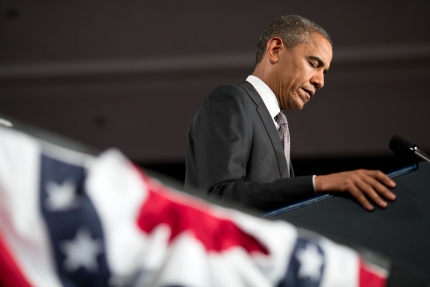
Remarks by the President at a Campaign Event -- West Palm Beach, FL
Century Village at West Palm Beach
West Palm Beach, Florida
6:45 P.M. EDT
THE PRESIDENT: What a great crowd! Everybody, have a seat. I want everybody to be relaxed. I am so excited to be here. Now, first of all, I just want to say that's the most kisses I've gotten at any campaign event. (Applause.) And that's just half of the crew. I might get some more on the way around here. (Applause.) I like that. I like that.
Can everybody please give David Israel a big round of applause for the great introduction. (Applause.) A couple of other people I want to acknowledge -- first of all, Palm Beach Mayor Geri Muio, give her a big round of applause. (Applause.) You just heard from an outstanding Congresswoman and the Chair of the Democratic National Committee, Debbie Wasserman-Schultz -- we love her. (Applause.) And your own outstanding Congressman who is doing a great job looking out for you every single day in Washington, Ted Deutch is here. (Applause.) Where's Ted? He is back there somewhere. Where did he go? There he is over there. Look at him. There he is. (Applause.)
And all of you are here, and I'm excited about that. (Applause.) So how is everybody doing today? (Applause.) You're doing good? I am excited to be in Century Village. This is legendary, Century Village. (Applause.) The folks are fired up in Century Village. (Applause.)
Now, by the way, I'm just curious -- how many folks who originally were from my hometown of Chicago? I'll bet there are some Chicagoans here. I knew there were some White Sox fans here -- I hope.
AUDIENCE: Nooo --
THE PRESIDENT: Sox! Don't talk about the Cubs now. (Laughter.)
So I have to tell you this is my last political campaign.
AUDIENCE: Awww --
THE PRESIDENT: No, this is -- Michelle thinks it's very good. She thinks it's great. Michelle thinks it's great. I am term limited, so this is going to be my last campaign. And it got me kind of nostalgic thinking about some of my first campaigns. I ran for state senate when I was 33 years old. And then I ran for the United States Senate. And back then, I didn't have Marine One. (Laughter.) I didn't have Air Force One. I didn't even have anybody driving me around. I was driving myself, filling up my own gas. (Laughter.) And we didn't have fancy stuff like GPS. So if you wanted to go somewhere, you had to get a map. So you'd be fumbling around with it, trying to figure out how to fold it back nicely. (Laughter.) And a bunch of times, I'd get lost. And then, finally, when I got to the place I was supposed to be, I had to find my own parking spot. I couldn't just pull up. These days, I just pull up. (Laughter.) Sometimes, it would be raining and I'd be trying to find my umbrella. By the time I got into the event, I'd be soaked.
But I have such great memories of those first campaigns. And the reason is because everywhere I went -- and Illinois is a big state, so you'd go to inner-cities and farm towns and suburbs, and people of every walk of life -- everywhere I went, I’d hear people’s stories. And those stories reminded me of my own stories.
So if I saw a couple that was 70 or 80, I’d think about my grandparents who fought in World War II -- my grandfather fought in World War II and my grandmother worked on a bomber assembly line. And when my grandfather came home, he was able to get a college education because of the GI Bill, and was able to buy their first home using the -- with the help of the FHA. And I was reminded of that Greatest Generation, everything they did on behalf of building this great country that we live in.
AUDIENCE MEMBER: And we’re still here!
THE PRESIDENT: There you go. (Applause.)
And then if I met a single mom, I’d think about my own mom. My dad left when I was an infant and so I didn’t know him, but -- and my mom didn’t have a lot of money, but, with the help of my grandparents, she was able to work and put herself through school, and then give a great education to me and my sister. And I’d think about how this country is so great because people have opportunities, even if they don’t come from a fancy background. (Applause.)
And I’d meet a working couple and I’d think about Michelle’s parents. Michelle’s dad had multiple sclerosis, MS. And by the time I met him, he could barely walk, had to use two canes -- and had to wake up an hour earlier than everybody else to get dressed to get to work. He worked as a blue-collar worker at the water filtration plant in Chicago. But he never missed a day of work. And Michelle’s mom worked as a secretary. But with those modest jobs, they were able to look after Michelle and her brother, and ended up sending them to some of the best colleges and universities in the country.
And I thought about how that story was true for so many other families all across Illinois. And then when I began to run for President, I realized that was true all across America. And so the thing that I loved -- (phone rings.) Who’s calling? (Laughter.) Is that Michelle? (Laughter and applause.) That’s because she heard all those women were kissing me. (Laughter.) She got a little nervous. She’s feeling a little jealous. (Laughter.)
But what all these stories reminded me of is that all across America, people of every walk of life -- black, white, Hispanic, Asian, Native American -- it doesn’t matter where you come from, there’s this central idea that makes this country great, the idea that no matter who you are, no matter what you look like, no matter where you come from, no matter what your faith, here in America if you’re willing to work hard, you can make it. You can get ahead -- you can get ahead. (Applause.)
Americans -- we don’t want handouts. We want to work for what we earn, but we do want hard work to pay off.
AUDIENCE: Yes!
THE PRESIDENT: We do expect that, if you’re willing to put in the effort, you should be able to find a job that pays a living wage. You shouldn’t go broke just because you get sick. (Applause.) You should be able to send your kids to a good school. You should retire with dignity and respect -- (applause) -- and you should be able to provide your children and hopefully your grandchildren with opportunities that you might not even have imagined, that they’re going to do even better than you did. That’s what America is all about. That’s at the heart of the American idea. (Applause.)
Now, I ran in 2008 because that basic bargain, that belief that hard work should pay off, it seemed as if that simple American Dream was at risk like never before. For more than a decade, it had been slipping away from too many hardworking people. Jobs and factories were shipped overseas. Folks at the very top were doing better than ever before, but the middle class, the folks who are the heartbeat of this country -- for middle-class families and those trying to get into the middle class, it seemed as if paychecks were getting smaller and bills were getting bigger.
Meanwhile, in Washington trillions of dollars were spent on two wars and tax cuts, and we went from record surpluses to record deficits. And on Wall Street, you had a culture of "anything goes," that led to reckless bets and ultimately resulted in the worst financial crisis since the Great Depression.
Ever since I ran for office I said that it's going to take more than one year or one term or even one President to solve some of these problems. (Applause.)
AUDIENCE: Four more years! Four more years!
THE PRESIDENT: You know what, let's face it, there's so much more work to do. This crisis made things that much tougher. And when you go through something as bad as anything since the Great Depression, it's a challenge to make sure that we get the economy moving and everybody is back to work and people's property values and their homes are back to where they need to be.
But when I hear people saying that somehow our best days are behind us, I tell them, you don't know the American people -- the courage, the character, the determination of the American people. Because as I travel across the country and I meet a small business person who sacrificed some of their own perks and maybe even their own pay to make sure that they could keep all those families on the job, or when I talk about some of autoworkers in Michigan and Ohio, who were never supposed to be building cars again but now can't build them fast enough -- (applause) -- when I meet men and women in their 50s who go back to community colleges, sitting with a bunch of 20-year-olds because they don't give up just because they got laid off -- and they retrain and suddenly they're finding new jobs in health care or medical technologies, or advanced manufacturing -- that spirit, that understanding that we may get knocked down but we always get back up, and that we always believe in our capacity to bring about the kind of changes that keep America moving, that tenacity and determination, that's undiminished. It's still there. It is still there.
And so, there may not be any quick fixes and easy solutions to some of the challenges we face, but we're going to fix them. I have every bit of confidence. In fact, the problem we have right now is not that we don't have good ideas for things like housing and education, making sure that we're bringing down our deficit and protecting seniors' Medicare and Social Security. The problem is not that we don't know how to do it. The problem is we've got a stalemate in Washington. (Applause.)
I mean, we've got the best scientists. We've got the best universities. We've got the best entrepreneurs. We've got the best system. We've got more diversity and ingenuity and talent coming from every part of the globe. So every other country on Earth, they'd be happy to trade places with us. But we do have this stalemate in Washington -- because there are a group of folks who want us to go backwards. I don't believe in going backwards, I believe in going forward. (Applause.) I believe in going forward. (Applause.) I want us to go forward.
My opponent, and his friends in Congress, they've got an economic plan.
AUDIENCE MEMBER: -- their economics don’t work!
THE PRESIDENT: Yes, well, it sounds like you've heard the plan. (Laughter.) Their plan is to cut taxes more for the wealthy, cut more regulations on banks and insurance companies and unscrupulous lenders, and cut more investments in things like education and research -- and hope that somehow all that is going to create more prosperity for everybody.
Now, that's a good theory if we hadn't just tried it. We tried it for a decade before I got elected, and it didn't work. It got us into this mess in the first place. (Applause.)
I think most of you, like most of America, understands that America works best not with top-down economics, but with a middle-out economics, with a bottom-up economics. (Applause.) When everybody has opportunity, then everybody does well, including those at the top. That's how we became the most prosperous nation on Earth. That's how we built the greatest middle class in history. And it's because I want to restore that basic bargain that I'm running for a second term as President of the United States. (Applause.)
AUDIENCE: Four more years! Four more years! Four more years!
THE PRESIDENT: I'm running because I don't believe that you can reduce the deficit without asking the wealthiest Americans -- including, by the way, folks like me -- to give up the tax cuts that they've been benefiting from for the last decade. My opponent doesn't want to just keep those tax cuts. He wants to pile on another $5 trillion in tax cuts, including a 25 percent tax cut for every millionaire in the country.
AUDIENCE: Booo --
THE PRESIDENT: But wait, it gets better. (Laughter.) To pay for this, he'd have to gut job-training programs for workers, financial aid for our students. He'd potentially have to raise taxes on the middle class -- the folks who can least afford it. He wants to roll back the Affordable Care Act, health care reform, forcing 200,000 Floridians to pay more for their prescription drugs. He plans to turn Medicare into a voucher program.
Now, understand how that works. If the voucher isn't worth what it takes to buy health insurance in the private marketplace, you're out of luck. You've got to make up the difference. You're on your own. So one independent, nonpartisan study found that under a similar plan, seniors would have to pay nearly $6,400 for Medicare than they do today. Where are you going to get that from? Where are you going to get it from -- $6,400? How many people here think that's a good idea --
AUDIENCE: No!
THE PRESIDENT: -- to finance tax cuts for folks who don't need them and weren't even asking for them. So, Florida, that is wrong. It’s wrong to ask you to pay for Medicare so that people who are doing well right now get even more. That’s no way to reduce the deficit. We shouldn’t be squeezing more money out of our seniors. My plan is to squeeze more money out of the health care system that is being wasted with waste and abuse and fraud. And we’ve been, by the way, cracking down on Medicare fraud harder than just about anybody because those dollars should be going to you and your care, not to folks who are cheating the system. (Applause.)
We’re going to cut -- and, look, let me tell you, there are some government programs that don’t work. And we can’t afford to waste money so we’ve already made a trillion dollars’ worth of cuts. We’re willing to cut spending on stuff that is not helping the middle class and not helping us grow. But we’ve also got to balance that by making sure that everybody’s doing their fair share.
And by the way, just like we tried their way and it didn’t work -- the way I’m talking about, we tried that, too, under a guy named Bill Clinton, and we created 23 million new jobs -- (applause) -- and we had a surplus instead of a deficit, and Medicare was protected, and Social Security was protected. And by the way, wealthy people did pretty well, too. (Applause.)
Because when middle-class families are doing well and they’ve got a little money in their pockets, that means they’re spending it with the local restaurant and the local business. So suddenly businesses have more customers and they start hiring more workers. And you get a virtuous cycle where everybody does well. That’s the recipe for success.
But this isn’t the only place where I’ve got a difference with Mr. Romney. (Laughter.) We talked about the auto industry -- Mr. Romney said, let’s "let Detroit go bankrupt."
AUDIENCE: Booo --
THE PRESIDENT: There were a million jobs at stake. So I said, no, let’s bet on American workers. Let’s bet on American manufacturing. (Applause.) And now G.M. is number one again. And Chrysler and Ford are on the move. The auto industry has come roaring back. (Applause.)
So I want to make sure that what we did with the auto industry, let’s do it with manufacturing all across the country -- right here in Florida, all across the country. Let’s put people back to work. And one of the ways we can do it is instead of giving tax breaks to companies that are shipping jobs overseas, let’s give tax breaks to companies that are investing here in the United States and hiring American workers. (Applause.) I want to sell goods around the world made in America. (Applause.) That’s what I believe in. That’s why I’m running for a second term. (Applause.)
I’m running because after a decade of war, it’s time for us to do some nation-building here at home. (Applause.) America is safer and more respected because of the unbelievable service of our troops. And because of their efforts, we ended the war in Iraq, as I promised. (Applause.) We’ve been able to refocus on al Qaeda and those who caused 9/11, and we have decimated their leadership and taken out bin Laden. (Applause.) We’ve been able to set a timeline to end the war in Afghanistan.
And we’ve strengthened our alliances and stood with countries that shared our values. I know a lot of people in this community care about the state of Israel -- (applause) -- and we are heartbroken -- and it’s an important time to talk about this because of these barbaric attacks that happened in Bulgaria -- young people being killed because of this ruthless terrorist attack. And I want everybody here to know, under my administration, we haven’t just preserved the unbreakable bond with Israel; we have strengthened it. (Applause.)
We’ve stood by Israel’s side in the face of criticism. Our military and intelligence cooperation has never been closer. And obviously this is a moment of great uncertainty in the Middle East given what’s happening in Syria and what’s happening in other places. So now is the time to make sure that we are doing everything we can to protect Israel’s security. And I want you to know that that’s something that should transcend party. That’s not a Republican or a Democratic issue. That is an issue of how we work with one of our closest allies in the world that shares our values and believes in democracy. (Applause.)
Now, the good news is our alliances are stronger and our homeland is safer because of the courage of our Armed Forces. But that also means that we’ve got to take care of our own responsibilities. The idea that anybody who wore the uniform of the United States Armed Forces is homeless right now is unacceptable. (Applause.) The notion that they should be fighting for a job or a roof over their heads after having fought for us is unacceptable. (Applause.) And that’s why we are going to meet that sacred trust and make sure every veteran gets the care that they have earned and the services that they have earned.
That’s one of the reasons I’m running for a second term as President of the United States of America. (Applause.)
AUDIENCE: Four more years! Four more years! Four more years!
THE PRESIDENT: So -- there’s more work to do. I want to take about half of the savings that we’ve been spending on war; let’s rebuild America. Let’s put workers back to work rebuilding our roads and our bridges. (Applause.) Rebuilding our ports. You know, I just took a step today that will save -- shave years off of the renovation of the Jacksonville Port. All across Florida, there are ports that are gateways for trade and commerce and jobs, and we want to accelerate those things.
And it’s important for the local economy, but it’s also important for the American economy. We used to have the best stuff -- the best airports, the best roads, the best everything, but we’ve been slipping because we haven’t been making those investments. And you know what happens when you defer maintenance -- if you don’t fix the roof, what happens? That’s going to cost you more later on. Why wouldn’t we want to put some folks back to work right now rebuilding America? (Applause.) That’s good for the economy. It’s good for our future. (Applause.)
I’m running to make sure America once again has the best education system in the world. (Applause.) I want our schools to hire and reward the best teachers, especially in math and science. I want to give 2 million more Americans the chance to get trained at community colleges for the jobs that local businesses are hiring right now. (Applause.) I want colleges and universities to bring down their tuition so that young people aren’t loaded up with debt. (Applause.)
Higher education isn’t a luxury anymore; it’s an economic necessity. It may not be at a four-year college, but two-year, four-year, you need an advanced degree of some sort to get into the middle class. And we’ve got to make it affordable for all of our young people. (Applause.)
Now, me and Mr. Romney, we’ve got a lot of differences and I’ve just mentioned a few. Here in Florida, we’re all still concerned that the housing market is weak. You’re starting to see some signs of life around the country, but it’s still a lot of homes underwater. Mr. Romney’s plan is to just let the market bottom out. That’s his plan. That’s not a solution, that’s a problem.
Now, we’ve already helped millions of responsible homeowners refinance at historically low rates, refinance their mortgages, so I’m running to make sure that everybody can refinance and save about $3,000 -- money in your pocket that you can use either to build back the equity in your home or spend it at a local business, which will further strengthen the economy. That’s a difference between me and Mr. Romney. (Applause.)
I believe it was the right thing to do, to pass health care reform. (Applause.) All of you know what it means to have security when it comes to your health care. A lot of folks here may already be on Medicare. But imagine if you had been unlucky and ended up getting laid off at the age of 55 or 57, and maybe you've already had an illness and now you're trying to get back in the workforce, but it's taking a long time. You'd lose your health insurance. Or you get a job that doesn't offer you health insurance. Or maybe you're a small business person and you've got to go into the individual market, and it turns out that because of a preexisting condition you can't get it or it costs so much you could never even afford it. That's not right. That's not who we are.
So that's why we passed the Affordable Care Act. It was the right thing to do. (Applause.) The Supreme Court has now spoken, and we are going to implement this plan -- because we're moving forward, we're not going backwards. (Applause.)
We're not going to go backwards when it comes to telling outstanding servicemembers that they can't serve this country they love just because of who they love. We ended "don't ask, don't tell". It was the right thing to do. (Applause.)
We're not going backwards when it comes to the need for immigration reform. We're a nation of laws, but we're also a nation of immigrants. (Applause.) And so we need to have a smart system that says, you know what, those who are willing to work hard and act responsibly, you've got a chance to succeed here in America just like previous generations. (Applause.)
And all these things, whether it's bringing manufacturing or construction jobs back, or protecting your health care, or making sure your grandkids can stay on your -- their parent's health insurance plan if they don't have a job that provides health insurance, or making sure that our veterans are cared for, or making sure that young people can afford college -- all these things go back to that original idea, the idea that if you work hard, you can make it in this country. You can get ahead. (Applause.)
That's the promise that our parents and our grandparents made to us. And that's what we now have to pass on to our kids and grandkids.
And so, over the next four months, the other side is going to spend more money than we've ever seen. (Laughter.) And they'll have a bunch of ads with scary voices. (Laughter.) And most of what you hear, you can pretty much just go mute -- (laughter) -- just press the mute button. That's the good thing about the remote. Or you can use the DVR and fast forward. (Laughter.)
And the reason you don't really have to pay much attention is because these ads are going to say the same thing over and over again. They know -- the other side knows they can't sell their economic plan, because we've tried it and it didn't work. And everybody remembers that. So instead, what they're going to say is, well, you know what, the economy is still bad and it's Obama's fault. That's their message over and over again. So it doesn't matter what's on the screen. You know that's what they're saying. Plus, some of the pictures of me will be unflattering. (Laughter.) My face is all distorted -- one eye is all droopy. (Laughter.) Right? I'm looking all grim. (Laughter.)
So you know what they're saying. Now, that may be a way -- that may be their plan to win an election. But it's not a plan to create jobs. It's not a plan to revitalize the middle class. It's not a plan to actually move this country forward.
And, frankly, I'd be worried if this was my first campaign, but I've been to this rodeo before. (Laughter.) And one of the things that gives me confidence is you. (Applause.) The American people know to cut through some nonsense.
AUDIENCE MEMBER: (Inaudible.) (Laughter.)
THE PRESIDENT: And I -- (laughter) -- this is kind of a wild crowd here. (Laughter and applause.)
What gives me hope is you, because just like in that first campaign, when I'm now campaigning, I'm traveling around the country, I constantly hear stories that are just like my story, just like my family's stories. All the struggles that previous generations went through -- folks coming over here as immigrants, in some cases folks coming in chains -- but despite heartache and disappointment, and when you think about all those who traveled through Ellis Island, they didn't know what they were going to find. But what they knew was there was something special about this country.
AUDIENCE: Yes!
THE PRESIDENT: And so, no matter how hard it was, no matter how tough, they just kept on going. They kept on working. And they understood that this was a country where people were free to pursue their own individual dreams, but that people would still come together as a country.
I was saying the other day, we take pride in individual initiative and, like I said, we don’t like handouts. We don’t expect government to solve every problem and we don’t think the government should help people who don’t want to even help themselves. But we also remember that that GI Bill that educated so many people -- we did that together. Hoover Dam, Golden Gate Bridge, we built together. The Internet was created because of investments that we made together. That’s how we sent a man to the moon -- together.
And so we are not going to -- we’re not going to abandon those values and those traditions that ultimately made this the country that we love. So when we tap into those values, those things we know that are right and that are true, then all that other money and all that negativity doesn’t matter. All that stuff, that’s not going to impact the election. It’s going to be up to you. The choice is going to be up to you.
AUDIENCE MEMBER: We choose you. (Applause.)
THE PRESIDENT: And if you are ready to work, then I’m confident about this election, I feel good about it -- because you are going to break this stalemate and get things back on track.
In 2008, I told you I’m not a perfect man -- Michelle could have told you that -- (laughter) -- and I said I wouldn’t be a perfect President. No President is. But what I said was I’d always tell you where I stood, I’d always tell you what I thought, and most importantly, I’d wake up every single day fighting as hard as I knew how for you. (Applause.) Fighting for you. (Applause.) Thinking about you.
Because I see myself in you. I see myself, I see my grandparents, I see my own kids in you. We’re a part of that same story. And so when I’m fighting for you, I’m fighting for my kids and their future. And that’s why I’ve been able to keep that promise -- because I still believe in you. And if you still believe in me and you are willing to stand with me -- (applause) -- and work with me, and knock on doors with me, and make phone calls with me, I promise you, we will win Florida, we will win this election, and together, we will finish what we started and remind the world why America is the greatest nation on Earth.
God bless you, everybody. God bless the United States of America.
END
7:21 P.M. EDT