West Wing Week 07/27/12 “A Brighter Day Is Going To Come”

This week, the President addressed the nation on the tragedy in Colorado and made Aurora his first stop on a four day trip out West, then continued to Reno to address the VFW, and to New Orleans to speak at the National Urban League.  Back in Washington DC, Dr. Biden announced a major Joining Forces initiative for social workers, the President signed an Executive Order on Education, and hosted a reception at the White House to honor the International AIDS Conference taking place in Washington DC.

Watch the West Wing Week here.

Related Topics: Colorado, Pennsylvania

President Obama Pushes the House of Representatives on Middle Class Tax Cuts

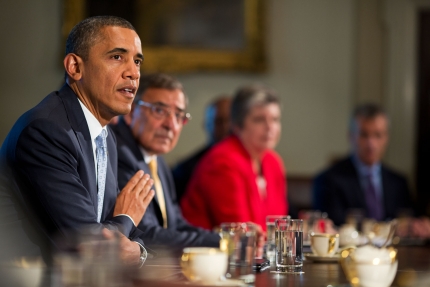
President Barack Obama holds a Cabinet meeting (July 26, 2012)

President Barack Obama holds a Cabinet meeting in the Cabinet Room of the White House, July 26, 2012. (Official White House Photo by David Lienemann)

Kicking off a Cabinet meeting this afternoon, President Obama again pushed the House of Representatives to follow the lead of the Senate and extend tax cuts for the middle class before the looming January 1 deadline.

"[My] administration is focusing on our economy, and how do we make sure that this is an economy in which people who work hard, who act responsibly, can get ahead," the President said.

At midnight on New Year's Eve, tax cuts for 114 million middle class families are set to expire, even though there's broad consensus in Washington about the need for a solution. Without an extension, a typical family of four would be asked to pay an additional $2,200 in 2013.

"[Yesterday], the Senate voted to ensure that 98 percent of Americans don’t see their taxes go up next year, that 97 percent of small businesses don’t see their taxes go up next year," the President told his Cabinet. "It was the right thing to do."

The President said he would push the members of the Cabinet to join him in amplifying that message in the days ahead.

"[One] of the things that I’m going to be doing, my Cabinet members are going to be doing over the next several days, is to make sure that the American people understand that we can provide them certainty right now for next year that their taxes will not go up, and they will then be able to plan accordingly,” he told reporters before the meeting. 

Watch President Obama hold a cabinet affairs meeting.

Related Topics: Taxes

President Obama on the Middle Class Tax Cuts

July 26, 2012 | 2:29 | Public Domain

President Obama urges the House of Representatives to follow the Senate's lead and extend the middle class tax cuts for 98% of Americans. http://obamawhitehouse.archives.gov

Download mp4 (79.8MB)

The White House

Office of the Press Secretary

President Obama Announces More Key Administration Posts

WASHINGTON, DC – Today, President Barack Obama announced his intent to nominate the following individuals to key Administration posts:

• Eric J. Jolly – Member, National Museum and Library Services Board
• Susana Torruella Leval – Member, National Museum and Library Services Board

The President also announced his intent to appoint the following individuals to key Administration posts:

• Nani A. Coloretti – Member, Government Accountability and Transparency Board
• Greg Friedman – Member, Government Accountability and Transparency Board
• Freeman A. Hrabowski III – Chair, President’s Advisory Commission on Educational Excellence for African Americans
• Maria T. Nagorski – Member, President’s Advisory Council on Faith-Based and Neighborhood Partnerships
• Elder Steven E. Snow – Member, President’s Advisory Council on Faith-Based and Neighborhood Partnerships

President Obama said, “I am proud that such experienced and committed individuals have agreed to serve the American people in these important roles. I look forward to working with them in the months and years ahead.”

President Obama announced his intent to nominate the following individuals to key Administration posts:

Dr. Eric J. Jolly, Nominee for Member, National Museum and Library Services Board
Dr. Eric J. Jolly is President of the Science Museum of Minnesota.  Previously, from 1995 to 2004, he served as Senior Scientist and Vice President at the Education Development Center, a nonprofit research and design organization in Newton, Massachusetts.  Dr. Jolly was Assistant to the Chancellor and Director for Affirmative Action and Diversity Programs at the University of Nebraska-Lincoln from 1992 to 1995, Assistant Dean of University College at the University of Rhode Island from 1989 to 1992, and Associate Dean of the College of Arts and Sciences at Indiana State University from 1987 to 1989.  He served on the Board of Directors of the Cornell Laboratory of Ornithology and the Association of Science-Technology Centers, as well as the Board of Trustees of the National Museum of the American Indian, and the Senior Advisory Board of the University of Arizona Science Center.  Dr. Jolly received a B.A. from the University of Rhode Island, and an M.S. and Ph.D. from the University of Oklahoma.

Susana Torruella Leval, Nominee for Member, National Museum and Library Services Board
Susana Torruella Leval is Director Emerita of El Museo del Barrio.   She served as Director of El Museo del Barrio from 1994 to 2002, after serving as Chief Curator for four years.  Ms. Torruella Leval is a member of the Board of Trustees of the Metropolitan Museum of Art, the Aperture Foundation, and Dreamyard.  In addition, she is on the Editorial Board of the International Center of the Art of the Americas.  She previously served on the Overseers’ Committee to Visit the Arts Museums at Harvard College and the Visiting Committee of the Getty Center.  Ms. Torruella Leval received a B.A. from Manhattanville College and an M.A. from New York University’s Institute of Fine Arts.

President Obama announced his intent to appoint the following individuals to key Administration posts:

Nani A. Coloretti, Appointee for Member, Government Accountability and Transparency Board
Nani A. Coloretti is Acting Assistant Secretary for Management and Deputy Assistant Secretary for Management and Budget at the U.S. Department of the Treasury.  Prior to joining the Administration, Ms. Coloretti worked in the San Francisco’s Mayor’s office from 2005 until 2009, most recently serving as Budget Director.  Previously, Ms. Coloretti served as the Director of Policy, Planning, and Budget for the San Francisco Department of Children, Youth, and Their Families from 1999 to 2005.  Ms. Coloretti worked as a Health Financing Branch Budget Examiner for the U.S. Office of Management and Budget from 1994 to 1997.  She was a Budget Analyst for the Department of Public Safety in the State of Hawaii from 1991 to 1992.  Ms. Coloretti is a recipient of the National Public Service Award, the Public Policy and International Affairs Achievement Award, and the Government Finance Officers Association Distinguished Budget Presentation Award.  She received a B.A. in Economics and Communications from the University of Pennsylvania and an M.P.P. from the Goldman School of Public Policy at the University of California at Berkeley.

Greg Friedman, Appointee for Member, Government Accountability and Transparency Board
Greg Friedman is Inspector General at the U.S. Department of Energy (DOE), a position he has held since 1998.  In addition, Mr. Friedman serves as a Member of the Recovery Accountability and Transparency Board.  He joined the Office of the Inspector General in 1982 as an Auditor and served in a variety of roles, including Deputy Inspector General from 1994 to 1998.  He has served as Vice Chair of the President’s Council on Integrity and Efficiency and as a Member of the Advisory Council on Government Auditing Standards.  He is a recipient of DOE’s Meritorious Service Award and a two-time recipient of the Presidential Rank Award, once for Distinguished Service and once for Meritorious Service.  In 1979, he was selected by DOE to be a Mid-Career Fellow in Public Affairs at Princeton University’s Woodrow Wilson School for Public and International Affairs.  Mr. Friedman received a B.A. in Business Administration from Temple University and an M.B.A. from Fairleigh Dickinson University.

Dr. Freeman A. Hrabowski III, Appointee for Chair, President's Advisory Commission on Educational Excellence for African Americans
Dr. Freeman A. Hrabowski III is President of the University of Maryland, Baltimore County (UMBC), a position he has held since 1992.  Previously, Dr. Hrabowski was Executive Vice President of UMBC from 1990 to 1992 and Vice Provost of UMBC from 1987 to 1990.  Before joining UMBC, Dr. Hrabowski held leadership and faculty positions at Coppin State College, now Coppin State University, from 1977 to 1987 and at the University of Illinois at Urbana-Champaign from 1974 to 1976.  He serves on the boards of the Alfred P. Sloan Foundation, the France-Merrick Foundation, and the Urban Institute, and is Chair of the Marguerite Casey Foundation.  He is a recipient of the U.S. Presidential Award for Excellence in Science, Mathematics, and Engineering Mentoring.  He was named one of the “100 Most Influential People in the World” in 2012 by Time Magazine and one of the seven “Top American Leaders” in 2011 by The Washington Post and the Kennedy School of Government at Harvard University.  He received a B.A. in Mathematics from the Hampton Institute, now Hampton University, as well as an M.A. in Mathematics and a Ph.D. in Higher Education Administration from the University of Illinois at Urbana-Champaign.

Maria T. Nagorski, Appointee for Member, President’s Advisory Council on Faith-Based and Neighborhood Partnerships
Maria T. Nagorski is the Executive Director of the nonprofit organization Fair Chance.  Fair Chance partners with community-based nonprofits to increase their ability to address issues related to child poverty.  Previously, from 1999 to 2007, Ms. Nagorski provided leadership and training services to a variety of organizations, including the United Nations World Food Programme, the White Ribbon Alliance for Safe Motherhood, and the International Youth Foundation.  From 1994 to 1999, Ms. Nagorski was the Founder and Executive Director of Center for Youth as Resources, a national organization focused on engaging youth in service, philanthropy, and leadership in their communities.  Concurrently, from 1985 to 1999, she was the Deputy Executive Director of the National Crime Prevention Council.  Ms. Nagorski is an active member of Leadership Greater Washington and was awarded a 2010 Purpose Prize Fellowship by Civic Ventures.  Ms. Nagorski received a B.A. in History from the University of Rochester.

Elder Steven E. Snow, Appointee for Member, President’s Advisory Council on Faith-Based and Neighborhood Partnerships
Elder Steven E. Snow currently serves as Church Historian, Recorder, and Church History Department Executive Director for the Church of Jesus Christ of Latter-day Saints.  Previously, Elder Snow served as a member of the Presidency of the Seventy, supervising the Utah Areas and the North America Central Area from 2007 to 2012.  Prior to this, he served as Executive Director of the Church’s Priesthood Department from 2006 to 2007 and as President of the Church’s Africa Southeast Area from 2001 to 2005.  Elder Snow first joined the Church’s First Quorum of the Seventy in 2001.  Prior to his work with the Church, Elder Snow was a Senior Partner at the Utah law firm of Snow & Nuffer from 1979 to 2001 and a county prosecutor in Washington County, Utah, from 1977 to 1979.  Elder Snow has also served as a member and President of the Washington County, Utah, School Board; Chairman of the Utah State Board of Regents; and Chairman of the Western Interstate Commission of Higher Education.  Elder Snow received his B.S. in Accounting from Utah State University and his J.D. from Brigham Young University.

President Obama Holds a Cabinet Meeting

July 26, 2012 | 3:15 | Public Domain

President Obama holds a meeting with his Cabinet and addresses the issue of middle class tax cuts for Americans. July 26, 2012

Download mp4 (105.2MB) | mp3 (7.4MB)

The White House

Office of the Press Secretary

Remarks by the President Before Cabinet Meeting

Cabinet Room

2:24 P.M. EDT

THE PRESIDENT:  Well, this is a good opportunity for me to bring my Cabinet together to thank them for the extraordinary work that they’re doing on a whole range of fronts. 

You’ve got Tom Vilsack working very hard to make sure that farmers and ranchers are getting help at a time of devastating drought. 

You have Secretary Clinton who has been logging more miles than any Secretary of State in history, dealing with a whole range of problems and opportunities around the globe.  Obviously, we’re going to be focusing a lot on the situation in Syria and what we can do there to make sure that we reduce the bloodshed.

But a whole range of Cabinet members and obviously my administration is focusing on our economy, and how do we make sure that this is an economy in which people who work hard, who act responsibly, can get ahead.

This is a particular challenge right now -- we’re seeing some of the weaknesses in Europe -- and it is a perfect time for us to focus on what are steps we can take now -- not later, not a year from now, but right now -- to strengthen the middle class, put more people back to work and provide business greater certainty.

And yesterday, the Senate voted to ensure that 98 percent of Americans don’t see their taxes go up next year, that 97 percent of small businesses don’t see their taxes go up next year.  It was the right thing to do.  It will provide certainty and security to families who are already being pinched because of the economy.  It will be good for the economy as a whole. 

And now, the only thing that is going to prevent the vast majority of Americans from not seeing a tax increase next year is if the House doesn’t act.  We need 218 votes in the House of Representatives -- 218 votes in the House of Representatives -- to make sure that 98 percent of Americans don’t see their taxes go up next year.

And so one of the things that I’m going to be doing, my Cabinet members are going to be doing over the next several days is to make sure that the American people understand that we can provide them certainty right now for next year that their taxes will not go up, and that they will then be able to plan accordingly; small businesses will be able to plan accordingly, knowing that we’ve taken a whole bunch of uncertainty out of the economy at a time when the global economy is experiencing a number of disruptions.

So, again, I would urge the House of Representatives to do the right thing and I’m going to make sure that my Cabinet members amplify that message in the days to come.

Thank you very much, everybody.

Q    Mr. President, can you tell us, if what the Colorado shooter did was entirely legal, how do you do more on this subject without any new laws?

THE PRESIDENT:  Thank you very much.  I’m sure we’ll have more opportunity to talk about this.

Q    This afternoon is fine.  I’m available.

THE PRESIDENT:  Thanks.  I’ll ask Jay for your number.  (Laughter.)

END 
2:27 P.M. EDT

The White House

Office of the Press Secretary

President Obama Signs New Initiative to Improve Educational Outcomes for African Americans

Executive Order Establishes the White House Initiative on Educational Excellence for African Americans

On Wednesday, during his remarks at the National Urban League conference in New Orleans, LA, President Obama announced he would sign an Executive Order today to improve outcomes and advance educational opportunities for African Americans.

The President has made providing a complete and competitive education for all Americans – from cradle to career – a top priority.  The White House Initiative on Educational Excellence for African Americans will work across Federal agencies and with partners and communities nationwide to produce a more effective continuum of education programs for African American students.  The Initiative aims to ensure that all African American students receive an education that fully prepares them for high school graduation, college completion, and productive careers.

In the nearly 60 years since the Brown v. Board of Education decision put America on a path toward equal educational opportunity, America’s educational system has undergone a remarkable transformation.  Many African American children who attended substandard, segregated schools in the 1950s have grown up to see their children attend integrated and effective elementary and secondary schools, colleges, and universities.  Nonetheless, substantial obstacles to equal educational opportunity still remain in America’s educational system.  African American students lack equal access to highly effective teachers and principals, safe schools, and challenging college-preparatory classes, and they disproportionately experience school discipline and referrals to special education.

Significantly improving the educational outcomes of African Americans will provide substantial benefits for our country by advancing important outcomes, like increasing college completion rates, employment rates, and the number of African American teachers.  Enhanced educational outcomes for African Americans will lead to more productive careers, improved economic mobility and security, and greater social well-being for all Americans. 

Advancing Educational Achievement of African American Students

The President has set the goal for America to have the highest proportion of college graduates in the world by 2020. To reach this ambitious goal, and to ensure equality of access and opportunity in education for all Americans, the Obama Administration is dedicating new resources, through rigorous and well-rounded academic and support services, to enable African American students to improve their educational achievement and prepare for college and career.

The White House Initiative on Educational Excellence for African Americans, housed within the Department of Education, will work with the Executive Office of the President and Cabinet agencies to identify evidence-based best practices to improve African American student achievement in school and college, and to develop a national network of individuals, organizations, and communities that will share and implement these practices.  It will also help ensure that Federal programs and initiatives administered by the Department of Education and other Federal agencies maintain a focus on serving and meeting the educational needs of African Americans. The Initiative will complement the existing White House Initiative that strengthens the nation’s Historically Black Colleges and Universities (HBCUs) by working with Federal agencies and partners nationwide to provide all African American students with a more effective continuum of education programs.

To deliver a complete and competitive education for all African Americans, the Initiative will promote, encourage, and undertake efforts designed to meet several objectives, including:

• Increasing the percentage of African American children who enter kindergarten ready for success by improving access to high-quality early learning and development programs;
• Ensuring that all African American students have access to high-level, rigorous course work and support services that will prepare them for college, a career, and civic participation;
• Providing African American students with equitable access to effective teachers and principals in pursuit of a high-quality education, and supporting efforts to improve the recruitment, preparation, development, and retention of successful African American teachers and principals;
• Promoting a positive school climate that does not rely on methods that result in disparate use of disciplinary tools, and decreasing the disproportionate number of referrals to special education by addressing root causes of the referrals;
• Reducing the dropout rate of African American students and increasing the proportion of African American students who graduate from high school prepared for college and career;
• Increasing college access, college persistence, and college attainment for African American students;
• Strengthening the capacity of institutions of higher education that serve large numbers of African American students, including community colleges, HBCUs, Predominantly Black Institutions (PBIs), and other institutions; and
• Improving the quality of, and expanding access to, adult education, literacy, and career and technical education.

The Presidential Advisory Commission and Federal Interagency Working Group to Enhance Educational Outcomes for African American Students

The Executive Order also creates the President’s Advisory Commission on Educational Excellence for African Americans, to aid and advise the work of the Initiative. The Commission will advise President Obama and Education Secretary Arne Duncan on matters pertaining to the educational attainment of the African American community, including the development, implementation, and coordination of resources aimed at improving educational opportunities and outcomes for African Americans of all ages. The Commission will also engage the philanthropic, business, nonprofit, and education communities in a national dialogue on African American student achievement, and work with the Initiative to establish partnerships with stakeholders from these sectors to achieve the objectives of this Executive Order.

The Executive Order also establishes a Federal Interagency Working Group on Educational Excellence for African Americans. The Working Group will be chaired by the Initiative’s Executive Director, and will convene senior officials from the Executive Office of the President and several Cabinet and sub-Cabinet agencies to coordinate the Federal investment in education programs and initiatives aimed at enhancing outcomes for African Americans in early childhood education; elementary, secondary, and postsecondary education; career and technical education; and adult education.

The White House

Office of the Press Secretary

Executive Order -- White House Initiative on Educational Excellence for African Americans

EXECUTIVE ORDER

- - - - - - -

WHITE HOUSE INITIATIVE ON EDUCATIONAL EXCELLENCE
FOR AFRICAN AMERICANS

By the authority vested in me as President by the Constitution and the laws of the United States of America, to restore the country to its role as the global leader in education, to strengthen the Nation by improving educational outcomes for African Americans of all ages, and to help ensure that all African Americans receive an education that properly prepares them for college, productive careers, and satisfying lives, it is hereby ordered as follows:

Section 1. Policy. Over the course of America's history, African American men and women have strengthened our Nation, including by leading reforms, overcoming obstacles, and breaking down barriers. In the less than 60 years since the Brown v. Board of Education decision put America on a path toward equal educational opportunity, America's educational system has undergone a remarkable transformation, and many African American children who attended the substandard segregated schools of the 1950s have grown up to see their children attend integrated elementary and secondary schools, colleges, and universities.

However, substantial obstacles to equal educational opportunity still remain in America's educational system. African Americans lack equal access to highly effective teachers and principals, safe schools, and challenging college-preparatory classes, and they disproportionately experience school discipline and referrals to special education. African American student achievement not only lags behind that of their domestic peers by an average of two grade levels, but also behind students in almost every other developed nation. Over a third of African American students do not graduate from high school on time with a regular high school diploma, and only four percent of African American high school graduates interested in college are college-ready across a range of subjects. An even greater number of African American males do not graduate with a regular high school diploma, and African American males also experience disparate rates of incarceration.

Significantly improving the educational outcomes of African Americans will provide substantial benefits for our country by, among other things, increasing college completion rates, productivity, employment rates, and the number of African American teachers. Enhanced educational outcomes lead to more productive careers, improved economic opportunity, and greater social well-being for all Americans. Complementing the role of Historically Black Colleges and Universities (HBCUs) in preparing generations of African American students for

successful careers, and the work of my Administration's separate White House Initiative on Historically Black Colleges and Universities, this new Initiative's focus on improving all the sequential levels of education will produce a more effective educational continuum for all African American students.

To reach the ambitious education goals we have set for our Nation, as well as to ensure equality of access and opportunity for all, we must provide the support that will enable African American students to improve their level of educational achievement through rigorous and well-rounded academic and support services that will prepare them for college, a career, and a lifetime of learning.

Sec. 2. White House Initiative on Educational Excellence for African Americans.

(a) Establishment. There is hereby established the White House Initiative on Educational Excellence for African Americans (Initiative), to be housed in the Department of Education (Department). There shall be an Executive Director of the Initiative, to be appointed by the Secretary of Education (Secretary). The Initiative shall be supported by the Interagency Working Group established under subsection (c) of this section and advised by the Commission established under section 3 of this order.

(b) Mission and Functions.

(1) The Initiative will help to restore the United States to its role as the global leader in education; strengthen the Nation by improving educational outcomes for African Americans of all ages; and help ensure that African Americans receive a complete and competitive education that prepares them for college, a satisfying career, and productive citizenship.

(2) The Initiative will complement and reinforce the Historically Black Colleges and Universities Initiative established by Executive Order 13532 of February 26, 2010, and together, they both will support enhanced educational outcomes for African Americans at every level of the American education system, including early childhood education; elementary, secondary, and postsecondary education; career and technical education; and adult education.

(3) To help expand educational opportunities, improve educational outcomes, and deliver a complete and competitive education for all African Americans, the Initiative shall, consistent with applicable law, promote, encourage, and undertake efforts designed to meet the following objectives:

(i) increasing general understanding of the causes of the educational challenges faced by African American students, whether they are in urban, suburban, or rural learning environments;

(ii) increasing the percentage of African American children who enter kindergarten ready for success by improving their access to high-quality programs and services that enable early learning and development of children from birth through age 5;

(iii) decreasing the disproportionate number of referrals of African American children from general education to special education by addressing the root causes of the referrals and eradicating discriminatory referrals;

(iv) implementing successful and innovative education reform strategies and practices in America's public schools to ensure that African American students receive a rigorous and well-rounded education in safe and healthy environments, and have access to high-level, rigorous course work and support services that will prepare them for college, a career, and civic participation;

(v) ensuring that all African American students have comparable access to the resources necessary to obtain a high-quality education, including effective teachers and school leaders, in part by supporting efforts to improve the recruitment, preparation, development, and retention of successful African American teachers and school leaders and other effective teachers and school leaders responsible for the education of African American students;

(vi) reducing the dropout rate of African American students and helping African American students graduate from high school prepared for college and a career, in part by promoting a positive school climate that does not rely on methods that result in disparate use of disciplinary tools, and by supporting successful and innovative dropout prevention and recovery strategies that better engage African American youths in their learning, help them catch up academically, and provide those who have left the educational system with pathways to reentry;

(vii) increasing college access and success for African American students and providing support to help ensure that a greater percentage of African Americans complete college and contribute to the goal of having America again lead the world in the proportion of adults who are college graduates by 2020, in part through strategies to strengthen the capacity of institutions of higher education that serve large numbers of African American students, including community colleges, HBCUs, Predominantly Black Institutions (PBIs), and other institutions; and

(viii) enhancing the educational and life opportunities of African Americans by fostering positive family and community engagement in education; reducing racial isolation and resegregation of elementary and secondary schools to promote understanding and tolerance among all Americans; improving the quality of, and expanding access to, adult education, literacy, and career and technical education; and increasing opportunities for education and career advancement in the fields of science, technology, engineering, and mathematics.

(4) In working to fulfill its mission and objectives, the Initiative shall, consistent with applicable law:

(i) identify evidence-based best practices that can provide African American students a rigorous and well-rounded education in safe and healthy environments, as well as access to support services, which will prepare them for college, a career, and civic participation;

(ii) develop a national network of individuals, organizations, and communities to share and implement best practices related to the education of African Americans, including those identified as most at risk;

(iii) help ensure that Federal programs and initiatives administered by the Department and other agencies are serving and meeting the educational needs of African Americans, including by encouraging agencies to incorporate best practices into appropriate discretionary programs where permitted by law;

(iv) work closely with the Executive Office of the President on key Administration priorities related to the education of African Americans;

(v) increase the participation of the African American community, including institutions that serve that community, in the Department's programs and in education-related programs at other agencies;

(vi) advise the officials of the Department and other agencies on issues related to the educational attainment of African Americans;

(vii) advise the Secretary on the development, implementation, and coordination of educational programs and initiatives at the Department and other agencies that are designed to improve educational opportunities and outcomes for African Americans of all ages; and

(viii) encourage and develop partnerships with public, private, philanthropic, and nonprofit stakeholders to improve African Americans' readiness for school, college, and career, as well as their college persistence and completion.

(5) The Initiative shall periodically publish reports on its activities. The Secretary and the Executive Director of the Initiative, in consultation with the Working Group and the Chair of the Commission established under subsection (c) of this section and section 3 of this order, respectively, may develop and submit to the President recommendations designed to advance and promote educational opportunities and attainment for African Americans.

(c) Interagency Working Group.

(1) There is established the Federal Interagency Working Group on Educational Excellence for African Americans (Working Group), which shall be convened and chaired by the Initiative's Executive Director and that shall support the efforts of the Initiative described in subsection (b) of this section.

(2) The Working Group shall consist of senior officials from the Department, the White House Domestic Policy Council, the Department of Justice, the Department of Labor, the Department of Health and Human Services, the National Science Foundation, the Department of Defense, and such additional agencies and offices as the President may subsequently designate. Senior officials shall be designated by the heads of their respective agencies and offices.

(3) The Initiative's Executive Director may establish subgroups of the Working Group to focus on different aspects of the educational system (such as early childhood education, K-12 education, higher education (including HBCUs and PBIs), career and technical education, adult education, or correctional education and reengagement) or educational challenges facing particular populations of African Americans (such as young men, disconnected or out-of-school youth, individuals with disabilities, children identified as gifted and talented, single-parent households, or adults already in the workforce).

(d) Administration. The Department shall provide funding and administrative support for the Initiative and the Working Group, to the extent permitted by law and within existing appropriations. To the extent permitted by law, other agencies and offices represented on the Working Group may detail personnel to the Initiative, to assist the Department in meeting the objectives of this order.

(e) Collaboration Among White House Initiatives. The Initiative may collaborate with the White House Initiatives on American Indian and Alaska Native Education, Educational Excellence for Hispanics, Asian-American and Pacific Islanders, and (consistent with section 3(c) of this order) Historically Black Colleges and Universities, whenever appropriate in light of their shared objectives.

Sec. 3. President's Advisory Commission on Educational Excellence for African Americans.

(a) Establishment. There is established in the Department the President's Advisory Commission on Educational Excellence for African Americans (Commission).

(b) Commission Mission and Scope. The Commission shall advise the President and the Secretary on matters pertaining to the educational attainment of the African American community, including:

(1) the development, implementation, and coordination of educational programs and initiatives at the Department and other agencies to improve educational opportunities and outcomes for African Americans of all ages;

(2) efforts to increase the participation of the African American community and institutions that serve the African American community in the Department's programs and in education programs at other agencies;

(3) efforts to engage the philanthropic, business, nonprofit, and education communities in a national dialogue on the mission and objectives of this order; and

(4) the establishment of partnerships with public, private, philanthropic, and nonprofit stakeholders to meet the mission and policy objectives of this order.

The Commission shall meet periodically, but at least twice a year.

(c) Commission Membership and Chair.

(1) The Commission shall consist of not more than 25 members appointed by the President. The President shall designate one member of the Commission to serve as Chair. The Executive Director of the Initiative shall also serve as the Executive Director of the Commission and administer the work of the Commission. The Chair of the Commission shall work with the Executive Director to convene regular meetings of the Commission, determine its agenda, and direct its work, consistent with this order.

(2) The Commission may include individuals with relevant experience or subject-matter expertise that the President deems appropriate, as well as individuals who may serve as representatives of a variety of sectors, including the education sector (early childhood education, elementary and secondary education, higher education (including HBCUs and PBIs), career and technical education, and adult education), labor organizations, research

institutions, the military, corporate and financial institutions, public and private philanthropic organizations, and nonprofit and community-based organizations at the national, State, regional, or local levels.

(3) In addition to the 25 members appointed by the President, the Commission shall also include two members from the President's Board of Advisors on Historically Black Colleges and Universities (Board), designated by the President. In turn, the Board will henceforth include two members from the Commission, designated by the President. This reciprocal arrangement will foster direct communication and vital consultations that will benefit both bodies.

(4) The Executive Director of the Commission and the Executive Director of the Board shall convene at least one annual joint meeting between the Commission and the Board for the purpose of sharing information and forging collaborative courses of action designed to fulfill their respective missions. Such meetings shall be in addition to other prescribed meetings of the Commission or Board.

(5) The Executive Director of the Commission shall be a non-voting, ex officio member of the Board and shall be the Commission's liaison to the Board; and the Executive Director of the Board shall be a non-voting, ex officio member of the Commission and shall be the Board's liaison to the Commission.

(d) Commission Administration. The Department shall provide funding and administrative support for the Commission, to the extent permitted by law and within existing appropriations. Members of the Commission shall serve without compensation but shall be allowed travel expenses, including per diem in lieu of subsistence, as authorized by law for persons serving intermittently in the Government service (5 U.S.C. 5701-5707). Insofar as the Federal Advisory Committee Act, as amended (5 U.S.C. App.) (the "Act"), may apply to the administration of the Commission, any functions of the President under the Act, except that of reporting to the Congress, shall be performed by the Secretary, in accordance with the guidelines issued by the Administrator of General Services.

Sec. 4. General Provisions. (a) The heads of agencies shall assist and provide information to the Initiative as may be necessary to carry out the functions of the Initiative, consistent with applicable law.

(b) Nothing in this order shall be construed to impair or otherwise affect:

(1) the authority granted by law to an executive department, agency, or the head thereof; or

(2) the functions of the Director of the Office of Management and Budget relating to budgetary, administrative, or legislative proposals.

(c) This order shall be implemented consistent with applicable law and subject to the availability of appropriations.

(d) This order is not intended to, and does not, create any right or benefit, substantive or procedural, enforceable at law or in equity by any party against the United States, its departments, agencies, or entities, its officers, employees, or agents, or any other person.

BARACK OBAMA

The White House

Office of the Press Secretary

Statement by the Press Secretary on H.R. 3001 and S. 2009

On Thursday, July 26, 2012, the President signed into law:

H.R. 3001, the "Raoul Wallenberg Centennial Celebration Act," which provides for the award of a Congressional Gold Medal to Raoul Wallenberg, in recognition of his achievements and heroic actions during the Holocaust; and

S. 2009, the "Insular Areas Act of 2011," which amends the Compact of Free Association Amendments Act of 2003 to require the Department of Energy to survey radiological conditions at Cactus Crater on Runit Island and delays the scheduled minimum wage increase in American Samoa.

The White House

Office of the Press Secretary

Statement by NSC Spokesman Tommy Vietor on National Security Advisor Tom Donilon’s Trip to Japan

National Security Advisor Tom Donilon had a positive and productive visit to Japan on July 26, where he met with Prime Minister Yoshihiko Noda and other senior officials to discuss U.S. - Japan cooperation in a range of fields.  In his meetings, Mr. Donilon underscored the strategic importance of the U.S. - Japan alliance and the mutual benefit of continued coordination and consultation on political, economic, and security issues.
 
Mr. Donilon stressed the value of ongoing cooperation on North Korea, Iran, and regional security in Asia.  He discussed the development of regional institutions such as the East Asia Summit and welcomed Japan's interest in joining the TPP.  In his meeting with Foreign Minister Gemba, Mr. Donilon expressed appreciation for Japan's support for Afghanistan and its successful hosting of the Tokyo Donors Conference earlier this month.