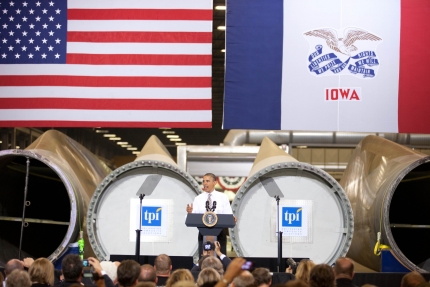
President Obama Talks Clean Energy in Iowa

President Barack Obama at TPI Composites Iowa’s wind turbine blade facility (May 24, 2012)

President Barack Obama delivers remarks urging Congress to act on the “To Do List” and highlighting the need to invest in clean energy by passing legislation, at TPI Composites Iowa’s wind turbine blade facility in Newton, Iowa, May 24, 2012. (Official White House Photo by Chuck Kennedy)

In Iowa this afternoon, President Obama continued to press lawmakers to take action on his To-Do List for Congress.

He traveled to Newton to push for the renewal of a tax credit for companies that produce clean energy. The credit currently supports as many as 37,000 jobs.

His host for the visit was TPI Composites -- a company that makes blades for wind turbines and employs more 700 people.

"If Congress doesn’t act, companies like this one will take a hit," he said. "Jobs will be lost. That’s not a guess, that’s a fact. We can’t let that happen."

Currently, 20 percent of all the electricity used in the Iowa is generated by wind power, and there are currently more wind power jobs in the state than in any other in America.

Overall, the United States generates enough electricity from wind to power 10 million homes. And there are 500 production facilities in 43 states putting people to work in that industry.

Later, he answered questions about the To-Do List on Twitter.

President Obama Calls on Congress to Invest in Clean Energy

May 24, 2012 | 22:59 | Public Domain

President Obama urges Congress to act on the “To Do List,” specifically highlighting the need to invest in clean energy by extending and expanding tax credits that support clean energy manufacturing.

Download mp4 (812MB) | mp3 (52MB)

The White House

Office of the Press Secretary

Remarks by the President on Energy in Newton, Iowa

TPI Composites
Newton, Iowa

4:30 P.M. CDT

THE PRESIDENT:  Hello, Iowa!  (Applause.)  Well, it is good to be back in Newton!  (Applause.)  It's been a while.  It's good to be back in Iowa.  It's brought back memories -- of a lot of driving.  (Laughter.)  And I just had a great tour of this facility.  By the way, if people have chairs, feel free to sit down.  (Laughter.)  Some of you may not have seats, but I want to make everybody comfortable.  But don't worry, I'm not going to talk that long.  I didn’t want to give that impression.

I just had a wonderful tour of this facility.  And I was telling some of the folks we couldn’t take the helicopters in because the winds were too strong, so you are definitely in the right business.  (Laughter.)  Obviously there's some wind power here in Iowa that we want to tap.

I want to thank Quinten for the terrific introduction and for sharing his story.  Give Quinten a big round of applause.  (Applause.)  Quinten was telling my team this is the first time he's ever spoken in public.  But he looked like a pro to me.  (Applause.) 

I want to thank your mayor, Mayor Allen, for welcoming us here today.  (Applause.)  I also want to thank Representative Dave Loebsack for being here.  Give Dave a big round of applause. (Applause.)  And I know he had to leave early, but I just want to acknowledge somebody you know well -- our outstanding Secretary of Agriculture, Tom Vilsack.  (Applause.)  Tom was instrumental in helping transform Newton and he's still got your back.  He is still fighting every single day for every single person in this town, but all across rural America.  And so we're very proud of him.

Now, we all know how difficult these past few years have been for the country.  Iowa has actually done a little better than some other states, but it's still been tough.  And after the worst recession of our lifetimes, it's going to take some time for the economy to fully recover -- more time than a lot of us would like.  And we're still facing some headwinds, like the situation in Europe right now, which is having an impact on our economy. 

But while there's certain economic developments we can't control, there are a bunch of things that we can control.  There are plenty of steps that we can take right now -- steps that we must take right now -- to speed up this recovery and to create jobs, and to restore some of the financial security that a lot of families have lost.  It's within our control to do all of that right now.  But here's the thing -- (applause.)  It's true, we can make that difference. 

The challenge we've got is that too many folks aren't on the same page.  We've got too many of my dear Republican friends in Congress that have been standing in the way of some steps that we could take that would make a difference at the moment.  Either they say they don't want to do anything at all, or they don't want to do it before the election, or they want to double down on some of the policies that didn’t work and helped to get us into this mess in the first place.

And Newton knows something about that -- because Newton lost manufacturing.  Newton lost Maytag.  A lot of the trends that we had seen even before the financial crisis hit, hit Newton first. And so when you hear somebody say we should cut more taxes, especially for the wealthiest Americans, well, Newton, you've been there and you've done that.  We did that -- 2000, 2001, 2003.  When you hear people say that we should cut back more on the rules we put in place for banks and financial institutions to avoid another taxpayer bailout -- well, we tried that.  When people say that we should just wait until the housing market hits bottom and hope that it comes back, hope for the best -- well, that's not an answer for people.  That doesn't make sense. 

We've tried at lot of these ideas for nearly a decade.  It did not work.  We saw manufacturing moving offshore.  We saw a few people do very well, but too many families struggling just to get by -- all before the financial crisis hit.  And the financial crisis made it worse.  So we can't go backwards.  We've got to move forward.  We've got to build an economy where hard work and responsibility pay off, where you can find a good job and own your own home, maybe start your own businesses and give your kids a chance for a better future.  (Applause.)  That's the American way.  That's who we are.  (Applause.)  

So I’ve been pushing Congress to help us get there by passing a few common-sense policies that would strengthen the economy and put more folks to work right now.  We even made a handy "To-Do" list that they can check off.  It's just like the to-do list Michelle gives me, a "honey-do" list.  (Laughter.)  There are only five things on it, on this "To-Do" list, but these are all things we could get done before the election.  We don't have to wait until then.  There are some things that we should put ahead of politics, and one of them is making sure that the economy is moving forward and the recovery is moving forward.  (Applause.)

And like I said, I kept it simple.  There are just five things.  I didn't want to overload Congress with too much at once.  (Laughter.)  But these are all ideas that will make a difference right now and we shouldn't wait for an election to get them done. 

So first up on the list, it makes no sense that we’re actually still giving tax breaks to companies that ship jobs and factories overseas.  That doesn’t make sense at all.  That doesn’t make any sense.  (Applause.)  So what I’ve asked Congress to do is end tax breaks for companies that are shipping jobs overseas, use that money to cover the moving expenses for companies that are bringing jobs back to the United States of America.  That’s a common-sense approach.  (Applause.)

Second, we’ve asked Congress to give every responsible homeowner -- folks who have been making their mortgage payments  -- the opportunity to save an average of $3,000 a year by refinancing their mortgage and taking advantage of these historically low rates.  The problem is a lot of folks are having trouble refinancing if their home is underwater, if it’s worth less than their mortgage, and sometimes banks have been pulling back a little bit.  We want to make it easier for people to refinance.  So that’s the second thing because that will create  -- that will put more money in the economy for everybody.  And if you’ve got an extra $3,000 in your pocket, then you’ll go shopping, you’ll go out to a restaurant -- suddenly there’s a lot more money circulating and the economy gets stronger.  So that’s the second thing. 

Two weeks ago I was in Reno, Nevada, with a family -- they got a chance to refinance because of some steps that we had already taken administratively, and it’s making a huge difference in their lives.  And we want all families to have that same opportunity.  

Third thing, instead of just talking about job creators -- you always hear -- every member of Congress has said, we’ve got to help the job creators.  Okay, let’s help them.  Congress should help small business owners who create most of the new jobs in America -- small business owners -- (Applause.)  So what we want to do is give them a tax break for hiring more workers and for paying them higher wages.  Give them an incentive to say, you know what, if on the margins maybe I’m thinking about hiring that extra person, if I get a tax break it makes that person a little bit cheaper to hire, and that can put more of our neighbors and friends back to work.  So that’s a common-sense idea.  (Applause.)

Fourth thing, we have done a whole lot to make sure that those men and women who have served us in Iraq and Afghanistan, that we are serving them as well as they’ve served us -- (applause) -- treating them with the honor and respect that they have earned when they come home.  (Applause.)  So we put together the Post-9/11 GI Bill so they’re able to go back and get some training and skills.  We mobilized the private sector to hire more veterans and give them the private sector incentives to hire more veterans.

But there's another thing we can do.  Congress should create what we're calling a Veterans Jobs Corps, so that we can help communities across America put our returning heroes back to work as police officers and firefighters and park rangers.  Nobody who fought for our country overseas should have to fight for a job when they come back home.  We've still got too much unemployment among our veterans.  (Applause.) 

So those are four simple things.  And the fifth thing is the reason why I'm here today.  The fifth item on my "To-Do" list -- I'm calling on Congress to extend tax credits that are set to expire at the end of the year for clean-energy companies like TPI.  (Applause.)  Let's not wait.  Let's do it now.  (Applause.)

Many of you know the story of what's happening here better than I do, but I just want to remind you how far we've come.  Shortly after I took office, I came to Newton -- some of you remember -- and we unveiled an all-of-the-above energy strategy for America.  We said let's produce more oil and gas, but let's also produce more biofuels; let's produce more fuel-efficient cars; let's produce more solar and wind powerand other sources of clean, renewable energy.  And I came to Newton because Newton is helping to lead the way when it comes to building wind turbines. 

And since then, our dependence on foreign oil has gone down every single year that I've been in office -- every single year. (Applause.)  America is now producing more domestic oil than any time in the last eight years.  But we're also producing more natural gas, and we're producing more biofuels than any time in our history.  And that’s good for the Iowa economy.  (Applause.) We're laying the foundation for some of our nation's first offshore wind farms.  And since I became President, America has nearly doubled the use of renewable energy, like solar power and wind power -- we've nearly doubled it.  (Applause.) 

So this country is on the path towards more energy independence.  And that’s good for everybody.  It's good for people's pocketbooks; it's good for the environment; it's good for our national security.  We don’t want our economy dependent on something that happens on the other side of the world.  We don’t want every time there's a scare about war or some regime change in the Middle East that suddenly everybody here is getting socked and the whole economy is going down.

And the best thing is, in the process, we're also putting thousands of Americans back to work -- because the more we rely on American-made energy, the less oil we buy from other countries, the more jobs we create here at home, the more jobs we create here in Iowa.

So let's look at the wind industry.  It's so important to Iowa.  This industry, thanks in large part to some very important tax credits, has now taken off.  The state of Iowa now gets nearly 20 percent of all your electricity from wind -- 20 percent.  Overall, America now has enough wind capacity to power 10 million homes.  So this is an industry on the rise.  And as you know, it’s an industry that’s putting people to work.  You know this firsthand.  There are more wind power jobs in Iowa than any other state.  That’s a big deal.  (Applause.)   

And one of these modern windmills has more than 8,000 different parts -- everything from the towers and the blades to the gears, to the electrical switches.  And it used to be that almost all these parts were imported.  Today, more and more of these parts are being made here in America -- right here.  (Applause.)  We used to have just a few dozen manufacturing facilities attached to the wind industry.  Today we have nearly 500 facilities in 43 states employing tens of thousands of American workers -- tens of thousands. 

So we’re making progress.  And you know it better than anybody.  I mean, when I was talking to Quinten and Mark and a whole bunch of the other folks who are working here, they reminded me of the experience at working at Maytag and putting your heart and soul into a company and making a great product, and then, suddenly having that company leave, and how hard that was for families and how hard it was for the community.  But folks made the transition. 

And now, when you look at what's happening here -- 700 to 800 jobs, over $30 million being put back into the community -- this gives folks hope.  It gives people opportunity.  I met some folks who have been in manufacturing for 30 years, but I also met a couple of young folks who were just getting started.  And that's what we're looking for.  Nobody wants a handout.  Nobody wants to get something for nothing.  But if we've got a chance to create energy and create value and put people back to work, why wouldn't we do that? 

So I'm here today because, as much progress as we've made, that progress is in jeopardy.  If Congress doesn’t act, those tax credits that I mentioned -- the ones that helped build up the wind industry, the ones that helped to bring all these jobs to Newton, those tax credits will expire at the end of the year if Congress doesn't do anything. 

If Congress doesn’t act, companies like this one will take a hit.  Jobs will be lost.  That’s not a guess, that’s a fact.  We can’t let that happen.  And keep in mind that -- and this is something Congress needs to understand -- Dave Loebsack understands it, but I want every member of Congress to understand it.  These companies that are putting in orders for these amazing blades, they're making plans now.  They're making decisions now. So if they're cutting back on their orders, if they're not confident that the industry is going to be moving at a fast clip and they start reducing orders here, that affects you.  You can't wait for six months.  You can't wait for eight months.  You can't wait for a year to get this done.  It's got to be done now.  (Applause.)  

So this is a simple thing on Congress's "To-Do" list -- extend these tax credits.  Do it now.  Every day they don't act business grows more concerned that they will not be renewed.  They're worried demand for their products is going down, so they start thinking twice about expanding, more cautious about making new investments.  They start looking overseas.  I was talking to your CEO.  We got an opportunity to branch out, but we want to branch out by making the stuff here and then sending it there.  We don't want to branch out by sending the jobs and the investments over there, and then shipping it back to America.  That doesn't make sense.  (Applause.)  One company that had plans to invest $100 million to build a wind manufacturing plant in Arkansas -- and create hundreds of jobs –- put those plans on hold. 

And by the way, this should not be a partisan issue.  There are several Republican governors –- including the governor of this state -– who are calling on Congress to act.  There are members of Congress in both chambers and on both sides of the aisle –- including your two senators –- who support these tax credits.  And that doesn’t happen much in Washington where Democrats and Republicans say they agree on something.  So if you agree, why haven’t we gotten it done yet? 

This is not just an issue, by the way, for the wind industry.   Some of America’s most prominent companies -– from Starbucks to Campbell’s Soup –- they’re calling on Congress to act because they use renewable energy.  

Sometimes when I think about Washington and Congress -- and I know some of you think the same way -- I don’t get it.  I understand why we wouldn’t get something if we really disagree on something.  And there are some big disagreements:  They want to make big cuts to pay for more big tax cuts for the wealthy.  I disagree with that.  I think we should have a balanced approach  -- cut waste, but make sure that everybody is paying their fair share.  (Applause.)  An issue like that, maybe it can’t get settled before an election because they just have a different approach.  I understand that.  But this, everybody says they agree to or at least a lot of people agree to it. 

So I’m going to need your help.  I need you to get involved. I need you to help get this done.  I need everybody here in Newton -- and I mean everybody -- I don’t just mean folks who work at TPI -- anybody who’s watching, everybody here in Iowa, pick up the phone, send an email, send a tweet, tell Congress, let’s do the right thing.  Tell Congress the story of Newton.  Tell folks why it’s so important to this community.  Tell them we’ve come too far to turn back now.  (Applause.)

It used to be Newton was known for building washers and dryers, used to be Newton was known for Maytag.  And obviously they were a big employer -- thousands of people working in the area.  But back in 2007 when they closed down the operations here, that was a major blow.  And everybody here, if you don’t -- if you weren’t affected personally by it, you were affected indirectly.  Your friends, your neighbors, friends like Quinten were forced to start all over again.  And he didn’t give up.  You didn’t give up.  You kept pushing ahead.  Some of you had to retrain.  Pretty soon after one industry had left, another showed up.  Some of the facilities that Maytag closed were reopened.  So a lot of folks who used to build washers and dryers, now they’re part of the future, building an industry that’s going to make America stronger.  That’s the story of Newton.  That’s the story of America.

So, yes, we’re facing tough times, but we’re getting through them.  We’re getting through them together -- because in this country, just like in Newton, we don’t give up.  We keep moving. We keep moving forward.  And if we work together with a common purpose, we will get this economy back on track -- and remind everybody why America is the greatest country on Earth. 

Thank you, everybody.  God bless you.  God bless America.  Thank you.  (Applause.)

END             
4:55 P.M. CDT

President Obama Talks #CongressToDoList on Twitter

Yes, President Obama was on Twitter today – taking your questions about his plan to create jobs and help the middle class.

Earlier, the President paid a visit to TPI Composites, a wind manufacturer in Newton, Iowa. At the plant, he called on Congress to act on a to-do list that’ll create jobs, specifically highlighting the need to invest in clean energy. 

After the speech, the President answered some of your questions on Twitter. Check out the full Q&A below and learn more about clean energy tax credits and the other items on the to-do list here. To see more conversations like this one, check out some of our recent White House Twitter “Office Hours” at Storify.com/WhiteHouse.

Related Topics: Economy, ToDo List, Iowa

The White House

Office of the Press Secretary

Statement by the Press Secretary on Student Loan Interest Rate Votes in the Senate

With only 37 days left to stop student loan interest rates from doubling on July 1, Senate Republicans still have not proven that they’re serious about resolving this problem.  For the second time this month, they voted to ask millions of students to pay an average of $1,000 each rather than close a loophole that allows the very wealthy to avoid paying their fair share.  Now is not the time to refight old political battles, and certainly not the time to cut preventive health care measures.  With only a few days left until student loan interest rates double, it’s time to get this done so hard working students get a fair shot at an affordable education.

The White House

Office of the Press Secretary

Presidential Nominations Sent to the Senate

NOMINATIONS SENT TO THE SENATE:

Greta Christine Holtz, of Maryland, a Career Member of the Senior Foreign Service, Class of Minister-Counselor, to be Ambassador Extraordinary and Plenipotentiary of the United States of America to the Sultanate of Oman.

Alexander Mark Laskaris, of Maryland, a Career Member of the Senior Foreign Service, Class of Counselor, to be Ambassador Extraordinary and Plenipotentiary of the United States of America to the Republic of Guinea.

Jonathan Lippman, of New York, to be a Member of the Board of Directors of the State Justice Institute for a term expiring September 17, 2012, vice Robert A. Miller, term expired.

Jonathan Lippman, of New York, to be a Member of the Board of Directors of the State Justice Institute for a term expiring September 17, 2015.  (Reappointment)
 

Allison M. Macfarlane, of Maryland, to be a Member of the Nuclear Regulatory Commission for the remainder of the term expiring June 30, 2013, vice Gregory B. Jaczko, resigned.

Marcie B. Ries, of the District of Columbia, a Career Member of the Senior Foreign Service, Class of Career-Minister, to be Ambassador Extraordinary and Plenipotentiary of the United States of America to the Republic of Bulgaria.

Walter M. Shaub, Jr., of Virginia, to be Director of the Office of Government Ethics for a term of five years, vice Robert Irwin Cusick, Jr., term expired.

The White House

Office of the Press Secretary

Press Gaggle by Press Secretary Jay Carney en route Newton, IA, 5/24/12

Aboard Air Force One
En Route Newton, Iowa

1:18 P.M. CDT

MR. CARNEY:  Good morning, everyone.  I hope you had a restful sleep last night in San Jose.  We are now making our way to Iowa.  Before I take your questions, I just want to mention a couple of things. 

One, I'd like to announce that on Wednesday, May 30th, the President will sign the reauthorization of the Export-Import Bank at the White House.  Additional details of the bill signing will be provided when they become available.  I would simply note that the President has said that this important step will help American businesses create jobs here at home and sell their products around the world, all at no cost to taxpayers.

Last year marks the highest level of financing in the Bank's 77-year history, as they supported thousands of U.S. companies, hundreds of thousands of jobs, and brought us closer to the goal the President set of doubling our nation's exports by the end of 2014.  Over the last several months, the President met with business leaders in Washington, visited workers and companies like Boeing, and urged Congress to reauthorize the Bank to keep building on this progress.  We are pleased that Congress was able to get it done.

Q    That's May 30th, you said?

MR. CARNEY:  May 30th, Wednesday. 

Also, as you know, the President is traveling now to TPI Composites in Newton, Iowa, where he will highlight steps that Congress can take right now to create jobs here in America and support American companies and manufacturers, all while continuing to increase clean energy production here at home.

Newton is a city of roughly 16,000 residents located 30 miles -- 35 miles rather, east of Des Moines.  For many years, Maytag, the manufacturer of washers and dryers, had its corporate headquarters in Newton, employing 3,500 people at its peak.  After being acquired by Whirlpool in 2006, plans were made to consolidate manufacturing into existing facilities and the remaining 1,900 employees in Newton lost their jobs. 

But because of the growth in the wind industry, much of it stimulated by the federal Production Tax Credit -- PTC -- TPI Composites, a leading global provider of composite wind blades to major turbine manufacturers, built a plant in Newton in 2008 and today employs more than 700 workers.  As you know, Congress has
-- as part of his congressional "To-Do" list called -- rather the President has -- let me back up.  As part of his congressional "To-Do" list, the President has called on Congress to pass legislation that would extend the Production Tax Credit. 

At my briefing earlier this week -- was that earlier this week -- it was -- with the CEO of Winergy, Terry Royer I think gave a very clear and powerful argument for why this Production Tax Credit needs to be extended, why it is so important to his business and his industry, why it is so vital for American jobs  -- manufacturing jobs here, and the fact that it has traditionally enjoyed bipartisan support.  So that's what the President will be talking about at TPI Composites.

With that, I will take your questions.

Q    Jay, there have been a number of developments on the Iranian talks.  Can you bring us up to date and what the President's reaction might be so far?

MR. CARNEY:  What I can tell you is that I have no specifics to talk about in terms of the Baghdad consultations.  It is a positive development that there are another round of talks -- there is another round of talks scheduled for June 18th and 19th in Moscow.  There have been concrete ideas exchanged in these negotiations.  And the P5-plus-1 are unified in calling for Iran to demonstrate the peaceful intent of its nuclear program and to fully comply with their international obligations. 

Q    Does the administration feel, though, that a foundation has been laid to perhaps get a breakthrough in Moscow in a few weeks?

MR. CARNEY:  Well, look, we made clear even prior to the initial round of negotiations, as well as prior to the one in Baghdad, and I'll make it clear now that we -- these are not -- we are not -- we did not expect in the prior two rounds breakthrough moments.  What we're looking for is progress.  We're looking for seriousness on the part of the Iranians in terms of addressing the concerns of the international community.  And thus far, those expectations have been met. 

What I said yesterday remains true, which is, even as we have positive steps, the President’s position is that we will judge Iran by its actions, not by its words or simply by the fact that it’s holding meetings.  That’s a positive development, but we need to -- we obviously need to see positive actions.  And I talked about this at length yesterday, but that’s still our disposition.

Q    Jay, does the White House have any details on what the Iranians are putting on the table in these discussions?

MR. CARNEY:  No, I don’t have any details for you on that, and I think this is a process that’s ongoing and we’re not going to read out every meeting in any detail.  I would simply say that we’re now scheduled for an additional round of talks.  The Iranians know about the concerns of the international community. They have felt the impact of the unprecedented sanctions regime. They are aware of the additional sanctions that will be coming online this summer. 

And clearly that provides to them, we believe, an impetus to take these talks very seriously and to then take steps, concrete steps that allay the international community’s concerns about its nuclear ambitions.  So that’s where we are at this point.

Q    Has the President been in touch with Angela Merkel or any other leaders in Europe this week?  Or any sort of sense of how things are going there?

MR. CARNEY:  I don’t have at this moment any calls or conversations to read out to you.  If I do, I’ll get back to you.

Q    Jay, the Brussels meeting ended, though, without really any concrete steps.  I mean, does the administration see that as a setback?  And I guess do you also feel, as the President said previously, that there was an emerging consensus on the issue?

MR. CARNEY:  As the President said, there was a consensus that you all heard about coming out of the G8, about the need to have a balanced approach that included a focus on growing the economy and creating jobs in Europe.  And that remains the case. Obviously these are tough issues and the Europeans have a lot of work to do as they wrestle with them.  They’ve made some important decisions and taken some important steps, but more work needs to be done.

As I’ve said and the President has said, this is within the capacity of the Europeans to resolve this crisis.  Our role is to provide advice born out of our own experience and to -- and that’s what the President did during the G8, and that’s obviously what Secretary Geithner has been doing all along.

Q    On Pakistan, there have been two drones in the past couple days.  Do those attacks, given the Pakistanis’ objections to these attacks, undermine progress on the trade routes?

MR. CARNEY:  I’m not in a position to talk about methods and the like.  I can simply say that we -- on the GLOCs, that we’ve been in conversations with and consultations with the Pakistanis on resolving this issue.  The Pakistani government has made clear that they want to resolve it; we obviously do as well.  And we expect that it will be resolved.

Q    Another one on Pakistan.  The doctor who aided the CIA on the OBL raid got a 33-year sentence.  I was wondering if the administration had any reaction to that sentence, and whether there’s any effort to try to encourage the Pakistanis to shorten the sentence or perhaps dismiss it.

MR. CARNEY:  I think Secretaries Panetta and Clinton have made comments about this.  I would simply say that our views have not changed and we continue to see no basis for Dr. Afridi to be held.  I think it's an important point that any assistance provided by anyone in the effort to bring Osama bin Laden to justice was assistance not against Pakistan, but against al Qaeda and against Osama bin Laden.

And we're obviously -- to answer the last part of your question, we've raised the issue with the Pakistani government. We'll continue to have conversations with them about it. 

Q    Is the White House aware of reports that Chen Guangcheng's brother escaped from his village last night?  And are there any efforts to help the rest of the members of his family that are in China?

MR. CARNEY:  I'll have to take that question and check with my colleagues back in Washington. 

Q    Are you in a position to preview a little bit about the grassroots rally tonight?

MR. CARNEY:  I’m sure it will be filled with excitement and energy and enthusiasm.  But I don’t have anything else.

Q    As much excitement and energy as that answer is?  (Laughter.) 

MR. CARNEY:  I don’t know about you guys, but the altitude yesterday or whatever -- I am in -- and obviously the long day and lack of adequate sleep, but I'm dragging a little bit. 

Q    Your espresso machine, you're missing it.

MR. CARNEY:  I wish I had that thing this morning.  The coffee in the hotel did not make the grade.

Q    Jay, in the hearing they had yesterday regarding the Secret Service situation, Director Sullivan said, in his view, it's not a systemic issue, it's not systemic to the culture in the Secret Service.  I'm wondering if the administration agrees with that, and if the President still has confidence in Director Sullivan, given some of the other cases that have emerged.

MR. CARNEY:  The President does have confidence in Director Sullivan.  I think the President himself has made clear that the vast majority, the overwhelming majority of men and women who serve their country by working in the Secret Service conduct themselves in the most professional manner, and many of them put their lives on the line to do so.  So he has -- I mean, I think that would answer your question. 

It is obviously important that the kind of investigation that Director Sullivan undertook take place.  And the President believes Director Sullivan has taken this matter -- has demonstrated that he has taken this matter very seriously.

Q    One more.  Mitt Romney has an ad in which he's critical of the President on China.  I wonder if the administration has any reaction to the ad, and whether the President may be vulnerable on China trade.

MR. CARNEY:  Despite his tough talk now, Governor Romney wasn't always for enforcing trade laws against China.  In his book, Governor Romney attacked the President for standing up for American workers and businesses by enforcing trade law against China, even calling it "bad for the nation and our workers." 

Look, I think you guys know -- those of you who have covered this President -- that he has been extremely consistent and firm when it comes to enforcing trade laws.  You know the record in terms of the number of cases, the increasing number of cases at the WTO.  You know about our efforts to consistently raise with and press the Chinese on the issue of the valuation of their currency.  The President's record I think speaks for itself.  The fact that Governor Romney is criticizing the President from one side despite having occupied the other side of the issue I suppose is not very surprising.

Q    Back on Secret Service.  The fact that there's an additional DHS investigation now underway -- does the White House think that investigation is necessary when the Secret Service is already undergoing its own investigation?

MR. CARNEY:  I think we feel that the processes that have been undertaken have been the right ones.  I don’t have any specific comment on the additional investigation.

Are we good? 

Q    Thank you.

END
1:34 P.M. CDT

The White House

Office of the Press Secretary

President Obama Announces More Key Administration Posts

WASHINGTON, DC – Today, President Barack Obama announced his intent to nominate the following individuals to key Administration posts:

• Greta C. Holtz – Ambassador to the Sultanate of Oman, Department of State
• Alexander M. Laskaris – Ambassador to the Republic of Guinea, Department of State
• Allison M. Macfarlane - Commissioner, Nuclear Regulatory Commission, upon appointment to be designated Chair
• Marcie B. Ries – Ambassador to the Republic of Bulgaria, Department of State
• Walter M. Shaub, Jr. – Director, Office of Government Ethics

The President also announced his intent to appoint the following individuals to key Administration posts:

• Fred P. Hochberg  - Member, Board of Trustees of the Woodrow Wilson International Center for Scholars
• Earl W. Stafford – Member, President’s Board of Advisors on Historically Black Colleges and Universities

President Obama said, “These dedicated individuals bring a wealth of experience and talent to their new roles, and I am grateful they have agreed to lend their considerable talents to this Administration. I look forward to working with them in the months and years ahead.”

President Obama announced his intent to nominate the following individuals to key Administration posts:

Greta C. Holtz, Nominee for Ambassador to the Sultanate of Oman, Department of State
Greta C. Holtz, a career member of the Senior Foreign Service, Class of Minister-Counselor, serves as Deputy Assistant Secretary of State for Public Diplomacy and Strategic Communications in the Bureau of Near Eastern Affairs.   From 2009 to 2010, Ms. Holtz was Director for Provincial Affairs at the U.S. Embassy in Baghdad.  Previous assignments in Washington include Director of the Middle East Partnership Initiative in the Bureau of Near Eastern Affairs (2006-2007) and Coordinator for the Organization for Security and Cooperation in Europe within the Bureau of European Regional Political-Military Affairs (2004-2006).  Ms. Holtz entered the Foreign Service in 1985 and has served at U.S. Missions in Saudi Arabia, Yemen, Tunisia, Syria, and as Principal Officer in Adana, Turkey.   She received a B.S. from Vanderbilt University, an M.A. from the University of Kentucky, and an M.S. from the National War College.

Alexander M. Laskaris, Nominee for Ambassador to the Republic of Guinea, Department of State
Alexander M. Laskaris, a career member of the Senior Foreign Service, Class of Counselor, is Consul General at the U.S. Consulate in Erbil, Iraq, a position he has held since June 2010. Previously, he was the Team Leader for the Provincial Reconstruction Team in Mosul, Iraq from 2008 to 2009.  Prior to serving in Iraq, he was the Deputy Chief of Mission at the U.S. Embassy in Kosovo (2006-2009) and Burundi (2003-2005).  Previously, Mr. Laskaris was a member of the U.S. Secretary of State’s Policy Planning Staff (2001-2003) and Advisor to the U.S. Mission to the United Nations (1999-2001).  Other overseas assignments have included Political Officer in Luanda, Angola; Political and Economic Officer in Gaborone, Botswana; and Vice Consul in Monrovia, Liberia.  From 1996 to 1997, he served as Desk Officer for Rwanda and Burundi at the Department of State.  He received a B.S. from Georgetown University and an M.A. from the U.S. Army War College.

Allison M. Macfarlane, Nominee for Commissioner, Nuclear Regulatory Commission, and upon appointment to be designated Chair
Allison M. Macfarlane is an associate professor of Environmental Science and Policy at George Mason University (GMU), a position she has held since 2006.  Dr. Macfarlane served as a member of the Blue Ribbon Commission on America’s Nuclear Future from March 2010 to January 2012. Dr. Macfarlane worked as a research associate at Massachusetts Institute of Technology (MIT) from 2004 to 2006 and 2000 to 2003, and as an associate professor at the Georgia Institute of Technology from 2003 to 2004. She was also a fellow at Harvard University’s Belfer Center for Science and International Affairs from 1998 to 2000, and a fellow at Stanford University's Center for International Security and Cooperation from 1997 to 1998.  Dr. Macfarlane began her teaching career in the Department of Geography and Earth Systems Science at GMU.  She received a B.Sc. from the University of Rochester and a Ph.D. in Geology from MIT.

Ambassador Marcie B. Ries, Nominee for Ambassador to the Republic of Bulgaria, Department of State
Ambassador Marcie B. Ries, a career member of the Senior Foreign Service, class of Career-Minister, is currently Principal Deputy Assistant Secretary of State in the Bureau of Arms Control, Verification and Compliance.  From 2008 to 2009, she was Principal Deputy Assistant Secretary of State for European and Eurasian Affairs.  Previously, she served as Minister-Counselor for Political-Military Affairs at the U.S. Embassy in Baghdad (2007-2008), U.S. Ambassador to the Republic of Albania (2004-2007), and Chief of Mission at the U.S. Office in Pristina, Kosovo (2003-2004).  She has also served as Director of the Office of United Nations Political Affairs in the Bureau of International Organizations (2001-2003) and as Political Counselor at the U.S. Embassy in London (1996-2000).  Other overseas assignments include posts to the U.S. Mission to the European Union in Brussels; Ankara, Turkey; and Santo Domingo, Dominican Republic.  She received a B.A. from Oberlin College and an M.A. from the School of Advanced International Studies at Johns Hopkins University.

Walter M. Shaub, Jr., Nominee for Director, Office of Government Ethics
Walter M. Shaub, Jr. is Deputy General Counsel of the U.S. Office of Government Ethics (OGE), a position he has held since 2008. In addition, he served as a supervisory attorney at OGE from 2006 to 2008. From 2004 to 2006, he worked as an attorney with the law firm Shaw, Bransford, Veilleux and Roth, P.C., where he focused on federal employment law. Previously, Mr. Shaub served as a staff attorney at several federal agencies, including OGE from 2001 to 2004, the Central Office of the U.S. Department of Veterans Affairs (VA) from 2000 to 2001, the Office of General Counsel of the U.S. Department of Health and Human Services from 1998 to 2000, and the VA’s Baltimore-Washington Regional Counsel’s office from 1997 to 1998. He earned a B.A. in History from James Madison University and a J.D. from American University Washington College of Law.

President Obama announced his intent to appoint the following individuals to key Administration posts:

Fred P. Hochberg, Appointee for Member, Board of Trustees of the Woodrow Wilson International Center for Scholars
Fred P. Hochberg is President of the Export-Import Bank of the United States, having been appointed by President Obama in May 2009.  From 2004 to 2008, Mr. Hochberg was Dean of Milano, The New School for Management and Urban Policy in New York, N.Y.  From 1998 to 2001, he served first as Deputy Administrator, then as Acting Administrator of the Small Business Administration (SBA).  Prior to his service at SBA, Mr. Hochberg was President and Chief Operating Officer of the Lillian Vernon Corporation.  He is a past board member of the Port Authority of New York and New Jersey, the Citizens Budget Commission, the Foundation for International Community Assistance, and the New York State Financial Control Board.  Mr. Hochberg received his B.A. from New York University and an M.B.A from Columbia University.

Earl W. Stafford, Appointee for Member, President’s Board of Advisors on Historically Black Colleges and Universities
Earl W. Stafford is Chief Executive Officer of The Wentworth Group, LLC, a position he has held since February 2009.  Mr. Stafford is also Chairman of The Stafford Foundation, Inc., a non-profit organization he founded in 2002. From 1988 to 2009 he was Chairman and Chief Executive of Universal Systems & Technology, Inc.  Previously, Mr. Stafford served in the United States Air Force from 1967 to 1987.  He currently serves on the boards of several organizations, including the Horatio Alger Association, the Joint Center for Political and Economic Studies, the Wesley Theological Seminary, and the Venture Philanthropy Partners. Mr. Stafford holds a B.B.A. from the University of Massachusetts, Amherst and an M.B.A. from Southern Illinois University.  He is a graduate of the Owner/President Management Executive Program at Harvard Business School, and received an honorary Doctorate of Humane Letters from Virginia State University.

The White House

Office of the Press Secretary

President Obama Signs Kansas Disaster Declaration

The President today declared a major disaster exists in the State of Kansas and ordered Federal aid to supplement state and local recovery efforts in the area affected by severe storms, tornadoes, straight-line winds, and flooding during the period of April 14-15, 2012. 

Federal funding is available to state and eligible local governments and certain private nonprofit organizations on a cost-sharing basis for emergency work and the repair or replacement of facilities damaged by the severe storms, tornadoes, straight-line winds, and flooding in the counties of Edwards, Ellsworth, Harper, Hodgeman, Jewell, Kiowa, Mitchell, Osborne, Rice, Rush, Russell, Sedgwick, Stafford, and Sumner.

Federal funding is also available on a cost-sharing basis for hazard mitigation measures statewide. 

W. Craig Fugate, Administrator, Federal Emergency Management Agency (FEMA), Department of Homeland Security, named Stephen R. Thompson as the Federal Coordinating Officer for federal recovery operations in the affected area. 

FEMA said additional designations may be made at a later date if requested by the state and warranted by the results of further damage assessments.

The White House

Office of the Press Secretary

Remarks by the President at a Campaign Event

Fox Theatre
Redwood City, California

9:45 P.M. PDT

THE PRESIDENT:  Thank you!  (Applause.)  Thank you.  Thank you.  Thank you so much.  How’s it going, Redwood City!  (Applause.)  Thank you very much.  Thank you.  Thank you, guys.  (Applause.)  Well, it is good to be back in California.  (Applause.) 

A couple of people I just want to acknowledge.  First of all, your mayor, Alicia Aguirre.  Give her a big round of applause -- she’s here.  (Applause.)  And please give it up for Ben Harper for performing tonight.  (Applause.) 

Now, you guys can have a seat.  I’m going to be talking for a while.  (Laughter.) 

AUDIENCE MEMBER:  We love you, Obama!

THE PRESIDENT:  It is good to see all of you.  Are you having fun tonight?  (Applause.) 

Well, listen, I’m here not just because I need your help -- although I do need your help.  (Applause.)  I'll get to that in a second.  But I’m here because your country needs your help. 

Now, four years ago, we came together because we wanted to reclaim the basic bargain that had built the largest middle class and the most prosperous nation on Earth.  We shared a belief that in America, your circumstances shouldn't be determined -- or your success shouldn't be determined by the circumstances of your birth, right?  (Applause.)  And you can see that in Redwood City -- people from every background, from every corner not just of the country but of the world. 

This represents that idea that if you’re willing to work hard, you should be able to create a life for yourself and your family, find a good job.  If you’re willing to meet your responsibilities, you should be able to own a home and maybe start a business, strike out with a new idea, send your kids to a good school -- give them a chance to do even better than you, no matter who you are, no matter where you come from, no matter what you look like, no matter who you love.  (Applause.)

So that’s why we did all this in 2008.  This wasn’t a commitment you made because of me.  This was a commitment you made to each other, because you felt that the country had strayed from some of those basic values. 

We watched a record surplus that was squandered on tax cuts for folks who didn't need them and weren’t asking for them.  (Applause.)  We saw two wars being waged on a credit card.  We saw speculation in the financial sector, reaping huge profits for a few folks who were making bets with other people’s money, but it was a flimsy kind of success.  Manufacturing left our shores. A shrinking number of Americans did really, really well, but a growing number saw falling incomes and stagnant job growth and rising costs for everything from college to health care.

And so we had strayed from those values.  And we built a house of cards, and it ended up collapsing in the worst economic crisis since the Great Depression -- lost three million jobs while we were campaigning; 800,000 jobs lost the month I took office. 

And it’s been tough.  But it turns out the American people were tougher.  (Applause.)  We don't quit.  We don't give up.  We keep on going.  Together, we fought back.  We fought our way back.  When some said, you know what, we should just let Detroit go bankrupt, we made a bet on American workers and American innovators and American companies, and today, the auto industry is back on top of the world.  (Applause.)

Manufacturers are starting to invest in America again, adding jobs for the first time consistently since the '90s.  Businesses got back to basics.  Small business owners, entrepreneurs -- they hung on, made it work, kept on their employees where they could -- created over 4 million jobs in the last 26 months, more than 1 million in the last 6 months alone.  (Applause.) 

Now, we’re not satisfied.

AUDIENCE MEMBER:  No, we aren’t.

THE PRESIDENT:  We’ve got a lot more to do.  Not when so many of our friends and family are still out of work.  Not when so many homes are still underwater.  Not when so many states are still laying off teachers and first responders. 

This crisis -- a crisis this deep didn't happen overnight, and it’s not going to be solved overnight -- so we’ve got more work to do.  We know that.  And that’s why this year is so important.  Because we know the last thing we can afford to do is to go back to the very same policies that got us into this mess in the first place.  Not now.  Not with so much at stake.  We’ve come too far to abandon the changes that we’ve fought for, for the last few years.  (Applause.) 

We’ve got to move forward and not backwards -- forward to what we imagined in 2008:  a country where everybody has got a fair shot, and everybody is doing their fair share, and everybody is playing by the same set of rules.  And that’s the choice in this election, and that’s why I’m running again for President of the United States.  (Applause.)

AUDIENCE:  Four more years!  Four more years!

THE PRESIDENT:  Now, you know we’re starting to get into election season here.  (Laughter.)

AUDIENCE MEMBER:  We love you!

THE PRESIDENT:  You know, I’ve still got my day job, and so I’m -- (laughter) -- I’m working hard solving problems.  But I’ve got to pay attention to what the other side is up to.  (Laughter.)

And my opponent in this election, Governor Romney, he’s a patriotic American.  He’s raised a wonderful family.  He should be proud of the great personal success he’s had.  (Laughter.)  No, I mean, he has been extraordinarily successful at the financial firm that he helped put together.  But I think he’s drawn the wrong lessons from these experiences.  He seems to believe that if CEOs and wealthy investors like him are getting rich that the rest of us automatically do, too. 

Now, we believe in the free market.  We believe in risk-taking and innovation.  This whole area is built on risk-taking and innovation.  (Applause.)  But we also understand that it doesn't happen in a vacuum.  It happens because of outstanding schools and universities.  It happens because of a well-regulated financial market.  It happens because we have extraordinary infrastructure.  It happens for a whole host of reasons.
 
But Governor Romney doesn’t seem to understand that.  So when a woman in Iowa shared the story of her financial struggles, he sounded like he was talking out of a textbook.  He said, well, our productivity equals our income.  Well, the implication was the only reason that somebody might be in financial hardship is because they’re not productive enough, they’re not working hard enough.

But I have to tell you, those of us who have spent a lot of time talking to a lot of Americans have come to realize the problem isn’t the American people aren’t productive enough.  Our productivity is actually higher than it’s ever been.  You’ve been working harder than ever.  (Applause.)  The challenge right now, the challenge we’ve faced for over a decade, is that harder work for too many people doesn’t lead to higher incomes, and bigger profits don’t necessarily lead to better jobs.  (Applause.)

And so what Governor Romney and my opponents don’t seem to understand is that a healthy economy doesn’t just mean maximizing the profits of some.  That’s important.  That’s part of our free market, but not if it’s purchased at the cost of massive layoffs; not if your main strategy is busting unions.  You don’t make America stronger just by shipping jobs and profits overseas.  (Applause.)  You don’t create an environment where everybody has got a fair shot if you’re gutting all those investments that help to create a platform for everybody’s success.  You don’t create economic growth when you propose cutting your own taxes while raising them on 18 million working families.  That’s not a recipe for broad-based economic growth.  (Applause.)

Of course, the fact is there’s nothing new about these ideas.  They’ve been peddling this stuff for years.  Although, as Bill Clinton said a few weeks ago, this time their agenda is on steroids.  But it’s not new.  They want bigger tax cuts for the wealthiest Americans.  They want even deeper cuts for things like education and Medicare, and research and technology.  They want to give banks and insurance companies even more power to do as they please, and gut and strip out regulations that help protect consumers.
 
But that’s not new.  That was tried, remember?  The last guy did all this.  (Laughter and applause.)  Governor Romney, well, he is saying, well, my 25 years in private sector gives me a special understanding of how our economy works.  Well, if that’s true, why is he peddling the same bad ideas that brought our economy to the brink of collapse?  (Applause.)  Most good business people I know, if something doesn’t work, they do something different.  (Applause.)  So he must either think that  there’s going to be a different result, or he's hoping you don’t remember what happened the last time we tried it his way.  (Applause.)

I’ll tell you what, I remember.  You remember.  We were there.  And we’re not going back to that.

AUDIENCE:  No!

THE PRESIDENT:  We’re moving this country forward.  (Applause.)  Now, you’re going to be hearing a bunch of stuff during the course of this campaign -- of course, you’ve been hearing it for the last three and a half years.  They started saying it the day after I took office -- actually the day I took office.  (Laughter.)  So let’s be clear.  We don’t expect government to solve all our problems.  It shouldn’t try.  I learned from my mom there is no education policy that by itself can take the place of a parent’s love and attention -- and sometimes a stern rebuke.  (Applause.) 

My first job as a community organizer was with Catholic churches who taught me the power of kindness and commitment to others in neighborhoods.  (Applause.)  Not everything in government works.  Not every regulation is smart.  Not every tax dollar is spent wisely.  Not every person can be helped who refuses to help themselves.  And the fact is that a bunch of the stuff that we do in government is outdated and has to be streamlined.  And we’ve been focused on everything from making sure that they don’t use rotary phones anymore to -- (laughter)
I’m exaggerating.  (Laughter.)  But there is all kinds of reorganization and streamlining that has to be done, because we want government to have the same customer service mentality that the best businesses do.  We want folks to have that same sense of efficiency and effectiveness. 

But that’s different from telling the vast majority of responsible, hardworking Americans, you’re on your own; that unless you’re lucky enough to have parents who can lend you the money, you may not be able to go to college -- (applause) -- that even if you pay your premiums every month, you’re out of luck if an insurance company decides to drop your coverage when you need it most.
 
That’s not who we are.  That’s not how America was built.  (Applause.)  We built this country -- together.  We built railroads and highways, the Hoover Dam and the Golden Gate Bridge
together. (Applause.)  We sent my grandfather’s generation to college on the GI Bill -- together.  (Applause.)  We went to the moon -- together.  (Applause.)  The entire structure for the Internet we built together.  (Applause.)  All the stuff that’s going on here can be traced back to investments we made together that then gave the opportunity, created the platform for Google and Facebook and you name it, because we understood that there are some things that we have to do together.  (Applause.)
 
And we didn’t do it for some particular group or individual. We understood that stuff made us all richer.  It gave us all opportunity.  We move forward together as one nation and as one people.  And that’s the true lesson of our past.  That’s the right vision for our future.  That’s why I’m running, again, for President of the United States.  (Applause.)

I’m running to make sure that by the end of this decade, more of our citizens hold college degrees than any other nation on Earth.  I want more engineers.  I want more scientists.  I want our schools to be able to hire and reward the best teachers, especially in math and science.  I want to give 2 million more Americans the chance to go to community colleges and learn the skills that local businesses need so that workers can compete in the 21st century.  Higher education is not a luxury, it is a necessity of this new global economy and everybody should be able to afford it.  Everybody should be able to get that chance.  That’s the choice in this election.  That’s why I’m running for President.  (Applause.)

I’m running to make sure the next generation of high-tech innovation takes place right here -- (applause) -- in Silicon Valley, in Cleveland and in Pittsburgh and Charlotte and Chicago. I want to stop rewarding businesses that ship jobs and profits overseas.  I want to reward companies that are investing and creating jobs here in the United States.  (Applause.)  And that’s the choice in this election.

I want to keep moving towards a future where we control our own energy.  Our dependence on foreign oil is at its lowest point in 16 years.  We have doubled clean energy investments.  We have raised fuel-efficiency standards so the cars will be getting 55 miles a gallon.  (Applause.)  Thousands of Americans have jobs because of the investments we’re making in things like advanced battery manufacturing.  That’s our future. 

And imagine what we could keep on doing if we weren’t spending $4 billion a year on subsidies for the oil companies, and we were investing that in clean energy, we’re investing it in energy efficiency.  (Applause.)  It is time for us to end subsidies for a mature industry that’s rarely been more profitable.  Let’s double down on the clean energy future that’s never been more promising for our economy and for our security and for the safety of our planet and doing something about climate change. 

We can make a difference.  That’s our future.  That’s our choice.  And that’s why I’m running for reelection -- because we still have more work to do.  (Applause.)

For the first time in nine years, we have no Americans fighting in Iraq.  (Applause.)  Osama bin Laden is no longer a threat to this country.  Al Qaeda is on the path to defeat.  And by 2014, the war in Afghanistan will be over.  (Applause.)

America is safer and stronger and more respected around the world because of the courage and selflessness of the U.S. armed forces, because of their outstanding service.  (Applause.)  And as long as I’m Commander-in-Chief, this country will care for our veterans and serve our veterans as well as they’ve served us.  (Applause.)  They shouldn’t have to fight for a job when they come home.  They shouldn’t be fighting homelessness when they come home.  We need to look after them.  That’s what we’ve done for the last three and a half years.  And I want to keep on doing it as long as I’m President of the United States of America.  (Applause.)

And this is another place where my opponent has different ideas.  He said ending the war was "tragic" -- in Iraq.  He won’t set a timeline for ending the war in Afghanistan.  I have.  And I intend to keep it.  It’s the right thing to do for our country -- (applause) -- because after a decade of war that’s cost us thousands of lives and over a trillion dollars, the nation we need to build is our own. 

We will end this war responsibly.  (Applause.)  We will use half of what we’re no longer spending to cut our deficit.  We’ll use the rest to do some rebuilding right here in research and education, in building new runways and wireless networks.  (Applause.)  That’s the choice in this election.

AUDIENCE MEMBER:  -- loves you!  (Laughter.)

THE PRESIDENT:  Well, I love you, too.  Thank you.  (Applause.)

And by the way, we’re going to pay down our debt in a way that is balanced and responsible.  I inherited a trillion dollar deficit; I signed $2 trillion in spending cuts.  My opponents won’t admit it because it runs contrary to, I guess, the only argument they have -- but since I’ve been President, federal spending has actually risen at the lowest pace in nearly 60 years.  (Applause.)  It usually takes a Democrat to fix these problems after they have run up the tab.  (Applause.)

And so we’re going to finish the job.  Yes, by streamlining government and cutting more waste.  But we also need to reform our tax code so it’s simpler and fairer and so it asks folks like me -- the wealthiest Americans -- just to pay a little more. 

And my opponent won’t -- (applause) -- he’s proposed a $5 trillion tax cut on top of the Bush tax cut.  This gives an average of $250,000 to every millionaire in the country.  And although he won’t detail how he’s going to pay for it, I can tell you either it’s going to be passed on to our kids, or you’re going to have to pay for it.  A whole lot of ordinary Americans will have to pay for it. 

And I refuse to let that happen.  We’re not going to have another millionaires tax cut paid for by eliminating medical research for cancer and Alzheimer’s.  (Applause.)  Another tax cut paid for by kicking kids out of Head Start programs, or asking students to pay more for college, or eliminating health insurance for millions of poor, elderly, disabled Americans on Medicaid.  We're not going to voucherize our Medicare system.

AUDIENCE:  No!

THE PRESIDENT:  We are going to reform Medicare and Medicaid, but we'll do it the right way, which is to stop spending money on things that don't make people healthier, actually reduce costs, don't just shift them on to seniors, don't just shift them off to folks who can't afford it.  (Applause.)  That's the right way to do it.

And that's what's at stake.  On issue after issue, these guys want to go backwards.  America doesn’t want to spend the next four years re-fighting the battles we just had over Wall Street reform.  We're just seeing now how necessary it still is to just provide some basic rules for the road.  (Applause.)  We don't want to re-fight the battles of health care.  We've got 2.5 million young people on their parent's health insurance plan.  That was the right thing to do.  (Applause.)  Millions of seniors saving on their prescription drugs -- that was the right thing to do.  (Applause.)  We're not going to go back to a time when insurance companies could just drop your coverage, or cancel your policy, or charge women more than men.  (Applause.)  We’re not going back to that.   

We don’t need another political fight about ending a woman’s right to choose, or getting rid of Planned Parenthood, or taking away access to affordable birth control.  (Applause.)  I want women to control their own health care choices, just like I want my daughters to have the same opportunities as my sons.  We’re not rolling back the clock.  (Applause.)   

We’re not going back to the days when somebody could be kicked out of the military just because of who you are and who you love.  We're not going there.  (Applause.)  We’re moving forward to a country where everybody is treated with dignity and respect.  That's what we're moving towards.  (Applause.)

And we're not going to enshrine a system where elections are determined because you can write a $10 million check, drowning out the voices of other citizens.  (Applause.)  We're not going to give up on the notion that it makes no sense for us to deny citizenship to responsible young people who want to start a business here or work here, to contribute to this country, to serve their country -- (applause) -- just because their parents might have been undocumented.  That doesn’t make sense.  (Applause.)  This country is best when we harness the God-given talents of every individual and we hear every voice and we come together as one American family, striving for the same American Dream.  (Applause.)   

That’s what we’re fighting for.  That’s why I’m running for President.  That's why I need your help.  (Applause.) 

AUDIENCE:  Four more years!  Four more years!  Four more years!

THE PRESIDENT:  Now, let me tell you, this election is going to be tougher than the last.  We’ve got more negative ads, more undisclosed spending.

AUDIENCE MEMBER:  Super PACs. 

THE PRESIDENT:  Super PACs.  (Laughter.) Didn’t even know what those -- there weren’t super PACs last time we ran.  And the atmosphere of cynicism and nastiness and sometimes just plain foolishness seems to ratchet up each cycle.   

But ultimately, the outcome of this election is going to be up to you.  I'll work hard.  Michelle is out there -- (applause.) We're going after this thing.  But if there’s one thing we learned in 2008, no matter what the other side throws at us, when there are millions of voices calling for change, when you knock on enough doors and make enough phone calls and talk to your friends and neighbors -- (applause) -- when you decide it’s time for change to happen, guess what -- change happens.  (Applause.)
And that’s the spirit that we're going to need again -- only more so. 

If people ask you what this campaign is about, you tell them it’s still about hope.  (Applause.)  You tell them it’s still about change.  You tell them it’s still about ordinary people who believe in the face of great odds that we can make a difference in the life of this country. 

I still believe that.  (Applause.)  I still believe our politics isn’t as divided as our politics suggest.  I still believe that we've got more in common than the pundits tell us we do.  We're not Democrats or Republicans first; we're Americans first.  (Applause.)  And I see it all across the country, wherever I travel -- north, south, east, west, big cities, small towns.  There's a core decency and practicality and common sense in the American people that makes me so determined -- so determined to get this thing done.

I still believe in you, and I hope you still believe in me.
(Applause.)  Because I told you in 2008 I may not be a perfect man and I'm not a perfect President, but I'll always tell you what I think and where I stand.  And I wake up every single day thinking about you and how I can make your lives better and your kids' lives better.  And if you stick with me, if you march with me and campaign with me and work as hard as you did the last time, we're going to finish what we started in 2008 -- (applause) -- we're going to finish what we started in 2008.  We're going to get this country moving.  We're going to be going forward and remind the entire world just why it is the United States is the greatest nation on Earth. 

Thank you, everybody.  God bless you.  (Applause.)

END
10:18 P.M. PDT