The White House

Office of the Press Secretary

Readout of the President’s Meeting Regarding Preparations for the Upcoming Hurricane Season

Today, ahead of the start of the 2012 Atlantic hurricane season which begins on Friday, President Obama was briefed on federal preparations for the upcoming hurricane season and steps FEMA and its federal partners have already taken to continue to build coordination with state and local partners in hurricane-prone areas. The briefing included Assistant to the President for Homeland Security and Counterterrorism John Brennan, Homeland Security Secretary Janet Napolitano, FEMA Administrator Craig Fugate, NOAA Deputy Administrator Kathy Sullivan, National Hurricane Center Director Bill Read, Department of Energy Deputy Secretary Dan Poneman, and Lt. General Thomas Bostick and Karen Durham-Aguilera of the U.S. Army Corps of Engineers.

The Administration’s focus on disaster preparedness includes working closely with state and local partners, faith based organizations, non-profits, as well as the private sector, and the briefing also featured representatives from the state emergency management community as well as the private sector.

Participants included the State of Florida Emergency Manager Bryan Koon, Florida Adjutant General Major General Emmett Titshaw, and Florida Power & Light President Eric Silagy.

During the briefing, participants highlighted steps taken in this year’s preparations based on lessons learned  from past disasters ranging from Hurricane Andrew, which impacted the Southeast United States 20 years ago this summer and is the second costliest hurricane in U.S. history, as well as more recent events including last year’s responses to the Joplin Tornado and Hurricane Irene.

The President reiterated the importance of the Administration’s all-of-nation approach to disaster preparedness and response, and underscored the important role the public plays in emergency preparedness.  The President made clear that the Administration stands ready to support state and local officials and directed his team to continue to take all necessary steps as the season progresses.

You can view a photo of the meeting HERE.

The White House

Office of the Press Secretary

Remarks by the President to a Jewish American Heritage Reception

East Room

5:17 P.M. EDT

THE PRESIDENT:  Thank you!  (Applause.)  Well, welcome to the White House, everybody.  I hope you're having fun.  Excellent. 

I want to recognize Ambassador Michael Oren, and thank him for his work representing our great friend, the state of Israel.  I want to recognize and thank all the members of Congress and the members of my administration who are here today.  I want to thank our musical guests, Rak Shalom.  (Applause.)  I was just meeting with all of them back there -- they said they did quite a few numbers.  And they were outstanding, I know. 

This year, we celebrate Jewish Heritage Month -- Jewish American Heritage Month, and we're also commemorating an important anniversary.  One hundred-fifty years ago, General Ulysses Grant issued an order –- known as General Orders Number 11 –- that would have expelled Jews, “as a class,” from what was then known as the military department of the Tennessee.  It was wrong.  Even if it was 1862, even if official acts of anti-Semitism were all too common around the world, it was wrong and indicative of an ugly strain of thought.

But what happened next could have only taken place in America. Groups of American Jews protested General Grant’s decision.  A Jewish merchant from Kentucky traveled here, to the White House, and met with President Lincoln in person.  After their meeting, President Lincoln revoked the order -- one more reason why we like President Lincoln.  (Laughter and applause.)

And to General Grant’s credit, he recognized that he had made a serious mistake.  So later in his life, he apologized for this order, and as President, he went out of his way to appoint Jews to public office and to condemn the persecution of Jews in Eastern Europe.

Today, we have a few documents on display –- maybe some of you saw them when you walked in.  There are two letters of protest from Jewish organizations to President Lincoln.  There is President Lincoln’s handwritten reply, saying that he had taken action.  And there is a receipt for the donation that President Grant made to the Adas Israel Synagogue here in Washington, when he attended a service there in 1876.

So together, these papers tell a story, a fundamentally American story.  Like so many groups, Jews have had to fight for their piece of the American dream.  But this country holds a special promise:  that if we stand up for the traditions we believe in and in the values we share, then our wrongs can be made right; our union can be made more perfect and our world can be repaired.

Today, it’s our turn, our generation’s turn.  And you guys, your generation’s turn.  You’re younger than us.  (Laughter.)  We got some later generations here in the front.  We’re the ones who have to stand up for our shared values.   Here at home, we have to rebuild an America where everybody gets a fair shot, and everybody is doing their fair share, and everybody is playing by the same rules.

Beyond our borders, we have to stand alongside our friends who share our commitment to freedom and democracy and universal rights; and that includes, of course, our unwavering commitment to the State of Israel and its security and the pursuit of a just and lasting peace.  (Applause.)

It’s no secret that we’ve got a lot of work to do.  But as your traditions teach us, while we are not obligated to finish the work, neither are we free to desist from that work.

So today, we don’t just celebrate all that American Jews have done for our country; we also look toward the future.  And as we do, I know that those of you in this room, but folks all across this country will continue to help perfect our union; and for that, I am extraordinarily grateful.

God bless you.  God bless America.  (Applause.) 

END
5:21 P.M. EDT

The White House

Office of the Press Secretary

President Obama Announces Presidential Delegation to Apia, Samoa to Attend the 50th Anniversary of Independence

President Barack Obama today announced the designation of a Presidential Delegation to Apia, Samoa to attend the 50th Anniversary of Independence, on June 1, 2012.

The Honorable David Huebner, U.S. Ambassador to New Zealand and the Independent State of Samoa, will lead the delegation.

Members of the Presidential Delegation:

The Honorable Eni F.H. Faleomavaega, U.S. House of Representatives, The territory of American Samoa; and former Chairman and current Ranking Member of the Subcommittee on Asia and the Pacific

Mr. James L. Loi, Deputy Assistant Secretary for the Bureau of East Asian and Pacific Affairs, U.S. Department of State

Admiral Cecil D. Haney, Commander, U.S. Pacific Fleet, U.S. Navy

President Obama Signs Renewal of the Export-Import Bank

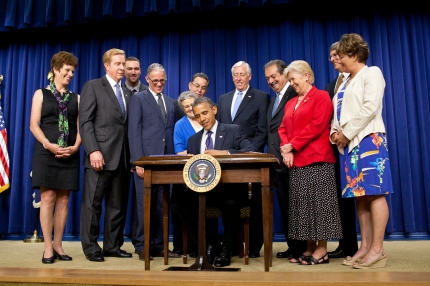
President Barack Obama signs the Export-Import Bill (May 30, 2012)

President Barack Obama signs the Export-Import Bill during a ceremony in South Court Auditorium in the Eisenhower Executive Office Building, May 30, 2012. (Official White House Photo by Pete Souza)

Through the course of the past twelve months, U.S. companies exported $2.15 trillion worth of goods.

That figure breaks a record -- it's a 36 percent increase from the level of exports in 2009, and in fact, it's the most we've ever exported in one, 12-month period. Some 9.7 million people went to work because of these exports -- which is itself an increase of 1.2 million export-related jobs since 2009.

And part of the reason for that success has been the Export-Import Bank. The Bank, which is 78 years old, offers assistance to companies around the world that buy American products -- in order to help boost the sale of those goods.

The Bank's charter was set to expire at the end of the month, but with a bipartisan agreement from Congress, the President was able to extend the Bank's mandate through September of 2014.

"By reauthorizing support for the Export-Import Bank, we’re helping thousands of businesses sell more of their products and services overseas," the President said. "And in the process, we’re helping them create jobs here at home."

Signing Export-Import Bank Reauthorization

May 30, 2012 | 11:06 | Public Domain

President Obama signs the Export-Import Bank Reauthorization Act of 2012, which will reauthorize the Bank to continue financing U.S. exports and ensure a level playing field for U.S. businesses at no cost to American taxpayers.

Download mp4 (392MB) | mp3 (25MB)

Read the Transcript

Remarks by the President at Export-Import Bank Bill Signing

South Court Auditorium

11:35 A.M. EDT

THE PRESIDENT:  Thank you.  (Applause.)  Thank you very much.  Everybody, please have a seat.  Have a seat.  I want to begin by recognizing the members of Congress who are here today.  All of them did outstanding work on this legislation.  In particular, I want to thank Steny Hoyer, Congresswoman Maloney, as well as Congressman Miller, who helped to make this day possible.  Their leadership, their hard work made this bill a reality.  

We’ve talked a lot recently about the fundamental choice that we face as a country.  America can either settle for an economy where just a few are doing well and a lot of folks are struggling to get by.  Or we can build the kind of economy where everybody is getting a fair shot and everybody is doing their fair share, and everybody is playing by the same rules. 

And part of building that broad-based economy with a strong middle class is making sure that we’re not just known as a nation that consumes.  We’ve got to be a nation that produces, a nation that sells.  Our middle class was created by workers who made and sold the best products in the world.  Our communities and our economy have always done better when we shipped more goods than anybody else, stamped with that phrase:  “Made in America.”  And I want us to be that nation again.  I want us to be that nation in perpetuity.

Two years ago, I set a goal of doubling American exports over five years.  Today, with the trade agreements that we’ve signed into law, with the help of some of these same members of Congress, we’re making historic progress.  Soon, there are going to be millions of new customers for our goods and services in Korea, in Colombia and Panama.  That way, even though we got some Hyundais over here, we’re also going to have some Chryslers and Fords and Chevys in Seoul that are imported from Detroit and Toledo and Chicago. 

So I’m going to go anywhere I can in the world to create new markets for American goods.  And we’re also not going to stand by when our competitors aren’t following the rules.  We’ve brought trade cases against China at nearly twice the rate of the previous administration.  We’ve set up a Trade Enforcement Unit to investigate unfair trade practices that are taking place anyplace -- anywhere in the world.  Anytime other countries skirt the rules or put our workers and our businesses in an unfair position, we’re going to take action.

We’re also making sure that American businesses have better access to the 95 percent of the world’s consumers who live beyond our shores.  And that’s why the bipartisan bill that I’m about to sign is so important.  By reauthorizing support for the Export-Import Bank, we’re helping thousands of businesses sell more of their products and services overseas and, in the process, we’re helping them create jobs here at home.  And we’re doing that at no extra cost to the taxpayer.   

Over the past few years, I’ve met with a lot of business leaders and a lot of workers across America, from companies like Boeing to Dow Chemical to smaller companies that are also interested in accessing foreign markets.  And they’ve told me how critical support from the Ex-Im Bank has been in competing more effectively in the global marketplace.  As the head of the bank, we owe our thanks to Fred Hochberg, who is here on stage, for doing such an outstanding job.

Just to give you a couple of examples, Boeing relied on support from the Ex-Im Bank to strike a deal selling more than 200 planes to one of the fastest-growing airlines in the world.  And that translates into thousands of jobs here in the United States.  As long as our global competitors are providing financing for their exports, we’ve got to do the same.  So I’m glad that Congress got this done.  I’m grateful to members of both parties who came together and put the interests of the American people first. 

Now we’ve got to do more.  Obviously, the world economy is still in a delicate place because of what’s going on in Europe and the fact that some of the emerging countries have been slowing down.  It is absolutely critical for us to make sure that we are full speed ahead.

I’ve been traveling around the country talking about a “To-Do” list for Congress with some commonsense ideas that historically have had bipartisan support to help continue growth and job creation.  And just like the bill I’m about to sign, those policies can help strengthen the economy and put more folks back to work.  We shouldn’t have to wait until an election to do some of this business. 

A couple of points.  Number one, it still makes no sense for us to be giving tax breaks to companies that are shipping jobs and factories overseas.  The great news is there are a lot of companies that are now thinking about insourcing and moving jobs back to the United States.  We are more competitive than ever.  Our workers are more productive than ever.  We want to help provide incentives for folks to make those decisions.  So it's time for Congress to take tax breaks away that allow for deductions moving jobs overseas and instead cover moving expenses for companies that are interested in bringing jobs back to America. 

Number two, Congress should give every responsible homeowner the opportunity to save an average of $3,000 a year by refinancing their mortgage.  We're starting to see a little bit of stabilizing in some of the housing markets around the country, but that continues to be a significant drag on our economy.  But when families are able to take advantage of these historically low rates, it makes a difference.  It puts money in their pockets or it may help them rebuild some of their equity.  It gives them more confidence and the housing market stabilizes further. 

We've done everything that we can do administratively to help some portion of homeowners around the country refinance.  But every responsible homeowner in America should have a chance to save money.  That's not just good, by the way, for the housing industry, that's good for all businesses, because it means consumers are going to be out there with a little extra money in their pockets. 

Number three, Congress still has the opportunity to do more to help small business owners who create most of the new jobs in America.  So we want to give them a tax break for hiring more workers and providing those workers higher wages. 

Fourth, Congress should extend the tax credits for clean energy companies that are set to expire at the end of the year.  This is something that a lot of members, both Democrats and Republicans, should be able to appreciate, because wind power, solar power, biofuels -- those aren't partisan issues -- that's a job sector that is growing across the country.  But right now, there is too much uncertainty because we haven't gone ahead and locked down some of these tax credits. 

These companies are putting folks back to work and they're helping us break our dependence on foreign oil.  There are members, again, of both parties that support these tax credits.  And tens of thousands of jobs are at stake.  So I think it's very important for us to make sure that we move forward on that.  

Fifth -- and I’m going to speak to this on Friday -- Congress should create a Veterans Job Corps so we can put our returning heroes back to work as cops and firefighters and park rangers.  We just observed Memorial Day, an extraordinarily moving Memorial Day -- we were down at the Vietnam Veterans Memorial commemorating 50 years since that difficult and challenging war.  And one thing we learned from that was that we’ve got to treat our heroes with the respect and dignity that they have earned. 

And our veterans are some of the most highly-trained, highly-educated, highly-skilled workers we’ve got.  These are Americans who want to keep serving now that they’re back.  So we’ve got to make sure when they come home, they come home to new jobs and new opportunities.  So there are a number of things that my administration can do on our own and we’re going to keep on doing them, but it gets a whole lot easier if we get some help from Congress.  And this is a great example, a great model of what can happen. 

America has come through some tough times together, and it’s going to take more time than any of us would like to get to a place where all of us have fully recovered from the worst recession in our lives.  There will continue to be hurdles and there will continue to be some headwinds that we can’t fully control, but there are plenty of things we can control.  And there are plenty of solutions within our reach.  There are steps that we can take right now to speed up this recovery, to help create jobs, to restore some of the financial security that families have lost.  It’s within our control to do the right thing and do it now. 

So my message to Congress is thank you and congratulations on authorizing Ex-Im Bank to continue on its extraordinary mission.  We’ve got more work to do.  I hope this ends up being a model for the kind of progress that we can make in the months to come and the years to come.  So with that, it is my great pleasure to sign this bill into law.  (Applause.)

(The bill is signed.)

END
11:48 A.M. EDT

Close Transcript

The White House

Office of the Press Secretary

Remarks by the President at Export-Import Bank Bill Signing

South Court Auditorium

11:35 A.M. EDT

THE PRESIDENT:  Thank you.  (Applause.)  Thank you very much.  Everybody, please have a seat.  Have a seat.  I want to begin by recognizing the members of Congress who are here today.  All of them did outstanding work on this legislation.  In particular, I want to thank Steny Hoyer, Congresswoman Maloney, as well as Congressman Miller, who helped to make this day possible.  Their leadership, their hard work made this bill a reality.  

We’ve talked a lot recently about the fundamental choice that we face as a country.  America can either settle for an economy where just a few are doing well and a lot of folks are struggling to get by.  Or we can build the kind of economy where everybody is getting a fair shot and everybody is doing their fair share, and everybody is playing by the same rules. 

And part of building that broad-based economy with a strong middle class is making sure that we’re not just known as a nation that consumes.  We’ve got to be a nation that produces, a nation that sells.  Our middle class was created by workers who made and sold the best products in the world.  Our communities and our economy have always done better when we shipped more goods than anybody else, stamped with that phrase:  “Made in America.”  And I want us to be that nation again.  I want us to be that nation in perpetuity.

Two years ago, I set a goal of doubling American exports over five years.  Today, with the trade agreements that we’ve signed into law, with the help of some of these same members of Congress, we’re making historic progress.  Soon, there are going to be millions of new customers for our goods and services in Korea, in Colombia and Panama.  That way, even though we got some Hyundais over here, we’re also going to have some Chryslers and Fords and Chevys in Seoul that are imported from Detroit and Toledo and Chicago. 

So I’m going to go anywhere I can in the world to create new markets for American goods.  And we’re also not going to stand by when our competitors aren’t following the rules.  We’ve brought trade cases against China at nearly twice the rate of the previous administration.  We’ve set up a Trade Enforcement Unit to investigate unfair trade practices that are taking place anyplace -- anywhere in the world.  Anytime other countries skirt the rules or put our workers and our businesses in an unfair position, we’re going to take action.

We’re also making sure that American businesses have better access to the 95 percent of the world’s consumers who live beyond our shores.  And that’s why the bipartisan bill that I’m about to sign is so important.  By reauthorizing support for the Export-Import Bank, we’re helping thousands of businesses sell more of their products and services overseas and, in the process, we’re helping them create jobs here at home.  And we’re doing that at no extra cost to the taxpayer.   

Over the past few years, I’ve met with a lot of business leaders and a lot of workers across America, from companies like Boeing to Dow Chemical to smaller companies that are also interested in accessing foreign markets.  And they’ve told me how critical support from the Ex-Im Bank has been in competing more effectively in the global marketplace.  As the head of the bank, we owe our thanks to Fred Hochberg, who is here on stage, for doing such an outstanding job.

Just to give you a couple of examples, Boeing relied on support from the Ex-Im Bank to strike a deal selling more than 200 planes to one of the fastest-growing airlines in the world.  And that translates into thousands of jobs here in the United States.  As long as our global competitors are providing financing for their exports, we’ve got to do the same.  So I’m glad that Congress got this done.  I’m grateful to members of both parties who came together and put the interests of the American people first. 

Now we’ve got to do more.  Obviously, the world economy is still in a delicate place because of what’s going on in Europe and the fact that some of the emerging countries have been slowing down.  It is absolutely critical for us to make sure that we are full speed ahead.

I’ve been traveling around the country talking about a “To-Do” list for Congress with some commonsense ideas that historically have had bipartisan support to help continue growth and job creation.  And just like the bill I’m about to sign, those policies can help strengthen the economy and put more folks back to work.  We shouldn’t have to wait until an election to do some of this business. 

A couple of points.  Number one, it still makes no sense for us to be giving tax breaks to companies that are shipping jobs and factories overseas.  The great news is there are a lot of companies that are now thinking about insourcing and moving jobs back to the United States.  We are more competitive than ever.  Our workers are more productive than ever.  We want to help provide incentives for folks to make those decisions.  So it's time for Congress to take tax breaks away that allow for deductions moving jobs overseas and instead cover moving expenses for companies that are interested in bringing jobs back to America. 

Number two, Congress should give every responsible homeowner the opportunity to save an average of $3,000 a year by refinancing their mortgage.  We're starting to see a little bit of stabilizing in some of the housing markets around the country, but that continues to be a significant drag on our economy.  But when families are able to take advantage of these historically low rates, it makes a difference.  It puts money in their pockets or it may help them rebuild some of their equity.  It gives them more confidence and the housing market stabilizes further. 

We've done everything that we can do administratively to help some portion of homeowners around the country refinance.  But every responsible homeowner in America should have a chance to save money.  That's not just good, by the way, for the housing industry, that's good for all businesses, because it means consumers are going to be out there with a little extra money in their pockets. 

Number three, Congress still has the opportunity to do more to help small business owners who create most of the new jobs in America.  So we want to give them a tax break for hiring more workers and providing those workers higher wages. 

Fourth, Congress should extend the tax credits for clean energy companies that are set to expire at the end of the year.  This is something that a lot of members, both Democrats and Republicans, should be able to appreciate, because wind power, solar power, biofuels -- those aren't partisan issues -- that's a job sector that is growing across the country.  But right now, there is too much uncertainty because we haven't gone ahead and locked down some of these tax credits. 

These companies are putting folks back to work and they're helping us break our dependence on foreign oil.  There are members, again, of both parties that support these tax credits.  And tens of thousands of jobs are at stake.  So I think it's very important for us to make sure that we move forward on that.  

Fifth -- and I’m going to speak to this on Friday -- Congress should create a Veterans Job Corps so we can put our returning heroes back to work as cops and firefighters and park rangers.  We just observed Memorial Day, an extraordinarily moving Memorial Day -- we were down at the Vietnam Veterans Memorial commemorating 50 years since that difficult and challenging war.  And one thing we learned from that was that we’ve got to treat our heroes with the respect and dignity that they have earned. 

And our veterans are some of the most highly-trained, highly-educated, highly-skilled workers we’ve got.  These are Americans who want to keep serving now that they’re back.  So we’ve got to make sure when they come home, they come home to new jobs and new opportunities.  So there are a number of things that my administration can do on our own and we’re going to keep on doing them, but it gets a whole lot easier if we get some help from Congress.  And this is a great example, a great model of what can happen. 

America has come through some tough times together, and it’s going to take more time than any of us would like to get to a place where all of us have fully recovered from the worst recession in our lives.  There will continue to be hurdles and there will continue to be some headwinds that we can’t fully control, but there are plenty of things we can control.  And there are plenty of solutions within our reach.  There are steps that we can take right now to speed up this recovery, to help create jobs, to restore some of the financial security that families have lost.  It’s within our control to do the right thing and do it now. 

So my message to Congress is thank you and congratulations on authorizing Ex-Im Bank to continue on its extraordinary mission.  We’ve got more work to do.  I hope this ends up being a model for the kind of progress that we can make in the months to come and the years to come.  So with that, it is my great pleasure to sign this bill into law.  (Applause.)

(The bill is signed.)

END
11:48 A.M. EDT
The White House

Office of the Press Secretary

Statement by the Press Secretary on H.R. 2072

On Wednesday, May 30, 2012, the President signed into law:

H.R. 2072, the "Export-Import Bank Reauthorization Act of 2012," which reauthorizes Export-Import Bank activities, increases the Bank's exposure cap, and makes other modifications to the Bank's authorities.

The White House

Office of the Press Secretary

FACT SHEET: President Obama to Sign the Export-Import Bank Reauthorization Act of 2012

Will Extend the Bank’s Authority Through 2014 and Increase Its Portfolio Cap to $140 Billion to Help U.S. Businesses Sell Their Products and Services Around the World

WASHINGTON, DC – Today, President Obama will sign the Export-Import Bank Reauthorization Act of 2012, a bipartisan bill that will reauthorize the Bank to continue financing U.S. exports, and ensure a level playing field for U.S. businesses, at no cost to American taxpayers.

The President believes that a critical component of building stronger and more durable domestic economic growth is ensuring that U.S. workers and businesses can compete successfully in global markets.  Doing so requires promoting U.S. export of goods and services overseas, which is why the President launched the National Export Initiative (NEI) in 2010, with the goal of doubling U.S. exports over five years while supporting two million new export-related jobs.  This legislation will allow the Export-Import Bank to continue financing U.S. exports to meet global competition.  

America continues to make historic progress under the NEI, despite challenges in the global economy.  U.S. exports over the past 12 months are higher than any previous 12-month period in history, reaching $2.15 trillion, over 36% above the level of exports in 2009.  This record-breaking level of exports supported 9.7 million exports-related jobs in 2011, an increase of 1.2 million exports-related jobs since 2009. 

The Export-Import Bank is playing an important role in contributing to this progress.  Last year, the Bank set export finance records for the third straight year. Overall authorizations hit $32.7 billion, supporting $40 billion in export sales and 290,000 American jobs at more than 3,600 U.S. companies.  More than 85% of these transactions were for small businesses.  The Bank is on track to meet the growing demand for export financing this fiscal year, as well, and small business transactions currently account for more than 22% of the Bank's overall authorizations.

As we create export opportunities for our businesses and workers, the President will continue to ensure that U.S. exporters have a level global playing field on which to compete.  The U.S. will pursue its longstanding goal of minimizing trade-distorting financing of exports from our global competitors.  However, as long as our global competitors provide official export financing, America will do the same.

Under the NEI, the Administration has been working tirelessly on behalf of U.S. exporters since day one.  Through the direct counseling of more than 12,000 U.S. companies, federal trade agencies have supported nearly $140 billion in U.S. exports, and through the recent launch of the Interagency Trade Enforcement Center, the President has brought an unprecedented level of focus and cooperation around investigating unfair trade practices around the world.  The Administration has also worked to expand access to overseas markets for U.S. exporters by resolving outstanding issues with pending trade agreements, negotiating new market access, and deepening engagement in major emerging markets, such as the Free Trade Agreements the President signed with Korea, Colombia, and Panama.

Key Elements of the Export-Import Bank Reauthorization Act of 2012

The reauthorization legislation includes the following provisions:

  • Extending the Bank’s Authority: The Bank’s authority to approve new export financing is extended to September 30, 2014.
  • Increasing the Bank’s Portfolio Limit:  The Bank’s financing authority is increased immediately to $120 billion and will be further stepped up to $140 billion, while requiring the Bank to submit a business plan and maintain a low default rate.
  • Focusing the Bank’s Mission:  The Bank will provide additional information on its business planning, default rates, and its support for small business and the U.S. textile industry.  In addition, the GAO will evaluate the role of the Bank in the world economy, the Bank’s risk management, and its underwriting and fraud prevention procedures.
  • Enhancing Transparency:  The Bank will provide the public with an opportunity to comment on transactions of more than $100 million through Federal Register notification.
  • Updating Technology:  The Bank is given authority to use part of its fee income to update its information technology systems.
  • Reviewing Existing Policies:  The Bank will conduct reviews of its economic impact procedures and domestic content policies.

The Presidential Medal of Freedom Ceremony

May 29, 2012 | 33:32 | Public Domain

President Obama presents exceptional individuals with the Presidential Medal of Freedom.

Download mp4 (1229MB) | mp3 (77MB)

President Obama Honors the 50th Anniversary of the Vietnam War on Memorial Day

May 29, 2012 | 2:05 | Public Domain

Highlights from President Obama's commemoration of the 50th Anniversary of the Vietnam War on Memorial Day, May 28, 2012, at the Vietnam Veterans Memorial in Washington, DC.

Download mp4 (68.5MB)