President Obama: We Have to Deliver for Our Veterans

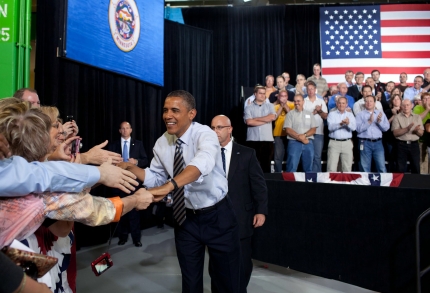
President Barack Obama greets people in the crowd at the Honeywell Golden Valley Facility (June 1, 2012)

President Barack Obama greets people in the crowd at the Honeywell Golden Valley Facility in Golden Valley, Minn., June 1, 2012. The President urged Congress to act on the “To Do List,” specifically highlighting the need to honor our commitment to returning veterans by passing legislation that creates a Veterans Jobs Corps. (Official White House Photo by Pete Souza)

In Minnesota today, President Obama was introduced by Ryan Sullivan -- a Navy veteran who served in Iraq and Yemen. When he was discharged, Sullivan got an education in electrical maintenance and construction, then went to work for Honeywell.

The President wants to make sure that all those returning from war find good jobs, just like Ryan Sullivan. That's why he's proposed the Veterans Jobs Corps, with a goal of putting 20,000 servicemembers to work rebuilding American infrastructure and serving as cops and firefighters.

He told the crowd in Golden Valley:

[Now] that the war in Iraq is over and we’re starting to wind down the war in Afghanistan over a million more of those outstanding heroes, they're going to be joining this process of transition back into civilian life over the next few years.

Now, just think about the skills these veterans have acquired at an incredibly young age. Think about the leadership they’ve learned -- 25-year-olds, 26-year-olds leading platoons into unbelievably dangerous situations, life-or-death situations. Think about the cutting-edge technologies they’ve mastered; their ability to adapt to changing and unpredictable situations -- you can’t get that stuff from a classroom.

I mean, these kids, these men, these women, they’ve done incredible work, and that's exactly the kind of leadership and responsibility that every business in America should be wanting to attract, should be competing to attract.

The President called on lawmakers to pass legislation making the Veterans Jobs Corps a reality -- part of his To-Do List for Congress.

Learn more about the actions that President Obama is asking Congress to take here.

Related Topics: Economy, ToDo List, Veterans, Minnesota

The White House

Office of the Press Secretary

Presidential Proclamation -- African-American Music Appreciation Month, 2012

AFRICAN-AMERICAN MUSIC APPRECIATION MONTH, 2012
- - - - - - -
BY THE PRESIDENT OF THE UNITED STATES OF AMERICA
A PROCLAMATION

As a long-cherished piece of American culture, music offers a vibrant soundtrack to the story of our people and our Union. At times when words alone could not bring us together, we have found in melodies and choruses the universal truths of our shared humanity. African-American musicians have left an indelible mark on this tradition, and during African-American Music Appreciation Month, we pay special tribute to their extraordinary contributions.

Generations of African Americans have used music to share joy and pain, triumph and sorrow. Spiritual hymns gave hope to those laboring under the unrelenting cruelty of slavery, while gospel-inspired freedom songs sustained a movement for justice and equality for all. The smooth sounds of jazz and the soulful strain of the blues fed a renaissance in art and prose. The rhythm and blues that began in a basement in Detroit brought people together when laws would have kept them apart, while the urban beats and young wordsmiths from cities coast-to-coast gave voice to a new generation. And on stages and in concert halls around the world, African-American singers and composers have enhanced opera, symphony, and classical music by bringing energy and creativity to traditional genres.

At its core, African-American music mirrors the narrative of its original creators -- born of humble beginnings and raised to refuse the limitations and circumstances of its birth. This month, we honor the African-American musicians, composers, singers, and songwriters who have forever shaped our musical heritage, and celebrate those who carry this rich legacy forward.

NOW, THEREFORE, I, BARACK OBAMA, President of the United States of America, by virtue of the authority vested in me by the Constitution and the laws of the United States, do hereby proclaim June 2012 as African-American Music Appreciation Month. I call upon public officials, educators, and all the people of the United States to observe this month with appropriate activities and programs that raise awareness and foster appreciation of music that is composed, arranged, or performed by African Americans.

IN WITNESS WHEREOF, I have hereunto set my hand this first day of June, in the year of our Lord two thousand twelve, and of the Independence of the United States of America the two hundred and thirty-sixth.

BARACK OBAMA

The White House

Office of the Press Secretary

Statement by NSC Spokesman Tommy Vietor on Deputy National Security Advisor McDonough’s Travel

Deputy National Security Advisor Denis McDonough concluded a productive trip to Bahrain, Qatar, and Afghanistan, during which he consulted with key counterparts on a range of issues of mutual concern.  During his visit to Bahrain May 29-30, Mr. McDonough met with National Security Advisor Khalifa bin Abdullah Al-Khalifa and Interior Minister Rashid bin Abdullah Al-Khalifa and held a roundtable discussion with civil society leaders.  In these meetings, Mr. McDonough stressed the importance of the U.S.-Bahraini partnership as well as the importance the United States places on reconciliation and reform in Bahrain.  In Qatar, Mr. McDonough gave a keynote address at the U.S.-Islamic World Forum on May 30, and met with Prime Minister and Foreign Minister Hamad bin Jasim Al-Thani to discuss regional issues, including the ongoing crisis in Syria.

Finally, following the President’s May 1 trip to Afghanistan and the recent NATO Summit in Chicago, Mr. McDonough traveled to Afghanistan May 31-June 1 to meet with U.S. civilian and military leaders and with Afghan government officials.  Mr. McDonough met with officials in Kabul, and in Regional Command-South and Regional Command-East. During all of these discussions, he reiterated the United States’ commitment to the strategy laid out by President Obama and reviewed our joint progress on the five elements of that strategy: transition to an Afghan security lead by the end of 2014; training sufficient and sustainable Afghan Security Forces; building an enduring partnership with Afghanistan; supporting Afghan-led reconciliation; and promoting regional stability.

The White House

Office of the Press Secretary

Remarks by the President on Veterans Jobs -- Golden Valley, Minnesota

Honeywell Golden Valley Facility
Golden Valley, Minnesota

12:18 P.M. CDT

THE PRESIDENT:  Hello, Golden Valley!  (Applause.)  It is good to be back in Minnesota.  (Applause.)  It is good to see your Governor, Mark Dayton, here.  (Applause.)  On the way over we were talking about making sure the Vikings were staying.  (Applause.)  Now, that’s a hard thing for a Bears fan to do.  (Laughter.)  But I was rooting for the Vikings sticking around here -- and the Governor did a great job.  You were praying, too, huh?  (Laughter.)  Absolutely.  Prayer never hurts.  It helps. 

You got two outstanding Senators, Amy Klobuchar -- (applause) -- and Al Franken.  (Applause.)  Your mayor, Shep Harris is here.  (Applause.)  Outstanding congressional delegation in the house.  Give them a big round of applause.  (Applause.)  And I thought Ryan was really good, so give him a big round of applause.  (Applause.)  He’s a natural.

Now, one of the last times I was here was last August.  We took a bus tour around the state.  I needed a little “Minnesota nice.”  (Laughter.)  I stopped for some pie in Zumbrota.  I held a town hall in Cannon Falls.  Amy and Al were there.  I think Al ate my pie, in fact.  (Laughter.)  And I spent a lot of time talking with folks who’d spent the past couple years making their way through a tough economy.

And today, we’re still fighting our way back from the worst economic crisis since the Great Depression.  The economy is growing again, but it’s not growing as fast as we want it to grow.  Our businesses have created almost 4.3 million new jobs over the last 27 months, but as we learned in today’s jobs report, we’re still not creating them as fast as we want.  And just like this time last year, our economy is still facing some serious headwinds.  We had high gas prices a month, two months ago, and they’re starting to come down, and they were spiking, but they’re still hitting people’s wallets pretty hard.  That has an impact.  And then, most prominently, most recently, we’ve had a crisis in Europe’s economy that is having an impact worldwide, and it’s starting to cast a shadow on our own as well.  So we’ve got a lot of work to do before we get to where we need to be.  And all these factors have made it even more challenging to not just fully recover, but also lay the foundation for an economy that’s built to last over the long term.

But that’s our job.  From the moment we first took action to prevent another depression, we knew the road to recovery would not be easy.  We knew it would take time.  We knew there would be ups and downs along the way.  But we also knew if we were willing to act wisely, and boldly, and if we were acting together, as Americans; if we were willing to keep at it; if we were willing to roll up our sleeves and never quit –- then we wouldn’t just come back, we’d come back stronger than ever.  That was our belief.  (Applause.)  And that continues to be my belief. 

We will come back stronger, we do have better days ahead, and that is because of all of you.  That’s because of all of you.  (Applause.)  I’d place my bets on American workers and American businesses any day of the week.  (Applause.)  You’ve been fighting through this tough economy with resilience and grit and innovation.  Honeywell is a great example of a company that’s doing outstanding work, and I want to acknowledge Dave Cote here who has been –- (applause) -– serving on my Jobs Council and doing a lot of great work. 

That’s why our auto industry has come roaring back.  It’s why manufacturing is consistently adding jobs for the first time since the 1990s.  (Applause.)  All that is happening because of you.  Everybody here plays by the rules.  You work hard.  You meet your responsibilities.  And you deserve leaders who do the same -- leaders who will stand shoulder to shoulder with you and do everything possible to strengthen the middle class and move this economy forward.  That’s what you deserve.  (Applause.)

Look, we can’t fully control everything that happens in other parts of the world -- disturbances in the Middle East, what’s going on in Europe.  But there are plenty of things we can control here at home.  There are plenty of steps we can take right now to help create jobs and grow this economy.

Now, let me give you a couple examples.  I sent Congress a jobs bill last September full of the kinds of bipartisan ideas that would have put our fellow Americans back to work and helped reinforce our economy against some of these outside shocks.  I sent them a plan that would have reduced the deficit by $4 trillion in a way that is balanced -- that pays for the job-creating investments we need by cutting unnecessary spending, but also by asking the wealthiest Americans to pay a little more in taxes.  (Applause.)

And I’ll give them a little bit of credit:  Congress has passed a few parts of that jobs bill, like a tax cut that’s allowing working Americans to keep more of your paychecks every week.  That was important.  I appreciated it.  But Congress has not acted on enough of the other ideas in that bill that would make a difference and help create jobs right now.  And there’s no excuse for it.  Not when there are so many people out there still looking for work.  Not when there are still folks out there struggling to pay their bills.  It’s not lost on anybody that it’s an election year –- I understand that; I’ve noticed.  (Laughter.) 

AUDIENCE MEMBER:  Four more years!  (Applause.)

THE PRESIDENT:  But we’ve got responsibilities that are bigger than an election.  (Applause.)  We’ve got responsibilities to you.

So my message to Congress is:  Now is not the time to play politics.  Now is not the time to sit on your hands.  The American people expect their leaders to work hard no matter what year it is.  The economy still isn’t where it needs to be.  There are steps that could make a difference right now -- steps that can also serve as a buffer in case the situation in Europe gets any worse. 

So, right now, Congress should pass a bill to help states prevent more layoffs, so we can put thousands of teachers and firefighters and police officers back on the job.  (Applause.)  Layoffs at the state and local levels have been a chronic problem for our recovery, but it’s a problem we can fix. 

Congress should have passed a bill a long time ago to put thousands of construction workers back on the job rebuilding our roads and our bridges and our runways.  (Applause.)  Since the housing bubble burst, no sector has been hit harder than the construction industry, and we’ve got all this stuff that needs fixed.  Remember that bridge here in Minnesota?  So this is a problem we can fix.  Let’s do it right away.

Instead of just talking about job creators, Congress should give small business owners a tax break for hiring more workers and paying them higher wages.  We can get that done.  (Applause.)  We can get it done right now.  Let’s not wait.

Right now, Congress should give every responsible homeowner the opportunity to save an average of $3,000 a year by refinancing their mortgage.  We’ve got historically low rates right now.  (Applause.)  I was with a family in Reno, Nevada, a couple weeks ago.  They got a chance to refinance -- even though their home was underwater -- put that money back in their pockets because we had taken some steps as an administration to make that available for those who have mortgages held by government agencies like the FHA or a government guarantee.  But not everybody has those kinds of mortgages.  I want everybody to have those same opportunities.

I assume there are some folks here who could use $3,000 a year.  (Applause.)  Let's get that done right now.  That means there are going to be -- if you have $3,000 a year extra, that helps you pay down your credit cards.  That helps you go out and buy some things that your family needs, which is good for business.  Maybe somebody will be replacing some thingamajig for their furnace.  (Laughter.)  They've been putting that off.  But if they've got that extra money, they might just go out there and buy that thing.  Right?  (Laughter and applause.)

Right now, Congress needs to extend the tax credits for clean energy manufacturers that are set to expire at the end of this year.  I was talking to Dave Cote.  The issue of energy efficiency and everything we need to do to shift away from dependence on foreign oil, we're making huge progress.  (Applause.)  We're actually importing less oil than any time in the last eight years.  We're down under 50 percent, but we can do more. 

And these clean energy companies, they're hiring folks.  They're helping us break dependence on foreign oil.  It's part of a package of stuff that Honeywell is doing a lot of work on.  But almost 40,000 jobs are on the line if these tax credits expire.  Why would anyone in Congress walk away from those jobs?  We need to pass those tax credits right now.  (Applause.)  We need to pass them right now.  (Applause.) 

It’s long past time we started encouraging what a lot of companies have been doing lately, which is bringing jobs back to this country.  (Applause.)  And some of them are coming to Minnesota.  The Governor and I were talking in the car about some companies coming back -- Red Bull, right, coming back.  But let's give more incentive.  It's time for Congress to end tax breaks for companies that ship jobs overseas.  Let's use that money to cover moving expenses for companies that are bringing jobs back to America.  (Applause.)  That would make a difference right now.

So those are all steps that we could be taking to strengthen the economy, to provide us some insurance if the situation overseas starts getting worse so we can control our own destiny, keep this recovery moving forward.   

Which brings me to the last thing Congress should do to help businesses create jobs -- that’s why I’m here at Honeywell today.  I believe that no one who fights for this country should ever have to fight for a job when they come home.  (Applause.)  And for Congress, that means creating a Veterans Job Corps so we can put our returning heroes back to work as cops and firefighters, on projects that protect our public lands and resources.  And they should do it right now.  They should do it right now.  But if we’re going to serve our veterans as well as they’ve served us, we’ve got to do even more.   

We just observed Memorial Day, which makes us think about the extraordinary sacrifices so many make.  But we've got to make sure we translate words into action.  We can't just be in a parade, can't just march.  We also have to deliver for our veterans. 

Over the past three decades -- over the past decades, rather, more than 3 million servicemembers have transitioned back to civilian life.  And now that the war in Iraq is over and we’re starting to wind down the war in Afghanistan -- (applause) -- over a million more of those outstanding heroes, they're going to be joining this process of transition back into civilian life over the next few years. 

Now, just think about the skills these veterans have acquired at an incredibly young age.  Think about the leadership they’ve learned -- 25-year-olds, 26-year-olds leading platoons into unbelievably dangerous situations, life-or-death situations.  Think about the cutting-edge technologies they’ve mastered; their ability to adapt to changing and unpredictable situations -- you can’t get that stuff from a classroom.

I mean, these kids, these men, these women, they’ve done incredible work, and that's exactly the kind of leadership and responsibility that every business in America should be wanting to attract, should be competing to attract.  That's the kind of talent we need to compete for the jobs and the industries of the future.  These are the kinds of Americans that every company should want to hire.  (Applause.)

And that’s why, here at Honeywell, you’ve made it a mission to hire more veterans.  (Applause.)  And let me say, Dave is incredibly patriotic, loves his veterans, but this -- Honeywell is doing this not just because it feels good.  They're doing it because it’s good for business, because veterans make outstanding workers.  So today, I’m taking executive action that will make it easier for a lot of companies to do the same thing.

I’ve told the story before of a soldier in the 82nd Airborne who served as a combat medic in Afghanistan, saved lives over there, earned a Bronze Star for his actions.  But he came home, here to Minnesota -- met him on our way to Cannon Falls.  When he first came home, he couldn’t even get a job as a first responder.  Think about it -- this guy is out there taking care of troops who are wounded in action, couldn’t initially get a job.  So then he took classes through the Post-9/11 GI Bill -- classes that he could have taught -- (laughter) -- just so he could qualify for the same duties at home that he had performed every day at war.

Let me tell you something -- if you can save a life on the battlefield, you can save a life in an ambulance.  (Applause.)  If you can oversee a convoy or millions of dollars of assets in Iraq, you can help manage a supply chain or balance its books here at home.  If you can maintain the most advanced weapons in the world, if you’re an electrician on a Navy ship, well, you can manufacture the next generation of advanced technology in our factories like this one.  (Applause.)  If you’re working on complex machinery, you should be able to take those skills and find a manufacturing job right here -- right here at home.

But, unfortunately, a lot of returning heroes with advanced skills like these, they don’t get hired simply because they don’t have the civilian licenses or certifications that a lot of companies require.  At the same time, I hear from business leaders all the time who say they can’t find enough workers with the skills necessary to fill open positions.  Eighty percent of manufacturers say this, according to one survey.  So think about it -- we got all these openings and all these skilled veterans looking for work, and somehow they’re missing each other.  That doesn’t make any sense.  So that’s where executive action comes in.  That’s where we’re going to fix it. 

Today, I’m proud to announce new partnerships between the military and manufacturing groups that will make it easier for companies to hire returning servicemembers who prove they’ve earned the skills our country needs.  (Applause.)  Soldiers, sailors, Marines, airmen, Coast Guardsmen -- if they’ve got skills in machining or welding or weapons maintenance, for example, you’ll have a faster track to good-paying manufacturing jobs.  Servicemembers with experience in logistics or maintenance on the front lines, they’ll have a faster track to jobs in those fields here at home.

I’ve also directed the Department of Defense to establish a new task force charged with finding new opportunities for servicemembers to use the skills they’ve learned in the military to gain the relevant industry credentials -- the civilian certifications and licenses -- so that it doesn’t cost them and they don’t necessarily have to go back to school for three years and take out a whole bunch of student loans when, potentially, they could do it quicker, more inexpensively, and get on the job faster.  We’re talking about jobs in manufacturing, in health care, in IT, in logistics, for first responders -- so that returning combat medic that I spoke about, he doesn’t have to prove himself over and over again.

So this task force’s first action is going to create opportunities for up to 126,000 servicemembers to gain the industry-recognized certifications for high-demand manufacturing jobs like the jobs right here at this plant at Honeywell.  (Applause.)  This builds on the Skills for America’s Future partnership that we launched last year with the National Association of Manufacturers to provide 500,000 community college students with industry-recognized credentials that will help them secure good manufacturing jobs.

And all of this builds on the steps we’ve already taken to make sure our returning heroes come home able to share in the opportunities that they have defended.  Because when our men and women sign up to become a soldier, a sailor, an airman, Marine, Coast Guardsman, they don’t stop being a citizen.  When they take off that uniform, their service to this nation doesn’t stop.  Think about previous generations.  Well, today's veterans are the same.  When they come home, they're looking to continue serving America however they can.  And at a time when America needs all hands on deck, they've got the skills and the strength to help lead the way. 

Our government needs their patriotism and their sense of duty.  That’s why I ordered the hiring of more veterans by the federal government; we’ve hired more than 200,000 so far.  (Applause.)

Our economy needs their outstanding talent.  That’s why I pushed hard last year for tax breaks for businesses that hire unemployed veterans and wounded warriors.  And I’m proud to say that both parties in Congress came together to get that part done. 

That’s why we launched free personalized job services -- job search services through the Veterans Gold Card program and an online Veterans Job Bank to help veterans find jobs that meet their talents.  And, by the way, if there are any veterans here who need those services, you can find that at WhiteHouse.gov/vets.  And then, later this month, the VA will hold a jobs fair in Detroit where 12,000 more opportunities will be available to veterans.

And that’s also why I challenged business leaders to hire 100,000 post-9/11 veterans and their spouses by the end of next year -- because don't forget our military families.  They're serving alongside our veterans.  (Applause.)  Michelle and Jill Biden -- that's Michelle Obama and Jill Biden -- (laughter) -- just in case you were curious.  (Laughter.)  You might not know which Michelle I was talking about.  (Laughter.)  They're leading this effort with respect to military families, nationally.  It's called Joining Forces -- to mobilize all of us to support today’s military families and their veterans.

And so far, the good news is participating businesses have hired more than 70,000 veterans.  And they’ve pledged to hire 175,000 more in the coming years.  And I want to thank Honeywell not only for being an active partner in this initiative, but, right here, Honeywell has hired 900 veterans over the past year, and for employing 65 veterans here just here at Golden Valley.  So give them a big round of applause.  Proud of you.  (Applause.) 

Standing up for our veterans, this is not a Democratic responsibility, it's not a Republican responsibility -- it’s an American responsibility.  It’s an obligation of every citizen who enjoys the freedom that these heroes defended.  So we've got to meet our obligations today just like folks here at Honeywell are doing. 

And as Commander-in-Chief, I want all of our servicemembers and veterans to know we are forever grateful for your service and your sacrifice.  Just like you fought for us, we’ll keep fighting for you -- (applause) -- for more jobs, more security, for the opportunity to keep your families strong -- because you'll help us keep America on top in the 21st century.  (Applause.)  We're going to keep fighting, just as you did, to show just why it is that the United State of America is the greatest nation on Earth.

God bless you.  God bless America. 

END          
12:43 P.M. CDT

The White House

Office of the Press Secretary

Presidential Memorandum -- Suspension of Limitations Under the Jerusalem Embassy Act

MEMORANDUM FOR THE SECRETARY OF STATE

SUBJECT: Suspension of Limitations under the Jerusalem Embassy Act

Pursuant to the authority vested in me as President by the Constitution and the laws of the United States, including section 7(a) of the Jerusalem Embassy Act of 1995 (Public Law 104-45)(the "Act"), I hereby determine that it is necessary, in order to protect the national security interests of the United States, to suspend for a period of 6 months the limitations set forth in sections 3(b) and 7(b) of the Act.

You are authorized and directed to transmit this determination to the Congress, accompanied by a report in accordance with section 7(a) of the Act, and to publish the determination in the Federal Register.

This suspension shall take effect after the transmission of this determination and report to the Congress.

BARACK OBAMA

The White House

Office of the Press Secretary

Press Gaggle by Principal Deputy Press Secretary Josh Earnest en route Minneapolis, MN, 6/1/12

Aboard Air Force One
En Route Minneapolis, Minnesota   

10:35 A.M. EDT

MR. EARNEST:  We're glad that all of you made it this morning for the trip for this busy day ahead in our nation's heartland.  I hope you're looking forward to it as much as I am. I have a couple of announcements before we get started -- one that I hope will anticipate a few questions that you may have already this morning.

The first thing is as you may have seen, the President spent some time with Congressman Rothman at the White House today.  Congressman Rothman is a longtime friend and longtime supporter of President Obama.  The two of them have worked together on a variety of the President's priorities.  These are priorities that I know Congressman Rothman shares, including things like cutting taxes for small businesses who want to grow their jobs -- who want to grow their businesses and create jobs, standing up for middle-class families and cutting taxes for middle-class families, protecting Social Security and Medicare. 

These are priorities that the President and Congressman Rothman share.  They've worked on them together extensively in Washington, and the President was pleased to have the opportunity to spend a little time with him at the White House today.

The second thing, on Thursday, June 14th, the President will visit the Port Authority of New York and New Jersey's World Trade Center site, where he'll receive a briefing on construction progress.  The visit will be a preview of the One World Trade Center topping-off ceremony, which will symbolize the near-completion of the iconic building's framework.  So, again, that's June 14th.

And then, lastly, a little bit about the President's activities today.  The President is traveling to Minnesota today to continue talking about his "To-Do" list for Congress, which is composed of bipartisan policies that if passed would help the economy and offer much needed support to middle-class families.  The item the President will highlight today is a proposal to put our veterans back to work, protecting and preserving our country. He'll also discuss the success of the Joining Forces initiative to encourage private sector companies to hire veterans, something that Honeywell -- the company that we're visiting today -- has done with great success.

And finally, to further this goal, the President has directed the Department of Defense to form a task force that will help veterans with solid skills from their military service get the credentials they need to get work in the private sector.  There are highly technical manufacturing jobs that are available and military veterans who fought for our country overseas shouldn’t have to fight for those good jobs when they get back home.

So you'll hear the President talk about this a little bit.  He's going to do a tour of the Honeywell facility and then will deliver some remarks.

So, with that, I'll take your questions.

Q    Josh, but anemic job numbers today.  Does the President think that his "To-Do" list is a powerful enough weapon to turn those numbers around?

MR. EARNEST:  As you know, Jim, we're digging out of a very deep hole, but the numbers today indicate that the country has benefited from 27 consecutive months of private sector job growth -- this is about 4.3 million jobs.  But the numbers also make it apparent that we're not quickly creating those jobs at a rapid enough pace. 

So what the President believes -- well, and there are some important reasons for that.  We've certainly faced some pretty significant headwinds -- like we’re apparently facing right now on the plane -- (laughter) -- some significant headwinds related to gas prices.  Gas prices have come down recently, but certainly over the spring that took a pretty big bite out of the budgets of many families across the country and some businesses certainly, as well.  We’re also seeing continued instability in the eurozone region, which is having an impact on the American economy. 

Those are external factors.  But there are some things that Congress can do to mitigate those factors and further strengthen our economy and support middle-class families.  So the President, back in September, laid out an American Jobs Act that included proposals that would put construction workers back to work rebuilding our roads and runways and modernizing our schools.  It included a proposal to put teachers and firefighters and police officers back to work.

We saw in those jobs numbers that there were significant losses in the education sector and in the local government sector.  Many of those are teachers and firefighters and police officers.

And then we’ve seen some items on the "To-Do" list that would also do some very important things for economy.  The refinancing proposal would offer a benefit to responsible homeowners, many of them from middle-class families who -- because red tape exists, is blocking their path -- are prevented from benefiting from the historically low mortgage interest rates.  So there are a number of proposals.

And certainly the item on the "To-Do" list today that would put veterans back to work, preserving and protecting our country -- these are the kinds of things that would help the economy.

Q    Josh, the numbers today obviously were very disappointing.  Is the President concerned that this loss of momentum in the U.S. economy raises the risk that it could suffer another recession?

MR. EARNEST:  Well, as we’ve said many times, Alister, even I’ve said standing in this one place in reaction to jobs numbers that exceeded expectations and those job numbers that did not meet expectations, what we’re looking at is the longer-term trend.  And the longer-term trends still indicate that we have an economy that's adding jobs.  As I mentioned, they've been doing that for 27 consecutive months.  But as I also mentioned, it’s readily apparent that we’re not adding those jobs at a rapid enough pace. 

And so the President believes that there are some very important things that Congress can do, things that have bipartisan support, things that independent analysts would acknowledge would both create jobs and strengthen our economy, the kinds of things that would offer support to middle-class families who are really bearing the brunt of the financial instability that our country is going through right now.  And it’s the President’s view that just because it’s an election year, Congress is not off the hook in terms of putting in place the kinds of policies that would create jobs.

Q    If he can't move Congress, does he have a plan B?

MR. EARNEST:  Well, Congress has a responsibility here.  I mean, we shouldn't overlook the fact that members of Congress are in a position where everyone acknowledges, so people on both sides of the partisan aisle acknowledge that there's more that we need to do to strengthen our economy.  There's a very deep hole that we're digging out of.  Middle-class families need support.  They need help.  And there are a number of things that we can do. The refinancing proposal would add -- for the typical responsible homeowner, middle-class family, would have about an extra $3,000 to the family budget. That's a pretty significant -- that would have a pretty significant impact on the broader economy.

So just because we're in election year, we're not in a position where members of Congress who are worried about their jobs are off the hook for supporting the kinds of policies that we know would create jobs.

Q    -- election year, and opinions of the economy are shaped generally in the coming months before the election.  So is the President running out of time to get employment below 8 percent or at least close to 8 percent before the election?
MR. EARNEST:  Well, the President right now is focused on the broader economy and how that has an impact on the jobs of middle-class families all across the country -- not as it relates to his own job. 

So what the President is going to do is he is going to do more of the kinds of things he is doing today, which is traveling across the country and making the case to the American people and to members of Congress about why passing elements of the American Jobs Act are so important, why getting to work on this "To-Do" list is so important. 

The President is not asking members of Congress to step that far -- is not asking them to step outside their comfort zone at all.  This is part of their specific job description, which is to come together around bipartisan ideas that we know would create jobs and strengthen the overall economy -- things like the refinancing proposal; things like cutting taxes for small businesses that are looking to grow their business and hire workers; things like putting construction workers back to work building our infrastructure, building our roadways and runways; putting construction workers back to work updating schools.  These are the kinds of things that we know would have an impact on the economy, the kinds of things that we know would create jobs.  There's no excuse for Congress not to act.

Q    Josh, surely the administration and the campaign is concerned about those numbers.  Steve Rattner, who used to work for the administration, said that absolutely nothing good can be said about this number today.  So because we're getting so close to the election and because you've seen the statistics that it's hard to get reelected with unemployment this high, I mean is there a concern that there isn't enough time -- following up on Jessica's question.

MR. EARNEST:  Look, what the President is concerned about is making sure that we have in place the kinds of economic policies that we know will create jobs.  The President has laid out a number of those ideas.  The President has forwarded those ideas to members of Congress.  And the President is interested in working with members of Congress, both Democrats and Republicans, to pass those ideas so the President can sign them into law. 

The politics are going to take care of themselves.  The President is focused right now on putting in place the kinds of economic policies that we know will offer much-needed support to middle-class families.  That’s the President's focus.

Q    Josh, along these lines, any update for us on the student loan situation?  Was the President at all encouraged by the offer made by congressional Republicans yesterday?

MR. EARNEST:  Well, to say that we got some mixed signals yesterday is putting it rather mildly.  Reportedly, yesterday morning, the Speaker of the House told his Republican colleagues that this is just a phony issue.  Several hours later the President got a letter that was signed by the Speaker of the House and some of his colleagues indicating that they may be interested in working on this issue. 

The President certainly believes the prospect of increasing -- of doubling the interest rate on middle-class students and their families is not a phony issue.  We're talking about adding $1,000 to the debt load of the average college student if we see these interest rates double a month from today.  That’s not phony. 

I understand that the Speaker of the House may have actually used even more colorful words to describe this issue, which is unfortunate.  Hopefully, the Speaker, in the form of that letter, was indicating a genuine willingness to work with the President to solve this problem.  It remains a priority of the President's.

Q    What's the next step?  Why can't you just take the letter on paper and run with it?

MR. EARNEST:  Well, what I can tell is that our policy folks are evaluating proposals that the Republicans have offered, and so we'll evaluate what they've offered and we'll take a look at it.  But it's something that the President believes is a high priority for the next four weeks.

Q    Does the meeting with Congressman Rothman today mean that the President's endorsing him in his race? 

MR. EARNEST:  It means that the President has a longstanding relationship with Congressman Rothman, is appreciative of the solid working relationship that they've enjoyed while the President has been in office.  It's indicative of the priorities that they share.  And the President certainly enjoyed the opportunity he had to visit with him in the Oval Office today.

Q    Who will the President or won't the President endorse in this race?

MR. EARNEST:  Well, as the head of the party, the President has made it -- has not weighed in to primary contests in which there are two incumbent members of Congress.  But the President has had a --

Q    -- reference here, isn't he?

MR. EARNEST:  The President has certainly shown that he has a long-term relationship with Congressman Rothman and has appreciated the relationship and the ability and opportunity they've had to work together on a number of priorities.

Q    Josh, since the President is going to be in the neighborhood, did he give any thought to going to Wisconsin and weighing in on the recall?

MR. EARNEST:  Well, as you may have seen, Christi, about a week or so ago, the President's reelection campaign put out a statement about the recall election in Wisconsin and indicated that the President stood with Mayor Barrett and thousands of Wisconsin families in support of his campaign.  But I don’t know that there was any talk about going to Wisconsin today. 

Q    People think that this might be predictive about how things are going to look for him in the fall in Wisconsin.  Does he agree with that?  And is there a particular reason he personally doesn’t want to show up in Wisconsin before the vote?

MR. EARNEST:  Well, I haven't talked to the President personally about this issue, and I know that the members of the President's reelection campaign have discussed this at length, so I'll leave the political analysis from the governor's race and the lines that may or may not be appropriately drawn to the presidential race to them.

Q    Josh, on Syria, Secretary Panetta today said that -- or yesterday -- that any military action would be up to the President and the international community.  I'm wondering whether the President, in talking to European leaders, as he has recently, or other allies, has tried to feel them out on the issue of military action.  Is he trying to construct any kind of alliance in support of that at this point?

MR. EARNEST:  Well, as you've seen, Jim, the President has been in regular consultation with our allies and partners all around the world on a range of issues including this one.  The President remains very concerned about the situation in Syria, about the horrific violence that’s being perpetrated by the Assad regime against the Syrian people.  So the President has been in consultation with our allies and partners about that. 

I don’t have any details to read out from those meetings.  What I can tell you is that the President does believe that a political transition needs to happen immediately.  That’s the only way that this situation will be resolved in Syria, is for the -- is for Assad to leave power.  That remains the firm resolve of the international community.  And the President is hopeful that we can find a diplomatic solution to reach that goal.  But what's clear about what needs to happen right now is the violence needs to end and the political transition needs to begin.

Q    Josh, on the Stuxnet story in the Times today, can you confirm the United States collaborating with the Israelis to launch a cyber attack on Iran?

MR. EARNEST:  I've read the story that you're referring to, Alister, and I'm not able to comment on any of the specifics or details that are included in that story.  I can tell you more, though, about what this President's approach to Iran has been in terms of dealing with the threat.

When this President took office, the nation of Iran was unified behind their goal, their stated goal of pursuing a nuclear program.  The international community was fractured about how to deal with that challenge.  Since the President took office, he has marshaled international opinion where we now see an international consensus about holding Iran accountable for living up to their international obligations.  And we’ve seen many signs, many indications coming from Iran that there’s a lot of discord and disunity in Iran about the wisdom of their approach. 

So the circumstances have changed pretty significantly thanks in no small part to the President’s leadership on this issue.  We’re going to continue to hold the Iranian regime accountable.  There are -- the pressure on them is only increasing.  We’re going to see some additional sanctions go into place, take effect later this summer that will see further ramping up of pressure on them.  And hopefully, it will have the effect of the Iranians coming clean about the true nature of their program, confirming for the international community that their program that they're pursuing is only for peaceful means, and that they’ll live up to their international obligations.  And we’ll see -- there’s a meeting here among the P5-plus-1 and representatives of the Iranian government in Moscow in June, and we should learn more then.

Q    So, Josh, you won’t comment on the actual content in the Times story, but it cites remarks that the President and the Vice President made inside the Situation Room.  It seems very obvious that this is an authorized leak.  So --

MR. EARNEST:  Why would you say that?

Q    -- in the Situation Room.  Obviously it’s not a national security concern to talk about it.  So for what reason won’t you talk to us about it?

MR. EARNEST:  I disagree with you in the strongest possible terms about your characterization of that handling of classified data.  There is a reason that information is classified.  It’s classified for a reason, because publicizing that information would pose a significant threat to national security.  So I disagree entirely with the premise of the question as you posed it.

Q    So are you saying that there was -- are you denying there was an authorized leak?

MR. EARNEST:  I’m saying that I’m not in a position to talk to you about any of the details that were included in the story. But I am telling you that this administration -- well, that it’s our view, as it is the view of everybody who handles classified information, that information is classified for a reason; that it is kept secret, it is intended not to be publicized because publicizing it would pose a threat to our national security.

Q    So let me ask you this.  Given that, does the President intend to open an investigation into the apparent leak of this secure information?

MR. EARNEST:  I don't have any information for you on that right now.

Q    Josh, given that, too, though, did the administration or the White House seek to consult with The New York Times not to publish that story?

MR. EARNEST:  I don't have any details for you in terms of the way that that story was handled.

Q    -- on Syria, some human rights groups believe that a Russian-flagged ship docked in the Syrian port of Tartus was delivering weapons to Syria.  Putin has denied this, and the administration is saying you’re investigating it.  How are you investigating it?  If that's found to be true, is Russia in part responsible for these massacres?

MR. EARNEST:  Well, as you pointed out, Jessica, this is something that apparently is still being investigated.  I don't have any information on this specific instance for you other than to say that as you’ve seen us read out, this administration at a range of levels is in regular consultation with the Russian government about the situation in Syria.  We are continuing to urge the Russians to exercise the influence that they have to end the violence that's being perpetrated by the Assad regime in Syria. 

After all, it is in the interest -- it’s clear that the Russian government has a significant investment in Syria, and they have -- in their own self-interest, ensuring that sectarian violence doesn't spread beyond Syrian borders, that this situation doesn't get worse, and that the violence comes to an end immediately.  This is not a situation where we have differing points of view or different interests here.  So that's why we are continuing to engage with the Russians to try and reach a solution.

Q    Does the President, like Secretary Clinton, believe -- or reject the claims by the Russians that they're doing everything they can to stop the strife there?

MR. EARNEST:  Well, what I can say is that we continue to be in touch with the Russians on a regular basis, and we are encouraging them to do more; to use their influence in Syria to persuade the Assad regime to end the horrific violence that they've perpetrated on innocent Syrians, and to support and bring about the other members of the international community, both in the region and around the world, to find a prompt -- or to put in place a prompt democratic transition -- political transition.

Q    Human rights groups want evidence of the massacres to be turned over to the International Criminal Court.  Does the administration support that move?

MR. EARNEST:  Well, the International Criminal Court is something that requires U.N. Security Council action.  I can tell you that this administration remains committed to accountability and ensuring that there is accountability for what's happened there.  But what we're focused on right now is trying to get an immediate end to the terrible violence that's being perpetrated by the Assad regime.

Q    Can you confirm that the President apologized in a letter to the Polish President about his use of the phrase "Polish death camps" and what was said in that letter?

MR. EARNEST:  Well, as you know, Kate, I believe it was the President of Poland sent a letter to President Obama.  I can confirm to you that President Obama did send a letter back.  We typically are not in the habit of releasing correspondence between the President and other world leaders.  But I can tell you that the way that you characterized the content of the letter in your question is not quite accurate.

Q    So it wasn’t an apology?

MR. EARNEST:  My understanding is that the letter was in line with other public statements that you've seen from this administration.  But I don't have any specific words from that letter to read to you. 

Q    -- that it was his statement?

MR. EARNEST:  Well, you've seen the things that we've said.

Q    Anything on calls to European leaders since Wednesday, and anything this week -- planned for this weekend?  And also, is the First Lady and the two daughters staying tonight in Chicago with the President, or is he just there by himself at their house?

MR. EARNEST:  That was a lot all in one -- (laughter.)  I don't have any additional calls to read out to you in terms of consultation with world leaders.  The President did hold that secure video-teleconference with leaders of Germany, France and Italy earlier this week.  As you know, Under Secretary of the Treasury Lael Brainard has been traveling in Europe this week.  She has been in Greece, Spain and Germany, I believe.  Under Secretary Brainard is an expert on these issues, frankly.  She is somebody who has great credibility with her counterparts in Europe.  She's playing a very important role in offering to the Europeans the kind of advice, based on her own experience here in this country in dealing with some of these financial challenges.

But ultimately, despite the important advice that the United States can offer, it's the Europeans -- this is a European challenge.  The Europeans have the resources that they need to solve this problem.  It requires -- these are not easy problems to solve; these are difficult challenges, but the Europeans do have the resources that they need to confront them and to deal with them.  We hope they will.

Q    In that same call, was the majority of it on the eurozone debt, or what -- because the readout was kind of vague and said Syria was part of it.  Can you give any insight into what actually happened on that call?

MR. EARNEST:  It is my understanding that the bulk of the call was devoted to -- was to the eurozone challenges there.  I don't have any more details to read out on that. 

Q    What about tonight?

MR. EARNEST:  My understanding is that the First Family will not be in Chicago tonight.  The President, though, is looking forward to spending the night in his own house for the first time in quite a while.  He told me specifically that he's looking forward to sleeping in his own bed and might even make himself breakfast in the morning.  So I think he's looking forward to the -- to spend the night at home.

Q    When is the last time he --

MR. EARNEST:  I know the President spent a little bit of time at home on a previous trip to Chicago back in January, though he did not spend the night there.  We returned to Washington that night.  I'm not quite sure the last time that he spent the night at his house. 

Q    Does the President have any reaction to David Axelrod being shouted down by Romney supporters in Boston yesterday?

MR. EARNEST:  To be honest with you, Dave, I have not had a chance to talk to him about that at all.

Q    Can I ask you two domestic questions?  Last night Bill Clinton said that Mitt Romney's record at Bain was sterling and he's qualified to be President.  How does that square with the President and the campaign's argument broadly that the record at Bain does not qualify him to be governor and doesn’t qualify him to be President?

MR. EARNEST:  I will acknowledge, Jessica, that I did not see the entire interview, but I saw some of the reports.  And I also understand that there's one other thing that President Clinton said in that interview that has not been as widely reported, which is that he said that this was a company -- when he was characterizing the business activities at Bain, that they would "invest in the company, run up the debt, and force people to lose their retirement and fire them." 

So it's not apparent to me that President Clinton made news in this interview.  It seems that he was drawing the same kind of conclusions and making the same argument that the President’s reelection campaign has been making, which is related to what kinds of values and experience do we want in the Oval Office.  There is one candidate who’s citing his business experience -- what I just read to you that President Clinton characterized -- saying that he’ll take those kinds of values and that kind of experience into the Oval Office. 

The President is offering -- well, and I should also point out that he -- that by embracing the approach that’s offered up by House Republicans, it’s apparent he’s serious about doubling down on the kinds of policies that would benefit those at the top of the income scale, that would raise taxes on middle-class families, and would end Medicare as we know it. 

That is a much different approach than the one that’s being offered by the President.  He believes that we need a balanced approach to deal with our fiscal challenges, but that we can’t sacrifice our investments in research and development, in clean energy and education, and that in terms of dealing with our tax situation, that we need to ask those at the top of the income scale to pay their fair share and we need to cut taxes for middle-class families and for small businesses that are looking to create jobs.

Q    The President thinks he's qualified to be President, just that his business experience didn’t prepare him to be President -- is that the distinction you make?

MR. EARNEST:  The distinction that I’m making is that the goal of business that Mr. Romney ran was to maximize profits for his investors.  And he’s saying that he wants to put in place -- he’s drawn from those lessons and those experiences, and based on his support of the Republican budget, wants to double down on the kinds of policies that would, in this case, maximize the benefit for those at the top of the income scale.

It’s no coincidence those are exactly the same kinds of policies that got us into this financial turmoil in the first place.  The President has a very different approach, and we look forward to having a debate over the course of the next five months about whether the American people are going to back the President’s approach, which is to invest in research and development, invest in education, cut taxes for middle-class families, cut taxes for small businesses that are looking to create jobs and grow their business, and asking those at the top of the income scale to pay more and to do their fair share.

Q    On the John Edwards trial, this is a person that the President campaigned with, knew, and his Justice Department helped prosecute indirectly.  Does he have any thoughts on the aftermath of this verdict?  And is he expecting the Justice Department to push for a new prosecution?

MR. EARNEST:  I haven’t spoken to the President about the Edwards trial since the verdict came down.  And I don’t have any comment about prosecutorial decisions that may be made by the Department of Justice, so I’d just send you over there.

Q    Josh, does the President have any special plans in Chicago tonight or tomorrow morning?  Is going to get together with friends or go to any of his old haunts?

MR. EARNEST:  I would anticipate that he’ll see some friends when he’s here, but I don’t have any details for you at this point.  So we’ll do the best we can and try to keep you updated on what he’s up to.

Q    And do you have any idea (inaudible)?

MR. EARNEST:  I don’t believe that there’s a plan to do that currently.

Q    Do you have the week ahead?

MR. EARNEST:  I do.  Not a moment too soon.

On Monday, the President will travel to New York City where he will attend campaign events before returning to Washington, D.C. at night. 

On Tuesday, the President will attend meetings at the White House. 

On Wednesday, the President will travel to San Francisco, California and Los Angeles, California to attend campaign events. He’ll spend the night in Los Angeles.

On Thursday, the President will travel to the home of the Runnin' Rebels, the University of Nevada-Las Vegas, for an official event.  The President will return to Washington, D.C. that evening.

On Friday, the President will welcome the President of the Philippines to the White House for a bilateral meeting.  The Philippines is a longstanding friend and ally of the United States, and the President looks forward to discussing the close strategic, economic and people-to-people ties between our two countries, and our cooperation in the Asia Pacific region.  The two leaders will also discuss ways to deepen our bilateral cooperation.

Also, on Friday, the President will welcome the Super Bowl XLVI Champions, New York football Giants, to the White House to honor the team and celebrate their Super Bowl victory.

Q    What is that --

MR. EARNEST:  The Super Bowl Champion New York Giants.

Q    New York Giants.

MR. EARNEST:  The New York football Giants -- 

All right.  We’ll see you on the ground.

END
11:05 A.M. EDT

The White House

Office of the Press Secretary

Letter from the President Regarding Sanctions on Foreign Narcotics Kingpins

Attached is the text of a letter from the President to the Chairmen and Ranking Members of the House and Senate Committees on Armed Services and the Judiciary, the Chairman and Ranking Member of the House Committee on Foreign Affairs, the Chairman and Ranking Member of the House Committee on Ways and Means, the Chairman and Ranking Member of the House Permanent Select Committee on Intelligence, the Chairmen and Ranking Members of the Senate Committees on Foreign Relations and Finance, and the Chairman and Ranking Member of the Senate Select Committee on Intelligence regarding sanctions on foreign narcotics kingpins.

The White House

Office of the Press Secretary

Letter from the President Regarding Sanctions on Foreign Narcotics Kingpins

TEXT OF A LETTER FROM THE PRESIDENT
TO THE CHAIRMEN AND RANKING MEMBERS OF THE
HOUSE AND SENATE COMMITTEES ON ARMED SERVICES
AND THE JUDICIARY, THE CHAIRMAN AND RANKING MEMBER
OF THE HOUSE COMMITTEE ON FOREIGN AFFAIRS,
THE CHAIRMAN AND RANKING MEMBER OF THE
HOUSE COMMITTEE ON WAYS AND MEANS, THE CHAIRMAN
AND RANKING MEMBER OF THE HOUSE PERMANENT SELECT
COMMITTEE ON INTELLIGENCE, THE CHAIRMEN AND RANKING
MEMBERS OF THE SENATE COMMITTEES ON FOREIGN RELATIONS
AND FINANCE, AND THE CHAIRMAN AND RANKING MEMBER
OF THE SENATE SELECT COMMITTEE ON INTELLIGENCE

June 1, 2012

Dear Madam Chairman: (Dear Mr. Chairman:)
(Dear Representative:) (Dear Senator:)

This report to the Congress, under section 804(a) of the Foreign Narcotics Kingpin Designation Act, 21 U.S.C. 1903(b)(1) (the "Kingpin Act"), transmits my designations of the following three foreign individuals as appropriate for sanctions under the Kingpin Act and reports my direction of sanctions against them under the Act:

Naser Kelmendi (Bosnia and Herzegovina)
Sayed Wazir Shah (Afghanistan)
Jose Antonio Soto Gastelum (Mexico)

Sincerely,

BARACK OBAMA

The White House

Office of the Press Secretary

Letter from the President Regarding North Korea

Dear Madam Chairman: (Dear Mr. Chairman:)
(Dear Representative:) (Dear Senator:)

Pursuant to section 1405 of the Supplemental Appropriations Act, 2008 (Public Law 110-252) (the "Act"), and in order to keep the Congress fully informed, I am providing the enclosed report prepared by my Administration. This report includes information related to the issuance of any waivers under the authority of section 1405 of the Act of certain sanctions against North Korea and to certain other matters relating to North Korea.

Sincerely,

BARACK OBAMA

President Obama on Hiring Veterans

June 01, 2012 | 26:15 | Public Domain

President Obama discusses his proposal for the creation of a Veterans Jobs Corps from a Honeywell manufacturing facility in Minnesota.

Download mp4 (927MB) | mp3 (60MB)

Read the Transcript

Remarks by the President on Veterans Jobs -- Golden Valley, Minnesota

Honeywell Golden Valley Facility
Golden Valley, Minnesota

12:18 P.M. CDT

THE PRESIDENT:  Hello, Golden Valley!  (Applause.)  It is good to be back in Minnesota.  (Applause.)  It is good to see your Governor, Mark Dayton, here.  (Applause.)  On the way over we were talking about making sure the Vikings were staying.  (Applause.)  Now, that’s a hard thing for a Bears fan to do.  (Laughter.)  But I was rooting for the Vikings sticking around here -- and the Governor did a great job.  You were praying, too, huh?  (Laughter.)  Absolutely.  Prayer never hurts.  It helps. 

You got two outstanding Senators, Amy Klobuchar -- (applause) -- and Al Franken.  (Applause.)  Your mayor, Shep Harris is here.  (Applause.)  Outstanding congressional delegation in the house.  Give them a big round of applause.  (Applause.)  And I thought Ryan was really good, so give him a big round of applause.  (Applause.)  He’s a natural.

Now, one of the last times I was here was last August.  We took a bus tour around the state.  I needed a little “Minnesota nice.”  (Laughter.)  I stopped for some pie in Zumbrota.  I held a town hall in Cannon Falls.  Amy and Al were there.  I think Al ate my pie, in fact.  (Laughter.)  And I spent a lot of time talking with folks who’d spent the past couple years making their way through a tough economy.

And today, we’re still fighting our way back from the worst economic crisis since the Great Depression.  The economy is growing again, but it’s not growing as fast as we want it to grow.  Our businesses have created almost 4.3 million new jobs over the last 27 months, but as we learned in today’s jobs report, we’re still not creating them as fast as we want.  And just like this time last year, our economy is still facing some serious headwinds.  We had high gas prices a month, two months ago, and they’re starting to come down, and they were spiking, but they’re still hitting people’s wallets pretty hard.  That has an impact.  And then, most prominently, most recently, we’ve had a crisis in Europe’s economy that is having an impact worldwide, and it’s starting to cast a shadow on our own as well.  So we’ve got a lot of work to do before we get to where we need to be.  And all these factors have made it even more challenging to not just fully recover, but also lay the foundation for an economy that’s built to last over the long term.

But that’s our job.  From the moment we first took action to prevent another depression, we knew the road to recovery would not be easy.  We knew it would take time.  We knew there would be ups and downs along the way.  But we also knew if we were willing to act wisely, and boldly, and if we were acting together, as Americans; if we were willing to keep at it; if we were willing to roll up our sleeves and never quit –- then we wouldn’t just come back, we’d come back stronger than ever.  That was our belief.  (Applause.)  And that continues to be my belief. 

We will come back stronger, we do have better days ahead, and that is because of all of you.  That’s because of all of you.  (Applause.)  I’d place my bets on American workers and American businesses any day of the week.  (Applause.)  You’ve been fighting through this tough economy with resilience and grit and innovation.  Honeywell is a great example of a company that’s doing outstanding work, and I want to acknowledge Dave Cote here who has been –- (applause) -– serving on my Jobs Council and doing a lot of great work. 

That’s why our auto industry has come roaring back.  It’s why manufacturing is consistently adding jobs for the first time since the 1990s.  (Applause.)  All that is happening because of you.  Everybody here plays by the rules.  You work hard.  You meet your responsibilities.  And you deserve leaders who do the same -- leaders who will stand shoulder to shoulder with you and do everything possible to strengthen the middle class and move this economy forward.  That’s what you deserve.  (Applause.)

Look, we can’t fully control everything that happens in other parts of the world -- disturbances in the Middle East, what’s going on in Europe.  But there are plenty of things we can control here at home.  There are plenty of steps we can take right now to help create jobs and grow this economy.

Now, let me give you a couple examples.  I sent Congress a jobs bill last September full of the kinds of bipartisan ideas that would have put our fellow Americans back to work and helped reinforce our economy against some of these outside shocks.  I sent them a plan that would have reduced the deficit by $4 trillion in a way that is balanced -- that pays for the job-creating investments we need by cutting unnecessary spending, but also by asking the wealthiest Americans to pay a little more in taxes.  (Applause.)

And I’ll give them a little bit of credit:  Congress has passed a few parts of that jobs bill, like a tax cut that’s allowing working Americans to keep more of your paychecks every week.  That was important.  I appreciated it.  But Congress has not acted on enough of the other ideas in that bill that would make a difference and help create jobs right now.  And there’s no excuse for it.  Not when there are so many people out there still looking for work.  Not when there are still folks out there struggling to pay their bills.  It’s not lost on anybody that it’s an election year –- I understand that; I’ve noticed.  (Laughter.) 

AUDIENCE MEMBER:  Four more years!  (Applause.)

THE PRESIDENT:  But we’ve got responsibilities that are bigger than an election.  (Applause.)  We’ve got responsibilities to you.

So my message to Congress is:  Now is not the time to play politics.  Now is not the time to sit on your hands.  The American people expect their leaders to work hard no matter what year it is.  The economy still isn’t where it needs to be.  There are steps that could make a difference right now -- steps that can also serve as a buffer in case the situation in Europe gets any worse. 

So, right now, Congress should pass a bill to help states prevent more layoffs, so we can put thousands of teachers and firefighters and police officers back on the job.  (Applause.)  Layoffs at the state and local levels have been a chronic problem for our recovery, but it’s a problem we can fix. 

Congress should have passed a bill a long time ago to put thousands of construction workers back on the job rebuilding our roads and our bridges and our runways.  (Applause.)  Since the housing bubble burst, no sector has been hit harder than the construction industry, and we’ve got all this stuff that needs fixed.  Remember that bridge here in Minnesota?  So this is a problem we can fix.  Let’s do it right away.

Instead of just talking about job creators, Congress should give small business owners a tax break for hiring more workers and paying them higher wages.  We can get that done.  (Applause.)  We can get it done right now.  Let’s not wait.

Right now, Congress should give every responsible homeowner the opportunity to save an average of $3,000 a year by refinancing their mortgage.  We’ve got historically low rates right now.  (Applause.)  I was with a family in Reno, Nevada, a couple weeks ago.  They got a chance to refinance -- even though their home was underwater -- put that money back in their pockets because we had taken some steps as an administration to make that available for those who have mortgages held by government agencies like the FHA or a government guarantee.  But not everybody has those kinds of mortgages.  I want everybody to have those same opportunities.

I assume there are some folks here who could use $3,000 a year.  (Applause.)  Let's get that done right now.  That means there are going to be -- if you have $3,000 a year extra, that helps you pay down your credit cards.  That helps you go out and buy some things that your family needs, which is good for business.  Maybe somebody will be replacing some thingamajig for their furnace.  (Laughter.)  They've been putting that off.  But if they've got that extra money, they might just go out there and buy that thing.  Right?  (Laughter and applause.)

Right now, Congress needs to extend the tax credits for clean energy manufacturers that are set to expire at the end of this year.  I was talking to Dave Cote.  The issue of energy efficiency and everything we need to do to shift away from dependence on foreign oil, we're making huge progress.  (Applause.)  We're actually importing less oil than any time in the last eight years.  We're down under 50 percent, but we can do more. 

And these clean energy companies, they're hiring folks.  They're helping us break dependence on foreign oil.  It's part of a package of stuff that Honeywell is doing a lot of work on.  But almost 40,000 jobs are on the line if these tax credits expire.  Why would anyone in Congress walk away from those jobs?  We need to pass those tax credits right now.  (Applause.)  We need to pass them right now.  (Applause.) 

It’s long past time we started encouraging what a lot of companies have been doing lately, which is bringing jobs back to this country.  (Applause.)  And some of them are coming to Minnesota.  The Governor and I were talking in the car about some companies coming back -- Red Bull, right, coming back.  But let's give more incentive.  It's time for Congress to end tax breaks for companies that ship jobs overseas.  Let's use that money to cover moving expenses for companies that are bringing jobs back to America.  (Applause.)  That would make a difference right now.

So those are all steps that we could be taking to strengthen the economy, to provide us some insurance if the situation overseas starts getting worse so we can control our own destiny, keep this recovery moving forward.   

Which brings me to the last thing Congress should do to help businesses create jobs -- that’s why I’m here at Honeywell today.  I believe that no one who fights for this country should ever have to fight for a job when they come home.  (Applause.)  And for Congress, that means creating a Veterans Job Corps so we can put our returning heroes back to work as cops and firefighters, on projects that protect our public lands and resources.  And they should do it right now.  They should do it right now.  But if we’re going to serve our veterans as well as they’ve served us, we’ve got to do even more.   

We just observed Memorial Day, which makes us think about the extraordinary sacrifices so many make.  But we've got to make sure we translate words into action.  We can't just be in a parade, can't just march.  We also have to deliver for our veterans. 

Over the past three decades -- over the past decades, rather, more than 3 million servicemembers have transitioned back to civilian life.  And now that the war in Iraq is over and we’re starting to wind down the war in Afghanistan -- (applause) -- over a million more of those outstanding heroes, they're going to be joining this process of transition back into civilian life over the next few years. 

Now, just think about the skills these veterans have acquired at an incredibly young age.  Think about the leadership they’ve learned -- 25-year-olds, 26-year-olds leading platoons into unbelievably dangerous situations, life-or-death situations.  Think about the cutting-edge technologies they’ve mastered; their ability to adapt to changing and unpredictable situations -- you can’t get that stuff from a classroom.

I mean, these kids, these men, these women, they’ve done incredible work, and that's exactly the kind of leadership and responsibility that every business in America should be wanting to attract, should be competing to attract.  That's the kind of talent we need to compete for the jobs and the industries of the future.  These are the kinds of Americans that every company should want to hire.  (Applause.)

And that’s why, here at Honeywell, you’ve made it a mission to hire more veterans.  (Applause.)  And let me say, Dave is incredibly patriotic, loves his veterans, but this -- Honeywell is doing this not just because it feels good.  They're doing it because it’s good for business, because veterans make outstanding workers.  So today, I’m taking executive action that will make it easier for a lot of companies to do the same thing.

I’ve told the story before of a soldier in the 82nd Airborne who served as a combat medic in Afghanistan, saved lives over there, earned a Bronze Star for his actions.  But he came home, here to Minnesota -- met him on our way to Cannon Falls.  When he first came home, he couldn’t even get a job as a first responder.  Think about it -- this guy is out there taking care of troops who are wounded in action, couldn’t initially get a job.  So then he took classes through the Post-9/11 GI Bill -- classes that he could have taught -- (laughter) -- just so he could qualify for the same duties at home that he had performed every day at war.

Let me tell you something -- if you can save a life on the battlefield, you can save a life in an ambulance.  (Applause.)  If you can oversee a convoy or millions of dollars of assets in Iraq, you can help manage a supply chain or balance its books here at home.  If you can maintain the most advanced weapons in the world, if you’re an electrician on a Navy ship, well, you can manufacture the next generation of advanced technology in our factories like this one.  (Applause.)  If you’re working on complex machinery, you should be able to take those skills and find a manufacturing job right here -- right here at home.

But, unfortunately, a lot of returning heroes with advanced skills like these, they don’t get hired simply because they don’t have the civilian licenses or certifications that a lot of companies require.  At the same time, I hear from business leaders all the time who say they can’t find enough workers with the skills necessary to fill open positions.  Eighty percent of manufacturers say this, according to one survey.  So think about it -- we got all these openings and all these skilled veterans looking for work, and somehow they’re missing each other.  That doesn’t make any sense.  So that’s where executive action comes in.  That’s where we’re going to fix it. 

Today, I’m proud to announce new partnerships between the military and manufacturing groups that will make it easier for companies to hire returning servicemembers who prove they’ve earned the skills our country needs.  (Applause.)  Soldiers, sailors, Marines, airmen, Coast Guardsmen -- if they’ve got skills in machining or welding or weapons maintenance, for example, you’ll have a faster track to good-paying manufacturing jobs.  Servicemembers with experience in logistics or maintenance on the front lines, they’ll have a faster track to jobs in those fields here at home.

I’ve also directed the Department of Defense to establish a new task force charged with finding new opportunities for servicemembers to use the skills they’ve learned in the military to gain the relevant industry credentials -- the civilian certifications and licenses -- so that it doesn’t cost them and they don’t necessarily have to go back to school for three years and take out a whole bunch of student loans when, potentially, they could do it quicker, more inexpensively, and get on the job faster.  We’re talking about jobs in manufacturing, in health care, in IT, in logistics, for first responders -- so that returning combat medic that I spoke about, he doesn’t have to prove himself over and over again.

So this task force’s first action is going to create opportunities for up to 126,000 servicemembers to gain the industry-recognized certifications for high-demand manufacturing jobs like the jobs right here at this plant at Honeywell.  (Applause.)  This builds on the Skills for America’s Future partnership that we launched last year with the National Association of Manufacturers to provide 500,000 community college students with industry-recognized credentials that will help them secure good manufacturing jobs.

And all of this builds on the steps we’ve already taken to make sure our returning heroes come home able to share in the opportunities that they have defended.  Because when our men and women sign up to become a soldier, a sailor, an airman, Marine, Coast Guardsman, they don’t stop being a citizen.  When they take off that uniform, their service to this nation doesn’t stop.  Think about previous generations.  Well, today's veterans are the same.  When they come home, they're looking to continue serving America however they can.  And at a time when America needs all hands on deck, they've got the skills and the strength to help lead the way. 

Our government needs their patriotism and their sense of duty.  That’s why I ordered the hiring of more veterans by the federal government; we’ve hired more than 200,000 so far.  (Applause.)

Our economy needs their outstanding talent.  That’s why I pushed hard last year for tax breaks for businesses that hire unemployed veterans and wounded warriors.  And I’m proud to say that both parties in Congress came together to get that part done. 

That’s why we launched free personalized job services -- job search services through the Veterans Gold Card program and an online Veterans Job Bank to help veterans find jobs that meet their talents.  And, by the way, if there are any veterans here who need those services, you can find that at WhiteHouse.gov/vets.  And then, later this month, the VA will hold a jobs fair in Detroit where 12,000 more opportunities will be available to veterans.

And that’s also why I challenged business leaders to hire 100,000 post-9/11 veterans and their spouses by the end of next year -- because don't forget our military families.  They're serving alongside our veterans.  (Applause.)  Michelle and Jill Biden -- that's Michelle Obama and Jill Biden -- (laughter) -- just in case you were curious.  (Laughter.)  You might not know which Michelle I was talking about.  (Laughter.)  They're leading this effort with respect to military families, nationally.  It's called Joining Forces -- to mobilize all of us to support today’s military families and their veterans.

And so far, the good news is participating businesses have hired more than 70,000 veterans.  And they’ve pledged to hire 175,000 more in the coming years.  And I want to thank Honeywell not only for being an active partner in this initiative, but, right here, Honeywell has hired 900 veterans over the past year, and for employing 65 veterans here just here at Golden Valley.  So give them a big round of applause.  Proud of you.  (Applause.) 

Standing up for our veterans, this is not a Democratic responsibility, it's not a Republican responsibility -- it’s an American responsibility.  It’s an obligation of every citizen who enjoys the freedom that these heroes defended.  So we've got to meet our obligations today just like folks here at Honeywell are doing. 

And as Commander-in-Chief, I want all of our servicemembers and veterans to know we are forever grateful for your service and your sacrifice.  Just like you fought for us, we’ll keep fighting for you -- (applause) -- for more jobs, more security, for the opportunity to keep your families strong -- because you'll help us keep America on top in the 21st century.  (Applause.)  We're going to keep fighting, just as you did, to show just why it is that the United State of America is the greatest nation on Earth.

God bless you.  God bless America. 

END          
12:43 P.M. CDT

Close Transcript