The White House

Office of the Press Secretary

Presidential Proclamation -- World Trade Week, 2012

WORLD TRADE WEEK, 2012
- - - - - - -
BY THE PRESIDENT OF THE UNITED STATES OF AMERICA
A PROCLAMATION

America has always been a Nation of doers, makers, growers, and builders. Empowered by innovative universities, pioneering entrepreneurs, and productive workers, we have met a global demand for goods and services designed and produced by Americans. During World Trade Week, we reaffirm the essential role exports play in creating jobs and growing our economy.

Two years ago, my Administration launched the National Export Initiative with the goal of doubling our exports by the end of 2014. We continue to make historic progress toward achieving this goal; last year, exports surpassed $2.1 trillion in value for the first time in our history. This kind of growth protects and creates jobs here at home, helping individuals, families, and entire communities prosper.

We are determined to do everything in our power to sustain this momentum. Last year, I signed legislation to implement three trade agreements that will make it easier for American companies, farmers, and ranchers to sell their products in Korea, Panama, and Colombia. These agreements will support tens of thousands of American jobs, generate billions of dollars in additional exports, and help level the playing field to ensure our businesses can compete and succeed in the global marketplace. To ensure competitors play by the rules, we created the Interagency Trade Enforcement Center, which will aggressively investigate unfair trade practices taking place anywhere in the world. These and other measures will help maintain our Nation's competitive edge in a challenging and evolving global economy.

Because 95 percent of the world's consumers live outside the United States, we must continue to look beyond our borders -- from Beijing to Bogota -- to open new markets for American exporters. As we work to expand economic opportunity here at home, we are reminded how three proud words, "Made in America," will ensure our next generation inherits an economy built to last.

NOW, THEREFORE, I, BARACK OBAMA, President of the United States of America, by virtue of the authority vested in me by the Constitution and the laws of the United States, do hereby proclaim May 20 through May 26, 2012, as World Trade Week. I encourage all Americans to observe this week with events, trade shows, and educational programs that celebrate and inform Americans about the benefits of trade to our Nation and the global economy.

IN WITNESS WHEREOF, I have hereunto set my hand this twenty-first day of May, in the year of our Lord two thousand twelve, and of the Independence of the United States of America the two hundred and thirty-sixth.

BARACK OBAMA

The White House

Office of the Press Secretary

Press Briefing by U.S. Ambassador to NATO Ivo Daalder and Deputy National Security Advisor Ben Rhodes

Press Filing Center
McCormick Place
Chicago, Illinois

5:50 P.M. CDT
 
MR. RHODES:  Hey, everybody.  Thanks for sticking around.  So what we’re going to do now is read out the first NATO session, which was a North Atlantic Council that focus on NATO defense capabilities.  We have with us Ambassador Ivo Daalder, the U.S. Ambassador to NATO, and the man who sang “Take Me Out to the Ballgame” at Wrigley Field last night.  (Laughter.) 
 
The President will have the ISAF session on Afghanistan in the morning, and then he will have the session with NATO partners in the -- falling then in afternoon, and then he'll hold the press conference.  So we'll keep you updated on those developments tomorrow.  But we'll turn it over to Ivo to do the defense capabilities pieces.
 
AMBASSADOR DAALDER:  Thanks, Ben.  And thanks, all, for staying up and out here.  There's another ballgame that you missed, but I was in the NAC; I couldn’t sing. 
 
Anyway, 18 months ago we had our last summit at NATO at Lisbon in which we agreed to set the stage to revitalize the Alliance, ready for the 21st century.  We would try to ensure, to figure out how NATO could be ready, fit for purpose, for the threats that we face today and tomorrow.  And we decided there that we would deploy and develop a NAC territorial missile defense system, that we would pursue a set of critical capabilities to make the Alliance ready to meet the challenges of today and tomorrow, and to do an overall review of our deterrence and defense posture.
 
At Chicago, we are delivering on the promises that we had in Lisbon.  The leaders today, in the first formal NAC session, took stock of where we stand, and they made a number of fundamental decisions to make sure that NATO will have the right capabilities.  NATO will develop what we call a NATO Forces 2020 concept -- a concept whereby NATO, in 2020, eight years from now, will have and continue to have the capabilities necessary to address the threats that we -- and the challenges that we face.
 
We also adopted a Deterrence and Defense Posture Review that showed what the appropriate mix of conventional nuclear and missile defense forces should be in order to advance our deterrence and defense capabilities.  And we agreed that NATO should be prepared to considered reciprocal reductions in non-strategic nuclear forces deployed in Europe. 
 
Among the critical capabilities that we focused on today in the session and that was decided, was the decision regarding missile defense.  The leaders, at the end of the session, declared that they would agree to have an interim NATO ballistic missile defense capability.  What does that mean?  It means that NATO will now have an operationally meaningful ballistic missile defense mission.  It will be limited in the initial phase, but it will expand over time.  It will, as of today, provide real protection for parts of NATO Europe against ballistic missile attack.
 
We agreed to a set of command and control procedures for ballistic missile defense.  We designated the Supreme Allied Commander of Europe, Admiral Jim Stavridis, as the commander for the ballistic defense mission.  We have tested and validated the command and control capability by all 28 allies.  We have agreements with four countries -- Spain, Turkey, Romania, Poland -- to host U.S. missile defense assets.  Allies themselves have committed to invest over $1 billion in command and control and communications infrastructure needed to support the NATO ballistic missile defense system.  And the President has directed the transfer of the operational control of the radar in Turkey to NATO. 
 
U.S. missile defense ships are already in the Mediterranean and they are able to operate under NATO command -- under NATO operational control when necessary in a crisis. 
 
As I said, this is the beginning of the deployment of ballistic missile defenses.  The initial operating -- operational capability should be achieved by 2015; and by 2018, we will have a fully operational capability for NATO ballistic missile defense.  This decision, which we had agreed would need to be taken in Lisbon, now means that NATO has, for the first time, a theatre -- a territorial missile defense capability.
 
There were other critical capability decisions that we made. Just a few minutes ago, NATO signed a contract to acquire the Alliance Ground Surveillance system.  These are five Global Hawk drones that provide the kind of surveillance capability that we saw in the Libya operation was so vital to the effective operation of our military.  Then, we relied on the United States to provide it; in the future, NATO will have the capacity to deploy these drones.
 
We also agreed to extend the Baltic air policing mission.  The President noted the importance of having allies providing aircraft to police the Baltic states so that the Balts can invest their resources in other -- into other operations, including their very important commitment to Afghanistan. 
 
And we supported the Smart Defense Initiative by the Secretary General, where, in a time of austerity, we are promoting more specialization and more multilateral cooperation in order to make sure that the European defense euro or krone, or, indeed, the U.S. dollar goes further than it would if we were spending it by ourselves.
 
Finally, as part of the Deterrence and Defense Posture Review, as I said, we looked at our nuclear posture, as well as our conventional and our missile defense posture.  With regard to the nuclear posture, we reaffirmed, as we did in Lisbon, that NATO will remain a nuclear alliance for as long as nuclear weapons exist, and as long as we have nuclear weapons that those weapons will be safe, secure and effective. 
 
But we also affirmed that NATO will look at ways to reduce
-- further reduce its reliance on nuclear weapons.  And we recognized the value of national negative security assurances -- assurances that the United States and other nuclear powers have made that we will not threaten -- use or threaten to use nuclear weapons against other state -- non-nuclear weapon states who are in full compliance with their NPT, nuclear non-proliferation obligations.  And we agreed that we would pursue further reductions on a reciprocal basis of nuclear weapons in Europe. 
 
So those were the major decisions that leaders reached today.  As I said, they were the implementation of the kinds of vision that we had laid out in Lisbon 18 months ago.  In that sense, we promised in Lisbon; and in Chicago, we were able to deliver.  And with that, I'm happy to take some questions.
 
Q    I wonder if you could tell us what the discussion about Syria consisted of, and whether there was any indication that Turkey, as it has said publicly recently, would discuss implementation or application of Article IV or indeed Article V?
 
AMBASSADOR DAALDER:  There was no discussion in the session today about Syria.  And there was -- Turkey raised issues on -- related to capabilities, did not raise the issue of Syria or Article IV or Article V.
 
Q    Can you talk about why there was virtually no talk formally within the Alliance about Syria?  The Secretary General said that NATO has absolutely no intention of taking any action inside Syria.  And I'm wondering -- many on the Hill, some of your predecessors have said that’s a really bad signal to send to President Bashar al Assad given the fact that you have recognized that the Annan plan isn't working, and he feels that he can completely continue with impunity because there's absolutely no credible threat of military action.
 
AMBASSADOR DAALDER:  As I said, the issue didn’t come up.  There are, at present, no planning going on that’s related to a NATO role in Syria.  The situation in Syria is, indeed, a negative one.  We are continuing to find ways to pressure -- put pressure on the regime, to abide by the Annan plan, to implement it.  We will continue to find different ways of pressure.  And at the moment, that does not include a active discussion on NATO issues.
 
Q    But do you think it's a wise idea to publicly say that you have absolutely no intention of doing anything like that?
 
MR. RHODES:  Look, let me say a couple things on this.  First of all, as it relates to NATO planning, a NATO ally has to come forward and request that type of planning.  So that’s a circumstance that hasn't taken place.  We'd obviously take any requests of that nature seriously if it were to be made.  So that’s something that we'll be monitoring going forward.
 
I think with respect to Syria, I'd say a number of things.  First of all, we have, within the framework of the Annan plan, an international community that’s working to stop the violence within Syria, but also, at the G8, we made a point of elevating the need for a political transition to get underway within Syria, because it's our belief that you're not simply going to stop the violence within Syria by putting monitors into the country -- as important as that is -- to bring the violence down; that there needs to be a credible political transition process that gets underway.
 
And so the G8 focused on this as a major topic of discussion.  It was one of the principal topics at the leaders dinner, and the decision was taken out of there to elevate the focus on a political transition. 
 
Separate and apart from the Annan plan, we've been working through the "Friends of Syria" process so that the United States, together with like-minded countries, can apply pressure on the Syrian regime, precisely because we are so concerned about the situation there.
 
 
And what we've done together with our European allies, our Arab partners -- and, of course, within that context Turkey plays an important role as well -- is provide assistance to the Syrian opposition.  That includes political and diplomatic support.  The U.S. has also taken the step of providing non-lethal assistance, such as communications equipment, medical equipment, humanitarian assistance as well as, again, helping them determine a road map for an inclusive future within Syria.  And we've also coordinated sanctions.  And I think when you look at the pressure that has had the most effect on the Assad regime to date, it's the fact that they are seeing a significant drop in their revenues and their ability, ultimately, to sustain themselves because of the coordinate sanctions that we've done through the "Friends of Syria" grouping.
 
We've also decided, however, that a military intervention of the nature that we did in Libya would further militarize the situation in ways that wouldn’t necessarily protect civilian life; that unlike Libya, you don’t have pockets of the country that can be protected by civilian protection zones, you've got security forces intermingled with the population; and that introduction of greater military intervention from outside or arms to groups within Syria could further militarize the conflict in a counterproductive way.
 
So our focus right now is working on the tracks that we have.  Let's send a clear message that there needs to be an end to the violence.  Let's get monitors in the country to support that initiative.  Let's begin a political transition, and within that context, let's also provide support to the Syrian opposition and let's continue to put pressure on the Assad regime, including through a very robust and coordinated set of sanctions.
 
Q    Two weeks ago, in front of the council on foreign relations, you said you were convinced that French troops would be still in Afghanistan in the end of 2014.  I would like to know if you are disappointed, and if you feel the specifics the French have been given -- the assurance that's been given to you --
 
AMBASSADOR DAALDER:  I think what I said is that troops, French troops, would still be in Afghanistan in 2014.  And indeed, President Hollande has announced that he will fulfill his campaign pledge of withdrawing combat troops, but there will remain a presence within the NATO-led mission of ISAF through the end of that mission, which is the end of 2014.  And in that regard, I think France has fulfilled -- has continued to remain committed to the decision we laid out in Lisbon, which was “in together, out together.” 
 
The way in which countries contribute to the mission will evolve, ours will evolves, ever country’s will evolve.  And France will, in the future, focus more on training than it has in the past, and that is perfectly appropriate because we are increasingly shifting responsibility to the Afghan national security forces for the security of the country.
 
Q    -- with the United States troops after 2014?
 
AMBASSADOR DAALDER:  That’s a question you will have to ask the French President.
 
MR. RHODES:  And just to add to that, the NATO-ISAF combat mission is obviously concluding at the end of 2014.  I think individual nations are going to make -- just as NATO will -- individual nations are going to make their own decisions about what their partnership is going to be with Afghanistan after 2014. 
 
France does have a strategic partnership agreement with the Afghans so we fully expect that France will continue to be a supporter of Afghanistan, of its government, into the future.  And as Ivo said, and as we addressed before, I think we’re understanding of the fact that different nations make different decisions about their national actions. 
 
We do believe that France can continue to be a credible partner and an important part of the ISAF mission in ways such as training, advising, instructing after their combat -- particularly combat role is concluded.
 
Q    Are we going to see any steps towards NATO expansion at this summit, and if so, what will they be?
 
AMBASSADOR DAALDER:  We will address the issue of the aspirant countries, countries who aspire to be part of NATO, both in our communiqué and, importantly, we will have a meeting tomorrow with those four countries:  Bosnia, Macedonia, Montenegro and Georgia.  And we will have a discussion at foreign minister level about their aspirations, about how they are making progress towards membership. 
 
An actual invitation to membership will not issued at this summit -- this was never going to be an enlargement summit -- but we are fully supportive of the efforts of countries who want to become members of NATO, as we are supportive of countries to have a partnership with NATO when they don’t want to necessarily join NATO. 
 
And those are the kinds of issues we will address both in our partnership meetings tomorrow with our ISAF partners, but the -- a core partner meeting that the President will be present with all the other leaders of 13 countries who are making significant political and military and other contributions to Alliance operations and what the Alliance does. 
 
And, as I said, we will have a meeting with four countries that have demonstrated and said that they would like to join the Alliance and see how far they have gone on that path.  And we will continue to engage with them on an individual basis because it is not a group of countries that will become members of NATO; it is individual countries who will be invited if and when they have made the necessary progress for such an invitation to be extended.
 
Q    When you say fully supportive, do you mean that the administration supports them becoming members, or supports them in a more abstract sense -- to apply, to ask for --
 
AMBASSADOR DAALDER:  We believe that the Euro-Atlantic integration of the Western Balkans, of other parts of Europe is important and that the prospect of membership by NATO -- for NATO, by these countries is one of the things that entices them to make the necessary political and economic reforms, and military reforms, to contribute to security in the North Atlantic region.
 
MR. RHODES:  Anything else?  We’ll take one more in the back.
 
Q    The interim capability had been talked about for many months before the summit.  How specifically does this play into the talks coming up --
 
AMBASSADOR DAALDER:  The decision that was made here is to enable NATO to have the command and control of national assets that individual countries can contribute.  So the United States would contribute its radar, and in the times of need, would contribute the Aegis-capable ships. 
 
And in that sense, the actual capability has existed since the end of 2011, as far as the United States is concerned.  Now that capability will be made -- it is possible to make that capability available to NATO.  That is the fundamental change, and in that sense it has -- that’s the only thing that we have done.  We have moved from a U.S. capability that is extent and will continue to exist, to one that is now -- can be made available to NATO and operate under NATO rules of engagement, NATO agreements on how the command-and-control system is supposed to operate, and formally, under the operational control of a NATO commander as opposed to a U.S. commander.
 
MR. RHODES:  I'd just say one other thing on that.  With respect to Iran, when we took office we took a hard look at our missile defense planning and we redesigned a missile defense system that we felt was focused on a careful threat assessment. 
 
And it was our assessment that the greatest ballistic missile defense -- or ballistic missile threat to the Alliance and to the United States and our interests was from Iran, for instance.  And so we have designed a system that will be focused on threats emanating from that part of the region and particularly from Iran.  And that is a system that, of course, is going to continue to come online. 
 
And the other thing I’d say about this is there’s a lot of talk about missile defense in the United States; there has been for many years.  I think what we’ve demonstrated in this administration is not just talk on missile defense but action.  We see now the deployment of a missile defense system that is transitioning now to the defense of NATO, that ultimately will provide for the defense of Europe and the United States.  We have concrete commitments and plans to move forward with the deployment of this system, with four countries already stepping forward to play their part in hosting part of the architecture.
 
So I think that today reaffirms, I think, the very strong record that we’ve built on missile defense.  And even as we continue to have our differences with the Russians that we would like to work through, I think we’re demonstrating that we’re moving forward with our plans.  And we’ll continue to talk to the Russians, of course, as we do.  But today is another milestone in demonstrating that we’re serious about the threat from ballistic missiles.  We assess that that threat comes in part from Iran, and that the Alliance as a whole is going to have this capability, and it’s going to grow stronger over time.
 
Q    Follow on that -- and forgive me if you went over some of this -- how far across Europe does the interim capability mean the shield extends?  And how is that different from IOC in a couple of years?  Where there will be more of Europe covered?
 
AMBASSADOR DAALDER:  Right now, it is a part of southern Europe that will be able to be covered.  After -- we right now have only ship deployed that is possibly dedicated to NATO.  We have the radar in southeast -- in Turkey. 
 
As over time, as more ships come online -- and by 2014 we should have about four ships into the Mediterranean -- that footprint for the defense will extend to larger and larger parts.
 
IOC relates to the command-and-control capability of the NATO system.  By 2015, we have said we will deploy land-based Aegis SM-3 interceptors in Romania in 2018; by 2018 in Poland.  As you deploy more capability, interceptor capability and more ships with radars, the ability to protect more and more of Europe will increase with the threat moving from short- to medium-range missiles today to intermediate-range ballistic missiles, and in phase four of our system to intercontinental ballistic missiles by 2020.
 
Q    So can you say which countries are protected now in southern Europe?

AMBASSADOR DAALDER:  Now, that’s an operational kind of decision that because it’s an operational decision we won’t go into.  Our ability to protect different countries, because it is a mobile system, exists.  And we have looked at the rules of engagement and a defense design for a wide variety of places that could be protected by the fact that the ship can be moved.
 
MR. RHODES:  All right, thanks, everybody.  We will see you all tomorrow, and, again, kick off in the morning with the ISAF session.  Thanks.
 
END
6:12 P.M. CDT

President Obama Attends NATO Summit in Chicago

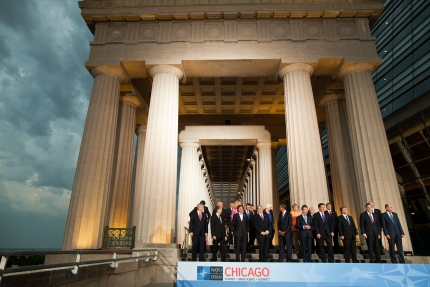
President Barack Obama, NATO Secretary General Anders Fogh Rasmussen, and North Atlantic Council leaders pose for a “family” photo

President Barack Obama, NATO Secretary General Anders Fogh Rasmussen, and North Atlantic Council leaders pose for a “family” photo at Soldier Field during the NATO Summit in Chicago, Illinois, May 20, 2012. (Official White House Photo by Pete Souza)

President Obama was in Chicago today for the first day of the NATO summit, a gathering of leaders from the 28 member countries of the North Atlantic Treaty Organization.

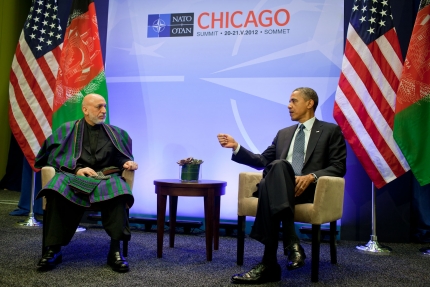
In the morning, he held a bilateral meeting with President Hamid Karzai of Afghanistan to discuss implementation of the Strategic Forces Agreement. The agreement, which the two leaders signed in Kabul earlier this month, lays out the future relationship between the United States and Afghanistan.

President Barack Obama and President Hamid Karzai of Afghanistan deliver statements after a bilateral meeting

President Barack Obama and President Hamid Karzai of Afghanistan deliver statements after a bilateral meeting at the McCormick Place Convention Center during the NATO Summit in Chicago, Illinois, May 20, 2012. (Official White House Photo by Pete Souza)

In the afternoon, President Obama met with NATO Secretary General Anders Fogh Rasmussen to discuss goals of the NATO Summit in Chicago.

Later in the day, President Obama spoke at the opening session of the North Atlantic Council, and participated in a working dinner with NATO leaders.

Related Topics: Foreign Policy, Illinois

The White House

Office of the Press Secretary

Briefing by General John Allen, General Doug Lute, and Deputy National Security Advisor Ben Rhodes

White House Press Filing Center
McCormick Place
Chicago, Illinois

3:00 P.M. EDT

MR. RHODES:  Good afternoon, everybody.  Thanks for joining us.  We're very pleased today to be joined by two guests here -- General John Allen, who's the Commanding General of ISAF; and Doug Lute, who leads our Afghanistan-Pakistan policy at the White House.

General Allen is here for a limited amount of time, so I think we'll begin by having the General walk you through his view of the situation in Afghanistan and the summit here.  And he can take questions on the security aspects of our efforts in Afghanistan. 

Then later on, Doug and I can give you a readout of the President's meeting with President Karzai and answer whatever other questions you have about Afghanistan and about the summit or other issues.  But with that, I'll turn it over to General Allen.  Thanks.

GENERAL ALLEN:  Thank you, Ben.

Well, it's good to see you all.  I wanted to spend just a couple of moments this afternoon just summarizing my key priorities with respect to the campaign, where we find ourselves now.  Those priorities generally revolve around three key points. One is to continue the momentum of the campaign itself, continue to pressure the Taliban.  The second priority is to move with all dispatch to accelerate the capacity and the role of the ANSF moving forward in assuming their role in security lead across the country.  And a third is to set the conditions for, and to support the process of transition as it was envisioned as a road map in the Lisbon Summit in November of 2010.

All of those are complementary.  The actions that we are undertaking with respect to the campaign in this coming campaign season are supported by the continued build of the Afghan National Security forces.  We anticipate completing the recruitment of the ANSF, which will be 352,000 troops upon completion, and we expect to do that several months ahead of schedule.  That date was originally 1 October; we would anticipate within the next couple of months.

We will continue to train and equip and ultimately to field the entire ANSF by the end of 2013.  So we'll be approaching a key crossover point in the campaign in 2013 -- what's known as the Milestone 2013 where the ANSF will move into security lead in the context of the counterinsurgency campaign and where ISAF forces will be supporting that move into the lead, recognizing and noting, however, that combat will continue -- combat operations will continue in the country throughout the period of the remainder of the ISAF mission, which will conclude on the 31st of December 2014.

We've had a number of key developments in the last several months.  The first was the successful signing of two memoranda of understanding with the Afghan government -- one on the shift of detention operations from the U.S. government to the Afghan government under Additional Protocol 2 of the Geneva Convention. The second was the memorandum of understanding which moved special operations under the Afghan constitution and in compliance with Afghan law.  Those culminated later with the signing of the Strategic Partnership Agreement by President Obama and President Karzai in Kabul in Afghanistan recently.

That has set the conditions for negotiations to begin in the relatively near future on a bilateral security agreement.  That bilateral security agreement -- you'll see it called sometimes the BSA -- will ultimately define the size and the contribution of the United States over time to Afghan security.

Additionally, during the summer, I think many of you are aware, we will begin the process of recovering the phase two of the President's surge forces -- 23,000 troops -- which will redeploy from Afghanistan back to the United States by the end of September.

So there's been a lot of positive moves in the last several months.  The ANSF continues on a positive trajectory both in terms of the recruiting but also in its operational commitment in the field and its accomplishments in the field as well.

And so with that, let me take your questions.

Q    Thanks very much.  What do you think about the French insistence to stick to their guns on pulling out combat troops by the end of this year?  Are you concerned that other countries might view that as an opportunity to leave early as well?  How do you see that impacting troop conditions on the ground?

GENERAL ALLEN:  Well, ultimately, we will need to understand exactly what the French decision will mean.  At this juncture -- and ultimately those decisions will be finally taken by the new French administration and the new President.  At this juncture, we will seek to provide France opportunity, should they desire to continue to contribute to the ISAF mission.  We have the capacity, using our current force structure to ensure that there is no degradation in security with respect to any decisions that might be made. 

But those are sovereign French decisions and we'll support those decisions.  But we're also prepared to provide options, viable options for contributions to the ISAF mission over time.  And many of those contributions often take the form and the shape of training, mentoring, instructing.  And all of those are important to the mission overall.

Q    General, do you run the risk of gradually having nations take decisions like France's and being allowed to do so, where they leave some forces in place in a different role but the fighting ends up being done by the United States?  And what would that say about the overall health of the mission if that's the case?

GENERAL ALLEN:  Well, again, all of those decisions ultimately are sovereign decisions by the states themselves.  The nature of the mission as it is evolving now is, as our numbers get smaller, is evolving into an advisory mission.  And that's a very important mission in terms of being able to accelerate the ANSF to the lead.  But as I think you've heard, Anne, many times, the mantra of this particular coalition has been "in together, out together," and I'm not seeing, frankly, many voices being raised that would oppose that mantra. 

All of the states are going to ultimately make their own decisions with respect to how and when they draw their forces down.  And many of the states today have made those decisions, and there are numbers coming down for many of those countries across the battle space.

Q    Do you feel that you're being given adequate military input as to the effect of those decisions?

GENERAL ALLEN:  We do the planning.  I don't input directly into capitals, but senior national representatives, chiefs of defense, leadership that works through SACEUR and SHAPE -- we're in constant conversation about the needs of forces, expressed through something called the Combined Joint Statement of Requirements, which is a document that my headquarters publishes and SACEUR ultimately presents to the leadership of all 50 countries, which details my force generation priorities in order to accomplish this campaign. 

And those CJSORs, they're called, help the countries to understand the countries to understand the kinds of forces that we need and the numbers of forces that we need.  And as the mission continues to evolve from a mission that has relied so heavily to this point on maneuver forces and general purpose combat forces to specialized forces for the purposes of instructing or for advising, it's important that we all be in a constant conversation.  And we are.

Again, I don't input directly into capitals on this, but I'm comfortable that the conversation is sufficiently strategic and expansive that we're accounting for the countries' input and the countries' opinions.

Q    General, thank you.  To what extent do the so-called inside killings, the attacks by people wearing Afghan uniforms on our and other ally troops that have occurred -- and the corruption that's been reported in the Afghan government -- affect your goals of this mission and your confidence in their government's ability to stand up a military that can defend their own turf?

GENERAL ALLEN:  Well, that's several questions.  Let me go first to what you articulated as the insider threat.  Every one of those attacks we take very seriously.  Every one of those attacks that has produced a death we offer our sincere condolences to those families.  We pray for those who were wounded.

It's important to note that in the analysis that we have done, less than 50 percent of the ones that have perpetrated these attacks were in fact Taliban infiltraters.  Many of these folks are self-radicalized.  So it's important to understand and be able to recognize the nature of that self-radicalization in the ranks. 

To that extent, we have partnered very, very closely with the Ministry of Defense, the Ministry of Interior, the National Director of Security to undertake measures bilaterally to protect each other.  It's not well-known that the Afghans suffer nearly as many casualties from insider threats as we do.  And so it's important that we protect ourselves.  And that begins with a more comprehensive screening process at induction.  There's an eight-step vetting process that is now underway.  There is also strong cooperation between the Ministry of Defense and the National Director of Security to ensure that there are counterintelligence elements that are placed in key locations, such as recruiting centers, training centers in the ranks of operational formations. 
And so that's a -- those are measures -- we would call it unprecedented cooperation, actually, between the Afghans themselves and with us to reduce the potential threat of these insider attacks.

As well, we have revamped our own training standards to ensure that our troops are, not only as they enter the theater as well trained as possible, but we've pushed those standards back up through NATO and through the U.S. chain to ensure that that training occurs.

Now, there's a good-news story here, and that is that the Afghans have arrested more than 160 individuals in the last several months that they believe could have been in the throes of planning for an attack on ISAF forces.  So the process is working.  It's not perfect.  Any time we have one of these it's a tragedy, but I also make sure everyone understands that every case where one of these occurs, that same day there are tens of thousands -- tens of thousands of interactions between the Afghans and ISAF forces that don't go that way, and in fact, strengthen the relationships and deepen our partnership. 

As to the issue of corruption, I'm very conscious of that.  It's, in fact, a line of operation within the campaign plan to do all that we can to reduce the influence of corruption with respect to the ISAF mission.  To that extent, the President -- President Karzai has designated a presidential executive commission to work with us in a number of areas -- and they're very important areas with respect to reducing criminal capture of certain capabilities.  But we're also partnering closely with the Ministry of Defense and the Ministry of Interior in something called Transparency and Awareness Accountability Working Groups
TAAWGs.  And the Ministry of Defense has mapped the entire function of the Ministry of Defense from the accession of recruits to the acquisition of weapons.  And we're looking at every aspect of Ministry of Defense, and the Ministry of Interior is engaged in it now, to be able to reduce the influence of corruption and potential criminal capture within those ministries.  And we're focused on that and we're in close partnership with that.

Q    So, cumulatively, these issues, how do they affect your confidence in the ability to fulfill the mission?

GENERAL ALLEN:  I think we'll fulfill the mission, but I don't want to understate the complexity of the mission and the challenges that we will have.  This country hasn’t suffered from corruption that started last week and it's not going to be able to solve all of those issues in the near term.  But I believe that senior leaders among the Afghans are, in fact, committed ultimately to solving this.  They understand that corruption is corrosive to a democratic process.  And ultimately to have the confidence of the international community and to be good partners with us in the business of the security and development of the Afghan national security forces, they recognize they've got to deal with this issue.  I believe they are earnest in it and I think they're putting some real energy into it.

Q    Let me ask about the security plan and the whole -- and the President's decision.  Do you think that decision was made by the President really based on the conditions on the ground, which way they were heading, or was this more of a politically based decision?  And do you think your input into the planning here was heard inside the White House?

GENERAL ALLEN:  Which plan is that, sir?

Q    Sorry -- the withdrawal plan, the 2014 --

GENERAL ALLEN:  Well, I didn’t participate in that, but I'll simply tell you that -- I wasn’t the commander at the time.  I'll simply tell you that I believe we have a very strong national security team now and the dialogue is wide open.  And I'm very clear in saying -- and it's not intended to be a bumper sticker, but I mean it sincerely -- there's no daylight between the commander on the ground in Afghanistan and the Commander-in-Chief.  And I think we're in an excellent strategic conversation right now about the way ahead.  I'm frequently asked for my opinion and my views and I am grateful to be engaged in that kind of a strategic conversation.

They have played out to the advantage of the campaign because we have been strong consultation throughout the chain of command on the defense side up through NATO as well to the Secretary General, but also into the White House.  So I'm comfortable with the state of the conversation right now, which is the strategic conversation, and the way ahead with respect to consultation between the commander, his chain of command, and the defense chain of command with the White House.

Q    I'm sorry, I should have made it a little more clear on your part there, but in terms of your discussions with the President -- I understand that you weren’t there before -- but do you really think that the level of troop withdrawal was to your liking?

GENERAL ALLEN:  Well, I was asked whether I could execute that plan, and I told them that I can.  And I'm executing the plan.  And it's not just a pure factor of reducing 23,000 troops. There are a lot of other things that are occurring simultaneously with that. 

Part of the importance of the surge was to create conditions under which we could withdraw those troops -- and I think those conditions are now underway -- and that was to move the Afghan National Security forces to a level and to a confidence where they could begin to assume the role of some of those surge forces in the field.  And in fact, that's what's going to happen this coming summer.  As those 23,000 troops come out, there will be Afghan National Security forces that will flow into those areas where there had been surge forces and they will take over the functions that those surge forces ultimately had performed.  The difference is that now, as I explained a moment ago to Anne, as this mission begins to see more and more the introduction of advisory forces into the field, those Afghan forces which will flow in behind the surge forces will have advisors in them.

So I said I supported the drawdown plan; I'm executing that plan now and I believe it can be executed.

MR. RHODES:  The General has to leave at 3:30 p.m., so we time for a couple more here. 

Q    Just following up on that question, do you -- is part of the planning that as the surge forces are replaced with the ANSF, for example, in Helmand, if there is some reinsurgence of the Taliban, do you have a plan to send troops back in, or once they’re out, they’re out?

GENERAL ALLEN:  We have short-term capabilities to shift forces.  We’re going to watch very closely the Taliban.  The Taliban have been unambiguous in that they intend to take advantage of the removal of the surge forces, and so we have planned for that.  We’re going to watch very, very closely their activities, and of course their -- what they say versus what they do.  And if we detect that there is, in fact, a Taliban presence beginning to surge in behind our forces, we have forces that are available that we intend to put against that to prevent that from happening.

Q    Thank you.  General, could you put into perspective for the American people how the shift out of the combat lead role next year affects the risks for U.S. troops?  And is there any concern that perhaps the diminishment of that risk would be overstated, that these troops will still be in serious harm’s way?

GENERAL ALLEN:  Well, I don’t want to, again, understate the challenge that we have ahead of us.  The Taliban is still a resilient and capable opponent in the battle space.  And it’s also important to understand while the Afghan National Security Forces will move in the lead in the context of this counterinsurgency campaign, we fully expect that combat is going to continue.  And I anticipate having conventional maneuver forces as well as special operations forces that we will apply against those areas, where, in partnership with the ANSF, they are going to need our assistance in order to deal with the challenges that the Taliban are going to present to them.

We’re three tranches into this process of transition, and the final two tranches -- one will occur towards the end of this year and one will occur roughly in the middle of next year -- some of the areas that will be transitioning will be up along the Pakistani border.  We can anticipate that the Taliban there, recognizing that that’s some of the last areas in which they can operate with freedom in Afghanistan, they’re going to oppose that.  And so I anticipate that during that period of time we’re going to see some combat.  The ANSF will be in the lead in that period and they'll be in the lead for the purposes of prosecuting the operations there.  But we’re going to see U.S. forces and ISAF forces engaged in supporting them.

So there is no end of combat before the end of 2014.  And in fact, the Taliban will oppose the ANSF after 2014.  But the difference -- and I think it needs to be clearly explained -- that we envisage that the ANSF will move into the lead -- this Milestone 2013 -- for the prosecution of counterinsurgency, and we’ll largely be in support of that.  But it doesn’t mean that we won’t be fighting and it doesn’t mean there won’t be combat.  And that’s important, because there is a narrative out there that combat operations for the U.S. stops at Milestone 2013.  That is not in fact correct.  It acknowledges that the ANSF have moved firmly and completely into the lead for the purposes of the counterinsurgency campaign, and we are largely in support of them.

Q    General, can you explain how serious the Pakistan’s closure of the crossings -- how that’s impacting your ability to supply troops now that the fighting season has resumed?  And also, what’s holding up the deal, and when do you expect this is going to get settled?

GENERAL ALLEN:  With regard to the ground line of communication, it has not, in fact, negatively affected my -- our prosecution of the campaign.  Indeed, in some manner, some ways in which we measure our stockage, if you will, of certain capabilities in the battle space, they’re higher today than they were when the ground line of communications were closed.

But there have been some very positive indications of late with the government in Islamabad about an interest in entering into negotiations, which I think you’re all aware of, to open the ground line of communications.  I can’t tell you when that will occur -- obviously sooner is better than later -- but I can’t tell you when that will occur. 

But I think one of the important realizations of that is that, in fact, we are now talking about it.  That, we view as being positive.  We think it’s a good indication -- a good indicator of an improvement in the relationship.  We hope to see that improve even more.  I recently had the opportunity to meet with General Kayani and his leadership in Islamabad for two days to talk about the future relationship of the trilateral military commands -- the Pakistani military, the Afghan National Security Forces and ISAF.  It was a very positive conversation; the first time we’d met in about a year.

So I think that the trending right now is in a positive direction with respect to a variety of the conversations between Islamabad and ISAF, and Islamabad and Kabul, and Islamabad and the United States.

MR. RHODES:  Thanks very much, General.

GENERAL ALLEN:  Okay.

MR. RHODES:  So now that we’ve focused on the security side -- and we can continue to take questions on some of these issues -- Doug can give you a readout of the Karzai meeting.  Just from the perspective of the White House and the President on a couple of these issues that came up, on the French question, given the fact that President Obama has just spent a lot of time with President Hollande, we are confident that we can work with the French to ensure that even as they make their own national decisions about their combat forces, that there are, as the General said, additional ways for them to remain a part of the ISAF mission and for them to make contributions to the ISAF mission.  And again, you heard the General speak to some of the different options for that around training.

But I think there is a broader story, frankly, of alliance unity and sticking with this mission, given the fact that it has been over a decade now and it’s been a very difficult challenge; the fact that we still see so many countries engage in Afghanistan, and we see countries like Germany and the United Kingdom and Australia and others committing to the long-term sustainment of the Afghan National Security Forces I think speaks to how seriously NATO takes this.

And then to the question of what guides the President’s decision-making on troops, I think the single-most important question that the President looks at and looked at when he called for the recovery of the surge is how -- are we going against our core objective in Afghanistan, which is to defeat al Qaeda and to deny it a safe haven in that country.

And again, the President has acknowledged that Afghanistan is not going to be a perfect place when we complete our NATO-ISAF combat mission in 2014.  But we do think that we made good process against that core objective.  He, of course, made the decisions to recover the surge in the context of the most devastating blows against al Qaeda’s leadership that we’d seen over the course of the previous two years or so.

And again, we believe that we can continue to draw down our forces while making progress against that objective of denying a safe haven to al Qaeda and training up Afghan National Security Forces that can ensure that that threat pictures doesn’t emerge once more from within Afghanistan.

With that, Doug will give you a brief readout of the Karzai meeting, and then we can take your questions on this and other topics.

GENERAL LUTE:  Before talking about the bilat, which was a sort of 75-minute session earlier this morning, let me just add to Ben’s last point and to John’s earlier comments with regard to the recovery of the surge.

A lot of times we miss that the U.S. surge was intended to buy the time and space to fill up the Afghan capacity.  And so when the President last year, at about this time, was considering options for recovering the U.S. surge, he judged that against progress on building up the Afghans.  And that was a central factor, and in fact, the U.S. surge has enabled now the fielding of about 350,000 Afghans.  So in a sense, the U.S. surge of 30,000 enabled the buildup of the Afghans to its current surge straight to 350,000. 

And really the theme of Lisbon and now Chicago is very much the handoff from the U.S. and the NATO surge to the Afghan surge. So in a sense, you’re exchanging the baton here between the U.S. surge and the Afghan surge.

The bilat -- so obviously, the President has just met about just short of three weeks ago in Kabul, where President Karzai welcomed President Obama to sign the Strategic Partnership Agreement -- and maybe some of you were there.  That historic agreement was obviously founded on two key principles.  One was a highlighting or an underlining of Afghan sovereignty.  And if you read the document itself, it’s very much a reflection of an appreciation for Afghan sovereignty.  And then, the other key theme in the document, it is a theme of mutual commitments -- security commitments on both sides, but also beyond that, our political and economic commitments.   

So they began the bilat by sort of just reminiscing only a couple weeks ago when they were in Kabul, so the President was able President Karzai to his hometown here in Chicago.  And they agreed that already the Strategic Partnership Agreement has had a significant political impact from President Karzai’s perspective -- political impact inside of Afghanistan by way of a reassurance to the Afghan people that they won’t be abandoned in 2014.  And President Karzai reflected that he views it as also having had a positive effect in the region.

President Obama then went on to outline three parallel transitions, which will all culminate in 2014.  Obviously, the transition that gets the most attention is the security transition.  That, as John mentioned, was kicked off at Lisbon about 18 months ago.  And here in Chicago, we’re about at the halfway point in the Lisbon vision, which began in November of ’10 and which culminates with the full security responsibility in the hands of the Afghans four years later in December of ’14.  So here in Chicago, we’re as close as we’re going to get to a midway point assessment of that four-year at Lisbon process. 

And they talked about how the security transition is underway.  And they also talked about the three key decisions that will be undertaken tomorrow by the ISAF coalition of 50 national leaders.  You undoubtedly know about these already, but this is the 2013 milestone.  This is progress with the Afghan National Security Forces.  And this is detailing the role that NATO will take in a successor mission post-2014.

President Obama reported to President Karzai the discussion he had had among his G8 colleagues at Camp David just yesterday, and how at the G8, they talked about the upcoming Tokyo conference in early July, and how the economic dimension of transition will need to work in close parallel and reinforce the security transition.
 
And then, finally, they talked and spent most of the time, actually, on the political transition, which will obviously have a major milestone with the 2014 presidential elections in Afghanistan, but actually a political transition that will take
-- and a political development process that will take years beyond 2014.

They spent about 45 minutes in this sort of delegation-on-delegation session, and then met privately for a few minutes as they to do, just so they can be completely candid in a personal exchange.  And they concluded and look forward to the upcoming events over the next day or so here at Chicago.

So in a nutshell, that’s the bilat readout, and I’m happy to take questions or comment.

Q    I want to follow up on Carol’s question on Pakistan that was given to General Allen.  But first of all, can you confirm that Secretary Clinton is going to be meeting President Zardari?  And second, you seem to say that progress was being made.  So can you give us some update on what progress has been made?

MR. RHODES:  I’ll just make a couple comments and then, Doug, you may want to add something.

Secretary Clinton did meet with President Zardari today, so I’d expect there to be some form of readout of that meeting. 

Q    Do you not have one?

MR. RHODES:  How it went or how long it went?

Q    You don’t have one?  I mean, you don’t --

MR. RHODES:  I don’t.  It’s a State Department meeting, so I wasn’t in the meeting, and I think it just recently concluded.  What I will say on the supply lines, for instance, is you’ve seen very positive statements out of Islamabad about wanting to get this done.  And we, of course, have made positive statements as well by wanting to get this done.  And so now we’re in a process of our teams working with through the issues associated with the reopening of the GLOCs. 

So we’re confident that we’re going to be able to accomplish this objective.  It’s a positive sign, as the General alluded to, that after a difficult period in our relations and a parliamentary review of the relationship between the United States and Pakistan within Pakistan, that we’re not sitting down at the table and working through difficult issues like the ground supply lines. 

So again, we believe that we’re moving in the right trajectory and that we can accomplish what is now a shared objective with the Pakistanis at reopening the supply lines. 

But, Doug, I don’t know if you want to --

GENERAL LUTE:  The only thing I’d add to Ben’s and John’s
comments are that these ongoing discussions with the Pakistanis extend beyond -- by the way, isn’t GLOCs -- that must me about the worst acronym ever invented, even as a military guy who doesn’t  -- the supply lines, right?  (Laughter.)
 
MR. RHODES:  -- if you’re still wearing a uniform.

GENERAL LUTE:  No, no, this shows you that I’m retired.  (Laughter.) 

But you have those discussions going on.  You’ve got discussions going on, on a mil-to-mil basis, especially having to do with operations on both sides of the border, as John mentioned, his recent visit with General Kayani.  You’ve got discussions going on with Marc Grossman and his counterparts in both Afghanistan and Pakistan -- the potential for reaching out to the Taliban.  You’ve got discussions going on with regard to ongoing CT cooperation.  So this is a multi-dimensional approach to trying to reset our relationship with Pakistan and get ourselves back to a place that we both agree we need to be, which is a much more cooperative setting.

Q    Was there a miscommunication between -- did Zardari think by coming here, he was going to get a meeting with the President to negotiate this?  And did you guys think by him coming this meant, no, no, no, he was going to cut the deal and you guys were going to announce something?

GENERAL LUTE:  No.  I don’t have any indications that there were any miscommunications.  I don’t know -- Ben, do you have any reflections?

MR. RHODES:  No.  The President -- or the invitation to attend this summit was extended by NATO, of course.  We obviously supported that.  It’s important for Pakistan to be here because as we contemplate the future of the region, they are obviously going to be a part of that picture.

What I would say is, frankly, the types of issues that are being worked through about the reopening of the supply lines are not the type of issues that get hammered out at the presidential level.  These are things that working-level negotiating teams sit down and address.  So we’re confident that that can take place.  And we’re also confident, as General Allen alluded to, that even as we’ve worked to reopen these supply lines, our Northern Distribution Network, through Russia and Central Asia, has kept our mission fully sustained and hasn’t in any way disrupted our operation.

Q    So the reason the President cannot meet with Zardari doesn’t have anything to do with the supply lines?

MR. RHODES:  No, we -- as I said yesterday when I got this question, the President has got a very full slate of summit meetings he has to attend.  The only bilateral meeting -- or two bilateral meetings, really, that he did, or President Karzai for obvious reasons given the focus on Afghanistan here, and the Secretary General of NATO given that it’s traditional for the host to make sure that we’re aligned with the Secretary General heading into the summit.  So they met this morning briefly before the plenary sessions.

But we don’t anticipate any other bilateral meetings so we didn’t draw that linkage.  We’re going to continue to work through the issue with the Pakistanis.

Q    Can I ask you about the significance of the summer of 2013 date and what that means?  And is this something that the President wants to highlight in his message here that combat operations will cease in the summer of 2013?

GENERAL LUTE:  Well, first of all, let me correct the last clause -- so combat operations will not cease at the end of 2013, or in the middle of 2013, although we will establish a milestone, we think.  And I’ll come back to the milestone.

The NATO-led combat operation, combat mission, ISAF, will end at the stroke of midnight, December 31st, 2014.  The milestone that we believe the leaders will consider tomorrow and we anticipate that they’ll approve is a midway mile marker that marks a point in transition from NATO lead to Afghan lead where the following is true:  At that point, in mid-2013, across all of Afghanistan -- so all 34 provinces and 400-odd districts -- Afghan security forces will be in the lead.  And the remaining ISAF forces will be decidedly in a support role.

So the mission doesn’t change from combat to non-combat; it shifts from combat to more of a support role.  So it’s a question of balance in the mission.  But John Allen was quite explicit here, and I thought spot-on, and that is that after this milestone in 2013, there still will be combat capability in the ISAF force, there will still be combat authorities, there will still be an expectation that there will be combat, once combat mission ends at the end of ISAF, at the end of ’14 -- if that helps.

Q    Isn’t that somewhat of an acceleration of the timetable?

GENERAL LUTE:  No, not at all.  So what Lisbon envisioned was the endpoint, December, 2014.  And Lisbon said that on that
-- at that point in the transition process, the process will be complete.  So Afghan security forces will be fully responsible without the NATO backup by December of ’14.  What we’re marking
-- what, 18 months before that point -- is a point where the Afghan security forces are in the lead, but we’re still there to substantially support them.  So it’s a shift in emphasis from NATO-led to Afghan-led, but it’s not the end of transition.  That doesn’t actually happen until December of ’14. 

MR. RHODES:  I’d just say one thing to your question of emphasis, Karen.  I think the President in Bagram laid out basically a five-part strategy for how you responsibly end the war.  And what we want to emphasize is each of these pieces as reinforcing one another. 

So we have a transition process that is going to move us into a support role in 2013 and then complete transition, in terms of ending the combat mission in 2014.

Then we have an Afghan National Security Force component to this, and that involves training Afghan National Security Forces, but getting them into the lead.  Because in order for them to be prepared on December 31st of 2014, to be fully responsible without any continued combat mission from the United States and ISAF, they need to have had time to be in the lead across the country.

We will partner with them in instances where they need our support, but what the 2013 milestone creates is an interim period where they are essentially in the lead, but have the ability to call on the support of ISAF troops in their operations.  So there’s an interconnection between those two pieces of the strategy -- a transition process that moves them forward, and then a training process that makes sure that they’re prepared to step forward.  And then associated with that, an investment in their long-term capability, so that we know that after the combat mission is over, there will be strong Afghan National Security Forces that can carry forward the security of their country.

Then, of course, the other components of the plan the President mentioned are the strategic partnership, which allows that investment in Afghan National Security Forces and institutions; an ongoing political transition that Doug spoke about that includes reconciliation within Afghanistan; and then of course a type of international support that Afghanistan and the region receives.

And we’ve seen that manifested not just in our SPA, but other countries that have reached these types of strategic partnerships with Afghanistan, like Germany, like the United Kingdom, like Australia, so that they know that as they’ve stood up and taken responsibility for their country and the NATO-ISAF mission is concluded, that they will be able to count on our support for the equipping of their national security forces and for their long-term stability.

GENERAL LUTE:  I think you’ve got a picture here of Secretary Clinton/President Zardari bilat.  So here --

MR. RHODES:  That’s confirmation that the bilat --

GENERAL LUTE:  Visual evidence.  And I’m very proud of the video team that was able to pipe this in at the right time.

Q    General, can you tell us a little bit more about the reconciliation part of the discussions?  Did either leader have any new suggestions for how to get that going again a little bit faster, anything to draw the Taliban back to the table?  And relatedly, do you consider the proposal to release Afghan Taliban prisoners from Guantanamo effectively dead?

GENERAL LUTE:  Well, they didn’t talk about the tactics of reconciliation -- so particular measures to bring the Taliban back to a particular channel or so forth.  Nor did they talk about alternative channels, which we know, in cooperation with the Afghans, there is outreach to different -- to multiple channels.

What they did both commit to, though, was the point that Ben just made, which is that reconciliation is one of the essential five ingredients.  Both of them believe that to get to where we want to be with these multiple transitions two and a half years from now, we have to have some payoff from reconciliation; that we’ve got to move forward on this political track of reconciliation. 

And they both recommitted, and in particular, President Obama committed to supporting fully Afghan-led reconciliation -- all at the aim of getting to the point where you could have the Afghan government talking to the Afghan Taliban about the future of Afghanistan.

So there’s a general recommitment, but they didn’t talk about tactics.

Q    Did they talk about Guantanamo at all?

GENERAL LUTE:  No, they did not.

Q    Two questions.  The first is that the President said today, quote, “The Afghan war, as we understand it, is over.”  General Allen said there is no daylight between the Commander-in-Chief and the commanders on the ground.  The scenario you’re describing this summer does not sound particularly like this war is over.  Can you sort of explain the dissonance between those two?

MR. RHODES:  That’s not what the President said, Glenn.  If you go back and look at what he said with both President Karzai and the Secretary General Rasmussen, he said, at the end of 2014, the Afghan war, as the United States has known it and participated in it, will be over. 

So I think it’s important to understand what we’re charting in Chicago is how we get from here to the end of the war.  A critical step on the way to that process is us being in a support role across the country, and having a mission that is far more about training, advising and equipping Afghan security forces who are in the lead than us being in the lead for combat operations.

But we’ll continue to partner with them until the end of 2014.  At that point, as the President said, the war in Afghanistan, as the United States has participated in it and has fought it since shortly after 9/11, will be concluded. 

That’s not just the view of President Obama; NATO as an alliance has set the date of the end of 2014 as the completion of their combat mission in Afghanistan.  So I think you have a unity among the allies here that we are planning against a timeline that is firmly set out and that says that on December 31st -- or by December 31st of 2014, Afghans will be fully responsible for the security of their country, the ISAF combat mission will be concluded.  And frankly, at that point, the future security of Afghanistan is in its own hands, but they can count on our continued support for their security forces going forward.

Q    I’m sorry, I asked that question inartfully.  What I meant was, if in the summer of 2013, if things don’t work out as you say, if the Afghan security forces don’t -- aren’t able to stand up, if it turns into a terrible situation and U.S. forces are continuing to have to play the lead role, does anyone anticipate any alteration on the timetable?  And how will things play out over the summer if this arrangement doesn’t work out?

MR. RHODES:  Well, I’d say a couple things.  First of all, let’s remember what our objective is in Afghanistan:  It’s to defeat al Qaeda and deny it a safe haven -- so deny it the opportunity to reestablish itself in Afghanistan.  That requires not us leaving behind an Afghanistan that is eradicated of any vestige of the Taliban or any vestige of some form of violence.  It’s leaving behind an Afghanistan that can stand on its own two feet, and manage its affairs, and be a sovereign nation and manage its security.

And so that’s the goal that we’re planning against, and we’re confident that we can achieve it -- achieve that core objective that led us into Afghanistan, which is to defeat al Qaeda. 

Now, as we move forward, the mission that’s been defined allows for and has planned for an increase in our support for -- sorry, I should say an increase in the numbers and capabilities of Afghan National Security Forces, precisely so they are more capable of getting into the lead.

Now, to be clear, this doesn’t just happen with a light switch at the 2013 milestone.  This is already happening.  With the tranches of transition that have been identified already and implemented already -- or are in the process of being implemented -- 75 percent of the Afghan population lives in areas where Afghan security forces are already moving into the lead.

So it’s not going from zero to 100 percent at the completion of the 2013 milestone.  It’s the end of a process.  And in this process, we’ve seen the Afghan security forces be able to manage security incidents on their own and with our support.  And then in that interim period between the 2013 milestone and the end of ’14, we’ll continue to be there, capable of doing partnered missions with them, continuing to train and advise and assist them. 

So we believe built into the plan is sufficient capability for us to be in a strong supportive role of the Afghans.  But the plan is set and the date is set.  The end of 2014 is when this combat mission concludes.  What we have is a road map to get there in the most responsible fashion that we can, in a way that allows us to achieve our core objective of denying a safe haven.

Q    So just to be clear, even if they are not, in your words, able to stand on their own two feet, the war, using the President’s words, would effectively be over either way.

MR. RHODES:  Well, absolutely, in the sense that our combat mission concludes at the end of 2014.  We believe that we’ve designed this in a way that they will be able to have competent, strong national security forces that can be responsible for the security of their country.

We’ve also committed to support those going forward.  And here, in Chicago, one of the items that we’re addressing that will be one of the key outcomes of the summit, is how we sustain our support for Afghan security forces going forward.  And you have nations making strong commitments to support and finance Afghan National Security Forces into the future, beyond 2017.  So there will be a continued relationship between Afghan security forces in which they are being equipped, supported, trained by the United States and some of our other allies, which is a significant asset for them as they are moving forward and taking responsibility for the security of their country.

GENERAL LUTE:  The only point I'd highlight is Ben's point. Look, this has been happening almost without our noticing it.  So since Lisbon, the transition -- which kicked off the transition process, it's been underway for over the course of the last 18 months.  And as Ben said, President Karzai just announced what's called the third tranche or the third set of geographic entities -- provinces and so forth -- which accounts for 75 percent of the population.  So this is going on now.

In the portions where -- in the areas where transition is underway now, we have not seen a dramatic uptick in violence, and what we have seen is that the Afghan security forces, both army and police, have actually surprised us a bit, and maybe surprised themselves a bit by their ability to handle this.

Now, admittedly, as you might expect, the early transition areas were the ones more ripe for transition, and we're getting now into some tough areas.  So the next year, six months to 12 months in the transition process will be telling.  But we planned this so that in a very deliberate way, our surge is handing off the fight to the Afghan surge.  And we wouldn't have planned it that way if we didn’t think it was viable.

Q    Can you update us on the effort to secure monetary commitments from other countries to fund the Afghan security forces?

GENERAL LUTE:  So one of the key goals of the Chicago conference on the Afghanistan side was to arrive at a vision for the ANSF beyond 2015 -- beyond 2014, so beyond transition, which has two key qualities -- that it's sufficient to the task and it's sustainable.  And by sustainable we mean the sum of the Afghan contribution, our contribution and contributions from the rest of the international community. 

So as we assess that adjective, "sustainable," we're in a place today where we believe we've made substantial progress against the overall monetary goal, and given that this kicks in in 2015, we're well within reach of meeting our sustain -- goal.  So, yes, we have quite a bit of confidence.  And we've been -- actually, this is very concrete evidence of the kind of international cohesion and resilience that you have even at the 10-year mark in this coalition.  So we have good confidence.

Q    Can you define "sustainable" -- in relation to how much you need?  How much has the crisis in Europe complicated this?

GENERAL LUTE:  I think the financial economic crisis in Europe certainly plays a role.  But I'll also tell you that many of the sort of top-10 contributors to this financial effort come from countries where there[s financial strife.  So, look, we understand that.  Again, I think it speaks to the level of commitment that even in these tough financial times, these leaders are willing to take the political -- make the political commitment to fund the Afghan security forces.  They all, in my view, view this as a reinforcement of their investment that they've made in the Afghan security forces over the last 10 years.  And this sustainment cost is really just a premium that they're paying to secure that investment out into the future.

Q    In dollars --

GENERAL LUTE:  And we are -- I don't have the running dollar count.  In fact, it actually is a very complicated matrix that changes all the time.  But we are very, very close to attaining our full goal.

MR. RHODES:  I'd just say one more thing on that.  Just to give you an example, Kristen, the Germans, who are obviously at the center of the issue in the eurozone, recently made a commitment of 150 million euro, so nearly $200 million to the sustainment of the Afghan national security forces.  We see similar commitments from other European countries.  The United Kingdom made a significant commitment.

So even in the context of that financial crisis in Europe, those countries have stepped forward in a particular way. 

MR. RHODES:  Last one in the back there.

Q    Thank you.  Ben, could you tell us how close are we to getting that $1.3 billion in commitments?

MR. RHODES:  We're certainly far along the way there.  I don't have the specific dollar number for you, in part because nations are continuing to make commitments throughout the course of the meeting here.  So we can keep you updated on that.  But again, I think we are far along on the path to achieving that objective -- keeping in mind that this is for funding of Afghan national security forces beyond 2014 and into -- beyond 2017, even.

So this is far in the future.  We have time to continue to close out this account.  But what this summit has done is allowed leaders to come together around what the size and scope of the ANSF that they want to support will be, and with that target of an ANSF that we want to support on the other end of transition, we're then able to go out and put together contributions from different nations to achieve the objective.

So what will we do here in Chicago is a sense of what the target is of the ANSF, its size and scope, and then match these contributions against that.  And we expect that we'll be able to close that out here with the contributions that have been made leading into the summit, at the summit, and then going forward here in the coming weeks and months. 

With that, I'll end.  I'll make just one additional comment to reference back to the bilat on this question of transition.  The Afghans themselves very much want the same thing we do.  They want the sovereignty of their country.  And that was the type of discussion that the two Presidents had.  So they very much want to see this process go forward.  They want to stand up -- which of course, is heartening -- and they want to have a full reassertion of Afghan sovereignty at the end of 2014, knowing that they can count on the support of the United States and the international community going forward.

So this is a shared objective among not only all the nations here but all the nations here and the Afghan government.

With that, we will wrap here.  We'll have brief readout for you after the NAC session concludes with our Ambassador to NATO Ivo Daalder, who can tell you about the session on defense capabilities that's taking place this afternoon, and then continue to answer your queries in the meantime.

Thanks, everybody. 

END  
4:00 P.M. EDT

The White House

Office of the Press Secretary

Fact Sheet: Chicago Summit – NATO Capabilities

NATO remains an essential transatlantic link and force multiplier for the United States, our Allies, and partners.  The Chicago Summit provides us a new opportunity to reaffirm and refine the vision that binds Allies together and sets us on a course to maintain and develop the capabilities NATO needs to remain an essential source of global stability.

At the 2010 Lisbon Summit, NATO leaders adopted a Strategic Concept that committed NATO to meeting the security challenges of the 21st century, from terrorism to ballistic missile and cyber attacks to nuclear proliferation.  At the NATO 2012 Summit, NATO’s leadership outlined a clear vision of how NATO will maintain the capabilities we need, utilizing all available defense resources and ensuring the Alliance is greater than the sum of its parts.  This vision, enshrined in a new document titled “NATO Forces 2020,” helps set NATO’s priorities for investing in capabilities the Alliance needs to move forward over the next decade.  This framework calls for realistic efforts to maintain and develop multinational capabilities despite defense budget cuts in the United States and Europe.  It also institutionalizes lessons learned from recent and current operations, ensures we can maintain interoperability among Allies and with partners, and identifies critical capabilities gaps. 

***

At the Lisbon Summit, Heads of State and Government directed a review of the Alliance’s deterrence and defense posture to ensure the Alliance maintains the appropriate mix of conventional, nuclear and missile defense capabilities needed to meet the security challenges we face. That review, called the  Deterrence and Defense Posture Review (DDPR), was concluded and endorsed in Chicago.  The nuclear element of the review reaffirms NATO’s commitment to work to create the conditions for a world without nuclear weapons, while remaining a nuclear Alliance for as long as nuclear weapons exist.  It commits the Alliance to ensuring NATO’s nuclear deterrent remains safe, secure, and effective.  The DDPR also makes clear that the Alliance is prepared to consider, in the context of reciprocal steps by Russia, further reductions in non-strategic nuclear weapons assigned to the Alliance.   Finally, the DDPR outlines the priorities NATO needs to address to ensure we can fulfill the three core missions identified in the new strategic concept, namely: collective defense, crisis management, and cooperative security.


***

"To put it simply, our new missile defense architecture in Europe will provide stronger, smarter, and swifter defenses of American forces and America's Allies. It is more comprehensive than the previous program; it deploys capabilities that are proven and cost-effective; and it sustains and builds upon our commitment to protect the U.S. homeland against long-range ballistic missile threats; and it ensures and enhances the protection of all our NATO Allies."

– President Obama, September 17, 2009

In September 2009, the President directed the European Phased Adaptive Approach (EPAA) for missile defense to be implemented in a NATO context.  At the Lisbon Summit in November 2010, NATO made the historic decision to endorse a missile defense capability whose aim is to provide full coverage and protection for all NATO European populations, territory, and forces against ballistic missile attack.  EPAA was welcomed as the U.S. national contribution to NATO missile defense.  NATO also agreed in Lisbon to expand its current missile defense command, control, and communications capabilities to be able to effectively integrate additional voluntary contributions from other Allies.  Since then, Phase 1 of the EPAA, including deployment of A radar in Turkey and an Aegis ship in the eastern Mediterranean, has been successfully achieved. 

In Chicago, NATO declared the achievement of an Interim Capability for NATO ballistic missile defense, an important step towards fulfilling the commitment made at Lisbon. This means that NATO has initiated a capability that, although limited in its initial phase, can provide real protection against ballistic missile attack.  With initial NATO command and control procedures in place, the President has directed the Secretary of Defense to transfer operational control of the U.S. radar in Turkey to NATO. The radar’s information, combined with the NATO command and control system, gives NATO missile defense commanders a comprehensive and real-time operational picture, enabling them to employ the available missile defense assets effectively.

What does Interim Capability mean?

• NATO has agreed on the command and control procedures for ballistic missile defense, designated Supreme Allied Commander Europe (SACEUR) as the commander for this mission, and through missile defense exercises has tested and validated a command and control capability funded by all 28 Allies.

• Spain, Turkey, Romania and Poland have agreed to host key U.S. missile defense assets.

• Allies have committed to invest over $1 billion in the command, control, and communications infrastructure needed to support NATO missile defense.
• The President directed the transfer of operational control of the AN/TPY-2 radar deployed in Turkey to NATO.

• U.S. missile defense-capable ships in Europe are able to operate under NATO operational control when necessary. 

• Interim capability is scheduled to be followed by the milestones of initial operational capability in 2015 and full operational capability in 2018. 

***

The Libya operation highlighted intelligence, surveillance and reconnaissance shortfalls within the Alliance.  In Chicago, NATO signed a contract to move forward with the Alliance Ground Surveillance (AGS) system, which uses unarmed drones to provide crucial intelligence, surveillance, and reconnaissance information to our military commanders so that they may monitor developing situations and identify potential threats.  This is a capability that would not otherwise be available to many Allies without NATO’s facilitation.  By pooling our resources and sharing the burden, we can provide better security for every Ally at a lower cost.

• A group of 14 Allies (Bulgaria, Czech Republic, Denmark, Estonia, Germany, Italy, Latvia, Lithuania, Luxembourg, Norway, Romania, Slovakia, Slovenia and the United States) has agreed to acquire five unmanned aerial vehicles (UAVs) and the associated command and control ground stations.

• NATO will operate and maintain the system on behalf of the Alliance with common funding from all 28 Allies.  

***

In Chicago, Allied leaders reached agreement to extend the operation of Baltic Air Policing, a mission that demonstrates the Alliance’s commitment to collective defense.  Because Baltic skies are policed by Allies who already possess supersonic fighters, the Baltic states can forego acquisition of expensive fighter aircraft and focus their security resources on other high-priority NATO capabilities and operations.   This program allows economies of scale through the pooling and sharing of existing or future air assets, particularly important for Allies faced with the replacement of aging aircraft in the coming decade.

***

Despite tough economic times, the milestones NATO has achieved on missile defense and the Alliance Ground Surveillance system and other important initiatives have shown the Alliance’s ability to work effectively together to procure new capabilities and position our military forces to meet emerging threats.  With “NATO Forces 2020” the Alliance has taken an important first step toward providing NATO with the tools it needs to tackle 21st century challenges.

The White House

Office of the Press Secretary

Remarks by the President at Opening NAC Meeting

McCormick Place
Chicago, Illinois

2:15 P.M. CDT

THE PRESIDENT:  Thank you very much, Mr. Secretary General.  Anders, I want to take this opportunity on behalf of all of us to thank you for your outstanding leadership over these past three years.  And I want to begin by welcoming each and every one of you to my hometown.  I hope everybody has enjoyed themselves.  I understand some took a architectural boat tour, some have run along the lakefront.  Chicago is a great place, and we look forward to having you back again.

As Anders mentioned, so many people here in Chicago trace their roots back to NATO countries.  So it’s especially fitting that Chicago is the first American city outside of Washington, D.C. ever to host a NATO Summit.  Given the moment of silence we just observed, I also want to take the opportunity to salute Admiral Stavidris, General Abrial, General Allen, and all of our men and women who are serving in uniform on our behalf, and especially those who are serving today in Afghanistan.

For over 65 years, our alliance has been the bedrock of our common security, of freedom and of prosperity.  And though the times may have changed, the fundamental reason for our alliance has not.  Our nations are stronger and more prosperous when we stand together.  In good times and in bad, our alliance has endured; in fact, it has thrived -- because we share an unbreakable commitment to the freedom and security of our citizens.

We’ve seen this from the Cold War to the Balkans, from Afghanistan to Libya.  And that’s the spirit that we need to sustain here in Chicago, and with an alliance that is focused squarely on the future.

When we last met in Lisbon, we agreed to a bold plan of action to revitalize the alliance and ensure that we have the tools that are required to confront a changing and uncertain strategic landscape.  Here, at this session, we can reaffirm our Article V commitment to our collective defense and to investing in the defense capabilities and new technologies that meet our collective security needs.

In these difficult economic times, we can work together and pull our resources.  NATO is a force multiplier, and the initiatives we will endorse today will allow each of our nations to accomplish what none of us could achieve alone.  We can all be proud that in Lisbon we committed, and now in Chicago we are delivering. 

Over the next two days, we’ll meet -- first as allies and then with President Karzai and our international partners -- to chart the next phase of the transition in Afghanistan.  Just as we’ve sacrificed together for our common security, we will stand together, united, in our determination to complete this mission. 

And finally, I look forward to our meeting with NATO’s neighbors and our partners around the world who have been so critical to NATO operations as in Afghanistan and Libya.  It will be another reminder that NATO is truly a hub of a network of global security partners.  There is nothing else like it on Earth. 

So, again, thank you, Mr. Secretary General, for your outstanding leadership.  Thank you to all my fellow leaders and friends who are here.  Welcome to Chicago.  I’m confident that the next two days are going to help to sustain and strengthen the strongest and most successful alliance that the world has ever known.

                                                                                     END                2:20 P.M. CDT

The White House

Office of the Press Secretary

Remarks by President Obama and NATO Secretary General Rasmussen Before Bilateral Meeting

McCormick Place
Chicago, Illinois

12:52 P.M. CDT

PRESIDENT OBAMA:  Well, I just want to not only welcome Secretary General Rasmussen to my hometown of Chicago -- my understanding is he’s already enjoyed some of the sights, and we were hearing about him jogging along the lake and appreciating the outstanding views and the skyline -- but more importantly, I want to thank him for his extraordinary leadership. 

Secretary General Rasmussen arrived in this post during one of most challenging times that NATO has faced.  He has guided us through some very rocky times.  And I think the results of this NATO Summit are reflective of his extraordinary leadership.

At this summit, we anticipate not only ratifying the plan for moving forward in Afghanistan -- a transition process that will bring the war to an end at the end of 2014 and put Afghans in the lead for their own security -- but we’re also going to be talking about the progress that we’ve made in expanding NATO’s defense capabilities -- ensuring that every NATO member has a stake and is involved and integrated in our mutual defense efforts. 

And we’re going to have an opportunity to talk about the partnerships that NATO has been able to set up with like-minded countries around the world, and find ways that we can deepen and engage those partners to help to promote security and peace around the world.

All this has happened because of Secretary General Rasmussen’s leadership.  I’m very proud of the work that he’s done.  I think it’s going to be reflected in the success of this summit.  And on behalf of the American people, we want to say thank you.

SECRETARY GENERAL RASMUSSEN:  Thank you very much.  Mr. President, I would like to thank very much for your strong leadership, for your dedication to our alliance.  America has always been a source of strength and inspiration in NATO, and I’m very pleased that we can hold our 25th summit in your home city, Chicago.

Chicago has always been a place where Europeans and North Americans have come together.  And now, we have come together to reaffirm the unbreakable bond between us.

I look very much forward to a successful summit, and I would like to take this opportunity to thank all those who have worked so hard to make this summit a success.  And I would like to thank the people of Chicago for their great hospitality.

PRESIDENT OBAMA:  All right.  Thank you so much, everybody.


                                                                                                 END                12:55 P.M. CDT

The White House

Office of the Press Secretary

Remarks by President Obama and President Karzai of Afghanistan After Bilateral Meeting

McCormick Place
Chicago, Illinois

11:57 A.M. CDT

PRESIDENT OBAMA:  All right.  Good morning, everybody.  It is a great pleasure to welcome President Karzai to my hometown of Chicago after he extended hospitality to me during my visit to to Kabul recently.  During that trip to Afghanistan, we were able to finalize the Strategic Partnership Agreement that reflects a future in which two sovereign nations -- the United States and Afghanistan -- are operating as partners, to the benefit of our countries’ citizens, but also for the benefit of peace and security and stability in the region and around the world.

I want to thank President Karzai for his cooperation, and his delegation’s hard work in helping us to achieve the Strategic Partnership Agreement.  And the NATO Summit is going to be largely devoted to ratifying and reflecting the broad consensus that so many of our partners and ISAF members have agreed to -- one in which we are working with the Afghans over the next several years to achieve a complete transition to Afghan lead for Afghan security; one in which we continue to provide support for the Afghan National Security Forces that have made excellent progress over the last several years; and also painting a vision post-2014 in which we have ended our combat role, the Afghan war as we understand it is over, but our commitment to friendship and partnership with Afghanistan continues.  

And so the Strategic Partnership Agreement, this NATO Summit, are all part and parcel of a shared vision that we have in which Afghanistan is able to transition from decades of war to a transformational decade of peace and stability and development.  And so I just want to stress my appreciation for the hard work that President Karzai has done.  I think he recognizes the enormous sacrifices that have been made by the American people and, most profoundly, by American troops, as well as the troops of our other coalition partners.  We recognize the hardship that the Afghan people have been through during these many, many years of war.  Both of us recognize that we still have a lot of work to do, and there will be great challenges ahead.  The loss of life continues in Afghanistan; there will be hard days ahead.  But we’re confident that we are on the right track, and what this NATO Summit reflects is that the world is behind the strategy that we’ve laid out.

Now it’s our task to implement it effectively.  And I believe that we can do so, in part because of the tremendous strength and resilience of the Afghan people.  I think they desperately want peace and security and development.  And so long as they’re reflecting that resilience and that hope for a better future, they will have a friend in the United States of America.

So, President Karzai, welcome.  I am confident this will be a productive NATO Summit, and I’m looking forward to continuing to work to implement the plans that we’ve laid out.

PRESIDENT KARZAI:  Thank you, Mr. President.  We have had a good meeting today in which Afghanistan reaffirmed its commitment to the transition process and to the completion of it in 2013, and the completion of withdrawal of our partners in 2014, so that Afghanistan is no longer a burden on the shoulder of our friends in the international community, on the shoulders of the United States and our other allies. 

Afghanistan, indeed, Mr. President, as you very rightly put it, is looking forward to an end to this war, and a transformational decade in which Afghanistan will be working further for institution building and the development of sounder governance in the country and a better economy, where the Afghans will be taking steady steps towards self-reliance in all aspects of life, that Afghanistan will be collecting its own revenues.

But in the meantime, that the world community, in particular the United States and our allies in NATO and ISAF, will be with us to make sure that we take steady and strong steps and are back while you are making those steps towards 2024, when Afghanistan will be largely defending itself and providing for itself.

Mr. President, the partnership that we signed a few weeks ago in Kabul has turned a new page in our relations.  And the new page is a page of two sovereign countries working together for the mutual interests -- peace and security and in all other areas of concentration.  

Mr. President, I’m bringing to you and to the people of the United States the gratitude of the Afghan people for the support that your taxpayers’ money has provided us over the past decade, and for the difference that it has made to the wellbeing of the Afghan people -- to our education and health and the building of the Afghan government.

Mr. President, Afghanistan is fully aware of the task ahead and of what Afghanistan needs to do to reach the objectives that we all have of a stable, peaceful and self-reliant Afghanistan.  

In the meantime, until then, thank you for your support.

PRESIDENT OBAMA:  Thank you.  All right, thank you, guys.  Thank you.

Q    Mr. President, will you get the financial support needed to hit that $4.1 billion?  Are you confident about that?

PRESIDENT OBAMA:  We’ll have a press conference.

Q   Okay, thanks.

END                12:04 P.M. CDT

Opening Session of the North Atlantic Council

May 20, 2012 | 14:46 | Public Domain

After a ceremony honoring NATO military, NATO Secretary General Anders Fogh Rasmussen and President Obama speak before a meeting of the North Atlantic Council at the NATO Summit in Chicago.

Download mp4 (522MB) | mp3 (34MB)

Read the Transcript

Remarks by the President at Opening NAC Meeting

McCormick Place
Chicago, Illinois

2:15 P.M. CDT

THE PRESIDENT:  Thank you very much, Mr. Secretary General.  Anders, I want to take this opportunity on behalf of all of us to thank you for your outstanding leadership over these past three years.  And I want to begin by welcoming each and every one of you to my hometown.  I hope everybody has enjoyed themselves.  I understand some took a architectural boat tour, some have run along the lakefront.  Chicago is a great place, and we look forward to having you back again.

As Anders mentioned, so many people here in Chicago trace their roots back to NATO countries.  So it’s especially fitting that Chicago is the first American city outside of Washington, D.C. ever to host a NATO Summit.  Given the moment of silence we just observed, I also want to take the opportunity to salute Admiral Stavidris, General Abrial, General Allen, and all of our men and women who are serving in uniform on our behalf, and especially those who are serving today in Afghanistan.

For over 65 years, our alliance has been the bedrock of our common security, of freedom and of prosperity.  And though the times may have changed, the fundamental reason for our alliance has not.  Our nations are stronger and more prosperous when we stand together.  In good times and in bad, our alliance has endured; in fact, it has thrived -- because we share an unbreakable commitment to the freedom and security of our citizens.

We’ve seen this from the Cold War to the Balkans, from Afghanistan to Libya.  And that’s the spirit that we need to sustain here in Chicago, and with an alliance that is focused squarely on the future.

When we last met in Lisbon, we agreed to a bold plan of action to revitalize the alliance and ensure that we have the tools that are required to confront a changing and uncertain strategic landscape.  Here, at this session, we can reaffirm our Article V commitment to our collective defense and to investing in the defense capabilities and new technologies that meet our collective security needs.

In these difficult economic times, we can work together and pull our resources.  NATO is a force multiplier, and the initiatives we will endorse today will allow each of our nations to accomplish what none of us could achieve alone.  We can all be proud that in Lisbon we committed, and now in Chicago we are delivering. 

Over the next two days, we’ll meet -- first as allies and then with President Karzai and our international partners -- to chart the next phase of the transition in Afghanistan.  Just as we’ve sacrificed together for our common security, we will stand together, united, in our determination to complete this mission. 

And finally, I look forward to our meeting with NATO’s neighbors and our partners around the world who have been so critical to NATO operations as in Afghanistan and Libya.  It will be another reminder that NATO is truly a hub of a network of global security partners.  There is nothing else like it on Earth. 

So, again, thank you, Mr. Secretary General, for your outstanding leadership.  Thank you to all my fellow leaders and friends who are here.  Welcome to Chicago.  I’m confident that the next two days are going to help to sustain and strengthen the strongest and most successful alliance that the world has ever known.

                                                                                     END                2:20 P.M. CDT

Close Transcript

President Obama’s Bilateral Meeting with NATO Secretary General Rasmussen

May 20, 2012 | 3:05 | Public Domain

President Obama and NATO Secretary General Anders Fogh Rasmussen speak to the press before a bilateral meeting at the NATO Summit in Chicago.

Download mp4 (109MB) | mp3 (7MB)

Read the Transcript

Remarks by President Obama and NATO Secretary General Rasmussen Before Bilateral Meeting

McCormick Place
Chicago, Illinois

12:52 P.M. CDT

PRESIDENT OBAMA:  Well, I just want to not only welcome Secretary General Rasmussen to my hometown of Chicago -- my understanding is he’s already enjoyed some of the sights, and we were hearing about him jogging along the lake and appreciating the outstanding views and the skyline -- but more importantly, I want to thank him for his extraordinary leadership. 

Secretary General Rasmussen arrived in this post during one of most challenging times that NATO has faced.  He has guided us through some very rocky times.  And I think the results of this NATO Summit are reflective of his extraordinary leadership.

At this summit, we anticipate not only ratifying the plan for moving forward in Afghanistan -- a transition process that will bring the war to an end at the end of 2014 and put Afghans in the lead for their own security -- but we’re also going to be talking about the progress that we’ve made in expanding NATO’s defense capabilities -- ensuring that every NATO member has a stake and is involved and integrated in our mutual defense efforts. 

And we’re going to have an opportunity to talk about the partnerships that NATO has been able to set up with like-minded countries around the world, and find ways that we can deepen and engage those partners to help to promote security and peace around the world.

All this has happened because of Secretary General Rasmussen’s leadership.  I’m very proud of the work that he’s done.  I think it’s going to be reflected in the success of this summit.  And on behalf of the American people, we want to say thank you.

SECRETARY GENERAL RASMUSSEN:  Thank you very much.  Mr. President, I would like to thank very much for your strong leadership, for your dedication to our alliance.  America has always been a source of strength and inspiration in NATO, and I’m very pleased that we can hold our 25th summit in your home city, Chicago.

Chicago has always been a place where Europeans and North Americans have come together.  And now, we have come together to reaffirm the unbreakable bond between us.

I look very much forward to a successful summit, and I would like to take this opportunity to thank all those who have worked so hard to make this summit a success.  And I would like to thank the people of Chicago for their great hospitality.

PRESIDENT OBAMA:  All right.  Thank you so much, everybody.


                                                                                                 END                12:55 P.M. CDT

Close Transcript