President Obama Speaks on Supporting Agriculture to Fight Hunger

May 18, 2012 | 20:31 | Public Domain

President Obama announces a new alliance between government leaders and private sector partners to reduce hunger and lift 50 million people out of poverty by investing in Africa’s agricultural economy.

Download mp4 (725MB) | mp3 (47MB)

Read the Transcript

Remarks by President Obama and President Hollande of France after Bilateral Meeting

Oval Office

12:35 P.M. EDT

PRESIDENT OBAMA:  Well, it is my great pleasure to welcome President Hollande to the United States, to the Oval Office, and this evening to Camp David. 

We all watched the remarkable election, and I offered him hardy congratulations and assured him that the friendship and alliance between the United States and France is not only of extraordinary importance to me but is deeply valued by the American people.

I was interested, when I was reading the President's biography, that he actually spent some time in the United States in his youth, studying American fast food -- (laughter) -- and although he decided to go into politics, we'll be interested in his opinions of cheeseburgers in Chicago.  (Laughter.) 

I also warned him that now that he's President, he can no longer ride a scooter in Paris.  (Laughter.)  I know because I've tried with the Secret Service and they don't let me do it.  (Laughter.) 

Obviously we have had a lot to talk about.  Much of our discussion centered on the situation in the eurozone.  And President Hollande and I agree that this is an issue of extraordinary importance not only to the people of Europe, but also to the world economy.  And we're looking forward to a fruitful discussion later this evening and tomorrow with the other G8 leaders about how we can manage a responsible approach to fiscal consolidation that is coupled with a strong growth agenda.

We also discussed the situation in Afghanistan, in anticipation of our NATO meeting in Chicago on Saturday and Sunday.  And we agreed that even as we transition out of a combat phase in Afghanistan that it's important that we sustain our commitment to helping Afghans build security and continue down the path of development.

We also identified the issues of Iran and Syria, the transition that's taking place in countries like Egypt and Tunisia as topics of critical importance.  And we'll be devoting extensive time to those issues throughout the G8 meeting.  France has shown great leadership on these issues, and as I indicated to President Hollande, when the United States and France, along with our other key allies, make up our minds to stand firm on the side of democracy and freedom and development, that enormous progress can be made.

So I'm grateful to President Hollande for being willing to come here so shortly after his election and the formation of his government.  He's gotten off to a very strong start.  And I hope that he will find my administration and the American people strong partners in delivering prosperity not only to the people of France but helping to provide peace and security throughout the world.

PRESIDENT HOLLANDE:  (As interpreted.)  I wanted my first visit outside Europe to be to the United States in order to meet President Obama.  The Camp David G8 summit as well as the meeting in Chicago was an outstanding opportunity, and I would like to thank President Obama for taking that opportunity to allow us to have a long conversation together.

This is the first time that we meet, and not the last one; there will be many other opportunities for as long as possible.  But it was important for me, on this occasion, to reaffirm the importance of the relationship between France and the United States.

Through history, we lived together some important events.  We've had our differences, but we always manage to overcome them because of that strong link between our two countries.  We also share some common causes -- freedom, democracy.  This is the reason why our history, our culture go back together a long way, and we managed to go through these differences when necessary and have these ties that mean that when France and the U.S. come together we can make progress.

I discussed the main topics with President Obama, including the economy and the fact that growth must be a priority, at the same time as we put in place some fiscal compacts to improve our finances.  And President Obama was able to acknowledge shared views so that we can progress.

I also -- on the Greece -- the eurozone situation, and our concerns regarding Greece, and we share the same views, the fact that Greece must stay in the eurozone and that all of us must do what we can to that effect.  There will be elections in Greece and we wanted to send a message to that effect to the Greek people.

Our economies depend on one another.  What happens in Europe has an impact on the U.S., and vice versa.  So we are related, and the more coherent we are, the more efficient we can be.

We also discussed Afghanistan, and I reminded President Obama that I made a promise to the French people to the effect that our combat troops would be withdrawn from Afghanistan by the end of 2012.  That being said, we will continue to support Afghanistan in a different way, our support will take a different format, and all of that will be done in good understanding with our allies within ISAF.  And so we will continue and comply with our commitment to that country, and supply and support, as I said, in a different way.

We will discuss that further in Chicago, and I'm pretty sure I will find the right means so that our allies can continue with their mission and at the same time I can comply to the promise I made to the French people.

And regarding Iran, we, again, noted that we share views and that we could start negotiations, but that being said, with the required firmness that Iran doesn't get the nuclear military capability.

Regarding Syria and Arab Spring countries, we talked about the Deauville partnership, and here again I said that we would comply with our commitments.

What was important to say today is that, as to our responsibilities, France and the U.S. are countries that have an impact on the destiny of the world, but we are great in friendship, cohesion and partnership.  France is an independent country and cares about its independence but in old friendship with the United States of America.  So it is with that friendship and with that independence that we can be both the most efficient when it comes to dealing with the current challenges. 

And I would like to thank President Obama for the knowledge he has of my life before I took office.  I will say nothing against cheeseburgers, of course.  And as to my own vehicle, the one I used to have until I took office, I hope that I will not have to use it -- (laughter.)

PRESIDENT OBAMA:  I just want to remember that cheeseburgers go very well with French fries.  (Laughter.)

END
12:53 P.M. EDT

Close Transcript

The White House

Office of the Press Secretary

President Obama Announces More Key Administration Posts

WASHINGTON, DC – Today, President Barack Obama announced his intent to nominate the following individuals to key Administration posts:

• Joseph B. Donovan – Member, Board of Directors of the National Institute of Building Sciences
• Bruce R. Sievers – Member, National Council on the Humanities

The President also announced his intent to appoint the following individuals to key Administration posts:

• Miaohong Hsiangju Liu – Member, President’s Advisory Council on Faith-Based and Neighborhood Partnerships
• Barbara Williams-Skinner – Member, President’s Advisory Council on Faith-Based and Neighborhood Partnerships

President Obama said, “I am grateful that these impressive individuals have chosen to dedicate their talents to serving the American people at this important time for our country.  I look forward to working with them in the months and years ahead.”

President Obama announced his intent to nominate the following individuals to key Administration posts:

Joseph B. Donovan, Nominee for Member, Board of Directors of the National Institute of Building Sciences
Joseph B. Donovan is Senior Vice President at Beacon Capital Partners (Beacon), a privately held real estate investment firm, where he has overseen and directed the emergency response for Beacon’s portfolio since 2004.  From 1997 to 2003, he was at CarrAmerica, serving first as Vice President and Director of Operations and then as Senior Vice President of Facilities Management.  He worked at LaSalle Partners from 1986 to 1997 in several positions including Regional Vice President.  Currently, Mr. Donovan oversees the Building Owners and Managers Association’s National Preparedness Committee.  He is also Vice Chair of the Real Estate Roundtable’s Homeland Security Task Force and Co-Chair of the U.S. Department of Homeland Security’s Commercial Facilities Sector Coordinating Council.  Mr. Donovan received a B.A. in Accounting from the University of Dayton.

Bruce R. Sievers, Nominee for Member, National Council on the Humanities
Bruce R. Sievers is a visiting scholar and lecturer at the Haas Center for Public Service and the Center on Philanthropy and Civil Society, which he helped found in 2006, at Stanford University.  Previously,  he served as the Executive Director of the Walter and Elise Haas Fund from 1983 to 2002.  He was the founding Chief Executive Officer of both California Council for the Humanities, now known as Cal Humanities, from 1974 to 1983, and Montana Committee for the Humanities, now known as Humanities Montana, from 1972 to 1974.   In addition, Mr. Sievers is a Consulting Director of the Skirball Foundation and a Senior Fellow Emeritus with Rockefeller Philanthropy Advisors.  He is a past Treasurer of the Fulbright Association.  He has written widely on topics of civil society and philanthropy, and in 2010, published his book Civil Society, Philanthropy and the Fate of the Commons.  Mr. Sievers was a Fulbright Scholar and received a B.A. in International Relations, and an M.A. and Ph.D. in Political Science from Stanford University.

President Obama announced his intent to appoint the following individuals to key Administration posts:

The Venerable Miaohong Hsiangju Liu, Appointee for Member, President’s Advisory Council on Faith-Based and Neighborhood Partnerships
The Venerable Miaohong Hsiangju Liu is a Humanitarian Project Liaison for both the International Buddhist Progress Society and Buddha's Light International Association (BLIA) in the United States and Australia, a position she has held since 1990. She has served as a special assistant to the Board of Trustees of the University of the West since 2011 and as a BLIA representative to the United Nations since 2009. She is a graduate of FoGuangShan Buddhist College, having studied Mahayana Tradition in Taiwan. She received a B.A. in International Marketing from Curtin University and a M.A. in International Marketing from Swinburne University.

Dr. Barbara Williams-Skinner, Appointee for Member, President’s Advisory Council on Faith-Based and Neighborhood Partnerships
Dr. Barbara Williams-Skinner is President of Skinner Leadership Institute, which she co-founded in 1992.  The Skinner Leadership Institute was formerly known as Tom Skinner Associates, where she was Vice President from 1981 to 1992. Previously, she was Executive Director of the Congressional Black Caucus from 1974 to 1981, where she helped to found the annual Congressional Black Caucus Foundation Prayer Breakfast.  Dr. Williams-Skinner received a B.A. from San Francisco State University, an M.S.W. and J.D. from the University of California at Los Angeles, and a M.Div. and D.Min. from Howard University School of Divinity.

The White House

Office of the Press Secretary

Presidential Proclamation -- Armed Forces Day, 2012

BY THE PRESIDENT OF THE UNITED STATES OF AMERICA
A PROCLAMATION

With every assignment and in every theater, America's men and women in uniform perform their duties with the utmost dignity, honor, and professionalism. Through their dauntless courage and dedication, they live up to our Nation's highest ideals in even the most perilous circumstances. On Armed Forces Day, we pay tribute to the unparalleled service of our Armed Forces and recall the extraordinary feats they accomplish in defense of our Nation.

As individuals, our service members set extraordinary examples of character for those whose freedom they protect. Together, they comprise the greatest force for freedom and security the world has ever known. From their earliest training to the thick of battle, they look to those with whom they stand shoulder-to-shoulder, knowing they rise and fall as one team. United in their love of country, they teach us the true meaning of words like duty, honor, and strength.

Not just leaders and troops, patriots and heroes, the members of our Armed Forces are also parents, spouses, partners, sons, and daughters. Their families are just as vital to their success as their brothers and sisters in arms, and our debt of gratitude extends to them as well. As we celebrate the Soldiers, Sailors, Airmen, Marines, and Coast Guardsmen who make our way of life possible, we also pay our deepest respect to their families, our missing, our wounded, and our fallen. Inspired by their service and humbled by their sacrifice, let us recommit to providing all those who have served our Nation the support they deserve.

NOW, THEREFORE, I, BARACK OBAMA, President of the United States of America, and Commander in Chief of the Armed Forces of the United States, continuing the precedent of my predecessors in office, do hereby proclaim the third Saturday of each May as Armed Forces Day.

I direct the Secretary of Defense on behalf of the Army, Navy, Air Force, and Marine Corps, and the Secretary of Homeland Security on behalf of the Coast Guard, to plan for appropriate observances each year, with the Secretary of Defense responsible for encouraging the participation and cooperation of civil authorities and private citizens.

I invite the Governors of the States, the Commonwealth of Puerto Rico, and other areas subject to the jurisdiction of the

United States, to provide for the observance of Armed Forces Day within their jurisdiction each year in an appropriate manner designed to increase public understanding and appreciation of the Armed Forces of the United States. I also invite veterans, civic leaders, and organizations to join in the observance of Armed Forces Day.

Finally, I call upon all Americans to display the flag of the United States at their homes on Armed Forces Day, and I urge citizens to learn more about military service by attending and participating in the local observances of the day. I also encourage Americans to volunteer at organizations that provide support to our troops.

Proclamation 8681 of May 20, 2011, is hereby superseded.

IN WITNESS WHEREOF, I have hereunto set my hand this

eighteenth day of May, in the year of our Lord two thousand twelve, and of the Independence of the United States of America the two hundred and thirty-sixth.

BARACK OBAMA

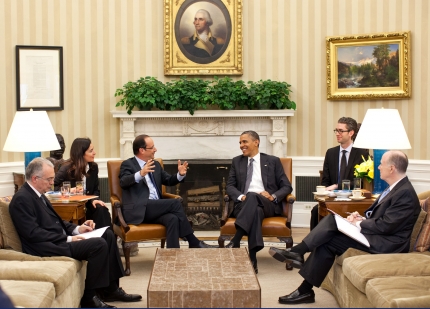
President Obama Welcomes French President Francoise Hollande to the White House

President Obama with President François Hollande of France in the Oval Office, May 18, 2012

President Barack Obama holds a bilateral meeting with President François Hollande of France in the Oval Office, May 18, 2012 (Official White House Photo by Pete Souza)

President Obama today met with French President Francois Hollande for the first time when the newly-inaugurated leader stopped at the White House in advance of the G8 Summit which starts tonight at Camp David.

While much of the conversation in the Oval Office was focused on the economic situation in the eurozone -- which President Obama said will also be central to the discussions throughout the weekend when they are joined by leaders from Britain, Canada, Germany, Italy, Japan, and Russia  -- others issues concerning areas of our nations' mutual cooperation were on the agenda:

We also discussed the situation in Afghanistan, in anticipation of our NATO meeting in Chicago on Saturday and Sunday. And we agreed that even as we transition out of a combat phase in Afghanistan that it's important that we sustain our commitment to helping Afghans build security and continue down the path of development. 

We also identified the issues of Iran and Syria, the transition that's taking place in countries like Egypt and Tunisia as topics of critical importance. And we'll be devoting extensive time to those issues throughout the G8 meeting. France has shown great leadership on these issues, and as I indicated to President Hollande, when the United States and France, along with our other key allies, make up our minds to stand firm on the side of democracy and freedom and development, that enormous progress can be made.

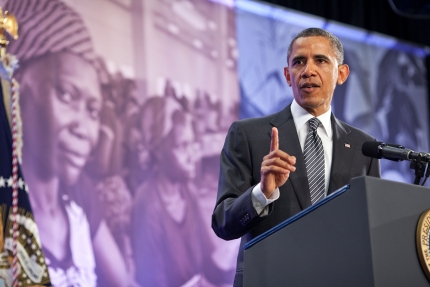
President Obama Announces New Partnership to Fight Global Hunger

President Barack Obama delivers remarks at the Symposium on Global Agriculture and Food Security

President Barack Obama delivers remarks at the Symposium on Global Agriculture and Food Security at the Ronald Reagan Building and International Trade Center in Washington, D.C. May 18, 2012. (Official White House Photo by Pete Souza)

At today’s Symposium on Global Agriculture and Food Security, President Obama announced that leaders at this weekend’s G8 meeting would devote a special session to the urgent challenge facing nearly 1 billion men, women and children around the world: the injustice of chronic hunger and the need for long-term food security.

G8 and African leaders will launch a major new alliance with private sector partners to reduce hunger and lift 50 million people out of poverty by investing in Africa’s agricultural economy. The partnership builds on the commitment leaders made during the 2009 G8 meeting in L’Aquila to put the fight against hunger at the forefront of global development.

And that fight is about more than delivering aid, President Obama said. True, sustainable development is about promoting economic growth that helps nations develop. "The whole purpose of development is to create the conditions where assistance is no longer needed, where people have the dignity and the pride of being self-sufficient,” he said. 

Related Topics: Foreign Policy

The White House

Office of the Press Secretary

Remarks by President Obama and President Hollande of France after Bilateral Meeting

Oval Office

12:35 P.M. EDT

PRESIDENT OBAMA:  Well, it is my great pleasure to welcome President Hollande to the United States, to the Oval Office, and this evening to Camp David. 

We all watched the remarkable election, and I offered him hardy congratulations and assured him that the friendship and alliance between the United States and France is not only of extraordinary importance to me but is deeply valued by the American people.

I was interested, when I was reading the President's biography, that he actually spent some time in the United States in his youth, studying American fast food -- (laughter) -- and although he decided to go into politics, we'll be interested in his opinions of cheeseburgers in Chicago.  (Laughter.) 

I also warned him that now that he's President, he can no longer ride a scooter in Paris.  (Laughter.)  I know because I've tried with the Secret Service and they don't let me do it.  (Laughter.) 

Obviously we have had a lot to talk about.  Much of our discussion centered on the situation in the eurozone.  And President Hollande and I agree that this is an issue of extraordinary importance not only to the people of Europe, but also to the world economy.  And we're looking forward to a fruitful discussion later this evening and tomorrow with the other G8 leaders about how we can manage a responsible approach to fiscal consolidation that is coupled with a strong growth agenda.

We also discussed the situation in Afghanistan, in anticipation of our NATO meeting in Chicago on Saturday and Sunday.  And we agreed that even as we transition out of a combat phase in Afghanistan that it's important that we sustain our commitment to helping Afghans build security and continue down the path of development.

We also identified the issues of Iran and Syria, the transition that's taking place in countries like Egypt and Tunisia as topics of critical importance.  And we'll be devoting extensive time to those issues throughout the G8 meeting.  France has shown great leadership on these issues, and as I indicated to President Hollande, when the United States and France, along with our other key allies, make up our minds to stand firm on the side of democracy and freedom and development, that enormous progress can be made.

So I'm grateful to President Hollande for being willing to come here so shortly after his election and the formation of his government.  He's gotten off to a very strong start.  And I hope that he will find my administration and the American people strong partners in delivering prosperity not only to the people of France but helping to provide peace and security throughout the world.

PRESIDENT HOLLANDE:  (As interpreted.)  I wanted my first visit outside Europe to be to the United States in order to meet President Obama.  The Camp David G8 summit as well as the meeting in Chicago was an outstanding opportunity, and I would like to thank President Obama for taking that opportunity to allow us to have a long conversation together.

This is the first time that we meet, and not the last one; there will be many other opportunities for as long as possible.  But it was important for me, on this occasion, to reaffirm the importance of the relationship between France and the United States.

Through history, we lived together some important events.  We've had our differences, but we always manage to overcome them because of that strong link between our two countries.  We also share some common causes -- freedom, democracy.  This is the reason why our history, our culture go back together a long way, and we managed to go through these differences when necessary and have these ties that mean that when France and the U.S. come together we can make progress.

I discussed the main topics with President Obama, including the economy and the fact that growth must be a priority, at the same time as we put in place some fiscal compacts to improve our finances.  And President Obama was able to acknowledge shared views so that we can progress.

I also -- on the Greece -- the eurozone situation, and our concerns regarding Greece, and we share the same views, the fact that Greece must stay in the eurozone and that all of us must do what we can to that effect.  There will be elections in Greece and we wanted to send a message to that effect to the Greek people.

Our economies depend on one another.  What happens in Europe has an impact on the U.S., and vice versa.  So we are related, and the more coherent we are, the more efficient we can be.

We also discussed Afghanistan, and I reminded President Obama that I made a promise to the French people to the effect that our combat troops would be withdrawn from Afghanistan by the end of 2012.  That being said, we will continue to support Afghanistan in a different way, our support will take a different format, and all of that will be done in good understanding with our allies within ISAF.  And so we will continue and comply with our commitment to that country, and supply and support, as I said, in a different way.

We will discuss that further in Chicago, and I'm pretty sure I will find the right means so that our allies can continue with their mission and at the same time I can comply to the promise I made to the French people.

And regarding Iran, we, again, noted that we share views and that we could start negotiations, but that being said, with the required firmness that Iran doesn't get the nuclear military capability.

Regarding Syria and Arab Spring countries, we talked about the Deauville partnership, and here again I said that we would comply with our commitments.

What was important to say today is that, as to our responsibilities, France and the U.S. are countries that have an impact on the destiny of the world, but we are great in friendship, cohesion and partnership.  France is an independent country and cares about its independence but in old friendship with the United States of America.  So it is with that friendship and with that independence that we can be both the most efficient when it comes to dealing with the current challenges. 

And I would like to thank President Obama for the knowledge he has of my life before I took office.  I will say nothing against cheeseburgers, of course.  And as to my own vehicle, the one I used to have until I took office, I hope that I will not have to use it -- (laughter.)

PRESIDENT OBAMA:  I just want to remember that cheeseburgers go very well with French fries.  (Laughter.)

END
12:53 P.M. EDT

The White House

Office of the Press Secretary

Notice -- Continuation of the National Emergency with Respect to the Stabilization of Iraq

NOTICE
- - - - - - -
CONTINUATION OF THE NATIONAL EMERGENCY WITH RESPECT

TO THE STABILIZATION OF IRAQ

On May 22, 2003, by Executive Order 13303, the President declared a national emergency protecting the Development Fund for Iraq and certain other property in which Iraq has an interest, pursuant to the International Emergency Economic Powers Act (50 U.S.C. 1701-1706). The President took this action to deal with the unusual and extraordinary threat to the national security and foreign policy of the United States posed by obstacles to the orderly reconstruction of Iraq, the restoration and maintenance of peace and security in the country, and the development of political, administrative, and economic institutions in Iraq.

In Executive Order 13315 of August 28, 2003, Executive Order 13350 of July 29, 2004, Executive Order 13364 of November 29, 2004, and Executive Order 13438 of July 17, 2007, the President modified the scope of the national emergency declared in Executive Order 13303 and took additional steps in response to this national emergency.

Because the obstacles to the orderly reconstruction of Iraq, the restoration and maintenance of peace and security in the country, and the development of political, administrative, and economic institutions in Iraq continue to pose an unusual and extraordinary threat to the national security and foreign policy of the United States, the national emergency declared in Executive Order 13303, as modified in scope and relied upon for additional steps taken in Executive Orders 13315, 13350, 13364, and 13438, must continue in effect beyond May 22, 2012. Therefore, in accordance with section 202(d) of the National Emergencies Act (50 U.S.C. 1622(d)), I am continuing for 1 year the national emergency with respect to the stabilization of Iraq.

This notice shall be published in the Federal Register and transmitted to the Congress.

BARACK OBAMA

The White House

Office of the Press Secretary

Message -- Continuation of the National Emergency with Respect to the Stabilization of Iraq

TO THE CONGRESS OF THE UNITED STATES:

Section 202(d) of the National Emergencies Act (50 U.S.C. 1622(d)) provides for the automatic termination of a national emergency unless, within 90 days prior to the anniversary date of its declaration, the President publishes in the Federal Register and transmits to the Congress a notice stating that the emergency is to continue in effect beyond the anniversary date. In accordance with this provision, I have sent the enclosed notice to the Federal Register for publication continuing the national emergency with respect to the stabilization of Iraq. This notice states that the national emergency with respect to the stabilization of Iraq declared in Executive Order 13303 of May 22, 2003, as modified in scope and relied upon for additional steps taken in Executive Order 13315 of August 28, 2003, Executive Order 13350 of July 29, 2004, Executive Order 13364 of November 29, 2004, and Executive Order 13438 of July 17, 2007, is to continue in effect beyond May 22, 2012.

Obstacles to the orderly reconstruction of Iraq, the restoration and maintenance of peace and security in the country, and the development of political, administrative, and economic institutions in Iraq continue to pose an unusual and extraordinary threat to the national security and foreign policy of the United States. Accordingly, I have determined that it is necessary to continue the national emergency with respect to this threat and maintain in force the measures taken to deal with that national emergency.

Recognizing positive developments in Iraq, my Administration will continue to evaluate Iraq's progress in resolving outstanding debts and claims arising from actions of the previous regime, so that I may determine whether to further continue the prohibitions contained in Executive Order 13303 of May 22, 2003, as amended by Executive Order 13364 of November 29, 2004, on any attachment, judgment, decree, lien, execution, garnishment, or other judicial process with respect to the Development Fund for Iraq, the accounts, assets, and property held by the Central Bank of Iraq, and Iraqi petroleum-related products, which are in addition to the sovereign immunity accorded Iraq under otherwise applicable law.

BARACK OBAMA

The White House

Office of the Press Secretary

Remarks by the President at Symposium on Global Agriculture and Food Security

Ronald Reagan Building
Washington, D.C.

10:08 A.M. EDT

THE PRESIDENT:  Thank you so much.  (Applause.)  Thank you, everybody.  Please have a seat.  Thank you.  Well, good morning, everybody.  Thank you, Catherine Bertini, and Dan Glickman and everyone at the Chicago Council.  We were originally going to convene, along with the G8, in Chicago.  But since we’re not doing this in my hometown, I wanted to bring a little bit of Chicago to Washington.  (Laughter.)  It is wonderful to see all of you.  It is great to see quite a few young people here as well.  And I want to acknowledge a good friend.  We were just talking backstage -- he was my inspiration for singing at the Apollo -- (laughter) -- Bono is here, and it is good to see him.  (Applause.)

Now, this weekend at the G8, we’ll be represented by many of the world's largest economies.  We face urgent challenges -- creating jobs, addressing the situation in the eurozone, sustaining the global economic recovery.  But even as we deal with these issues, I felt it was also important, also critical to focus on the urgent challenge that confronts some 1 billion men, women and children around the world -- the injustice of chronic hunger; the need for long-term food security.

So tomorrow at the G8, we’re going to devote a special session to this challenge.  We’re launching a major new partnership to reduce hunger and lift tens of millions of people from poverty.  And we’ll be joined by leaders from across Africa, including the first three nations to undertake this effort and who join us here today -- I want to acknowledge them:  Prime Minister Meles of Ethiopia -- (applause) -- President Mills of Ghana -- (applause) -- and President Kikwete of Tanzania.  (Applause.)  Welcome.

I also want to acknowledge President Yayi of Benin, chair of the African Union -- (applause) -- which has shown great leadership in this cause.  And two of our leaders in this effort -- USAID Administrator -- every time I meet him, I realize that I was an underachiever in my 30s -- (laughter) -- Dr. Raj Shah is here.  (Applause.)  And the CEO of the Millennium Challenge Corporation, Daniel Yohannes.  (Applause.)

Now, this partnership is possible because so many leaders in Africa and around the world have made food security a priority.  And that’s why, shortly after I took office, I called for the international community to do its part.  And at the G8 meeting three years ago in L’Aquila, in Italy, that's exactly what we did -- mobilizing more than $22 billion for a global food security initiative. 

After decades in which agriculture and nutrition didn’t always get the attention they deserved, we put the fight against global hunger where it should be, which is at the forefront of global development.  And this reflected the new approach to development that I called for when I visited Ghana, hosted by President Mills, and that I unveiled at the last summit on the Millennium Development goals.

It’s rooted in our conviction that true development involves not only delivering aid, but also promoting economic growth -- broad-based, inclusive growth that actually helps nations develop and lifts people out of poverty.  The whole purpose of development is to create the conditions where assistance is no longer needed, where people have the dignity and the pride of being self-sufficient. 

You see our new approach in our promotion of trade and investment, of building on the outstanding work of the African Growth and Opportunity Act.  You see it in the global partnership to promote open government, which empowers citizens and helps to fuel development, creates the framework, the foundation for economic growth.

You see it in the international effort we’re leading against corruption, including greater transparency so taxpayers receive every dollar they’re due from the extraction of natural resources.  You see it in our Global Health Initiative, which instead of just delivering medicine is also helping to build a stronger health system, delivering better care and saving lives. 

And you see our new approach in our food security initiative, Feed the Future.  Instead of simply handing out food, we’ve partnered with countries in pursuit of ambitious goals:  better nutrition to prevent the stunting and the death of millions of children, and raising the incomes of millions of people, most of them farmers.  The good news is we’re on track to meet our goals. 

As President, I consider this a moral imperative.  As the wealthiest nation on Earth, I believe the United States has a moral obligation to lead the fight against hunger and malnutrition, and to partner with others. 

So we take pride in the fact that, because of smart investments in nutrition and agriculture and safety nets, millions of people in Kenya and Ethiopia did not need emergency aid in the recent drought. 

But when tens of thousands of children die from the agony of starvation, as in Somalia, that sends us a message we’ve still got a lot of work to do.  It’s unacceptable.  It’s an outrage.  It’s an affront to who we are. 

So food security is a moral imperative, but it’s also an economic imperative.  History teaches us that one of the most effective ways to pull people and entire nations out of poverty is to invest in their agriculture.  And as we’ve seen from Latin America to Africa to Asia, a growing middle class also means growing markets, including more customers for American exports that support American jobs.  So we have a self interest in this.  

It's a moral imperative, it's an economic imperative, and it is a security imperative.  For we’ve seen how spikes in food prices can plunge millions into poverty, which, in turn, can spark riots that cost lives, and can lead to instability.  And this danger will only grow if a surging global population isn’t matched by surging food production.  So reducing malnutrition and hunger around the world advances international peace and security -- and that includes the national security of the United States.

And perhaps nowhere do we see this link more vividly than in Africa.  On the one hand, we see Africa as an emerging market.  African economies are some of the fastest growing in the world.  We see a surge in foreign investment.  We see a growing middle class; hundreds of millions of people connected by mobile phones; more young Africans online than ever before.  There's hope and some optimism.  And all of this has yielded impressive progress -- for the first time ever, a decline in extreme poverty in Africa; an increase in crop yields; a dramatic drop in child deaths.  That's the good news, and in part it's due to some of the work of the people in this room.

On the other hand, we see an Africa that still faces huge hurdles:  stark inequalities; most Africans still living on less than $2 a day; climate change that increases the risk of drought and famine.  All of which perpetuates stubborn barriers in agriculture, in the agricultural sector -- from bottlenecks in infrastructure that prevent food from getting to market, to the lack of credit, especially for small farmers, most of whom are women.

I’ve spoken before about relatives I have in Kenya, who live in villages where hunger is sometimes a reality -- despite the fact that African farmers can be some of the hardest-working people on Earth.  Most of the world’s unused arable land is in Africa.  Fifty years ago, Africa was an exporter of food.  There is no reason why Africa should not be feeding itself and exporting food again.  There is no reason for that.  (Applause.)

So that’s why we’re here.  In Africa and around the world, progress isn’t coming fast enough.  And economic growth can’t just be for the lucky few at the top, it's got to be broad-based, for everybody, and a good place to start is in the agricultural sector.  So even as the world responds with food aid in a crisis -- as we’ve done in the Horn of Africa -- communities can’t go back just to the way things were, vulnerable as before, waiting for the next crisis to happen.  Development has to be sustainable, and as an international community, we have to do better.

So here at the G8, we’re going to build on the progress we've made so far.  Today, I can announce a new global effort we're calling a New Alliance for Food Security and Nutrition.  And to get the job done we’re bringing together all the key players around a shared commitment.  Let me describe it.

Governments, like those in Africa, that are committed to agricultural development and food security, they agree to take the lead -- building on their own plans by making tough reforms and attracting investment.  Donor countries -- including G8 members and international organizations -- agree to more closely align our assistance with these country plans.  And the private sector -- from large multinationals to small African cooperatives, your NGOs and civil society groups -- agree to make concrete and continuing commitments as well, so that there is an alignment between all these sectors. 

Now, I know some have asked, in a time of austerity, whether this New Alliance is just a way for governments to shift the burden onto somebody else.  I want to be clear:  The answer is no.  As President, I can assure you that the United States will continue to meet our responsibilities, so that even in these tough fiscal times, we will continue to make historic investments in development.  And, by the way, we're going to be working to end hunger right here in the United States as well.  (Applause.)  That will continue to be a priority.

We’ll continue to be the leader in times of crisis, as we’ve done as the single largest donor of aid in the Horn of Africa, and as we focus on the drought in the Sahel.  That's why I’ve proposed to continue increasing funds for food security.  (Applause.)  So I want to be clear:  The United States will remain a global leader in development in partnership with you.  And we will continue to make available food -- or emergency aid.  That will not change.  But what we do want to partner with you on is a strategy so that emergency aid becomes less and less relevant as a consequence of greater and greater sustainability within these own countries.  

That's how development is supposed to work.  That's what I mean by a new approach that challenges more nations, more organizations, more companies, more NGOs, challenges individuals -- some of the young people who are here -- to step up and play a role -- because government cannot and should not do this alone.  This has to be all hands on deck. 

And that’s the essence of this New Alliance.  So G8 nations will pledge to honor the commitments we made in L’Aquila.  We must do what we say; no empty promises.  And at the same time, we’ll deliver the assistance to launch this new effort.  Moreover, we’re committing to replenish the very successful Global Agricultural and Food Security Program.  (Applause.)  That's an important part of this overall effort.

Next, we’re going to mobilize more private capital.  Today, I can announce that 45 companies -- from major international corporations to African companies and cooperatives -- have pledged to invest more than $3 billion to kick off this effort.  (Applause.)  And we’re also going to fast-track new agricultural projects so they reach those in need even quicker.

Third, we’re going to speed up the development and delivery of innovation -- better seeds, better storage -- that unleash huge leaps in food production.  And we’re going to tap that mobile phone revolution in Africa so that more data on agriculture -- whether it’s satellite imagery or weather forecasts or market prices -- are put in the hands of farmers so they know where to plant and when to plant and when to sell.

Fourth, we’re joining with the World Bank and other partners to better understand and manage the risks that come with changing food prices and a changing climate -- because a change in prices or a single bad season should not plunge a family, a community or a region into crisis.

And finally, we’re going to keep focusing on nutrition, especially for young children, because we know the effects of poor nutrition can last a lifetime -- it’s harder to learn, it’s harder to earn a living.  When there is good nutrition, especially in those thousand days during pregnancy up to the child’s second birthday, it means healthier lives for that child and that mother.  And it’s the smart thing to do because better nutrition means lower health care costs and it means less need for assistance later on.

That’s what we’re going to do.  We’re going to sustain the commitments we made three years ago, and we’re going to speed things up.  And we’re starting with these three countries -- Tanzania, Ghana and Ethiopia -- precisely because of their record in improving agriculture and food security. 

But this is just the beginning.  In the coming months, we’ll expand to six countries.  We’ll welcome other countries that are committed to making tough reforms.  We’ll welcome more companies that are willing to invest.  We’re going to hold ourselves accountable; we’ll measure results.  And we’ll stay focused on clear goals:  boosting farmers’ incomes, and over the next decade, helping 50 million men, women and children lift themselves out of poverty.  (Applause.)

And I know there are going to be skeptics -- there always are.  We see heartbreaking images -- fields turned to dust, babies with distended bellies -- and we say it’s hopeless, and some places are condemned to perpetual poverty and hunger.  But the people in this room disagree.  I think most of the American people disagree.  Anyone who claims great change is impossible, I say look at the extraordinary successes in development.

Look at the Green Revolution, which pulled hundreds of millions of people out of poverty.  (Applause.)  Look at microfinance, which has empowered so many rural poor -- something my mother was involved with.  Look at the huge expansion of education, especially for girls.  Look at the progress we’ve made with vaccines -- from smallpox to measles to pneumonia to diarrhea -- which have saved the lives of hundreds of millions.  And of course, look at the global fight against HIV/AIDS, which has brought us to the point where we can imagine what was once unthinkable -- and that is the real possibility of an AIDS-free generation.  (Applause.) 

Moreover, we are already making progress in this area right now.  In Rwanda, farmers are selling more coffee and lifting their families out of poverty.  In Haiti, some farmers have more than doubled their yields.  In Bangladesh, in the poorest region, they’ve had their first-ever surplus of rice.  There are millions of farmers and families whose lives are being transformed right now because of some of the strategies that we’re talking about.  And that includes a farmer in Ethiopia who got a new loan, increased production, hired more workers.  And he said, “This salary changed my life.  My kids can now go to school.”

And we start getting the wheel turning in the direction of progress.  We can do this.  We’re already doing it.  We just need to bring it all together.  We can unleash the change that reduces hunger and malnutrition.  We can spark the kind of economic growth that lifts people and nations out of poverty.  This is the new commitment that we’re making.  And I pledge to you today that this will remain a priority as long as I am United States President.  Thank very much.  (Applause.)  God bless you.  Thank you.  God bless America. 

END
10:29 A.M. EDT

Watch the G8 Summit Live This Weekend from Camp David

G8 Summit in Camp David, 2012 Logo

This weekend, the leaders of Britain, Canada, France, Germany, Italy, Japan, and Russia will join President Obama at Camp David. The G8 is a gathering of eight of the world's leading economies, which meets annually. This will be the first meeting in the United States since 2004, and it will be the largest gathering of world leaders ever to assemble at Camp David.  

Their agenda for this weekend includes talks on growing the world economy, the nuclear situations in Iran and North Korea, and energy and climate issues. We’ll broadcasting a number of events from the weekend live on WhiteHouse.gov. Check out the schedule below:

Tonight at 7:40 PM – The Leaders Greeting
Saturday at 10:45 AM – The Family Photo
Saturday at 5:45 PM – A Statement from President Obama