Press Briefing by Press Secretary Jay Carney, 3/29/2012
James S. Brady Press Briefing Room
12:29 P.M. EDT
MR. CARNEY: All right. Good afternoon, everyone. Welcome to the White House for your daily briefing. It's my pleasure to see you.
I don't have any opening statements. I'll just note that you should have a paper statement that I put out from me on the surface transportation bill, the need to ensure that we take -- we make sure that folks working on these construction jobs around the country don't get thrown out of work, but that we need to -- the House needs to do what the Senate has already done, which is pass a bipartisan bill for a longer-term funding of our infrastructure projects.
Secondly, I would note that the Senate just voted on the bill that would have eliminated billions of dollars of subsidies to major oil and gas companies, and unfortunately, Senate Republicans overwhelmingly chose to side with oil and gas companies instead of the American people, who overwhelmingly support the notion that the President talked about this morning in the Rose Garden, which is that at a time of record profits, at a time when a company like Exxon-Mobil is pulling down -- was it $4.7 million an hour in profits -- that the American taxpayer should not be subsidizing oil and gas companies. And so that was an unfortunate vote.
With that, I will take your questions.
Ben.
Q Thanks, Jay. Two topics. To follow up on that one, given the action in the Senate, is it fair to say now that the President made his pitch, Congress has acted once again on the tax subsidies, and he's going to move on to other elements, or is he going to continue to call for these even though Congress has already weighed in?
MR. CARNEY: Well, you can be sure he won't stop calling for this, because we simply cannot afford and it makes zero sense to have American taxpayers subsidize oil and gas companies that are enjoying record profits. Oil and gas company executives themselves have said that at a time of record-high profits and high prices for oil that they don't need the incentives that the subsidies were meant to create.
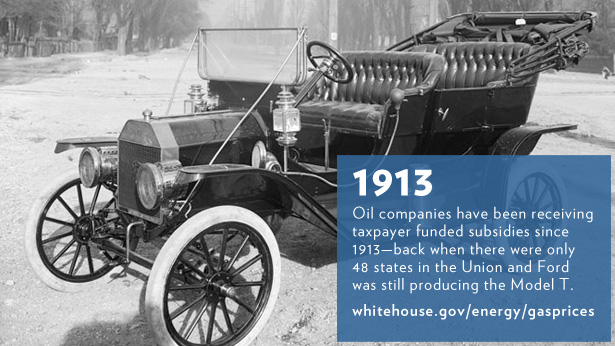
We've been subsidizing oil and gas companies for a century. We need to invest in the energy industries of the future. That's part of the President's all-of-the-above approach to our energy challenges, and he will continue to make the case that we should not be subsidizing these companies. The taxpayers should not be, and it's not wise policy.
Q But he's, at this point forward, if he hasn't already, he's just making a case politically to the American people, right? He's not actually trying to change Congress's mind. I mean, they've acted.
MR. CARNEY: Well, I mean, I think that's misunderstanding a bit of the question -- it represents a misunderstanding a little bit about how politics can work. What has become clear is that Senate Republicans -- or Republicans in general on Capitol Hill have decided to ally themselves with oil and gas companies over the interests of the American taxpayer in this case, despite the President's best efforts to persuade them otherwise.
Those same Republicans in the House and Senate are going to have to answer to their own constituents. And you all read the polls. You know how the American people feel about this. So the President will continue to look for opportunities both to make his case and for any sign that Republicans have changed their mind.
Q So he genuinely thinks there's still an opportunity this year to change their mind?
MR. CARNEY: I think you have to keep pressing on the issues like this. Obviously there are a number of other things, many other things that he’ll be working on and focusing on. But you simply can't say that because at this point in time Republicans continue to side with oil and gas companies who are enjoying record profits, that that’s okay. We can't afford that and we need a change.
Q Just one on health care. I know your colleague got a lot of questions about this yesterday, but I’m wondering now that the arguments are done, can you enlighten us at all about how the President thinks the arguments went?
MR. CARNEY: The President is pleased with the presentation made by Don Verrilli, the Solicitor General, and his team. The President believes that the Affordable Care Act is constitutional. He agrees with the opinions of conservative judges who have said the same thing about the Affordable Care Act, that it’s constitutional. And he focused on, and his whole administration is focused on implementing the important provisions of the Affordable Care Act that has -- that act has already provided benefits to 2.5 million young adult Americans who have insurance -- have health insurance on their parent’s plan because of the Affordable Care Act; 5.1 million seniors with Medicare who have saved $3.2 billion on their prescription drugs because of the Affordable Care Act; 54 million Americans with private insurance who can now receive many preventive services without paying co-payments or deductibles.
We’re going to keep implementing this law. And the President was pleased with the presentation and remains convinced that the Affordable Care Act is constitutional.
Yes, Reuters.
Q Jay, on the oil and gas tax breaks, Republicans are citing a 2011 Congressional Research Service report that says that repealing these tax breaks might actually result in a small increase for consumers at the pump. They do say in the report that this is probably because the tax breaks artificially lowered the prices. And I was wondering what your response is to that. And also, what specifically would repealing these tax breaks do for consumers?
MR. CARNEY: Two things. One, last year, the ex-Shell CEO, John Hofmeister, said, "In the face of sustained high oil prices it was not an issue for large companies of needing the subsidies to entice us into looking for and producing more oil." The subsidies exist for that reason. There is no need to incentivize oil and gas companies to look for and produce oil when the incentive exists in the high price right now in the market. It’s just -- it’s wrong-headed policy.
There is no reason for -- there would be no reason if we removed these subsidies for oil and gas companies to raise their prices, given the high price globally. That would be their choice if they had to do it. There would be no reason to do that.
The American people would benefit by not having to subsidize these oil and gas companies. That money would be used to either reduce the deficit or invest in the kind of alternative energy sources that we need to develop in this country to increase our energy independence in the 21st century. I would also note that in the last three years since President Obama took office, we have increased domestic oil and gas production substantially, and we have decreased substantially our reliance on foreign oil.
So the correlation between greater production and the price is simply not there, because as we’ve discussed many times, the price of oil is set on the global market; it’s dependent on many factors. And if simply drilling more and producing more in the United States would reduce the price at the pump we would have seen that already. Unfortunately, it doesn’t.
So that’s why you need to pursue an all-of-the-above approach that the President has to our energy challenges that ensures that we are increasing domestic oil and gas production, that we are investing in alternative sources of energy like biofuels and wind and solar, and that we're making wise policy decisions like the President made to dramatically improve the fuel efficiency of automobiles. That alone will save 12 billion barrels of oil, and will save American taxpayers $1.7 trillion.
That’s the only approach that makes sense for the long term, because in a world where emerging economies like China and India are growing rapidly, where millions and millions and millions of new cars are hitting the road in China and India, and therefore the demand, globally, for oil will just increase, we need to make smart investments and smart choices about the way that we can insulate ourselves from the kind of price shocks that we've seen almost annually lately in the oil global market -- in the global oil market.
So that’s why the President has the approach that he has. That’s why he thinks that it is nonsensical to continue a policy of subsidizing oil and gas companies that are doing quite well.
Q But would a repeal do anything to alleviate the pain at the pump now?
MR. CARNEY: I think that the President has made clear that there are no silver bullets here in terms of prices at the pump. You need a sustained, comprehensive policy to insulate ourselves from these kinds of fluctuations in the oil market in the future.
There are options that do exist that he'll continue to examine. But anyone who suggests that there's a single action that you can take as a politician and candidate or a member of Congress that will suddenly reduce the price of oil, and therefore the price of gas at the pump, is blowing hot air. And I think the American people understand that.
They've seen this before, and they've seen the empty promises that are made -- often in election years -- and seen those promises not be fulfilled.
Let me move around. Cheryl.
Q Thanks, Jay. The Senate is about to leave for a short recess, and there is of course a huge backlog of nominations. Is the President considering making additional recess appointments?
MR. CARNEY: We remain very concerned about the backlog of nominations. We've gotten to a situation where nominees that are reported out of committee unanimously get held up for no good reason at all. We continue to work with the Senate on this issue. I have no announcements to make about any presidential actions in that regard.
Dan.
Q Thank you. On health care, you and others here at the White House continue to insist that the law is constitutional. But what happens if the Court rules otherwise? What kind of plans are underway behind the scenes to -- in reaction to that possibility?
MR. CARNEY: I think, as Josh said yesterday and others have said, we're focused on implementing a law. It is the law of the land. It passed both the House and the Senate, and was signed into law by the President. A number of courts and a number of conservative judges on the Appeals Courts have ruled that the Affordable Care Act is constitutional, which is obviously an opinion that we share. We remain confident that the Affordable Care Act is constitutional.
Now, when the Supreme Court makes a decision we'll be ready for that. But we're confident that the Affordable Care Act is constitutional.
Q On the tax breaks for oil companies, you're making the argument that they don't need these incentives. But one analyst, industry analyst told us, "There would be less drilling. One of our companies said that they would drill 2,800 to 3,000 less wells in this country." Why do you believe that it would not be a disincentive for them?
MR. CARNEY: Well, I think you can always find an analyst or somebody to say -- to make a point -- a political point, essentially. I think that I'll rely on what the former CEO of Shell said just last year: "In the face of sustained high oil prices, it was not an issue for large companies of needing the subsidies to entice us into looking for and producing more oil." I mean, what more enticement do you need than the price of oil that pertains today? What more enticement do you need than the record profits you're making today?
The suggestion that you seem to be making, or at least the person you're quoting seems to be making, is that those profits depend on the subsidies of the American taxpayer. Well, I think every analyst would disagree with that notion. So any effect -- upward effect on prices that ending these subsidies might have would be a matter of choice by oil companies. And I think that that decision, if it were made, would not be met with applause by any means by the American consumers.
Q A follow-on?
MR. CARNEY: Sure.
Q Thank you.
MR. CARNEY: Dan, were you done? Sorry.
Q Yes.
MR. CARNEY: Okay, Ann.
Q The Republican leaders do say that they would consider some kind of changes in these subsidies as part of a broader change -- closing loopholes and really looking at the tax code. For 2012, is the idea of broader tax reform dead?
MR. CARNEY: Well, look, that's a -- the President has put forward his broad budget proposals. We would welcome a decision by Republicans in the leadership to take up a balanced approach to our long-term deficit and debt challenges, a balanced approach to our budget issues that would include, as the President has called for, tax reform. But it would have to include tax reform that made sure that we ask the wealthiest Americans to bear some of the burden of getting our deficits and debt under control, rather than the Ryan Republican budget plan -- new and not improved -- that is likely to pass the House again with overwhelming Republican support.
And that plan, remarkably, in the face of what is obviously the sentiment of the American people, says that the answer we need today to our budget challenges is to give more tax breaks to millionaires and billionaires, folks who have enjoyed quite a bit out of our tax code in recent years, and ends welfare as we know it, asks seniors to pay more, dramatically cuts education, research and development, and other programs that are essential, and holds harmless -- not only holds harmless millionaires and billionaires, but says, here's another $150,000 per year, annually. That's not a solution that I think the American people want.
Q Speaker Boehner has --
Q Jay, you said welfare as we know it.
MR. CARNEY: I'm sorry, thank you for correcting me. I was sitting in that chair when we ended welfare as we know it, that Knoller occupies. Ends Medicare as we know it. Let's be clear. The new Ryan Republican budget creates a segmented replacement for Medicare that would burden seniors and end the program as we know it.
Q Speaker Boehner has written a letter to the President I think about his comments to President Medvedev. Has the President responded to that, or could you respond to that?
MR. CARNEY: I don’t have anything on the President responding to it. Why don’t you -- if you want to ask me about it.
Q The Speaker expressed concern that the President wanted space, wanted to be flexible on missile defense. Is the President going to get passed the election year and then feel he can change position on this?
MR. CARNEY: The President addressed this quite clearly, as you know, in South Korea, in Seoul. What he said to President Medvedev is what he has said publicly, and said again when he addressed this, which is it is a reality that this is an election year, both in Russia and in the United States, and that the kind of painstaking work that requires -- that is required when you are dealing with negotiations over nuclear weapons levels, as we saw with the New START Treaty, takes a sustained engagement with Congress. And it absolutely requires bipartisan effort.
That’s what we saw when the President was able to work with the Senate to achieve ratification of the New START Treaty at the end of 2010. And that would certainly be required for any efforts to further address this issue in the years forward.
On missile defense, let's be clear, as the President has. We are building a missile defense system in Eastern Europe with our allies that is aimed at protecting the United States and our allies in Europe from rogue nations like Iran. It is not directed at Russia. That is a point that we have made to the Russians. They have not been persuaded, but we will work with them and continue to have discussions with them to demonstrate that.
And as President Medvedev said and President Obama said, we should not step away from those consultations simply because there's disagreement on this issue. There's an opportunity this year to have this discussed at a technical level. This is highly complex stuff, as you know, Ann. You’ve been covering these issues for a long time. So those conversations will continue. That’s what President Obama was referring to.
Bill.
Q Is there any evidence that anything the President wants to do or is trying to do, whether it’s drilling in the Atlantic or the failed attempt to get the repeal of the subsidies, would actually lower gas prices?
MR. CARNEY: I think we’ve addressed this many times, and that is, there is no silver bullet, there's not a magic wand that is in a box somewhere in the Oval Office, or in a campaign van out on the trail, that somehow allows you to reduce the price at the pump. It’s a global oil market. There are things that we can potentially do. The President is constantly asking for and reviewing those options, and we’ve taken no option off the table.
But he has been extremely candid and honest with the American people about the challenge that high prices present to them and present to the country. He is keenly aware of the burden that it’s placing on -- these prices are placing on American families. And he will continue to work not only on the short term but on the long term in terms of our energy policy. But any --
Q So does that only an election year show?
MR. CARNEY: No, just the opposite. It is the -- an election year show is to go out and promise that if only you are elected or only your plan was passed, that suddenly the price of gas would drop, which is malarkey -- and you know it, I know it, everybody in this rooms knows it. Everybody who utters those words knows it.
What is the unpolitical approach is to level with the American people about our long-term energy challenges and why we need to take an all-of-the-above approach to dealing with them -- why we need to not just invest in alternative energies, which we absolutely must do, but we also have to license the first -- the construction of the first nuclear power plant in this country in 30 years. It’s why we have to continue to open up spaces for oil and gas exploration domestically. We have to do it all. And we have to do it in a way that’s responsible and safe, and that continues to enhance the energy security of this country.
Ed Henry.
Q Jay, on the tax breaks, in the context of the Ryan Budget, where you're saying everyone needs to pay their fair share, the oil industry says they make a lot of money obviously, as you pointed out, and they pay an effective tax rate of about 41 percent. We’ve all read the stories about some American companies that pay no taxes, or pay 10, 20 percent. They pay 41 percent, they claim. So what’s wrong with companies making big money but then paying their share, as the President says?
MR. CARNEY: Well, again this is -- first of all, I haven’t analyzed their tax returns and I don’t anticipate that I will. This is not an issue of -- I can barely handle mine --
Q But you’re calling for a fair share --
MR. CARNEY: But they’re also -- regardless of what their effective tax rate is -- and I don’t know and I think it probably varies per company -- they are being subsidized at a substantial rate by you and me and every American who pays taxes. And there was a time when that made sense. It does not make sense anymore, with our budget challenges and at a time when these same companies are making huge profits -- huge profits; at a time when there is every incentive in the world to drill and explore, to invest in the -- upfront in doing that, which obviously requires investment by these companies and cost.
The price is high; it’s worth it; they can do it. They certainly don’t need the American taxpayers’ dollars to find the incentive to further explore and develop domestic energy or international energy. So that’s the argument the President is making, not -- it has not nothing to do with whether they’re paying their taxes or not. What they don’t need is the taxes of you and me and every other American for the incentive they need to continue to do business.
Q So if it’s non-sensible, and you said earlier, why did the President vote for the energy bill in 2005 as a senator if it had over $2 billion in tax breaks for the oil industry? They were making a lot of money then, too.
MR. CARNEY: Well, what I can tell you, Ed, is that the oil and gas companies in this country are making record profits now in 2012. The price at the pump is very high, and that is plenty of incentive for these companies to continue to drill, to continue to explore, and continue to develop energy sources here in the United States and abroad. There is no reason for the American taxpayer to subsidize that activity.
Q So why did he vote for them?
MR. CARNEY: Look, I haven't examined the vote or what the prices were at the time or the whole bill that it was attached to. What I know and what the President knows is that this year, in 2012, when we are seeing high prices at the pump, high prices on the international oil market, and record profits from the oil and gas companies, there is no reason to continue these kinds of subsidies. It's just -- take that argument out to the people. I don’t think they'll go along with it.
Margaret.
Q Thanks. Can you help us to understand what, if anything, the President needs to do tomorrow or between now and the weekend as related to the Iranian oil sanctions taking effect on June 28? I'm trying to understand the issue myself. It sounds like the question is whether he thinks there is a -- whether there's enough non-Iranian oil available to go forward with those sanctions, and if he doesn’t, that he needs to do some intermediate steps by an April 1 deadline. Can you tell us, is he preparing to do something? And what can you tell us about that process?
MR. CARNEY: I can only tell you that there is a deadline related to the legislation, and obviously we're mindful of that. But I have no updates for you on it.
Q Can we get the updates in like a 5 o'clock deadline --
MR. CARNEY: Well, I think that we'll -- we're prepared to meet the deadline.
Q Okay, but nothing that you will discuss between now and then?
MR. CARNEY: I don’t have anything for you on it.
Q Okay. And can you tell us a little bit more about the trips tomorrow? Are they purely fundraising trips? Is there any public element to them? And why is -- what's the statement that he's trying to make in going to Vermont and Maine?
MR. CARNEY: I believe those are campaign events -- is that right? I think those are campaign events.
Q No public component?
MR. CARNEY: No official events. Just campaign events.
Yes, Kristen.
Q Thanks, Jay. Officials in France are, today, saying that an actual deal is near to tap the SPR between the United States and other allies. Can you confirm that that’s the case, that a deal is actually near?
MR. CARNEY: I cannot confirm that. And I will say, as we have said repeatedly, that this option is on the table, it remains on the table, but no decisions have been made and no specific actions have been proposed.
We obviously consult, as we have said repeatedly both this year and last, with our partners around the world and with energy-producing states. But again, there are no decisions that have been made, and no specific actions proposed.
Q Well, can you say if you're currently consulting with those other countries?
MR. CARNEY: By currently you mean at this minute, in this hour? We have conversations with various countries all the time. I can't possibly monitor them all, so I don’t know if that’s the case at this hour of this day.
Q Given that gas prices are approaching $4 a gallon, isn't it important to update the American people on this component?
MR. CARNEY: As I just said, and the President has said, this is -- regarding the reserves and the SPR, this is an option that remains on the table. A variety of other options remain on the table, something that the President looks at. And I really don’t have any other update on it for you.
Q On Syria, Jay, President Bashar al-Assad has said that he is going to work to make the mission of the U.N.-Arab League a success. Do you believe him?
MR. CARNEY: Our approach to this is to look at the actions of the Assad regime, not the rhetoric, not the words. It is a welcome development, certainly, the indication that Assad supports the Annan mission, but it is meaningless unless they act on it. It is meaningless unless there is a cessation of violence. It is meaningless unless all of the provisions that are required here are followed. We've seen a lot of empty rhetoric from Assad and his government in the past, a lot of promises that were never fulfilled and never meant to be fulfilled. So actions are what matter here, not words.
April.
Q Jay, I'm going to ask you a question about the Sudan, particularly after -- weeks after George Clooney met with President Obama on the Sudan. Andrew Natsios, the former Special Envoy to the Sudan, has written a book and he's also talking about there needs to be more pressure on the Sudan, world community pressure. He says this is the window to strike, particularly as the military is getting weaker in the Sudan, and he says that it doesn’t necessarily need to be boots on the ground there, but the strike should be strikes on their import. What do you say about that?
MR. CARNEY: Well, I'm not aware of the book or those recommendations. And I'm certainly not aware of any decision along those lines that’s under consideration.
This is an issue that’s of importance to the President; it's an issue that’s of importance to the administration and we continue to work hard on it. But again, it's hard for me to respond to that not having seen it. I know that’s not our policy right now.
Q And also, what are the conversations right now, the precursor conversations to the bigger conversation with this President and Chinese leaders about putting pressure on the Sudan, particularly when it comes to their oil?
MR. CARNEY: Well, the situation in the Sudan is definitely a problem and one of the contributing factors to the escalating price of oil globally. I would refer you to the State Department for more details about conversations we're having with other countries. But we're obviously interested in reducing tensions there, and certainly in trying to mitigate the factors that are having an impact on high oil prices.
Q How much would you say that the tensions in the Sudan are causing on our oil prices? How much of a percentage?
MR. CARNEY: You know, I haven't -- I would not hazard a guess because I just don’t know. I'm sure there are oil market analysts who can give that to you. I've certainly seen some suggestion that the kind of uncertainty created globally in various areas -- the Middle East, principally, but also Sudan and other places -- have contributed significantly to the current rise in prices. But more sophisticated analysts than I will have that information for you.
Jon Christopher.
Q Jay, has the President expressed his thoughts or his feelings regarding the very strong statement made yesterday by Chicago Congressman Bobby Rush on the House floor?
MR. CARNEY: I haven't discussed that with him. I mean, the President made some comments about that case last week, and I haven't had that conversation with him.
Alexis.
Q Jay, what does the President believe motivated the senators who voted against cloture? Because some senators suggested that their motivation was the amount of money that goes into their campaign coffers. Does the President agree?
MR. CARNEY: I'm not going to address motivations. We simply believe they're wrong; that the right choice here is to support the American taxpayer, to acknowledge and recognize that while these subsidies may have been appropriate in a different time, they're not appropriate now. We can't afford them. They're not necessary. Oil companies have all the incentive in the world without these subsidies to continue to drill and explore, and that we need to end these subsidies, because we can't afford them, and the American taxpayer can't afford them. And we need to make the appropriate investments in alternative energies.
I mean, what is perplexing is a resistance by those who voted against ending these subsidies to investing in the energy technologies of the future, the energy technologies that everybody recognizes who examines this market and examines what's happening globally, everyone recognizes that we have to have -- that these will be the markets of the future, that alternative energies will be a major factor in the global economy in the 21st century. So there's a great resistance to investing in that sector of the energy economy and insistence on investing in the past, at a time when we don’t need to, when oil and gas companies are doing very well on their own without help from the American taxpayer.
Q Is it possible that that resistance is motivated by the influence of the industry itself?
MR. CARNEY: I'm not -- you'd have to ask individual senators. I don’t know.
Who's next?
Q Me.
MR. CARNEY: Okay. Mike.
Q You asked. (Laughter.) Thank you. Going back to oil -- (laughter.) I'm shameless, I'm sorry. Big oil isn't what it used to be. It was announced today that Exxon Mobil has been replaced as the largest publicly traded producer of oil by a Chinese company in China. And I wanted to see the administration's reaction to that. Is there any concern -- as China aggressively tries to lock up fossil fuel resources in places like Canada, Iraq, the Caribbean Basin, is there any concern that the United States may end up on the short end of the dipstick? (Laughter.)
MR. CARNEY: Sounds like a radio piece in the making. (Laughter.) I don’t have a specific reaction to this. It is a global market. There are obviously -- because of the attraction that the high price creates, I'm sure a lot of companies are eagerly participating in the market. That’s another reason why we don’t need to subsidize it, why you do not need to contribute some of your tax dollars to Exxon Mobil. It just doesn’t make sense.
I think that this administration's policy is to take all the necessary actions that are responsible and safe to expand domestic oil and gas production as part of an all-of-the-above energy strategy that includes investments in alternative sources of energy like wind, solar and biofuels; that includes administration actions like the dramatic fuel-efficiency standards the President put in place, with all the major automobile companies agreeing with him to do it. That action alone will have a dramatic effect on the amount of oil that we need to import and the amount of money that the American people can save at the pump.
So I think Exxon Mobil, other major oil companies are doing very well. I don't even think they would argue with that statement. And they certainly don't need these subsidies from us.
Q But the administration has often talked about the way the Chinese have been investing in things like windmills and solar. They're also investing very much in fossil fuels. In fact, about 86 percent of the shares of this company are held by the Chinese government, so isn't the Chinese government doing that?
MR. CARNEY: Well, I'm sure they are. But this is not about -- there is not a market reason for us to subsidize oil and gas companies. Major oil and gas companies in this country are doing extremely well, making record or near-record profits. They do not need, as an incentive to drill and explore, billions of dollars in taxpayer subsidies. So I think that's a principle that a vast majority of the American people can agree with. Unfortunately, even though a majority of the Senate agreed with it, because of the rules in place, you need a super majority. And unfortunately, the vast majority of Republicans voted against cloture today.
All the way in the back.
Q Yes, I wanted to ask you about ANWR. When the President was a senator, he helped filibuster it seven years ago. Now we have a new, novel approach from both Alaska senators that would basically allow you to drink ANWR's milkshake from adjacent state lands. (Laughter.) I'm wondering --
MR. CARNEY: I'm not sure I follow that, but okay.
Q They say you can drill horizontally under ANWR, up to eight miles -- potentially get at a lot of that oil. And they also say, hey, if the President hadn't helped block it a number of years ago, it could have been producing a million barrels a day, which would have maybe not have -- maybe it wouldn't be a silver bullet, but would have been a bullet in dealing with high gas prices, potentially keeping tens of billions of dollars here. Does the President still want -- still say that ANWR is off the table? And is there -- would he be willing to look at something like that, that gets you some additional oil?
MR. CARNEY: Well, I haven't had a discussion with him about the milkshake principle. (Laughter.) But I can tell you that the Department of Interior recently approved Shell's Beaufort Sea oil spill response plan for potential activities off the coast of Alaska that could lead to greater development there. And this President is committed to expanding domestic oil and gas production in a safe and responsible way.
And any suggestion that that's not the case -- I think it's worth noting that in 2011, we held a lease sale in the western Gulf of Mexico that made available more than 21 million acres, equal to an area the size of South Carolina. And yet, just over 1 million acres was leased by industry. Twenty million acres went un-leased.
So there are -- we are making available substantial areas for oil and gas production. We will continue to do that, whether it's Alaska or the announcement -- the step forward that Secretary Salazar announced yesterday that Interior is taking to assess the conventional and renewable energy resource potential in the mid and south Atlantic. We're approaching this holistically and examining every opportunity to further develop oil and gas in this country in a safe and responsible way.
I don't have any specifics for you beyond what I just said about Alaska. But the President is committed to the safe and responsible principle, as well as increasing oil and gas production.
Andrei Sitov. Pajalsta.
Q Thank you, Jay. A follow-up to Ann’s question. Do you regard the backlash from the Republicans to this episode with Medvedev as directed primarily against the President or against Russia, per se?
MR. CARNEY: That’s a great question. I don’t know. You’ll have to ask them. What I do know is that I’m pretty sure the Cold War ended when some of the folks in this room were still in elementary school. And any suggestion that Russia is America’s number-one geopolitical foe represents a profound -- or unique understanding of recent history.
Q Are you required to respond to letters such as the Boehner letter?
MR. CARNEY: Is the President? I don’t think we’re required to, and I don’t have a response from the President at this time. But I can tell you that -- look, as you know, Andrei -- you cover this for the Russian press -- we obviously have our differences with Russia; we have a relationship with Russia that allows us to discuss those differences candidly and openly. We also have a number of very important areas of agreement.
Because of the policy that this President put in place when he came into office, the so-called reset policy, our relations with Russia improved, and that allowed for greater cooperation between the United States and Russia on Iran. It allowed for significant assistance and cooperation from Russia for the trans-shipment of materiel and other goods to our troops in Afghanistan. There are a number of areas, very important areas, where the United States and Russia cooperate. And that cooperation is not a good unto itself; it directly benefits the national security interest of the United States. And obviously Russia cooperates because they believe -- the leadership there believes that it’s in their interest.
We obviously -- we do have our differences. We have had our differences over Syria. We have had our differences over missile defense. But as we saw in the meeting between President Medvedev and President Obama in Seoul, we’re able to discuss those differences and try to work them out constructively, which is more evidence of the fact that Russia is not our number-one geopolitical foe.
Q If the Republicans choose to make this into a subject before the elections, of a dispute, would the President welcome a chance to defend his reset policy?
MR. CARNEY: Well, setting aside -- I mean, the President welcomes an opportunity to discuss and explain his policy towards Russia and why it has produced tangible benefits to America’s national security interest at any time. And whether that happens within the context of the election or in a foreign policy forum somewhere, or in answer to questions from you, I’m sure he’ll welcome that opportunity.
Q Mega Million ticket -- is the President tempted to buy one?
MR. CARNEY: No, but I’m going to run out and buy one. (Laughter.) Thanks, guys.
END
1:11 P.M. EDT