President Obama Talks Title IX

President Obama coaches basketball (February 5, 2011)

(Official White House Photo by Pete Souza) Feb. 5, 2011

In June, Title IX, the federal law that mandates gender equality in school sports, will celebrate its 40th anniversary. There's no denying its impact: Since 1972, the number of female athletes in college has climbed by more than 450 percent.

In a discussion with ESPN's Andy Katz, President Obama talks about why that's so important:

Studies show that girls who are involved in athletics often do better in school; they are more confident in terms of dealing with boys. And, so, for those of us who grew up just as Title IX was taking off, to see the development of women's role models in sports, and for girls to know they excelled in something, there would be a spot for them in college where they weren't second-class, I think has helped to make our society more equal in general.

The President also discussed one of his favorite weekend responsibilities -- helping to coach his daughter Sasha's basketball team.

The whole interview is worth a watch. Take some time to check it out.

Related Topics: Women

The White House

Office of the Press Secretary

Statement by the President on Senegal’s Elections

I congratulate Macky Sall on his victory in Senegal’s presidential elections.  Domestic and international observers report that the election was carried out transparently, freely, and reflects the will of the Senegalese people.

I also recognize President Abdoulaye Wade for his leadership and friendship to the United States during his presidency.  I look forward to building similarly productive ties with President-elect Sall, while deepening the longstanding bonds between the United States and the Senegalese people.

Senegal has, through this election, reaffirmed its tradition as a leading example of good governance and democracy at work in Africa and remains an example for its neighbors.  The government and people of Senegal have once again demonstrated their commitment to political expression through peaceful, democratic elections, making it harder for non-democratic forces near and far to prevail.  Today's results deepen hopes across the continent and around the world that the quest for human dignity cannot be denied and that Africa's democratic wave must continue.

The United States looks forward to maintaining its strong partnership and close engagement with the people and government of Senegal to continue to strengthen democracy, peace, and prosperity in the region.

President Obama’s Bilateral Meeting with President Hu of China

March 26, 2012 | 5:16 | Public Domain

President Obama and President Hu Jintao of China speak to the press before a bilateral meeting in Seoul.

Download mp4 (50MB) | mp3 (12MB)

Read the Transcript

Remarks by President Obama and President Hu Jintao of the People's Republic of China Before Bilateral Meeting

Coex Center
Seoul, Republic of Korea

3:31 P.M. KST

PRESIDENT HU:  (As interpreted.)  A month ago, Vice President Xi Jinping made a successful visit to the United States.  I asked him to hand to the President my reply to earlier letter, and I want to thank the American side for the warm hospitality and for all the arrangements made for his visit.
 
Now I'd like to talk to President Obama.
 
PRESIDENT OBAMA:  Well, Mr. President, first of all, I’d like to say -- (inaudible) -- you and your delegation.  And I think that the fact that we have met 11 times during the course of my presidency is an indication of the importance that both of us place on strong U.S.-China relations.
 
I am very pleased to hear that Vice President Xi had a wonderful visit.  We very much enjoyed hosting him in the United States, and he did deliver your letter, which I appreciated very much.
 
I think this is an excellent opportunity for us to discuss a wide range of issues.  First of all, the fact that we are at a nuclear security summit, following up on our discussions in Washington two years ago, shows the progress that the international community has made in preventing nuclear proliferation and making sure that we’ve secured nuclear materials.  And I know that’s in the interest of both the United States and China.
 
I think this is also an opportunity to build on the excellent cooperation and dialogue across all the dimensions of our relationship that we’ve been able to establish over the last three years.  So I’m looking forward to discussing economic and commercial issues, how we can continue to expand trade and make sure that there is strong mutual understanding about the potential benefits of commerce between our two nations, in accordance with the international rules and norms.
 
It also gives us an opportunity to talk about a wide range of international issues.  Obviously of great importance to us and I know to you as well, the situation in North Korea and the situation in Iran -- we both have an interest in making sure that international norms surrounding non-proliferation and preventing destabilizing nuclear weapons is very important; issues like Sudan, where we both have an interest in ensuring peace and stability and development in a previously war-torn region of the world; the situation in the Middle East.  In all of these issues, I think cooperation and coordination between the United States and China is very important not only to the interest of our two countries but to the interest of the world.
 
And so I’m looking forward as always to a constructive, frank, and productive meeting that can ultimately benefit both the peoples of China and the peoples of the United States.
 
END
3:36 P.M. KST
 

Close Transcript

The White House

Office of the Press Secretary

President Obama Announces Presidential Delegation to the Kingdom of Tonga to Attend the State Funeral of His Majesty King George Topou V

President Barack Obama today announced the designation of a Presidential Delegation to the Kingdom of Tonga to attend the State Funeral of His Majesty King George Topou V on March 27, 2012.  

The Honorable Frankie A. Reed, Ambassador to Fiji, Kiribati, Nauru, Tonga and Tuvalu, will lead the delegation.

Members of the Presidential Delegation:

The Honorable Anthony M. Babauta, Assistant Secretary for Insular Affairs, Department of the Interior

Lieutenant General Duane D. Thiessen, Commander of the United States Marine Corps Forces Pacific

The White House

Office of the Press Secretary

Presidential Memoranda -- Trade Act of 1974 Argentina

TO THE CONGRESS OF THE UNITED STATES:

In accordance with section 502(f)(2) of the Trade Act of 1974, as amended (the "1974 Act") (19 U.S.C. 2462(f)(2)), I am providing notification of my intent to suspend designation of Argentina as a beneficiary developing country under the Generalized System of Preferences (GSP) program.  Section 502(b)(2)(E) of the 1974 Act (19 U.S.C. 2462(b)(2)(E)) provides that the President shall not designate any country a beneficiary developing country under the GSP if such country fails to act in good faith in enforcing arbitral awards in favor of U.S. owned companies.  Section 502(d)(2) of the 1974 Act (19 U.S.C. 2462(d)(2)) provides that, after complying with the requirements of section 502(f)(2) of the 1974 Act (19 U.S.C. 2462(f)(2)), the President shall withdraw or suspend the designation of any country as a beneficiary developing country if, after such designation, the President determines that as the result of changed circumstances such country would be barred from designation as a beneficiary developing country under section 502(b)(2) of the 1974 Act.

Pursuant to section 502(d) of the 1974 Act, having considered the factors set forth in section 502(b)(2)(E), I have determined that it is appropriate to suspend Argentina's designation as a beneficiary country under the GSP program because it has not acted in good faith in enforcing arbitral awards in favor of U.S. owned companies.

BARACK OBAMA

THE WHITE HOUSE,
March 26, 2012.

The White House

Office of the Press Secretary

Presidential Memoranda -- Trade Act of 1974 South Sudan

TO THE CONGRESS OF THE UNITED STATES:

In accordance with section 502(f)(1)(A) of the Trade Act of 1974, as amended (the "1974 Act") (19 U.S.C. 2462(f)(1)(A)), I am notifying the Congress of my intent to add the Republic of South Sudan (South Sudan) to the list of beneficiary developing countries under the Generalized System of Preferences (GSP) program.  South Sudan became an independent nation on July 9, 2011.  After considering the criteria set forth in section 502(c) of the 1974 Act (19 U.S.C. 2462(c)), I have determined that South Sudan should be designated as a GSP beneficiary developing country.

In addition, in accordance with section 502(f)(1)(B) of the 1974 Act (19 U.S.C. 2462(f)(1)(B)), I am providing notification of my intent to add South Sudan to the list of least developed beneficiary countries under the GSP program.  After considering the criteria set forth in section 502(c) of the 1974 Act, I have determined that it is appropriate to extend least developed beneficiary developing country benefits to South Sudan.

BARACK OBAMA

THE WHITE HOUSE,
March 26, 2012.

The White House

Office of the Press Secretary

Technical Trade Proclamation; Messages to Congress Regarding Argentina and South Sudan

Attached and signed by the President today is a technical trade proclamation to modify duty-free treatment under the generalized system of preferences and for other purposes as well as a message to Congress signed by the President today regarding Argentina and a message to Congress signed by the President today regarding South Sudan.

The White House

Office of the Press Secretary

Presidential Proclamation -- To Modify Duty-free Treatment Under the Generalized System of Preferences and for Other Purposes

TO MODIFY DUTY-FREE TREATMENT UNDER
THE GENERALIZED SYSTEM OF PREFERENCES AND FOR OTHER PURPOSES

BY THE PRESIDENT OF THE UNITED STATES OF AMERICA

A PROCLAMATION


 1.  Section 502(b)(2)(E) of the Trade Act of 1974, as amended (the "1974 Act") (19 U.S.C. 2462(b)(2)(E)), provides that the President shall not designate any country a beneficiary developing country under the Generalized System of Preferences (GSP) if such country fails to act in good faith in recognizing as binding or in enforcing arbitral awards in favor of United States citizens or a corporation, partnership, or association that is 50 percent or more beneficially owned by United States citizens, which have been made by arbitrators appointed for each case or by permanent arbitral bodies to which the parties involved have submitted their dispute.  Section 502(d)(2) (19 U.S.C. 2462(d)(2)) provides that, after complying with the requirements of section 502(f)(2) (19 U.S.C. 2462(f)(2)), the President shall withdraw or suspend the designation of any country as a beneficiary developing country if, after such designation, the President determines that as the result of changed circumstances such country would be barred from designation as a beneficiary developing country under section 502(b)(2).  Section 502(f)(2) requires the President to notify the Congress and the country concerned at least 60 days before terminating the country's designation as a beneficiary developing country for purposes of the GSP.

 2.  Having considered the factors set forth in section 502(b)(2)(E) of the 1974 Act, I have determined pursuant to section 502(d) that it is appropriate to suspend Argentina's designation as a GSP beneficiary developing country because it has not acted in good faith in enforcing arbitral awards in favor of United States citizens or a corporation, partnership, or association that is 50 percent or more beneficially owned by United States citizens, and I will so notify the Congress.  In order to reflect the suspension of Argentina's status as a beneficiary developing country under the GSP, I have determined that it is appropriate to modify general note 4(a) of the Harmonized Tariff Schedule of the United States (HTS).

 3.  Pursuant to section 502(a) of the 1974 Act (19 U.S.C. 2462(a)), the President is authorized to designate countries as beneficiary developing countries and to designate any beneficiary developing country as a least-developed beneficiary developing country, for purposes of the GSP.  Section 502(f)(1)(A) (19 U.S.C. 2462(f)(1)(A)) requires the President to notify the Congress before designating any country as a beneficiary developing country.  Section 502(f)(1)(B) (19 U.S.C. 2462(f)(1)(B)) requires the President to notify the Congress at least 60 days before designating any country as a least-developed beneficiary country.

 4.  Pursuant to section 502(a)(1) of the 1974 Act, having considered the factors set forth in section 502(c) (19 U.S.C. 2462(c)), I have determined that the Republic of South Sudan should be designated as a beneficiary developing country under the GSP, and I will so notify the Congress.

 5.  Pursuant to section 502(a)(2) of the 1974 Act, having considered the factors set forth in section 502(c), I have determined that the Republic of South Sudan should also be designated as a least-developed beneficiary developing country for purposes of the GSP, and I will so notify the Congress.

 6.  Section 203(o) of the Dominican Republic-Central America-United States Free Trade Agreement Implementation Act (the "CAFTA-DR Implementation Act") (19 U.S.C. 4033(o)) authorizes the President to proclaim as part of the HTS the provisions set out in Annex 4.1 of the Dominican Republic-Central America-United States Free Trade Agreement (CAFTA-DR).

 7.  Appendix 4.1-B of Annex 4.1 of the CAFTA-DR provides that "[f]or purposes of determining whether a good of chapter 62 of the Harmonized System is originating, materials used in the production of such a good that are produced in Canada or Mexico and that would be originating under this Agreement if produced in the territory of a Party shall be considered as having been produced in the territory of a Party."  For the Dominican Republic, this rule entered into effect only with regard to Mexico.  Furthermore, under the terms of Appendix 4.1-B, for operations performed in the Dominican Republic, this rule would no longer apply to Mexican-produced materials 5 years from the date CAFTA-DR enters into force, unless within that 5-year period, the Dominican Republic concludes a free trade agreement with Mexico and provides written notification to the United States and other Parties to the CAFTA-DR that the Dominican Republic and Mexico have taken actions necessary to provide reciprocal application of the rule.  The 5-year period expired on March 1, 2012, and the Dominican Republic has not concluded a free trade agreement with Mexico.  Accordingly, the rule set out in Appendix 4.1-B to Annex 4.1 of the CAFTA-DR, no longer applies to operations performed in the Dominican Republic, and the HTS must be modified to implement this provision of Annex 4.1.

8.  Section 3 of the Haiti Economic Lift Program Act of 2010, Public Law 111-171, amended section 213(b) of the Caribbean Basin Economic Recovery Act, as amended (19 U.S.C. 2703(b)), to extend the duration of duty-free treatment for certain apparel articles qualifying as the product of a beneficiary country under the Caribbean Basin Trade Partnership Act until September 30, 2020.  A modification to the HTS needs to be made to reflect this amendment.

9.  Presidential Proclamation 8771 of December 29, 2011, modified the HTS to conform it to the International Convention on the Harmonized Commodity Description and Coding System (the "Convention").  Technical corrections to the HTS are necessary to ensure conformity with the Convention.

10.  Presidential Proclamation 8783 of March 6, 2012, authorized the United States Trade Representative to modify U.S. note 4 to subchapter XX of chapter 99 of the HTS in a notice published in the Federal Register to reflect modifications made by the Committee for the Implementation of Textile Agreements (CITA) to the list of fabrics, yarns, or fibers in Annex 4-B-1 of the United States-Korea Free Trade Agreement.  That authorization erroneously referred to paragraph (6), and instead should refer to paragraph (5) of that proclamation.

11.  Section 604 of the 1974 Act (19 U.S.C. 2483) authorizes the President to embody in the HTS the substance of the relevant provisions of that Act, and of other Acts affecting import treatment, and actions thereunder, including the removal, modification, continuance, or imposition of any rate of duty or other import restriction.

NOW, THEREFORE, I, BARACK OBAMA, President of the United States of America, by virtue of the authority vested in me by the Constitution and the laws of the United States of America, including but not limited to title V and section 604 of the 1974 Act, section 203(o) of the CAFTA-DR Implementation Act, and section 301 of title 3, United States Code, do proclaim that:

(1)  The designation of Argentina as a beneficiary developing country under the GSP is suspended on the date that is 60 days after the date this proclamation is published in the Federal Register.

(2)  In order to reflect the suspension of Argentina's designation as a beneficiary developing country under the GSP, general note 4 of the HTS is modified as set forth in section A of the Annex to this proclamation, effective with respect to articles entered, or withdrawn from warehouse for consumption, on or after the date that is 60 days after the date this proclamation is published in the Federal Register.

(3)  The Republic of South Sudan is designated as a beneficiary developing country for purposes of the GSP, effective on the date that is 20 days after the date of this proclamation.

(4)  In order to reflect this designation in the HTS, general note 4(a) to the HTS is modified by adding in alphabetical order "South Sudan" to the list entitled, "Independent Countries," effective with respect to articles entered, or withdrawn from warehouse for consumption, on or after the date that is 20 days after the date of this proclamation.

(5)  The Republic of South Sudan is designated as a least-developed beneficiary developing country for purposes of the GSP, effective 60 days after the date this proclamation is published in the Federal Register.

(6)  In order to reflect this designation in the HTS, general note 4(b)(i) is modified by adding in alphabetical order "South Sudan," effective with respect to articles entered, or withdrawn from warehouse for consumption, on or after the date that is 60 days after the date this proclamation is published in the Federal Register. 

(7)  In order to implement Appendix 4.1-B to Annex 4.1 of the CAFTA-DR, with respect to operations performed in the Dominican Republic, the HTS is modified as set forth in section B of the Annex to this proclamation.

(8)  The modifications to the HTS set forth in section B of the Annex to this proclamation shall be effective with respect to goods entered or withdrawn from warehouse for consumption on or after March 1, 2012.

(9)  In order to implement section 3 of the Haiti Economic Lift Program Act of 2010, the HTS is modified as set forth in section C of the Annex to this proclamation.

(10)  The modification to the HTS set forth in section C of the Annex to this proclamation shall be effective with respect to goods entered or withdrawn from warehouse for consumption, on or after May 24, 2010.

(11)  In order to make the technical corrections to the HTS necessary to conform to the Convention, the HTS is modified as set forth in section D of the Annex to this proclamation.

(12)  The modifications to the HTS set forth in section D of the Annex to this proclamation shall be effective with respect to goods entered, or withdrawn from warehouse for consumption, on or after February 3, 2012.

(13)  Paragraph (9) of Presidential Proclamation 8783 is amended to provide that the United States Trade Representative is authorized to modify U.S. note 4 to subchapter XX of chapter 99 of the HTS in a notice published in the Federal Register to reflect modifications pursuant to paragraph (5) of Presidential Proclamation 8783 by the CITA to the list of fabrics, yarns, or fibers in Annex 4-B-1 of the United States-Korea Free Trade Agreement.

(14)  Any provisions of previous proclamations and Executive Orders that are inconsistent with the actions taken in this proclamation are superseded to the extent of such inconsistency.

IN WITNESS WHEREOF, I have hereunto set my hand this twenty-sixth day of March, in the year of our Lord two thousand twelve, and of the Independence of the United States of America the two hundred and thirty-sixth.


BARACK OBAMA

President Obama’s Bilateral Meeting with President Nazarbayev of Kazakhstan

March 26, 2012 | 12:12 | Public Domain

President Obama and President Nursultan Nazarbayev of Kazakhstan speak to the press before a bilateral meeting in Seoul.

Download mp4 (116MB) | mp3 (28MB)

Read the Transcript

Remarks by President Obama and President Nursultan Nazarbayev of the Republic of Kazakhstan Before Bilateral Meeting

Grand Hyatt
Seoul, Republic of Korea

2:27 P.M. KST
 
PRESIDENT OBAMA:  It is wonderful to see once again President Nazarbayev from Kazakhstan.  And I want to first of all congratulate him on his leadership for the issues that are going to be discussed over the next two days.
 
Twenty years ago, Kazakhstan made a decision not to have nuclear weapons.  And not only has that led to growth and prosperity in his own country, but he has been a model in efforts around the world to eliminate nuclear materials that could fall into the wrong hands.  So I very much appreciate his leadership.
 
In fact, one of the major deliverables that will take place at the summit is a outstanding effort to deal with nuclear materials that were carried over from the Soviet era.  Working with Russia and the United States, Kazakhstan has been able to secure those materials, and that makes us all safer.
 
I know that we’ll have an opportunity during this bilateral meeting to also discuss some of the other efforts that Kazakhstan has made when it comes to highly-enriched uranium, plutonium, their efforts at helping to develop a international fuel bank that can lessen the need for countries to pursue their own enrichment capabilities.
 
So across the board, Kazakhstan has been a key leader on these issues and is appropriately going to be featured during the next two days at this nuclear security summit.
 
The close relationship between our two countries extends beyond just the nuclear security issue, so this meeting will give us an opportunity to discuss the cooperation that we have built over the last several years with respect to Afghanistan and the help we've received in supplying our troops and helping to assist the Afghan government. 
 
We obviously have commercial tie as well, and we’ll be discussing how we can deepen those.  I’ll be interested in discussing with the President efforts to further expand democracy and human rights within Kazakhstan, which will help to lead to further growth and prosperity in the future.
 
And so I very much appreciate his leadership and his efforts.  And I look forward to continuing to strengthen the relationship between our two countries. 
 
PRESIDENT NAZARBAYEV:  (As interpreted.)  Well, I'm very grateful for this opportunity to participate in this important summit in Seoul.  We are discussing a very crucial issue of nuclear security.  And I am very grateful to you, Mr. President, for the invitation to participate at the Washington summit, and now we are here in Seoul to discuss a very important issue.
 
Mr. President, I support your call to all nations to struggle for a nuclear-free world and we fully support the nuclear strategy of the United States, and we say that all the countries that support the Non-Proliferation Treaty will get the support of nuclear powers and will never be threatened by any nuclear state.  And I think this is very important.
 
You discussed in detail your plan -- the joint work that we carry out between our nations.  And Kazakhstan 20 years ago was the first country to close its nuclear test site -- in Semipalatinsk we voluntarily renounced our nuclear arsenal.  And you know very well that at that time, on the territory of Kazakhstan, there was 1,100 warheads were deployed on the intercontinental missiles. 
 
And in the last years we have worked closely -- Russia, the United States and Kazakhstan -- to demolish the infrastructure that was left over on the polygon, and we did a lot to rehabilitate the part of the Kazakhstan territory that was radiated.  And the people of Kazakhstan who suffered a lot and who lost many lives in that tragedy, they appreciate that effort very much.
 
And we work very closely with the United States, and we have achieved a lot.  We work jointly on many projects.  About $20 billion U.S. dollars have been invested in the Kazakhstan economy so far.  And 80 percent of all foreign investments that were directed to Central Asia ended up in Kazakhstan.  And I always show this collaboration as a very shining and proud example of good collaboration.  And I talk to all the nuclear powers and those who are threshold countries, and I talked to the leaders of Iran and I explained that they can get better collaboration with the two countries and start to peace.
 
And of course we work very closely on stopping terrorism, on Afghanistan, and the issues of transportation and transit through the territory of Kazakhstan that we discussed two years ago.
 
And, Mr. President, we hope that the good and strong relations between us and the United States will strengthen further in the future, especially in economics and politics.  And we're ready to work shoulder to shoulder on this particular issue of nuclear safety and in other -- all of the issues that we believe that will involve our part of the world.
 
PRESIDENT OBAMA:  Thank you, everybody.
 
END
2:39 P.M. KST
 

Close Transcript

Invest in a Clean Energy Future by Ending Fossil Fuels Subsidies

Earlier this month, President Obama called on Congress to repeal the $4 billion annual subsidies we give to oil companies, and they are scheduled to vote on doing so today.
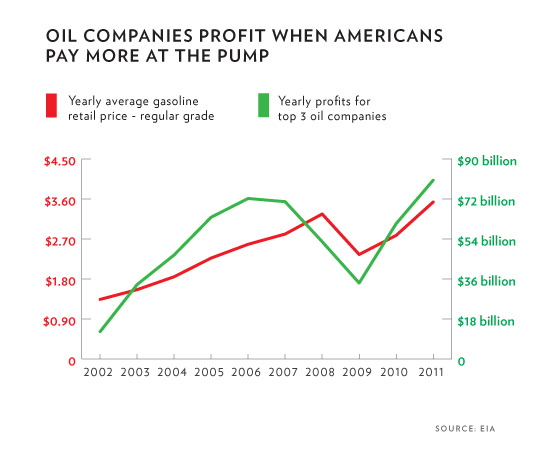
Congress "can either stand up for oil companies, or they can stand up for the American people," the President said in a recent Weekly Address. "They can either place their bets on a fossil fuel from the last century, or they can place their bets on America’s future."

Investing in an all-of-the-above energy strategy—one that relies on domestically produced oil and gas, clean renewable resources like wind and solar power, and new technologies that help us use less energy altogether—requires the putting the right incentives in place.

Instead of subsidizing the fossil fuels of the last century by giving away $4 billion of taxpayer money each year to oil companies that are more profitable than ever, we should be investing in a clean energy future—especially when gas prices are high and drivers, whose budgets are already stretched thin, are feeling the pain at the pump.

President Obama explained earlier this month in New Hampshire:

We want to have successful oil companies that are able to get the oil that we have in our country, but we also understand that our future requires us to make investments in clean, renewable energies.  And that has to start now.  We can’t wait.  We can’t wait until gas has skyrocketed more and people are desperate.  We need to start making those investments now.

Read more about the factors that go into high gas prices and why we need to take control of our energy future.