The White House

Office of the Press Secretary

Trilateral Announcement Between Mexico, the United States, and Canada on Nuclear Security

At the March 2012 Nuclear Security Summit in Seoul, South Korea, the Governments of Mexico, the United States, and Canada announced the completion of an important joint nuclear security project to convert the fuel in Mexico’s research reactor from highly enriched uranium (HEU) to low enriched uranium (LEU).  The project was initiated at the Nuclear Security Summit in Washington, D.C. in April 2010, and was carried out by the three countries, working closely with the International Atomic Energy Agency (IAEA). 
 
The full conversion of the reactor from the use of HEU to LEU fuel supports the goal of minimizing the use of HEU for civilian purposes. By converting its research nuclear reactor, Mexico contributes to non-proliferation.
 
President Calderón stated, “With this decision, Mexico reaffirms its commitment to building a world free of the nuclear threat. Each country must do its share to reach a safer North America and a safer planet. This is a clear example of the significant work we can do together in the North American region.”
 
This effort, which was conducted and completed under the auspices of the IAEA, benefited from the hard work and dedication of hundreds of individuals from all three countries and the IAEA, and it further strengthens nuclear security in North America.
 
President Obama stated, “I would like to thank Mexico, Canada and the IAEA for their support of our joint nuclear security efforts.  Our strong trilateral partnership, supported by the IAEA, has made our people safer and advanced our international nuclear security effort leading into the Seoul Summit.” 
 
Prime Minister Harper added that “The successful completion of this project demonstrates the concrete steps countries can collectively take in the context of the Nuclear Security Summit. We will continue to work with the United States and Mexico to enhance nuclear security in our region and worldwide.”
 
The conversion will not only extend the length of time the Mexican reactor can operate with LEU fuel, it also makes the reactor eligible for further program engagement under the IAEA.  With the provided fuel, Mexico’s National Institute for Nuclear Research (ININ) also has the potential to increase the reactor power output, which would greatly improve its capabilities for medical and industrial isotope production, silicon doping, neutron radiography, and nuclear physics research such as neutron activation analysis.

The White House

Office of the Press Secretary

Remarks by President Obama at Hankuk University

Seoul, Republic of Korea

10:32 A.M. KST
 
PRESIDENT OBAMA:  Thank you.  (Applause.)  Thank you so much.  Thank you.  (Applause.)  Please, thank you very much. 
 
To President Park, faculty, staff and students, thank you so much for this very warm welcome.  It is a great honor to be here at Hankuk University of Foreign Studies.  (Applause.)  I want to thank Dr. Park for, a few moments ago, making me an honorary alumni of the university.  (Applause.)
 
I know that this school has one of the world’s finest foreign language programs -- which means that your English is much better than my Korean.  (Laughter.)  All I can say is, kamsa hamnida.  (Applause.) 
 
Now, this is my third visit to the Republic of Korea as President.  I've now been to Seoul more times than any other capital -- except for Washington, D.C.,  of course.  This reflects the extraordinary bonds between our two countries and our commitment to each other.  I’m pleased that we’re joined by so many leaders here today, Koreans and Americans, who help keep us free and strong and prosperous every day.  That includes our first Korean-American ambassador to the Republic of Korea -- Ambassador Sung Kim.  (Applause.)   
 
I’ve seen the deep connections between our peoples in my own life -- among friends, colleagues.  I’ve seen it so many patriotic Korean Americans, including a man born in this city of Seoul, who came to America and has dedicated his life to lifting up the poor and sick of the world.  And last week I was proud to nominate him to lead the World Bank -- Dr. Jim Yong Kim.  (Applause.)  
 
I’ve also seen the bonds in our men and women in uniform, like the American and Korean troops I visited yesterday along the DMZ -- Freedom’s Frontier.  And we salute their service and are very grateful for them.  We honor all those who have given their lives in our defense, including the 46 brave souls who perished aboard the Cheonan two years ago today.  And in their memory we reaffirm the enduring promise at the core of our alliance -- we stand together, and the commitment of the United States to the defense and the security of the Republic of Korea will never waver.  (Applause.)
 
Most of all, I see the strength of our alliance in all of you.  For decades, this school has produced leaders -- public servants, diplomats, businesspeople -- who’ve helped propel the modern miracle that is Korea-- transforming it from crushing poverty to one of the world’s most dynamic economies; from authoritarianism to a thriving democracy; from a country focused inward to a leader for security and prosperity not only in this region but also around the world -- a truly “Global Korea.” 
 
So to all the students here today, this is the Korea your generation will inherit.  And I believe there's no limits to what our two nations can achieve together.  For like your parents and grandparents before you, you know that the future is what we make of it.  And you know that in our digital age, we can connect and innovate across borders like never before -- with your smart phones and Twitter and Me2Day and Kakao Talk.  (Laughter and applause.)  It’s no wonder so many people around the world have caught the Korean Wave, Hallyu.  (Applause.)
 
Or consider this:  In advance of my visit, our embassy invited Koreans to send us your questions using social media.  Some of you may have sent questions.  And they called it, "Ask President Obama."  Now, one of you -- maybe it was you, maybe it was somebody else -- this is true -- asked this question:  “Have you posted, yourself, a supportive opinion on a website under a disguised name, pretending you are one of the supporters of President Obama?”  (Laughter.)  I hadn’t thought of this.  (Laughter.)  But the truth is I have not done this.  Maybe my daughters have.  (Laughter.)  But I haven’t done that myself.
 
So our shared future -- and the unprecedented opportunity to meet shared challenges together -- is what brings me to Seoul.  Over the next two days, under President Lee’s leadership, we’ll move ahead with the urgent work of preventing nuclear terrorism by securing the world’s nuclear materials.  This is an important part of the broader, comprehensive agenda that I want to talk with you about today -- our vision of a world without nuclear weapons.
 
Three years ago, I traveled to Prague and I declared America’s commitment to stopping the spread of nuclear weapons and to seeking a world without them.  I said I knew that this goal would not be reached quickly, perhaps not in my lifetime, but I knew we had to begin, with concrete steps.  And in your generation, I see the spirit we need in this endeavor -- an optimism that beats in the hearts of so many young people around the world.  It’s that refusal to accept the world as it is, the imagination to see the world as it ought to be, and the courage to turn that vision into reality.  So today, with you, I want to take stock of our journey and chart our next steps.
 
Here in Seoul, more than 50 nations will mark our progress toward the goal we set at the summit I hosted two years ago in Washington -- securing the world’s vulnerable nuclear materials in four years so that they never fall into the hands of terrorists.  And since then, nations -- including the United States -- have boosted security at nuclear facilities. 
 
South Korea, Japan, Pakistan and others are building new centers to improve nuclear security and training.  Nations like Kazakhstan have moved nuclear materials to more secure locations.  Mexico, and just yesterday Ukraine, have joined the ranks of nations that have removed all the highly enriched uranium from their territory.  All told, thousands of pounds of nuclear material have been removed from vulnerable sites around the world.  This was deadly material that is now secure and can now never be used against a city like Seoul.
 
We’re also using every tool at our disposal to break up black markets and nuclear material.  Countries like Georgia and Moldova have seized highly enriched uranium from smugglers.  And countries like Jordan are building their own counter-smuggling teams, and we’re tying them together in a global network of intelligence and law enforcement.  Nearly 20 nations have now ratified the treaties and international partnerships that are at the center of our efforts.  And I should add that with the death of Osama bin Laden and the major blows that we’ve struck against al Qaeda, a terrorist organization that has actively sought nuclear weapons is now on the path to defeat.     
 
So in short, the international community has made it harder than ever for terrorists to acquire nuclear weapons, and that has made us all safer.  We’re building an international architecture that can ensure nuclear safety.  But we’re under no illusions.  We know that nuclear material, enough for many weapons, is still being stored without adequate protection.  And we know that terrorists and criminal gangs are still trying to get their hands on it -- as well as radioactive material for a dirty bomb.  We know that just the smallest amount of plutonium -- about the size of an apple -- could kill hundreds of thousands and spark a global crisis.  The danger of nuclear terrorism remains one of the greatest threats to global security.
 
And that's why here in Seoul, we need to keep at it.  And I believe we will.  We’re expecting dozens of nations to announce over the next several days that they’ve fulfilled the promises they made two years ago.  And we’re now expecting more commitments -- tangible, concrete action -- to secure nuclear materials and, in some cases, remove them completely.  This is the serious, sustained global effort that we need, and it's an example of more nations bearing the responsibility and the costs of meeting global challenges.  This is how the international community should work in the 21st century.  And Korea is one of the key leaders in this process.
 
The United States will continue to do our part -- securing our own material and helping others protect theirs.  We’re moving forward with Russia to eliminate enough plutonium for about 17,000 nuclear weapons and turn it instead into electricity.  I can announce today a new agreement by the United States and several European partners toward sustaining the supply of medical isotopes that are used to treat cancer and heart disease without the use of highly enriched uranium.  And we will work with industry and hospitals and research centers in the United States and around the world, to recover thousands of unneeded radiological materials so that they can never do us harm. 
 
Now, American leadership has been essential to progress in a second area -- taking concrete steps towards a world without nuclear weapons.  As a party to the Nuclear Nonproliferation Treaty, this is our obligation, and it’s one that I take very seriously.  But I believe the United States has a unique responsibility to act -- indeed, we have a moral obligation.  I say this as President of the only nation ever to use nuclear weapons.  I say it as a Commander-in-Chief who knows that our nuclear codes are never far from my side.  Most of all, I say it as a father, who wants my two young daughters to grow up in a world where everything they know and love can’t be instantly wiped out.
 
Over the past three years, we’ve made important progress.  With Russia, we’re now reducing our arsenal under the New START Treaty -- the most comprehensive arms control agreement in nearly 20 years.  And when we’re done, we will have cut American and Russian deployed nuclear warheads to their lowest levels since the 1950s.
 
As President, I changed our nuclear posture to reduce the number and role of nuclear weapons in our national security strategy.  I made it clear that the United States will not develop new nuclear warheads.  And we will not pursue new military missions for nuclear weapons.  We’ve narrowed the range of contingencies under which we would ever use or threaten to use nuclear weapons.  At the same time, I’ve made it clear that so long as nuclear weapons exist, we’ll work with our Congress to maintain a safe, secure and effective arsenal that guarantees the defense not only of the United States but also our allies -- including South Korea and Japan.
 
My administration’s nuclear posture recognizes that the massive nuclear arsenal we inherited from the Cold War is poorly suited to today’s threats, including nuclear terrorism.  So last summer, I directed my national security team to conduct a comprehensive study of our nuclear forces.  That study is still underway.  But even as we have more work to do, we can already say with confidence that we have more nuclear weapons than we need.  Even after New START, the United States will still have more than 1,500 deployed nuclear weapons, and some 5,000 warheads. 
 
I firmly believe that we can ensure the security of the United States and our allies, maintain a strong deterrent against any threat, and still pursue further reductions in our nuclear arsenal.
 
Going forward, we’ll continue to seek discussions with Russia on a step we have never taken before -- reducing not only our strategic nuclear warheads, but also tactical weapons and warheads in reserve.  I look forward to discussing this agenda with President Putin when we will meet in May.  Missile defense will be on the agenda, but I believe this should be an area of cooperation, not tension.  And I’m confident that, working together, we can continue to make progress and reduce our nuclear stockpiles.  Of course, we’ll consult closely with our allies every step of the way, because the security and defense of our allies, both in Europe and Asia, is not negotiable.   
 
Here in Asia, we've urged China -- with its growing nuclear arsenal -- to join us in a dialogue on nuclear issues.  That offer remains open.  And more broadly, my administration will continue to pursue ratification of the Comprehensive Test Ban Treaty.  And after years of delay, it’s time to find a path forward on a new treaty that verifiably ends the production of fissile materials for nuclear weapons -- ends it once and for all.
 
By working to meet our responsibilities as a nuclear power, we’ve made progress in a third area -- strengthening the global regime that prevents the spread of nuclear weapons.  When I came into office, the cornerstone of the world’s effort -- which is the Nuclear Non-Proliferation Treaty -- was fraying.  Iran had started spinning thousands of centrifuges.  North Korea conducted another nuclear test.  And the international community was largely divided on how to respond.
 
Over the past three years, we have begun to reverse that dynamic.  Working with others, we’ve enhanced the global partnership that prevent proliferation.  The International Atomic Energy Agency is now conducting the strongest inspections ever.  And we’ve upheld the basic bargain of the NPT:  Countries with nuclear weapons, like the United States and Russia, will move towards disarmament; countries without nuclear weapons will not acquire them; and all countries can have access to peaceful nuclear energy. 
 
Because of these efforts, the international community is more united and nations that attempt to flout their obligations are more isolated.  Of course, that includes North Korea. 
 
Here in Korea, I want to speak directly to the leaders in Pyongyang.  The United States has no hostile intent toward your country.  We are committed to peace.  And we are prepared to take steps to improve relations, which is why we have offered nutritional aid to North Korean mothers and children. 
 
But by now it should be clear, your provocations and pursuit of nuclear weapons have not achieved the security you seek; they have undermined it.  Instead of the dignity you desire, you're more isolated.  Instead of earning the respect of the world, you've been met with strong sanctions and condemnation.  You can continue down the road you are on, but we know where that leads.  It leads to more of the same -- more broken dreams, more isolation, ever more distance between the people of North Korea and the dignity and the opportunity that they deserve. 
 
And know this:  There will be no rewards for provocations.  Those days are over.  To the leaders of Pyongyang I say, this is the choice before you.  This is the decision that you must make.  Today we say, Pyongyang, have the courage to pursue peace and give a better life to the people of North Korea.  (Applause.)
 
This same principle applies with respect to Iran.  Under the NPT, Iran has the right to peaceful nuclear energy.  In fact, time and again the international community -- including the United States -- has offered to help Iran develop nuclear energy peacefully.  But time and again Iran has refused, instead taking the path of denial, deceit and deception.  And that is why Iran also stands alone, as the only member of the NPT unable to convince the international community that its nuclear program is for peaceful purposes -- the only member.  That’s why the world has imposed unprecedented sanctions, slowing Iran’s nuclear program. 
 
The international community is now poised to enter talks with Iran’s leaders.  Once again, there is the possibility of a diplomatic resolution that gives Iran access to peaceful nuclear energy while addressing the concerns of the international community.  Today, I’ll meet with the leaders of Russia and China as we work to achieve a resolution in which Iran fulfills its obligations. 
 
There is time to solve this diplomatically.  It is always my preference to solve these issues diplomatically.  But time is short.  Iran’s leaders must understand they, too, face a choice. Iran must act with the seriousness and sense of urgency  that this moment demands.  Iran must meet its obligations. 
 
For the global response to Iran and North Korea’s intransigence, a new international norm is emerging:  Treaties are binding; rules will be enforced; and violations will have consequences.  We refuse to consign ourselves to a future where more and more regimes possess the world’s most deadly weapons.
 
And this brings me to the final area where we’ve made progress -- a renewed commitment to harnessing the power of the atom not for war, but for peaceful purposes.  After the tragedy at Fukushima, it was right and appropriate that nations moved to improve the safety and security of nuclear facilities.  We’re doing so in the United States.  It’s taking place all across the world.
 
As we do, let’s never forget the astonishing benefits that nuclear technology has brought to our lives.  Nuclear technology helps make our food safe.  It prevents disease in the developing world.  It’s the high-tech medicine that treats cancer and finds new cures.  And, of course, it’s the energy -- the clean energy that helps cut the carbon pollution that contributes to climate change.  Here in South Korea, as you know, as a leader in nuclear energy, you’ve shown the progress and prosperity that can be achieved when nations embrace peaceful nuclear energy and reject the development of nuclear arms.
 
And with rising oil prices and a warming climate, nuclear energy will only become more important.  That’s why, in the United States, we’ve restarted our nuclear industry as part of a comprehensive strategy to develop every energy source.  We supported the first new nuclear power plant in three decades.  We’re investing in innovative technologies so we can build the next generation of safe, clean nuclear power plants.  And we’re training the next generation of scientists and engineers who are going to unlock new technologies to carry us forward.
 
One of the great challenges they’ll face and that your generation will face is the fuel cycle itself in producing nuclear energy.  We all know the problem:  The very process that gives us nuclear energy can also put nations and terrorists within the reach of nuclear weapons.  We simply can’t go on accumulating huge amounts of the very material, like separated plutonium, that we’re trying to keep away from terrorists. 
 
And that’s why we’re creating new fuel banks, to help countries realize the energy they seek without increasing the nuclear dangers that we fear.  That’s why I’ve called for a new framework for civil nuclear cooperation.  We need an international commitment to unlocking the fuel cycle of the future.  In the United States we’re investing in the research and development of new fuel cycles so that dangerous materials can’t be stolen or diverted.  And today I urge nations to join us in seeking a future where we harness the awesome power of the atom to build and not to destroy.
 
In this sense, we see how the efforts I’ve described today reinforce each other.  When we enhance nuclear security, we’re in a stronger position to harness safe, clean nuclear energy.  When we develop new, safer approaches to nuclear energy, we reduce the risk of nuclear terrorism and proliferation.  When nations, including my own, fulfill our responsibilities, it strengthens our ability to ensure that other nations fulfill their responsibilities.  And step by step, we come closer to the security and peace of a world without nuclear weapons.
 
I know that there are those who deride our vision.  There are those who say ours is an impossible goal that will be forever out of reach.  But to anyone who doubts the great progress that is possible, I tell them, come to Korea.  Come to this country, which rose from the ashes of war -- (applause) -- a country that rose from the ashes of war, turning rubble into gleaming cities.  Stand where I stood yesterday, along a border that is the world’s clearest contrast between a country committed to progress, a country committed to its people, and a country that leaves its own citizens to starve. 
 
Come to this great university, where a new generation is taking its place in the world -- (applause) -- helping to create opportunities that your parents and grandparents could only imagine.  Come and see some of the courageous individuals who join us today -- men and women, young and old, born in the North, but who left all they knew behind and risked their lives to find freedom and opportunity here in the South.  In your life stories we see the truth -- Koreans are one people.  And if just given the chance, if given their freedom, Koreans in the North are capable of great progress as well.  (Applause.)
 
Looking out across the DMZ yesterday, but also looking into your eyes today, I’m reminded of another country’s experience that speaks to the change that is possible in our world.  After a terrible war, a proud people was divided.  Across a fortified border, armies massed, ready for war.  For decades, it was hard to imagine a different future.  But the forces of history and hopes of man could not be denied.  And today, the people of Germany are whole again -- united and free.  
 
No two places follow the same path, but this much is true:  The currents of history cannot be held back forever.  The deep longing for freedom and dignity will not go away.  (Applause.) So, too, on this divided peninsula.  The day all Koreans yearn for will not come easily or without great sacrifice.  But make no mistake, it will come.  (Applause.)  And when it does, change will unfold that once seemed impossible.  And checkpoints will open and watchtowers will stand empty, and families long separated will finally be reunited.  And the Korean people, at long last, will be whole and free.
 
Like our vision of a world without nuclear weapons, our vision of a Korea that stands as one may not be reached quickly.  But from this day until then, and all the days that follow, we take comfort in knowing that the security we seek, the peace we want, is closer at hand because of the great alliance between the United States and the Republic of Korea -- (applause) -- and because we stand for the dignity and freedom of all Koreans.  (Applause.)  And no matter the test, no matter the trial, we stand together.  We work together.  We go together.  (Applause.)
Katchi kapshida! 
 
Thank you very much.  (Applause.)
 
END               
11:03 A.M. KST
 

President Obama's Bilateral Meeting with Prime Minister Erdogan of Turkey

March 25, 2012 | 14:25 | Public Domain

President Obama and Prime Minister Recep Tayyip Erdogan of Turkey speak to the press after a bilateral meeting.

Download mp4 (138MB) | mp3 (33MB)

Read the Transcript

Remarks by President Obama and Prime Minister Erdogan of Turkey after Bilateral Meeting

Grand Hyatt Hotel

Seoul, Republic of Korea

4:49 P.M. KST

PRESIDENT OBAMA:  I just want to say how much I appreciate the opportunity to once again meet with my friend and colleague, Prime Minister Erdogan.  I think it's fair to say that over the last several years, the relationship between Turkey and the United States has continued to grow across every dimension.  And I find Prime Minister Erdogan to be an outstanding partner and an outstanding friend on a wide range of issues.

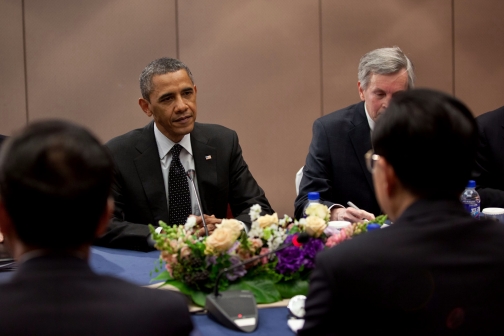
We devoted a lot of this meeting to the issue of Syria, where the United States and Turkey have worked with a broad-based coalition, an international coalition of countries in the region, as well as around the world, who deeply object to the killings that have been taking place in Syria and are absolutely committed to trying to help those innocent civilians who are being killed by the Assad regime.  And we are very much in agreement that there should be a process whereby a transition to a representative and legitimate government in Syria takes place.

So I expressed my thanks for Turkey hosting the next "Friends of Syria" meeting.  And we worked on a common agenda in terms of how we can support both humanitarian efforts, political efforts, the efforts of Kofi Annan to bring about much needed change inside of Syria.  And not only Prime Minister Erdogan but his entire team has shown outstanding leadership on this critical issue.

We also had the opportunity to discuss the issue of Iran and its nuclear program.  I expressed to the Prime Minister once again that I believe there is a window of time to resolve this question diplomatically, but that window is closing.  And it's absolutely critical for us to be able to move forward in an effective way, in a serious way, in concert based on negotiations through the P5-plus-1 and other channels, to ensure that Iran abides by its international obligations, which also then assures them the right to engage in peaceful nuclear power.  I very much appreciate the Prime Minister's insights obviously as a neighbor of Iran and as someone who is interested in seeing this issue resolved in a peaceful fashion.

Beyond those two specific issues, we had a wide-ranging conversation about our continued support of counterterrorism efforts, including the efforts that are taking place in Turkey with respect to the PKK.  We are very supportive of making sure that the kinds of terrorist attacks that we've seen in the past are not occurring.  I congratulated the Prime Minister on the efforts that he's made within Turkey to protect religious minorities.  I am pleased to hear of his decision to reopen the Halki Seminary. 

We discussed our joint NATO efforts, and I look forward to welcoming him to my hometown of Chicago to discuss the transition process in Afghanistan, to provide support for an effort within Afghanistan so that they can provide for their own security and a stable government that's representative of its people and provides them with opportunity and prosperity.

And we discussed some of the important humanitarian efforts that are being made jointly in places like Somalia.

So the bottom line is that we find ourselves in frequent agreement upon a wide range of issues.  Our discussions are frank and honest, and I very much appreciate our collaboration.  And I also appreciate the advice he gives me, because he has two daughters that are a little older than mine -- they've turned out very well, so I'm always interested in his perspective on raising girls.

PRIME MINISTER ERDOGAN:  (As interpreted.)  My dear friend, Barack, thank you very much for a very fruitful meeting today.  The first topic that we discussed was Syria.  We extensively evaluated the situation in Syria.  Of course for a country like Turkey, which has a border of 910 kilometers with Syria, the events that are taking place in Syria is very close to us, and we feel it in our hearts and we’re very encouraged to see some of the developments.

Our country has become a center of migration in that more than 17,000 people have had to come over from the Syrian side to Turkey as a result of the events in Syria.  And we also see significant number of people who are killed, and there seems to be continuous action in terms of bombing and burning cities and settlement areas by headquarters and the need to do more of this. 

And of course, as human beings, people with conscience, we cannot remain a spectator to these developments, which are things that we have to be doing something about within the framework of international law.  And I’m also very pleased to see that our views in general very much overlap on this subject. 

We’ve also had an opportunity to talk about, with respect to Syria again, developments in the region -- Iran, Russia, and China, in that context. 

On my return from South Korea I will be visiting Iran, specifically on the issue of Syria.  And I was hoping that we would have a chance to discuss that aspect as well, which we did today.  And there are also developments in Iran which were important which we wanted to discuss, and those have also been discussed in our meeting. 

We discussed about developments in Iraq to see how we can create greater impetus towards greater peace in Iraq.  And I’m hoping that all efforts will in the end help contribute to greater peace in Iraq.

We’re also very pleased to see the United States standing with us in our fight against the separatist terrorist organization.  Our fight against the separatist terrorist organization will continue, but we also have to have discussions with the political extension of this organization.

We also had a chance to evaluate the situation with respect to Cyprus.  Our hope is that we can achieve the desired future for Cyprus sooner. 

A very, very important point has been that from the moment Barack became President we upgraded the status of our relations from a strategic partnership to a model partnership, which he also placed a lot of importance on. 

A second meeting after the first one that was held in Washington will be held in Turkey in June this year to talk about those relations, which, in turn, in my opinion, will also lead to a significant increase once again for those relations.

And I also told you about my daughters.

Thank you.

END                5:03 P.M. KST


Close Transcript

President Obama in South Korea

Just after midnight on Saturday morning, President Obama boarded Air Force One and departed for a trip to South Korea. After crossing the International Date Line, he arrived in Seoul for a nuclear security summit. 

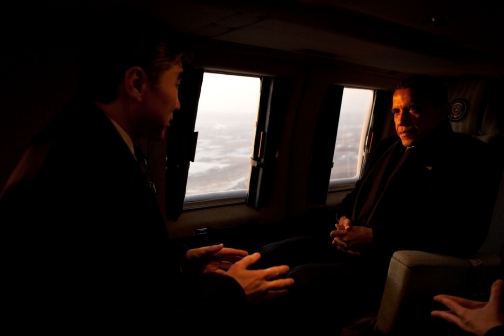
  • President Barack Obama Talks With Ambassador Sung Kim

    President Obama talks with U.S. Ambassador to Republic of Korea Sung Kim aboard Marine One, March 25, 2012. (Official White House Photo by Pete Souza)

    1 of 29
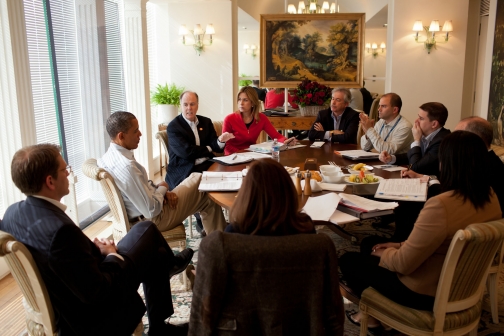
  • President Barack Obama Meets With Senior Staff

    President Obama meets with senior staff in Seoul, Republic of Korea, March 25, 2012. (Official White House Photo by Pete Souza)

    2 of 29
  • President Barack Obama Greets Troops

    President Barack Obama greets troops the dining hall at Camp Bonifas, Republic of Korea, March 25, 2012. (Official White House Photo by Pete Souza)

    3 of 29
  • President Barack Obama Signs A Bar

    President Obama signs a bar in the dining hall at Camp Bonifas, Republic of Korea,March 25, 2012. (Official White House Photo by Pete Souza)

    4 of 29
  • President Barack Obama Is Briefed By Lt. Col. Ed Taylor

    President Obama is briefed by Lt. Col. Ed Taylor at Camp Bonifas, Republic of Korea, March 25, 2012. (Official White House Photo by Pete Souza)

    5 of 29
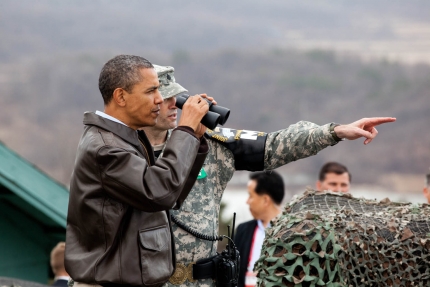
  • President Barack Obama Uses Binoculars To View The DMZ

    President Obama uses binoculars to view the DMZ at Camp Bonifas, March 25, 2012. (Official White House Photo by Pete Souza)

    6 of 29
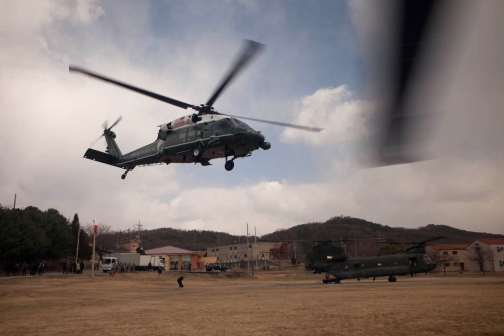
  • Marine One Departs Camp Bonifas

    Marine One departs Camp Bonifas en route to Seoul, Republic of Korea, March 25, 2012. (Official White House Photo by Chuck Kennedy)

    7 of 29
  • President Barack Obama Talks With Prime Minister Recep Tayyip Erdoğan

    President Obama talks with Prime Minister Recep Tayyip Erdoğan of Turkey, March 25, 2012. (Official White House Photo by Pete Souza)

    8 of 29
  • President Barack Obama And President Lee Myung-bak Walk Down The Grand Staircase

    President Obama and President of Republic of Korea Myung-bak after their bilateral meeting, March 25, 2012. (Official White House Photo by Pete Souza)

    9 of 29
  • President Barack Obama Is Briefed Before A Press Conference

    President Obama is briefed before a conference with the President of Republic of Korea, March 25, 2012. (Official White House Photo by Pete Souza)

    10 of 29
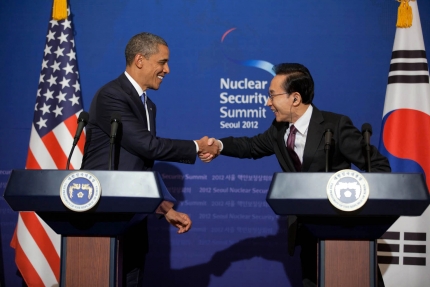
  • President Barack Obama And President Lee Myung-bak Shake Hands

    President Obama and President of Republic of Korea Lee Myung-bak shake hands, March 25, 2012. (Official White House Photo by Pete Souza)

    11 of 29
  • President Obama Gestures at the Working Dinner at the Spring House

    President Obama gestures before the start of a working dinner at the Spring House in Seoul, March 25, 2012. (Official White House Photo by Pete Souza)

    12 of 29
  • President Barack Obama Delivers Remarks At Hankuk University Of Foreign Studies

    President Obama delivers remarks at Hankuk University of Foreign Studies in Seoul, March 26, 2012. (Official White House Photo by Pete Souza)

    13 of 29
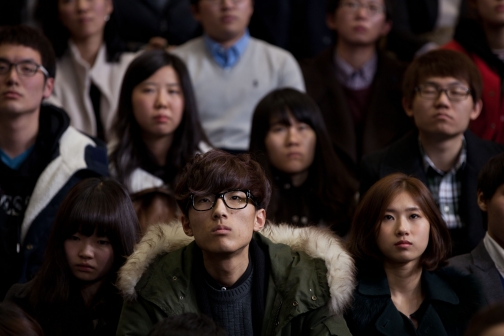
  • Students Listen As President Barack Obama Delivers Remarks

    Students listen as President Obama delivers remarks at Hankuk University in Seoul, March 26, 2012. (Official White House Photo by Pete Souza)

    14 of 29
  • President Barack Obama Greets Members Of The Audience

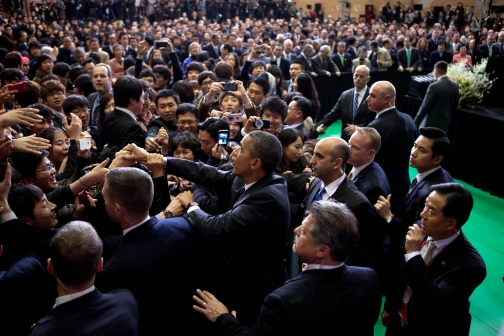
    President Obama greets members of the audience following his remarks at Hankuk University, March 26, 2012. (Official White House Photo by Pete Souza)

    15 of 29
  • President Barack Obama Talks With President Dmitry Medvedev

    President Obama and President Medvedev of the Russian Federation in a bilateral meeting, March 26, 2012. (Official White House Photo by Pete Souza)

    16 of 29
  • President Barack Obama And President Dmitry Medvedev Of The Russian Federation Exchange Gifts

    President Obama and President Medvedev of the Russian Federation exchange gifts, March 26, 2012. (Official White House Photo by Pete Souza)

    17 of 29
  • President Barack Obama And President Hu Jintao

    President Obama and President Jintao of China participate in a bilateral meeting, March 26, 2012. (Official White House Photo by Pete Souza)

    18 of 29
  • President Barack Obama As He Arrives At The Coex Center

    Vic Erevia, U.S. Secret Service Special-Agent-in-Charge, holds the door for President Obama, March 27, 2012.(Official White House Photo by Pete Souza)

    19 of 29
  • President Barack Obama Jokingly Covers The Microphone

    President Obama jokingly covers the microphone before the Nuclear Security Summit, March 27, 2012. (Official White House Photo by Pete Souza)

    20 of 29
  • President Barack Obama Talks With Staff

    President Obama talks with Press Secretary Carney, Dan Pfeiffer, and Ben Rhodes, March 27, 2012. (Official White House Photo by Pete Souza)

    21 of 29
  • Flags for the Family Photo

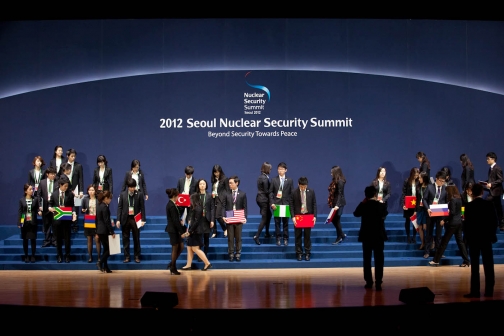
    Flags are held as place holders for heads of delegation before the family photo, March 27, 2012. (Official White House Photo by Pete Souza)

    22 of 29
  • President Obama Nuclear Security Summit Family Photo

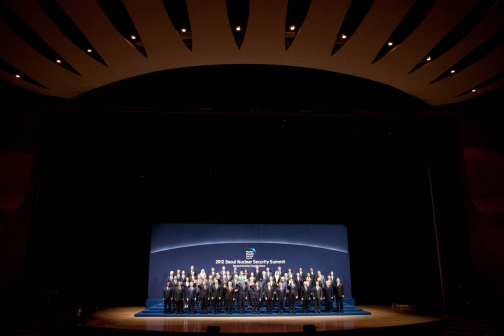
    President Obama joins other heads of delegations for the Nuclear Security Summit photo, March 27, 2012. (Official White House Photo by Pete Souza)

    23 of 29
  • President Barack Obama Walks With President Nursultan Nazarbayev And President Dmitry Medvedev

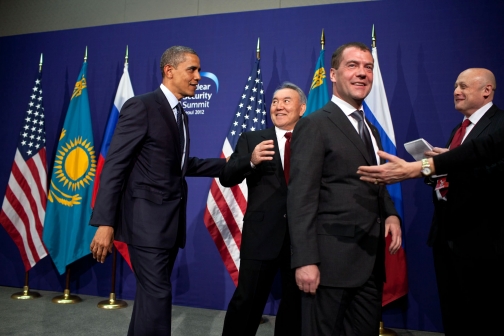
    President Obama with President Nazarbayev of Kazakhstan and President Medvedev of Russia, March 27, 2012. (Official White House Photo by Pete Souza)

    24 of 29
  • President Barack Obama Talks With National Security Advisor Tom Donilon

    President Obama talks with National Security Advisor Tom Donilon, March 27, 2012. (Official White House Photo by Pete Souza)

    25 of 29
  • President Barack Obama Talks With President Viktor Yanukovych

    President Obama in a bilateral meeting with Prime Minister Gillani of Pakistan, March 27, 2012. (Official White House Photo by Pete Souza)

    26 of 29
  • President Barack Obama Meets With Prime Minister Yousaf Raza Gillani Of Pakistan

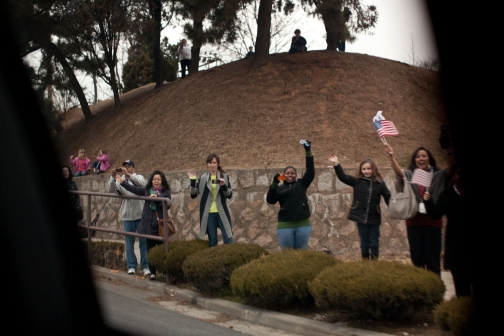
    People wave along President Obama's motorcade route, March 27, 2012. (Official White House Photo by Pete Souza)

    27 of 29
  • People Wave Along President Barack Obama's Motorcade Route

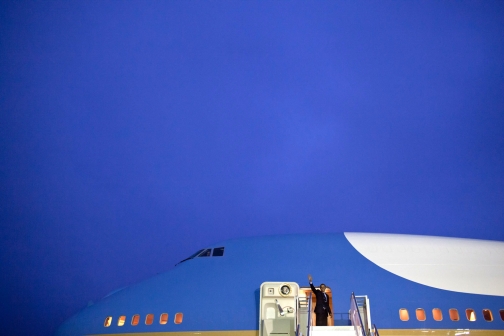
    President Obama waves before boarding Air Force One at Osan Air Base, March 27, 2012. (Official White House Photo by Pete Souza)

    28 of 29
  • President Barack Obama Waves From The Top Of The Stairs
    29 of 29

As part of the trip, the President today got a first hand view of North Korea as he toured to the DMZ and met with U.S. troops stationed on the border. He told the servicemen and women, "Everybody back home could not be prouder of what you guys do each and every day -- the dedication, the professionalism that you show." 

President Obama views the DMZ (March 25, 2012)

President Barack Obama is briefed by Lt. Col. Ed Taylor as he views the DMZ from Observation Post Ouellette at Camp Bonifas, Republic of Korea, March 25, 2012. (Official White House Photo by Chuck Kennedy)

The President also kicked off the three days of diplomacy with a pair of bilateral meetings -- with President Lee Myung-bak of South Korea and Prime Minister Erdogan or Turkey. 

President Barack Obama and President Lee Myung-bak (March 25, 2012)

President Barack Obama and President Lee Myung-bak participate in a press conference at the Blue House in Seoul, Republic of Korea, March 25, 2012. (Official White House Photo by Chuck Kennedy)

President Obama and President Lee Hold a News Conference

March 25, 2012 | 40:28 | Public Domain

President Obama and President Lee Myung-bak hold a press conference after discussing North Korea's nuclear weapons development, bilateral trade, and other issues of mutual interest.

Download mp4 (386MB) | mp3 (93MB)

Read the Transcript

Remarks by President Obama and President Lee Myung-bak in Joint Press Conference

Blue House

Seoul, Republic of Korea


6:44 P.M. KST

PRESIDENT LEE:  (As interpreted.)  I apologize for running a little late, ladies and gentlemen. 

Mr. President, distinguished members of the press, it's good to see my good friend again.  The last time we met was four months ago.  Welcome to Korea, Mr. President. 

And I wish to thank you, Mr. President, for taking time to visit the DMZ early this morning, soon after your arrival in Seoul.  Mr. President, I'm sure it was a chance to witness firsthand the reality of division that has been a part of Korea for such a long time.  And I gather you had a good time meeting with the members of the armed forces from both Korea and the United States.  And thank you for the encouragement that you gave these men and women in uniform.

Today, ladies and gentlemen, we had a very useful and constructive discussion on a wide array of issues from North Korea's nuclear and missile development and including other security issues, and also how to promote bilateral trade between our two countries, and of course, other topics of mutual interest.

And we talked about the security situation in the region and the situation on the Korean Peninsula, and agreed to continue working closely together in implementing our North Korea policy. Both countries agreed that North Korea's announcement to test-fire its long-range missile is a violation of U.N. Security Council resolutions, not to mention the latest agreement between the U.S. and North Korea.  Therefore President Obama and I both agreed that North Korea must immediately repeal its decision and abide by its international obligations. 

President Obama and I agreed that we will continue to enhance and strengthen our combined defense capabilities, and at the same time, firmly respond to any threats or provocations from the North.  If North Korea gives up its pursuit of nuclear weapons and missile development, and instead chooses a path towards peace and cooperation, our two countries will work together, along with the international community, to help improve the lives of the people in North Korea and provide necessary assistance that will help North Korea open up a new era.

And we reaffirmed the value and importance of our enduring alliance and discussed a future vision of our partnership. Following the adoption of the future vision of the alliance, which was adopted in June 2009, our alliance is evolving into a truly global partnership where we are working shoulder to shoulder to resolve global challenges.

Furthermore, we reviewed the progress being made in our alliance, a chance to transfer of OPCON two-plus-two security consultations, and agree that we will strengthen our deterrence capabilities through enhanced policy coordination, and strive towards a future-oriented alliance. 

Ladies and gentlemen, we will also work together so that the KORUS FTA that came into effect last March 15th will fulfill its goal, that is creating jobs for our workers, expand trade and investments, and overall improve the lives of our peoples.  And accordingly, in order to ensure the faithful implementation of the KORUS FTA, we will establish a ministerial-level joint committee, as previously agreed, and check upon the progress.

President Obama and I also exchanged views on the state of the global economy and shared our concern regarding the uncertainties that still remain.  In particular, we share the concern that rising oil prices is an obstacle to speedy recovery of the global economy, and agree that international cooperation needed to be further strengthened to bring about stability in the world oil market.

And of course we also talked about regional issues -- issues in the Middle East, Afghanistan, and other issues, including Iran, and how we can strengthen international cooperation to bring about a resolution to these issues.

I welcome President Obama once again on his visit.  The Nuclear Security Summit was President Obama’s initiative born out of his vision to leave behind a safer, more prosperous world for the future generation.  And we will continue to strive together to achieve a world without nuclear weapons.  I thank him and his team for all the help in ensuring a successful Nuclear Security Summit meeting.

Thank you.

PRESIDENT OBAMA:  Well, good evening, everyone.  Thank you to my good friend and partner, President Lee, for your very kind words.  And thank you, to the people of Korea, for your gracious welcome.  This is my third visit to the Republic of Korea as President.  It is wonderful to be back.  And once again, I’m grateful for the hospitality. 

This visit reflects the extraordinary friendship between our two people.  My wife and I were proud to help strengthen those ties when we had the honor of hosting President Lee and First Lady Kim for a state visit at the White House last fall.  And during that visit I learned a Korean word that I believe captures the deep affection between our people -- jeong.  And I feel that spirit again today.

My visits to Korea reflect the leadership role that South Korea is playing in this region and around the world -- a "Global Korea.”  I was last here for the G20, which was a success under President Lee’s leadership.  Now we’re back, along with more than 50 world leaders, for the second Nuclear Security Summit. 

In fact, just today we saw another important step forward.  We learned that Ukraine completed the removal of highly enriched uranium from its territory.  This fulfills a commitment Ukraine made at our last Nuclear Security Summit in Washington, and I believe it’s a preview of the kind of progress we’re going to see over the next two days in confronting one of the most urgent challenges of global security -- securing the world’s nuclear weapons and preventing nuclear terrorism.

My visit to Korea also reflects the enduring strength of our alliance.  My last visit to Seoul came as we marked both the 60th anniversary of the Korean War and Veterans Day.  And today I traveled, as President Lee mentioned, to the DMZ to thank our men and women in uniform, American and Korean, who serve shoulder to shoulder.  They’re the reason that we can stand here free today, and prosperous here today.  And we salute them all.

My visit to Korea reflects the fact that the United States is leading again in the Asia Pacific -- a region that will affect American security and prosperity in the 21st century like no other.  As I declared in Australia last year, the United State as a Pacific nation will play a larger and long-term role in shaping this region and its future.  And the cornerstone of our efforts is our strong alliances, including our alliance with the Republic of Korea. 

This is the context for our meeting today.  And as President Lee indicated, we had a very good discussion on a wide range of issues.  We reviewed our ongoing efforts to modernize our security alliance.  We agreed to have our foreign and defense ministers meet in June to discuss concrete measures we can take to continue strengthening that alliance.  We’re on track for South Korea to assume operational control for the alliance in 2015. 

I reaffirmed, as I said in Australia, that reductions in U.S. defense spending will not come at the expense of the Asia Pacific -- and that includes South Korea.  America’s armed forces are going to stay ready for the full range of contingencies and threats.  And the alliance between the United States and the Republic of Korea remains unshakable.

We reviewed our great progress in bringing our economies even closer.  During my last visit to Seoul we pledged to get our landmark trade agreement done.  On President Lee’s visit to Washington, it passed our Congress.  On this visit, we can say that our trade agreement is now in force.  We got it done.  This is a win for both of our countries -- more jobs and opportunities for our workers and businesses on both sides of the Pacific.  That includes supporting some 70,000 American jobs and keeping us on track to meet my goal of doubling American exports. 

We discussed regional security, and that obviously includes the issue of North Korea.  Last month, North Korea agreed to a series of steps, including a moratorium on long-range missile launches. This month, North Korea announced its intention to conduct a missile launch.  As President Lee mentioned, this would constitute a direct violation of Pyongyang’s own commitments and its international obligations.  Moreover, it would only deepen North Korea’s isolation, damage further its relations with its neighbors, and seriously undermine the prospect of future negotiations. 

I’ll have more to say in my speech tomorrow about our commitment to security and peace on the Korean Peninsula and the choice Pyongyang must make.  Today, I’ll simply say that North Korea will achieve nothing by threats or by provocations.  North Korea knows its obligations, and it must take irreversible steps to meet those obligations.  On this, the United States and the Republic of Korea are absolutely united.

Since South Korea is one of our key global partners, we discussed a range of challenges to international security.  I again want to thank South Korea for its important contributions to reconstruction in Afghanistan, and I updated the President on our preparations for the NATO summit in Chicago, where we will chart the next phase of the transition to Afghan lead. 

And I also thanked the President for South Korea’s strong support of sanctions on Iran because its failure to meet its international obligations.  I know this decision does not come without costs, both to the Republic of Korea, as well as our own country, but the prospects of an Iran with nuclear weapons would be a threat to the world, and this is one more example of South Korea stepping up and playing a leadership role on the world stage.

And finally, we’re deepening the ties between our people.  We agreed to expand educational exchanges, which will give more Korean students the opportunity to study in the United States, which benefits both of our countries. 

So once again, President Lee, I thank you for your hospitality, for your leadership.  Our alliance is strong.  Our commitment to the security and prosperity of our people is unwavering.  And I’m confident that under South Korea’s leadership, the Nuclear Security Summit is going to be a great success.  

PRESIDENT LEE:  Thank you.  (Applause.) 

We will now take questions from the press.

Q    A question going out to President Lee.  As predicted, you just explained that you and President Obama discussed the issue of North Korea’s impending rocket launch.  But despite the international community’s warnings, how will you respond if North Korea goes ahead and test-fires its long-range missile?  What will Korea do?  What kind of sanctions are you planning to impose on North Korea?  And could you explain the status of the negotiations regarding extending the missile range of South Korea? 

 In a recent press interview you spoke about the fact that discussions are proceeding between the U.S. and Korea regarding extending the missile range of South Korea.  Can you explain the status of the negotiations?

PRESIDENT LEE:  Thank you.  You asked about North Korea’s impending launch of its long-range missile, and let me just reiterate once again, ladies and gentlemen, if North Korea goes ahead with its plan to test-launch its long-range missile, this is a clear violation of U.N. Security Council Resolution 1874.  North Korea, if it goes ahead with its plan, will be going straight against its pledges that it made with the international community.

The international community is urging the North Koreans to repeal its announcement to test-fire its long-range missile.  Now, your question was, how are we going to respond?  I just want to answer that question by saying that if North Korea goes ahead with it, North Korea must be the sole country to bear the entire responsibility.  As President Obama just mentioned, if it goes ahead with its plan it will only deepen its isolation and all the consequences North Korea will have to face. 

And from the perspective of the people of North Korea, they will understand that its leader is spending hundreds of millions of dollars just to launch a long-range missile.  And watching their leader do so, they’re not going to feel proud that their country was able to launch a long-range missile, but rather they will get -- surely understand the nature of their leaders, and understand why they have to go through such hardships today.

Domestically, I’m sure the North Korean leaders are hoping to achieve some sort of -- an objective by test-launching its long-range missile.  But they must clearly understand that if they go ahead with the plan that they will put themselves in a very difficult position.  I urge the North Koreans to come out as a responsible member of the international community, and that is the surest way to ensure a better life for the people of North Korea.

In this regard, there is no difference of opinion between the U.S. and South Korea.  We'll remain very calm and rational and we will be wise in dealing with the North Koreans if in fact they do go ahead with their announcement.

You asked about extending the missile range of South Korea. We did not discuss that issue.  Of course, working-level officials have been discussing this issue.  But you have to look at this from a more holistic framework in that extending the missile range is part of increasing and enhancing our defense capabilities vis-à-vis North Korea. 

Q    Good evening.  President Obama, President Lee, thank you for the question.  I would like to follow up on the North Korean threat on two fronts.  The first is to follow up on the question my colleague had.  Could you be more specific, from your perspective, what the consequences would be that you would bring to bear on North Korea should there be a rocket launch, in terms of the overall relationship, but also specifics, such as food aid and negotiations?

And also, I’m wondering, sir, if you could give us some insight about whether you’ve developed an impression of North Korea’s new leader, and whether you’ve been able to yet take a measure of the man.

And to President Lee, good to see you again.  I wanted to ask you about the Nuclear Security Summit.  Can you explain how it would have any true and lasting credibility when the two major antagonists of North Korea and Iran are on the sidelines?

 PRESIDENT OBAMA:  Well, first of all, with respect to the consequences should there be a launch by the North Koreans -- as President Lee indicated, North Korea is already under an extraordinary battery of sanctions.  They are the most isolated country in the world.  They are cut off from basic commerce and exchanges beyond their borders that every other country -- almost every other country takes for granted.

Their people are extraordinarily impoverished.  The contrast between living standards in the North and living standards in the South could not be greater, and couldn’t be a greater testimony to the benefits of living in a free society.

And so the real consequence, should they go forward with a launch, is they will have missed an opportunity, because what we presented to them, and what we’ve consistently presented to them, is an opportunity for them to take a different path than the one they’ve been taking, which is resulting in not simply hardship for their people, but a state that is decades behind their counterparts in the region in terms of development, in terms of economic strength, in terms of influence in world affairs.

And so immediate, concrete, tangible effects -- we had offered them the possibility, as part of a series of confidence-building measures to move forward with a nutritional aid package, for example.  We’ve indicated to them very directly -- because this was part of discussions that had taken place among negotiators -- that it would be difficult to move forward with that package if they show themselves unable to make commitments that they’ve made even a month earlier.  Because part of the challenge for any nutrition aid package, for example, is that you makes sure it actually gets to the people who need it, and it doesn’t go to serve elites in that country or their military.  That requires monitors.  It’s very difficult to have monitors at a period of tension and friction.  And it is difficult to provide aid if you don’t think that it’s going to get to the people who actually need it.  So that’s just one example of the kinds of consequence that will take place.

I’ll also note that every time North Korea has violated international resolution, the Security Council resolution, it’s resulted in further isolate, tightening of sanctions, stronger enforcement, greater support on part of the international community for stronger enforcement.  I suspect that will happen this time as well.

So they need to understand that bad behavior will not be rewarded.  There had been a pattern, I think for decades, in which North Korea thought that if they acted provocatively then somehow they would be bribed into ceasing and desisting acting provocatively.  And President Lee and I have agreed from the start of our relationship that we’re going to break that pattern. And I suspect that it will ultimately end up having the impact intended, but in the meantime, it’s the people of North Korea that are most likely to suffer.

I do want to comment on the issue you raised with respect to the Nuclear Security Summit.  Understand that the concept of the Nuclear Security Summit that we set up was not directed at the specific issue of Iran or North Korea, but was directed at one leg of a multi-legged stool when it comes to our nuclear security.  Specifically, if you’ve got a lot of loose nuclear material, if countries, either historically because of old nuclear programs, or currently in terms of how they operate their nuclear energy facilities, are leaving a bunch of material out there that could potentially fall in the hands of terrorists, that poses an extraordinary threat to the United States, to South Korea, and to countries all around the world.

And so our goal with this Nuclear Security Summit has always been to be very specific, concrete, around a set of issues that if we act with some deliberateness, can actually enhance everybody's security and should not be controversial.  And it's a testament I think to that well-defined agenda that two years later we're seeing all these deliverables take place that are taking a whole bunch of nuclear material out of vulnerable positions that could fall into the wrong hands.

It doesn’t solve every problem; it doesn’t address every issue that I raised in my Prague speech three and a half years ago.  We still have issues of how can we reduce nuclear weapons among those countries that currently have nuclear weapons, consistent with the long-term obligations of the NPT.

We still have outliers like Iran and North Korea that are potentially pursuing nuclear weapons and that pose a significant danger, and are engaging in potential nonproliferation activities.  But that doesn’t diminish in any way the concrete work that's gotten done here.  That is significantly reducing the risk that an al Qaeda or a terrorist organization could get a dirty bomb and explode it in Seoul or New York City.  And that's always been the objective of the Nuclear Security Summit, and I think that because of the fine leadership that's been shown by President Lee and his delegation, we're going to see a whole bunch of concrete stuff get done over the next two days.

Q    Kim Jong-un?

PRESIDENT OBAMA:  Oh.  I think it's hard to have an impression of Kim Jong-un in part because the situation in North Korea still appears unsettled.  It's not clear exactly who's calling the shots and what their long-term objectives are.  But regardless of the North Korean leadership, what is clear is that they have not yet made that strategic pivot where they say to themselves, what we're doing isn't working.  It's leading our country and our people down a dead end.

And, Ben, you were there at the DMZ, and it's like you're in a time warp.  It's like you're looking across 50 years into a country that has missed 40 years or 50 years of progress.  And if a country can't feed its people effectively, if it can't make anything of any use to anybody, if it has no exports other than weapons, and even those aren’t ones that in any way would be considered state-of-the-art, if it can't deliver on any indicators of well-being for its people, then you'd think you'd want to try something different.

I don't get a sense that they’ve made that decision yet.  But my suspicion is, is that, at some point, that's what the North Korean people are going to be looking for.  And they do have that opportunity.  And when they make that decision, I know I speak for President Lee, no one will welcome it more than we do, because it is in our interests to see every country provide opportunity and prosperity for its people.  But there are certain things that just don't work, and what they're doing doesn’t work.

PRESIDENT LEE:  Regarding the Nuclear Security Summit, President Obama just explained the kind of objectives that we want to achieve by holding this second Nuclear Security Summit.  So I just want to add to what President Obama said and say that  during the Seoul summit which begins tomorrow, first of all, we're going to review the kind of progress that we made back in Washington, D.C., and then what we're going to do is we're going to make more pledges to reduce and eliminate nuclear materials.  We are going to set up more concrete benchmarks, and as a result of the Seoul summit, we will be able to reduce and eliminate about 20,000 nuclear weapons.  We still have about 100,000 nuclear weapons left.  This is a tremendous amount of nuclear weapons, but I have hope that as we continue to engage with this problem that we will be able to achieve and attain our goal of a world without nuclear weapons.

And another important point that President Obama also mentioned is that 50-plus leaders gathered here in Seoul are going to be discussing how we can prevent nuclear materials and weapons from falling into the wrong hands.  We are going to discuss how we can share intelligence and information so that we can prevent individuals and organizations from acquiring nuclear weapons. 

You can just only imagine the kind of work that will go into coming up with an agreement between 50-plus states, but nonetheless, we share a common vision and a commitment.  And I'm confident that following the meeting in Washington, D.C., the meeting that will start tomorrow will contribute to enhancing our safety and security.

Q    A question going out to President Obama.  Mr. President, you just visited the DMZ this morning, and today the North Koreans are commemorating the 100th anniversary of the birth of Kim Il-sung and so they were having this big parade in North Korea, also celebrating the new leadership of Kim Jung-un. If you can share with us your thoughts in visiting the DMZ and what you think about the leaders in North Korea.

And the second question has to do with extending the missile range of South Korea.  The South Korean government's position is that since North Korea has a capability of more than 3,000 kilometers in its missile range, that is one reason why you hope to extend the missile range here in South Korea.  What are your thoughts on this.  And what are some of the preconditions in order to resume the six-party talks?

The last question was also going out to both President Obama and President Lee.

PRESIDENT OBAMA:  You just asked three questions.  It's hard to remember them.  (Laughter.)  Well, the first question I think I basically answered -- my impressions with respect to the DMZ and the North Korean leadership.

With respect to the issue of extending missile ranges, I think President Lee got it exactly right.  We have this incredibly powerful alliance that is multidimensional and involves a whole range of coordination, training activities, making sure that there's interoperability with respect to various weapon systems and our defensive capabilities.  And so all these issues are being discussed as we move forward to implementing the 2015 plan.

And so there are no specific preconditions around -- or specific obstacles around the missile range issue.  Rather it's a broader question of what are the needs in order for us to fulfill our enduring goals around the alliance.  And a lot of that is technical.  A lot of it takes place not at the presidential level, but rather at the military level.  And we will continue to instruct our teams that they work closely together to ensure what is the ultimate outcome -- which is not any particular weapon system or any particular missile range, but rather can we protect our people, can we make sure that the objectives of the alliance are achieved.

With respect to the six-party talks, look, we've been very clear about this again and again.  It's not that complicated.  If the North Koreans are serious about entering into six-party talks they have to show that they are operating in good faith.  At minimum, that requires them suspending activities that right now clearly are contrary to previous obligations that they've made and international law.  And when they do that, then we'll be able to sit down and resolve, hopefully, some of these longer-term issues.

In the absence of that, it's hard to figure out how these discussions would be productive.  And frankly, President Lee and I both have a lot of things to do, and so we try not to have our team sit around tables talking in circles without actually getting anything done.  And my hope is, is that at some point the North Koreans make the decision that it is in their interests to try to figure out how to feed their people and improve their economy rather than have big parades where they show off weapons.

Mark Landler.  You can use them both [mics], Mark.  (Laughter.) 

Q    Exactly.  Thank you both.  A question first for President Obama.  Mr. President, in the past you’ve been, particularly when frustrated with China on the issue of North Korea, not shy about telling President Hu that the U.S. will do what’s necessary to protect its national security interest.  As you’re meeting President Hu tomorrow, I wonder what message will you give him regarding North Korea.  Are you satisfied with the pressure that China has brought to bear on North Korea?  Is there more they could be doing?  And is it realistic to think that if they pushed hard enough they might persuade the North Koreans not to go ahead with the satellite launch?

And a question for President Lee.  As long as my colleague asked President Obama for his views on Kim Jong-un, I’d like to ask you your views.  You live here.  You’ve paid attention to North Korea for longer than our President has, I daresay.  And I just wonder whether you think he is, as the President suggested, still in a very tenuous situation, or whether you see him as really establishing quite some control.

PRESIDENT OBAMA:  Well, first of all, I look forward to my meeting with President Hu tomorrow.  Obviously the issue of North Korea will be one among a number of topics that we discuss. 

 My communications with the Chinese have been very consistent on this issue.  It is my firm belief that it is in none of our interests to see either tension and instability on the Peninsula, and it’s not in anybody’s interest to see a nuclearized Peninsula.  The Chinese say they agree with that.  The question then is, given that they have more influence and closer diplomatic relations with North Korea than any other country on Earth, what are they doing to help guide or encourage North Korea to take a more constructive approach?  And that certainly will be a topic of conversation.

Now, I am sympathetic to the fact that they share a border with North Korea; they are deeply concerned about potential instability in that country and what ramifications it might have on China.  And it is important to recognize that they have a broad range of equities when it comes to how they operate with North Korea, given that they’re neighbors.  But what I’ve said to them consistently is rewarding bad behavior, turning a blind eye to deliberate provocations, trying to paper over these not just provocative words but extraordinarily provocative acts that violate international norms -- that’s not obviously working.

So in the same way that North Korea needs to do something new if it actually wants to do right by its people, my suggestion to China is, is that how they communicate their concerns to North Korea should probably reflect the fact that the approach they’ve taken over the last several decades hasn’t led to a fundamental shift in North Korea’s behavior.

And the irony of course is, is that during the last 20 years China has leapt into the 21st centur, in part by abandoning some of the practices that North Korea still clings to.  You couldn’t ask for a better model of the difference at least on the economic front that different policies had made.

And again, I believe China is very sincere that it does not want to see North Korea with a nuclear weapon.  But it is going to have to act on that interest in a sustained way.  And if it does, I think together, between the South Koreans, the Japanese, the Russians, the Chinese and ourselves, I think we can have a real impact.

PRESIDENT LEE:  With regards to your question about Kim Jong-un and my impression of him, it’s a difficult question.  I think it’s safe to say that it’s rather premature for anyone to make any initial assessment or analysis of Kim Jong-un, or have an accurate impression on Kim Jong-un.  And I think it’s safe to say that the majority of North Korean people themselves are probably having a difficult time trying to assess their own leader because it hasn’t been very long since he assumed the  leadership role.

So I don’t think any leader around the world is going to give you a definitive impression or an answer to your question.  But having said that, I initially did have a bit of an expectation that he will take a different path.  But his recent announcement was a source of disappointment.  Nonetheless, I will wait and see, and give you a more definitive answer of my impression on Kim Jong-un, and I think that will be more accurate. 

And new leader in North Korea will have to understand that he cannot survive alone in this world.  In this day and age, no country or people -- or leader, for that matter, cannot stand alone.  It’s imperative that all leaders and countries work together as a responsible member of the international community. And this is the surest way to ensure a better life for the people of that country.  And if they do so, of course including the Republic of Korea and the United States and many other members of the international community, will help the North Koreans realize a better life for their people.

 PRESIDENT LEE:  Thank you very much

 PRESIDENT OBAMA:  Thank you very much.


                             END                7:23 P.M. KST


Close Transcript

President Obama Speaks to Troops at Camp Bonifas

March 25, 2012 | 3:36 | Public Domain

President Obama thanks troops at Camp Bonifas for their service.

Download mp4 (35MB) | mp3 (8MB)

Read the Transcript

Remarks by the President During Meet and Greet with Troops

Camp Bonifas

11:26 A.M. KST
 
THE PRESIDENT:  It's good to see you.  (Applause.)  Thank you.
 
Well, listen, I'm not going to give a long speech, because I just want to make sure that I get a chance to shake everybody's hands.  I just want to point out that I was just presented this spiffy jacket.  And so whoever arranged to make sure that it fit -- I'm sure it wasn't the General -- I appreciate it.  (Laughter.)
 
But as I told General Thurman and your commander here, you guys are the -- at freedom's frontier.  When you think about the transformation that has taken place in South Korea during my lifetime, it is directly attributable to this long line of soldiers, sailors, airmen, Marines, Coast Guardsmen who were willing to create the space and the opportunity for freedom and prosperity.  And the contrast between South Korea and North Korea could not be clearer, could not be starker, both in terms of freedom but also in terms of prosperity.
 
And the reason that the South is doing so well is obviously attributable to the incredible resilience of their people and their incredible talents and hard work, but it also has to do with you guys.  And so my main message is the same, obviously, to every base that I go to all across -- all around the world, which is, I could not be prouder of what you're doing.  Everybody back home could not be prouder of what you guys do each and every day -- the dedication, the professionalism that you show.
 
But there's something about this spot in particular, where there's such a clear line and there's such an obvious impact that you have for the good each and every day that should make all of you proud. 
 
And I'll just share with you real briefly -- last time I was here, I was having lunch with the President of South Korea, President Lee.  And he talked about how he was a small child when the Korean War was taking place and its aftermath, and the brutal poverty, the fact that they had nothing.  And he went on to be a auto executive and ultimately the President of his country, and watch it grow.  And he specifically said to me -- and this was a private moment; he didn't say this in front of the press, so you knew he meant it -- he said, the only reason that was able to happen -- and I still think back to all those American soldiers and the sacrifices that they made.
 
That's the legacy you're carrying on here.  So we're grateful to you.  We're proud of you.  And I hope that all your family back home knows how proud your Commander-in-Chief is of you.
 
And the only other thing I'll say is, for those of you guys who missed the ball games -- (laughter) -- Florida got beat by Louisville, and Ohio State just beat Syracuse.  So I don't know how your brackets are doing.  (Laughter and applause.)
 
But anyway, thank you, God bless you, and let me just shake some hands and take some pictures.  All right.  (Applause.)
 
END
11:29 A.M. KST

Close Transcript
The White House

Office of the Press Secretary

Remarks by the President During Meet and Greet with Troops

Camp Bonifas

11:26 A.M. KST
 
THE PRESIDENT:  It's good to see you.  (Applause.)  Thank you.
 
Well, listen, I'm not going to give a long speech, because I just want to make sure that I get a chance to shake everybody's hands.  I just want to point out that I was just presented this spiffy jacket.  And so whoever arranged to make sure that it fit -- I'm sure it wasn't the General -- I appreciate it.  (Laughter.)
 
But as I told General Thurman and your commander here, you guys are the -- at freedom's frontier.  When you think about the transformation that has taken place in South Korea during my lifetime, it is directly attributable to this long line of soldiers, sailors, airmen, Marines, Coast Guardsmen who were willing to create the space and the opportunity for freedom and prosperity.  And the contrast between South Korea and North Korea could not be clearer, could not be starker, both in terms of freedom but also in terms of prosperity.
 
And the reason that the South is doing so well is obviously attributable to the incredible resilience of their people and their incredible talents and hard work, but it also has to do with you guys.  And so my main message is the same, obviously, to every base that I go to all across -- all around the world, which is, I could not be prouder of what you're doing.  Everybody back home could not be prouder of what you guys do each and every day -- the dedication, the professionalism that you show.
 
But there's something about this spot in particular, where there's such a clear line and there's such an obvious impact that you have for the good each and every day that should make all of you proud. 
 
And I'll just share with you real briefly -- last time I was here, I was having lunch with the President of South Korea, President Lee.  And he talked about how he was a small child when the Korean War was taking place and its aftermath, and the brutal poverty, the fact that they had nothing.  And he went on to be a auto executive and ultimately the President of his country, and watch it grow.  And he specifically said to me -- and this was a private moment; he didn't say this in front of the press, so you knew he meant it -- he said, the only reason that was able to happen -- and I still think back to all those American soldiers and the sacrifices that they made.
 
That's the legacy you're carrying on here.  So we're grateful to you.  We're proud of you.  And I hope that all your family back home knows how proud your Commander-in-Chief is of you.
 
And the only other thing I'll say is, for those of you guys who missed the ball games -- (laughter) -- Florida got beat by Louisville, and Ohio State just beat Syracuse.  So I don't know how your brackets are doing.  (Laughter and applause.)
 
But anyway, thank you, God bless you, and let me just shake some hands and take some pictures.  All right.  (Applause.)
 
END
11:29 A.M. KST

The White House

Office of the Press Secretary

WEEKLY ADDRESS: President Obama Says House Must Pass Bipartisan Transportation Bill

WASHINGTON, DC—In this week’s address, President Obama called on the House of Representatives to pass a bipartisan transportation bill that would repair crumbling roads and bridges and support construction jobs in communities all across America.  According to a new report, 90 percent of these construction jobs are middle class jobs. The Senate passed the bill with the support of Democrats and Republicans because if the bill stalls in Congress then constructions sites will go idle, workers will have to go home, and our economy will take a hit.  The President calls on everyone to tell their elected officials to pass a long-term transportation bill that will support American construction workers and our economy.

Remarks of President Barack Obama
Weekly Address
The White House
Saturday March 24, 2012

Hello.  This week, I traveled across the country to talk about my all-of-the-above energy strategy for America – a strategy where we produce more oil and gas here at home, but also more biofuels and fuel-efficient cars; more solar power and wind power and other sources of clean, renewable energy. 

Now, you wouldn’t know it by listening to some of the folks running for office today, but producing more oil at home has been, and will continue to be, a key part of my energy strategy.  Under my Administration, we’re producing more oil than at any other time in the last eight years.  We’ve quadrupled the number of operating oil rigs to a record high.  And we’ve added enough oil and gas pipeline to circle the entire Earth and then some.  Those are the facts. 

But as I’ve been saying all week, even though America uses around 20 percent of the world’s oil, we only have around 2 percent of the world’s known oil reserves.  So even if we drilled everywhere, we’d still be relying on other countries for oil.

That’s why we’re pursuing an all-of-the-above strategy.  We’re producing more biofuels.  More fuel-efficient cars.  More solar power.  More wind power.  This week, I was in Boulder City, Nevada, where they’ve got the largest solar plant of its kind anywhere in the country.  That’s the future.  I was at Ohio State University, where they’ve developed the fastest electric car in the world.  That’s the future.  I don’t want to cede these clean energy industries to China or Germany or any other country.  I want to see solar panels and wind turbines and fuel-efficient cars manufactured right here in America, by American workers. 

Now, getting these clean energy industries to locate here requires us to maintain a national commitment to new research and development.  But it also requires us to build world-class transportation and communications networks, so that any company can move goods and sell products all around the world as quickly and efficiently as possible. 
So much of America needs to be rebuilt right now.  We’ve got crumbling roads and bridges.  A power grid that wastes too much energy.  An incomplete high-speed broadband network.  And we’ve got thousands of unemployed construction workers who’ve been looking for a job ever since the housing market collapsed. 

But once again, we’re waiting on Congress.  You see, in a matter of days, funding will stop for all sorts of transportation projects.  Construction sites will go idle.  Workers will have to go home.  And our economy will take a hit. 

This Congress cannot let that happen.  Not at a time when we should be doing everything in our power – Democrats and Republicans – to keep this recovery moving forward.  The Senate did their part.  They passed a bipartisan transportation bill.  It had the support of 52 Democrats and 22 Republicans.  Now it’s up to the House to follow suit; to put aside partisan posturing, end the gridlock, and do what’s right for the American people.  

This is common sense.  Right now, all across this country, we’ve got contractors and construction workers who have never been more eager to get back on the job.  A long term transportation bill would put them to work.  And those are good jobs.  We just released a report that shows nearly 90 percent of the construction, manufacturing and trade jobs created through investments in transportation projects are middle class jobs.  Those are exactly the jobs we need right now, and they’ll make the economy stronger for everybody. 

We’ve done this before.  During the Great Depression, America built the Hoover Dam and the Golden Gate Bridge.  After World War II, we connected our states with a system of highways.  Democratic and Republican administrations invested in great projects that benefited everybody, from the workers who built them to the businesses that still use them today. 

So tell Congress that if we invest in new technology and new energy; in new roads and bridges and construction projects, we can keep growing our economy, put our people back to work, and remind the world why the United States is the greatest nation on Earth.

Thanks and have a great weekend.

Weekly Address: President Obama Says House Must Pass Bipartisan Transportation Bill

President Obama is calling on the House of Representatives to pass a bipartisan transportation bill that would repair crumbling roads and bridges and support construction jobs in communities all across America. According to a new report, 90 percent of these construction jobs are middle class jobs. The Senate passed the bill with the support of Democrats and Republicans because if the bill stalls in Congress then constructions sites will go idle, workers will have to go home, and our economy will take a hit. 

 Transcript | Download mp4 | Download mp3

Weekly Address: President Obama Says House Must Pass Bipartisan Transportation Bill

March 24, 2012 | 4:14 | Public Domain

President Obama is calling on the House of Representatives to pass a bipartisan transportation bill that would repair crumbling roads and bridges and support construction jobs in communities all across America.

Download mp4 (150MB) | mp3 (9MB)

Read the Transcript
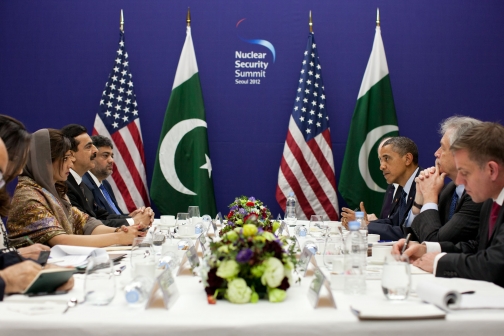
WEEKLY ADDRESS: President Obama Says House Must Pass Bipartisan Transportation Bill

WASHINGTON, DC—In this week’s address, President Obama called on the House of Representatives to pass a bipartisan transportation bill that would repair crumbling roads and bridges and support construction jobs in communities all across America.  According to a new report, 90 percent of these construction jobs are middle class jobs. The Senate passed the bill with the support of Democrats and Republicans because if the bill stalls in Congress then constructions sites will go idle, workers will have to go home, and our economy will take a hit.  The President calls on everyone to tell their elected officials to pass a long-term transportation bill that will support American construction workers and our economy.

Remarks of President Barack Obama
Weekly Address
The White House
Saturday March 24, 2012

Hello.  This week, I traveled across the country to talk about my all-of-the-above energy strategy for America – a strategy where we produce more oil and gas here at home, but also more biofuels and fuel-efficient cars; more solar power and wind power and other sources of clean, renewable energy. 

Now, you wouldn’t know it by listening to some of the folks running for office today, but producing more oil at home has been, and will continue to be, a key part of my energy strategy.  Under my Administration, we’re producing more oil than at any other time in the last eight years.  We’ve quadrupled the number of operating oil rigs to a record high.  And we’ve added enough oil and gas pipeline to circle the entire Earth and then some.  Those are the facts. 

But as I’ve been saying all week, even though America uses around 20 percent of the world’s oil, we only have around 2 percent of the world’s known oil reserves.  So even if we drilled everywhere, we’d still be relying on other countries for oil.

That’s why we’re pursuing an all-of-the-above strategy.  We’re producing more biofuels.  More fuel-efficient cars.  More solar power.  More wind power.  This week, I was in Boulder City, Nevada, where they’ve got the largest solar plant of its kind anywhere in the country.  That’s the future.  I was at Ohio State University, where they’ve developed the fastest electric car in the world.  That’s the future.  I don’t want to cede these clean energy industries to China or Germany or any other country.  I want to see solar panels and wind turbines and fuel-efficient cars manufactured right here in America, by American workers. 

Now, getting these clean energy industries to locate here requires us to maintain a national commitment to new research and development.  But it also requires us to build world-class transportation and communications networks, so that any company can move goods and sell products all around the world as quickly and efficiently as possible. 
So much of America needs to be rebuilt right now.  We’ve got crumbling roads and bridges.  A power grid that wastes too much energy.  An incomplete high-speed broadband network.  And we’ve got thousands of unemployed construction workers who’ve been looking for a job ever since the housing market collapsed. 

But once again, we’re waiting on Congress.  You see, in a matter of days, funding will stop for all sorts of transportation projects.  Construction sites will go idle.  Workers will have to go home.  And our economy will take a hit. 

This Congress cannot let that happen.  Not at a time when we should be doing everything in our power – Democrats and Republicans – to keep this recovery moving forward.  The Senate did their part.  They passed a bipartisan transportation bill.  It had the support of 52 Democrats and 22 Republicans.  Now it’s up to the House to follow suit; to put aside partisan posturing, end the gridlock, and do what’s right for the American people.  

This is common sense.  Right now, all across this country, we’ve got contractors and construction workers who have never been more eager to get back on the job.  A long term transportation bill would put them to work.  And those are good jobs.  We just released a report that shows nearly 90 percent of the construction, manufacturing and trade jobs created through investments in transportation projects are middle class jobs.  Those are exactly the jobs we need right now, and they’ll make the economy stronger for everybody. 

We’ve done this before.  During the Great Depression, America built the Hoover Dam and the Golden Gate Bridge.  After World War II, we connected our states with a system of highways.  Democratic and Republican administrations invested in great projects that benefited everybody, from the workers who built them to the businesses that still use them today. 

So tell Congress that if we invest in new technology and new energy; in new roads and bridges and construction projects, we can keep growing our economy, put our people back to work, and remind the world why the United States is the greatest nation on Earth.

Thanks and have a great weekend.

Close Transcript