The White House

Office of the Press Secretary

New Report: Affordable Care Act Gives Americans More Security, Better Benefits

The White House today released a new report highlighting the benefits of the Affordable Care Act. The report discusses how the Affordable Care Act has improved the health care system for millions of Americans and includes stories of Americans who have been helped by the law.

“Today, two years after we passed health care reform, more young adults have insurance, more seniors are saving money on their prescription drugs, and more Americans can rest easy knowing they won’t be dropped from their insurance plans if they get sick,” said President Obama.  “The law has made a difference for millions of Americans, and over time, it will help give even more working and middle-class families the security they deserve.”

Thanks to the Affordable Care Act:

• 2.5 million more young adults have health insurance on their parent’s plan.
• 5.1 million people with Medicare saved an average of $635 on the cost of their prescription drugs. And everyone on Medicare can get preventive services like mammograms for free.
• Insurance companies must spend at least 80 percent of your premium dollars on health care and not overhead and cannot raise your premiums by 10 percent or more with no accountability.
• It is illegal for insurance companies to deny coverage to children because of a pre-existing condition. And in 2014, discriminating against anyone with a pre-existing condition will be illegal.

The report spotlights examples of Americans from across the country who have benefitted from the law including:

• Devon Grochowski graduated from Pennsylvania State University in May of 2010 but she doesn’t get benefits, including health insurance, at work. Without the provision in the Affordable Care Act that allows her to stay on her parent’s plan until she is 26, Devon would have had to consider leaving her job to get one that offers benefits, even if that meant leaving the field where she’s hoping to build her career.
• Michael and Margaret Novak own a grocery store in a small rural town in Montana. They were able to receive a small business tax credit worth $10,500 to help them continue to offer health insurance to their more than two dozen employees.
• Amy Ward of West Des Moines, Iowa came down with a rare infection that nearly cost her life. Without the Affordable Care Act, Amy and her husband may not have been able to afford all the care she needed to recover. Before the new health care law, Amy's health insurance policy had a lifetime dollar limit.
The report released today also discusses how the new law is investing in public health and improving the quality of health care for all Americans. New health policies that cut red tape will save providers and health plans an estimated $12 billion. Additionally, investments in public health will expand the number of health care providers in underserved areas by supporting the National Health Service Corps and strengthening community health centers.

For additional information on your State and stories from Americans already benefitting from the law, visit www.whitehouse.gov/healthreform.

The White House

Office of the Press Secretary

Statement by the President on the Passing of John Payton

Michelle and I were saddened to hear about the passing of our dear friend John Payton. As president and director-counsel of the NAACP Legal Defense and Education Fund, John led the organization’s involvement in five Supreme Court cases. A true champion of equality, he helped protect civil rights in the classroom and at the ballot box.  The legal community has lost a legend, and while we mourn John's passing, we will never forget his courage and fierce opposition to discrimination in all its forms. 

Our thoughts and prayers go out to John’s family, the many students he taught, and those who love him.

West Wing Week: 3/22/12 or "Slainte!"

March 23, 2012 | 4:15

This week, the President celebrated his fourth St Patrick's Day in the White House and hosted the Irish Prime Minister, marked Nowruz with a video address, then embarked on a four state energy tour.

Download mp4 (133.6MB)

The White House

Office of the Press Secretary

President Obama Signs West Virginia Disaster Declaration

The President today declared a major disaster exists in the State of West Virginia and ordered Federal aid to supplement state and local recovery efforts in the area affected by severe storms, flooding, mudslides, and landslides beginning on March 15, 2012, and continuing.
 
The President's action makes federal funding available to affected individuals in Logan County.
 
Assistance can include grants for temporary housing and home repairs, low-cost loans to cover uninsured property losses, and other programs to help individuals and business owners recover from the effects of the disaster.
 
Federal funding also is available to state and eligible local governments and certain private nonprofit organizations on a cost-sharing basis for emergency work and the repair or replacement of facilities damaged by the severe storms, flooding, mudslides, and landslides in Lincoln, Logan, and Mingo Counties.
 
Federal funding is also available on a cost-sharing basis for hazard mitigation measures statewide.
 
W. Craig Fugate, Administrator, Federal Emergency Management Agency (FEMA), Department of Homeland Security, named Deanne Criswell as the Federal Coordinating Officer for federal recovery operations in the affected area.
 
FEMA said additional designations may be made at a later date if requested by the state and warranted by the results of further damage assessments.
 
FEMA said that residents and business owners who sustained losses in the designated counties can begin applying for assistance tomorrow by registering online at http://www.DisasterAssistance.gov or by calling 1-800-621-FEMA(3362) or 1-800-462-7585 (TTY) for the hearing and speech impaired.  The toll-free telephone numbers will operate from 7 a.m. to 10 p.m. (local time) seven days a week until further notice.

The White House

Office of the Press Secretary

Remarks by the President on American-Made Energy

The Ohio State University
Columbus, Ohio

4:27 P.M. EDT

THE PRESIDENT:  Hello, Buckeyes!  (Applause.)  Yes.  It is good to be back at The Ohio State University.  (Applause.)  I want to thank --

AUDIENCE MEMBER:  I love you!

THE PRESIDENT:  I love you back.  (Applause.)  I am thrilled to be here.  I want to thank a couple of people.  First of all, the outstanding Mayor of Columbus, Michael Coleman, is here.  (Applause.)  I want to thank OSU Provost Joe Alutto.  (Applause.)

And I just got this extraordinary tour from Giorgio Rizzoni, who's the director of the Center for Automotive Research.  So give him a big round of applause.  (Applause.)

Now, let's face it, a presidential visit isn’t even close to being the biggest thing this weekend on campus.  (Laughter.)  And despite what Vijay said, I did have the Buckeyes heading to the Final Four.  (Applause.)  I'm just saying.  I think Selinger is going to have a big game tonight.  (Applause.)  And I promise you I didn’t do it because I knew I was coming here -- because I am cold-blooded when it comes to filling out my brackets.  (Laughter.)  So I genuinely think you guys are looking good. 

And by the way, I just read somewhere that one in every four teams in the Sweet 16 is from Ohio.  (Applause.)  You've got Ohio State, Ohio University, Xavier -- (applause) -- Xavier is in -- Cincinnati.

AUDIENCE:  Booo --

THE PRESIDENT:  I'm not going to get in the middle of this. (Laughter.)  I do want to just say no state has ever done this before.  So it's a testimony to Ohio basketball.  (Applause.)

And I want to thank Vijay for the outstanding introduction  -- very much appreciate that. 

Now, this is our last stop on a trip where we’ve been talking about an all-of-the-above energy strategy for America -- a strategy where we produce more oil, produce more gas, but also produce more American biofuels and more fuel-efficient cars, more solar power, more wind power, more power from the oceans, more clean and renewable energy.  (Applause.)  More clean and renewable energy.

You know what I’m talking about here, because this school is a national leader in developing new sources of energy and advanced vehicles that use a lot less energy. 

I just had a chance to take a tour of the Center for Automotive Research.  Now, I admit the best part of it was seeing the Buckeye Bullet, which has gone over 300 miles an hour and is now shooting for 400 miles an hour.  (Applause.)  And I asked the guys who were helping to design this whether mom was going to let them actually test-drive this thing, and the answer was no.  (Laughter.)  Only professional drivers are permitted.

But for anybody who’s not familiar with this, the Buckeye Bullet is the fastest electric car in the world.  (Applause.)  The fastest in the world.  I don't know who’s going to need to go that fast.  (Laughter.)  But it is a testament to the ingenuity here at Ohio State and what is essential to American leadership when it comes to energy -- our brain power.

I will say, though, when Malia gets her license in a few years, she will not be allowed to go 300 miles an hour.  (Laughter.)

Now, one of the reasons that I’ve been talking so much about fuel-efficient cars and new sources of energy is obviously because we’re seeing another spike in gas prices right now.  And that’s tough on folks.  I remember when I was a student, filling up was always tough.  And gas prices are putting pressure not just on students but on a lot of families all across Ohio, all across the country.  Whether you’re trying to get to school, go to work, go grocery shopping, dropping off your kids, you’ve got to be able to fill up that gas tank.  Right now, for most people you don't have a choice. 

So when prices spike, that tax hike feels like a -- or that gas spike feels like a tax hike coming right out of your pocket. That’s part of the reason that we passed a payroll tax cut at the beginning of this year –- so that the average American would get an extra $40 in every paycheck to help offset the price of gas.  (Applause.)  So that’s going to offer some relief. 

But the bigger question is how do we make sure that these spikes in gas prices don’t keep on happening -- because we’ve seen this movie before.  This happens just about every year.  This happened this time last year.  Gas prices were even higher in the spring and summer of 2008.  It has been going on for years, for decades. 

And every time prices start to go up -- especially during an election year -- politicians, they start dusting off their 3-point plan for $2.00 gas.  (Laughter.)  Although this year, they decided it was going to be $2.50.  (Laughter.)  This year they decided it was going to be $2.50.  Now, I don't know where they pick that number, $2.50.  Because it could have been $2.40, I guess.  They could have said $2.10.  They could have said 50 cents a gallon.  But they all make the same promise.  They head down to the gas station and they make sure a few cameras are following them, and then they tell you how we’re going to have cheap gas forever if you just vote for them.  And it has been the same script for 30 years -- the same thing.  It has been like a bad rerun.  

And when you ask them, what specifically is your -- (audience interruption.)

Sir, I’m here to speak to these folks.  You can hold your own rally.  (Applause.)  You’re being rude.  Sir, we're trying to talk to these people.  (Applause.)  I’ll be happy to read your book -- if you want to give me your book, I’ll be happy to read it.  But don’t interrupt my conversation with these folks, all right?  (Applause.)  Show me some courtesy.  (Applause.)  Show me some courtesy.  I’ll be happy to take your book.  But don’t interrupt everybody else.  All right?  Okay.

Now, where was I?  (Laughter.)  Go ahead and get that book from him, guys.  He wants to give me a book.  Please feel free to grab it.  You’re touting this book -- make sure that you’ve given it to us. 

All right, now that we’ve gotten that settled.  (Laughter.) Now, the question is, why is it that every year we hear the same story about how we’re going to have $2 gas, or $1.50 gas, or whatever price they come up with, if we would just drill for more oil?  That’s the solution that you always here.  Prices will immediately come down and all our problems will go away -- like magic. 

There are two problems with that.  First of all, we have been drilling.  We’re drilling right now.  Under my administration, America is producing more oil today than at any time in the last eight years -- at any time.  (Applause.)  That's a fact.  Over the last three years, we’ve opened millions of acres of land in 23 different states for oil and gas exploration. That’s a fact.  (Applause.)  Offshore, I’ve directed my administration to open up more than 75 percent of potential oil resources.  We’ve quadrupled the number of operating oil rigs to a record high. 

I just visited New Mexico.  Their big problem is they don’t have enough truck drivers to transport all the oil that they are producing.  We’ve added enough oil and gas pipeline to circle the entire Earth and then some.  I just visited one of those new pipelines in Oklahoma, and today I directed my administration to make sure that we cut the red tape in terms of reducing some of these bottlenecks.

So the problem is not that we're not drilling, or that we're not producing more oil.  We are producing more oil than any time in the last eight years.  That’s not the problem.  There are probably a few spots where we're not drilling, it's true.  I'm not drilling in the South Lawn.  (Laughter.)  We're not drilling next to the Washington Monument.  We’re not drilling in Ohio Stadium.  

AUDIENCE:  No!

THE PRESIDENT:  So there are some spots out there that we are not drilling.  But we're doing so in a way that protects the health and safety of the American people, and protects America's incredible bounty that God gave us -- our resources.  (Applause.)

So that’s point number one.  But the second issue, which, because we got a lot of young people, you guys understand, is that a strategy that relies only on drilling defies the fact that America uses 20 percent of the world's oil, but we only have 2 percent of the world's known oil reserves.  So we use 20 percent; we have 2 percent.  Who's a math major here?  (Laughter.)  All right.  If I'm not mistaken, that leaves us about 18 percent short.  (Laughter.) 

We can't simply drill our way out of the problem.  Even if we drilled every square inch of this country right now, we're going to be relying on other countries for oil.  (Applause.)  Does anybody here think that's a good strategy?

AUDIENCE:  No!

THE PRESIDENT:  Of course, it isn't.  We shouldn't have to pay more at the pump every time there's instability in the Middle East, which is the main reason gas prices are going up right now. (Applause.)  We should not be held hostage to events on the other side of the world.  This is America.  We control our own destiny. We forge our own future.  And I will not accept an energy strategy that traps us in the past.  (Applause.)  We're not going to do it.

So as long as I'm President, America is going to be pursuing an all-of-the-above energy strategy.  Yes, we'll develop as much oil and gas as we can, in a safe way, but we're also going to develop wind power, and solar power, and advanced biofuels.  (Applause.)  We can build the next-generation nuclear reactors that are smaller and safer and cleaner and cheaper, but we've got to also look at renewable energy as the key to our future.  And we've got to build cars and trucks that get more miles to the gallon.  (Applause.)  We've got to build homes and businesses that waste less energy, and put consumers in control of their energy bills.

AUDIENCE MEMBER:  (Inaudible.)  (Laughter.) 

THE PRESIDENT:  And we'll do it by harnessing the same type of American ingenuity and imagination that's on display right here at Ohio State.  (Applause.)  Right here at Ohio State. 

So already we've made progress.  After decades of inaction, we raised fuel-economy standards, so that by the middle of the next decade, our cars will average nearly 55 miles per gallon, almost double what we get today.  (Applause.)  That means you'll be able to fill up your car every two weeks instead of every week.  (Applause.)  You like that? 

AUDIENCE:  Yes!

THE PRESIDENT:  That will save the average family about $8,000 at the pump over the life of a car, which is real money.  To use even less oil, we're going to have to keep investing in clean, renewable, homegrown biofuels.  And already we're using these biofuels to power everything from city buses to UPS trucks, even to Navy ships.  And the more we rely on these homegrown fuels, the less oil we buy from other countries and the more jobs we create right here in America.  (Applause.)

We also need to keep investing in clean energy like wind power and solar power.  I just visited the biggest American solar plant of its kind, in Boulder City, Nevada.  It's powering thousands of homes.  It put hundreds of local people at work.  There are thousands of companies like that all across America.  And today, thousands of Americans have jobs because of public investments that have nearly doubled the use of clean energy in this country. 

And as long as I’m President, we are going to keep on making those investments.  I am not going to cede the wind and solar and advanced battery industries to countries like China and Germany that are making those investments.  I want those technologies developed and manufactured here in Ohio, here in the Midwest, here in America.  (Applause.)  By American workers.  That's the future we want.

So all these steps, all these steps have put us on a path of greater energy independence.   Here's a statistic I want everybody to remember.  Since I took office, America’s dependence on foreign oil has gone down every single year.  (Applause.)  In 2010, our oil dependence was under 50 percent for the first time in 13 years.  (Applause.)  Even as the economy was growing, we’ve made progress in reducing the amount of oil that we have to import because we’re being smarter; we’re doing things better. 

But now we’ve got a choice.  We can keep moving in that direction -- we can keep developing new energy and new technology that uses less oil -- or we can listen to these folks who actually believe that the only thing we can do is drill our way out of this problem.  In fact, they make fun of clean energy.  They call the jobs produced by them "phony" jobs.  They make jokes about them at their rallies. 

Lately, we’ve heard a lot of politicians, a lot of folks who are running for a certain office –- (laughter) -- they shall go unnamed -- (laughter) -- they dismiss wind power.  They dismiss solar power.  They make jokes about biofuels.  I guess they like gas-guzzlers because they’re against raising fuel standards.  Imagine if these guys had been around when Columbus set sail.  They'd be charter members of the Flat Earth Society.  (Laughter and applause.)  They don’t ask what we can do; they explain what we can't do, and why we can't do it. 

And the point is there will always be cynics and naysayers who just want to keep on doing the same things the same way that we’ve always done them. 

AUDIENCE MEMBER:  Then we wouldn’t have a black President, but we do!

THE PRESIDENT:  Well, that’s true.  (Applause.) 

They want to double down on the same ideas that got us exactly into this mess that we’ve been in and we've been digging our way out of.  That's not who we are as Americans. 

We've always succeeded because we refused to stand still.  We put faith in the future.  We are inventors.  We are builders.  We're makers of things.  We're Thomas Edison and the Wright Brothers and Steve Jobs.  By the way, the Wright Brothers were from Ohio.  (Applause.)  Just want to point that out.  But that’s who we are.  That’s who we need to be right now.  We can't be afraid of the future.  (Applause.)  

The flat Earth crowd, they've got a different view.  They would rather give $4 billion in taxpayer subsidies to oil companies this year than to invest in clean energy.  Four billion dollars to an industry that’s making record profits because of what you're paying at the gas station.  Does anybody think that they need help, that they don’t have enough incentive to drill for oil?  Does anybody think that’s a wise use of your tax dollars?

AUDIENCE:  No!

THE PRESIDENT:  We have been subsidizing oil companies for a century.  That’s long enough.  (Applause.)  It is time to stop a taxpayer giveaway to an industry that’s rarely been more profitable, and start making investments in a clean energy industry that has never been more promising. 

And when Congress votes on this, you guys should put some pressure on to tell them, do the right thing.  Bet on our future, not on our past.  (Applause.)  Put them on record:  They can either stand with the oil industry, or they can stand with the American people.  They can place their bets on the energy of the past, or place their bets on America's future -- on American workers, American technology, American ingenuity, American-made energy.

AUDIENCE MEMBER:  Our children.  (Applause.)

THE PRESIDENT:  Our children.  (Applause.)  That's the choice we face.  That's what's at stake right now. 

And, Ohio, we know the direction that we've got to go in.  Ending these oil subsidies won't bring gas prices down tomorrow. Even if we drilled every inch of America, that won't bring gas prices down tomorrow.  But if we're tired of watching gas prices spike every single year, if we're tired of being caught in this position, knowing that China and India are growing -- China had 10 million cars purchased in 2010 alone.  You've got a billion people, two billion people out there, who are interested in buying cars -- which means that unless we develop alternatives, oil prices are going to keep on going up.

I don't want folks in the Middle East taking your money out of your pocket because we did not develop the kind of strategies that will sustain our future and our independence.  (Applause.) 
    
So I need all of you guys to make your voices heard.  Get on the phone.  Write and email.  Send a tweet.  Let your members of Congress know where you stand.  Tell them to do the right thing. Tell them that we can win this fight.  Tell them:  Yes, we can.  (Applause.)  We can build an economy that lasts.  We can make this another American Century.  We can remind the entire world just why it is the United States of America is the greatest nation on Earth. 

Thank you.  God bless you.  God bless the United States of America.  (Applause.)

END
4:46 P.M. EDT

The White House

Office of the Press Secretary

Statement by the President on the Passage of the STOCK Act

In my State of the Union Address, I laid out a blueprint for an economy where everyone gets a fair shot, everyone does their fair share, and everyone plays by the same set of rules, including those who have been elected to serve the American people. 

Today, I’m pleased Congress took bipartisan action to pass the STOCK Act.  After I sign this bill into law, Members of Congress will not be able to trade stocks based on nonpublic information they gleaned on Capitol Hill.  It’s a good first step.  And in the months ahead, Congress should do even more to help fight the destructive influence of money in politics and rebuild the trust between Washington and the American people.

President Obama Speaks on Advanced Vehicle Technology

March 22, 2012 | 20:25 | Public Domain

President Obama discusses an all of the above energy strategy at the Center for Automotive Research.

Download mp4 (195MB) | mp3 (47MB)

Expanding Our Oil and Gas Pipeline Infrastructure

President Obama Speaks in Cushing

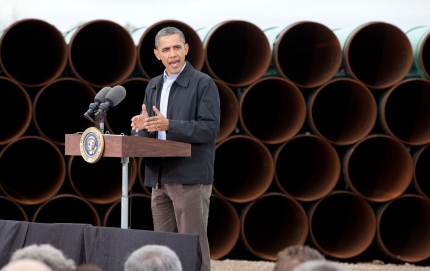
President Barack Obama delivers remarks on energy at the TransCanada Stillwater Pipe Yard near Cushing, Okla., March 22, 2012. The President highlighted the Administration’s commitment to expanding domestic oil and gas production. (Official White House Photo by Pete Souza)

Cushing, Oklahoma is an oil town. It’s a major hub for connecting our nation’s crude oil supply with refineries along the Gulf Coast, and the latest stop on President Obama’s cross-country tour to discuss American energy production.  

Domestic oil and gas production is the highest it’s been in eight years. We’re actually producing so much that, even though we've added enough new oil and gas pipelines to circle the Earth in the last three years, we still don’t have enough pipeline to transport it all around the country quickly enough, particularly to our nation's refineries.

And, as President Obama explained when he spoke there today, the fact that production is outpacing pipeline capacity is causing bottlenecks in places like Cushing, slowing our ability to further increase oil supplies when gas prices are high and we need it the most.

Modernizing pipeline infrastructure and expanding its ability to deliver oil to refineries and consumers around the country is a vital piece of a strategy to reduce our reliance on foreign oil and expand production of American-made energy. That’s why President Obama directed his Administration to expedite the permitting and construction process of a new pipeline that will help crude oil make its way to Gulf Coast refineries more quickly, and doing so while protecting natural resources and the health of local communities along the pipeline’s proposed path.

Read more about President Obama's all-of-the-above energy strategy

The White House

Office of the Press Secretary

Press Gaggle by Press Secretary Jay Carney en route Columbus, Ohio, 3/22/12

Aboard Air Force One
En Route Columbus, Ohio   

12:52 P.M. EDT

MR. CARNEY:  Good morning, everyone.  Thanks for joining us on the continuation of our two-day, multi-state tour focusing on American-made energy and the importance of the President's all-of-the-above strategy to deal with our energy challenges.  We are on our way, as you know, to Ohio, and the Ohio State University as the last stop of this tour. 

Before I take your questions, let me read a statement from me that will be issued shortly.

It says:  "The President is grateful that the Senate acted in a bipartisan way to move forward key ideas the President proposed last fall that will help our small businesses and start-ups access capital they need to grow and to create jobs.  We are heartened by the important investor protections added to the crowdfunding provision, and will be vigilant in monitoring this and other elements to ensure the overall bill achieves its goal of helping entrepreneurs while maintaining protections for investors.  We urge the House to adopt these important changes.

While this vote marks a moment of bipartisan cooperation, there is much more work to be done to create an economy that is built to last, and we encourage Congress to act on additional measures like rebuilding our nation's crumbling roads and bridges, putting our teachers back in the classroom and first responders back on the beat, and reauthorizing the Export/Import Bank, which thousands of American businesses and their workers depend on to stay competitive in the global economy."

That was from me.  And with that, I'll take your questions.
Maybe we should just end it now -- lot of turbulence, lot of turbulence.  Okay, go.

Q    I'm going to start out with a repetition of a question from yesterday.  Do you have, does the President have a World Bank candidate, and will there be an announcement tomorrow?

MR. CARNEY:  Jeff, I'm trying to keep it under my hat that you're his leading candidate.  (Laughter.)  I have no news to make on the World Bank front and no information to impart about the process or timing for any kind of decision or announcement.
Sorry.

Q    On the pipeline --   

Q    -- he make the decision by tomorrow?

MR. CARNEY:  That's a backward way but clever way of trying to get me to say -- to give a different answer.  But I just have no information on that for you.

Q    On the pipeline announcement today, are the steps that the President is taking, will they help make the pipeline get built any quicker?  The President's critics say that it won't have any impact on the timeline whatsoever.

MR. CARNEY:  Well, I understand that the President's critics want to make a political point, having been deprived by the facts and the visuals of this visit -- which demonstrated the President’s commitment to both increasing oil and gas production in this country and doing everything he can to open up bottlenecks in the supply chain for oil and gas production -- to find some other reason to criticize him.  The fact of the matter is even the southern portion of this pipeline requires federal permitting.  The actions the President took today will ensure that that process is -- moves as quickly as possible as a matter of -- as a national priority.  So, yes, we believe it will have an impact and certainly at the very least it ensures that there will not be any unnecessary bureaucratic delay.

Q    Do you expect -- is it your understanding that that construction will begin in June, as the company has targeted?

MR. CARNEY:  If that's what they've targeted, yes, that’s what will happen -- again, in part because we’re going to ensure that the permitting process, while done by the book, is done in an expedited way, that everything should proceed accordingly.  But I would refer you to the company itself as well as to the agencies for more specifics.

Q    What else did the President see there at the Cushing site?  We, obviously, heard his remarks, but did he walk around and look at the pipes?  Did he -- what did he do exactly?

MR. CARNEY:  Unfortunately, we weren’t on the ground that long.  He met with some folks, including some folks from the company, prior to the speech, and then did his usual greets with drivers and law enforcement and others, and then did a couple of interviews, one with AAA and another with Univision Radio.

Q    What did he have to say to the people from TransCanada?

MR. CARNEY:  I don’t have a readout of that conversation for you.  I think that what you heard the President say in his remarks, his public remarks, reflects his position, which is he’s committed to expediting this process.  He has -- on his watch, the United States has built a considerable amount of pipeline and will continue to do that. 

And with regard to the transnational portion of the Keystone pipeline, as we've said before, that process was halted because of pushback because of the requests of the Nebraska governor and others who had concerns about the environmental impact the proposed pipeline would have on that aquifer in Nebraska.  When a renewed pipeline proposal is put forward, it would be absolutely viewed on the merits.  And the process should be allowed to work as it’s supposed to work and it should not be hijacked for ideological or other political reasons.

Q    -- any TransCanada officials that he talked to?

MR. CARNEY:  I don't have names for you.  I mean, they were at the event.

Q    Whenever he meets with company officials at events, we usually do get the names.

MR. CARNEY:  I'll see if I can get them.  I just don't have them.  I wasn’t paying very close attention.  I apologize.

Q    On Afghanistan, General Allen testified before the Senate today.  He said the U.S. is going to need a substantial force -- a substantial military presence in 2013.  He was asked if 68,000 troops would be a sufficient number.  He said that that would be a good going-in number.  Does the administration think there’s a will among the American public to support that large of a military presence next year in Afghanistan?

MR. CARNEY:  Well, the President is focused on implementing a strategy that has as its core objective the goal of disrupting and dismantling and ultimately defeating al Qaeda.

As part of this process, he surged up U.S. forces considerably.  We are now drawing down those forces that surged into Afghanistan, and that withdrawal will be complete by the middle of September.  The President made clear that we will continue to withdraw U.S. forces at a steady pace.  However, the specific timetable for that and troop numbers will not be decided until we have finished the current withdrawal.

What General Allen was referring to is that 68,000 troops which will remain after the withdrawal of the surge forces is a good number going into the period of the post-surge-withdrawal period.   But the President’s position has not changed, and that position is that we will steadily draw down U.S. troops as we continue to transition security lead to Afghan security forces as they continue to be trained and their numbers increase.

What will be discussed and agreed upon we hope in Chicago is a decision to transfer combat lead to Afghan forces in 2013 as part of the full transition to Afghan security control by the end of 2014.  But no troop -- no announcements of further troop withdrawals will come in Chicago, and there are no options currently under consideration.  That will come after we have withdrawn the forces we’re withdrawing now.

That's it?  Man, you guys are easy.

Q    Does the President believe that the Republican candidate, whoever that will be, will be able to hit a reset button once the general election begins?  And did he have any reaction to this whole Etch-A-Sketch issue?

MR. CARNEY:  The President has been focused on this trip on the -- his all-of-the-above approach to our energy challenges.  He'll be ready to engage in a vigorous debate with a Republican opponent when the Republicans have picked their nominee.  We're not -- he's not, certainly, and we're not paying any great amount of attention to the day-by-day narrative in the race for the Republican nomination.  We're just lay observers.  We follow your work and the work of your colleagues, but beyond that we're focused on the job of trying to get this economy to continue to grow, to continue to create jobs, diversifying our energy portfolio so that we can reduce our dependence on foreign oil, insulate American consumers from the vicissitudes of the global oil market.  That's our focus at the moment.

Q    Did he have any reaction to the NFL's decision with the New Orleans Saints to suspended some of their coaches because of the --

MR. CARNEY:  He's certainly aware of it.  As you know, we occasionally have ESPN on on the plane here.  And I know he's aware of it, but I don't recall any specific reaction.

Q    How about Tebow, Manning?

MR. CARNEY:  I don't have any reaction to that to read out. But I think we all -- he's had pretty big sports headlines prior to this.  I do know that March Madness continues tonight -- right?  -- games starting again tonight?  I'm sure the President will try to catch a little of the games if he can.

Thanks.

    END

Amendment to the Gaggle:

MR. CARNEY:  -- said yesterday we don't have any plans on the President's schedule, any events to mark the anniversary of the signing of the Affordable Care Act.  But I want to be clear that this was historic and important legislation that is already leading to significant benefits for millions of Americans. 

And the White House has put out a video that features a lot of folks who have benefited from the Affordable Care Act already, and it's part of our effort to continue to inform the American people about the Affordable Care Act, about the protections it provides young Americans who are now able to stay on their parent's insurance plans for a lot longer, and for seniors who are getting significant assistance in dealing with their prescription drug bills, and preventive services -- and on the full-scale effort to continue to implement the Affordable Care Act across the country, in states across the country.

Q    Is that video timed to the anniversary date or to the arguments that are going to be --

MR. CARNEY:  It is.  Yes, it is.  And I think I made the point yesterday that I found it absurd -- that I found absurd some of the suggestions that the President or the White House, the administration was running away from or not interested in talking about the Affordable Care Act, because, as you know, and I have seen, the campaign has put out its own campaign video where the Affordable Care Act is featured prominently.  The President speaks about the Affordable Care Act and its importance to the American people frequently.  I don't think a week goes by where he doesn’t include remarks about health care reform in some form or another.

But we are looking at -- he is focused this week and in the coming weeks on pushing forward policies that will continue to grow the economy, continue to create jobs, and diversify our energy resources. 

Q    (Inaudible.)

MR. CARNEY:  The White House put out a video that, as I understand it -- I confess I haven't seen it yet, but I heard about it -- that tells some of the stories of people who have benefited from the Affordable Care Act.  It's part of an effort to inform Americans about the protections and provisions of the law as it's being implemented.

Q    Does that come out today, tomorrow?

MR. CARNEY:  I think today.

Q    The campaign released something today, too.

MR. CARNEY:  Yes, I think they're separate.  I'll check that, but I think they're separate.

Thanks, guys. 

END  
1:07 P.M. CDT

The White House

Office of the Press Secretary

Statement by the Press Secretary

The President is grateful that the Senate acted in a bipartisan way to move forward key ideas the President proposed last fall that will help our small businesses and startups access capital they need to grow and create jobs.  We are heartened by the important investor protections added to the crowdfunding provision and will be vigilant in monitoring this and other elements to ensure the overall bill achieves its goal of helping entrepreneurs while maintaining protections for investors. We urge the House to adopt these important changes.

While this vote marks a moment of bipartisan cooperation, there is much more work to be done to create an economy that is built to last, and we encourage Congress to act on additional measures like rebuilding our nation’s crumbling roads and bridges, putting our teachers back in the classroom and first responders back on the beat, and reauthorizing the Export-Import Bank which thousands of American businesses and their workers depend on to stay competitive in the global economy.