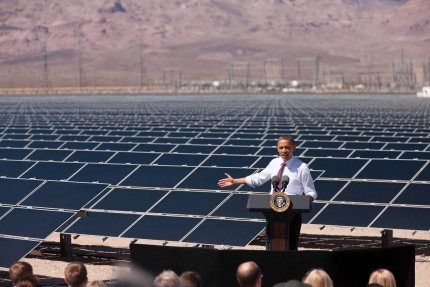
President Obama Discusses Solar Power in Nevada

President Obama Delivers Remarks on Energy at the Copper Mountain Solar 1 Facility

President Barack Obama delivers remarks on energy after a tour of a Solar Panel Field at the Copper Mountain Solar 1 Facility, the largest photovoltaic plant operating in the country with nearly one million solar panels powering 17,000 homes, in Boulder City, Nevada, March 21, 2012. (Official White House Photo by Lawrence Jackson)

Today, President Obama visited the Copper Mountain Solar 1 Facility in Boulder City, Nevada. The facility is the largest photovoltaic plant in the country, and its one million solar panels power 17,000 homes in California.

Boulder City, a small town near Las Vegas with fewer than 20,000 residents, was initially established to house the workers building the Hoover Dam. Today, the sun shines on Boulder City 320 days each year, making it an ideal place for a massive solar facility. Construction began in 2010, and hundreds of local residents now have jobs because of the plant. Things are going so well, in fact, that a second and third Copper Mountain facility are in the works, which will eventually generate enough electricity to power 45,000 and 66,000 homes, respectively. 

Across the country, businesses like the one that built Copper Mountain are developing enough solar energy to power 730,000 homes.

Increasing the use of renewable energy sources like solar power is one piece of President Obama’s strategy to develop every available source of American-made energy. Since he took office, federal investment in renewable energy has helped nearly double its use across the country. And as a result, we are reducing our dependence on oil and other fossil fuels while becoming more energy independent, creating jobs, and keeping our environment clean.

 Read more about the other parts of the President’s all-of-the-above energy strategy.

The White House

Office of the Press Secretary

President Obama Announces More Key Administration Posts

WASHINGTON, DC – Today, President Barack Obama announced his appointment of the following individuals to the National Council on Federal Labor-Management Relations:

  • Michael B. Filler – Member, National Council on Federal Labor-Management Relations
  • David J. Holway - Member, National Council on Federal Labor-Management Relations
  • H.T. Nguyen - Member, National Council on Federal Labor-Management Relations

The Council, created in 2009 by Executive Order, is tasked with advising the President on matters involving labor-management relations in the executive branch.  The Council is co-chaired by the Director of the Office of Personnel Management, John Berry, and the Deputy Director for Management of the Office of Management and Budget, Jeffrey Zients.  The President also designated the following Deputy Secretaries to be members of the Council: Ashton B. Carter, Deputy Secretary of Defense; W. Scott Gould, Deputy Secretary of Veterans Affairs; Seth Harris, Deputy Secretary of Labor; Jane Holl Lute, Deputy Secretary of Homeland Security; and Kathleen Merrigan, Deputy Secretary of Agriculture.

President Obama said, “I am grateful that these accomplished individuals have agreed to play an integral role in this Administration, and I’m confident they will serve ably in these important roles.  I look forward to working with them in the coming months and years.”

President Obama announced today his appointment of the following individuals:

Michael B. Filler, Appointee for Member, National Council on Federal Labor-Management Relations
Michael B. Filler is the Director of the Public Services Division of the International Brotherhood of Teamsters (IBT) with responsibility for overseeing the representation over 260,000 public and professional employees throughout North America.  He was first appointed to the National Council on Federal Labor-Management Relations by President Obama in February 2010.  From 2003 to 2005, Mr.  Filler was the Associate Director of the IBT’s Education Department. Previously, Mr. Filler worked at the National Treasury Employees Union (NTEU) as Director of Negotiations (1999 - 2003), as Northeast Regional Director (1988 - 1999), and as a National Field Representative (1985 - 1987).  Prior to his tenure with NTEU, Mr. Filler worked at the Federal Election Commission as a Branch Chief (1981 - 1985) and as a Reports Analyst (1976 -  1981).  He currently serves as Co-Chair of the Public Sector Industry Council of the Labor and Employment Relations Association.  In addition, he was a founding member of the Federal Workers Alliance, an active participant in the United Department of Defense Workers Coalition, and the Teamsters’ Delegate to the Public Services International Convention in Vienna, Austria in 2007.  Mr. Filler received a B.A. in Political Science from American University and attended the Executive Program at the Kennedy School of Government at Harvard University.

David J. Holway, Appointee for Member, National Council on Federal Labor-Management Relations
David J. Holway is the President of the National Association of Government Employees (NAGE) and the International Brotherhood of Police Officers (IBPO), which represents more than 110,000 bargaining unit members across the country.  He has been a member of the National Council on Federal Labor-Management Relations since being appointed by President Obama in February 2010.  Prior to his current role, Mr. Holway served in many capacities at NAGE, including as Lead Negotiator and Legislative Director.  He also previously held several government positions including Deputy Commissioner in the Massachusetts Department of Correction, Chief Financial Officer at the Norfolk County Hospital, and as Budget and Staff Director at the Massachusetts Legislative Committee on Counties.  Mr. Holway served on the Cambridge Massachusetts School Committee from 1978 to 1979. In 2011, Mr. Holway began serving his second four-year term as a member of the Employee Thrift Advisory Council of the Federal Retirement Thrift Investment Board. He received his B.S. from Boston State College.

H.T. Nguyen, Appointee for Member, National Council on Federal Labor-Management Relations
H.T. Nguyen is the Executive Director/General Counsel of the Federal Education Association (FEA), a state affiliate of the National Education Association (NEA) representing federally-employed educators.  He was first appointed to the National Council on Federal Labor-Management Relations by President Obama in February 2010.  Previously, Mr. Nguyen served as the Deputy General Counsel for the FEA from 1988 to 1998, where he was the FEA’s lead attorney in all major cases involving the Association.  From 1984 to 1988, Mr. Nguyen was a Staff Attorney with the FEA.  In 1983, Mr. Nguyen was an associate at Berger & Miranda in San Jose, CA.  From 1978 to 1980, he was a case worker for the International Rescue Committee in Washington, DC.  He received his B.A. in American Government, his M.A. in International Relations, and his J.D. from the Columbus School of Law at the Catholic University of America.

The White House

Office of the Press Secretary

Remarks by the President on Energy

Copper Mountain Solar Project
Boulder City, Nevada

1:10 P.M. PDT

THE PRESIDENT:  Hello, everybody.  (Applause.)  Good afternoon.  Everybody, please have a seat.  Have a seat.  It is wonderful to be here.  Thank you so much.  It is great to be in Boulder City. 

A couple people I want to thank for their outstanding work. First of all, our Interior Secretary, Ken Salazar, is in the house.  (Applause.)  He's the guy in the nice-looking hat.  Not only does it look good, but it protects his head, because the hair has gotten a little thin up there.  (Laughter.)  He is a good-looking guy.

AUDIENCE MEMBER:  One of them.  One of them.

THE PRESIDENT:  One of them.  (Laughter.)  That's right.  There's the other guy.  (Laughter.)   

I also want to thank your Mayor -- a big supporter of solar energy -- and that's Roger Tobler, for being here.  Where's Roger?  Here he is right there.  I just met his beautiful daughter.  It's great to see you.  (Applause.) 

I want to thank Jeffrey Martin, CEO of Sempra, and John and Kevin, who helped just give me this tour.

And Boulder City is the first stop on a tour where I’ll be talking about what we’re calling an all-of-the-above energy strategy -- all of the above.  A strategy that relies on producing more oil and gas here in America, but also more biofuels, more fuel-efficient cars, more wind power and, as you can see, a whole lot more solar power. 

This is the largest solar plant of its kind anywhere in the country.  That's worth applauding.  (Applause.)  Every year, you produce enough clean energy to power around 17,000 homes.  And that’s just the beginning.  Things are going so well that another plant is already under construction down the road that will eventually power another 45,000 homes.  And a third plant is in development that will be, one day, able to power around 66,000 homes.

Now, this is an area that was hit hard by the recession -- and that's true of the whole state.  You guys have been through a lot.  But you haven’t given up.  You looked around at this flat, beautiful land and all this sun -- I just -- I asked the question, how many days of sun do you get a year -- 320 -- that's pretty good -- and decided that Boulder City was the perfect place to generate solar power. 

In fact, as I was talking to the folks from Sempra, they were explaining that this location is almost optimal for solar power generation, not only because it's flat, transmission lines were already here, the sun is traveling and there's no haze and it's absolutely clear.  And so this is an extraordinary opportunity for the community.  And when a business showed up with plans to build a new solar plant, hundreds of local workers got jobs because of it.  Thousands of families are now powering their homes with a cleaner, renewable source of energy. 

And this is not just happening here in Boulder City -- it’s happening in cities and towns all across America.  According to experts, we’ve now got more than 5,600 solar companies nationwide, and many of them are small businesses.  There are solar companies in every single state in the Union.  And today, we’re producing enough solar energy to power 730,000 American homes.  And because of the investments we’ve made as a nation, the use of renewable energies has actually doubled.

So this is an industry on the rise.  It’s a source of energy that’s becoming cheaper; we all know it's cleaner.  And more and more businesses are starting to take notice.  They’re starting to look around for more places like Boulder City to set up shop. 

When I took office I said, why not give these businesses some access to public lands that aren't otherwise being utilized? At the time, there wasn’t a single solar project in place on public lands -- not one.  Today, thanks to some great work by Ken Salazar, we’ve got 16 solar projects approved.  (Applause.)  And when they’re complete, we’ll be generating enough energy to power 2 million homes.  And that’s progress.   

We’re also enforcing our trade laws to make sure countries like China aren’t giving their solar companies an unfair advantage over ours.  (Applause.)  And that’s important because countries all around the world -- China, Germany, you name it -- they understand the potential.  They understand the fact that as countries all around the world become more interested in power generation -- their population is expanding, their income level is going up, they use more electricity -- and we’re going to have to make sure that we’re the guys who are selling them the technology and the know-how to make sure that they’re getting the power that they need. 

In fact, just yesterday, our administration determined China wasn’t playing fair when it came to solar power.  And so we took the first step towards leveling the playing field, because my attitude is, when the playing field is level, then American workers and American businesses are always going to win.  And that’s why we’ve got to make sure that our laws are properly enforced.  (Applause.) 

Now, you’d think given this extraordinary site, given the fact that this is creating jobs, generating power, helping to keep our environment clean, making us more competitive globally, you’d think that everybody would be supportive of solar power.   That’s what you’d think.  And yet, if some politicians had their way, there won’t be any more public investment in solar energy.  There won’t be as many new jobs and new businesses. 

Some of these folks want to dismiss the promise of solar power and wind power and fuel-efficient cars.  In fact, they make jokes about it.  One member of Congress who shall remain unnamed called these jobs "phony" -- called them phony jobs.  I mean, think about that mindset, that attitude that says because something is new, it must not be real.  If these guys were around when Columbus set sail, they’d be charter members of the Flat Earth Society.  (Laughter.)  We were just talking about this -- that a lack of imagination, a belief that you can’t do something in a new way -- that’s not how we operate here in America.  That’s not who we are.  That’s not what we’re about.

These politicians need to come to Boulder City and see what I’m seeing.  (Applause.)  They should talk to the people who are involved in this industry, who have benefitted from the jobs, who benefit from ancillary businesses that are related to what’s going on right here.

Now, all of you know that when it comes to new technologies, the payoffs aren’t always going to come right away.  Sometimes, you need a jumpstart to make it happen.  That's been true of every innovation that we’ve ever had.  And we know that some discoveries won’t pan out.  There’s the VCR and the Beta and the -- all that stuff.  (Laughter.) 

And each successive generation recognizes that some technologies are going to work, some won’t; some companies will fail, some companies will succeed.  Not every auto company succeeded in the early days of the auto industry.  Not every airplane manufacturer succeeded in the early days of the aviation.  But we understood as Americans that if we keep on this track, and we’re at the cutting edge, then that ultimately will make our economy stronger and it will make the United States stronger.  It will create jobs.  It will create businesses.  It will create opportunities for middle-class Americans and folks who want to get into the middle class.  That's who we are.  That's what we’re about.  (Applause.)

So I want everybody here to know that as long as I’m President, we will not walk away from the promise of clean energy.  (Applause.)  We’re not going to walk away from places like Boulder City.  I’m not going to give up on the new to cede our position to China or Germany or all the other competitors out there who are making massive investments in clean energy technology.  I refuse to see us stand by and not make the same commitment.  That’s not what we do in America.  It’s not who we are as a country.

One of the main reasons I ran for this office is I didn't think that our leaders were doing enough to tackle the big challenges, the hard challenges, to seize the big opportunities.  And energy is one of the best examples.  We have been talking about changing our energy policies for 30 years now.  When I was the age of these guys right here, when I was 10, 11, right, in the ‘70s, and my grandparents were complaining about long gas lines, we were talking about how we were going to do things differently.  Thirty, 40 years, and we keep on doing the same stuff.  We keep on punting.  We keep on putting it off.  For decades, Washington kept kicking the can down the road. 

I don't want to do that anymore.  I want to make sure when these guys are grown up that they're seeing solar panels all across the country.  They're seeing American-made energy and American-made power.  They're benefiting from a cleaner environment.  They're seeing jobs and opportunity -- that’s what I want to see. 

So as long as I'm President, we're going to develop every available source of energy.  That is a promise that I'm making to you.  (Applause.) 

And, yes, that means we make investments in stuff that is new, and we stop subsidizing stuff that’s old.  The current members of the Flat Earth Society in Congress -- (laughter) -- they would rather see us continue to provide $4 billion -- $4 billion -- in tax subsidies, tax giveaways, to the oil companies -- $4 billion to an industry that is making record profits.  Every time you fill up the pump, they're making money.  They are doing just fine.  They're not having any problems.

And yet, on top of what we're paying at the pump, we're also going to give them $4 billion in subsidies that could be going into making sure there were investments in clean energy for the future?  That doesn’t make any sense.  Does that make any sense?

AUDIENCE:  No!

THE PRESIDENT:  All right, I just wanted to make sure.  Because I didn’t think it was a wise use of your tax dollars.  (Laughter.)

We have subsidized oil companies for a century.  We want to encourage production of oil and gas, and make sure that wherever we've got American resources, we are tapping into them.  But they don’t need an additional incentive when gas is $3.75 a gallon, when oil is $1.20 a barrel, $1.25 a barrel.  They don’t need additional incentives.  They are doing fine.

AUDIENCE MEMBER:  It is our retirement! 

THE PRESIDENT:  Yes.  A century of subsidies to oil companies is long enough.  It's time to end the taxpayer giveaways to an industry that’s rarely been more profitable, and double down on investments in an energy industry that has never been more promising.  (Applause.)  That’s what we need to do. 

So Congress needs to pass more tax credits for projects like this one; needs to provide certainty when it comes to these tax credits.  We need to go out there and do what a lot of states are doing right now, which is saying, let's get a certain percentage of our energy from clean energy sources.  Because when we do that, that gives a company like this one certainty that they're going to have customers, and they can invest more and build more. (Applause.)

We need to keep Americans on the job.  We need to keep these homes powered by clean energy.  We need to support the businesses that are doing it.

And again, I just want everybody to be clear -- because sometimes, when you listen to the news and you listen to some of these other politicians, they seem a little bit confused about what I'm saying.  We are going to continue producing oil and gas at a record pace.  That's got to be part of what we do.  We need energy to grow.  That's why we're producing more oil right now, here in America, than at any time in the last eight years -- any time in the last eight years.  We're opening up more land for oil exploration.  We've got more oil rigs operating.  There are more pipelines out there that are being approved.  I'll be visiting one of those rigs and one of those pipelines this week.

But an energy strategy that focuses only on drilling and not on an energy strategy that will free ourselves from our dependence on foreign oil, that's a losing strategy.  That's not a strategy I'm going to pursue.  America uses 20 percent of the world's oil, and we've got 2 percent of the world's oil reserves. Think about -- I wasn't a math major, but I just want -- (laughter) -- if you're using 20, you've only got 2, that means you got to bring in the rest from someplace else.  Why wouldn't we want to start finding alternatives that make us less reliant, less dependent on what's going on in the Middle East?  (Applause.)

So we've got to develop new energy technologies, new energy sources.  It's the only way forward.  And here in Boulder City, you know that better than anybody.  You know the promise that lies ahead because this city has always been about the future.  Eight decades ago, in the midst of the Great Depression, the people of Boulder City were busy working on another energy project you may have heard of.  Like today, it was a little bit ahead of its time; it was a little bit bigger than this solar plant -- it was a little louder, too.  It was called the Hoover Dam.  And at the time, it was the largest dam in the world.  (Applause.)  Even today, it stands as a testimony to American ingenuity, American imagination, the power of the American spirit -- a testimony to the notion we can do anything.

That was true back then; it is true today.  You know the choice we need to make when it comes to energy.  We've got to invest in a sustained, all-of-the-above strategy that develops every available source of energy.  We've got to stay ahead of the curve.  We've got to make sure that we're taking some risks.  We've got to make sure that we're making the investments that are necessary.  We've got to support extraordinary entrepreneurs that are on the cutting-edge.  That's who we are.  That's what we do. And if we keep on doing it, nothing is going to stop us.

Thank you very much, everybody.  God bless you.  God bless the United States of America.  Thank you.  (Applause.)

END
1:27 P.M. PDT

The White House

Office of the Press Secretary

Presidential Nominations Sent to the Senate

NOMINATIONS SENT TO THE SENATE:

Rainey Ransom Brandt, of the District of Columbia, to be an Associate Judge of the Superior Court of the District of Columbia for the term of fifteen years, vice Joan Z. McAvoy, retired.

John S. Leonardo, of Arizona, to be United States Attorney for the District of Arizona for the term of four years, vice Dennis K. Burke, resigned.

The White House

Office of the Press Secretary

President Obama Nominates Judge John S. Leonardo to Serve as U.S. Attorney for the District of Arizona

WASHINGTON, DC – Today, President Obama nominated Judge John S. Leonardo to serve as U.S. Attorney for the District of Arizona.

“Judge John S. Leonardo’s legal career has been distinguished and impressive,” said President Obama.  “I am confident that, as a US Attorney, he will be relentless in his pursuit of justice and serve the people of Arizona with distinction.”

Judge John S. Leonardo:  Nominee for United States Attorney for the District of Arizona
Judge John S. Leonardo served as a judge for Pima County Superior Court, a position he held from 1993 to 2012.  From 2002 to 2007, he also served as Presiding Judge.  Prior to his judicial service, Judge Leonardo served as an Assistant United States Attorney for the District of Arizona from 1982 to 1993 and for the Northern District of Indiana from 1973 to 1982, where he also served as the First Assistant United States Attorney from 1978 to 1982.  From 1972 to 1973, Judge Leonardo was an Assistant State’s Attorney for Prince George’s County, Maryland.  Judge Leonardo graduated from the University of Notre Dame in 1969 and from the George Washington University School of Law in 1972.

The White House

Office of the Press Secretary

President Obama Nominates Rainey Ransom Brandt to Serve on the Superior Court of the District of Columbia

WASHINGTON, DC – Today, President Obama nominated Rainey Ransom Brandt to serve on the Superior Court of the District of Columbia.

“Throughout her career, Rainey Ransom Brandt has demonstrated an unwavering commitment to justice,” said President Obama.  “I am proud to nominate her to the Superior Court of the District of Columbia.”

Rainey Ransom Brandt:  Nominee for the Superior Court of the District of Columbia
Rainey Ransom Brandt currently serves as Special Counsel to the Chief Judge of the Superior Court of the District of Columbia, having previously served as Special Counsel to the two most recent former chief judges of that Court. Prior to her tenure with the Court, Brandt taught as a full-time professor in the Department of Justice, Law and Society, at American University, where she remains an Adjunct Associate Professor teaching courses related to criminal justice.  Brandt received her B.A., M.S., and Doctorate degrees from American University and is a graduate of the Columbus School of Law, The Catholic University of America.

The White House

Office of the Press Secretary

Readout of President Obama’s Call with President Sarkozy of France

The President spoke by phone today with President Sarkozy of France while aboard Air Force One en route to Nevada. President Obama expressed his solidarity with President Sarkozy, and the government and people of France, as they deal with the aftermath of the tragic and unprovoked attacks that left seven dead, including three French soldiers, and three children and a teacher at a Jewish school. President Obama welcomed the actions taken by French authorities in identifying and locating a suspect in the killings, and their continued efforts to prevent further acts of violence. President Obama underscored that the American people stand shoulder to shoulder with our French allies and friends in this trying time.

President Obama Speaks on Expanding Our Energy Portfolio

March 21, 2012 | 16:30 | Public Domain

President Obama discusses investing in clean and renewable energy sources as part of an all-of-the-above strategy to develop American energy and reduce our reliance on foreign oil at the Copper Mountain Solar Project.

Download mp4 (158MB) | mp3 (38MB)

Read the Transcript

Remarks by the President on Energy

Copper Mountain Solar Project
Boulder City, Nevada

1:10 P.M. PDT

THE PRESIDENT:  Hello, everybody.  (Applause.)  Good afternoon.  Everybody, please have a seat.  Have a seat.  It is wonderful to be here.  Thank you so much.  It is great to be in Boulder City. 

A couple people I want to thank for their outstanding work. First of all, our Interior Secretary, Ken Salazar, is in the house.  (Applause.)  He's the guy in the nice-looking hat.  Not only does it look good, but it protects his head, because the hair has gotten a little thin up there.  (Laughter.)  He is a good-looking guy.

AUDIENCE MEMBER:  One of them.  One of them.

THE PRESIDENT:  One of them.  (Laughter.)  That's right.  There's the other guy.  (Laughter.)   

I also want to thank your Mayor -- a big supporter of solar energy -- and that's Roger Tobler, for being here.  Where's Roger?  Here he is right there.  I just met his beautiful daughter.  It's great to see you.  (Applause.) 

I want to thank Jeffrey Martin, CEO of Sempra, and John and Kevin, who helped just give me this tour.

And Boulder City is the first stop on a tour where I’ll be talking about what we’re calling an all-of-the-above energy strategy -- all of the above.  A strategy that relies on producing more oil and gas here in America, but also more biofuels, more fuel-efficient cars, more wind power and, as you can see, a whole lot more solar power. 

This is the largest solar plant of its kind anywhere in the country.  That's worth applauding.  (Applause.)  Every year, you produce enough clean energy to power around 17,000 homes.  And that’s just the beginning.  Things are going so well that another plant is already under construction down the road that will eventually power another 45,000 homes.  And a third plant is in development that will be, one day, able to power around 66,000 homes.

Now, this is an area that was hit hard by the recession -- and that's true of the whole state.  You guys have been through a lot.  But you haven’t given up.  You looked around at this flat, beautiful land and all this sun -- I just -- I asked the question, how many days of sun do you get a year -- 320 -- that's pretty good -- and decided that Boulder City was the perfect place to generate solar power. 

In fact, as I was talking to the folks from Sempra, they were explaining that this location is almost optimal for solar power generation, not only because it's flat, transmission lines were already here, the sun is traveling and there's no haze and it's absolutely clear.  And so this is an extraordinary opportunity for the community.  And when a business showed up with plans to build a new solar plant, hundreds of local workers got jobs because of it.  Thousands of families are now powering their homes with a cleaner, renewable source of energy. 

And this is not just happening here in Boulder City -- it’s happening in cities and towns all across America.  According to experts, we’ve now got more than 5,600 solar companies nationwide, and many of them are small businesses.  There are solar companies in every single state in the Union.  And today, we’re producing enough solar energy to power 730,000 American homes.  And because of the investments we’ve made as a nation, the use of renewable energies has actually doubled.

So this is an industry on the rise.  It’s a source of energy that’s becoming cheaper; we all know it's cleaner.  And more and more businesses are starting to take notice.  They’re starting to look around for more places like Boulder City to set up shop. 

When I took office I said, why not give these businesses some access to public lands that aren't otherwise being utilized? At the time, there wasn’t a single solar project in place on public lands -- not one.  Today, thanks to some great work by Ken Salazar, we’ve got 16 solar projects approved.  (Applause.)  And when they’re complete, we’ll be generating enough energy to power 2 million homes.  And that’s progress.   

We’re also enforcing our trade laws to make sure countries like China aren’t giving their solar companies an unfair advantage over ours.  (Applause.)  And that’s important because countries all around the world -- China, Germany, you name it -- they understand the potential.  They understand the fact that as countries all around the world become more interested in power generation -- their population is expanding, their income level is going up, they use more electricity -- and we’re going to have to make sure that we’re the guys who are selling them the technology and the know-how to make sure that they’re getting the power that they need. 

In fact, just yesterday, our administration determined China wasn’t playing fair when it came to solar power.  And so we took the first step towards leveling the playing field, because my attitude is, when the playing field is level, then American workers and American businesses are always going to win.  And that’s why we’ve got to make sure that our laws are properly enforced.  (Applause.) 

Now, you’d think given this extraordinary site, given the fact that this is creating jobs, generating power, helping to keep our environment clean, making us more competitive globally, you’d think that everybody would be supportive of solar power.   That’s what you’d think.  And yet, if some politicians had their way, there won’t be any more public investment in solar energy.  There won’t be as many new jobs and new businesses. 

Some of these folks want to dismiss the promise of solar power and wind power and fuel-efficient cars.  In fact, they make jokes about it.  One member of Congress who shall remain unnamed called these jobs "phony" -- called them phony jobs.  I mean, think about that mindset, that attitude that says because something is new, it must not be real.  If these guys were around when Columbus set sail, they’d be charter members of the Flat Earth Society.  (Laughter.)  We were just talking about this -- that a lack of imagination, a belief that you can’t do something in a new way -- that’s not how we operate here in America.  That’s not who we are.  That’s not what we’re about.

These politicians need to come to Boulder City and see what I’m seeing.  (Applause.)  They should talk to the people who are involved in this industry, who have benefitted from the jobs, who benefit from ancillary businesses that are related to what’s going on right here.

Now, all of you know that when it comes to new technologies, the payoffs aren’t always going to come right away.  Sometimes, you need a jumpstart to make it happen.  That's been true of every innovation that we’ve ever had.  And we know that some discoveries won’t pan out.  There’s the VCR and the Beta and the -- all that stuff.  (Laughter.) 

And each successive generation recognizes that some technologies are going to work, some won’t; some companies will fail, some companies will succeed.  Not every auto company succeeded in the early days of the auto industry.  Not every airplane manufacturer succeeded in the early days of the aviation.  But we understood as Americans that if we keep on this track, and we’re at the cutting edge, then that ultimately will make our economy stronger and it will make the United States stronger.  It will create jobs.  It will create businesses.  It will create opportunities for middle-class Americans and folks who want to get into the middle class.  That's who we are.  That's what we’re about.  (Applause.)

So I want everybody here to know that as long as I’m President, we will not walk away from the promise of clean energy.  (Applause.)  We’re not going to walk away from places like Boulder City.  I’m not going to give up on the new to cede our position to China or Germany or all the other competitors out there who are making massive investments in clean energy technology.  I refuse to see us stand by and not make the same commitment.  That’s not what we do in America.  It’s not who we are as a country.

One of the main reasons I ran for this office is I didn't think that our leaders were doing enough to tackle the big challenges, the hard challenges, to seize the big opportunities.  And energy is one of the best examples.  We have been talking about changing our energy policies for 30 years now.  When I was the age of these guys right here, when I was 10, 11, right, in the ‘70s, and my grandparents were complaining about long gas lines, we were talking about how we were going to do things differently.  Thirty, 40 years, and we keep on doing the same stuff.  We keep on punting.  We keep on putting it off.  For decades, Washington kept kicking the can down the road. 

I don't want to do that anymore.  I want to make sure when these guys are grown up that they're seeing solar panels all across the country.  They're seeing American-made energy and American-made power.  They're benefiting from a cleaner environment.  They're seeing jobs and opportunity -- that’s what I want to see. 

So as long as I'm President, we're going to develop every available source of energy.  That is a promise that I'm making to you.  (Applause.) 

And, yes, that means we make investments in stuff that is new, and we stop subsidizing stuff that’s old.  The current members of the Flat Earth Society in Congress -- (laughter) -- they would rather see us continue to provide $4 billion -- $4 billion -- in tax subsidies, tax giveaways, to the oil companies -- $4 billion to an industry that is making record profits.  Every time you fill up the pump, they're making money.  They are doing just fine.  They're not having any problems.

And yet, on top of what we're paying at the pump, we're also going to give them $4 billion in subsidies that could be going into making sure there were investments in clean energy for the future?  That doesn’t make any sense.  Does that make any sense?

AUDIENCE:  No!

THE PRESIDENT:  All right, I just wanted to make sure.  Because I didn’t think it was a wise use of your tax dollars.  (Laughter.)

We have subsidized oil companies for a century.  We want to encourage production of oil and gas, and make sure that wherever we've got American resources, we are tapping into them.  But they don’t need an additional incentive when gas is $3.75 a gallon, when oil is $1.20 a barrel, $1.25 a barrel.  They don’t need additional incentives.  They are doing fine.

AUDIENCE MEMBER:  It is our retirement! 

THE PRESIDENT:  Yes.  A century of subsidies to oil companies is long enough.  It's time to end the taxpayer giveaways to an industry that’s rarely been more profitable, and double down on investments in an energy industry that has never been more promising.  (Applause.)  That’s what we need to do. 

So Congress needs to pass more tax credits for projects like this one; needs to provide certainty when it comes to these tax credits.  We need to go out there and do what a lot of states are doing right now, which is saying, let's get a certain percentage of our energy from clean energy sources.  Because when we do that, that gives a company like this one certainty that they're going to have customers, and they can invest more and build more. (Applause.)

We need to keep Americans on the job.  We need to keep these homes powered by clean energy.  We need to support the businesses that are doing it.

And again, I just want everybody to be clear -- because sometimes, when you listen to the news and you listen to some of these other politicians, they seem a little bit confused about what I'm saying.  We are going to continue producing oil and gas at a record pace.  That's got to be part of what we do.  We need energy to grow.  That's why we're producing more oil right now, here in America, than at any time in the last eight years -- any time in the last eight years.  We're opening up more land for oil exploration.  We've got more oil rigs operating.  There are more pipelines out there that are being approved.  I'll be visiting one of those rigs and one of those pipelines this week.

But an energy strategy that focuses only on drilling and not on an energy strategy that will free ourselves from our dependence on foreign oil, that's a losing strategy.  That's not a strategy I'm going to pursue.  America uses 20 percent of the world's oil, and we've got 2 percent of the world's oil reserves. Think about -- I wasn't a math major, but I just want -- (laughter) -- if you're using 20, you've only got 2, that means you got to bring in the rest from someplace else.  Why wouldn't we want to start finding alternatives that make us less reliant, less dependent on what's going on in the Middle East?  (Applause.)

So we've got to develop new energy technologies, new energy sources.  It's the only way forward.  And here in Boulder City, you know that better than anybody.  You know the promise that lies ahead because this city has always been about the future.  Eight decades ago, in the midst of the Great Depression, the people of Boulder City were busy working on another energy project you may have heard of.  Like today, it was a little bit ahead of its time; it was a little bit bigger than this solar plant -- it was a little louder, too.  It was called the Hoover Dam.  And at the time, it was the largest dam in the world.  (Applause.)  Even today, it stands as a testimony to American ingenuity, American imagination, the power of the American spirit -- a testimony to the notion we can do anything.

That was true back then; it is true today.  You know the choice we need to make when it comes to energy.  We've got to invest in a sustained, all-of-the-above strategy that develops every available source of energy.  We've got to stay ahead of the curve.  We've got to make sure that we're taking some risks.  We've got to make sure that we're making the investments that are necessary.  We've got to support extraordinary entrepreneurs that are on the cutting-edge.  That's who we are.  That's what we do. And if we keep on doing it, nothing is going to stop us.

Thank you very much, everybody.  God bless you.  God bless the United States of America.  Thank you.  (Applause.)

END
1:27 P.M. PDT

Close Transcript

The White House

Office of the Press Secretary

Press Gaggle by Press Secretary Jay Carney en route Boulder City, Nevada, 3/21/12

Aboard Air Force One
En Route Boulder City, Nevada

10:57 A.M. EDT
 
MR. CARNEY:  Okay, let's get started.  I have no announcements.  I just want to welcome you onboard Air Force One for the beginning of this two-day, multi-state trip that's focusing on American-made energy and the President's all-of-the-above approach to our energy needs and energy challenges.  You have all the details.  I won't torture you by reading again about the stops that we're making and why we're making them.  Instead I will invite you to ask penetrating but easy-to-answer questions.

Q    Jay, does the administration have any authority over the southern portion of Keystone?  I thought that was just a FERC issue.

MR. CARNEY:  I'd have to refer you to the agency and then -- which has some, as I understand it, role to play in these kinds of domestic pipeline issues.  I just don't have those details handy for you.

Q    -- is reporting that the President is going to talk about some sort of expedited review.

MR. CARNEY:  I've seen those reports.  I don't have anything new for you.  The President has been very clear, as he put out -- we put out in a statement -- about his support for the building of the pipeline, the so-called Cushing pipeline, from Cushing, Oklahoma to the Gulf of Mexico because of the glut of oil in Cushing and the need to move that product to the Gulf for refining.  So he's very supportive, and he -- and the statement we put out the urged that it be expedited.  But I don't have any more details to provide to you about that at this time.

Q    What authority would he have to expedite any reviews for the southern portion?

MR. CARNEY:  I don't -- I haven’t reviewed the material on that.  I just don't know.  I don't have anything I can tell you about that right now.

Q    Jay, our first stop today will have to do with solar energy.

MR. CARNEY:  Yes.

Q    Yesterday, the United States put some tariffs on solar panels from China, but the tariffs were lower than the industry expected and it ended up boosting Chinese shares.  Why were the tariffs so low?

MR. CARNEY:  Well, you're probably asking the wrong person in terms of the level of tariffs.  I can tell you that this administration, as you have reported yourself, is very focused on the need to ensure that, whether it's with China or with other countries, that American workers, American companies are able to compete on a level playing field.

This administration has taken a number of steps to level the playing field both broadly and in actions related to specific industries and specific products.  It's my understanding that this is one of them.  It is no mystery that there has been an issue with Chinese production of solar products, but beyond that I think I would refer you to the experts.

Q    But is it concerning at all that the President, especially on a day when he's visiting a solar facility --

MR. CARNEY:  I would hesitate to evaluate the effect of an action like that based on one day -- one day's market reaction.

Q    But does he want to do more along the lines of trade or elsewhere to support the solar industry in the U.S.?

MR. CARNEY:  I don't have anything specific for you on this particular industry, but he absolutely wants to do more and will do more, as necessary, to ensure that there's a level playing field for American industries and American workers.

Q    Related to oil and gas drilling, the Republicans have criticized the President saying that he's put a lot of obstacles in the way of drilling and that federal lands have not been as open to drilling as possible.  Does the administration feel that it's done everything it can to increase the amount of drilling?

MR. CARNEY:  Yes.  The problem with that argument is that the facts prove otherwise.  It is a fact that U.S. production of oil has risen under President Obama to levels that we had not seen, based on the chart I'm looking at now, since the very early part of this century.  It is a fact that U.S. dependence on foreign oil has been declining since President Obama took office to levels we have not seen for many, many years, and certainly to levels well below we saw under the previous administration.  Indisputable, incontrovertible, immutable, inexorable facts.

So it is also a fact that under President Obama, production on public lands has increased -- of oil -- on public lands has increased.  It is also a fact that this President is committed to increasing production of domestic oil and gas in a safe and responsible way.  He doesn't believe it's an either/or proposition; it's a both/and.  You can do it safely and responsibly, and you can increase production.  That's true with oil and it is also true with natural gas.  He's made clear that he believes natural gas plays a significant role in our energy future and that we can exploit our domestic resources in a way that's responsible and increases our production.  On gas, our production is at an all-time high.

So I understand that, as we've seen for weeks now, there is a sustained effort to try to achieve some political gain out of the challenge presented to average folks out there by the price of gas at the pump.  But the reality is oil and gas production in the United States has increased under President Obama; reliance on foreign oil has decreased significantly under President Obama. We have made clear that some of the trend, especially in the increase in domestic production, is due to policies of the previous administration, but it is due also to the actions that this administration has taken. 

And those facts are hard to live with when you're trying to make a political argument the Republicans are making.  I don't expect them to stop making it, but we will continue to make our points and point to the facts.

Q    Is this trip merely sort of an effort to push back against that Republican argument?

MR. CARNEY:  This trip is designed to highlight for the American people the absolute importance of the President's all-of-the-above approach to energy issues.  These are about policies that he has put in place, policies that he is continuing to push -- because energy is such a central factor in our economic future.  It's why the President finds it so baffling and disconcerting to hear Republicans and other -- hear critics talk about clean energy in mocking terms.  I guess that means they're just -- they just assume that it's okay for the Chinese, the Indians, the Europeans to corner the markets in the 21st century. Better to stick your head in the sand now, in 2012, and just assume that the U.S. cannot compete in what will indisputably be vitally important industries of this 21st century.  The President could not disagree more strongly, and that's why he's pursued the policies that he's pursued.

Q    -- the Republican budget, I think administration folks have said would make -- cut pretty deeply into investments in clean energy.

MR. CARNEY:  Well, that is an excellent point and I'm glad you raised it. 

Q    Senior administration officials have raised it.

MR. CARNEY:  Among the many serious problems with the Ryan budget, Republican budget proposal, is its dramatic cuts in some of the absolutely essential programs that we need to sustain and the investments that we need to make to secure America's economic future.  Education, Pell grants is one; investments in clean energy is another. 

I mean, again, it is -- you have to be aggressively and deliberately ignorant of the world economy not to know and understand that clean energy technologies are going to play a huge role in the 21st century.  You have to have severely diminished capacity to understand what drives economic growth in industrialized countries in this century if you do not understand that education is the key that unlocks the door to prosperity.  The budget proposed by Chairman Ryan and supported overwhelmingly already by Republicans suggests that those problems exist in the minds of the supporters of that plan.

That was a bad sentence, but you get my point.  I lost track because I was watching RG3 over there, future quarterback of my Washington Redskins.

Q    So you’re distracted, Jay.

MR. CARNEY:  Yes.

Q    Jay, General Allen said yesterday that he doesn’t expect consideration on additional drawdowns after September.  Is that the timeframe that you understand?

MR. CARNEY:  Until September -- before September, right?  Is that what you're --

Q    Right, after the 23,000 withdraw in September, he said he doesn’t expect additional consideration until after the new year.

MR. CARNEY:  Well, look, I think -- I would point you to General Allen’s testimony, and I think what we have made clear is that we are in the process of implementing the policy the President put in place that included surging up U.S. forces and drawing down those forces.  We are in the midst of drawing down significant numbers of U.S. forces.  That process will complete itself by the end of September -- end of summer, middle of September.  And the President has made clear that he intends to continue to draw down U.S. forces.  But decisions about the pace of that withdrawal have not been made and options have not been proposed -- contrary to some reporting by a major outlet.

Q    In the Rose Garden last week, the President said that the NATO leaders in Chicago will determine the next phase of transition when they meet.  But I understood you to say yesterday that they would not be talking about the pace of drawdown.  Does that --

MR. CARNEY:  There would be no announcements about numbers or timetables is my understanding.  And I think General Allen reflected -- his testimony reflected that. 

Obviously, the strategy surrounding the transition will be very much a topic of conversation at NATO, and has been a conversation among defense ministers in the run-up to the NATO summit.  As we’ve been saying in the last several weeks, the Lisbon framework that will result in the full transfer of security lead to the Afghan forces by the end of 2014 will, as an interim step or interim milestone, produce transfer over of combat lead to Afghan forces in 2013.  U.S. forces will continue to partner with Afghan forces, but they will not be in combat lead.  The full transfer will happen in 2014. 

So this is part of the process that will be discussed in Chicago.  But we will not have decisions or announcements about the timetable for future drawdowns.

Q    There will be announcements of a timetable for drawdown, but will there be discussion at that level of detail among the leaders?

MR. CARNEY:  Again, I don’t expect discussions -- there will be discussions about Afghanistan, the strategy and the implementation of the transition, but not -- there will not be, as I understand it, decisions made about withdrawal timetables beyond the withdrawal that we’re currently undertaking.

Q    Can I also ask you, did the President vote by absentee in the Illinois primary yesterday?

MR. CARNEY:  He did.

Q    Did his candidates win?

MR. CARNEY:  I haven’t had the discussion with him about who his candidates were.

Q    Did he have a reaction to Tammy Duckworth’s --

MR. CARNEY:  You know, I haven’t -- I spent some time with him this morning, but I didn’t -- I haven’t spoken to him about that.

Q    Jay, on Syria, the U.N. Security Council has agreed to a Council statement that’s in support of Kofi Annan’s efforts to try to bring peace to the region.  Does the administration view that positively in the sense that it could show China and Russia maybe more supportive of the --

MR. CARNEY:  We do view it positively.  We think it’s an important -- a modest, but important step.  And I think that it demonstrates the fact that there’s unanimity on the Security Council in support of Kofi Annan’s mission and demonstrates the building chorus of voices on the international stage that is insisting that Assad halt his brutal campaign against his own people, and that is obviously a good thing.

Q    Jay, will the President be looking at any personnel decisions in the next couple days?  For example, World Bank appointment?

MR. CARNEY:  You work for Reuters, right?

Q    I do.

MR. CARNEY:  You beat Bloomberg to the punch.  I have no updates for you on that process.

Q    Let me just give it one more shot.  Can we expect an announcement on Friday?

MR. CARNEY:  I have no updates for you on that process.

Q    Jay, Friday is the health care anniversary.  Is the President going to mark it in any way?  Is he going to say anything publicly about it?  And if not, why not, given that it’s become a political football and there will be a lot of discussion about it?

MR. CARNEY:  I appreciate the question.  I have no scheduling announcements to make today about Friday for the President.  I don’t anticipate a presidential marking of an anniversary that only those who toil inside the Beltway focus on. 

What this President is focused on and what his administration is focused on with regards to the Affordable Care Act is the implementation of the Affordable Care Act.  And we have been -- I think you saw, at various levels within the administration we have been talking about and publicizing the benefits of and the implementation of the Affordable Care Act -- Secretary Sebelius, Senior Advisor Valerie Jarrett, most recently -- and that effort will continue.

And if I may, as a layman, take issue with the knuckleheaded reporting that suggests or buys the critique that we’re somehow not proud of the accomplishment by -– referring you to Chicago,  on my own time, I did happen to see that excellent video that the campaign put out and you might note that it focuses on health care quite significantly.  So I’ll leave it at that.

Q    Did the upcoming Supreme Court case at all impact the decision whether or not to mark the anniversary publicly?

MR. CARNEY:  No.  I would simply say that we’re confident that the individual responsibility provision within the Affordable Care Act is constitutional.  I’m confident in our legal arguments.  I don’t have any comment on the Supreme Court's case beyond that.  And I would just say again, the issue here isn’t the anniversary of a signing ceremony; it’s the implementation of a law that would provide affordable health care to 30 million people who didn’t have it, that has already provided tremendous benefits to young Americans, to seniors, to small businesses who are trying to provide health care to their employees, and will continue to provide benefits as implementation continues.

Thanks, guys.

END
11:13 A.M. EDT

The White House

Office of the Press Secretary

FACT SHEET: Obama Administration’s All-of-the-Above Approach to American Energy

FACT SHEET: Obama Administration’s All-of-the-Above Approach to American Energy - President Obama to Highlight Commitment to American Made Energy