The White House

Office of the Press Secretary

Remarks by the President and Vice President on Health Insurance Reform at the Department of the Interior

Department of Interior, Washington, D.C.

12:39 P.M. EDT

THE VICE PRESIDENT:  Thank you all.  (Applause.) 

AUDIENCE:  Yes, we can!  Yes, we can!  Yes, we can!

THE VICE PRESIDENT:  Yes, he did.  (Applause.)  Thank you all for being here, ladies and gentlemen.  Please be seated. 

Ladies and gentlemen, to state the obvious, this is truly a historic day.  But as all of you know, history is not merely what’s printed in our textbooks.  It doesn’t begin or end with a stroke of a pen.  History is made.  History is made when men and women decide that there’s a greater risk in accepting the situation we cannot bear than in steeling our spines and embracing the promise of change.  History is made when a leader’s passion is matched with his principle in service of his country.

Mr. President, your passion to make the lives of ordinary Americans better has been on display.  And the principles that guided your public service, beginning when you were a community organizer, have led this nation to this moment.  Mr. President, 30 minutes ago, by the stroke of your pen, you began the process of making life better for tens of millions of Americans today and for evermore.  (Applause.) 

For much too long, for much too long, Americans have been denied what every human being is entitled to -- decent, affordable health care.  Starting with Teddy Roosevelt straight through to you, Mr. President, everyone else tried.  They were great men, they gave it their best, but they came up short.  But you succeeded, Mr. President, and we owe you for that.  (Applause.)

As I said just before the President signed the health care bill, I quoted Virgil, the classic Greek poet, who once said, “The greatest wealth is health.”  The greatest wealth is health.  Mr. President, you’ve made us a nobler and wealthier nation by providing for the health of your fellow citizens.

Ladies and gentlemen, the President of the United States of America, Barack Obama.  (Applause.)

THE PRESIDENT:  Thank you, everybody.  Thank you.  (Applause.)  Thank you, everybody.  Please have a seat. 

We wanted to do this twice -- (laughter) -- because there are so many people we have to thank.  And as I look around the room, we've got leaders of labor who helped to make this happen.  We've got ordinary folks who knocked on doors and made phone calls at the last minute to get this thing over the top.  My extraordinary members of my Cabinet -- we've still got some additional members of Congress who helped lead the charge on this.  There’s my staff, who I see are still here.  (Laughter.)  At any given moment I thought they were going to quit -- (laughter) -- but they just stuck it out with me. 

So the main purpose here is to say thank you, and thank you on behalf of the American people.

After a century of striving, after a year of debate, after a historic vote, health care reform is no longer an unmet promise.  It is the law of the land.  It is the law of the land.  (Applause.) 

And although it may be my signature that’s affixed to the bottom of this bill, it was your work, your commitment, your unyielding hope that made this victory possible.  When the special interests deployed an army of lobbyists, an onslaught of negative ads, to preserve the status quo, you didn’t give up.  You hit the phones and you took to the streets.  You mobilized and you organized.  You turned up the pressure and you kept up the fight.

When the pundits were obsessing over who was up and who was down, you never lost sight of what was right and what was wrong.  You knew this wasn’t about the fortunes of a party -- this was about the future of our country.  (Applause.) 

And when the opposition said this just wasn’t the right time, you didn’t want to wait another year, or another decade, or another generation for reform.  You felt the fierce urgency of now.

You met the lies with truth.  You met cynicism with conviction.  Most of all, you met fear with a force that’s a lot more powerful -- and that is faith in America.  You met it with hope.  (Applause.) 

Despite decades in which Washington failed to tackle our toughest challenges, despite the smallness of so much of what passes for politics these days, despite those who said that progress was impossible, you made people believe that people who love this country can still change it. 

So this victory is not mine -- it is your victory.  It’s a victory for the United States of America.  (Applause.)

For two years on the campaign trail, and for the past year as we’ve worked to reform our system of health insurance, it’s been folks like you who have propelled this movement and kept us fixed on what was at stake in this fight.  And rarely has a day gone by that I haven’t heard from somebody personally -- whether in a letter, or an email, or at a town hall -- who’s reminded me of why it was so important that we not give up; who reminded me why we could not quit.

I heard from Ryan Smith, who’s here today, and runs a small business with five employees.  He is trying to do the right thing, paying for half of the cost of coverage for his workers.  But as his premiums keep on going up and up and up, he’s worried he’s going to have to stop offering health care for his people.  But because of this bill he is now going to be getting tax credits that allow him to do what he knows is the right thing to do -- and that's going to be true for millions of employers all across America.  (Applause.)

I heard the story of 11-year-old Marcelas Owens, who’s right here -- looking sharp -- (applause.)  He and I made sure to coordinate our ties today.  (Laughter.)  Yes, it looks good.  (Laughter.)

Marcelas is a wonderful young man, and he lost his mom to illness.  And she didn’t have insurance and couldn’t afford the care that she needed.  So in her memory, Marcelas, 11 years old, has told her story across America so that no other children have to go through what his family has experienced.  (Applause.)  That's why we don't quit.  (Applause.)

I heard from folks like Natoma Canfield, who had to give up her health coverage after her rates were jacked up by more than 40 percent.  She was terrified that an illness would mean she’d lose the house that her parent built, but she also knew that if she was burdened by these huge premiums, that she wouldn’t be able to pay the mortgage.  So she finally decided not to -- not to keep her health insurance.  And she’s now lying in a hospital bed, as we speak, faced with just such an illness, and she’s praying that she can somehow afford to get well.  And her sister Connie is here today.  (Applause.)  And it’s because of Natoma’s family that we could not quit.  (Applause.)

I’ve met people like Ashley Baia, who worked for my campaign.  Where’s Ashley?  She’s around here somewhere.  I know she is.  There she is, right in front.  She just doesn’t like waving.  (Laughter.)  Ashley decided to get involved with our campaign a couple of years ago because her own mother lost her job, and with it, her health insurance when she got sick.  And they had to file bankruptcy.  And so Ashley worked tirelessly, not to get me elected, but to solve a problem that millions of families across the country were facing.

Each of these Americans made their voices heard.  It’s because of them, and so many others, so many of you, that real, meaningful change is coming to the United States of America.  (Applause.)  It is because of you that we did not quit.  It’s because of you that Congress did not quit.  It’s because of you that I did not quit.  It’s because of you.  (Applause.) 

Now, let me tell you what change looks like -- because those fighting change are still out there, still making a lot of noise -- (laughter) -- about what this reform means.  So I want the American people to understand it.  And look it up for yourself.  Go on our Web site, whitehouse.gov, or go to any credible news outlet’s Web site, and look in terms of what reform will mean for you.  (Laughter.)

I said this once or twice, but it bears repeating:  If you like your current insurance, you will keep your current insurance.  No government takeover; nobody is changing what you’ve got if you’re happy with it.  If you like your doctor, you will be able to keep your doctor.  In fact, more people will keep their doctors because your coverage will be more secure and more stable than it was before I signed this legislation.

And now that this legislation is passed, you don’t have to take my word for it.  You’ll be able to see it in your own lives.  I heard one of the Republican leaders say this was going to be Armageddon.  Well, two months from now, six months from now, you can check it out.  We’ll look around –- (laughter) -- and we’ll see.  (Applause.)  You don’t have to take my word for it.  (Applause.)

So what works in our system won’t change.  And a lot of people are happy with the health care that they’ve got and that won’t change because of this legislation.  Here’s what will change, and here’s what will change right away:

This year, we’ll start offering tax credits to about 4 million small businesses to help them cover the cost of coverage.  And that means that folks like Ryan will immediately get a tax break so that he can better afford the coverage he’s already providing for his employees.  And who knows, because of that tax break, he may decide to hire a couple more folks in his small business -- because of this legislation.  (Applause.) 

This year, tens of thousands of uninsured Americans with a preexisting condition and parents whose children have a preexisting condition will finally be able to purchase the coverage they need.  And that means folks like Natoma Canfield will have access to affordable insurance.  That happens this year.  (Applause.) 

This year, insurance companies will no longer be able to drop people’s coverage when they get sick, or place lifetime limits or restrictive annual limits on the amount of care they can receive.  This year, all new insurance plans will be required to offer free preventive care.  And this year, young adults will be able to stay on their parents’ policies until they’re 26 years old.  That all happens this year.  (Applause.)

This year, seniors who fall in the coverage gap known as the doughnut hole will get some help to help pay for prescription drugs.  And I want seniors to know, despite what some have said, these reforms will not cut your guaranteed benefits.  Let me repeat that:  They will not cut your guaranteed benefits.  Period.  I’d be wary of anybody who claimed otherwise.

So these are the reforms that take effect right away.  These reforms won’t give the government more control over your health care.  They certainly won’t give the insurance companies more control over your health care.  (Applause.)  These reforms give you more control over your health care.  And that’s only the beginning.  (Applause.) 

That’s only the beginning.  After more than a decade, we finally renewed the Indian Health Care Improvement Act.  (Applause.)  And the other changes I’m signing into law will take several years to implement fully, but that’s because this is a difficult, complex issue and we want to get it right.

One of these reforms is the creation of a health insurance exchange.  This is one of the most important reforms -- and by the way, originally, I should point out, a Republican idea.  Imagine that.  (Laughter.) 

The idea is, is that right now there are a lot of people out there buying health insurance on their own, or small businesses buying health insurance on their own.  They don’t work for a big company, they’re not part of a big pool, so they have no leverage; they’ve got no bargaining power with insurance companies.  But now what we’re going to do is create exchanges all across the country where uninsured people -- small businesses -- they’re going to be able to purchase affordable, quality insurance.  They will be part of a big pool, just like federal employees are part of a big pool.  They’ll have the same choice of private health insurance that members of Congress get for themselves.  That’s going to happen as a consequence of this legislation.  (Applause.) 

And when this exchange is up and running, not only because of better bargaining power will they see their premiums reduced, will people get a better deal, but millions of people who still can’t afford it are going to get tax breaks so they can afford coverage.  And this represents the largest middle-class tax cut for health care in our history.  (Applause.)  And it’s going to mean that millions of people can get health care that don’t have it currently.

Now, for those of us who fought so hard for these reforms, and believe in them so deeply, I have to remind you our job is not finished.  We’re going to have to see to it that these reforms are administered fairly and responsibly.  And this includes rooting out waste and fraud and abuse in the system.  That’s how we’ll extend the life of Medicare and bring down health care costs for families and businesses and governments.  And in fact, it is through these reforms that we achieve the biggest reduction in our long-term deficits since the Balanced Budget Act of the 1990s. 

So for all those folks out there who are talking about being fiscal hawks and didn’t do much when they were in power -- (applause) -- let’s just remind them that according to the Congressional Budget Office, this represents over a trillion dollars of deficit reduction that is being done in a smart way.

And for those who’ve been suspicious of reform -- and there are a lot of wonderful folks out there who, with all the noise, got concerned -- because of the misinformation that has marred this debate, I just repeat, don’t take my word for it.  Go to our Web site, whitehouse.gov; go to the Web sites of major news outlets out there; find out how reform will affect you.  And I’m confident that you will like what you see -- a common-sense approach that maintains the private insurance system but makes it work for everybody; makes it work not just for the insurance companies, but makes it work for you.  

So that’s what health reform is all about.  Now, as long a road as this has been, we all know our journey is far from over.  There’s still the work to do to rebuild this economy.  There’s still work to do to spur on hiring.  There’s work to do to improve our schools and make sure every child has a decent education.  There’s still work to do to reduce our dependence on foreign oil.  There’s more work to do to provide greater economic security to a middle class that has been struggling for a decade. 

So this victory does not erase the many serious challenges we face as a nation.  Those challenges have been allowed to linger for years, even decades, and we’re not going to solve them all overnight. 

But as we tackle all these other challenges that we face, as we continue on this journey, we can take our next steps with new confidence, with a new wind at our backs -- because we know it’s still possible to do big things in America -- (applause) -- because we know it’s still possible to rise above the skepticism, to rise above the cynicism, to rise above the fear; because we know it’s still possible to fulfill our duty to one another and to future generations.  (Applause.)

So, yes, this has been a difficult two years.  There will be difficult days ahead.  But let us always remember the lesson of this day -- and the lesson of history -- that we, as a people, do not shrink from a challenge.  We overcome it.  (Applause.)  We don’t shrink from our responsibilities.  We embrace it.  We don’t fear the future.  We shape the future.  That’s what we do.  That’s who we are.  That makes us the United States of America.  (Applause.)

God bless you.  And God bless the United States of America.  Thank you.  (Applause.)

END
1:01 P.M. EDT

The White House

Office of the Press Secretary

Remarks by the President and Vice President at Signing of the Health Insurance Reform Bill

East Room

11:29 A.M. EDT

THE VICE PRESIDENT:  Thank you all.  (Applause.) 

AUDIENCE:  Fired up!  Ready to go!  Fired up!  Ready to go!

THE VICE PRESIDENT:  Thank you. 

Mr. President, I think we got a happy room here.  (Laughter.)  It seems ridiculous to say thank you all for being here.  (Laughter.)  Ladies and gentlemen, to state the obvious, this is a historic day.  (Applause.) 

In our business you use that phrase a lot, but I can't think of a day in the 37 years that I've been a United States senator and the short time I've been Vice President that it is more appropriately stated.  This is a historic day. 

And history -- history is not merely what is printed in textbooks.  It doesn’t begin or end with the stroke of a pen.  History is made.  History is made when men and women decide that there is a greater risk in accepting a situation that we cannot bear than in steeling our spine and embracing the promise of change.  That's when history is made.  (Applause.) 

History is made when you all assembled here today, members of Congress, take charge to change the lives of tens of millions of Americans.  Through the efforts of those of us lucky enough to serve here in this town, that's exactly what you’ve done.  You’ve made history.

History is made when a leader steps up, stays true to his values, and charts a fundamentally different course for the country.  History is made when a leader’s passion -- passion -- is matched with principle to set a new course.  Well, ladies and gentlemen, Mr. President, you are that leader.  (Applause.)

Mr. President, your fierce advocacy, the clarity of purpose that you showed, your perseverance -- these are in fact -- it is not hyperbole to say -- these are the reasons why we're assembled in this room together, today.  But for those attributes we would not be here.  Many, many men and women are going to feel the pride that I feel in watching you shortly, watching you sign this bill, knowing that their work -- their work has helped make this day possible.  But, Mr. President, you’re the guy that made it happen.  (Applause.)

And so, Mr. President, all of us, press and elected officials, assembled in this town over the years, we’ve seen some incredible things happen.  But you know, Mr. President, you’ve done what generations of not just ordinary, but great men and women, have attempted to do.  Republicans as well as Democrats, they’ve tried before.  Everybody knows the story, starting with Teddy Roosevelt.  They’ve tried.  They were real bold leaders. 
But, Mr. President, they fell short.  You have turned, Mr. President, the right of every American to have access to decent health care into reality for the first time in American history. (Applause.)

Mr. President, I’ve gotten to know you well enough.  You want me to stop because I’m embarrassing you.  (Laughter.)  But I’m not going to stop for another minute, Mr. President, because you delivered on a promise -- a promise you made to all Americans when we moved into this building. 

Mr. President, you are -- to repeat myself -- literally about to make history.  Our children and our grandchildren, they’re going to grow up knowing that a man named Barack Obama put the final girder in the framework for a social network in this country to provide the single most important element of what people need -- and that is access to good health -- (applause) -- and that every American from this day forward will be treated with simple fairness and basic justice.

Look, the classic poet, Virgil, once said that “The greatest wealth is health.”  The greatest wealth is health.  Well, today, America becomes a whole lot wealthier because tens of millions of Americans will be a whole lot healthier from this moment on.

Ladies and gentlemen, the President of the United States of America, Barack Obama.  (Applause.)

THE PRESIDENT:  Thank you, everybody.  Thank you.  (Applause.)  Thank you.  Thank you, everybody.  Thank you.  Thank you everybody.  Thank you so much.  Thank you.  Thank you.  (Applause.)  Thank you, everybody.  Please, have a seat.

Thank you, Joe.  (Laughter.)

THE VICE PRESIDENT:  Good to be with you, Mr. President.  (Laughter.)

THE PRESIDENT:  Today, after almost a century of trying; today, after over a year of debate; today, after all the votes have been tallied –- health insurance reform becomes law in the United States of America.  (Applause.)  Today.

It is fitting that Congress passed this historic legislation this week.  For as we mark the turning of spring, we also mark a new season in America.  In a few moments, when I sign this bill, all of the overheated rhetoric over reform will finally confront the reality of reform.  (Applause.)

And while the Senate still has a last round of improvements to make on this historic legislation -- and these are improvements I’m confident they will make swiftly -- (applause)  -- the bill I’m signing will set in motion reforms that generations of Americans have fought for, and marched for, and hungered to see.

It will take four years to implement fully many of these reforms, because we need to implement them responsibly.  We need to get this right.  But a host of desperately needed reforms will take effect right away.  (Applause.)

This year, we’ll start offering tax credits to about 4 million small businessmen and women to help them cover the cost of insurance for their employees.  (Applause.)  That happens this year.

This year, tens of thousands of uninsured Americans with preexisting conditions, the parents of children who have a preexisting condition, will finally be able to purchase the coverage they need.  That happens this year.  (Applause.)

This year, insurance companies will no longer be able to drop people’s coverage when they get sick.  (Applause.)  They won’t be able to place lifetime limits or restrictive annual limits on the amount of care they can receive.  (Applause.)

This year, all new insurance plans will be required to offer free preventive care.  And this year, young adults will be able to stay on their parents’ policies until they’re 26 years old.  That happens this year.  (Applause.)

And this year, seniors who fall in the coverage gap known as the doughnut hole will start getting some help.  They’ll receive $250 to help pay for prescriptions, and that will, over time, fill in the doughnut hole.  And I want seniors to know, despite what some have said, these reforms will not cut your guaranteed benefits.  (Applause.)  In fact, under this law, Americans on Medicare will receive free preventive care without co-payments or deductibles.  That begins this year.  (Applause.)

Once this reform is implemented, health insurance exchanges will be created, a competitive marketplace where uninsured people and small businesses will finally be able to purchase affordable, quality insurance.  They will be able to be part of a big pool and get the same good deal that members of Congress get.  That’s what’s going to happen under this reform.  (Applause.)  And when this exchange is up and running, millions of people will get tax breaks to help them afford coverage, which represents the largest middle-class tax cut for health care in history.   That's what this reform is about.  (Applause.)  

This legislation will also lower costs for families and for businesses and for the federal government, reducing our deficit by over $1 trillion in the next two decades.  It is paid for.  It is fiscally responsible.  And it will help lift a decades-long drag on our economy.  That's part of what all of you together worked on and made happen.  (Applause.) 

That our generation is able to succeed in passing this reform is a testament to the persistence –- and the character -– of the American people, who championed this cause; who mobilized; who organized; who believed that people who love this country can change it.

It’s also a testament to the historic leadership -– and uncommon courage –- of the men and women of the United States Congress, who’ve taken their lumps during this difficult debate. (Laughter.) 

AUDIENCE MEMBER:  Yes, we did.  (Laughter.)

THE PRESIDENT:  You know, there are few tougher jobs in politics or government than leading one of our legislative chambers.  In each chamber, there are men and women who come from different places and face different pressures, who reach different conclusions about the same things and feel deeply concerned about different things.

By necessity, leaders have to speak to those different concerns.  It isn’t always tidy; it is almost never easy.  But perhaps the greatest –- and most difficult –- challenge is to cobble together out of those differences the sense of common interest and common purpose that’s required to advance the dreams of all people -- especially in a country as large and diverse as ours.

And we are blessed by leaders in each chamber who not only do their jobs very well but who never lost sight of that larger mission.  They didn’t play for the short term; they didn’t play to the polls or to politics:  One of the best speakers the House of Representatives has ever had, Speaker Nancy Pelosi.  (Applause.)

AUDIENCE:  Nancy!  Nancy!  Nancy!  Nancy!

THE PRESIDENT:  One of the best majority leaders the Senate has ever had, Mr. Harry Reid.  (Applause.) 

To all of the terrific committee chairs, all the members of Congress who did what was difficult, but did what was right, and passed health care reform -- not just this generation of Americans will thank you, but the next generation of Americans will thank you. 

And of course, this victory was also made possible by the painstaking work of members of this administration, including our outstanding Secretary of Health and Human Services, Kathleen Sebelius -- (applause) -- and one of the unsung heroes of this effort, an extraordinary woman who led the reform effort from the White House, Nancy-Ann DeParle.  Where’s Nancy?  (Applause.)

Today, I’m signing this reform bill into law on behalf of my mother, who argued with insurance companies even as she battled cancer in her final days.

I’m signing it for Ryan Smith, who’s here today.  He runs a small business with five employees.  He’s trying to do the right thing, paying half the cost of coverage for his workers.  This bill will help him afford that coverage.

I’m signing it for 11-year-old Marcelas Owens, who’s also here.  (Applause.)  Marcelas lost his mom to an illness.  And she didn’t have insurance and couldn’t afford the care that she needed.  So in her memory he has told her story across America so that no other children have to go through what his family has experienced.  (Applause.)

I’m signing it for Natoma Canfield.  Natoma had to give up her health coverage after her rates were jacked up by more than 40 percent.  She was terrified that an illness would mean she’d lose the house that her parents built, so she gave up her insurance.  Now she’s lying in a hospital bed, as we speak, faced with just such an illness, praying that she can somehow afford to get well without insurance.  Natoma’s family is here today because Natoma can’t be.  And her sister Connie is here.  Connie, stand up.  (Applause.)

I’m signing this bill for all the leaders who took up this cause through the generations -- from Teddy Roosevelt to Franklin Roosevelt, from Harry Truman, to Lyndon Johnson, from Bill and Hillary Clinton, to one of the deans who’s been fighting this so long, John Dingell.  (Applause.)  To Senator Ted Kennedy.  (Applause.)  And it’s fitting that Ted’s widow, Vicki, is here -- it’s fitting that Teddy’s widow, Vicki, is here; and his niece Caroline; his son Patrick, whose vote helped make this reform a reality.  (Applause.)

I remember seeing Ted walk through that door in a summit in this room a year ago -- one of his last public appearances.  And it was hard for him to make it.  But he was confident that we would do the right thing.

Our presence here today is remarkable and improbable.  With all the punditry, all of the lobbying, all of the game-playing that passes for governing in Washington, it’s been easy at times to doubt our ability to do such a big thing, such a complicated thing; to wonder if there are limits to what we, as a people, can still achieve.  It’s easy to succumb to the sense of cynicism about what’s possible in this country.

But today, we are affirming that essential truth -– a truth every generation is called to rediscover for itself –- that we are not a nation that scales back its aspirations.  (Applause.)  We are not a nation that falls prey to doubt or mistrust.  We don't fall prey to fear.  We are not a nation that does what’s easy.  That’s not who we are.  That’s not how we got here.

We are a nation that faces its challenges and accepts its responsibilities.  We are a nation that does what is hard.  What is necessary.  What is right.  Here, in this country, we shape our own destiny.  That is what we do.  That is who we are.  That is what makes us the United States of America. 

And we have now just enshrined, as soon as I sign this bill, the core principle that everybody should have some basic security when it comes to their health care.  (Applause.)  And it is an extraordinary achievement that has happened because of all of you and all the advocates all across the country.

So, thank you.  Thank you.  God bless you, and may God bless the United States.  (Applause.)  Thank you.  Thank you.

All right, I would now like to call up to stage some of the members of Congress who helped make this day possible, and some of the Americans who will benefit from these reforms.  And we’re going to sign this bill.

This is going to take a little while.  I’ve got to use every pen, so it’s going to take a really long time.  (Laughter.)  I didn’t practice.  (Laughter.)

(The bill is signed.) 

We are done.  (Applause.)

END
11:56 A.M. EDT

The White House

Office of the Vice President

Readout of Vice President Biden's Dinner with Israeli Prime Minister Netanyahu

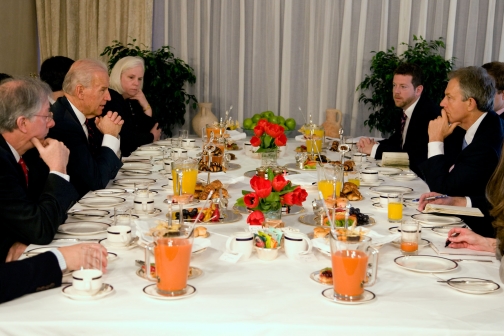
Last evening, the Vice President and General Jones had a working dinner with Israeli Prime Minister Netanyahu and Israeli Defense Minister Barak at the Vice President’s residence at the Naval Observatory, together with their delegations. They had a productive, candid discussion on the full range of issues in the bilateral relationship, in preparation for the meeting later today between the President and the Prime Minister.

Recovery Act Tax Benefits

March 22, 2010 | 22:29 | Public Domain

Vice President Joe Biden, joined by Treasury Secretary Timothy Geithner and IRS Commissioner Doug Shulman, announces that average tax returns are up nearly 10 percent this year thanks to tax benefits in the Recovery Act and says that a new Tax Savings Tool is available on WhiteHouse.gov.

Download mp4 (353MB) | mp3 (49MB)

Read the Transcript

Vice President Biden Announces Recovery Act Putting More Money Back in Middle Class Taxpayers' Pockets This Year

Launches New WhiteHouse.gov Tax Savings Tool to Help Taxpayers Take Advantage of Recovery Act Tax Credits

WASHINGTON – With the 2010 tax filing season underway, Vice President Joe Biden, Treasury Secretary Tim Geithner and IRS Commissioner Doug Shulman today announced that that average tax refunds are up nearly 10 percent this year, due in large part to the significant new tax benefits available under the American Recovery and Reinvestment Act (Recovery Act), and reminded taxpayers that they can collect on those benefits this year as they file their 2009 tax returns.  To help taxpayers see for themselves exactly how they can benefit from Recovery Act tax credits and collect every dollar owed when they file this tax season, the White House today launched a new interactive Tax Savings Tool available at www.WhiteHouse.gov/Recovery.

“The big guys know all the credits and deductions to claim during tax season, but we want middle class families to know just how much is out there for them this year thanks to the Recovery Act – and how to take advantage of it,” said Vice President Biden.  “From help with college expenses to credits for cost-saving, energy-efficiency home improvements, these Recovery Act tax credits not only provide some needed relief for working Americans, but also help them invest in their families’ futures.”

“The more that individuals and families take advantage of these benefits, the more money is pushed back into the economy, helping all Americans as we grow our way out of this crisis,” said Treasury Secretary Geithner.  “Only by getting these benefits to the American people can we help ensure that the recovery is firmly established. And only by firmly establishing the recovery can we encourage the creation of new jobs and lay a foundation for sustained economic growth.”

"The average tax refund has reached $3,036 this year, a $266 increase from a year ago," said IRS Commissioner Shulman. "The Recovery Act is a major factor behind these larger, record refunds. About half of all Americans haven't filed their taxes yet, so we urge them to look carefully at these Recovery provisions. Taxpayers should also remember that the fastest, best way to get their tax refund is by filing electronically with direct deposit."

During these tough economic times, Recovery Act tax cuts are helping hard-hit middle class families.  This year’s tax refund puts more money in the pockets of families across the country, and gives them incentives to make energy-saving home improvements, purchase a new vehicle or buy a home.  Those purchases are helping to jumpstart the economy and provide more clean energy, manufacturing and construction jobs for working families right here in the U.S.  The Recovery Act’s nearly $300 billion in tax benefits are helping to rebuild the long-term strength of the economy, while helping middle class families get back on firm financial footing.

According to early data from the IRS, the average income tax refund is up more than $260 – a 9.6 percent increase over last year – which is due in large part to the Recovery Act.  The average refund through March 12, 2010, is $3,036, which is an increase of $266 compared to the same time a year ago.  This is a sign that people are taking advantage of the Recovery Act tax savings this year.

However, data show that less than half of the overall expected returns have been filed.  The Obama Administration wants to make sure that taxpayers are aware of the new Recovery Act benefits they are eligible for this year.  The new interactive Tax Savings Tool was launched today to alert taxpayers to the more than a dozen tax benefits available to them under the Recovery Act.  The Tax Savings Tool can be accessed HERE.

Administration officials will hold a series of events across the country leading up to the April 15th tax filing deadline to help educate taxpayers on the Recovery Act benefits available to them when they file their taxes this year.   On Tuesday, March 23rd, Commerce Secretary Locke will travel to Minneapolis, MN to meet with homeowners and a contractor benefiting from the Recovery Act’s tax credits for new home purchases and energy-efficient home retrofits.  On Wednesday, March 24th, Secretary Duncan will meet with students and parents that stand to benefit from the American Opportunity Credit for college expenses at Northern Virginia Community College in Annandale, VA.  Secretary Chu will visit Seaway Manufacturing Corporation, a manufacturer of energy efficient home improvement products that qualify for the Recovery Act tax credits, in Erie, PA on Friday, March 26th.  Secretary LaHood will host a community roundtable on Recovery Act tax relief on Monday, March 29th, in the Chicago area; Secretary Donovan will hold an event on the First-Time Homebuyer Credit on Wednesday, March 31st in Charlotte, NC; and SBA Administrator Mills will also travel as part of the month-long effort.

Taxpayers can collect more than a dozen 2009 Recovery Act tax benefits when they file their 2009 tax returns, including:

  • Making Work Pay - Ninety-five percent of working families are receiving the Recovery Act’s Making Work Pay tax credit of $400 for an individual or $800 for married couples filing jointly in their paychecks in 2009 – and will continue to in 2010.  Taxpayers whose withholding in 2009 did not provide the full amount of the credit they are due will get the additional amount when they file their 2009 tax return. Even though most taxpayers received the benefit of this credit in their paychecks from adjusted tax withholding by their employers, they still need to claim this credit on their tax returns (i.e., Form 1040 or 1040A).
  • Up to $2,500 in College Expenses – Families and students are eligible for up to $2,500 in tax savings under the American Opportunity Credit as well as enhanced benefits under 529 college savings plans, which help families and students pay for college expenses.
    • American Opportunity Credit – More parents and students are eligible for a tax credit of up to $2,500 to pay for college expenses and can claim the credit annually for four years instead of two.


    • 529 College Savings Plans – Students can now use a 529 plan to pay for computer technology, adding this to the list of traditional college expenses (tuition, books, etc.) that can be paid for by a 529 plan.
  • Up to $8,000 for Purchase of First Home – Homebuyers can get a credit of up to $8,000 for first homes purchased by April 30, 2010 under the First Time Homebuyer tax credit.  Long-time residents who don’t qualify as first-time homebuyers and those with incomes of up to $145,000 for an individual and $245,000 for joint filers are also eligible for a reduced credit.
  • Up to $1,500 in Energy Efficiency and Renewable Energy Incentives – Taxpayers are eligible for up to $1,500 in tax credits for making some energy-efficiency improvements to their homes such as adding insulation and installing energy efficient windows.
  • Money Back for New Vehicle Purchases – Taxpayers can deduct the state and local sales taxes they paid for new vehicles purchased from Feb. 17, 2009 through Dec. 31, 2009 under the vehicle sales tax deduction.  In states that don't have a sales tax, some other taxes or fees paid may be deducted.
  • Expanded Family Tax Credits - Moderate income families with children may be eligible for an increase in the Earned Income Tax Credit and the additional Child Tax Credit.
    • Earned Income Tax Credit – The Recovery Act increased the credit for families with three or more children, bringing the maximum amount to $5,657.
    • Child Tax Credit – More families will be able to take advantage of the child tax credit under the Recovery Act, which reduced the minimum amount of earned income used to calculate the additional child tax credit to $3,000 from $12,550. 
  • Up to $2,400 in Unemployment Benefits Tax Free in 2009 – Unemployment benefits are normally taxable, but the Recovery Act made the first $2,400 of unemployment benefits received in 2009 tax free.

RECOVERY ACT TAX CREDIT IMPACT ON MIDDLE CLASS FAMILIES
Fact Sheet

During these tough economic times, Recovery Act tax cuts are making things a little easier for hard-hit middle class families.  There are more than a dozen Recovery Act tax cuts working families can take advantage of this tax season.

Here is a sampling of how Recovery Act tax cuts would benefit some “typical” middle class families this tax season:

Married Couple with Child in College

  • Married couple with income of $75,000 in 2009. 
  • Two children, one of whom is a junior in college. 
  • Paid $5,000 in college expenses in 2009.

Thanks to the Recovery Act, this married couple making $75,000 in 2009 is eligible for $3,300 in new or expanded 2009 tax credits.

Their employers adjusted their withholding last year to reflect the Making Work Pay Credit, and they collected an extra $800 in their paychecks in 2009 – and will continue to collect this credit in 2010.  When they file their taxes this year, they will collect an additional $2,500 thanks to the American Opportunity Credit to help with the costs of sending their oldest child to college.

Tax Savings:

  •  $800 in Making Work Pay Credit: Over 110 million working Americans qualify for the Recovery Act’s Making Work Pay Credit, saving them up to $400 per year ($800 for married couples filing a joint return).  Qualifying Americans should have received the credit incrementally in paychecks in 2009 and should continue to collect it throughout 2010.
  • $2,500 in American Opportunity Credit: College students and their parents are eligible to collect an American Opportunity Tax Credit of up to up to $2,500 through the Recovery Act to pay for college tuition and other expenses when filing taxes. This expanded the Hope Credit by $700 per student, and opened up the credit to apply beyond the first two years of college. Only the parent or the student can claim this credit – not both.

    Married Couple Who Made Energy-Efficient Home Improvements

    • Married couple with income of $90,000 in 2009.
    • Spent $6,000 in 2009 making energy-efficiency improvements including new energy-efficient windows, doors and insulation.

    Thanks to the Recovery Act, this married couple making $90,000 in 2009 is eligible for $2,300 in new or expanded 2009 tax credits.

    Their employers adjusted their withholding last year to reflect the Making Work Pay Credit, and they collected an extra $800 in their paychecks in 2009 – and will continue to collect this credit in 2010.  And when they file their taxes this year; they will collect an additional $1,500 in Residential Energy Property Credits because they made qualifying energy-efficiency improvements to their home.

    Tax Savings:

    • $800 in Making Work Pay Credit: Over 110 million working Americans qualify for the Recovery Act’s Making Work Pay Credit, saving them up to $400 per year ($800 for married couples filing a joint return).  Qualifying Americans should have received the credit incrementally in paychecks in 2009 and should continue to collect it throughout 2010.
    • $1,500 in Residential Energy Property Credits: Americans who made some types of energy-efficient upgrades to their homes this year can get 30 percent of what was spent back – up to $1,500 – this tax season.

    Single Mom With Three Children, Collected Unemployment

    • This single parent made $15,700 in 2009 and has three children. 
    • She dealt with a layoff at the beginning of the year and collected $2,400 in unemployment benefits.

    Thanks to the Recovery Act, this single mom making $15,700 in 2009 is eligible for $1,233 in new or expanded 2009 tax credits – plus her unemployment benefits are tax-free.

    Her employer adjusted her withholding last year to reflect the Making Work Pay Credit, and she collected an extra $400 in her paychecks in 2009 – and will continue to collect this credit in 2010.  She also will collect an extra $833 in Earned Income Tax Credit this year since the Recovery Act increased the maximum EITC for families with three or more children from $4,824 to $5,657.  And thanks to the Recovery Act, she will not have to pay taxes on the $2,400 in unemployment benefits she collected in 2009.  Typically unemployment benefit income is taxable.

    Tax Savings:

    • strong>$400 in Making Work Pay Credit: Over 110 million working Americans qualify for the Recovery Act’s Making Work Pay Credit, saving them up to $400 per year ($800 for married couples filing a joint return).  Qualifying Americans should have received the credit incrementally in paychecks in 2009 and should continue to collect it throughout 2010.
    • $833 increase in Earned Income Tax Credit to $5,657: The Recovery Act has expanded the Earned Income Tax Credit for larger families (with 3 or more children) up to $5,657.
    • Up to $2,400 in Unemployment Benefits Tax-Free: Americans who collected unemployment benefits in 2009 can benefit from the Recovery Act tax exemption that makes the first $2,400 of those benefits tax-free.

    First-Time Homebuyer Couple, Purchased New Car

    • This married couple made $80,000 in 2009 and closed on their first home last year that cost $125,000. 
    • They also bought a $17,000 new car in St. Louis, MO in 2009.

    Thanks to the Recovery Act, this married couple is eligible for $8,800 in new or expanded 2009 tax credits plus they can deduct the state and local sales taxes they paid on their new car.

    Their employers adjusted their withholding last year to reflect the Making Work Pay Credit, and they collected an extra $800 in their paychecks in 2009 – and will continue to collect this credit in 2010.  When they file their taxes this year, they will collect an additional $8,000 through the First-Time Homebuyer Tax Credit because they purchased their first home in 2009 (this credit is refundable).  They will also be able to deduct the state and local taxes they paid when they bought their new car last year.

    Tax Savings:

    • $800 in Making Work Pay Credit: Over 110 million working Americans qualify for the Recovery Act’s Making Work Pay Credit, saving them up to $400 per year ($800 for married couples filing a joint return).  Qualifying Americans should have received the credit incrementally in paychecks in 2009 and should continue to collect it throughout 2010.
    •  $8,000 in First Time Homebuyers Tax Credit: First-time homebuyers who purchased in 2009 can collect a refundable tax credit of up to $8,000 with no payback requirement unless they sell the home within three years of purchase.
    • Deduction of State and Local Taxes Paid on New Vehicle: The Recovery Act’s New Vehicle Purchase Incentive provides a tax deduction for state and local taxes or other fees paid on up to $49,500 of the price of that vehicle purchased between February 17, 2009 and December 31, 2009.

Close Transcript

The White House

Office of the Press Secretary

Vicepresidente Biden anuncia que la Ley para la Recuperación está poniendo más dinero en el bolsillo de los contribuyentes de clase media este año

Lanza nueva Herramienta de Ahorros Tributarios en WhiteHouse.gov para ayudar a los contribuyentes a aprovechar los créditos tributarios de la Ley para la Recuperación

WASHINGTON – Ya que es el momento de preparar las declaraciones de impuestos del 2010, el Vicepresidente Joe Biden, el secretario del Tesoro Tim Geithner y Doug Shulman, comisionado del Servicio de Rentas Internas (IRS por sus siglas en inglés), anunciaron hoy que el reembolso promedio de impuestos ha aumentado casi 10 por ciento este año, debido en gran parte a nuevos beneficios tributarios contenidos en la Ley para la Recuperación y Reinversión en Estados Unidos (American Recovery and Reinvestment Act), y les recordaron a los contribuyentes que pueden recibir dichos beneficios este año cuando presenten su declaración de impuestos del 2009. Para ayudar a los contribuyentes a ver por sí mismos exactamente cómo se pueden beneficiar de los créditos tributarios de la Ley para la Recuperación y recibir todo lo que se les debe cuando presenten sus declaraciones esta temporada de impuestos, la Casa Blanca lanzó hoy una nueva Herramienta de Ahorros Tributarios (Tax Savings Tool), disponible en www.WhiteHouse.gov/Recovery.

“La gente rica conoce al dedillo todos los créditos y deducciones que pueden reclamar esta temporada de impuestos, pero queremos que las familias de clase media sepan igual de bien cuánto pueden ahorrar este año gracias a la Ley para la Recuperación y cómo aprovecharlo”, afirmó el Vicepresidente Biden. “Desde ayuda con gastos universitarios hasta créditos por remodelar casas para mejorar el consumo de energía, estos créditos tributarios de la Ley para la Recuperación no sólo ofrecen un poco de ayuda necesaria a los trabajadores estadounidenses, sino que también los ayudan a invertir en el futuro de sus familias’”.

“Mientras más personas y familias aprovechen estos beneficios, más dinero vuelve a incorporarse en la economía, lo que ayuda a todos los estadounidenses a salir de esta crisis por medio del crecimiento”, afirmó el secretario del Tesoro Geithner. “Solamente si le hacemos llegar estos beneficios al pueblo estadounidense podemos ayudar a asegurar que la recuperación esté firmemente arraigada. Y sólo arraigando firmemente la recuperación podemos fomentar la generación de empleo y sentar las bases para un crecimiento económico sostenido”.

"El reembolso promedio de impuestos ha alcanzado $3,036 este año, un aumento de $266 con relación al año pasado", indicó el comisionado Shulman del IRS. "La Ley para la Recuperación es un factor importante detrás de este récord en el monto de los reembolsos. Aproximadamente la mitad de todos los estadounidenses aún no han presentado sus impuestos, por lo que los instamos a que examinen detenidamente estas disposiciones de la Ley para la Recuperación. Los contribuyentes también deben recordar que la manera más rápida y mejor de recibir su reembolso de impuestos es presentando su declaración electrónicamente con depósito directo".

Durante este difícil momento económico, los recortes tributarios de la Ley para la Recuperación están ayudando a las más afectadas familias de clase media. El reembolso de impuestos de este año pone más dinero en el bolsillo de familias en todo el país y les otorga incentivos para hacer mejoras que les ahorren energía en casa y comprar vivienda o vehículos nuevos. Estas adquisiciones están ayudando a impulsar la economía y generar más empleos industriales, de construcción y consumo de energía limpia para las familias trabajadoras aquí en Estados Unidos. Los casi $300,000 millones en beneficios tributarios de la Ley para la Recuperación están ayudando a restablecer la solidez a largo plazo de la economía, a la vez que ayudan a las familias de clase media a recuperar la estabilidad económica.

Según datos iniciales del IRS, el reembolso promedio de impuestos a la renta se ha incrementado en más de $260 –un aumento de 9.6 por ciento con relación al año pasado– lo cual se debe en gran parte a la Ley para la Recuperación. El reembolso promedio hasta el 12 de marzo, 2010, es de $3,036, un aumento de $266 en comparación al mismo periodo el año pasado. Éste es un indicio de que la gente está aprovechando los ahorros tributarios otorgados por la Ley para la Recuperación este año.

Sin embargo, los datos indican que se ha presentado menos de la mitad de todas las declaraciones de impuestos previstas. El gobierno del Presidente Obama quiere asegurarse de que los contribuyentes estén informados de los nuevos beneficios de la Ley para la Recuperación que pueden recibir este año. La nueva Herramienta de Ahorros tributarios, que es interactiva, se lanzó hoy para alertar a los contribuyentes acerca de más de una docena de beneficios tributarios a disposición por medio de la Ley para la Recuperación. Se puede obtener acceso a la Herramienta de Ahorros Tributarios AQUI.

Funcionarios del gobierno organizarán una serie de eventos en todo el país antes del 15 de abril, la fecha límite para presentar la declaración de impuestos, a fin de ayudar a informar a los contribuyentes de los beneficios de la Ley para la Recuperación a su disposición cuando presenten sus impuestos este año. El martes, 23 de marzo, el secretario de Comercio Locke viajará a Minneapolis, MN, para reunirse con propietarios de vivienda y un contratista que se están beneficiando de créditos tributarios para la compra de casa y arreglos para el consumo eficiente de energía en viviendas contenidos en la Ley para la Recuperación. El miércoles, 24 de marzo, el secretario Duncan se reunirá con estudiantes y padres que se beneficiarán del Crédito de Oportunidades Estadounidenses (American Opportunity Credit) para gastos universitarios en Northern Virginia Community College de Annandale, VA. El viernes, 26 de marzo en Erie, PA, el secretario Chu visitará Seaway Manufacturing Corporation, fabricante de productos que mejoran el consumo de energía en viviendas y reúnen los requisitos para créditos tributarios conforme a la Ley para la Recuperación. El lunes, 29 de marzo, en el área de Chicago, el secretario LaHood participará en una mesa redonda comunitaria sobre ahorros tributarios contenidos en la Ley para la Recuperación; el miércoles, 31 de marzo en Charlotte, NC, el secretario Donovan participará en un evento sobre el Crédito para Quienes Compran Casa por Primera Vez (First-Time Homebuyer Credit), y la administradora Mills de la Dirección de Pequeñas Empresas (Small Business Administration o SBA) también viajará como parte de la campaña de un mes.

Los contribuyentes podrán recibir más de una docena de beneficios contenidos en la Ley para la Recuperación del 2009 cuando presenten sus declaraciones de impuestos del 2009, entre ellos:

• Making Work Pay – Noventa y cinco por ciento de las familias trabajadoras están recibiendo el crédito tributario Making Work Pay de la Ley para la Recuperación, que equivale a $400 para personas individuales u $800 para matrimonios que presentan la declaración conjuntamente por medio de sus cheques de pago en el 2009 y que continuará en el 2010. Los contribuyentes a quienes no se les reembolsó lo suficiente en el 2009 para cubrir el monto total del crédito que se les debe recibirán la cantidad adicional cuando presenten su declaración de impuestos del 2009. Aunque la mayoría de los contribuyentes se benefició de este crédito en sus cheques de pago vía deducciones tributarias modificadas por sus empleadores, de todos modos deben solicitar este crédito en sus declaraciones de impuestos (por ejemplo, Formulario 1040 ó 1040A).

• Hasta $2,500 por gastos universitarios – Las familias y estudiantes que reúnen los requisitos pueden ahorrar hasta $2,500 con el American Opportunity Credit, como también mayores beneficios con planes 529 de ahorro por gastos universitarios, que ayudan a las familias y estudiantes a pagar sus gastos universitarios.

o American Opportunity Credit – Los padres y estudiantes, en su mayoría, reúnen los requisitos para un crédito tributario de hasta $2,500 para pagar gastos universitarios y pueden solicitar el crédito anualmente durante cuatro años en vez de dos.

o Planes 529 de ahorro para gastos universitarios – Los estudiantes ahora pueden usar un plan 529 para pagar computadoras, además de la lista tradicional de gastos universitarios (matrícula, libros, etc.) que se pueden pagar con un plan 529.

• Hasta $8,000 para la compra de la primera casa – Quienes compren casa por primera vez para el 30 de abril del 2010, a más tardar, pueden recibir un crédito de hasta $8,000 con el crédito tributario First Time Homebuyer. También pueden recibir un crédito menor quienes ya son propietarios pero no reúnen los requisitos de compra inicial y las personas individuales con ingresos de hasta $145,000 y los matrimonios que declaran conjuntamente con ingresos de hasta $245,000.

• Hasta $1,500 en incentivos para la eficiencia energética y energía renovable – Los contribuyentes pueden recibir hasta $1,500 en créditos tributarios por hacer ciertasmejoras para el consumo eficiente de energía en su casa, como aumentar el material aislante e instalar ventanas de consumo eficiente de energía.

• Reembolso por la compra de vehículos nuevos – Los contribuyentes pueden deducir los impuestos a la venta estatales y locales que pagaron si compraron vehículos nuevos del 17 de febrero, 2009 al 31 de diciembre, 2009 con la deducción de impuestos por venta de autos. En los estados sin impuesto a las ventas, se pueden deducir otros impuestos o cuotas pagadas.

• Mayores créditos tributarios para familias - Las familias de ingresos moderados con hijos posiblemente puedan recibir un mayor crédito tributario por ingresos devengados (Earned Income Tax Credit) y un crédito tributario por hijos (Child Tax Credit) adicional.

o Crédito tributario por ingresos devengados – La Ley para la Recuperación aumentó el crédito a las familias de tres o más hijos hasta una cantidad máxima de $5,657.

o Crédito tributario por hijos – Más familias podrán aprovechar el crédito tributario por hijos con la Ley para la Recuperación, que redujo la cantidad mínima de ingresos devengados que se usa para calcular el crédito tributario por hijo adicional de $12,550 a $3,000.

• Hasta $2,400 en beneficios por desempleo libres de impuestos en el 2009 – Los beneficios por desempleo generalmente están sujetos a impuestos, pero la Ley para la Recuperación exoneró de impuestos los $2,400 iniciales en beneficios de desempleo recibidos en el 2009.

IMPACTO DE CRÉDITOS TRIBUTARIOS DE LA LEY PARA LA RECUPERACIÓN EN LAS FAMILIAS DE CLASE MEDIA
Hoja informativa
 
Durante este difícil momento económico, los recortes tributarios de la Ley para la Recuperación están facilitando las cosas un poco para las afectadas familias de clase media. Hay más de una docena de recortes tributarios en la Ley para la Recuperación que las familias trabajadoras pueden aprovechar esta temporada de impuestos.
 
A continuación, algunos ejemplos sobre cómo los recortes tributarios del Ley para la Recuperación benefician a algunas familias “típicas” de la clase media esta temporada de impuestos:
 
Matrimonio con hijos universitarios
• Matrimonio con ingresos de $75,000 en el 2009.
• Dos hijos, uno de los cuales cursa el tercer año de universidad.
• Pagó $5,000 en gastos universitarios en el 2009.

Gracias a la Ley para la Recuperación, este matrimonio con ingresos de $75,000 en el 2009 cumple con los requisitos para un nuevo o mayor crédito tributario de $3,300 en el 2009.

Sus empleadores modificaron los impuestos deducidos el año pasado para reflejar el crédito de Making Work Pay, y el matrimonio recibió $800 adicionales en sus cheques de pago en el 2009 y continuará recibiendo este crédito en el 2010. Cuando presenten su declaración de impuestos este año, recibirán $2,500 adicionales gracias al American Opportunity Credit para ayudar con el costo de mandar a su hijo mayor a la universidad.
 
Ahorros tributarios:

• $800 en crédito de Making Work Pay: Más de 110 millones de trabajadores estadounidenses reúnen los requisitos para el crédito de Making Work Pay con la Ley para la Recuperación, lo que les ahorrará hasta $400 al año ($800 en el caso de matrimonios que presentan declaraciones conjuntas). Los estadounidenses que reúnen los requisitos deberían haber recibido el crédito gradualmente en sus cheques de pago en el 2009 y deben continuar recibiéndolo durante el 2010.

• $2,500 en crédito de American Opportunity: Los estudiantes universitarios y sus padres reúnen los requisitos para recibir un crédito tributario de American Opportunity de hasta $2,500 contenido en la Ley para la Recuperación para pagar la matrícula universitaria y otros gastos cuando presenten sus declaraciones. Esto aumentó el crédito Hope hasta $700 por estudiante y permitió que el crédito se aplique después de los dos primeros años de universidad. Sólo el padre de familia o el estudiante puede reclamar este crédito, no ambos.
 
 
Matrimonio que hizo mejoras para el consumo eficiente de energía
• Matrimonio con ingresos de $90,000 en el 2009.
• Gastó $6,000 en el 2009 haciendo mejoras para el consumo eficiente de energía, entre ellos nuevas ventanas, puertas y asilamiento eficiente.

Gracias a la Ley para la Recuperación, este matrimonio con ingresos de $90,000 en el 2009 reúne los requisitos para un nuevo o mayor crédito tributario de $2,300 en el 2009.

Sus empleadores modificaron los impuestos descontados el año pasado para reflejar el crédito de Making Work Pay, y el matrimonio recibió $800 adicionales en sus cheques de pago en el 2009 y continuarán recibiendo este crédito en el 2010. Y cuando presenten su declaración de impuestos este año, recibirán $1,500 adicionales en créditos por Residential Energy Property porque reúnen los requisitos de mejoras para el consumo eficiente de energía en su casa.

Ahorros tributarios:

• $800 con el crédito de Making Work Pay: Más de 110 millones de trabajadores estadounidenses reúnen los requisitos para el crédito de Making Work Pay de la Ley para la Recuperación, lo que les ahorrará hasta $400 al año ($800 en el caso de matrimonios que presentan declaraciones conjuntas). Los estadounidenses que cumplan con los requisitos deberían haber recibido el crédito gradualmente en sus cheques de pago en el 2009 y deben continuar recibiéndolo durante el 2010.

• $1,500 en créditos de Residential Energy Property: Los estadounidenses que hicieron ciertos tipos de mejoras para el consumo eficiente de energía en su casa este año pueden recibir hasta 30 por ciento de lo que gastaron –hasta $1,500– esta temporada de impuestos.
 

Madre sola con tres hijos, cobró beneficios por desempleo
• Esta madre sola ganó $15,700 en el 2009 y tiene tres hijos.
• Fue despedida a comienzos de año y cobró $2,400 en beneficios de desempleo.

Gracias a la Ley para la Recuperación, esta madre sola con ingresos de $15,700 en el 2009 reúne los requisitos para un nuevo o mayor crédito tributario de $1,233 en el 2009 y además, los beneficios de desempleo están exonerados de impuestos.

Su empleador modificó los impuestos deducidos el año pasado para reflejar el crédito de Making Work Pay, y ella recibió $400 adicionales en sus cheques de pago en el 2009 y continuará recibiendo este crédito en el 2010. También recibirá $833 adicionales en el crédito tributario por ingresos devengados este año, ya que la Ley para la Recuperación aumentó el crédito máximo para las familias con tres hijos o más de $4,824 a $5,657. Y gracias a la Ley para la Recuperación, no tendrá que pagar impuestos por los $2,400 en beneficios de desempleo que recibió en el 2009. Generalmente, los beneficios por desempleo son gravables.

Ahorros tributarios:

• $400 en el crédito de Making Work Pay: Más de 110 millones de trabajadores estadounidenses reúnen los requisitos para el crédito de Making Work Pay de la Ley para la Recuperación, lo que les ahorra hasta $400 al año ($800 en el caso de matrimonios que presentan declaraciones conjuntas). Los estadounidenses que cumplan con los requisitos deberían haber recibido el crédito gradualmente en sus cheques de pago en el 2009 y deben continuar recibiéndolo durante el 2010.
 
• Aumento de $833 en crédito tributario por ingresos devengados de hasta $5,657: La Ley para la Recuperación ha aumentado el crédito tributario por ingresos devengados de las familias más numerosas (con 3 hijos o más) a un máximo de $5,657.

• Hasta $2,400 en beneficios de desempleo exonerados de impuestos: Los estadounidenses que recibieron beneficios por desempleo en el 2009 pueden beneficiarse de la exención tributaria de la Ley para la Recuperación con la que los primeros $2,400 de esos beneficios están exonerados de impuestos.

Matrimonio que compra casa por primera vez y auto nuevo
• Este matrimonio tuvo ingresos de $80,000 en el 2009 y compró su primera casa de $125,000 el año pasado.
• También compró un auto de $17,000 en St. Louis, MO, en el 2009.

Gracias a la Ley para la Recuperación, este matrimonio reúne los requisitos para un nuevo o mayor crédito tributario de $8,800 en el 2009 y además puede deducir los impuestos a la venta, tanto estatales como locales, que pagaron por su auto nuevo.

Sus empleadores modificaron sus impuestos deducidos el año pasado para reflejar el crédito de Making Work Pay, y el matrimonio recibió $800 adicionales en sus cheques de pago en el 2009 y continuarán recibiendo este crédito en el 2010. Cuando presenten su declaración de impuestos este año, recibirán $8,000 adicionales por el crédito tributario de First-Time Homebuyer porque compraron su primera casa en el 2009 (este crédito es reembolsable). También podrán deducir los impuestos estatales y locales que pagaron cuando compraron su auto nuevo el año pasado.
 
Ahorros tributarios:

• $800 con el crédito de Making Work Pay: Más de 110 millones de trabajadores estadounidenses reúnen los requisitos para el crédito de Making Work Pay de la Ley para la Recuperación, lo que les ahorra hasta $400 al año ($800 en el caso de matrimonios que presentan declaraciones conjuntas). Los estadounidenses que cumplan con los requisitos deberían haber recibido el crédito gradualmente en sus cheques de pago en el 2009 y deben continuar recibiéndolo durante el 2010.

• $8,000 con el crédito tributario de First Time Homebuyers: Quienes compraron casa por primera vez en el 2009 pueden recibir un crédito tributario reembolsable de hasta $8,000 sin necesidad de devolverlo a no ser que vendan su casa antes de que se cumplan tres años de la compra.

• Deducción de impuestos estatales y locales pagados por el vehículo nuevo: El incentivo para la compra de vehículo nuevo de la Ley para la Recuperación otorga una deducción tributaria por los impuestos estatales o locales u otras cuotas pagadas hasta $49,500 del precio del vehículo comprado entre el 17 de febrero, 2009 y 31 de diciembre, 2009.
 

The White House

Office of the Vice President

Vice President Biden Announces Recovery Act Putting More Money Back in Middle Class Taxpayers' Pockets This Year

Launches New WhiteHouse.gov Tax Savings Tool to Help Taxpayers Take Advantage of Recovery Act Tax Credits

WASHINGTON – With the 2010 tax filing season underway, Vice President Joe Biden, Treasury Secretary Tim Geithner and IRS Commissioner Doug Shulman today announced that that average tax refunds are up nearly 10 percent this year, due in large part to the significant new tax benefits available under the American Recovery and Reinvestment Act (Recovery Act), and reminded taxpayers that they can collect on those benefits this year as they file their 2009 tax returns.  To help taxpayers see for themselves exactly how they can benefit from Recovery Act tax credits and collect every dollar owed when they file this tax season, the White House today launched a new interactive Tax Savings Tool available at www.WhiteHouse.gov/Recovery.

“The big guys know all the credits and deductions to claim during tax season, but we want middle class families to know just how much is out there for them this year thanks to the Recovery Act – and how to take advantage of it,” said Vice President Biden.  “From help with college expenses to credits for cost-saving, energy-efficiency home improvements, these Recovery Act tax credits not only provide some needed relief for working Americans, but also help them invest in their families’ futures.”

“The more that individuals and families take advantage of these benefits, the more money is pushed back into the economy, helping all Americans as we grow our way out of this crisis,” said Treasury Secretary Geithner.  “Only by getting these benefits to the American people can we help ensure that the recovery is firmly established. And only by firmly establishing the recovery can we encourage the creation of new jobs and lay a foundation for sustained economic growth.”

"The average tax refund has reached $3,036 this year, a $266 increase from a year ago," said IRS Commissioner Shulman. "The Recovery Act is a major factor behind these larger, record refunds. About half of all Americans haven't filed their taxes yet, so we urge them to look carefully at these Recovery provisions. Taxpayers should also remember that the fastest, best way to get their tax refund is by filing electronically with direct deposit."

During these tough economic times, Recovery Act tax cuts are helping hard-hit middle class families.  This year’s tax refund puts more money in the pockets of families across the country, and gives them incentives to make energy-saving home improvements, purchase a new vehicle or buy a home.  Those purchases are helping to jumpstart the economy and provide more clean energy, manufacturing and construction jobs for working families right here in the U.S.  The Recovery Act’s nearly $300 billion in tax benefits are helping to rebuild the long-term strength of the economy, while helping middle class families get back on firm financial footing.

According to early data from the IRS, the average income tax refund is up more than $260 – a 9.6 percent increase over last year – which is due in large part to the Recovery Act.  The average refund through March 12, 2010, is $3,036, which is an increase of $266 compared to the same time a year ago.  This is a sign that people are taking advantage of the Recovery Act tax savings this year.

However, data show that less than half of the overall expected returns have been filed.  The Obama Administration wants to make sure that taxpayers are aware of the new Recovery Act benefits they are eligible for this year.  The new interactive Tax Savings Tool was launched today to alert taxpayers to the more than a dozen tax benefits available to them under the Recovery Act.  The Tax Savings Tool can be accessed HERE.

Administration officials will hold a series of events across the country leading up to the April 15th tax filing deadline to help educate taxpayers on the Recovery Act benefits available to them when they file their taxes this year.   On Tuesday, March 23rd, Commerce Secretary Locke will travel to Minneapolis, MN to meet with homeowners and a contractor benefiting from the Recovery Act’s tax credits for new home purchases and energy-efficient home retrofits.  On Wednesday, March 24th, Secretary Duncan will meet with students and parents that stand to benefit from the American Opportunity Credit for college expenses at Northern Virginia Community College in Annandale, VA.  Secretary Chu will visit Seaway Manufacturing Corporation, a manufacturer of energy efficient home improvement products that qualify for the Recovery Act tax credits, in Erie, PA on Friday, March 26th.  Secretary LaHood will host a community roundtable on Recovery Act tax relief on Monday, March 29th, in the Chicago area; Secretary Donovan will hold an event on the First-Time Homebuyer Credit on Wednesday, March 31st in Charlotte, NC; and SBA Administrator Mills will also travel as part of the month-long effort.

Taxpayers can collect more than a dozen 2009 Recovery Act tax benefits when they file their 2009 tax returns, including:

  • Making Work Pay - Ninety-five percent of working families are receiving the Recovery Act’s Making Work Pay tax credit of $400 for an individual or $800 for married couples filing jointly in their paychecks in 2009 – and will continue to in 2010.  Taxpayers whose withholding in 2009 did not provide the full amount of the credit they are due will get the additional amount when they file their 2009 tax return. Even though most taxpayers received the benefit of this credit in their paychecks from adjusted tax withholding by their employers, they still need to claim this credit on their tax returns (i.e., Form 1040 or 1040A).
  • Up to $2,500 in College Expenses – Families and students are eligible for up to $2,500 in tax savings under the American Opportunity Credit as well as enhanced benefits under 529 college savings plans, which help families and students pay for college expenses.
    • American Opportunity Credit – More parents and students are eligible for a tax credit of up to $2,500 to pay for college expenses and can claim the credit annually for four years instead of two.


    • 529 College Savings Plans – Students can now use a 529 plan to pay for computer technology, adding this to the list of traditional college expenses (tuition, books, etc.) that can be paid for by a 529 plan.
  • Up to $8,000 for Purchase of First Home – Homebuyers can get a credit of up to $8,000 for first homes purchased by April 30, 2010 under the First Time Homebuyer tax credit.  Long-time residents who don’t qualify as first-time homebuyers and those with incomes of up to $145,000 for an individual and $245,000 for joint filers are also eligible for a reduced credit.
  • Up to $1,500 in Energy Efficiency and Renewable Energy Incentives – Taxpayers are eligible for up to $1,500 in tax credits for making some energy-efficiency improvements to their homes such as adding insulation and installing energy efficient windows.
  • Money Back for New Vehicle Purchases – Taxpayers can deduct the state and local sales taxes they paid for new vehicles purchased from Feb. 17, 2009 through Dec. 31, 2009 under the vehicle sales tax deduction.  In states that don't have a sales tax, some other taxes or fees paid may be deducted.
  • Expanded Family Tax Credits - Moderate income families with children may be eligible for an increase in the Earned Income Tax Credit and the additional Child Tax Credit.
    • Earned Income Tax Credit – The Recovery Act increased the credit for families with three or more children, bringing the maximum amount to $5,657.
    • Child Tax Credit – More families will be able to take advantage of the child tax credit under the Recovery Act, which reduced the minimum amount of earned income used to calculate the additional child tax credit to $3,000 from $12,550. 
  • Up to $2,400 in Unemployment Benefits Tax Free in 2009 – Unemployment benefits are normally taxable, but the Recovery Act made the first $2,400 of unemployment benefits received in 2009 tax free.

RECOVERY ACT TAX CREDIT IMPACT ON MIDDLE CLASS FAMILIES
Fact Sheet

During these tough economic times, Recovery Act tax cuts are making things a little easier for hard-hit middle class families.  There are more than a dozen Recovery Act tax cuts working families can take advantage of this tax season.

Here is a sampling of how Recovery Act tax cuts would benefit some “typical” middle class families this tax season:

Married Couple with Child in College

  • Married couple with income of $75,000 in 2009. 
  • Two children, one of whom is a junior in college. 
  • Paid $5,000 in college expenses in 2009.

Thanks to the Recovery Act, this married couple making $75,000 in 2009 is eligible for $3,300 in new or expanded 2009 tax credits.

Their employers adjusted their withholding last year to reflect the Making Work Pay Credit, and they collected an extra $800 in their paychecks in 2009 – and will continue to collect this credit in 2010.  When they file their taxes this year, they will collect an additional $2,500 thanks to the American Opportunity Credit to help with the costs of sending their oldest child to college.

Tax Savings:

  •  $800 in Making Work Pay Credit: Over 110 million working Americans qualify for the Recovery Act’s Making Work Pay Credit, saving them up to $400 per year ($800 for married couples filing a joint return).  Qualifying Americans should have received the credit incrementally in paychecks in 2009 and should continue to collect it throughout 2010.
  • $2,500 in American Opportunity Credit: College students and their parents are eligible to collect an American Opportunity Tax Credit of up to up to $2,500 through the Recovery Act to pay for college tuition and other expenses when filing taxes. This expanded the Hope Credit by $700 per student, and opened up the credit to apply beyond the first two years of college. Only the parent or the student can claim this credit – not both.

    Married Couple Who Made Energy-Efficient Home Improvements

    • Married couple with income of $90,000 in 2009.
    • Spent $6,000 in 2009 making energy-efficiency improvements including new energy-efficient windows, doors and insulation.

    Thanks to the Recovery Act, this married couple making $90,000 in 2009 is eligible for $2,300 in new or expanded 2009 tax credits.

    Their employers adjusted their withholding last year to reflect the Making Work Pay Credit, and they collected an extra $800 in their paychecks in 2009 – and will continue to collect this credit in 2010.  And when they file their taxes this year; they will collect an additional $1,500 in Residential Energy Property Credits because they made qualifying energy-efficiency improvements to their home.

    Tax Savings:

    • $800 in Making Work Pay Credit: Over 110 million working Americans qualify for the Recovery Act’s Making Work Pay Credit, saving them up to $400 per year ($800 for married couples filing a joint return).  Qualifying Americans should have received the credit incrementally in paychecks in 2009 and should continue to collect it throughout 2010.
    • $1,500 in Residential Energy Property Credits: Americans who made some types of energy-efficient upgrades to their homes this year can get 30 percent of what was spent back – up to $1,500 – this tax season.

    Single Mom With Three Children, Collected Unemployment

    • This single parent made $15,700 in 2009 and has three children. 
    • She dealt with a layoff at the beginning of the year and collected $2,400 in unemployment benefits.

    Thanks to the Recovery Act, this single mom making $15,700 in 2009 is eligible for $1,233 in new or expanded 2009 tax credits – plus her unemployment benefits are tax-free.

    Her employer adjusted her withholding last year to reflect the Making Work Pay Credit, and she collected an extra $400 in her paychecks in 2009 – and will continue to collect this credit in 2010.  She also will collect an extra $833 in Earned Income Tax Credit this year since the Recovery Act increased the maximum EITC for families with three or more children from $4,824 to $5,657.  And thanks to the Recovery Act, she will not have to pay taxes on the $2,400 in unemployment benefits she collected in 2009.  Typically unemployment benefit income is taxable.

    Tax Savings:

    • strong>$400 in Making Work Pay Credit: Over 110 million working Americans qualify for the Recovery Act’s Making Work Pay Credit, saving them up to $400 per year ($800 for married couples filing a joint return).  Qualifying Americans should have received the credit incrementally in paychecks in 2009 and should continue to collect it throughout 2010.
    • $833 increase in Earned Income Tax Credit to $5,657: The Recovery Act has expanded the Earned Income Tax Credit for larger families (with 3 or more children) up to $5,657.
    • Up to $2,400 in Unemployment Benefits Tax-Free: Americans who collected unemployment benefits in 2009 can benefit from the Recovery Act tax exemption that makes the first $2,400 of those benefits tax-free.

    First-Time Homebuyer Couple, Purchased New Car

    • This married couple made $80,000 in 2009 and closed on their first home last year that cost $125,000. 
    • They also bought a $17,000 new car in St. Louis, MO in 2009.

    Thanks to the Recovery Act, this married couple is eligible for $8,800 in new or expanded 2009 tax credits plus they can deduct the state and local sales taxes they paid on their new car.

    Their employers adjusted their withholding last year to reflect the Making Work Pay Credit, and they collected an extra $800 in their paychecks in 2009 – and will continue to collect this credit in 2010.  When they file their taxes this year, they will collect an additional $8,000 through the First-Time Homebuyer Tax Credit because they purchased their first home in 2009 (this credit is refundable).  They will also be able to deduct the state and local taxes they paid when they bought their new car last year.

    Tax Savings:

    • $800 in Making Work Pay Credit: Over 110 million working Americans qualify for the Recovery Act’s Making Work Pay Credit, saving them up to $400 per year ($800 for married couples filing a joint return).  Qualifying Americans should have received the credit incrementally in paychecks in 2009 and should continue to collect it throughout 2010.
    •  $8,000 in First Time Homebuyers Tax Credit: First-time homebuyers who purchased in 2009 can collect a refundable tax credit of up to $8,000 with no payback requirement unless they sell the home within three years of purchase.
    • Deduction of State and Local Taxes Paid on New Vehicle: The Recovery Act’s New Vehicle Purchase Incentive provides a tax deduction for state and local taxes or other fees paid on up to $49,500 of the price of that vehicle purchased between February 17, 2009 and December 31, 2009.

The White House

Office of the Vice President

Vice President Biden Announces 10,000 Recovery Act Transportation Projects Now Under Way

As Spring Construction Season Begins, Active Transportation Projects Totaling $29.8 Billion are Creating Jobs Across the Country

DURHAM, NC – Vice President Joe Biden today announced that 10,000 transportation projects are now under way in all 50 states and the District of Columbia thanks to the American Recovery and Reinvestment Act (ARRA).  Projects are considered under way when a contractor has been hired, the project has received official notice to proceed, and work has begun.  This milestone comes just over a year after the Recovery Act was signed into law and as the spring construction season is getting into full swing. 

The Vice President made the announcement as part of a visit to North Carolina - the state where the 10,000th project, the Sanford Bypass, will break ground.  The contractor, DHG Infrastructure, says they are hiring more than 45 employees to work on the project.  The $26 million project, which was accelerated by the Recovery Act, will redirect commercial truck traffic away from the heart of the city of Sanford, relieving congestion and maintenance problems, and increasing access for businesses to relocate and expand in the area.

“The 10,000 transportation projects under way are already helping put us on the road to economic recovery, but there is even more to come,” said Vice President Biden. “This spring, Recovery Act projects will pick up the pace across the country, providing even more jobs improving America’s roads, highways and bridges.”

In just one year, the Recovery Act has improved more than 33,000 miles of pavement across the United States; helped purchase nearly 12,000 buses, vans and rail vehicles; helped construct or renovate more than 850 transit facilities and provided more than $620 million in preventive maintenance.  This helped save and create jobs, and maintained and enhanced the nation’s transportation network. In addition to the 10,000 projects already under way, construction activity is expected to ramp up even further in the next few months as temperatures warm and new projects break ground.

“Every new Recovery Act project means workers back on the job, paying their rent or mortgage, putting food on the table for their families,” said U.S. Transportation Secretary Ray LaHood.  “These 10,000 projects are strengthening our economy and creating jobs right now, and there are more projects still to come this spring.”

During the first week of March, the U.S. Department of Transportation successfully met an aggressive deadline to “obligate” – or commit funds to specific projects – 100 percent of their Recovery Act highway and transit formula dollars.  That important milestone means that for every Recovery Act project, contracts can be bid, workers can be hired and construction can begin on projects that create jobs and drive economic growth.

In addition to the Sanford Bypass Project, some other major Recovery Act-funded projects under construction include:

I-4/Selmon Expressway in Tampa. Because of $105 million in Recovery Act funds, construction began earlier this month on the $653 million I-4/Selmon Expressway Crosstown Connector in Tampa.  The project will provide direct access for the more than 12,000 commercial trucks that travel through downtown to and from the Port of Tampa every day.

DART Orange Line in Dallas.  Recovery Act funds totaling $61.2 million are helping Dallas Area Rapid Transit construct the 14-mile Orange Line, which will eventually link Downtown Dallas and the Dallas/Fort Worth International Airport.

Nelsonville Bypass in Southeast Ohio.  Ohio is constructing a new, 8.5 mile, four-lane highway to divert freight traffic from U.S. 33, which bottlenecks in the town of Nelsonville. Recovery Act funds totaling $138 million are helping fund this final upgrade of the U.S. 33 corridor in southeast Ohio that will take traffic off local roads, which carry 1,700 trucks a day on one of the busiest truck routes in the state.

Merritt Parkway, near Fairfield, Conn.   Recovery Act funds in the amount of $67 million are improving safety for the estimated 60,000 daily drivers who use the Merritt Parkway by widening shoulders and installing or updating guard rails along 9.3 miles of one of the East Coast’s most congested commuter routes.

South Westnedge Avenue Interchange on I-94 near Kalamazoo, Mich. Last fall, the Recovery Act fully funded this $47.7 million project to reconstruct the interchange and ease traffic congestion along this key Midwest corridor that serves an estimated 87,000 drivers daily. One additional lane will be added in each direction to widen the road from four lanes to six, allowing cars and trucks to move through Kalamazoo more safely and easily.

The White House

Office of the Press Secretary

Remarks by the President, the Vice President and the Taoiseach of Ireland at St. Patrick's Day Reception

East Room

7:47 P.M. EDT

VICE PRESIDENT BIDEN:  Good evening, everyone.  Mr. President, Mrs. Obama, the Taoiseach, Mrs. Cowen.  Welcome to the White House and welcome, all of you, to the White House.

You know, as I said to some of my friends at the Vice President’s residence this morning at a breakfast, there’s an old saying -- there’s an old saying that goes like this:  If you're lucky enough to be Irish, well, you’re lucky enough.  (Laughter and applause.)

I was telling the Taoiseach earlier today, one of my favorite cartoons to explain to the Irish-Irish what we American-Irish are like was one handed to me, Mr. President, by Pat Moynihan about 15, 18 years ago.  It was The New Yorker Magazine and it was a picture of Pat and Mike sitting in a pub in New York.  And Pat looks at Mike and says, “Mike, don't you wish you were in a pub in Dublin wishing you were in a pub in New York?”  (Laughter.)  You understand that about us, you got it all straight, Taoiseach.

But the Taoiseach knows a lot about it.  His mom lived in Long Island for 10 years or so -- God rest her soul and -- although, wait, your mom is still alive, it’s your dad passed.  God bless her soul.  (Laughter.)  I got to get this straight.

You know, there are nearly 40 million of us who claim to be Irish-American.  That's considerably larger than the entire population of the Emerald Isle.  But 40 million, many of you in this room, have made incredible, incredible contributions to our country.  Perhaps the greatest contribution collectively we Irish have made is that we have the same set of values both in Ireland and here:  family, faith, pride and courage.

And these are the values, in my view -- and I mean this sincerely -- that define the man I work with every day, Barack Obama.  (Applause.)

The President is always kidding me because I'm always quoting Irish poets.  He thinks I quote them because I'm Irish.  I don't do it for that reason -- I do it because they’re simply the best poets.  And the best of them in my view is Yeats.  Yeats once said, “In dreams begin responsibility.”  Well, ladies and gentlemen, the dreams that President Obama has awakened and have awakened in the American people are generating a new sense of responsibility that I think is going to serve this nation well.  It’s going to be a more peaceful world, a more prosperous nation, and, at the same time, an awful lot of people who haven’t had hope are going to get it.

There’s an old Irish proverb, as some of you know, that I heard my grandfather use but never really applied to me before.  He said, it goes, “A silent mouth is sweet to hear.”  (Laughter.)  Well, I'm going to yield to that proverb -- (laughter) -- and introduce you to the President of the United States of America, Barack Obama.  (Applause.)

PRESIDENT OBAMA:  Good evening, everybody.

AUDIENCE:  Good evening.

PRESIDENT OBAMA:   Welcome to St. Patrick’s Day at the White House, on a day when springtime is in the air –- and this is -- even though the Taoiseach hasn’t even shared his shamrocks yet, but we can feel spring coming.

Before I say anything else let me just say that I could not have a better partner in a difficult job than the Vice President of the United States, Joe Biden; he does a great job each and every day.  (Applause.)  And I couldn't have a better partner in life than the First Lady of the United States, Michelle Obama.  (Applause.)

Welcome back, Mr. Prime Minister, First Lady.  We are thrilled to have you.

The Irish and Irish-Americans are out in force tonight.  I believe, if I'm not mistaken that Supreme Court Justice Anthony Kennedy is here.  (Applause.)  A couple of my Cabinet Secretaries are here, as well –- Secretary of Health and Human Services Kathleen Sebelius, and Secretary of Homeland Security Janet Napolitano.  (Applause.)  I would love to acknowledge all the members of Congress who are here tonight, but there are a few dozen of you, including three or four Murphys.  (Laughter.)  There’s one right there.  (Laughter.)  You're everywhere.

Governor Martin O’Malley -- (applause) -- who’s been known to be the lead in an Irish rock band.  Governor Bob McDonnell is here, of the great Commonwealth of Virginia.  And Mayor Tom Menino shipped down from Boston.  (Applause.)  My dear friend, the United States Ambassador to Ireland and the person who is singly responsible for converting the entire country to become Steelers’ fans, Dan Rooney.  (Applause.)  And his counterpart, the Irish Ambassador to the United States, Michael Collins.  (Applause.)  So welcome, everybody.

This has been a wonderful day filled with good reminders of just how deeply woven the ties between our two countries are.  We welcomed back a friend, the Taoiseach.  He and I remarked once again of our shared ties to County Offaly.  (Applause.)  He was born there, and when I was running for President, it was brought to my attention that -- I want to make sure I get this straight -- it was my great-great-great-great grandfather on my mother’s side who hailed from Moneygall.  I wish I knew about this when I was running in Chicago.  (Laughter.)

I also had the pleasure of welcoming back First Minister Peter Robinson and Deputy First Minister Martin McGuinness of Northern Ireland -- (applause) -- two men who have stood together with conviction to chart a historic path towards peace.  They are here tonight.  We were thinking about sending them up to Congress tomorrow -- (laughter) -- to see if they can share some of their secrets.  (Laughter.)

I also just met with Andrew Sens and Brigadier General -- I want to make sure I get this right -- Tauno Niemenen, who, because of their successful leadership, are winding down the work of the Independent Commission on Decommissioning after 12 years.  (Applause.)  And Matt Baggott, the Chief Constable of the Police Service of Northern Ireland, whose fairness and impartiality is keeping the peace across all of Northern Ireland’s communities.  So thank you.  (Applause.)

Twelve years ago, America was inspired by the brave men and women who found the courage to see past the scars of a troubled past so that their children would know a better future.  And we are watching you and continue to be inspired by your extraordinary work.

It’s wonderful to have everybody here at the White House here tonight.  During his last visit, the Taoiseach mentioned that the Irish Diaspora is some 70 million strong -- which is obviously impressive for a small island.  And it’s even more impressive that they all find their way to America for St. Patrick’s Day.  (Laughter.)  I can make that joke as somebody of Irish heritage.  (Laughter.)

I should mention by the way that -- we were discussing this with my mayor from Chicago, Mayor Daley, and I told him that I had this Irish heritage.  And he said that he had actually Kenyan blood in him also.  (Laughter.)

It just goes to show that in recent decades it has become cool to be Irish.  (Laughter.)  It’s the phenomenon the Irish poet, and Joe Biden’s favorite poet, Seamus Heaney, once described in stunned fashion as “the manifestation of sheer, bloody genius -– Ireland is chic.”  (Laughter.)

And obviously we know, though, that that wasn’t always the case.  After centuries of oppression, the Irish began coming to America -– even before America had been won.  Many came with no family, no friends, no money -– nothing to sustain their voyage but faith.  Faith in the Almighty.  Faith in a better life over the horizon.  And faith that in America, you can make it if you try.

And in the wake of a Great Hunger, that migration intensified.  And the Irish carved out a place for themselves in our nation’s story -– America and Ireland, our brawn and our blood, side by side in the making and remaking of this nation; pulling it westward, pushing it skyward, moving it forward -– even if it was a nation that was not always as welcoming as it could be.

But with hard work and toughness and loyalty and faith, the Irish persevered.  And in the process they secured the future for generations of Irish-Americans free to live their lives as they will -– and today, free to argue openly and proudly about who is more Irish than whom.  (Laughter.)

So it can be easy to forget that there was a time when “No Irish Need Apply.”  Particularly when it was half a century ago this year that John F. Kennedy walked through the doors of this house as the first Irish Catholic President of the United States.  (Applause.)

One person who never forgot this history -– someone who frequently recalled his grandfather’s vivid stories of those days; who through his office window could see the Boston Harbor steps where his eight Irish grandparents first set foot in America –- was the President’s youngest brother and our dear friend, Ted Kennedy.  (Applause.)

He knew, as we do, that our nation is infinitely richer for not only the contributions of the Irish throughout history -– but the contributions of people from around the world.  That’s why I’m pleased that there’s bipartisan progress being made in an area that I know was close to his big heart -– and that's fixing our broken immigration system.  (Applause.)  And that’s why my own commitment to comprehensive immigration reform remains unwavering.

In this and every other battle for progress, Ted was a tireless warrior.  And I know that we could use him this week.  I am so glad that we’re joined tonight by his wife Vicki; his daughter, Kara; his son, Congressman Patrick Kennedy; and his sister-in-law, Ethel Kennedy, as well as a whole bunch of nieces and nephews.  Please give them a big round of applause.  (Applause.)

Both of our nations are down one friend, a champion, and peacemaker.  But it wouldn’t be Irish mourning without some undercurrent of joy.  So while Teddy’s laughter may not shake the walls of this house tonight, as it did so many times over the past half-century, ours will not be diminished.  While his singing may not fill these rooms, I suspect that won’t stop some of you from trying.  (Laughter.)  You don't have to try, though -- that's why we brought in the entertainment.  (Laughter.)

This is rightly a day for celebration and good cheer between America and one of her oldest friends -– and it’s a partnership that extends to our earliest days as a Republic.  So before I turn it over to the Taoiseach, let me leave you with all the words from those early days that speak to why this has been such an incredible relationship between our two countries.  These are words spoken by the father of our country, George Washington:

“When our friendless standards were first unfurled, who were the strangers who first mustered around our staff?  And when it reeled in the light, who more brilliantly sustained it than Erin’s generous sons?  Ireland, thou friend of my country in my country’s most friendless days, much injured, much enduring land, accept this poor tribute from one who esteems thy worth, and mourns thy desolation.  May the God of Heaven, in His justice and mercy, grant thee more prosperous fortunes, and in His own time, cause the sun of Freedom to shed its benign radiance on the Emerald Isle.”

To all of you from near and far, and over all the years and tests ahead, may America and Ireland forever brilliantly sustain one another’s sons and daughters.

And with that, to our guest, the Taoiseach of Ireland, on behalf of the American people we want to thank you for your presence here.  We are proud to call you a friend this day and every day.  And we are looking forward to planting this little piece of Ireland in the garden here in the White House.

Happy St. Patrick’s Day, everybody.  (Applause.)

The Taoiseach, the Prime Minister of Ireland, Brian Cowen.  (Applause.)

TAOISEACH COWEN:  Thank you very much, President Obama.  I made one solemn promise to myself when I've come to the White House for the second time:  I intend reading my own speech tonight.  (Laughter.)

Mr. President, First Lady Mrs. Obama, Mr. Vice President, distinguished guests, ladies and gentlemen.  I want to thank you, Mr. President and Mrs. Obama, for your warm and gracious welcome to the White House tonight for so many of us.  Mary and I and all of our delegation are delighted to be here with you again this year.

We’ve had a great day of celebrations today at your nation’s Capitol, starting of course, with a very gracious invitation from the Vice President -- great Irishman, Joe Biden -- to a St. Patrick’s Day breakfast at is house.  Himself and Jill gave us a wonderful start to a wonderful morning and we deeply appreciate that wonderful gesture.  Thank you.  (Applause.)

In fact, Mr. President, it’s almost as nice as your home here.  (Laughter.)  Joe Biden said he always voted for public housing -- he never thought he’d get into one as good.  (Laughter.)

So I extend to you all our greetings for St. Patrick’s Day from the home sod.  This occasion is an honor not only for those of us present this evening, but for all Irish people -- at home and across America.  We feel very much at home here.  And as we gather here tonight we remember that this year marks the 50th anniversary of the election of President Kennedy, in whose legacy we Irish take great pride.

On one occasion, speaking in your home city of Chicago, John F. Kennedy described Ireland’s Diaspora as a “fraternal empire.”  He said that “whether we live in Cork or Boston, Chicago or Sydney, we are all members of a great family which is linked together by that strongest of chains -- a common past.”

The bonds between Ireland and America run deep in our shared history.  St. Patrick’s Day is celebrated in every state and corner of this great land.  And it is so pleasing to us that this day has come to be appreciated and enjoyed by all Americans, not just those of Irish heritage.

The great blending of our people and our history has been shown in all its glory by those who are entertaining us tonight, including the City of Washington Pipe Band, the President's Marine Band, Irish Combo, and the magnificent Celtic Dreams from New York City.  (Applause.)

Next year we will be having a special year of celebration of Irish arts and culture here in the United States, so I can assure you that we will have many more artists who will be ready and willing to return here at any time.

And I am delighted in that context that we are joined here tonight by that great Irish actor, Gabriel Byrne.  Gabriel this week accepted an appointment as Ireland’s first Cultural Ambassador and I wish him well in that wonderful endeavor.  (Applause.)

And of course, Mr. President, when the Irish are finished looking after your entertainment needs -- (laughter) -- Pádraig Harrington, who also joins us tonight can help you with your golf game.  (Applause.)

PRESIDENT OBAMA:  I need help.  There he is.  I need some tips.

TAOISEACH COWEN:  Mr. President, this year on St. Patrick’s Day we are particularly mindful of the absence of our dear and loyal friend, Senator Ted Kennedy.  Ted loved to celebrate St. Patrick’s Day, and at times like this we miss his enthusiastic presence.  He took great pride in his Irish heritage and he cared deeply about peace on our island.  I know that he would be especially pleased to acknowledge the crucial and decisive step forward taken in recent weeks by First Minister Peter Robinson and Deputy First Minister Martin McGuinness, and all the leaders in Northern Ireland.  We congratulate them on all that has been achieved and promise them our support.  (Applause.)

In conclusion can I say that we hope to see you, the First Lady and your family in Ireland soon, Mr. President.  (Applause.)  It is important that we get visits from prestigious people of the American constituency from time to time.  (Laughter.)  I'm sure you have heard that the great welcome accorded to your predecessors is available to you as well.  (Laughter.)

And we’ll never forget the historic visit by President Kennedy to his home place in 1963.  And I can assure you of an equally warm welcome, especially in County Offaly, where I may have some influence.  (Laughter.)

I also want to thank you very much, Mr. President, because we’re delighted and touched to know that not only will you plant shamrock in the children’s garden, but it will grow from soil from my own County of Offaly.  Not only is the soil from Offaly, but it’s also from Moneygall -- the place of your own family’s Irish heritage.  I believe, of course, that this soil will have special properties that will ensure that the garden flourishes.  At least I hope so.  (Laughter.)

And I know that when you trace your ancestry back to that place where I have lived all my life you’ll find a hearty welcome and many people waiting to see you there and to reconnect with your Irish heritage in a very real and personal way.

It’s amazing, you know, how many O’Haras, O’Sullivans and O’Neills are frantically searching to see if there’s any way they can be linked to the Obamas.  (Laughter and applause.)

I want to say to you one search -- I am very closely acquainted with the electorate registered in County Offaly -- and there are no Obamas on it.  (Laughter.)

However, Mr. President, it’s now my great honor to present you with a bowl of shamrock.  I do so in celebration of the achievements of the Irish in America and of the everlasting friendship between the people of Ireland and the people of the United States of America.  You will always have a loyal and faithful friend in me as long as I lead this government.  (Applause.)

(The bowl of shamrock is presented.)

PRESIDENT OBAMA:  This is wonderful.  Beautiful.  Thank you so much.  And I think in addition to all the fertilizer we put down this will bring good luck to the garden.  (Laughter.)  Thank you very much, that is lovely.  Thank you.  (Applause.)

So I want to thank everybody for being here.  I want you to have a wonderful time -- not that I need to tell you that.  If anybody wants pictures taken, Patrick Leahy is here -- (laughter) -- he always has a camera.  (Laughter.)

Have a wonderful time.  Happy St. Patrick’s Day, everybody.  (Applause.)

END
8:12 P.M. EDT

The Vice President in the Middle East

  • VP Israel Netanyahu
    1 of 8
  • VP Israel Peres
    2 of 8
  • VP Israel Gravesite
    3 of 8
  • VP Israel Museum
    4 of 8
  • VP Israel Blair
    5 of 8
  • VP Israel Mrs Biden
    6 of 8
  • VP Israel Nassar
    7 of 8
  • VP Israel Abbas
    8 of 8

Yesterday, Vice President Biden spoke at Tel Aviv University in Israel about the partnership between the United States and Israel:

Israel’s unique relationship with the United States means that you need not bear that heavy burden alone.  Our nations’ unbreakable bond borne of common values, interwoven cultures, and mutual interests has spanned the entirety of Israel’s history.  And it’s -- it’s impervious to any shifts in either country and either country’s partisan politics.  No matter what challenges we face, this bond will endure.  As a result, generations of Israelis and Americans and American-Israelis have kept a foot in each country, enriching both our nations and peoples.  I met with some of your leading high-tech leaders earlier, prior to coming to the stage.  And they have a foot in both countries, many of them.

While these close relationships span the realm of commerce and education, medicine and technology, culture and the arts, at its core is an ironclad commitment to security -- Israel and my own country’s.  Every day, Israel faces bravely threats no country should have to endure.  No parent should their child to schools equipped with air raid sirens in the year 2010.  No government should be expected to turn a blind eye while an enemy calls for its destruction.

I am here to remind you, though I hope you will never forget, that America stands with you shoulder-to-shoulder in facing these threats.  President Obama and I represent an unbroken chain of American leaders who have understood this critical, strategic relationship.  As the President said recently, “I will never waver from ensuring Israel’s security and helping them secure themselves in what is a very hostile region."

To watch the full speech, click here.

Earlier this week, the Vice President also spoke with Palestinian Authority President Mahmoud Abbas at Ramallah and with Israeli Prime Minister Netanyahu in Jerusalem.  

Related Topics:

The White House

Office of the Vice President

Remarks by Vice President Biden: The Enduring Partnership Between the United States and Israel

Tel Aviv University

VICE PRESIDENT BIDEN:  Mr. President, thank you for that lovely introduction.  And thank you for hosting me at such a world-class center for higher learning.  It’s been a long time since I’ve been back on campus.  I was a mere child, a 31-year-old Senator when I was here the first time.  But it’s a privilege to be back. 

The past few days being back in Israel has been wonderful.  It’s -- it’s been an honor to be here, and it’s been -- I wanted everyone to know with whom I spoke, and all of you to know, the deep friendship and kinship I feel as well as President Obama feels for this magnificent country.  I should probably be used to it by now, but I’m always struck every time I come back by the hospitality of the Israeli people.  No matter how long I’ve been away -- and I imagine you’ve experienced this yourself -- the instant I return, I feel like I’m at home.  I feel like I never left.  I feel like things just picked up where they left off the day that I left being here.  So please accept my warmest gratitude, as well that of President Obama, who knows as well as I do that the United States has no better friend in the community of nations than Israel.  Thank you so much.  (Applause.) 

I see some of my U.S. friends down there in the front row.  I won’t identify them and ruin their reputations.  But they -- they know where my love for this country comes.  It started at my dinner table with my father, who you would refer to as a righteous Christian.  My father -- my dinner table was a place where we gathered to have conversation and incidentally eat, as opposed to the other way around.  And my father -- my father’s support for Israel is outrage for what had happened in the ‘30s and the failure of the world to act, his support for the creation of the state of Israel.  It generated a feeling for Israel that began in my gut and went to my heart, and the older I got matured in my mind. 

During those sessions, my other -- my father often spoke passionately about the special connection between the Jewish people and this land.  Like many of my countrymen, I experienced the magic of Israel at a relatively young age -- at least it looks young now from my perspective.  When I first visited here in 1973 on the eve of the Yom Kippur War, your nation was only a quarter-century old, and I was not much older.  Already, Israel had a tragic as well as triumphal history behind it, and as we all know, some very difficult days ahead.  Already, there was a sense here that anything was possible.

My very first meeting in Israel was maybe the one that I carry closest to my heart.  My first meeting in Israel -- I was invited by a woman named Golda Meir, who I admired from afar as millions of Americans did.  We sort of claimed her as our own.  I know she is Israeli, but we claimed her.  We claimed her as our own in America.  And I remember walking into her office as a young senator being literally in awe as she was so gracious the way she accepted me and gave me a hug more like my mother would, sat down behind her desk and while chain-smoking -- she had a series of maps behind her.  And there were six or seven maps.  She kept flipping the maps up and down, and explaining to me what exactly had happened in the Six-Day War.  And there was a young man sitting next to me, a guy named Yitzhak Rabin, who I met for the first time.  And as she pulled those maps up and down, educating this young senator as to the -- to the threat that this young nation of Israel was facing, I guess she could see the sense of apprehension on my face.  I found myself being -- the more she talked about 2 million Jews -- and back then, by the way, there were not that many Arabs compared to today.  The numbers were much smaller, but they were still exponentially larger than the Jewish population.  And she went through the threats that were faced, and how it had come through the battles of the Six-Day War.  She spoke so passionately about her country.

And I was concerned.  I guess it showed in my face.  I was concerned that surrounded by the neighbors who denied the very right of the nation to exist, how were you going to do this?  The Prime Minister caught me off guard.  After about an hour and a half, she looked at me and she said. “Senator, would you like a photo opportunity?”  And I thought, what the hell is a photo opportunity?  And I said, “Well, yes, Madam Prime Minister.”  We opened those double doors and we walked out into the ending room of her office and there was a lot of press there -- a lot, half a dozen photographers and cameras.  (Laughter.) 

For me, that was a lot, not like today.  And they started snapping pictures.  And while looking straight ahead, she talked to me without turning her head.  She said, “Senator, don’t look so worried.”  She said -- I said, “Well I am, Madam President, and because I just had this hour and a half.”  And she said -- she said, “We Israelis have a secret weapon.”  And I thought she only had said this to me, no one else in the whole world.  She said, “We have a secret weapon in our struggle with the Arabs.”  And I thought she was going to tell me about a new secret weapon.  (Laughter.)  And I found myself turning and looking at her, and the press -- because this was all just a stand-up photo opportunity.  And she said, “We have a secret weapon.  We have nowhere else to go.”

That trip was almost four decades ago, but I remember it as clearly as if it happened yesterday.  And it drove home all that my father had spoken of -- randomly, occasionally but consistently -- over the previous 15 years.  And he told me as a young boy, that Israel and Jews in the world had no place else to go with absolute certitude.  This place, it gets in your blood.  It never really lets you go.  

I expect that there are several people in the audience today who have had similar experiences who first came here as tourists or religious pilgrims and ended up making aliyah and launching a new life in northern kibbutz, or a small town in Negev, or in the beautiful city by the sea.  Throughout my career, Israel has not only remained close to my heart but it has been the center of my work as a United States Senator and now as Vice President of the United States.

I have had the privilege of returning many times, and to know every one of your prime ministers over these past three and a half decades, including your current leader who is a close, personal friend of over 33 years, Bibi Netanyahu. 

Israel’s history is a tale of remarkable accomplishment.  On a perilous patch of desert with sparse natural resources, you have built perhaps the most innovative economy in the world.  You have more start-ups per capita than any nation on the planet, more firms on the NASDAQ exchange than anyone except the United States, and more U.S. patents per capita than any country, including my own.  You have cultivated the gifts of 11 Nobel laureates, the great -- and as well as those of the great Itzhak Perlman, and in recent years you have Shai Agassi, whose path-breaking work on electric automobiles began not very far from where I stand.

Israel owes this remarkable and yet improbable success, I believe, to your democratic traditions, to its patriotic and pioneering citizens, and as with my own country, to its willingness to welcome the persecuted and the downtrodden from far-flung corners of the globe.  All this gives life to Theodor Herzl’s famous slogan, which I was reminded of this week while visiting his grave on this 150th anniversary of his birth.  He said, “If you will it, it is no dream.”

I had said in a speech in the United States some years ago for which I got some criticism, I said were I a Jew, I would be a Zionist.  And it got a lot of national publicity, how could I say that, until I was reminded by my father you need not be a Jew to be a Zionist. 

Ladies and gentlemen, just over 60 years ago, Israel’s founders gave life to Herzl’s dream by willing Israel into being.  Since then, this nation has become more than an undeniable fact, more than just a legacy of age-old ties between a people and a land, though it is both of those things.  Your very existence is also a hard-won and inviolable right.

Israel’s unique relationship with the United States means that you need not bear that heavy burden alone.  Our nations’ unbreakable bond borne of common values, interwoven cultures, and mutual interests has spanned the entirety of Israel’s history.  And it’s -- it’s impervious to any shifts in either country and either country’s partisan politics.  No matter what challenges we face, this bond will endure.  As a result, generations of Israelis and Americans and American-Israelis have kept a foot in each country, enriching both our nations and peoples.  I met with some of your leading high-tech leaders earlier, prior to coming to the stage.  And they have a foot in both countries, many of them. 

While these close relationships span the realm of commerce and education, medicine and technology, culture and the arts, at its core is an ironclad commitment to security -- Israel and my own country’s.  Every day, Israel faces bravely threats no country should have to endure.  No parent should their child to schools equipped with air raid sirens in the year 2010.  No government should be expected to turn a blind eye while an enemy calls for its destruction.

I am here to remind you, though I hope you will never forget, that America stands with you shoulder-to-shoulder in facing these threats.  President Obama and I represent an unbroken chain of American leaders who have understood this critical, strategic relationship.  As the President said recently, “I will never waver from ensuring Israel’s security and helping them secure themselves in what is a very hostile region.”

President Obama has not only stated those words, he has translated that vow into action in his first year in ways both known to the public and not known to you, as Prime Minister Netanyahu eloquently acknowledged the other day when he and I were meeting and had a short press conference that followed.  Beyond providing Israel nearly $3 billion in military aid each and every year, we have reinvigorated defense consultations and redoubled our efforts to ensure that Israel’s -- that Israel’s forces will always maintain a qualitative edge.

We lead the fight in international institutions against the insidious campaign to challenge Israel’s legitimacy and question its right to self-defense.  Since our administration came into office, our militaries have expanded cooperation -- not maintained, expanded -- cooperation on joint exercises and missile defense.  Last fall, more than 1,000 American troops participated in Juniper Cobra ballistic missile defense exercises, the largest such drill to date. 

And it should go without saying, but I’ll say it anyway so there’s no doubt, the United States stands resolutely beside Israel against the scourge of terrorism, from which both of our countries have suffered badly.  No one in this audience needs to be reminded of the fear and devastation caused by suicide bombers or by rockets from Southern Lebanon or from Gaza.  The band of Israeli territory outside the rocket’s range grows narrower all the time.  And I, as an American, continue to marvel -- continue to marvel at the residents in the region being able to resolutely get up every morning of the communities -- other communities that in fact are within the bulls eye, the crosshairs, how you respond to that with defiance and not fear.  American support for Israel is not just an act of friendship; it’s an act of fundamental national self-interest on the part of the United States, a key component to our broader efforts to secure this region and a wider world, as well as our own security.

Ladies and gentlemen, I’ve heard it raised occasionally in editorials in this country and others wondering about our resolve.  Make no mistake about America’s resolve.  Make no mistake about America’s resolve.  We have 200,000 young women and men -- we are spending a quarter of a trillions a year.  We have had tens of thousands of fallen angels and multiple times more injured in the service of our nation deployed far from home  in Iraq and Afghanistan.  There, and elsewhere, we are aggressively confronting violent extremism and radical ideologies that threaten not only you and the United States, but our allies as well. 

But our approach consists of more than the awesome military might we possess and are willing to use.  From the very start, President Obama has called for a new era of diplomatic engagement with both our friends -- some of whom we had alienated the previous years -- as well as -- as well as those who are not viewed as our friends. 

In Cairo last June, he launched a new beginning between the United States and the Muslim communities around the world.  Later this month, the President will continue this engagement by visiting Indonesia, home of the world’s largest Muslim population where he lived as a boy.  We are absolutely convinced that this approach will improve not only our security, but as a consequence, your security.

A new generation of Muslims is coming to age, more numerous than its predecessors, more dispersed geographically, and because of technology, more closely connected with each other and with the forces and events that shape the world we share.  If we can rollback recent tensions and redirect crude stereotypes -- theirs and our own -- it will make America safer and our closest allies, like Israel, safer as well in our view.

We are returning an ambassador to Damascus and elevating our diplomatic contacts.  We do so with our eyes wide open both to our deep concerns with Syrian actions that has threatened your security and the stability of the region, and also to the hope of a better relationship and peace between Israel and Syria.  And we will continue to help strengthen the institutions in Lebanon and work to implement the U.N. Security Council resolutions aimed at ending the flow of weapons to Hizballah and disarming this threat to Israel, as well as to the civilian Lebanese. 

With other Arab and Muslim countries, we are revitalizing a partnership in education, science, technology, business, culture; because the best way to counter the lure of extreme ideology is to offer future opportunity.  In speaking with your Prime Minister recently, he talked about the high birth rates in neighboring poor countries, including Yemen, and the need for us to provide economic outlets and opportunities so there is an option.

Looming over all our efforts in this region is the shadow cast by Iran, home of a -- home of a great civilization and proud people who suffer from a leadership that flouts the will of the world by pursuing nuclear weapons and supporting terrorism and terrorists.  Over the past decade, Iran has become more, not less dangerous, building thousands of centrifuges that churn out nuclear material, funding and arming dangerous proxies like Hizballah and Hamas, intimidating both its neighbors as well as its own citizens.

From the moment we were elected, President Obama decided that we needed a new approach.  He has sought to engage Iran’s leaders for the purpose of changing their conduct, knowing full well how difficult that may be, but also knowing that if they fail to respond, we would be in a much stronger position to rally the international community to impose consequences for their actions.  

Iran thus far has refused to cooperate, as the whole world has witnessed.  Instead it has engaged in more violations of international obligations, like undeclared enrichment facilities that were recently exposed by the United States, and the decision to enrich uranium to 20 percent to build more -- and to build more enrichment facilities, all violations.  It rejected a good-faith offer to exchange its low enriched uranium for fuel that could power a research reactor to produce medical isotopes.  And it continues to deploy thugs to lock up and beat down those who bravely take to the streets in a quest for basic justice in their own country.

The Iranian leadership’s continuing defiance has set the stage for our efforts to mobilize the world to impose meaningful sanctions that clarify for the Iranian leadership the stark choice:  follow international rules or face harsh penalties and further isolation. 

You have to acknowledge that today Iran is more isolated with its own people as well as the region and in the world than it has been at any time in the past two decades.  The United States is determined to prevent Iran from acquiring nuclear weapons, period.  I know -- I know that for Israel -- (applause) -- I know that for Israel, there is no greater existential strategic threat.  Trust me, we get that.  It’s also a threat -- the acquisition of nuclear weapons by Iran is also a threat to the security -- short-term, mid-term, and long-term -- to the United States of America. 

And many other countries in this region and around the world strongly oppose a nuclear-armed Iran.  It would threaten them, trigger an arms race in this region, and undermine the efforts to stop the spread of nuclear weapons, which would be a sorry outcome for such a promising beginning of the 21st century.  For all those reasons, confronting this challenge is and must be a top national priority for the United States of America.

We are determined to keep the pressure on Iran so that it will change its course.  And as we do, we will also be seeking to improve relations between the Israelis and Palestinians.  They are connected indirectly, but there is a relationship.  We call on Arab states who share a mutual concern about Iran -- we call on Arab states to support the effort to bring peace between Palestinians and the Israelis, and to take their own steps forward for peace with Israel.

These are critical goals in their own rights.  Their pursuit also denies Tehran the opportunity to exploit the differences between Israelis and Palestinians, and Israelis and the Arab world, and to distract the many countries that stand united against Iran’s pursuit of nuclear weapons and the support of terrorism.  Building peace and security between a Jewish democratic state of Israel and a viable, independent Palestinian state is profoundly in Israel’s interest, if you will forgive me for suggesting that.  (Applause.)

I’ve learned never tell another man or another country what’s in their own interest, but it seems so -- it’s also profoundly in the interest of Palestinians.  And it’s fundamentally in the national security interest of the United States of America.

Ladies and gentlemen, in my experience one necessary precondition for progress is that the rest of the world knows this.  There is no space -- this is what they must know, every time progress is made, it’s made when the rest of the world knows there is absolutely no space between the United States and Israel when it comes to security, none.  No space.  (Applause.)  That’s the only time when progress has been made.   

And I applaud Prime Minister Netanyahu’s recent call for two states for two people, lending a vital voice to what the Israelis, Palestinians, their Arab neighbors all know in their heart to be true.  Ladies and gentlemen, the status quo is not sustainable. 

It’s no secret the demographic realities make it increasingly difficult for Israel to remain both a Jewish homeland and a democratic country in the absence of the Palestinian state.  Genuine steps toward a two-state solution are also required to empower those living to live in peace and security with Israel and to undercut their rivals who will never accept that future. 

For Israel, then, this is about both preserving your identity and achieving the security you deserve, lasting security.  

For Palestinians, statehood will not just fulfill a legitimate and long-sought aspiration common to all peoples; it will restore the fundamental dignity and self-respect that their current predicament denies them.  I understand why both sides are skeptical.  I’ve been doing this for a long time, not as long as my friend, Dennis Ross who is with me -- Ross, who is with me -- Ross who is with me.  He is with me.  (Laughter and applause.)  He has even more experience in the nitty-gritty of this than I do.  We understand why both sides are skeptical.  We’ve been down this road before and so have you, which every time makes it a little harder to go down the road again.

But I know -- I know that Israel’s faith in the prospects for peace have been shaken by the searing experience of withdrawing from Lebanon and from Gaza, only to be rewarded with rocket fire and ambushes across your border.  I know you’ve been frustrated by the unwillingness of some Palestinian leaders to curb incitement and take the risk that peace requires, just as when the West Bank checkpoints proliferate and settlements grow, the Palestinians experience their own crisis in confidence and come to doubt Israeli intentions.

And we all know what happens when cynicism festers -- distrust, harsh words, and eventually violence.  The cycle of unintended consequences, which has happened more times than I can count, has led you to build more walls that may offer short term relief, but will not bring the sustained security that you seek.  This is no way to live.  This cycle must be broken.

In the Middle East -- in the Middle East that I first visited, peace between Israelis and its neighbors seemed absolutely impossible even to discuss.  Those who suggested a two-state solution -- and no one did that, actually.  But had someone suggested a two-state solution, they would have been considered either demented or dreamers.  But then, Israel, Egypt and Jordan all acted boldly to end decades of conflict.  Over time, other contacts have emerged between Israelis and Arabs.

And there is now an Arab Peace Initiative that makes an important contribution by envisioning a future in which Israel is secure and at peace with its Arab neighbors.  Turning these visions into reality is among the hardest challenges we face, but we have to face it.  There is no alternative.  (Applause.) 

As Prime Minister Netanyahu said, “all sides” -- “all sides need to take action in good faith if peace is to have a chance.”  But it’s hard, my words, it’s hard.  While it’s always easier to point fingers, it’s time for Israeli and Palestinian leaders to acknowledge each others’ steps to heed this call, even when more remains to be done -- and for the world to do the same thing.

Your Prime Minister is roundly criticized in other parts of the world, but your Prime Minister has endorsed the idea of a Palestinian State.  He has removed roadblocks and checkpoints that choked the West Bank.  These were difficult decisions -- not all that was asked for on the other side, but these were difficult decisions.

It was also difficult for the Palestinian Authority to take a step that it has to take to combat incitement and reform the institutions it’s reforming.  Of an even greater note, it’s building an effective -- for the first time a genuinely effective security force to uphold law and order, in my view, with the potential to do it throughout the West Bank and throughout the Palestinian territories. 

President Obama and I believe that -- believe that in President Abbas and Prime Minister Fayyad, men who I’ve known for a long time, Israeli leaders finally have willing partners who share the goal of peace between two states and have the competence to establish a nation.  Their commitment to peace is an opportunity that must be seized.  It must be seized.  Who has there been better to date, to have the prospect of settling this with?  But instead, two days ago the Israeli government announced it would advance planning for new housing units in East Jerusalem.  I realize this is a very touchy subject in Israel as well as in my own country.  But because that decision, in my view, undermined the trust required for productive negotiations, I -- and at the request of President Obama condemned it immediately and unequivocally.  (Applause.)

Now, some legitimately may have been surprised that such a strong supporter of Israel for the last 37 years and beyond, but 37 years as an elected official, how I can speak out so strongly given the ties that I share as well as my country shares with Israel.  But quite frankly, folks, sometimes only a friend can deliver the hardest truth.  And I appreciate, by the way, the response your Prime Minister today announced this morning that he is putting in place a process to prevent the recurrence of that sort of that sort of events and who clarified that the beginning of actual construction on this particular project would likely take several years -- a statement he put out.  That’s significant, because it gives negotiations the time to resolve this, as well as other outstanding issues.  Because when it was announced, I was on the West Bank.  Everyone there thought it had meant immediately the resumption of the construction of 1,600 new units.   

Look, folks, as we move forward I promise you this:  The United States will continue to hold both sides accountable for any statements or any actions that inflame tensions or prejudice the outcome of these talks.  The most important thing is for these talks to go forward and go promptly and go forward in good faith.  We can’t delay, because when progress is postponed, extremists exploit our differences and they sow hate. 

These indirect talks everyone knows are just that, indirect talks, indirect negotiations.  The only path, though, to finally resolving the permanent status issues, including borders, security, refugees, and Jerusalem are direct talks.  Our administration -- (applause) -- but you’ve got to begin.  The process has to begin.  Our administration fully supports this effort led by our Special Envoy, Senator George Mitchell, a seasoned negotiator and a proven peacemaker in whom the President, the Secretary of State Hillary Clinton, and I have complete and utter confidence.

We believe that through good-faith negotiations, the parties can mutually agree to an outcome which ends the conflict and reconciles the Palestinian goal of an independent and viable state based on the ‘67 lines with agreed swaps and Israel’s goal of a Jewish state with secure and recognized borders that reflect subsequent developments and meet Israel’s security requirements.

Many challenges remain.  Gilad Shalit is still in captivity and we pray every day for the day when he will come home and be reunited with his family.  (Applause.)  Ladies and gentlemen, incitement against Israel continues as do attacks on the legitimacy of Jewish ties to this ancient land. 

And the ongoing threat from Gaza still in Hamas’s grip, and from Hizballah in Southern Lebanon, remind us that your security is far from assured.  Meanwhile, though, our policy and our concerns about Israel’s settlements remain unchanged.  And while Hamas has condemned Gaza’s populace to misery and hopelessness, Israel too has a responsibility to address their many needs.  That’s why we’re working with the Israeli government to do just that and address some of legitimate needs without -- without further endangering Israel’s security.

Ladies and gentlemen, I’m a Roman Catholic.  And no one -- and I’m no expert on the Old Testament.  But I know we’re gathered today between Purim and Passover, holidays that teach us about salvation and redemption.  It was written in the Book of Isaiah that Israel shall be “a light unto the nations.”  And yet, for more than six decades, Israelis have often sought but never found the salvation of a lasting peace. And it is very hard -- it is very hard to be a beacon for others, when you are constantly at war.  To end this historic conflict, both sides must be historically bold, because if each waits stubbornly for the other to act first, this will go on and we’ll be waiting for an eternity. 

Back home, I am sometimes called an optimist, but I am an optimist about the prospects for peace because I am a realist.  And to paraphrase Golda Meir, there is nowhere else to go.  There is nowhere else to go.  I cannot tell you that peace will come easily, you know better.  In human history, it rarely has.  But I can promise you, both Israelis and Palestinians, that the rewards for success will be boundless and that so long as well-intentioned people are engaged in this struggle, the United States will be your partner.

Thank you.  And may God protect you, and may God protect Israel.  Thank you very much.  (Applause.)