Vice President Biden in Central Europe

Today the Vice President is on the second day of a three-day trip through Central Europe, where he is visiting Poland, Romania and the Czech Republic. The trip comes on the eve of the 20th anniversary of the fall of the Berlin Wall – and the subsequent collapse of communist dictatorships across Central Europe. The autumn of 1989 was a remarkable season of change, when history moved with lightning speed as the men and women of the region broke free from decades of oppression.

Few could have imagined then that in just 20 years, the nations of the region would become stable democracies and would be full members of both NATO and the European Union. But they are, thanks to a lot of visionary leaders in Central Europe, and the help and support of the United States and the nations of Western Europe.

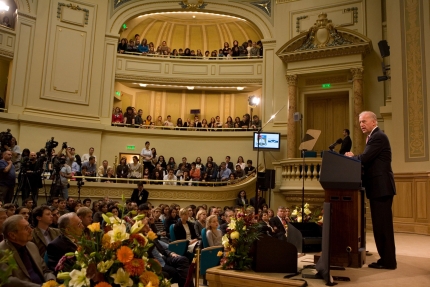
Vice President Joe Biden Speaks in Romania

Vice President Joe Biden speaks at the Central University Library Bucharest, in Bucharest, Romania. October 22, 2009. (Official White House Photo by David Lienemann)

The Vice President is in the region not only to celebrate the tremendous progress that the region has made in the last two decades, but also focus on the future -- to reaffirm our alliance and partnership with these countries, and to challenge them to continue to play an increasing leadership role in Europe and on the world stage. He believes that their experience is particularly relevant to other nations in transition to democracy.

He is also talking to the political leaders in each country about our shared agenda, including the situation in Afghanistan, and the new European-based missile defense system that the President announced last month. That system is designed to meet the growing threat to Europe and U.S. forces based there from the threat of medium range missiles from Iran.

The Vice President gave a speech today at the Central University Library in Bucharest, the scene of heavy fighting in December 1989 when the Romanian people brought down the Ceausescu regime – the most brutal dictatorship in Europe. At our request, the U.S. Embassy in Romania invited not only local students, but also top diplomats from 10 countries in the region. They met with the Vice President after his speech. This afternoon, General James Jones, the President’s National Security Adviser, will meet in the Roosevelt Room with diplomats from those same countries.

Vice President Joe Biden Speaks at the Central University Library Bucharest

Vice President Joe Biden speaks at the Central University Library Bucharest, in Bucharest, Romania. October 22, 2009. (by David Lienemann)

Tony Blinken is National Security Advisor to the Vice President

Related Topics: Foreign Policy

The White House

Office of the Vice President

Remarks By Vice President Biden in a Joint Statement with President Basescu

Presidential Palace, Bucharest, Romania

VICE PRESIDENT BIDEN:  Well, Mr. President, thank you for your hospitality.  You know, diplomats and high-level politicians always walk out of meetings saying, we had a frank and useful discussion.
Well, we did have a frank and very useful discussion, and I appreciate your insight, and I appreciate your leadership.

I am very pleased to be here today with the President in this magnificent palace.  The United States and Romania have been, and continue to be, close allies and partners in NATO.  And the European-Atlantic alliance is something that I know the President, and President -- my President, President Obama, strongly, strongly support.  And we deeply, deeply value Romania's cooperation.

You know, I was telling the -- I was telling the President, he and his country have made me look very good.  I argued very, very strongly that Romania be admitted into NATO on the first round, as you'll remember.  I was -- and I tried to the very end, as chairman of the Foreign Relations Committee.  Now look how smart I was.

The fact of the matter is, all kidding aside, you've been a tremendous partner -- Romania has been.  And it's -- Romania -- as you start this election season, Mr. President, it reminds me of our own intense political campaigns last year.  And this is the type of -- this is the type of competition, healthy competition that's essential, essential to a vibrant democracy.  And I wish you success in your electoral process, and congratulate the remaining people on what is nothing less than a thriving democracy.

We have -- as we approach our 130th anniversary -- 130th anniversary of our diplomatic relationships to Romania, we want to continue to strengthen what I would argue is already a strong partnership, already a strong partnership.

Our relationship is anchored in interests that are of shared values, working together on global threats, human rights, commercial investment, and trade promotion.  It's the full panoply of things that countries who treat each other as equals deal with.  And our cooperation is both bilateral and multi-lateral, both through NATO and the E.U., but also through our bilateral negotiations and relationships.

We serve together in Afghanistan, in the western Balkans, and in Iraq. And I feel obliged to tell the Romanian people how grateful President Obama and I, and the American people, are for the Romanian troops that are in Afghanistan.  Let me say something as clearly as I can, your troops are warriors, they are warriors.  They have no caveats.  Our troops -- and I mean this sincerely, and my son just got back from Iraq after a year as a captain in the United States Army.  Our troops -- our troops are proud to serve next to Romanian troops, because you are incredibly competent.  Your kids -- I wish I could -- I wish you could all see, as I get to see, just how incredibly competent they are.  You should be proud.

And all the mothers and fathers, sons and daughters, husbands and wives of those 1,100 Romanians that are stationed in Afghanistan -- I mean this sincerely, as a parent -- thank you.  Thank you, thank you, thank you.  There's an old expression attributable to an Englishman. He said, "Those also serve who stand and wait.  Those also serve who stand and wait."  So we not only owe your troops that are deployed, Mr. President, we owe their families.  We genuinely owe them.  And I want to, on behalf of the President of the United States of America, say we appreciate it, and we're proud -- proud to stand next to you and serve with you.

In Afghanistan, your forces are performing skillfully, and in some of the toughest places, the toughest combat.  The United States is grateful for the circus -- service, as well as the sacrifice.  And I want to make one other point as it relates to the strategic side of the relationship.  I really -- with regard to defense, Mr. President, I really appreciate your embrace, and your government's embrace, of the new missile defense architecture that we are introducing into Europe.  There is -- the SM-3 will replace what originally was going to be intended to provide for security.  But it will -- in fact, it is a much better architecture.  It has the benefit of protecting Europe physically, as well as the United States.  And I must tell you I appreciate your almost instant embrace of this new architecture, as well as was embraced by our colleagues in Poland, and others.  As people look at this, they are understanding what you understood from the beginning, that this makes more sense.

We share a desire that -- as well, that Romania's neighbors, including Moldova, will continue along the path toward democratization and economic reform, and that they will be integrated into the Euro-Atlantic institutions when they are ready.  And that's why, as you pointed out, we are participating in helping to hopefully stabilize, economically, Moldova.

And, Mr. President, you and I also discussed energy security issues, the role of Romania and what -- the role you're playing in supporting and developing pipelines, as well as other transit methods to bring new sources of energy to Europe.  I can think of nothing that would be more consequential than that.  And we appreciate your leadership, and the leadership of your country.

And I also would point out that we have an ambassador here -- America, in my view, has sent their best.  But I have to, as we say -- in the United States Senate, there's an expression.  When you stand up on the floor of the Senate, if you're going to talk about something personally, Mr. President, we say, please excuse the point of personal privilege.  And full disclosure, our ambassador is my best personal friend.  We have raised each other's children.  We have -- our wives are close friends.  My grandchildren are -- consider the Gitenstein's to be almost relatives.  So I can assure you first-hand, this is a man I've worked with for 35 years -- 30 years, actually -- and he has my ear.  I know you've already figured that out, because I know you've gone to him and you know he immediately picks up the phone and calls me.  I hope you won't take advantage of my friendship with the ambassador too badly.

But he is new here, but his diplomatic skills and his erudition I think will serve us both well, Mr. President.  He has a direct line, as I said, to me, and he is very effective.  And I'm confident -- I'm confident that our ties with Romania will continue to thrive, will continue to thrive together with our advance of shared objectives of a free and peaceful Europe.

I'll conclude, Mr. President, by saying something that reminded me of my country, of America, the last thing you said, which is what we say, but we don't always hear.  You said, Mr. Vice President, I want to assure you no matter who wins this election, Romania will remain a strong and vital partner to the United States.  That's what democracies are built on.  That's what long-term alliances thrive on.

And so I wish you all the good luck, the people of Romania, and in the conduct of this election.  And I envy the fact that it's only going to last 30 days.  Ours go on considerably longer.  But at any rate, Mr. President, thank you for your hospitality, also for allowing us the opportunity to meet with your -- your staff, and your defense minister, and others.  We have a lot of work to do, but it's good to be back in Romania.  It is one of the most beautiful countries in the world, and I feel so much better than the first trip I took here decades ago about the progress you've made and the partnership reform.

So thank you very much.

PRESIDENT BASESCU:  Thank you very much, Mr. Vice President.  If you allow me to mention something extremely important for us, the Romanian army is the single army which have -- Romanian officers are the single foreign officers which have under command American troops -- is the situation in Afghanistan.  And this is a proof how far the relations between Romania and United States --

VICE PRESIDENT BIDEN:  It is the first time that has ever happened, so obviously we trust your officer corps.  Thank you very, very much.

PRESIDENT BASESCU:  Thank you very much.  Thank you again.

VICE PRESIDENT BIDEN:  Thank you.

END

The White House

Office of the Vice President

Remarks By Vice President Biden in a Joint Statement with President Kaczynski

Presidential Palace, Warsaw, Poland

VICE PRESIDENT BIDEN:  Mr. President, thank you for your hospitality.  And I apologize to your colleagues, when two old friends get together, they tend to talk.  You know how diplomats always walk out and say, we had a frank and thorough discussion?  Well, we had a discussion friends have, we talked about everything.  And had we the time, and were we not cognizant of people's schedules, we probably would have talked for another two hours. 

But, Mr. President, I am proud to stand here with you, and I think our meeting was productive.  I know of no problem of consequence we have with Poland.  I know of no consequential problem.  I know of no problem that is not able to be resolved as they emerge.  Poland has a decided disadvantage in the relationship -- they own a part of our heart, and that is a disadvantage, Mr. President, we have.

My daughter-in-law comes from the second largest Polish city in the world, Chicago.  But all kidding aside, it was a great discussion, and we discussed a broad range of mutual interests.  I think if I could add on to what the President said, we both see the relationship as being rooted in security, but much beyond that, it's much beyond that.  Poland, in 20 years, has moved from a country that in fact we looked at in terms of what we could do for, to a country as to what we can do jointly with, how we can jointly address the problems and opportunities that we face as genuine partners.

So there's a broad range of mutual interests, and our joint commitment to the NATO effort, to Afghanistan on.  By the way, I expressed my deep appreciation -- I, like the President, have visited the troops on more than one occasion in Afghanistan.  The Polish soldiers in Afghanistan are not just soldiers, they are warriors.  They are warriors.  They are doing an incredibly difficult job, and I wish every Pole could see just how brave and steadfast they are.  You would be incredibly proud, incredibly proud, as I was, to have the opportunity to know and see where they were.

As a matter of fact -- it is just part of my DNA, as they say -- but I'm going to go from here to meet with men and women of the Polish armed forces later today, to let them know how much I truly appreciate -- and I mean this sincerely, this is not a diplomatic nicety.  The President and I truly appreciate -- truly appreciate the sacrifices that the Polish military is making.  And I'm going to meet with decorated Polish war veterans who have served in Afghanistan.

I understand, like all parents -- my son just got back from a year in Iraq.  I understand the anxiety of every Polish mother and father, husband and wife, son and daughter.  And I just want you to know it may not be a big deal, but it's a big deal to me.  It's a big deal that you all know that we generally appreciate and recognize the sacrifice not only the soldiers in the field are making, but the families who are left at home.

There's a famous expression attributable to another man, not me.  It says that, "they also serve who stand and wait.  They also serve who stand and wait."  So we owe a debt of obligation to the mothers and fathers, husbands and wives, and children of those brave Polish soldiers. 

We also reaffirmed -- I reaffirmed -- President Obama's absolute determination to secure and ensure NATO's success in the 21st century is matched by the -- matches the success of the 20th century.  I briefed the President on Secretary Clinton's -- we talked in depth about Russia.  And we talked in depth about the -- our mutual desire to see better relations with Russia.  We also talked about my recent trip to Ukraine and to Georgia, and our similar views and concerns that we have relative to both countries.

The President and I discussed the leading role that Poland can play if it chooses to play -- and I believe it will, but that's a decision made by Poland -- on national missile defense within NATO -- within NATO.  And I welcome the President's support for the missile defense, and for Poland's offer to host a standard missile, this so-called SM-3s, in a third stage. 

President Obama has a phased adaptive approach to missile defense that I believe -- I don't believe, I know -- strengthens missile defense for Europe unlike its ever existed, reinforces Article 5, and it will bolster the alliance's deterrent capability overall.  Simply put, it's better for NATO, it's better for Poland, it's better for Europe, it's better for the United States.  It's a more adaptable, rational, and workable system. 

And I want to thank the President, and the Polish people, for the hospitality they’ve shown during my visit to Warsaw.  I was reminiscing with some of my colleagues prior to arriving -- and I mentioned this at a previous meeting -- that how far Poland has come, the incredible sacrifices the Polish people have made over the past century and a half longer, but in modern history, and the distance they have traveled in the last 20 years.  It's absolutely remarkable. 

And I was discussing this with my national security advisor in the way over, in the car.  As I rode through Warsaw in the last -- the first -- well, the most recent time I was here, was when we were deciding -- we, me and others -- pushing for the admission of Poland into NATO in the mid-'90s.  And the discussion then was if Poland would be a partner in NATO -- Poland clearly wanted to be -- if it would be.  We were pushing with all of our allies for the admission of Poland into NATO.  And I look now, and here we are, not just talking about whether or not Poland is a part of NATO, but the vital role Poland is playing within NATO. 

And I assured -- in conclusion, I assured the President that no one should misunderstand our commitment -- NATO's commitment and the United States' commit -- to the security of Poland is unalterable.  It will not change.  It has not changed.  The only thing that's changed is the admission of Poland into NATO, making NATO stronger than it was.

So, Mr. President, I thank you very much for your hospitality.  And I apologize to all of you, because we got to talking, and we ended up spending two hours together in a private meeting.  But it was -- I benefited greatly from the discussion, Mr. President.  Thank you for your hospitality, and I'll see you all.  Thank you. 

END

The White House

Office of the Vice President

Remarks By Vice President Biden In a Joint Statement With Prime Minister Tusk

Prime Minister's Chancellery Warsaw, Poland

VICE PRESIDENT BIDEN: Mr. President, thank you very much. You know, it's remarkable, I was thinking as I rode over to see you, that one of my last visits to Poland was to meet with your predecessors, and then to give a speech at Warsaw University, discussing -- as I was pushing very hard -- the admission of Poland into NATO. I had the great honor of leading that effort in the United States Senate, which ratifies those treaties. And to think how far we've come, how far Poland has come. You are already shouldering significant responsibility.

The reference that the Prime Minister made was I think we've moved from a relationship of only being the notion of that we would provide security, which we will, but also moving to the relationship where we work together, we work together and not for, but with one another.

And so, Mr. President, it's a great pleasure -- Mr. Prime Minister, it's a great pleasure to meet with you. To state the obvious -- and I don't think it needs restating, but its worth it anyway. To state the obvious, Poland -- Poland is one of our closest allies and critical partners in facing global challenges.

As you all -- already all know, Poland a long time ago captured the heart of the American people. But it also has the heart of our government, through Democratic and Republican administrations. The people in the United States and Poland have deep historic ties that sometimes are sort of mentioned as if they are not so consequential. They are incredibly consequential. They run deep. We share values, and ideals, and countless friendships over the years, and particularly now.

The United States, Mr. Prime Minister, deeply appreciates the service of the -- and sacrifice of your Polish soldiers, who are real warriors. I've been there, I've been in Afghanistan. I've seen them. They are genuine warriors, and they are making great sacrifices. And I know are proud of them, but we are thankful. We are thankful for your soldiers standing alongside of ours in Afghanistan, also in Iraq and the Balkans. And it's an honor -- it's an honor to stand with you in these difficult but vital deployments, Mr. Prime Minister.

Our two countries are bound together by an American commitment to Poland's security beyond the longstanding ties literally through Article 5 of the Washington treaty, NATO, and by Poland's commitment to our security, which you demonstrated I might add, through Article 5 on September the 11th. Without hesitation, you and NATO responded and said an attack on one is an attack on all. Under NATO's Article 5, an attack on one is an attack on all. And this strategic assurance is absolute, absolute, Mr. Prime Minister.

As one who championed the admission of Poland into NATO, I would also point out that we take not only our mutual commitments seriously, but I take it very, very seriously. President Obama and I consider this to be a solemn obligation. President Obama has said, and this is a promise he said not only for our time, but for all time. We appreciate Poland has stepped up and agreed to host an element of the previous missile defense plan.

And we now appreciate that Poland's government agrees with us that there is now a better way, a better way -- with new technology and new information -- to defend against the emerging ballistic missile threats. Our new phased adaptive approach to missile defense is designed to meet a growing threat not only to the United States, but first and foremost to Europe. It's going to meet it with proven technology that will cover more of Europe, including Poland, and will do it more efficiently than the previous system could have, or did. It strengthens missile defense for Europe, it strengthens Article 5, and it strengthens the alliance's deterrent  capability. Mr. Prime Minister, we have -- we have a lot to do. Simply put, our missile plan is better security for NATO, and is better security for Poland, and ultimately better security for the United States of America. 
 

The White House

Office of the Press Secretary

Briefing by National Security Advisor Tony Blinken on The Vice President's Upcoming Trip to Central Europe

Via Conference Call

11:05 A.M. EDT

MR. BLINKEN: Good morning, everyone. Thanks very much for joining the call. Let me walk you through the trip. I'll start with the schedule, at least the highlights of the schedule, and then talk about some of the key themes and objectives for the trip.

As Jay said, we start tomorrow, Tuesday. We depart Washington in the morning and arrive at Warsaw late Tuesday night. On Wednesday, we start the day in Warsaw. The Vice President will start by meeting and greeting our embassy staff in Warsaw. He then meets with Prime Minister Tusk, who will be hosting a working lunch for him as well. And you can expect statements by the Vice President and the Prime Minister immediately following the lunch.

Next, the Vice President sits down with a broad cross section of civil society leaders to talk about common efforts to promote democracy. He then moves on to the presidential palace for a meeting with President Kaczynski. And again, each will make a brief statement at the top of the meeting.

And then it's off to the airport, where the Vice President will greet Polish veterans who served in Afghanistan. And from Warsaw, we go on to Bucharest, Romania. We arrive there Wednesday night in the mid-evening around 8:00 p.m.

Thursday, we are in Bucharest, and the Vice President starts the day again by meeting with our embassy staff there. That will be followed by a working session with the President, Basescu -- again, statements from the Vice President and the President, immediately following their meeting.

Next on the agenda is a meeting with the Prime Minister, Boc. And then, we move on to Central University, where the Vice President will deliver a speech that's going to be focused on U.S. relations with the countries of central Europe. After the speech, he'll meet briefly with some of the political directors from across central Europe. These are the senior diplomats from each country in the region. And then he concludes the afternoon by meeting with two leading opposition leaders, the leader of the PSD and the former Foreign Minister, Geoana, and the leader of the PNL, Antonescu. And from there it is wheels up for Prague and the Czech Republic.

And that brings us to Friday. Friday, we're in Prague for the day. The Vice President starts with a meeting with the Prime Minister, Fischer. There's a brief lunch, and then the two leaders will each make a statement to the press. The Vice President then meets with President Klaus. After that, he is back to the ambassador's residence. He will sit down with some of the key opposition leaders in the Czech Republic. He'll meet with our embassy staff there. And then in the early evening it's back to Washington, and we arrive home around 10:00 p.m. on Friday.

So that's a snapshot of the schedule that captures the major events and meetings. But there will also be other things to fill out the picture as we go along.

Let me talk briefly about the key objectives and themes of the trip, and then take questions. First, and most obviously, the trip comes at a historic marker, the 20th anniversary of the fall of the Berlin Wall. So the Vice President is going to mark the moment. But his focus is going to be much more on the future than on the past. In his view, the real validation of 1989 is less in what we took down and more in what we built, and continue to build together -- strong democracies, strong partnerships that deliver for people in all of our countries and beyond.

Second, I think you'll see a lot of focus and reaffirmation on the substance of those partnerships with the countries of central Europe. Let me just touch quickly on a few of them. We have the very strong security partnership. All three countries the Vice President will visit are members of NATO. As NATO members, we're committed to each other's defense. All three make important contributions -- with soldiers and civilians -- to the allied effort in Afghanistan, just as they have in Iraq and in the Balkans. With all three, we benefit from strong defense cooperation, including joint training and exercises. And with all three, the Vice President will discuss the new missile defense architecture we're proposing for Europe. That architecture, as you know, is designed to meet a current threat with proven technology. It's adaptable to future threats. It will be deployed sooner than the previous program, and cover all the countries in NATO.

We also have a partnership for energy security and combating climate change. The countries in central Europe have a particularly critical role to play in diversifying energy sources and suppliers, promoting efficiency, strengthening the European grids. And, of course, we have a strong partnership for trade and investment, and these partnerships are all the more important as we emerge from the global economic downturn.

Third, and finally, the United States and the countries of central Europe are really transitioning from a local agenda to a global one, and the Vice President will talk about that during the trip. The United States is thinking about the region less in terms of what we can do for central Europe, and more in terms of what we can do with central Europe. The countries are no longer "post-Communist," or "in transition." They are full-fledged members of the NATO alliance and the European Union with serious and substantial responsibilities.

The partnerships I already mentioned go well beyond local interests, and right to our common global responsibilities -- from Afghanistan to Iran, from energy security to global economic growth. And we're also looking at our partners in central Europe for leadership, in an area they're uniquely qualified to provide, advancing democracy.

The example that they set 20 years ago inspired the world. The leadership they exert over the next 20 years can change the world, encouraging, supporting, and defending young democracies. So let me stop with that and take any questions. Thank you.

Q Can you give us just a little bit more of a flavor for how big a role the missile defense issue will play in these talks? And is there any significance in the Vice President's trip timing, coming right now shortly after Secretary of State Clinton went to Russia?

MR. BLINKEN: In terms of missile defense, I think it's going to be an important item on the agenda in all of the meetings that we have in all three countries. But the agenda is much bigger than missile defense. And I touched on a number of the issues, whether it's what we're doing together in Afghanistan; whether it's the work we're doing together actually to reform NATO, going forward with a new strategic concept; energy security, climate change, the economies in all these countries. There is a very full and broad agenda -- the advancement of democracy. And so missile defense will be part of it, but the trip is not focused on missile defense per se.

That said, it's clearly an issue that is on the minds of people, and I think this is an opportunity for the Vice President to continue discussions with our key allies on missile defense, and in particular about the new architecture that we put -- that we put forward, and to emphasize the fact that this architecture will address the current threats that we and the Europeans are facing, with technology that we know works and can be deployed faster than the previous system we've been talking about and cover all of NATO.

So I think what you're -- what you're hearing and what the Vice President will talk about, is a strong commitment to missile defense and to a better system, a more effective system than the one we had originally proposed.

Q And the Russia connection?

MR. BLINKEN: The Russia connection is simply that we're working -- and indeed, a number of countries in central Europe are working -- to reset the -- the relationship with Russia. And we've made I think significant progress. The Secretary of State, as you mentioned, was just there. On a broad variety of issues, we're working very closely with Russia. We're obviously moving forward on a start successor treaty. We've been working very closely with the Russians on securing nuclear materials. We're in close collaboration on Iran. And this is very positive, not only for us and for Russia, but also I think for countries in the region, because the stronger the relationship we have, the more you're likely to see stability throughout -- throughout Europe.

At the same time, you'll recall the Vice President, in February, when he went to Munich to make the first major foreign policy speech of the administration at President Obama's request, made it very clear that as we reset the relationship with Russia, that will not come at the expense of our partners and alliances.

And so we've reaffirmed -- and the Vice President has done it, the President has done it -- that we continue to reject the notion of a sphere of influence. We continue to stand by the right of sovereign democracies to choose their own alliances. And that remains the case.

Q Thank you.

MR. BLINKEN: Thank you.

Q My question is concerning the Czech Republic. Will Mr. Vice President, or President, present any concrete offers or suggestions to the Czech Republic concerning the participation in the new anti-missile system? This is one question. The next, as you mentioned, the energy security question, will the Vice President discuss the Nord Stream pipeline in Prague? What can we expect in this energy security respect? And the last question is if you can specify the names of these positions, leaders the Vice President will meet in Prague? And what do you mean by opposition, since there is no regular political government in the Czech Republic? Thank you.

MR. BLINKEN: Thanks very much for your multiple questions. First, on missile defense, let me say first we very much appreciate the Czech Republic's partnership in addressing the threat of ballistic missiles. And as part of the consultations that we're undertaking now through NATO, and bilaterally, the government has expressed -- the Czech government has expressed a strong interest in continuing to play a leadership role as we work with our NATO allies on this issue. And that's something that we welcome. So the Vice President is going to be I'm sure discussing that with our hosts as we talk about our broad strategic cooperation, including in the area of missile defense.

In terms of energy, yes, I'm sure that will come up. I know that the Vice President wants to talk about European efforts to diversify supply routes, to diversify sources of energy, to strengthen the European grid for energy and electricity. So I expect this to feature very much in his discussions in the Czech Republic, and in all three countries.

And let me get back to you -- I will -- on the list of people that we're meeting with. We're still working out the final meetings, but we can get back to you on that.

Q But just to follow-up, will there be any concrete offers to the participation in the new missile defense?

MR. BLINKEN: I'm going to let the Vice President's trip speak for itself. But what we're doing now is we're engaged in consultations, both bilaterally with countries, but also, and very importantly, through NATO. And these discussions have to play out. People need to get all the information necessary to decide on what role they might play in going forward in missile defense.

Q Thank you.

MR. BLINKEN: Thank you.

Q Can you talk a little bit more about the way the roll out of the missile defense decision has played out in Poland and the Czech Republic? I mean, you've made the case that this is a better system for all the reasons you talked about, but there has obviously been a lot of angst in that region. Should this have been handled differently? And how do you feel that the Vice President's trip will -- that dynamic?

MR. BLINKEN: I think allies heard and discussed what we're proposing -- the stronger the support. I think it was unfortunate that some of the initial headlines, when the decision was announced, talked about the United States "abandoning" missile defense in Europe. And, of course, it's exactly the opposite. The approach we're taking strengthens missile defense in Europe.

As I said -- and more importantly, as the President, Vice President, and others have said -- we did a number of things. First of all, we had this -- a new threat assessment. And the assessment was that the threat from short and intermediate-range missiles was growing from Iran, and the threats from inter-continental ballistic missiles was further in the future than we thought. And the person who led the review that led to the initial program, the so-called program of record, was Secretary Bob Gates, just before he was Secretary of Defense in the previous administration. And the person who led this new review that led to the new approach that we're proposing -- Secretary Bob Gates.

And so the threat, the nature of the threat had changed. Our technology, in the intervening years, has changed. And we have systems that are proven against short-range missiles and intermediate-range missiles. And so taking those two things into account, we came up with this new phased adaptive approach. And we're convinced that the approach is stronger across the board.

As I suggested earlier, it meets a threat that exists, as opposed to one that is far off in the future. It's adaptive to future threats. It is based on technology that's already out there and working. And it will cover more of Europe faster than the previous program.

So the more allies have been focused on the details and the specifics, the stronger the support has been. We just had a high-level defense group go to Poland this past week. There will be one going out to the Czech Republic in a few weeks. And, of course, the Vice President's trip is out there.

Could we have handled it better, differently? You can always handle things better. And as I said, I think what really created an initial problem were headlines that fundamentally misunderstood, or misrepresented, what we were doing. But I'm confident that based on the discussions we've already had, based on the discussions that have been initiated in NATO, and based on what I'm sure we'll talk about this week, that we're getting very strong support across the board for this approach.

Q And on the -- Poland, specifically, they were given, or told they were given the right of first refusal for these SM-3 missiles that are land-based. Have they responded in that regard? Will that come up in the conversation tomorrow, or I guess, Wednesday?

MR. BLINKEN: We have made it very clear to Poland that we value their involvement in the phased adaptive approach. And, indeed, we offered them a right of first refusal to host the SM-3s. We've had a number of discussions already on this issue with Polish officials, most recently that high-level defense group I just mentioned, which was in Poland from the 15th -- the 15th and 16th of October.

And what we're doing now is we're trying to provide Poland with all of the information from our consultations -- bilaterally, and in NATO -- certainly to support a NATO framework for missile defense in Europe, and more specifically, a role in our phased adaptive approach. So what we need to do though is work with Poland to find a role that they find suitable, and then we can discuss how we move forward on it. And I'm sure this will come up in the Vice President's discussions this week. We'll see what -- where they are, especially after the high-level defense group that met with them last week.

Q I appreciate it.

MR. BLINKEN: Thank you.

Q Could you describe for just a second where Vice President Biden fits into the foreign policy team, where he thinks he has value added? A lot of us who have written about his, kind of a unique weight given on the special envoys in the foreign policy team, and in what Clinton's role is. But talk to us for just a second about what Vice President Biden sees his role and where he gives the best bang for the buck?

MR. BLINKEN: I really think that's a question best addressed to others on the team, and including to the Vice President. I think it's fair to say that you've seen the Vice President, virtually from day one -- actually, before day one -- play a central role on the foreign policy team. You'll recall that he went to -- at the President-elect's request, went to Afghanistan, Pakistan, and Iraq in January before the inaugural. As I mentioned earlier, he gave the -- again, at the President's request -- the first major foreign policy speech of this administration, February at the Munich conference.

And since then, at the President's request, he's been virtually all over the world as a core member of the team, to the Balkans, to Europe, repeatedly to Iraq, where the President has asked him to oversee the Iraq policy, to South and Central America, and now to Central Europe. And here at home, he is a core member of the team that meets multiple times a week, if not more than that, to talk about and make decisions on every foreign policy issue we have to deal with.

But I don't want to characterize it any further than that. I think that the Vice President's work to date speaks for itself.

Q Okay, thanks.

Q Thanks, Tony, for taking these questions. I wonder if you could just follow up a little more. You've talked about the reset with Russia, and we've talked about the missile defense situation. But how the countries the Vice President is visiting have responded to those? And how much of this trip is meant to soothe concerns on their part that the United States is not fully aware of their fears and worries about where Russia is headed, and where the U.S. relationship with Russia is headed?

MR. BLINKEN: Look, any of these trips are an opportunity to hear firsthand what's on the minds of our closest partners and allies, so we look forward to doing that. We've been very clear from day one that we are seeking to improve relations with Russia, but not at the expense of any of our partners -- our partnerships. And the view we have is that any improvement in U.S.-Russian relations can only improve security in Europe, and will -- to the benefit of all our allies. And I think, again, we're seeing that in the work that Secretary Clinton was doing in Russia just last week, and that the President has done repeatedly with President Medvedev. But our ears are open.

And I think it's very important that we continue to reiterate a very important principle of our foreign policy, particularly with regard to central Europe. And it's a principle that we invoked in the 1990s, and remains important today, and that's nothing about you without you. We're working all of these issues, whether it's missile defense, whether it's NATO strategic concepts, whether it's Afghanistan, the Balkans, Iraq, energy security -- we're working on all of these issues in partnership with the countries in central Europe. We're not making decisions without them. We're making decisions with them, and that's the principle we're proceeding on. And we look forward to hearing all of the ideas that they have on this trip and any concerns they may have.

Q Thanks very much.

MR. BLINKEN: Thank you.

Q This is a follow-up on missile defense, as it regards to Poland. In your response to Peter, regarding the technical and adaptive advantages of the new approach on a missile shield, Poland's chief of -- was quoted today -- a new approach of failure in the long-term thinking, and the -- should regard it as part of Europe, that missile shield had only -- not only a military dimension, but a -- in that stance --

MR. BLINKEN: I'm sorry, you're fading in and out a little on my line. Could you -- I'm sorry, would you mind repeating that?

Q Sure, I'm following up on missile defense as it regards to Poland -- can you hear me better now, Tony --

MR. BLINKEN: Yes, thanks very much.

Q -- and with regard to the technical and adaptive advantages that you were speaking about regarding the new approach. Poland's Chief of National Security, Aleksander Szczyglo, was quoted today as calling the new approach a failure in long-term thinking in the U.S. administration regarding this part of Europe, and saying that the missile shield has not only a military dimension, but a political and strategic one. How would the Vice President be likely to respond to this opinion regarding the new approach on the new missile shield?

MR. BLINKEN: Well, I didn't -- I haven't seen or heard what he said, so I really don't want to comment directly, because I want to see exactly what the quote was. But, again, without repeating too much of what I said, I think that based on the discussions we've had to date with the high-level defense and discussions we've had in a lead-up to the Vice President's trip, the more our partners look at the substance of what we're proposing, the stronger the support. Because when you look at the facts of what we're -- what we put on the table in terms of meeting an existing threat with technology that works, that covers all of the NATO countries, and gets there sooner, and can be adapted if the threat changes, it is manifestly better for our security and better for your security than the previous system that was designed under a different threat environment with different technology.

And, again, Poland has the possibility -- if it chooses -- of playing a central role in this effort. So in my judgment -- and more importantly, in the judgment of the Secretary of Defense of the President and the Vice President -- this approach makes sense strategically, it makes sense militarily, it makes sense politically. But again, we look forward to hearing all of the views on this, this week, and addressing any of the concerns that our partners may have, and talking through any of the outstanding issues.

Q Thanks, Tony.

Q Just a quick question -- back to missile defense. You talked about the new architecture as a more sophisticated, more advanced, more capable system. And I'm wondering if there is anything about the new architecture that should leave Russia feeling more comfortable with this system than they did with the previous one?

MR. BLINKEN: I think that's probably a question better addressed to the Russians than to me. The Russians have expressed some concerns about the previous systems -- which was never directed at Russia -- which the Bush administration, our administration repeated and made clear. But the fact is the decision we took on the new architecture was not based on Russia's concerns; it was based on what best meets our national security interests and that of our allies and the forces that we're protecting in Europe. And that's the basis upon which the decision was made.

If the Russians have a different view of the architecture, that's good, that's fine. But that was not the basis of the decision. But I would just address any questions to them about any concerns they may have had with the old system, and their feelings about the new architecture.

Q Okay, thank you.

MR. BLINKEN: Thanks very much. Well, thank you all very much. Thanks for taking the time. And we look forward to talking with you over the course of the trip. Thanks.

END
11:35 A.M. EDT
"Middle Class Task Force, The Vice President of the United States"

THE WHITE HOUSE

Office of the Vice President
__________________________________________________________________________
For Immediate Release                                                                                                October 19, 2009


Vice President Biden Unveils Report Focused on Expanding Green Jobs And Energy Savings For Middle Class Families


WASHINGTON, D.C. - Vice President Biden today unveiled Recovery Through Retrofit, a report that builds on the foundation laid in the Recovery Act to expand green job opportunities and boost energy savings by making homes more energy efficient.  Joining the Vice President today were Nancy Sutley, Chair of the White House Council on Environmental Quality; Steven Chu, Secretary of Energy; Hilda Solis, Secretary of Labor; Shaun Donovan, Secretary of Housing and Urban Development; and Karen Mills, Administrator of the Small Business Administration.

At a Middle Class Task Force meeting earlier this year, the Vice President asked the White House Council on Environmental Quality (CEQ) to develop a proposal for Federal action to lay the groundwork for a self-sustaining home energy efficiency retrofit industry. In response, CEQ facilitated a broad interagency process with the Office of the Vice President, eleven Departments and Agencies and six White House Offices to develop recommendations for how to use existing authority and funding to accomplish this goal.  These recommendations are described in detail in the Recovery Through Retrofit Report. 

“Recovery Through Retrofit is a blueprint that will create good green jobs – jobs that can’t be outsourced, and jobs that will be the cornerstones of a 21st-Century economy,” said Vice President Biden. “And, thanks to the Recovery Act’s unprecedented investments in energy efficiency, we are making it easier for American families to retrofit their homes - helping them save money while reducing carbon emissions and creating a healthier environment for our families.”

“This report builds on the foundation laid in the Recovery Act to expand green job and business opportunities for the middle class while ensuring that the energy efficiency market will thrive for years to come,” said Nancy Sutley, Chair of the White House Council on Environmental Quality.  “An aggressive program to retrofit American homes and businesses will create more work, more savings, and better health for middle class Americans.”

Existing techniques and technologies in energy efficiency retrofitting can reduce energy use by up to 40 percent per home and lower total associated greenhouse gas emissions by up to 160 million metric tons annually.  Retrofitting existing homes also has the potential to cut home energy bills by $21 billion annually.  Yet, despite the real energy cost savings and environmental benefits associated with improving home energy efficiency, a series of barriers have prevented a self-sustaining retrofit market from forming.  These barriers include a lack of access to information, financing and skilled workers.

The recommendations and actions in this Report have been carefully designed to help overcome these barriers and to leverage Recovery Act funding to help ensure that the energy efficiency market will thrive long after the Recovery Act money is fully spent.  

Some recommendations in the report include:

 Provide American Homeowners with Straightforward and Reliable Home Energy Retrofit Information:  Consumers need consistent, accessible, and trusted information that provides a reliable benchmark of energy efficiency and sound estimates of the costs and benefits of home energy retrofits. 

• Reduce High Upfront Costs, Making Energy Retrofits More Accessible:  Access to retrofit financing should be more transparent, more accessible, repayable over a longer time period, and more consumer-friendly. 

• Establish National Workforce Certifications and Training Standards:  A uniform set of national standards to qualify energy efficiency and retrofit workers and industry training providers will establish the foundation of consumer confidence that work will be completed correctly and produce the expected energy savings and benefits.  Such standards should incorporate healthy and environmentally friendly housing principles, as outlined in the report titled, the Surgeon General’s Call to Action To Promote Healthy Homes (2009).  Proper certification and training standards will ensure that retrofitted homes are healthy homes.  Consistent high-level national standards will spur the utilization of qualified training providers that offer career-track programs for people of all skill levels, promote and expand green jobs opportunities and facilitate the mobilization of a national home retrofit workforce.

To read the full report and recommendations, please go to http://obamawhitehouse.archives.gov/assets/documents/Recovery_Through_Retrofit_Final_Report.pdf

“As Secretary of Labor I'm working to help build the clean energy economy of tomorrow by investing in our workers today," said Secretary Solis "Training for green jobs can empower workers to climb the career ladder, sustain a family and provide a secure retirement. Through Recovery through Retrofit, we're committing to meet the needs of workers, employers and homeowners, so we can shape our clean energy future into one that supports working families and is inclusive of the diversity of our nation.”

"I am proud to join my colleagues today in announcing Recovery through Retrofit," said Secretary Donovan. "It will allow us to work closely together to remove barriers to creating more energy efficient homes for American families.  This initiative will not only lead to cost savings for homeowners and reduce negative environmental impact, but will also be a powerful vehicle for economic recovery by creating quality middle class jobs and lasting neighborhood benefits. This is another demonstration of HUD's commitment to creating jobs for the new economy in high growth industries by encouraging and investing in “green” building and energy retrofits."

"This initiative will not only result in considerable cost savings for homeowners on their energy bills, but also put resources in the hands of green sector small businesses who will in turn create good-paying jobs in communities across the country," said SBA Administrator Mills.

EPA Administrator Lisa Jackson, who was unable to attend this event due to travel added, “This is the Recovery Act at work.  Communities will benefit from good jobs, families will benefit from lower energy bills, and we will all benefit from reduced air pollution and a growing green economy. Our Energy Star program can help families cut up to 30% off their energy bills -- saving the average household more than $700 a year through efficiency investments.  EPA is proud to be working with all of our partners to help people save money when they need it the most, and build a new foundation for prosperity through a growing green economy.”

The Department of Energy today also announced $454 million under the American Recovery and Reinvestment Act for energy efficiency efforts nationwide.
The Department is now accepting applications for a new $390 million "Retrofit Ramp-Up" program that will deploy innovative approaches to energy efficiency building retrofits. These Recovery Act funds will help create new partnerships to deliver energy bill savings to entire neighborhoods and towns.  Bringing energy retrofits to whole neighborhoods at a time will simplify the process for homeowners and significantly reduce costs. When applied on a national scale, the program could save billions of dollars annually in utility bills for households and businesses and create thousands of jobs across the country. In addition, the Energy Department announced $64 million in energy efficiency funding for cities, counties, and Indian tribes.

"The Retrofit Ramp-Up initiative is designed to slice through the barriers identified in this report - inconvenience, lack of information, and lack of financing - and to make energy efficiency easy and accessible to all," said Secretary Chu.  "We want to make our communities more energy efficient, block by block, neighborhood by neighborhood -- eventually expanding to entire cities and states.  We can literally bring energy efficiency to the doorsteps of the American people."

Separately, the Department of Energy will accept state proposals to use State Energy Grant or Energy Efficiency Conservation Block Grant funds for Property Assessed Clean Energy (PACE) pilots.  This is an innovative model which allows communities to provide financing to homeowners to install renewable energy systems and retrofit buildings that can be paid off over time on their property tax bills.  Today, the White House is announcing a “Policy Framework for PACE Financing Programs” developed through an interagency process to ensure that effective homeowner and lender safeguards are included in PACE programs. 

To read the framework, please go to

http://obamawhitehouse.archives.gov/assets/documents/PACE_Principles.pdf

To ensure implementation of the Recovery Through Retrofit Report’s recommendations, CEQ will continue to convene an interagency Energy Retrofit Working Group which will be co-chaired by the Department of Energy, the Environmental Protection Agency, the Department of Housing and Urban Development, the Department of Labor, and the Department of Agriculture. 

The group will track the progress of the Report’s recommendations, develop additional strategies to support expansion of the retrofit market, including recommendations for rental housing, and operate as the single point of contact for the implementation of this effort.   Within thirty days, the group will submit an implementation plan to the Vice President.  Moreover, the group will report to the Vice President regularly on its progress toward implementing each of the recommendations identified in the Report.

Going Green - And Saving You Money

Vice President Biden and the Middle Class Task Force just finished unveiling the Recovery Through Retrofit Report, at a public event inside the Eisenhower Executive Office Building. Joining the Vice President at the announcement were Nancy Sutley, Chair of the White House Council on Environmental Quality, Steven Chu, Secretary of Energy, Hilda Solis, Secretary of Labor, Shaun Donovan, Secretary of Housing and Urban Development and Karen Mills, Administrator of the Small Business Administration.

Last May in Denver, CO the Vice President asked the White House Council of Environmental Quality (CEQ) to report back to the Middle Class Task Force with a plan to make sure that the unprecedented Recovery Act investments in energy efficiency and renewable energy lay the groundwork for a self-sustaining home energy efficiency retrofit industry -- which will create good, green jobs and save middle class families money on their energy bills. CEQ answered this call by bringing together eleven Departments and Agencies and six White House offices to develop today’s report.

The report identifies three barriers that have prevented a national market for home retrofits from taking off. First, consumers don’t have access to reliable information about retrofits. Second, the upfront costs of home retrofits can be high but consumers don’t have access to financing. Finally, there aren’t enough skilled workers to serve a robust national retrofit market.

Recovery Through Retrofit is an action plan to address these barriers without new money and by using authority the federal government already has.

Here’s how we will take steps toward breaking down each barrier:

  1. To give consumers the information they need, the federal government will develop a standardized measure of home energy performance that is applicable to every home as well as a home performance label to signal that a home is energy efficient – like ENERGY STAR® does for appliances.
  2. We will make it easier for homeowners to pay for home retrofits by promoting accessible and affordable financing options.
  3. We will establish nationally recognized standards for worker training and certification so when you decide to invest in a home retrofit, you can rest assured that the work will be done right. 


With almost 130 million homes in the United States, there’s plenty of work to be done.   Building a nationwide home retrofit market will create good jobs and reduce greenhouse gas emissions. Right now, homes generate more than 20 percent of our carbon dioxide emissions.

Today’s announcement is just the beginning. The Agencies, Departments and White House offices involved with this report will continue their collaboration. An interagency Energy Retrofit Working Group will submit an implementation plan to the Vice President within thirty days. In the coming months, this group will keep track of the progress we are making on the report’s recommendations and report back to the Vice President on a regular basis.

As the Vice President said this afternoon, "when we recover—and we will recover—we will come out of this a much stronger nation, better prepared to lead the world in the 21st Century as we did in the 20th."

We’ll come out a little greener, too.

Terrell McSweeny is Domestic Policy Adviser to the Vice President.


Always Reach for the Stars: Astronomy Night at the White House

The White House South Lawn was lined with telescopes and science exhibits featuring moon rocks, mars rocks, meteorites and more for Astronomy Night earlier this month. The President and First Lady invited local middle school students to star-gaze and welcomed space heroes Buzz Aldrin and Sally Ride, as well as two remarkable science students, Caroline Moore and Lucas Bolyard to come share some of their wisdom. Caroline was just 14 years old when she became the youngest person ever to discover a supernova and Lucas, a high school sophomore, discovered an extremely rare kind of star called a pulsar.

See Astronomy Night through the eyes of young discoverers Caroline and Lucas.

Read the Transcript  |  Download Video: mp4 (210MB) | mp3 (9MB)

Caroline and Lucas shared some reflections following the event. Caroline reminded adults and kids alike to take chances and "always reach for the stars":

Going to the White House has been one of the most exciting experiences of my life. It was an honor, and not just to meet the President, but also to know that I was selected to be a role model and to show kids that education is important and that success can be achieved at any age. I loved how the President, the First Lady, daughters, and grandma really got involved, even with the family climbing a ladder to get up to a 24-inch telescope! Having the opportunity to meet amazing people like Buzz Aldrin and Sally Ride was incredible.

This year was the International Year of Astronomy (IYA) and I feel that they could not have picked a better time for this event. IYA is all about inspiring the public to get involved in astronomy, especially kids, and that’s just what this event did. It inspired the kids that science can be fun and learning more about it can be quite a pleasurable experience. My message to all the kids out there is to remember that no matter what age, you can always make a difference, and never let any one stop you from chasing for your dream. Remember to always reach for the stars. And for the adults, if you take a chance, and put an opportunity in front of a child they can and will achieve great things.

And even though Lucas has discovered a Pulsar, he learned something new on his visit to the White House:

Well, my favorite part was getting to meet the people there, they were all very nice, especially President Obama.  Also, it was a great honor to simply be there at the White House. The main thing I learned was something I never really thought about; what we are looking at actually happened many years ago because light only travels at a certain speed to our eye.  My message to other students interested in astronomy is to simply stick to it, the opportunities are out there and all you have to do is act on them.

In case you missed it, watch the live chat with Sally Ride, the first American woman in space, here and the President's full remarks here.

Related Topics: Education

Retrofitting and the Middle Class

With the leaves changing color, the air crisper, and the days shorter – fall is fully upon us (well, depending on where you live) - and many Americans are putting the heat back on in their homes.  In that spirit, the Vice President is holding a Middle Class Task Force event at the White House on Monday morning to unveil our "Recovery through Retrofit" report.

The report offers a plan that builds on the Recovery Act’s unprecedented investments in energy efficiency to make it easier and more effective for middle class families to retrofit their homes – helping them save money and creating jobs, while reducing carbon emissions. It’s a plan agreed to by 11 different agencies and departments – which means the federal government will lead a coordinated effort to make American homes more energy efficient.

So, be sure to check back in with us Monday to read the report and watch the event at WhiteHouse.gov/live.

Terrell McSweeny is Domestic Policy Advisor to the Vice President.

Celebrating Hispanic Heritage with the Bidens

Ed. note: A Spanish translation of this blog post is also available below.

Last night was a celebratory night at the Vice President's residence as the Bidens celebrated Hispanic Heritage Month. The doors were swung open to the U.S. Naval Observatory as the Mariachi Las Americas greeted guests as the sun set on a beautiful fall evening in our nation's capital.

Vice President Joe Biden holds a Hispanic Heritage Month reception at the Naval Observatory
(Vice President Joe Biden holds a Hispanic Heritage Month reception at the Naval Observatory, Thursday, October 1, 2009.  Official White House Photo by David Lienemann)
The Vice President and Dr. Jill Biden hosted a gathering of 150 Hispanic mayors, cabinet members, members of Congress and other Latino leaders from across the nation.
The Vice President quoted Cesar Chavez in his remarks by reminding us all that "when you have people together who believe in something very strongly – whether it's religion or politics or unions – things happen." Last night's celebration was a reminder that under the Obama-Biden Administration, good things are happening.
Moises Vela is the Director of Administration in the Office of the Vice President
 ***
----------------------------------------------
 
Anoche fue un momento de celebración en la residencia del Vicepresidente ya que los Biden celebraron el Mes de la Herencia Hispana. El Observatorio Naval de los Estados Unidos mantuvo sus puertas abiertas de par en par mientras los Mariachis Las Americas recibieron los invitados a medida que el sol se ocultaba en una noche hermosa de otoño en la capital de nuestra nación.
Vice President Joe Biden holds a Hispanic Heritage Month reception at the Naval Observatory
(El vicepresidente Joe Biden lleva a cabo una recepción para celebrar el Mes de la Herencia Hispana en el Observatorio Naval el jueves 1 de octubre de 2009. Foto oficial de la Casa Blanca tomada por David Lienemann)
El Vicepresidente y la Dra. Jill Biden fueron los anfitriones de la actividad que reunió unos 150 alcades hispanos, miembros del gabinete, miembros del congreso y otros líderes latinos de toda la nación.
El Vicepresidente como parte de su discurso citó las palabras de César Chávez recordándonos que "Cuando se está junto a personas que creen en algo con mucha firmeza — ya sea en la religión, la política o los sindicatos—, se logran muchas cosas". La celebración anoche fue un recordatorio de que bajo la administración de Obama y Biden, ocurren cosas buenas. 
 Moise Vela es el Director de Administración de la Oficina del Vicepresidente Moises Vela is the Director of Administration in the Office of the Vice President

Related Topics: