The White House

Office of the Vice President

Remarks by Vice President Joe Biden in Closing at Roundtable Discussion on Women in the Japanese Economy

DeNA Headquarters
Tokyo, Japan

THE VICE PRESIDENT:  Well, thank you, Ambassador.  Look, first of all, thank you all very much.  This has been both interesting, intriguing, and very important. 

As was pointed out, I’m not going to identify each of the panelists, for I haven’t asked their permission to who said what. But as has been pointed out, Japan, like many other countries around the world, in Europe and in Asia as well, is running into a bit of a conundrum, which is that birth rates are slowing and/or declining and/or in the negative territory, both in Europe and in parts of Asia -- in Japan.  And I am often kidded by the President for using the phrase I guess I use frequently that reality has a way of intruding.  Reality is intruding in a way, not only here in Japan but around the world, to make it clear to national leaders that, as Nick Kristof said, women are half the sky.  Women are half the sky.  They are half the brainpower.  They are half the energy.  They’re half the innovation.  And so many countries, including to some degree ours, wastes that asset -- waste that asset. 

And so it’s not only the right thing to do based on issues of equality that we feel very strongly about -- the President and I and the Ambassador, both Ambassadors -- but it has profound, direct economic impact on the GDP of a country.  And so one of the good things that’s occurred is the growing realization, in some places out of necessity -- I’m not just speaking in Japan now -- out of necessity, that women have to be fully included and engaged in the workforce and in leadership.

I said earlier that some advocates argue that the reason to have women more involved in leadership positions is they’re gentler and kinder.  I’ve never found that to be the case.  (Laughter.)  They’re as tough, they’re as strong, they’re as everything as a man is, and vice versa.  But the important thing that’s different is, just like men, they bring a different perspective -- a different perspective.  And that perspective sometimes shines the light on the avenue that no one thought about pursuing.

I was telling them I recently met with Lee Kuan Yew in Singapore -- he is much older now.  I think he’s 92.  He’s not in the same physical condition, but his mind is as sharp and as incisive as it ever has been.  And I asked him -- I said, what’s going on in this part of the world?  What’s going on in China now?  What’s going on in India?  He said, “Well, they’re in America looking for the black box.  They’re looking for that thing that allows Americans to remake themselves as a country every generation or two.”  And I said, I can tell them what’s in the black box -- a constant stream of immigration and diversity, bringing totally new perspectives, totally new perspectives, and ultimately being totally integrated into the society, and it’s stamped in every American’s DNA that you get rewarded for challenging orthodoxy. 

Well, the most important orthodoxy to challenge around the world is the orthodoxy that says somehow, women have a limited role.  Somehow, women -- there are certain things women can’t do. I’ve said this many times in America, and I’ll continue to say it.  I personally will not rest till my four granddaughters have every single, solitary opportunity my grandson has.  And I mean every.  I don’t mean some; I mean every.  There’s not a single thing that a man can do that a woman cannot do.  And until we begin to face up to that, we’re going to be having an incredible amount of wasting assets out there.  But it’s also -- guess what -- the right thing to do.

And the last thing I’ll say is that I, too, compliment Prime Minister Abe on the initiative to bring more women into the workforce, sustain them in the workforce, give them similar opportunities.  And the $3 billion commitment that Japan has made around the world for women in areas of the world where we have -- who not only don’t have job opportunities, but are treated as property, where they are viewed as being owned by their husbands -- cultures where people say it’s all right to physically abuse a woman.  There is never, never, never, in any culture, anyplace, anywhere, that makes it justified for a man to treat a woman physically in an inhumane way.  I don’t care what the culture is. It’s about time we shred these notions.

And so Japan is leading the way in many of these areas around the world, and it looks like it’s decided to write a new chapter.  And by the way, we in America have a long way to go as well.  But there’s an inevitability to this march.  There’s an inevitability to it.  And I’m delighted to be here with six people, two men and four women, who have slightly different perspectives on how to do it, but absolutely firmly committed to the notion that the women of Japan hold Japan’s future in their hand as well as any man in Japan holds the future.

So thank you all for having me.  It’s been a great honor to be with you.

END

The White House

Office of the Vice President

Background Briefing by Senior Administration Officials on Vice President Joe Biden's Trip to Asia

U.S. Ambassador’s Residence
Tokyo, Japan

12:40 P.M. (Local)

SENIOR ADMINISTRATION OFFICIAL:  On background, senior administration officials.  You can direct quote us.

So with that understanding, I’ll just give you a couple minutes at the top and then I’m going to be happy to answer a few questions.  The Vice President has just finished meeting with a bipartisan group of members of the Diet, and then he did a short one-on-one meeting with Deputy Prime Minister Aso.  And this meeting really kind of covered the breadth of the issues in the U.S.-Japan alliance and relationship and gave a good, comprehensive flavor for the agenda he has here today and tomorrow, and in particular in his meetings with the Prime Minister.

The U.S.-Japan alliance we believe is at a high-water mark across the board, and really has never been in a stronger place.  And that’s one of the messages that the Vice President will underscore during his time here.  And he will discuss a wide range of issues in the political, security and economic realms.  He will consult with Prime Minister Abe, as he just did with members of the Diet, on our alliance modernization, including the efforts to bring to closure the move of the Futenma facility on Okinawa, and a range of ways in which we’ll collaborate together within the framework of our alliance on a host of security-related issues.

TPP, the Trans-Pacific Partnership, will obviously be a crucial component of his discussions with the Prime Minister, as it was here with members of the Diet, as we try to bring to a conclusion a high-standard trade agreement that encompasses 40 percent of the world’s GDP.  And before going into his meetings today, he had the opportunity to get briefed by the TPP negotiating team that’s here on the ground, led by Assistant USTR Wendy Cutler.  Mike Froman was just in town a couple of days ago negotiating, and the Vice President is not here to negotiate, but he is here to drive a message at the political level about the importance of getting this thing done and getting it done right in a way that works for U.S. businesses and workers and also works for Japanese businesses and workers and all of our TPP partners.

Obviously, the issue of the air defense identification zone will be a subject of discussion and consultation with the Prime Minister, as will the broader situation in the East China Sea, and a host of other regional security issues.  And the Vice President will reiterate our view that we are deeply concerned by the sudden announcement of the ADIZ; that we consider it a unilateral effort to change the status quo in the East China Sea; that we view it as a provocative action, an uncoordinated action at a time when tensions were already running high; and that this is not the kind of thing that contributes to greater peace and security in Northeast Asia or in the Asia Pacific region. 

And we will want to be consulting closely -- the Vice President will consult closely with Prime Minister Abe and later this week with President Park, two of our treaty allies, on this specific issue and on the broader set of issues related to the East China Sea.  He’ll also have the opportunity to have extensive conversations with President Xi on these matters as well.  And we can talk about that a little more when we get to questions.

Obviously, at the same time that we want to see a lowering of tensions between Japan and China in the East China Sea and the advance of diplomacy, we also want to see a stronger relationship between Japan and Korea, two very important allies to us, and strong relations between the U.S. and Japan and the U.S. and Korea.  And Japan and Korea can contribute to the sort of positive security environment that has made this region’s remarkable economic progress possible.

There are other issues as well -- North Korea, Iran, Syria, go down a list of ways in which we are cooperating with the Japanese.  And it is truly a full-breadth agenda across all dimensions and components.  And that’s what’s going to be on display in the many hours of meetings that he’ll end up having with Prime Minister Abe later today, and it’s what was on display earlier today when he met with members of the Diet.

So with that basic outline, we’d be happy to take some questions.

Q    Can you help us understand I think this sense of a disconnect between the Japanese and the U.S. on the FAA’s ruling for American airliners?  Did you sense in your meeting with Mr. Aso that the Japanese are somewhat -- that there was a need for some clarity of where the U.S. is on this?  And in hindsight, could the thing have been handled in a way where there was less confusion around it?

SENIOR ADMINISTRATION OFFICIAL:  So let me just start by saying that there wasn’t a ruling by the FAA on this issue.  In fact, contrary to reports, the FAA didn’t issue guidance with regard to the Chinese NOTAM, the notice to airmen.  What the FAA has done is simply reiterate longstanding practice that for the safety and security of passengers, U.S. civilian aircraft operate consistent with NOTAMs the world over. 

In terms of the U.S.-Japan position on the ADIZ, there is fundamentally no daylight between us.  Nothing that the FAA has done constitutes any kind of acceptance or recognition of this.  And the United States has clearly set forth that our military aircraft will continue to operate normally without regard to the ADIZ.  So the U.S. government position on this and the Japanese government position on the ADIZ are the same insofar as we see this as a provocative and unilateral effort to change the status quo.  And it was done in a way that is not in keeping with international norms or practice.  And from the U.S. government’s perspective, we’re going to operate without regard to it; our aircraft will continue operating normally.

So there shouldn’t be any misunderstanding about where the FAA is on this.  I think the meetings with Prime Minister Abe later this afternoon will provide an opportunity not only to consult closely on our respective views on what has happened here, but also to discuss the way forward.  And I don’t want to prejudge that conversation in terms of how we proceed from here.  But I can say that we head into that conversation in the same place as Japan with respect to our very strong views on the Chinese government’s announcement of this ADIZ.  But do you want to add something?

Q    Can we just ask a clarifying question?  So is it the U.S. government policy today -- FAA, all parties combined -- that commercial airliners are not required to give the tracking data or identification data to the Chinese in this case?

SENIOR ADMINISTRATION OFFICIAL:  Look, I don’t --

Q    I mean, I’m just trying to understand exactly where the policy is.  I think there’s a lot of confusion.

SENIOR ADMINISTRATION OFFICIAL:  Yes.  Yes.  What the FAA has done here is simply reiterate the longstanding practice that the safety and security of U.S. passengers on -- and all passengers on U.S. civilian aircraft operating internationally operate consistent with NOTAMs, respond to NOTAMs.  That is the guidance that -- not the guidance; that is the practice or the policy that the FAA has the world over.  There’s nothing specific to this ADIZ. 

There’s no guidance with respect to this announcement.  It is merely a statement of FAA policy with respect to NOTAMs anywhere in the world, in any region -- in Europe, in Africa, in Asia -- that U.S. carriers operate consistent with these NOTAMs.

Did you want to add something on that?

SENIOR ADMINISTRATION OFFICIAL:  Yes.  Just on Mark’s question, I would just add the issue that you raised, Mark, about the FAA did not come up in the meeting with prime minister -- Deputy Prime Minister Aso.  In fact, there was a unanimity of views among the entire group that the U.S.-Japan relationship is at an all-time high, that we’ve got a strong agenda for security cooperation, diplomatic cooperation, economic cooperation, and that the alliance is central to peace, stability, security, prosperity in the future.

So the conversation was largely future-oriented.  There was a lot of appreciation for the quick, strong, robust U.S. response -- statements by Hagel and Kerry -- to the ADIZ announcement.  So there was no sense of daylight or difference in views between us.

Q    So those things said, is it -- in the later meeting with Abe, is there going to be a joint statement or a written joint statement from the two parties formally asking China to withdraw this ADIZ announcement?

SENIOR ADMINISTRATION OFFICIAL:  I’m not going to prejudge the content.

Q    That’s been reported by Japanese press.

SENIOR ADMINISTRATION OFFICIAL:  I mean, both Abe and Biden will make statements this evening after their meeting.

SENIOR ADMINISTRATION OFFICIAL:  There won’t be a written joint statement on the ADIZ, though.

SENIOR ADMINISTRATION OFFICIAL:  Yes.

SENIOR ADMINISTRATION OFFICIAL:  You should not expect that.

Q    Okay.

SENIOR ADMINISTRATION OFFICIAL:  That was not -- that was never in contemplation, so it’s not like --

SENIOR ADMINISTRATION OFFICIAL:  Right.

SENIOR ADMINISTRATION OFFICIAL:  -- we had been working towards one and decided not to do it.  I don’t know where that news report came from.

Q    But you’re calling it, like, a provocative act.  Are you asking China to roll that back then?  Is that -- or has that already been the policy -- the statement?  Or is -- and if not, is that something that you’re considering that would happen later today, or Japan is asking for?

SENIOR ADMINISTRATION OFFICIAL:  From the key -- from our perspective, the key thing is to give the Vice President the opportunity to consult with Prime Minister Abe, and then, frankly, to go to Beijing and be able to talk directly to the Chinese about this.  So we don’t want to get ahead of those conversations in terms of laying out our approach moving forward.  We have made clear our deep concerns about this.  We’ve done that publicly; we’ve done that directly with the Chinese.  And we’d begun consultations, intensive consultations with both the Japanese and Koreans, but that’s no substitute for the Vice President being able to talk leader to leader on this issue.

Q    Did Japan’s government reach out after this reiteration of the policy on cooperating with NOTAMs went out, to say, what’s going on here?  And what was the U.S. response to those concerns?

SENIOR ADMINISTRATION OFFICIAL:  I don’t know, colleagues, if you want to --

SENIOR ADMINISTRATION OFFICIAL:  Sure.  Look, there’s an ongoing dialogue at multiple levels between the U.S. and Japan, as well as the U.S. and Korea, the other affected parties by the ADIZ, and frankly, an ongoing dialogue with the Chinese as well.  And that gets to my colleague’s point that the visit of the Vice President to the region at this juncture creates the opportunity to have both a substantive and political level discussion about the implications of this particular move and the broader questions of what kind of response we are making and what kind of actions we are seeking.

The Japanese government and the U.S. government have been conferring. The key point with regard to the Vice President’s conversations thus far was the meeting he held with the leaders of the major political parties in Japan.  There was a strong consensus that the quality and extent of U.S.-Japan cooperation is excellent and that maintaining that high degree of unity in the alliance and in the overall relationship continues the trend of stabilizing the region and allowing us to respond to provocations and respond to problems in ways that reduce risk and lower tensions, not precipitate confrontation.

SENIOR ADMINISTRATION OFFICIAL:  Dave, let me just get back to your question.  I mean, the two things that we all -- we are calling on China to do is exercise restraint in terms of further provocative actions, including how it implements its ADIZ procedures, to avoid increasing tensions or any acts that would raise the risk of miscalculation.  In addition, we’re also calling on China to avoid any further destabilizing actions such as creating a new ADIZ over contested territory without any kind of prior consultation with other potentially affected parties.

So those are sort of two core elements involved.

Q    And on that note, did you ask the Japanese and Aso, will you ask Abe anything along the same lines of any provocative acts in response to China’s move that would then increase tensions?  I mean, Japan is -- their government is saying their airlines should continue flying in there.  I mean, what do you consider Japan a provocation, I guess?  Are they free to sort of fly through that airspace as they see fit as far as you’re concerned?

SENIOR ADMINISTRATION OFFICIAL:  I mean, that’s -- I’m not going to prejudge what the VP is going to say to Abe and what Abe is going to say to him.  We can talk about that afterwards.  I mean, as longstanding policy, irrespective of the ADIZ, the Senkakus issues or other issues, we sort of regularly call on all parties to pursue dialogue and diplomacy, common restraint, and in particular, as the VP said in his interview with Asahi, we think there’s value in pursuing crisis management mechanisms, confidence building, to sort of lower the tensions, to create channels of communication so in crises, those situations don’t escalate.

Q    Do you have -- with Aso, you didn’t ask anything particularly about Japan reaction to the ADIZ announcement by China in terms of what Japan is doing or may contribute to --

SENIOR ADMINISTRATION OFFICIAL:  Well, I mean, we know what Japan is doing.  I mean, we’re in constant consultation.  We have diplomatic channels.  We have defense channels.

Q    And you’re comfortable with what Japan is doing or not doing?

SENIOR ADMINISTRATION OFFICIAL:  I would say we’re in very close consultation with Japan about their reactions and we regularly, as a matter of principle, underscore the importance of dialogue, diplomacy, restraint by everybody.

SENIOR ADMINISTRATION OFFICIAL:  I mean, fundamentally this is about a troubling action taken by China and that has required us to work closely with the Japanese and Koreans to develop a response and sort through what the implications are.  So the focus here should not really be on the question of where is Japan in all of this.  It should be on the nature of this announcement, the steps that China has taken, and what needs to be done to ensure that we get a lowering of tensions.

Now, we would argue across the board that it is -- we want to see a lowering of tensions and an advance of diplomacy with respect to the East China Sea.  That goes for all of the parties concerned.  But sitting here today, the actor that has injected greater risk, uncertainty and the potential for miscalculation or escalation with this latest action is China.

Q    You said you mentioned containment.

MODERATOR:  Thanks, guys.

Q    Can I have one more?  Is that possible?

MODERATOR:  One more.

SENIOR ADMINISTRATION OFFICIAL:  Him and Steve.

Steve.

Q    Or you go.

Q Well, Futenma -- I mean, you said you mentioned Futenma, and right now the Japanese have agreed -- or you all agreed to close the base, move the Marines.  That would seem to be possibly a moment for Aso and Abe to come back.  The other part of that equation is, what is the offset or the replacement for Futenma, which was decoupled?  And so has there been any move by the Japanese government to be -- move more expeditiously in now providing an alternative, which they’ve put on hold?

SENIOR ADMINISTRATION OFFICIAL:  Do you want to take that?

SENIOR ADMINISTRATION OFFICIAL:  Yes.  I don’t think that characterization is entirely precise, because the move from Futenma is a move to Henoko, Camp Schwab.  There’s no ambiguity whatsoever on that score.

Q    So we’re not dividing the Marines and sending some to other bases off Okinawa?

SENIOR ADMINISTRATION OFFICIAL:  No, you’re referring to an agreement updated earlier in the year that has to do with the number of Marines and the degree of funding for Guam --

Q    Right, okay.

SENIOR ADMINISTRATION OFFICIAL:  -- not Okinawa.  But no, the conversation at the political level with party leaders today -- and I would suspect it’s indicative of all the conversations the Vice President will have in Japan regarding the Okinawa Futenma issue -- was positive and forward-looking.  There is a clear commitment on both sides to follow through with the commitments made, and it was clear from what the Vice President heard in the meeting today that there is strong bipartisan consensus in Japan that it’s important to follow through on the specifics regarding the Futenma relocation facility, and the parliamentarians made clear that they are very much engaged in and very much supportive of that effort.

If I could just say, at the risk of being the skunk in the garden party, as salient an issue as the ADIZ is, I think my colleague made the point that it goes to a bigger problem, which is a problem of behavior in sensitive regions and contested situations.  A hallmark of the U.S. approach has been our ability to confer, to consult and to discuss with the relevant parties in a candid way, and that’s not limited to our allies.  Obviously, the level of coordination between the U.S. and our allies is extremely good.  But our ability to confer and to discuss openly even difficult issues with the Chinese is also an important part of our diplomacy.  The Vice President, by virtue of his extensive interactions with the senior leadership in China, has the ability to have that kind of candid conversation.

MODERATOR:  Thanks, guys.  Appreciate it.

END
1:01 P.M. (Local)

Previewing the Vice President's Trip to Asia

December 03, 2013 | 4:50

Jake Sullivan, the Vice President's National Security Advisor, previews the upcoming trip to Asia.

Download mp4 (200.9MB)

The White House

Office of the Vice President

Remarks to the Press by Vice President Joe Biden and Prime Minister Shinzo Abe of Japan

The Kantei
Tokyo, Japan

PRIME MINISTER ABE:  (As interpreted.)  I am very much delighted to welcome Vice President Biden here in Japan after meeting in Singapore in July.  We had discussion in a candid manner over various matters of interest between the United States and Japan an issues surrounding this region.

First and foremost, Vice President Biden and I confirmed that the United States and Japan alliance will continue to play a pivotal role for peace and stability of this region.

Then we discussed announcement of establishing East China Sea air defense identification zone, or ADIZ, by China and confirmed that we should not tolerate the attempt by China to change status quo unilaterally by force, and we will continue to work closely in dealing with the situation based on strong U.S.-Japan alliance.

Above all, we reaffirmed that policies and measures, including those on operation of the self-defense forces and U.S. forces will not change, and that we will meet in close cooperation.  We further agreed that we will not condone any action that could threaten safety of civilian aircraft.

Then I explained that the government of Japan will work on construction over time of a replacement facility in a resolute manner, given its extreme importance in advancing cooperation based on alliance.

On TPP, I stated that at the final phase of negotiation, political solution has to be sought on difficult issues for participating countries.  I explained farther that Japan and the United States need to solve major pending issues through cooperation, and then should show a path toward conclusion of negotiation within this year.

We also affirmed that U.S.-Japan cooperation is not confined to this region, but rather is expanding in diversified sectors throughout the world, such as cooperation in Southeast Asia, support to Middle East, support for women, health care among others.  And we will continue to work together in those areas.

I look to continue our discussion over dinner reception after this on various topics as a testament of Japan-U.S. cooperation relationship.

VICE PRESIDENT BIDEN:  Mr. Prime Minister, thank you for your hospitality and for the great discussion.  We had good meetings in Singapore, and you had a great meeting with President Obama.  And I was present, and it’s good to see you again.

We meet at a moment, Mr. Prime Minister, when a new Asia Pacific is emerging with limitless potential, but also new dynamics, rising tensions and the risk of miscalculation.

And just as we have for more than six decades, the United States looks to our alliance with Japan as the cornerstone of stability and security in East Asia, and we are fully committed to our announced strategy of rebalancing as well in the Pacific.

The Prime Minister and I also discussed how to make an already very strong alliance even stronger, how to modernize it to meet the challenges and opportunities of this new century. 

The President and I are determined, the United States is determined to implement our roadmap to relocate the base for Futenma as quickly as possible.  As we discussed in some length the strengthening of the U.S.-Japanese alliance, it’s also important to see closer cooperation and better relations between our allies -- Japan and South Korea -- and as was discussed briefly between our allies and China.

I told the Prime Minister in the larger bilateral meeting, as well as of our private meeting that I witnessed firsthand, and we appreciate greatly the outreach he has made to Japan’s neighbors.  It’s in not only Japan’s interest, but it’s in our interest as well.

Of course, as the Prime Minister mentioned our alliance extends far beyond Northeast Asia.  It’s a global platform to act on values and interests that we share.  And today we talked about new global commitments.  The new initiative to support disaster relief and recovery, training in Southeast Asia, building on the work that we’ve done together in the Philippines to respond to the deadly typhoon, stronger cooperation on maritime security throughout the Asia Pacific; and new U.S.-Japanese development dialogue to help communities from the Lower Mekong to Sub Saharan Africa.

And lastly and consequentially, an $800 million contribution from Japan, unlocking an additional $400 million from the United States to combat the worldwide spread of infectious diseases such as AIDS, malaria and tuberculosis. 

We have no ally in closer collaboration with us on the many challenges facing us in the Middle East, whether it’s the issue of preventing a nuclear-armed Iran, supporting the Palestinian economy, which Japan is doing and has done, or responding to the humanitarian crisis in Syria.  In each of these matters and many more, Japan is making significant contributions to global security.  And we thank you, Mr. Prime Minister, for those efforts.  They benefit us all.

Today, as the Prime Minister mentioned, we discussed China’s sudden announcement of a new air defense identification zone.  We, the United States, are deeply concerned by the attempt to unilaterally change the status quo in the East China Sea.  This action has raised regional tensions and increased the risk of accidents and miscalculation.  We are closely consulting with our allies on this matter, here in Japan and in Korea, and I will -- which I will soon visit later this week.

The world should not forget that our alliances have been critical for the stability that has made this region’s remarkable progress possible.  And I told the Prime Minister that we will remain steadfast in our alliance commitments.

The United States has an interest in the lowering of tensions in this vital region, as I believe all the countries of Northeast Asia share that same interest with us.

This underscores the need for crisis management mechanisms and effective channels of communication between China and Japan to reduce the risk of escalation.

I’ll be raising these concerns with great specificity directly when I meet with Chinese leadership the day after tomorrow.

Mr. Prime Minister, if you’ll forgive a personal reference, my father had an expression.  He said, the only conflict that is worse than one that is intended is one that is unintended.  The prospect for miscalculation mistake is too high.

We also spoke at length about our economic relationships. We’re in the final stages of negotiating a Trans-Pacific Partnership that would link together a dozen economies from Singapore to Peru, 40 percent of the world’s GDP.

To state the obvious, for the countries involved, the decisions and the compromises that need to be made are very sensitive and very difficult.  The upsides of getting such an agreement done are almost beyond comprehension.  They're incredibly positive for all countries involved.

But the reward does not diminish the realization of how difficult the compromises needed are -- needed to be made are.  We need a comprehensive agreement that involves longstanding differences between the United States and Japan, including issues like agriculture and automobiles.  And it’s difficult.

The TTP will increase trade and investment, help our businesses create jobs and put in place a powerful constituency for open markets, for a rules-based competition and for higher standards for labor, the environment, and intellectual property protection.

Unlike the bulk of the 20th century, the 21st century is a global economy.  And we need to establish new economic rules of the road that allow our countries to prosper together.

And finally, as we discussed, beyond our alliance, our military alliance, our economic cooperation, our global cooperation, it is ultimately based on the people-to-people ties that are the lifeblood of this alliance.  It rests on commitment to democracy, shared values and a genuine respect for one another. 

I visited Japan not long after the 3/11 earthquake and tsunami.  I witnessed firsthand the devastation, the neighborhoods that have been destroyed.  But I also witnessed something else -- the rebuilding and the indomitable spirit of the Japanese people.  It was truly impressive.

In my capacity as United States senator and Vice President, I visited many disaster areas around the world over the past three decades.  But I’ve never seen the kind of response that I saw here.  It was an absolute worldwide advertisement of the character and the spirit and the culture of the Japanese people.  No one complained.  Everyone got back up.  They all continued to move forward, it was remarkable.  And it is remarkable.

Mr. Prime Minister, I’m not sure there is a more resilient nation on Earth than yours.  I was proud that we were able to play a small part to help save lives -- not only with U.S. troops, but with American volunteers who know and love Japan; many of whom are still here rebuilding.

As a consequence, Mr. Prime Minister, we’ve created an initiative named after the Japanese word for friendship that is going to bring together young Japanese and young American leaders.

Mr. President [sic], it’s not only our alliance, it’s the friendship between our countries and our people.  It’s tried and it’s true.  It’s been tested by time and tragedy, and it still grows stronger to the benefit of both our countries, the region and I would suggest to the world.

Thank you, Mr. President.  I’m looking forward to dinner.  (Laughter.) 

END

The White House

Office of the Vice President

Fact Sheet on United States-Japan Global Cooperation: Meeting Modern Challenges

The United States and Japan are dedicated to working together to advance human security, economic prosperity and political stability throughout the world.  During their meeting on December 3rd in Tokyo, as part of a broader discussion, Prime Minister Shinzo Abe and Vice President Joe Biden highlighted the following aspects of our global partnership:

Humanitarian Assistance/Disaster Relief

  • Regional Disaster Response:  The United States and Japan share a strong mutual commitment to help the governments of the Philippines and Palau provide humanitarian assistance and disaster relief, as demonstrated by ongoing joint efforts, such as airlift of affected people and relief goods under the Multi-National Coordination Centre, to respond to the devastation of Typhoon Haiyan.  The United States and Japan will strengthen cooperation to support disaster relief and recovery training and capacity-building in Southeast Asia, starting with the Philippines. 

  • Disaster Risk Reduction:  The United States and Japan will  coordinate the establishment of an emergency information transmission system on natural disasters in ASEAN countries, especially in the Philippines, utilizing their experience and technology.  The United States also will support Japan’s role as host of the Third United Nations World Conference on Disaster Risk Reduction (WCDRR) in Sendai, Japan in March 2015.  

Development Assistance
  • Coordination of Overseas Development Assistance:  The United States and Japan both seek to promote peace, stability and economic growth regionally and globally through overseas development assistance.  In order to maximize the effectiveness of that assistance, the United States and Japan will initiate a new, regular, senior-level Development Dialogue among their respective foreign ministries and aid agencies.  

    • A major focus of this initiative will include Southeast Asia.  Japan and the United States will focus our cooperation on supporting Myanmar’s 2014 ASEAN host year; addressing women’s empowerment and gender-based issues, coordinating our work on health, infrastructure, energy in the Lower Mekong basin, and promoting national peace and reconciliation in Myanmar. 

    • Japan and the United States will also work together in the Pacific region, where both have deep ties.  In the “Okinawa ‘Kizuna’ Declaration,” released at the Sixth Pacific Islands Leaders Meeting (PALM 6) in 2012, Japan committed $500 million over three years to strengthen cooperation in five areas (response to natural disasters, environment and climate change, people-to-people exchanges, sustainable development and human security, and maritime issues) in the Pacific region.  The United States welcomes Japan’s partnership to reinforce our joint engagement in the Pacific region. 

    • Another area of focus will be assistance to Africa.  Japan recently announced a robust and comprehensive assistance package for Africa, utilizing private and public means, of up to approximately JPY 3.2 trillion (32 billion USD), including ODA of approximately JPY 1.4 trillion (14 billion USD) in the next five years. The United States also welcomes Japan’s partnership to work with the private sector to expand access to power and electricity in Africa, in close cooperation with the Power Africa initiative.  The United States and Japan will coordinate our work in areas including economic growth and governance. 

  • Shared Focus on Global Health:  To contribute to unprecedented efforts to combat the worldwide spread of infectious diseases, Japan announced that it will contribute $800 million in the coming years to the Global Fund to Fight AIDS, Malaria, and Tuberculosis.  This generosity will leverage $400 million from the United States’ challenge pledge and will work to turn the tide against these three devastating diseases. The United States and Japan are also determined to strengthen global health security capacity to counter pandemic and biological threats, including activities in support of the World Health Organization International Health Regulations. 

  • Millennium Development Goals: The United States and Japan strongly support the Millennium Development Goals (MDGs) and are committed to aggressive efforts to accelerate their achievement before 2015.  We also commit to working together with international partners to develop one post-2015 development agenda that addresses poverty, inclusive growth, and sustainability in clear, ambitious, and measurable goals. 

  • Empowering Women:  The United States and Japan share a commitment to expanding opportunity for women and girls around the world, in line with Prime Minister Abe’s commitment to promote greater economic opportunity for women in Japan and worldwide, and President Obama’s vision of advancing the status of women and girls around the world.  Both countries commit to expanding cooperation, including in helping increase women’s economic inclusion in the ASEAN economic community and in APEC; advancing the APEC Women in the Economy Forum’s efforts to further strengthen women’s full economic participation, and maximize their contributions towards economic growth; accelerating nutrition improvement through support of the Scaling Up Nutrition movement; improving the environment through measures such as increasing the enrollment rate of girls and providing vocational-training; and promoting the role of women in peace and security, including through cooperation with UN Women.  Japan and the United States will also work together to prevent and respond to gender-based violence by leveraging resources between our respective strategies in the Mekong region; by strengthening women’s roles in humanitarian response; by improving the capacity of the humanitarian assistance system, including through the Call to Action on Protecting Women and Girls in Emergencies; and by strong support for the UN system, including activities led by the UN Secretary-General’s Special Representative on Sexual Violence in Conflict. 

Contributions to Global Security

  • Commitment to Middle East Peace:  Reflecting our shared commitment to Middle East Peace, the United States and Japan support Palestinian economic growth and institution building efforts.  Japan welcomes the High-Impact Micro Infrastructure Initiative and the Palestinian Economic Initiative, while the United States welcomes the steady development of Japan’s “Corridor for Peace and Prosperity” and “the Conference on the Cooperation among East Asian Countries for Palestinian Development (CEAPAD)” initiatives.  Japan and the United States will explore further collaboration in assisting the Palestinians, bearing in mind that a strong, vibrant, private sector-driven economy will be critical to the viability of a future Palestinian state.  Japan and the United States will also strengthen coordination in the Middle East Peace process. The United States is the largest contributor to Palestinian economic development, having committed approximately $5 billion in bilateral assistance since the mid-1990s.  Japan has also provided over $1.35 billion in assistance to the Palestinians since the mid1990s, making Japan one of major donors to the Palestinians after the United States.  

  • Commitment to Syria:  Japan and the United States concur on the necessity and urgency to actively participate in and contribute to international efforts to mitigate suffering and provide humanitarian assistance in Syria and neighboring countries.  Furthermore, Japan and the United States reaffirm their commitment to support international efforts to eliminate Syria’s chemical weapons.  The United States and Japan will also continue strong support for efforts to prevent the proliferation of weapons of mass destruction and to improve global capacity to counter biological, nuclear, radiological and chemical threats. 

  • Promoting Maritime Safety and Security: Japan and the United States will coordinate their capacity building assistance on maritime safety and security towards Southeast Asian countries and work together, through various multilateral fora, to strengthen maritime order based on fundamental principles and the rule of law. Japan will support in a substantive manner the Expanded ASEAN Seafarer Training initiative proposed by the United States.  Japan will further contribute to the counter-piracy efforts of the international community including the United States through the participation of Japan Maritime Self-Defense Forces deployed off the coast of Somalia and in the Gulf of Aden, in the Combined Task Force 151.

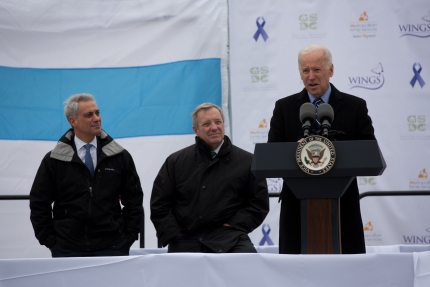
New Chicago Shelter Will Help Victims of Domestic Violence Rebuild Their Lives in Safety

Vice President Joe Biden with Sen. Dick Durbin, Chicago Mayor Rahm Emanuel and his wife Amy Rule backstage at the groundbreaking of a shelter for battered women

Vice President Joe Biden with Sen. Dick Durbin, Chicago Mayor Rahm Emanuel and his wife Amy Rule backstage at the groundbreaking of a shelter for battered women outside the WINGS Metro facility in the Chicago Lawn neighborhood, Nov. 25, 2013. (Official White House Photo by Lawrence Jackson)

Yesterday, Vice President Biden delivered remarks at the groundbreaking ceremony for Chicago’s first new domestic violence shelter in over a decade. Wings Metro, a state-of-the-art facility, will increase the number of available beds in the city by 36% and expects to serve 100 families in its first year of operation after it opens its doors in June 2014.

The creation of this shelter comes at a needed time in Chicago. In 2012, there were 51,174 reported domestic incidents in the city. In addition, 56% of women in homeless shelters in Chicago stated they had been victims of domestic violence, with 22% reporting domestic violence as the immediate cause of their homelessness.

In his remarks, Vice President Biden asked us all to imagine “how cold today feels to the woman who is sleeping in a park with her four children because she had to run out in the night.” Wings Metro will go a long way to support survivors like this woman and will reduce family homelessness in Chicago. The shelter, which was developed through the collaboration of Women in Need Growing Stronger (WINGS), Metropolitan Family Services, and the Greater Southwest Development, will increase the number of available beds in the city from 112 to 152 and will provide comprehensive services to survivors and their children. The Vice President noted in his remarks that this new facility is about more than just shelter—it is about giving survivors access to the services, privacy, and job training they need to rebuild their lives.

Vice President Joe Biden delivers remarks with Sen. Dick Durbin and Chicago Mayor Rahm Emanuel at the groundbreaking of a shelter for battered women

Vice President Joe Biden delivers remarks with Sen. Dick Durbin and Chicago Mayor Rahm Emanuel at the groundbreaking of a shelter for battered women outside the WINGS Metro facility in the Chicago Lawn neighborhood, Nov. 25, 2013. (Official White House Photo by Lawrence Jackson)

The Vice President was joined by Mayor Rahm Emmanuel and Senator Dick Durbin, both of whom have shown a strong commitment to the fight against domestic violence. Since being elected mayor of Chicago in 2011, Mayor Emmanuel has committed to expand funding for domestic violence services. He has dedicated $123,000 to provide court advocates to assist an additional 1,500 survivors as they go through the legal proceedings of their cases. Senator Durbin was one of the leading House sponsors of the original Violence Against Women Act; he has continued to be a strong supporter of the legislation after his election to the Senate.  

The White House

Office of the Vice President

Readout of Vice President Biden’s Meeting with Deputy Prime Minister Bulent Arinc of Turkey

Vice President Biden met with Turkish Deputy Prime Minister Bulent Arinc today to discuss a range of bilateral and regional issues that promote our shared interests.  The Vice President underscored the value both he and the President place on continuing to work with Turkey to broaden and deepen this vital partnership.

West Wing Week 11/22/13 or, "A Man, A Plan, A Canal, Panama!"

November 22, 2013 | 5:47 | Public Domain

Welcome to the West Wing Week, your guide to everything that's happening at 1600 Pennsylvania Avenue, and beyond! This week, the Vice President traveled to Houston and Panama, the President honored the legacy of John F. Kennedy, this year's Medal of Freedom Winners and Nobel Laureates, and attended the Wall Street Journal's CEO Summit. That's November 15th to 21st or "A Man, A Plan, A Canal, Panama!"

Download mp4

West Wing Week: 11/22/13 or "A Man, A Plan, A Canal, Panama!"

This week, the Vice President traveled to Houston and Panama, the President honored the legacy of John F. Kennedy, this year's Medal of Freedom Winners and Nobel Laureates, and attended the Wall Street Journal's CEO Summit. That's November 15th to 21st or "A Man, A Plan, A Canal, Panama!"

Related Topics:

The White House

Office of the Press Secretary

Readout of Vice President Biden's Call with Ukrainian President Viktor Yanukovych

In a phone call today with Ukrainian President Viktor Yanukovych, Vice President Biden expressed his disappointment in the Ukrainian government’s decision to delay preparations for signature of an Association Agreement and Deep and Comprehensive Free Trade Agreement with the EU.  As the Vice President has told President Yanukovych before, it is our strong conviction that closer integration with Europe offers Ukraine a strategic opportunity to strengthen its democracy and return its economy to prosperity.   The Vice President underscored the continued support of the United States for the Ukrainian people and their aspirations for European integration.