Remarks by Vice President Joe Biden to the Munich Security Conference. Hotel Bayerischer Hof Munich, Germany
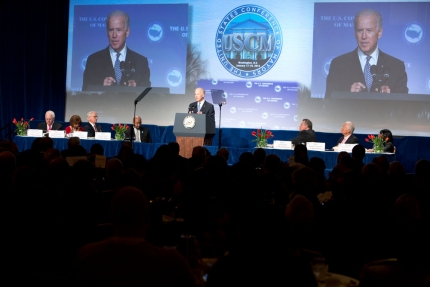
9:22 A.M. (Local) THE VICE PRESIDENT: Well, Wolfgang, let me begin by saying thank you and our expectations are very high as well. (Laughter.) The good news is we’re not going anywhere. The bad news is we’re not going anywhere. (Laughter.) So you have nothing to worry about along those lines. It’s a delight to be back, and it’s a particular delight to be back here starting this morning off observing a tribute to an old friend. One of the great privileges of my career is that I was elected the same year that Sam Nunn was, in 1972, to the United States Senate. And in 1976, one of my -- our closest friends in the Senate arrived. His name was Dick Lugar. I had the privilege of over 30 years chairing or sitting alongside of Dick Lugar on the Foreign Relations Committee. And Sam and Dick and I can say one thing that is rare in politics period, in American politics now: I don’t ever remember there being a harsh word exchanged in over 36 years among any of the three of us. And I always looked to, and still look to, the leadership of Dick and Sam on so many issues. In each of our countries, we’ve had fine men and women who have made significant contributions while they were actively involved in the political process. But many of them, upon leaving that political office they held, recede into private life and their contributions end. I would suggest that Dick Lugar’s* [*sic- Sam Nunn’s] contributions have been as profound from the day he left the United States Senate and public elective office as they have been when he was in public office, and I believe you’ll see the same thing can be said of my very close friend, Sam Nunn* [*sic Dick Lugar]. We, as a country, are lucky to have them both and I would argue everyone assembled in this conference is lucky they are still deeply involved in the security interests of all of us involved. So again, congratulations, Sam. Congratulations. (Applause.) It’s great to be back among friends. When I say among friends, I mean not only the distinguished guests that are from around the world who have joined us in this conference. I also mean to be back here in Germany, to be back here in Europe. I have traveled over 640,000 miles since I’ve been Vice President, and most of the time the President sends me to places that he doesn’t want to go. (Laughter.) So I’ve spent an awful lot of time with McCain and others in Afghanistan and Iraq, and so it’s nice to be here in Germany. (Laughter.) It’s nice to be invited back. (Applause.) You remain, to state the obvious, America’s oldest and our closest allies. And it’s hard to imagine a single threat or a single opportunity that cannot be addressed more effectively if we do so together. Simply put, President Obama and I continue to believe that, Europe is the cornerstone of our engagement with the rest of the world and is the catalyst for our global cooperation. It’s that basic. Nothing has changed. Where we come from is a place that understands that this European alliance is critical to our interests. When I came to Munich four years ago this week, I focused on the challenges of our time, and how this new administration in our first term of office planned on dealing with those challenges. Those challenges included Iraq and Afghanistan; addressing the failure of Iran to meet the international obligations with regard to its nuclear program; managing the crisis of the global economy, which was in a precarious position at that moment; fighting terrorism; repairing our relationships between the United States and Russia. And today, I’m pleased to report on the undeniable progress that we’ve made together in each of these fields. Four years ago, American foreign policy -- and the majority of the discussions with our friends and partners -- was dominated by the wars in Iraq and Afghanistan. Today, we’re in the process of turning the page on more than a decade of conflict following the September 11, 2001 attack, and we ended the war in Iraq responsibly. And together we’re responsibly drawing down in Afghanistan, and by the end of next year, the transition will be complete. Four years ago, Iran had succeeded in dividing the international community over how to address the illicit and destabilizing nuclear program they had underway. We needed to change that dynamic by giving Iran the opportunity to make clear its intentions to the world. As I told the conference then, and I quote: “We will be willing to talk to Iran and offer a very clear choice: Continue down the course and there will be continued pressure and isolation; abandon the illicit nuclear program and your support for terrorism, there will be meaningful incentives.” We were criticized at the time for suggesting we would engage Iran along those lines. Well, we all know what path Iran has chosen. And so the international community came together, and the United States, the European Union and the United Nations imposed what Iran -- the Iranian leaders are acknowledging to be the most robust sanctions in history. As President Obama has made clear to Iranian leaders, our policy is not containment -- it is not containment. It is to prevent Iran from acquiring a nuclear weapon. But we’ve also made clear that Iran’s leaders need not sentence their people to economic deprivation and international isolation. There is still time, there is still space for diplomacy, backed by pressure, to succeed. The ball is in the government of Iran’s court, and it’s well past time for Tehran to adopt a serious, good-faith approach to negotiations with the P5-plus-1. Four years ago, the world was mired in the deepest economic downturn since the Great Depression. Today, times remain tough for too many American and European families -- but conditions are improving. The United States is taking difficult but critical steps to put ourselves on a sounder economic footing. And I might add, it’s never been a real good bet to bet against America. We’re going to do just fine in terms of our economic “crisis” and the cliffs that are about to approach. We’re determined to continue in a balanced way to cut our debt in the coming years and have made significant strides towards that goal. Last year, with the help of my colleagues in the United States Congress, we reached a difficult agreement on reducing our spending over the next 10 years by close to $1 trillion. Just the end of this year, we agreed on a very difficult decision about our tax code, raising another $600 billion, making significant compromises. There is more to be done, because it’s essential, both for the wellbeing of our citizens, and also for our nation’s ability to meet what Wolfgang stated at the outset: our strategic obligations to the rest of the world. Because the strength of our economy at home is the most fundamental source of our power and influence in the world. But I must say, the same must and can be said of Europe, whose contributions to global stability and prosperity are critical, yet also depend on the strength of your economy and your economic and financial commitment to security. Believe me when I say that I realize how difficult this is with an economy having slipped back into recession last year and the ever-present temptation to back away from commitments on defense spending. But I also know that maintaining our capabilities is what enables us to advance our common global agenda. That’s just one reason why a strong and capable Europe is profoundly in America’s interest, and I might add, presumptuously, the world’s interest. We have seen positive steps recently to address the eurozone crisis, with the European Central Bank pledging to stand behind countries willing to launch reforms, and with Greece, Ireland, Poland* [*sic-Portugal], Spain and Italy all taking important steps to put their economies on a sounder path. Governments across the eurozone must also remain focused on growth and jobs. These may be fundamentally European problems, requiring European solutions, but their resolution has tremendous impact on the United States of America and on the global economy. Now, just imagine what we can do as we get our respective houses in order. Already, Europe is America’s largest economic partner, and the numbers are staggering: over $600 billion in annual trade that creates and sustains millions of jobs on the continent and at home, and a $5 trillion overall commercial relationship. But the potential is so much greater still. There’s a lot of interest lately in the idea of a comprehensive transatlantic trade and investment agreement. The reason we don’t have one already is not because no one ever thought of it; it’s because there have always been difficult issues, such as regulations and standards, which continue to divide us. The question now is whether the political will exists to resolve those longstanding differences. And if so, we should pursue a transatlantic partnership. And if we go down that road, we should try to do it on one tank of gas and avoid protracted rounds of negotiations. This is within our reach. It would be good for growth, job creation, and be good on both sides of the Atlantic; it would strengthen our global trading system; and it would, importantly, help us strategically as a key element -- add another element of our transatlantic alliance. I believe we can overcome these differences and get this done, because the rewards for success are almost boundless. When I addressed this conference four years ago, many of our nations had been scarred in recent memory by the scourge of international terrorism -- 9/11 in the United States, 7/7 in the U.K., 3/11 in Spain. Core al Qaeda was on the ascendancy. Osama bin Laden was alive and well and plotting against our countries, inspiring followers. Four years ago, I spoke of a shared struggle against a “small number of violent extremists beyond the call of reason” and said “we will and we must defeat them.” Now, as a result of the joint efforts of all of our countries and renewed and relentless focus on counterterrorism, the cooperation of our law enforcement agencies, and President Obama’s unflinching determination to bring Osama bin Laden to justice, those -- we’ve made progress. We’ve dealt that organization, al Qaeda, a crippling blow, made all our homelands more secure. But even as we look as -- took the fight to core Al Qaeda in the FATA, we were cognizant of an evolving threat posed by affiliates like AQAP in Yemen, al-Shabaab in Somalia, AQI in Iraq and Syria and AQIM in North Africa. Most of these groups do not pose the same threat, with the same capacity, to our homelands as core al Qaeda once did. And in some cases they are merely amalgams of disparate groups adopting a name. But increasingly they are targeting Western interests overseas. That’s why we have been just as relentless in taking them on. Today, across North Africa and in parts of the Middle East, extremists are seeking to exploit the following: increasingly porous borders; a broad swath of ungoverned territory; readily available weapons; new governments that lack the capacity and sometimes the will to contend with extremism; a swelling generation of disaffected young people whose futures are stifled by stagnant economies. This is not a call to spend tens of billions of dollars and deploy thousands and tens of thousands of boots on the ground, as once occurred. It requires a more integrated strategy, a more coordinated strategy. And the threat that spreads across many nations and millions of square miles cannot and will not be eliminated overnight, and we all know that. But meeting these challenges is going to require us to continue to work together, including through the United Nations, NATO, the G8 and other key international institutions. And it will take a comprehensive approach -- employing the full range of the tools at our disposal -- including our militaries. That’s why the United States applauds and stands with France and other partners in Mali, and why we are providing intelligence support, transportation for the French and African troops and refueling capability for French aircraft. The fight against AQIM may be far from America’s borders, but it is fundamentally in America’s interest. And finally, four years ago at this conference, we proposed the United States and Russia, Mr. Ambassador, press the “reset button,” a phrase that became more used than I had intended when I used the phrase. But the whole idea was to pursue a common agenda around common interests. I would think -- I think Foreign Minister Lavrov would agree that important steps -- that important step enabled us to do some good things: to negotiate, ratify and implement the New START Treaty; to activate unprecedented sanctions on Iran; and unity on North Korea; to build the northern distribution network that supplies the United States and ISAF forces in Afghanistan; to expand economic and trade relationships -- including both Russian accession to the WTO and extension of the permanent normal trade relations to Russia; to negotiate a civilian nuclear cooperation agreement; to build a bilateral presidential commission that networks Russian and American officials and publics on the broadest cooperative agenda the United States and Russia have ever tried to share. But I also made clear four years ago, we are not naïve -- neither Russia or the United States. I said we would not agree with Russia on everything. For example, the United States will not recognize Abkhazia and South Ossetia as independent states. We will not recognize any nation having a sphere of influence. It will remain America’s view that sovereign states have the right to make their own decisions and choose their own alliances. All that remains the U.S. position; it will not change. But in the meantime, other clear differences have emerged as well. It’s no secret that we have serious differences on issues like Syria, missile defense, NATO enlargement, democracy, human rights. These differences are real. But we continue to see opportunities for the United States and Russia to partner in ways that advance our mutual security interest and the interest of the international community -- whether by safeguarding and reducing nuclear arsenals, boosting our trade and investment to help each other unlock the enormous innovative potential of our societies, working collaboratively to advance freedom of navigation in the Arctic while preserving access to natural resources. New challenges -- there are new challenges in the years to come. Over the next four years and beyond, Europe and the United States will turn our attention to a new set of challenges no less daunting than the ones that came when I addressed this conference four years ago. But I would also -- I argue no less soluble than those challenges we faced four years ago. President Obama will say more about this agenda next week in his State of the Union address, and I’ve learned as Vice President it’s not a good thing to steal the President’s thunder, John. (Laughter.) I’ve learned that. I’ve gotten better after four years of this. But it will reflect our shared interests in the following areas: advancing a comprehensive nuclear agenda to strengthen the nonproliferation regime, reduce global stockpiles and secure nuclear materials -- and I am looking forward -- Sam told me of the initiative that he and his colleagues are thinking about, and we’re anxious to hear it -- getting -- combating climate change, moving it up on the agenda; enhancing our development initiatives to promote global health and food security and end extreme poverty in the near future; strengthening our alliances, which are essentially -- essential to our ability to meet our challenges in the 21st century; continuing to take down barriers to trade including with Europe to spur growth on both sides of the Atlantic; maintaining our commitment to the elusive but essential goal of Middle East Peace; and strengthening the -- engaging the democracies in Southeast Asia, Latin America, Sub-Saharan Africa and across the Middle East. And this afternoon, I’ll be meeting here in Munich with the leaders of the Syrian Opposition Coalition, as many of you have already done. President Obama and I and nearly all of our partners and allies are convinced that President Assad, a tyrant, hell-bent on clinging to power, is no longer fit to lead the Syrian people and he must go. We can all agree -- but we can all agree not on how or what we do -- we can all agree on the increasingly desperate plight of the Syrian people and the responsibility of the international community to address that plight. Just this week the international community came together to raise -- to pledge $1.5 billion in pledges for humanitarian support for the Syrian people and refugees fleeing the violence. As part of that effort, President Obama announced that we would be contributing $155 million, bringing the total of humanitarian aid for Syria to $365 million -- the largest contribution of any nation’s humanitarian assistance to the Syrian people. We also provided more than $50 million in non-lethal assistance to the Syrian opposition and are working, alongside our partners to help them become more inclusive and cohesive. As President Obama said last week, we’re under no illusions. The days ahead will continue to be very difficult. But the opposition continues to grow stronger. And as the Syrian people have their chance to forge their own future, they will continue to find a partner in the United States of America. Europe remains I might add -– Europe remains essential to that entire effort. As I said at the outset, Europe is the cornerstone of our engagement with the world, and Europe is the catalyst -- our catalyst for global cooperation. And as I hope we’ll all agree, although our mutual agenda has shifted over the past four years, one important thing remains unchanged: We need to work together; we need to stick together. We need you as much as you need us. Neither the United States nor any other country can alone address the challenges we face. We know that. Europe remains America’s indispensable partner of first resort. And, if you forgive some presumptuousness, I believe we remain your indispensable partner. I stand before you as a proud Atlanticist for my entire career and a firm believer in the transatlantic ties that have never been deeper, in my view, broader or more important at any time since I was elected as a kid in 1972. Time and again, when it comes to a search for partners in this extremely complex world, Europe and America still look to each other before they look anywhere else. Our soldiers, diplomats, security personnel, and citizens continue to stand shoulder-to-shoulder. In Afghanistan, America looks to Europe, which provides about 30,000 troops and trainers and has spent almost $15 billion. Our collaboration on missile defense is protecting both of our populations -– and our agreements with Romania, Spain and Turkey provide tangible proof of that cooperation. Our intensified counterterrorism cooperation has helped keep 800 million citizens safer than they had been in the recent past. In Libya, NATO acted quickly, effectively and decisively. And now we are working together to support Libya in building effective institutions of governance that have never existed before. European partnership remains an indispensable force in advancing democracy and universal rights. We’ve joined forces in response to the unprecedented promise and unresolved turmoil of the Arab Spring. From Tunis to Tripoli, Cairo to Sana’a, our collaboration could not be closer. And it’s going to be required to continue. We also know there is unfinished business in our common project of a Europe whole and free. Georgia and the states of the Balkans have unfulfilled aspirations for Euro-Atlantic integration. The pace of these integration efforts will be determined by the aspirants themselves. But we too share a responsibility for helping them achieve their rightful place in Europe and the Transatlantic Alliance. The broader focus also needs to be kept in mind. But folks, our interests well go -- go well beyond the territory of our nations. In a changing world, what’s unique about our collaboration with Europe is that the issues we address truly span the globe. That’s all the more essential in a changing world, where emerging powers and far-flung events can have profound impact in each of our countries. It’s a simple fact that nations like Brazil, India, China, South Africa, Indonesia will continue play an ever greater role in the global security and economic affairs of the world. And it’s in all of our interests that they emerge as responsible, fully integrated actors on the world stage. That’s why America’s engagement with these countries -— and particularly in Asia -— plays an increasingly prominent role in our conduct of our foreign affairs. This engagement does not come at Europe’s expense. Many of you I know talk to us, talk to me about are we taking our focus off of Europe as we’ve reasserted that we are a Pacific power -- and we are a Pacific power. It’s quite the opposite. It is profoundly in Europe’s interest for America to engage more broadly with the world, and we should be doing it more fully together. In the economic realm, European customers and companies gain from the United States advocating on behalf of greater market access or fairer rules of the road in international trade. Europe also gains from peace and stability in the Asia-Pacific region, and the United States -– along with our allies in the region –- have helped guarantee that. At the request of President Obama and Chinese President Hu two years ago, we were asked -- they asked us both -- both President Xi -- Vice President Xi and I to spend some more time together. We traveled to each other’s countries, spent literally scores of hours together, spent 10 days together in each of our countries -- five and five. And I believe that --President Obama and I believe that this -- establishing personal relationships with an emerging Chinese leadership -- is critically important not only to the United States, but that we know and they know where we stand. We fully understand one another. I say to my colleagues in the House and the Senate, Tip O’Neill used to say, all politics is local. I believe all politics, particularly international politics, is personal. I think personal relationships matter. So when I visited China I made it absolutely clear that the United States does not view China with hostile intent and that we can cooperate and compete simultaneously. I’ve said many times, the rise of a peaceful and responsible China that contributes to global security and prosperity is in the interests of all nations. And we all have a role to play in encouraging Beijing to define its interests more in terms of common global concerns than merely introspective concerns. The United States is a Pacific power. And the world’s greatest military alliance helps make us an Atlantic power as well. As our new defense strategy makes clear, we will remain both a Pacific power and an Atlantic power. And I would respectfully suggest it’s very much in Europe’s interest that we do so. The bottom line is that the USA, Europe -- we all have an important and specific interest in an Asia-Pacific region that is peaceful and growing –- as do our Russian friends and our Japanese friends. So we ought to intensify our cooperation in advance of those interests, moving forward together. I have to discuss today just -- I’ve discussed today just some of the challenges that we face over the next four years and many more years to come. There are many more that I could name and inevitably others on the horizon that only will emerge in time. In a complex world, there is a comfort in knowing that we can face them together though because we’ve done it in the past. Together we can again provide the doubters -- prove the doubters wrong who never tire of tedious question that from my first -- as a young senator, chairman of the European Affairs Subcommittee of Foreign Relations Committee, attended my first meeting on NATO in 1976 and the question was: Whither NATO? I have never attended a conference where that wasn’t a subset of the conference: Whither NATO? Are we going to make it? Are we going to stick together? Ladies and gentlemen, we should scoff at the notion that we cannot make it together. We have to. America, North America and Europe have to meet these security challenges of the modern world together. And we will continue to do so. So I thank you very much for inviting me back to Munich, and to begin by laying out some of the plans of our administration over the next four years. It’s an honor to be with you today, and I look forward to having some private meetings with a number of you and say to my Senate and House friends, if you’re willing, I’d like to buy you lunch or something before you’re out of here, okay? (Laughter.) All right, thank you all so very much for allowing me to be here today, and I appreciate all you’ve done. (Applause.) AMBASSADOR ISCHINGER: Thank you. Thank you very much, Mr. Vice President. Thank you so much. We have time for just one or two questions. The Vice President was kind enough to accept to take a few questions. I have a whole bunch of questions here. I’m sure that Sergei Lavrov will want to comment on the U.S.-Russian relationship, so the two questions I thought I should choose from this stack -- one is on Iran and one is on China. I’ll start with the question on Iran: Many argue that the time for direct U.S.-Iranian negotiations has come. When is that going to happen, and if not, why not? THE VICE PRESIDENT: When the Iranian leadership, Supreme Leader, is serious. We have made it clear at the outset that we would not -- we would be prepared to meet bilaterally with the Iranian leadership. We would not make it a secret that we were doing that. We would let our partners know if that occasion presented itself. That offer stands, but it must be real and tangible, and there has to be an agenda that they’re prepared to speak to. We are not just prepared to do it for the exercise. AMBASSADOR ISCHINGER: The other question is about -- and you talked about that, the relationship with China, the so-called pivot or the rebalancing. I read the question: How concerned are you, Mr. Vice President, about the conflicts brewing in the Pacific? If Henry Kissinger is right, U.S.-China relations are the single most important bilateral relationship, he said. What are your plans, what are the administration’s plans to make sure that this will develop into a constructive partnership and not into a kind of new Cold War confrontation? THE VICE PRESIDENT: I am confident that it’s in the interests of China and the emerging Chinese leadership that it not result in conflict. The last thing that they need at this moment -- and they’re dealing with the incredible potential and incredibly complex problems relative to their economy, their growth and their national needs -- is to engage in anything remotely approaching military competition with the United States. I do not believe that is their intention. It clearly is not our intention. We work and coordinate with our Russian friends and our Japanese friends as well. The bottom line here is that we believe the most important thing to assure that this not occur is to have a frank -- and I mean frank, straightforward, private dialogue with the emerging leadership in China, letting them know what our interests are, letting them know what we believe our role is, and let them make judgments about whether or not that in any way conflicts with their growth patterns or their -- what they believe ability to maintain their own national security interest. The only thing, as I said in one of my -- as I said, we spent 10 days together, my colleague, the ascendant President, still Vice President of China, President Xi. And we both acknowledged that the most dangerous thing is, at this juncture and the next several years of our relationship, is a misunderstanding. The only conflict worse than one that is intended, as my father would say, was one that’s unintended. And so it’s very important we speak frankly about -- for example, I referred to the China Sea. I pointed out it’s not China’s sea; it’s international waters. They have great interests and they have as much interest as anyone else does. It’s a matter of laying out clearly what the parameters of the relationship are and those of the neighbors. And I am convinced that it is -- if we do our job correctly and we, in fact, interface directly with the leadership, that there will be intense competition, there will be occasional misunderstandings, but there will not be -- my children -- my son, who is with me today, a 40-year-old man, will not, when he is my age, be looking at China as a sworn enemy. I do not believe that’s in the cards. I believe there is healthy competition from a growing, emerging China, which I would argue is in the interest of all of us. I’ll conclude by saying I went so far as to say, and I believe it was acknowledged, that one of the reasons China has been able to have this period of sort of sustained growth and stability is because of a U.S. presence in the Pacific, not in spite of. And so I believe we can, with a lot of hard work and direct dialogue, avoid confrontation and manage what will be an intense competition, particularly in the economic field. But then again, I am an American; I look forward to competition. Thank you. (Applause.) END 9:57 A.M. (Local)