President Obama: I Look Forward to Working with Governors to Reignite America's Economic Engine

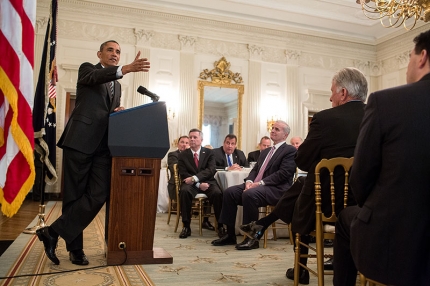
President Barack Obama has a meeting with the National Governors Association in the White House, Feb. 25, 2013

President Barack Obama delivers remarks and participates in a Q&A during a meeting with the National Governors Association (NGA) in the State Dining Room of the White House, Feb. 25, 2013 (Official White House Photo by Pete Souza)

In a meeting with the National Governors Association today at the White House, President Obama stressed the need for bipartisan cooperation, and pressed the leaders in attendance to work together with their partners in Washington to put the focus back on the next generation, rather than the next election.

All of us are elected officials. All of us are concerned about our politics, both in our own party’s as well as the other party’s. But at some point, we've got to do some governing. And certainly what we can't do is keep careening from manufactured crisis to manufactured crisis. As I said in the State of the Union, the American people have worked hard and long to dig themselves out of one crisis; they don't need us creating another one. And unfortunately, that's what we've been seeing too much out there.

The American people are out there every single day, meeting their responsibilities, giving it their all to provide for their families and their communities.  A lot of you are doing the same things in your respective states. Well, we need that same kind of attitude here in Washington. At the very least, the American people have a right to expect that from their representatives.  

The White House

Office of the Press Secretary

Remarks by the President and Vice President at Meeting of the National Governors Association

State Dining Room

11:18 A.M. EST

THE VICE PRESIDENT:  Thank you all.  I tell you what, I didn't know Jack was as good as he is until I heard that rhyme last night.  (Laughter.)  Jack, if you had done that, I’d be introducing you here.  (Laughter.)

Thank you all very, very much.  I’m sorry -- you guys are much more disciplined than the place I lived for 36 years, up on the Hill, and you’re running ahead of schedule.  And so the President is with me, and I want to thank you all for being here.  
We have a lot to work on.  There’s a lot from fixing a broken immigration system to rebuilding our nation’s infrastructure, and this new word everybody in America is learning about -- “sequester.”

This town, unlike many of your capitals, is I hope temporarily frozen in -- not indifference but in sort of an intense partisanship, the likes of which in my career I’ve only see the last couple years.  But you know the American people have moved to a different place.  By the way, thanks for being so nice to my wife last night.  I like you a hell of better.  (Laughter.) We disagreed on some things.  

But all kidding aside, I think the American people have moved -- Democrats, Republicans, independents.  They know that the possibilities for this country are immense.  They're no longer traumatized by what was a traumatizing event, the great collapse in 2008.  They're no longer worried, I think, about our economy being overwhelmed either by Europe writ large, the EU, or China somehow swallowing up every bit of innovation that exists in the world.  They're no longer, I think, worried about our economy being overwhelmed beyond our shores.  

And I don't think they're any more -- there’s no -- there’s very little doubt in any circles out there about America’s ability to be in position to lead the world in the 21st century, not only in terms of our foreign policy, our incredible defense establishment, but economically.  I think the American people are ready to get up.  As a civil rights leader, when I was coming up as a kid, said, they're just -- the American people are tired of being tired.  I think they're ready to get up and move.  And you guys know that because it’s happening in your states.  You probably feel it in your fingertips more than most of us do here in Washington.

And as I said, I think they know we’re better positioned than any nation in the world to lead the world.  And that's why I think they're so frustrated by what they see and don't see happening here in Washington.  And I think their frustration is turning into a little bit of anger.

I found an interesting dynamic -- without ruining any of your reputations and picking out any one of you -- but whether it was a Democrat or Republican governor I had been talking to last night and over this past weekend, I heard from several of you, both parties, how do you deal with this going on up here?  How do you deal with the Congress?  No distinction, Democrat or Republican, depending who I was talking to, no distinction about who you’re dealing with -- but how do you deal with this?  Because you guys deal and women deal with legislatures that are split.  Some of you represent a minority party as a governor, yet you get on very well with -- you accomplish things in your home state.  And as I said, I’ve been here long enough -- that's the way it used to work, and I think we can make it work that way again.

But there’s a number of things we have to do immediately, and we may disagree on how to address them, but I don't think anybody disagrees on the need for them to be addressed -- from implementing the Affordable Care Act.  It’s the law.  You all are grappling with that.  Each of you are making different decisions, but you’re grappling with it.  You’re moving and you’re making your own judgments.  

We also have to -- I don't think there’s much disagreement there’s a need for immigration reform.  I’ve not met a governor from the time of implementing the Recovery Act to now who doesn't think that we have do something about our crumbling infrastructure in order to impact on our productivity here in this country -- continue to attract, keep and bring back American business from abroad.  

And there’s very little disagreement on the need to build an education system that has such immense possibilities for our people.

But on most of these issues we’re united by more than what divides us.  All these issues intersect at a place -- the ones I just mentioned and others -- they intersect at a place where both the state and federal governments engage.  So we’re going to have to work together.  They overlap in many cases.  

We’ll have our differences, but we all should agree that the United States has to once again have the highest percentage of college graduates of any nation in the world.  I don't think there’s any disagreement.  Everybody agrees and some of you governors have led the way on early education and the consequences for the prospects of success for our children not only of graduating, but avoiding the criminal justice system.  You’ve all led in knowing that we have to have reform of our high school system so that we -- and not only finding a pathway for people who are going to four-year college and community college but go into the trades.  

So there’s so much agreement that I think we ought to be able to get a fair amount done.  And we should all agree that to grow our economy we have to invest in manufacturing, clean energy, infrastructure, education.  The question is who invests and how much and how -- we’re going to debate that.  But there’s not much disagreement about the need to invest.  

And I think we’re all -- I’ve never met a Democrat or Republican who’s been a governor who doesn't think that the American people should have the sense that hard work is going to be rewarded, that there’s a chance that if you work hard, you got an opportunity.  I don't know of any group of men or women who are a better living example of that than all of you sitting in front of me in your own experiences.  

So the question is -- we all use the phrase “move forward in a balanced way” -- when one man’s balance is another man’s imbalance, but that's what we got to talk about.  That's what’s at stake.  But the one thing that I don't think any of you lack is a vision about how great this country can be now that we’re coming back, that we ought to be able to reassert ourselves in a way that we own the 21st century.  And I know the guy I’m about to introduce believes that as strongly as all of you do.

Ladies and gentlemen, let me introduce you to the President -- who’s back with the pastry chef and I’m wondering what he’s doing back there.  (Laughter.)  The President of the United States, my friend, Barack Obama.  (Applause.)

THE PRESIDENT:  Thank you, everybody.  (Applause.)   Thank you.  Thank you, guys.  Please have a seat.  Well, welcome, everybody.  Thanks for being here.  

We all have a lot on our plate, everything from our immigration system to our education system.  As Joe talked about, our goal is to make sure that we can be an effective partner with you.

I want to thank the members of my Cabinet who are here, and members of the administration.  I want to thank Jack and Mary for their leadership of the NGA.  And everybody else, I just want to say thanks to you for being on your best behavior last night.  (Laughter.)  I’m told nothing was broken.  No silverware is missing.  (Laughter.)  I didn’t get any calls from the neighbors about the noise -- although I can’t speak for Joe’s after-party at the Observatory.  I hear that was wild.  (Laughter.)  

Now, I always enjoy this weekend when I have a chance to see the governors.  As leaders, we share responsibility to do whatever we can to help grow our economy and create good middle-class jobs, and open up new doors of opportunity for all of our people.  That’s our true north, our highest priority.  And it’s got to guide every decision that we make at every level.

As I’ve said, we should be asking ourselves three questions every single day:  How do we make America a magnet for good jobs? How do we equip our people with the skills and the training to get those jobs?  And how do we make sure if they get those jobs that their hard work actually pays off?  

As governors, you’re the ones who are on the ground, seeing firsthand every single day what works, what doesn’t work, and that's what makes you so indispensable.  Whatever your party, you ran for office to do everything that you could to make our folks’ lives better.  And one thing I know unites all of us, and all of you -- Democrats and Republicans -- and that is the last thing you want to see is Washington get in the way of progress.  

Unfortunately, in just four days, Congress is poised to allow a series of arbitrary, automatic budget cuts to kick in that will slow our economy, eliminate good jobs, and leave a lot of folks who are already pretty thinly stretched scrambling to figure out what to do.  

This morning, you received a report outlining exactly how these cuts will harm middle-class families in your states.  Thousands of teachers and educators will be laid off.  Tens of thousands of parents will have to deal with finding child care for their children.  Hundreds of thousands of Americans will lose access to primary care and preventive care like flu vaccinations and cancer screenings.  Tomorrow, for example, I’ll be in the Tidewater region of Virginia, where workers will sit idle when they should be repairing ships, and a carrier sits idle when it should be deploying to the Persian Gulf.  

Now, these impacts will not all be felt on day one.  But rest assured the uncertainty is already having an effect.  Companies are preparing layoff notices.  Families are preparing to cut back on expenses.  And the longer these cuts are in place, the bigger the impact will become.

So while you are in town, I hope that you speak with your congressional delegation and remind them in no uncertain terms exactly what is at stake and exactly who is at risk.  Because here’s the thing -- these cuts do not have to happen.  Congress can turn them off any time with just a little bit of compromise. To do so, Democrats like me need to acknowledge that we’re going to have to make modest reforms in Medicare if we want the program there for future generations and if we hope to maintain our ability to invest in critical things like education, research and infrastructure.

I’ve made that commitment.  It’s reflected in proposals I made last year and the year before that, and will be reflected in my budget, and I stand by those commitments to make the reforms for smart spending cuts.  

But we also need Republicans to adopt the same approach to tax reform that Speaker Boehner championed just two months ago.  Under our concept of tax reform, nobody’s rates would go up, but we’d be able to reduce the deficit by making some tough, smart spending cuts and getting rid of wasteful tax loopholes that benefit the well-off and the well-connected.  

I know that sometimes folks in Congress think that compromise is a bad word.  They figure they’ll pay a higher price at the polls for working with the other side than they will for standing pat or engaging in obstructionism.  But, as governors, some of you with legislators controlled by the other party, you know that compromise is essential to getting things done.  And so is prioritizing, making smart choices.  

That’s how Governor O’Malley in Maryland put his state on track to all but eliminate his deficit while keeping tuition down and making Maryland’s public schools among the best in America five years running.  That’s how Governor Haslam balanced his budget last year in Tennessee while still investing in key areas like education for Tennessee’s kids.  Like the rest of us, they know we can’t just cut our way to prosperity.  Cutting alone is not an economic policy.  We’ve got to make the tough, smart choices to cut what we don’t need so that we can invest in the things that we do need.  

Let me highlight two examples of what we do need.  The first is infrastructure.  This didn’t used to be a partisan issue. I don’t know when exactly that happened.  It should be a no-brainer.  Businesses are not going to set up shop in places where roads and bridges and ports and schools are falling apart.  They’re going to open their doors wherever they can connect the best transportation and communications networks to their businesses and to their customers.  

And that’s why I proposed what we’re calling “fix-it-first” -- I talked about this in my State of the Union address -- to put people to work right now on urgent repairs like the nearly 70,000 structurally deficient bridges across the country.  And to make sure taxpayers don’t shoulder the entire burden, I also proposed a partnership to rebuild America that attracts private capital to upgrade what our businesses need most -- modern ports to move our goods, modern pipelines to withstand a storm, modern schools that are worthy of our children.

I know that some people in Congress reflexively oppose any idea that I put forward, even if it’s an idea that they once supported, but rebuilding infrastructure is not my idea.  It’s everybody’s idea.  It’s what built this country.  Governor Kitzhaber, a Democrat in Oregon, has made clean-energy infrastructure a top priority.  Governor Brownback of Kansas, a Republican, has been fighting to upgrade water infrastructure there.  

And folks who think spending really is our biggest problem should be more concerned than anybody about improving our infrastructure right now.  We're talking about deferred maintenance here.  We know we're going to have to spend the money.  And the longer we wait, the more it’s going to cost.  That is a fact.  I think Matt Mead, a Republican, put it pretty well in Wyoming’s state address.  He said failing to maintain our roads “is not a plan for being fiscally conservative.”  Well, what's true in Wyoming is true all across the United States.  

And we could be putting folks back to work right now.  We know contractors are begging for work.  They’ll come in on time, under budget, which never happens.   And we could make a whole lot of progress right now on things that we know we're going to have to do at some point.  This is like fixing the roof or repairing a boiler that's broken.  It will save us money in the long term.   

I know that one of the biggest hurdles that you face when it comes to fixing infrastructure is red tape.  And oftentimes, that comes out of Washington with regulations.  In my first term, we started to take some steps to address that.  And we’ve shaved months -- in some cases, even years -- off the timeline of infrastructure projects across America.

So today, I’m accelerating that effort.  We’re setting up regional teams that will focus on some of the unique needs each of you have in various parts of the country.  We’re going to help the Pacific Northwest move faster on renewable energy projects.  We’re going to help the Northeast Corridor move faster on high-speed rail service.  We’re going to help the Midwest and other states, like Colorado, move faster on projects that help farmers deal with worsening drought.  We’re going to help states like North Dakota and South Dakota and Montana move faster on oil and gas production.  All of these projects will get more Americans back to work faster.  And we can do even more if we can get Congress to act.    

The second priority that I want to talk about is education  -- and in particular, education that starts at the earliest age. I want to partner with each of you to make high-quality preschool available to every child in America.  

Now, this is an area where we've already seen great bipartisan work at the state level.  I was just in Governor Deal’s state to highlight this issue because Georgia has made it a priority to educate our youngest kids.  And in the school district where I visited in Decatur, Georgia, you're already seeing closing of the achievement gap.  Kids who are poor are leveling up.  And everybody is seeing real improvement, because it's high-quality, early childhood education.

Study after study shows that the sooner children begin to learn in these high-quality settings, the better he or she does down the road, and we all end up saving money.  Unfortunately, today fewer than three in 10 four-year-olds are enrolled in a high-quality preschool program.  Most middle-class parents can’t afford a few hundred bucks a week in additional income for these kinds of preschool programs.  And poor kids, who need it most, lack access.  And that lack of access can shadow them for the rest of their lives.  We all pay a price for that.  

Every dollar we invest in early childhood education can save more than seven dollars later on -- boosting graduation rates, reducing teen pregnancy, even reducing incidents of violent crime.  

And again, I'm not the first person to focus on this. Governor Bentley has made this a priority in Alabama.  Governor Snyder is making it a priority in Michigan.  Governor Tomblin has made this a priority in West Virginia.  Even in a time of tight budgets, Republicans and Democrats are focused on high-quality early childhood education.  We want to make sure that we can be an effective partner in that process.

We should be able to do that for every child, everywhere -- Democrat, Republican, blue state, red state -- it shouldn't matter.  All of us want our kids to grow up more likely to read and write and do math at grade level, to graduate high school, hold a job, and form more stable families of their own.  That will be better for every state.  That will be better for this country.  That's what high-quality early childhood education can deliver.  And I hope that you're willing to partner with us to make that happen.

Let me just close with this.  There are always going to be areas where we have some genuine disagreement, here in Washington and in your respective states.  But there are more areas where we can do a lot more cooperating than I think we've seen over the last several years.  To do that, though, this town has to get past its obsession with focusing on the next election instead of the next generation.

All of us are elected officials.  All of us are concerned about our politics, both in our own party’s as well as the other party’s.  But at some point, we've got to do some governing.  And certainly what we can't do is keep careening from manufactured crisis to manufactured crisis.  As I said in the State of the Union, the American people have worked hard and long to dig themselves out of one crisis; they don't need us creating another one.  And unfortunately, that's what we've been seeing too much out there.

The American people are out there every single day, meeting their responsibilities, giving it their all to provide for their families and their communities.  A lot of you are doing the same things in your respective states.  Well, we need that same kind of attitude here in Washington.  At the very least, the American people have a right to expect that from their representatives.  

And so I look forward to working with all of you not just to strengthen our economy for the short term, but also to reignite what has always been the central premise of America’s economic engine, and that is that we build a strong, growing, thriving middle class where if you work hard in this country, no matter who you are, what you look like, you can make it; you can succeed.  That's our goal, and I know that's the goal of all of you as well.  
   
So I look forward to our partnering.  And with that, what I want to do is clear out the press so we can take some questions. (Applause.)

END
11:40 A.M. EST

Vice President Biden: There’s a Moral Price to Be Paid for Inaction on Gun Violence

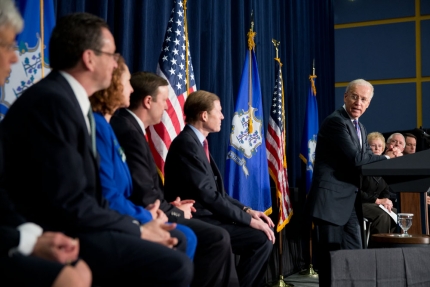
Vice President Joe Biden delivers remarks during a gun violence conference

Vice President Joe Biden delivers remarks during a gun violence conference hosted by the Connecticut Congressional delegation, at Western Connecticut State University, in Danbury, CT, Feb., 21, 2013. (Official White House Photo by David Lienemann)

Yesterday, Vice President Biden spoke at a conference on gun violence at Western Connecticut State University. He told the crowd that while there’s no one thing that can be done to prevent gun violence, there are many steps we can – and must -- take as a nation to better protect our children and communities, regardless of the politics involved.

“People write about the political risks and why they're unacceptable to take on," he said. “I say it’s unacceptable not to take these on.” 

“There’s a moral price to be paid for inaction,” he said.

Vice President Biden Hosts Medal of Valor Ceremony

February 20, 2013 | 53:46 | Public Domain

Vice President Joe Biden hosts a Medal of Valor ceremony with Attorney General Eric Holder at the White House. The Medal of Valor is awarded to public safety officers who have exhibited exceptional courage, regardless of personal safety, in the attempt to save or protect others from harm.

Download mp4 (2038MB) | mp3 (129MB)

Vice President Biden Honors Public Safety Officers with Medal of Valor

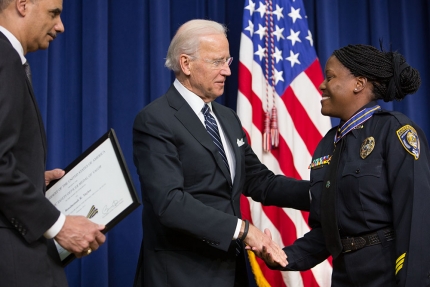
Vice President Joe Biden with Officer Reeshemah Taylor at a Medal of Valor ceremony, Feb., 20, 2013.

Vice President Joe Biden congratulates Officer Reeshemah Taylor of the Osceola County Corrections Department after presenting her with the Medal of Valor, during a Medal of Valor ceremony with Attorney General Eric Holder, in the South Court Auditorium at the White House, Feb., 20, 2013. (Official White House Photo by David Lienemann)

Vice President Joe Biden today recognized 18 public safety officers for exhibiting exceptional courage in a Medal of Valor ceremony at the White House. The Medal of Valor is the highest national award for valor by a public safety officer, and it is bestowed on those whose heroic actions were above and beyond the call of duty.

The Vice President, who was joined by Attorney General Eric Holder, highlighted the bravery of the men and women who were being honored, and paid tribute to the spouses of the recipients who had lost their lives in the line of duty. He also talked about the special qualities that are unique to those who put themselves in danger to save others:

My association with firefighters and police has been... the essence of my public life. And as many of these things that I do, I still grapple with what makes you do what you do? I’m just thankful that you do.

You can't explain it, but you know it when you see it. I see it in the shield over someone’s heart. I see it in the men and women who are sitting here before us today...Thank God for you. You’re from different backgrounds, but you’re the glue that literally binds communities together at times of stress. You’re that face that shows up for a woman on the second floor of a burning building just when she thinks it’s all over for her... The amazing thing about all of you is that the very things you do when you’re on duty to save people’s lives, you do when you're off duty. There’s no separation.

Related Topics: Homeland Security

The White House

Office of the Vice President

Background on Medal of Valor Ceremony

On Wednesday, February 20, 2013, the Vice President will host a Medal of Valor ceremony with Attorney General Eric Holder. The Vice President and Attorney General will deliver remarks at this ceremony. Below is background information on the Medal of Valor and the recipients of the Medal at Wednesday’s ceremony.

Watch this event live on Wednesday at 1:30 PM ET at www.whitehouse.gov/live

THE PUBLIC SAFETY OFFICER MEDAL OF VALOR:

The Public Safety Officer Medal of Valor, authorized by the Public Safety Officer Medal of Valor Act of 2001, is the highest national award for valor by a public safety officer. The medal is awarded to public safety officers who have exhibited exceptional courage, regardless of personal safety, in the attempt to save or protect human life. Including today’s awardees, a total of 78 medals have been presented since the first recipients were honored in 2003.
 
To receive the Medal of Valor, public safety officers must be nominated by the chief executive officer of their employing agencies, recommended by the bipartisan Medal of Valor Review Board, and cited by the Attorney General. The Attorney General designated Mary Lou Leary, Acting Assistant Attorney General in the Department’s Office of Justice Programs (OJP), to serve as the Federal point of contact for the Medal of Valor initiative. OJP’s Bureau of Justice Assistance (BJA), led by Director Denise E. O’Donnell, assists in overseeing the Medal of Valor initiative.
 
More information about the award, the Medal of Valor Review Board members, and the nomination process is available at: www.ojp.usdoj.gov/medalofvalor.  
 
 
RECIPIENTS OF THE PUBLIC SAFETY OFFICER MEDAL OF VALOR:
 
2009-2010 Medal of Valor Recipients
 
Officer Julie Olson

Maplewood Police Department, Minnesota
 
On September 7, 2009, Officer Julie Olson was called to assist North St. Paul Officer Richard Crittenden. A woman had called the police concerned that her estranged husband had returned to her apartment and might be inside. North St. Paul’s police department had dealt with the suspect several times in the past, including as recently as the previous night when the suspect fled before squads arrived. The woman had an Order of Protection against the suspect.
 
Officer Olson and Officer Crittenden arrived on the scene at the same time.  They initially searched a vacant apartment, knowing the suspect had hidden there in the past. They were then let into the complainant’s apartment, which was next door to the vacant apartment. As they entered the darkened apartment, Officer Crittenden observed a flaming cloth advancing in his and the residents’ direction. He pushed the residents out of harm’s way and was struck in the face and side of the head with an accelerant-soaked t-shirt. The suspect grabbed Officer Crittenden in a “bear hug.” After a brief struggle, the suspect then grabbed Officer Olson in an apparent effort to disarm her. He then disengaged with Officer Olson and re-engaged with Officer Crittenden. The suspect grabbed Officer Crittenden’s sidearm from his holster and fired one round at point-blank range at Officer Crittenden’s head, killing him. 
 
The suspect then turned the gun on Officer Olson. When Officer Olson heard one round sail past her ear, she responded as she had been trained, and side stepping and returning fire. Another round struck Officer Olson’s spare magazine on her duty belt, shattering it and causing pieces of the round to enter her strong-side arm. Now injured, Officer Olson returned fire on the suspect, striking him five times. While under the extreme pressure of the moment, she had the wherewithal to do a combat reload as she backed out of the apartment, only to find she had attempted to reload with the shattered magazine. She subsequently dropped the shattered magazine and reloaded with another magazine, as Officer Lonn Bakke entered the apartment building. Officer Olson and Officer Bakke then re-entered the apartment to disarm and handcuff the suspect, who subsequently died at the scene.

Officer Reeshemah Taylor
Osceola County Corrections Department, Florida
 
On June 22, 2009, Officer Reeshemah Taylor was assigned to the Medical Unit of the Osceola County Jail. While performing her duties, Officer Taylor was confronted by a high-risk inmate who had taken one officer hostage and changed into that officer’s uniform. The inmate placed a fully loaded 9mm semi-automatic handgun to Officer Taylor’s head as she walked into the room where the inmate and the captive officer were located. This inmate had a history of violent felony charges and was already serving three consecutive life sentences with no possibility of parole within the Florida Department of Corrections. The inmate was being held at the Osceola County Jail pending trial for a violent armed robbery. The inmate was also a well-known member of the “Los 27” and “La Nieta” gangs domiciled out of Puerto Rico, who are notorious for their violent acts against law enforcement personnel. Through the subsequent criminal investigation of this attempted escape, it was determined that this inmate planned to walk out of the jail dressed as a corrections officer.  The gun was factored into his plan and would be used if someone attempted to stop him or intervene.  According to investigators, there was no doubt that this inmate would have used the firearm to ensure that his escape was successful.  He was prepared to shoot anyone who might attempt to avert him from his plan, as he felt he had nothing to lose and did not want to return to prison.
 
During Officer Taylor’s face-to-face confrontation with the inmate, a struggle took place for the weapon. While the weapon was pointed at Officer Taylor, she immediately grabbed the weapon with both hands, diverting it from her direction, and delivered a knee spike to the inmate’s groin. The inmate dropped to the floor, dislodging the weapon from his hand. The gun dropped several feet away from Officer Taylor and the inmate. Officer Taylor placed herself on top of the inmate, with one arm around his head to fashion a headlock, and her legs scissoring his lower body, to keep him on the floor and away from the gun. With her free hand, she utilized her portable radio to announce the code and summon assistance. Officer Taylor engaged an inmate that was far superior in size, strength, motivation, and intention. She successfully subdued this inmate through sheer determination, instincts, will, and courage. Her efforts, in the face of imminent death, saved the lives of many.
 
Wildlife Officer Michael Neal
Arkansas Game and Fish Commission, Arkansas
 
On May 20, 2010, Officer Neal answered a call for assistance after two West Memphis Police officers had been shot and killed during a traffic stop along Interstate 40, and engaged two suspects in the Walmart parking lot. The two suspects were engaged in a firefight with Sheriff Dick Busby and Chief Deputy W. A. Wren. The Sheriff and Deputy, armed with only handguns, were taking fire from an AK-47 assault rifle and a handgun.
 
Officer Neal used his truck to ram the suspects’ van to prevent the suspects from being mobile and possibly harming innocent bystanders, and to divert the suspects’ attention away from the Sheriff and Deputy. Once Officer Neal rammed the suspects’ van, the suspects opened fire on Officer Neal’s truck, firing several rounds through his windshield. Officer Neal avoided being hit by the AK-47 rounds and returned fire with his issued AR-15. He disabled the driver and possibly the passenger before putting his truck in reverse and backing out of the line of fire so other officers could continue the firefight.  Both suspects were pronounced dead at the scene.  By putting himself in harm’s way, Officer Neal’s actions undoubtedly saved the lives of Sheriff Busby and Deputy Wren, both of whom were injured by the suspects. Officer Neal was only slightly injured.
 
Officer Sean Haller
Officer Rafael Rivera

California Highway Patrol, California
 
On February 25, 2010, the Fresno County Sheriff’s Office attempted to serve a search warrant in the town of Minkler. As deputies attempted to breach the main door of the residence, they came under intense gunfire from within the building, which fatally wounded one of the deputies. The deputies immediately broadcast “shots fired” over the radio.
 
Officer Haller monitored the “shots fired” call over the radio and responded to the scene.  Upon arriving at the scene, he heard gun shots. Officer Haller stopped his patrol vehicle and engaged the suspect in gunfire.  Fellow California Highway Patrol Officer Rivera arrived and took cover behind Officer Haller’s patrol vehicle. Both officers were engaged in gunfire with the suspect for an undetermined amount of time until someone on scene gave a “cease-fire” command. This was followed by approximately 30 minutes with no shooting.
 
The suspect again began firing from within the home. Fearing for their safety and the safety of the other officers at the scene, both Officers Rivera and Haller returned fire. During this exchange, Officer Rivera overheard someone say, “Officer down!” and moved toward the location of the downed officer. He found the downed officer on the passenger side of a marked patrol vehicle.  Officer Rivera recognized the fallen officer as Officer Javier Bejar of the Reedley Police Department and attempted to remove him from the line of fire. The suspect began shooting directly at Officer Rivera as he attempted to rescue the downed officer. Seeing this, Officer Haller broke cover and moved into the line of fire. He engaged the suspect and provided cover fire to assist with the removal effort.
Officer Rivera was able to move the downed officer to a location of cover.  Although Officer Bejar did not survive his injuries, Officers Rivera and Haller exhibited great personal courage, while putting themselves in danger in their efforts to save Officer Bejar’s life. The assailant in this incident subsequently committed suicide by shooting himself prior to the officers’ entry into the residence.
 
 
Trooper Robert Lombardo
Fallen Trooper Joshua Miller

Pennsylvania State Police, Pennsylvania
 
On June 7, 2009, a subject arrived at his estranged wife’s residence in Nazareth, Pennsylvania. After threatening his wife with a handgun, the subject abducted his 9-year-old son and fled the scene in a black Honda Civic with his son seated in the right front passenger seat. The Nazareth Borough Police Department became involved in a high speed pursuit of the subject. Troopers Joshua D. Miller and Robert K. Lombardo, as well as other Swiftwater Station members and local police department officers, assisted in the pursuit. The pursuit went on for some 40 miles and ended on State Route 611 in Coolbaugh Township, Monroe County, Pennsylvania, when Trooper Miller employed the PIT maneuver to bring the vehicle to a stop.  The PIT maneuver is a method by which the pursuit car forces the other vehicle to abruptly turn sideways towards the direction of travel. This causes the driver to lose control and stop.
 
Recognizing that the child was in extreme peril, Troopers Miller and Lombardo immediately approached the driver’s side of the Honda in an attempt to arrest the subject and rescue the child. Troopers Lombardo and Miller both used their collapsible batons to shatter the driver’s side window of the Honda. The subject then fired three shots from a 9mm Taurus, striking Trooper Lombardo once in the left shoulder, and Trooper Miller in the right thigh and neck. Troopers Miller and Lombardo returned fire, striking the assailant eight times. The force of the impact of being shot spun Trooper Lombardo to his left. Despite knowing Trooper Miller was wounded and his own left arm was now paralyzed, Trooper Lombardo did not seek cover. Trooper Lombardo chose to continue to engage the assailant with one arm. Only after the threat was neutralized did Trooper Lombardo seek treatment for his wounds. The suspect’s son was rescued uninjured.
 
Trooper Miller was subsequently flown to Lehigh Valley Hospital in Allentown where he was pronounced dead. Trooper Lombardo was taken to Community Medical Center in Scranton, Pennsylvania, where he was treated for his wounds. Trooper Lombard recently returned to duty. Trooper Miller gave his life and Trooper Lombardo risked his life to rescue the 9-year-old boy. They were/are dedicated officers of the law, committed to serving the citizens of the Commonwealth of Pennsylvania.
 
 
2010-2011 Medal of Valor Recipients
 
Firefighter Peter Demontreux
New York City Fire Department, New York
 
On August 30, 2010, Firefighter Peter Demontreux’s unit responded to a fire in a 4 story brownstone. On arrival they encountered heavy fire at the front door and up the stairway to the third floor preventing entry until a hoseline was put in place. Instead of waiting for a hoseline, Firefighter Demontreux climbed an aerial ladder to a third floor window. There he encountered a civilian who stated that his friend was still trapped inside the burning apartment. After assisting the civilian onto the ladder, Firefighter Demontreux immediately entered the apartment to conduct a search. He located the victim deep within the apartment.
 
In the ensuing minutes, Firefighter Demontreux executed one of the most remarkable rescues ever witnessed. As he assisted the victim through the apartment, the entire third floor suddenly exploded into flames setting both rescuer and victim ablaze. According to the on-scene Battalion Chief’s report, Firefighter Demontreux, now on fire, made the split second decision that he would not leave victim behind. After reaching the window, Firefighter Demontreux insured the victim was safely on the aerial ladder before diving out himself. Both men were extinguished by a hoseline and though badly burned- the civilian victim received burns over 50% of his body- both survived. Firefighter Demontreux’s protective equipment was subsequently tested and found to have been subjected to temperatures in excess of 1,000 degrees.
                       
Firefighter Hope Scott
Battalion Chief William Reynolds

Virginia Beach Fire Department, Virginia
 
On October 12, 2010, the Virginia Beach Fire Department received multiple 911 calls for a house fire with people trapped in a single family dwelling. Engine 7 with Captain William Reynolds and Firefighter Hope Scott, arrived on scene. Captain Reynolds reported heavy fire from the corner of the first floor spreading to the second floor. Two family members were on the porch roof attempting to enter the structure and were screaming that a baby and was in the second floor bedroom and the great grandmother was still inside. Heavy smoke and heat conditions forced the civilian would-be rescuers to withdraw from their rescue efforts.
 
Captain Reynolds, hearing the pleas of the family and realizing time was of the essence, made the tactical decision to enter the second floor window with Firefighter Scott without the protection of a fire hose. This tactic is known as Vent-Enter-Search in the fire service, and is considered a high risk maneuver to the personnel making the entry. Captain Reynolds and Firefighter Scott climbed a ladder and entered the second floor window without the protection of a charged fire hose (hand-line). They encountered high heat and zero visibility conditions. Captain Reynolds was equipped with a thermal imaging camera to aid in the rescue effort. However, the high heat conditions rendered the camera ineffective and they were forced the crew to crawl blindly through the assorted debris. The fire still raged underneath the bedroom, made the floor so hot that Firefighter Scott could feel the heat through her protective gear. Captain Reynolds encouraged Firefighter Scott to keep pushing on as they knew the child was located somewhere in the room.
 
Approximately two minutes into the search, Firefighter Scott heard what she thought was a faint cry. She started sweeping the floor with her arms and located an infant lying on a mattress located on the floor covered in makeshift bedding material. Firefighter Scott scooped up the infant and handed the lifeless infant to Captain Reynolds as he was positioned near the window. Captain Reynolds handed the infant through the window to firefighters who were standing on an egress ladder. The infant was not breathing and unresponsive once she was removed from the structure. Resuscitation efforts were immediately started and EMS personnel transported the infant to Norfolk General Hospital Burn Center. The infant has since made a full recovery without any major medical issues or deficits.
 
After Firefighter Scott located the infant, she and Captain Reynolds continued to search the second floor for the other reported fire victim. Other responding personnel found the 73 year old woman, lying on the stairs leading to the second floor. She was unconscious and unresponsive, suffering from smoke inhalation. She was removed from the structure and resuscitation efforts immediately started. Unfortunately, she died from her injuries three days later.
 
Captain Reynolds and Firefighter Hope Scott demonstrated incredible bravery and self sacrifice in their decision to enter the floor directly above the uncontrolled fire without the protection of a charged hose-line and placed themselves at one of the greatest risks recognized in the fire service. Their fast, decisive actions and disregard for their own safety truly resulted in the saving of the life of a young infant who would have succumbed from the smoke and fire if not for their brave actions.
 
Deputy Sheriff Krista McDonald
Kitsap County Sheriff’s Office, Washington
 
On January, 23, 2011, the Kitsap County Sheriff's Office had been given information on the location of a possibly armed suspect, accompanied by an underage female who was reported as missing from Utah and a runaway. Deputies Stacy and Ejde approached the suspect and his 13 year-old companion as they sat outside the entrance to a Walmart Store in Port Orchard, Washington. These deputies were assisted by Deputy Krista McDonald who had responded as an additional back-up.
 
The suspect refused to identify himself, and attempted to run from the location. Deputy Stacy tried to grab the suspect but missed and fell. Deputy Ejde ran after the suspect as he attempted to run across the street and into the parking lot. Halfway across the roadway, the suspect drew a semi-automatic handgun hidden on his person, turned and fired multiple shots. He struck Deputy Ejde twice, in the left shoulder and right arm. Deputy Ejde went down into a raised flowerbed. By this time Deputy Stacy had regained his footing and was running after the suspect. The suspect shot and wounded Deputy Stacy in the right shoulder. Deputy Stacy also fell to the asphalt. Deputy McDonald began firing at suspect from her position at her patrol vehicle, approximately 90 - 100 feet distance. The suspect then directed his attention toward Deputy McDonald as she started to move toward her two downed colleagues. The suspect continued to shoot at both Deputy McDonald and Deputy Ejde.
 
Advancing toward the suspect without benefit of protective cover, Deputy McDonald stayed in the gunfight and returned fire. The suspect was struck in the left leg and dropped to the pavement where he continued to fire on the deputies. By this time Deputy McDonald had moved to within 60 feet of the suspect, placing herself in the line of fire to distract the suspect. The young girl, witnessing this, ran over to the suspect. As she approached she was shot by the suspect and mortally wounded. Moments later the suspect then committed suicide when he turned his handgun on himself.

Officer Timothy McClintick
Officer Max McDonald
Officer Douglas Weaver
Sergeant Karl Lounge Jr.
Fallen Sergeant Thomas Baitinger

Saint Petersburg Police Department, Florida
 
On January 24, 2011, a Federal Fugitive Task Force arrived at a residence in Saint Petersburg in an attempt to locate a violent fugitive who had been on the run from law enforcement for several months. The fugitive’s wife eventually advised officers that he was hiding in the attic of the house.
 
Additional units were called to the house to help secure the perimeter. After the fugitive failed to respond to any attempts to establish contact, Officer Yaslowitz and US Marshal Ley obtained a latter and entered the attic. They subsequently located the fugitive laying face down some 15 feet for the attic opening.  The fugitive was initially compliant to direction, but as Officer Yaslowitz attempted to handcuff him, the fugitive began to aggressively resist. During the struggle, Marshal Ley deployed his Taser, and then heard a single muffled shot follow by three additional shots. Officer Yaslowitz collapsed and Marshal Ley was subsequent shot twice, causing him to fall through the attic opening onto the floor below.
 
During the ensuing minutes, the fugitive continuously fired multiple rounds through the ceiling at the officers below. Officer McClintick saw a bloodied Marshal Ley on the floor and realized that he was wounded. He reached into the hallway and grabbed Marshal Ley’s foot and tried to drag him back into the bathroom. Unable to get enough leverage, Officer McClintick came out into the hallway, directly under the attic opening and under fire, to grab Marshal Ley and pull him out of the kill zone and into the bathroom. There, he performed lifesaving measures to control the bleeding of Marshal Ley while continuing to provide cover from the assailant.
 
The assailant then moved Officer Yaslowitz’s body to the attic opening, and positioned him so that his foot protruded over the opening.  This was an apparent attempt to lour responding officers out into the open. It was later learned that he had also tied Officer Yasolwitz’s body in place so this it could not be moved while he continued to wait in ambush. During this time officers could hear Lacey moving around in the attic, and firing at anything he heard below.
 
A Rapid Response Team quickly came together to rescue the officers inside the house. Sergeant Thomas Baitinger had arrived at about the same time as Sergeant Karl Lounge. Officer Max McDonald was present, along with Officer Doug Weaver. Sergeant Lounge was carrying his AR15 and a ballistic shield from his cruiser. They only knew that a suspect had shot multiple officers inside the house, that the suspect or suspects were inside the house, and wounded officers were trapped inside, perhaps as hostages. Sergeant Baitinger, a Rapid Response Instructor, recognized that he was the best qualified to handle the shield and lead the entry and assumed that role.
 
Sergeant Baitinger and Officer Weaver moved into the hallway at the far end of the house and observed the open attic and a step stool under it. A Sergeant, positioned by the front door, warned that the assailant and Officer Yaslowitz were in the attic, and to be careful, that the assailant had been shooting down through the ceiling.
 
Sergeant Lounge and Officer McDonald covered the hallway and attic opening from the living room. Sergeant Baitinger put the shield up over his head as he passed under the attic opening and into the threshold of the bedroom, right at the end of the hall. As Sergeant Baitinger entered the kill zone, a hail of gunfire erupted from the attic above. The other officers in the house reported that Sergeant Baitinger was struck once in the back, stopped by his vest. The impact knocked him forward and spun him around. He brought up the shield and yelled, “I’m hit, I’m OK, I can see Yaz in the attic, get him out!” Another burst of gunfire rained down from the attic and Sergeant Baitinger was fatally wounded by a round passing over the shield.
 
During this extensive gun battle, all the involved officers continued to come under fire by the assailant. Sergeant Tom Baitinger, Sergeant Karl Lounge, Officer Doug Weaver, Officer Max McDonald, and Officer Timothy McClintick each demonstrated incredible courage and professionalism under very difficult circumstances. They braved heavy gunfire while attempting to rescue the wounded officers, with Sergeant Baitinger making the supreme sacrifice. Officer McClintick braved heavy gunfire, moving into the kill zone, directly under the attic opening where two officers had already been shot, and another was later killed, to rescue the wounded U.S. Deputy Marshal. The incident ended when the assailant was killed during an exchange of gunfire with the St. Petersburg TAC Team on scene.                                                
 
Fallen Deputy Cameron Justus
Fallen Deputy William Stiltner

Buchanan County Sheriff's Office, Virginia
 
On March 13, 2011, Deputy William Stiltner was at home when he heard through his scanner that two fellow officers were shot while responding to a larceny call at a local salvage yard. Deputy Stiltner headed to the scene to find that a sniper was shooting from the woods above the salvage yard, and both officers were lying on the ground. Without hesitation Deputy Stiltner along second deputy went to aid their fellow colleagues by trying to move them out of the range of the shooter and into safety. As the deputies carried fallen Deputy Rasnake to a nearby car, a shot rang out from behind them. The car window shattered and Deputy Stiltner fell to the ground fatally wounded.
 
Shortly afterwards, Deputy Cameron Justus, who was also off duty, heard that a gunman had shot three of his fellow deputies, and that officers were trapped at the scene by the gunman. By the time Deputy Justus arrived at the salvage yard, he already knew the gravity of the situation. An unknown assailant armed with a high-power rifle had taken refuge in the tree line behind the property. This skilled sniper who had already shot three deputies multiple times, had the advantage of being perched above them on the mountainside. Deputy Justus met with Sheriff Ray Foster and both officers took cover behind their vehicle. Armed with his M-16 rifle, Deputy Justus suddenly spotted a shadowy figure in the pine trees. He called out to the sheriff that he had the man in his sights and was going to take the shot. Just as Deputy Justus pulled the trigger and the bullet erupted from his rifle, simultaneously the sniper fired from his weapon, fatally wounding Deputy Justus. After refusing to surrender, the assailant was shot and killed by other deputies on the scene.
 
Deputy Stiltner's heroic efforts to save the lives of his fellow deputies, along with Deputy Justus’ courageous actions putting him in a dangerous position in order to safeguard the lives of his fellow deputies unquestionably demonstrate performance that went above and beyond the call of duty.
 

Open for Questions: Vice President Biden on Reducing Gun Violence

February 19, 2013 | 28:58 | Public Domain

Vice President Biden answers questions about the Obama administration's proposals to reduce gun violence.

Download mp4 (1096MB) | mp3 (70MB)

West Wing Week: 02/15/13 or “You’re a Hero”

This week, the President delivered the first State of the Union address of his second term, and then brought his proposals to a factory in North Carolina and a school in Georgia, presided over a Medal of Honor ceremony, honored the outgoing Secretary of Defense, and hungout on Google Plus. 

West Wing Week: 02/15/13 or “You’re a Hero”

February 14, 2013 | 5:34 | Public Domain

This week, the President delivered the first State of the Union address of his second term, and then brought his proposals to factories in North Carolina and a school in Georgia, presided over a Medal of Honor ceremony, honored the outgoing Secretary of Defense, and hungout on Google Plus.

Download mp4 (190.5MB)

Vice President Biden Meets with Law Enforcement Officials in Philadelphia

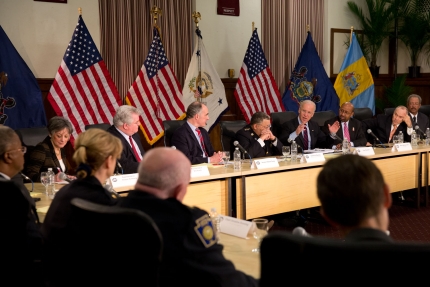
Vice President Joe Biden holds a roundtable with law enforcement officials

Vice President Joe Biden holds a roundtable with law enforcement officials and members of congress on gun safety, at Girard College in Philadelphia, PA, Feb., 11, 2013. (Official White House Photo by David Lienemann)

Today, Vice President Biden traveled to Philadelphia to meet with law enforcement officials and hold a roundtable discussion to talk about the Administration’s plan to reduce gun violence.

In addition to Vice President Biden, the roundtable included Philadelphia Mayor Michael Nutter, Philadelphia Police Commissioner Charles Ramsey, Senator Robert Casey, Congressman Robert Brady, Congresswoman Allyson Schwartz, Congressman Chaka Fattah, New York City Police Commissioner Ray Kelly, and police chiefs and prosecutors from other cities and communities.

In the meeting, the participants discussed the challenges for law enforcement as they work to reduce gun crime. The Vice President pledged to continue the Administration’s fight to put 15,000 police officers on the street – and also argued that there is a consensus growing behind sensible gun safety legislation. He called for getting assault weapons and high capacity magazines off the streets, requiring background checks for all gun purchases, and a federal gun trafficking statute, among other proposals.