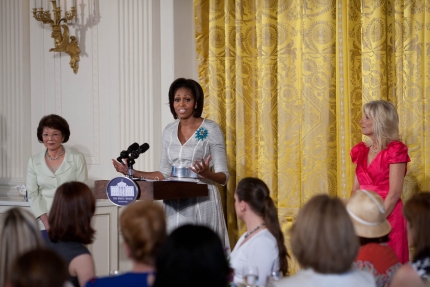
Remarks by the First Lady at Spelman College Commencement
Georgia International Convention Center
Atlanta, Georgia
3:53 P.M. EDT
MRS. OBAMA: Well, goodness. Thank you. (Applause.) Let me tell you it is a pleasure and an honor -- yes, Chicago -- (laughter and applause) -- to be with all of you today.
And I want to thank President Tatum for her leadership and for that very kind and generous introduction. She is such an inspiration to all of the women who are part of the
Spelman family, so let’s give her our thanks and round of applause. (Applause.)
I also want to acknowledge a few people who are here in the audience: Senator Isakson, Representative Johnson, and of course Mayor Reed. Thank you all so much for joining us today. Thank you all for your leadership. (Applause.)
And I want to give a special shoutout to one of my people, one of my staff members, Ms. Kristen Jarvis of Spelman class of 2003. (Applause.) Look, ladies, you want to know what Spelman does for you? Kristen is my right-hand woman. She travels with me all across the country and around the world. I don't know what I would do without her. She has been with me from the very beginning, looking after my girls, taking care of my mom. So I want to thank Spelman for giving me Kristen. (Applause.)
And again, let’s take a moment to thank all of those beautiful people sitting behind you all today and standing behind you every day, the folks who brought you into this world -- (applause) -- the folks who showed you, with their love, that you belong here. They pushed you, they believed in you, and they answered calls those late nights, even when you were just calling for money. (Laughter.) So again, let’s give a special round of applause for all the families here today. (Applause.)
And of course, most of all, to the Spelman class of 2011, congratulations! (Applause.) We are so, so proud of you. We’re proud of the effort you’ve invested and the risks that you took. We’re proud of the bonds that you forged, the growth that you’ve showed. We’re proud of how, for the past four years, you’ve immersed yourselves in the life of this school and embraced all that it has to offer. In doing so, you didn’t just write a chapter in your own life story. You also became part of the Spelman story –- a story that began 130 years ago about 10 miles down the road from where we are today.
And by now, all of you know the details: about how two white women from up North –- Sophia Packard and Harriet Giles -– (laughter) -- came here to Atlanta to establish the Atlanta Baptist Female Seminary. Now we want the world to know this story. They started out in a dank church basement loaned to them by a kindly preacher named Father Quarles. And their first class had just 11 students, many of whom were former slaves.
Back then, the thought of an African American woman learning to read and write was, to so many, laughable at best, an impossibility at worst. And plenty of people tried to dissuade Miss Packard and Miss Giles from founding this school. They said the South was too dangerous. They said that at the ages of 56 and 48, these women were too old.
But these two ladies were unmoved. As Miss Giles put it –- and these are her words –- they were determined to lift up “these women and girls who have never had a chance.”
It’s a story that has been told and re-told, enacted and re-enacted, in every generation since the day that Spelman first opened its doors.
In a time of black codes and lynching, this school was training African American women to be leaders in education, in the health professions.
In a time of legalized segregation, this school was establishing math and biology departments and training a generation of black women scientists. (Applause.)
At a time when many workplaces were filled with not just glass ceilings, but brick walls, this school was urging black women to become doctors, and lawyers, engineers, ambassadors.
Now, that is the story of Spelman college: that unyielding presumption of promise, that presumption of brilliance, that presumption that every woman who enrolls at this school has something infinitely valuable to offer this world.
And ladies, that is now your story. That legacy is now your inheritance. And I’ve chosen that word –- inheritance –- very carefully, because it’s not an entitlement that you can take for granted. It’s not a gift with which you can do whatever you please. It is a commitment that comes with a certain set of obligations, obligations that don’t end when you march through that arch today.
And that’s really what I want to talk with you about this afternoon. I want to talk about the obligations that come with a Spelman education, and how I believe you all might fulfill those obligations going forward.
So let’s go back again to those first 11 women in that church basement all those years ago. Their teachers started with nothing but a couple of Bibles, some notebooks and some pencils. When it rained, it got so damp in that church that grass started growing on the floor. Often, the stove was so smoky, and the light was so poor, that students could barely see their teachers.
But still, week after week, more women showed up to enroll. Some walked eight or nine miles each way. Many were older, in their 30s, 40s and 50s. Doesn’t sound so old to me. (Laughter.) And often, they were ridiculed. But they kept coming.
One student, a woman named Mary Ann Brooks, simply stated –- and these are her words: “I spoke of going to school, and people laughed at me and said ‘You go to school! You too old! You’re so old you’ll die there.’ But I told them it was just as good a place to die in as I ever wanted, and I knew Miss Packard and Miss Giles would bury me, so I just came right along.” (Laughter and applause.)
Now, that spark, that spirit, that odds-defying tenacity has defined the alumnae of this school from its very first graduating class.
I mean, think about one of my heroines, Marian Wright Edelman, class of 1960 -- (applause) -- working as a young civil rights lawyer down in Mississippi. Attorneys in judge’s chambers refused to shake her hand. The sheriff locked the doors against her when she came to visit her clients in jail. She was always careful to leave the door open when she started her car in the morning. That way, if somebody had planted a car bomb, she had a chance of being injured rather than killed. But through it all, she continued to represent her clients. She continued to resist unjust laws with every fiber of her being.
Then there’s Janet Bragg, class of 1925, who was determined to be a pilot. When she was barred from flying out of segregated airports, she worked with her flying school classmates and instructors to build their own airfield.
When she was rejected from the Women Airforce Service pilots because of her race, she enrolled in a civilian training program instead.
And when she completed her training, but an instructor unfairly prevented her from receiving her license, she picked up and moved to Chicago, passed the exam, and became the first African American woman to earn a commercial pilot’s license. (Applause.) Of her experiences, she said: “There were so many things they said women couldn’t do and blacks couldn’t do. Every defeat to me was a challenge.”
And for six generations, that is what Spelman women have done. They have seen every defeat as a challenge. Now, did they have moments of doubt, anxiety and fear? Did they have moments of despair when they thought about giving up, or giving in? Of course they did. We all do.
And I am no exception. I mean, some of you may have grown up like me, in neighborhoods where few had the chance to go to college, where being teased for doing well in school was a fact of life, where well-meaning, but misguided folks questioned whether a girl with my background could get into a school like Princeton.
Sometimes, I’d save them the trouble, and raise the questions myself, in my own head, lying awake at night, doubting whether I had what it took to succeed. And the truth is that there will always be folks out there who make assumptions about others.
There will always be folks who try to raise themselves up by cutting other people down. That happens to everyone, including me, throughout their lives. But when that happens to you all, here’s what I want you to do. I want you to just stop a minute. Take a deep breath, because it’s going to need to be deep -- (laughter) -- and I want you to think about all those women who came before you, women like those first 11 students. (Applause.) Think about how they didn’t sit around bemoaning their lack of resources and opportunities and affirmation.
I want you to think about women like Marian Wright Edelman and Janet Bragg. They didn’t go around pointing fingers and making excuses for why they couldn’t win a case or soar above the horizon. They were Spelman women with the privilege of a Spelman education. And instead of focusing on what they didn’t have, they focused on what they did have: their intellect, their courage, their determination, their passion.
And with few advantages and long odds, with doors closed to them and laws stacked against them, still they achieved, still they triumphed, still they carved a glorious path for themselves in this world.
And graduates, every single one of you has an obligation to do the same. You have an obligation to see each setback as a challenge and as an opportunity to learn and grow. You have an obligation to face whatever life throws your way with confidence and with hope.
And don’t ever let anyone get into your head, especially yourself, because if it’s one thing I can promise you, it’s this: With a Spelman education, you all have everything you need, right here and right now, to be everything you’ve ever wanted to be. (Applause.)
But let’s be clear, the Spelman legacy isn’t just about those first 11 women. And it’s not just about the generations of students and alumnae who came after them. It’s about everyone who believed in those women, it’s about everyone who invested in those women, right from the beginning.
I mean, make no mistake about it, Miss Packard, Miss Giles, they were ambitious for their students. Even as they started their classes at a first grade level, teaching the alphabet and basic arithmetic, they had big dreams. They were planning to build a full-scale liberal arts college for African American women.
I mean, think about that. They could barely afford to keep their doors open. Their students could barely read or write. But already, they were planning to build something big, a college. And in those early years, they actually rejected an offer to merge with the Atlanta Baptist Seminary, the school that eventually became Morehouse. Yep, said, “No thank you, brothers!” -- (laughter and applause) -- because this move would have -- may have solved all their financial problems. But they were afraid that a coed school -- their students would be treated as second class citizens. And they weren’t going to stand for that. No. (Applause.)
Then there was Father Quarles, the preacher who lent them his church basement. He undertook an arduous journey North to raise money for the school. And his last words to the students were: “I am going North for you. I may never return. But remember, if I die, I die for you and in a good cause.”
And those words turned out to be prophetic. In the end, the harsh climate was too much, and he got sick and passed away not long after.
Miss Giles, Miss Packard, Father Quarles, they weren’t the only ones who believed in these students. In those early years, thousands of dollars of donations poured in from the black community itself. I mean, these were folks who likely didn’t have a dime to spare, digging deep into their wallets to support this school. See, that fierce devotion to the potential of others, that commitment to give even when you’re barely getting by yourself, all of that is your legacy as well.
That is your mission now too. (Applause.) Your mission is to find those 11 women wherever in the world your journey may take you. Find those folks who have so much potential, but so little opportunity, and do for them what Spelman has done for you. Maybe it’s a group of kids in your community. Maybe it’s a struggling family at your church. And I’m not just talking about here at home. Maybe it’s folks in a village or an inner-city halfway around the world.
Wherever you go, I guarantee you that you will find folks who have been discounted or dismissed, but who have every bit as much promise as you have. They just haven’t had the chance to fulfill it. It is your obligation to bring Spelman to those folks -– to bring that same presumption of value and worth, to make that same kind of sacrifice, to be as ambitious for them as Spelman has been for you.
And in so doing, I can promise you that you won’t just enrich their lives, you’ll immeasurably enrich your own lives as well.
All of you already know this from your own experiences here at Spelman. Over the past four years, you all have been serving your community in every way possible: tutoring kids, bringing meals to seniors, building homes, and so much more.
And I can tell you from my own experience just how rewarding it can be to make this kind of work the work of your careers. Back when I was sitting right where you are, I was certain that I wanted to be a lawyer. I knew it. So I did everything I was supposed to do. I got my law degree. Got a prestigious job at a fancy law firm. Had a nice big ‘ol paycheck and was finally making a dent in my student loans. My friends were impressed. My family proud -- and relieved. (Laughter.) By all appearances, I was living the dream.
But all the while, I knew something was missing, because the truth is, I didn’t want to be up in that tall building, alone in an office writing memos. I wanted to be on the ground, working with the folks I grew up with. I wanted to be mentoring young people. I wanted to be helping families put food on the table and a roof over their heads. I wanted to be out there giving folks the same kind of chances that I had. (Applause.)
So much to the surprise of my family and friends, I left that secure, high-paying job and eventually became the Executive Director of a non-profit, working to help young people get involved in public service. I was making a lot less money -- a lot -- and my office was a lot smaller. But I woke up every morning with a sense of purpose and possibility. I went to work every day feeling excited -- (applause) -- because with every young person I inspired, I felt myself becoming inspired. With every community I engaged, I felt more engaged and alive than I’d felt in years.
Now, I’m not saying that you have to devote your entire career to public service, though I hope that many of you will. The private sector has all kinds of meaningful, satisfying opportunities. And there is nothing wrong with taking home a nice paycheck. And many of you will need that money to help pay off your student loans and support your families. That, I know. And it is vitally important that you all rise to the highest ranks of every industry and of profession. (Applause.)
But as you climb those career ladders, just remember to reach down and pull others up behind you. (Applause.) That’s what so many folks have done for you all. And now it is your turn to repay the favor.
Now, juggling these obligations to yourself and to others won’t be easy. And I know that along with the pride and joy you’re feeling today, you may also be feeling some worry and some anxiety. Some of you may be worrying about getting a job or getting into grad school. Others may be wondering what it will be like to move back home with mom and dad again. And let me tell you there are plenty of moms and dads here who are wondering the same thing. (Laughter.)
But today, and every day going forward, I want you to remember one last legacy that Spelman has left you. It has left you each other.
I mean, look at all these beautiful, magnificent women beside you. (Applause.) It is breathtaking. (Applause.) Think of all the connections that you have, all those experiences that you’ve shared. The first time you set foot on the campus during Spelbound. Crying your eyes out together at the parting ceremony. Sweating through the night in those un-air conditioned freshman dorms. (Applause.) Sounds pretty rough. (Laughter.) Maybe the alumni can help out with that. (Laughter and applause.) All those classes, convocations, Christmas concerts -- ooh, and the late night conversations about some man. (Laughter.) You all know you were doing that. (Laughter.) You all are the keepers of each other’s histories. And the bonds that you’ve formed here will nourish you and sustain you for the rest of your lives. Now, that is sisterhood. (Applause.)
And look at all these magnificent women around all of you –- the alumnae of this institution who led you through that arch on Friday, cheering you on as you start your journey into the world.
I’m told that back in the depths of the recession in 2009, when many seniors here couldn’t pay their tuition bills, President Tatum made an appeal to Spelman alumnae, parents and friends asking for help. And even though times were tough for everyone, enough gifts poured in to help 100 seniors graduate from Spelman that year. (Applause.) That is sisterhood. (Applause.)
And finally, think back over the years to all those who have made this day possible: Miss Giles, Miss Packard, Father Quarles, and so many others. Think about all those anonymous folks who were just barely getting by themselves, but still found a way to support this school. Those folks never had the chance to get an education themselves -- never -- but they were determined that other young people would. Even if it wasn’t their daughters. Even if it wasn’t their grand-daughters, because, see, what you all have to understand is that hope, that yearning, that wasn’t just about themselves and their own families. It was about a vision for us as a people, and as a nation, where every child can develop every last bit of their God-given potential. (Applause.)
Graduates, you are their dream come true. You are the culmination of their sacrifice, of their longing, of their love. You are part of a glorious sisterhood –- past, present and future. You have a diploma that will take you places you’ve never even dreamed of. (Applause.)
And no matter what obstacles you encounter, no matter what hardships you endure, all of you have that for life. No one can ever take that away from you.
And today, I want to end with some words from Tina McElroy Ansa, Spelman class of 1971. (Applause.) In one of her novels, she wrote, simply: “Claim what is yours…You belong anywhere on this earth you want to.”
And graduates, if you go out there and make that claim, if you reach back to help others do the same, then I am confident that you will lead lives worthy of your dreams, and you will fulfill that precious Spelman legacy that is now yours.
So congratulations, graduates, on all that you have achieved. I am so proud of you, all of you. We are so proud of you. Do big things. Thank you, and God bless. (Applause.)
END
4:19 P.M. EDT