The First Lady's Message for Faith and Community Leaders

May 27, 2011 | 3:31 | Public Domain

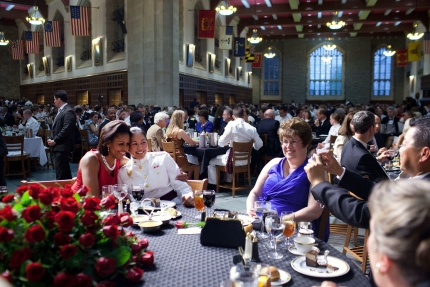
First Lady Michelle Obama shares a message on Joining Forces, her initiative to support and honor our nation's military families, for faith and community leaders.

Download mp4 (414MB)

West Wing Week "OCONUS III: A Homecoming of Sorts"

May 26, 2011 | 7:59 | Public Domain

Welcome to the West Wing Week, your guide to everything that's happening at 1600 Pennsylvania Avenue. This week, President Obama embarked on a six-day trip to Europe, visiting Ireland, the United Kingdom, France and Poland to engage our allies in the region on a host of issues. While overseas, the President pledged support for those back home affected by devastating tornadoes in Missouri and across the Midwest. Before leaving, the President met with Israeli Prime Minister Netanyahu and went to the CIA Headquarters in Langley, VA. That's May 20th, 2011 to the 26th, or "OCONUS (Outside the Continental United States) III: A Homecoming of Sorts."

Download mp4 (295MB)

The White House

Office of the First Lady

Remarks by the First Lady at an Event with Elizabeth Garrett Anderson Students

Oxford University, London, United Kingdom

2:27 P.M. British Summer Time

     MRS. OBAMA:  Well, hello.  How are you all doing?  Good to see you.

     Well, good afternoon, everyone.  I am beyond thrilled to be back in the United Kingdom and to be here with all of you at Oxford University.

     I want to thank Professor Hamilton, the Vice Chancellor of this university, for that very kind introduction and for hosting us all here today.

     And thanks to Professor Hamilton and to the Dean of Christ Church College, The Very Reverend Christopher Lewis also, for hosting us throughout today. 

     I also want to recognize Jo Dibb.  Jo, who has just been so terrific, is such a wonderful example that we just get to (inaudible).  She’s the Head of School at the Elizabeth Garrett Anderson -- we’re losing a mic -- for her leadership -- does that work better -- for her leadership and for joining us here today.

     And I want to thank the Oxford students, as well, who’ve served as mentors today.  Thank you for your time, thank you for making all of us feel so welcome, for looking after these beautiful young women.  And thank you for your hard work and effort.

     But most of all, I want to recognize these brilliant young women from the Elizabeth Garrett Anderson School.  My visit to your school two years ago -- and some of you weren’t there when I came, correct -- that was my first solo international event as First Lady.  Truly, that was the first time I went off all by myself as First Lady.  And from the minute that I walked into the door of your school, I knew I had come to a very special place. 

     It was clear to me that you all were so very special.  I was blown away by your talent.  You all put on a performance for me at the drop of a hat, and I understand you didn’t even really know I was coming.  But you put on such a performance.  And I was also impressed with your achievements.  I was inspired by your passion and your energy.  And I felt this strong sense of connection with all of you because in your stories I saw so much of my own story.

     So I knew that the next time I came to the United Kingdom, I wanted to visit with all of the students again. And I knew that I wanted to visit with all of you in a place like this.  Look around.  I mean, just look at this, a renowned university that has trained so many of the world’s brightest minds and greatest leaders.

     And I’m not the only one who’s excited to see you all here today.  Students and faculty at this university were eager to visit with you all, as well. 

     And there’s a reason for that.  It’s because all of us -- and it’s important for you to know that -- all of us believe that you belong here; that this is a place for you, as well.  We passionately believe that you have the talent within you, you have the drive, you have the experience to succeed here at Oxford and at universities just like it across the country and across the world, because you attend a school that has been labeled “outstanding,” a school that’s preparing you for whatever course of study that you might choose.

     I know that you spend each day with girls from many different countries, who speak 59 different languages in your school.  So you’re already learning how to fit into a university like Oxford, which has students from more than 140 different countries.

     And finally, by overcoming challenges in your lives –- by adjusting to a new culture, and learning a new language, many of you enduring hardships in your own families -– through those experiences, you have gained strength, courage and maturity that is far beyond your years.

     And those qualities will help you succeed in school and in life.  So in other words, all of us who brought you here today don’t just think that universities have a lot to offer you.  We believe that you all have a lot to offer these universities –- your talent, your passion, your unique life experiences.  And we very much want you to believe that’s true, as well.

     And I know that from my own experience, that can be hard sometimes.  And I remember back when I was your age, trying to decide which schools that I would apply to.  And I remember how well meaning but misguided people sometimes questioned whether someone with my background could succeed at an elite university. 

     And when I was accepted at one of those universities, I had all kinds of worries and fears and doubts before I entered.  I worried that I wouldn’t be as well prepared as students who had come from more privileged families.  I worried that I wouldn’t fit in somewhere so different from where I’d grown up, or with people whose backgrounds were so different from mine.

     But after a few months in college, away from home on my own, I realized that I was just as capable and I had just as much to offer any of my classmates.  I realized that if I worked hard enough, I could do just as well as anyone else.  I realized that success is not about the background you’re from.  It’s about the confidence that you have and the effort you’re willing to invest.

     Clarissa here knows that, as well.  She’s one of our mentors here today.  Where’s Clarissa?  There she is.  And she’s also a graduate of the Elizabeth Garrett Anderson School.  And she’s going to be sharing a story in a minute, but I want to give you a little preview, because I worry that she’ll be too modest to tell you about all her achievements.

     Clarissa, I understand, was a star student at Elizabeth Garrett Anderson with outstanding test scores, and she’s now Reading English Language and Literature here at Oxford.  She also somehow finds time here to be an award-winning poet.  She serves as President of the Oxford Poetry Society.  And she’s one of only seven young editors currently working for a major international publishing company.

     So if any of you ever start to doubt yourselves, I want you to remember Clarissa’s story, if mine somehow doesn’t resonate.  I want you to remember that she started out just like all of you.

     And I want you to know that you have everything you need to succeed at a place like this.  You just have to work hard.  That's it.  You have to push yourselves.  That's the only thing.  This does not come easy for anyone.  Everyone here, regardless of their background, got here because they worked hard.  And you stay here because you work hard.  But more importantly, you have to believe in yourself.  You have to mentally believe that you can be here.  You have to paint that picture for yourself. 

     And most of all, when you eventually get to a place like Oxford, I want every last one of you to reach back and to help others get here, too. 

     That's one of the reasons why I’m here, reaching back, even as First Lady of the United States, making sure that other young girls get the same opportunities that I have.  Maybe that means mentoring or tutoring young people in your community.  Or maybe it means keeping in touch with students at Elizabeth Garrett Anderson and helping them with their university applications, because many kids don't have the experience to even apply.

     And the one thing is that you don’t have to wait until you’ve made it yourself.  You don't have to wait until you’re big time.  You can start the minute that you get back to school, because for every one of you here, there's someone else from your school who could be here, who won’t have this opportunity.  So I want you to tell your classmates about the people that you met here today, about the classes you attended here.  And I want you to get them all inspired and excited about what you’ve seen here today.  You all have so much to offer.  You have to believe that.  And I look forward to seeing all of you fulfill whatever dreams you have, and I know they’re big.  So I want to see you all in the future, visiting me somewhere around the world, doing great things.

     So with that, I’m eager to hear from you all about what you saw and learned today.  And then we can talk and talk and talk until they yank me out of here.  So with that, I’m going to turn it over to Jo Dibb, who’s going to take us through.  So congratulations, you all.  We’re very proud.  (Applause.)

     (Clarissa Pabi and Silan Fidan share their stories.)

     MS. DIBB:  Thank you, Silan.  Do you have your question handy?

     Q    Yes.

     MS. DIBB:  Do you have your question handy?

     Q    Yes.

     MS. DIBB:  Would you like to ask your question while everybody else is looking for theirs?

     Q    Okay.  We waited too many years for the first black President.  Considering how far women have come, how long do you think it will be -- take before we have the first female President?

     MRS. OBAMA:  Excellent question.  I think we’re there.  I think that the United States, I think many countries around the world are ready.  So now the challenge is our preparation as women and our desire and willingness to step up and grab that ring, because we’re at a time when so many people just want good leadership.  They want people, number one, who have good character, who are open, who are -- especially young people, because you all see the world in such broader terms, particularly students at Oxford, students who get to travel and experience the world.  Their limits just continue to expand.

     So our job as women is to envision ourselves as leaders, and then to prepare and be ready for a good fight and a good battle, because one thing about our success is that no one feels sorry, is going to take it easy on us, right?

     Hillary Clinton is a fabulous leader.  My husband had a formidable opponent in her in the primaries.  She is a phenomenal Secretary of State.  We have examples of outstanding women like her in leadership all over the world. 

     So it’s completely there.  The question is, are we ready?  Are we, as young women, are we ready to take that responsibility on and go after it and take the risk that go with stepping out there and being judged?  And I think sometimes as women we can step back, but we can start pushing ourselves now, so --

     Q    Thank you.

     MS. DIBB:  You have the next question from Kristina.

     Q    Yeah, my name is Kristina, and I’m 13 years old, and I’m from London.  And my question is, how is it different in raising your children now in the White House than before?

     MRS. OBAMA:  Oh, that's a good question.  A lot more cameras.  (Laughter.) 

     You know, my philosophy about mothering and how I feel about being a mother hasn’t changed.  That doesn’t change with the house you live in and the job that you have. 

     And truly I call myself Mom-in-Chief.  It’s not because I don't value a career or my education.  I am glad that I had the education that I do.  I’m glad I have the accomplishments that I have.  But truly the most important thing to me is raising strong women and raising my daughters well, probably because that's what my mother did for me.  So I think that is the most important job that I will ever have.  And it doesn’t really matter where we live.

     But my husband and I, the President, we’re very protective to make sure they get privacy and normalcy.  But we push them just as we would at any time.  Our girls have responsibilities.  We want to make sure they don't take anything for granted; that they’re grateful.

     The things I tell my girls are the same things I tell all of you.  Don't be afraid to fail.  Don't be afraid to take risks.  Learn to use your voice now.  Ask questions.  Ask stupid questions.  Be laughed at.  Get it wrong.  Trip, fall, and then get back up.  Do your homework.  Do chores.  Have responsibilities, because what I tell my kids -- you have to practice who you want to be.  You know, you don't wake up one morning and you’re suddenly who you think you want to be.  You have to put some energy into it.

     So if you want to be an honest person, you have to be an honest person every day, even starting at three and four and five, right?  If you’re going to be a hard worker, hard work doesn’t just appear.  You have to practice hard work.  You have to practice effort. 

     And I also encourage them and try to help them understand that good things don't come easy.  With that effort, that's where you grow, that's where growth is.  Some of the best times in my life, when I’ve grown, it’s when I’ve done something hard, when I’ve overcome a fear.  You won’t realize that when you’re doing it, but when you come out on the other side, you realize, wow, I’ve really stepped up.

     So I push my girls.  And -- but more importantly, I love them a lot.  And that's what I feel for all of you.  I want you guys to feel that in your lives so that you can be excellent, okay?

     So it’s no different.  Right? 

     MS. DIBB:  Should we have the next question from Yasmin?

     Q    Hi, my name is Yasmin, I’m 14, I'm from London.  My question is, as the First Lady of America, how do you feel -- how do you help others around the world?

     MRS. OBAMA:  Say the last part?

     Q    How do you help others around the world? 

     MRS. OBAMA:  How do I help others around the world?  Well.  I think sessions like this -- I’m hoping that it helps others around the world.  I mean, mentoring young people around the world, not just in the United States, is a significant part of what my husband and I believe we should be doing -- giving all kids a chance to have some level of excellence and opportunity in their lives. 

     And we’ve started doing mentoring.  One of the things I mentioned in my remarks is that it is so important, no matter where you are in your life, to think about how you’re helping those behind you, those younger than you, come up.  And that's not just an American notion.  That's what we need to be doing around the world.  So mentoring is a big part of what gives us joy and pleasure and makes us feel accomplished, because it’s not enough for us to just sit in our success and advantage if we’re not doing everything we can as often as possible to bring others up, and I believe that's especially true for women around the world, women and young girls.

     So these messages of hope and possibility and education and leadership and service and talking about that and shining these bright lights on models of that -- you know, I want the world to see you all, because there's going to be a set of girls looking at this, reading about this day.  And even if they didn't get to be here, there's somewhere, maybe in a small village or in a city somewhere, they’re going to see you, and they’re going to feel some sense of possibility, even if they’re struggling or they’re challenged.  My hope is that your stories resonate, because they can.  Don't believe that this experience doesn’t matter to somebody beyond yourself.  It can resonate here, in the U.K., and it can resonate around the world.

     So that's a part of what we’re trying to do.  But we need your help.  So we need you to be ready.  We need more mentoring.  We need more young women pushing these doors open and getting into schools like this and other places.

     I mean, Oxford is one of the most renowned universities, but there are outstanding universities and colleges that people haven’t even heard of that provide an excellent education. 

     So we’re pushing you to dream big because if you can see yourself here in Oxford, then you can see yourself anywhere, right?  But, you know, don't feel like this is the only place to go.  You have to get an education.  You must get an education.  You must be smart.  You must be prepared.  And that can happen anywhere.  That can happen in community colleges, in small universities, in small cities.  So that can happen anywhere.

     So those are some of the messages that we’re trying to push for on an international scale.  But we need you guys to be ready.  All right?  You’re going to be ready?  Okay.

     MS. DIBB:  Thank you.  Seren, are you ready to ask your question?

     Q    I’m Seren, I’m 13 years old, and my question is, when you first met the President, did you think that he would go on to achieve such great things?

     MRS. OBAMA:  Absolutely not.  (Laughter.)  No, I’m just kidding.  You know, that's the thing about visioning.  So, honestly, when I met him, I knew he was special.  And I wish -- I’m sharing secrets now, so we have to pretend like none of these people are here, because they’re writing it all down.  (Laughter.) 

     I knew he was a special person.  And it had nothing to do with his education.  It had nothing to do with his potential.  And I say this to young women:  Don’t check off -- there are a lot of women who have the boxes.  Did he go to the right school?  What is his income?

     It was none of that.  It was how he felt about his mother; the love that he felt for his mother; his relationship to women; his work ethic.  We worked together in a firm.  He did his work, and he was good, and he was smart, and I liked that.  And he was low-key.  And he wasn’t impressed with himself.  And he was funny.  And we joked a lot.  And he loved his little sister.

     Those were the things -- and he was a community organizer.  I really respected that.  Here we are in a big law firm, right?  And everybody was pushing to make money.  He was one of the smartest students at Harvard Law School, one of the smartest associates in our firm.  He had the chance to clerk for the Supreme Court.  And I thought, well, you’re definitely going to do that, right?  Only a few people even have the chance to do that.  And he was like, I mean, not really; I think I can do more work working with folks in churches.  And I was like, whoa, that's different.  And he meant it.  It wasn’t a line.  He wasn’t trying to impress me.

     It was those kind of values that made me think you don't meet people like that often.  And when you couple that with talent, and he’s cute -- (laughter) -- you know, I always thought he would be useful.  (Laughter.) 

     But I had no idea he would be President.  I didn’t think he was going to be President until the night we were standing on the stage and he actually won.  I was like, gosh, look, you won.  (Laughter.)

     But the lesson, particularly I think for women, in this is, reach for partners that make you better, you know?  Do not bring people in your life who weigh you down.  And trust your instincts. 

     You know, good relationships feel good.  They feel right.  They don't hurt.  They’re not painful.  That's not just with somebody you want to marry, but it’s with the friends that you choose.  It’s with the people you surround yourselves with.  And that's just as important as the school that you choose.  Who’s in your life, and do you respect them, and do they respect you?  And are you respecting them.  Right? 

     And we as women in particular -- and this is such an important message -- starting today, you all have to be supportive of each other.  You can’t be jealous, and push and trip, you know?  It’s hard enough.  So in your lives now, whether you like somebody because of what -- be kind to each other.  Support each other.  There's room for everyone to succeed.  And that has to start in your lives now.  Right?

     So that's -- I think that's a key message for us as women.  And if we do it to one another, then we’ll do it in the rest of the world -- is draw goodness to you, and that will help propel you.  And I was fortunate to choose a good husband.  But that goes for friendships, as well.  Does that make sense?  Okay.

     MS. DIBB:  Thank you.  Mary, are you ready?

     MRS. OBAMA:  There we go, right behind you.

     Q    Hello.  My name is Mary and I’m 14 years old.  And my question is, during your studies, did you ever suffer from low self-esteem?  And if so -- that you weren’t the First Lady -- who helped you the most?

     MRS. OBAMA:  What helped me the most?

     Q    Who helped you?

     MRS. OBAMA:  Low self-esteem, doubt -- yeah, I talked about that, because I -- you know, I wasn’t sure, because other people told me that I might not be able to do well in school, for whatever reason.  I was always a good student, I worked hard, but I thought there was some magic that happened that made you really -- you know, I didn’t know that it was just plain old hard work. 

     So there were periods of doubt, for sure, and I think we all -- I have doubts today.  Doubts don't go away.  You just learn how to deal with them.  You start knowing yourself and you become more confident the more successes you have, the more chances you take.  You don't let the failures or the stumbles define you. 

     Everybody falls every now and then.  Some people fall a lot.  And what I realize is that we have long lives, if we’re healthy and we do what we’re supposed to.  I’m 47 years old.  So think about it.  Whatever mistake I made when I was 13, who cares?  So think about life as a long trajectory. 

     But at the same time, you don't want to make huge mistakes, because when you’re young, making big, big mistakes can last forever, right?  So you want to choose wisely. 

     But the stumbles, the lessons learned, that's part of life.  That makes you grow.  But I came to know that.  I didn’t know that when I was your again. I thought every mistake was the end of the world.  “I'll never be able to…I'll never get into school, never be…” -- you know, of course, we all feel that way.  But just continue to work.  Put the effort in.

     And I think that has been some of what's helped me being First Lady.  First of all, it’s knowing who you are and being confident in yourself, because there will be -- Clarissa worded it -- said, pushing beyond other people’s labels of you, right?  That's a big part.  That's what we do to each other all the time.  We don't even know each other, and we already determine from one glance, meeting, one line, one word, one phrase, this is who you are. 

     So you have to know who you are before that.  And you live that reality.  And you keep living it out no matter what.  And if you’re a good -- have good character and good intentions, that that ultimately shines through.

     But in the end, it’s hard work.  And I like to work hard.  And I like to do good things.  And you practice that now.  And believe it or not -- I didn’t know it -- it prepared me to be the First Lady of the United States.  I didn’t know.  I guess I’m doing okay.

     But you know what?  Every day we just get up and keep doing what we think is the right thing.  Right?  Thanks.

     MS. DIBB:  should we have Aneesah next?

     Q    Well, thank you.  Hello, my name is Aneesah Siddiqi.  What do your children want to be when they grow up?  Because I know that you are the First Lady.  Do they aspire to be as high as that?

     MRS. OBAMA:  The one thing about your children is they never want to be like you.  (Laughter.)  They want to be the opposite of you.

     But the truth is they now know that they have no idea what they want to be.  I think Malia tried to -- somebody asked her that question, and she started to answer, she had five answers -- this is when she was 11 -- and then she finally said, “I don't know.  I’m 11.”  (Laughter.)

     And you might say that for a very long time.  But fortunately they understand they don't know what they want to be.  But they know they aspire to go to great schools.  That's what they’re starting to do now. 

     I don't think they understand -- Malia understands a little bit more than Sasha, but, again, my kids see the possibilities, so they aspire to the best, right?  That's what we want you all to do, because they’re no different from you.  It’s just they’ve set their bar really high already.  But what they do know is that with that high bar, you’ve got -- that means you’ve got to work even harder, and you’ve got to be okay with working harder.  And that means you’re going to stumble a little bit.  If there's one thing I have to convince one of my children of is, you know, it’s not about getting the A, you know?   It’s not always about getting the A. 

     It’s about learning, and it’s about loving learning.  And sometimes the A won’t come because you take a course that pushes you, right, and it’s going to be hard, and you’re going to, again, stumble a little bit.  But if you always just go for the grade, sometimes you’ll bypass what's interesting because you might not get a good grade in it, right?  And I don't want you all to start doing that.  It’s too early. 

     Read, write, read, read.  If the President were here -- one of his greatest strengths is reading.  That's one of the reasons why he’s a good communicator, why he’s such a good writer.  He’s a voracious reader.  So we’re trying to get our girls, no matter what, to just be -- to love reading and to challenge themselves with what they read, and not just read the gossip books but to push themselves beyond and do things that maybe they wouldn’t do.  So I would encourage you all to read, read, read.  Just keep reading.

     And writing is another skill.  It’s practice.  It’s practice.  The more you write, the better you get.  Drafts -- our kids are learning the first draft means nothing.  You’re going to do seven, 10 drafts.  That's writing, it’s not failure, it’s not the teacher not liking you because it’s all marked up in red.  When you get to be a good writer, you mark your own stuff in red, and you rewrite, and you rewrite, and you rewrite.  That's what writing is.

     And if you come out with those skills, and then you’re confident, and you can articulate, and you can stand up straight and look anybody in the eye and say, “This is who I am.  It’s a pleasure to meet you” -- that's one of the things we try to do with our mentoring program with young girls.

     My message to them is if you can walk into the White House and meet the First Lady and say, “My name is…how are you?” and look me in the eye, then there's nothing you can’t do.  That's why it’s important -- if you guys walked here, are sitting here in front of all these people, standing tall, asking questions, using your voice -- you have to practice that.  (Inaudible) just show up again and again, and you need to just get used to it.  The nerves go away, and you start relaxing into your own abilities.  But it’s practice.

     That make sense?  So that's what my girls -- we’re working on that.  That's baseline stuff.  They get that stuff down, and then whatever they want to be, it really doesn’t matter.  They’ll just be good at it, right?  Whatever they do, they’ll be passionate about it and they’ll be good at it.

     MS. DIBB:  I think we’ve got time for just one more question and a very quick answer, I believe.  So have we got Bisi?

     Q    Hi, I’m Bisi.  One question I really want to know is what’s life like on a daily basis?

     MRS. OBAMA:  Life on a daily basis.  You know, sometimes it -- look, I’m here.  And yesterday we slept in Buckingham Palace.  We had a State Dinner with the Queen.  Friday I'll go home and go to soccer.  (Laughter.)  And go over homework.

     You know, it can range from very mundane and normal to oh, my god, who could have ever have dreamed?  That's what life is like in the White House. 

     But it is exciting and it is a privilege, mostly because I get to meet you guys, and I do want you to understand that for people like us, leading you all to a better place is the only reason we do this.  The dresses, the cars, the horses, the carriages, you know, I can watch that on TV.  But moving you guys and pushing you to see more for yourselves is all that matters. 

     So if the White House lets me do that, and we can use and we can open it up and invite kids in -- and we had a poetry session and we invited young kids in, just last week, from all over the country, and they talked to some of the most outstanding poets, and they wrote their poetry in the State Room, and then we had a poetry night, and Common was there.  He’s very cute.

     But everybody from poet laureates to hip-hop folks, right -- it’s been -- being able to mix up the world in that interesting way -- the White House allows you to do that.  And it’s fun to watch and it’s fun to have the opportunity to do that.

     So otherwise, it’s kind of cool.  (Laughter.)

     MS. DIBB:  Thank you so much.

END 3:12 P.M. British Summer Time
"Our Force is a Force of Families": First Lady Michelle Obama to West Point Graduates

Read the Transcript  |  Download Video: mp4 (269.3MB)

Watch the First Lady speak at the West Point Graduation Banquet, here

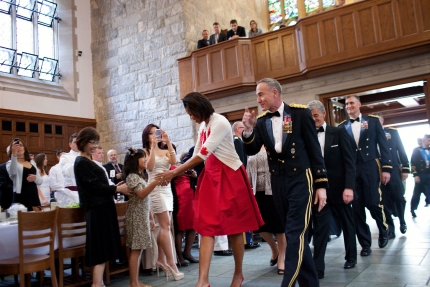
We came in to West Point under cloudy grey skies for the First Lady's speech to the Class of 2011. In fact, we found out that it had been pouring rain for the last five days!  But as the plane touched down, the last of the showers swept through, the clouds parted, and beautiful blue skies greeted Mrs. Obama as she came onto campus. Similarly warm greetings came through from the community, from people waving to the motorcade as it drove by to the thunderous applause that greeted her as she entered Washington Hall for the Class Banquet.  Lieutenant General David Huntoon Jr., the Superintendent of the United States Military Academy (USMA), noted that West Point and the First Lady shared a similar ethos that emphasized values and service.

In her remarks, the First Lady emphasized how important family had been and would continue to be in the lives of these new officers, reminding them:

Our force is a force of families...They’re military spouses who pursue a career, raise their kids alone, and still find time for night school.  They’re children who move from town to town, constantly adjusting to new schools and making new friends.  They’re Blue Star moms who wake up every morning and pray and pray that their child comes home safely.  They’re Gold Star families who honor the memory of their loved ones while channeling their strength into serving others.

But the First Lady was also empathic that those families would not bear the burden alone.  She reminded the class that an entire country stood behind them, and that through efforts like the Joining Forces initiative, the combined efforts of diverse organizations from government and business to faith-based organizations and school districts would be backing them up. She ended the speech with a stirring promise:

I want you to remember that this country and all of its citizens stand ready to serve you and your families.  And I want you to remember that as long as we all do our duty, as long as we all serve with honor, then the fate of this country will never be in doubt.


First Lady Michelle Obama shakes hands with a young girls as she enters the West Point Graduation

First Lady Michelle Obama shakes hands with a young girls as she enters the West Point Graduation Banquet at the United States Military Academy in West Point, New York, May 20, 2011. Mrs. Obama is escorted by Lt. Gen. David Huntoon, superintendent at the U.S. Military Academy. (Official White House Photo by Samantha Appleton)

 
First Lady Michelle Obama poses for a photo while attending the West Point Graduation Banquet

First Lady Michelle Obama poses for a photo while attending the West Point Graduation Banquet at the United States Military Academy in West Point, New York, May 20, 2011. (Official White House Photo by Samantha Appleton)


First Lady Michelle Obama Speaks at West Point Graduation Banquet

May 23, 2011 | 23:25 | Public Domain

First Lady Michelle Obama makes her first visit to West Point as the banquet speaker for the U.S. Military Academy Class of 2011. Held in the historic Cadet Mess the is an address to over 3,000 graduating cadets, their families and guests. This marks the final social event the cadets will take part in as a class prior to commencement and commissioning. This is also the first time a First Lady has spoken for the Cadets at West Point.

Download mp4 (269.3MB)

Read the Transcript

Remarks of First Lady Michelle Obama at United States Military Academy Graduation Family Banquet

West Point, New York
May 20, 2011

AS PREPARED FOR DELIVERY—

Hello everyone, and thank you for that wonderful welcome.  I want to thank Lieutenant General Huntoon for that very kind introduction, as well as Secretary of the Army John McHugh, the Class of 1961 bar presenters, all of our distinguished guests, and all of the parents, families, and friends who are joining us tonight.  And of course, I want to say thank you for inviting me here to the United States Military Academy. 

This is my first visit to West Point and I am truly humbled to speak to you tonight on an evening that’s so special for all of you, for this Academy, and for this country.  As I look around at the cadets in this room, it is very clear to me that you all reflect everything we hope to see in ourselves and our country – firmness of character and strength of heart, a strong body and a ferocious mind, a devotion to country and to family.

And I know that this weekend is the product of 47 months of extraordinary effort and endurance from R-Day to your last exam during TEE-week.  For all of you, I know this has been a magnificent journey, a journey full of academic and athletic victories, a journey that has taken you across the country and around the world.

You’ve learned new skills and immersed yourself in new cultures, which will serve you well on today’s battlefields.  You’ve also created a Bionic Foot, an Exoskeleton, and other robotics and cyber defense projects that will help troops in the field.  In the area of sports, your football team had its first winning season in 14 years and its first bowl victory in 25.  Your women’s rugby team just brought home the national championship last weekend.  And with your help, West Point earned its first victory in the Sandhurst Competition in 18 years.

But along with all of your successes, your journey has also been filled with plenty of challenges.  You learned that crawling face-first through the mud and enduring a long, cold winter aren’t just metaphors.  You’ve learned just how little sleep you need to survive and how much coffee you can stomach to stay awake.  You’ve crammed facts into your brain until you thought it would burst – and then you crammed in even more. 

That’s the beauty of West Point.  It’s a place where you learn that your greatest achievements will never come easily, and they will never be achieved alone. 

You learn that duty, honor, and country are not simply words, but guideposts.  They dictate what you ought to be, what you can be, what you will be.

And you learn that there are times when we must stand up to defend our way of life, when we must live out your class motto, “For Freedom We Fight.”

We live in such times today. 

You knew this from the moment you signed up.  You knew that coming to this Academy meant that you would likely be placed in dangerous situations on unknown soil.  Yet you came anyway. 

You have seen cadets from the classes ahead of you pack their bags for Afghanistan or Iraq, and many of you have already served there yourselves.  You hear updates not only from headlines and newsfeeds, but from emails and cell phone calls from friends.  And yes, you’ve visited wounded friends, you’ve heard the bugle’s call each time a graduate of this academy has fallen in our wars.  Yet you stayed anyway. 

Each of you has taken a journey here that is uniquely your own, but follows in the great tradition of West Point.  And tonight, you are on the cusp of taking your rightful place in that long, gray line.

Now, this journey is a testament not just to you as individuals, but also to the families that surround you, because your journey began long before you got that first military haircut and put on white-over-grey.  Without your families, you never would have had the strength to tackle Beast Barracks while your peers were enjoying a final, carefree summer before college.  Your families were the ones you called for a shoulder to lean on or a kick in the pants.  They’ve been there for you for every moment of triumph and every moment of challenge.  Their unending love and support provide the very foundation that allows you to stand strong today.

And that’s what I really want to talk with you about tonight.  I want to talk about what family can and will mean for you as leaders of our Army and of our nation. 

Now, I grew up like many of you did.  My family lived on the South Side of Chicago on the top floor of a two-family home.  We didn’t have much money, but we had more than enough of what mattered.  We had the unwavering love and support of family.  We had a community that looked after us. 

And we had parents who showed us by example that if we worked hard enough, if we kept ourselves grounded and held fast to certain core values, then we could be anything that we dreamed of. 

My dad was diagnosed with MS when he was in his early 30s, and as he grew older, he grew weaker and sicker.  But I remember how he still went to work every day.  I remember how he’d drag himself out to play in the park with me and my brother.  And he was a role model in our community.  Just by being himself, he showed me what it means to be a parent, a citizen, a leader.

And I know that each of you has your own family stories that shape you.  Cadet Russ Burgin was inspired by his father, too.  He saw how his dad went through chemo and radiation treatments, but never complained, never felt sorry for himself, and continued to work full-time to provide for his family.   Today, his dad is cancer free, and Cadet Burgin is here at West Point, the best place he could imagine to live out the values that his father demonstrated every day.

Then we have Cadet Woo Do, who is a first-generation American.  Growing up, he’d accompany his grandfather on doctor visits as a translator, and that’s how he developed his passion for medicine – a passion that will take him to Harvard Medical School next year.

And so many of you come from military backgrounds, like Cadets Christina Veney and Megan Snook, who each have multiple family members that graduated from this Academy.

And Cadet Erin Anthony can trace her family’s military history to the 1600s.

But Cadets, no matter how you’ve grown up, no matter how you define family, all of you have someone in your life who believed in you and pushed you.  You had someone who taught you the values and lessons that will sustain you when times get tough or you’re unsure of what’s ahead.  Some of those people are here with you tonight. 

So, to the parents: I can only imagine the joy you’ll feel tomorrow when you see your sons and daughters in their officer’s uniforms for the first time.  I can only imagine the pride that comes from knowing that your kids are the kind of kids that everyone dreams of raising.

But as a parent, I can also imagine what else might be on your mind tonight.  All of you read the news.  All of you understand what your children have signed up for.  You know what their next assignment is, and in the back of your mind, you’re wondering where the assignments after that might take them. 

Those concerns are only natural.  And it is a testament to your strength, your patriotism and your unconditional love that you have proudly supported these cadets every step of the way. 

And cadets, I want you to know that these people will always be there for you. 

As I’ve seen in my own life and heard from troops all across this world, your family will be your rock, whether they’re right next to you or across an ocean. 

And soon, many of you will be building families of your own.  Very soon, for some of you.  I hear that, in addition to all the graduation preparations, many of you are planning weddings as well.  So congratulations to all of you as you prepare for the big day.

And no matter where your career takes you, your families will be there right alongside you. 

Because our force is a force of families.

That’s become more clear even in just a generation.  During Vietnam, most of our troops were young single men.  And most of those who were married had spouses who stayed at home. But today, more than half of our servicemembers are married, forty percent have two or more kids, and most military spouses are employed outside the home. 

That’s what today’s military families look like.  They’re military spouses who pursue a career, raise their kids alone, and still find time for night school.  They’re children who move from town to town, constantly adjusting to new schools and making new friends.  They’re Blue Star moms who wake up every morning and pray and pray that their child comes home safely.  They’re Gold Star families who honor the memory of their loved ones while channeling their strength into serving others.

And graduates, here’s why your role is so important.  Soon, you’ll be serving not just for yourselves, and not just for your own families, but for these families, too.  You’ll be helping your troops deal with the joy of a newborn and the disappointment of not being in the delivery room.  You’ll be helping a Soldier cope with a family emergency halfway around the world.  And you’ll see again and again that those family relationships are just as important to a soldier’s success as anything that you can provide them in the field.

And just as our troops need your leadership and support, their families do as well, because they sacrifice and serve this nation right alongside anyone who wears our uniform. 

But America doesn’t always see that.  They can thank our troops in airports or at the grocery store because they’re wearing fatigues.  But military families don’t wear any kind of uniform.  They just blend in. 

And because only one percent of our country serves in the Armed Forces, a lot of Americans simply don’t know many – or any – military families.  They aren’t familiar with the resilience it takes to get through a long deployment.  They don’t know the courage it takes simply to turn on the evening news.  They don’t fully realize the strength you need to move your family for the fourth or fifth or sixth time in a decade.

But even though people may not always know exactly what you’re going through or exactly how to help, I can assure you that they do want to help. 

Admiral Mullen, who will be speaking to you tomorrow, calls it the Sea of Goodwill.  And believe me, I’ve seen it with my own eyes all across the country. 

I’m working with Dr. Jill Biden to channel that Sea of Goodwill through an effort we are calling Joining Forces.  This is a nationwide campaign calling on all Americans to recognize, honor, and support our military families – not just with words, but with deeds.  We want your families to feel these efforts on the ground, in your daily lives.  So we’re working across sectors, asking everyone from government and business to faith communities and school districts to make a commitment to you and your families.  Already, people across this country – including many of our largest corporations and nonprofits – have stepped up with real, tangible commitments.

And let me tell you, when I meet a Member of Congress or a powerful CEO and ask for their help, I have been blown away by their enthusiasm.  They all want to help.  They’re excited to do it.  And we haven’t had one single person tell us no.

So graduates, I want you to know that while this country is asking a lot of you once you pin on those gold bars, we’re not asking you to do it alone.  You have your families that are with you today and every day.  You have the many friends and family members outside these walls, the ones watching all around the Academy, and all of those who support you in your hometowns and across this country. And you have millions of folks who you don’t even know, and who you will never meet, who have your back. 

From my husband right on down through the ranks of this military, from those powerful CEOs to all of the teachers, clergy, and neighbors that you deal with every single day.  We all want to give something back to you and your families because we are inspired by you.  We’re inspired by the character reflected in your acceptance to this Academy, and by the courage to serve during a time of war.

We’re inspired by how, over these past 47 months, you have become not simply warriors and not simply scholars.  You have become leaders.  You have come to embody duty, honor, country, just like all those who came before you.  Thayer.  Grant.  Eisenhower.  Schwartzkopf.  Those values stretch through generations and across this nation, powering engineers and astronauts, senators and statesmen, business leaders and five-star generals.

But tonight, I’d actually like to end with the story of someone who lived long before your motto was adopted.  It’s someone who was never a West Point Cadet, but I think that’s fine, since this building is named after him. 

In the summer of 1775, we were barely two months removed from Paul Revere’s ride and the shot heard round the world.  And the Second Continental Congress was meeting in Philadelphia to take control of the war effort.  They decided to put the Continental Army under George Washington’s command, and he was to leave for Boston immediately.  And the night before he was officially commissioned as Commander-in-Chief, before he left to lead thousands of men, before he began to chart the course of freedom for our country and our world, Washington sat down to draft a letter to his wife, Martha.

In it, he writes not of battle plans or great pride and personal achievement.  He writes with, in his words, “inexpressible concern” because he’s thinking about his wife.  He’s thinking about her being at home, alone, on their farm.  So he asks her to be strong, and he says he hopes that the time will pass as easily as possible, because, as he writes, “Nothing will give me so much sincere satisfaction as to hear this, and to hear it from your own Pen.”

Well, today’s soldiers may write emails rather than “penning” letters.  They may be able to video chat with their kids at bedtime.  But that abiding love, that passionate devotion to family – that is what has sustained so many on battlefields here in America and around the world since the very beginning of this nation.  

Your families – the ones here tonight and the ones you will build someday – will always be at the forefront of your minds and hearts.  And the only thing that will give you and your troops that “sincere satisfaction” that General Washington spoke of is knowing that they are safe.

So, alongside everything else you have learned and experienced here at the United States Military Academy, the calculus and Shakespeare, the intramurals and leadership training, I ask you to remember that family has always been a centerpiece of our American story.  I want you to remember that this country and all of its citizens stand ready to serve you and your families.

And I want you to remember that as long as we all do our duty, as long as we all serve with honor, then the fate of this country will never be in doubt.

So congratulations again, graduates.  We are all so very proud of you.  May God bless you and your families on the journey ahead and may God bless the United States of America.

Close Transcript

The White House

Office of the First Lady

Remarks of First Lady Michelle Obama at United States Military Academy Graduation Family Banquet

West Point, New York
May 20, 2011

AS PREPARED FOR DELIVERY—

Hello everyone, and thank you for that wonderful welcome.  I want to thank Lieutenant General Huntoon for that very kind introduction, as well as Secretary of the Army John McHugh, the Class of 1961 bar presenters, all of our distinguished guests, and all of the parents, families, and friends who are joining us tonight.  And of course, I want to say thank you for inviting me here to the United States Military Academy. 

This is my first visit to West Point and I am truly humbled to speak to you tonight on an evening that’s so special for all of you, for this Academy, and for this country.  As I look around at the cadets in this room, it is very clear to me that you all reflect everything we hope to see in ourselves and our country – firmness of character and strength of heart, a strong body and a ferocious mind, a devotion to country and to family.

And I know that this weekend is the product of 47 months of extraordinary effort and endurance from R-Day to your last exam during TEE-week.  For all of you, I know this has been a magnificent journey, a journey full of academic and athletic victories, a journey that has taken you across the country and around the world.

You’ve learned new skills and immersed yourself in new cultures, which will serve you well on today’s battlefields.  You’ve also created a Bionic Foot, an Exoskeleton, and other robotics and cyber defense projects that will help troops in the field.  In the area of sports, your football team had its first winning season in 14 years and its first bowl victory in 25.  Your women’s rugby team just brought home the national championship last weekend.  And with your help, West Point earned its first victory in the Sandhurst Competition in 18 years.

But along with all of your successes, your journey has also been filled with plenty of challenges.  You learned that crawling face-first through the mud and enduring a long, cold winter aren’t just metaphors.  You’ve learned just how little sleep you need to survive and how much coffee you can stomach to stay awake.  You’ve crammed facts into your brain until you thought it would burst – and then you crammed in even more. 

That’s the beauty of West Point.  It’s a place where you learn that your greatest achievements will never come easily, and they will never be achieved alone. 

You learn that duty, honor, and country are not simply words, but guideposts.  They dictate what you ought to be, what you can be, what you will be.

And you learn that there are times when we must stand up to defend our way of life, when we must live out your class motto, “For Freedom We Fight.”

We live in such times today. 

You knew this from the moment you signed up.  You knew that coming to this Academy meant that you would likely be placed in dangerous situations on unknown soil.  Yet you came anyway. 

You have seen cadets from the classes ahead of you pack their bags for Afghanistan or Iraq, and many of you have already served there yourselves.  You hear updates not only from headlines and newsfeeds, but from emails and cell phone calls from friends.  And yes, you’ve visited wounded friends, you’ve heard the bugle’s call each time a graduate of this academy has fallen in our wars.  Yet you stayed anyway. 

Each of you has taken a journey here that is uniquely your own, but follows in the great tradition of West Point.  And tonight, you are on the cusp of taking your rightful place in that long, gray line.

Now, this journey is a testament not just to you as individuals, but also to the families that surround you, because your journey began long before you got that first military haircut and put on white-over-grey.  Without your families, you never would have had the strength to tackle Beast Barracks while your peers were enjoying a final, carefree summer before college.  Your families were the ones you called for a shoulder to lean on or a kick in the pants.  They’ve been there for you for every moment of triumph and every moment of challenge.  Their unending love and support provide the very foundation that allows you to stand strong today.

And that’s what I really want to talk with you about tonight.  I want to talk about what family can and will mean for you as leaders of our Army and of our nation. 

Now, I grew up like many of you did.  My family lived on the South Side of Chicago on the top floor of a two-family home.  We didn’t have much money, but we had more than enough of what mattered.  We had the unwavering love and support of family.  We had a community that looked after us. 

And we had parents who showed us by example that if we worked hard enough, if we kept ourselves grounded and held fast to certain core values, then we could be anything that we dreamed of. 

My dad was diagnosed with MS when he was in his early 30s, and as he grew older, he grew weaker and sicker.  But I remember how he still went to work every day.  I remember how he’d drag himself out to play in the park with me and my brother.  And he was a role model in our community.  Just by being himself, he showed me what it means to be a parent, a citizen, a leader.

And I know that each of you has your own family stories that shape you.  Cadet Russ Burgin was inspired by his father, too.  He saw how his dad went through chemo and radiation treatments, but never complained, never felt sorry for himself, and continued to work full-time to provide for his family.   Today, his dad is cancer free, and Cadet Burgin is here at West Point, the best place he could imagine to live out the values that his father demonstrated every day.

Then we have Cadet Woo Do, who is a first-generation American.  Growing up, he’d accompany his grandfather on doctor visits as a translator, and that’s how he developed his passion for medicine – a passion that will take him to Harvard Medical School next year.

And so many of you come from military backgrounds, like Cadets Christina Veney and Megan Snook, who each have multiple family members that graduated from this Academy.

And Cadet Erin Anthony can trace her family’s military history to the 1600s.

But Cadets, no matter how you’ve grown up, no matter how you define family, all of you have someone in your life who believed in you and pushed you.  You had someone who taught you the values and lessons that will sustain you when times get tough or you’re unsure of what’s ahead.  Some of those people are here with you tonight. 

So, to the parents: I can only imagine the joy you’ll feel tomorrow when you see your sons and daughters in their officer’s uniforms for the first time.  I can only imagine the pride that comes from knowing that your kids are the kind of kids that everyone dreams of raising.

But as a parent, I can also imagine what else might be on your mind tonight.  All of you read the news.  All of you understand what your children have signed up for.  You know what their next assignment is, and in the back of your mind, you’re wondering where the assignments after that might take them. 

Those concerns are only natural.  And it is a testament to your strength, your patriotism and your unconditional love that you have proudly supported these cadets every step of the way. 

And cadets, I want you to know that these people will always be there for you. 

As I’ve seen in my own life and heard from troops all across this world, your family will be your rock, whether they’re right next to you or across an ocean. 

And soon, many of you will be building families of your own.  Very soon, for some of you.  I hear that, in addition to all the graduation preparations, many of you are planning weddings as well.  So congratulations to all of you as you prepare for the big day.

And no matter where your career takes you, your families will be there right alongside you. 

Because our force is a force of families.

That’s become more clear even in just a generation.  During Vietnam, most of our troops were young single men.  And most of those who were married had spouses who stayed at home. But today, more than half of our servicemembers are married, forty percent have two or more kids, and most military spouses are employed outside the home. 

That’s what today’s military families look like.  They’re military spouses who pursue a career, raise their kids alone, and still find time for night school.  They’re children who move from town to town, constantly adjusting to new schools and making new friends.  They’re Blue Star moms who wake up every morning and pray and pray that their child comes home safely.  They’re Gold Star families who honor the memory of their loved ones while channeling their strength into serving others.

And graduates, here’s why your role is so important.  Soon, you’ll be serving not just for yourselves, and not just for your own families, but for these families, too.  You’ll be helping your troops deal with the joy of a newborn and the disappointment of not being in the delivery room.  You’ll be helping a Soldier cope with a family emergency halfway around the world.  And you’ll see again and again that those family relationships are just as important to a soldier’s success as anything that you can provide them in the field.

And just as our troops need your leadership and support, their families do as well, because they sacrifice and serve this nation right alongside anyone who wears our uniform. 

But America doesn’t always see that.  They can thank our troops in airports or at the grocery store because they’re wearing fatigues.  But military families don’t wear any kind of uniform.  They just blend in. 

And because only one percent of our country serves in the Armed Forces, a lot of Americans simply don’t know many – or any – military families.  They aren’t familiar with the resilience it takes to get through a long deployment.  They don’t know the courage it takes simply to turn on the evening news.  They don’t fully realize the strength you need to move your family for the fourth or fifth or sixth time in a decade.

But even though people may not always know exactly what you’re going through or exactly how to help, I can assure you that they do want to help. 

Admiral Mullen, who will be speaking to you tomorrow, calls it the Sea of Goodwill.  And believe me, I’ve seen it with my own eyes all across the country. 

I’m working with Dr. Jill Biden to channel that Sea of Goodwill through an effort we are calling Joining Forces.  This is a nationwide campaign calling on all Americans to recognize, honor, and support our military families – not just with words, but with deeds.  We want your families to feel these efforts on the ground, in your daily lives.  So we’re working across sectors, asking everyone from government and business to faith communities and school districts to make a commitment to you and your families.  Already, people across this country – including many of our largest corporations and nonprofits – have stepped up with real, tangible commitments.

And let me tell you, when I meet a Member of Congress or a powerful CEO and ask for their help, I have been blown away by their enthusiasm.  They all want to help.  They’re excited to do it.  And we haven’t had one single person tell us no.

So graduates, I want you to know that while this country is asking a lot of you once you pin on those gold bars, we’re not asking you to do it alone.  You have your families that are with you today and every day.  You have the many friends and family members outside these walls, the ones watching all around the Academy, and all of those who support you in your hometowns and across this country. And you have millions of folks who you don’t even know, and who you will never meet, who have your back. 

From my husband right on down through the ranks of this military, from those powerful CEOs to all of the teachers, clergy, and neighbors that you deal with every single day.  We all want to give something back to you and your families because we are inspired by you.  We’re inspired by the character reflected in your acceptance to this Academy, and by the courage to serve during a time of war.

We’re inspired by how, over these past 47 months, you have become not simply warriors and not simply scholars.  You have become leaders.  You have come to embody duty, honor, country, just like all those who came before you.  Thayer.  Grant.  Eisenhower.  Schwartzkopf.  Those values stretch through generations and across this nation, powering engineers and astronauts, senators and statesmen, business leaders and five-star generals.

But tonight, I’d actually like to end with the story of someone who lived long before your motto was adopted.  It’s someone who was never a West Point Cadet, but I think that’s fine, since this building is named after him. 

In the summer of 1775, we were barely two months removed from Paul Revere’s ride and the shot heard round the world.  And the Second Continental Congress was meeting in Philadelphia to take control of the war effort.  They decided to put the Continental Army under George Washington’s command, and he was to leave for Boston immediately.  And the night before he was officially commissioned as Commander-in-Chief, before he left to lead thousands of men, before he began to chart the course of freedom for our country and our world, Washington sat down to draft a letter to his wife, Martha.

In it, he writes not of battle plans or great pride and personal achievement.  He writes with, in his words, “inexpressible concern” because he’s thinking about his wife.  He’s thinking about her being at home, alone, on their farm.  So he asks her to be strong, and he says he hopes that the time will pass as easily as possible, because, as he writes, “Nothing will give me so much sincere satisfaction as to hear this, and to hear it from your own Pen.”

Well, today’s soldiers may write emails rather than “penning” letters.  They may be able to video chat with their kids at bedtime.  But that abiding love, that passionate devotion to family – that is what has sustained so many on battlefields here in America and around the world since the very beginning of this nation.  

Your families – the ones here tonight and the ones you will build someday – will always be at the forefront of your minds and hearts.  And the only thing that will give you and your troops that “sincere satisfaction” that General Washington spoke of is knowing that they are safe.

So, alongside everything else you have learned and experienced here at the United States Military Academy, the calculus and Shakespeare, the intramurals and leadership training, I ask you to remember that family has always been a centerpiece of our American story.  I want you to remember that this country and all of its citizens stand ready to serve you and your families.

And I want you to remember that as long as we all do our duty, as long as we all serve with honor, then the fate of this country will never be in doubt.

So congratulations again, graduates.  We are all so very proud of you.  May God bless you and your families on the journey ahead and may God bless the United States of America.

First Lady Michelle Obama Bringing the Support of Joining Forces to West Point

Tonight, in a historic first, Michelle Obama will address the Cadets and families of the United States Military Academy (USMA) Class of 2011 at their Graduation Banquet. I will have the honor and pleasure of accompanying her on the trip up the Hudson Valley, to what West Point graduates refer to as our “Rockbound Highland Home.”

I’ve spent a fair amount of time of widely varying lengths on the West Point campus. Four years as a student from 1991 to 1995, four days getting married on a brief break from flight school in 1996, and three and a half years as a history professor from 2005 to 2009.  I’ve gotten to know the campus pretty well in that time, but this trip is a chance to see it through the fresh eyes of Mrs. Obama and her staff.

At the banquet, The First Lady will speak to the core of what it means to serve the nation as an officer in the armed forces.  She will invoke those hallowed words shining brightly on the USMA Crest – Duty, Honor, Country – that have served as a signpost for the generations of West Point graduates that have come before, the Long Gray Line.  And she’ll talk about the challenges that lie ahead as these men and women move forward to defend a nation at war.

The White House

Office of the First Lady

Remarks by the First Lady at DNC event in Washington, DC

Grand Hyatt, Washington, DC

11:35 A.M. EDT

   MRS. OBAMA:  Oh, my goodness.  (Applause.)  You all are looking beautiful.  It is so good to see you.  Thank you so much. 

   It is a true pleasure to be here today at this year’s National Issues Conference.  I hope you all have figured out all the issues.  (Laughter.)  You’ve solved them all.

   I want to start by thanking the conference leadership committee and the WLF national leadership for all of their hard work to make this day possible.  The turnout is wonderful.  Let’s give them a round of applause.  (Applause.)

   And, of course, I want to thank all of you for joining us here today.  I am thrilled to see so many new faces.  But I am thrilled to see so many folks who’ve been with us right from the very beginning, folks who’ve been through all of the ups and downs and all the nail-biting moments along the way.

   And today, as we look ahead to the next part of this journey, I just want to take you back to how it all began, at least in my mind.

   Now, I have to be honest with you, and many of you know this, when Barack first started talking about running for President, I wasn’t exactly enthusiastic about the idea.  (Laughter.)  Yes, I was proud of the work that he was doing as a U.S. senator.  And I thought -- no, no, I knew that he would make an extraordinary President.  And I told you that.

   But like a lot of folks, I still had some cynicism about politics.  And I was worried about the toll that a presidential campaign would take on our family.  I mean, we had two young daughters at home.  They’re not so little now.  Malia is -- here.  (Laughter.)  And the last thing I wanted to do was to disrupt their lives and their routines.  The last thing in the world I wanted was to spend time apart from my girls

   So it took some convincing on Barack’s part, and by “some,” I mean a lot.  (Laughter.)  And even as I hit the trail, I was still a little uneasy about the whole “President thing,” and that's what Malia would call it, the “President thing.”  (Laughter.)   

   But something happened during those first few months that changed me.  See, campaigning in places like Iowa and New Hampshire and South Carolina, that wasn't just about handshakes and stump speeches.  For me, it was about conversations on front porches and in living rooms where people would welcome me into their homes and into their lives. 

   I remember one of the first events in Iowa that I did was a gathering in someone’s backyard, beautiful backyard, beautiful sunny day.  And I remember that within a few minutes, I was so comfortable that I kicked off my shoes, which I wish I could do today because they really do hurt -- (laughter) -- and I was standing barefoot in the grass, just talking to folks.

   And that’s what campaigning was all about for me.  It was about meeting people one-on-one and hearing what was going on in their lives.  And I learned so much.  I learned about the businesses that folks were trying to keep afloat, the home they loved but could no longer afford, the spouse who came back from the war, and needed a lot of help, the child who was so smart, who could be anything she wanted, if only her parents could find a way to pay tuition.

   And these stories moved me.  And even more than that, these stories were familiar to me, because in the parents working that extra shift, or taking that extra job, I saw Barack’s mother, a young, single mother struggling to support Barack and his sister.

   I saw my father, who dragged himself to work at the city water plant every morning, because even as his M.S. made him weaker and weaker, my father was determined to be our family’s provider.

   In the grandparents coming out of retirement to pitch in and help make ends meet, I saw my own mom who has helped raise our girls since the day they were born.  And I couldn’t do this without her.  (Applause.)

   I saw Barack’s grandmother who caught a bus to work before dawn every day to help provide for their family.

   In the children I met who were worried about a mom who’s lost her job, or a dad deployed far from home, kids so full of promise and dreams, I saw my own daughters, who are the center of my world.

   These folks weren’t asking for much.  They were looking for basic things, like being able to see a doctor when you’re sick.  Things like having decent public schools and a chance to go to college even if you’re not rich.  These things, simple things, like making a decent wage, having a secure retirement, and leaving something better for your kids.

   And while we may have grown up in different places and seemed different in so many ways, their stories were my family’s stories.  They were Barack’s family’s stories.  Their values –- things like you treat people how you want to be treated, you put your family first, you work hard, you do what you say you’re going to do -– these were our family’s values.  (Applause.)

   And then suddenly, everything Barack had been saying about how we’re all interconnected, about how we’re not just red states and blue states, those were not just lines from a speech.  It was what I was seeing with my own eyes.  And that changed me.

   And you want to know what else changed me during all those months out on the campaign?  I mean, you all.  You really did.  I see people out there who have become like family.  You all changed me.  And when I got tired, I would think of all the folks out there making calls, knocking on doors in all kinds of weather.  Remember that?  (Laughter.)  And that would energize me.  When I got discouraged, I would think of folks opening up their wallets when they didn’t have much to give.  I would think of folks who had the courage to let themselves believe again and hope again.  And that would give me hope.

   And the simple truth is that today, four years later, we’re here because of all of you.  And I’m not just talking about winning an election.  I’m talking about what we’ve been doing every day in the White House since that time to keep on fighting for the folks we met and the values we share.  I’m talking about what Barack has been doing to help all of us win the future.  At a time when we still have so many challenges and so much work to do, it’s easy to forget what we’ve done along the way.  It is so easy.

   But let’s just step back a moment.  Think about these past couple of years.

   I mean, we’ve gone from an economy on the brink of collapse to an economy that is starting to grow again.

   We’re helping middle-class families by cutting taxes -- (applause) -- working to stop credit card companies from taking advantage of people.  (Applause.)

   We’re going to give working moms and dads a childcare tax credit because we know how those costs add up for those folks.

   We’re helping women get equal pay for equal work with the Lilly Ledbetter Fair Pay Act.  (Applause.)  And if you remember, that was the very first bill my husband signed into law as President of the United States.  That was the first thing he did.  (Applause.)

   Because of health reform, millions of people will finally be able to afford a doctor.  Their insurance companies won’t be able to drop their coverage when they’re sick, charge them through the roof because their child has a pre-existing condition.  And they now have to cover preventive care –- things like prenatal care, mammograms that we all in this room know save money, but it saves lives.  We know that.

   Because we don’t want to leave our kids a mountain of debt, we’re reducing our deficit by doing what families across this country are already doing.  We’re cutting back so that we can start living within our means.

   And we’re investing in things that really matter -- things like clean energy, so that we can bring down those gas prices, scientific research, including stem cell research.

   We’re also investing in community colleges, which are a gateway to opportunity for so many people, and Pell Grants, which help so many young people afford that tuition.  That's what we’re doing.  (Applause.)

   And through a competition called Race to the Top, we’ve got 40 states working to raise standards and reform their schools.

   We’re working to live up to our founding values of freedom and equality.

   And today, because we ended “don't ask, don’t tell,” our troops will never again have to lie about who they are to serve the country they love.  (Applause.)

   And you may recall that my husband also appointed two brilliant Supreme Court Justices, and for the first time in history -- (applause) -- our daughters and our sons watched three women take their seats on our nation’s highest court.

   We’re working to keep our country safe and to restore our standing in the world.

   We are responsibly ending the war in Iraq and have already brought home 100,000 men and women in uniform who have served this country bravely.  (Applause.)

   And as you know today, thanks to the tireless work of our intelligence and counter-terrorism communities and the heroic efforts of our troops, the man behind the 9/11 attacks and so many other horrific acts has finally been brought to justice.  (Applause.)

   And finally, we’re tackling, of course, two issues that are near and dear to my heart, both as a First Lady and as a mom.

   As you’ve heard, the first is childhood obesity.  This issue doesn’t just affect our kids’ health and how they feel.  It affects how they feel about themselves and whether they have the energy and the stamina to succeed in school and in life.  So we’re working hard to get better food into our schools and our communities and to help parents make better decisions for their kids.  And we’re seeing some change.  (Applause.)

   The second issue is one that I came to on the campaign trail, meeting so many extraordinary military families.  I mean, these folks are raising their kids and running their households all alone while spouses are deployed, and they do it all with tremendous courage, strength and pride.  And that’s why Jill and I launched a nationwide campaign to rally our country to serve them as well as they serve us.  (Applause.)

   So look, that's just some of what has been accomplished.  And I think that it’s fair to say that we’ve seen some change.  And we should be proud of what we’ve accomplished. 

   But we should not be satisfied, because we know that we are still nowhere near winning the future.  Not when so many of our kids don’t have what they need to succeed.  Not when so many of our businesses don’t have what they need to compete.  Not when so many folks are still struggling to pay the bills today. 

   The truth is that all those folks we campaigned for, and won for, and that have been fighting for us and we’ve been fighting for over these past two years, those folks still need our help. 

   And that, more than anything else, is what drives my husband as President.  I mean, let me tell you, that’s what I see when he comes home after a long day traveling around the country, meeting with folks in that Oval Office, doing things.  (Laughter.)  They do things in that office.  (Laughter.) 

   And he tells me about the people he’s met.  And I see it in those quiet moments late at night, after we put the girls to bed, and he’s reading the letters people have sent him, because he reads everything.  The letter from the woman dying of cancer whose health insurance wouldn’t cover her care.  The letter from the young person with so much promise, but so few opportunities. 

   And you all -- I see the sadness and the worry creasing his face.  I hear the passion and the determination in his voice.  Says, “You won’t believe what these folks are going through.”  That’s what he tells me.  He says, “Michelle, this is not right.  We’ve got to fix it.  And we have to do more.”

   Let me share something with you.  When it comes to the people that he meets, Barack has a memory like a steel trap.  (Laughter.)  I mean, you all know this, right?  He might not remember your name, but if he’s had a few minutes and a decent conversation with you, he will never forget your story.  It’s a gift; becomes imprinted in his mind and on his heart.

   And that’s what he carries with him every single day –- that collection of hopes, and dreams and struggles.  That’s where Barack gets his passion.  And that’s why he works so very hard every day.  It’s unbelievable, starting first thing in the morning everyday and going late into the night, hunched over briefings, reading every single word of every single memo he gets, making notes, writing questions, making sure he knows more than the people briefing him, because all of those wins and losses are not wins and losses for him.

   They’re wins and losses for the folks whose stories he carries with him, the folks he worries about and prays about before he goes to bed at night.  In the end, for Barack, and for me, and for so many of you, that is what politics is about.  It is not about one person.  It’s not about one President.  It’s about how we can and should work together to make real change that makes a real difference in people’s lives.

   The young person attending college today because she can finally afford it, that's what this is about.  The mom or the dad who can take their child to a doctor because of health reform, the folks who are working on the line today at places like GM, and bringing home a good paycheck for their families, that's what this is about.  (Applause.)

   And look, folks, now, more than ever before, we need to finish what we’ve started and we need your help.  We need all of you to be with us for the next phase of our journey.

   And I am not going to kid you, because I never do, I said this in the first campaign it is going to be long.  (Laughter.)  It is going to be hard.  It’s designed that way.  (Laughter.)  And there will be plenty of twists and turns along the way.

   But here’s the thing about my husband –- and this is something that I’d appreciate even if he hadn’t shown the good sense to marry me -- (laughter and applause) -- that even in the toughest moments, when it seems like all is lost, and everybody is wringing their hands, and calling, worrying and calling -- what's going on, what's he doing, what's going on -- I’m one of those people -- (laughter) -- Barack Obama never loses sight of the end goal.  He never lets himself get distracted by the chatter and the noise, even if it comes from some of his best supporters.  He just keeps moving forward.

   And in those moments when we’re all sweating it, when we’re worried that the bill won’t pass, or the negotiations might fall through, Barack always reminds me that we’re playing a long game here.  (Applause.)  He reminds me that change is slow.  He reminds me that change doesn’t happen all at once.

   But he says that if we keep showing up, if we keep fighting the good fight, and doing what we know is right, then eventually we will get there.  We always have.

   And that’s what he needs from you.  He needs you to be in this with him for the long haul.  He needs you to hold fast to our vision and our values and our dreams for our kids and for our country.  He needs you to work like you have never worked before, people -- (applause) -- because that’s what I plan on doing.  (Applause.)  I’m not going to ask you to do anything that I wouldn’t do.

   And I will not be doing it just as a wife or as a First Lady.  I’ll be doing it as a mother, who wants to leave a legacy for my children.  (Applause.)  And more than that, I’ll be doing it as a citizen who knows what we can do together to change this country, because the truth is no matter what happens, we’re blessed.  My girls will be okay.  My girls will have plenty of advantages and opportunities in their lives.  That’s probably true for many of you all in this room.

   But I think that the last four years have shown us the truth of what Barack has always said:  that if any child in this country is left behind, then that matters to all of us, even if she’s not our daughter, or even if he’s not our son.  If any family in this country struggles, then we can’t be fully content with our own family’s good fortune.  We can’t -- that’s not what we do in this country.  It’s not who we are. 

   In the end, we cannot separate our story from the broader American story.  Like it or not, we are all in this together.  (Applause.)  And I know that if we put our hearts and our souls into this, if we do what we need to do during these next couple of years, then we can continue to make that change we believe in.  I know that we can build that country that we want for our kids.

   So I have one question for you.  Are you in?  (Applause.)  Come on.  Are you in?

   AUDIENCE:  Yes!  (Applause.)

   MRS. OBAMA:  Because I’m in.  (Applause.)  And I hope that all of you are fired up.  (Applause.)  I hope that all of you are ready to go.  (Applause.)  And I look forward to getting back out there with all of you in the months and years ahead.  It’s wonderful to see you all. 

   Thank you all, and God bless.  (Applause.)

END 11:57 A.M. EDT

The White House

Office of the First Lady

Remarks by the First Lady at Congressional Service Event

Joint Base Anacostia-Bolling Youth Center, Washington, DC

2:41 P.M. EDT

 MRS. OBAMA:  Yay!  (Applause.)  Well, I’m not going to talk long because I want to paint.  (Laughter.)  I love painting murals.  I am a mural-focused painter.  I think I am an expert.  (Laughter.)  You’ll have to test me out.  I hope I have something fun to paint.  I’m very -- looking forward to it.

 But before we start, I want to just thank everyone again.  First of all, to my congressional spouse partners who all came out today, thank you so much.  We had a wonderful lunch yesterday.  We had the best time.  It was so much fun.  And this is a perfect way to cap off what has been a really wonderful couple of days for us. 

 Pat, again, I want to thank you as the co-chair of the luncheon -- (applause) -- as well as Helen.  I’m not sure if everybody is here.  But thank you for the luncheon yesterday.

 But to all the spouses, thank you for coming out today.  I mean, as I said in my speech to you all yesterday, these service opportunities mean so much to the communities that we work with.  I mean, the fact that we are out here, dressed down, hanging out with our community, doing something that means something and adds value is priceless.  And it’s not just priceless for them; it’s priceless for us.  So again, thank you for doing this.  I want to see our numbers increase.  We’re going to do this every year. 

 And to the families in the community here on the base, we are so proud of you all and so grateful that you’ve given us the opportunity to spend some time and paint this beautiful mural.

 The effort that Jill Biden and I have put together, Joining Forces, truly is for you all because we know you guys sacrifice so much.  I mean, it makes me feel good to know that you have such a wonderful community center, that you have such strong child and youth programs, because the children and families need it.  They are making sacrifices that many Americans don't even understand.  And to know that they’ve got a resource like this making their lives just a little bit brighter and a little bit easier is just what we want to see in this country. 

 And I continue to urge all Americans to find ways to be a part of these types of programs, to reach out and help.  They’re all over the country.  There are families all over this nation who need this support.

 And I also want to thank the Corcoran students, as well.  I mean, wow.  It’s easier for us to fill in the lines -- (laughter) -- but the time that you’ve invested in structuring this beautiful mural -- (applause) -- we really do value what you do.  This is truly the kind of leadership that we know you have in you for the years to come.  This is putting your education to good use.  So we’re very proud of you.  Thank you for taking the time. 

 I want to again thank our team back here.  I want to make sure -- I want to thank Rachel and Darrilyn and Captain Calandra and everyone here, all the staff, again, for hosting us today.

 And with that, I think we should get back to painting.  You guys ready?  (Applause.)  All right.  (Applause.)

END 2:44 P.M. EDT

First Lady Michelle Obama Talks with Faith and Community Leaders About Joining Forces

We are fresh off an inspiring call yesterday with First Lady Michelle Obama and over 1,800 faith and community leaders from across the country who gathered to discuss Joining Forces, an initiative started by the First Lady and Dr. Biden to support our nation's military families. The call focused on how congregations and community groups can participate, and several faith leaders shared their ongoing work to support military families and veterans.  

The purpose of Joining Forces, the First Lady noted, is to lift up and share that good work, and to invite others to join, expand or initiate efforts to support military families.  Leading up to Memorial Day weekend, the First Lady and Joshua DuBois, director of the White House Faith-based and Neighborhood Partnership Office, mentioned several specific ways that faith and community groups can get involved in Joining Forces. Mrs. Obama pointed out you don't necessarily have to be an expert in military family issues to make a difference, highlighting some of the ways community leaders can get involved:  You can build on what you already do best, whether it’s family counseling programs that you already have.  Maybe you have a youth ministry or a career mentoring program that’s already in existence.  And you can work and ensure that you’re helping families in your congregations and in your communities.  Here are some of the ideas that were discussed:

  • Ensure that existing ministries and services are accessible to military families and veterans.
  • Start a new ministry or service for military families or veterans, or partner with an existing program in your community.
  • Coordinate a once-a-year fair, an event or some kind of service activity that’s focused on military families.
  • Help raise awareness about the issues and challenges that military families and veterans face, as well as their service and strengths that some of their neighbors may not fully be aware of. 

Speakers on the call shared eloquently about the practical ways that congregations and community groups can partner with existing efforts, replicate successful programs, or ensure that their own programs reach military families and veterans in their community. Candy Hill with Catholic Charities USA, discussed the work of her local parish to help military families who had an injured family member. Chaplain Colonel William Sean Lee with the Maryland National Guard talked about the Partners in Care initiative which coordinates support for Maryland National Guard members during times of crisis or need. We look forward to sharing more stories about the work faith and community leaders are doing around the country to support military families.

Alexia Kelley is the Deputy Director of the White House Office of Faith-based and Neighborhood Partnerships.

Email whpartnerships@who.eop.gov to stay connected with the White House Office of Faith-based and Neighborhood Partnerships.