West Wing Week: 05/24/13 or “Justice for Everybody”

This week, the President continued his Jobs & Opportunity tour, this time highlighting bold new efforts in education and manufacturing in Baltimore, gave the commencement address at Morehouse College, invited the President of Myanmar, eight immigration reform advocates and DREAMers themselves, and Gershwin Prize winner Carole King and friends to the White House, and delivered a major counter-terrorism speech at the National Defense University. 

West Wing Week: 05/24/13 or “Justice for Everybody”

May 23, 2013 | 05:38 | Public Domain

This week, the President continued his Jobs & Opportunity tour, this time highlighting bold new efforts in education and manufacturing in Baltimore, gave the commencement address at Morehouse College, invited the President of Myanmar, eight immigration reform advocates and DREAMers themselves, and Gershwin Prize winner Carol King and friends to the White House, and delivered a major counter-terrorism speech at the National Defense University.

Download mp4 (185MB)

The White House

Office of the First Lady

Children Affected by Hurricane Sandy to Join First Lady Michelle Obama for the Summer Harvest of the White House Kitchen Garden

Mrs. Obama will be joined by children from New Jersey communities that were affected by Hurricane Sandy, as well as children who helped plant the garden in April

Washington, DC – On Tuesday, May 28, at 1:30 PM ET, First Lady Michelle Obama will join school children from across the country to harvest the summer crop from the White House Kitchen Garden. For this harvest, the First Lady invited children from two New Jersey communities that were affected by Hurricane Sandy. The First Lady also invited back all the children who helped plant the garden in April so they could see the fruits of their labors. She will be joined by students from Somerville, MA; Knox County, TN; Milton, VT and Washington, DC.

Mrs. Obama planted a vegetable garden on the South Lawn to initiate a national conversation around the health and wellbeing of our nation – a conversation that evolved into her Let’s Move! initiative to solve the problem of childhood obesity within a generation.
 
Children from the following New Jersey schools affected by Hurricane Sandy will help harvest this year’s garden:

Union Beach Memorial School – Union Beach, NJ
The students of Union Beach Memorial School were displaced by Hurricane Sandy and currently attend school in other locations while their school is repaired. Through the displacement, Union Beach school district is focused on keeping their students healthy. The school district is providing all its displaced students with a free lunch through the National School Lunch Program until they return to Memorial School, and in March, 8th grade students from the school joined New Jersey and USDA officials to celebrate National Nutrition Month. Recently, volunteers planted herb and vegetable beds at Memorial School for the students to utilize upon their return to the school.

Long Beach Island Grade School – Ship Bottom, NJ
Since Hurricane Sandy, all of the LBI Grade School students (grades 3-6) have been attending their sister school, the Ethel A. Jacobsen Elementary School, which is PreK-2.  They are awaiting their modular classroom units due to storm damage to their school. Despite the displacement, the school was recognized with the HealthierUS School Challenge award in March of 2013. The school uses MyPlate to teach kids about healthy eating, and they provide ideas for healthy classroom snacking while partaking in their home-grown crops at the EJ School. The district will also be receiving an award from the USDA officials in June 2013. 

Children from the following schools who helped plant this year’s garden will also be returning to harvest what they planted:

Arthur D. Healey School, Somerville Public Schools – Somerville, MA
Somerville Public Schools has had great success with the new, healthy school meals and is promoting healthy eating and snacking at school and at home. The district has a Farm to School program for K-12 that includes food education events like “corn shucking day” when kids learn about the food they’re eating in school meals. At Healey, the school’s parents, teachers, the Mayor, and school administrators support the continued efforts to integrate nutrition education into after-school programming. The school serves healthy breakfasts and snacks, its lunch program has a salad bar and kids participate in taste tests as new healthy recipes are created. The Healey Garden, started in 2004, hosts celebratory gardening days and gardening activities throughout the year.
 
Sarah Moore Greene Magnet Technology Academy, Knox County Schools – Knox County, TN
This school district revamped its lunch menus and engaged parents and students to make sure everyone would like their new healthy recipes - like their own hand-tossed, whole grain pizza. Sarah More Greene Elementary has integrated innovative ways of encouraging kids to eat fruits and vegetables. Just this fall, the school started a Jeffersonian Heirloom Garden and connected the project to 3rd-5th grade social studies coursework on America’s history, highlighting American presidents who have had a role in gardening and land stewardship. Additionally, the school offers nutritious snacks and breakfasts to students daily and works with community partners to provide gardening classes to parents and kids.
 
Milton Elementary School, Milton Town School District – Milton, VT
This district has made lunchtime a dining experience for students by using MyPlate, fruit and veggie bars, local ingredients, and delicious takes on fruits and vegetables like squash with nutmeg and cinnamon. They also have kid taste tests and samplings to ensure that kids like the meals served. Milton Elementary School is currently planting a garden and using the produce for student meals during the school year and for their summer food service program.

Photo Gallery: Behind the Scenes in April 2013

Go behind the scenes at 1600 Pennsylvania Avenue by checking out The White House Photo Office’s latest photo gallery. The gallery highlights some of the major events that occurred in April – from the Easter Egg Roll to the opening of the George W. Bush Library and Museum.

Check out some of our favorite images below, and then see the full set on our Flickr gallery.

  • KidTribe hula hoopers perform during the Easter Egg Roll

    KidTribe hula hoopers perform during the Easter Egg Roll. (Official White House Photo by Pete Souza)

    1 of 8
  • President Obama and Chief of Staff McDonough walk along the South Lawn driveway

    President Obama and Chief of Staff McDonough walk along the South Lawn driveway. (Official White House Photo by Pete Souza)

    2 of 8
  • President Obama at the “In Performance at the White House: Memphis Soul” concert

    President Obama and First Lady Obama, along with daughters Malia and Sasha, listen as Eddie Floyd sings. (Official White House Photo by Pete Souza)

    3 of 8
  • President Obama at Ceremony with Alabama Crimson Tide football team

    President Obama following a ceremony honoring the University of Alabama Crimson Tide football team. (Official White House Photo by Pete Souza)

    4 of 8
  • President Obama at Cathedral of the Holy Cross following Boston Marathon bombings

    President Obama during an interfaith prayer service for the victims of the Boston Marathon bombings. (Official White House Photo by Lawrence Jackson)

    5 of 8
  • President Obama at the White House Science Fair

    President Obama at the White House Science Fair in the East Garden of the White House. (Official White House Photo by Pete Souza)

    6 of 8
  • President Obama with Presidents Jimmy Carter, Bill Clinton, and George W. Bush at the dedication of the George W. Bush Presidential Library and Museum

    President Obama at the George W. Bush Presidential Library and Museum, (Official White House Photo by Pete Souza)

    7 of 8
  • President Barack Obama and First Lady Michelle Obama in West, Texas

    Fire Chaplain Duncan stands with the President and First Lady during a memorial service in West, Texas. (Official White House Photo by Pete Souza)

    8 of 8

The White House

Office of the First Lady

Remarks by the First Lady at Decatur House Visit

Decatur House
Washington D.C.

11:19 A.M. EDT

MRS. OBAMA:  Good morning.  (Applause.)  Thank you so much.  Good morning, everyone.  Thank you.  I am truly delighted to be here. 

But before I begin, I want to just take a moment to say that our thoughts and prayers are with all of the people in Oklahoma.  And as you all know, my husband and his team continue to monitor the situation, and he has directed the full resources of the federal government to be there for the people of Oklahoma as they begin to recover and rebuild. 

And it's important to remember during these times that the spirit of unity and resolve and resilience that has defined that situation as we watch the people in Oklahoma recover and work together, that that’s the kind of resilience that has defined this country since its inception.  It's who we are as Americans.  And it’s that history that brings us together today. 

So I want to start by thanking Fred for that very kind introduction, but more importantly, for his leadership throughout so many presidents to tell the story of this country; as well as Ken and Stephanie for their leadership and hard work to make this day possible.  We should give them all another round of applause for their efforts.  (Applause.) 

For nearly 200 years, as our country has grown and evolved, the Decatur House has grown and evolved right along with it.  This house has hosted parties and social events with some of our nation’s foremost leaders.  It’s been a residence for secretaries of state, and at one time, it served as headquarters for the Army Subsistence Department of the Civil War.

But from the back of the house, from a structure far less lavish, comes even more history -- the kinds of stories that too often get lost, the kinds of stories that are a part of so many of our families’ histories, including my own.  I’m talking about the slaves here at Decatur House who spent their lives within shouting distance of one of the most powerful buildings on the planet -- a bastion of freedom and justice for all.

Yet, within this very place, about 20 men and women spent their days serving those who came and went from this house and their nights jammed together on the second floor of the slave quarters, all the while holding onto a quiet hope, a quiet prayer that they, too, and perhaps their children, would someday be free.  These stories of toil, and sweat, and quiet, unrelenting dignity -- these stories are as vital to our national memory as any other.  And so it is our responsibility as a nation to ensure that these stories are told.

So more than anything, today, I simply want to say thank you.  Thank you for coming together to preserve these stories for years to come.  Thank you to everyone from American Express for making such a generous commitment to honor all of our nation’s history.  Of course, thank you to the White House Historical Association and the National Trust for Historic Preservation for finding new ways to engage with our past. 

And finally, I want to thank all of you for all of the educational opportunities you’re giving to our young people.  I’m about to go on a wonderful tour with some students from Willow Springs Elementary School in Fairfax, Virginia.  And what’s most exciting is that they’re not just going to look at some pictures on a wall, they’re going to take part in the re-enactment of the Emancipation Proclamation.  I'm not sure what I'm going to do while they do it.  (Laughter.)  I'm going to look on.   

So truly, it is this type of engagement that you all are providing for young people that will continue to draw them into these spaces and give them an opportunity to really grow and understand, and understand the stories that create this country and their place in that history. 

So you all aren’t just teaching our young people about history, you’re inspiring them to believe that they can make history as well.  And that’s really what history is for -- it's for the next generation, it's for us to continue to learn and grow.  So these spaces are critical.  The work that you all are doing is vital.  They would not exist without the work that you do, and we couldn’t be more grateful.

So with that, I guess I get to go do the fun thing -- I get to go hang out with some kids, which is my favorite thing to do and one of the reasons why you've done all this work.  But I want to thank you all for your continued efforts.  There are many more spaces that need this kind of attention and this kind of support.  I hear it all the time, and those conversations do not fall on deaf ears.  I know that these resources are vital to this country, so you all should be very proud of the work you have done and I hope you continue to do for centuries to come. 

Thank you all.  Take care.

END               
11:25 A.M. EDT

The White House

Office of the First Lady

Remarks by the First Lady at Martin Luther King Jr. Magnet High School Commencement

Tennessee State University Howard C. Gentry Complex
Nashville, Tennessee

1:24 P.M. CDT

 MRS. OBAMA:  Yes!  (Applause.)  Wow.  Good afternoon, everyone!  Yes.  I am thrilled to be here.  And go, Royals.  You all are awesome.  (Applause.)  So proud of you.  This is very touching.  This is the only high school graduation I’m doing this year, and this is a special treat for me.  (Applause.) 

Let me start by thanking Mustapha for that very kind introduction -- and I would love to see his mom’s arms.  (Laughter.)  Where are they?  Where is she?  Oh, yes.  Yes!  (Laughter and applause.)  I love that.  And she’s showing them off, too.  (Laughter.)  Yes, indeed.

I also want to thank Dr. Turner for her leadership of this magnificent school.  Absolutely.  (Applause.)  Especially for all the steps the school has taken to serve healthy food and to make sure you all -- yes, as Mustapha said -- get off the couch and move.  (Laughter.)  We are just pleased to see the wonderful example this school is setting for schools across the country, and you should be very proud of that.

I also want to recognize Congressman Cooper, Nashville Mayor Karl Dean, President Glover from Tennessee State University.  Thank you for hosting us here today.  (Applause.)  And all I can say about the MLK wind ensemble is, wow, you guys are really good.  That was so good.  Oh!  (Applause.)  Pose, all of you.  Very good.  

And of course, I just want to thank Rafat, Lauren and Busra for their wonderful remarks, great speeches.  I will remember those speeches, so forget about your class.  I will remember the valedictorian and salutatorian speeches here.  (Laughter.)  But congratulations on all your hard work.

And of course, I want to join in all of the thanks to the moms and the dads, and the brothers and sisters, and all the extended family members who are here with us today.  You all have been there for these graduates every step of the way.  And as a mom myself, I am not looking forward to this day.  (Laughter.)  I want to hold onto my babies as long as possible.  So I know this is bittersweet, but thank you for loving these young people and encouraging them and keeping them in line.  And so you all deserve, yes, another round of applause for the families.  Indeed.  (Applause.)  Congratulations.

And most importantly, I want to congratulate these fine young men and women right in front of us: the MLK Class of 2013.  Yes.  Yes, indeed.  (Applause.)  You all look good, too.  You look very good.   

Now, it’s my understanding -- and one of the reasons why I wanted to come here is that I know that this is a very special school, and this is a wonderfully accomplished class, from your incredible band program to those three state track titles the girls won -- yes -- (applause) -- to all the volunteering you’ve done in your community to the three graduates who made the national semifinals in the Intel Science Talent Search.  (Applause.)  I could go on and on and on. 

You all should be very proud of the great things that you have done in your lives so far.  As a class, you have earned millions of dollars in college scholarships, and this fall you will be heading to schools all across this country -- UT, Vanderbilt, Columbia, Duke, Colorado, so many more. 

So I think it is fair to say that you all have certainly lived up to your class slogan:  “Act like a Royal, but think like a boss.”  Yes.  Yes.  (Applause.) 

And today, you become the latest in a long line of success stories that started here at MLK.  Every single student in this class -- senior class has graduated.  Every single one of you is going on to higher education or the military.  So this school is truly the realization of the dream of educational empowerment for all, a dream that began 130 years ago, back when your Pearl building first opened its doors as a school for young African Americans. 

And since that building became home to MLK, students from every background, every culture, every Zip Code throughout Nashville have walked through your halls each day to read and to write, and to think and to dream.

And I have to tell you, another reason why I wanted to come here is that all the things I’ve heard about this school, it is so familiar to me because I actually went to a school just like this one when I was your age.  I grew up on the South Side of Chicago, and as I made my way through -- yes, South Side.  (Laughter and applause.)  South Side.  South Side -- you can find them everywhere.  (Laughter.) 

But as I made my way through elementary school, because we didn’t have junior high, my number one goal was to go to a high school that would push me and challenge me.  I wanted to go somewhere that would celebrate achievement; a place where academic success wouldn’t make me a target of teasing or bullying, but instead would be a badge of honor.  And for me, Whitney Young Magnet High School was that place.  And during my four years there, I made the most of all my experiences.  I chose the classes that I thought would get me ahead.  I signed up for every activity that I could fill up my applications with, and I focused my life around the singular goal of getting into the next school of my dreams, which was Princeton University.  And I -- (applause) -- thank you.

But let me tell you, I still remember that time in my life so vividly, and you will, too.  It seemed like every paper was life or death, every point on an exam was worth fighting for.  Yes, a lot of head-shaking there, a lot of faculty.  You’re sick of them lobbying you for some extra points, aren’t you?  (Laughter.)

My whole identity was bound up in checking those boxes, winning every award I could.  And I was good at it, too.  (Laughter.)  By the time I got to my high school graduation, I was at the top of my class, a member of the National Honor Society, student council treasurer, and my college dream had come true:  I was heading to Princeton that fall.  So I thought I had everything I needed to get ahead. 

But graduates, I just want to share something with you that I learned.  I learned that I had it all wrong.  Yes.  It wouldn’t be the first time.  But everything I was so concerned about -- the grades, the test scores, the worries about which schools my friends were getting into -- all of that stuff was far less important than I’d always thought.  Because when I got to college, it turned out that I needed an entirely new set of skills to earn my degree.  Now, don’t get me wrong; I’m not saying that grades aren’t important.  I’m just saying that they’re less important than what you learn and what you’re made of.  And that’s what I want to talk with you about today.  (Applause.)

Yes, I want to talk about what lies ahead for all of you and some of the things I wish I’d known when I was in your shoes.  And the first thing I want to talk about is the importance of community. 

Now, when I arrived at Princeton, the whole college experience was a mystery to me.  I was sleeping in a room with strangers.  And as I looked around at all the other students who had come from wealthy families and were third and fourth generation Princetonians, I didn’t always feel like I fit in.  I was a little lonely at times, and so what I understood was that I needed to build a community of my own, right? 

So I worked hard to make new friends in my classes and at the campus cultural center.  I reached out to professors and administrators around campus.  And soon enough, I had built a wonderful group of friends and supporters that became my family away from home, and I relied on that family probably as heavily as you rely on your family -- stopping by folks’ rooms when I was bored; calling up folks when I needed to vent; leaning on them when I was anxious, or down, or just plain tired.  And what I know now is that I would not have made it through that college period without that group of people by my side. 

So, graduates, first thing I want you to know, I want you to think about the importance of the community that you have here at MLK, because it seems like a very special bond that you all have.  You’ve got your friends here at school.  You’ve got great teachers.  When you go home to your family, you’ve got parents and siblings who know you inside and out.   

But just understand that when you get to college, that’s all gone.  So you’re really going to have to work to recreate that community, that system of support, and you’re going to have to do it from the ground up.  And there are so many ways to do that.  You might try volunteering in a service group or joining a choir or a band.  You might find your new community on your dorm floor or on an intramural soccer field.

It doesn’t matter where you find it, just be sure to find it.  Because it is so much harder to get through college if you try to do this on your own, okay?  And I know that some of you might be feeling a little anxious about that aspect of the college experience.  Maybe you don’t know anybody at the school you’re heading to.  Maybe you never felt like you quite fit in here at MLK.  I don’t know.

But here is something that I want you to remember.  The beautiful thing about college is that you get to start with a clean slate.  And while it might take a little time, I guarantee you that you will find friends that will let you be the person you always wanted to be.  You will find friends who will challenge you and inspire you, friends who will be there for you when something goes wrong -- because believe me, something inevitably will go wrong.

And that leads me to the second thing that I want to talk to you about, and that is failure.  Yes, failure.  It’s probably a concept that many of you aren’t very used to.  I know I was like that.  Or maybe you are, which is good.  (Laughter.)  Then you’re ready. 

But when I got to college, that happened to me during my very first semester.  I took a class on Greek mythology -- yes, Greek mythology -- that was way over my head.  I found myself sitting in a lecture hall full of juniors and seniors -- how did I get there? -- struggling just to keep up, and by the time I took the midterm exam, all I could muster was a C -- and it was the very first C I’d ever gotten and I was devastated.

But instead of wilting, I found a way to fight through it:  I poured my heart and soul into a paper.  I spent a lot of time talking to the professor before and after class.  And in the end, I ended up getting a good grade in that class.  But what I learned was far more important than that letter grade from that experience.  What I learned was that when something doesn’t go your way, you’ve just got to adjust.  You’ve got to dig deep and work like crazy.  And that’s when you’ll find out what you’re really made of, during those hard times. 

But you can only do that if you’re willing to put yourself in a position where you might fail.  And that’s why so often, failure is the key to success for so many great people.  Take Steve Jobs, who was fired from Apple early in his career, and now his iPods and iPads and iPhones have revolutionized the entire world.  Oprah was demoted from her first job as a news anchor, now she doesn’t even need a last name.  (Laughter.)  And then there’s this guy, Barack Obama, who lost -- (applause) -- I could take up a whole afternoon talking about his failures, but -- (laughter) -- he lost his first race for Congress, and now he gets to call himself my husband.  (Laughter and applause.)

All jokes aside, the point is, is that resilience and grit, that ability to pick yourself up when you fall.  Those are some of the most important skills you’ll need as you make your way through college and through life.

And here’s the thing, graduates:  These qualities are not ones that you’re born with.  They’re not like the color of your eyes or your height.  They’re not qualities that are beyond your control.  Instead, you can dictate whether you’ll have grit.  You decide how hard you’ll work.  So I want you to make those choices right now, today, if you haven’t already done so.  Make those choices.  I want you to tell yourself that no matter what challenges you face, that you will commit yourself to achieving your goals, no matter where life takes you.

And that brings me to my final point, and that’s finding your passion.  And I’ll be honest.  I didn’t find my passion until long after college; heck, until after law school.  I mean, the truth is I spent -- still spent way too much of my time at Princeton continuing to chase grades and check boxes and climb higher and higher.  I went on to law school, I did the same thing.  By the time I was in my mid-20s, I had everything I was told I should want -– a fancy job at a prestigious law firm, a big office, a nice paycheck.

But on the inside, something was missing.  And so after a few knocks, I finally asked myself some big questions -- simple questions:  What did I want out of my life?  What makes me happy?  What do I care about?  Yes, simple questions that I had never bothered to ask, too busy checking boxes.  And soon, I realized that what I really wanted was pretty simple.  I wanted to give back to the people around me, to the world around me.  I wanted to live my life by the principle that to whom much is given, much is expected.  (Applause.) 

So for me, that led me to quit that fancy job, and since then I’ve dedicated my life to giving back.  I’ve worked to train young people for careers in public service.  I’ve started community outreach programs at a college and a hospital.  And today, as First Lady, I’m working to honor our nation’s military families and help our children grow up healthy.  But as I look back, I wish I’d asked myself what I really wanted when I was sitting right where you are. 

So, graduates, my message to all of you today is this:  Do not waste a minute living someone else’s dream.  Each of us has unique gifts.  (Applause.)  But it takes a lot of work, a lot of real work to discover what brings you joy.  It just doesn’t happen; it requires you spending some time.  And you won’t find what you love simply by checking boxes or padding your GPA.  You won’t figure it out only by listening to your guidance counselor, or your friends, or even your parents.  You can only find your passion by looking inside yourself.  And that’s hard work. 

And if you don’t know what you want to do right now, that’s okay.  In fact, that’s a good thing, because that means you just got the freedom to explore.  So use it.  I urge you to take classes in college like art history or astronomy or web design, something you’ve never tried before.  And even if you feel like you do know what you want to do, the chances are you’re probably going to have a number of different careers throughout your life, just like me.  Because the road to happiness is rarely a straight one -- just understand that.  It rarely goes easily. 

So I really want you guys to be curious, and take risks, and when you get stuck -- and you will; we all do, we still get stuck, right, parents?  Still get stuck -- don’t be afraid to veer off course and take your life in another direction. 

And when you get anxious -- and you will, because we still do, right, parents? -- (laughter) -- or have moments of doubt -- Amen -- (laughter) -- just remember this time, remember all of the things that you have already accomplished right here and now.  You’ve got the tools for greatness right now.  Think of all the challenges you have already overcome.  Right here in front of us, we have students who have stood up to bullying.  We have students who have dropped everything to help take care of ailing parents or grandparents.  We have students right here who have overcome some of the most difficult family situations imaginable -- right here. 

That’s the kind of grit and determination that defines all of you, each and every one of you.  You all have worked so hard to make it to this day.  And you have been so blessed.  Understand how blessed you are to be at a place like MLK.  Because unfortunately, schools like this don’t exist for every kid.  You are blessed.  (Applause.)  A school that nurtures you and challenges you and inspires you, faculty who leave you with great stories and songs and poems for remembering math.  (Laughter.) 

But now we need you to make the most of these wonderful opportunities that you’ve been given, because it is not enough just to make it to college; we need you to complete college.  We need you to finish hard and strong and be great leaders.  (Applause.)  That is your responsibility.  That’s your next job.  (Applause.) 

And next year, you’re on your own in so many ways.  No one is going to be checking on whether or not you make it to class.  That’s over.  No one is going to care if you cut corners on an assignment.  No one is going to know whether you’re doing your absolute very best every single day.  No one but you, that is.  And that’s all that it takes:  No one but you. 

So you have to take charge of your lives right now.  Today is the day.  And I want you to start by figuring out how you’re going to create that new community for yourself.  I want you to start with keeping that passion for learning burning strong.  I want you to start with understanding that when challenges come your way, all you’ve got to do is dig deep like you’ve been doing, like you know how, and find a way to come out on the other end stronger. 

As Dr. Martin Luther King himself once said, “You don’t get to the Promised Land without going through the Wilderness.”  But, graduates, if you remember all of the wonderful lessons that you’ve learned here at MLK, if you keep acting like a Royal and thinking like a boss -- (applause) -- then believe me, I am confident that there is no promise you can’t realize and there is no telling how bright your futures will be.

So congratulations, again, graduates.  We are all so proud of you.  You have done it.  Godspeed, we love you.  Work hard.  Stay true.  God bless.  (Applause.)

                        END                1:47 P.M. CDT

First Lady Delivers Commencement Addresses at Bowie State, Martin Luther King Jr. Magnet High School

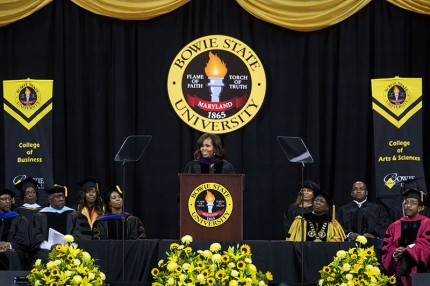
First Lady Michelle Obama delivers remarks during the Bowie State University commencement

First Lady Michelle Obama delivers remarks during the Bowie State University commencement at the Comcast Center in College Park, Md., May 17, 2013. (Official White House Photo by Lawrence Jackson)

On Friday, First Lady Michelle Obama delivered the commencement address to the Bowie State University Class of 2013. Bowie State, which opened just two years after the Emancipation Proclamation was signed, "was founded not just to educate African Americans, but to teach them how to educate others,” the First Lady explained. 

And since then, generations of students from all backgrounds have come to this school to be challenged, inspired and empowered. And they have gone on to become leaders here in Maryland and across this country, running businesses, educating young people, leading the high-tech industries that will power our economy for decades to come. 

That is the story of Bowie State University, the commitment to educating our next generation and building ladders of opportunity for anyone willing to work for it. All of you are now part of that story. And with that tremendous privilege comes an important set of responsibilities -- responsibilities that you inherit the moment you leave this stadium with that diploma in your hand. 

Read her full remarks here.

On Saturday, she traveled to Nashville to speak to the graduating class of Martin Luther King Jr. Magnet High School. The First Lady took the opportunity to talk to the students – all of whom are going on to higher education or the military – about some of the skills they’ll need as they make their way through college and through life: resilience, grit, and the ability to pick themselves up when they fall.

First Lady Michelle Obama Delivers Commencement Address at MLK, JR. Magnet High School Commencement

May 18, 2013 | 22:54 | Public Domain

The First Lady, Michelle Obama, delivers the commencement address to graduates of the Martin Luther King, Jr. Academic Magnet High School for Health Sciences and Engineering at Historic Pearl High in Nashville, TN on May 18 at 1:00 PM. The school serves approximately 1,200 students in grades 7 through 12 with a curriculum that emphasizes mathematics and science. Housed in the historic Pearl High School building, MLK is consistently ranked among the best public schools in the nation for its academic rigor and high graduation rate.

Download mp4 (1860MB)

The White House

Office of the First Lady

Remarks by the First Lady at Bowie State University Commencement Ceremony

University of Maryland
College Park, Maryland


11:54 A.M. EDT

MRS. OBAMA:  Well, thank you.  (Applause.)  Oh, my goodness.  Thank you so much.  (Applause.)  Oh, my goodness.  It is such a -- you all, rest yourselves.  You’ve got a long day ahead.  It is beyond a pleasure and an honor for me to be here with all of you today.

Of course, I want to start by thanking President Bernim for that very kind introduction, for this wonderful degree, and for his outstanding leadership here at Bowie State University.  I also want to recognize Chancellor Kirwan, Provost Jackson, Executive Vice President and General Counsel Karen Johnson Shaheed, Vice Chair Barry Gossett.  And of course, I want to thank the BSU Madrigal Singers -- they did a great job -- the university choir, and DeMarcus Franklin for their wonderful performances here today.  You all are amazing.  I just wish I could sing.  Can’t sing a lick.

I also want to recognize today’s Presidential Medal of Excellence recipient, Professor Freeman Hrabowski, who’s a for-real brother as well.  (Applause.)  And I want to thank him for his tremendous work as the Chair of the President’s Advisory Commission on Educational Excellence for African Americans.  He has done some magnificent work, but we have so much more work to do. 

And let’s take another moment to thank all of the beautiful people sitting all around us today -- the folks who have loved you and pushed you and put up with you every step of the way.  (Applause.)  Give another round of applause to all the family members who are here today.  (Applause.)  Yes, indeed.  This is your day, too.

But most of all, to the Bowie State University class of 2013, congratulations.  (Applause.)  Oh, congratulations.  You don’t know how proud we all are of you.  Just look at you.  We’re so proud of how hard you worked, all those long hours in the classroom, in the library.  Oh, yeah.  Amen.  (Laughter.)  All those jobs you worked to help pay your tuition.  Many of you are the first in your families to get a college degree.  (Applause.)  Some of you are balancing school with raising families of your own.  (Applause.)  So I know this journey hasn’t been easy.  I know you’ve had plenty of moments of doubt and frustration and just plain exhaustion. 

But listen, you dug deep and you kept pushing forward to make it to this magnificent day.  (Applause.)  And in doing so, you didn’t just complete an important chapter in your own story, you also became part of the story of this great university -- a story that began nearly 150 years ago, not far from where we all sit today.  As you all know, this school first opened its doors in January of 1865, in an African Baptist church in Baltimore.  And by 1866, just a year later, it began offering education courses to train a new generation of African American teachers. 

Now, just think about this for a moment:  For generations, in many parts of this country, it was illegal for black people to get an education.  Slaves caught reading or writing could be beaten to within an inch of their lives.  Anyone -- black or white -- who dared to teach them could be fined or thrown into jail.  And yet, just two years after the Emancipation Proclamation was signed, this school was founded not just to educate African Americans, but to teach them how to educate others.  It was in many ways an act of defiance, an eloquent rebuttal to the idea that black people couldn’t or shouldn’t be educated.  And since then, generations of students from all backgrounds have come to this school to be challenged, inspired and empowered.  And they have gone on to become leaders here in Maryland and across this country, running businesses, educating young people, leading the high-tech industries that will power our economy for decades to come. 

That is the story of Bowie State University, the commitment to educating our next generation and building ladders of opportunity for anyone willing to work for it.  All of you are now part of that story.  And with that tremendous privilege comes an important set of responsibilities -- responsibilities that you inherit the moment you leave this stadium with that diploma in your hand. 

And that’s what I want to talk with you about today.  I want to talk about the obligations that come with a Bowie State education, and how you can fulfill those obligations by how you live your lives. 

So let’s return, for a moment, to the time when the school and others like it were founded.  Many of these schools were little more than drafty log cabins with mud floors, leaky roofs and smoke-wood stoves in the corner.  Blackboards, maps, and even books were considered luxuries.  And both students and teachers faced constant threats from those who refuse to accept freedom for African Americans. 

In one Eastern Shore town, a teacher reported to work one morning to find that someone had smashed the windows of her schoolhouse.  Other black schools across Maryland were burned to the ground.  Teachers received death threats.  One was even beaten by an angry mob.  But despite the risks, understand, students flocked to these schools in droves, often walking as many as eight to ten miles a day to get their education.  In fact, the educational association that founded Bowie State wrote in their 1864 report that -- and this is a quote -- “These people are coming in beyond our ability to receive them.”  Desperately poor communities held fundraisers for these schools, schools which they often built with their own hands.  And folks who were barely scraping by dug deep into their own pockets to donate money. 

You see, for these folks, education was about more than just learning to read or write.  As the abolitionist Fredrick Douglas put it, “Education means emancipation,” he said.  He said, “It means light and liberty.  It means the uplifting of the soul of man into the glorious light of truth, the only light by which men can be free.”  You hear that?  The only light by which men can be free.  (Applause.) 

So to the folks who showed up to your school on that January day back in 1865, education meant nothing less than freedom.  It meant economic independence, a chance to provide for their families.  It meant political empowerment, the chance to read the newspaper and articulate an informed opinion, and take their rightful place as full citizens of this nation.

So back then, people were hungry to learn.  Do you hear me?  Hungry to get what they needed to succeed in this country.  And that hunger did not fade over time.  If anything, it only grew stronger.  I mean, think about the century-long battle that so many folks waged to end the evil of segregation.  Think about civil rights icons like Thurgood Marshall, Dr. King, who argued groundbreaking school integration cases, led historic marches, protests, and boycotts.  As you know, Dr. King’s house was bombed.  A police chief pulled a gun on Thurgood Marshall.  They both received piles of hate mail and countless death threats, but they kept on fighting.

Think about those nine young men and women who faced down an angry mob just to attend school in Little Rock, Arkansas.  And that was just the first day.  For months afterwards, they were spat on, jeered at, punched, and tripped as they walked down the halls.  Their classmates threw food at them in the cafeteria and hurled ink at them during class.  But they kept on showing up.  They kept claiming their rightful place at that school. 

And think about little Ruby Bridges, who was just six years old when she became one of the first black children in New Orleans to attend an all-white school.  Parents actually pulled their children out of that school in protest.  People retaliated against her family.  Her father lost his job.  And only one teacher at that entire school would agree to teach her.  But the Bridges family refused to back down.  So for an entire year, little Ruby sat all alone, a class of one, dutifully learning her lessons. 

See, that is the sacrifice that those folks and so many others have made.  That is the hunger they felt.  For them and so many others, getting an education was literally a matter of life or death. 

But today, more than 150 years after the Emancipation Proclamation, more than 50 years after the end of “separate but equal,” when it comes to getting an education, too many of our young people just can’t be bothered.  Today, instead of walking miles every day to school, they’re sitting on couches for hours playing video games, watching TV.  Instead of dreaming of being a teacher or a lawyer or a business leader, they’re fantasizing about being a baller or a rapper.  (Applause.)  Right now, one in three African American students are dropping out of high school.  Only one in five African Americans between the ages of 25 and 29 has gotten a college degree -- one in five. 

But let’s be very clear.  Today, getting an education is as important if not more important than it was back when this university was founded.  Just look at the statistics.  (Applause.)  People who earn a bachelor’s degree or higher make nearly three times more money than high school dropouts, and they’re far less likely to be unemployed.  A recent study even found that African American women with a college degree live an average of six and a half years longer than those without.  And for men, it’s nearly 10 years longer.  So yes, people who are more educated actually live longer.

So I think we can agree, and we need to start feeling that hunger again, you know what I mean?  (Applause.)  We need to once again fight to educate ourselves and our children like our lives depend on it, because they do. 

We need to dig deep and find the same kind of grit and determination that drove those first students at this school and generations of students who came after them.  I am talking about the kind of grit and determination displayed by folks right here at Bowie State.  Folks like Ariel Williams-Edwards, one of today’s graduates.  (Applause.)  Yeah, Ariel!  Ariel’s mother struggled with substance abuse, and Ariel and her sister were removed from her care and sent to live with their grandmother. 

But Ariel decided to draw inspiration from her struggle -- she majored in Social Work so she could help families like hers.  (Applause.)  Yes!  She became a member of the Phi Alpha National Honor Society.  And she’s been accepted to graduate school to get her master’s degree in Social Work starting in September.  Yes, indeed.  (Applause.)

And then there’s Audrey Marie Lugmayer, another one of this year’s graduates.  Audrey is the daughter of a single father, and her dad has struggled with some serious health issues.  So after graduating from high school, Audrey worked full time for a year, because she couldn’t bear the thought of putting any more financial burdens on her father.  She kept on working here at Bowie State, even while juggling a full course load.  And today, she is graduating with a perfect 4.0 GPA.  (Applause.)  Yes.  God is very good.

It is that kind of unwavering determination -- that relentless focus on getting an education in the face of obstacles -- that’s what we need to reclaim, as a community and as a nation.  That was the idea at the very heart of the founding of this school.

It’s even in the words of your school song:  “Oh Bowie State, dear Bowie State, may you forever be the flame of faith, the torch of truth to guide the steps of youth.”  And that’s not just a lyric -- it is a call to action.  Many of you will answer that call by carrying on the proud Bowie State tradition of serving as teachers, devoting your careers to guiding the steps of the next generation. 

But for those of you who aren’t going into education, you’re not off the hook.  Oh, no.  Oh, no.  No matter what career you pursue, every single one of you has a role to play as educators for our young people.  So if you have friends or cousins or siblings who are not taking their education seriously, shake them up.  Go talk some sense into them.  Get them back on track.  (Applause.)

If the school in your neighborhood isn’t any good, don't just accept it.  Get in there, fix it.  Talk to the parents.  Talk to the teachers.  Get business and community leaders involved as well, because we all have a stake in building schools worthy of our children’s promise.

And when it comes to your own kids, if you don't like what they're watching on TV, turn it off.  (Applause.)  If you don't like the video games they're playing, take them away.  (Applause.)  Take a stand against the media that elevates today’s celebrity gossip instead of the serious issues of our time.  Take a stand against the culture that glorifies instant gratification instead of hard work and lasting success. 

And as my husband has said often, please stand up and reject the slander that says a black child with a book is trying to act white.  Reject that.  (Applause.)

In short, be an example of excellence for the next generation and do everything you can to help them understand the power and purpose of a good education.  See, that's what my own parents did for me and my brother. 

See, my parents didn't go to college, but they were determined to give us that opportunity.  My dad was a pump operator at the city water plant, diagnosed with MS in his early thirties.  And every morning I watched him struggle to get out of bed and inch his way to his walker, and painstakingly button his uniform, but never once did I hear him complain.  Not once.  He just kept getting up, day after day, year after year, to do whatever he could to give our family a better shot at life.

So when it came time for my brother and I to go to college, most of our tuition came from student loans and grants.  But my dad still had to pay a small portion of that tuition each semester, and he was always determined to pay his share right on time -- even taking out loans when he fell short, because he couldn’t bear the thought of us missing a registration deadline because his check was late.

And there is not a day that goes by when I don't think about the sacrifices that my mom and dad made for me.  There is not a day that goes by when I don't think about living up to the example they set, and how I must do everything in my power to make them proud of the daughter they raised.  (Applause.)

And today, I am thinking about all the mothers and fathers just like my parents, all the folks who dug into their pockets for that last dime, the folks who built those schools brick by brick, who faced down angry mobs just to reach those schoolhouse doors.  I am thinking about all the folks who worked that extra shift and took that extra job, and toiled and bled and prayed so that we could have something better.  (Applause.)

The folks who, as the poet Alice Walker once wrote, “Knew what we must know without knowing a page of it themselves.”  Their sacrifice is your legacy.  Do you hear me?  And now it is up to all of you to carry that legacy forward, to be that flame of fate, that torch of truth to guide our young people toward a better future for themselves and for this country.

And if you do that, and I know that you will, if you uphold that obligation, then I am confident we will build an even better future for the next generation of graduates from this fine school and for all of the children in this country because our lives depend on it.

I wish you Godspeed, good luck.  I love you all.  Do good things.  God bless.  (Applause.)

END
12:15 P.M. EDT

The White House

Office of the First Lady

President and First Lady to Host Concert Honoring Carole King in the East Room

Wednesday, May 22 * White House – As part of their “In Performance at the White House” series, the President and First Lady will host a concert in the East Room honoring singer-songwriter Carole King, who will be awarded the 2013 Library of Congress Gershwin Prize for Popular Song.  President Obama will present the award as he did when the Library of Congress honored Stevie Wonder (2009), Sir Paul McCartney (2010), and the songwriting team of Burt Bacharach and Hal David (2012). The program will include performances by King, as well as Gloria Estefan, Billy Joel, Jesse McCartney, Emeli Sandé, James Taylor and Trisha Yearwood.

The President’s remarks will be pooled press and the entire event will be streamed live on www.whitehouse.gov/live starting at 7:00 PM ET.  “Carole King: The Library of Congress Gershwin Prize In Performance at the White House” will be broadcast Tuesday, May 28 at 8:00 PM ET on PBS stations nationwide (check local listings).  The program will also be broadcast at a later date via the American Forces Network to American service men and women and civilians at U.S. Department of Defense locations around the world.

This will be the first time the Gershwin Prize honor has been awarded to a woman.  The Gershwin Prize commemorates George and Ira Gershwin, the legendary American songwriting team whose extensive manuscript collections reside in the Library of Congress. The prize is awarded to musicians whose lifetime contributions in the field of popular song exemplify the standard of excellence associated with the Gershwins. 

The White House concert caps off two days of events celebrating the recipient of the Library of Congress Gershwin Prize for Popular Song. On Tuesday, May 21st at 7:00 PM ET, the Library of Congress will host an invitation-only concert at their Coolidge Auditorium in honor of Carole King. The all-star tribute will include performances by Patti Austin, Colbie Caillat, Michael Feinstein, Siedah Garrett, Louise Goffin, Shelby Lynne, Gian Marco, Arturo Sandoval and a special performance by honoree Carole King. This event will be open to press, but space is limited. Members of the media who wish to cover this event must contact Sheryl Cannady at 202-707-6456 or scannady@loc.gov.

 “Carole King: The Library of Congress Gershwin Prize In Performance at the White House” will be the eleventh “In Performance at the White House” program hosted by the President and Mrs. Obama.  Starting in February 2009, these events have honored the musical genius of Stevie Wonder, Sir Paul McCartney, Burt Bacharach and Hal David; celebrated Hispanic musical heritage during Hispanic Heritage Month; marked Black History Month with events featuring music from the Civil Rights Movement, Motown, Memphis Soul and the Blues; spotlighted Broadway and the unique spirit of the American musical; and explored the rich roots and resiliency of Country Music.