The White House

Office of the First Lady

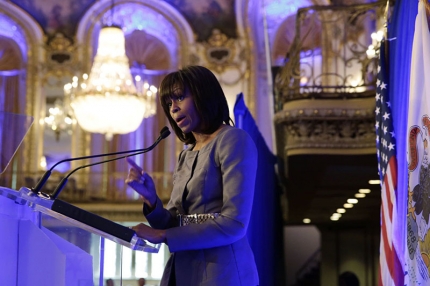
Remarks by the First Lady at the Veterans Full Employment Act of 2013 Bill Signing

State House
Annapolis, Maryland 

1:55 P.M. EDT

MRS. OBAMA:  Thank you.  (Applause.)  Thank you so much.  Good afternoon.  It is truly a pleasure to be here in Maryland today. 

But before we get started, I want to take a moment to say that our thoughts and prayers are with everyone in Boston.  My husband continues to monitor the situation, and he has directed the full resources of the federal government to assist state and local authorities as they investigate this horrific act. 

And what happened on Monday was a reminder that in times of crisis, here in America we respond with courage, and grit, and selflessness.  That’s exactly what we saw from the people of Boston, and from all those who rushed to aid the victims, especially the police officers and firefighters, the first responders, and our men and women in uniform.

And that is the spirit of Boston, but it is also the spirit of this country.  And in many ways, that’s the spirit of service and sacrifice that we are here to honor today. 

So I want to thank Governor O’Malley for hosting us, but also for his tremendous leadership for the state of Maryland and for all of his efforts on behalf of our troops, veterans, and military families.

I also want to thank Lieutenant Governor Brown; the Secretary of the Navy, Secretary Mabus; and all of the servicemembers from Fort Meade and the United States Naval Academy who are here with us today. 

And I’d like to recognize all of the Maryland state legislators:  Attorney General Gansler, Mayor Cohen, the representatives we have here from veterans service organizations and the University of Maryland, and to all of the military family members who are joining us today.  Welcome, and thank you for being here. 

And, finally, I want to thank Senior Chief Hite and his wonderful family who I got to meet -- Mom and Dad are here, and his handsome son, who I will embarrass -- (laughter) -- but we are proud of you all.  But I want to thank you all for your service to this country, because the truth is, is that every family member serves, and every time I meet a servicemember, a veteran, I don’t just thank him or her, I think children and parents and grandparents and brothers and sisters, because everyone in some way is part of that service.  And thank you for sharing your story with us today.

Two years ago, Jill Biden and I launched Joining Forces in large part because we’d heard too many stories like that of Senior Chief Hite’s.  We had heard the stories of military spouses like Janelle Gray, whose husband serves in the Air Force at Fort Meade. 

Janelle was a professional counselor for seven years in Minnesota and North Dakota.  But when she and her husband were transferred here to Maryland, she found out that she’d either have to wait three years or take additional coursework and get extra training before she could get back to work.

And then there were all the veterans we’d heard from -- the Army medics who couldn’t get jobs as EMTs; the Marine welders who couldn’t land a manufacturing job here; or the convoy drivers who couldn’t get hired to drive a semi.

Earlier today, I was over at the U.S. Naval Academy, and I met with some wonderful individuals who are here today in the healthcare professions who have served this country for years -- even decades -- and have mastered so many highly technical, high-demand skills.

But even with all that experience, these men and women wouldn’t even be considered for entry-level jobs in their fields because they didn’t have the right civilian credentials.  And all of this is happening after we have already asked so much of our troops. 

We have asked them to risk their lives in combat, manage dozens of peers, operate complicated machinery, oversee millions of dollars of assets, and save lives on the battlefield.  And then, when they come home, we’re also asking them to repeat months of training for skills they’ve already mastered.  So we have to ask ourselves:  How does this make sense? 

And the same is true for our military spouses.  We’re asking them to juggle a full-time job and their family’s finances, and the entire household all alone while their spouse is deployed overseas.  And we’re asking them to move their families to new communities and new states every couple of years.  And after they do all that, we’re also asking them to wait months and pay hundreds of dollars in fees just to be able to continue their careers?

That’s just not right.  And let me be clear -- this is about more than just eliminating a few bureaucratic headaches for these men and women.  This is about improving the financial security for thousands of military families.  It’s about giving veterans and their spouses an opportunity to build their careers and create a better future for their children.

So with all of that on the line, we knew we had to get this fixed.  And that meant we had to turn to state leaders like so many of you here in this room, because you all are the only ones who can make an impact on these licensing issues.

And I’m here today not just because Annapolis is beautiful -- which it is, and I wish I could stay and have ice cream and crab cakes -- (laughter) -- but I would clog up the city.  I will be back.  (Laughter.)  But I’m here today because here in Maryland, you all have done just that.

You have come together to take a bold step forward on behalf of our troops, veterans, and military families.  And by doing so, your state is joining a growing list of states that are addressing this issue.

Since last year, when I spoke to our nation’s governors about the issues facing military spouses, the number of states that have passed laws to help those spouses has more than tripled -- from 11 to 36.   And since we spoke with the governors again at the end of February of this year, this time about veterans issues, 13 states, including Maryland, have acted to help our veterans earn credentials.

And let me tell you, your bill here in Maryland is one of the best bills that we have seen in this entire country.  You all are tackling three big issues all at once.  You’re helping our veterans obtain professional credentials.  You’re helping them earn college credit.  And you’re making it easier for military spouses to continue their careers as they transfer to your state. 

So I want to say a huge thank you to Governor O’Malley for his leadership on this effort and to all of the legislators who have made our military families a priority.  You all didn’t just ask yourselves, can we do this.  You asked yourselves, how can we do it right; how can we serve our men and women in uniform as well as they’ve served us. 

But I also want to make an important point here:  This is not simply about patriotism and repaying our debt to our servicemen and women.  This is also about putting highly skilled individuals to work in communities all across Maryland and throughout the country.  It’s about strengthening our hospitals and our schools, and making our businesses more productive and dynamic.

That’s why the bill that’s being signed into law today is so important.  And I want you to know that we’re working at the federal level to address these issues as well.  For example, my husband has championed programs to help our troops get their civilian credentials in areas like manufacturing, medicine, and transportation before they leave the Armed Forces.  And I want to recognize the Navy, in particular, for leading the way on this issue with sailors earning more than 80,000 credentials in the last six years. 

So all of these efforts couldn’t be more important as we look at what’s coming in the years ahead.  With the Iraq war over, the war in Afghanistan winding down, more than a million servicemembers are going to be hanging up their uniforms and transitioning back to civilian life.  And that comes on top of the hundreds of thousands of veterans and military spouses already out there looking for work. 

So even though we’ve made a lot of progress on veterans employment over the past few years, as a country, we still have a lot more work to do.  And that means we need to redouble our efforts across the board.  We need more businesses to make big, bold commitments to hire and train our veterans and military spouses.  We need more hospitals and colleges and employers from every sector to recognize our veterans’ and military spouses’ unique skills and experiences, and give them a fair shot at a job.  We need every single state that has not already acted on these licensing and credentialing issues to follow Maryland’s lead and clear away every unnecessary obstacle facing our veterans and military spouses. 

And while these bills are a wonderful first step, we can’t rest until we’ve worked with our licensing boards, colleges, and universities to make sure these bills are fully implemented so that our veterans and military spouses get the credentials and the jobs they need.

And if we all step up in this way, if we all keep coming together on this issue, we will be sending a powerful message of love and support that makes a real, concrete difference for our military families.  We’ll be helping them build their careers, support their families, and find new ways to serve this country, which they so desperately want to do.  And that’s what Joining Forces is about.  And that’s why we’re not going to stop working until every state has enacted legislation to address these issues.  We’re not going to stop until every single military family in America gets the honor and support they’ve earned.

And so to all the military families here today, I want you to know from the bottom of my heart that we are going to do whatever it takes to make that happen.  We are in this for the long haul.  And we are bound and determined to repay your service and sacrifice with service and sacrifice of our own.

So to our servicemembers and military families, thank you.  Thank you.  Thank you so much for everything you have done for this country, and everything you will continue to do in the years ahead.  And to all the elected officials, to the leaders from the University of Maryland, to all the people of this great state, thank you for stepping up to show your support for these brave men and women.

I look forward to continuing our work together in the months and years ahead.  Thank you, God bless, and let’s get some signing done.  (Applause.)

END
2:05 P.M. EDT

President Obama and Vice President Biden’s 2012 Tax Returns

Today, the President released his 2012 federal income tax returns. He and the First Lady filed their income tax returns jointly and reported adjusted gross income of $608,611. The Obamas paid $112,214 in total tax. 

The President and First Lady also reported donating $150,034 – or about 24.6 percent of their adjusted gross income – to 33 different charities. The largest reported gift to charity was $103,871 to the Fisher House Foundation.

The President’s effective federal income tax rate is 18.4 percent. The President believes we must reform our tax system which is why he has proposed policies like the Buffett Rule that would ask the wealthiest Americans to pay their fair share while protecting families making under $250,000 from seeing their taxes go up. Under the President’s own tax proposals, including limitations on the value of tax preferences for high-income households, he would pay more in taxes while ensuring we cut taxes for the middle class and those trying to get in it.

Jay Carney is the White House Press Secretary
Related Topics: Delaware, Illinois, Virginia

Photo Gallery: Behind the Scenes in March 2013

The White House Photo Office just released their latest behind-the-scenes photo gallery, which includes images from President Obama’s historic Middle East trip, candid shots with senior advisors, and events around the White House.

Check out some of the best images below, and see the full set of 36 photos on our Flickr gallery.

  • President Barack Obama signs memorabilia for March of Dimes 2013 National Ambassador Nina Centofanti

    President Obama signs memorabilia for March of Dimes 2013 National Ambassador Nina Centofanti, 8. (Official White House Photo by Pete Souza)

    1 of 6
  • President Barack Obama talks with Vice President Joe Biden in March

    President Barack Obama talks with Vice President Joe Biden in the Oval Office. (Official White House Photo by Pete Souza)

    2 of 6
  • President Barack Obama throws a football with Chief of Staff Denis McDonough

    President Barack Obama throws a football with Chief of Staff Denis McDonough. (Official White House Photo by Pete Souza)

    3 of 6
  • Bo, the Obama family dog, waits for First Lady Michelle Obama on the South Lawn driveway

    Bo, the Obama family dog, waits for First Lady Michelle Obama on the South Lawn driveway. (Official White House Photo by Lawrence Jackson)

    4 of 6
  • President Barack Obama visits Yad Vashem Holocaust Museum

    President Barack Obama visits Yad Vashem Holocaust Museum in Jerusalem, March 22, 2013. (Official White House Photo by Pete Souza)

    5 of 6
  • President Barack Obama and First Lady Michelle Obama walk with their daughtersto attend an Easter service

    President Obama and First Lady Obama walk with their daughters Sasha and Malia to attend an Easter service. (Official White House Photo by Pete Souza)

    6 of 6
 
To learn more:


Related Topics: Inside the White House

West Wing Week: 04/12/13 or “We Choose Love”

April 11, 2013 | 6:41 | Public Domain

This week, the President, Vice President and First Lady continued to call for action to reduce gun violence, while the President announced the Fiscal Year 2014 Budget, conferred the Medal of Honor, met with UN Secretary General Ban Ki-moon, and held an Easter Prayer breakfast.

Download mp4 (229.9MB)

West Wing Week: 04/12/13 or “We Choose Love”

This week, the President, Vice President and First Lady continued to call for action to reduce gun violence, while the President announced the Fiscal Year 2014 Budget, conferred the Medal of Honor, met with UN Secretary General Ban Ki-moon, and held an Easter Prayer breakfast.

Related Topics: Inside the White House

The White House

Office of the First Lady

First Lady Michelle Obama to Address 2013 Graduating Seniors

This year, First Lady Michelle Obama will deliver commencement addresses at Eastern Kentucky University, Bowie State University, and the Martin Luther King, Jr. Academic Magnet High School for Health Sciences and Engineering at Historic Pearl High (MLK).

The First Lady will be speaking at Eastern Kentucky University as part of her Joining Forces initiative because of its outstanding record supporting veterans and military families; she will be speaking at Bowie State University because of its legacy as Maryland's oldest historically black university; and she will be speaking at MLK Magnet as it is consistently ranked among the best public schools in the nation for its academic rigor and high graduation rate.

The commencement addresses will be open press, but space is limited. Members of the media who wish to cover the commencements must RSVP directly to the schools. Contact information is below.

Eastern Kentucky University
Mrs. Obama will deliver remarks at the Eastern Kentucky University commencement in Richmond, KY on Saturday, May 11 at 7:30 PM, where she will address graduates from the College of Education and the College of Business and Technology in the last of three ceremonies that day. The First Lady will be speaking at EKU as part of her Joining Forces initiative to support veterans and military families. The University has received national recognition in recent years for its commitment to helping veterans further their education. The university, one of only 16 Tillman Military Scholar Partner Universities in the nation, is recognized for its Veterans Success Center that is a one-stop-shop for numerous services, from specialized job placement for veterans to full-time advisors and counselors dedicated to serving their community. EKU is also a recipient of the “Best for Vets” honor by the Military Times EDGE magazine, as well as the “Military Friendly Schools” for G.I. Jobs Magazine, placing Eastern among the top colleges, universities and trade schools nationwide for embracing America’s student veterans. Already home to more than 1,275 veterans and their families. EKU is ranked 16th nationally among the 2013 “Best for Vets: Business Schools” by Military Times EDGE magazine.

To RSVP for this event, please contact the school.
Marc C. Whitt
Associate Vice President for Public Relations and Chief Communications Officer
859-622-2301
marc.whitt@eku.edu

 
Bowie State University
The First Lady will speak at the commencement ceremonies for Bowie State University, in Bowie, MD, on the morning of Friday, May 17. Bowie State University is part of the rich legacy of historically black colleges and universities (HBCUs) that have been instrumental in educating generations of African Americans. The President and First Lady both have recognized the important contributions of HBCUs across the country and have delivered commencement addresses to highlight their successes. This year commemorates Bowie State University's 148th anniversary as Maryland's oldest historically black university and one of the oldest in the nation. The University educates students from diverse academic and socioeconomic backgrounds, seeking a high quality and affordable public comprehensive university. Bowie State places special emphasis on the disciplines of science, technology, teacher education, business, and nursing within the context of a liberal arts education.

To RSVP for this event, please contact the school.
Damita Chambers
301-860-4311
dchambers@bowiestate.edu

Martin Luther King Academic Magnet High School for Health Sciences and Engineering
Mrs. Obama will deliver the commencement address to graduates of the Martin Luther King, Jr. Academic Magnet High School for Health Sciences and Engineering at Historic Pearl High in Nashville, TN on May 18 at 1:00 PM. The school serves approximately 1,200 students in grades 7 through 12 with a curriculum that emphasizes mathematics and science. Housed in the historic Pearl High School building, MLK is consistently ranked among the best public schools in the nation for its academic rigor and high graduation rate. The school recently unveiled a community-supported wellness center and students have been active in planting and caring for a community garden at the nearby community center; both efforts align with First Lady Michelle Obama’s and Nashville Mayor Karl Dean’s healthy lifestyle initiatives. MLK is part of Metropolitan Nashville Public Schools, the nation’s 42nd largest district, which is preparing more than 81,000 students to excel in higher education, work and life with the goal of being the first choice for Nashville’s families.

To RSVP for this event, please contact the school.
Meredith Libbey
Special Communications Assistant to the Director Metropolitan Nashville Public Schools
615-259-8656
Meredith.Libbey@mnps.org

 
In 2009, Mrs. Obama spoke at the graduation of University of California Merced’s first full senior class. She also addressed the Washington Math and Science Tech Public Charter High School Graduation in Washington DC. In 2010, Mrs. Obama addressed graduates of the University of Arkansas at Pine Bluff, the George Washington University, and the Anacostia Senior High School. In 2011, Mrs. Obama delivered commencement addresses at the University of Northern Iowa, Spelman College, and Quantico Middle High School. The First Lady also spoke to graduates and families at West Point. In 2012, Mrs. Obama spoke at the graduation of Virginia Polytechnic Institute and State University (Virginia Tech), Agricultural and Technical State University (North Carolina A&T), and Oregon State University (OSU).

First Lady Michelle Obama Speaks at Meeting to Address Youth Violence

April 10, 2013 | 19:55 | Public Domain

The First Lady addresses a joint luncheon meeting in Chicago hosted by Mayor Rahm Emanuel that included members of Chicago's leading civic organizations. Mrs. Obama urges Chicago¹s business leaders to invest in expanded opportunities for youth across Chicago¹s neighborhoods.

Download mp4 (805.9MB)

Read the Transcript

Remarks by the First Lady at the Joint Luncheon Meeting: Working Together to Address Youth Violence in Chicago

Hilton Chicago
Chicago, Illinois

1:54 P.M. CDT

MRS. OBAMA: Thank you. Thank you so much. Thank you. It’s good to be home. It is. Even though it’s freezing cold in April, it’s good to be home.

It is certainly a pleasure to be here with all of you today. I want to start by thanking Rahm for that very kind introduction and that very powerful statement of what our kids in this city need, and also for his outstanding leadership here in this city.

I also want to acknowledge Attorney General Lisa Madigan, Cook County Board President Toni Preckwinkle. Thank you all for being here. It’s good to see you. You’re all looking good. It’s very good.

And of course, I want to recognize Jim Reynolds as well as Tom Wilson for taking the lead as co-chairs of the Public Safety Action Committee. Thank you both for your leadership, for your words, for your service. We are so very proud of you.

And most of all, I want to thank all of you for coming here today on behalf of this city’s young people. I want to thank you for your commitment to their safety, their wellbeing, and their God-given potential. And I know that many of you aren’t new to this work. For years, you have been sponsoring sports leagues, afterschool programs, summer jobs and more.

So you in this room know firsthand the impact that we can have when this city truly invests in our children. And that’s something I know from my own experience, which is why it was so important for me to be here today.

I’m here today because Chicago is my home. I was born and raised here. I built my career here. Several of my bosses are here -- former bosses are here. I met and married the love of my life here. I raised my children here, who, by the way, still refer to Chicago as home. They believe it gives them a little more credibility.

So let me tell you, when it comes to ensuring the health and development and success of young people in this city, for me, this is my passion, it is my mission. And for me, this is personal because my story would not be possible without this city.

And that’s where I want to start today -– by talking about our city and the neighborhoods that make us who we are. As you all know, Chicago is truly a city of neighborhoods, separated by parks and boulevards. It’s a city where walking just a few blocks can put you into an entirely different world of experiences. Cut through a park, and you go from English to Spanish, black to white, Puerto Rican to Polish. Cross a few streets, and you go from historic homes and manicured lawns to abandoned buildings and dark street corners.

So the opportunities available to a child growing up in one neighborhood in this city might be vastly different than a child growing up just five blocks away. And that difference can shape their lives and their life prospects from the moment they’re born.

That was certainly the case for me. As Rahm said, I was born and raised in South Shore. Our neighbors were teachers and secretaries, city workers; also a few professionals, doctors, lawyers, business owners. Most folks weren’t wealthy. A lot of people never went to college. And we generally couldn’t afford things like private music lessons or tutoring.

But thanks in part to this city, our lives were still rich with opportunities. We had decent public schools. I am a product of our public schools. We attended the Chicago Park District summer camps. Got a lot of ribbons from those camps I’m quite proud of. Played basketball on city courts. Our churches ran programs to expose us to music and the arts. So we didn’t have to be children of privilege to get the opportunity to enrich ourselves.

And back then, our parents knew that if they loved and encouraged us, if they kept us off the streets and out of trouble, then we’d be okay.; They knew that if they did everything right, we’d have a chance.

But today, for too many families and children in this city, that’s simply no longer the case. Today, too many kids in this city are living just a few El stops, sometimes even just a few blocks, from shiny skyscrapers and leafy parks and world-class museums and universities, yet all of that might as well be in a different state, even in a different continent.

Because many of our children have never been to the Art Institute or Millennium Park. Many of them don’t even know that the University of Chicago exists, let alone dream of attending that university -– or any university for that matter. They haven’t strolled along Navy Pier. Some of them have probably never even seen the lake. Because instead of spending their days enjoying the abundance of riches this city has to offer, they are consumed with watching their backs. They’re afraid to walk alone, because they might get jumped. They’re afraid to walk in groups, because that might identify them as part of a gang and put them at risk.

At Harper High School in Englewood, where I’ll be visiting later on today, a newly-hired teacher noticed that when classes ended in the afternoon, kids would leave the building and walk right down the middle of the street. Now, at first, she thought this was just typical adolescent misbehavior. But one student explained that it’s actually safest that way, even with all the cars whizzing by, because it gives them the best view of any fights or shootings, and they have more time to run.

Thousands of children in this city live in neighborhoods where a funeral for a teenager is considered unfortunate, but not unusual; where wandering onto the wrong block or even just standing on your own front porch can mean putting yourself at risk.

Those are the odds that so many young people are facing in this city –- young people like Hadiya Pendleton, whose funeral I attended back in February. And we all know Hadiya’s story. She was 15 years old, an honor student at King College Prep. And she came from a good family -– two devoted parents, plenty of cousins, solid godparents and grandparents, an adoring little brother. The Pendletons are hardworking people. They’re churchgoing folks. And Hadiya’s mother did everything she could for her daughter. She enrolled her in every activity you could imagine -– cheerleading, majorettes, the praise dance ministry -– anything to keep her off the streets and keep her busy.

And as I visited with the Pendleton family at Hadiya’s funeral, I couldn’t get over how familiar they felt to me. Because what I realized was Hadiya’s family was just like my family. Hadiya Pendleton was me, and I was her. But I got to grow up, and go to Princeton and Harvard Law School, and have a career and a family and the most blessed life I could ever imagine.

And Hadiya? Oh, we know that story. Just a week after she performed at my husband’s inauguration, she went to a park with some friends and got shot in the back because some kid thought she was in a gang. Hadiya’s family did everything right, but she still didn’t have a chance. And that story -– the story of Hadiya’s life and death –- we read that story day after day, month after month, year after year in this city and around this country.

So I’m not talking about something that’s happening in a warzone halfway around the world. I am talking about what’s happening in the city that we call home, the city where we’re raising our kids, the city where your businesses operate.

This kind of violence is what so many young people like Hadiyah Pendleton are dealing with every single day. And those two boys charged with her shooting -– this is the violence they were facing as well. And you have to wonder: What if, instead of roaming around with guns, boys like them had access to a computer lab or a community center or some decent basketball courts? Maybe everything would have turned out differently.

Maybe they would be doing their homework, or taking jump shots, or learning a new program instead of looking for trouble. Maybe if these kids saw some kind of decent future for themselves, instead of shootings, there would just be fistfights, some angry words exchanged.; And then maybe -- just maybe -- today, more of our young people would be in classrooms and at jobs, instead of in custody, facing even worse odds than they started out with.

See, at the end of the day, this is the point I want to make -– that resources matter. They matter. That what it takes to build strong, successful young people isn’t genetics, or pedigree, or good luck. It’s opportunity. And I know from my own experience. I started out with exactly the same aptitude -– exactly the same intellectual, emotional capabilities -– as so many of my peers. And the only thing that separated me from them was that I had a few more advantages than some of them did. I had adults who pushed me. I had activities that engaged me, schools that prepared me to succeed. I had a community that supported me and a neighborhood where I felt safe.

And in the end, that was the difference between growing up and becoming a lawyer, a mother, and First Lady of the United States, and being shot dead at the age of 15. And that is why this new fund that you’ve created here in Chicago is so important. It is so important.

As you’ve heard, this fund will help create those ladders of opportunities for all of our kids. It will give our children mentors who push them and nurture them. It will teach them the life skills they need to succeed. It will give them alternatives to gangs and drugs -- safe places where they can learn something and stay out of trouble.

Because we know that every single child in this city has boundless promise no matter where they live. And whether we give them the chance to fulfill that promise and grow into productive adults who lead meaningful lives -– see, that’s on us. That’s our job. And our kids know when we’re fulfilling that obligation. They know. They know the difference between lip service and reality. They see it and feel it every single day.

So we can host all the luncheons and make all the announcements we want. But at the end of the day, if our kids keep waking up in neighborhoods where they don’t feel safe on their own front porches, if they’re still attending schools with crumbling ceilings and ripped-up textbooks, if there’s nowhere safe for them to go when that afternoon bell rings, then nothing speaks louder than that. Nothing.

So let’s be clear. This is going to take a serious and sustained investment over a very long period of time, people. This is forever. And I am here today to join the call to all of you -– Chicago’s most distinguished business and community leaders -– to take up this challenge with fervor. And I hope that communities across America will follow Chicago’s lead to get our young people off the streets and back on track to successful lives.

Right now, my husband is fighting as hard as he can, and engaging as many people as he can, to pass common-sense reforms to protect our children from gun violence. And these reforms deserve a vote in Congress.

As he has said, we can’t stop all the violence in the world. But if there is even one thing we can do, even one step we can take to save another child, or another parent from the grief that’s visited families like Hadiya’s and so many others here today, then don’t we have an obligation to try?

But we all know that these reforms must be just one part of a comprehensive effort to rebuild our neighborhoods and build a better future for our children. And if anyone can make that happen, it’s all of you. You all are some of the most creative, innovative, influential people not just in this city, but in the entire country. You have brought together folks from all across Chicago to do great things for this city, like build Millennium Park, host the NATO Summit -- quite well, by the way -- make the lakefront the cultural jewel of the Midwest.

And today, we need you to dig deep and apply that same passion, determination and civic pride to this city’s most precious asset –- our children. Now, we all take great pride in this city. And I don’t just mean the center of it; I mean every single one of the 77 neighborhoods that make us who we are. Each of these neighborhoods is a vital part of this city, as is every single child.

And as business leaders, you all know that this city’s young people are your future workers, your future customers. Their success is critical to the success of your businesses, which is critical to the success of this city.

But you all are also here, I know, today because you know that this is about more than just fulfilling a business obligation or a civic obligation. You all know that this is a moral obligation. Because ultimately, this city and this community will be judged not just by the beauty of our parks and lakefront, or the vitality of our businesses, but by our commitment to our next generation.

I think my husband put it best when he spoke to the people of Newtown, Connecticut back in December, and he said this is –- and this is a quote: “This is our first task, caring for our children. It’s our first job. If we don’t get that right, we don’t get anything right. That’s how, as a society, we will be judged. And by that measure, can we truly say, as a nation, that we’re meeting our obligations?”

That is the question my husband asked -– are we truly meeting our obligations to our children? It’s a question we should also be asking in Chicago and in every corner of this country.

And it was the question weighing on my heart when I met with Hadiya Pendleton’s classmates on the day of her funeral. Dozens of them later spoke at the service, each referring to her as “my best friend.” And let me tell you, it is hard to know what to say to a room full of teenagers who are about to bury their best friend.

But I started by telling them that Hadiya was clearly on her way to doing something truly worthy with her life. I told them that there is a reason that we’re here on this Earth -– that each of us has a mission in this world. And I urged them to use their lives to give meaning to Hadiya’s life. I urged them to dream as big as she did, and work as hard as she did, and live a life that honors every last bit of her God-given promise.

So today, I want to say the exact same thing to all of you. I want to urge you to come together and do something worthy of Hadiya Pendleton’s memory and worthy of our children’s future.

Join me and Hadiya’s classmates and young people across this city who, by the way, even in the face of so much hardship and such long odds, are still fighting so hard to succeed.

We need to show them -– not just with words, but with action -– that they are not alone in this struggle. We need to show them that we believe in them, and we need to give them everything they need to believe in themselves.

I would not be here if it weren’t for that kind of belief. And I know that together, we can do this. So let me tell you this: I look forward to the work that you do. I look forward to you hitting this goal and surpassing it. I look forward to this city being the model of what communities can do to wrap their arms around our youth and make them the best they can be, to embrace all of our neighborhoods and every last one of our children.

Thank you so much. Good luck, and God bless.

Close Transcript

First Lady Michelle Obama Challenges Chicago Leaders to Create Opportunity for all Children

First Lady Michelle Obama delivers remarks on youth empowerment in Chicago, Ill., April 10, 2013.

First Lady Michelle Obama delivers remarks on youth empowerment at a “Joint Luncheon Meeting: Working Together to Address Youth Violence in Chicago,” hosted by Mayor Rahm Emanuel in Chicago, Ill., April 10, 2013. (Official White House Photo by Chuck Kennedy)

First Lady Michelle Obama today brought a room filled with Chicago business and community leaders to tears as she challenged them to commit to the most important unfinished work of our lifetime -- widening the circle of opportunity for every last one of our children.

Mrs. Obama was in Chicago to address the Public Safety Action Committee, a new private-sector effort launched by Mayor Rahm Emanuel to address the violent crime that is taking a terrible toll on the youth of the great city she and I both call home.

As the First Lady pointed out, thousands of Chicago children are now living in neighborhoods where a funeral for a teenager is considered unfortunate, but not unusual; where wandering onto the wrong block or even just standing on your own front porch can mean putting yourself at risk.

This needs to change. In Chicago and across the country, we need to create ladders of opportunity for our young people. We need to give our children mentors who push them and nurture them. We need to teach them the life-skills they need to succeed. We need to give them alternatives to gangs and drugs – safe places where they can learn something and stay out of trouble. Every single child -- in cities like Chicago and all across America -- has boundless promise, no matter where he or she lives. 

Tina Tchen is the Chief of Staff for First Lady Michelle Obama

The White House

Office of the First Lady

Remarks by the First Lady at the Joint Luncheon Meeting: Working Together to Address Youth Violence in Chicago

Hilton Chicago
Chicago, Illinois

1:54 P.M. CDT

MRS. OBAMA: Thank you. Thank you so much. Thank you. It’s good to be home. It is. Even though it’s freezing cold in April, it’s good to be home.

It is certainly a pleasure to be here with all of you today. I want to start by thanking Rahm for that very kind introduction and that very powerful statement of what our kids in this city need, and also for his outstanding leadership here in this city.

I also want to acknowledge Attorney General Lisa Madigan, Cook County Board President Toni Preckwinkle. Thank you all for being here. It’s good to see you. You’re all looking good. It’s very good.

And of course, I want to recognize Jim Reynolds as well as Tom Wilson for taking the lead as co-chairs of the Public Safety Action Committee. Thank you both for your leadership, for your words, for your service. We are so very proud of you.

And most of all, I want to thank all of you for coming here today on behalf of this city’s young people. I want to thank you for your commitment to their safety, their wellbeing, and their God-given potential. And I know that many of you aren’t new to this work. For years, you have been sponsoring sports leagues, afterschool programs, summer jobs and more.

So you in this room know firsthand the impact that we can have when this city truly invests in our children. And that’s something I know from my own experience, which is why it was so important for me to be here today.

I’m here today because Chicago is my home. I was born and raised here. I built my career here. Several of my bosses are here -- former bosses are here. I met and married the love of my life here. I raised my children here, who, by the way, still refer to Chicago as home. They believe it gives them a little more credibility.

So let me tell you, when it comes to ensuring the health and development and success of young people in this city, for me, this is my passion, it is my mission. And for me, this is personal because my story would not be possible without this city.

And that’s where I want to start today -– by talking about our city and the neighborhoods that make us who we are. As you all know, Chicago is truly a city of neighborhoods, separated by parks and boulevards. It’s a city where walking just a few blocks can put you into an entirely different world of experiences. Cut through a park, and you go from English to Spanish, black to white, Puerto Rican to Polish. Cross a few streets, and you go from historic homes and manicured lawns to abandoned buildings and dark street corners.

So the opportunities available to a child growing up in one neighborhood in this city might be vastly different than a child growing up just five blocks away. And that difference can shape their lives and their life prospects from the moment they’re born.

That was certainly the case for me. As Rahm said, I was born and raised in South Shore. Our neighbors were teachers and secretaries, city workers; also a few professionals, doctors, lawyers, business owners. Most folks weren’t wealthy. A lot of people never went to college. And we generally couldn’t afford things like private music lessons or tutoring.

But thanks in part to this city, our lives were still rich with opportunities. We had decent public schools. I am a product of our public schools. We attended the Chicago Park District summer camps. Got a lot of ribbons from those camps I’m quite proud of. Played basketball on city courts. Our churches ran programs to expose us to music and the arts. So we didn’t have to be children of privilege to get the opportunity to enrich ourselves.

And back then, our parents knew that if they loved and encouraged us, if they kept us off the streets and out of trouble, then we’d be okay.; They knew that if they did everything right, we’d have a chance.

But today, for too many families and children in this city, that’s simply no longer the case. Today, too many kids in this city are living just a few El stops, sometimes even just a few blocks, from shiny skyscrapers and leafy parks and world-class museums and universities, yet all of that might as well be in a different state, even in a different continent.

Because many of our children have never been to the Art Institute or Millennium Park. Many of them don’t even know that the University of Chicago exists, let alone dream of attending that university -– or any university for that matter. They haven’t strolled along Navy Pier. Some of them have probably never even seen the lake. Because instead of spending their days enjoying the abundance of riches this city has to offer, they are consumed with watching their backs. They’re afraid to walk alone, because they might get jumped. They’re afraid to walk in groups, because that might identify them as part of a gang and put them at risk.

At Harper High School in Englewood, where I’ll be visiting later on today, a newly-hired teacher noticed that when classes ended in the afternoon, kids would leave the building and walk right down the middle of the street. Now, at first, she thought this was just typical adolescent misbehavior. But one student explained that it’s actually safest that way, even with all the cars whizzing by, because it gives them the best view of any fights or shootings, and they have more time to run.

Thousands of children in this city live in neighborhoods where a funeral for a teenager is considered unfortunate, but not unusual; where wandering onto the wrong block or even just standing on your own front porch can mean putting yourself at risk.

Those are the odds that so many young people are facing in this city –- young people like Hadiya Pendleton, whose funeral I attended back in February. And we all know Hadiya’s story. She was 15 years old, an honor student at King College Prep. And she came from a good family -– two devoted parents, plenty of cousins, solid godparents and grandparents, an adoring little brother. The Pendletons are hardworking people. They’re churchgoing folks. And Hadiya’s mother did everything she could for her daughter. She enrolled her in every activity you could imagine -– cheerleading, majorettes, the praise dance ministry -– anything to keep her off the streets and keep her busy.

And as I visited with the Pendleton family at Hadiya’s funeral, I couldn’t get over how familiar they felt to me. Because what I realized was Hadiya’s family was just like my family. Hadiya Pendleton was me, and I was her. But I got to grow up, and go to Princeton and Harvard Law School, and have a career and a family and the most blessed life I could ever imagine.

And Hadiya? Oh, we know that story. Just a week after she performed at my husband’s inauguration, she went to a park with some friends and got shot in the back because some kid thought she was in a gang. Hadiya’s family did everything right, but she still didn’t have a chance. And that story -– the story of Hadiya’s life and death –- we read that story day after day, month after month, year after year in this city and around this country.

So I’m not talking about something that’s happening in a warzone halfway around the world. I am talking about what’s happening in the city that we call home, the city where we’re raising our kids, the city where your businesses operate.

This kind of violence is what so many young people like Hadiyah Pendleton are dealing with every single day. And those two boys charged with her shooting -– this is the violence they were facing as well. And you have to wonder: What if, instead of roaming around with guns, boys like them had access to a computer lab or a community center or some decent basketball courts? Maybe everything would have turned out differently.

Maybe they would be doing their homework, or taking jump shots, or learning a new program instead of looking for trouble. Maybe if these kids saw some kind of decent future for themselves, instead of shootings, there would just be fistfights, some angry words exchanged.; And then maybe -- just maybe -- today, more of our young people would be in classrooms and at jobs, instead of in custody, facing even worse odds than they started out with.

See, at the end of the day, this is the point I want to make -– that resources matter. They matter. That what it takes to build strong, successful young people isn’t genetics, or pedigree, or good luck. It’s opportunity. And I know from my own experience. I started out with exactly the same aptitude -– exactly the same intellectual, emotional capabilities -– as so many of my peers. And the only thing that separated me from them was that I had a few more advantages than some of them did. I had adults who pushed me. I had activities that engaged me, schools that prepared me to succeed. I had a community that supported me and a neighborhood where I felt safe.

And in the end, that was the difference between growing up and becoming a lawyer, a mother, and First Lady of the United States, and being shot dead at the age of 15. And that is why this new fund that you’ve created here in Chicago is so important. It is so important.

As you’ve heard, this fund will help create those ladders of opportunities for all of our kids. It will give our children mentors who push them and nurture them. It will teach them the life skills they need to succeed. It will give them alternatives to gangs and drugs -- safe places where they can learn something and stay out of trouble.

Because we know that every single child in this city has boundless promise no matter where they live. And whether we give them the chance to fulfill that promise and grow into productive adults who lead meaningful lives -– see, that’s on us. That’s our job. And our kids know when we’re fulfilling that obligation. They know. They know the difference between lip service and reality. They see it and feel it every single day.

So we can host all the luncheons and make all the announcements we want. But at the end of the day, if our kids keep waking up in neighborhoods where they don’t feel safe on their own front porches, if they’re still attending schools with crumbling ceilings and ripped-up textbooks, if there’s nowhere safe for them to go when that afternoon bell rings, then nothing speaks louder than that. Nothing.

So let’s be clear. This is going to take a serious and sustained investment over a very long period of time, people. This is forever. And I am here today to join the call to all of you -– Chicago’s most distinguished business and community leaders -– to take up this challenge with fervor. And I hope that communities across America will follow Chicago’s lead to get our young people off the streets and back on track to successful lives.

Right now, my husband is fighting as hard as he can, and engaging as many people as he can, to pass common-sense reforms to protect our children from gun violence. And these reforms deserve a vote in Congress.

As he has said, we can’t stop all the violence in the world. But if there is even one thing we can do, even one step we can take to save another child, or another parent from the grief that’s visited families like Hadiya’s and so many others here today, then don’t we have an obligation to try?

But we all know that these reforms must be just one part of a comprehensive effort to rebuild our neighborhoods and build a better future for our children. And if anyone can make that happen, it’s all of you. You all are some of the most creative, innovative, influential people not just in this city, but in the entire country. You have brought together folks from all across Chicago to do great things for this city, like build Millennium Park, host the NATO Summit -- quite well, by the way -- make the lakefront the cultural jewel of the Midwest.

And today, we need you to dig deep and apply that same passion, determination and civic pride to this city’s most precious asset –- our children. Now, we all take great pride in this city. And I don’t just mean the center of it; I mean every single one of the 77 neighborhoods that make us who we are. Each of these neighborhoods is a vital part of this city, as is every single child.

And as business leaders, you all know that this city’s young people are your future workers, your future customers. Their success is critical to the success of your businesses, which is critical to the success of this city.

But you all are also here, I know, today because you know that this is about more than just fulfilling a business obligation or a civic obligation. You all know that this is a moral obligation. Because ultimately, this city and this community will be judged not just by the beauty of our parks and lakefront, or the vitality of our businesses, but by our commitment to our next generation.

I think my husband put it best when he spoke to the people of Newtown, Connecticut back in December, and he said this is –- and this is a quote: “This is our first task, caring for our children. It’s our first job. If we don’t get that right, we don’t get anything right. That’s how, as a society, we will be judged. And by that measure, can we truly say, as a nation, that we’re meeting our obligations?”

That is the question my husband asked -– are we truly meeting our obligations to our children? It’s a question we should also be asking in Chicago and in every corner of this country.

And it was the question weighing on my heart when I met with Hadiya Pendleton’s classmates on the day of her funeral. Dozens of them later spoke at the service, each referring to her as “my best friend.” And let me tell you, it is hard to know what to say to a room full of teenagers who are about to bury their best friend.

But I started by telling them that Hadiya was clearly on her way to doing something truly worthy with her life. I told them that there is a reason that we’re here on this Earth -– that each of us has a mission in this world. And I urged them to use their lives to give meaning to Hadiya’s life. I urged them to dream as big as she did, and work as hard as she did, and live a life that honors every last bit of her God-given promise.

So today, I want to say the exact same thing to all of you. I want to urge you to come together and do something worthy of Hadiya Pendleton’s memory and worthy of our children’s future.

Join me and Hadiya’s classmates and young people across this city who, by the way, even in the face of so much hardship and such long odds, are still fighting so hard to succeed.

We need to show them -– not just with words, but with action -– that they are not alone in this struggle. We need to show them that we believe in them, and we need to give them everything they need to believe in themselves.

I would not be here if it weren’t for that kind of belief. And I know that together, we can do this. So let me tell you this: I look forward to the work that you do. I look forward to you hitting this goal and surpassing it. I look forward to this city being the model of what communities can do to wrap their arms around our youth and make them the best they can be, to embrace all of our neighborhoods and every last one of our children.

Thank you so much. Good luck, and God bless.

The White House

Office of the First Lady

Remarks by the First Lady at Visit with Chicago Youth -- Chicago, Illinois

William R. Harper High School
Chicago, Illinois

2:45 P.M. CDT
 
MRS. OBAMA:  I want to hear from you all.  And I have as much time as we need to take.  I am just thrilled to be back home.
 
I don’t know how much you know about me, in addition to being the First Lady, but I grew up in South Shore, went to public schools here.  My parents -- working class folks.  And one of the reasons why I like to talk to kids, especially from my city, is to make sure you all know that there isn't much distance between me and you.  There really is not. 

The only difference that I can see is that -- you know, I went to school every day, worked hard, did my homework, tried not to listen to the haters, tried to take care of my business.  And the truth is, is that in this world today, if you stay focused, you can still make that happen, even with all of the challenges that we all face. 
 
And I want to make sure you guys are on track and really understand that the best thing you can do for yourself in life is to really be serious about your education.  That is truly the ticket in this country to get where you need to go. 
 
But I'm not going to talk, because we're not going to -- I'm a participant in today's activities.  And I want you to feel free to do what you do, but I want you to at some point be able to ask me whatever you want to know.  Whatever I can tell you, it's all -- I find that it's always better to hear from you and hear what you want -- to find out what I can tell you. 
 
But I want to do a lot of listening.  I want to learn about what's going on in your lives, what's going on in your school, your communities.  I want you to tell me what you think I need to know, to tell the President, to tell the rest of the country.  So I'm really here to listen.
 
And I am very excited to be here.  You all look good.
 
STUDENTS:  Thank you.
 
MRS. OBAMA:  And I am so proud of you all.  And I am honored to be here at Harper.  I really am.  So I'm going to stop talking for a second. 
 
END 
2:48 P.M. CDT