The White House

Office of the Press Secretary

President Obama Announces Another Key Administration Post

WASHINGTON, DC – Today, President Barack Obama announced his intent to nominate the following individual to a key Administration post:

• Kristine L. Svinicki – Commissioner, Nuclear Regulatory Commission

President Obama announced his intent to nominate the following individual to a key Administration post:

Kristine L. Svinicki, Nominee for Commissioner, Nuclear Regulatory Commission
Kristine L. Svinicki is a Commissioner of the U.S. Nuclear Regulatory Commission (NRC), a position she has held since 2008.  Prior to joining the NRC, Ms. Svinicki served as a professional staff member on the Senate Armed Services Committee for Senator John Warner and Senator John McCain.  From 2001 to 2005, she served as a senior policy advisor to Senator Larry Craig.  From 1990 to 2001, Ms. Svinicki worked as a nuclear engineer in the U.S. Department of Energy’s Office of Nuclear Energy, Science, and Technology, the Office of Civilian Radioactive Waste Management, and the Idaho Operations Office.  She began her career in 1989 as an energy engineer with the State of Wisconsin at the Wisconsin Public Service Commission in Madison, Wisconsin.  Ms. Svinicki received a B.S. in Nuclear Engineering from the University of Michigan. 

The White House

Office of the Press Secretary

President Obama Announces More Key Administration Posts

WASHINGTON, DC – Today, President Barack Obama announced his intent to nominate the following individuals to key Administration posts:

• Maria Lopez De Leon - Member, National Council on the Arts
• Emil J. Kang – Member, National Council on the Arts

President Obama said, “I am proud that such experienced and committed individuals have agreed to serve the American people in these important roles.  I look forward to working with them in the months and years ahead.”

President Obama announced his intent to nominate the following individuals to key Administration posts:

Maria Lopez De Leon, Nominee for Member, National Council on the Arts
Maria Lopez De Leon is the Executive Director and a member of the board of the National Association of Latino Arts and Culture (NALAC). Ms. De Leon has been affiliated with NALAC for thirteen years and has served as Executive Director for ten years.  Under Ms. De Leon’s leadership, NALAC launched the Fund for the Arts, a grant program for Latino artists and organizations, completed production of a documentary series on Latino art and culture for PBS, and developed a grant program for cultural exchanges between the US, Mexico, and Central America.   Ms. De Leon is an advisory council member of San Anto Cultural Arts, Women of Color in the Arts, and is a fellow of the Rockwood Leadership Institute. 

Emil J. Kang, Nominee for Member, National Council on the Arts
Emil J. Kang is the Executive Director for the Arts and Professor of the Practice of Music at the University of North Carolina at Chapel Hill.  Previously, he served as President and Executive Director of the Detroit Symphony Orchestra.  He has also held positions with the Seattle Symphony and the American Composers Orchestra and was an Orchestra Management Fellow with the League of American Orchestras.  Mr. Kang serves as Secretary of the Board of Directors of the Association of Performing Arts Presenters, and is a member of both the Nominating Committee of the International Society for the Performing Arts and Board of Advisors of the Kenan Institute for the Arts at the University of North Carolina School of the Arts.  Mr. Kang holds a B.A. in Economics from the University of Rochester.

The White House

Office of the Press Secretary

Statement by the Press Secretary on Senate Republicans Blocking Bill to Prevent Student Interest Rates from Doubling

It is extremely disappointing that Republicans in the Senate today voted to ask millions of students to pay an average of $1,000 each in order to protect a loophole that allows millionaires to dodge payroll taxes. On July 1, more than 7.4 million students across the country will see their interest rates double unless Congress acts. We’re pleased that despite failing to address it in their budget, Republicans in Congress now profess to be concerned about this coming rate hike. But now it’s time for them to stop refighting old political battles and prove they’re serious by proposing a real solution to keep rates low for students without burdening middle class families or undercutting preventive health care for women. We look forward to continuing to work with Congress to prevent rates from doubling and ensure that students continue to get a fair shot at an affordable education.

The White House

Office of the Press Secretary

Fact Sheet: An Update on Bringing Jobs Back to the United States

On January 11, 2012, President Obama hosted the White House Insourcing Forum, where he called on companies to invest in America and heard from companies already bringing jobs back and making additional investments in America.  Those companies at the Forum – large and small, foreign and domestic, manufacturers and services firms – all chose to invest and create new jobs here, citing that rising cost abroad combined with the continued productivity improvements by American workers, our world-leading universities, and a strong business environment make the U.S. an increasingly attractive location for investment and jobs. 
 
In conjunction with the Forum, the White House released a report highlighting the emerging trend of insourcing.  Since the Forum, the evidence continues to mount, demonstrating that the economic trends are taking hold and more companies are choosing to bring their operations to America.
 
Today, the President is traveling to the College of Nanoscale Science and Engineering (CNSE) of the University at Albany - State University of New York, a research, education, and manufacturing resource center dedicated to preparing the next generation of scientists and researchers in nanotechnology, to highlight insourcing and the connection between education, innovation, and manufacturing in supporting investment and bringing jobs back.
 
The U.S. economy continues to add private sector jobs, particularly in the manufacturing sector

  • The U.S. economy has added private sector jobs for 26 straight months for a total of 4.25 million jobs during that period.  So far this year, the U.S. economy has added over 820,000 private sector jobs, on net.  
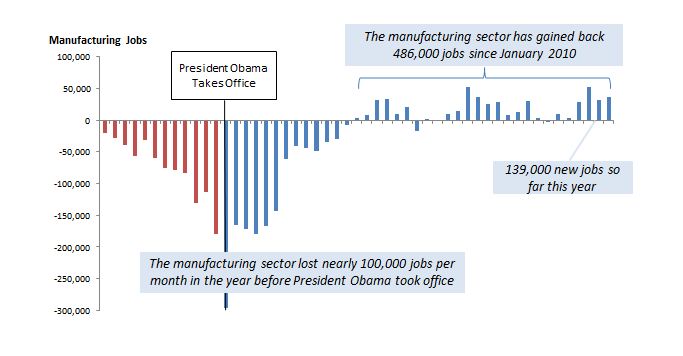
  • U.S. manufacturing continues to grow.  U.S. manufacturing has added nearly 500,000 jobs in the past 26 months – the strongest growth for any 26 month period since 1995.  So far this year, the manufacturing sector has added 139,000 new jobs.  


Unlike the previous decade, our economic growth is being supported by manufacturing production, exports, and business investment

  • U.S. manufacturing production – the amount of goods that we make – continues to grow.  Production is up 13% over the past 26 months, a 6% annual rate of growth which is the fastest since the 1990s.  So far this year, manufacturing production has accelerated, growing at a 7% annual rate of growth.  
  • The export of U.S. goods and services to other countries continues to grow, despite challenges abroad. The U.S. exported $2.1 trillion over the last 12 months, the highest level of exports over a 12-month period in U.S. history.  This is a 35% increase over the level of our exports in 2009.
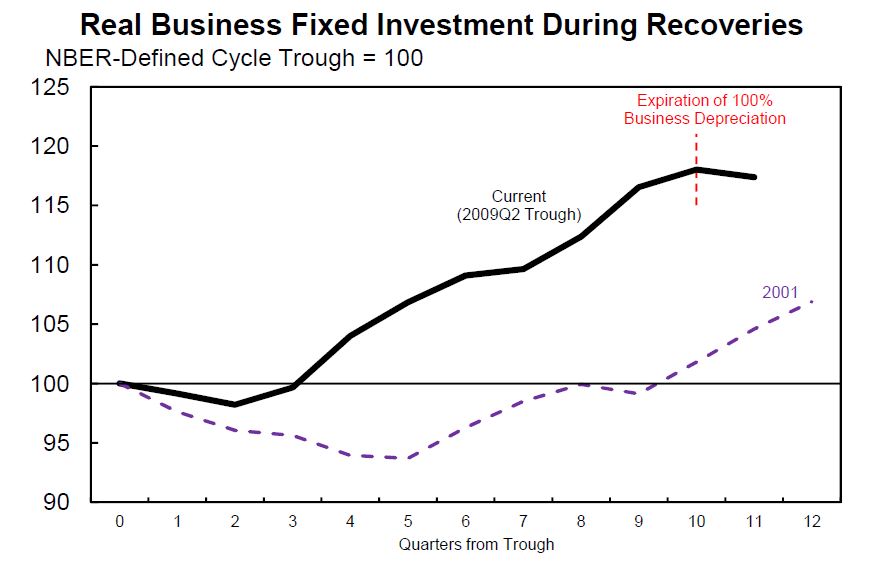
  • Business investment is up over 18% since the end of 2009, as companies continue to invest in capacity and equipment to help our workers become even more productive.  Business investment has been much stronger than in the economic recovery during the last decade. 


Outside analysts agree that the U.S. is an increasingly attractive location to invest, and companies are planning to insource more jobs and investment to the United States.
 
In the Investing in America Report released at the White House Insourcing Forum, it was highlighted that outside analysts from the Boston Consulting Group, Accenture, and Booz & Company had examined the relative attractiveness of the U.S. as a location for manufacturing and found that America was increasingly an attractive option for companies.  Analysts noted that the “total cost of doing business” – after taking into account the productivity of U.S. workers as well as transportation, supply chain risks, and other costs – is now making production in a range of industries as economical in the United States as in other parts of the world, including China.  New reports from The Boston Consulting Group and Bank of America support these claims: 

  • In April 2012, The Boston Consulting Group released a recent survey of executives showing that 37% of all companies surveyed, and 50% of big companies with revenues over $10 billion, were planning to, or actively considering, moving manufacturing to the United States from China.  These companies are actively looking to move to the United States because 9 in 10 believe that costs in China are on the rise and 7 in 10 believe that their operations in China turned out to be more costly than they had originally anticipated.
  • In a report from March 2012, Bank of America released a report on U.S. manufacturing that claimed “the U.S. economy is in the early stages of a long term manufacturing renaissance.”  When examining the increasing competitiveness of U.S. manufacturing, the report argues that “manufacturers [are] increasingly likely to focus on and possibly bring production back to the U.S.”  Rising costs abroad combined with U.S. advantages in knowledge, logistics, access to energy, workforce, and overall productivity will continue to support a U.S. manufacturing renaissance.

President Obama believes that a strong and growing manufacturing sector is necessary for a strong and growing economy.
 
While Insourcing is happening across different industries – from manufacturers making jet engine components and furniture to services firms providing IT and customer call center solutions – the President has, in particular, highlighted the importance of a competitive U.S. manufacturing sector to the vision of a U.S. economy that was innovate, competitive, and the source of good jobs for American workers.
 
While we must lay a foundation for private sector job growth across the board, we also recognize that manufacturing “punches above its weight.”  


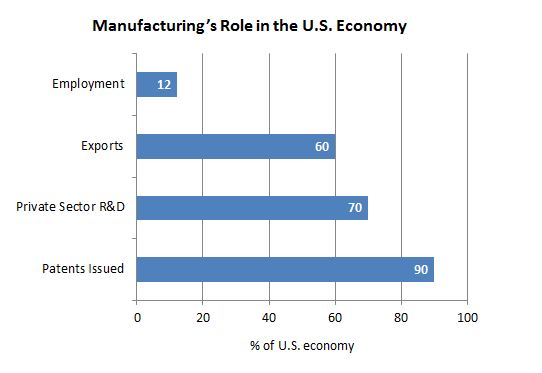
When you take into account the outsized role that manufacturing plays in innovation through R&D investment and patents, the tight linkage between innovation and manufacturing production, the higher-wage jobs manufacturing produces, its importance for exports, the spillover benefits that manufacturing facilities have on firms and communities around them, and the deeper economic harm that comes from allowing our manufacturing production capacity to be hollowed out – it becomes clear why President Obama has placed a special emphasis on revitalizing American manufacturing.
 
The President’s visit to the College of Nanoscale Science and Engineering at SUNY-Albany demonstrates the important role that partnerships between universities and companies can play in accelerating education, innovation and U.S. manufacturing investment.
 
The College of Nanoscale Science and Engineering (CNSE) at SUNY-Albany is a global education, research, development and technology deployment resource dedicated to preparing the next generation of scientists and researchers in nanotechnology.  In September 2011, New York State announced a $4.4 billion investment by Intel, IBM, GLOBALFOUNDRIES, TSMC, and Samsung to develop the next generation of computer chip technology in partnership with the State and research institutions led by CNSE.  This type of partnership is spurring investment in the surrounding area, creating additional opportunities for American workers, and encouraging more firms to bring manufacturing production to the United States.
 
The President believes that the United States need to support these critical shared manufacturing facilities and has proposed in the FY13 Budget a $1 billion investment to catalyze a National Network for Manufacturing Innovation consisting of up to fifteen institutes, each serving as a hub that will help to make U.S. manufacturing facilities and enterprises more competitive and encourage investment in the United States.  Like CNSE, the Institutes will bring together large companies, small and medium enterprises, research organizations and universities, federal agencies, and states to accelerate innovation through investment in key manufacturing technologies with broad applications.  In March 2012, the President announced that to jumpstart this effort, the Administration will invest $45 million in existing resources to launch a single pilot institute through a competitive award to be announced later this year.
 

The White House

Office of the Press Secretary

President Obama Calls on Congress to Act on “To Do List” to Create Jobs

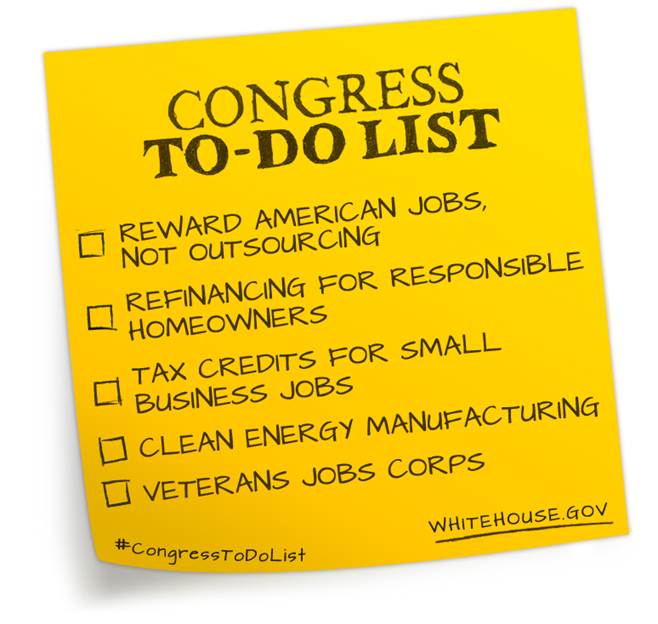
Today, President Obama will travel to the College of Nanoscale Science and Engineering’s (CNSE) NanoTech Complex in Albany, New York to call on Congress to act on a “To Do List” that will create jobs and help restore middle class security. These initiatives have bipartisan support and at this make-or-break moment for the middle class, we need to create an economy built to last that creates secure American jobs and makes things the rest of the world buys - not one built on outsourcing, loopholes, or risky financial deals.

Congress' To Do List

  1. Reward American Jobs, Eliminate Tax Incentives To Ship Jobs Overseas:Congress needs to attract and keep good jobs in the United States by passing legislation that gives companies a new 20 percent tax credit for the cost of moving their operations back to the U.S. and pay for it by eliminating tax incentives that allow companies to deduct the costs of moving their business abroad.
  2. Cut Red Tape So Responsible Homeowners Can Refinance:Congress needs to pass legislation to cut red tape in the mortgage market so that responsible families who have been paying their mortgages on time can feel secure in their home by refinancing at today’s lower rates.
  3. Invest in a New Hire Tax Credit For Small Businesses: Congress needs to invest in small businesses and jumpstart new hiring by passing legislation that gives a 10 percent income tax credit for firms that create new jobs or increase wages in 2012 and that extends 100 percent expensing in 2012 for all businesses.
  4. Create Jobs By Investing In Affordable Clean Energy:Congress needs to help put America in control of its energy future by passing legislation that will extend the Production Tax Credit to support American jobs and manufacturing alongside an expansion of the 30 percent tax credit to investments in clean energy manufacturing (48C Advanced Energy Manufacturing Tax Credit)
  5. Put Returning Veterans to Work Using Skills Developed in the Military:Congress needs to honor our commitment to returning veterans by passing legislation that creates a Veterans Job Corps to help Afghanistan and Iraq veterans get jobs as cops, firefighters, and serving their communities.


REWARD AMERICAN JOBS, ELIMINATE TAX INCENTIVES TO SHIP JOBS OVERSEAS

The tax code currently allows companies moving operations overseas to deduct their moving expenses – and reduce their taxes in the United States as a result.  Congress needs to act to help attract and keep good jobs in the United States by passing legislation that gives companies moving operations back to the U.S. a new 20 percent tax credit for moving expenses and pay for it by ending the tax break that allows companies to deduct expenses associated with moving operations overseas.
 
• Eliminating Tax Incentives to Ship Jobs Overseas: Congress needs to end the tax break that allows companies to deduct expenses associated with moving operations overseas, while still encouraging companies to assist displaced workers.

How the President’s Plan Would Deny Tax Breaks for Moving Abroad

If a firm shutters a production facility, moves it to another country, and incurs $15 million in expenses for breaking down assembly lines and production equipment, moving expenses to transport equipment abroad, and mothballing the Iowa facility, then under current law:

  •  The company could reduce its tax burden by $5.25 million dollars, assuming a 35 percent corporate tax rate.

Under the President’s plan:

  • This company can no longer deduct the $15 million in moving expenses, eliminating the $5.25 million tax break for shipping the facility overseas.

In denying the deduction for outsourcing firms, the President’s plan does not count the cost of severance and re-training workers.

  • And reward businesses bringing jobs back to the United States: Congress should create a new general business credit against income tax equal to 20 percent of the eligible expenses paid or incurred during closing down operations abroad and bringing jobs back to the U.S. In order to qualify for this credit, companies would have to reduce or eliminate a trade or business outside the United States and start up, expand, or move the same trade or business to the United States.

How a Company Would Get a Tax Credit for Bringing Jobs Back to the U.S.

Consider the same firm as above, except they are moving the facility from overseas back to the U.S. If this company were to move a manufacturing plant with 800 employees back to the United States from another country, and incurred $15 million in costs from packaging and transporting equipment, and cleaning up the old facility abroad, then under the President’s plan:

  • The company would still be able to deduct the $15 million, saving $5.25 million in taxes and on top of that wouldreceive a 20% credit on its $15 million in expenses – or a $3 million additional income tax benefit.

The White House

Office of the Press Secretary

Statement by the Press Secretary on the Visit of NATO Secretary-General Rasmussen

The President will host NATO Secretary-General Rasmussen for a meeting in the Oval Office on May 9.  The two leaders will discuss final preparations for the NATO Summit the President will host in Chicago on May 20-21.

The White House

Office of the First Lady

First Lady to Welcome Spouses of Foreign Leaders to White House and Hometown of Chicago

Next week, First Lady Michelle Obama will host spouses of foreign leaders who are visiting the United States for the G-8 and NATO summits. Mrs. Obama will invite spouses to the White House and, while in Chicago, to visit the Gary Comer Youth Center which supports youth living on the South Side of Chicago, where Mrs. Obama grew up.

On May 19th, while President Obama is hosting G-8 leaders at Camp David, First Lady Michelle Obama will invite their spouses to the White House for a tour guided by White House Curator Bill Allman and an intimate lunch. Chef José Andrés will work with White House Chefs to prepare the meal using produce from the White House Kitchen Garden.

On May 20th, Mrs. Obama will then travel to Chicago where she will invite NATO leaders’ spouses to the Gary Comer Youth Center on the South Side of Chicago. The Center offers young people diverse, educational and extracurricular enrichment activities as well as support to help prepare them to graduate from high school and to pursue college and meaningful careers. The Center’s programs include academic tutoring, college readiness courses, a Youth Urban Agriculture Program held at its rooftop garden, a culinary program, visual arts opportunities, and fitness and physical education classes.

The First Lady will greet spouses and invite them to take a tour of the Gary Comer Youth Center. Following this tour, they will join the Center’s youth members and faculty at a performance by the South Shore Dance Drill Team; the Chicago-based Muntu Dance Theater known for their African and African-American dance, music and folklore performances; and Soul Children of Chicago which uses music to motivate and inspire young people. Founded in 1980, the South Shore Drill Team uses performing arts to engage urban youth by teaching responsibility and camaraderie through its dance routines and performances around the country. The Gary Comer Youth Center serves as home base to the Drill Team. Following the performance, Mrs. Obama and the NATO Leaders’ spouses will sit for a private lunch created by Chef Paul Kahan who worked with Gary Comer Youth Center youth members in preparing the meal.

Later that evening, Mrs. Obama will invite NATO Leaders’ spouses to the Art Institute of Chicago for a private dinner.

The White House

Office of the Press Secretary

Statement by the Press Secretary on the President’s Call to President Sarkozy of France

President Obama called President Sarkozy to thank him for his strong leadership and for his friendship and partnership in challenging times.  He expressed his appreciation for the valued cooperation that has characterized the relationship between the two leaders since January 2009.   President Obama said that he and Mrs. Obama extend their very best wishes to President Sarkozy and his wife Carla in their future endeavors.

The White House

Office of the Press Secretary

Statement by the Press Secretary on the President’s Call to President-elect Hollande of France

President Obama called President-elect Francois Hollande of France to congratulate him after the results of the French election were announced today.  President Obama indicated that he looks forward to working closely with Mr. Hollande and his government on a range of shared economic and security challenges.  President Obama noted that he will welcome President-elect Hollande to Camp David for the G-8 Summit and to Chicago for the NATO Summit later this month, and proposed that they meet beforehand at the White House.  President Obama and President-elect Hollande each reaffirmed the important and enduring alliance between the people of the United States and France.

###

The White House

Office of the Press Secretary

WEEKLY ADDRESS: A New Chapter in Afghanistan

WASHINGTON, DC— In this week’s address, President Obama spoke about his recent trip to Afghanistan, where he met with our brave troops and signed an historic agreement that will help put an end to the war.  The goal of defeating al Qaeda is within sight, we have killed Osama Bin Laden, and the President has now signed an agreement with Afghanistan that details a new relationship in which the Afghans will soon be responsible for the security of their nation. As we look towards that future, we must also focus on the type of nation our troops return to.  This is why the President called on Congress to take the money we are no longer spending at war, use half of it to pay down our debt, and use the other half to rebuild America. It’s time for America to make the choices that ensure a strong middle class where everyone a fair shot, everyone does their fair share, and everyone plays by the same rules.

The audio of the address and video of the address will be available online at www.whitehouse.govat 6:00 a.m. ET, Saturday, May 5, 2012.

 Remarks of President Barack Obama
Weekly Address
The White House
May 5, 2012

 This week, I traveled to Afghanistan—to thank our troops serving far from home, and to sign an historic agreement that will help us complete our mission and end the war. 

As Commander-in-Chief, nothing is more humbling or inspiring than the chance to spend some time with our troops.  At Bagram Air Base, I visited with some of our outstanding men and women in uniform.  I thanked them for their extraordinary service.  And I let them know that America honors their sacrifice.

Because of their bravery and dedication, the tide of war has turned in Afghanistan. We have broken the Taliban’s momentum. We’ve built strong Afghan Security Forces. We have devastated al Qaeda’s leadership. And one year ago, our troops launched the operation that killed Osama bin Laden. The goal that I set – to defeat al Qaeda, and deny it a chance to rebuild – is within reach.

Because of the progress we have made, I was able to sign an historic agreement between the United States and Afghanistan that defines a new kind of relationship between our countries – a future in which Afghans are responsible for the security of their nation, and we build an equal partnership between two sovereign states; a future in which the war ends, and a new chapter begins.

The enormous sacrifices of our men and women in uniform are not over.  But many of our troops are already coming home. Last year, we removed 10,000 U.S. troops from Afghanistan. Another 23,000 will leave by the end of the summer. As our coalition agreed, by the end of 2014, the Afghans will be fully responsible for the security of their country

And this is as it should be.  Because after more than a decade of war, it is time to focus on nation building here at home.

As a new greatest generation returns from overseas, we must ask ourselves, what kind of country will they come back to?  Will it be a country where a shrinking number of Americans do really well while a growing number barely get by?  Or will it be a country where everyone gets a fair shot, everyone does their fair share, and everyone plays by the same set of rules – a country with opportunity worthy of the troops who protect us?

America has answered this question before. My grandfather, a veteran of Patton’s Army, got the chance to go to college on the GI Bill.  My grandmother, who worked on a bomber assembly line, was part of a workforce that turned out the best products on Earth.  They contributed to a story of success that every American had the chance to share in, the basic American promise that if you work hard, you could do well enough to raise a family, own a home, send your kids to college, and put a little away for retirement. 

Keeping that promise alive is the defining issue of our time. But it means making responsible choices.

I don’t think we should prioritize things like more tax cuts for millionaires while cutting the kinds of investments that built a strong middle class.

That’s why I’ve called on Congress to take the money we’re no longer spending at war, use half of it to pay down our debt, and use the other half to rebuild America.

Because we’ve got more jobs to create.  More students to educate.  More clean energy to generate.  More entrepreneurs with the next great idea, just looking for their shot at success. We’ve got to invest in things like education and medical research.  We’ve got to build newer, faster transportation and communication networks.  And we’ve got to secure the care and benefits our veterans have earned, so that we serve them as well as they have served us.

Every time I have the privilege of meeting with our troops, I’m struck by their courage, their commitment, their selflessness, and their teamwork.  They have something to teach us.  Recovering from the worst economic crisis since the Great Depression is a work in progress – but if we follow their example, then I have no doubt we will preserve the promise of this country, protect the freedoms we cherish, and leave for our children an America that’s built to last.

God bless you, and have a great weekend.

 ###