

Latest News
Tribal Health and the Affordable Care Act
Posted by on March 19, 2012 at 2:19 PM ESTRecently, I had the privilege to speak about how the Affordable Care Act is having a positive impact in Indian Country as I joined other Administration officials in addressing the Executive Council Winter Session of the National Congress on American Indians in Washington, D.C.
Thanks to the Affordable Care Act, Indian tribes, tribal organizations and urban Indian organizations can now choose to purchase health insurance coverage for their employees through the Federal Employees Health Benefits (FEHB) program.
Learn more about Health CareWhite House Celebrates Purim with Megillah Reading
Posted by on March 19, 2012 at 1:18 PM EST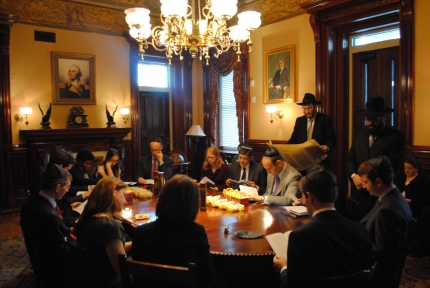
White House and Agency staff celebrate the Jewish Holiday of Purim with a Megillah Reading, March 8, 2012. (Photo by Daniel Ensign)
On March 8, Jews around the world celebrated the holiday of Purim, made famous in the Book of Esther, which tells the story of the Jews of ancient Persia overcoming a murderous plot by Haman. White House and Agency staffers from all faiths and backgrounds gathered in the Eisenhower Executive Office Building to celebrate the holiday. In partnership with Rabbi Levi Shemtov of the American Friends of Lubavitch, staffers were led in a reading of the Megillah by Rabbi Shua Hecht.
Learn more about Additional IssuesWhite House Rural Council Sponsors "Working Lands and Healthy Watersheds Roundtable"
Posted by on March 19, 2012 at 9:45 AM ESTSuccess Stories Highlighted
On Wednesday, the White House Rural Council sponsored a Working Lands and Healthy Watersheds roundtable. The Rural Council, established last June, provides a forum for discussing how to support conservation work and create jobs in rural America. This week's roundtable brought together folks from across the country with experience in farming, ranching, conservation, and water quality to share their experience in how to more effectively and efficiently invest resources to improve water quality for rural communities.
The roundtable was an opportunity to celebrate some of the good work already happening and to share innovative ideas for continuing progress. We heard how leaders from three states successfully used EPA Section 319 grant program and USDA Farm Bill conservation programs to improve water quality in critical watersheds. We also heard about what stakeholders most need to carry out new and long-term on-the-ground efforts, and how EPA and USDA can improve their support for those efforts at the local scale.
Some of the themes that emerged from the session are:
- Partnerships and On-the-Ground Leadership are essential to success. It takes time to forge the relationships that lead to results.
- Stakeholder Education and Engagement helps landowners and producers understand their broader role and tie their actions to a broader community and mission.
- Using a Watershed Scale Approach creates a community for all who impact or depend on the watershed.
- Flexibility is essential to success on the ground, and allows stakeholders to work strategically and to leverage resources to support watershed efforts.
- Tracking the outcomes and impact of projects over time is critical to success and assists in identifying where further investments are needed.
The nation's rural landowners, farmers, ranchers, and forest owners are often our best environmental stewards, providing clean water and wildlife habitat from the healthy, functioning watersheds on their lands. We are committed to supporting this good work, and look forward to continuing the conversation about partnerships that support farmers, ranchers, forest owners, and the healthy watersheds communities depend on.
Here's what some of the roundtable participants had to say about the discussion:
Successful water quality improvement projects appear to be united by four primary themes. Positive relationships between landowners/land operators and the agency specialists that facilitate projects are a critical first step to success. Access to, and understanding of, water monitoring and practice performance data leads to setting goals, targeting implementation and measuring outcomes at the watershed level. Coordination and information sharing between partners expedites the process of implementing watershed improvement plans. Versatility in how funding can be used from public and private sources can lead to unexpected opportunities and benefits.
It's easy to see we have the system in place to provide great technical expertise, but we need to incorporate lessons learned from watershed project successes around the country and utilize a strategy that facilitates and empowers watershed communities, priming individuals to act.
~ Chad Ingels, Extension Watershed Specialist, Iowa State University Extension
Voluntary efforts to address nonpoint source pollution can work. The trick is you need strong partnerships with local entities like conservation districts that have a positive history with landowners You also must coordinate programs from EPA 319 and USDA to ensure you get the most bang for your buck. This, combined with monitoring data to assess the effects of best management practices on tributaries, has achieved show significant reductions in nonpoint source pollution in many priority watersheds.
~ Clay Pope, Executive Director, Oklahoma Association of Conservation Districts
Farmers in the U.S. have made tremendous strides over the past several decades toward increasing production while at the same time improving environmental conservation. EPA Section 319 grants and USDA Farm Bill conservation programs have played an important role in supporting the voluntary adoption of best management practices. Using a watershed approach, we are also able to more accurately measure how conservation practices are directly improving water quality in a particular region, which in turn helps farmers and landowners focus our efforts.
As the world's population increases to 9 billion people by 2050, we understand that agricultural producers will be expected to do more with less. We have a finite amount of land, water and other natural resources; however, through research, technology development and support from federal programs, American farmers will continue to produce the most abundant and affordable supply of food, feed, fuel and fiber in the world. We will be equipped to meet growing demand while also preparing to pass along the land, better than we found it, to the next generation of producers.
~ Rod Snyder, National Corn Growers Association
Ann Mills is Deputy Under Secretary for Natural Resources and Environment at USDA
Larry Elworth is Chief Agriculture Counselor at EPA
Learn more about Energy and Environment, RuralOn the Road in Detroit: Focus on Housing & Homelessness
Posted by on March 19, 2012 at 8:35 AM ESTAcross the country, organizations and individuals are doing important work to address the housing needs of lesbian, gay, bisexual, and transgender (LGBT) people and prevent homelessness among members of the LGBT community. Earlier this month, hundreds of advocates, community organizers, and interested members of the public came together in Detroit, Michigan for the White House LGBT Conference on Housing & Homelessness to participate in an important dialogue with the Obama Administration on these issues. The Conference was hosted by the White House Office of Public Engagement in partnership with the U.S. Department of Housing & Urban Development (HUD) and the Ruth Ellis Center, a Detroit-based center for runaway and homeless LGBT youth.
White House Women’s Leadership Panel Encourages Students to Dream Big Dreams
Posted by on March 16, 2012 at 6:14 PM ESTThis past week, a group of twelve students ages 13-15 from the Elizabeth Garrett Anderson College (EGA) in Islington, London visited Washington during the UK Official visit. EGA is an all-girls school with students ranging in ages from 11-17 where nearly 90% of the girls come from minority ethnic backgrounds and 2/3 speak English as a second language. First Lady Michelle Obama visited EGA during her trip to London in 2009 and invited a group of EGA students to join her at Oxford University in 2011, as well as to visit the United States. Their trip this week, which was focused on diplomacy, leadership and community, included a visit to the White House where they were joined by White House Mentees in attending a Women’s Leadership Panel in the State Dining Room. The panel was moderated by Sarah Hurwitz, Special Assistant to the President, Senior Advisor to the Council on Women and Girls and Senior Presidential Speechwriter, and featured four White House staffers – Deputy Assistant to the President and Director of Policy and Projects for the First Lady Jocelyn Frye, Deputy Assistant to the President for Economic Policy Danielle Gray, Secret Service Agent Leslie Pichon, and myself.

While we initially spoke a bit about our professional backgrounds and what our jobs entail at the White House, the afternoon took a more personal turn as we took questions from the students. The girls wanted to know what kinds of obstacles we had overcome in our lives, if we ever felt insecure about our abilities or hesitant to share our opinions, and when we knew what we wanted to do in our careers. We shared our personal experiences and admitted to doubts, confusion and hurdles along the way. We all came from different backgrounds and experiences, parts of the country and perspectives, yet the common theme that came across from all the women on the panel was the importance of discovering your passion and having the courage to allow it to guide your path.
I imagine that I speak for the other panelists as well when I say that meeting these girls was a highlight of my experience at the White House. My background likely has similarities to theirs, despite being an ocean apart, which was something I talked about. I was raised in a Mexican immigrant household by a single mother and my family dealt with issues such as limited access to health care, unemployment, and immigration status, as well as struggling in general just to make ends meet. Spanish was the primary language in my home during my childhood and dreams such as working in the White House didn’t seem anywhere near the realm of possibility. I know how much it would have meant for me when I was their age to hear from women who came from similar experiences, faced comparable obstacles and overcame the statistics.
EGA’s motto is “learning without limits, achieve without limits and futures without limits.” I believe that truly is the most important lesson to internalize as one dares to find the courage to dream big. I hope in a small way, the girls were able to see themselves in us just as I was able to recognize myself in them. And just as President Obama encourages young people everywhere to “dream big dreams,” he is the example of the extraordinary places our dreams and our education can take us.
By White House Deputy Director of Hispanic Media Alejandra Campoverdi
Learn more about WomenSan Antonio Community Joins National Conversation about Education
Posted by on March 15, 2012 at 6:57 PM EST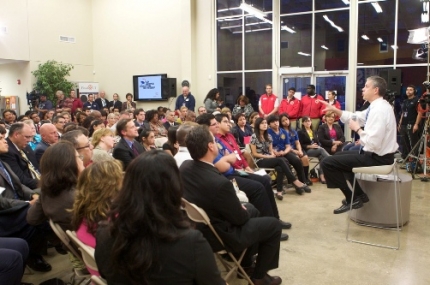
Secretary Duncan at Cafe College in San Antonio. Official Department of Education photo by Joshua Hoover. March 10, 2012.
Ed. Note: The following is a cross-post that originally appeared on the Department of Education blog.
“America’s economic success is inextricably linked with the success of the Hispanic community,” Secretary Duncan said last week in San Antonio. Duncan joined the White House Initiative on Educational Excellence for Hispanics for two events, including a town hall with San Antonio Mayor Julian Castro at Café College, San Antonio’s college access and resource center that encourages and helps students of all ages obtain a higher education.
Learn more about EducationBreaking the Cycle of Poverty, Microfinancing a Community
Posted by on March 15, 2012 at 11:55 AM EST
My work with the Social Entrepreneurs of Grinnell (SEG), a nonprofit located in Grinnell, IA, has taught me that passionate individuals have great capacity to create positive change in their communities. SEG practices microfinance: we provide access to capital in an innovative and empowering way so that people are able to reclaim financial agency. Originally conceived as a student group raising money for entrepreneurs in developing countries, SEG has since evolved to provide microfinance services to communities around the world and in the local Grinnell community.
We believe in the creative, entrepreneurial energy of all people, and that all people deserve the power to define their lives. In reality, many individuals lack access to capital and conventional banking services, and easily get caught in a cycle of poverty. Limited access to credit restricts options; if someone takes a payday loan or cash advance, they can be charged interest rates so high that it will be difficult for them to ever pay down the principle of the loan. These lenders justify charging high interest rates because they’re serving a constituency that is termed ‘high-risk,’ but these business relationships then become exploitative and demeaning in nature. SEG chooses to embody a different philosophy by offering small, zero-interest loans through our Emergency Loans Project. We believe that we can minimize our risk and maximize our social impact by forging partnerships with borrowers that are tailored to their individual needs and that empower rather than disenfranchise them.
Cultivating Tomorrow's Future Today: Sustainable Communities and Economies
Posted by on March 15, 2012 at 11:50 AM EST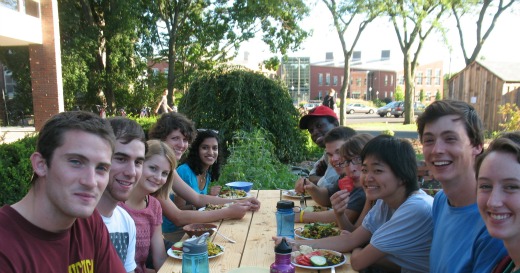
“Never doubt that a small group of thoughtful, committed citizens can change the world. Indeed, it is the only thing that ever has.”
This famous quote, by Margaret Mead, couldn’t be truer when it comes to the UMass Amherst Permaculture Committee. Before I go into detail about what we do, I want to describe permaculture as a concept.
Permaculture is a vision for creating a more sustainable world. It is a regenerative design science that involves people working together to build ecological and edible landscapes, which are just a small piece of the sustainable communities and economies that we must act now to create. It is based on thoughtful observation of the patterns and relationships found in nature.
The UMass Amherst Permaculture Initiative is a unique and cutting-edge campus sustainability program that transforms grass lawns and neglected landscapes into edible, educational and ecologically designed gardens. Our student group designs and implements these gardens, hosts events, organizes volunteers, and networks with surrounding communities and beyond. Together, we have created one of the first university permaculture initiatives in the nation that has involved over 1,000 individuals and 300 local youths from K-12 schools and Big Brothers Big Sisters Organization. By establishing new gardens each year, we demonstrate how permaculture can feed an exponentially growing population in an environmentally sustainable and socially responsible manner.
- &lsaquo previous
- …
- 153
- 154
- 155
- 156
- 157
- 158
- 159
- 160
- 161
- …
- next &rsaquo
Twitter