
Office of Science and Technology Policy Blog
Making at the White House: Creating Bo-Bot and Sunny-Bot
Posted by on December 12, 2014 at 5:40 PM ESTFor the past several years, Bo and Sunny, the First Family’s dogs, have been creatively included in the White House holiday décor. Last year’s decorations even included a 3D model of Bo with a wagging tail powered by a motor from a reindeer lawn decoration!
This year the White House enlisted Stephanie Santoso, Mark DeLoura, and Laura Gerhardt from the White House Office of Science and Technology Policy (OSTP) and David Naffis and Bosco So from the Presidential Innovation Fellows (PIF) program to feature Bo and Sunny in the holiday decorations as life-size, animated “dog-bots."
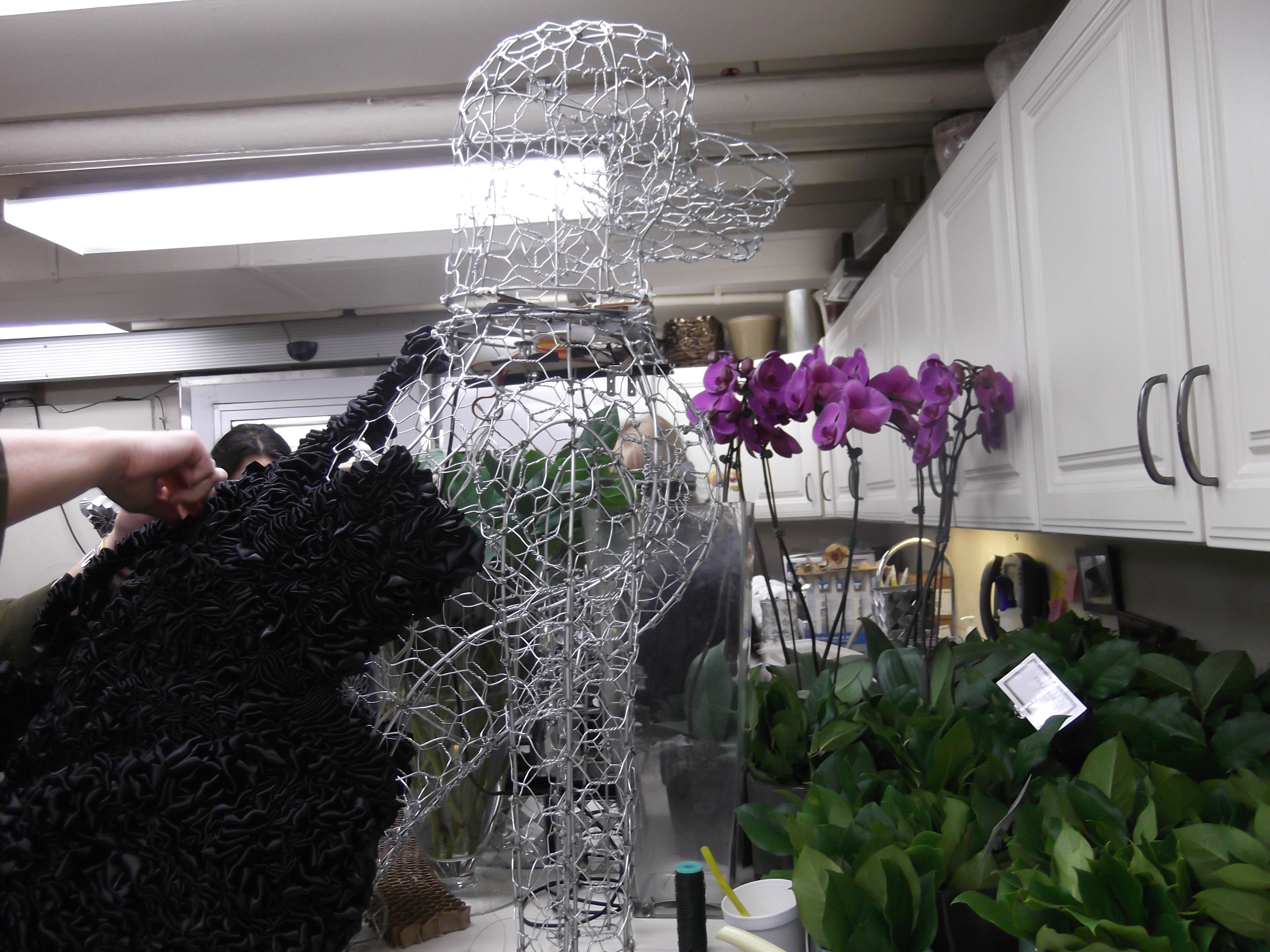
A volunteer applies ribbon “fur” onto Bo’s wire mesh frame.
Learn more aboutSTEM for Students on the Silver Screen
Posted by on December 12, 2014 at 9:48 AM ESTOn Wednesday evening, the White House welcomed dozens of eager middle-school, high-school and college students to a special Computer Science Heroes Film Festival that recognized outstanding women in Science, Technology, Engineering, and Mathematics (STEM).

U.S. CTO Megan Smith (second row, fourth from left) and other accomplished women in STEM joined students at a special Computer Science Heroes Film Festival at the White House.
The film festival was part of this week’s White House celebration of Computer Science Education Week, which is always held during the birthdays of computer science pioneers Navy Rear Admiral Grace Hopper and Lady Ada Lovelace. Through interviews and movie clips, the short film program and storytelling showcased the incredible stories of elite technical women, including the personal contributions of Rear Admiral Hopper and other extraordinary women in computer science.
The students learned about Katherine Johnson, an African-American NASA scientist who calculated flight trajectories for Alan Sheppard, John Glenn and the 1969 Apollo moon missions; renowned mathematician, computer scientist, and scholar Maria Klawe; and the story of the ENIAC Programmers. The students also watched the trailer for The Imitation Game -- a new film which chronicles the story of WWII Bletchley Park code breakers Alan Turning and Joan Clarke -- and saw a clip from David Letterman’s interview of Grace Hopper. Finally, the students had the chance to ask questions to astronaut Cady Coleman, computer programmer, Internet lawyer and founder of the ENIAC Programmers Project Kathy Kleiman, and U.S. CTO Megan Smith.

Astronaut Cady Coleman speaks at the film festival.
Too often, the success stories of women in STEM fields go untold, leaving young girls interested in these fields searching for role models. The Computer Science Heroes Film Festival was just one of the Administration’s many efforts and events intended to help draw attention to the important contributions women have made to STEM and inspire the next generation of female scientists, programmers, and engineers.
Learn more about the White House’s Women in STEM efforts here: http://obamawhitehouse.archives.gov/administration/eop/ostp/women
Lauren Smith is a Policy Advisor for the White House Office of Science and Technology Policy.
Neekta Hamidi is an Intern at the White House Office of Science and Technology Policy.
Learn more about Technology, WomenTalk With Me Baby! Increasing Early Learning Opportunities for Every Child in Georgia
Posted by on December 12, 2014 at 9:36 AM ESTAnd some states are proving that it’s possible to give every child that chance. For 16 years, every child in Oklahoma has been guaranteed a preschool education. Georgia’s building on their successful pre-K program by launching something called “Talk With Me Baby” – which sounds like an Al Green song, but is actually a program to make sure language learning begins in the very first weeks of a child’s life. Oklahoma and Georgia are not places where I did particularly well politically – but that just goes to show you that this issue is bigger than politics. It’s not a red issue or a blue issue. It’s about doing what’s best for our kids, and for our country, and that’s an American issue.
-President Obama, White House Early Learning Summit, December 10, 2014
This week, President Obama hosted the White House Summit on Early Childhood Education, where he highlighted new efforts to ensure that every child in America has access to high-quality preschool and rich early learning opportunities. The Summit brought together state and local policymakers, mayors, school superintendents, corporate and community leaders, and advocates, who together committed to $1 billion of support for the President’s Early Learning Agenda.
Back in September, the White House hosted a workshop in which we heard about exciting Federal, State, and Local efforts to “bridge the word gap” that develops between poor children and their more affluent peers during the first few years of life. For example, Too Small to Fail, in partnership with the George Kaiser Family Foundation, has launched a community-wide Talking is Teaching: Talk, Read, Sing campaign in Tulsa, Oklahoma with the help of their local faith-based, medical, and childcare communities. Working through trusted messengers such as pastors, home visitors, pediatricians, nurses, obstetricians and gynecologists, information and resources are being distributed to help Tulsa parents talk, read and sing to their young children to boost early brain and vocabulary development. Moreover, the State of Georgia has launched the Talk With Me Baby Initiative, which aims to provide language nutrition to every child in Georgia through the public health care system and has continued to grow in response to the President’s call-to-action to bridge the word gap.
I recently sat down with Arianne Weldon, Director of the Get Georgia Reading Campaign and member of the team guiding Talk With Me Baby, to hear more about her team’s work, new developments and future plans.
Learn more about EducationMaking Makers in Cleveland
Posted by on December 11, 2014 at 12:16 PM ESTOn June 17th, President Obama hosted the first ever White House Maker Faire, and called on people across the country to join him to spark creativity and invention in their communities. Responding to his call to action, 150 higher education institutions signed a letter committing to promote making on their campuses.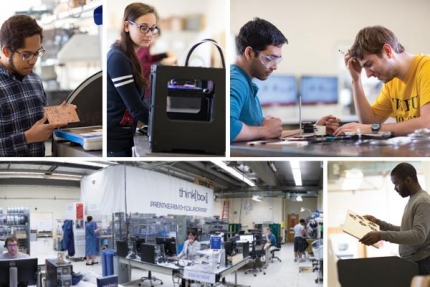
(Photo by Case Western Reserve University’s think[box])
Recently I spoke with Ian Charnas, who is the manager of Case Western Reserve University’s think[box]. Case Western is one of the universities that signed the letter, and think[box] is a makerspace and innovation center designed to provide students, staff, faculty and members of the public with the tools they need to create, build and invent.
What resources do students and other users of think[box] currently have access to?
Higher Education Institutions Respond to the President’s Call to Support Making on College Campuses
Posted by on December 10, 2014 at 3:10 PM ESTAt the White House Maker Faire last June, more than 150 universities committed to expanding opportunities for Making on their campuses and in their communities. The Maker Faire was one of several OSTP initiatives this year aimed at highlighting the importance of the Maker Movement in creating opportunities for hands-on STEM learning, facilitating entrepreneurship, and expanding advanced manufacturing in the United States. At that event, the President issued a call to action to enable the next generation of innovators to be not just the consumers of things, but the makers of things.
Today, OSTP Director John Holdren visited Spelman College’s innovation lab and Makerspace. Spelman is one example of the many colleges that are creating opportunities for Making in response to the President’s call. Spelman’s innovation lab is home to the Spelbots, an all-female robotics team that has competed in international robotics competitions and is currently building an autonomous Remotely Operated Vehicle (ROV) system.
As part of the visit to Spelman, Director Holdren discussed how a subset of higher education institutions have come together to form the Make Schools Alliance. This new initiative will provide students with spaces, projects and mentors to engage in hands-on Making activities and boost their interest and persistence in science, technology, engineering and math (STEM). The Alliance will capture best practices and support research that examines the impact of Making on learning, student retention, and degree completion in STEM fields. It will also serve as a network, dynamic platform, and one-stop online resource for information on higher education institutions regarding initiatives, programs and collaboration that foster Making. Currently, information on nearly 50 colleges and universities can be found on the Alliance’s online platform.
The Make Schools Alliance builds on a growing momentum in the higher education community to support Making. Earlier this month, members of the Alliance met with Federal agencies, including USAID, CNCS, SBA, NSF and USDA, in Washington, DC to explore potential avenues for broadening accessibility and participation in Making in communities across the country.
K-12 superintendents, teachers, and organizations across the U.S. have joined the higher education community in creating ways for students to design, tinker, invent, and Make in the classroom and after school. One example is the Roanoke County Public School District in Virginia, which has created Makerspaces for its special education students to solve problems by designing and creating their own solutions. A number of programs being offered by Makerspaces, museums, and educational organizations focus on providing professional development for teachers around integrating Making into curriculum and the use of tools and technologies such as programmable microcontrollers, 3D modeling and 3D printing.
Building an educational pipeline that will enable students to make throughout K-12 and continue to develop and pursue their interests in STEM, arts, and design in college will be critical to supporting the America’s next generation of problem solvers and innovators. If your educational institution is doing something to engage students in Making, we want to hear about it! Send an email to maker@ostp.gov.
Stephanie Santoso is the OSTP Senior Advisor for Making.
Learn more about Energy and Environment, TechnologyUnleashing Climate Data and Innovation for more Resilient Ecosystems
Posted by on December 9, 2014 at 9:35 AM ESTEcosystems provide vast services and benefits to humankind: food and water that is needed for survival; nutrients and other natural products that fuel farms and industries; natural controls on many pests and pathogens; storage of carbon safely out of the atmosphere; shared spaces for tourism and recreation; and sanctuaries that preserve biodiversity, natural beauty, and cultural history.
The EcoINFORMA map viewer available on data.gov/ecosystems enables visualizations and mashups of spatial data related to ecosystems, natural resources, and species.
The Third National Climate Assessment confirms that ecosystems and the benefits they provide to society are being affected by climate change. These changes are having impacts on biodiversity and limiting the capacity of ecosystems—including forests, barrier beaches, and wetlands— to continue to play their roles in reducing the impacts of extreme events on infrastructure, human communities, and other valued resources.
Land and water managers, environmental planners, and those who rely on ecosystems to support and run businesses need easy, intuitive access to the most accurate and relevant available information about climate change in order to make informed decisions on the ground.
Today, in an important milestone to help achieve this goal, the Department of Interior and other Executive Branch agencies and offices are releasing, on climate.data.gov, new troves of government data on water and ecosystems, as well as new geospatial tools, as part of the President’s Climate Data Initiative. Earlier installments of that initiative focused on data relating to sea-level rise, flood risk, and agriculture.
The newly released datasets—which include critical information about streamflow, soil, landcover, and biodiversity and are complemented by tools to overlay and visualize them—will be extremely valuable to natural-resource managers faced with day-to-day and long-term strategic decisions about how to operate in the context of climate change.
In a further step to make these data as useful as possible, today a host of public, nonprofit, and private-sector organizations made commitments to devote resources, expertise, and technological capabilities to leverage climate data in ways that make the Nation’s ecosystems and water resources more resilient to the impacts of climate change.
For example, Amazon Web Services (AWS) has committed to make a petabyte of Earth-imagery data from the U.S. Geological Survey widely available as an AWS public dataset; the University of Maryland’s Socio-Environmental Synthesis Center has committed to fund 25 early-career scholars as they conduct research at the nexus of water systems, food systems, and climate change; Esri will stand up a Water Open Data portal to extend accessibility of key water data through interactive services and tools by which selected data can be downloaded in various formats through an intuitive user interface; and HP has announced a partnership with the Camera Trap Data Network to create new data-sharing and analytic tools that allow users to access and analyze millions of camera-trap images and related data about threatened species and biodiversity.
- Read the full set of commitments launched today here.
- Read the Department of Interior's Press Release here.
- Read more about the President’s Climate Data Initiative here.
- Access climate.data.gov here.
Dr. John P. Holdren is Assistant to the President for Science and Technology and Director of the White House Office of Science & Technology Policy
Learn more about Energy and Environment
- &lsaquo previous
- …
- 17
- 18
- 19
- 20
- 21
- 22
- 23
- 24
- 25
- …
- next &rsaquo


White House Blogs
- The White House Blog
- Middle Class Task Force
- Council of Economic Advisers
- Council on Environmental Quality
- Council on Women and Girls
- Office of Intergovernmental Affairs
- Office of Management and Budget
- Office of Public Engagement
- Office of Science & Tech Policy
- Office of Urban Affairs
- Open Government
- Faith and Neighborhood Partnerships
- Social Innovation and Civic Participation
- US Trade Representative
- Office National Drug Control Policy
categories
- AIDS Policy
- Alaska
- Blueprint for an America Built to Last
- Budget
- Civil Rights
- Defense
- Disabilities
- Economy
- Education
- Energy and Environment
- Equal Pay
- Ethics
- Faith Based
- Fiscal Responsibility
- Foreign Policy
- Grab Bag
- Health Care
- Homeland Security
- Immigration
- Innovation Fellows
- Inside the White House
- Middle Class Security
- Open Government
- Poverty
- Rural
- Seniors and Social Security
- Service
- Social Innovation
- State of the Union
- Taxes
- Technology
- Urban Policy
- Veterans
- Violence Prevention
- White House Internships
- Women
- Working Families
- Additional Issues