Energy and Environment Latest News
The Smart Grid and You
Posted by on November 24, 2009 at 1:24 PM ESTToday, I announced a $620 million investment in the "Smart Grid" -- building on a $3.4 billion investment announced by President Obama last month as part of the Recovery Act. So what is a "Smart Grid?" How will it save your family money? Check out this video:
Viewing this video requires Adobe Flash Player 8 or higher. Download the free player.Steven Chu is Secretary of Energy
Learn more about Energy and EnvironmentWatch, Discuss, Engage at 10:00: Clean Energy Forum on Public Health
Posted by on November 20, 2009 at 9:27 AM ESTAt 10:00 AM EST today the White House, the Environmental Protection Agency, and the Department of Health and Human Services will host another Clean Energy Economy Forum. A group of stakeholders, business and community leaders will discuss clean energy and climate legislation work, and the benefits towards public health. HHS Secretary Kathleen Sebelius and EPA Administrator Lisa Jackson will be answering questions, including some taken live from our Facebook chat application.
Learn more about Energy and EnvironmentChair Sutley Visits Cornell Fuel Cell Institute and Energy Materials Center
Posted by on November 19, 2009 at 10:17 AM ESTLast weekend I had the opportunity to visit my alma mater, Cornell University, to speak at the annual Net Impact Conference. The conference brought together students and professionals from around the U.S. interested in sustainable enterprise and environmental stewardship, and allowed participants to share best practices and discuss new initiatives to advance global sustainability through entrepreneurship and innovation.
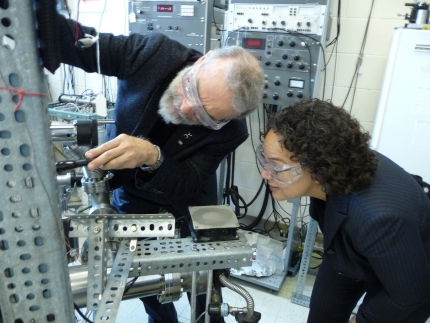
Dr. Hector Abruna shows Chair Sutley an ultra-high-vacuum chamber for coupled electrochemical and surface studies of single crystal electrocatalyst materials for fuel cells at the Cornell Fuel Cell Institute. November 14, 2009.
While at Cornell, I had the opportunity to check out the Cornell Fuel Cell Institute and the Energy Materials Center, a U.S. Department of Energy designated Energy Frontier Research Center. Héctor Abruña, the director of the Center presented some of their fascinating advances in fuel cell technology and told me about Cornell’s partnerships with major companies to develop efficient, high-performance batteries and fuel cells for industry and consumer products. These technologies have an amazing potential to revolutionize our transportation and energy sectors.
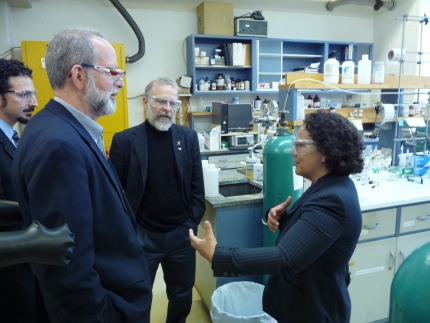
Chair Sutley speaks with Dr. Frank DiSalvo, Dr. Paul Mutolo, and Dr. Hector Abruna about the importance of research universities. November 14, 2009.
Needless to say, I really appreciated the opportunity to get a back-stage tour of the University’s fuel cell labs and enjoyed being back on campus. Research universities all over the U.S. are doing groundbreaking work in developing clean energy technology and training the next generation of scientists, engineers, and entrepreneurs.
Nancy Sutley is the Chair of the White House Council on Environmental Quality
Learn more about Energy and EnvironmentGreen Jobs Grants, Seizing the Opportunity of a Clean Energy Economy
Posted by on November 18, 2009 at 5:24 PM EST
Secretary Solis discusses “smart meter” technology during a visit to Nevada Energy in October.
Today the Department of Labor announced nearly $55 million in grants to help workers, many in underserved communities, find jobs in expanding green industries.
As a part of the American Recovery and Reinvestment Act of 2009, these grants reflect the administration’s long-term commitment to fostering both immediate economic growth and a clean energy future. It’s an investment that will help American workers do well, while doing good.
The recipients of today’s grants will strengthen the capacity to provide training opportunities, support the collection and dissemination of invaluable state labor market information, and most importantly, help individuals acquire green jobs.
Of the grants announced, $48.8 million focus on collecting and disseminating labor market information, which will enable job seekers to connect with green job banks and help to ensure that workers find employment after completing training. State workforce agencies will be able to work together as part of a consortium to collect information and create a regional, multi-state or national impact.
In addition, $5.8 million in grants have been awarded to increase the capacity of 62 current Labor Department grant recipients to provide training opportunities specifically focused on jobs in expanding green industries.
These grants aren’t just more money to the same players. They reflect my commitment, that of the Department of Labor and that of this administration to ensure that help finds those who need it most. Many of these training grants are targeted at traditionally underserved communities, including American Indians, women, at-risk youth, and farm workers.
As a result, programs like Apprenticeship and Nontraditional Employment for Women (ANEW) in Western Washington State will be able to provide training and certificate programs in green industries to women who are low-income, unemployed, at-risk youth, or our female veterans.
These investments are part of nearly $500 million in Recovery Act money for green jobs grants designed to promote economic growth. Over the next several months the Department of Labor will release funding for an additional three green grant award categories.
I encourage you all to visit www.doleta.gov for information on the recipients of the current grants as well as information about upcoming grant opportunities.
It is time for America to seize the opportunity of a clean energy economy, and American workers must lead this green revolution. That is why we are investing these dollars here at home in American jobs and American innovation. By making strategic choices now, we will restore our country’s role as a global leader in the clean energy industry.
Hilda Solis is the Secretary of Labor
Learn more about Energy and EnvironmentPursuing Economic Growth and Opportunity
Posted by on November 18, 2009 at 5:00 PM ESTToday we concluded a weeklong trip to Asia. In our closing meeting with President Obama and Chinese Premier Wen, leaders of our two countries reiterated their commitments to renew old alliances and forge new partnerships.
Throughout the past week, we have made strides toward our goal of strengthening U.S. leadership and economic competitiveness in the region and making progress on issues that matter to the American people and leveraging that progress into job creation at home.
From a trade perspective, the steps we’ve taken in Asia will benefit businesses and workers across the American economy – ranchers, farmers, manufacturers, and creative industries all have a future in U.S. trade with Asia.
As companies across the spectrum look for a way forward out of these difficult economic times, we’re asking them to take a second look at trade. Because engaging new customers abroad can create jobs at home.
President Obama began his trip to Asia by making an announcement in Tokyo that the United States will engage with the Trans-Pacific Partnership. This will be done in close consultation with the United States Congress and with stakeholders at home. This is an exciting opportunity for the United States to engage with some of the fastest growing economies in the world as well as providing the opportunity to address gaps in our current agreements, and to set the standard for 21st-century trade agreements going forward.
The US and China: Towards a Clean Energy Economy
Posted by on November 17, 2009 at 2:13 PM ESTAfter a warm welcome in Beijing's historic Great Hall of the People, President Obama and President Hu sat down to discuss the many overlapping issues facing both nations, including China's growing economy and its effect on the US and the rest of the world and the exciting education reforms happening in each country:
PRESIDENT OBAMA: As we both affirmed, the United States and China have a great many mutual interests. And after 30 years of bilateral relations, I think it's fair to say that our two governments have continued to move forward in a way that can bring even greater cooperation in the future.And I want to reaffirm the fact that the American people are interested in stronger relations with the people of China, and that the more that we can encourage people-to-people exchanges that are consistent with the discussions that we're having at the government level, the more that China and the United States will be able to work cooperatively on a whole range of issues -- both economic issues, security issues, and global issues that are in the interest not just of our two nations but the entire world.
President Barack Obama and Chinese President Hu Jintao speak during a joint press conference held at the Great Hall of the People in Beijing, China, Nov 17, 2009. (Official White House Photo by Lawrence Jackson) November 17, 2009. (Official White House Photo by Lawrence Jackson)
One topic of particular interest to both leaders is a joint initiative towards clean energy, and President Obama and President Hu introduced a far-reaching package of measures to strengthen cooperation between the United States and China on clean energy. An abridged version of the measures is below, and the full version is available here:
The U.S.-China Clean Energy Research Center will facilitate joint research and development of clean energy technologies by teams of scientists and engineers from the United States and China, as well as serve as a clearinghouse to help researchers in each country.
The U.S.-China Electric Vehicles Initiative will include joint standards development, demonstration projects in more than a dozen cities, technical roadmapping and public education projects, all aimed at eventual deployment of electric vehicles to reduce oil dependence.
The U.S. China Energy Efficiency Action Plan will allow the two countries to work together to improve the energy efficiency of buildings, industrial facilities, and consumer appliances, culminating with an annual U.S.-China Energy Efficiency Forum, rotating between the two countries.
The U.S. China Renewable Energy Partnership will facilitate development of roadmaps for wide-spread renewable energy deployment. A new Advanced Grid Working Group made up of American and Chinese developers and strategists will help plan for grid modernization in both countries, and a new U.S.-China Renewable Energy Forum will be held annually, rotating between the two countries.
A 21st Century Coal Initiative, for which the two Presidents pledged to promote cooperation on cleaner uses of coal, will include large-scale carbon capture and storage (CCS) demonstration projects.
A Shale Gas Initiative, will allow the U.S. and China to use experience gained in the United States to assess China’s shale gas potential, promote environmentally-sustainable development of shale gas resources, conduct joint technical studies to accelerate development of shale gas resources in China, and promote shale gas investment in China through the U.S.-China Oil and Gas Industry Forum, study tours, and workshops.
The U.S. China Energy Cooperation Program will leverage private sector resources for project development work in China across a broad array of clean energy projects, to the benefit of both nations.
Read more about the President's historic 10-day trip to Asia here.

President Barack Obama and President Hu Jintao together at a reception before the formal state dinner at Great Hall of the People in Beijing, China on Nov. 17, 2009. (Official White House photo by Pete Souza) November 17, 2009. (Official White House Photo by Pete Souza)
Learn more about , Energy and Environment, Foreign Policy
- &lsaquo previous
- …
- 187
- 188
- 189
- 190
- 191
- 192
- 193
- 194
- 195
- …
- next &rsaquo
Related Videos
-
 May 09, 2014 8:21 AM
Inside the White House: Solar Panels
-
 September 01, 2016 8:25 PM
President Obama Delivers a Statement to the Press
White House Blogs
- The White House Blog
- Middle Class Task Force
- Council of Economic Advisers
- Council on Environmental Quality
- Council on Women and Girls
- Office of Intergovernmental Affairs
- Office of Management and Budget
- Office of Public Engagement
- Office of Science & Tech Policy
- Office of Urban Affairs
- Open Government
- Faith and Neighborhood Partnerships
- Social Innovation and Civic Participation
- US Trade Representative
- Office National Drug Control Policy